

SIST-TP CEN/TR 12349:2023
(Main)Mechanical vibration - Guide to the health effects of vibration on the human body
General Information
- Abstract
The aim of this document is to provide information on the possible adverse health effects caused by exposure to vibration at work. The report addresses manufacturers, companies which introduce machinery on the EU market as well as employers and employees using vibrating machinery in order to improve their understanding of the possible health problems arising from occupational exposure to vibration.
This document is limited to the effects on health and does not cover the potential effects of vibration on comfort, human performance, or vibration perception. Most of the information on whole-body vibration in this document is based upon data available from research on human response to vibration of seated persons. There are only few data on the effects of vibration on persons in standing, reclining or recumbent positions.
The information on both hand-transmitted vibration and whole-body vibration is based upon data from laboratory research on acute effects as well as upon data from epidemiologic field-studies at workplaces.
Additional information can be obtained from the scientific literature.
- Status
- Published
- Publication Date
- 24-Aug-2023
- Technical Committee
- I13 - Imaginarni 13
- Current Stage
- 6060 - National Implementation/Publication (Adopted Project)
- Start Date
- 09-Aug-2023
- Due Date
- 14-Oct-2023
- Completion Date
- 25-Aug-2023

Overview
CEN/TR 12349:2023 - Mechanical vibration: Guide to the health effects of vibration on the human body - is a CEN technical report that summarizes current knowledge about adverse health effects of occupational vibration. Approved July 2023, it updates the 1996 report and is intended as an informative resource (not a normative standard) for manufacturers, employers, workers and occupational health professionals across the EU. The document focuses on hand‑transmitted vibration (HAV) and whole‑body vibration (WBV) and provides background for implementing preventive measures and complying with the EU Vibration Directive (2002/44/EC).
Key topics
- Scope and purpose: Describes occupational health effects from vibration and targets machinery manufacturers, market introducers, employers and employees.
- Hand‑transmitted vibration (HAV):
- Health outcomes: vascular (vibration‑induced white finger / Raynaud’s phenomenon), neurological (numbness, reduced tactile discrimination), and musculoskeletal disorders.
- Epidemiology: prevalence varies widely; estimated 1.7–3.6% of EU workers exposed to potentially harmful HAV.
- Diagnostic approaches: cold‑provocation tests and measurement of finger skin temperature or digital blood flow (see ISO 14835‑1/2 references in the report).
- Clinical staging: Stockholm Workshop scales for vascular and sensorineural components (also referenced in EN ISO 5349‑1:2001).
- Whole‑body vibration (WBV):
- Main concerns: low‑back pain and related disorders, foot‑transmitted vibration and other systemic effects.
- Notes limitation: most WBV data are from seated subjects; limited evidence for standing or recumbent positions.
- Prevention and guidance: Informative Annex A presents approaches for risk reduction (engineering, organisational, personal protective measures).
- Glossary and bibliography: Annex B and references to scientific literature for deeper study.
Practical applications - who uses it and why
- Manufacturers & machine designers: to understand health risks associated with tools and vehicles and to inform design choices reducing vibration exposure.
- Employers & occupational safety teams: for risk assessment, selection of lower‑vibration tools, work‑rotation and exposure control, and planning medical surveillance.
- Health professionals & ergonomists: to interpret epidemiologic evidence, apply staging systems, and advise on diagnostic tests and prevention.
- Regulators & compliance officers: as background material supporting implementation of the EU Vibration Directive and related workplace limits/actions.
Related standards and references
- EN ISO 5349‑1:2001 (Stockholm Workshop scales cited)
- ISO 14835‑1 / ISO 14835‑2 (cold provocation tests and measurement methods)
- EU Vibration Directive 2002/44/EC
For implementation details or to obtain the full text, consult your national standards body or the CEN website.
Relations
- Effective Date
- 19-Jan-2023
Get Certified
Connect with accredited certification bodies for this standard

CIS Institut d.o.o.
Personal Protective Equipment (PPE) certification body. Notified Body NB-2890 for EU Regulation 2016/425 PPE.

Kiwa BDA Testing
Building and construction product certification.
Kmetijski inštitut Slovenije
Agricultural Institute of Slovenia. Soil testing, plant health, agricultural product analysis.
Sponsored listings
Frequently Asked Questions
SIST-TP CEN/TR 12349:2023 is a technical report published by the Slovenian Institute for Standardization (SIST). Its full title is "Mechanical vibration - Guide to the health effects of vibration on the human body". This standard covers: The aim of this document is to provide information on the possible adverse health effects caused by exposure to vibration at work. The report addresses manufacturers, companies which introduce machinery on the EU market as well as employers and employees using vibrating machinery in order to improve their understanding of the possible health problems arising from occupational exposure to vibration. This document is limited to the effects on health and does not cover the potential effects of vibration on comfort, human performance, or vibration perception. Most of the information on whole-body vibration in this document is based upon data available from research on human response to vibration of seated persons. There are only few data on the effects of vibration on persons in standing, reclining or recumbent positions. The information on both hand-transmitted vibration and whole-body vibration is based upon data from laboratory research on acute effects as well as upon data from epidemiologic field-studies at workplaces. Additional information can be obtained from the scientific literature.
The aim of this document is to provide information on the possible adverse health effects caused by exposure to vibration at work. The report addresses manufacturers, companies which introduce machinery on the EU market as well as employers and employees using vibrating machinery in order to improve their understanding of the possible health problems arising from occupational exposure to vibration. This document is limited to the effects on health and does not cover the potential effects of vibration on comfort, human performance, or vibration perception. Most of the information on whole-body vibration in this document is based upon data available from research on human response to vibration of seated persons. There are only few data on the effects of vibration on persons in standing, reclining or recumbent positions. The information on both hand-transmitted vibration and whole-body vibration is based upon data from laboratory research on acute effects as well as upon data from epidemiologic field-studies at workplaces. Additional information can be obtained from the scientific literature.
SIST-TP CEN/TR 12349:2023 is classified under the following ICS (International Classification for Standards) categories: 13.160 - Vibration and shock with respect to human beings. The ICS classification helps identify the subject area and facilitates finding related standards.
SIST-TP CEN/TR 12349:2023 has the following relationships with other standards: It is inter standard links to SIST CR 12349:2000. Understanding these relationships helps ensure you are using the most current and applicable version of the standard.
SIST-TP CEN/TR 12349:2023 is available in PDF format for immediate download after purchase. The document can be added to your cart and obtained through the secure checkout process. Digital delivery ensures instant access to the complete standard document.
Standards Content (Sample)
SLOVENSKI STANDARD
01-oktober-2023
Mehanske vibracije - Vodilo o vplivu vibracij na zdravje človeškega telesa
Mechanical vibration - Guide to the health effects of vibration on the human body
Mechanische Schwingungen - Leitfaden über die Wirkung von Schwingungen auf die
Gesundheit des Menschen
Vibrations mécaniques - Guide concernant les effets des vibrations sur la santé du corps
humain
Ta slovenski standard je istoveten z: CEN/TR 12349:2023
ICS:
13.160 Vpliv vibracij in udarcev na Vibration and shock with
ljudi respect to human beings
2003-01.Slovenski inštitut za standardizacijo. Razmnoževanje celote ali delov tega standarda ni dovoljeno.
CEN/TR 12349
TECHNICAL REPORT
RAPPORT TECHNIQUE
August 2023
TECHNISCHER REPORT
ICS 13.160 Supersedes CR 12349:1996
English Version
Mechanical vibration - Guide to the health effects of
vibration on the human body
Vibrations mécaniques - Guide concernant les effets Mechanische Schwingungen - Leitfaden über die
des vibrations sur la santé du corps humain Wirkung von Schwingungen auf die Gesundheit des
Menschen
This Technical Report was approved by CEN on 9 July 2023. It has been drawn up by the Technical Committee CEN/TC 231.
CEN members are the national standards bodies of Austria, Belgium, Bulgaria, Croatia, Cyprus, Czech Republic, Denmark, Estonia,
Finland, France, Germany, Greece, Hungary, Iceland, Ireland, Italy, Latvia, Lithuania, Luxembourg, Malta, Netherlands, Norway,
Poland, Portugal, Republic of North Macedonia, Romania, Serbia, Slovakia, Slovenia, Spain, Sweden, Switzerland, Türkiye and
United Kingdom.
EUROPEAN COMMITTEE FOR STANDARDIZATION
COMITÉ EUROPÉEN DE NORMALISATION
EUROPÄISCHES KOMITEE FÜR NORMUNG
CEN-CENELEC Management Centre: Rue de la Science 23, B-1040 Brussels
© 2023 CEN All rights of exploitation in any form and by any means reserved Ref. No. CEN/TR 12349:2023 E
worldwide for CEN national Members.
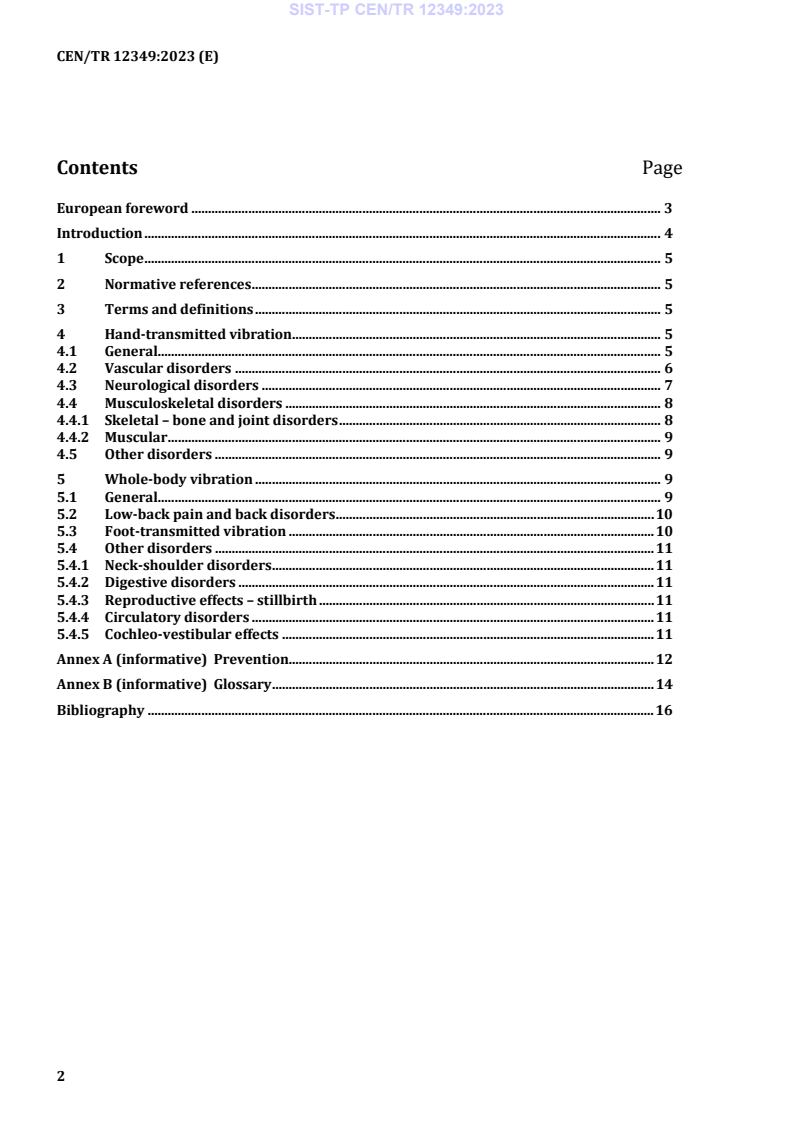
Contents Page
European foreword . 3
Introduction . 4
1 Scope . 5
2 Normative references . 5
3 Terms and definitions . 5
4 Hand-transmitted vibration. 5
4.1 General. 5
4.2 Vascular disorders . 6
4.3 Neurological disorders . 7
4.4 Musculoskeletal disorders . 8
4.4.1 Skeletal – bone and joint disorders . 8
4.4.2 Muscular . 9
4.5 Other disorders . 9
5 Whole-body vibration . 9
5.1 General. 9
5.2 Low-back pain and back disorders . 10
5.3 Foot-transmitted vibration . 10
5.4 Other disorders . 11
5.4.1 Neck-shoulder disorders . 11
5.4.2 Digestive disorders . 11
5.4.3 Reproductive effects – stillbirth . 11
5.4.4 Circulatory disorders . 11
5.4.5 Cochleo-vestibular effects . 11
Annex A (informative) Prevention. 12
Annex B (informative) Glossary . 14
Bibliography . 16
European foreword
This document (CEN/TR 12349:2023) has been prepared by Technical Committee CEN/TC 231
“Mechanical vibration and shock”, the secretariat of which is held by DIN.
Attention is drawn to the possibility that some of the elements of this document may be the subject of
patent rights. CEN shall not be held responsible for identifying any or all such patent rights.
This document supersedes CR 12349:1996.
The main changes compared to the previous edition are as follows:
• general information about foot transmitted vibration included;
• subclauses on “Prevention” moved to new informative Annex A;
• glossary moved to Annex B;
• editorial revision to comply with CEN Internal Regulations.
Any feedback and questions on this document should be directed to the users’ national standards body.
A complete listing of these bodies can be found on the CEN website.
Introduction
This document is an update of the 1st version from 1996 and it provides a short overview of the
knowledge of the possible effects of vibration on the human body at work. It is an informative document
which presents general background information for the user of the different European Standards on
vibration. Information about existing approaches for prevention is provided in the informative Annex A.
A glossary with important terms is listed in Annex B.
Mechanical vibration arises from a wide variety of processes and operations performed in industry, craft,
forestry and agriculture, and public utilities. Vibrations are mainly caused by powered processes, hand-
held and hand-guided tools, workpieces, or by vehicles. Occupational exposure to vibration can lead to
health risks including occupational diseases. Exposure to harmful vibration can induce several
complaints and health disorders, mainly at the upper limbs and the lower back. A comprehensive
knowledge of effects of vibration on the body with risks for safety and health at work is essential to
implement appropriate technical, administrative/organisational, personal protective measures and
medical preventive measures.
This knowledge forms the basis for the EU Vibration Directive 2002/44/EC, its national implementation
at EU Member States and the continuous updating of this regulatory framework by new scientific
knowledge including the technical and medical guides to avoid or minimize occupational risks by
vibration exposure at work.
1 Scope
The aim of this document is to provide information on the possible adverse health effects caused by
exposure to vibration at work. The report addresses manufacturers, companies which introduce
machinery on the EU market as well as employers and employees using vibrating machinery in order to
improve their understanding of the possible health problems arising from occupational exposure to
vibration.
This document is limited to the effects on health and does not cover the potential effects of vibration on
comfort, human performance, or vibration perception. Most of the information on whole-body vibration
in this document is based upon data available from research on human response to vibration of seated
persons. There are only few data on the effects of vibration on persons in standing, reclining or recumbent
positions.
The information on both hand-transmitted vibration and whole-body vibration is based upon data from
laboratory research on acute effects as well as upon data from epidemiologic field-studies at workplaces.
Additional information can be obtained from the scientific literature.
2 Normative references
There are no normative references in this document.
3 Terms and definitions
No terms and definitions are listed in this document.
ISO and IEC maintain terminological databases for use in standardization at the following addresses:
• ISO Online browsing platform: available at https://www.iso.org/obp
• IEC Electropedia: available at https://www.electropedia.org/
4 Hand-transmitted vibration
4.1 General
Powered processes and tools which expose operators’ hands to vibration are widespread in several
industrial and craft activities. Occupational exposure to hand-transmitted vibration can arise from
rotating and percussive hand-held power tools used in the manufacturing industry, craft, quarrying,
mining and construction, forestry and agriculture, and public utilities. Exposure to hand-transmitted
vibration can also occur from vibrating workpieces held in the hands of the operator, and from hand-held
vibrating controls such as motorcycle bars or vehicle steering wheels.
It has been estimated that 1,7 % to 3,6 % of the workers in the European countries are exposed to
potentially harmful hand-transmitted vibration.
The term hand-arm vibration (HAV) syndrome is commonly used to refer to the complex of peripheral
vascular, neurological and musculoskeletal disorders associated with exposure to hand-transmitted
vibration. Workers exposed to hand-transmitted vibration can be affected with neurological and/or
vascular disorders separately or simultaneously. Excessive exposure to hand-transmitted vibration can
include disturbances in finger blood flow, and in neurological and locomotor functions of the hand and
arm. Vascular disorders and bone and joints abnormalities caused by hand-transmitted vibration are
compensated occupational diseases in several countries. These disorders are also included in a European
schedule of recognized occupational diseases.
The vibration related diseases as listed at the European schedule of occupational diseases.
This is the background for the exposure action and limit values given in the EU Directive Vibration
connected with corresponding mandatory preventive measures.
4.2 Vascular disorders
Workers exposed to hand-transmitted vibration can complain of episodes of pale or white finger usually
triggered by cold exposure. This disorder, due to temporary abolition of blood circulation to the fingers,
is called Raynaud’s phenomenon (after Maurice Raynaud, a French physician who first described it in
1862). It is believed that vibration can disturb the digital circulation making it more sensitive to the
vasoconstrictive action of cold.
To explain cold-induced Raynaud’s phenomenon in vibration-exposed workers, some investigators
invoke an exaggerated central vasoconstrictor reflex caused by prolonged exposure to harmful vibration,
while others tend to emphasize the role of vibration-induced local changes in the digital vessels.
Various synonyms have been used to describe vibration-induced vascular disorders: dead or white finger,
Raynaud’s phenomenon of occupational origin, traumatic vasospastic disease, and, more recently,
vibration-induced white finger (VWF). VWF is a prescribed disease in many countries.
Initially attacks of blanching involve the tips at one or more fingers, but, with continued exposure to
vibration, the blanching can extend to the base of the fingers. Sometimes, an attack of blanching is
followed by cyanosis, i.e. a bluish discoloration of the affected fingers due to increased extraction of
oxygen from the sluggish digital circulation. In the recovery phase, commonly accelerated by warmth or
local massage, redness, eventually associated with pain, can appear in the affected fingers as a result of a
reactive increase of blood flow in the cutaneous vessels. The blanching attacks are more common in
winter than in summer and last from a few minutes to more than one hour. The duration varies with the
intensity of the triggering stimuli, the attack is usually ending when the entire body is warmed.
If vibration exposure continues, the blanching attacks become more frequent and can occur all year
around. In rare advanced cases, repeated and severe finger blanching attacks can lead to trophic changes
(ulceration or gangrene) in the skin of the fingertips. During the attack the affected workers can
experience a complete loss of touch sensation and manipulative dexterity, which can interfere with work
activity increasing the risk for acute injuries due to accidents. In occupational medicine various staging
systems for the classification of VWF have been developed. A grading scale proposed at the Stockholm
Workshop 86 is reported in Table 1. This scale is also included in EN ISO 5349-1:2001, Annex B.
Table 1 — The Stockholm Workshop scale for staging cold-induced Raynaud’s phenomenon in
the hand-arm vibration syndrome
Stage Grade Symptoms
0 — No attacks
1 Mild Occasional attacks affecting only the tips of one or more fingers
v
Occasional attacks affecting distal and middle (rarely also proximal)
2 Moderate
v
phalanges of one or more fingers
3 Severe Frequent attacks affecting all phalanges of most fingers
v
4 Very severe As in stage 3, with trophic skin changes in the fingertips
v
Key:
v vascular component
Several laboratory tests are used to diagnose white finger objectively. Most of these tests are based on
cold provocation and the measurement of finger skin temperature or digital blood flow and pressure
before, during and after cooling of the fingers and hands (see ISO 14835-1 and ISO 14835-2).
Epidemiologic studies have demonstrated that the prevalence of VWF varies widely, from 0 % to 100 %.
It appears that the probability and severity of white finger symptoms is influenced by several factors such
as
• the characteristics of vibration exposure (frequency, magnitude, direction, impulsiveness, duration),
• the type of tool and work process,
• the environmental conditions (temperature, air flow, humidity, noise),
• some biodynamic and ergonomic factors (grip force, push force, arm position), and
• various individual characteristics (susceptibility, diseases and agents, e.g. smoking and certain
medicines, affecting the peripheral circulation).
Thus, there is a complex relationship between vibration exposure and the development of white finger
symptoms. Epidemiologic studies have shown that the occurrence of VWF increases with increasing
duration of vibration exposure. There is some evidence that the cumulative exposure before the
appearance of finger blanching is approximately inversely proportional to the magnitude of the vibration
exposure (i.e. if the vibration magnitudes are doubled, a halving of the years of exposure is necessary to
produce the same effect).
Since the late 1970s a decrease in the incidence of VWF has been reported among active forestry workers
in both Europe and Japan after the introduction of anti-vibration chain saws and administrative measures
curtailing the saw usage time together with endeavours to reduce exposure to other harmful work
environment (e.g. cold, and physical stress). Recovery from VWF has also been reported among retired
forestry workers. Similar findings are not yet available for tools of other type.
4.3 Neurological disorders
Workers exposed to hand-transmitted vibration can experience tingling and numbness in their fingers
and hands. If vibration exposure continues, these symptoms tend to worsen and can interfere with work
capacity and life activities. Vibration-exposed workers can exhibit a reduction in the normal sense of
touch and temperature as well as an impairment of manual dexterity at the clinical examination. As an
effect of hand-transmitted vibration, also a reduction of the vibration sensitivity of the skin of the
fingertips can be found. Epidemiologic surveys of vibration-exposed workers show that the prevalence
of peripheral neurological disorders varies from a few percent to more than 80 %, and that sensory loss
affects users of a wide range of tool type. It seems that sensorineural disturbances can develop
independently of other vibration-induced disorders, probably reflecting different pathological
mechanisms.
A classification for the neurological component of the HAV syndrome was proposed at the Stockholm
Workshop 86, consisting of three stages according to the symptoms complained and the results of clinical
neurological examination and psychophysical testing methods such as tactile discrimination, vibrotactile
perception, and precision manipulation (see Table 2). This scale is also included in EN ISO 5349-1:2001,
Annex B.
Table 2 — Sensorineural stages of the hand-arm vibration syndrome according to the Stockholm
Workshop scale
Stage Signs and symptoms
0 Exposed to vibration but no symptoms
SN
1 Intermittent numbness, with or without tingling
SN
2 Intermittent or persistent numbness, reduced sensory perception
SN
Intermittent or persistent numbness, reduced tactile discrimination and/or manipulative
SN
dexterity
Key:
SN sensorineural component
Vibration-exposed workers can sometimes show signs and symptoms of entrapment neuropathies, such
as carpal tunnel syndrome (CTS), a disorder due to compression of the median nerve as it passes through
an anatomical tunnel in the wrist. CTS seems to be a common disorder in some occupational groups using
vibrating tools such as rock-drillers, platers and forestry workers. It is believed that ergonomic stressors
acting on the hand and wrist (repetitive movements, forceful gripping, awkward postures), in
combination with vibration can cause CTS in workers handling vibrating tools. CTS is acknowledged by
most of the EU Member States as occupational disease.
4.4 Musculoskeletal disorders
4.4.1 Skeletal – bone and joint disorders
Vibration-induced bone and joint disorders are a controversial matter:
a) Early radiological investigations revealed a high prevalence of bone vacuoles and cysts in the hands
and wrists of vibration-exposed workers, other studies have shown no significant increase with
respect to manual workers not exposed to vibration.
b) Excess occurrence of wrist and elbow osteoarthrosis as well as ossifications at the sites of tendon
insertion, mostly at the elbow, have been found in miners, road construction workers and metal-
working operators exposed to shock and low-frequency vibration (<50 Hz) of high magnitude from
pneumatic percussive tools.
c) An excess prevalence of Kienböck’s disease (lunate malacia) and pseudoarthrosis of the scaphoid
bone in the wrist has also been reported by a few investigators.
An increased prevalence of degenerative bone and joint disorders in the upper limbs of workers exposed
to mid- or high-frequency vibration arising from chain saws or grinding operation. Heavy physical effort,
forceful gripping and various biomechanical factors can also account for the higher occurrence of skeletal
injuries found in workers operating percussive tools. Local pain, swelling, and joint stiffness and
deformities can be associated with radiological findings of bone and joint degeneration.
In some countries (e.g. France, Germany, Italy), bone and joint disorders occurring in workers using hand-
held vibrating tools are considered to be an occupational disease and the affected workers are
compensated.
4.4.2 Muscular
For workers with prolonged exposure to vibration muscular weakness, pain in the hands, arms and
shoulders, and diminished muscle force are known. Vibration exposure has also been found to be
associated with a reduction of hand-grip strength. In some individuals muscle fatigue can cause disability.
Direct mechanical injury or peripheral nerve damage have been suggested as possible aetiological factors
for muscle symptoms. Other work-related disorders have been reported in vibration-exposed workers,
such as tendinitis and tenosynovitis (i.e. inflammation of tendons and their sheaths) in the upper limbs,
and Dupuytren’s contracture, a disease of the fascial tissues of the palm of the hand. These disorders seem
to be related to ergonomic stress factors arising from heavy manual work, and the association with hand-
transmitted vibration is not completely known.
4.5 Other disorders
Some studies indicate that in workers affected with VWF, hearing loss is greater than that expected on
the basis of ageing and noise exposure from vibrating tools. It has been suggested that VWF subjects can
have an additional risk of hearing impairment due to vibration-induced vasoconstriction of the blood
vessels supplying the inner ear.
In addition to peripheral disorders, other adverse health effects involving the endocrine and central
nervous system of vibration-exposed workers have been reported by Russian and Japanese investigators.
The clinical picture, called “vibration disease”, includes signs and symptoms related to dysfunction of the
higher centres of the brain (e.g. persistent fatigue, headache, irritability, sleep disturbances, impotence,
electroencephalographic abnormalities). These findings can only be interpreted with caution and further
carefully designed epidemiologic and clinical research work is needed to confirm the hypothesis of an
association between disorders of the central nervous system and exposure to hand-transmitted
vibration.
5 Whole-body vibration
5.1 General
The mechanical vibration transmitted by the seat or by the feet in vehicles (land,
...