

SIST EN 16732:2025
(Main)Slide fasteners (zips) - Specification
General Information
- Abstract
This document specifies performance levels and test methods for the following characteristics of slide fasteners made from interlocking components mounted on tapes: strengths of puller attachment, closed-end slide fastener bottom stop, top stop, open-end slide fastener box, reciprocating mechanism, closed slide fastener when extended laterally, open-end attachment when extended laterally, slider locking device, and open-end slide fastener single stringer slider retention and slider resistance to torque.
NOTE The tests specified in Annexes B to K have been specifically devised to permit their direct application to finished slide fasteners with a view to giving the user reasonable assurance that a slide fastener conforming to the requirements of this document can satisfactorily fulfil its intended purpose. Annex L gives information about sampling procedures for bulk quantities of slide fasteners.
In addition, performance levels are also specified for colour fastness to washing, dry cleaning and water, and for dimensional stability to washing and dry cleaning.
This document is applicable to all different types of slide fasteners for general use and is not applicable to slide fasteners for specialist purposes (for example: pressure sealed slide fasteners for diving suits).
- Status
- Published
- Public Enquiry End Date
- 23-Apr-2024
- Publication Date
- 14-May-2025
- Technical Committee
- ITEK - Textile and textile products
- Current Stage
- 6060 - National Implementation/Publication (Adopted Project)
- Start Date
- 08-May-2025
- Due Date
- 13-Jul-2025
- Completion Date
- 15-May-2025


Overview
EN 16732:2025 - Slide fasteners (zips) - Specification is the CEN standard that defines performance levels and test methods for slide fasteners (zips) used in general-purpose garments and textile products. It covers finished slide fasteners made from interlocking elements mounted on tapes (metallic, moulded plastic or monofilament construction) and specifies tests that give users reasonable assurance that a zip will perform as intended. This edition (2025) supersedes EN 16732:2015 and includes updated definitions, revised performance codes, expanded reporting and new annexes.
Key topics and technical requirements
- Performance characteristics and tests (normative Annexes B–K):
- Strength of puller attachment
- Strength of closed-end bottom stop and top stops
- Strength of open-end box and open-end attachment
- Resistance to reciprocation (slider wear and movement)
- Lateral strength (chain and attachment under lateral load)
- Slider locking device strength and single-stringer slider retention
- Slider resistance to torque
- Colour fastness and dimensional stability:
- Performance levels for colour fastness to washing, dry cleaning and water
- Dimensional stability to washing and dry cleaning
- Sampling and labelling guidance:
- Annex L: sampling procedures for bulk quantities
- Annex M: end-use and performance codes for labelling
- New Annex N: reciprocation test for shorter lengths (75–200 mm)
- Conditioning, measurements and test reporting: standardised conditioning (EN ISO 139), measurement methods and mandatory elements for test reports.
Practical applications and users
EN 16732:2025 is intended for:
- Zip manufacturers - to design and validate products to defined performance codes.
- Textile and garment manufacturers - selecting appropriate slide fasteners for apparel, outerwear, children’s clothes and accessories.
- Quality control and test laboratories - performing standardised mechanical, colourfastness and dimensional tests.
- Product specifiers and compliance teams - ensuring component durability, safety and labelling consistency.
- Purchasing and sourcing departments - verifying bulk shipments via Annex L sampling procedures.
This standard helps reduce field failures (slider breakage, tape distortion, colour bleeding) and supports specification of zips for target end-uses (including child sizing definitions included in the standard).
Related standards
EN 16732:2025 references several textile test standards, including:
- EN 20105‑A02, EN ISO 105‑A03, EN ISO 105‑C06, EN ISO 105‑D01, EN ISO 105‑E01 (colour fastness tests)
- EN ISO 139 (conditioning)
- EN ISO 3175‑2 (drycleaning)
- EN ISO 5077, EN ISO 6330 (dimensional change and washing procedures)
Keywords: EN 16732:2025, slide fasteners, zips specification, zip testing, slider locking device, colour fastness, dimensional stability, CEN standard.
Relations
- Effective Date
- 28-Jan-2026
- Effective Date
- 28-Jan-2026
- Refers
SIST EN ISO 139:2005 - Textiles - Standard atmospheres for conditioning and testing (ISO 139:2005) - Effective Date
- 28-Jan-2026
- Effective Date
- 28-Jan-2026
- Effective Date
- 28-Jan-2026
- Effective Date
- 28-Jan-2026
- Effective Date
- 28-Jan-2026
- Effective Date
- 28-Jan-2026
- Effective Date
- 28-Jan-2026
- Effective Date
- 23-Sep-2026
- Effective Date
- 08-Apr-2026
- Effective Date
- 28-Jan-2026
- Effective Date
- 28-Jan-2026
- Effective Date
- 19-Jan-2023
Frequently Asked Questions
SIST EN 16732:2025 is a standard published by the Slovenian Institute for Standardization (SIST). Its full title is "Slide fasteners (zips) - Specification". This standard covers: This document specifies performance levels and test methods for the following characteristics of slide fasteners made from interlocking components mounted on tapes: strengths of puller attachment, closed-end slide fastener bottom stop, top stop, open-end slide fastener box, reciprocating mechanism, closed slide fastener when extended laterally, open-end attachment when extended laterally, slider locking device, and open-end slide fastener single stringer slider retention and slider resistance to torque. NOTE The tests specified in Annexes B to K have been specifically devised to permit their direct application to finished slide fasteners with a view to giving the user reasonable assurance that a slide fastener conforming to the requirements of this document can satisfactorily fulfil its intended purpose. Annex L gives information about sampling procedures for bulk quantities of slide fasteners. In addition, performance levels are also specified for colour fastness to washing, dry cleaning and water, and for dimensional stability to washing and dry cleaning. This document is applicable to all different types of slide fasteners for general use and is not applicable to slide fasteners for specialist purposes (for example: pressure sealed slide fasteners for diving suits).
This document specifies performance levels and test methods for the following characteristics of slide fasteners made from interlocking components mounted on tapes: strengths of puller attachment, closed-end slide fastener bottom stop, top stop, open-end slide fastener box, reciprocating mechanism, closed slide fastener when extended laterally, open-end attachment when extended laterally, slider locking device, and open-end slide fastener single stringer slider retention and slider resistance to torque. NOTE The tests specified in Annexes B to K have been specifically devised to permit their direct application to finished slide fasteners with a view to giving the user reasonable assurance that a slide fastener conforming to the requirements of this document can satisfactorily fulfil its intended purpose. Annex L gives information about sampling procedures for bulk quantities of slide fasteners. In addition, performance levels are also specified for colour fastness to washing, dry cleaning and water, and for dimensional stability to washing and dry cleaning. This document is applicable to all different types of slide fasteners for general use and is not applicable to slide fasteners for specialist purposes (for example: pressure sealed slide fasteners for diving suits).
SIST EN 16732:2025 is classified under the following ICS (International Classification for Standards) categories: 61.040 - Headgear. Clothing accessories. Fastening of clothing. The ICS classification helps identify the subject area and facilitates finding related standards.
SIST EN 16732:2025 has the following relationships with other standards: It is inter standard links to SIST EN ISO 105-A03:2019, SIST EN ISO 105-C06:2012, SIST EN ISO 139:2005, SIST EN 20105-A02:1996, SIST EN ISO 105-E01:2013, SIST EN ISO 6330:2022, SIST EN ISO 105-D01:2013, SIST EN ISO 5077:2009, SIST EN ISO 3175-2:2018, SIST EN 16781:2026, SIST-TS CEN ISO/TS 20358:2026, SIST EN 16781:2018, SIST EN 16780:2018, SIST EN 16732:2016. Understanding these relationships helps ensure you are using the most current and applicable version of the standard.
SIST EN 16732:2025 is available in PDF format for immediate download after purchase. The document can be added to your cart and obtained through the secure checkout process. Digital delivery ensures instant access to the complete standard document.
Standards Content (Sample)
SLOVENSKI STANDARD
01-julij-2025
Patentne zadrge - Specifikacija
Slide fasteners (zips) - Specification
Reißverschlüsse - Spezifikation
Fermetures à glissière - Spécifications
Ta slovenski standard je istoveten z: EN 16732:2025
ICS:
61.040 Pokrivala. Dodatki k Headgear. Clothing
oblačilom. Spenjanje oblačil accessories. Fastening of
clothing
2003-01.Slovenski inštitut za standardizacijo. Razmnoževanje celote ali delov tega standarda ni dovoljeno.
EN 16732
EUROPEAN STANDARD
NORME EUROPÉENNE
April 2025
EUROPÄISCHE NORM
ICS 61.040 Supersedes EN 16732:2015
English Version
Slide fasteners (zips) - Specification
Fermetures à glissière - Spécifications Reißverschlüsse - Spezifikation
This European Standard was approved by CEN on 14 March 2025.
CEN members are bound to comply with the CEN/CENELEC Internal Regulations which stipulate the conditions for giving this
European Standard the status of a national standard without any alteration. Up-to-date lists and bibliographical references
concerning such national standards may be obtained on application to the CEN-CENELEC Management Centre or to any CEN
member.
This European Standard exists in three official versions (English, French, German). A version in any other language made by
translation under the responsibility of a CEN member into its own language and notified to the CEN-CENELEC Management
Centre has the same status as the official versions.
CEN members are the national standards bodies of Austria, Belgium, Bulgaria, Croatia, Cyprus, Czech Republic, Denmark, Estonia,
Finland, France, Germany, Greece, Hungary, Iceland, Ireland, Italy, Latvia, Lithuania, Luxembourg, Malta, Netherlands, Norway,
Poland, Portugal, Republic of North Macedonia, Romania, Serbia, Slovakia, Slovenia, Spain, Sweden, Switzerland, Türkiye and
United Kingdom.
EUROPEAN COMMITTEE FOR STANDARDIZATION
COMITÉ EUROPÉEN DE NORMALISATION
EUROPÄISCHES KOMITEE FÜR NORMUNG
CEN-CENELEC Management Centre: Rue de la Science 23, B-1040 Brussels
© 2025 CEN All rights of exploitation in any form and by any means reserved Ref. No. EN 16732:2025 E
worldwide for CEN national Members.
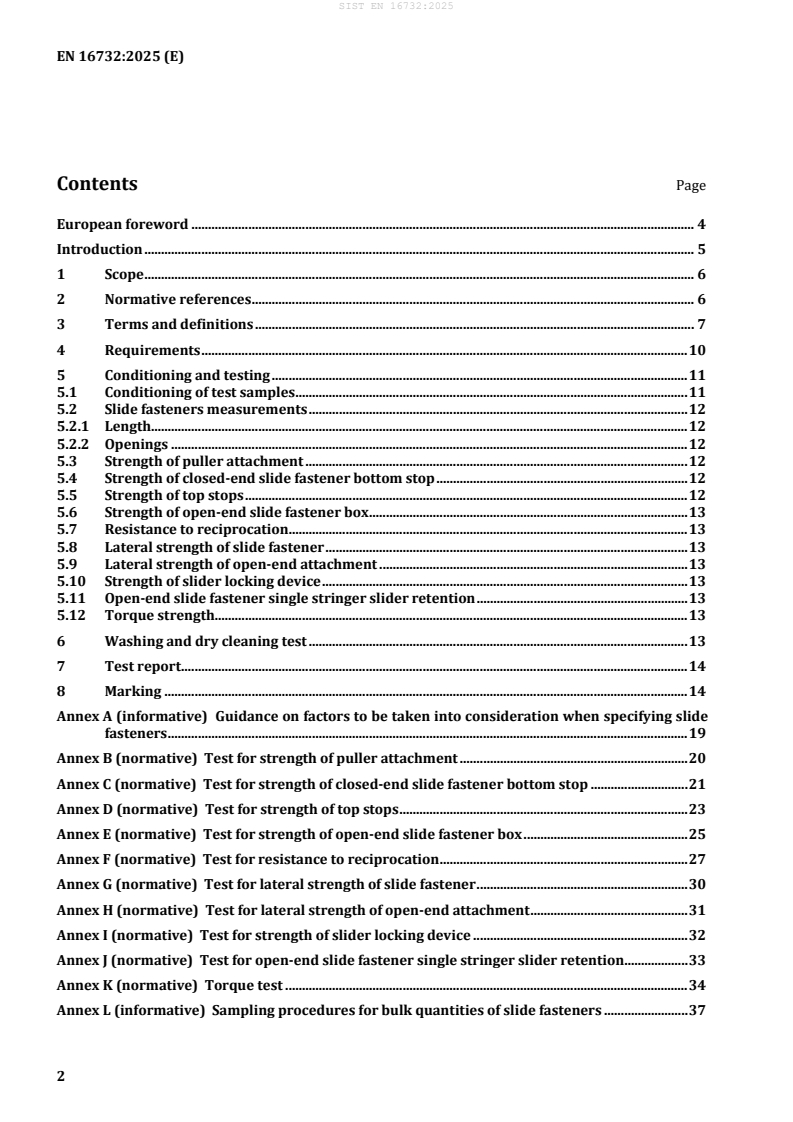
Contents Page
European foreword . 4
Introduction . 5
1 Scope . 6
2 Normative references . 6
3 Terms and definitions . 7
4 Requirements . 10
5 Conditioning and testing . 11
5.1 Conditioning of test samples . 11
5.2 Slide fasteners measurements . 12
5.2.1 Length. 12
5.2.2 Openings . 12
5.3 Strength of puller attachment . 12
5.4 Strength of closed-end slide fastener bottom stop . 12
5.5 Strength of top stops . 12
5.6 Strength of open-end slide fastener box . 13
5.7 Resistance to reciprocation. 13
5.8 Lateral strength of slide fastener . 13
5.9 Lateral strength of open-end attachment . 13
5.10 Strength of slider locking device . 13
5.11 Open-end slide fastener single stringer slider retention . 13
5.12 Torque strength. 13
6 Washing and dry cleaning test . 13
7 Test report . 14
8 Marking . 14
Annex A (informative) Guidance on factors to be taken into consideration when specifying slide
fasteners . 19
Annex B (normative) Test for strength of puller attachment . 20
Annex C (normative) Test for strength of closed-end slide fastener bottom stop . 21
Annex D (normative) Test for strength of top stops . 23
Annex E (normative) Test for strength of open-end slide fastener box . 25
Annex F (normative) Test for resistance to reciprocation . 27
Annex G (normative) Test for lateral strength of slide fastener . 30
Annex H (normative) Test for lateral strength of open-end attachment . 31
Annex I (normative) Test for strength of slider locking device . 32
Annex J (normative) Test for open-end slide fastener single stringer slider retention . 33
Annex K (normative) Torque test . 34
Annex L (informative) Sampling procedures for bulk quantities of slide fasteners . 37
Annex M (informative) End-uses and performance codes for labelling purposes . 38
Annex N (informative) Test for resistance to reciprocation for slide fasteners with length from
75 mm to 200 mm . 39
Bibliography . 43
European foreword
This document (EN 16732:2025) has been prepared by Technical Committee CEN/TC 248 “Textiles and
textile products”, the secretariat of which is held by BSI.
This European Standard shall be given the status of a national standard, either by publication of an
identical text or by endorsement, at the latest by October 2025, and conflicting national standards shall
be withdrawn at the latest by October 2025.
Attention is drawn to the possibility that some of the elements of this document may be the subject of
patent rights. CEN shall not be held responsible for identifying any or all such patent rights.
This document supersedes EN 16732:2015.
— New definitions (3.21, 3.22 and 3.23) and relevant requirements have been added;
— Performance codes B and C related to Annex C have been updated in Table 1;
— Table 2 title has been updated;
— 5.2.2 has been added;
— Test report (7) has been increased;
— Annex M has been updated;
— New Annex N has been added.
Any feedback and questions on this document should be directed to the users’ national standards body.
A complete listing of these bodies can be found on the CEN website.
According to the CEN-CENELEC Internal Regulations, the national standards organisations of the
following countries are bound to implement this European Standard: Austria, Belgium, Bulgaria, Croatia,
Cyprus, Czech Republic, Denmark, Estonia, Finland, France, Germany, Greece, Hungary, Iceland, Ireland,
Italy, Latvia, Lithuania, Luxembourg, Malta, Netherlands, Norway, Poland, Portugal, Republic of North
Macedonia, Romania, Serbia, Slovakia, Slovenia, Spain, Sweden, Switzerland, Türkiye and the United
Kingdom.
Introduction
The different types of slide fasteners are defined by the material of the elements (teeth), which form their
slide fastener chains. They can be of metallic, moulded plastic or monofilament plastic construction.
Metallic elements can be produced from flat or profiled wire and are usually clamped around the edge of
a beaded tape. An alternative approach is to cast metallic elements directly onto such a tape. Similarly,
plastic elements can be moulded onto a beaded tape. Such cast or moulded elements might have
projections on which the slider operates to reduce abrasion of the tape.
Plastic coil slide fasteners have polyamide or polyester monofilaments that are wound into coils to form
engaging elements. The coils can be attached to the face of flat tapes by sewing. Alternatively, the coils
can be woven or knitted into the tapes as they are constructed. Monofilament plastic elements can also
be of the meander type, which straddle the tape edge.
Typical slide fastener chain types are shown in Figure 3.
1 Scope
This document specifies performance levels and test methods for the following characteristics of slide
fasteners made from interlocking components mounted on tapes: strengths of puller attachment, closed-
end slide fastener bottom stop, top stop, open-end slide fastener box, reciprocating mechanism, closed
slide fastener when extended laterally, open-end attachment when extended laterally, slider locking
device, and open-end slide fastener single stringer slider retention and slider resistance to torque.
NOTE The tests specified in Annexes B to K have been specifically devised to permit their direct application to
finished slide fasteners with a view to giving the user reasonable assurance that a slide fastener conforming to the
requirements of this document can satisfactorily fulfil its intended purpose. Annex L gives information about
sampling procedures for bulk quantities of slide fasteners.
In addition, performance levels are also specified for colour fastness to washing, dry cleaning and water,
and for dimensional stability to washing and dry cleaning.
This document is applicable to all different types of slide fasteners for general use and is not applicable
to slide fasteners for specialist purposes (for example: pressure sealed slide fasteners for diving suits).
2 Normative references
The following documents are referred to in the text in such a way that some or all of their content
constitutes requirements of this document. For dated references, only the edition cited applies. For
undated references, the latest edition of the referenced document (including any amendments) applies.
EN 20105-A02, Textiles — Tests for colour fastness — Part A02: Grey scale for assessing change in colour
(ISO 105-A02)
EN ISO 105-A03, Textiles — Tests for colour fastness — Part A03: Grey scale for assessing staining (ISO 105-
A03)
EN ISO 105-C06, Textiles — Tests for colour fastness — Part C06: Colour fastness to domestic and
commercial laundering (ISO 105-C06)
EN ISO 105-D01, Textiles — Tests for colour fastness — Part D01: Colour fastness to dry cleaning using
perchloroethylene solvent (ISO 105-D01)
EN ISO 105-E01, Textiles — Tests for colour fastness — Part E01: Colour fastness to water (ISO 105-E01)
EN ISO 139, Textiles — Standard atmospheres for conditioning and testing (ISO 139)
EN ISO 3175-2, Textiles — Professional care, drycleaning and wetcleaning of fabrics and garments — Part
2: Procedure for testing performance when cleaning and finishing using tetrachloroethene (ISO 3175-2)
EN ISO 5077, Textiles — Determination of dimensional change in washing and drying (ISO 5077)
EN ISO 6330, Textiles — Domestic washing and drying procedures for textile testing (ISO 6330)
3 Terms and definitions
For the purposes of this document, the following terms and definitions apply.
ISO and IEC maintain terminology databases for use in standardization at the following addresses:
— ISO Online browsing platform: available at https://www.iso.org/obp/
— IEC Electropedia: available at https://www.electropedia.org/
3.1
slide fastener
zip
fastening device consisting of two flexible, interlocking stringers, with or without end stops, and one or
more sliders so arranged that by moving the slider along the stringers in one direction an opening is
formed, and by moving it in the other direction the opening is closed
3.2
stringer
tape with an attached row of elements designed to interlock with a row similarly attached to another tape
3.3
tape
narrow fabric to which elements are fitted
3.4
element
tooth
engaging component fixed to the edge of the tape
Note 1 to entry: See Figure 4.
3.5
slider
moving component consisting essentially of a slider body and, normally, a puller which opens or closes
the slide fastener by separating or engaging the single elements of the stringer
Note 1 to entry: The slider might incorporate a locking device. Alternative slider types are available with a flip-over
puller or double pullers, to facilitate operation from both front and back sides.
3.6
slider body
component that joins or separates the elements when sliding along the two stringers of slide fastener
3.7
puller
fitting attached to the slider body to facilitate manipulation
3.8
locking device
device incorporated in the slider unit restricting its free movement along the slide fastener length in an
opening direction
Note 1 to entry: The locking device might operate either automatically on release of the puller or by manual
pressure on the puller.
3.9
slide fastener length
distance from the top of the slider to the bottom of the bottom stop, or box in the case of an open-end
slide fastener, measured with the slider in the top position and with the puller in the downward position
Note 1 to entry: See Figure 4.
Note 2 to entry: Some suppliers measure the effective length of slide fasteners from the top of the slider to the
bottom edge of the tape, especially in the case of two-way open-end slide fasteners.
3.10
bottom stop
stop at the bottom end (3.14) of the chain that checks the opening movement of the slider
Note 1 to entry: See Figure 4a), Key n. 5.
3.11
top stop
stop(s) at the top end (3.15) of the chain that check(s) the closing movement of the slider
3.12
chain
continuous closure formed by two interlocking compatible stringers
Note 1 to entry: See Figure 4a), Key n.8.
3.13
chain width
width across the interlocked elements or shoulder on which the slider runs, whichever is the greater
Note 1 to entry: See Figure 4b), Key n.6.
3.14
bottom end
end which is adjacent to the slider when the device is fully open
3.15
top end
end which is adjacent to the slider when the device is fully closed
3.16
open-end slide fastener
slide fastener having a special fitment at the bottom end (3.14) of each stringer in place of the bottom
stop, so as to permit the two stringers to be completely separated and re-assembled at will when the
slider is in the fully open position
Note 1 to entry: The special fitment normally consists of a pin permanently fixed to the bottom end (3.14) of one
stringer, which fits into a box permanently fixed to the bottom end (3.14) of the other stringer (see Figure 7 a) and
7 b)).
Note 2 to entry: See Figure 5c) and 6a).
3.17
closed-end slide fastener
slide fastener which does not permit the complete separation of the two stringers
Note 1 to entry: Normally the top end (3.15) of the slide fastener separates as the slider is lowered, although there
is one type whose top ends (3.15) are permanently joined together by means of a bridge stop [see Figure 5a) and
Figure 5b), 6b), 6d)].
3.18
concealed slide fastener
slide fastener with the tapes folded so that on closure neither the slider body nor the slide fastener are
visible from the outside of the article
Note 1 to entry: See Figure 3g).
3.19
two-way slide fastener
slide fastener fitted with two sliders that operate with equal facility in either direction
Note 1 to entry: This type is available in a variety of forms, as illustrated in Figure 6.
3.20
batch
quantity of slide fasteners having a specific design, performance code and chain size
3.21
baby
child from birth up to age 12 months, that is all children of height up to and including 80 cm
[SOURCE: CEN/TR 16792:2014, 3.1]
3.22
infant
child from age 12 months to and including 36 months, that is all children over 80 cm and up to and
including 98 cm in height
[SOURCE: CEN/TR 16792:2014, 3.2]
3.23
child
young person
person aged over 36 months and up to 14 years (that is up to and including 13 years and 11 months), that
is all children over 98 cm in height and for girls up to 176 cm and for boys 182 cm in height
[SOURCE: CEN/TR 16792:2014, 3.3]
3.24
tape width
width of a single tape
Note 1 to entry: See Figure 4b), Key N.2
4 Requirements
When subjected to the tests specified in Clause 5 (as applicable to the features of the slide fastener design
to be tested), other than the slide fastener length measurements (see 5.2), samples of new slide fasteners
shall conform to Table 1 and to Table 2 if applicable (children’s items, 3.21, 3.22 and 3.23).
For children's items (3.21, 3.22 and 3.23), no sharp point and no sharp edges shall be noted on the original
state and no sharp point or sharp edges shall be noted after testing according to Annex F, Annex K, and
Annex N. Sharp point and sharp edges shall be verified by visual and tactile inspection [5].
The overall performance for the slide fastener, as determined by the minimum test results, shall be that
of the lowest performance grade achieved by any test specimen for any applicable test.
Attention shall be given to the use of the sampling procedures given in Annex L with regard to the
interpretation of potential outlier results.
It is permissible to perform more than one test on the same slide fastener, but care should be taken to
ensure that damage sustained in testing does not compromise subsequent test results.
A minimum of 3 specimens shall be tested in respect of each applicable test. Failure of any part of a slide
fastener before the specified force or number of cycles is reached in any of these tests shall be deemed a
failure of the sample. For the acceptance criteria for larger batches the sampling scheme in Annex L shall
be used and the number of specimens for each test increased accordingly.
Annex L gives information about an appropriate sampling procedure for bulk quantities of slide fasteners.
Annex M gives information about end-use and performance codes for labelling purposes.
Table 1 — Performance requirements of slide fasteners according to end use
a
Performance code
Annex Test description Unit A B C D E
B Strength of puller attachment (min.) N 70 80 200 250 300
Strength of closed-end slide fastener bottom stop
C N 35 70 90 100 140
(min.)
D Strength of top stops (min.) N 50 70 90 110 130
E Strength of open-end slide fastener box (min.) N 40 70 90 120 150
Resistance to reciprocation:
b
F Minimum cycles without failure Cycles 500 500 500 500 500
G Lateral strength of slide fastener (min.) N 150 200 250 370 470
H Lateral strength of open-end attachment (min.) N 40 70 90 120 160
I Strength of slider locking device (min.) N 10 15 25 40 60
a
These performance codes correspond to the description of slide fastener type as follows: A (ultra-light), B (light), C
(medium), D (medium-heavy) and E (heavy).
b
For slide fasteners with length from 75 mm to 200 mm Annex N can be alternatively applied.
Table 2 — Additional performance requirements of slide fasteners for baby's and infant's (3.21,
and 3.22) items
Annex Test description Unit Minimum
requirement
J Open-end slide fastener single stringer slider N 70
retention
K Torque strength Nm 0,34
In addition to the requirements of Table 1 and Table 2, slide fasteners shall conform to the colour fastness
and dimensional stability requirements of Table 3.
Table 3 — Colour fastness and dimensional stability requirements of slide fasteners
d
Property Method of test Performance level
a
Colour fastness minimum rating to:
dry cleaning EN ISO 105-D01 Change in colour and staining 3–4
EN ISO 105-C06,
washing Change in colour and staining 3–4
Method A2S
water EN ISO 105-E01 Change in colour and staining 3–4
Maximum dimensional change on:
b, c
washing EN ISO 5077 −4 % of original length
c
dry cleaning EN ISO 3175-2 −3 % of original length
a
Colour change and staining assessed using the Grey scale according to EN 20105-A02 and EN ISO 105-A03.
b
Using washing procedure 4N and tumble-drying procedure F at a temperature not exceeding 80 °C according
to EN ISO 6330.
c
Except that the change in slide fastener length only, as defined in 3.9, shall be determined.
d
In some cases performance levels can be lower due to technical reasons (e.g.: denim, pigment prints,
fluorescent colours). In other cases, they can be higher (e.g.: contrast colour). Variation of the performance levels
shall be agreed between the parties.
NOTE Guidance on the factors to be considered when specifying slide fasteners is given in Annex A.
5 Conditioning and testing
5.1 Conditioning of test samples
Prior to being subjected to the tests specified in 5.2 to 5.11, sample slide fasteners shall first be
conditioned for minimum of 16 h and then tested in the reference standard atmosphere for testing
textiles as defined in EN ISO 139 [ i.e. a temperature of (20 ± 2) °C and a relative humidity of (65 ± 4) %].
An alternative atmosphere having a temperature of (23 ± 2) °C and a relative humidity of (50 ± 4) % may
be used and the alternative atmosphere used shall be reported on the test report.
5.2 Slide fasteners measurements
5.2.1 Length
The length tolerance for slide fasteners compared with the nominal length shall be ± 1,5 % or ± 5 mm
(whichever is the greater), unless otherwise specified between parties. The slide-fastener length shall be
measured on a smooth flat surface using a one-millimetre graduated ruler (see Figure 4).
5.2.2 Openings
On slide fasteners used in baby and/or infant (from birth to 36 months, up to 98 cm in height) items,
there shall be no completely bounded openings between 5 mm and 12 mm, unless the depth of
penetration is less than 10 mm.
The test probes shall be made from plastic or other smooth, hard material, which can be mounted on a
force-measuring device.
Determine whether the 5 mm test probe (Figure 1) with an applied force of up to 30 N, enters 10 mm or
more into any completely bounded circular openings in rigid materials, in any possible orientation.
Dimensions in millimetres
Figure 1 — 5 mm test probe for openings in rigid materials
If the 5 mm test probe enters 10 mm or more, then the 12 mm test probe (Figure 2) shall also enter
10 mm or more with an applied force of up to 5 N.
Dimensions in millimetres
Figure 2 — 12 mm test probe for openings in rigid materials
5.3 Strength of puller attachment
Strength of puller attachment shall be in accordance with Annex B. When tested in accordance with
Annex B, slide fasteners shall conform to the performance code specified in Table 1.
5.4 Strength of closed-end slide fastener bottom stop
Strength of closed-end slide fastener bottom stop shall be in accordance with Annex C. When tested in
accordance with Annex C, closed-end slide fasteners bottom stop shall conform to the performance code
specified in Table 1.
5.5 Strength of top stops
Strength of top stops shall be in accordance with Annex D. When tested in accordance with Annex D, slide
fasteners shall conform to the performance code specified in Table 1.
5.6 Strength of open-end slide fastener box
Strength of open-end slide fastener box shall be in accordance with Annex E. When tested in accordance
with Annex E, slide fasteners shall conform to the performance code as specified in Table 1. This method
may also be applied to test the retention of the lower slider on two-way slide fasteners.
5.7 Resistance to reciprocation
Resistance to reciprocation shall be in accordance with Annex F. When tested in accordance with Annex F,
a slide fastener 200 mm or longer shall complete 500 cycles without failure.
If a slide fastener is less than 200 mm long then it is permissible to attach extension stringers by suitable
means to the top and/or bottom of the existing stringers such that the slide fastener can be mounted on
the apparatus described in Annex F and tested.
The means of attachment of the extension stringers is not critical but shall be of sufficient strength as to
withstand the forces applied during the test. Where the length of the interlocking elements of the slide
fastener is insufficient to permit reciprocation to be performed, then it is permissible to test a nominally
identical slide fastener with a longer length of interlocking elements.
Zippers with a length less than 200 mm can be alternatively tested in accordance with Annex N.
5.8 Lateral strength of slide fastener
Lateral strength of slide fastener shall be in accordance with Annex G. When tested in accordance with
Annex G, slide fasteners shall conform to the performance code specified in Table 1.
5.9 Lateral strength of open-end attachment
Lateral strength of open-end attachment shall be in accordance with Annex H. When tested in accordance
with Annex H, slide fasteners shall conform to the performance code specified in Table 1.
5.10 Strength of slider locking device
Strength of slider locking device shall be in accordance with Annex I. When tested in accordance with
Annex I, a slider fitted with a locking device shall withstand the lateral force specified in Table 1 when
the lock is engaged, and the stringers are pulled at right angles to the length of the slide fastener.
5.11 Open-end slide fastener single stringer slider retention
Open-end slide fastener single stringer slider retention shall be in accordance with Annex J. When testing
in accordance with Annex J, slide fasteners shall conform to the performance requirement specified in
Table 2.
5.12 Torque strength
Torque strength shall be in accordance with Annex K. When testing in accordance with Annex K, slide
fasteners shall conform to the minimum requirement as specified in Table 2.
6 Washing and dry cleaning test
If particular post-washing/dry cleaning performance levels are specified in the care information for the
slide fasteners or for the article in which the slide fastener is intended to be used, the samples shall be
tested in accordance with Clause 5 after subjecting samples to the specified cleansing procedures. If no
cleansing procedures are specified but it is desired to determine the performance of the fastener after
laundering then the samples shall be subjected to one or both of the default cleansing regimes detailed
below. For fasteners which can be both washed and dry cleaned, separate sets of samples shall be tested
after washing and after dry cleaning.
a) One wash and dry in accordance with, respectively, procedure 4 N and tumble drying procedure F
specified in EN ISO 6330.
b) One dry cleaning cycle in accordance with EN ISO 3175-2.
After dry cleaning the application of a suitable lubricant prior to reciprocation is acceptable.
7 Test report
The test report shall include the following information:
a) a reference to this document (i.e. EN 16732);
b) identification of slide fasteners tested and declared performance code, if known;
c) where known, information on the intended end-use;
d) date of the tests;
e) slide fasteners measurements results and rigid opening assessment when applicable;
f) final performance code based on test results;
g) any deviations from the procedure;
h) the numerical result obtained for each test and sharp points and sharp edges assessment when
applicable;
i) a description of the mode of failure by component parts;
j) the Annex used for testing the reciprocation (if any additional tab on tape is added to the item it shall
be specified including the type of tab);
k) a description of any washing or dry cleaning procedures performed and of any observed effects of
these procedures;
l) where applicable, the alternative atmosphere used when conditioning the test samples; and
m) any unusual features observed.
8 Marking
The following information shall be indicated on the package, the swing ticket or any associated
commercial documents:
a) the name of the manufacturer;
b) number and date of this document and the performance code of the slide fastener, as given in Table 1;
c) details of slide fastener type, length, colour, chain and tape width, element material and,
d) any special characteristics or manufacturer's identification which defines these details.
a) Metal elements b) Diecast or plastics moulded elements
c) Diecast or moulded winged elements d) Offset coil elements
e) Meander or ladder elements f) Woven-in coil elements
g) Concealed slide fastener
Figure 3 — Slide fastener chain types
a) Basic components b) Closed-end slide c) Open-end one way d) Open-end two
dimensions fastener dimensions slide fastener ways slide fastener
dimensions dimension
Key
1 top stop 6 chain width
2 tape width 7 length of slide fastener
3 slider body 8 chain
4 puller 9 elements (teeth)
5 bottom stop
Figure 4 — Slide fasteners: basic components dimensions
a) Closed-end — normal type b) Closed-end — alternative c) Open-end slide fastener
type
Figure 5 — One-way slide fasteners
a) Open-end b) “O” type c) “X” type d) “R” type
Figure 6 — Two-way slide fasteners
Key
1 pin for open-end one way
2 box for open-end one way
3 pin for open-end two ways
4 box for open-end two ways
Figure 7 — Box and pin of open-end slide-fasteners
Annex A
(informative)
Guidance on factors to be taken into consideration when specifying slide
fasteners
The following information should be included in the slide fastener specifications:
a) the type of slide fastener (e.g. closed-end, open end, left-handed, right-handed);
b) the fabric construction used in the tape;
c) the type and material of the elements;
d) the slide fastener length;
e) the chain width;
f) the tape width, as shown in Figure 4b) Key 2;
g) the slider type;
h) the performance code of the slide fastener;
i) any other special features of the slide fastener;
j) any end product related characteristics which might can affect the recommendation of minimum
performance code.
Annex B
(normative)
Test for strength of puller attachment
B.1 Principle
The puller is subjected to tension whilst the slider is rigidly supported.
B.2 Apparatus
B.2.1 Constant rate of extension tensile testing machine
Constant rate of extension tensile testing machine conforms to EN ISO 7500-1 and produces a rate of jaw
separation of (100 ± 10) mm/min. The force range is such that the breaking strength of the test specimen
falls between 10 % and 90 % of the maximum on the scale.
B.2.2 Fixture to retain the slider body rigidly
Fixture to retain the slider body rigidly, such as a face-plate or a blanking-off plate, to allow the tension
to be applied to the puller and its attachment to the slider body (see example in Figure B.1).
B.3 Procedure
Mount the test specimen in one jaw of the tensile testing machine, with the puller passed through a hole
in the fixture. Arrange the fixture so that the slider and the chain are rigidly clamped in place, with only
the puller and its attachment to the slider being free. Secure the end of the puller to the other jaw so that
tension is applied perpendicular to the face of the slider. Set the testing machine in operation until either
the specified force is reached or the specimen fails.
Key
1 slider body
2 puller
3 fixture
Figure B.1 — Example of puller attachment test
Annex C
(normative)
Test for strength of closed-end slide fastener bottom stop
C.1 Principle
The bottom stop is subjected to a force via the slider by tension applied to the stringers.
C.2 Apparatus
C.2.1 Constant rate of extension tensile testing machine
See Annex B.
C.2.2 Clamping device
The clamping devices of the machine shall be positioned with the central point of the two jaws in the line
of applied force, the front edges shall be at right angles to the line of applied force and their clamping
faces shall be in the same plane.
The jaws shall be capable of holding the test specimen without allowing it to slip and designed so that
they do not cut or otherwise weaken the test specimen.
The faces of the jaws shall be smooth and flat, except that when, even with packing, the test specimen
cannot be held satisfactorily with flat-faced jaws, engraved or corrugated jaws can be used to prevent
slippage.
The width of the jaws shall be (25 ± 1) mm (see Figure C.1).
Dimensions in millimetres
Key
1 upper clamp
2 stringer
3 slider body
4 bottom stop
5 stringer
6 lower clamp (jaw)
Figure C.1 — Closed-end slide fastener bottom stop test
C.3 Procedure
With the test specimen in its open position and the slider adjacent to the bottom stop, clamp one stringer
in each of the two jaws approximately between 75 mm and 100 mm between the jaws. (This might be
better achieved by cutting away the surplus stringer). Ensure that the locking mechanism is inoperative.
Apply a longitudinal force to the stringers thus forcing the slider against the bottom stop. Set the machine
in operation until either the specified force is reached, or the specimen fails.
Instances of failure include slipping of the bottom stop and removal of adjacent elements.
Annex D
(normative)
Test for strength of top stops
D.1 Principle
The top stops are subjected to a force via the slider applied through the puller.
D.2 Apparatus
Constant rate of extension tensile testing machine, as described in Annex B.
Dimensions in millimetres
Key
1 puller
2 stringer
3 slider body
4 top stop
5 stringer
6 lower clamp (jaw)
Figure D.1 — Example of top stop test
D.3 Procedure
With the slide fastener in the closed position and the slider adjacent to the top stops, secure the puller in
the moving jaw of the machine and secure the closed slide fastener stringers in the fixed clamp of the
machine such that the length of closed slide fastener between the top of the fixed jaw and the bottom of
the slider is set to (25 ± 2) mm (see Figure D.1). Set the machine in operation until the specified force is
reached or until the specimen fails.
Instances of failure include slipping of the top stops, the slider riding over the top stops and the slider
coming apart.
Annex E
(normative)
Test for strength of open-end slide fastener box
E.1 Principle
The box (see 3.16, note 1 to entry) is subjected to longitudinal force whilst the slide fastener chain is in
the closed position.
E.2 Apparatus
E.2.1 Constant rate of extension tensile testing machine
See Annex B.
E.2.2 Slotted plate
Slotted plate, shaped to clear the tape, chain and pin and to bear against the whole of the top edges of the
box. In the case of a non-grippable box the use of an alternative slotted plate shall be reported (see
Figure E.1).
Dimensions in millimetres
Key
1 upper clamp with slotted plate 4 stringer
2 stringer 5 lower clamp
3 open end box
Figure E.1 — Open-end one-way slide fastener box test
Figure E.2 — Open-end two-ways slide fastener box test
E.3 Procedure
With the test specimen in the closed position, clamp the whole slotted plate into the moveable jaw of the
apparatus and insert the slide fastener such that the open-end slide fastener box is gripped in the slotted
plate. For two-way slide fasteners, clamp the puller of the lower slider into the upper jaw (see Figure E.2).
Clamp the interlocked chain into the other jaw of the apparatus such that the distance between the top of
the slotted plate and the top of the lower jaw is (25 ± 2) mm (see Figure E.1 or Figure E.2). Set the machine
in operation until the specified force is reached or the test specimen fails.
Annex F
(normative)
Test for resistance to reciprocation
F.1 Principle
The test specimen is subjected to a specified number of cyclic operations whilst under simultaneous
lateral and longitudinal tension.
F.2 Apparatus
Vertically operated testing machine of the type shown in Figure F.1 and providing the following facilities.
a) Means of holding the test specimen firmly at the bottom end, with the slide fastener in the closed
position, without the chain being damaged.
b) Means of separately gripping the two stringers at the other end so that the slide fastener beyond the
slider is open. These gripping devices form the means of applying longitudinal spring balance forces
to the slide fastener and are therefore connected together by a swivel-plate or other similar device,
so that the slide fastener can be centred when the forces are applied. The gripping devices also swivel
at the points of connection to the swivel-plate to facilitate the operation of the slider on the test
specimen. The distance between the gripping devices is such that when the slider is at the lowest
point in the cycle the two ends of the slide fastener subtend an angle of 60° ± 10° (see α in Figure F.1).
c) Means of gripping the tapes securely midway along the traversed length at opposite points of the
testing zone so that the clamps can be subjected to force by means of spring balances. The clamps are
mounted so that they are “floating”, i.e. free to follow the natural direction of opening of the test
specimen.
The clamps are attached at an angle of 10° ± 5° (see β in Figure F.1) and are capable of moving 5 mm
in the direction of the pulleys. Setting pads are provided to hold the clamps in position until they are
secured to the tapes. The spring balances are of the tubular type and are 100 N balances for the lateral
tension and 50 N balances for the longitudinal force. In each case the scale is 44 mm in length. The
100 N balances have a spring rating of 2,25 N/mm and the 50 N balances one of 1,10 N/mm. They
are graduated in 1 N steps and accurate to within 1 N on each reading.
d) Means of applying a regular reciprocating action, at (30 ± 1) cycles per minute through the medium
of the puller, to the slider on the test specimen. The clamp or other gripping device may provide an
indirect form of connection in which the clamp is in two parts, one of which is attached to the
reciprocating device and the other to the puller on the specimen. This method of attachment can
incorporate a spring mechanism or other feature to withdraw any automatic locking device fitted to
the slider on the specimen.
Dimensions in millimetres
Key
α 60°
β 10° F lateral clamps
A top clamp G lateral spring balances
B longitudinal clamps H adjusting screw
C test specimen I swivel plate
D stop pin J setting pads
E longitudinal spring balances K test specimen
Figure F.1 — Resistance to reciprocation test
F.3 Procedure
F.3.1 Preparation of the specimens
Mount the test specimen in the vertical plane so that the bottom end is away from the spring balance ends
of the testing machine. Leave the stringers separate at the other end so that they can be individually
mounted in the testing machine (see Figure F.1). The lateral and longitudinal forces applied are as given
in Table F.1.
Table F.1 — Lateral and longitudinal applied forces for reciprocating test
Longitudinal force on each
Performance code Lateral force on each stringer
stringer
N N
A 7 5
B 10 7
C 16 14
D 24 18
E 30 23
F.3.2 Method
Arrange the machine so that the length of traverse of the slider is from 75 mm to 90 mm in each direction,
a to-and-fro movement of 150 mm to 180 mm forming a cycle. The procedure then follows the steps
indicated b
...