


SIST EN 1888-1:2019+A1:2024
(Main)Child care articles - Wheeled child conveyances - Part 1: Pushchairs and prams
Child care articles - Wheeled child conveyances - Part 1: Pushchairs and prams
This European Standard specifies the safety requirements and test methods for pushchairs and prams, designed for the carriage of one or more children, up to 15 kg each and up to 20 kg for any integrated platform on which a child can stand.
This European Standard does not cover toys, baby carriers fitted with wheels; pushchairs and prams propelled by a motor and pushchairs and prams designed for children with special needs.
Where a pushchair or pram or any part of the pushchair or pram has several functions or can be converted into another function it is due to comply with relevant standard(s).
Artikel für Säuglinge und Kleinkinder - Transportmittel auf Rädern für Kinder - Teil 1: Kinderwagen und Kinderwagenaufsätze
Dieses Dokument legt die sicherheitstechnischen Anforderungen an und die Prüfverfahren für Kinderwagen und Kindersportwagen fest, die für die Beförderung eines Kindes oder mehrerer Kinder bis jeweils 15 kg und bis zu 20 kg für eine integrierte Plattform, auf der ein Kind stehen kann, vorgesehen sind.
Dieses Dokument gilt nicht für Spielzeug, Babytragehilfen mit Rädern; motorbetriebene Kinderwagen und Kindersportwagen sowie Kinderwagen und Kindersportwagen die für Kinder mit besonderen Bedürfnissen hergestellt sind.
Wenn ein Kinderwagen oder Kindersportwagen oder ein beliebiges Teil desselben mehrere Funktionen besitzt oder zum Zweck einer anderen Funktion umgebaut werden kann, muss er die Anforderungen der jeweiligen Norm(en) erfüllen.
Articles de puériculture - Voitures d'enfant - Partie 1 : Poussettes et landaus
La présente Norme européenne spécifie les exigences de sécurité et les méthodes d’essai relatives aux poussettes et landaus destinés au transport d’un ou plusieurs enfants, pesant jusqu’{ 15 kg chacun, et jusqu’{ 20 kg pour toute plate-forme intégrée sur laquelle un enfant peut se tenir debout.
La présente Norme européenne ne concerne ni les jouets, ni les porte-enfants munis de roues, ni les poussettes et landaus propulsés par un moteur, ni les poussettes et landaus destinés aux enfants ayant des besoins spécifiques.
Lorsqu’une poussette ou un landau ou toute partie de cette poussette ou ce landau possède plusieurs fonctions ou peut être converti(e) en une autre fonction, il/elle doit être conforme à ou aux normes pertinentes.
Izdelki za otroke - Otroški vozički - 1. del: Otroški vozički s sedežem in otroški vozički s košaro (vključno z dopolnilom A1)
Ta evropski standard določa varnostne zahteve in preskusne metode za otroške vozičke s sedežem in otroške vozičke s košaro, namenjene prevozu enega ali več otrok s težo do 15 kg, pri čemer lahko na morebitno pritrjeno ploščad stopi otrok s težo do 20 kg.
Ta evropski standard ne zajema igrač, opreme za nošenje otrok, opremljene s kolesi, otroških vozičkov s sedežem in otroških vozičkov s košaro, ki jih poganja motor, ter otroških vozičkov s sedežem in otroških vozičkov s košaro, namenjenih otrokom s posebnimi potrebami.
Če ima otroški voziček s sedežem ali otroški voziček s košaro ali kateri koli del takega otroškega vozička več funkcij ali je mogoče njegovo funkcijo spremeniti, mora biti zagotovljena skladnost z ustreznimi standardi.
General Information
- Status
- Published
- Publication Date
- 20-Jun-2024
- Technical Committee
- OTR - Child use and care article
- Current Stage
- 6060 - National Implementation/Publication (Adopted Project)
- Start Date
- 17-Jun-2022
- Due Date
- 22-Aug-2022
- Completion Date
- 21-Jun-2024
Relations
- Replaces
SIST EN 1888-1:2019 - Child care articles - Wheeled child conveyances - Part 1: Pushchairs and prams - Effective Date
- 01-Jul-2024
- Effective Date
- 01-Jul-2024
SIST EN 1888-1:2019+A1:2024 - BARVE
Frequently Asked Questions
SIST EN 1888-1:2019+A1:2024 is a standard + national annex and/or foreword published by the Slovenian Institute for Standardization (SIST). Its full title is "Child care articles - Wheeled child conveyances - Part 1: Pushchairs and prams". This standard covers: This European Standard specifies the safety requirements and test methods for pushchairs and prams, designed for the carriage of one or more children, up to 15 kg each and up to 20 kg for any integrated platform on which a child can stand. This European Standard does not cover toys, baby carriers fitted with wheels; pushchairs and prams propelled by a motor and pushchairs and prams designed for children with special needs. Where a pushchair or pram or any part of the pushchair or pram has several functions or can be converted into another function it is due to comply with relevant standard(s).
This European Standard specifies the safety requirements and test methods for pushchairs and prams, designed for the carriage of one or more children, up to 15 kg each and up to 20 kg for any integrated platform on which a child can stand. This European Standard does not cover toys, baby carriers fitted with wheels; pushchairs and prams propelled by a motor and pushchairs and prams designed for children with special needs. Where a pushchair or pram or any part of the pushchair or pram has several functions or can be converted into another function it is due to comply with relevant standard(s).
SIST EN 1888-1:2019+A1:2024 is classified under the following ICS (International Classification for Standards) categories: 97.190 - Equipment for children. The ICS classification helps identify the subject area and facilitates finding related standards.
SIST EN 1888-1:2019+A1:2024 has the following relationships with other standards: It is inter standard links to SIST EN 1888-1:2019, SIST EN 1888-1:2019/kFprA1:2021. Understanding these relationships helps ensure you are using the most current and applicable version of the standard.
SIST EN 1888-1:2019+A1:2024 is associated with the following European legislation: Standardization Mandates: M/264. When a standard is cited in the Official Journal of the European Union, products manufactured in conformity with it benefit from a presumption of conformity with the essential requirements of the corresponding EU directive or regulation.
You can purchase SIST EN 1888-1:2019+A1:2024 directly from iTeh Standards. The document is available in PDF format and is delivered instantly after payment. Add the standard to your cart and complete the secure checkout process. iTeh Standards is an authorized distributor of SIST standards.
Standards Content (Sample)
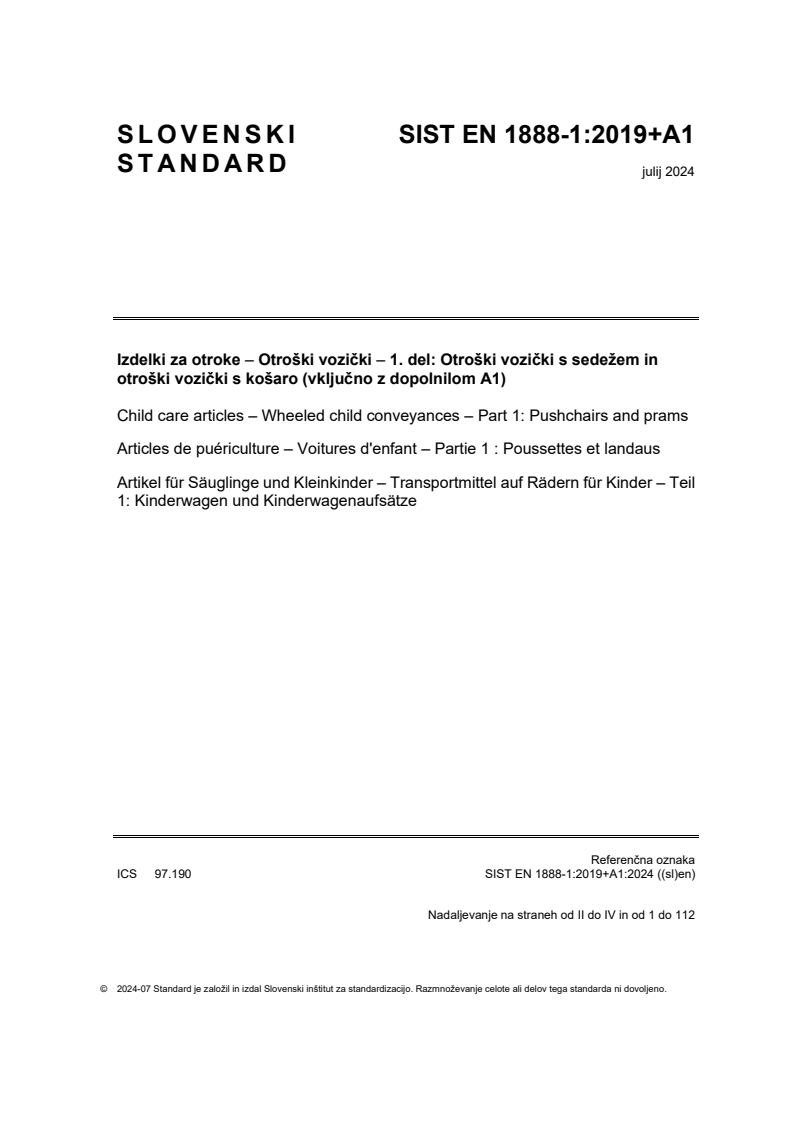
S L O V E N S K I SIST EN 1888-1:2019+A1
S T A N D A R D
julij 2024
Izdelki za otroke – Otroški vozički – 1. del: Otroški vozički s sedežem in
otroški vozički s košaro (vključno z dopolnilom A1)
Child care articles – Wheeled child conveyances – Part 1: Pushchairs and prams
Articles de puériculture – Voitures d'enfant – Partie 1 : Poussettes et landaus
Artikel für Säuglinge und Kleinkinder – Transportmittel auf Rädern für Kinder – Teil
1: Kinderwagen und Kinderwagenaufsätze
Referenčna oznaka
ICS 97.190 SIST EN 1888-1:2019+A1:2024 ((sl)en)
Nadaljevanje na straneh od II do IV in od 1 do 112
© 2024-07 Standard je založil in izdal Slovenski inštitut za standardizacijo. Razmnoževanje celote ali delov tega standarda ni dovoljeno.
SIST EN 1888-1 : 2019+A1 : 2024
NACIONALNI UVOD
Standard SIST EN 1888-1:2019+A1 ((sl)en), Izdelki za otroke – Otroški vozički – 1. del: Otroški vozički
s sedežem in otroški vozički s košaro (vključno z dopolnilom A1), 2024, ima status slovenskega
standarda in je po metodi ponatisa izvirnika z nacionalnim dodatkom privzet evropski standard EN 1888-
1:2018+A1 (en), Child care articles – Wheeled child conveyances – Part 1: Pushchairs and prams, 2022.
Ta slovenski standard nadomešča slovenski standard SIST EN 1888-1:2019.
NACIONALNI PREDGOVOR
Evropski standard EN 1888-1:2018+A1:2022 je pripravil tehnični odbor Evropskega komiteja za
standardizacijo CEN/TC 252 »Izdelki za otroke«, katerega sekretariat vodi AFNOR.
Ta dokument vključuje dopolnilo A1.
Odločitev za izdajo tega standarda je 9. maja 2024 sprejel tehnični odbor SIST/TC OTR Izdelki za
otroke.
II
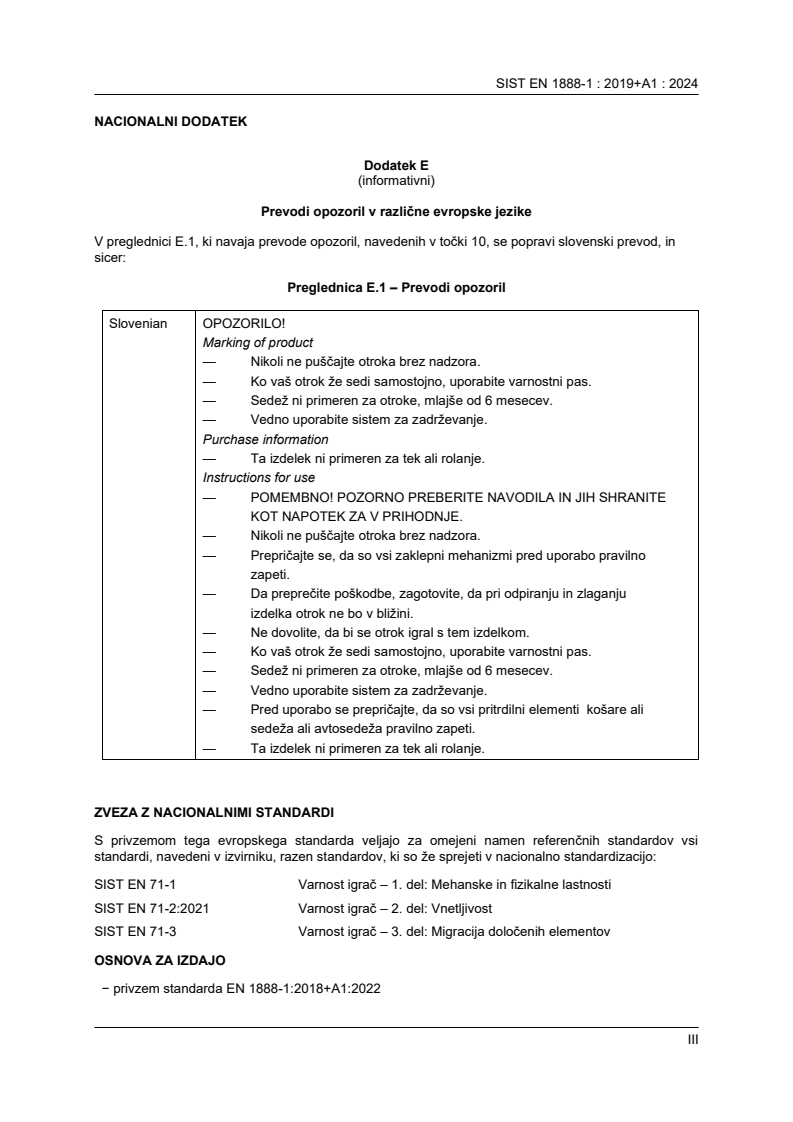
SIST EN 1888-1 : 2019+A1 : 2024
NACIONALNI DODATEK
Dodatek E
(informativni)
Prevodi opozoril v različne evropske jezike
V preglednici E.1, ki navaja prevode opozoril, navedenih v točki 10, se popravi slovenski prevod, in
sicer:
Preglednica E.1 – Prevodi opozoril
Slovenian OPOZORILO!
Marking of product
— Nikoli ne puščajte otroka brez nadzora.
— Ko vaš otrok že sedi samostojno, uporabite varnostni pas.
— Sedež ni primeren za otroke, mlajše od 6 mesecev.
— Vedno uporabite sistem za zadrževanje.
Purchase information
— Ta izdelek ni primeren za tek ali rolanje.
Instructions for use
— POMEMBNO! POZORNO PREBERITE NAVODILA IN JIH SHRANITE
KOT NAPOTEK ZA V PRIHODNJE.
— Nikoli ne puščajte otroka brez nadzora.
— Prepričajte se, da so vsi zaklepni mehanizmi pred uporabo pravilno
zapeti.
— Da preprečite poškodbe, zagotovite, da pri odpiranju in zlaganju
izdelka otrok ne bo v bližini.
— Ne dovolite, da bi se otrok igral s tem izdelkom.
— Ko vaš otrok že sedi samostojno, uporabite varnostni pas.
— Sedež ni primeren za otroke, mlajše od 6 mesecev.
— Vedno uporabite sistem za zadrževanje.
— Pred uporabo se prepričajte, da so vsi pritrdilni elementi košare ali
sedeža ali avtosedeža pravilno zapeti.
— Ta izdelek ni primeren za tek ali rolanje.
ZVEZA Z NACIONALNIMI STANDARDI
S privzemom tega evropskega standarda veljajo za omejeni namen referenčnih standardov vsi
standardi, navedeni v izvirniku, razen standardov, ki so že sprejeti v nacionalno standardizacijo:
SIST EN 71-1 Varnost igrač – 1. del: Mehanske in fizikalne lastnosti
SIST EN 71-2:2021 Varnost igrač – 2. del: Vnetljivost
SIST EN 71-3 Varnost igrač – 3. del: Migracija določenih elementov
OSNOVA ZA IZDAJO
− privzem standarda EN 1888-1:2018+A1:2022
III
SIST EN 1888-1 : 2019+A1 : 2024
PREDHODNE IZDAJE
– SIST EN 1888-1:2019
– SIST EN 1888:2012
– SIST EN 1888:2003
OPOMBE
– Povsod, kjer se v besedilu standarda uporablja izraz “evropski standard”, v
– Ta nacionalni dokument je istoveten EN 1888-1:2018+A1:2022 in je objavljen z dovoljenjem
Upravni center
CEN-CENELEC
Rue de la Science 23
B-1040 Bruselj
– This national document is identical with EN 1888-1:2018+A1:2022 and is published with the
permission of
CEN-CENELEC
Management Centre
Rue de la Science 23
B-1040 Brussels
IV
EN 1888-1:2018+A1
EUROPEAN STANDARD
NORME EUROPÉENNE
April 2022
EUROPÄISCHE NORM
ICS 97.190 Supersedes EN 1888-1:2018
English Version
Child care articles - Wheeled child conveyances - Part 1:
Pushchairs and prams
Articles de puériculture - Voitures d¿enfant - Partie 1 : Artikel für Säuglinge und Kleinkinder - Transportmittel
Poussettes et landaus auf Rädern für Kinder - Teil 1: Kinderwagen und
Kinderwagenaufsätze
This European Standard was approved by CEN on 23 April 2018 and includes Amendment 1 approved by CEN on 24 January
2022.
CEN members are bound to comply with the CEN/CENELEC Internal Regulations which stipulate the conditions for giving this
European Standard the status of a national standard without any alteration. Up-to-date lists and bibliographical references
concerning such national standards may be obtained on application to the CEN-CENELEC Management Centre or to any CEN
member.
This European Standard exists in three official versions (English, French, German). A version in any other language made by
translation under the responsibility of a CEN member into its own language and notified to the CEN-CENELEC Management
Centre has the same status as the official versions.
CEN members are the national standards bodies of Austria, Belgium, Bulgaria, Croatia, Cyprus, Czech Republic, Denmark, Estonia,
Finland, France, Germany, Greece, Hungary, Iceland, Ireland, Italy, Latvia, Lithuania, Luxembourg, Malta, Netherlands, Norway,
Poland, Portugal, Republic of North Macedonia, Romania, Serbia, Slovakia, Slovenia, Spain, Sweden, Switzerland, Turkey and
United Kingdom.
EUROPEAN COMMITTEE FOR STANDARDIZATION
COMITÉ EUROPÉEN DE NORMALISATION
EUROPÄISCHES KOMITEE FÜR NORMUNG
CEN-CENELEC Management Centre: Rue de la Science 23, B-1040 Brussels
© 2022 CEN All rights of exploitation in any form and by any means reserved Ref. No. EN 1888-1:2018+A1:2022 E
worldwide for CEN national Members.
Contents Page
European foreword . 5
1 Scope . 6
2 Normative references . 6
3 Terms and definitions . 6
4 General requirements and test conditions . 9
4.1 Samples . 9
4.2 Principle of the most onerous condition . 9
4.3 Tolerances for test equipment . 9
4.4 Test conditions . 10
4.5 Determination of the protected volume . 10
4.5.1 Protected volume of seat units. 10
4.5.2 Protected volume of pram bodies having a length greater than 800 mm . 12
4.5.3 Protected volume for pram bodies having a maximum internal length of 800 mm and
car seats . 13
4.6 Determination of the junction line . 13
4.7 Determination of the occupant space . 14
4.7.1 Determination of occupant space for seat unit and car seat . 14
4.7.2 Determination of occupant space for pram body having a length less than 800 mm 14
4.7.3 Determination of occupant space for pram body having a length greater than 800 mm
................................................................................................................................................................... 14
5 Test equipment . 15
5.1 Test masses . 15
5.1.1 General. 15
5.1.2 Test mass A . 15
5.1.3 Test mass B . 16
5.1.4 Test mass C . 16
5.1.5 Test mass D. 17
5.1.6 Test mass D . 18
5.1.7 Test mass F . 18
5.1.8 Test mass G . 19
5.1.9 Test bar . 20
5.2 Test probes . 21
5.2.1 Finger probes . 21
5.2.2 Hip probe . 23
5.2.3 Large head probe . 24
5.2.4 Conical probes . 25
5.3 Angle measuring device . 25
5.4 Test ball . 27
5.5 Hinged board . 27
5.6 Small parts cylinder . 27
5.7 Bite tester . 28
5.8 Test surface . 29
5.9 Rectangular stops . 29
5.10 Irregular surface test equipment . 30
EN 1888-1:2018 (E)
5.10.1 Obstacles . 30
5.10.2 Articulating arms (see Annex B) . 31
6 Chemical hazards (see A.2) . 31
7 Thermal hazards (see A.3) . 31
8 Mechanical hazards (see A.4) . 32
8.1 Protective function (see A.4.2) . 32
8.1.1 Suitability of vehicle . 32
8.1.2 Minimum internal height of pram body . 35
8.1.3 Restraint system and fasteners . 36
8.2 Entrapment hazards (see A.4.3) . 39
8.2.1 Holes and openings . 39
8.2.2 Entrapment between the handle and the pram body . 39
8.3 Hazards from moving parts (see A.4.4) . 39
8.3.1 General . 39
8.3.2 Shearing hazards (see A.4.4) . 40
8.3.3 Crushing hazards, requirement (see A.4.4) . 40
8.3.4 Wheels . 41
8.3.5 Locking mechanism(s) . 41
8.4 Entanglement hazards (see A.5). 44
8.4.1 Requirements . 44
8.4.2 Test method . 45
8.5 Choking and ingestion hazards (see A.6) . 46
8.5.1 Requirements . 46
8.5.2 Test methods . 46
8.6 Suffocation hazards (see A.7) . 48
8.6.1 Internal lining of the pram body and seat unit . 48
8.6.2 Plastic packaging . 48
8.7 Hazardous edges and protrusions (see A.8) . 48
8.8 Parking and braking devices (see A.9) . 49
8.8.1 Requirements . 49
8.8.2 Test methods . 49
8.9 Stability (see A.10) . 53
8.9.1 Stability of vehicle . 53
8.9.2 Longitudinal stability of a pram body with carrying handles . 57
8.9.3 Stability hazards due to the position of swivelling wheels Error! Bookmark not defined.
8.10 Structural integrity (see A.11) . 58
8.10.1 Carrying handles and handle anchorage points of pram bodies and detachable seat
units . 58
8.10.2 Strength and durability of attachment devices for pram bodies or seat units or car
seats . 58
8.10.3 Irregular surface test . 59
8.10.4 Dynamic strength . 60
8.10.5 Wheel strength . 62
8.10.6 Handle strength . 62
9 Durability of marking . 66
10 Product information . 66
10.1 General . 66
10.2 Marking of product . 66
10.3 Purchase information (A.12) . 67
10.4 Instructions for use . 68
Annex A (informative) Rationales . 70
A.1 General. 70
A.2 Chemical hazards (see Clause 6) . 70
A.3 Thermal hazards (see Clause 7) . 70
A.4 Mechanical hazards (see Clause 8) . 70
A.4.1 General. 70
A.4.2 Protective function (see 8.1) . 70
A.4.3 Entrapment hazards (see 8.2) . 70
A.4.4 Hazards from moving parts (see 8.3) . 71
A.5 Entanglement hazards (see 8.4) . 72
A.6 Choking and ingestion hazards (see 8.5) . 73
A.7 Suffocation hazards (see 8.6) . 73
A.8 Hazardous edges and protrusions (see 8.7) . 73
A.9 Parking and braking devices (see 8.8) . 73
A.10 Stability (see 8.9) . 73
A.11 Structural integrity (see 8.10) . 73
A.12 Purchase information (see 10.3) . 74
Annex B (informative) Examples of articulated arms to maintain the vehicle on the rig for
the irregular surface test . 75
Annex C (informative) Guideline for the application of 8.3.5.1.1.3 “Unintentional release of
locking mechanism(s)” . 77
C.1 Relevant definitions . 77
C.2 Guidelines for the application of 8.3.5.1.1.3 “Unintentional release of locking
mechanism(s)” . 77
C.2.1 General. 77
C.2.2 Products fitted with one single operating device (products that may be fold using only
one hand) . 77
C.2.3 Products fitted with two operating devices . 78
C.2.4 Products having three or more operating devices . 79
C.2.5 Products covered by different requirements . 79
Annex D (informative) Examples of moving parts of the canopies inside 100 mm from the
pivot point . 81
D.1 Case A . 81
D.2 Case B . 82
D.3 Case C . 83
Annex E (informative) Translation of Warnings in different European languages . 84
Annex F (informative) A–deviations . 110
Annex G (informative) Child restraint systems: arrangement of approval marks . 111
Bibliography . 112
EN 1888-1:2018 (E)
European foreword
This document (EN 1888-1:2018+A1:2022) has been prepared by Technical Committee CEN/TC 252
“Child care articles”, the secretariat of which is held by AFNOR.
This European Standard shall be given the status of a national standard, either by publication of an
identical text or by endorsement, at the latest by October 2022, and conflicting national standards shall
be withdrawn at the latest by October 2022.
Attention is drawn to the possibility that some of the elements of this document may be the subject of
patent rights. CEN shall not be held responsible for identifying any or all such patent rights.
This document supersedes !EN 1888-1:2018".
This document includes Amendment 1 approved by CEN on 01 January 2022.
The start and finish of text introduced or altered by amendment is indicated in the text by tags !".
In comparison with this EN 1888:2012, the significant technical changes relate to the following issues:
a) chemical hazards;
b) entrapment hazards;
c) hazards from moving parts;
d) entanglement hazards;
e) parking device test method;
f) stability of the vehicle;
g) introduction of an informative Annex E giving relevant translations for warning sentences;
h) introduction of an informative Annex D giving information on the assessment of moving parts of
canopies;
i) introduction of an informative Annex G giving information on the arrangement of approval marks for
car seats.
In November 2014, the European Working Group decided to split EN 1888 into different parts to clearly
treat in a different way, new products or new functions of wheeled child conveyances.
EN 1888 is currently composed with the following parts:
— EN 1888-1, Child care articles — Wheeled child conveyances — Part 1: Pushchairs and prams;
— EN 1888-2, Child care articles — Wheeled child conveyances — Part 2: Pushchairs for children above
15 kg up to 22 kg.
EN 1888 therefore becomes EN 1888-1 and is only applicable to pushchairs and prams. It will be used as
a reference in future parts.
According to the CEN-CENELEC Internal Regulations, the national standards organisations of the
following countries are bound to implement this European Standard: Austria, Belgium, Bulgaria, Croatia,
Cyprus, Czech Republic, Denmark, Estonia, Finland, France, Germany, Greece, Hungary, Iceland, Ireland,
Italy, Latvia, Lithuania, Luxembourg, Malta, Netherlands, Norway, Poland, Portugal, Republic of North
Macedonia, Romania, Serbia, Slovakia, Slovenia, Spain, Sweden, Switzerland, Turkey and the United
Kingdom.
1 Scope
This document specifies the safety requirements and test methods for pushchairs and prams, designed
for the carriage of one or more children, up to 15 kg each and up to 20 kg for any integrated platform on
which a child can stand.
This document does not cover toys, baby carriers fitted with wheels; pushchairs and prams propelled by
a motor and pushchairs and prams designed for children with special needs.
Where a pushchair or pram or any part of the pushchair or pram has several functions or can be converted
into another function it is due to comply with relevant standard(s).
2 Normative references
The following documents are referred to in the text in such a way that some or all of their content
constitutes requirements of this document. For dated references, only the edition cited applies. For
undated references, the latest edition of the referenced document (including any amendments) applies.
EN 71-1, Safety of toys — Part 1: Mechanical and physical properties
EN 71-2:2020, Safety of toys — Part 2: Flammability
EN 71-3, Safety of toys — Part 3: Migration of certain elements
3 Terms and definitions
For the purposes of this document, the following terms and definitions apply.
ISO and IEC maintain terminological databases for use in standardization at the following addresses:
• IEC Electropedia: available at http://www.electropedia.org/
• ISO Online browsing platform: available at http://www.iso.org/obp
3.1
wheeled child conveyance
vehicle designed for the carriage of one or more children which can be manually steered while being
pushed or pulled
3.2
pushchair
vehicle comprising a chassis and one or more seat units or car seats
Note 1 to entry: Referred to as the “vehicle” for the purpose of this standard.
3.3
pram
vehicle comprising a chassis and one or more pram bodies
Note 1 to entry: Referred to as the “vehicle” for the purpose of this standard.
3.4
integrated platform
!integral part of the vehicle designed to support a child in a standing position"
EN 1888-1:2018 (E)
3.5
chassis
wheeled framework with extended handle(s) for pushing, pulling and steering, designed to accommodate
and transport a pram body (bodies) or car seat(s) or seat unit(s) or a combination of these items
3.6
seat unit
structure which may or may not be adjustable to achieve a reclining or recumbent position designed to
support one or more children
3.7
type A car seat
Child Restraint System (CRS) used for children up to 9 kg according to Regulation ECE R44 (group 0) or
Regulation ECE R129
Note 1 to entry: Child Restraint Systems are covered by UNECE regulations.
Note 2 to entry: Arrangement of approval marks is shown in Annex G
3.8
type B car seat
Child Restraint System (CRS) used for children up to 13 kg according to Regulation ECE R44 (group 0+)
or Regulation ECE R129
Note 1 to entry: Child Restraint Systems are covered by UNECE regulations.
Note 2 to entry: Arrangement of approval marks is shown in Annex G.
3.9
pram body
structure with essentially vertical and continuous sides and ends with an internal base designed to
transport one or more children in a primarily horizontal position
3.10
protected volume
volume accessible by the child (occupant) when sitting or lying in the pushchair or pram, where specific
safety requirements are necessary
3.11
junction line
intersection of the seat and the backrest
3.12
restraint system
system to restrain the child within the vehicle
3.13
crotch restraint
device positioned between the child’s legs to prevent the child from sliding forwards
3.14
harness anchorage point
device suitable for the attachment of an additional child’s harness
3.15
footrest
support for the feet or a foot, used when sitting
3.16
shearing hazard
hazard due to the movement of components relatively one to another resulting in a scissoring action
3.17
crushing hazard
hazard due to the movement of components relatively one to another resulting in a compression action
3.18
folding system
!assembly of moving parts which enables the vehicle to be changed from an erected position to a folded
position and vice versa under the control of the carer"
3.19
locking mechanism
assembly of components consisting of one or more locking device(s) and one or more operating device(s)
3.20
locking device
mechanical component that maintains part(s) of the vehicle erected in the position of use (e.g. latch(es),
hooks, over centre lock.) which could be deactivated or activated by action(s) on the operating device
3.21
operating device
part of the locking mechanism(s) designed to be activated by the carer through one or several positive
action(s)
3.22
automatic locking device
device that engages with no additional voluntary action by the carer, when the vehicle is erected to its
position of use
3.23
reversible handle
!handle that can be rotated on the chassis to change the direction of pushing or pulling"
3.24
occupant space
space enclosed by the surfaces, for example, side and ends or the base, or both, of a pram body, seat unit
or car seat that contains the child (occupant) within a pram or pushchair
3.25
parking device
device to maintain the vehicle in a stationary position
3.26
braking device
device to reduce the speed of the vehicle
EN 1888-1:2018 (E)
3.27
carry cot
product consisting of a base, sides, ends and carrying handle(s), within which a child can be laid down
and transported by hand(s)
Note 1 to entry: Carry cot is the generic term generally used.
4 General requirements and test conditions
NOTE Words in italics are defined in Clause 3 (Terms and definitions). Additional information on the
background and rationale for various requirements is given in Annex A.
4.1 Samples
Tests should be carried out in the order of the clauses given in this European standard, unless otherwise
stated. Each test shall be carried out only using one vehicle, unless otherwise stated.
Vehicles with multiple places for pram bodies and/or seat units shall comply with all applicable
requirements in any possible arrangement in accordance with the manufacturer's instructions. If a
vehicle can be equipped with an additional seat unit or pram body or type A/B car seat supplied or
recommended by the manufacturer, the combination shall comply with this European Standard.
4.2 Principle of the most onerous condition
Unless otherwise stated each test shall be conducted with the vehicle in the most onerous condition for
that test in terms of:
— the choice and number of seat units and/or pram bodies and/or car seats attached to the chassis stated
in the manufacturer's instructions;
— the addition of any additional seat unit(s) approved by the manufacturer;
— the use of test masses: for vehicles transporting more than one child, at least one place that a child
can occupy shall be loaded with a test mass;
— the loading (or not) of any receptacle designed for carrying additional load(s) allowed for in the
instructions or otherwise approved by the manufacturer and the placing (or not) of load(s) in any
such facility, up to the maximum mass allowed in the manufacturer's instructions, or 2 kg if nothing
is indicated; small pockets fitted onto textile parts are not concerned by this condition;
— the addition (or not) of any other accessories supplied or recommended by the manufacturer for use
with the vehicle and with accessories loaded according to the manufacturers instructions;
— the adjustment of seat units, pram bodies, handles, car seats, and any other adjustable features or
accessories, or any other optional arrangement of the vehicle allowed in the manufacturer's
instructions or otherwise approved by the manufacturer.
NOTE The heaviest loads do not always produce the most onerous conditions.
4.3 Tolerances for test equipment
Unless otherwise stated, the accuracy of the test equipment shall be:
— forces ± 5 %;
— masses ± 0,5 %;
— dimensions ± 0,5 mm;
— timing ± 1 s;
— angles ± 0,5°.
4.4 Test conditions
The vehicle shall be conditioned at a temperature of (23 ± 5) °C for at least 2 h prior to tests. All tests shall
be carried out at a temperature of (23 ± 10) °C unless otherwise specified.
For vehicles fitted with inflatable tyres, the tyre pressure shall be adjusted according to manufacturer’s
instructions for use before conducting the entire test procedure. If a tyre is punctured during the test
procedure, the tyre shall be replaced and the test procedure continued.
4.5 Determination of the protected volume
4.5.1 Protected volume of seat units
The protected volume of seat units shall be determined in accordance with Figure 1 below.
EN 1888-1:2018 (E)
Dimensions in millimetres
Key
1 origin from which the protected volume has been defined (mid-point of the junction line, on the uncompressed
upper surface of the seat unit)
2 seat
3 back rest
4 leg rest
Figure 1 — Protected volume for seat units
The space located behind the backrest is excluded from the protected volume.
Where a vehicle is suitable for two or more children the space located behind the backrest shall be
considered if it enters another protected volume.
The space underneath the seat and underneath the leg rest is excluded from the protected volume, except
for a 50 mm wide band measured from the outermost edge of the seat/leg rest sides where the seat/leg
rest is not fitted with lateral protections of a height greater than 50 mm (textile or any rigid component)
(see Figure 2).
Dimensions in millimetres
Key
1 space to be checked
2 space not to be checked
3 leg rest
4 seat
5 backrest
Figure 2 — Effect of lateral protection on the determination of the protected volume
4.5.2 Protected volume of pram bodies having a length greater than 800 mm
The protected volume of pram bodies having a length greater than 800 mm shall be determined in
accordance with Figure 3.
The 550 mm height shall be measured in accordance with 8.1.2.2.
The surface underneath the pram body is excluded from the protected volume.
Dimensions in millimetres
Figure 3 — Protected volume for pram bodies having a length greater than 800 mm
EN 1888-1:2018 (E)
4.5.3 Protected volume for pram bodies having a maximum internal length of 800 mm and car
seats
For vehicles designed only for children under 6 months of age, pram bodies with a maximum internal
length of 800 mm and for car seats, the protected volume is considered to be the inner upper surface that
supports the child and the inner surface of the sides and ends of the pram body.
4.6 Determination of the junction line
The junction line shall be determined as the intersection between the seat and the backrest as shown on
Figure 4.
Key
LL junction line
1 backrest
2 seat
Figure 4 — Junction line
When the seat unit is in the form of a hammock, then a theoretical junction line, “LL”, is determined as
shown in Figure 5.
Key
LL junction line
L vertical projection of C on the hammock
Figure 5 — Junction line for seat unit in form of a hammock
NOTE The junction line may vary when the backrest is adjusted to different positions.
4.7 Determination of the occupant space
4.7.1 Determination of occupant space for seat unit and car seat
The occupant space is defined 550 mm from the mid-point of the junction line, on the uncompressed
upper surface of the seat unit or car seat and the sides of the inner upper surface that support the child.
!The volume stops at the vertical projection of the front edge of the seat." See Figure 6.
Dimensions in millimetres
Figure 6 — Occupant space for seat unit and car seat
4.7.2 Determination of occupant space for pram body having a length less than 800 mm
For vehicles designed only for children under 6 months of age, pram bodies with a maximum internal
length of 800 mm, the occupant space is considered to be the volume of the inner upper surface that
supports the child and the inner surface of the sides and ends of the pram body. See Figure 7.
Key
1 occupant space
Figure 7 — Occupant space for pram body having a length less than 800 mm
4.7.3 Determination of occupant space for pram body having a length greater than 800 mm
For pram bodies with a internal length greater than 800 mm, the occupant space is considered to be the
volume of the inner upper surface that supports the child and the inner surface of the sides and ends of
the pram body up to 550 mm above. See Figure 8.
EN 1888-1:2018 (E)
Dimensions in millimetres
Key
1 occupant space
Figure 8 — Occupant space for pram body having a length greater than 800 mm
5 Test equipment
5.1 Test masses
5.1.1 General
Unless otherwise specified, the test masses shall be those given in 5.1.2 to 5.1.9.
Any damage to fabric which may occur as a result of abrasion by the test masses during tests shall be
ignored. Damage can be minimized by using a convenient means of protection of negligible mass. Where
damage is not caused by abrasion by the test masses it constitutes a structural failure.
Test masses may be fitted with additional handles for carrying purposes, as long as the centre of gravity
is not changed and mass remains within tolerances and the test procedure is not affected.
5.1.2 Test mass A
Test mass A is a rigid cylinder (160 ± 5) mm in diameter and (300 ± 5) mm in height, having a mass
of (9 + 0, 1/0) kg and with its centre of gravity in the centre of the cylinder. All edges shall have a radius
of (5 ± 1) mm. Two anchorage points shall be provided, positioned (150 ± 2,5) mm from the base and
at 180° to each other around the circumference as shown in Figure 9.
Dimensions in millimetres
Key
1 radius: (5 ± 1) mm
2 two anchorage points
Figure 9 — Test mass A
5.1.3 Test mass B
Test mass B is a rigid cylinder (200 ± 5) mm in diameter and (300 ± 5) mm in height, having a mass
of (15 + 0, 1/0) kg and with its centre of gravity in the centre of the cylinder. All edges shall have a radius
of (5 ± 1) mm. Two anchorage points shall be provided, positioned (150 ± 2,5) mm from the base and
at 180° to each other around the circumference (see Figure 10).
Dimensions in millimetres
Key
1 radius: (5 ± 1) mm
2 two anchorage points
Figure 10 — Test mass B
5.1.4 Test mass C
Test mass C is a rigid plate (600 ± 5) mm long and (180 ± 5) mm wide, having a minimum thickness
of 5 mm and a mass of (9 + 0, 1/0) kg hinged along the centre line (see Figure 11).
EN 1888-1:2018 (E)
Dimensions in millimetres
Key
1 hinge line
Figure 11 — Test mass C
5.1.5 Test mass D
Test mass D is made of a rigid material with a smooth finish and a total mass of (9 ± 0,1) kg
(see Figure 12).
Dimensions in millimetres
Tolerances:
— dimensions ± 2 mm;
— angles ± 2°;
— where shown, corner radii shall be (10 ± 1) mm.
Figure 12 — Test mass D
5.1.6 Test mass D
Test mass D is made of a rigid material with a smooth finish and a total mas
...
Questions, Comments and Discussion
Ask us and Technical Secretary will try to provide an answer. You can facilitate discussion about the standard in here.
Loading comments...