

SIST ISO 10694:1996
(Main)Soil quality - Determination of organic and total carbon after dry combustion (elementary analysis)
General Information
- Abstract
Specifies a method for the determination of the total carbon content in soil after dry combustion. The organic carbon content is calculated from this content after correcting for carbonates present in the sample. If carbonates are removed beforehand, the organic carbon content is measured directly. Applicable to all types of air-dried soil samples.
- Status
- Published
- Publication Date
- 31-Aug-1996
- Technical Committee
- KAT - Soil quality
- Current Stage
- 6060 - National Implementation/Publication (Adopted Project)
- Start Date
- 01-Sep-1996
- Due Date
- 01-Sep-1996
- Completion Date
- 01-Sep-1996
Buy Documents

ISO 10694:1995 - Soil quality — Determination of organic and total carbon after dry combustion (elementary analysis) Released:3/9/1995
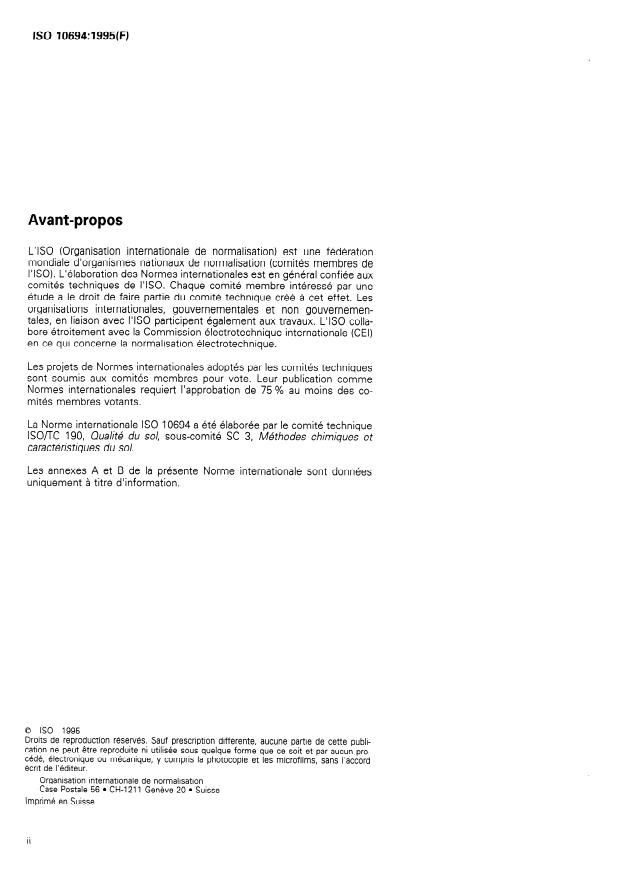
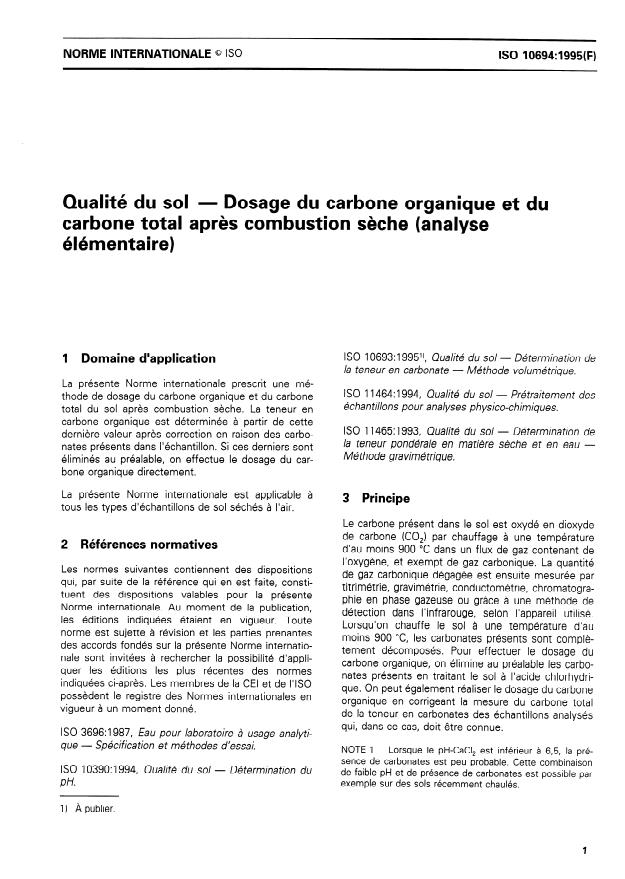
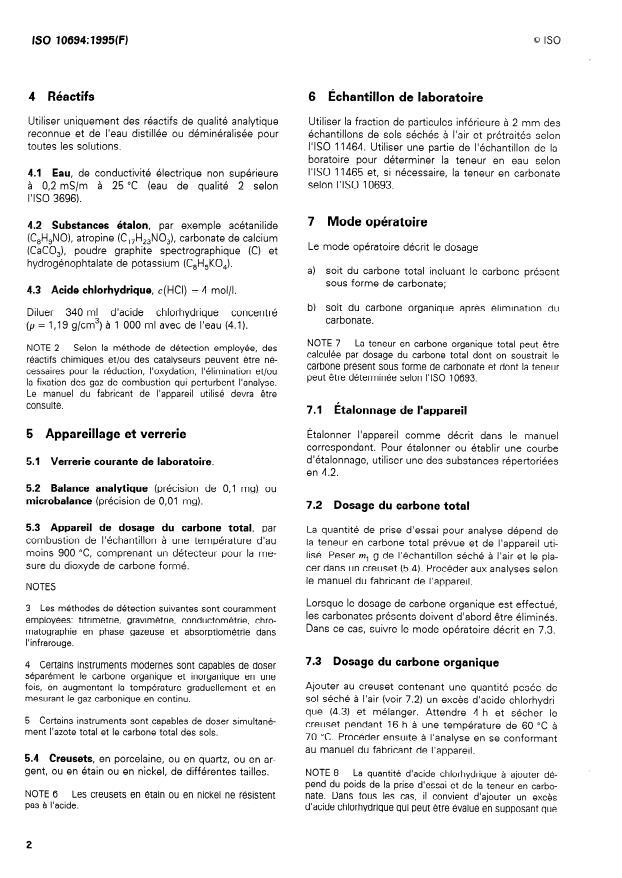
ISO 10694:1995 - Qualité du sol — Dosage du carbone organique et du carbone total apres combustion seche (analyse élémentaire) Released:3/9/1995
ISO 10694:1995 - Qualité du sol — Dosage du carbone organique et du carbone total apres combustion seche (analyse élémentaire) Released:3/9/1995
Overview
ISO 10694:1995 - "Soil quality - Determination of organic and total carbon after dry combustion (elementary analysis)" specifies a laboratory method for measuring total carbon in air-dried soils by dry combustion and for reporting organic carbon after correction for, or removal of, carbonates. The standard applies to all types of air-dried soil samples and defines the principle, apparatus, reagents, sample pretreatment and calculation procedures for soil carbon determination using combustion at temperatures of at least 900 °C.
Key topics and technical requirements
- Principle: Oxidize soil carbon to CO2 by dry combustion (≥900 °C) in an oxygen-containing, CO2‑free gas stream; measure CO2 released by titrimetry, gravimetry, conductometry, gas chromatography or infrared detection.
- Organic vs total carbon:
- Total carbon is measured directly after combustion.
- Organic carbon is calculated by correcting total carbon for carbonate carbon (determined separately), or measured directly after removing carbonates by HCl treatment.
- Sample preparation:
- Use air-dried soil, fraction <2 mm, pretreated per ISO 11464.
- Determine water content (ISO 11465) and, if needed, carbonate content (ISO 10693).
- Apparatus and calibration:
- Analytical balances (0.1 mg or better), combustion apparatus with CO2 detector, crucibles (porcelain, quartz, etc.).
- Calibrate using certified substances (e.g., acetanilide, CaCO3, graphite).
- Reagents and safety:
- Use analytical-grade reagents and grade‑2 water (ISO 3696).
- If removing carbonates, add excess HCl (c = 4 mol/L) to sample in crucible-use appropriately sized crucibles and handle acid-treated samples with care.
- Calculations:
- Convert CO2 to carbon using factor 0.2727 (CO2 → C).
- Organic matter may be estimated from organic carbon using a conversion factor f (commonly 1.7–2.0 for agricultural soils).
- Quality and precision:
- Repeatability and reproducibility guidance provided; interlaboratory trial results and precision limits are reported (ISO 5725-2 referenced).
Applications and who uses it
ISO 10694 is used by:
- Soil testing laboratories and analytical chemistry facilities
- Agricultural and environmental researchers measuring soil organic carbon (SOC)
- Environmental consultants and regulators assessing soil quality, carbon stocks and land management impacts
- Land managers and carbon accounting projects that require standardized soil carbon data for monitoring and reporting
Keywords: ISO 10694:1995, soil quality, organic carbon, total carbon, dry combustion, elementary analysis, soil testing, carbonate correction.
Related standards
- ISO 11464 - Pretreatment of samples for physico-chemical analyses
- ISO 11465 - Determination of dry matter and water content
- ISO 10693 - Determination of carbonate content (volumetric method)
- ISO 3696 - Water for analytical laboratory use
- ISO 10390 - Determination of pH
- ISO 5725-2 - Repeatability and reproducibility (precision)
Relations
- Effective Date
- 09-Feb-2026
- Effective Date
- 09-Feb-2026
- Effective Date
- 09-Feb-2026
- Effective Date
- 09-Feb-2026
- Effective Date
- 09-Feb-2026
- Effective Date
- 09-Feb-2026
- Effective Date
- 09-Feb-2026
- Effective Date
- 09-Feb-2026
- Effective Date
- 09-Feb-2026
- Effective Date
- 09-Feb-2026
- Effective Date
- 09-Feb-2026
- Effective Date
- 09-Feb-2026
- Effective Date
- 09-Feb-2026
- Effective Date
- 09-Feb-2026
- Effective Date
- 09-Feb-2026
Buy Documents
ISO 10694:1995 - Soil quality — Determination of organic and total carbon after dry combustion (elementary analysis) Released:3/9/1995
ISO 10694:1995 - Qualité du sol — Dosage du carbone organique et du carbone total apres combustion seche (analyse élémentaire) Released:3/9/1995
ISO 10694:1995 - Qualité du sol — Dosage du carbone organique et du carbone total apres combustion seche (analyse élémentaire) Released:3/9/1995
Get Certified
Connect with accredited certification bodies for this standard

CIS Institut d.o.o.
Personal Protective Equipment (PPE) certification body. Notified Body NB-2890 for EU Regulation 2016/425 PPE.

Kiwa BDA Testing
Building and construction product certification.
Kmetijski inštitut Slovenije
Agricultural Institute of Slovenia. Soil testing, plant health, agricultural product analysis.
Sponsored listings
Frequently Asked Questions
SIST ISO 10694:1996 is a standard published by the Slovenian Institute for Standardization (SIST). Its full title is "Soil quality - Determination of organic and total carbon after dry combustion (elementary analysis)". This standard covers: Specifies a method for the determination of the total carbon content in soil after dry combustion. The organic carbon content is calculated from this content after correcting for carbonates present in the sample. If carbonates are removed beforehand, the organic carbon content is measured directly. Applicable to all types of air-dried soil samples.
Specifies a method for the determination of the total carbon content in soil after dry combustion. The organic carbon content is calculated from this content after correcting for carbonates present in the sample. If carbonates are removed beforehand, the organic carbon content is measured directly. Applicable to all types of air-dried soil samples.
SIST ISO 10694:1996 is classified under the following ICS (International Classification for Standards) categories: 13.080.10 - Chemical characteristics of soils. The ICS classification helps identify the subject area and facilitates finding related standards.
SIST ISO 10694:1996 has the following relationships with other standards: It is inter standard links to SIST EN ISO 16387:2014, SIST EN ISO 11267:2014, SIST EN 450-1:2013, SIST EN ISO 11269-1:2013, SIST EN ISO 17155:2020, SIST EN ISO 16387:2024, SIST EN ISO 21285:2020, SIST EN ISO 11268-2:2015, SIST EN 13282-2:2015, SIST EN ISO 16198:2015, SIST EN ISO 11267:2024, SIST EN ISO 23611-1:2018, SIST EN ISO 15952:2012, SIST EN ISO 11268-3:2015, SIST EN ISO 29200:2020. Understanding these relationships helps ensure you are using the most current and applicable version of the standard.
SIST ISO 10694:1996 is associated with the following European legislation: EU Directives/Regulations: 2017-01-3098, 2019-01-2991, 2022-01-2545, TP255. When a standard is cited in the Official Journal of the European Union, products manufactured in conformity with it benefit from a presumption of conformity with the essential requirements of the corresponding EU directive or regulation.
SIST ISO 10694:1996 is available in PDF format for immediate download after purchase. The document can be added to your cart and obtained through the secure checkout process. Digital delivery ensures instant access to the complete standard document.
Standards Content (Sample)
SLOVENSKI STANDARD
01-september-1996
Kakovost tal - Določevanje organskega in celotnega ogljika po suhem sežigu
(elementna analiza)
Soil quality - Determination of organic and total carbon after dry combustion (elementary
analysis)
Qualité du sol - Dosage du carbone organique et du carbone total après combustion
sèche (analyse élémentaire)
Ta slovenski standard je istoveten z: ISO 10694:1995
ICS:
13.080.10 Kemijske značilnosti tal Chemical characteristics of
soils
2003-01.Slovenski inštitut za standardizacijo. Razmnoževanje celote ali delov tega standarda ni dovoljeno.
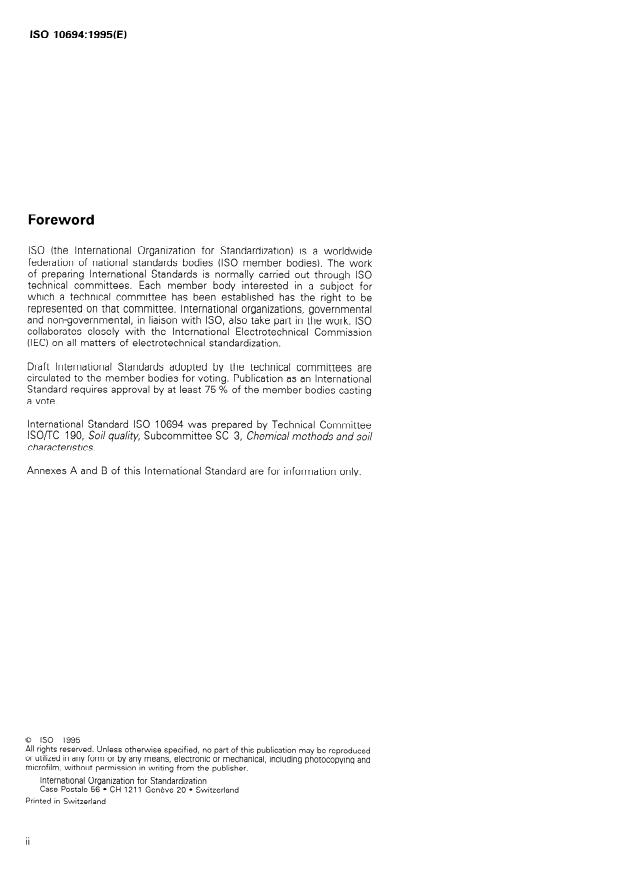
INTERNATIONAL
ISO
STANDARD
First edition
1995-03-01
Soil quality - Determination of organic
and total carbon after dry combustion
(elementary analysis)
Qualite du so/ - Dosage du carbone organique et du carbone total apr&
combustion Seche (analyse elernen taire)
Reference number
ISO 7 0694:1995(E)
Foreword
ISO (the International Organization for Standardization) is a worldwide
federation of national Standards bodies (ISO member bodies). The work
of preparing International Standards is normally carried out through ISO
technical committees. Esch member body interested in a subject for
which a technical committee has been established has the right to be
represented on that committee. International organizations, governmental
and non-governmental, in liaison with ISO, also take part in the work. ISO
collaborates closely with the International Electrotechnical Commission
(1 EC) on all matters of electrotechnical standardization.
Draft International Standards adopted by the technical committees are
circulated to the member bodies for voting. Publication as an International
Standard requires approval by at least 75 % of the member bodies casting
a vote.
International Standard ISO 10694 was prepared by Technical Committee
lSO/TC 190, Seil quality, Subcommittee SC 3, Chemical methods and so;/
characteristics.
Annexes A and B of this International Standard are for information only.
0 ISO 1995
All rights reserved. Unless otherwise specified, no part of this publication may be reproduced
or utilized in any form or by any means, electronie or mechanical, including photocopying and
microfilm, without Permission in writing from the publisher.
International Organization for Standardization
Case Postale 56 l CH-l 211 Geneve 20 l Switzerland
Printed in Switzerland
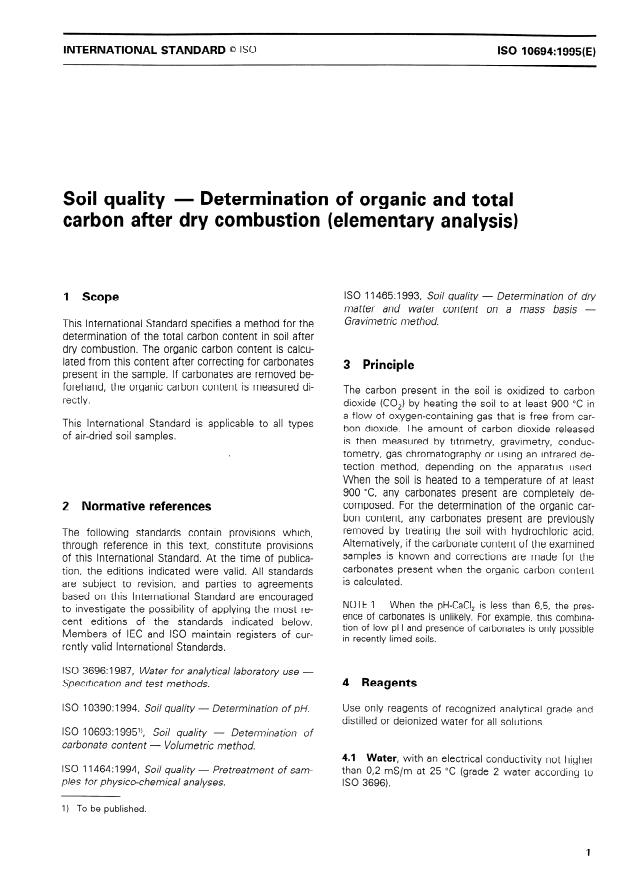
INTERNATIONAL STANDARD 0 ISO
Soil quality - Determination of organic and total
carbon after dry combustion (elementary analysis)
ISO 11465: 1993, Seil quality - Determination of dry
1 Scope
matter and water content on a mass basis -
Gravimetric method.
This International Standard specifies a method for the
determination of the total carbon content in soil after
dry combustion. The organic carbon content is calcu-
lated from this content after correcting for carbonates
3 Principle
present in the Sample. If carbonates are removed be-
forehand, the organic carbon content is measured di-
The carbon present in the soil s oxidized to carbon
rectly.
dioxide (CO,) by heating the soil to at least 900 “C in
a flow of Oxygen-containing gas that is free from car-
This International Standard is applicable to all types
bon dioxide. The amount of carbon dioxide released
of air-dried soil samples.
is then measured by titrimetry, gravimetry, conduc-
tornett-y, gas chromatography or using an infrared de-
tection method, depending on the apparatus used.
When the soil is heated to a temperature of at least
900 “C, any carbonates present are completely de-
composed. For the determination of the organic car-
2 Normative references
bon content, any carbonates present are previously
removed by treating the soil with hydrochloric acid.
The following Standards contain provisions which,
Alternatively, if the carbonate content of the examined
through reference in this text, constitute provisions
samples is known and corrections are made for the
of this International Standard. At the time of publica-
carbonates present when the organic carbon content
tion, the editions indicated were valid. All Standards
is calculated.
are subject to revision, and Parties to agreements
based on this International Standard are encouraged
NOTE 1 When the pH-CaCI, is less than 6,5, the pres-
to investigate the possibility of applying the most re-
ence of carbonates is unlikely. For example, this combina-
cent editions of the Standards indicated below.
tion of low pH and presence of carbonates is only possible
Members of IEC and ISO maintain registers of cur-
in recently limed soils.
rently valid International Standards.
ISO 3696: 1987, Water for analytical laboratory use -
4 Reagents
Specifica tion and test me thods.
Use only reagents of recognized analytical grade and
ISO 10390:1994, Seil quality - Determination of pH.
distilled or deionized water for all solutions.
ISO 10693:19951), Soil quality - Determination of
carbona te con ten t - Volume tric me thod.
4.1 Water, with an electrical conductivity not higher
ISO 11464:1994, Seil quality - Pretreatment of sam- than 0,2 mS/m at 25 “C (grade 2 water according to
ples for physico-Chemical analyses. ISO 3696).
1) To be published.
0 ISO
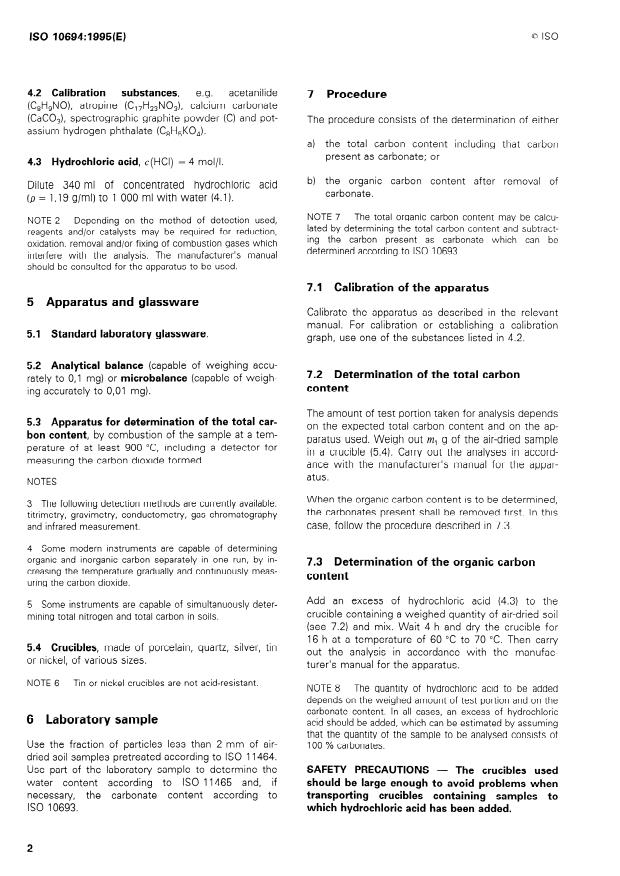
4.2 Calibration substances, e.g. acetanilide
7 Procedure
(C,H,NO), atropine (C,,H,,N03), Calcium carbonate
(CaCO,), spectrographic graphite powder (C) and pot-
The procedure consists of the determination of either
assium hydrogen phthalate (C,H,KO,).
a) the total carbon content including that carbon
present as carbonate; or
4.3 Hydrochlorit acid, c(HCI) = 4 mol/l.
b) the organic carbon content after removal of
Dilute 340 ml of concentrated hydrochloric acid
carbonate.
(p = 1,19 g/ml) to 1 000 ml with water (4.1).
NOTE 7 The total organic carbon content may be calcu-
NOTE 2 Depending on the method of detection used,
lated by determining the total carbon content and subtract-
reagents and/or catalysts may be required for reduction,
ing the carbon present as carbonate which tan be
Oxidation, removal and/or fixing of combustion gases which
determined according to ISO 10693.
The manufacturer ’s manual
interfere with the analysis.
should be consulted for the apparatus to be used.
7.1 Calibration of the apparatus
5 Apparatus and glassware
Calibrate the apparatus as described in the relevant
manual. For calibration or establishing a calibration
5.1 Standard laboratory glassware.
graph, use one of the substances Iisted in 4.2.
5.2 Analytical balance (capable of weighing accu-
7.2 Determination of the total carbon
rately to 0,l mg) or microbalance (capable of weigh-
content
ing accurately to 0,Ol mg).
The amount of test Portion taken for analysis depends
5.3 Apparatus for determination of the total car-
on the expected total carbon content and on the ap-
bon content, by combustion of the Sample at a tem-
paratus used. Weigh out ml g of the air-dried Sample
perature of at least 900 “C, including a detector for
in a crucible (5.4). Carry out the analyses in accord-
measuring the carbon dioxide formed.
ante with the manufacturer ’s manual for the appar-
atus.
NOTES
When the organic carbon content is to be determined,
3 The following detection methods are currently available:
the carbonates present shall be removed first. In this
titrimetry, gravimetry, conductometry, gas chromatography
case, follow the procedure described in 7.3.
and infrared measurement.
4 Some modern instruments are capable of determining
organic and inorganic carbon separately in one run, by in-
7.3 Determination of the organic carbon
creasing the temperature gradually and continuously meas-
content
...
INTERNATIONAL
ISO
STANDARD
First edition
1995-03-01
Soil quality - Determination of organic
and total carbon after dry combustion
(elementary analysis)
Qualite du so/ - Dosage du carbone organique et du carbone total apr&
combustion Seche (analyse elernen taire)
Reference number
ISO 7 0694:1995(E)
Foreword
ISO (the International Organization for Standardization) is a worldwide
federation of national Standards bodies (ISO member bodies). The work
of preparing International Standards is normally carried out through ISO
technical committees. Esch member body interested in a subject for
which a technical committee has been established has the right to be
represented on that committee. International organizations, governmental
and non-governmental, in liaison with ISO, also take part in the work. ISO
collaborates closely with the International Electrotechnical Commission
(1 EC) on all matters of electrotechnical standardization.
Draft International Standards adopted by the technical committees are
circulated to the member bodies for voting. Publication as an International
Standard requires approval by at least 75 % of the member bodies casting
a vote.
International Standard ISO 10694 was prepared by Technical Committee
lSO/TC 190, Seil quality, Subcommittee SC 3, Chemical methods and so;/
characteristics.
Annexes A and B of this International Standard are for information only.
0 ISO 1995
All rights reserved. Unless otherwise specified, no part of this publication may be reproduced
or utilized in any form or by any means, electronie or mechanical, including photocopying and
microfilm, without Permission in writing from the publisher.
International Organization for Standardization
Case Postale 56 l CH-l 211 Geneve 20 l Switzerland
Printed in Switzerland
INTERNATIONAL STANDARD 0 ISO
Soil quality - Determination of organic and total
carbon after dry combustion (elementary analysis)
ISO 11465: 1993, Seil quality - Determination of dry
1 Scope
matter and water content on a mass basis -
Gravimetric method.
This International Standard specifies a method for the
determination of the total carbon content in soil after
dry combustion. The organic carbon content is calcu-
lated from this content after correcting for carbonates
3 Principle
present in the Sample. If carbonates are removed be-
forehand, the organic carbon content is measured di-
The carbon present in the soil s oxidized to carbon
rectly.
dioxide (CO,) by heating the soil to at least 900 “C in
a flow of Oxygen-containing gas that is free from car-
This International Standard is applicable to all types
bon dioxide. The amount of carbon dioxide released
of air-dried soil samples.
is then measured by titrimetry, gravimetry, conduc-
tornett-y, gas chromatography or using an infrared de-
tection method, depending on the apparatus used.
When the soil is heated to a temperature of at least
900 “C, any carbonates present are completely de-
composed. For the determination of the organic car-
2 Normative references
bon content, any carbonates present are previously
removed by treating the soil with hydrochloric acid.
The following Standards contain provisions which,
Alternatively, if the carbonate content of the examined
through reference in this text, constitute provisions
samples is known and corrections are made for the
of this International Standard. At the time of publica-
carbonates present when the organic carbon content
tion, the editions indicated were valid. All Standards
is calculated.
are subject to revision, and Parties to agreements
based on this International Standard are encouraged
NOTE 1 When the pH-CaCI, is less than 6,5, the pres-
to investigate the possibility of applying the most re-
ence of carbonates is unlikely. For example, this combina-
cent editions of the Standards indicated below.
tion of low pH and presence of carbonates is only possible
Members of IEC and ISO maintain registers of cur-
in recently limed soils.
rently valid International Standards.
ISO 3696: 1987, Water for analytical laboratory use -
4 Reagents
Specifica tion and test me thods.
Use only reagents of recognized analytical grade and
ISO 10390:1994, Seil quality - Determination of pH.
distilled or deionized water for all solutions.
ISO 10693:19951), Soil quality - Determination of
carbona te con ten t - Volume tric me thod.
4.1 Water, with an electrical conductivity not higher
ISO 11464:1994, Seil quality - Pretreatment of sam- than 0,2 mS/m at 25 “C (grade 2 water according to
ples for physico-Chemical analyses. ISO 3696).
1) To be published.
0 ISO
4.2 Calibration substances, e.g. acetanilide
7 Procedure
(C,H,NO), atropine (C,,H,,N03), Calcium carbonate
(CaCO,), spectrographic graphite powder (C) and pot-
The procedure consists of the determination of either
assium hydrogen phthalate (C,H,KO,).
a) the total carbon content including that carbon
present as carbonate; or
4.3 Hydrochlorit acid, c(HCI) = 4 mol/l.
b) the organic carbon content after removal of
Dilute 340 ml of concentrated hydrochloric acid
carbonate.
(p = 1,19 g/ml) to 1 000 ml with water (4.1).
NOTE 7 The total organic carbon content may be calcu-
NOTE 2 Depending on the method of detection used,
lated by determining the total carbon content and subtract-
reagents and/or catalysts may be required for reduction,
ing the carbon present as carbonate which tan be
Oxidation, removal and/or fixing of combustion gases which
determined according to ISO 10693.
The manufacturer ’s manual
interfere with the analysis.
should be consulted for the apparatus to be used.
7.1 Calibration of the apparatus
5 Apparatus and glassware
Calibrate the apparatus as described in the relevant
manual. For calibration or establishing a calibration
5.1 Standard laboratory glassware.
graph, use one of the substances Iisted in 4.2.
5.2 Analytical balance (capable of weighing accu-
7.2 Determination of the total carbon
rately to 0,l mg) or microbalance (capable of weigh-
content
ing accurately to 0,Ol mg).
The amount of test Portion taken for analysis depends
5.3 Apparatus for determination of the total car-
on the expected total carbon content and on the ap-
bon content, by combustion of the Sample at a tem-
paratus used. Weigh out ml g of the air-dried Sample
perature of at least 900 “C, including a detector for
in a crucible (5.4). Carry out the analyses in accord-
measuring the carbon dioxide formed.
ante with the manufacturer ’s manual for the appar-
atus.
NOTES
When the organic carbon content is to be determined,
3 The following detection methods are currently available:
the carbonates present shall be removed first. In this
titrimetry, gravimetry, conductometry, gas chromatography
case, follow the procedure described in 7.3.
and infrared measurement.
4 Some modern instruments are capable of determining
organic and inorganic carbon separately in one run, by in-
7.3 Determination of the organic carbon
creasing the temperature gradually and continuously meas-
content
uring the carbon dioxide.
Add an excess of hydrochloric acid (4.3) to the
5 Some instruments are capable of simultanuously deter-
crucible containing a weighed quantity of air-dried soil
mining total nitrogen and total carbon in soils.
(see 7.2) and mix. Wait 4 h and dry the crucible for
16 h at a temperature of 60 “C to 70 “C. Then carry
5.4 Crucibles, made of porcelain, quartz, silver, tin
out the analysis in accordance with the manufac-
or nickel, of various sizes.
turer’s manual for the apparatus.
NOTE 6 Tin or nicke1 crucibles are not acid-resistant.
NOTE
...
NORME ISO
INTERNATIONALE
Première édition
1995-03-01
- Dosage du carbone
Qualité du sol
organique et du carbone total après
combustion sèche (analyse élémentaire)
Soi/ quality - Determination of organic and total carbon after dry
combustion (elemen tary analysis)
Numéro de référence
ISO 10694: 1995(F)
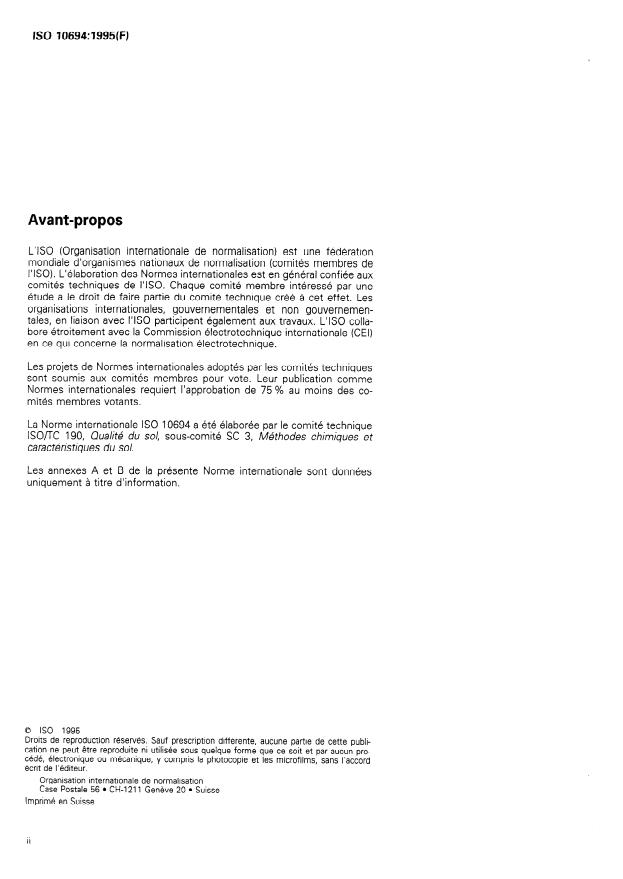
Avant-propos
L’ISO (Organisation internationale de normalisation) est une fédération
mondiale d’organismes nationaux de normalisation (comités membres de
I’ISO). L’élaboration des Normes internationales est en général confiée aux
comités techniques de I’ISO. Chaque comité membre intéressé par une
étude a le droit de faire partie du comité technique créé à cet effet. Les
organisations internationales, gouvernementales et non gouvernemen-
tales, en liaison avec I’ISO participent également aux travaux. L’ISO colla-
bore étroitement avec la Commission électrotechnique internationale (CEI)
en ce qui concerne la normalisation électrotechnique.
Les projets de Normes internationales adoptés par les comités techniques
sont soumis aux comités membres pour vote. Leur publication comme
Normes internationales requiert l’approbation de 75 % au moins des co-
mités membres votants.
La Norme internationale ISO 10694 a été élaborée par le comité technique
lSO/TC 190, Qualité du sol, sous-comité SC 3, Méthodes chimiques et
carat téris tiques du sol.
Les annexes A et B de la présente Norme internationale sont données
uniquement à titre d’information.
0 ISO 1995
Droits de reproduction réservés. Sauf prescription différente, aucune partie de cette publi-
cation ne peut être reproduite ni utilisée sous quelque forme que ce soit et par aucun pro-
cédé, électronique ou mécanique, y compris la photocopie et les microfilms, sans l’accord
écrit de l’éditeur.
Organisation internationale de normalisation
Case Postale 56 l CH-121 1 Genève 20 l Su isse
Imprimé en Suisse
NORME INTERNATIONALE 0 Iso
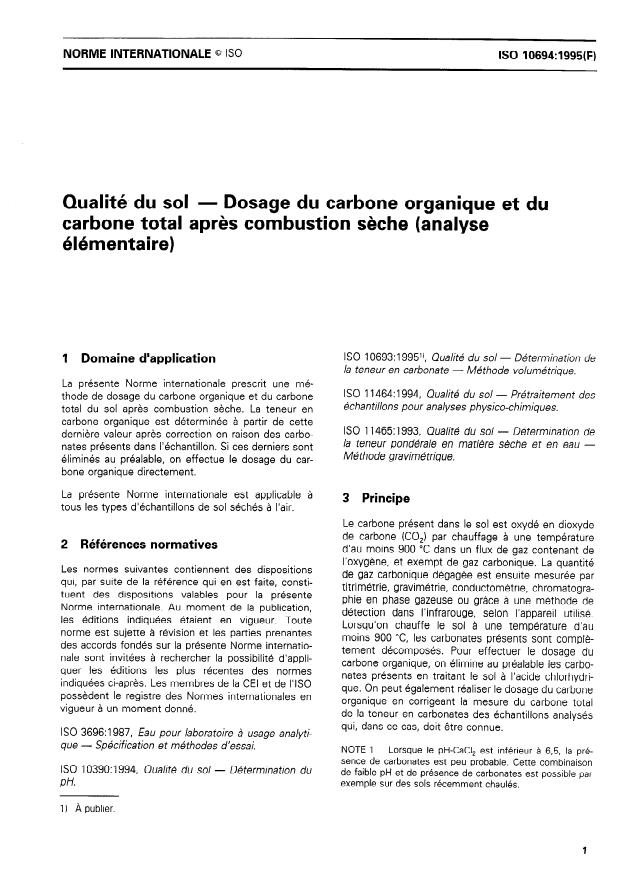
Qualité du sol - Dosage du carbone organique et du
carbone total après combustion sèche (analyse
élémentaire)
ISO 10693:1995l), Qualité du sol - Détermination de
1 Domaine d’application
la teneur en carbonate - Méthode volumétrique.
La présente Norme internationale prescrit une mé-
ISO II 464: 1994, Qualité du sol - Prétraitement des
thode de dosage du carbone organique et du carbone
échantillons pour analyses physico-chimiques.
total du sol après combustion sèche. La teneur en
carbone organique est déterminée à partir de cette
ISO 11465:1993, Qualité du sol - Détermination de
dernière valeur après correction en raison des carbo-
la teneur pondérale en matière sèche et en eau -
nates présents dans l’échantillon. Si ces derniers sont
Méthode gravimé trique.
éliminés au préalable, on effectue le dosage du car-
bone organique directement.
La présente Norme internationale est applicable à
3 Principe
tous les types d’échantillons de sol séchés à l’air.
Le carbone présent dans le sol est oxydé en dioxyde
de carbone (CO,) par chauffage à une température
2 Références normatives
d’au moins 900 “C dans un flux de gaz contenant de
l’oxygène, et exempt de gaz carbonique. La quantité
Les normes suivantes contiennent des dispositions
de gaz carbonique dégagée est ensuite mesurée par
qui, par suite de la référence qui en est faite, consti-
titrimétrie, gravimétrie, conductométrie, chromatogra-
tuent des dispositions valables pour la présente
phie en phase gazeuse ou grâce à une méthode de
Norme internationale. Au moment de la publication,
détection dans l’infrarouge, selon l’appareil utilisé.
les éditions indiquées étaient en vigueur. Toute
Lorsqu’on chauffe le sol à une température d’au
norme est sujette à révision et les parties prenantes
moins 900 “C, les carbonates présents sont complè-
des accords fondés sur la présente Norme internatio-
tement décomposés. Pour effectuer le dosage du
nale sont invitées à rechercher la possibilité d’appli-
carbone organique, on élimine au préalable les carbo-
quer les éditions les plus récentes des normes
nates présents en traitant le sol à l’acide chlorhydri-
indiquées ci-après. Les membres de la CEI et de I’ISO
que. On peut également réaliser le dosage du carbone
possèdent le registre des Normes internationales en
organique en corrigeant la mesure du carbone total
vigueur à un moment donné.
de la teneur en carbonates des échantillons analysés
qui, dans ce cas, doit être connue.
ISO 3696: 1987, Eau pour laboratoire à usage analyti-
- Spécification et méthodes d’essai.
9ue
NOTE 1 Lorsque le pH-CaCI, est inférieur à 6,5, la pré-
sence de carbonates est peu probable. Cette combinaison
ISO 10390: 1994, Qualité du sol - Détermination du
de faible pH et de présence de carbonates est possible par
exemple sur des sols récemment chaulés.
PH*
1) À publier.
0 ISO
4 Réactifs 6 Échantillon de laboratoire
Utiliser la fraction de particules inférieure à 2 mm des
Utiliser uniquement des réactifs de qualité analytique
échantillons de sols séchés à l’air et prétraités selon
reconnue et de l’eau distillée ou déminéralisée pour
I’ISO 11464. Utiliser une partie de l’échantillon de la-
toutes les solutions.
boratoire pour déterminer la teneur en eau selon
I’ISO 11465 et, si nécessaire, la teneur en carbonate
4.1 Eau, de conductivité électrique non supérieure
selon I’ISO 10693.
à 0,2 mS/m à 25 “C (eau de qualité 2 selon
I’ISO 3696).
7 Mode opératoire
4.2 Substances étalon, par exemple acétanilide
(C,H,NO), atropine (C,,H,,NO,), carbonate de calcium
Le mode opératoire décrit le dosage
(CaCO,), poudre graphite spectrographique (C) et
hydrogénophtalate de potassium (CsH,KO,).
a) soit du carbone total incluant le carbone présent
sous forme de carbonate;
4.3 Acide chlorhydrique, C(H~I) = 4 mol/l.
soit du ca rbone organique élimination du
b)
Diluer 340 ml d’acide chlorhydrique concentré
carbonate.
(p = 1 ,19 g/cm3) à 1 000 ml avec de l’eau (4.1).
NOTE 7 La teneur en carbone organique total peut être
NOTE 2 Selon la méthode de détection employée, des
calculée par dosage du carbone total dont on soustrait le
réactifs chimiques et/ou des catalyseurs peuvent être né-
carbone présent sous forme de carbonate et dont la teneur
cessaires pour la réduction, l’oxydation, l’élimination et/ou
peut être déterminée selon I’ISO 10693.
la fixation des gaz de combustion qui perturbent l’analyse.
Le manuel du fabricant de l’appareil utilisé devra être
consulté.
7.1 Étalonnage de l’appareil
Étalonner l’appareil comme décrit dans le manuel
5 Appareillage et verrerie
correspondant. Pour étalonner ou établir une courbe
d’étalonnage, utiliser une des substances répertoriées
5.1 Verrerie courante de laboratoire.
en 4.2.
(préc ision de 0,l mg) ou
5.2 Balance analytique
microbalance (précision d e 0,Ol mg).
7.2 Dosage du carbone total
5.3 Appareil de dosage du carbone total, par
La quantité de prise d’essai pour analyse dépend de
combustion de l’échantillon à une température d’au
la teneur en carbone total prévue et de l’appareil uti-
moins 900 “C, comprenant un détecteur pour la me-
lisé. Peser ml g de l’échantillon séché à l’air et le pla-
sure du dioxyde de carbone formé.
cer dans un creuset (5.4). Procéder aux analyses selon
le manuel du fabricant de l’appareil.
NOTES
Lorsque le dosage de carbone organique est effectué,
3 Les méthodes de détection suivantes sont couramment
les carbonates présents doivent d’abord être éliminés.
employées: titrimétrie, gravimétrie, conductométrie, chro-
Dans ce cas, suivre le mode opératoire décrit en 7.3.
matographie en phase gazeuse et absorptiométrie dans
l’infrarouge.
7.3 Dosage du carbone organique
4 Certains instruments modernes sont capables de doser
séparément le carbone organique et inorganique en une
Ajouter au creuset contenant une quantité pesée de
fois, en augmentant la température graduellement et en
sol séché à l’air (voir 7.2) un excès d’acide chlorhydri-
mesurant le gaz carbonique en continu.
que (4.3) et mélanger. Attendre 4 h et sécher le
5 Certains instruments son
...
NORME ISO
INTERNATIONALE
Première édition
1995-03-01
- Dosage du carbone
Qualité du sol
organique et du carbone total après
combustion sèche (analyse élémentaire)
Soi/ quality - Determination of organic and total carbon after dry
combustion (elemen tary analysis)
Numéro de référence
ISO 10694: 1995(F)
Avant-propos
L’ISO (Organisation internationale de normalisation) est une fédération
mondiale d’organismes nationaux de normalisation (comités membres de
I’ISO). L’élaboration des Normes internationales est en général confiée aux
comités techniques de I’ISO. Chaque comité membre intéressé par une
étude a le droit de faire partie du comité technique créé à cet effet. Les
organisations internationales, gouvernementales et non gouvernemen-
tales, en liaison avec I’ISO participent également aux travaux. L’ISO colla-
bore étroitement avec la Commission électrotechnique internationale (CEI)
en ce qui concerne la normalisation électrotechnique.
Les projets de Normes internationales adoptés par les comités techniques
sont soumis aux comités membres pour vote. Leur publication comme
Normes internationales requiert l’approbation de 75 % au moins des co-
mités membres votants.
La Norme internationale ISO 10694 a été élaborée par le comité technique
lSO/TC 190, Qualité du sol, sous-comité SC 3, Méthodes chimiques et
carat téris tiques du sol.
Les annexes A et B de la présente Norme internationale sont données
uniquement à titre d’information.
0 ISO 1995
Droits de reproduction réservés. Sauf prescription différente, aucune partie de cette publi-
cation ne peut être reproduite ni utilisée sous quelque forme que ce soit et par aucun pro-
cédé, électronique ou mécanique, y compris la photocopie et les microfilms, sans l’accord
écrit de l’éditeur.
Organisation internationale de normalisation
Case Postale 56 l CH-121 1 Genève 20 l Su isse
Imprimé en Suisse
NORME INTERNATIONALE 0 Iso
Qualité du sol - Dosage du carbone organique et du
carbone total après combustion sèche (analyse
élémentaire)
ISO 10693:1995l), Qualité du sol - Détermination de
1 Domaine d’application
la teneur en carbonate - Méthode volumétrique.
La présente Norme internationale prescrit une mé-
ISO II 464: 1994, Qualité du sol - Prétraitement des
thode de dosage du carbone organique et du carbone
échantillons pour analyses physico-chimiques.
total du sol après combustion sèche. La teneur en
carbone organique est déterminée à partir de cette
ISO 11465:1993, Qualité du sol - Détermination de
dernière valeur après correction en raison des carbo-
la teneur pondérale en matière sèche et en eau -
nates présents dans l’échantillon. Si ces derniers sont
Méthode gravimé trique.
éliminés au préalable, on effectue le dosage du car-
bone organique directement.
La présente Norme internationale est applicable à
3 Principe
tous les types d’échantillons de sol séchés à l’air.
Le carbone présent dans le sol est oxydé en dioxyde
de carbone (CO,) par chauffage à une température
2 Références normatives
d’au moins 900 “C dans un flux de gaz contenant de
l’oxygène, et exempt de gaz carbonique. La quantité
Les normes suivantes contiennent des dispositions
de gaz carbonique dégagée est ensuite mesurée par
qui, par suite de la référence qui en est faite, consti-
titrimétrie, gravimétrie, conductométrie, chromatogra-
tuent des dispositions valables pour la présente
phie en phase gazeuse ou grâce à une méthode de
Norme internationale. Au moment de la publication,
détection dans l’infrarouge, selon l’appareil utilisé.
les éditions indiquées étaient en vigueur. Toute
Lorsqu’on chauffe le sol à une température d’au
norme est sujette à révision et les parties prenantes
moins 900 “C, les carbonates présents sont complè-
des accords fondés sur la présente Norme internatio-
tement décomposés. Pour effectuer le dosage du
nale sont invitées à rechercher la possibilité d’appli-
carbone organique, on élimine au préalable les carbo-
quer les éditions les plus récentes des normes
nates présents en traitant le sol à l’acide chlorhydri-
indiquées ci-après. Les membres de la CEI et de I’ISO
que. On peut également réaliser le dosage du carbone
possèdent le registre des Normes internationales en
organique en corrigeant la mesure du carbone total
vigueur à un moment donné.
de la teneur en carbonates des échantillons analysés
qui, dans ce cas, doit être connue.
ISO 3696: 1987, Eau pour laboratoire à usage analyti-
- Spécification et méthodes d’essai.
9ue
NOTE 1 Lorsque le pH-CaCI, est inférieur à 6,5, la pré-
sence de carbonates est peu probable. Cette combinaison
ISO 10390: 1994, Qualité du sol - Détermination du
de faible pH et de présence de carbonates est possible par
exemple sur des sols récemment chaulés.
PH*
1) À publier.
0 ISO
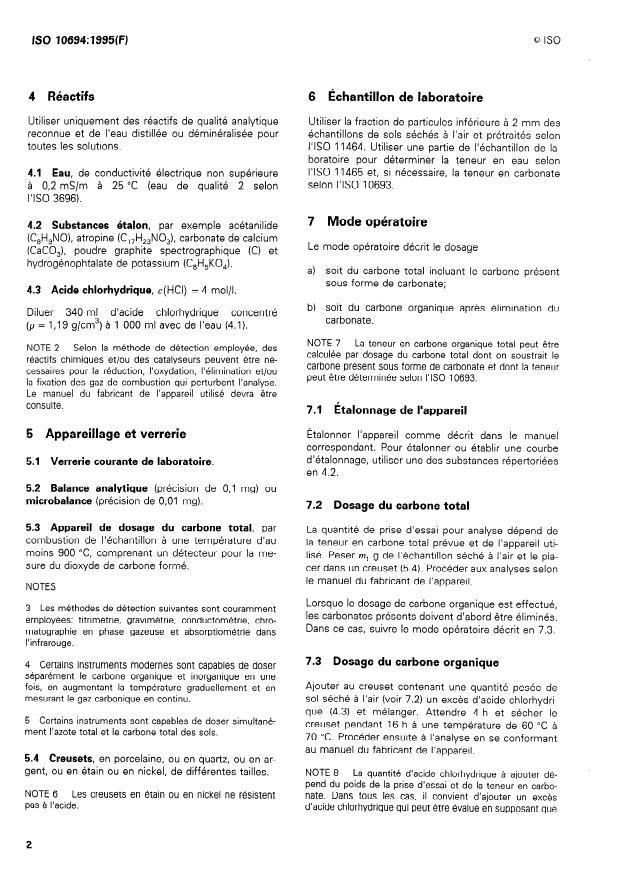
4 Réactifs 6 Échantillon de laboratoire
Utiliser la fraction de particules inférieure à 2 mm des
Utiliser uniquement des réactifs de qualité analytique
échantillons de sols séchés à l’air et prétraités selon
reconnue et de l’eau distillée ou déminéralisée pour
I’ISO 11464. Utiliser une partie de l’échantillon de la-
toutes les solutions.
boratoire pour déterminer la teneur en eau selon
I’ISO 11465 et, si nécessaire, la teneur en carbonate
4.1 Eau, de conductivité électrique non supérieure
selon I’ISO 10693.
à 0,2 mS/m à 25 “C (eau de qualité 2 selon
I’ISO 3696).
7 Mode opératoire
4.2 Substances étalon, par exemple acétanilide
(C,H,NO), atropine (C,,H,,NO,), carbonate de calcium
Le mode opératoire décrit le dosage
(CaCO,), poudre graphite spectrographique (C) et
hydrogénophtalate de potassium (CsH,KO,).
a) soit du carbone total incluant le carbone présent
sous forme de carbonate;
4.3 Acide chlorhydrique, C(H~I) = 4 mol/l.
soit du ca rbone organique élimination du
b)
Diluer 340 ml d’acide chlorhydrique concentré
carbonate.
(p = 1 ,19 g/cm3) à 1 000 ml avec de l’eau (4.1).
NOTE 7 La teneur en carbone organique total peut être
NOTE 2 Selon la méthode de détection employée, des
calculée par dosage du carbone total dont on soustrait le
réactifs chimiques et/ou des catalyseurs peuvent être né-
carbone présent sous forme de carbonate et dont la teneur
cessaires pour la réduction, l’oxydation, l’élimination et/ou
peut être déterminée selon I’ISO 10693.
la fixation des gaz de combustion qui perturbent l’analyse.
Le manuel du fabricant de l’appareil utilisé devra être
consulté.
7.1 Étalonnage de l’appareil
Étalonner l’appareil comme décrit dans le manuel
5 Appareillage et verrerie
correspondant. Pour étalonner ou établir une courbe
d’étalonnage, utiliser une des substances répertoriées
5.1 Verrerie courante de laboratoire.
en 4.2.
(préc ision de 0,l mg) ou
5.2 Balance analytique
microbalance (précision d e 0,Ol mg).
7.2 Dosage du carbone total
5.3 Appareil de dosage du carbone total, par
La quantité de prise d’essai pour analyse dépend de
combustion de l’échantillon à une température d’au
la teneur en carbone total prévue et de l’appareil uti-
moins 900 “C, comprenant un détecteur pour la me-
lisé. Peser ml g de l’échantillon séché à l’air et le pla-
sure du dioxyde de carbone formé.
cer dans un creuset (5.4). Procéder aux analyses selon
le manuel du fabricant de l’appareil.
NOTES
Lorsque le dosage de carbone organique est effectué,
3 Les méthodes de détection suivantes sont couramment
les carbonates présents doivent d’abord être éliminés.
employées: titrimétrie, gravimétrie, conductométrie, chro-
Dans ce cas, suivre le mode opératoire décrit en 7.3.
matographie en phase gazeuse et absorptiométrie dans
l’infrarouge.
7.3 Dosage du carbone organique
4 Certains instruments modernes sont capables de doser
séparément le carbone organique et inorganique en une
Ajouter au creuset contenant une quantité pesée de
fois, en augmentant la température graduellement et en
sol séché à l’air (voir 7.2) un excès d’acide chlorhydri-
mesurant le gaz carbonique en continu.
que (4.3) et mélanger. Attendre 4 h et sécher le
5 Certains instruments son
...