

SIST EN 50731:2025
(Main)Durability - Measurement method for the assessment of the reliability of washing machines for household use
General Information
- Abstract
This document provides a measurement method to assess the reliability of washing machines for household use. This document defines the functional analysis, limiting events/states, environmental conditions and test conditions of washing machines. It also elaborates on the level of confidence on the measurement results.
NOTE 1 The method is based on EN 45552 (General method for the assessment of the durability of energy-related products) and takes into account EN 45554 (General methods for the assessment of the ability to repair, reuse and upgrade energy-related products).
This document provides information about the interrelations of reliability, repairability and upgradeability with consideration towards a durability assessment for washing machines for household use.
This document provides input/results about the investigation on the assessment of repairability and upgradeability for washing machines for household use.
This document is not intended to be used to assess the reliability of:
- washing machines, intended for commercial or industrial use;
- washer-dryers.
NOTE 2 A testing method for washing machines unable to provide heated washing programmes have a low market relevance and will be considered in a future edition of this standard.
This document does not address the ability of washing machines to be reused.
Product functions related to the safety of washing machines are out of the scope of this document.
NOTE 3 EN 60335-2-7 addresses safety requirements for household appliances. It includes aging tests that are relevant to safety.
This document is intended to be used for the validation of a reliability declaration.
- Status
- Published
- Public Enquiry End Date
- 29-Jun-2024
- Publication Date
- 23-Jun-2025
- Technical Committee
- FGA - Consumer information related to household electrical appliances
- Current Stage
- 6060 - National Implementation/Publication (Adopted Project)
- Start Date
- 19-Jun-2025
- Due Date
- 24-Aug-2025
- Completion Date
- 24-Jun-2025

Overview
EN 50731:2025 - Durability - Measurement method for the assessment of the reliability of washing machines for household use - is a CLC/CENELEC European standard that defines a laboratory-based measurement method to assess the reliability and contribution to durability of household washing machines. The standard establishes functional analysis, limiting events/states, environmental and use conditions, test procedures and statistical treatment to support a reliability declaration for front‑ and top‑loading household washers (excluding commercial/industrial machines and washer‑dryers).
Key topics and technical requirements
- Functional analysis: Classification of primary, secondary and tertiary functions so tests target intended consumer use.
- Limiting events / limiting states: Definitions of failures and end states that stop product function or require repair.
- Test conditions: Specification of ambient and use conditions, preparation, loading, and reference testing procedures that align with household use patterns.
- Cycle requirements: Requirements for washing, rinse and spin cycles, including mid, high and eco cycles used for monitoring.
- Parameter monitoring & time tracking: Procedures to measure defined parameters (e.g., spin speed, remaining moisture content) and compare to reference values to detect deviations or failures.
- Parts tests: Complementary component-level tests for priority parts to improve coverage and shorten overall test time.
- End-of-test criteria & statistical relevance: Rules to stop tests and methods to quantify confidence in measurement results and sample sizes.
- Repairability & upgradeability: Consideration of how repair and upgrade options relate to measured reliability and durability outcomes.
- Scope exclusions & safety: Not intended for commercial washers, washer‑dryers or evaluation of safety functions (see EN 60335‑2‑7 for safety/aging).
Practical applications
- Supporting manufacturer reliability declarations and durability claims.
- Guiding R&D and product development to improve long‑term performance and component selection.
- Informing ecodesign, procurement and regulatory assessments that require quantified reliability data.
- Providing a repeatable lab protocol for third‑party test laboratories and consumer organisations performing comparative testing.
- Supplying input to repairability and upgradeability assessments relevant to lifecycle and circular‑economy evaluations.
Who should use this standard
- Appliance manufacturers and design engineers
- Independent test laboratories and certification bodies
- Product compliance, sustainability and procurement teams
- Regulators, policy makers and standards developers
- Consumer advocacy and durability research organisations
Related standards
- EN 45552 (general method for durability of energy‑related products)
- EN 45554 (assessment of repair, reuse and upgradeability)
- EN 60456 (washing machine performance test methods)
- EN 60335‑2‑7 (safety and aging tests for household laundry appliances)
Keywords: EN 50731:2025, durability, reliability, measurement method, washing machines, household use, repairability, upgradeability, durability assessment, testing.
Relations
- Effective Date
- 03-Feb-2026
- Effective Date
- 03-Feb-2026
Frequently Asked Questions
SIST EN 50731:2025 is a standard published by the Slovenian Institute for Standardization (SIST). Its full title is "Durability - Measurement method for the assessment of the reliability of washing machines for household use". This standard covers: This document provides a measurement method to assess the reliability of washing machines for household use. This document defines the functional analysis, limiting events/states, environmental conditions and test conditions of washing machines. It also elaborates on the level of confidence on the measurement results. NOTE 1 The method is based on EN 45552 (General method for the assessment of the durability of energy-related products) and takes into account EN 45554 (General methods for the assessment of the ability to repair, reuse and upgrade energy-related products). This document provides information about the interrelations of reliability, repairability and upgradeability with consideration towards a durability assessment for washing machines for household use. This document provides input/results about the investigation on the assessment of repairability and upgradeability for washing machines for household use. This document is not intended to be used to assess the reliability of: - washing machines, intended for commercial or industrial use; - washer-dryers. NOTE 2 A testing method for washing machines unable to provide heated washing programmes have a low market relevance and will be considered in a future edition of this standard. This document does not address the ability of washing machines to be reused. Product functions related to the safety of washing machines are out of the scope of this document. NOTE 3 EN 60335-2-7 addresses safety requirements for household appliances. It includes aging tests that are relevant to safety. This document is intended to be used for the validation of a reliability declaration.
This document provides a measurement method to assess the reliability of washing machines for household use. This document defines the functional analysis, limiting events/states, environmental conditions and test conditions of washing machines. It also elaborates on the level of confidence on the measurement results. NOTE 1 The method is based on EN 45552 (General method for the assessment of the durability of energy-related products) and takes into account EN 45554 (General methods for the assessment of the ability to repair, reuse and upgrade energy-related products). This document provides information about the interrelations of reliability, repairability and upgradeability with consideration towards a durability assessment for washing machines for household use. This document provides input/results about the investigation on the assessment of repairability and upgradeability for washing machines for household use. This document is not intended to be used to assess the reliability of: - washing machines, intended for commercial or industrial use; - washer-dryers. NOTE 2 A testing method for washing machines unable to provide heated washing programmes have a low market relevance and will be considered in a future edition of this standard. This document does not address the ability of washing machines to be reused. Product functions related to the safety of washing machines are out of the scope of this document. NOTE 3 EN 60335-2-7 addresses safety requirements for household appliances. It includes aging tests that are relevant to safety. This document is intended to be used for the validation of a reliability declaration.
SIST EN 50731:2025 is classified under the following ICS (International Classification for Standards) categories: 97.060 - Laundry appliances. The ICS classification helps identify the subject area and facilitates finding related standards.
SIST EN 50731:2025 has the following relationships with other standards: It is inter standard links to SIST EN 60456:2016, SIST EN 60456:2016/A12:2023. Understanding these relationships helps ensure you are using the most current and applicable version of the standard.
SIST EN 50731:2025 is available in PDF format for immediate download after purchase. The document can be added to your cart and obtained through the secure checkout process. Digital delivery ensures instant access to the complete standard document.
Standards Content (Sample)
SLOVENSKI STANDARD
01-september-2025
Trajnost - Merilna metoda za ocenjevanje zanesljivosti pralnih strojev za uporabo v
gospodinjstvu
Durability - Measurement method for the assessment of the reliability of washing
machines for household use
Funktionsbeständigkeit - Messverfahren zur Bewertung der Zuverlässigkeit von
Waschmaschinen für den Hausgebrauch
Durabilité - Méthode de mesure pour l’évaluation de la fiabilité des machines à laver
pour usage domestique
Ta slovenski standard je istoveten z: EN 50731:2025
ICS:
97.060 Aparati za nego perila Laundry appliances
2003-01.Slovenski inštitut za standardizacijo. Razmnoževanje celote ali delov tega standarda ni dovoljeno.
EUROPEAN STANDARD EN 50731
NORME EUROPÉENNE
EUROPÄISCHE NORM June 2025
ICS 97.060
English Version
Durability - Measurement method for the assessment of the
reliability of washing machines for household use
Durabilité - Méthode de mesure pour l'évaluation de la Funktionsbeständigkeit - Messverfahren zur Bewertung der
fiabilité des machines à laver pour usage domestique Zuverlässigkeit von Waschmaschinen für den
Hausgebrauch;
This European Standard was approved by CENELEC on 2025-05-27. CENELEC members are bound to comply with the CEN/CENELEC
Internal Regulations which stipulate the conditions for giving this European Standard the status of a national standard without any alteration.
Up-to-date lists and bibliographical references concerning such national standards may be obtained on application to the CEN-CENELEC
Management Centre or to any CENELEC member.
This European Standard exists in three official versions (English, French, German). A version in any other language made by translation
under the responsibility of a CENELEC member into its own language and notified to the CEN-CENELEC Management Centre has the
same status as the official versions.
CENELEC members are the national electrotechnical committees of Austria, Belgium, Bulgaria, Croatia, Cyprus, the Czech Republic,
Denmark, Estonia, Finland, France, Germany, Greece, Hungary, Iceland, Ireland, Italy, Latvia, Lithuania, Luxembourg, Malta, the
Netherlands, Norway, Poland, Portugal, Republic of North Macedonia, Romania, Serbia, Slovakia, Slovenia, Spain, Sweden, Switzerland,
Türkiye and the United Kingdom.
European Committee for Electrotechnical Standardization
Comité Européen de Normalisation Electrotechnique
Europäisches Komitee für Elektrotechnische Normung
CEN-CENELEC Management Centre: Rue de la Science 23, B-1040 Brussels
© 2025 CENELEC All rights of exploitation in any form and by any means reserved worldwide for CENELEC Members.
Ref. No. EN 50731:2025 E
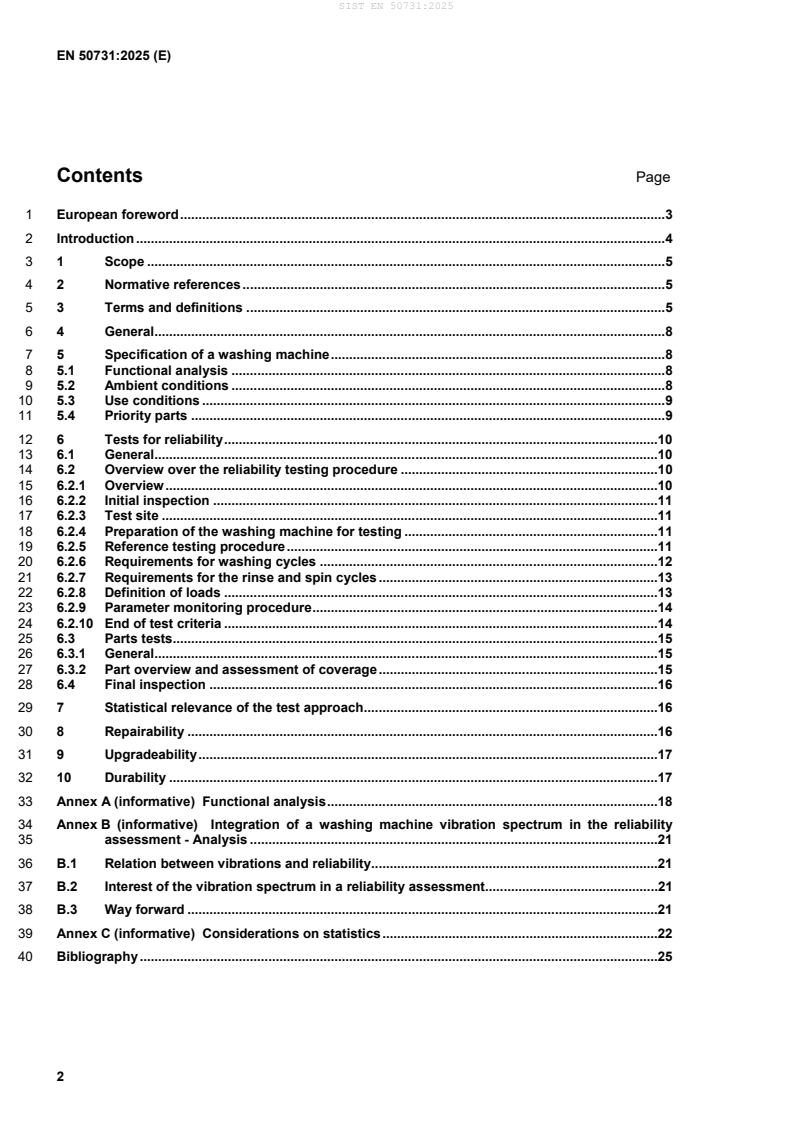
Contents Page
1 European foreword . 3
2 Introduction . 4
3 1 Scope . 5
4 2 Normative references . 5
5 3 Terms and definitions . 5
6 4 General . 8
7 5 Specification of a washing machine . 8
8 5.1 Functional analysis . 8
9 5.2 Ambient conditions . 8
10 5.3 Use conditions . 9
11 5.4 Priority parts . 9
12 6 Tests for reliability .10
13 6.1 General .10
14 6.2 Overview over the reliability testing procedure .10
15 6.2.1 Overview .10
16 6.2.2 Initial inspection .11
17 6.2.3 Test site .11
18 6.2.4 Preparation of the washing machine for testing .11
19 6.2.5 Reference testing procedure .11
20 6.2.6 Requirements for washing cycles .12
21 6.2.7 Requirements for the rinse and spin cycles .13
22 6.2.8 Definition of loads .13
23 6.2.9 Parameter monitoring procedure .14
24 6.2.10 End of test criteria .14
25 6.3 Parts tests.15
26 6.3.1 General .15
27 6.3.2 Part overview and assessment of coverage .15
28 6.4 Final inspection .16
29 7 Statistical relevance of the test approach .16
30 8 Repairability .16
31 9 Upgradeability .17
32 10 Durability .17
33 Annex A (informative) Functional analysis .18
34 Annex B (informative) Integration of a washing machine vibration spectrum in the reliability
35 assessment - Analysis .21
36 B.1 Relation between vibrations and reliability.21
37 B.2 Interest of the vibration spectrum in a reliability assessment.21
38 B.3 Way forward .21
39 Annex C (informative) Considerations on statistics .22
40 Bibliography .25
41 European foreword
42 This document (EN 50731:2025) has been prepared by CLC/TC 59X “Performance of household and similar
43 electrical appliances”.
44 The following dates are fixed:
• latest date by which this document has to be (dop) 2026-06-30
implemented at national level by publication of
an identical national standard or by
endorsement
• latest date by which the national standards (dow) 2028-06-30
conflicting with this document have to be
withdrawn
45 Attention is drawn to the possibility that some of the elements of this document may be the subject of patent
46 rights. CENELEC shall not be held responsible for identifying any or all such patent rights.
47 Any feedback and questions on this document should be directed to the users’ national committee. A complete
48 listing of these bodies can be found on the CENELEC website.
49 Introduction
50 As energy-related products (ErP) can often not be completely recycled, and the benefits associated with material
51 recovery cannot fully compensate the energy and material demand of the whole production chain, each
52 disposed ErP also means losses in energy and materials. Therefore, increasing the durability of ErPs can
53 contribute to a reduction in the quantity of raw materials used and energy required for the production and end-
54 of-life treatment of ErPs and consequently reduces adverse environmental impacts.
55 Due to the general longevity of washing machines and their long-running hours per annum, the assessment of
56 the reliability of these products can be very time-consuming and costly. Methods and approaches that may be
57 used to quantify these aspects are included in this document. The transportation and storage of washing
58 machines is usually considered as a separate aspect from the durability and reliability of the product. It is
59 generally expected that the product will arrive at the end consumer in a state where it can fulfil its intended
60 function.
61 The procedure described in this document is under consideration in light of a validation test being conducted at
62 the time of writing this document.
63 The validation test is conducted via APPLiA Home Appliances Europe
64 1 Scope
65 This document provides a measurement method to assess the reliability of washing machines for household
66 use. This document defines the functional analysis, limiting events/states, environmental conditions and test
67 conditions of washing machines. It also elaborates on the level of confidence on the measurement results.
68 NOTE 1 The method is based on EN 45552 (General method for the assessment of the durability of energy-related
69 products) and takes into account EN 45554 (General methods for the assessment of the ability to repair, reuse and upgrade
70 energy-related products).
71 This document provides information about the interrelations of reliability, repairability and upgradeability with
72 consideration towards a durability assessment for washing machines for household use.
73 This document provides input/results about the investigation on the assessment of repairability and
74 upgradeability for washing machines for household use.
75 This document is not intended to be used to assess the reliability of:
76 — washing machines, intended for commercial or industrial use;
77 — washer-dryers.
78 NOTE 2 A testing method for washing machines unable to provide heated washing programmes have a low market
79 relevance and will be considered in a future edition of this standard.
80 This document does not address the ability of washing machines to be reused.
81 Product functions related to the safety of washing machines are out of the scope of this document.
82 NOTE 3 EN 60335-2-7 addresses safety requirements for household appliances. It includes aging tests that are relevant
83 to safety.
84 This document is intended to be used for the validation of a reliability declaration.
85 2 Normative references
86 The following documents are referred to in the text in such a way that some or all of their content constitutes
87 requirements of this document. For dated references, only the edition cited applies. For undated references, the
88 latest edition of the referenced document (including any amendments) applies.
89 EN 60456:2016, Clothes washing machines for household use - Methods for measuring the performance
90 3 Terms and definitions
91 For the purposes of this document, the following terms and definitions apply.
92 ISO and IEC maintain terminology databases for use in standardization at the following addresses:
93 — ISO Online browsing platform: available at https://www.iso.org/obp/
94 — IEC Electropedia: available at https://www.electropedia.org/
95 3.1
96 durability
97 ability to function as required, under defined conditions of use, maintenance and repair,
98 until a limiting state is reached
99 Note 1 to entry: The degree to which maintenance and repair are within the scope of durability will vary by product or
100 product-group.
As impacted by EN 60456:2016/A12:2023.
101 Note 2 to entry: Durability can be expressed in units appropriate to the part or product concerned, e.g. calendar time,
102 operating cycles, distance run, etc. The units should always be clearly stated.
103 [SOURCE: EN 45552:2020, 3.1.1.1, Note 2 to entry substituted]
104 3.2
105 reliability
106 probability that a product functions as required under given conditions, including maintenance, for a given
107 duration without a limiting event
108 Note 1 to entry: The intended function(s) and given conditions are described in the information for use provided with the
109 product.
110 Note 2 to entry: Duration can be expressed in units appropriate to the part or product concerned, e.g. calendar time,
111 operating cycles, distance run, etc.
112 [SOURCE: EN 45552:2020, 3.1.1.2, last sentence of Note 2 to entry deleted]
113 3.3
114 limiting event
115 occurrence which results in a primary or secondary function no longer being delivered
116 Note 1 to entry: Examples of limiting events are failure, wear-out failure or deviation of any analogue signal.
117 [SOURCE: EN 45552:2020, 3.1.1.3]
118 3.4
119 limiting state
120 condition after one or more limiting event(s)
121 Note 1 to entry: A limiting state can be changed to a functional state by maintenance or repair of the appliance.
122 Note 2 to entry: A limiting state can change to EoL-status, if maintenance or repair is no longer viable due to socio-
123 economic or technical reasons.
124 [SOURCE: EN 45552:2020, 3.1.1.4]
125 3.5
126 primary function
127 function fulfilling the intended use
128 Note 1 to entry: There can be more than one primary function.
129 [SOURCE: EN 45552:2020, 3.1.2.1]
130 3.6
131 secondary function
132 function that enables, supplements or enhances the primary function(s)
133 [SOURCE: EN 45552:2020, 3.1.2.2]
134 3.7
135 tertiary function
136 function other than a primary or a secondary function
137 [SOURCE: EN 45552:2020, 3.1.2.3]
138 3.8
139 maintenance
140 action carried out by the user to retain a product in a condition where it is able to function as specified by the
141 manufacturer
142 Note 1 to entry: Examples of such actions include inspection, adjustments, cleaning, lubrication, automatic software
143 update. Such actions are performed by users in accordance with instructions provided with the equipment; any repair
144 process or other actions performed by service personnel in order to ensure that parts with a known time to failure are
145 replaced in order to keep the product functioning are not considered maintenance.
146 3.9
147 repair
148 process of returning a faulty product to a condition where it can fulfil its intended use
149 [SOURCE: EN 45554:2020, 3.1.4]
150 3.10
151 part
152 hardware, firmware or software constituent of a product
153 [SOURCE: EN 45554:2020, 3.1.1]
154 3.11
155 washing cycle
156 complete washing process as defined by a selected programme, consisting of a series of different operations
157 including washing, rinsing, and spinning procedure
158 3.12
159 reference test
160 initial procedure for determining the reference values of monitored parameters in the programmes used for
161 conducting the reliability test
162 3.13
163 parameter monitoring
164 procedure for monitoring defined parameters through the measurement of their values and assessing deviation
165 from reference values
166 3.14
167 time tracking
168 recording of values of defined parameters in relation to the test time
169 3.15
170 spin speed
171 rotational frequency of a drum during spin extraction
172 [SOURCE: EN 60456:2016, 3.1.17]
173 3.16
174 rinse and spin cycle
175 programme with the purpose of rinsing and spin drying the load
176 3.17
177 mid cycle
178 washing programme for cotton textiles which maximum temperature is closest to 60°C
179 3.18
180 high cycle
181 washing programme for heavily soiled textiles at the highest maximum temperature
182 3.19
183 eco cycle
184 dedicated programme used to determine energy label values
185 3.20
186 remaining moisture content
187 measure for the additional amount of moisture that is contained in the base load in relation to the equilibrium
188 condition for base load items which have been conditioned in a controlled space
189 [SOURCE: EN 60456:2016, 3.1.27]
190 3.21
191 EoL
192 end-of-life
193 life cycle stage of a product starting when it is removed from its intended use stage
194 Note 1 to entry: Within this document, removal from its intended use phase includes when it has been discarded as waste.
195 [SOURCE: EN 45555:2019, 3.1.1]
196 3.22
197 load
198 textile load used for the tests with defined characteristics and mass
199 4 General
200 The reliability assessment methodology for washing machines is developed using the general reliability
201 assessment approach as described in EN 45552 and considers concepts used in EN 60456. The methodology
202 described in this document consists of a reliability analysis and focuses on a physical testing methodology
203 carried out on the washing machine and complemented by an additional parts test. It contains the necessary
204 functional analysis of a washing machine with the classification of primary, secondary and tertiary functions.
205 During the test for reliability, the washing machine’s ability to perform its function is evaluated on the basis of
206 defined parameters. The methodology outlined in this document attempts to balance accuracy and acceleration.
207 Acceleration significantly reduces the time required to test the washing machine, but in return the test method
208 moves away from real life usage patterns. The described assessment attempts to compensate for through the
209 specified load quantities and washing temperatures.
210 5 Specification of a washing machine
211 5.1 Functional analysis
212 The primary function of a washing machine, fulfilling its main purpose, is to provide cleaned, rinsed and spin-
213 dried laundry.
214 The functional analysis that is shown in Annex A has been conducted to identify:
215 — secondary functions needed to fulfil primary functions;
216 — parts involved in providing secondary functions;
217 — technical parameters characterizing each secondary function and limiting states.
218 NOTE The FAST method described in EN 12973 was used to conduct the functional analysis.
219 5.2 Ambient conditions
220 The ambient conditions are a set of parameters reflecting the normal use conditions of the washing machine.
221 They represent an average of conditions met during the use of a washing machine in a real household. Table 1
222 lists relevant parameters, mainly based on the ambient conditions as defined in EN 60456, however, with larger
223 tolerances to reduce costs for operating the test.
224 Table 1 — Relevant ambient conditions
Parameter Value
Room temperature (23 ± 4) °C
Power supply 230 V with a tolerance of ± 7 V
50 Hz with a tolerance of ± 0,5 Hz
Floor/pedestal below Flat hard floor with scratches and other irregularities of the surface
(roughness below 0,5 mm)
The washing machine shall not be installed on soft floor coverings (e.g.
carpets, vinyl, PVC and similar) or on wooden joist floors.
Distance to wall Wooden cabinet for built in appliances
Free standing (follow manufacturers instruction on machine setup)
See EN IEC 60704-1:2021, Annex B.
Water supply – Temperature (15 ± 5) °C
Water supply – pressure (2 500 ± 1 000) kPa
Water – hardness (2,5 ± 1,0) mmol/l
Height of drainage system Maximum recommended height according to operating instructions of
the manufacturer
225 5.3 Use conditions
226 The testing procedure as used in Clause 6 has been put together to reflect the critical use conditions found in
227 consumer studies. They consider especially:
228 — reflection of programmes used by consumers; and
229 — putting thermal and mechanical stress on the machine.
230 NOTE A broad range of information on the user behaviour has been considered while drafting this document (see
231 Bibliography).
232 5.4 Priority parts
233 The concept of priority parts is based on the assumption that there is a limited and predictable set of parts that
234 cause the vast majority of failures in the field. Reducing the test to this limited number of parts can be a way to
235 reduce the effort for testing, shorten the testing period and create more consistent results. However, this
236 approach comes along with considerable shortcomings:
237 — first, there is no data indicating such a strict correlation. It is likely to be more than e.g. five parts involved in
238 the majority of failures. Thus testing priority parts would bear the risk of missing out relevant failure
239 mechanisms and failing parts;
240 — second, testing of parts outside their normal operation environment bears the risk of creating untypical load
241 situations for the part (e.g. in terms of current, mechanical load, exposure to humidity, etc.). Also, there may
242 be a variation between product design concepts using the same part in different places in the machine.
243 — another aspect is, that the test of individual parts would result in the need for additional test equipment that
244 is specifically designed for special tests of a single component mimicking somehow the conditions for the
245 part in the product.
246 All priority parts addressed by the reliability assessment methodology are listed in Annex A.
247 In the end, testing the whole product seemed to be the most realistic and most efficient way to cover all failure
248 mechanisms and the consistent exposure of parts to their “natural” environmental conditions.
249 6 Tests for reliability
250 6.1 General
251 The reliability test procedure consists of a series of washing cycles and rinse and spin cycles. The series of
252 washing cycles serve the purpose of checking the functionality of the product in a near-use scenario covering
253 all secondary functions, whilst the rinse and spin cycles are intended to put a mechanical stress on the product
254 while shortening the test duration.
255 The testing procedure described in 6.2 is equivalent to one year of usage. It shall be run multiple times to cover
256 a longer period.
257 Maintenance operations shall be performed as defined in the user manual.
258 As with any probability assessment a proper statistical treatment and responsible interpretation of the results is
259 required (see Clause 7).
260 An alternative approach for the reliability assessment can be the analysis of vibrations of the machine. A first
261 analysis of this approach is shown in informative Annex B.
262 6.2 Overview over the reliability testing procedure
263 6.2.1 Overview
264 The reliability test is composed of three phases: the initial phase, the main phase and the final inspection, as
265 described in Table 2.
266 Table 2 — Reliability testing procedure
Phase Details of test phase No. of
executions of
phase
Initial The initial phase consists of the initial inspection (see 6.2.2), the preparation 1
phase for testing (see 6.2.4) and the reference testing procedure (see 6.2.5). All of
them shall be carried out only once within a test scheme.
Main The main phase of the test procedure consists of repeated series of 80 Repeated as
phase washing cycles (see 6.2.6) alternating with 140 rinse and spin cycles (see often as
6.2.7) run with different load quantities. needed for the
validation of
One test series of 220 cycles (washing cycle and rinse and spin cycles) of the
the declared
main phase are considered to represent the use of the washing machine in an
value
average household for one year. The series of washing cycles and rinse and
spin cycles (220 cycles) shall be repeated up to the number of cycles, which
are declared by the manufacturer or the equivalent number of cycles
according to the declared lifetime or until a failure occurs or otherwise end-of-
test criteria are met. Within a test series the order of washing and rinse and
spin cycles maybe chosen arbitrarily.
Machine parameters as described in 6.2.8 will be monitored over these cycles.
Final After finishing the reliability test, the machine shall be finally inspected to 1
inspection detect damages that have not led to failure but are still existent (see 6.2.10).
267 NOTE A test series can be reduced to 110 cycles to represent half a year of use.
268 6.2.2 Initial inspection
269 The machine shall be unpacked and be set up according to the user’s manual and the parameter defined in 5.2,
270 Table 1. The machine and, if applicable, the packaging of the machine shall be inspected assuring the machine
271 has not been used before and does not show any sign of damage or wear. The initial inspection shall be done
272 without disassembly.
273 Water inside the tub should not be seen as a sign of usage or wear.
274 6.2.3 Test site
275 The test site ensures that the washing machine can be operated under defined ambient conditions as described
276 in 5.2. It provides the necessary measurement equipment as specified in the following clauses.
277 6.2.4 Preparation of the washing machine for testing
278 In case, according to manufacturer instructions, the machine requires running an initial programme for setup,
279 this shall be conducted but not count towards the final assessment of the total number of washing cycles and
280 rinse and spin cycles.
281 The necessary measuring equipment shall be installed and/or connected. Minor modifications to the product
282 are permitted for use of the measuring equipment, e.g. the machine may be opened to place sensors. Minimal
283 mechanical changes comprise drilling holes for wires or sensors or applying reflecting tape as long as influences
284 on the test results can be precluded.
285 Afterwards, the correct installation and placement of the machine shall be checked again and documented after
286 the installation of the measuring equipment.
287 During the washing cycles and the rinse and spin cycles specific machine parameters shall be permanently
288 monitored:
289 — energy consumption in kWh including time tracking;
290 — spin speed in rpm including time tracking;
291 — cycle counter;
292 — time to complete cycle;
293 — water usage in l (recommended).
294 The measurement instruments shall be designed to meet the requirements in accordance with EN 60456:2016,
295 Annex ZE and 5.5.
296 Testing the washing performance of the washing machine is not necessary because it is assumed that the
297 machine will maintain its performance as long as all secondary functions are working, which is ensured by
298 testing the parameters.
299 6.2.5 Reference testing procedure
300 In order to gain a sound understanding of the actual functionality of the washing machine and its behaviour
301 under regular operating conditions, a number of pre-runs (in the following called reference tests) shall be
302 performed. During these pre-runs, essential parameters shall be monitored which are relevant for the
303 assessment of the proper execution of the primary function and of relevant secondary functions of the machine.
304 During the reference test, measurements of the parameters defined under 6.2.4 shall be collected to allow for
305 detecting gradual performance deviations or even failure of secondary functions in the course of the testing
306 procedure. This is particularly relevant for those test cycles that are not based on the Eco cycle and are not
307 regulated. For the final assessment of the number of cycles performed by the machine, the reference test runs
308 shall not be counted towards the total number of washing cycles and rinse and spin cycles.
309 The washing cycles shall be performed with a wet cotton load.
310 In order to prepare a wet cotton load, the load has to complete one initial washing cycle in a cotton programme
311 with highest spin speed or, alternatively, shall be wetted artificially according to the declared remaining moisture
312 content of the eco cycle.
313 For all washing cycles and rinse and spin cycles, the total energy consumption per cycle, the water consumption
314 per cycle, the maximum spin speed reached in a washing or rinse and spin cycle and the duration of the spin
315 phase at the maximum speed shall be measured. The mean values of the measured values for each washing
316 cycle shall be calculated for each washing programme and taken as reference point for all following parameter
317 monitoring.
318 To measure the duration of the spin phase, the measured raw data shall be inspected visually. If a deviation is
319 discovered, the spin speed data needs to be checked in accordance with EN 60456:2016, ZA.4.7.
320 The programmes shown in Table 3 shall be run:
321 Table 3 — Initial reference testing proce
...