

SIST EN 9300-121:2024
(Main)Aerospace series - LOTAR - LOng Term Archiving and Retrieval of digital technical product documentation such as 3D CAD and PDM data - Part 121: Semantic representation of CAD 3D Explicit Geometry with Product and Manufacturing Information
General Information
- Abstract
1.1 Introduction
This document defines the requirements for the long term digital preservation of the Semantic Representation of Product and Manufacturing Information (PMI) with their possible links to the 3D explicit shape and geometry of single CAD parts. The goal is to preserve this 3D information, without loss, with respect to the geometry produced by the original CAD system, following the principles laid down in EN 9300 003 “Fundamentals and Concepts”.
The requirements of EN 9300 110 concerning the preservation of the 3D explicit shape shall apply within this Part.
The term “semantic representation” is defined in Clause 3 “Terms, definitions and abbreviations”.
1.2 In scope
The following outlines the total scope of EN 9300 121:
- machine-interpretable PMI “Semantic Representation” (Refer to clause 3 for definition);
- the association of the above with 3D geometric shapes;
- the possible association of the above with Presentation of 3D Product and Manufacturing Information (PMI), and 3D annotations as defined in EN 9300 120.
In EN 9300 121, the technology used to preserve this 3D information is based on semantic representation. The main use cases are Certification, Product Liability and Design re-use.
For the purpose of this document, the semantic definition is at the level that supports associative “Cross-highlighting” for the purpose of human readability.
1.3 Out of scope
The following is outside the scope:
- PMI presentation (defined in EN 9300 120);
- User defined attributes that are assigned to 3D geometric entities or at the part level. The archiving of the UDA is defined in EN 9300 120.
- How to preserve additional information:
- - property rights;
- - form features;
- - CAD Assemblies.
- The semantics of special Notes outside the scope of PMI: ITAR/EAR, proprietary, and title block information, etc.
- Status
- Published
- Public Enquiry End Date
- 14-Sep-2022
- Publication Date
- 19-Nov-2023
- Technical Committee
- I13 - Imaginarni 13
- Current Stage
- 6060 - National Implementation/Publication (Adopted Project)
- Start Date
- 16-Nov-2023
- Due Date
- 21-Jan-2024
- Completion Date
- 20-Nov-2023

Overview
EN 9300-121:2023 (CEN) is part of the aerospace LOTAR (LOng Term Archiving and Retrieval) series and defines requirements for the long‑term digital preservation of the semantic representation of Product and Manufacturing Information (PMI) tied to 3D explicit CAD geometry for single parts. The standard focuses on preserving machine‑interpretable PMI without loss of meaning or association to the original CAD geometry, following the principles in EN 9300-003 and the 3D shape preservation rules in EN 9300-110. Semantic representation here enables associative “cross‑highlighting” to support human readability while maintaining machine‑readable intent.
Key topics and technical requirements
- Scope and definitions
- Preservation of machine‑interpretable PMI (semantic representation) and its association with 3D shapes.
- Semantic level sufficient for associative cross‑highlighting.
- Explicitly out of scope: PMI presentation (EN 9300-120), user‑defined attributes (UDA), property rights, form features, CAD assemblies, and special notes (ITAR/EAR, proprietary, title block).
- Core model for PMI
- Definition of a core data model to represent PMI semantics and links to geometry (see Clause 7).
- Essential PMI content
- Preservation of dimensional tolerancing, geometric tolerances (GD&T), associativity between shape and PMI, and related PMI data (Clauses 6.x).
- Verification and validation
- Requirements and rules for verifying and validating archived PMI at ingest and retrieval (Clauses 8–9), including levels of verification/validation and comparison results (PMI Validation Properties).
- Business and use‑case specifications
- Business processes for archiving/retrieval are described (Clause 5), with primary use cases: certification, product liability, and design re‑use.
Applications and who should use it
EN 9300-121 is intended for organizations and professionals who must ensure authentic, long‑term access to CAD PMI and 3D geometry:
- Aerospace & defense manufacturers and suppliers
- PLM/CAx system vendors and integrators
- Digital archivists and long‑term data custodians
- Certification bodies, regulators and legal teams concerned with product liability
- Engineering teams focused on design re‑use, sustainment and inspection planning
Practical benefits include defensible archival records of design intent, machine‑readable PMI for automation and inspection, and preserved associativity for downstream reuse.
Related standards
- EN 9300 series (Fundamentals EN 9300-003, 3D shape EN 9300-110, PMI presentation EN 9300-120, terminology EN 9300-007/100)
- ISO 10303 AP242, AP214, AP514, AP519
- ISO 1101, ISO 16792
- ASME Y14.5, ASME Y14.41
- CAx‑IF Recommended Practices for PMI (AP242)
Keywords: LOTAR, long term archiving, semantic representation, PMI, CAD 3D, PDM, GD&T, EN 9300-121, aerospace archive.
Relations
- Effective Date
- 02-Sep-2026
- Effective Date
- 02-Sep-2026
- Effective Date
- 08-Apr-2026
- Effective Date
- 04-Mar-2026
- Effective Date
- 28-Jan-2026
- Effective Date
- 28-Jan-2026
- Effective Date
- 28-Jan-2026
- Effective Date
- 28-Jan-2026
- Effective Date
- 28-Jan-2026
- Effective Date
- 28-Jan-2026
- Effective Date
- 28-Jan-2026
- Effective Date
- 28-Jan-2026
- Effective Date
- 28-Jan-2026
- Effective Date
- 28-Jan-2026
- Effective Date
- 28-Jan-2026
Get Certified
Connect with accredited certification bodies for this standard

BSI Group
BSI (British Standards Institution) is the business standards company that helps organizations make excellence a habit.

Bureau Veritas
Bureau Veritas is a world leader in laboratory testing, inspection and certification services.

DNV
DNV is an independent assurance and risk management provider.
Sponsored listings
Frequently Asked Questions
SIST EN 9300-121:2024 is a standard published by the Slovenian Institute for Standardization (SIST). Its full title is "Aerospace series - LOTAR - LOng Term Archiving and Retrieval of digital technical product documentation such as 3D CAD and PDM data - Part 121: Semantic representation of CAD 3D Explicit Geometry with Product and Manufacturing Information". This standard covers: 1.1 Introduction This document defines the requirements for the long term digital preservation of the Semantic Representation of Product and Manufacturing Information (PMI) with their possible links to the 3D explicit shape and geometry of single CAD parts. The goal is to preserve this 3D information, without loss, with respect to the geometry produced by the original CAD system, following the principles laid down in EN 9300 003 “Fundamentals and Concepts”. The requirements of EN 9300 110 concerning the preservation of the 3D explicit shape shall apply within this Part. The term “semantic representation” is defined in Clause 3 “Terms, definitions and abbreviations”. 1.2 In scope The following outlines the total scope of EN 9300 121: - machine-interpretable PMI “Semantic Representation” (Refer to clause 3 for definition); - the association of the above with 3D geometric shapes; - the possible association of the above with Presentation of 3D Product and Manufacturing Information (PMI), and 3D annotations as defined in EN 9300 120. In EN 9300 121, the technology used to preserve this 3D information is based on semantic representation. The main use cases are Certification, Product Liability and Design re-use. For the purpose of this document, the semantic definition is at the level that supports associative “Cross-highlighting” for the purpose of human readability. 1.3 Out of scope The following is outside the scope: - PMI presentation (defined in EN 9300 120); - User defined attributes that are assigned to 3D geometric entities or at the part level. The archiving of the UDA is defined in EN 9300 120. - How to preserve additional information: - - property rights; - - form features; - - CAD Assemblies. - The semantics of special Notes outside the scope of PMI: ITAR/EAR, proprietary, and title block information, etc.
1.1 Introduction This document defines the requirements for the long term digital preservation of the Semantic Representation of Product and Manufacturing Information (PMI) with their possible links to the 3D explicit shape and geometry of single CAD parts. The goal is to preserve this 3D information, without loss, with respect to the geometry produced by the original CAD system, following the principles laid down in EN 9300 003 “Fundamentals and Concepts”. The requirements of EN 9300 110 concerning the preservation of the 3D explicit shape shall apply within this Part. The term “semantic representation” is defined in Clause 3 “Terms, definitions and abbreviations”. 1.2 In scope The following outlines the total scope of EN 9300 121: - machine-interpretable PMI “Semantic Representation” (Refer to clause 3 for definition); - the association of the above with 3D geometric shapes; - the possible association of the above with Presentation of 3D Product and Manufacturing Information (PMI), and 3D annotations as defined in EN 9300 120. In EN 9300 121, the technology used to preserve this 3D information is based on semantic representation. The main use cases are Certification, Product Liability and Design re-use. For the purpose of this document, the semantic definition is at the level that supports associative “Cross-highlighting” for the purpose of human readability. 1.3 Out of scope The following is outside the scope: - PMI presentation (defined in EN 9300 120); - User defined attributes that are assigned to 3D geometric entities or at the part level. The archiving of the UDA is defined in EN 9300 120. - How to preserve additional information: - - property rights; - - form features; - - CAD Assemblies. - The semantics of special Notes outside the scope of PMI: ITAR/EAR, proprietary, and title block information, etc.
SIST EN 9300-121:2024 is classified under the following ICS (International Classification for Standards) categories: 01.110 - Technical product documentation; 35.240.30 - IT applications in information, documentation and publishing; 49.020 - Aircraft and space vehicles in general. The ICS classification helps identify the subject area and facilitates finding related standards.
SIST EN 9300-121:2024 has the following relationships with other standards: It is inter standard links to SIST EN 9300-003:2026, SIST EN 9300-010:2026, SIST EN 9300-100:2026, SIST EN 9300-210:2026, SIST EN 13999-3:2007, SIST EN 9300-001:2024, SIST EN 9300-011:2014, oSIST prEN 12004-3:2022, SIST EN 9300-007:2025, SIST EN 9300-120:2024, SIST EN 9300-125:2024, SIST EN 9300-115:2018, SIST EN 9300-002:2018, SIST EN 9300-014:2014, SIST EN 9300-110:2018. Understanding these relationships helps ensure you are using the most current and applicable version of the standard.
SIST EN 9300-121:2024 is available in PDF format for immediate download after purchase. The document can be added to your cart and obtained through the secure checkout process. Digital delivery ensures instant access to the complete standard document.
Standards Content (Sample)
SLOVENSKI STANDARD
01-januar-2024
Aeronavtika - LOTAR - Dolgotrajno arhiviranje in iskanje digitalne tehnične
dokumentacije o izdelkih, kot so podatki o 3D, CAD in PDM - 121. del: Semantična
predstavitev CAD 3D eksplicitnih informacij o geometriji z grafičnim izdelkom in
izdelavo
Aerospace series - LOTAR - LOng Term Archiving and Retrieval of digital technical
product documentation such as 3D CAD and PDM data - Part 121: Semantic
representation of CAD 3D Explicit Geometry with Product and Manufacturing Information
Luft- und Raumfahrt - LOTAR - Langzeit-Archivierung und -Bereitstellung digitaler
technischer Produktdokumentationen, wie zum Beispiel von 3D-, CAD- und PDM-Daten -
Teil 121: Semantische Darstellung von eindeutiger 3D-CAD-Geometrie mit Produkt- und
Fertigungsinformationen
Série aérospatiale - LOTAR - Archivage long terme et récupération des données
techniques produits numériques, telles que CAO 3D et PDM - Partie 121 :
Représentation sémantique de la géométrie CAO 3D explicite avec données de produit
et de fabrication
Ta slovenski standard je istoveten z: EN 9300-121:2023
ICS:
01.110 Tehnična dokumentacija za Technical product
izdelke documentation
35.240.30 Uporabniške rešitve IT v IT applications in information,
informatiki, dokumentiranju in documentation and
založništvu publishing
49.020 Letala in vesoljska vozila na Aircraft and space vehicles in
splošno general
2003-01.Slovenski inštitut za standardizacijo. Razmnoževanje celote ali delov tega standarda ni dovoljeno.
EN 9300-121
EUROPEAN STANDARD
NORME EUROPÉENNE
November 2023
EUROPÄISCHE NORM
ICS 01.110
English Version
Aerospace series - LOTAR - LOng Term Archiving and
Retrieval of digital technical product documentation such
as 3D CAD and PDM data - Part 121: Semantic
representation of CAD 3D Explicit Geometry with Product
and Manufacturing Information
Série aérospatiale - LOTAR - Archivage long terme et Luft- und Raumfahrt - LOTAR - Langzeit-Archivierung
récupération des données techniques produits und -Bereitstellung digitaler technischer
numériques telles que CAO, 3D et PDM - Partie 121 : Produktdokumentationen, wie zum Beispiel von 3D-,
Représentation sémantique de la géométrie CAO 3D CAD- und PDM-Daten - Teil 121: Semantische
explicite avec données de produit et de fabrication Darstellung von eindeutiger 3D-CAD-Geometrie mit
Produkt- und Fertigungsinformationen
This European Standard was approved by CEN on 22 December 2019.
CEN members are bound to comply with the CEN/CENELEC Internal Regulations which stipulate the conditions for giving this
European Standard the status of a national standard without any alteration. Up-to-date lists and bibliographical references
concerning such national standards may be obtained on application to the CEN-CENELEC Management Centre or to any CEN
member.
This European Standard exists in three official versions (English, French, German). A version in any other language made by
translation under the responsibility of a CEN member into its own language and notified to the CEN-CENELEC Management
Centre has the same status as the official versions.
CEN members are the national standards bodies of Austria, Belgium, Bulgaria, Croatia, Cyprus, Czech Republic, Denmark, Estonia,
Finland, France, Germany, Greece, Hungary, Iceland, Ireland, Italy, Latvia, Lithuania, Luxembourg, Malta, Netherlands, Norway,
Poland, Portugal, Republic of North Macedonia, Romania, Serbia, Slovakia, Slovenia, Spain, Sweden, Switzerland, Türkiye and
United Kingdom.
EUROPEAN COMMITTEE FOR STANDARDIZATION
COMITÉ EUROPÉEN DE NORMALISATION
EUROPÄISCHES KOMITEE FÜR NORMUNG
CEN-CENELEC Management Centre: Rue de la Science 23, B-1040 Brussels
© 2023 CEN All rights of exploitation in any form and by any means reserved Ref. No. EN 9300-121:2023 E
worldwide for CEN national Members.
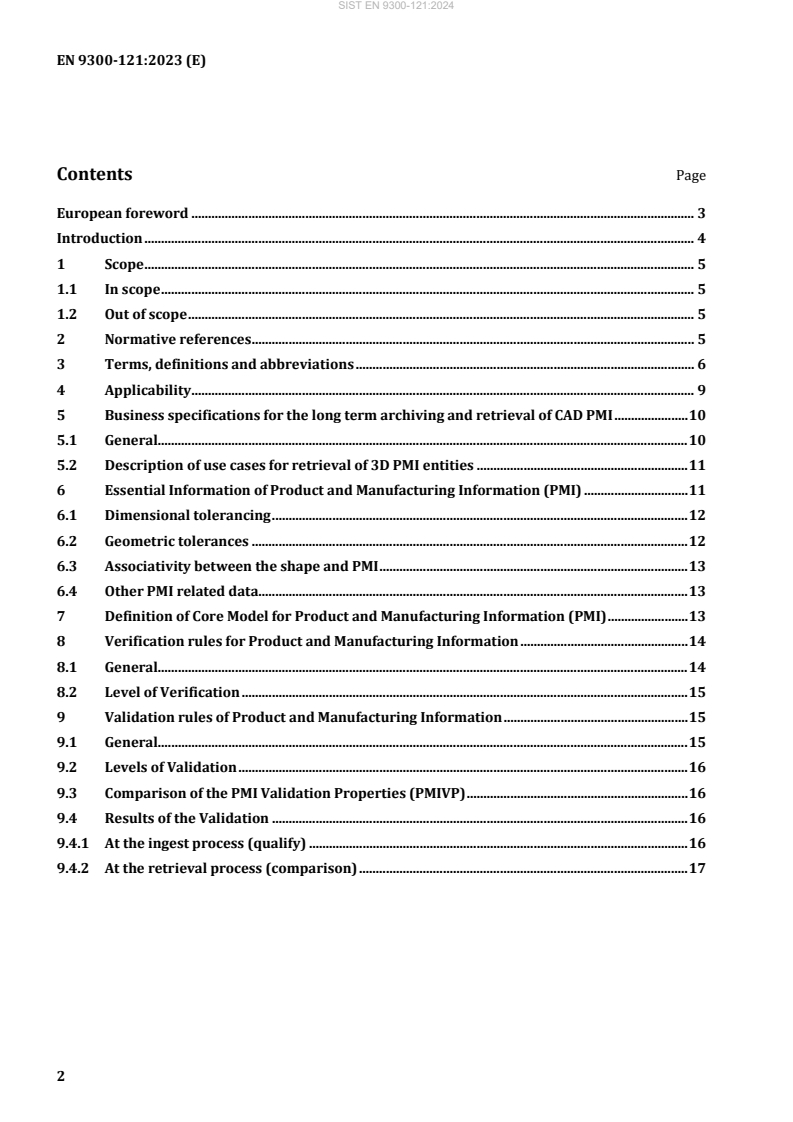
Contents Page
European foreword . 3
Introduction . 4
1 Scope . 5
1.1 In scope . 5
1.2 Out of scope . 5
2 Normative references . 5
3 Terms, definitions and abbreviations . 6
4 Applicability . 9
5 Business specifications for the long term archiving and retrieval of CAD PMI . 10
5.1 General. 10
5.2 Description of use cases for retrieval of 3D PMI entities . 11
6 Essential Information of Product and Manufacturing Information (PMI) . 11
6.1 Dimensional tolerancing . 12
6.2 Geometric tolerances . 12
6.3 Associativity between the shape and PMI . 13
6.4 Other PMI related data . 13
7 Definition of Core Model for Product and Manufacturing Information (PMI) . 13
8 Verification rules for Product and Manufacturing Information . 14
8.1 General. 14
8.2 Level of Verification . 15
9 Validation rules of Product and Manufacturing Information . 15
9.1 General. 15
9.2 Levels of Validation . 16
9.3 Comparison of the PMI Validation Properties (PMIVP) . 16
9.4 Results of the Validation . 16
9.4.1 At the ingest process (qualify) . 16
9.4.2 At the retrieval process (comparison) . 17
European foreword
This document (EN 9300-121:2023) has been prepared by the Aerospace and Defence Industries
Association of Europe - Standardization (ASD-STAN).
After enquiries and votes carried out in accordance with the rules of this Association, this document has
received the approval of the National Associations and the Official Services of the member countries of
ASD-STAN, prior to its presentation to CEN.
This European Standard shall be given the status of a national standard, either by publication of an
identical text or by endorsement, at the latest by May 2024, and conflicting national standards shall be
withdrawn at the latest by May 2024.
Attention is drawn to the possibility that some of the elements of this document may be the subject of
patent rights. CEN shall not be held responsible for identifying any or all such patent rights.
Any feedback and questions on this document should be directed to the users’ national standards body.
A complete listing of these bodies can be found on the CEN website.
According to the CEN-CENELEC Internal Regulations, the national standards organizations of the
following countries are bound to implement this European Standard: Austria, Belgium, Bulgaria,
Croatia, Cyprus, Czech Republic, Denmark, Estonia, Finland, France, Germany, Greece, Hungary, Iceland,
Ireland, Italy, Latvia, Lithuania, Luxembourg, Malta, Netherlands, Norway, Poland, Portugal, Republic of
North Macedonia, Romania, Serbia, Slovakia, Slovenia, Spain, Sweden, Switzerland, Türkiye and the
United Kingdom.
Introduction
This document was prepared jointly by AIA, ASD-STAN, PDES, Inc., and the prostep ivip Association. The
prostep ivip Association is an international non-profit association in Europe. For establishing
leadership in IT-based engineering it offers a moderated platform to its nearly 200 members from
leading industries, system vendors and research institutions. Its product and process data
standardization activities at European and worldwide levels are well known and accepted. The prostep
ivip Association sees this standard and the related parts as a milestone of product data technology.
PDES Inc. is an international non-profit association in USA. The mission of PDES Inc. is to accelerate the
development and implementation of ISO 10303 series, enabling enterprise integration and PLM
interoperability for member companies. PDES Inc. gathers members from leading manufacturers,
national government agencies, PLM vendors and research organizations. PDES Inc. supports this
standard as an industry resource to sustain the interoperability of digital product information, ensuring
and maintaining authentic longevity throughout their product lifecycle.
Readers of this standard should note that all standards undergo periodic revisions and that any
reference made herein to any other standard implies its latest edition, unless otherwise stated. The
Standards will be published under two different standards organizations using different prefixes.
ASD-STAN will publish the standard under the number EN 9300-xxx. AIA will publish the standard
under the number NAS 9300-xxx. The content in the EN 9300 and NAS 9300 documents will be the
same. The differences will be noted in the reference documentation (i.e. for EN9300 Geometric
Dimensioning & Tolerancing will be referenced in ISO 1101 and ISO 16792, and for NAS 9300 the same
information will be referenced in ASME Y14.5 and Y 14.41). The document formatting etc., will follow
that of the respective editorial rules of ASD-STAN and AIA.
This document specifies the requirements for the long term digital preservation of the Semantic
Representation of Product and Manufacturing Information (PMI) with their possible links to the 3D
explicit shape and geometry of single CAD parts. The goal is to preserve this 3D information, without
loss, with respect to the geometry produced by the original CAD system, following the principles laid
down in EN 9300-003 “Fundamentals and Concepts”.
The requirements of EN 9300-110 concerning the preservation of the 3D explicit shape shall apply
within this Part.
The term “semantic representation” is specified in Clause 3 “Terms, definitions and abbreviations”.
1 Scope
1.1 In scope
This document is applicable to:
— machine-interpretable PMI “Semantic Representation” (Refer to Clause 3 for definition);
— the association of the above with 3D geometric shapes;
— the possible association of the above with Presentation of 3D Product and Manufacturing
Information (PMI), and 3D annotations as specified in EN 9300-120.
In EN 9300-121, the technology used to preserve this 3D information is based on semantic
representation. The main use cases are Certification, Product Liability and Design re-use.
For the purpose of this document, the semantic definition is at the level that supports associative
“Cross-highlighting” for the purpose of human readability.
1.2 Out of scope
This document is applicable to:
— PMI presentation (specified in EN 9300-120);
— User defined attributes that are assigned to 3D geometric entities or at the part level. The archiving
of the UDA is specified in EN 9300-120.
— How to preserve additional information:
— property rights;
— form features;
— CAD Assemblies.
— The semantics of special Notes outside the scope of PMI: ITAR/EAR, proprietary, and title block
information, etc.
2 Normative references
The following documents are referred to in the text in such a way that some or all of their content
constitutes requirements of this document. For dated references, only the edition cited applies. For
undated references, the latest edition of the referenced document (including any amendments) applies.
EN 9300 (all parts), Aerospace series — LOTAR — Long Term Archiving and Retrieval of digital technical
product documentation such as 3D, CAD and PDM data
ISO 10303-203, Industrial automation systems and integration — Product data representation and
exchange — Part 203: Application protocol: Configuration controlled 3D design of mechanical parts and
assemblies
Document is withdrawn.
ISO 10303-214, Industrial automation systems and integration — Product data representation and
exchange — Part 214 — Application protocol: Core data for automotive mechanical design processes
ISO 10303-242, Industrial automation systems and integration — Product data representation and
exchange — Part 242: Application protocol: Managed model-based 3D engineering
ISO 10303-514, Industrial automation systems and integration — Product data representation and
exchange — Part 514: Application interpreted construct: Advanced boundary representation
ISO 10303-519, Industrial automation systems and integration — Product data representation and
exchange — Part 519: Application interpreted construct: Geometric tolerances
ISO 1101, Geometrical product specifications (GPS) — Geometrical tolerancing — Tolerances of form,
orientation, location and run-out
ISO 16792, Technical product documentation — Digital product definition data practices
ASME Y14.5, Dimensioning and Tolerancing
ASME Y14.41, Digital Product Definition Data Practices
CAx-IF Recommended Practices for the Representation and Presentation of Product Manufacturing
Information (PMI) (AP242), Available on the website managed by the CAX Implementer Forum
3 Terms, definitions and abbreviations
For the purposes of this document, the terms and definitions given in EN 9300-007 and EN 9300-100
and the following apply.
ISO and IEC maintain terminology databases for use in standardization at the following addresses:
— ISO Online browsing platform: available at https://www.iso.org/obp
— IEC Electropedia: available at https://www.electropedia.org/
Figure 1 illustrates the terms introduced in this Part:
Figure 1 — Hierarchy of PMI Terms
3.1
Product and Manufacturing Information (PMI)
Product and Manufacturing Information (PMI) is used in 3D Computer-aided Design (CAD) systems to
convey information about the definition of a product’s components for manufacturing, inspections and
sustainment, which supplements the geometric shape of the product. This includes – but is not limited
to – data such as dimensions, tolerances, surface finish, weld symbols, material specifications, 3D
annotations and user defined attributes. The term PMI, used by itself, relates to a certain information
content within a product definition; i. e. it indicates what information is being stored, independent from
how it is being stored.
Note 1 to entry: Though PMI is generally accepted to be the generic designation, the term Geometric Dimensions
and Tolerances (GD&T; sometimes also listed as Geometric Dimensioning and Tolerancing) is often used
synonymously, as it is the main type of PMI that is currently in focus. Other synonymously used terms are: General
Tolerances and Annotations, Annotation, Smart Dimensions, Functional Tolerancing and Annotation (FT&A) or
Geometric Product Specification (GPS). Some of these are specific to a particular CAD system. Industry standards
for defining PMI include standards such as ASME Y14.5, ASME Y14.41 and ISO 1101, ISO 16792 respectively.
3.2
Geometric Dimensions & Tolerances (GD&T)
Geometric Dimensions & Tolerances (GD&T) are a type of Product and Manufacturing Information
(PMI) that can be either computed automatically by a CAD system, or entered manually by the user. The
definitions below are additions to the terms mentioned in EN 9300-100:2018, 3.6:
— Explicit Tolerance: Any tolerance with a stated (numeric) value, regardless of how or where it is
applied. Explicit tolerances can be applied through general notes, flag notes, PMI or tolerance
dimensions. This must be attributable to a specific feature, feature set and/or datum reference (e. g.
position, orientation). Standard +/− 0,03 notes may be explicit, depending on their use.
— Implicit Tolerance: Any tolerance where there is no stated value and acceptability of the feature is
specified by engineering to be through visual comparison to the appearance shown in the CAD
model. Standard +/− 0,03 notes may also be implicit, depending on their use.
— Explicit Dimension: The required nominal value is stated in the CAD model so that it can be obtained
without interrogation.
— Implicit Dimension: The nominal value can only be obtained by interrogation (i. e. feature to feature
measuring) of the CAD model.
3.3
Semantic Representation
Semantic Representation designates a certain way how information is being stored; it does not relate to
the information content itself. Semantic Representation captures the meaning (intent) and relationships
(context) of a character, word, phrase, sentence, paragraph, specification, or symbol without using any
of the visual characters or constructs that are needed for a human to understand it – such as the letters,
graphical symbols, lines and arrows used on engineering drawings.
The main purpose of Semantic Representation is to facilitate automated consumption of the data, e. g.
for later re-use or for downstream applications. It applies to various types of data, such as PMI,
Composite Material Definition, and others.
EXAMPLE The Semantic Representation of a Linear Dimension includes all of the information needed to
understand the specification (the type of dimension, between which features it is specified…), without any of the
graphic components such as dimension lines and extension lines, their direction, arrowheads and the dimension
value.
3.4
Presentation
Presentation designates a certain way how information is being stored; it does not relate to the
information content itself. Presentation defines the visual representation of a character, word, phrase,
sentence, paragraph, specification, or symbol in way that is understandable by humans. Presentation is
a generic term that applies to any form of human-readable information transfer; this can for instance be
a handwritten note, an engineering drawing, or the display of a 3D CAD model on a computer screen.
Note 1 to entry: The main purpose of Presentation is to facilitate human comprehension of the data, e.g. to
manufacture, inspect, assemble or maintain the product described by the data. For a correct interpretation of the
presented data, it is required that the reader is familiar with the alphabet used and the general type of information
being presented.
In the context of 3D CAD, the term Presentation relates to elements that are visible in the display of a 3D model
and are either located (positioned) in 3D space, i.e. they rotate and move with the model, or in a fixed 2D plane.
Elements of Presentation can typically by styled (e. g. coloured), organized (e. g. in specific views), and associated
with other elements of the model. Presented types of data typically are geometry (3D shapes, surfaces, curves,
points) and characters (letters, numbers, symbols).
3.4.1
Character-based Presentation
Character-based Presentation is a type of Presentation where the conveyed information is stored as
characters (letters, numbers, and symbols). These characters are typically stored in a string variable
that can be retrieved and edited in a consuming application. The appearance of Character-based
Presentation depends on the font being used and may change if the originating system and the
consuming application use different fonts. To ensure no characters are lost from creation to
consumption, the alphabet (character encoding) used shall be specified as well. (This supports both
semantic and non-sematic PMI)?
EXAMPLE In ASCII, the letter ‘A’ is stored as character code ‘0x41’ (hexadecimal).
EN 9
...