

SIST HD 60364-4-43:2023
(Main)Low-voltage electrical installations - Part 4-43: Protection for safety - Protection against overcurrent (IEC 60364-4-43:2023)
General Information
- Abstract
IEC 60364-4-43:2023 provides requirements for:
- protection of live conductors, PEN conductors, PEM conductors, and PEL conductors against the harmful effects caused by overcurrent;
- coordination of measures for protection against overcurrent.
This fourth edition cancels and replaces the third edition published in 2008. This edition constitutes a technical revision.
This edition includes the following significant technical changes with respect to the previous edition:
a) the standard has been restructured, see Table 1 (Correspondence between IEC 60364‑4‑43:2008 and this document) below;
b) the measure "automatic disconnection of supply" has been designated as the preferred measure for protection against overcurrent;
c) all measures except the measure "automatic disconnection of supply" have been transferred into new normative annexes to indicate that these measures are usable in certain applications and under certain restricted conditions only (see Annex A, Annex B and Annex E);
d) a new clause "Terms and definitions" has been added;
e) new requirements have been added for the protection of the neutral or mid-point conductor (with and without triplen harmonics).
- Status
- Published
- Publication Date
- 18-Sep-2023
- Technical Committee
- ELI - Electrical and communication installations
- Current Stage
- 6060 - National Implementation/Publication (Adopted Project)
- Start Date
- 12-Sep-2023
- Due Date
- 17-Nov-2023
- Completion Date
- 19-Sep-2023

Overview
HD 60364-4-43:2023 (equivalent to IEC 60364-4-43:2023) is the fourth-edition European harmonization of the international standard for low-voltage electrical installations that covers protection for safety - protection against overcurrent. This technical revision supersedes the 2008 edition and reorganizes requirements to give automatic disconnection of supply primacy as the preferred protection measure. The document also adds a new terms-and-definitions clause and strengthens rules for protecting the neutral or mid‑point conductor, including situations with triplen harmonics.
Key topics and requirements
- Scope and definitions: New clause clarifies terms used for overcurrent protection and related conductors (live, PEN, PEM, PEL, neutral/mid‑point).
- Preferred protection measure: Automatic disconnection of supply is designated the primary method for overcurrent protection in low-voltage installations.
- Other measures in annexes: Alternative measures are retained but moved to normative annexes (A, B, E) to indicate restricted or application-specific use only.
- Overload and short-circuit protection: Requirements cover protection against both overload currents and short‑circuit currents, including coordination between conductors and protective devices.
- Neutral / mid‑point conductor protection: New requirements address protection with and without triplen harmonics and include specific provisions for IT systems.
- Coordination and selectivity: Guidance on coordination of devices to ensure selectivity and limit damage during faults, including considerations for conductors connected in parallel.
- Annexes and informative guidance: Normative and informative annexes (A–F) provide alternative methods, design current guidance, parallel conductor protection and country‑specific notes.
Practical applications
Who uses this standard:
- Electrical designers and consulting engineers for safe circuit design and protective-device selection
- Installers and electrical contractors implementing compliant low-voltage installations
- Inspection bodies and approval authorities assessing conformity with overcurrent protection rules
- Manufacturers of protective devices (fuses, circuit-breakers) to align product application guidance with the standard
- Facility and maintenance engineers managing coordination, selectivity and neutral conductor protection in buildings, industrial plants and distribution networks
Typical use cases:
- Selecting and coordinating overload and short‑circuit protective devices
- Designing protection schemes for installations with nonlinear loads and triplen harmonics (e.g., large commercial or industrial sites)
- Defining safe arrangements for parallel conductors and neutral/mid‑point protection
- Implementing preferred automatic disconnection strategies and applying restricted alternative measures where necessary
Related standards
HD 60364-4-43:2023 references other IEC/CENELEC documents used for correct application, including parts of the IEC 60269 series (fuses), IEC 60364-1 and IEC 60364-4-41, plus device standards such as IEC 60947 and IEC 61009. National committees should consult Annex ZA for the complete list of normative cross-references.
Keywords: HD 60364-4-43:2023, IEC 60364-4-43, protection against overcurrent, low-voltage electrical installations, automatic disconnection of supply, neutral conductor protection, triplen harmonics, overload protection, short-circuit protection, coordination, selectivity.
Relations
- Effective Date
- 03-Feb-2026
- Effective Date
- 08-Apr-2026
- Effective Date
- 09-Feb-2026
- Referred By
SIST EN 13213:2001 - Hollow floors - Effective Date
- 09-Feb-2026
- Effective Date
- 09-Feb-2026
- Referred By
SIST EN 17928-1:2025 - Gas infrastructure - Injection stations - Part 1: General requirements - Effective Date
- 09-Feb-2026
- Effective Date
- 09-Feb-2026
- Referred By
SIST EN 12825:2001 - Raised access floors - Effective Date
- 09-Feb-2026
- Effective Date
- 03-Feb-2026
- Effective Date
- 03-Feb-2026
- Effective Date
- 03-Feb-2026
- Effective Date
- 03-Feb-2026
- Effective Date
- 03-Feb-2026
- Effective Date
- 03-Feb-2026
- Effective Date
- 03-Feb-2026
Get Certified
Connect with accredited certification bodies for this standard

DIBt (Deutsches Institut für Bautechnik)
German Institute for Building Technology.
DIN CERTCO
DIN Group product certification.

IMQ S.p.A. (Certification)
Italian electrical product certification.
Sponsored listings
Frequently Asked Questions
SIST HD 60364-4-43:2023 is a standardization document published by the Slovenian Institute for Standardization (SIST). Its full title is "Low-voltage electrical installations - Part 4-43: Protection for safety - Protection against overcurrent (IEC 60364-4-43:2023)". This standard covers: IEC 60364-4-43:2023 provides requirements for: - protection of live conductors, PEN conductors, PEM conductors, and PEL conductors against the harmful effects caused by overcurrent; - coordination of measures for protection against overcurrent. This fourth edition cancels and replaces the third edition published in 2008. This edition constitutes a technical revision. This edition includes the following significant technical changes with respect to the previous edition: a) the standard has been restructured, see Table 1 (Correspondence between IEC 60364‑4‑43:2008 and this document) below; b) the measure "automatic disconnection of supply" has been designated as the preferred measure for protection against overcurrent; c) all measures except the measure "automatic disconnection of supply" have been transferred into new normative annexes to indicate that these measures are usable in certain applications and under certain restricted conditions only (see Annex A, Annex B and Annex E); d) a new clause "Terms and definitions" has been added; e) new requirements have been added for the protection of the neutral or mid-point conductor (with and without triplen harmonics).
IEC 60364-4-43:2023 provides requirements for: - protection of live conductors, PEN conductors, PEM conductors, and PEL conductors against the harmful effects caused by overcurrent; - coordination of measures for protection against overcurrent. This fourth edition cancels and replaces the third edition published in 2008. This edition constitutes a technical revision. This edition includes the following significant technical changes with respect to the previous edition: a) the standard has been restructured, see Table 1 (Correspondence between IEC 60364‑4‑43:2008 and this document) below; b) the measure "automatic disconnection of supply" has been designated as the preferred measure for protection against overcurrent; c) all measures except the measure "automatic disconnection of supply" have been transferred into new normative annexes to indicate that these measures are usable in certain applications and under certain restricted conditions only (see Annex A, Annex B and Annex E); d) a new clause "Terms and definitions" has been added; e) new requirements have been added for the protection of the neutral or mid-point conductor (with and without triplen harmonics).
SIST HD 60364-4-43:2023 is classified under the following ICS (International Classification for Standards) categories: 29.120.50 - Fuses and other overcurrent protection devices; 91.140.50 - Electricity supply systems. The ICS classification helps identify the subject area and facilitates finding related standards.
SIST HD 60364-4-43:2023 has the following relationships with other standards: It is inter standard links to SIST HD 60364-5-52:2011, SIST EN 1647:2026, SIST EN 1647:2019+A1:2021, SIST EN 13213:2001, SIST EN 1647:2019, SIST EN 17928-1:2025, SIST EN 1648-1:2018, SIST EN 12825:2001, SIST EN 50556:2019, SIST HD 60364-7-709:2009/A12:2019, SIST EN IEC 62933-5-1:2024, SIST EN IEC 62485-2:2018, SIST EN 60079-14:2014, SIST EN IEC 62932-2-2:2020, SIST EN 60947-2:2017. Understanding these relationships helps ensure you are using the most current and applicable version of the standard.
SIST HD 60364-4-43:2023 is available in PDF format for immediate download after purchase. The document can be added to your cart and obtained through the secure checkout process. Digital delivery ensures instant access to the complete standard document.
Standards Content (Sample)
SLOVENSKI STANDARD
01-november-2023
Nizkonapetostne električne inštalacije - 4-43. del: Zaščitni ukrepi – Nadtokovna
zaščita (IEC 60364-4-43:2023)
Low-voltage electrical installations - Part 4-43: Protection for safety - Protection against
overcurrent (IEC 60364-4-43:2023)
Errichten von Niederspannungsanlagen - Teil 4-43: Schutzmaßnahmen - Schutz bei
Überstrom (IEC 60364-4-43:2023)
Installations électriques à basse tension - Partie 4-43: Protection pour assurer la sécurité
- Protection contre les surintensités (IEC 60364-4-43:2023)
Ta slovenski standard je istoveten z: HD 60364-4-43:2023
ICS:
29.120.50 Varovalke in druga Fuses and other overcurrent
nadtokovna zaščita protection devices
91.140.50 Sistemi za oskrbo z elektriko Electricity supply systems
2003-01.Slovenski inštitut za standardizacijo. Razmnoževanje celote ali delov tega standarda ni dovoljeno.
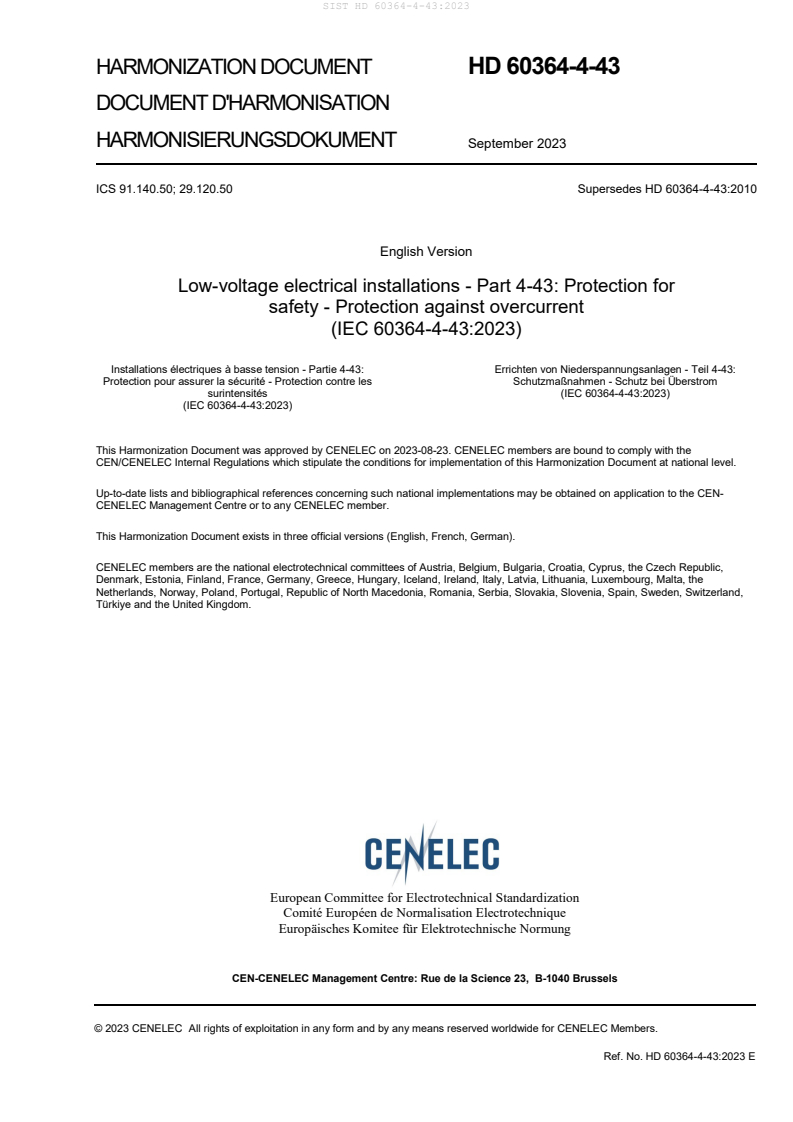
HARMONIZATION DOCUMENT HD 60364-4-43
DOCUMENT D'HARMONISATION
HARMONISIERUNGSDOKUMENT September 2023
ICS 91.140.50; 29.120.50 Supersedes HD 60364-4-43:2010
English Version
Low-voltage electrical installations - Part 4-43: Protection for
safety - Protection against overcurrent
(IEC 60364-4-43:2023)
Installations électriques à basse tension - Partie 4-43: Errichten von Niederspannungsanlagen - Teil 4-43:
Protection pour assurer la sécurité - Protection contre les Schutzmaßnahmen - Schutz bei Überstrom
surintensités (IEC 60364-4-43:2023)
(IEC 60364-4-43:2023)
This Harmonization Document was approved by CENELEC on 2023-08-23. CENELEC members are bound to comply with the
CEN/CENELEC Internal Regulations which stipulate the conditions for implementation of this Harmonization Document at national level.
Up-to-date lists and bibliographical references concerning such national implementations may be obtained on application to the CEN-
CENELEC Management Centre or to any CENELEC member.
This Harmonization Document exists in three official versions (English, French, German).
CENELEC members are the national electrotechnical committees of Austria, Belgium, Bulgaria, Croatia, Cyprus, the Czech Republic,
Denmark, Estonia, Finland, France, Germany, Greece, Hungary, Iceland, Ireland, Italy, Latvia, Lithuania, Luxembourg, Malta, the
Netherlands, Norway, Poland, Portugal, Republic of North Macedonia, Romania, Serbia, Slovakia, Slovenia, Spain, Sweden, Switzerland,
Türkiye and the United Kingdom.
European Committee for Electrotechnical Standardization
Comité Européen de Normalisation Electrotechnique
Europäisches Komitee für Elektrotechnische Normung
CEN-CENELEC Management Centre: Rue de la Science 23, B-1040 Brussels
© 2023 CENELEC All rights of exploitation in any form and by any means reserved worldwide for CENELEC Members.
Ref. No. HD 60364-4-43:2023 E
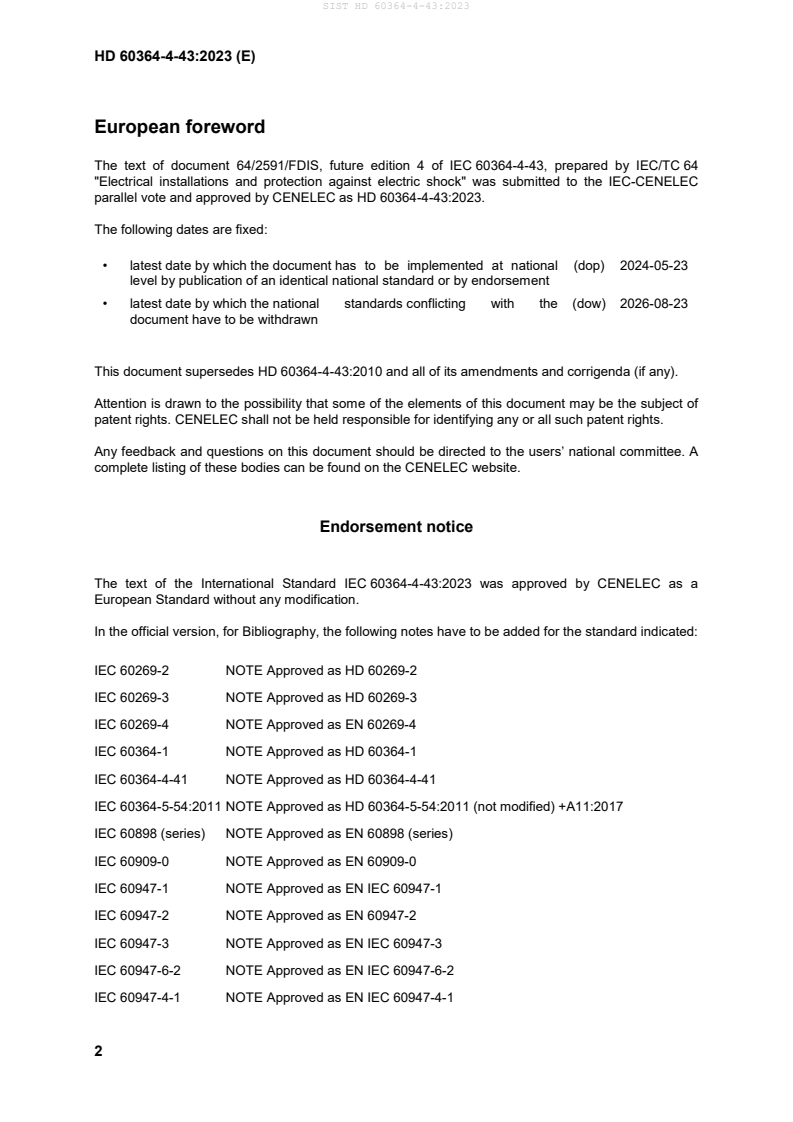
European foreword
The text of document 64/2591/FDIS, future edition 4 of IEC 60364-4-43, prepared by IEC/TC 64
"Electrical installations and protection against electric shock" was submitted to the IEC-CENELEC
parallel vote and approved by CENELEC as HD 60364-4-43:2023.
The following dates are fixed:
• latest date by which the document has to be implemented at national (dop) 2024-05-23
level by publication of an identical national standard or by endorsement
• latest date by which the national standards conflicting with the (dow) 2026-08-23
document have to be withdrawn
This document supersedes HD 60364-4-43:2010 and all of its amendments and corrigenda (if any).
Attention is drawn to the possibility that some of the elements of this document may be the subject of
patent rights. CENELEC shall not be held responsible for identifying any or all such patent rights.
Any feedback and questions on this document should be directed to the users’ national committee. A
complete listing of these bodies can be found on the CENELEC website.
Endorsement notice
The text of the International Standard IEC 60364-4-43:2023 was approved by CENELEC as a
European Standard without any modification.
In the official version, for Bibliography, the following notes have to be added for the standard indicated:
IEC 60269-2 NOTE Approved as HD 60269-2
IEC 60269-3 NOTE Approved as HD 60269-3
IEC 60269-4 NOTE Approved as EN 60269-4
IEC 60364-1 NOTE Approved as HD 60364-1
IEC 60364-4-41 NOTE Approved as HD 60364-4-41
IEC 60364-5-54:2011 NOTE Approved as HD 60364-5-54:2011 (not modified) +A11:2017
IEC 60898 (series) NOTE Approved as EN 60898 (series)
IEC 60909-0 NOTE Approved as EN 60909-0
IEC 60947-1 NOTE Approved as EN IEC 60947-1
IEC 60947-2 NOTE Approved as EN 60947-2
IEC 60947-3 NOTE Approved as EN IEC 60947-3
IEC 60947-6-2 NOTE Approved as EN IEC 60947-6-2
IEC 60947-4-1 NOTE Approved as EN IEC 60947-4-1
IEC 61009-1 NOTE Approved as EN 61009-1
IEC 61439-6 NOTE Approved as EN 61439-6
IEC 61534 (series) NOTE Approved as EN 61534 (series)
IEC 61557-9 NOTE Approved as EN 61557-9
Annex ZA
(normative)
Normative references to international publications
with their corresponding European publications
The following documents are referred to in the text in such a way that some or all of their content
constitutes requirements of this document. For dated references, only the edition cited applies. For
undated references, the latest edition of the referenced document (including any amendments)
applies.
NOTE 1 Where an International Publication has been modified by common modifications, indicated by (mod), the
relevant EN/HD applies.
NOTE 2 Up-to-date information on the latest versions of the European Standards listed in this annex is available
here: www.cencenelec.eu.
Publication Year Title EN/HD Year
IEC 60364-5-522009 Low-voltage electrical installations - Part 5- HD 60364-5-52 2011
(mod) 52: Selection and erection of electrical
equipment - Wiring systems
- - + A11 2017
- - + A12 2022
IEC 60364-4-43 ®
Edition 4.0 2023-07
INTERNATIONAL
STANDARD
NORME
INTERNATIONALE
Low-voltage electrical installations –
Part 4-43: Protection for safety – Protection against overcurrent
Installations électriques à basse tension –
Partie 4-43: Protection pour assurer la sécurité – Protection contre les
surintensités
INTERNATIONAL
ELECTROTECHNICAL
COMMISSION
COMMISSION
ELECTROTECHNIQUE
INTERNATIONALE
ICS 29.120.50; 91.140.50 ISBN 978-2-8322-7031-8
– 2 – IEC 60364-4-43:2023 © IEC 2023
CONTENTS
FOREWORD . 4
430 Protection against overcurrent . 8
430.1 Scope . 8
430.2 Normative references . 8
430.3 Terms and definitions . 8
430.4 General requirements . 10
431 Protection against overcurrent by automatic disconnection of supply . 10
431.1 Protection of line conductors . 10
431.2 Protection of neutral or mid-point conductor . 10
431.2.1 AC circuits without triplen harmonics and DC circuits . 10
431.2.2 Additional requirements for IT systems . 11
431.2.3 AC system with triplen harmonics . 11
431.3 Protection against overcurrent . 12
431.3.1 Protection against both overload current and short-circuit current . 12
431.3.2 Protection against overload current only . 12
431.3.3 Protection against short-circuit current only . 12
431.4 Protection against overload current . 12
431.4.1 General . 12
431.4.2 Coordination between conductors and overload protective devices . 12
431.4.3 Protection against overload current of conductors connected in parallel . 13
431.5 Protection against short-circuit currents . 14
431.5.1 General . 14
431.5.2 Determination of prospective short-circuit currents . 14
431.5.3 Protection against short-circuit current of conductors connected in
parallel . 14
431.5.4 Requirements for protection against short-circuit current . 15
431.6 Coordination of protection against overload current and protection against
short-circuit current . 17
431.6.1 Protection afforded by one device . 17
431.6.2 Protection afforded by separate devices . 17
431.6.3 Coordination for selectivity and combined short-circuit protection . 17
Annex A (normative) Protection against overcurrent by other means . 19
A.1 General . 19
A.2 Protection against overload . 19
A.3 Protection against short-circuits . 19
Annex B (normative) Protection against overcurrent by limitation of the characteristics
of supply . 20
Annex C (informative) Protection of conductors in parallel against overcurrent . 21
C.1 General . 21
C.2 Protection against overload current of conductors connected in parallel . 21
C.3 Protection against short-circuit current of conductors connected in parallel . 24
Annex D (informative) Design current . 27
Annex E (normative) Cases where automatic disconnection of supply for protection
against overcurrent can cause an increased risk . 28
Annex F (informative) List of notes concerning certain countries . 29
Bibliography . 32
IEC 60364-4-43:2023 © IEC 2023 – 3 –
Figure 1 – Coordination between conductor and protective device (conditions 1 and 2) . 13
Figure C.1 – Circuit in which an overload protective device is provided for each of the
m conductors in parallel . 23
Figure C.2 – Circuit in which a single overload protective device is provided for the m
conductors in parallel . 24
Figure C.3 – Current flow at the beginning of the short-circuit . 25
Figure C.4 – Current flow after operation of the protective device D3 . 25
Figure C.5 – Illustration of linked protective device . 26
Table 1 – Correspondence between IEC 60364-4-43:2008 and this document . 6
Table 2 – Values of k for conductors . 16
– 4 – IEC 60364-4-43:2023 © IEC 2023
INTERNATIONAL ELECTROTECHNICAL COMMISSION
____________
LOW-VOLTAGE ELECTRICAL INSTALLATIONS –
Part 4-43: Protection for safety – Protection against overcurrent
FOREWORD
1) The International Electrotechnical Commission (IEC) is a worldwide organization for standardization comprising
all national electrotechnical committees (IEC National Committees). The object of IEC is to promote international
co-operation on all questions concerning standardization in the electrical and electronic fields. To this end and
in addition to other activities, IEC publishes International Standards, Technical Specifications, Technical Reports,
Publicly Available Specifications (PAS) and Guides (hereafter referred to as "IEC Publication(s)"). Their
preparation is entrusted to technical committees; any IEC National Committee interested in the subject dealt with
may participate in this preparatory work. International, governmental and non-governmental organizations liaising
with the IEC also participate in this preparation. IEC collaborates closely with the International Organization for
Standardization (ISO) in accordance with conditions determined by agreement between the two organizations.
2) The formal decisions or agreements of IEC on technical matters express, as nearly as possible, an international
consensus of opinion on the relevant subjects since each technical committee has representation from all
interested IEC National Committees.
3) IEC Publications have the form of recommendations for international use and are accepted by IEC National
Committees in that sense. While all reasonable efforts are made to ensure that the technical content of IEC
Publications is accurate, IEC cannot be held responsible for the way in which they are used or for any
misinterpretation by any end user.
4) In order to promote international uniformity, IEC National Committees undertake to apply IEC Publications
transparently to the maximum extent possible in their national and regional publications. Any divergence between
any IEC Publication and the corresponding national or regional publication shall be clearly indicated in the latter.
5) IEC itself does not provide any attestation of conformity. Independent certification bodies provide conformity
assessment services and, in some areas, access to IEC marks of conformity. IEC is not responsible for any
services carried out by independent certification bodies.
6) All users should ensure that they have the latest edition of this publication.
7) No liability shall attach to IEC or its directors, employees, servants or agents including individual experts and
members of its technical committees and IEC National Committees for any personal injury, property damage or
other damage of any nature whatsoever, whether direct or indirect, or for costs (including legal fees) and
expenses arising out of the publication, use of, or reliance upon, this IEC Publication or any other IEC
Publications.
8) Attention is drawn to the Normative references cited in this publication. Use of the referenced publications is
indispensable for the correct application of this publication.
9) Attention is drawn to the possibility that some of the elements of this IEC Publication may be the subject of patent
rights. IEC shall not be held responsible for identifying any or all such patent rights.
IEC 60364-4-43 has been prepared by IEC technical committee 64: Electrical installations and
protection against electric shock. It is an International Standard.
This fourth edition cancels and replaces the third edition published in 2008. This edition
constitutes a technical revision.
This edition includes the following significant technical changes with respect to the previous
edition:
a) the standard has been restructured, see Table 1 (Correspondence between
IEC 60364‑4‑43:2008 and this document) below;
b) the measure "automatic disconnection of supply" has been designated as the preferred
measure for protection against overcurrent;
c) all measures except the measure "automatic disconnection of supply" have been transferred
into new normative annexes to indicate that these measures are usable in certain
applications and under certain restricted conditions only (see Annex A, Annex B and
Annex E);
IEC 60364-4-43:2023 © IEC 2023 – 5 –
d) a new clause "Terms and definitions" has been added;
e) new requirements have been added for the protection of the neutral or mid-point conductor
(with and without triplen harmonics).
The text of this International Standard is based on the following documents:
Draft Report on voting
64/2591/FDIS 64/2618/RVD
Full information on the voting for its approval can be found in the report on voting indicated in
the above table.
The language used for the development of this International Standard is English.
This document was drafted in accordance with ISO/IEC Directives, Part 2, and developed in
accordance with ISO/IEC Directives, Part 1 and ISO/IEC Directives, IEC Supplement, available
at www.iec.ch/members_experts/refdocs. The main document types developed by IEC are
described in greater detail at www.iec.ch/publications.
A list of all parts in the IEC 60364 series, published under the general title Low-voltage electrical
installations, can be found on the IEC website.
The reader's attention is drawn to the fact that Annex F lists all of the "in-some-country" clauses
on differing practices of a less permanent nature relating to the subject of this document.
The committee has decided that the contents of this document will remain unchanged until the
stability date indicated on the IEC website under webstore.iec.ch in the data related to the
specific document. At this date, the document will be
• reconfirmed,
• withdrawn,
• replaced by a revised edition, or
• amended.
– 6 – IEC 60364-4-43:2023 © IEC 2023
Correspondence between IEC 60364-4-43:2008 and this document
Table 1 provides a list of contents of both the previous edition and the current edition of
IEC 60364-4-43, indicating the new structure of the standard.
Table 1 also indicates which clauses of IEC 60364-4-43:2008 have been transferred to
IEC 60364-5-53:2019.
Table 1 – Correspondence between IEC 60364-4-43:2008 and this document
IEC 60364-4-43:2008 IEC 60364-4-43:2023
Low-voltage electrical installations – Low-voltage electrical installations –
Part 4-43: Protection for safety – Protection Part 4-43: Protection for safety – Protection
against overcurrent against overcurrent
43 Protection against overcurrent 430 Protection against overcurrent
430.1 Scope 430.1 Scope
430.2 Normative references 430.2 Normative references
430.3 Terms and definitions
430.3 General requirements 430.4 General requirements
431 Requirements according to the nature of the 431 Protection against overcurrent by automatic
circuits disconnection of supply
431.1 Protection of line conductors 431.1 Protection of line conductors
431.2 Protection of the neutral conductor 431.2 Protection of neutral or mid-point conductor
431.3 Disconnection and reconnection of the neutral Deleted
conductor in multi-phase systems
Covered by product standards and 530.4.2
432 Nature of protective devices 431.3 Protection against overcurrent
Partly covered by Clause 533
432.1 Devices providing protection against both 431.3.1 Protection against both overload current
overload current and short-circuit current and short-circuit current
432.2 Devices ensuring protection against overload 431.3.2 Protection against overload current only
current only
432.3 Devices ensuring protection against 431.3.3 Protection against short-circuit current only
short‑circuit current only
432.4 Characteristics of protective devices Deleted
Covered by Clause 533
433 Protection against overload current 431.4 Protection against overload current
Coordination between conductors and Coordination between conductors and
433.1 431.4.2
overload protective devices overload protective devices
433.2 Position of devices for overload protection Deleted
Covered by 533.4.2
433.3 Omission of devices for protection against Annex A Protection against overcurrent by other
overload means, Clause A.2 Protection against overload
except 433.3.2.1 which was initially transferred to
IEC 60364-5-53:2019, 533.4.2.4 but was then
deleted at CDV stage from IEC 60364-5-53:2019
433.4 Overload protection of conductors in parallel 431.4.3 Protection against overload current of
conductors connected in parallel
434 Protection against short-circuit currents 431.5 Protection against short-circuit currents
434.1 Determination of prospective short-circuit 431.5.2 Determination of prospective short-circuit
currents currents
IEC 60364-4-43:2023 © IEC 2023 – 7 –
IEC 60364-4-43:2008 IEC 60364-4-43:2023
Low-voltage electrical installations – Low-voltage electrical installations –
Part 4-43: Protection for safety – Protection Part 4-43: Protection for safety – Protection
against overcurrent against overcurrent
434.2 Position of devices for short-circuit protection Deleted
Covered by 533.4.3
434.3 Omission of devices for protection against Annex A Protection against overcurrent by other
short-circuit means, Clause A.3 Protection against short-circuits
434.4 Short-circuit protection of conductors in 431.5.3 Protection against short-circuit current of
parallel conductors connected in parallel
434.5 Characteristics of short-circuit protective 431.5.4 Requirements for protection against short-
devices circuit current
435 Coordination of overload and short-circuit 431.6 Coordination of protection against overload
protection current and protection against short-circuit
current
435.1 Protection afforded by one device 431.6.1 Protection afforded by one device
435.2 Protection afforded by separate devices 431.6.2 Protection afforded by separate devices
Coordination for selectivity and combined
431.6.3
short-circuit protection
Annex A (normative) Protection against overcurrent by
other means
436 Limitation of overcurrent by characteristics of Annex B (normative) Protection against overcurrent by
supply limitation of the characteristics of supply
Annex A (informative) Protection of conductors in Annex C (informative) Protection of conductors in
parallel against overcurrent. parallel against overcurrent
Annex B (informative) Conditions 1 and 2 of 433.1 Deleted
Covered by Figure 1 in 431.4.2
Annex C (informative) Position or omission of devices Moved to IEC 60364-5-53:2019, Annex A
for overload protection (Position of devices for overload protection)
Annex D (informative) Position or omission of devices Moved to IEC 60364-5-53:2019, Annex B
for short-circuit protection (Position of devices for short-circuit
protection)
Annex D (informative) Design current
Annex E (normative) Cases where automatic
disconnection of supply for protection against
overcurrent can cause an increased risk
Annex E (informative) List of notes concerning certain Annex F (informative) List of notes concerning certain
countries countries
– 8 – IEC 60364-4-43:2023 © IEC 2023
LOW-VOLTAGE ELECTRICAL INSTALLATIONS –
Part 4-43: Protection for safety – Protection against overcurrent
430 Protection against overcurrent
430.1 Scope
This part of IEC 60364 provides requirements for:
– protection of live conductors, PEN conductors, PEM conductors, and PEL conductors
against the harmful effects caused by overcurrent;
– coordination of measures for protection against overcurrent.
NOTE 1 The requirements of this document do not take account of external influences.
NOTE 2 Protection of conductors according to this document does not necessarily protect the equipment
connected to the conductors.
NOTE 3 Flexible cables connecting equipment by plugs and socket-outlet to fixed installations are not part of
the scope of this document and for this reason are not necessarily protected against the harmful effects caused
by overcurrent.
430.2 Normative references
The following documents are referred to in the text in such a way that some or all of their content
constitutes requirements of this document. For dated references, only the edition cited applies.
For undated references, the latest edition of the referenced document (including any
amendments) applies.
IEC 60364-5-52:2009, Low-voltage electrical installations – Part 5-52: Selection and erection
of electrical equipment – Wiring systems
430.3 Terms and definitions
For the purposes of this document, the following terms and definitions apply.
ISO and IEC maintain terminology databases for use in standardization at the following
addresses:
• IEC Electropedia: available at https://www.electropedia.org/
• ISO Online browsing platform: available at https://www.iso.org/obp
430.3.1
overcurrent
electric current the value of which exceeds a specified limiting value
Note 1 to entry: For conductors, the specified limiting value is equal to the current-carrying capacity.
Note 2 to entry: An overcurrent is an overload current or a short-circuit current.
[SOURCE: IEC 60050-151:2001, 151-15-28, modified – The Notes to entry have been added.]
IEC 60364-4-43:2023 © IEC 2023 – 9 –
430.3.2
overload current
overcurrent occurring in an electric circuit, which is not caused by a
short-circuit or an earth fault
[SOURCE: IEC 60050-826:2022, 826-11-15]
430.3.3
short-circuit current
electric current in a given short-circuit
[SOURCE: IEC 60050-195:2021, 195-05-18]
430.3.4
short-circuit
accidental or intentional conductive path between two or more conductive parts forcing the
electric potential differences between these conductive parts to be equal to or close to zero
[SOURCE: IEC 60050-151:2001, 151-12-04]
430.3.5
overload
operating conditions in an electrically undamaged circuit, which cause an overcurrent
[SOURCE: IEC 60050-441:1984, 441-11-08]
430.3.6
design current
electric current intended to be carried by an electric circuit in normal
operation
[SOURCE: IEC 60050-826:2022, 826-11-10]
430.3.7
rated conditional short-circuit current
I
cc
value of prospective short-circuit current, declared by the busbar trunking or powertrack system
manufacturer, that can be withstood for the disconnection time of the overcurrent protective
device under specified conditions
[SOURCE: IEC 61439-1:2020, 3.8.10.4, modified – The definition has been adapted to busbar
trunking or powertrack system.]
430.3.8
combined short-circuit protection
coordination of two overcurrent protective devices in series, capable of breaking short-circuit
currents higher than the breaking capacity of one of the devices alone
430.3.9
diversity
prospective simultaneous demand of a group of electrical loads.
[SOURCE: IEC 60364-1:—, 1.3.1]
– 10 – IEC 60364-4-43:2023 © IEC 2023
430.4 General requirements
Electric circuits shall be protected so as to eliminate the harmful effects caused by
overcurrent in live conductors, PEN conductors, PEM conductors, and PEL conductors.
This protection shall be achieved by the use of a protective device to disconnect any
overcurrent in the circuit conductors in accordance with Clause 431.
However, in certain cases, where automatic disconnection of the supply can be inappropriate,
protection may be achieved by other means as given in Annex A or by limitation of overcurrent
by the characteristics of supply as given in Annex B. In those cases where automatic
disconnection of supply can cause a danger or an increased risk, Annex E applies.
NOTE 1 Disconnection does not mean isolation in this document.
NOTE 2 Harmful effects include: thermal or mechanical effects detrimental to insulation, joints, terminations or
material surrounding the conductors.
NOTE 3 Conductors protected against overload in accordance with 431.4 are considered to be protected also
against faults likely to cause short-circuit currents of a magnitude similar to overload currents.
431 Protection against overcurrent by automatic disconnection of supply
431.1 Protection of line conductors
431.1.1 Detection of overcurrent shall be provided for all line conductors, except
where 431.1.2 applies. It shall cause the disconnection of the conductor in which the
overcurrent is detected but not necessarily the disconnection of the other live conductors.
If disconnection of a single phase can cause danger, for example in the case of a
three-phase motor, appropriate precautions shall be taken.
431.1.2 Detection of overcurrent is not required for a PEL conductor in DC circuits.
431.2 Protection of neutral or mid-point conductor
431.2.1 AC circuits without triplen harmonics and DC circuits
NOTE 1 AC circuits with triplen harmonics THD < 5 % are considered to be AC circuits without triplen harmonics.
i3n
Where the cross-sectional area (CSA) of the neutral or mid-point conductor is at least equivalent
to that of the line conductors, and the current in the neutral or mid-point conductor is
expected not to exceed the value in the line conductors, it is not necessary to provide overload
current detection for the neutral or mid-point conductor or a disconnecting device for that
conductor, except for IT systems where 431.2.2 applies.
Where the CSA of the neutral or mid-point conductor is at least equivalent to that of the line
conductors, and the current of the neutral or mid-point conductor is expected to exceed the
value of the line conductors, it is necessary to provide overload current detection for the neutral
or the mid-point conductor appropriate to the cross-sectional area of that conductor; this
detection shall cause the disconnection of the line conductors, but not necessarily of the neutral
or the mid-point conductor.
Where the CSA of the neutral or mid-point conductor is less than that of the line conductors,
a detection of overload current in the neutral or mid-point conductor shall be provided, causing
disconnection of the line conductors, but not necessarily of the neutral or mid-point conductor.
In the case where the conductors are of the same material the detection of the current in the
neutral conductor should follow the following equation:
IEC 60364-4-43:2023 © IEC 2023 – 11 –
S
N
I ≤ I ×
NZ
(1)
S
L
where
I is the detection setting current for the neutral conductor or the mid-point conductor;
N
I is the current-carrying capacity of the line conductors in the circuit;
Z
S is the CSA of the neutral conductor or the mid-point conductor;
N
S is the CSA of the line conductor.
L
NOTE 2 The formula is based on the assumption that the power loss in the neutral conductor will not be
greater than the power loss in the line conductor when loaded with a current corresponding to the current-carrying
capacity for the cable as given in IEC 60364-5-52.
The neutral or mid-point conductor shall be protected against short-circuit currents. This
protection may be achieved by the overcurrent protective devices in the line conductors. In
that case it is not necessary to provide short-circuit current detection for the neutral or mid-
point conductor or a disconnecting device for that conductor. Except for disconnection, the
requirements for a neutral conductor apply to a PEN conductor in AC systems, and the
requirements for a mid-point conductor apply to a PEM conductor in DC systems.
431.2.2 Additional requirements for IT systems
Where the neutral conductor is distributed, one of the following measures shall be provided:
– overcurrent detection for the neutral conductor of every circuit, causing disconnection of
all live conductors of the corresponding circuit;
– the neutral conductor is effectively protected against overcurrent by a protective device
placed on the supply side;
– the circuit is protected by a residual current operated protective device with a rated
residual operating current not exceeding 0,2 times the current-carrying capacity of the
corresponding neutral conductor. This device shall disconnect all the live conductors of
the corresponding circuit. The device shall have sufficient breaking capacity for all
poles.
Where a circuit in an IT DC system includes a mid-point conductor, overcurrent detection
shall be provided for the mid-point conductor, causing the disconnection of all the live
conductors of the corresponding circuit, including the mid-point conductor.
431.2.3 AC system with triplen harmonics
Where a neutral conductor carries triplen harmonics, the following applies:
a) where the harmonic content of the line currents is such that the current in the neutral
conductor is expected to cause the conductor temperature to exceed the maximum allowed
conductor temperature of the cable, the neutral conductor shall be provided with means for
overload detection causing disconnection of the line conductors but not necessarily the
neutral conductor, or
b) the CSA of the conductors shall be selected by using a reduction factor for the current-
carrying capacity as provided in IEC 60364-5-52.
NOTE In case of b), the protection of the neutral conductor is ensured by the protection of the line conductors
according to 431.4.1.
– 12 – IEC 60364-4-43:2023 © IEC 2023
431.3 Protection against overcurrent
431.3.1 Protection against both overload current and short-circuit current
Except where the circuit is protected according to 431.3.2 or 431.3.3, protection against both
overload and short-circuit current shall be provided.
431.3.2 Protection against overload current only
Where protection against overcurrent by automatic disconnection of the supply is provided only
in case of overload, protection against short-circuit current shall be achieved by other means
as specified in Clause A.3 or Annex B.
Devices for protection against overload current shall comply with the requirements of 431.4.
431.3.3 Protection against short-circuit current only
Where protection against overcurrent by automatic disconnection of the supply is provided only
in case of short-circuit, protection against overload current shall be achieved by other means
as specified in Clause A.2 or Annex B.
Devices for protection against short-circuit current shall comply with the requirements of 431.5.
431.4
Protection against overload current
431.4.1 General
Conductors shall be protected by an overcurrent protective device that disconnects overload
currents in the conductors before such currents cause detrimental effects on the conductors or
their insulation.
431.4.2 Coordination between conductors and overload protective devices
Protection against overload currents is provided if the following two conditions are satisfied:
I ≤ I ≤ I
Bn Z
(2)
I,≤×1 45 I
2Z (3)
where:
I is the design current for that circuit (see Annex D);
B
I is the continuous current-carrying capacity of the conductor system;
Z
I is the rated current of the protective device;
n
NOTE 1 For adjustable protective devices, the rated current I is the current setting selected.
n
I is the current ensuring effective operation in the conventional time of the protective device.
For conductor systems comprising insulated conductors or cables, the current-carrying capacity
shall be determined in accordance with IEC 60364-5-52:2009, Clause 523. For conductor
systems not covered by IEC 60364-5-52:2009, Clause 523, such as busbar trunking systems
and power track systems, information on current-carrying capacities shall be obtained from the
manufacturer.
The current I ensuring effective operation of the protective device shall be obtained from the
manufacturer.
IEC 60364-4-43:2023 © IEC 2023 – 13 –
It is possible that the requirement given by Formula (3) will not ensure protection in certain
cases, for example where sustained overcurrents less than I occur. In such cases,
consideration should be given to the selection of a wiring system with a higher current-carrying
capacity.
NOTE 2 The current ensuring effective operation in the conventional time of protective devices is also symbolized
I or I according to some product standards. Both I and I are multiples of I .
t f t f n
NOTE 3 Refer to Annex D for information on I .
B
Figure 1 illustrates the different currents considered.
Figure 1 – Coordination between conductor and protective device (conditions 1 and 2)
431.4.3 Protection against overload current of conductors connected in parallel
431.4.3.1 General
Where a single protective device protects several conductors in parallel, there shall be no
branch circuits or devices for isolation or switching in the parallel conductors.
This Subclause 431.4.3 does not preclude the use of ring final circuits with or without spur
connections.
NOTE 1 A ring final circuit is a final circuit where both ends of the circuit are connected to a single point of supply.
NOTE 2 Annex C, Clause C.2 provides further information on protection against overload current of conductors
connected in parallel.
431.4.3.2 Equal current sharing between parallel conductors
Where a single device protects conductors in parallel sharing currents equally, and having the
same current-carrying capacities, the value of I to be used in 431.4.2 is the sum of the current-
Z
carrying capacity of each conductor.
It is deemed that current sharing is equal if the requirements of IEC 60364-5-52:2009, 523.7 a)
are satisfied.
– 14 – IEC 60364-4-43:2023 © IEC 2023
431.4.3.3 Unequal current sharing between parallel conductors
Where currents in the parallel conductors per phase are unequal, protection against overload
in accordance with 431.4.3 shall be provided individually for each conductor.
It is deemed that current sharing is unequal if the requirements of IEC 60364-5-52:2009, 523.7
a) are not complied with.
NOTE Guidance on the protection against overload currents of the conductors in parallel is given in Annex C,
Clause C.2.
431.5 Protection against short-circuit currents
431.5.1 General
Conductors of a circuit shall be protected against the effect of short-circuit currents by one or
more overcurrent protective devices, for all supply configurations relevant for that circuit.
NOTE 1 The requirements for the position of the protective device are provided in IEC 60364-5-53:2019, 533.4.3.
2 2
NOTE 2 The reduction of the short-circuit withstands capacity (k S ) of the conductor anywhere along a circuit has
an impact on the selection and erection of short-circuit protective devices.
NOTE 3 Subclause 431.5 only considers the case of short-circuit between conductors belonging to the same circuit.
431.5.2 Determination of prospective short-circuit currents
For all configurations of the power sources, the maximum and the minimum prospective short-
circuit currents at every relevant point of the installation shall be determined.
The data needed for the determination of the prospective short-circuit currents at the relevant
point of the installation should be obtained by calculation, relevant measurements or by enquiry.
NOTE 1 For installations connected to a distribution network, the data on prospective short-circuit currents provided
by the distribution network at the point of connection can be obtained by enquiry to the distribution system operator.
NOTE 2 For installations with internal power sources, the data on prospective short-circuit currents provided by the
power sources can be obtained by enquiry to the respective power source manufacturers.
NOTE 3 IEC 60909-0 provides examples of calculation methods for short-circuit currents in AC 3-phase systems.
431.5.3 Protection against short-circuit current of conductors connected in parallel
Conductors in parallel shall be protected against the effects of short-circuit currents regardless
of whether they are protected by a single protective device or by one or more protective devices
for each conductor.
The protection shall be ensured for the most onerous location of the short-circuit, and that short-
circuit can be fed from both ends of a parallel connected conductor.
If protection by a single overcurrent protective device is not effective, then one or more of the
following measures shall be taken:
a) the wiring system shall be protected against short-circuit by other means according to
Clause A.3;
b) for two conductors in parallel, a short-circuit protective device shall be provided at the supply
side of each parallel conductor;
c) for more than two conductors in parallel, protection against short-circuit shall be provided
for each conductor.
Guidance for b) and c) is given in Annex C, Clause C.3.
IEC 60364-4-43:2023 © IEC 2023 – 15 –
431.5.4 Requirements for protection against short-circuit current
431.5.4.1 General
The short-circuit protective device, alone or in combination with an overcurrent protective
device on the supply side in accordance with 431.6.3.2, shall be capable of breaking the
maximum prospective short-circuit current in the circuit.
431.5.4.2 Protection against short-circuit current for cables and insulated
conductors
For cables and insulated conductors, all current caused by a short-circuit occurring at any point
of the circuit shall be interrupted in a time not exceeding that which brings the insulation of the
conductors to the permitted limit temperature.
For short-circuit durations < 0,1 s the let-through energy of the protective device shall be equal
2 2
to or less than the energy (k S ) that can be withstood by the cable or by the insulated
conductor.
For short-circuit durations ≤ 5 s, the time t, in which a given short-circuit current will raise the
temperature of the insulation of the conductors from the highest permissible value in normal
duty to the limit value, may be calculated by using Formula (4):
kS×
t= (4)
I
...