

SIST EN 12080:2026
(Main)Railway applications - Axleboxes - Rolling bearings
General Information
- Abstract
This document is a part of a package of standards: EN 12080, EN 12081, EN 12082-1 and EN 12082-2. This document specifies the quality parameters of axlebox rolling bearings supporting the load of the vehicle, required for reliable operation of trains on European networks. It covers metallurgical and material properties as well as geometric and dimensional characteristics. It also specifies methods for quality assurance and non-destructive testing of the products.
- Status
- Published
- Public Enquiry End Date
- 23-Oct-2024
- Publication Date
- 22-Dec-2025
- Technical Committee
- IŽNP - Reilway applications
- Current Stage
- 6060 - National Implementation/Publication (Adopted Project)
- Start Date
- 17-Dec-2025
- Due Date
- 21-Feb-2026
- Completion Date
- 23-Dec-2025

Overview
EN 12080:2025 - published by CEN and approved 17 November 2025 - is the European standard for railway applications: axleboxes - rolling bearings. It specifies the quality parameters, material and metallurgical requirements, geometric tolerances, manufacturing controls, and non‑destructive testing (NDT) methods required for rolling bearings that support vehicle loads on European rail networks. EN 12080 is part of a standards package together with EN 12081 and EN 12082‑1 / EN 12082‑2.
Key topics and technical requirements
- Scope and normative references: Defines terms, applicable documents and the standard’s role within the EN 12080 series.
- Technical specification & quality systems: Requirements for customer and manufacturer technical specifications and mandatory quality management practices.
- Manufacture and materials:
- Steel production, heat treatment and traceability requirements for rings and rolling elements.
- Material requirements for cages, spacers, seals and other components.
- Rules for coatings (permanent and non‑permanent).
- Geometry and dimensions:
- Dimensional tolerances, internal clearance before and after mounting, and ring/roller geometries.
- Mechanical and physical properties:
- Inner ring expanding ability, surface hardness, case depth, and visual/surface soundness criteria.
- Marking, inspection and records:
- Mandatory marking conventions for different bearing types (cylindrical, spherical, cartridge).
- Inspection plans, sampling rules and quality record keeping.
- Non‑destructive testing (NDT) - normative annexes:
- Ultrasonic inspection of rings (Annex A).
- Magnetic particle inspection of ring surfaces (Annex B).
- Eddy current inspection of rollers and ring surfaces (Annex C, E).
- Polymeric cage requirements and tests (Annex D).
Applications and who uses it
EN 12080:2025 is intended for:
- Rolling bearing manufacturers and suppliers producing axlebox bearings for railway vehicles.
- OEMs and railway vehicle designers specifying bearing performance and fitment.
- Procurement and quality assurance teams verifying supplier compliance.
- Maintenance organisations and inspection bodies performing acceptance testing and NDT.
- Certification and conformity assessment bodies auditing railway components.
Practical uses include design acceptance, manufacturing control, supplier qualification, in‑service inspection planning, and procurement specifications for axlebox rolling bearings.
Related standards
- EN 12081 (part of the same package)
- EN 12082‑1 and EN 12082‑2 (related series documents covering associated subjects)
Keywords: EN 12080:2025, axlebox rolling bearings, railway applications, non‑destructive testing, bearing material properties, CEN standard, quality assurance, bearing inspection.
Relations
- Effective Date
- 01-Feb-2026
- Effective Date
- 28-Jan-2026
- Effective Date
- 28-Jan-2026
- Effective Date
- 28-Jan-2026
- Effective Date
- 28-Jan-2026
- Effective Date
- 28-Jan-2026
- Effective Date
- 28-Jan-2026
- Refers
SIST EN ISO 307:2019 - Plastics - Polyamides - Determination of viscosity number (ISO 307:2019) - Effective Date
- 28-Jan-2026
- Effective Date
- 28-Jan-2026
- Effective Date
- 28-Jan-2026
- Effective Date
- 28-Jan-2026
- Effective Date
- 28-Jan-2026
- Effective Date
- 28-Jan-2026
- Effective Date
- 28-Jan-2026
- Effective Date
- 28-Jan-2026
Get Certified
Connect with accredited certification bodies for this standard

IRIS Certification (UNIFE)
International Railway Industry Standard certification.

TÜV SÜD Rail GmbH
TÜV SÜD railway certification services.

Bureau Veritas Railway Certification
Railway and transportation certification.
Sponsored listings
Frequently Asked Questions
SIST EN 12080:2026 is a standard published by the Slovenian Institute for Standardization (SIST). Its full title is "Railway applications - Axleboxes - Rolling bearings". This standard covers: This document is a part of a package of standards: EN 12080, EN 12081, EN 12082-1 and EN 12082-2. This document specifies the quality parameters of axlebox rolling bearings supporting the load of the vehicle, required for reliable operation of trains on European networks. It covers metallurgical and material properties as well as geometric and dimensional characteristics. It also specifies methods for quality assurance and non-destructive testing of the products.
This document is a part of a package of standards: EN 12080, EN 12081, EN 12082-1 and EN 12082-2. This document specifies the quality parameters of axlebox rolling bearings supporting the load of the vehicle, required for reliable operation of trains on European networks. It covers metallurgical and material properties as well as geometric and dimensional characteristics. It also specifies methods for quality assurance and non-destructive testing of the products.
SIST EN 12080:2026 is classified under the following ICS (International Classification for Standards) categories: 21.100.20 - Rolling bearings; 45.040 - Materials and components for railway engineering. The ICS classification helps identify the subject area and facilitates finding related standards.
SIST EN 12080:2026 has the following relationships with other standards: It is inter standard links to SIST EN 12080:2017+A1:2022, SIST EN ISO 179-1:2023, SIST EN ISO 18203:2022, SIST EN ISO 1183-2:2019, SIST EN ISO 3451-1:2019, SIST EN ISO 1172:2023, SIST EN ISO 9934-3:2015, SIST EN ISO 307:2019, SIST EN ISO 6507-1:2023, SIST EN ISO 9934-1:2017, SIST EN ISO 11357-3:2025, SIST EN ISO 178:2019, SIST EN 12082-1:2026, SIST EN 10204:2004, SIST EN 13018:2016. Understanding these relationships helps ensure you are using the most current and applicable version of the standard.
SIST EN 12080:2026 is associated with the following European legislation: EU Directives/Regulations: 2016/797/EU, 2016/797/EU, 2016/797/EU, 2016/797/EU, 2016/797/EU, 2016/797/EU, 2016/797/EU, 2016/797/EU, 2016/797/EU, 2016/797/EU, 2016/797/EU, 2016/797/EU, 2016/797/EU; Standardization Mandates: M/483, M/591. When a standard is cited in the Official Journal of the European Union, products manufactured in conformity with it benefit from a presumption of conformity with the essential requirements of the corresponding EU directive or regulation.
SIST EN 12080:2026 is available in PDF format for immediate download after purchase. The document can be added to your cart and obtained through the secure checkout process. Digital delivery ensures instant access to the complete standard document.
Standards Content (Sample)
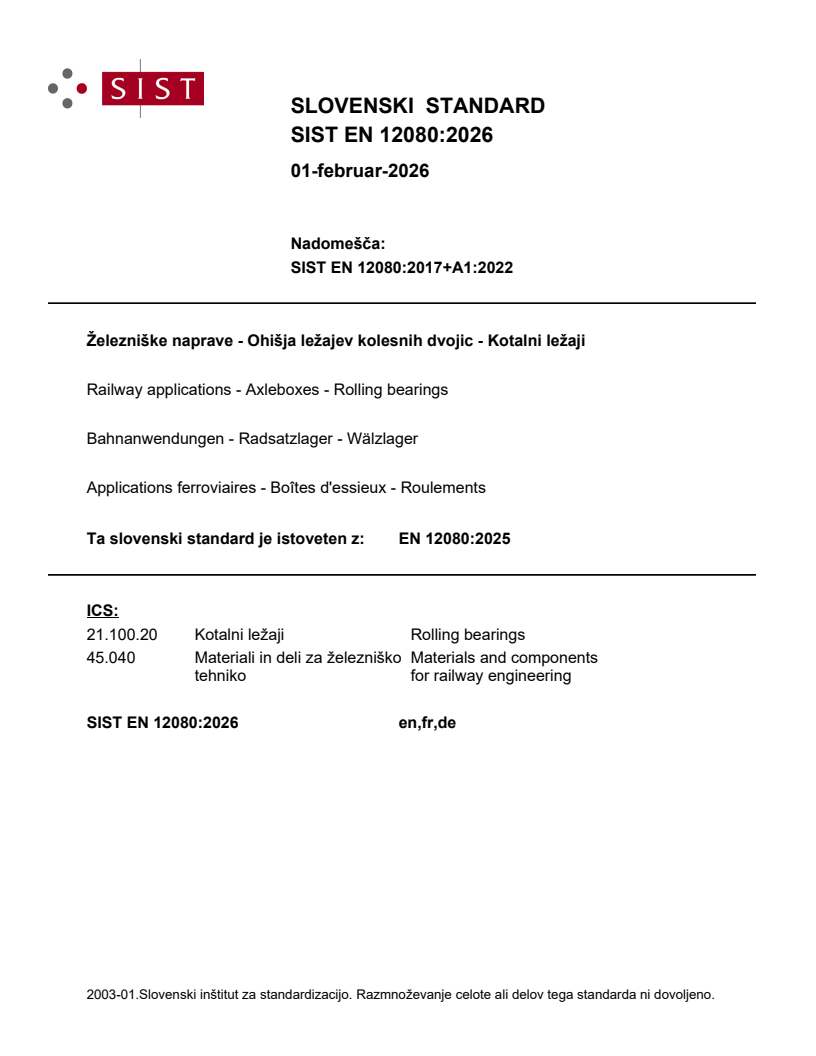
SLOVENSKI STANDARD
01-februar-2026
Nadomešča:
SIST EN 12080:2017+A1:2022
Železniške naprave - Ohišja ležajev kolesnih dvojic - Kotalni ležaji
Railway applications - Axleboxes - Rolling bearings
Bahnanwendungen - Radsatzlager - Wälzlager
Applications ferroviaires - Boîtes d'essieux - Roulements
Ta slovenski standard je istoveten z: EN 12080:2025
ICS:
21.100.20 Kotalni ležaji Rolling bearings
45.040 Materiali in deli za železniško Materials and components
tehniko for railway engineering
2003-01.Slovenski inštitut za standardizacijo. Razmnoževanje celote ali delov tega standarda ni dovoljeno.
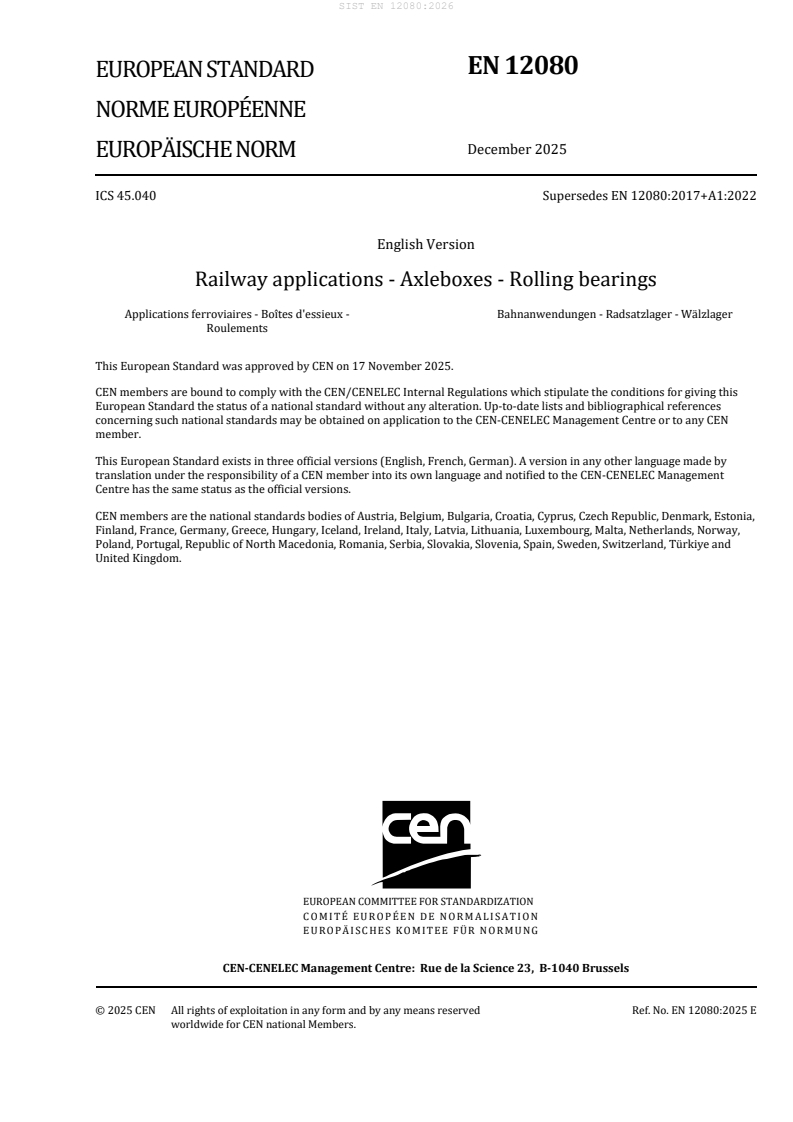
EN 12080
EUROPEAN STANDARD
NORME EUROPÉENNE
December 2025
EUROPÄISCHE NORM
ICS 45.040 Supersedes EN 12080:2017+A1:2022
English Version
Railway applications - Axleboxes - Rolling bearings
Applications ferroviaires - Boîtes d'essieux - Bahnanwendungen - Radsatzlager - Wälzlager
Roulements
This European Standard was approved by CEN on 17 November 2025.
CEN members are bound to comply with the CEN/CENELEC Internal Regulations which stipulate the conditions for giving this
European Standard the status of a national standard without any alteration. Up-to-date lists and bibliographical references
concerning such national standards may be obtained on application to the CEN-CENELEC Management Centre or to any CEN
member.
This European Standard exists in three official versions (English, French, German). A version in any other language made by
translation under the responsibility of a CEN member into its own language and notified to the CEN-CENELEC Management
Centre has the same status as the official versions.
CEN members are the national standards bodies of Austria, Belgium, Bulgaria, Croatia, Cyprus, Czech Republic, Denmark, Estonia,
Finland, France, Germany, Greece, Hungary, Iceland, Ireland, Italy, Latvia, Lithuania, Luxembourg, Malta, Netherlands, Norway,
Poland, Portugal, Republic of North Macedonia, Romania, Serbia, Slovakia, Slovenia, Spain, Sweden, Switzerland, Türkiye and
United Kingdom.
EUROPEAN COMMITTEE FOR STANDARDIZATION
COMITÉ EUROPÉEN DE NORMALISATION
EUROPÄISCHES KOMITEE FÜR NORMUNG
CEN-CENELEC Management Centre: Rue de la Science 23, B-1040 Brussels
© 2025 CEN All rights of exploitation in any form and by any means reserved Ref. No. EN 12080:2025 E
worldwide for CEN national Members.
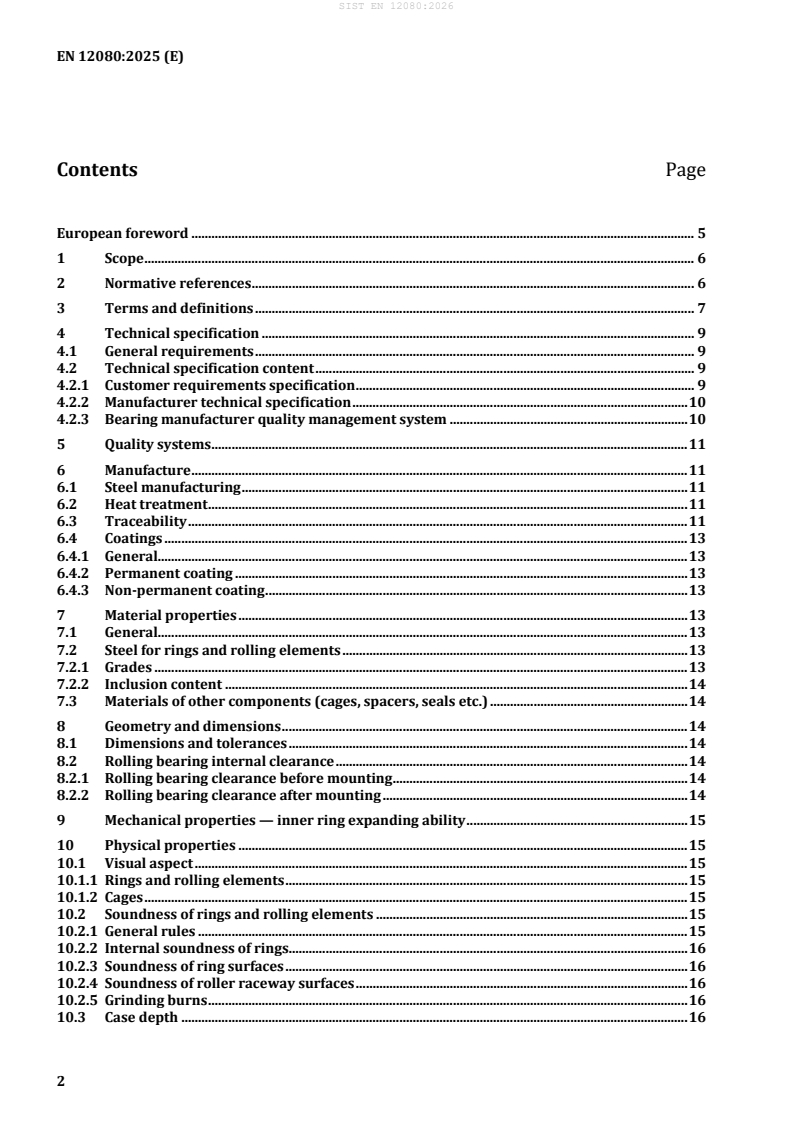
Contents Page
European foreword . 5
1 Scope . 6
2 Normative references . 6
3 Terms and definitions . 7
4 Technical specification . 9
4.1 General requirements . 9
4.2 Technical specification content . 9
4.2.1 Customer requirements specification . 9
4.2.2 Manufacturer technical specification . 10
4.2.3 Bearing manufacturer quality management system . 10
5 Quality systems . 11
6 Manufacture . 11
6.1 Steel manufacturing . 11
6.2 Heat treatment . 11
6.3 Traceability . 11
6.4 Coatings . 13
6.4.1 General. 13
6.4.2 Permanent coating . 13
6.4.3 Non-permanent coating . 13
7 Material properties . 13
7.1 General. 13
7.2 Steel for rings and rolling elements . 13
7.2.1 Grades . 13
7.2.2 Inclusion content . 14
7.3 Materials of other components (cages, spacers, seals etc.) . 14
8 Geometry and dimensions . 14
8.1 Dimensions and tolerances . 14
8.2 Rolling bearing internal clearance . 14
8.2.1 Rolling bearing clearance before mounting . 14
8.2.2 Rolling bearing clearance after mounting . 14
9 Mechanical properties — inner ring expanding ability . 15
10 Physical properties . 15
10.1 Visual aspect . 15
10.1.1 Rings and rolling elements . 15
10.1.2 Cages . 15
10.2 Soundness of rings and rolling elements . 15
10.2.1 General rules . 15
10.2.2 Internal soundness of rings . 16
10.2.3 Soundness of ring surfaces . 16
10.2.4 Soundness of roller raceway surfaces . 16
10.2.5 Grinding burns . 16
10.3 Case depth . 16
10.4 Surface hardness . 16
11 Marking . 17
11.1 General . 17
11.2 Marking of rings for cylindrical roller bearings (Cylindrical Roller Bearing) . 18
11.3 Marking of cartridge bearings for axleboxes . 19
11.4 Marking of Spherical Roller Bearings . 21
11.5 Prefix and postfix . 22
12 Inspection . 22
12.1 Inspection plan . 22
12.2 Sampling . 24
13 Quality records . 24
14 Deployment. 24
15 Delivery and packing . 24
15.1 Greasing of rolling bearings. 24
15.2 Corrosion protection . 24
15.3 Packaging . 25
Annex A (normative) Ultrasonic inspection of rolling bearing rings . 26
A.1 Purpose . 26
A.2 Principle . 26
A.3 Equipment . 26
A.4 Operating procedure . 26
A.4.1 General rules . 26
A.4.2 Preparation of rings . 26
A.4.3 Examination . 27
A.4.4 Calibration. 27
Annex B (normative) Magnetic particle inspection of ring surfaces . 31
B.1 Purpose . 31
B.2 Principle . 31
B.3 Equipment . 31
B.4 Operation procedure . 32
B.4.1 Preparation of rings . 32
B.4.2 Examination . 32
B.4.3 Demagnetisation . 32
Annex C (normative) Eddy current inspection of the raceways of the rollers. 33
C.1 Purpose . 33
C.2 Principle . 33
C.3 Equipment . 33
C.4 Operating procedure . 33
C.4.1 Preparation of rollers . 33
C.4.2 Examination . 33
C.4.3 Calibration . 34
Annex D (normative) Cages of polymeric material . 35
D.1 Purpose . 35
D.2 Material . 35
D.2.1 General. 35
D.2.2 Base material . 35
D.2.3 Additives . 35
D.3 Cage requirements . 35
D.3.1 Inspection plan . 35
D.3.2 Moisture content . 37
D.3.3 Fibre glass diameter and length measurement procedure . 38
D.3.4 Surface quality . 38
D.3.5 Surface defects . 38
D.3.6 Burrs . 38
D.3.7 Sub-surface quality . 39
D.4 Mechanical tests . 41
D.4.1 Test conditions . 41
D.4.2 Bending test procedures . 42
D.4.3 Tension test procedures . 43
D.5 Thermal ageing in grease or oil bath . 45
Annex E (informative) Eddy current testing of ring surfaces . 47
E.1 Purpose . 47
E.2 Principle . 47
E.3 Equipment . 47
E.4 Operating procedure . 47
E.4.1 Preparation of the rings . 47
E.4.2 Examination . 47
E.4.3 Calibration . 48
Bibliography . 51
European foreword
This document (EN 12080:2025) has been prepared by Technical Committee CEN/TC 256 “Railway
Applications”, the secretariat of which is held by DIN.
This European Standard shall be given the status of a national standard, either by publication of an
identical text or by endorsement, at the latest by June 2026, and conflicting national standards shall be
withdrawn at the latest by May 2026.
Attention is drawn to the possibility that some of the elements of this document may be the subject of
patent rights. CEN shall not be held responsible for identifying any or all such patent rights.
This document supersedes EN 12080:2017+A1:2022.
EN 12080:2017+A1:2022:
— focus is only on rolling bearing related product requirements. As a consequence, product
requirements not related to the rolling bearing or requirements connected with conformity
assessment of the rolling bearing have been deleted or transferred to EN 12082-2;
— Clause 4 on Technical Specification is revised;
— Annex E Approval Procedures and Annex F Criteria to determine the extent of approval procedures
are deleted and respective content transferred to EN 12082-2;
— Annex G is transferred to EN 12082-2;
— with respect to 10.2.3 Soundness of ring surfaces, eddy current testing is more emphasized as an
alternative to Magnetic Particle Inspection. A new Annex E is introduced with requirements on how
eddy current testing of ring surfaces should be processed;
— concerning Clause 11 Marking, changes are made to harmonize requirements for different rolling
bearing types and to address modern practices such as Data Matrix Coding;
— Annex D Cages of polymeric material is reviewed with changes across the annex.
This document has been prepared under a standardization request addressed to CEN by the European
Commission. The Standing Committee of the EFTA States subsequently approves these requests for its
Member States.
Any feedback and questions on this document should be directed to the users’ national standards body.
A complete listing of these bodies can be found on the CEN website. According to the CEN-CENELEC
Internal Regulations, the national standards organisations of the following countries are bound to
implement this European Standard: Austria, Belgium, Bulgaria, Croatia, Cyprus, Czech Republic,
Denmark, Estonia, Finland, France, Germany, Greece, Hungary, Iceland, Ireland, Italy, Latvia, Lithuania,
Luxembourg, Malta, Netherlands, Norway, Poland, Portugal, Republic of North Macedonia, Romania,
Serbia, Slovakia, Slovenia, Spain, Sweden, Switzerland, Türkiye and the United Kingdom.
1 Scope
This document is a part of a package of standards: EN 12080, EN 12081, EN 12082-1 and EN 12082-2.
This document specifies the quality parameters of axlebox rolling bearings supporting the load of the
vehicle, required for reliable operation of trains on European networks. It covers metallurgical and
material properties as well as geometric and dimensional characteristics. It also specifies methods for
quality assurance and non-destructive testing of the products.
2 Normative references
The following documents are referred to in the text in such a way that some or all of their content
constitutes requirements of this document. For dated references, only the edition cited applies. For
undated references, the latest edition of the referenced document (including any amendments) applies.
EN 10204:2004, Metallic products - Types of inspection documents
EN 12081:2025, Railway applications - Axleboxes - Lubricating greases
EN 12082-1:2025, Railway applications - Axleboxes – Part 1: Test procedure
EN 12082-2:2025, Railway applications - Axleboxes – Part 2: Deployment Procedure
EN 13018:2016, Non-destructive testing - Visual testing - General principles
EN ISO 178:2019, Plastics - Determination of flexural properties (ISO 178:2019)
EN ISO 179-1:2023, Plastics - Determination of Charpy impact properties - Part 1: Non-instrumented
impact test (ISO 179-1:2023)
EN ISO 307:2019, Plastics - Polyamides - Determination of viscosity number (ISO 307:2019)
EN ISO 683-17:2023, Heat-treated steels, alloy steels and free-cutting steels - Part 17: Ball and roller
bearing steels (ISO 683-17:2023)
EN ISO 1172:2023, Textile-glass-reinforced plastics - Prepregs, moulding compounds and laminates -
Determination of the textile-glass and mineral-filler content using calcination methods (ISO 1172:2023)
EN ISO 1183-1:2025, Plastics - Methods for determining the density of non-cellular plastics - Part 1:
Immersion method, liquid pycnometer method and titration method (ISO 1183-1:2025)
EN ISO 1183-2:2019, Plastics - Methods for determining the density of non-cellular plastics - Part 2:
Density gradient column method (ISO 1183-2:2019)
EN ISO 3059:2012, Non-destructive testing - Penetrant testing and magnetic particle testing - Viewing
conditions (ISO 3059:2012)
EN ISO 3451-1:2019, Plastics - Determination of ash - Part 1: General methods (ISO 3451-1:2019)
EN ISO 6507-1:2023, Metallic materials - Vickers hardness test - Part 1: Test method (ISO 6507-1:2023)
EN ISO 6508-1:2023, Metallic materials - Rockwell hardness test - Part 1: Test method (ISO 6508-1:2023)
EN ISO 6508-2:2023, Metallic materials - Rockwell hardness test - Part 2: Verification and calibration of
testing machines and indenters (ISO 6508-2:2023)
EN ISO 6508-3:2023, Metallic materials - Rockwell hardness test - Part 3: Calibration of reference blocks
(ISO 6508-3:2023)
EN ISO 9934-1:2016, Non-destructive testing - Magnetic particle testing - Part 1: General principles (ISO
9934-1:2016)
EN ISO 9934-2:2015, Non-destructive testing - Magnetic particle testing - Part 2: Detection media (ISO
9934-2:2015)
EN ISO 9934-3:2015, Non-destructive testing - Magnetic particle testing - Part 3: Equipment (ISO 9934-
3:2015)
EN ISO 11357-3:2025, Plastics - Differential scanning calorimetry (DSC) - Part 3: Determination of
temperature and enthalpy of melting and crystallization (ISO 11357-3:2025)
EN ISO 18203:2022, Steel - Determination of the thickness of surface-hardened layers (ISO 18203:2016)
ISO 492:2023, Rolling bearings — Radial bearings — Geometrical product specifications (GPS) and
tolerance values
3 Terms and definitions
For the purposes of this document, the terms and definitions given in EN 12082-2:2025, Annex B and
the following apply.
ISO and IEC maintain terminological databases for use in standardization at the following addresses:
— IEC Electropedia: available at https://www.electropedia.org/
— ISO Online browsing platform: available at https://www.iso.org/obp
3.1
customer
railway undertaking, rolling stock manufacturer, Entity in Charge of Maintenance (ECM) or buyer of
railway rolling stock or subassemblies, or their representative
3.2
railway undertaking
organization or its representative, whatever status it has, which is responsible for the registration of
rolling stock
3.3
manufacturer
bearing manufacturer of axlebox rolling bearings produced under their responsibility
3.4
network
infrastructure, on which any railway undertaking can operate rolling stock
3.5
axlebox
assembly consisting of the following major components: rolling bearing(s), grease, seal(s) and box
housing
Note 1 to entry: Further components such as axle end cap components, box cover(s), distance rings, fasteners,
labyrinth(s) may also be part of the assembly but are not considered as major components. Their presence
depends on the axlebox type design.
3.6
bearing sleeve
component of box housing which contains rolling bearing(s), grease and sealing
3.7
housing cover
component which retains the bearing in the housing or bearing sleeve
3.8
axle end cap components
components which secure the rolling bearing axially on the journal
3.9
rolling bearing
bearing, operating with rolling motion between the parts supporting load and moving in relation to
each other
3.10
cartridge bearing
rolling bearing with two or more rows of rolling elements within a self-contained unit, greased and
equipped with integral seals
3.11
ring
annular part of a rolling bearing incorporating one or more raceways with rolling element contact
3.12
rolling elements
cylindrical, tapered or convex rollers or balls
3.13
cage
component, which partly surrounds the rolling elements and moves with them
3.14
grease
semi-solid lubricant, which consists of a thickener and additives dispersed in a lubricating oil
3.15
seal
component that protects the bearing(s) against ingress of water and dust and retains the grease in the
rolling bearing(s)
3.16
box housing
structural component which contains rolling bearing(s), seal(s) and grease
Note 1 to entry: It may consist of several components such as an upper part, a lower part, bearing sleeve.
3.17
rolling bearing type
designation of the rolling bearing or cartridge bearing according to the shape of the rolling elements
EXAMPLE tapered roller bearing, cylindrical roller bearing, spherical roller bearing
3.18
rolling bearing design
designation of a specific rolling bearing or cartridge bearing design within a rolling bearing type
EXAMPLE WJ/WJP 130x240x80 P.C3, bearing design is a subset of a bearing type
3.19
ribs and thrust collars
annular component of a rolling bearing transmitting axial forces (separate from the bearing inner or
outer rings) in contact with the rolling element end face in cylindrical roller bearings
3.20
deployment process
methodical procedure of introducing an axlebox or a change to an axlebox into vehicle service
4 Technical specification
4.1 General requirements
The supply of a component shall be based on a comprehensive specification. This specification shall
consist of all the information relevant for design and manufacture of the bearing describing the
functional requirements over its complete life cycle and the interfaces with associated components and
assemblies.
The design and validation process requires the integration of different disciplines and areas of expertise
and the knowledge associated with them. Therefore, the specification shall include information defining
the intended operating conditions and calculation parameters.
The following information shall be fully documented in the technical specification by either of the
contracting parties. Both the requirements specified throughout this document and the following
documented requirements shall be satisfied before a claim of compliance with this document can be
made and verified.
The technical specification shall cover the items listed in 4.2 in the most suitable format (drawing, text
etc.).
4.2 Technical specification content
4.2.1 Customer requirements specification
The following information shall be considered for the development of a new bearing:
— interface drawing showing mounting conditions as in service; all dimensions of the space available
for the rolling bearings; dimensions, tolerances and materials of shaft and box housing;
— load specification at least according to EN 12082-1:2025;
— ambient temperatures in operation;
— deployment procedure type and conditions to be applied (see Clause 14).
4.2.2 Manufacturer technical specification
The following information of the bearing shall be made available by the bearing manufacturer:
— boundary dimensions and tolerances of the rolling bearing (see Clause 8);
— internal clearance measurement process and clearance values before mounting (see Clause 8);
— clearance values after mounting (see Clause 8);
— type of coating and influence on boundary dimensions (see 6.4);
— type of heat treatment;
— soundness Class 1 or 2 and the test methods (see 10.2);
— for cartridge bearings: grease designation, quantity and distribution (see 15.1);
— marking (see Clause 11).
4.2.3 Bearing manufacturer quality management system
Additionally, the following requirements which are specified in the clauses referred to shall be fully
documented in the bearing manufacturer quality management system:
— if required, special steel composition, cleanliness and soundness class (see 7.1 and 10.2);
— special conditions for quality records and traceability (see 6.3 and Clause 13);
— references to standards and special requirements (see Clause 2, Clause 7 and Clause 10);
— use of steel of special composition, manufacture or metallurgical quality (see 7.1);
— type of heat treatment to be applied and methods of testing (see 6.2, 10.3, 10.4 and 12.2);
— inspection plan (see 12.1);
— selection of mechanical testing method for cages of polymeric material (see D.4.1);
— material data sheet for polymer cage material;
— proof of batch release according to EN 12081:2025 for traceability;
— method for determining steel cleanliness.
5 Quality systems
The quality of workmanship and manufacturing shall be demonstrated to ensure the requirements of
the technical specification are met.
The manufacturer is responsible for this.
NOTE 1 Quality management system according to EN ISO 9001 is usually used.
NOTE 2 Competency of non-destructive testing staff can be demonstrated, e.g. according to ISO 9712, ASNT
recommended practice No. SNT-TC-1A or NAS 410.
6 Manufacture
6.1 Steel manufacturing
The process of steel manufacture in mass production shall be such that the metallurgical characteristics
are the same as those of the rolling bearings submitted for the deployment procedure.
6.2 Heat treatment
The heat treatment processes for the rolling bearing components shall be such that the hardness values
specified in 10.3 and/or 10.4 are respected. The heat treatment processes shall be such that all the
rolling bearings produced in a production batch are treated uniformly.
The temperature category shall be given and documented in the Technical specification (Clause 4).
The bearings (inner and outer rings) shall be heat-treated to retain dimensional stability at least for
operating temperatures up to 150 °C.
Inner rings of cylindrical roller bearings that are heated during mounting or dismounting shall be
dimensionally stable up to 200 °C.
The retained austenite content for inner rings made of through-hardened rolling bearing steel shall be:
— 150°C: ≤ 3,0 % with a measuring accuracy of ± 1 %;
— 200°C: ≤ 2,0 % with a measuring accuracy of ± 1 %.
For other steels, the retained austenite content shall be specified in the course of the (type) deployment
procedure.
The inspection frequency of the retained austenite content is specified in Table 3, 12.1. The method of
measurement of retained austenite is according to ASTM E975 -or to be specified in the technical
specification (Clause 4).
6.3 Traceability
For the manufacturing process a system of identification and traceability of finished products shall be
set up and maintained. This system shall allow identification, of the following elements:
— raw material for rings and rollers;
— inspection certificate 3.1 in accordance with EN 10204:2004 or equivalent. Minimum content:
— chemical analysis (all elements according steel grade specification);
— steel production method;
— microstructure (CN, CG, CZ);
— inclusion content (see 7.2.2);
— polymeric cages:
— raw material (granulate material) + raw material manufacturer;
— inspection results; inspections at least in accordance with, Annex D;
— manufacturer, manufacturer's mark, date of manufacture;
— rolling bearing grease:
— name, manufacturer;
— inspection certificate 3.1 in accordance with EN 10204:2004 or equivalent. The content of the
certificate is according to EN 12081:2025.
— production locations of rings and rollers;
— traceability of heat treatment:
— method;
— temperature variations including nominal and actual values per heat treatment batch;
— microstructural examination per heat treatment batch;
— hardness values/case-hardening depth of rings and rollers in accordance with Table 3;
— retained austenite content, inspection frequency in accordance with 6.2;
— if there are several heat treatment batches per production batch they shall be assignable to the
production batch;
— significant changes in the finishing process after heat treatment that could lead to defects, e.g. so
called “grinding burns”;
— traceability of the inspection results in accordance with the inspection plan (see 12.1);
— quality records in accordance with Clause 13 and records of inspection plans, inspection
instructions and calibrations.
— production of cartridge bearings
— name, manufacturer
— amount of grease
— assembly date
6.4 Coatings
6.4.1 General
The type of coating used for the bearing boundary surfaces shall be agreed and documented in
accordance with Clause 4. Distinction shall be made between permanent coatings (e.g. for electrical
insulation) and non-permanent coatings (e.g. phosphate coating for corrosion protection).
6.4.2 Permanent coating
The dimensions in the finished state (including the coating) shall apply deployment and use of the
bearing.
6.4.3 Non-permanent coating
The dimensions before coating shall apply for deployment and use of the bearing and the thickness of
the non-permanent coating shall be considered separately. Boundary dimensions shall be documented
both for the coated and the uncoated state.
7 Material properties
7.1 General
The grades and qualities of materials used shall conform to the requirements in 7.2 and 7.3.
7.2 Steel for rings and rolling elements
7.2.1 Grades
Steels should be selected from the grades specified in EN ISO 683-17:2023. Alternative steel grades may
be used if specified in the technical specification. For particular applications (high rotational speed,
reliability etc.) it may be requested that the rolling bearings are made from steel with special
composition, metallurgical quality or manufacturing processes (Clause 4).
Additional requirements regarding the chemical composition (mass fraction in %) after the ladle
analysis in accordance with EN ISO 683-17:2023 are listed below in Table 1, through hardened steel
and Table 2, case carburised steel below.
Table 1 — Additional requirements, chemical composition, through hardened steel
Mass
Mass fraction fraction
[%] [%]
Elements min. max.
Ti 0 0,003
H 0 0,000 2
Table 2 — Additional requirements, chemical composition, case carburised steel
Mass
Mass fraction
fraction
[%] [%]
Elements min. max.
Ti 0 0,005
H 0 0,000 25
7.2.2 Inclusion content
The methods for determining the inclusion content shall be in the technical specification.
The methods in accordance with ASTM E45 (Method A) and ISO 4967 (Method A) are permitted. For the
methods mentioned above, the limit values in accordance with EN ISO 683-17:2023, Annex A, Tables
A.1 and A.2 are authoritative.
The frequency and scope of inspection for inclusion content of raw material (bar, tube or billet) is
specified in Table 3, 12.1).
When needed - inspection of single rings and rollers can also be made according to the methods and
requirements specified above providing enough samples are taken to form an average value.
NOTE ASTM E45 gives a recommendation for number of samples.
For steel with special composition, metallurgical quality or manufacturing processes, the inclusion
content shall be documented in accordance with Clause 4.
7.3 Materials of other components (cages, spacers, seals etc.)
The materials of each one of these components shall be documented in the technical specification in
accordance with Clause 4. For cages of polymeric material, if not otherwise specified, refer to Annex D.
8 Geometry and dimensions
8.1 Dimensions and tolerances
The boundary dimensions shall be given in the technical specification, and the applicable tolerances
shall be those given in ISO 492:2023, normal tolerance class, unless given and documented in the
technical specification in accordance with Clause 4.
8.2 Rolling bearing internal clearance
8.2.1 Rolling bearing clearance before mounting
Rolling bearing internal clearance, axial and/or radial, depending on the type of rolling bearing, shall
conform to the values given in the technical specification. The methods for radial and/or axial clearance
inspection shall be specified and documented in the technical specification in accordance with Clause 4.
8.2.2 Rolling bearing clearance after mounting
Rolling bearing clearance after mounting on an axle is a calculated value used for checking the clearance
after mounting. The values for clearance after mounting shall be specified and documented by the
manufacturer in accordance with Clause 4.
9 Mechanical properties — inner ring expanding ability
With the exception of case-hardened rings and bainite hardened rings, an expansion test shall be
performed to guarantee that the inner rings can withstand an increase of the bore diameter without
causing fracture in service. This test shall be performed before the inspection for surface soundness.
The value of this diameter increase shall not be less than 0,0015 times the diameter. The rings shall
neither rupture nor show any traces of cracks (see 10.2.3). This expansion test shall be made with an
expandable mandrel that is inserted in the bore of the inner ring. The expansion shall be achieved
progressively in a few seconds.
10 Physical properties
10.1 Visual aspect
10.1.1 Rings and rolling elements
Rings and rolling elements shall be free of any defects which can be harmful to their function (such as
burrs, scratches, rust stains, nicks and dents). A defect catalogue to specify the acceptance limits for
visual defects shall be created and maintained.
NOTE Usually the manufacturer is responsible for maintaining a defect catalogue.
10.1.2 Cages
Rolling bearing cages shall exhibit no defects that might affect their function (such as burrs, scratches,
rust). To avoid crack initiation, the connection between the cage bars and the annular body shall be
smooth and conform to the rounding-off shown on the detail drawing.
The requirements for cages of polymeric material shall be taken into account (see Annex D).
For cages other than polymeric cages the approval process shall be specified in the technical
specification. Steel riveted brass cages are not allowed.
10.2 Soundness of rings and rolling elements
10.2.1 General rules
Rings and rolling elements shall have no internal defects, nor any form of surface defect that may be
harmful to their function. The methods for the soundness inspection are specified in Annex A, Annex B,
Annex C and informed about in Annex E. Any alternative methods to be used, which give equivalent
results, shall be documented in the technical specification in accordance with Clause 4.
Two soundness classes are specified:
— class 1 for vehicles with n × d > 250 000 [mm/min] or a vehicle speed > 200 km/h or axle
m
load ≥ 25.0t;
— class 2 for vehicles wi
...