

SIST EN 17888-1:2024
(Main)Thermal performance of buildings - In situ testing of building test structures - Part 1: Data collection for aggregate heat loss test
General Information
- Abstract
This document specifies a test method for the in situ testing of the thermal performance of building structures especially built for the purpose of the test.
This document also specifies the apparatus to be used and the measurement procedures to collect the data and the reporting format for the apparatus including the building test structure and the test conditions.
NOTE The analysis of the data and the reporting format for the analysis are referred to in prEN 17888-2.
This document does not apply to:
- existing buildings;
- building structures allowing direct solar gains through glazing surfaces;
- the determination of the thermal performance of a specific building product, material, component or element.
- Status
- Published
- Public Enquiry End Date
- 13-Nov-2022
- Publication Date
- 09-Jun-2024
- Technical Committee
- TOP - Thermal insulation
- Current Stage
- 6060 - National Implementation/Publication (Adopted Project)
- Start Date
- 29-May-2024
- Due Date
- 03-Aug-2024
- Completion Date
- 10-Jun-2024


Overview
EN 17888-1:2024 - published by CEN - defines an in situ test method for measuring the thermal performance of purpose-built building test structures. Part 1 focuses on data collection for an aggregate heat loss test, specifying the required apparatus, sensor placement, measurement procedures, sampling intervals and the reporting format for the test structure and test conditions. Analysis and reporting of the calculated results are addressed in Part 2.
Keywords: EN 17888-1:2024, thermal performance, in situ testing, aggregate heat loss test, building test structure, data collection, CEN.
Key topics and technical requirements
- Scope and exclusions
- Applies to building structures specially constructed for testing (not existing occupied buildings).
- Does not apply to structures with direct solar gain through glazing or to testing single products/components.
- Principle
- Measures the total in situ heat loss (aggregate heat transfer) of an assembled test structure - combining envelope heat transfer and heat loss due to air infiltration.
- Design and location of the building test structure
- Requirements for test-structure design, location, thermal qualification and guarded (non-tested) zones to ensure representative, controlled conditions.
- Apparatus and calibration
- Specifies internal and external apparatus and calibration needs, including:
- Temperature and relative humidity sensors
- Electric resistance fan heaters and circulation fans
- Temperature controllers, energy meters, data loggers
- Weather station and pyranometer
- Specifies internal and external apparatus and calibration needs, including:
- Measurement procedures
- Sensor placement, pressurization (air tightness) testing, establishing and maintaining set-point internal conditions, heating procedure, test duration, sampling intervals and post-test checks.
- Data handling and reporting
- Requirements for recording, downloading, verifying data and preparing a test report that documents apparatus, structure description, control/validation and results. Data analysis format is in Part 2.
Applications and users
EN 17888-1:2024 is valuable for:
- Test laboratories and research institutions performing controlled in situ measurements
- Building designers and manufacturers validating whole-envelope thermal performance
- Energy auditors, certifiers and policy bodies requiring validated in situ performance data
- R&D and product-installation studies where workmanship and integrated system performance need verification
Practical use cases include comparing measured aggregate heat loss with calculated design values, validating installation quality, and supporting energy performance certification for novel envelope systems.
Related standards
- EN 17888-2 (Part 2) - steady-state data analysis and reporting (analysis phase)
- FprEN 17887-1:2023 - comparable method for completed buildings
- EN ISO 12569 / EN ISO 9972 - air permeability/air leakage testing
- Normative references cited: EN ISO 7345, EN IEC 62053-21, EN 13187, EN ISO 7726
This standard enables standardized, repeatable in situ measurement of aggregate heat loss to better align calculated and real-world building thermal performance.
Relations
- Effective Date
- 09-Feb-2026
- Effective Date
- 28-Jan-2026
- Effective Date
- 28-Jan-2026
- Effective Date
- 28-Jan-2026
- Effective Date
- 28-Jan-2026
- Effective Date
- 28-Jan-2026
- Effective Date
- 28-Jan-2026
- Effective Date
- 28-Jan-2026
- Effective Date
- 28-Jan-2026
- Effective Date
- 28-Jan-2026
- Effective Date
- 28-Jan-2026
- Effective Date
- 28-Jan-2026
Get Certified
Connect with accredited certification bodies for this standard

DIBt (Deutsches Institut für Bautechnik)
German Institute for Building Technology.
DIN CERTCO
DIN Group product certification.

Aboma Certification B.V.
Specialized in construction, metal, and transport sectors.
Sponsored listings
Frequently Asked Questions
SIST EN 17888-1:2024 is a standard published by the Slovenian Institute for Standardization (SIST). Its full title is "Thermal performance of buildings - In situ testing of building test structures - Part 1: Data collection for aggregate heat loss test". This standard covers: This document specifies a test method for the in situ testing of the thermal performance of building structures especially built for the purpose of the test. This document also specifies the apparatus to be used and the measurement procedures to collect the data and the reporting format for the apparatus including the building test structure and the test conditions. NOTE The analysis of the data and the reporting format for the analysis are referred to in prEN 17888-2. This document does not apply to: - existing buildings; - building structures allowing direct solar gains through glazing surfaces; - the determination of the thermal performance of a specific building product, material, component or element.
This document specifies a test method for the in situ testing of the thermal performance of building structures especially built for the purpose of the test. This document also specifies the apparatus to be used and the measurement procedures to collect the data and the reporting format for the apparatus including the building test structure and the test conditions. NOTE The analysis of the data and the reporting format for the analysis are referred to in prEN 17888-2. This document does not apply to: - existing buildings; - building structures allowing direct solar gains through glazing surfaces; - the determination of the thermal performance of a specific building product, material, component or element.
SIST EN 17888-1:2024 is classified under the following ICS (International Classification for Standards) categories: 91.120.10 - Thermal insulation of buildings. The ICS classification helps identify the subject area and facilitates finding related standards.
SIST EN 17888-1:2024 has the following relationships with other standards: It is inter standard links to SIST EN IEC 62053-21:2021, SIST EN ISO 9972:2015, SIST EN ISO 7345:2018, SIST-TS CEN/TS 17811:2022, SIST EN ISO 7726:2026, SIST EN ISO 15927-1:2004, SIST EN ISO 52016-1:2017, SIST EN ISO 12569:2018, SIST EN ISO 6781-1:2023, SIST EN ISO 9229:2020, SIST EN ISO 13789:2017, SIST EN 17888-2:2024. Understanding these relationships helps ensure you are using the most current and applicable version of the standard.
SIST EN 17888-1:2024 is associated with the following European legislation: EU Directives/Regulations: 2010/31/EU. When a standard is cited in the Official Journal of the European Union, products manufactured in conformity with it benefit from a presumption of conformity with the essential requirements of the corresponding EU directive or regulation.
SIST EN 17888-1:2024 is available in PDF format for immediate download after purchase. The document can be added to your cart and obtained through the secure checkout process. Digital delivery ensures instant access to the complete standard document.
Standards Content (Sample)
SLOVENSKI STANDARD
01-julij-2024
Toplotne značilnosti stavb - Preskušanje gradbenih preskusnih struktur na mestu
vgradnje - 1. del: Zbiranje podatkov za preskus skupnih toplotnih izgub
Thermal performance of buildings - In situ testing of building test structures - Part 1: Data
collection for aggregate heat loss test
Wärmetechnisches Verhalten von Gebäuden - In-situ-Messung von
Gebäudeteststrukturen - Teil 1: Datenerfassung für den Gesamtwärmeverlusttest
Performance thermique des bâtiments - Mesurage in-situ de bâtiment d’essai - Partie 1 :
Collecte des données pour le test de perte de chaleur globale
Ta slovenski standard je istoveten z: EN 17888-1:2024
ICS:
91.120.10 Toplotna izolacija stavb Thermal insulation of
buildings
2003-01.Slovenski inštitut za standardizacijo. Razmnoževanje celote ali delov tega standarda ni dovoljeno.
EN 17888-1
EUROPEAN STANDARD
NORME EUROPÉENNE
May 2024
EUROPÄISCHE NORM
ICS 91.120.10
English Version
Thermal performance of buildings - In situ testing of
building test structures - Part 1: Data collection for
aggregate heat loss test
Performance thermique des bâtiments - Essais in situ Wärmetechnisches Verhalten von Gebäuden - In-situ-
des structures de bâtiments d'essai - Partie 1 : Collecte Messung an Bauwerksprüfkörpern - Teil 1:
de données pour l'essai de déperdition thermique Datenerfassung für die Prüfung des
globale Gesamtwärmeverlustes
This European Standard was approved by CEN on 27 February 2024.
CEN members are bound to comply with the CEN/CENELEC Internal Regulations which stipulate the conditions for giving this
European Standard the status of a national standard without any alteration. Up-to-date lists and bibliographical references
concerning such national standards may be obtained on application to the CEN-CENELEC Management Centre or to any CEN
member.
This European Standard exists in three official versions (English, French, German). A version in any other language made by
translation under the responsibility of a CEN member into its own language and notified to the CEN-CENELEC Management
Centre has the same status as the official versions.
CEN members are the national standards bodies of Austria, Belgium, Bulgaria, Croatia, Cyprus, Czech Republic, Denmark, Estonia,
Finland, France, Germany, Greece, Hungary, Iceland, Ireland, Italy, Latvia, Lithuania, Luxembourg, Malta, Netherlands, Norway,
Poland, Portugal, Republic of North Macedonia, Romania, Serbia, Slovakia, Slovenia, Spain, Sweden, Switzerland, Türkiye and
United Kingdom.
EUROPEAN COMMITTEE FOR STANDARDIZATION
COMITÉ EUROPÉEN DE NORMALISATION
EUROPÄISCHES KOMITEE FÜR NORMUNG
CEN-CENELEC Management Centre: Rue de la Science 23, B-1040 Brussels
© 2024 CEN All rights of exploitation in any form and by any means reserved Ref. No. EN 17888-1:2024 E
worldwide for CEN national Members.
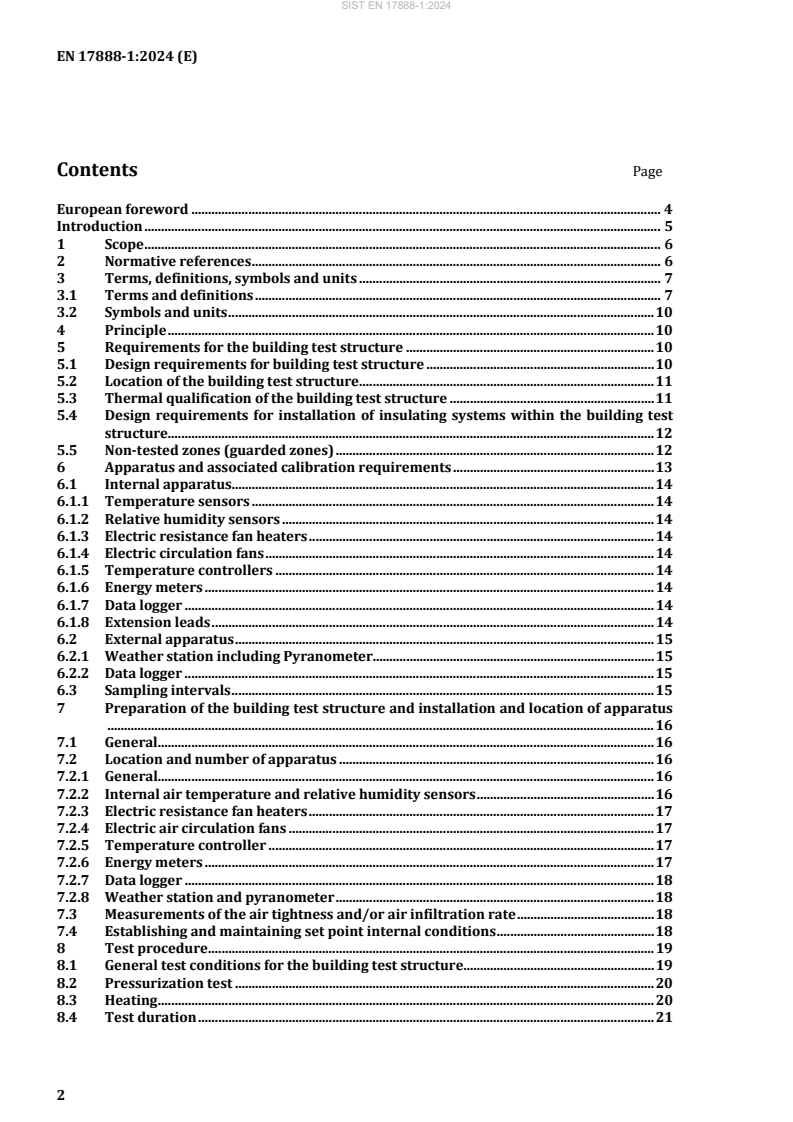
Contents Page
European foreword . 4
Introduction . 5
1 Scope . 6
2 Normative references . 6
3 Terms, definitions, symbols and units . 7
3.1 Terms and definitions . 7
3.2 Symbols and units . 10
4 Principle . 10
5 Requirements for the building test structure . 10
5.1 Design requirements for building test structure . 10
5.2 Location of the building test structure . 11
5.3 Thermal qualification of the building test structure . 11
5.4 Design requirements for installation of insulating systems within the building test
structure. 12
5.5 Non-tested zones (guarded zones) . 12
6 Apparatus and associated calibration requirements . 13
6.1 Internal apparatus. 14
6.1.1 Temperature sensors . 14
6.1.2 Relative humidity sensors . 14
6.1.3 Electric resistance fan heaters . 14
6.1.4 Electric circulation fans . 14
6.1.5 Temperature controllers . 14
6.1.6 Energy meters . 14
6.1.7 Data logger . 14
6.1.8 Extension leads . 14
6.2 External apparatus . 15
6.2.1 Weather station including Pyranometer. 15
6.2.2 Data logger . 15
6.3 Sampling intervals . 15
7 Preparation of the building test structure and installation and location of apparatus
................................................................................................................................................................... 16
7.1 General. 16
7.2 Location and number of apparatus . 16
7.2.1 General. 16
7.2.2 Internal air temperature and relative humidity sensors . 16
7.2.3 Electric resistance fan heaters . 17
7.2.4 Electric air circulation fans . 17
7.2.5 Temperature controller . 17
7.2.6 Energy meters . 17
7.2.7 Data logger . 18
7.2.8 Weather station and pyranometer . 18
7.3 Measurements of the air tightness and/or air infiltration rate . 18
7.4 Establishing and maintaining set point internal conditions . 18
8 Test procedure . 19
8.1 General test conditions for the building test structure. 19
8.2 Pressurization test . 20
8.3 Heating . 20
8.4 Test duration . 21
8.5 Post-test pressurization test . 21
9 Data collection . 21
9.1 Recording data . 21
9.2 Downloading data. 21
9.3 Data verification. 22
10 Test report . 22
10.1 General . 22
10.2 Description of test . 22
10.3 Control and validation . 23
10.4 Results . 23
10.5 Appendices . 23
Annex A (informative) Principle of design of multi-zones building test structure . 24
Annex B (informative) Examples of building test structures used in Europe for in situ testing
................................................................................................................................................................... 27
Annex C (informative) Example of layout of apparatus in a building test structure . 30
Bibliography . 31
European foreword
This document (EN 17888-1:2024) has been prepared by Technical Committee CEN/TC 89 “Thermal
performance of buildings and building components”, the secretariat of which is held by SIS.
This European Standard shall be given the status of a national standard, either by publication of an
identical text or by endorsement, at the latest by November 2024, and conflicting national standards shall
be withdrawn at the latest by November 2024.
Attention is drawn to the possibility that some of the elements of this document may be the subject of
patent rights. CEN shall not be held responsible for identifying any or all such patent rights.
Any feedback and questions on this document should be directed to the users’ national standards body.
A complete listing of these bodies can be found on the CEN website.
According to the CEN-CENELEC Internal Regulations, the national standards organisations of the
following countries are bound to implement this European Standard: Austria, Belgium, Bulgaria, Croatia,
Cyprus, Czech Republic, Denmark, Estonia, Finland, France, Germany, Greece, Hungary, Iceland, Ireland,
Italy, Latvia, Lithuania, Luxembourg, Malta, Netherlands, Norway, Poland, Portugal, Republic of North
Macedonia, Romania, Serbia, Slovakia, Slovenia, Spain, Sweden, Switzerland, Türkiye and the United
Kingdom.
Introduction
The world’s energy resources are being consumed at a significant rate that will result in the depletion of
non-renewable resources. It is imperative that energy be conserved. The building sector, through its use
of energy, can represent up to 40 % of the total energy consumed (in mild climates, where heating and
cooling correspond to the major energy demand in buildings). Conservation of energy in buildings can
result in a slowing down of non-renewable resource usage and consequently of the build-up of
greenhouse gases.
A critical contribution to the conservation of energy in buildings is made by minimizing the heat loss from
a building. This is achieved by creating building envelopes that are both airtight and highly insulated.
Standardized test methods exist for establishing the in situ air permeability or air leakage rate of a
building, EN ISO 12569 and EN ISO 9972. This document provides a method for measuring the total in
situ heat loss from a building test structure. The total heat loss is a combination of the heat lost through
air infiltration and envelope heat transfer, and since the air infiltration rate can be measured and the heat
loss associated with this approximated, the value for envelope heat transfer can be estimated, together
with their combined uncertainty.
In the design process for new buildings, and increasingly for refurbishment, an energy consumption
calculation is carried out; normally this uses a calculated value for total heat loss based upon assumptions
regarding air infiltration rates and calculated U-values for the plane building elements and openings, and
values for thermal bridges at the junctions between the plane elements (e.g. openings, intermediate
Ψ
floors). The assumptions on air infiltration can be confirmed by testing to standardized methodologies
and the design calculation is often adjusted post-testing to include the actual measured air permeability
or air leakage rate of the building that is achieved once construction is complete. This document provides
a test methodology that will allow the actual in situ building test structure aggregate heat loss to be
quantified.
This building aggregate heat loss test methodology can be used for the general confirmation of energy
performance, as might be required by the building certifier or consumer. It can also enable a comparison
to be made between the measured in situ values and the calculated values that are currently used.
Without a building aggregate heat loss test methodology, there is currently no way to check and confirm
actual energy performance in situ. Consequently, this could lead to the adoption of practices in both
design and workmanship that could make the calculated values invalid or inappropriate. In addition,
wider scale assumptions regarding the potential reductions in energy consumption that could be
achieved through the provision of new and refurbished energy efficient buildings, would be made on the
basis of calculated whole building performance, without validation by confirmation of actual aggregate
in situ performance.
This document provides an in situ test methodology for measuring the aggregate heat transfer coefficient
(H ) from a building test structure composed of opaque elements. It will allow for the comparison of
agg
calculated and measured thermal performance of the building test structure. Part 1 details the test
procedure and data collection while Part 2 details steady-state data analysis.
This test method is comparable to FprEN 17887-1:2023 which deals with completed buildings, with the
difference being that this method is applicable to simpler building structures especially built for the
purpose of the test. This offers a more robust control of each step of testing, including workmanship and
product installation for the fabric and the envelope, as well as including measurement equipment,
apparatus, sensors and monitoring. External climate conditions occurring during the period of test
remain free.
1 Scope
This document specifies a test method for the in situ testing of the thermal performance of building
structures especially built for the purpose of the test.
This document also specifies the apparatus to be used and the measurement procedures to collect the
data and the reporting format for the apparatus including the building test structure and the test
conditions.
NOTE The analysis of the data and the reporting format for the analysis are referred to in FprEN 17888-2.
This document is not applicable to:
— existing buildings;
— building structures allowing direct solar gains through glazing surfaces;
— the determination of the thermal performance of a specific building product, material, component or
element.
2 Normative references
The following documents are referred to in the text in such a way that some or all of their content
constitutes requirements of this document. For dated references, only the edition cited applies. For
undated references, the latest edition of the referenced document (including any amendments) applies.
EN ISO 7345, Thermal performance of buildings and building components — Physical quantities and
definitions (ISO 7345)
EN IEC 62053-21, Electricity metering equipment — Particular requirements — Part 21: static meters for
AC active energy (classes 0,5, 1 and 2) (IEC 62053-21)
EN 13187, Thermal performance of buildings — Qualitative detection of thermal irregularities in building
envelopes — Infrared method (ISO 6781 modified)
EN ISO 7726, Ergonomics of the thermal environment — Instruments for measuring physical quantities
(ISO 7726)
EN ISO 9229, Thermal insulation — Vocabulary (ISO 9229)
EN ISO 9972, Thermal performance of buildings — Determination of air permeability of buildings — Fan
pressurization method (ISO 9972)
EN ISO 12569, Thermal performance of buildings and materials — Determination of specific airflow rate in
buildings — Tracer gas dilution method (ISO 12569)
EN ISO 13789:2017, Thermal performance of buildings — Transmission and ventilation heat transfer
coefficients — Calculation method (ISO 13789:2017)
EN ISO 15927-1:2003, Hygrothermal performance of buildings — Calculation and presentation of climatic
data — Part 1: Monthly and annual means of single meteorological elements (ISO 15927-1: 2003)
EN ISO 52016-1:2017, Energy performance of buildings — Energy needs for heating and cooling, internal
temperatures and sensible and latent heat loads — Part 1: Calculation procedures (ISO 52016-1)
ISO 9060, Solar energy — Specification and classification of instruments for measuring hemispherical solar
and direct solar radiation
ISO 9869-1:2014, Thermal insulation — Building elements — In situ measurement of thermal resistance
and thermal transmittance — Part 1: Heat flow meter method
3 Terms, definitions, symbols and units
For the purposes of this document, the terms and definitions given in EN ISO 7345, EN ISO 9229 and the
following apply.
ISO and IEC maintain terminological databases for use in standardization at the following addresses:
— IEC Electropedia: available at https://www.electropedia.org/
— ISO Online browsing platform: available at https://www.iso.org/obp
3.1 Terms and definitions
3.1.1
aggregate heat loss
total rate of heat loss attributable to an entire building fabric obtained by measurement of the aggregate
heat loss rates from plane elements, thermal bridges and air infiltration
3.1.2
aggregate heat loss test
metric of a building’s thermal performance capable of measuring the heat loss attributable to a building
fabric according to this test standard
3.1.3
aggregate heat transfer coefficient
sum of the transmission and infiltration component of the ventilation heat transfer coefficient based upon
measurement according to this test standard
3.1.4
air leakage rate
air flow rate across the building envelope
Note 1 to entry: This movement includes flow through joints, cracks and porous surfaces, or a combination thereof,
inducted naturally or by air-moving equipment used in this International standard
[SOURCE: EN ISO 9972:2015, 3.1.1]
3.1.5
air permeability
air leakage rate per the envelope area across the building envelope
[SOURCE: EN ISO 9972:2015, 3.1.4]
3.1.6
building energy need for heating
heat to be delivered to the test zone by heating system to maintain the set point temperature during a
given period of time
3.1.7
building structure
organized combination of connected building elements designed to provide some measure of rigidity, or
a construction works having such arrangement
3.1.8
building test structure
building structure especially designed for testing thermal performance including any guarded spaces,
comprising walls, floor and roof, representative of a simplified building, inclusive of the specific building
products, elements or thermal insulation system to be tested
3.1.9
external (internal) air temperature
temperature of the external (internal) air measured by external (internal) air temperature sensor
3.1.10
guarded zones
non-tested zones separated to the test zone by a thermal guard aiming to minimize the heat loss so that
the separation wall can be supposed adiabatic
3.1.11
heat transfer coefficient
heat flow rate divided by temperature difference between two environments
Note 1 to entry: Specifically used for heat transfer coefficient by transmission or ventilation.
[SOURCE: EN ISO 13789:2017, 3.5]
3.1.12
infiltration air
uncontrolled passage of air into a space through leakage paths in the building envelope
3.1.13
in situ testing
testing in real building or in realistic full-scale representation built specifically for testing, which is
exposed to a realistic internal environment and the natural external environment in a manner that is
representative of its normal end-use application
3.1.14
internal set-point temperature
internal building structure air temperature required to achieve the minimum temperature difference
(ΔT) for the duration of the test
3.1.15
quasi steady-state
state under which the internal conditions within the test building are maintained constant, while the
external conditions are allowed to vary
Note to entry: In such a state, transient stages within the test building are minimised
3.1.16
solar heat gain
heat provided by solar radiation entering, directly or indirectly (after absorption in building elements),
into the building through windows, opaque walls and roofs, or passive solar devices such as sunspaces,
transparent insulation and solar walls
Note 1 to entry: Active solar devices such as solar collectors are considered part of the technical building system.
[SOURCE: ISO 52000-1:2017, 3.6.10]
3.1.17
temperature difference
difference between the internal temperature and external air temperature
3.1.18
test zone
part of building test structure where the test is being performed
3.1.19
thermal envelope
elements of a building that enclose conditioned spaces through which thermal energy is transferred to or
from the external environment or to or from unconditioned spaces
3.1.20
thermal insulation system
combination of a thermal insulation product(s) and associated component(s), such as breather
membrane and/or vapour control layer, including air spaces when contributing to the global thermal
performance of the system
3.1.21
transmission heat transfer coefficient
heat flow rate due to thermal transmission through the fabric of a building, divided by the difference
between the environment temperatures on either side of the construction
Note 1 to entry: By convention, if the heat is transferred between a conditioned space and the external
environment, the sign is positive if the heat flow is from the space to outside (heat loss).
[SOURCE: EN ISO 13789:2017, 3.6]
3.1.22
ventilation heat transfer coefficient
heat flow rate due to air entering a conditioned space by infiltration or ventilation, divided by the
temperature difference between the internal air and the supply air temperature
Note 1 to entry: The supply temperature for infiltration is equal to the external temperature.
Note 2 to entry: In this analysis, the ventilation component of the ventilation heat transfer coefficient is typically
omitted and only the infiltration component is included in the heat transfer coefficient, as intended ventilation
routes are sealed during the test.
[SOURCE: EN ISO 13789:2017, 3.7, modified – Note 2 to entry has benn added]
3.2 Symbols and units
Table 1 summaries the symbols and units referred to within this standard.
Table 1 — Symbols and units
Symbol Quantity Unit
A
Total area of the testing structure in contact with external environment m
test
A
Total area of elements situated between the test zone and all guarded zones m
g
ΔT Building internal to external air temperature difference K
R
Maximum thermal resistance of insulation products included in the test structure m .K/W
d_max
Minimum thermal resistance of element between the test zone and guarded
R
m .K/W
g
zones
H Heat transfer coefficient W/K
H
Aggregate building heat transfer coefficient W/K
agg
H
Transmission heat transfer coefficient W/K
tr
H
Ventilation heat transfer coefficient W/K
v
4 Principle
The test procedure is a quasi steady-state method of measuring the aggregate heat loss (both thermal
envelope and air infiltration) in W/K attributable to an unoccupied building test structure. It involves
heating the inside of the building test structure using heaters to the required mean internal set-point
temperature (typically 25 °C) over a specified period of time (typically a minimum of 15 days) while
external climate conditions are also recorded.
By measuring the internal and external conditions as well as the amount of electrical energy that is
required to maintain the mean internal set-point temperature, the daily heat input (in Watts) to the
building test structure can be determined. In particular, the aggregate heat transfer coefficient, H (in
agg
W/K), for the building test structure can be determined for a set of quasi steady-state conditions by
plotting periodically the heat inputs against the measured difference between the inside and outside
temperatures of the building test structure.
This test method does not set specific conditions related to moisture, as moisture is a natural variant of
weather and conditions of use. However, internal and external humidity levels are recorded during the
test but not controlled, and summary values detailed in the report. Requirements are also given in in
order to avoid abnormal humidity levels in the test structure.
When the test provides appropriate conditions, other optional building fabric performance tests are
practicable, such as for exemple heat flux density measurements and infrared thermal imagery for
diagnostic purpose.
5 Requirements for the building test structure
5.1 Design requirements for building test structure
The building test structure especially built for the purpose of in situ testing shall:
— have a design that allows multidirectional (3D) heat transfers, including residual thermal bridges due
to junctions between walls, floors and roof slopes;
— have a design allowing simplified calculations:
— no occupancy;
— no glazing surfaces (or covered), only opaque elements;
— no mechanical or natural ventilation system, but a natural air infiltration rate due to air leakage,
that shall be determined according to 7.3, 8.2 and 8.5;
— have a volume and surface area for test purposes:
— ceiling and ridge height greater than two metres allowing people to enter and stand upright;
— floor area not less than 20 m (conventional limitation);
— surface area in contact with external weather conditions not less than 40 m (conventional
limitation).
NOTE Principle of design of muti-zones building test structures is presented in Annex A. Examples of existing
building test structures in Europe are presented in Annex B.
5.2 Location of the building test structure
The building test structure shall be:
— positioned outside in an open space exposed to the external climatic conditions without natural or
constructed protection (masks). It shall not be moved during the test period;
— oriented to be exposed to the prevailing weather parameters as reference setup such that they are
as close as possible:
— to the sun. The building test structure is to be oriented as close as possible to make a line parallel
to the East–west direction. The guarded entrance shall be positioned on a North or East
direction;
— to the wind. The ridge of the roof of the test structure shall be oriented as close as possible so
that one of the roof slopes faces the prevailing wind direction of the test site, without any
masking from vegetation or building elements.
NOTE A pre-analysis of the weather conditions of the location area can be undertaken to determine any
limitations of the results arising from the site.
5.3 Thermal qualification of the building test structure
The building test structure is qualified by its thermal performances predicted by conventional physical
models. To do so, it is necessary to fulfil a database by centralizing the main characteristics of its
constituent components, as measured according to relevant standardized laboratory test procedure. See
example in Table 2. These data are made available for predicted physical models, which are intended to
be improved and validate their predicted energy performance of the building test structure by
comparison with the measured data as recorded.
Table 2 — Example of table characteristics
Emissivity
Bulk
Thermal Heat
Thickness (both
density
Components of the wall conductivity capacity etc.
face)
(mm)
(W/m.K) (J/kg.K)
(kg/m )
-
Plasterboard 0,250 680 12,5 960 0,9/0,9 …
Air gap 0,285 1 50 1 005 0,9/0,9 …
Metallic frame 50 285 48 1 000 0,9/0,9
Vapour barrier — 500 0,2 1 800 0,9/0,9 …
Insulation material 0,038 50 200 2 100 0,9/0,9 …
Concrete blocks 0,130 500 200 1 0,9/0,9 …
… … … … … … …
This database shall be completed in order to characterize by itself the thermal behaviour of the structure
when estimated by calculation. Tabulated values replacing direct measured characteristics shall be
avoided as much as possible, as exogeneous data can increase uncertainty. Nevertheless, if tabulated data
are used, they shall be noted in the report with associated references.
5.4 Design requirements for installation of insulating systems within the building test
structure
The insulating system to be installed in the building test structure shall be previously evaluated by using
laboratory steady-state test methods, according to their related harmonized product standard.
Installation of the insulation system shall comply with the manufacturers’ instructions. Installation shall
include a breather membrane and/or vapour control layer.
Prior to in situ testing, conventional calculation of the estimated thermal performance of the insulated
building test structure shall be carried out according to relevant standardized procedures such as (but
not limited to) EN ISO 13789:2017 or EN ISO 52016-1:2017, respecting the exact design and
characteristics of the installed insulating system. This is to define the total power to be installed as well
as the predicted heat losses through the guarded zones.
The start of the main tests will be done after the building test structure is totally lined with finishing
materials such as plasterboard or similar products. Building test structure areas shall be dried by heating
and ventilating until the relative humidity measured inside the building test structure is to a value
comprised between 40 % and 60 %.
5.5 Non-tested zones (guarded zones)
A building test structure can either represent a single zone or a multi-zone building test structure. When
testing a complete building structure, guarded zones should be minimized because they can provide
additional uncertainty parameters such that the recorded data becomes less pertinent than a building
test structure without guarded zones, for example, due to the impact on thermal bridging between floor
and walls.
If guarded zones are used, they shall respect the following basic requirements:
— measured or calculated heat transfers throughout non-tested zones shall represent no more than 5 %
of the total heat losses;
— there shall be no air exchange between guarded and non-guarded zones;
— any residual heat losses or gains issued from guarded zones shall be evaluated by calculation and or
direct measurements;
— any potential change in thermal behaviour of the building test structure shall be evaluated by
calculation and or direct measurements.
The requirements for guarded zones are assumed to be achieved when:
— measurement of surface temperature difference between the test and guarded zone, together with
limiting this temperature difference as close as possible to 0 K and shall not exceeding ± 1 K during
the test;
— use of airtight insulation system together with thermal resistance, R , of elements between the test
g
zone and all guarded zones which shall be calculated according to following equation:
A
g
RR≥×2 ×
gd_max
A
test
where
R minimal themal resistance of the element in between testing and non-tested ones, in m .K/W;
g
A total area of elements situated between the test zone and all guarded zones, in m ;
g
A total area of the testing structure, in m ;
test
R maximum thermal resistance of insulation products included in the testing structure, in
d_max
m .K/W.
EXAMPLE considering a test cell including:
2 2
• a 50 m testing structure designed to include insulation products such as R = 5 m .K/W;
d_max
• a guarded zone separated from the test zone with a 10 m wall. A wall separating the test zone from the guarded
zone having a thermal resistance R ≥ 2 m .K/W comply with this principle (while temperature difference between
g
test zone and the guarded zone is kept lower than 1 K).
— Perform optional building fabric performance tests, using heat flux density measurements according
to ISO 9869-1:2014 and infrared thermal measurements for detection of potential thermal
irregularities according to EN 13187:2017.
— the entrance door of the building test structure shall be protected from external climatic conditions
and especially from wind pressures and air infiltrations (e.g. by using a guarded zone as guarded
entrance).
6 Apparatus and associated calibration requirements
Calibration is required not only of individual sensors but also of each measurement chain, from the sensor
to the computer. A number of items of apparatus are required to undertake the building structure
aggregate heat loss test. These have been separated into internal apparatus (6.1) primarily to establish
the internal temperature and make the required measurements, and external weather measurement
apparatus (6.2). All apparatus shall comply with the requirements of EN ISO 7726.
6.1 Internal apparatus
6.1.1 Temperature sensors
These are used to measure internal temperature within the building.
Temperature sensors shall be calibrated for several values in the relevant range, in a well-insulated
container, in comparison with a reference sensor having a maximum permissible error better
than ± 0,5 K. The calibration procedure shall be such that the temperature difference between a pair of
sensors is better than ± 2 % and that the temperature can be measured with a maximum permissible
error better than 0,5 K.
6.1.2 Relative humidity sensors
These are used to measure relative humidity within the building.
Relative humidity sensors shall be calibrated for several values in the relevant range, in a well-insulated
container, in comparison with a reference sensor having a maximum permissible error better than 5 %.
6.1.3 Electric resistance fan heaters
These are used to heat the building test structure.
It shall be of a variable heat output model as it enables a degree of adjustment and more flexibility in
zoning if required.
6.1.4 Electric circulation fans
These are used to mix the internal air within the building.
A variable speed fan shall be used as it enables a degree of adjustment if required.
6.1.5 Temperature controllers
These are used to regulate the heat output from the electric fan heaters and maintain a fixed internal
temperature within a controlled range around the set point temperature.
They shall have proportional, integral and derivative control (PID) and automatic tuning or equivalent.
They shall be able to control temperature within a range of ± 0,5 K around the set point temperature.
6.1.6 Energy meters
These are used to measure the electrical energy consumption of the electric resistance fan heaters, the
electric circulation fans and any monitoring or recording equipment (data loggers and sensors) used
during the test.
The energy meter shall be a Class 1 in accordance with EN 62053-21. The energy meters shall have a
pulsed output that can be read by the data logger with a minimum resolution of 1 W hour (Wh).
6.1.7 Data logger
These are used to record the measured data obtained from inside the building test structure.
It shall be capable of recording data on: temperature and relative humidity data from the temperature
and relative humidity sensors and energy consumption data from the electric resistance fan heaters,
electric circulation fans and any electrically powered monitoring equipment.
6.1.8 Extension leads
These are used to supply mains power to the electric resistance fan heaters and air circulation fans, as
well as any other items of electrical equipment, such as thermostatic controllers, data loggers or sensors
that require mains power.
6.2 External apparatus
6.2.1 Weather station including Pyranometer
These are used to measure the external weather parameters representing the external conditions to
which the building test structure is exposed and can consist of single sensors or a number of combined
sensors.
The installation of the external sensors and the measurement of the weather parameters shall be carried
out in accordance with EN ISO 15927-1. At least, the following external parameters shall be measured:
— external air temperature within a thermometer screen with louvers to allow a free flow of air.
The sensor shall be calibrated for several values in the relevant range, in comparison with a reference
sensor having a maximum permissible error better than ± 0,5 K;
— atmospheric relative humidity. The sensor shall be calibrated for several values in the relevant range,
in comparison with a reference sensor having a maximum permissible error of ± 5 % or better;
— wind speed having a maximum permissible error of ± 5 % or better and wind direction having a
maximum permissible error of ± 5° or better;
— global solar radiation. A pyranometer shall be used to measure the vertical radiation flux density in
W/m . Vertical solar radiation measurements should be made in the same plane as the building
façade expected to receive the highest proportion of solar gains, typically this will be south-facing.
The pyranometer shall have a field of view of 180° and be calibrated according to ISO 9060 s class.
The recording of weather data shall be such that it allows instantaneous and average values to be
identified.
NOTE Further measurements of barometric pressure rainfall and net-radiation of the sky can be desirable to
aid deeper analysis.
6.2.2 Data logger
A separate dedicated data logger for the weather station (including pyranometer) may be required. This
will be dependent upon whether the data logger installed within the building is capable of recording all
of the measured inputs from the weather station. If a wireless system is used, it may also be dependent
upon the proximity of the weather station to the test building.
6.3 Sampling intervals
Recordings shall be carried out at fixed time intervals which are the average values of several individual
measurements sampled at shorter intervals.
The maximum sampling interval shall be defined by the sensor manufacturer. One minute sample rate is
suggested with the value to be averaged or aggregated over a ten minutes period, where appropriate. For
example, Wh data are to be aggregated and not averaged.
Alternatively, if only instantaneous values are possible, then the sampling frequency should be increased
to enable post processing of the data such that the instantaneous values can be averaged over an
appropriate time interval.
The sampling interval shall be the same for all recorded data.
7 Preparation of the building test structure and installation and location of
apparatus
7.1 General
An assessment of the building test structure shall be made to establish the estimated heating demand and
to determine the location of the apparatus to allow for an even temperature distribution.
7.2 Location and number of apparatus
7.2.1 General
The location and number of items of apparatus required to undertake the building aggregate heat loss
test will vary and be dependent upon the size, the form, the internal layout and the thermal performance
of the building test structure. In any respect the position of each sensor shall be recorded and included in
the test report.
To achieve the chosen internal set-point temperature, each building test zones shall have as a minimum
its own electric
...