

SIST EN 319 102-1 V1.4.1:2024
(Main)Electronic Signatures and Trust Infrastructures (ESI) - Procedures for Creation and Validation of AdES Digital Signatures - Part 1: Creation and Validation
General Information
- Abstract
The present document specifies procedures for:
• the creation of AdES digital signatures (specified in ETSI EN 319 122-1 [i.2], ETSI EN 319 132-1 [i.4], ETSI EN 319 142-1 [i.6] respectively);
• establishing whether an AdES digital signature is technically valid;
whenever the AdES digital signature is based on public key cryptography and supported by Public Key
Certificates (PKCs). To improve readability of the present document, AdES digital signatures are meant when the term signature is being used.
NOTE 1: Regulation (EU) No 910/2014 [i.15] defines the terms electronic signature, advanced electronic signature, electronic seals and advanced electronic seal. These signatures and seals are usually created using digital signature technology. The present document aims at supporting the Regulation (EU) No 910/2014 [i.15] for creation and validation of advanced electronic signatures and seals when they are implemented as AdES digital signatures.
The present document introduces general principles, objects and functions relevant when creating or validating signatures based on signature creation and validation constraints and defines general classes of signatures that allow for verifiability over long periods.
The following aspects are considered to be out of scope:
• generation and distribution of Signature Creation Data (keys, etc.), and the selection and use of cryptographic algorithms;
• format, syntax or encoding of data objects involved, specifically format or encoding for documents to be signed or signatures created; and
• the legal interpretation of any signature, especially the legal validity of a signature.
NOTE 2: The signature creation and validation procedures specified in the present document provide several options and possibilities. The selection of these options is driven by a signature creation policy, a signature augmentation policy or a signature validation policy respectively. Note that legal requirements can be provided through specific policies, e.g. in the context of qualified electronic signatures as defined in the Regulation (EU) 910/2014 [i.15].
- Status
- Published
- Public Enquiry End Date
- 31-May-2024
- Publication Date
- 01-Jul-2024
- Technical Committee
- SPN - Services and Protocols for Networks
- Current Stage
- 6060 - National Implementation/Publication (Adopted Project)
- Start Date
- 24-Jun-2024
- Due Date
- 29-Aug-2024
- Completion Date
- 02-Jul-2024
Buy Documents
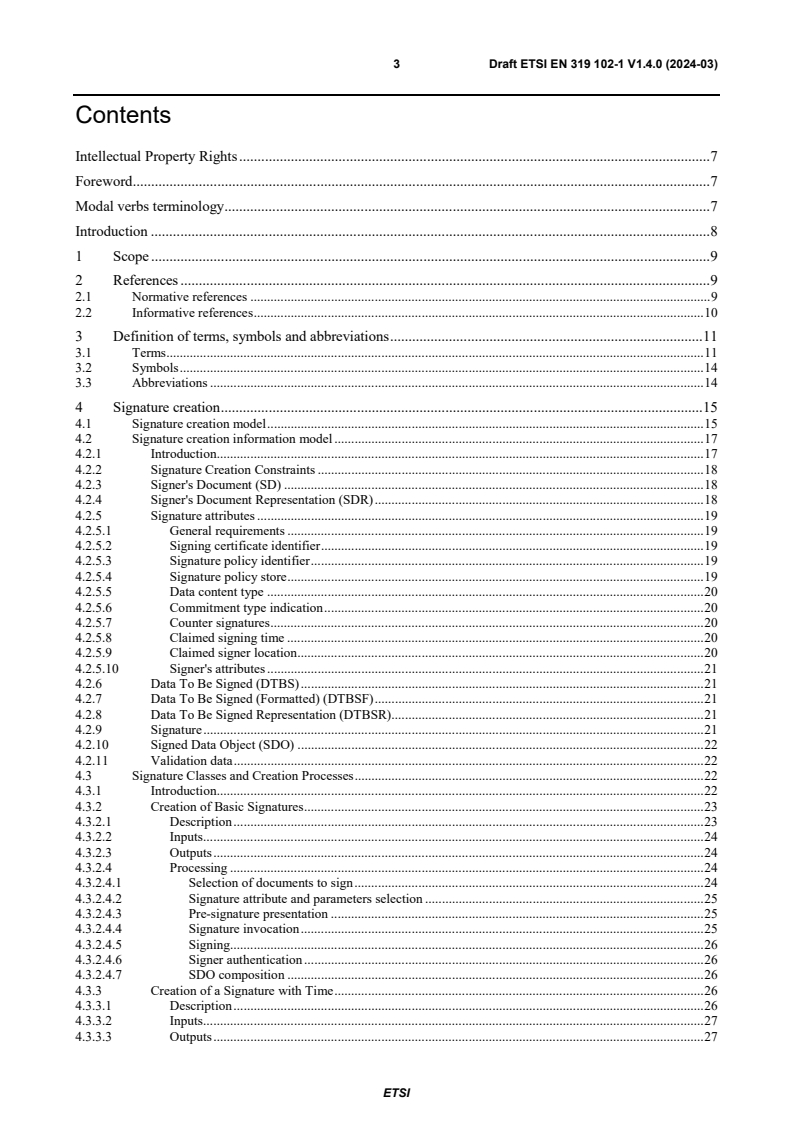
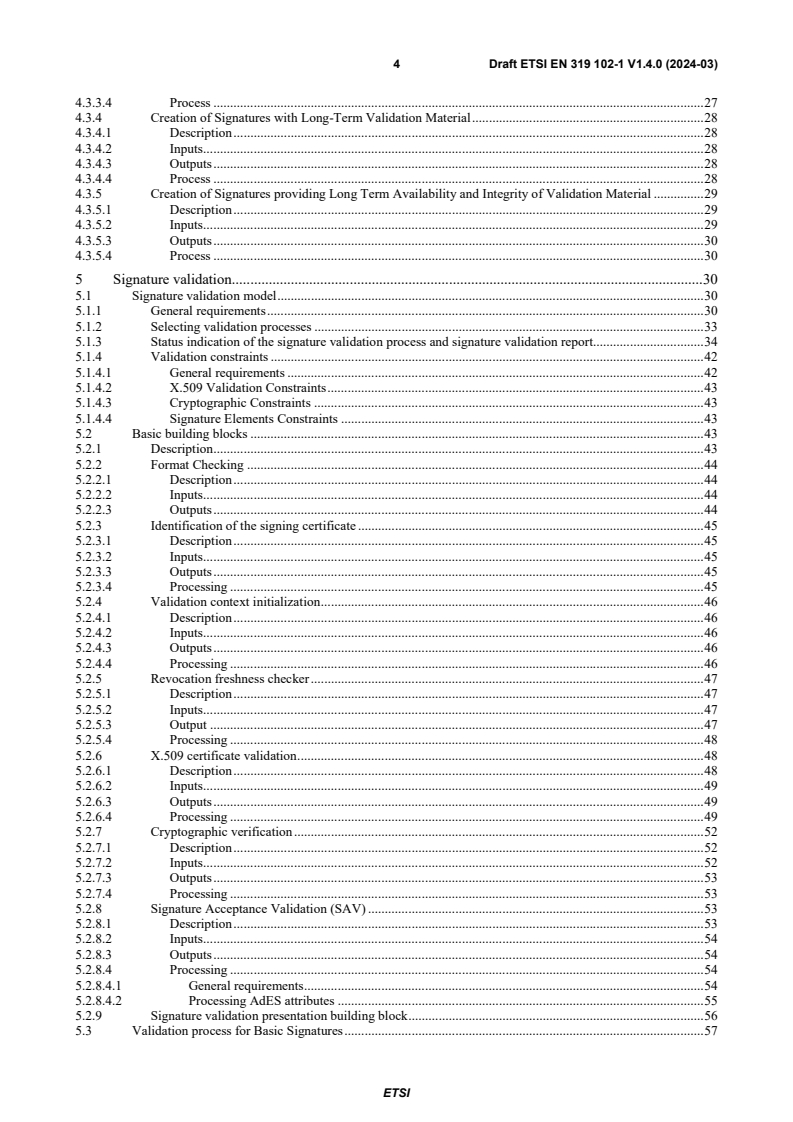
ETSI EN 319 102-1 V1.4.0 (2024-03) - Electronic Signatures and Trust Infrastructures (ESI); Procedures for Creation and Validation of AdES Digital Signatures; Part 1: Creation and Validation
ETSI EN 319 102-1 V1.4.1 (2024-06) - Electronic Signatures and Trust Infrastructures (ESI); Procedures for Creation and Validation of AdES Digital Signatures; Part 1: Creation and Validation

Overview
SIST EN 319 102-1 V1.4.1:2024 (identical to ETSI EN 319 102-1 V1.4.1) defines procedures for the creation and validation of AdES digital signatures (Advanced Electronic Signatures) when they are implemented using public key cryptography and supported by Public Key Certificates (PKCs). The standard supports compliance with Regulation (EU) No 910/2014 (eIDAS) by describing models, objects and functions needed to create verifiable AdES signatures and to determine their technical validity over short and long timeframes.
Key Topics and Technical Requirements
- Signature creation model and information model: Defines the structure and attributes involved in signature creation, including the Signer’s Document (SD), Data To Be Signed (DTBS), signature attributes and Validation Data.
- Signature classes and creation processes: Describes classes of signatures and stepwise creation processes such as Basic Signatures, Signatures with Time, Signatures with Long-Term Validation Material, and Signatures offering long-term availability and integrity of validation material.
- Validation model and processes: Specifies how to select validation processes, constraints for validation (format, cryptographic, X.509-related), and how to report validation status.
- Core building blocks for validation:
- Format checking and structure validation
- Identification of the signing certificate
- Validation context initialization
- Revocation freshness checking (checking recency of revocation evidence)
- X.509 certificate validation and cryptographic constraint checks
- Policies and constraints: Outlines how signature creation/validation options are selected via signature creation, augmentation or validation policies. Legal interpretation is out of scope, but the standard facilitates regulatory compliance.
- Out of scope: Key generation/distribution, choice of cryptographic algorithms, data encoding/format specifics, and legal validity interpretation.
Practical Applications and Who Uses It
- Trust Service Providers (TSPs) and Certification Authorities (CAs) implementing signature creation and long-term validation services.
- Software vendors and integrators building digital signing or signature validation components for e-government, banking, healthcare and enterprise document workflows.
- Security architects and PKI operators designing trust infrastructures that require verifiable, long-lived AdES signatures.
- Compliance and audit teams ensuring signature solutions meet eIDAS-related technical requirements.
Keywords: AdES, digital signature, electronic signatures, trust infrastructures, signature creation, signature validation, PKC, eIDAS, SIST EN 319 102-1, ETSI EN 319 102-1.
Related Standards
- ETSI EN 319 122-1, ETSI EN 319 132-1, ETSI EN 319 142-1 (AdES profiles referenced)
- Regulation (EU) No 910/2014 (eIDAS) - legal framework referenced for advanced electronic signatures
Buy Documents
ETSI EN 319 102-1 V1.4.0 (2024-03) - Electronic Signatures and Trust Infrastructures (ESI); Procedures for Creation and Validation of AdES Digital Signatures; Part 1: Creation and Validation
ETSI EN 319 102-1 V1.4.1 (2024-06) - Electronic Signatures and Trust Infrastructures (ESI); Procedures for Creation and Validation of AdES Digital Signatures; Part 1: Creation and Validation
Get Certified
Connect with accredited certification bodies for this standard

BSI Group
BSI (British Standards Institution) is the business standards company that helps organizations make excellence a habit.

NYCE
Mexican standards and certification body.
Sponsored listings
Frequently Asked Questions
SIST EN 319 102-1 V1.4.1:2024 is a standard published by the Slovenian Institute for Standardization (SIST). Its full title is "Electronic Signatures and Trust Infrastructures (ESI) - Procedures for Creation and Validation of AdES Digital Signatures - Part 1: Creation and Validation". This standard covers: The present document specifies procedures for: • the creation of AdES digital signatures (specified in ETSI EN 319 122-1 [i.2], ETSI EN 319 132-1 [i.4], ETSI EN 319 142-1 [i.6] respectively); • establishing whether an AdES digital signature is technically valid; whenever the AdES digital signature is based on public key cryptography and supported by Public Key Certificates (PKCs). To improve readability of the present document, AdES digital signatures are meant when the term signature is being used. NOTE 1: Regulation (EU) No 910/2014 [i.15] defines the terms electronic signature, advanced electronic signature, electronic seals and advanced electronic seal. These signatures and seals are usually created using digital signature technology. The present document aims at supporting the Regulation (EU) No 910/2014 [i.15] for creation and validation of advanced electronic signatures and seals when they are implemented as AdES digital signatures. The present document introduces general principles, objects and functions relevant when creating or validating signatures based on signature creation and validation constraints and defines general classes of signatures that allow for verifiability over long periods. The following aspects are considered to be out of scope: • generation and distribution of Signature Creation Data (keys, etc.), and the selection and use of cryptographic algorithms; • format, syntax or encoding of data objects involved, specifically format or encoding for documents to be signed or signatures created; and • the legal interpretation of any signature, especially the legal validity of a signature. NOTE 2: The signature creation and validation procedures specified in the present document provide several options and possibilities. The selection of these options is driven by a signature creation policy, a signature augmentation policy or a signature validation policy respectively. Note that legal requirements can be provided through specific policies, e.g. in the context of qualified electronic signatures as defined in the Regulation (EU) 910/2014 [i.15].
The present document specifies procedures for: • the creation of AdES digital signatures (specified in ETSI EN 319 122-1 [i.2], ETSI EN 319 132-1 [i.4], ETSI EN 319 142-1 [i.6] respectively); • establishing whether an AdES digital signature is technically valid; whenever the AdES digital signature is based on public key cryptography and supported by Public Key Certificates (PKCs). To improve readability of the present document, AdES digital signatures are meant when the term signature is being used. NOTE 1: Regulation (EU) No 910/2014 [i.15] defines the terms electronic signature, advanced electronic signature, electronic seals and advanced electronic seal. These signatures and seals are usually created using digital signature technology. The present document aims at supporting the Regulation (EU) No 910/2014 [i.15] for creation and validation of advanced electronic signatures and seals when they are implemented as AdES digital signatures. The present document introduces general principles, objects and functions relevant when creating or validating signatures based on signature creation and validation constraints and defines general classes of signatures that allow for verifiability over long periods. The following aspects are considered to be out of scope: • generation and distribution of Signature Creation Data (keys, etc.), and the selection and use of cryptographic algorithms; • format, syntax or encoding of data objects involved, specifically format or encoding for documents to be signed or signatures created; and • the legal interpretation of any signature, especially the legal validity of a signature. NOTE 2: The signature creation and validation procedures specified in the present document provide several options and possibilities. The selection of these options is driven by a signature creation policy, a signature augmentation policy or a signature validation policy respectively. Note that legal requirements can be provided through specific policies, e.g. in the context of qualified electronic signatures as defined in the Regulation (EU) 910/2014 [i.15].
SIST EN 319 102-1 V1.4.1:2024 is classified under the following ICS (International Classification for Standards) categories: 35.040.01 - Information coding in general. The ICS classification helps identify the subject area and facilitates finding related standards.
SIST EN 319 102-1 V1.4.1:2024 is available in PDF format for immediate download after purchase. The document can be added to your cart and obtained through the secure checkout process. Digital delivery ensures instant access to the complete standard document.
Standards Content (Sample)
Draft ETSI EN 319 102-1 V1.4.0 (2024-03)
EUROPEAN STANDARD
Electronic Signatures and Trust Infrastructures (ESI);
Procedures for Creation and Validation
of AdES Digital Signatures;
Part 1: Creation and Validation
2 Draft ETSI EN 319 102-1 V1.4.0 (2024-03)
Reference
REN/ESI-0019102-1V1.4.1
Keywords
electronic signature, security, trust services
ETSI
650 Route des Lucioles
F-06921 Sophia Antipolis Cedex - FRANCE
Tel.: +33 4 92 94 42 00 Fax: +33 4 93 65 47 16
Siret N° 348 623 562 00017 - APE 7112B
Association à but non lucratif enregistrée à la
Sous-Préfecture de Grasse (06) N° w061004871
Important notice
The present document can be downloaded from:
https://www.etsi.org/standards-search
The present document may be made available in electronic versions and/or in print. The content of any electronic and/or
print versions of the present document shall not be modified without the prior written authorization of ETSI. In case of any
existing or perceived difference in contents between such versions and/or in print, the prevailing version of an ETSI
deliverable is the one made publicly available in PDF format at www.etsi.org/deliver.
Users of the present document should be aware that the document may be subject to revision or change of status.
Information on the current status of this and other ETSI documents is available at
https://portal.etsi.org/TB/ETSIDeliverableStatus.aspx
If you find errors in the present document, please send your comment to one of the following services:
https://portal.etsi.org/People/CommiteeSupportStaff.aspx
If you find a security vulnerability in the present document, please report it through our
Coordinated Vulnerability Disclosure Program:
https://www.etsi.org/standards/coordinated-vulnerability-disclosure
Notice of disclaimer & limitation of liability
The information provided in the present deliverable is directed solely to professionals who have the appropriate degree of
experience to understand and interpret its content in accordance with generally accepted engineering or
other professional standard and applicable regulations.
No recommendation as to products and services or vendors is made or should be implied.
In no event shall ETSI be held liable for loss of profits or any other incidental or consequential damages.
Any software contained in this deliverable is provided "AS IS" with no warranties, express or implied, including but not
limited to, the warranties of merchantability, fitness for a particular purpose and non-infringement of intellectual property
rights and ETSI shall not be held liable in any event for any damages whatsoever (including, without limitation, damages
for loss of profits, business interruption, loss of information, or any other pecuniary loss) arising out of or related to the use
of or inability to use the software.
Copyright Notification
No part may be reproduced or utilized in any form or by any means, electronic or mechanical, including photocopying and
microfilm except as authorized by written permission of ETSI.
The content of the PDF version shall not be modified without the written authorization of ETSI.
The copyright and the foregoing restriction extend to reproduction in all media.
© ETSI 2024.
All rights reserved.
ETSI
3 Draft ETSI EN 319 102-1 V1.4.0 (2024-03)
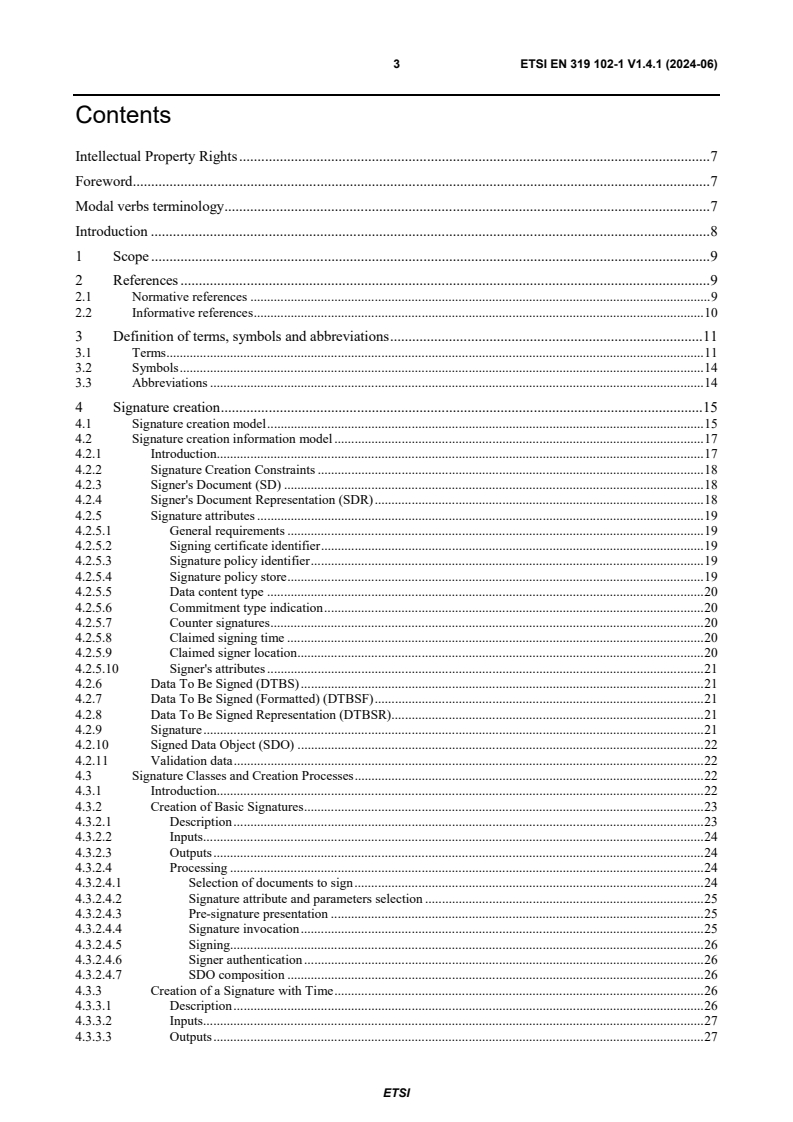
Contents
Intellectual Property Rights . 7
Foreword . 7
Modal verbs terminology . 7
Introduction . 8
1 Scope . 9
2 References . 9
2.1 Normative references . 9
2.2 Informative references . 10
3 Definition of terms, symbols and abbreviations . 11
3.1 Terms . 11
3.2 Symbols . 14
3.3 Abbreviations . 14
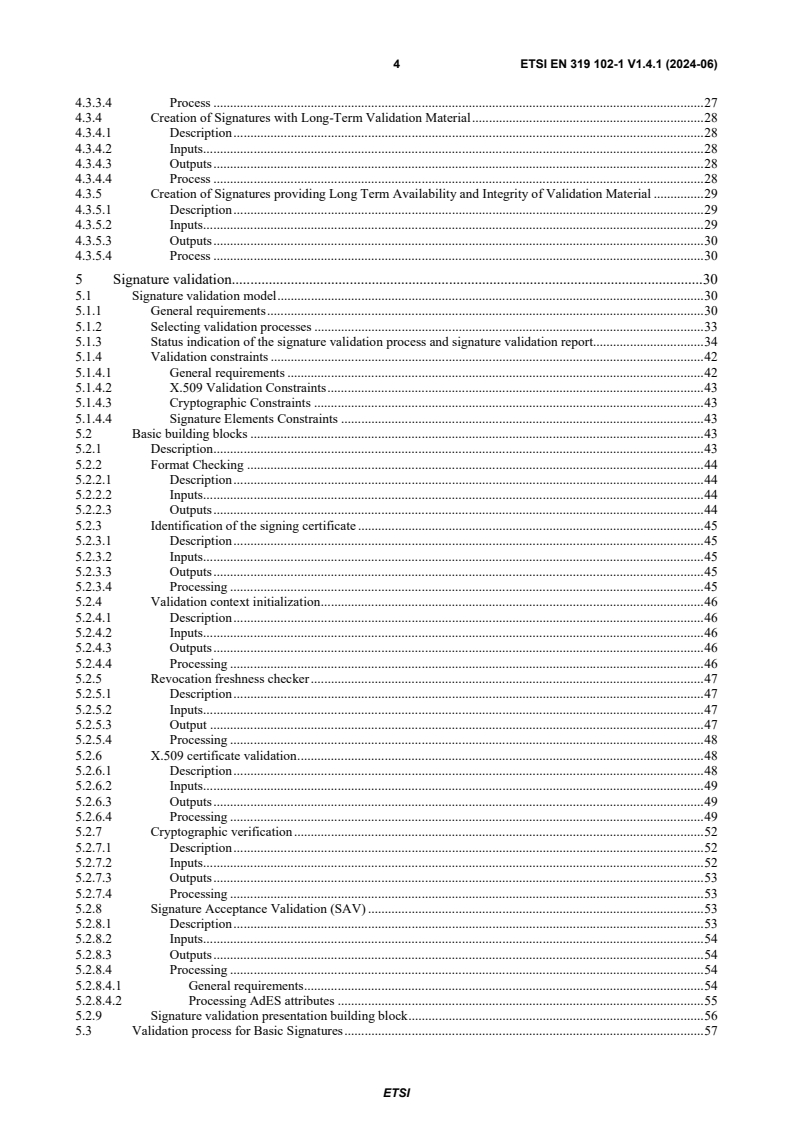
4 Signature creation . 15
4.1 Signature creation model . 15
4.2 Signature creation information model . 17
4.2.1 Introduction. 17
4.2.2 Signature Creation Constraints . 18
4.2.3 Signer's Document (SD) . 18
4.2.4 Signer's Document Representation (SDR) . 18
4.2.5 Signature attributes . 19
4.2.5.1 General requirements . 19
4.2.5.2 Signing certificate identifier . 19
4.2.5.3 Signature policy identifier . 19
4.2.5.4 Signature policy store . 19
4.2.5.5 Data content type . 20
4.2.5.6 Commitment type indication . 20
4.2.5.7 Counter signatures . 20
4.2.5.8 Claimed signing time . 20
4.2.5.9 Claimed signer location . 20
4.2.5.10 Signer's attributes . 21
4.2.6 Data To Be Signed (DTBS) . 21
4.2.7 Data To Be Signed (Formatted) (DTBSF) . 21
4.2.8 Data To Be Signed Representation (DTBSR) . 21
4.2.9 Signature . 21
4.2.10 Signed Data Object (SDO) . 22
4.2.11 Validation data . 22
4.3 Signature Classes and Creation Processes . 22
4.3.1 Introduction. 22
4.3.2 Creation of Basic Signatures . 23
4.3.2.1 Description . 23
4.3.2.2 Inputs . 24
4.3.2.3 Outputs . 24
4.3.2.4 Processing . 24
4.3.2.4.1 Selection of documents to sign . 24
4.3.2.4.2 Signature attribute and parameters selection . 25
4.3.2.4.3 Pre-signature presentation . 25
4.3.2.4.4 Signature invocation . 25
4.3.2.4.5 Signing. 26
4.3.2.4.6 Signer authentication . 26
4.3.2.4.7 SDO composition . 26
4.3.3 Creation of a Signature with Time . 26
4.3.3.1 Description . 26
4.3.3.2 Inputs . 27
4.3.3.3 Outputs . 27
ETSI
4 Draft ETSI EN 319 102-1 V1.4.0 (2024-03)
4.3.3.4 Process . 27
4.3.4 Creation of Signatures with Long-Term Validation Material . 28
4.3.4.1 Description . 28
4.3.4.2 Inputs . 28
4.3.4.3 Outputs . 28
4.3.4.4 Process . 28
4.3.5 Creation of Signatures providing Long Term Availability and Integrity of Validation Material . 29
4.3.5.1 Description . 29
4.3.5.2 Inputs . 29
4.3.5.3 Outputs . 30
4.3.5.4 Process . 30
5 Signature validation . 30
5.1 Signature validation model . 30
5.1.1 General requirements . 30
5.1.2 Selecting validation processes . 33
5.1.3 Status indication of the signature validation process and signature validation report. 34
5.1.4 Validation constraints . 42
5.1.4.1 General requirements . 42
5.1.4.2 X.509 Validation Constraints . 43
5.1.4.3 Cryptographic Constraints . 43
5.1.4.4 Signature Elements Constraints . 43
5.2 Basic building blocks . 43
5.2.1 Description . 43
5.2.2 Format Checking . 44
5.2.2.1 Description . 44
5.2.2.2 Inputs . 44
5.2.2.3 Outputs . 44
5.2.3 Identification of the signing certificate . 45
5.2.3.1 Description . 45
5.2.3.2 Inputs . 45
5.2.3.3 Outputs . 45
5.2.3.4 Processing . 45
5.2.4 Validation context initialization . 46
5.2.4.1 Description . 46
5.2.4.2 Inputs . 46
5.2.4.3 Outputs . 46
5.2.4.4 Processing . 46
5.2.5 Revocation freshness checker . 47
5.2.5.1 Description . 47
5.2.5.2 Inputs . 47
5.2.5.3 Output . 47
5.2.5.4 Processing . 48
5.2.6 X.509 certificate validation . 48
5.2.6.1 Description . 48
5.2.6.2 Inputs . 49
5.2.6.3 Outputs . 49
5.2.6.4 Processing . 49
5.2.7 Cryptographic verification . 52
5.2.7.1 Description . 52
5.2.7.2 Inputs . 52
5.2.7.3 Outputs . 53
5.2.7.4 Processing . 53
5.2.8 Signature Acceptance Validation (SAV) . 53
5.2.8.1 Description . 53
5.2.8.2 Inputs . 54
5.2.8.3 Outputs . 54
5.2.8.4 Processing . 54
5.2.8.4.1 General requirements . 54
5.2.8.4.2 Processing AdES attributes . 55
5.2.9 Signature validation presentation building block . 56
5.3 Validation process for Basic Signatures . 57
ETSI
5 Draft ETSI EN 319 102-1 V1.4.0 (2024-03)
5.3.1 Description . 57
5.3.2 Inputs . 57
5.3.3 Outputs . 57
5.3.4 Processing . 57
5.4 Time-stamp validation building block . 59
5.4.1 Description . 59
5.4.2 Inputs . 60
5.4.3 Outputs . 60
5.4.4 Processing . 60
5.5 Validation process for Signatures with Time and Signatures with Long-Term Validation Material . 60
5.5.1 Description . 60
5.5.2 Inputs . 61
5.5.3 Outputs . 61
5.5.4 Processing . 61
5.6 Validation process for Signatures providing Long Term Availability and Integrity of Validation
Material . 64
5.6.1 Introduction. 64
5.6.2 Additional building blocks . 65
5.6.2.1 Past certificate validation . 65
5.6.2.1.1 Description . 65
5.6.2.1.2 Input . 65
5.6.2.1.3 Output . 65
5.6.2.1.4 Processing . 66
5.6.2.2 Validation time sliding process . 66
5.6.2.2.1 Description . 66
5.6.2.2.2 Input . 66
5.6.2.2.3 Output . 67
5.6.2.2.4 Processing . 67
5.6.2.3 POE extraction . 68
5.6.2.3.1 Description . 68
5.6.2.3.2 Input . 69
5.6.2.3.3 Output . 69
5.6.2.3.4 Processing . 69
5.6.2.4 Past signature validation building block . 69
5.6.2.4.1 Description . 69
5.6.2.4.2 Input . 69
5.6.2.4.3 Output . 70
5.6.2.4.4 Processing . 70
5.6.3 Validation Process for Signatures providing Long Term Availability and Integrity of Validation
Material . 71
5.6.3.1 Description . 71
5.6.3.2 Input . 72
5.6.3.3 Output . 72
5.6.3.4 Processing . 72
Annex A (informative): Validation examples . 76
A.1 General remarks and assumptions . 76
A.2 Symbols . 76
A.3 Example 1: Revoked certificate . 77
A.3.1 Introduction . 77
A.3.2 Basic signature validation . 77
A.3.3 Validating a Signature with Time . 78
A.3.4 Example 2: Revoked CA certificate . 78
A.3.5 Basic signature validation . 79
A.3.6 Validation of a Signature with Time . 79
A.3.7 Long-Term Validation . 80
Annex B (informative): Signature Classes and AdES Signatures . 83
Annex C (informative): Applicability rules checking and format conformance check . 84
ETSI
6 Draft ETSI EN 319 102-1 V1.4.0 (2024-03)
C.1 Applicability checking . 84
C.2 Format conformance. 84
Annex D (informative): Change history . 86
History . 88
ETSI
7 Draft ETSI EN 319 102-1 V1.4.0 (2024-03)
Intellectual Property Rights
Essential patents
IPRs essential or potentially essential to normative deliverables may have been declared to ETSI. The declarations
pertaining to these essential IPRs, if any, are publicly available for ETSI members and non-members, and can be
found in ETSI SR 000 314: "Intellectual Property Rights (IPRs); Essential, or potentially Essential, IPRs notified to
ETSI in respect of ETSI standards", which is available from the ETSI Secretariat. Latest updates are available on the
ETSI Web server (https://ipr.etsi.org/).
Pursuant to the ETSI Directives including the ETSI IPR Policy, no investigation regarding the essentiality of IPRs,
including IPR searches, has been carried out by ETSI. No guarantee can be given as to the existence of other IPRs not
referenced in ETSI SR 000 314 (or the updates on the ETSI Web server) which are, or may be, or may become,
essential to the present document.
Trademarks
The present document may include trademarks and/or tradenames which are asserted and/or registered by their owners.
ETSI claims no ownership of these except for any which are indicated as being the property of ETSI, and conveys no
right to use or reproduce any trademark and/or tradename. Mention of those trademarks in the present document does
not constitute an endorsement by ETSI of products, services or organizations associated with those trademarks.
DECT™, PLUGTESTS™, UMTS™ and the ETSI logo are trademarks of ETSI registered for the benefit of its
Members. 3GPP™ and LTE™ are trademarks of ETSI registered for the benefit of its Members and of the 3GPP
Organizational Partners. oneM2M™ logo is a trademark of ETSI registered for the benefit of its Members and of the ®
oneM2M Partners. GSM and the GSM logo are trademarks registered and owned by the GSM Association.
Foreword
This draft European Standard (EN) has been produced by ETSI Technical Committee Electronic Signatures and
Infrastructures (ESI), and is now submitted for the combined Public Enquiry and Vote phase of the ETSI EN Approval
Procedure.
The present document is part 1 of a multi-part deliverable covering Procedures for Creation and Validation of AdES
Digital Signatures, as identified below:
ETSI EN 319 102-1: "Creation and Validation";
ETSI TS 119 102-2: "Signature Validation Report".
Proposed national transposition dates
Date of latest announcement of this EN (doa): 3 months after ETSI publication
Date of latest publication of new National Standard
or endorsement of this EN (dop/e): 6 months after doa
Date of withdrawal of any conflicting National Standard (dow): 6 months after doa
Modal verbs terminology
In the present document "shall", "shall not", "should", "should not", "may", "need not", "will", "will not", "can" and
"cannot" are to be interpreted as described in clause 3.2 of the ETSI Drafting Rules (Verbal forms for the expression of
provisions).
"must" and "must not" are NOT allowed in ETSI deliverables except when used in direct citation.
ETSI
8 Draft ETSI EN 319 102-1 V1.4.0 (2024-03)
Introduction
The present document aims to meet the general requirements of the international community to provide trust and
confidence in electronic transactions, including, amongst other, applicable requirements from Regulation (EU)
No 910/2014 [i.15].
ETSI
9 Draft ETSI EN 319 102-1 V1.4.0 (2024-03)
1 Scope
The present document specifies procedures for:
• the creation of AdES digital signatures (specified in ETSI EN 319 122-1 [i.2], ETSI EN 319 132-1 [i.4], ETSI
EN 319 142-1 [i.6] respectively);
• establishing whether an AdES digital signature is technically valid;
whenever the AdES digital signature is based on public key cryptography and supported by Public Key
Certificates (PKCs). To improve readability of the present document, AdES digital signatures are meant when the term
signature is being used.
NOTE 1: Regulation (EU) No 910/2014 [i.15] defines the terms electronic signature, advanced electronic signature,
electronic seals and advanced electronic seal. These signatures and seals are usually created using digital
signature technology. The present document aims at supporting the Regulation (EU) No 910/2014 [i.15]
for creation and validation of advanced electronic signatures and seals when they are implemented as
AdES digital signatures.
The present document introduces general principles, objects and functions relevant when creating or validating
signatures based on signature creation and validation constraints and defines general classes of signatures that allow for
verifiability over long periods.
The following aspects are considered to be out of scope:
• generation and distribution of Signature Creation Data (keys, etc.), and the selection and use of cryptographic
algorithms;
• format, syntax or encoding of data objects involved, specifically format or encoding for documents to be
signed or signatures created; and
• the legal interpretation of any signature, especially the legal validity of a signature.
NOTE 2: The signature creation and validation procedures specified in the present document provide several
options and possibilities. The selection of these options is driven by a signature creation policy, a
signature augmentation policy or a signature validation policy respectively. Note that legal requirements
can be provided through specific policies, e.g. in the context of qualified electronic signatures as defined
in the Regulation (EU) 910/2014 [i.15].
2 References
2.1 Normative references
References are either specific (identified by date of publication and/or edition number or version number) or
non-specific. For specific references, only the cited version applies. For non-specific references, the latest version of the
referenced document (including any amendments) applies.
Referenced documents which are not found to be publicly available in the expected location might be found at
https://docbox.etsi.org/Reference/.
NOTE: While any hyperlinks included in this clause were valid at the time of publication, ETSI cannot guarantee
their long term validity.
The following referenced documents are necessary for the application of the present document.
[1] IETF RFC 5280: "Internet X.509 Public Key Infrastructure Certificate and Certificate Revocation
List (CRL) Profile".
[2] ISO/IEC 9594-8:2020: "Information technology -- Open Systems Interconnection -- Part 8: The
Directory: Public-key and attribute certificate frameworks".
ETSI
10 Draft ETSI EN 319 102-1 V1.4.0 (2024-03)
[3] IETF RFC 3161: "Internet X.509 Public Key Infrastructure; Time Stamp Protocol (TSP)".
[4] ETSI TS 119 172-1: "Electronic Signatures and Infrastructures (ESI); Signature Policies;
Part 1: Building blocks and table of contents for human readable signature policy documents".
[5] T7 & TeleTrusT: "Common PKI Specifications for Interoperable Applications", Specification
Part 9 SigG-Profile, Version 2.0, 20 January 2009.
2.2 Informative references
References are either specific (identified by date of publication and/or edition number or version number) or
non-specific. For specific references, only the cited version applies. For non-specific references, the latest version of the
referenced document (including any amendments) applies.
NOTE: While any hyperlinks included in this clause were valid at the time of publication, ETSI cannot guarantee
their long term validity.
The following referenced documents are not necessary for the application of the present document but they assist the
user with regard to a particular subject area.
[i.1] IETF RFC 4158: "Internet X.509 Public Key Infrastructure: Certification Path Building".
[i.2] ETSI EN 319 122-1: "Electronic Signatures and Infrastructures (ESI); CAdES digital signatures;
Part 1: Building blocks and CAdES baseline signatures".
[i.3] ETSI EN 319 122-2: "Electronic Signatures and Infrastructures (ESI); CAdES digital signatures;
Part 2: Extended CAdES signatures".
[i.4] ETSI EN 319 132-1: "Electronic Signatures and Infrastructures (ESI); XAdES digital signatures;
Part 1: Building blocks and XAdES baseline signatures".
[i.5] ETSI EN 319 132-2: "Electronic Signatures and Infrastructures (ESI); XAdES digital signatures;
Part 2: Extended XAdES signatures".
[i.6] ETSI EN 319 142-1: "Electronic Signatures and Infrastructures (ESI); PAdES digital signatures;
Part 1: Building blocks and PAdES baseline signatures".
[i.7] ETSI EN 319 142-2: "Electronic Signatures and Infrastructures (ESI); PAdES digital signatures;
Part 2: Additional PAdES signatures profiles".
[i.8] IETF RFC 5652: "Cryptographic Message Syntax (CMS)".
[i.9] IETF RFC 4998: "Evidence Record Syntax (ERS)".
[i.10] IETF RFC 6283: "Extensible Markup Language Evidence Record Syntax (XMLERS)".
[i.11] Void.
[i.12] IETF RFC 6960: "X.509 Internet Public Key Infrastructure Online Certificate Status
Protocol - OCSP".
[i.13] ETSI EN 319 422: "Electronic Signatures and Infrastructures (ESI); Time-stamping protocol and
time-stamp token profiles".
[i.14] ETSI TS 119 312: "Electronic Signatures and Infrastructures (ESI); Cryptographic Suites".
[i.15] Regulation (EU) No 910/2014 of the European Parliament and of the Council of 23 July 2014 on
electronic identification and trust services for electronic transactions in the internal market and
repealing Directive 1999/93/EC.
[i.16] IETF RFC 3852: "Cryptographic Message Syntax (CMS)".
[i.17] ETSI TS 119 442: "Electronic Signatures and Infrastructures (ESI); Protocol profiles for trust
service providers providing AdES digital signature validation services".
ETSI
11 Draft ETSI EN 319 102-1 V1.4.0 (2024-03)
[i.18] ETSI TS 119 102-2: "Electronic Signatures and Infrastructures (ESI); Procedures for Creation and
Validation of AdES Digital Signatures; Part 2: Signature Validation Report".
[i.19] ETSI EN 319 411-1: "Electronic Signatures and Infrastructures (ESI); Policy and security
requirements for Trust Service Providers issuing certificates; Part 1: General requirements".
[i.20] ISO/IEC 14533-4:2019: "Processes, data elements and documents in commerce, industry and
administration - Long term signature profiles - Part 4: Attributes pointing to (external) proof of
existence objects used in long term signature formats (PoEAttributes)".
[i.21] ETSI EN 319 412-1: "Electronic Signatures and Infrastructures (ESI); Certificate Profiles;
Part 1: Overview and common data structures".
3 Definition of terms, symbols and abbreviations
3.1 Terms
For the purposes of the present document, the following terms apply:
attribute authority: authority which assigns privileges by issuing attribute certificates
attribute certificate: data structure, digitally signed by an attribute authority, that binds some attribute values with
identification information about its holder
certificate: See Public Key Certificate (PKC).
certificate identifier: unambiguous identifier of a certificate
certificate path (chain) validation: process of verifying and confirming that a certificate path (chain) is valid
Certificate Revocation List (CRL): signed list indicating a set of certificates that are no longer considered valid by the
certificate issuer
certificate validation: process of verifying and confirming that a certificate is valid
certification authority: authority trusted by one or more users to create and assign public-key certificates
chain model: model for validation of X.509 certificate chains where all CA certificates have to be valid at the time they
were used for issuing a certificate and the end-entity certificate was valid when creating the signature
claimed signing time: time of signing claimed by the signer which on its own does not provide independent evidence
of the actual signing time
(signature) commitment type: signer-selected indication of the exact implication of a digital signature
(signature) creation constraint: criteria used when creating a digital signature
cryptographic suite: combination of a signature scheme with a padding method and a cryptographic hash function
detached (digital) signature: digital signature that, with respect to the Signed Data Object, is neither enveloping nor
enveloped
digital signature: data appended to, or a cryptographic transformation of a data unit that allows a recipient of the data
unit to prove the source and integrity of the data unit and protect against forgery, e.g. by the recipient
digital signature value: result of the cryptographic transformation of a data unit that allows a recipient of the data unit
to prove the source and integrity of the data unit
...
EUROPEAN STANDARD
Electronic Signatures and Trust Infrastructures (ESI);
Procedures for Creation and Validation
of AdES Digital Signatures;
Part 1: Creation and Validation
2 ETSI EN 319 102-1 V1.4.1 (2024-06)
Reference
REN/ESI-0019102-1v1.4.1
Keywords
electronic signature, security, trust services
ETSI
650 Route des Lucioles
F-06921 Sophia Antipolis Cedex - FRANCE
Tel.: +33 4 92 94 42 00 Fax: +33 4 93 65 47 16
Siret N° 348 623 562 00017 - APE 7112B
Association à but non lucratif enregistrée à la
Sous-Préfecture de Grasse (06) N° w061004871
Important notice
The present document can be downloaded from:
https://www.etsi.org/standards-search
The present document may be made available in electronic versions and/or in print. The content of any electronic and/or
print versions of the present document shall not be modified without the prior written authorization of ETSI. In case of any
existing or perceived difference in contents between such versions and/or in print, the prevailing version of an ETSI
deliverable is the one made publicly available in PDF format at www.etsi.org/deliver.
Users of the present document should be aware that the document may be subject to revision or change of status.
Information on the current status of this and other ETSI documents is available at
https://portal.etsi.org/TB/ETSIDeliverableStatus.aspx
If you find errors in the present document, please send your comment to one of the following services:
https://portal.etsi.org/People/CommiteeSupportStaff.aspx
If you find a security vulnerability in the present document, please report it through our
Coordinated Vulnerability Disclosure Program:
https://www.etsi.org/standards/coordinated-vulnerability-disclosure
Notice of disclaimer & limitation of liability
The information provided in the present deliverable is directed solely to professionals who have the appropriate degree of
experience to understand and interpret its content in accordance with generally accepted engineering or
other professional standard and applicable regulations.
No recommendation as to products and services or vendors is made or should be implied.
In no event shall ETSI be held liable for loss of profits or any other incidental or consequential damages.
Any software contained in this deliverable is provided "AS IS" with no warranties, express or implied, including but not
limited to, the warranties of merchantability, fitness for a particular purpose and non-infringement of intellectual property
rights and ETSI shall not be held liable in any event for any damages whatsoever (including, without limitation, damages
for loss of profits, business interruption, loss of information, or any other pecuniary loss) arising out of or related to the use
of or inability to use the software.
Copyright Notification
No part may be reproduced or utilized in any form or by any means, electronic or mechanical, including photocopying and
microfilm except as authorized by written permission of ETSI.
The content of the PDF version shall not be modified without the written authorization of ETSI.
The copyright and the foregoing restriction extend to reproduction in all media.
© ETSI 2024.
All rights reserved.
ETSI
3 ETSI EN 319 102-1 V1.4.1 (2024-06)
Contents
Intellectual Property Rights . 7
Foreword . 7
Modal verbs terminology . 7
Introduction . 8
1 Scope . 9
2 References . 9
2.1 Normative references . 9
2.2 Informative references . 10
3 Definition of terms, symbols and abbreviations . 11
3.1 Terms . 11
3.2 Symbols . 14
3.3 Abbreviations . 14
4 Signature creation . 15
4.1 Signature creation model . 15
4.2 Signature creation information model . 17
4.2.1 Introduction. 17
4.2.2 Signature Creation Constraints . 18
4.2.3 Signer's Document (SD) . 18
4.2.4 Signer's Document Representation (SDR) . 18
4.2.5 Signature attributes . 19
4.2.5.1 General requirements . 19
4.2.5.2 Signing certificate identifier . 19
4.2.5.3 Signature policy identifier . 19
4.2.5.4 Signature policy store . 19
4.2.5.5 Data content type . 20
4.2.5.6 Commitment type indication . 20
4.2.5.7 Counter signatures . 20
4.2.5.8 Claimed signing time . 20
4.2.5.9 Claimed signer location . 20
4.2.5.10 Signer's attributes . 21
4.2.6 Data To Be Signed (DTBS) . 21
4.2.7 Data To Be Signed (Formatted) (DTBSF) . 21
4.2.8 Data To Be Signed Representation (DTBSR) . 21
4.2.9 Signature . 21
4.2.10 Signed Data Object (SDO) . 22
4.2.11 Validation data . 22
4.3 Signature Classes and Creation Processes . 22
4.3.1 Introduction. 22
4.3.2 Creation of Basic Signatures . 23
4.3.2.1 Description . 23
4.3.2.2 Inputs . 24
4.3.2.3 Outputs . 24
4.3.2.4 Processing . 24
4.3.2.4.1 Selection of documents to sign . 24
4.3.2.4.2 Signature attribute and parameters selection . 25
4.3.2.4.3 Pre-signature presentation . 25
4.3.2.4.4 Signature invocation . 25
4.3.2.4.5 Signing. 26
4.3.2.4.6 Signer authentication . 26
4.3.2.4.7 SDO composition . 26
4.3.3 Creation of a Signature with Time . 26
4.3.3.1 Description . 26
4.3.3.2 Inputs . 27
4.3.3.3 Outputs . 27
ETSI
4 ETSI EN 319 102-1 V1.4.1 (2024-06)
4.3.3.4 Process . 27
4.3.4 Creation of Signatures with Long-Term Validation Material . 28
4.3.4.1 Description . 28
4.3.4.2 Inputs . 28
4.3.4.3 Outputs . 28
4.3.4.4 Process . 28
4.3.5 Creation of Signatures providing Long Term Availability and Integrity of Validation Material . 29
4.3.5.1 Description . 29
4.3.5.2 Inputs . 29
4.3.5.3 Outputs . 30
4.3.5.4 Process . 30
5 Signature validation . 30
5.1 Signature validation model . 30
5.1.1 General requirements . 30
5.1.2 Selecting validation processes . 33
5.1.3 Status indication of the signature validation process and signature validation report. 34
5.1.4 Validation constraints . 42
5.1.4.1 General requirements . 42
5.1.4.2 X.509 Validation Constraints . 43
5.1.4.3 Cryptographic Constraints . 43
5.1.4.4 Signature Elements Constraints . 43
5.2 Basic building blocks . 43
5.2.1 Description . 43
5.2.2 Format Checking . 44
5.2.2.1 Description . 44
5.2.2.2 Inputs . 44
5.2.2.3 Outputs . 44
5.2.3 Identification of the signing certificate . 45
5.2.3.1 Description . 45
5.2.3.2 Inputs . 45
5.2.3.3 Outputs . 45
5.2.3.4 Processing . 45
5.2.4 Validation context initialization . 46
5.2.4.1 Description . 46
5.2.4.2 Inputs . 46
5.2.4.3 Outputs . 46
5.2.4.4 Processing . 46
5.2.5 Revocation freshness checker . 47
5.2.5.1 Description . 47
5.2.5.2 Inputs . 47
5.2.5.3 Output . 47
5.2.5.4 Processing . 48
5.2.6 X.509 certificate validation . 48
5.2.6.1 Description . 48
5.2.6.2 Inputs . 49
5.2.6.3 Outputs . 49
5.2.6.4 Processing . 49
5.2.7 Cryptographic verification . 52
5.2.7.1 Description . 52
5.2.7.2 Inputs . 52
5.2.7.3 Outputs . 53
5.2.7.4 Processing . 53
5.2.8 Signature Acceptance Validation (SAV) . 53
5.2.8.1 Description . 53
5.2.8.2 Inputs . 54
5.2.8.3 Outputs . 54
5.2.8.4 Processing . 54
5.2.8.4.1 General requirements . 54
5.2.8.4.2 Processing AdES attributes . 55
5.2.9 Signature validation presentation building block . 56
5.3 Validation process for Basic Signatures . 57
ETSI
5 ETSI EN 319 102-1 V1.4.1 (2024-06)
5.3.1 Description . 57
5.3.2 Inputs . 57
5.3.3 Outputs . 57
5.3.4 Processing . 57
5.4 Time-stamp validation building block . 59
5.4.1 Description . 59
5.4.2 Inputs . 60
5.4.3 Outputs . 60
5.4.4 Processing . 60
5.5 Validation process for Signatures with Time and Signatures with Long-Term Validation Material . 60
5.5.1 Description . 60
5.5.2 Inputs . 61
5.5.3 Outputs . 61
5.5.4 Processing . 61
5.6 Validation process for Signatures providing Long Term Availability and Integrity of Validation
Material . 64
5.6.1 Introduction. 64
5.6.2 Additional building blocks . 65
5.6.2.1 Past certificate validation . 65
5.6.2.1.1 Description . 65
5.6.2.1.2 Input . 65
5.6.2.1.3 Output . 65
5.6.2.1.4 Processing . 66
5.6.2.2 Validation time sliding process . 66
5.6.2.2.1 Description . 66
5.6.2.2.2 Input . 66
5.6.2.2.3 Output . 67
5.6.2.2.4 Processing . 67
5.6.2.3 POE extraction . 68
5.6.2.3.1 Description . 68
5.6.2.3.2 Input . 69
5.6.2.3.3 Output . 69
5.6.2.3.4 Processing . 69
5.6.2.4 Past signature validation building block . 69
5.6.2.4.1 Description . 69
5.6.2.4.2 Input . 69
5.6.2.4.3 Output . 70
5.6.2.4.4 Processing . 70
5.6.3 Validation Process for Signatures providing Long Term Availability and Integrity of Validation
Material . 71
5.6.3.1 Description . 71
5.6.3.2 Input . 72
5.6.3.3 Output . 72
5.6.3.4 Processing . 72
Annex A (informative): Validation examples . 76
A.1 General remarks and assumptions . 76
A.2 Symbols . 76
A.3 Example 1: Revoked certificate . 77
A.3.1 Introduction . 77
A.3.2 Basic signature validation . 77
A.3.3 Validating a Signature with Time . 78
A.3.4 Example 2: Revoked CA certificate . 78
A.3.5 Basic signature validation . 79
A.3.6 Validation of a Signature with Time . 79
A.3.7 Long-Term Validation . 80
Annex B (informative): Signature Classes and AdES Signatures . 83
Annex C (informative): Applicability rules checking and format conformance check . 84
ETSI
6 ETSI EN 319 102-1 V1.4.1 (2024-06)
C.1 Applicability checking . 84
C.2 Format conformance. 84
Annex D (informative): Change history . 86
History . 88
ETSI
7 ETSI EN 319 102-1 V1.4.1 (2024-06)
Intellectual Property Rights
Essential patents
IPRs essential or potentially essential to normative deliverables may have been declared to ETSI. The declarations
pertaining to these essential IPRs, if any, are publicly available for ETSI members and non-members, and can be
found in ETSI SR 000 314: "Intellectual Property Rights (IPRs); Essential, or potentially Essential, IPRs notified to
ETSI in respect of ETSI standards", which is available from the ETSI Secretariat. Latest updates are available on the
ETSI Web server (https://ipr.etsi.org/).
Pursuant to the ETSI Directives including the ETSI IPR Policy, no investigation regarding the essentiality of IPRs,
including IPR searches, has been carried out by ETSI. No guarantee can be given as to the existence of other IPRs not
referenced in ETSI SR 000 314 (or the updates on the ETSI Web server) which are, or may be, or may become,
essential to the present document.
Trademarks
The present document may include trademarks and/or tradenames which are asserted and/or registered by their owners.
ETSI claims no ownership of these except for any which are indicated as being the property of ETSI, and conveys no
right to use or reproduce any trademark and/or tradename. Mention of those trademarks in the present document does
not constitute an endorsement by ETSI of products, services or organizations associated with those trademarks.
DECT™, PLUGTESTS™, UMTS™ and the ETSI logo are trademarks of ETSI registered for the benefit of its
Members. 3GPP™ and LTE™ are trademarks of ETSI registered for the benefit of its Members and of the 3GPP
Organizational Partners. oneM2M™ logo is a trademark of ETSI registered for the benefit of its Members and of the ®
oneM2M Partners. GSM and the GSM logo are trademarks registered and owned by the GSM Association.
Foreword
This European Standard (EN) has been produced by ETSI Technical Committee Electronic Signatures and
Infrastructures (ESI).
The present document is part 1 of a multi-part deliverable covering Procedures for Creation and Validation of AdES
Digital Signatures, as identified below:
ETSI EN 319 102-1: "Creation and Validation";
ETSI TS 119 102-2: "Signature Validation Report".
National transposition dates
Date of adoption of this EN: 17 June 2024
Date of latest announcement of this EN (doa): 30 September 2024
Date of latest publication of new National Standard
or endorsement of this EN (dop/e): 31 March 2025
Date of withdrawal of any conflicting National Standard (dow): 31 March 2025
Modal verbs terminology
In the present document "shall", "shall not", "should", "should not", "may", "need not", "will", "will not", "can" and
"cannot" are to be interpreted as described in clause 3.2 of the ETSI Drafting Rules (Verbal forms for the expression of
provisions).
ETSI
8 ETSI EN 319 102-1 V1.4.1 (2024-06)
"must" and "must not" are NOT allowed in ETSI deliverables except when used in direct citation.
Introduction
The present document aims to meet the general requirements of the international community to provide trust and
confidence in electronic transactions, including, amongst other, applicable requirements from Regulation (EU)
No 910/2014 [i.15].
ETSI
9 ETSI EN 319 102-1 V1.4.1 (2024-06)
1 Scope
The present document specifies procedures for:
• the creation of AdES digital signatures (specified in ETSI EN 319 122-1 [i.2], ETSI EN 319 132-1 [i.4], ETSI
EN 319 142-1 [i.6] respectively);
• establishing whether an AdES digital signature is technically valid;
whenever the AdES digital signature is based on public key cryptography and supported by Public Key
Certificates (PKCs). To improve readability of the present document, AdES digital signatures are meant when the term
signature is being used.
NOTE 1: Regulation (EU) No 910/2014 [i.15] defines the terms electronic signature, advanced electronic signature,
electronic seals and advanced electronic seal. These signatures and seals are usually created using digital
signature technology. The present document aims at supporting the Regulation (EU) No 910/2014 [i.15]
for creation and validation of advanced electronic signatures and seals when they are implemented as
AdES digital signatures.
The present document introduces general principles, objects and functions relevant when creating or validating
signatures based on signature creation and validation constraints and defines general classes of signatures that allow for
verifiability over long periods.
The following aspects are considered to be out of scope:
• generation and distribution of Signature Creation Data (keys, etc.), and the selection and use of cryptographic
algorithms;
• format, syntax or encoding of data objects involved, specifically format or encoding for documents to be
signed or signatures created; and
• the legal interpretation of any signature, especially the legal validity of a signature.
NOTE 2: The signature creation and validation procedures specified in the present document provide several
options and possibilities. The selection of these options is driven by a signature creation policy, a
signature augmentation policy or a signature validation policy respectively. Note that legal requirements
can be provided through specific policies, e.g. in the context of qualified electronic signatures as defined
in the Regulation (EU) 910/2014 [i.15].
2 References
2.1 Normative references
References are either specific (identified by date of publication and/or edition number or version number) or
non-specific. For specific references, only the cited version applies. For non-specific references, the latest version of the
referenced document (including any amendments) applies.
Referenced documents which are not found to be publicly available in the expected location might be found at
https://docbox.etsi.org/Reference/.
NOTE: While any hyperlinks included in this clause were valid at the time of publication, ETSI cannot guarantee
their long term validity.
The following referenced documents are necessary for the application of the present document.
[1] IETF RFC 5280: "Internet X.509 Public Key Infrastructure Certificate and Certificate Revocation
List (CRL) Profile".
[2] ISO/IEC 9594-8:2020: "Information technology -- Open Systems Interconnection -- Part 8: The
Directory: Public-key and attribute certificate frameworks".
ETSI
10 ETSI EN 319 102-1 V1.4.1 (2024-06)
[3] IETF RFC 3161: "Internet X.509 Public Key Infrastructure; Time Stamp Protocol (TSP)".
[4] ETSI TS 119 172-1: "Electronic Signatures and Infrastructures (ESI); Signature Policies;
Part 1: Building blocks and table of contents for human readable signature policy documents".
[5] T7 & TeleTrusT: "Common PKI Specifications for Interoperable Applications", Specification
Part 9 SigG-Profile, Version 2.0, 20 January 2009.
2.2 Informative references
References are either specific (identified by date of publication and/or edition number or version number) or
non-specific. For specific references, only the cited version applies. For non-specific references, the latest version of the
referenced document (including any amendments) applies.
NOTE: While any hyperlinks included in this clause were valid at the time of publication, ETSI cannot guarantee
their long term validity.
The following referenced documents are not necessary for the application of the present document but they assist the
user with regard to a particular subject area.
[i.1] IETF RFC 4158: "Internet X.509 Public Key Infrastructure: Certification Path Building".
[i.2] ETSI EN 319 122-1: "Electronic Signatures and Infrastructures (ESI); CAdES digital signatures;
Part 1: Building blocks and CAdES baseline signatures".
[i.3] ETSI EN 319 122-2: "Electronic Signatures and Infrastructures (ESI); CAdES digital signatures;
Part 2: Extended CAdES signatures".
[i.4] ETSI EN 319 132-1: "Electronic Signatures and Infrastructures (ESI); XAdES digital signatures;
Part 1: Building blocks and XAdES baseline signatures".
[i.5] ETSI EN 319 132-2: "Electronic Signatures and Infrastructures (ESI); XAdES digital signatures;
Part 2: Extended XAdES signatures".
[i.6] ETSI EN 319 142-1: "Electronic Signatures and Infrastructures (ESI); PAdES digital signatures;
Part 1: Building blocks and PAdES baseline signatures".
[i.7] ETSI EN 319 142-2: "Electronic Signatures and Infrastructures (ESI); PAdES digital signatures;
Part 2: Additional PAdES signatures profiles".
[i.8] IETF RFC 5652: "Cryptographic Message Syntax (CMS)".
[i.9] IETF RFC 4998: "Evidence Record Syntax (ERS)".
[i.10] IETF RFC 6283: "Extensible Markup Language Evidence Record Syntax (XMLERS)".
[i.11] Void.
[i.12] IETF RFC 6960: "X.509 Internet Public Key Infrastructure Online Certificate Status
Protocol - OCSP".
[i.13] ETSI EN 319 422: "Electronic Signatures and Infrastructures (ESI); Time-stamping protocol and
time-stamp token profiles".
[i.14] ETSI TS 119 312: "Electronic Signatures and Infrastructures (ESI); Cryptographic Suites".
[i.15] Regulation (EU) No 910/2014 of the European Parliament and of the Council of 23 July 2014 on
electronic identification and trust services for electronic transactions in the internal market and
repealing Directive 1999/93/EC.
[i.16] IETF RFC 3852: "Cryptographic Message Syntax (CMS)".
[i.17] ETSI TS 119 442: "Electronic Signatures and Infrastructures (ESI); Protocol profiles for trust
service providers providing AdES digital signature validation services".
ETSI
11 ETSI EN 319 102-1 V1.4.1 (2024-06)
[i.18] ETSI TS 119 102-2: "Electronic Signatures and Infrastructures (ESI); Procedures for Creation and
Validation of AdES Digital Signatures; Part 2: Signature Validation Report".
[i.19] ETSI EN 319 411-1: "Electronic Signatures and Infrastructures (ESI); Policy and security
requirements for Trust Service Providers issuing certificates; Part 1: General requirements".
[i.20] ISO/IEC 14533-4:2019: "Processes, data elements and documents in commerce, industry and
administration - Long term signature profiles - Part 4: Attributes pointing to (external) proof of
existence objects used in long term signature formats (PoEAttributes)".
[i.21] ETSI EN 319 412-1: "Electronic Signatures and Infrastructures (ESI); Certificate Profiles;
Part 1: Overview and common data structures".
3 Definition of terms, symbols and abbreviations
3.1 Terms
For the purposes of the present document, the following terms apply:
attribute authority: authority which assigns privileges by issuing attribute certificates
attribute certificate: data structure, digitally signed by an attribute authority, that binds some attribute values with
identification information about its holder
certificate: See Public Key Certificate (PKC).
certificate identifier: unambiguous identifier of a certificate
certificate path (chain) validation: process of verifying and confirming that a certificate path (chain) is valid
Certificate Revocation List (CRL): signed list indicating a set of certificates that are no longer considered valid by the
certificate issuer
certificate validation: process of verifying and confirming that a certificate is valid
certification authority: authority trusted by one or more users to create and assign public-key certificates
chain model: model for validation of X.509 certificate chains where all CA certificates have to be valid at the time they
were used for issuing a certificate and the end-entity certificate was valid when creating the signature
claimed signing time: time of signing claimed by the signer which on its own does not provide independent evidence
of the actual signing time
(signature) commitment type: signer-selected indication of the exact implication of a digital signature
(signature) creation constraint: criteria used when creating a digital signature
cryptographic suite: combination of a signature scheme with a padding method and a cryptographic hash function
detached (digital) signature: digital signature that, with respect to the Signed Data Object, is neither enveloping nor
enveloped
digital signature: data appended to, or a cryptographic transformation of a data unit that allows a recipient of the data
unit to prove the source and integrity of the data unit and protect against forgery, e.g. by the recipient
digital signature value: result of the cryptographic transformation of a data unit that allows a recipient of the data unit
to prove the source and integrity of the data unit and protect against forgery, e.g. by the recipient
Driving Application (DA): application that uses a Signature Creation System (SCS) to create a signature
...
SLOVENSKI STANDARD
01-september-2024
Elektronski podpisi in infrastrukture zaupanja (ESI) - Postopki za oblikovanje in
validacijo digitalnih podpisov AdES - 1. del: Oblikovanje in validacija
Electronic Signatures and Trust Infrastructures (ESI) - Procedures for Creation and
Validation of AdES Digital Signatures - Part 1: Creation and Validation
Ta slovenski standard je istoveten z: ETSI EN 319 102-1 V1.4.1 (2024-06)
ICS:
35.040.01 Kodiranje informacij na Information coding in general
splošno
2003-01.Slovenski inštitut za standardizacijo. Razmnoževanje celote ali delov tega standarda ni dovoljeno.
EUROPEAN STANDARD
Electronic Signatures and Trust Infrastructures (ESI);
Procedures for Creation and Validation
of AdES Digital Signatures;
Part 1: Creation and Validation
2 ETSI EN 319 102-1 V1.4.1 (2024-06)
Reference
REN/ESI-0019102-1v1.4.1
Keywords
electronic signature, security, trust services
ETSI
650 Route des Lucioles
F-06921 Sophia Antipolis Cedex - FRANCE
Tel.: +33 4 92 94 42 00 Fax: +33 4 93 65 47 16
Siret N° 348 623 562 00017 - APE 7112B
Association à but non lucratif enregistrée à la
Sous-Préfecture de Grasse (06) N° w061004871
Important notice
The present document can be downloaded from:
https://www.etsi.org/standards-search
The present document may be made available in electronic versions and/or in print. The content of any electronic and/or
print versions of the present document shall not be modified without the prior written authorization of ETSI. In case of any
existing or perceived difference in contents between such versions and/or in print, the prevailing version of an ETSI
deliverable is the one made publicly available in PDF format at www.etsi.org/deliver.
Users of the present document should be aware that the document may be subject to revision or change of status.
Information on the current status of this and other ETSI documents is available at
https://portal.etsi.org/TB/ETSIDeliverableStatus.aspx
If you find errors in the present document, please send your comment to one of the following services:
https://portal.etsi.org/People/CommiteeSupportStaff.aspx
If you find a security vulnerability in the present document, please report it through our
Coordinated Vulnerability Disclosure Program:
https://www.etsi.org/standards/coordinated-vulnerability-disclosure
Notice of disclaimer & limitation of liability
The information provided in the present deliverable is directed solely to professionals who have the appropriate degree of
experience to understand and interpret its content in accordance with generally accepted engineering or
other professional standard and applicable regulations.
No recommendation as to products and services or vendors is made or should be implied.
In no event shall ETSI be held liable for loss of profits or any other incidental or consequential damages.
Any software contained in this deliverable is provided "AS IS" with no warranties, express or implied, including but not
limited to, the warranties of merchantability, fitness for a particular purpose and non-infringement of intellectual property
rights and ETSI shall not be held liable in any event for any damages whatsoever (including, without limitation, damages
for loss of profits, business interruption, loss of information, or any other pecuniary loss) arising out of or related to the use
of or inability to use the software.
Copyright Notification
No part may be reproduced or utilized in any form or by any means, electronic or mechanical, including photocopying and
microfilm except as authorized by written permission of ETSI.
The content of the PDF version shall not be modified without the written authorization of ETSI.
The copyright and the foregoing restriction extend to reproduction in all media.
© ETSI 2024.
All rights reserved.
ETSI
3 ETSI EN 319 102-1 V1.4.1 (2024-06)
Contents
Intellectual Property Rights . 7
Foreword . 7
Modal verbs terminology . 7
Introduction . 8
1 Scope . 9
2 References . 9
2.1 Normative references . 9
2.2 Informative references . 10
3 Definition of terms, symbols and abbreviations . 11
3.1 Terms . 11
3.2 Symbols . 14
3.3 Abbreviations . 14
4 Signature creation . 15
4.1 Signature creation model . 15
4.2 Signature creation information model . 17
4.2.1 Introduction. 17
4.2.2 Signature Creation Constraints . 18
4.2.3 Signer's Document (SD) . 18
4.2.4 Signer's Document Representation (SDR) . 18
4.2.5 Signature attributes . 19
4.2.5.1 General requirements . 19
4.2.5.2 Signing certificate identifier . 19
4.2.5.3 Signature policy identifier . 19
4.2.5.4 Signature policy store . 19
4.2.5.5 Data content type . 20
4.2.5.6 Commitment type indication . 20
4.2.5.7 Counter signatures . 20
4.2.5.8 Claimed signing time . 20
4.2.5.9 Claimed signer location . 20
4.2.5.10 Signer's attributes . 21
4.2.6 Data To Be Signed (DTBS) . 21
4.2.7 Data To Be Signed (Formatted) (DTBSF) . 21
4.2.8 Data To Be Signed Representation (DTBSR) . 21
4.2.9 Signature . 21
4.2.10 Signed Data Object (SDO) . 22
4.2.11 Validation data . 22
4.3 Signature Classes and Creation Processes . 22
4.3.1 Introduction. 22
4.3.2 Creation of Basic Signatures . 23
4.3.2.1 Description . 23
4.3.2.2 Inputs . 24
4.3.2.3 Outputs . 24
4.3.2.4 Processing . 24
4.3.2.4.1 Selection of documents to sign . 24
4.3.2.4.2 Signature attribute and parameters selection . 25
4.3.2.4.3 Pre-signature presentation . 25
4.3.2.4.4 Signature invocation . 25
4.3.2.4.5 Signing. 26
4.3.2.4.6 Signer authentication . 26
4.3.2.4.7 SDO composition . 26
4.3.3 Creation of a Signature with Time . 26
4.3.3.1 Description . 26
4.3.3.2 Inputs . 27
4.3.3.3 Outputs . 27
ETSI
4 ETSI EN 319 102-1 V1.4.1 (2024-06)
4.3.3.4 Process . 27
4.3.4 Creation of Signatures with Long-Term Validation Material . 28
4.3.4.1 Description . 28
4.3.4.2 Inputs . 28
4.3.4.3 Outputs . 28
4.3.4.4 Process . 28
4.3.5 Creation of Signatures providing Long Term Availability and Integrity of Validation Material . 29
4.3.5.1 Description . 29
4.3.5.2 Inputs . 29
4.3.5.3 Outputs . 30
4.3.5.4 Process . 30
5 Signature validation . 30
5.1 Signature validation model . 30
5.1.1 General requirements . 30
5.1.2 Selecting validation processes . 33
5.1.3 Status indication of the signature validation process and signature validation report. 34
5.1.4 Validation constraints . 42
5.1.4.1 General requirements . 42
5.1.4.2 X.509 Validation Constraints . 43
5.1.4.3 Cryptographic Constraints . 43
5.1.4.4 Signature Elements Constraints . 43
5.2 Basic building blocks . 43
5.2.1 Description . 43
5.2.2 Format Checking . 44
5.2.2.1 Description . 44
5.2.2.2 Inputs . 44
5.2.2.3 Outputs . 44
5.2.3 Identification of the signing certificate . 45
5.2.3.1 Description . 45
5.2.3.2 Inputs . 45
5.2.3.3 Outputs . 45
5.2.3.4 Processing . 45
5.2.4 Validation context initialization . 46
5.2.4.1 Description . 46
5.2.4.2 Inputs . 46
5.2.4.3 Outputs . 46
5.2.4.4 Processing . 46
5.2.5 Revocation freshness checker . 47
5.2.5.1 Description . 47
5.2.5.2 Inputs . 47
5.2.5.3 Output . 47
5.2.5.4 Processing . 48
5.2.6 X.509 certificate validation . 48
5.2.6.1 Description . 48
5.2.6.2 Inputs . 49
5.2.6.3 Outputs . 49
5.2.6.4 Processing . 49
5.2.7 Cryptographic verification . 52
5.2.7.1 Description . 52
5.2.7.2 Inputs . 52
5.2.7.3 Outputs . 53
5.2.7.4 Processing . 53
5.2.8 Signature Acceptance Validation (SAV) . 53
5.2.8.1 Description . 53
5.2.8.2 Inputs . 54
5.2.8.3 Outputs . 54
5.2.8.4 Processing . 54
5.2.8.4.1 General requirements . 54
5.2.8.4.2 Processing AdES attributes . 55
5.2.9 Signature validation presentation building block . 56
5.3 Validation process for Basic Signatures . 57
ETSI
5 ETSI EN 319 102-1 V1.4.1 (2024-06)
5.3.1 Description . 57
5.3.2 Inputs . 57
5.3.3 Outputs . 57
5.3.4 Processing . 57
5.4 Time-stamp validation building block . 59
5.4.1 Description . 59
5.4.2 Inputs . 60
5.4.3 Outputs . 60
5.4.4 Processing . 60
5.5 Validation process for Signatures with Time and Signatures with Long-Term Validation Material . 60
5.5.1 Description . 60
5.5.2 Inputs . 61
5.5.3 Outputs . 61
5.5.4 Processing . 61
5.6 Validation process for Signatures providing Long Term Availability and Integrity of Validation
Material . 64
5.6.1 Introduction. 64
5.6.2 Additional building blocks . 65
5.6.2.1 Past certificate validation . 65
5.6.2.1.1 Description . 65
5.6.2.1.2 Input . 65
5.6.2.1.3 Output . 65
5.6.2.1.4 Processing . 66
5.6.2.2 Validation time sliding process . 66
5.6.2.2.1 Description . 66
5.6.2.2.2 Input . 66
5.6.2.2.3 Output . 67
5.6.2.2.4 Processing . 67
5.6.2.3 POE extraction . 68
5.6.2.3.1 Description . 68
5.6.2.3.2 Input . 69
5.6.2.3.3 Output . 69
5.6.2.3.4 Processing . 69
5.6.2.4 Past signature validation building block . 69
5.6.2.4.1 Description . 69
5.6.2.4.2 Input . 69
5.6.2.4.3 Output . 70
5.6.2.4.4 Processing . 70
5.6.3 Validation Process for Signatures providing Long Term Availability and Integrity of Validation
Material . 71
5.6.3.1 Description . 71
5.6.3.2 Input . 72
5.6.3.3 Output . 72
5.6.3.4 Processing . 72
Annex A (informative): Validation examples . 76
A.1 General remarks and assumptions . 76
A.2 Symbols . 76
A.3 Example 1: Revoked certificate . 77
A.3.1 Introduction . 77
A.3.2 Basic signature validation . 77
A.3.3 Validating a Signature with Time . 78
A.3.4 Example 2: Revoked CA certificate . 78
A.3.5 Basic signature validation . 79
A.3.6 Validation of a Signature with Time . 79
A.3.7 Long-Term Validation . 80
Annex B (informative): Signature Classes and AdES Signatures . 83
Annex C (informative): Applicability rules checking and format conformance check . 84
ETSI
6 ETSI EN 319 102-1 V1.4.1 (2024-06)
C.1 Applicability checking . 84
C.2 Format conformance. 84
Annex D (informative): Change history . 86
History . 88
ETSI
7 ETSI EN 319 102-1 V1.4.1 (2024-06)
Intellectual Property Rights
Essential patents
IPRs essential or potentially essential to normative deliverables may have been declared to ETSI. The declarations
pertaining to these essential IPRs, if any, are publicly available for ETSI members and non-members, and can be
found in ETSI SR 000 314: "Intellectual Property Rights (IPRs); Essential, or potentially Essential, IPRs notified to
ETSI in respect of ETSI standards", which is available from the ETSI Secretariat. Latest updates are available on the
ETSI Web server (https://ipr.etsi.org/).
Pursuant to the ETSI Directives including the ETSI IPR Policy, no investigation regarding the essentiality of IPRs,
including IPR searches, has been carried out by ETSI. No guarantee can be given as to the existence of other IPRs not
referenced in ETSI SR 000 314 (or the updates on the ETSI Web server) which are, or may be, or may become,
essential to the present document.
Trademarks
The present document may include trademarks and/or tradenames which are asserted and/or registered by their owners.
ETSI claims no ownership of these except for any which are indicated as being the property of ETSI, and conveys no
right to use or reproduce any trademark and/or tradename. Mention of those trademarks in the present document does
not constitute an endorsement by ETSI of products, services or organizations associated with those trademarks.
DECT™, PLUGTESTS™, UMTS™ and the ETSI logo are trademarks of ETSI registered for the benefit of its
Members. 3GPP™ and LTE™ are trademarks of ETSI registered for the benefit of its Members and of the 3GPP
Organizational Partners. oneM2M™ logo is a trademark of ETSI registered for the benefit of its Members and of the ®
oneM2M Partners. GSM and the GSM logo are trademarks registered and owned by the GSM Association.
Foreword
This European Standard (EN) has been produced by ETSI Technical Committee Electronic Signatures and
Infrastructures (ESI).
The present document is part 1 of a multi-part deliverable covering Procedures for Creation and Validation of AdES
Digital Signatures, as identified below:
ETSI EN 319 102-1: "Creation and Validation";
ETSI TS 119 102-2: "Signature Validation Report".
National transposition dates
Date of adoption of this EN: 17 June 2024
Date of latest announcement of this EN (doa): 30 September 2024
Date of latest publication of new National Standard
or endorsement of this EN (dop/e): 31 March 2025
Date of withdrawal of any conflicting National Standard (dow): 31 March 2025
Modal verbs terminology
In the present document "shall", "shall not", "should", "should not", "may", "need not", "will", "will not", "can" and
"cannot" are to be interpreted as described in clause 3.2 of the ETSI Drafting Rules (Verbal forms for the expression of
provisions).
ETSI
8 ETSI EN 319 102-1 V1.4.1 (2024-06)
"must" and "must not" are NOT allowed in ETSI deliverables except when used in direct citation.
Introduction
The present document aims to meet the general requirements of the international community to provide trust and
confidence in electronic transactions, including, amongst other, applicable requirements from Regulation (EU)
No 910/2014 [i.15].
ETSI
9 ETSI EN 319 102-1 V1.4.1 (2024-06)
1 Scope
The present document specifies procedures for:
• the creation of AdES digital signatures (specified in ETSI EN 319 122-1 [i.2], ETSI EN 319 132-1 [i.4], ETSI
EN 319 142-1 [i.6] respectively);
• establishing whether an AdES digital signature is technically valid;
whenever the AdES digital signature is based on public key cryptography and supported by Public Key
Certificates (PKCs). To improve readability of the present document, AdES digital signatures are meant when the term
signature is being used.
NOTE 1: Regulation (EU) No 910/2014 [i.15] defines the terms electronic signature, advanced electronic signature,
electronic seals and advanced electronic seal. These signatures and seals are usually created using digital
signature technology. The present document aims at supporting the Regulation (EU) No 910/2014 [i.15]
for creation and validation of advanced electronic signatures and seals when they are implemented as
AdES digital signatures.
The present document introduces general principles, objects and functions relevant when creating or validating
signatures based on signature creation and validation constraints and defines general classes of signatures that allow for
verifiability over long periods.
The following aspects are considered to be out of scope:
• generation and distribution of Signature Creation Data (keys, etc.), and the selection and use of cryptographic
algorithms;
• format, syntax or encoding of data objects involved, specifically format or encoding for documents to be
signed or signatures created; and
• the legal interpretation of any signature, especially the legal validity of a signature.
NOTE 2: The signature creation and validation procedures specified in the present document provide several
options and possibilities. The selection of these options is driven by a signature creation policy, a
signature augmentation policy or a signature validation policy respectively. Note that legal requirements
can be provided through specific policies, e.g. in the context of qualified electronic signatures as defined
in the Regulation (EU) 910/2014 [i.15].
2 References
2.1 Normative references
References are either specific (identified by date of publication and/or edition number or version number) or
non-specific. For specific references, only the cited version applies. For non-specific references, the latest version of the
referenced document (including any amendments) applies.
Referenced documents which are not found to be publicly available in the expected location might be found at
https://docbox.etsi.org/Reference/.
NOTE: While any hyperlinks included in this clause were valid at the time of publication, ETSI cannot guarantee
their long term validity.
The following referenced documents are necessary for the application of the present document.
[1] IETF RFC 5280: "Internet X.509 Public Key Infrastructure Certificate and Certificate Revocation
List (CRL) Profile".
[2] ISO/IEC 9594-8:2020: "Information technology -- Open Systems Interconnection -- Part 8: The
Directory: Public-key and attribute certificate frameworks".
ETSI
10 ETSI EN 319 102-1 V1.4.1 (2024-06)
[3] IETF RFC 3161: "Internet X.509 Public Key Infrastructure; Time Stamp Protocol (TSP)".
[4] ETSI TS 119 172-1: "Electronic Signatures and Infrastructures (ESI); Signature Policies;
Part 1: Building blocks and table of contents for human readable signature policy documents".
[5] T7 & TeleTrusT: "Common PKI Specifications for Interoperable Applications", Specification
Part 9 SigG-Profile, Version 2.0, 20 January 2009.
2.2 Informative references
References are either specific (identified by date of publication and/or edition number or version number) or
non-specific. For specific references, only the cited version applies. For non-specific references, the latest version of the
referenced document (including any amendments) applies.
NOTE: While any hyperlinks included in this clause were valid at the time of publication, ETSI cannot guarantee
their long term validity.
The following referenced documents are not necessary for the application of the present document but they assist the
user with regard to a particular subject area.
[i.1] IETF RFC 4158: "Internet X.509 Public Key Infrastructure: Certification Path Building".
[i.2] ETSI EN 319 122-1: "Electronic Signatures and Infrastructures (ESI); CAdES digital signatures;
Part 1: Building blocks and CAdES baseline signatures".
[i.3] ETSI EN 319 122-2: "Electronic Signatures and Infrastructures (ESI); CAdES digital signatures;
Part 2: Extended CAdES signatures".
[i.4] ETSI EN 319 132-1: "Electronic Signatures and Infrastructures (ESI); XAdES digital signatures;
Part 1: Building blocks and XAdES baseline signatures".
[i.5] ETSI EN 319 132-2: "Electronic Signatures and Infrastructures (ESI); XAdES digital signatures;
Part 2: Extended XAdES signatures".
[i.6] ETSI EN 319 142-1: "Electronic Signatures and Infrastructures (ESI); PAdES digital signatures;
Part 1: Building blocks and PAdES baseline signatures".
[i.7] ETSI EN 319 142-2: "Electronic Signatures and Infrastructures (ESI); PAdES digital signatures;
Part 2: Additional PAdES signatures profiles".
[i.8] IETF RFC 5652: "Cryptographic Message Syntax (CMS)".
[i.9] IETF RFC 4998: "Evidence Record Syntax (ERS)".
[i.10] IETF RFC 6283: "Extensible Markup Language Evidence Record Syntax (XMLERS)".
[i.11] Void.
[i.12] IETF RFC 6960: "X.509 Internet Public Key Infrastructure Online Certificate Status
Protocol - OCSP".
[i.13] ETSI EN 319 422: "Electronic Signatures and Infrastructures (ESI); Time-stamping protocol and
time-stamp token profiles".
[i.14] ETSI TS 119 312: "Electronic Signatures and Infrastructures (ESI); Cryptographic Suites".
[i.15] Regulation (EU) No 910/2014 of the European Parliament and of the Council of 23 July 2014 on
electronic identification and trust services for electronic transactions in the internal market and
repealing Directive 1999/93/EC.
[i.16] IETF RFC 3852: "Cryptographic Message Syntax (CMS)".
[i.17] ETSI TS 119 442: "Electronic Signatures and Infrastructures (ESI); Protocol profiles for trust
service providers providing AdES digital signature validation services".
ETSI
11 ETSI EN 319 102-1 V1.4.1 (2024-06)
[i.18] ETSI TS 119 102-2: "Electronic Signatures and Infrastructures (ESI); Procedures for Creation and
Validation of AdES Digital Signatures; Part 2: Signature Validation Report".
[i.19] ETSI EN 319 411-1: "Electronic Signatures and Infrastructures (ESI); Policy and security
requirements for Trust Service Providers issuing certificates; Part 1: General requirements".
[i.20] ISO/IEC 14533-4:2019: "Processes, data elements and documents in commerce, industry and
administration - Long term signature profiles - Part 4: Attributes pointing to (external) proof of
existence objects used in long term signature formats (PoEAttributes)".
[i.21] ETSI EN 319 412-1: "Electronic Signatures and Infrastructures (ESI); Certificate Profiles;
Part 1: Overview and common data structures".
3 Definition of terms, symbols and abbreviations
3.1 Terms
For the purposes of the present document, the following terms apply:
attribute authority: authority which assigns privileges by issuing attribute certificates
attribute certificate: data structure, digitally signed by an attribute authority, that binds some attribute values with
identification information about its holder
certificate: See Public Key Certificate (PKC).
certificate identifier: unambiguous identifier of a certificate
certificate path (chain) validation: process of verifying and confirming that a certificate path (chain) is valid
Certificate Revocation List (CRL): signed list indicating a set of certificates that are no longer considered valid by the
certificate issuer
certificate validation: process of verifying and confirming that a certificate is valid
certification authority: authority trusted by one or more users to create and assign public-key certificates
chain model: model for validation of X.509 certificate chains where all CA certificates have to be valid at the time they
were used for issuing a certificate and the end-entity certificate was vali
...