

SIST EN 10222-2:2017+A1:2021
(Main)Steel forgings for pressure purposes - Part 2: Ferritic and martensitic steels with specified elevated temperatures properties
General Information
- Abstract
This part of this European Standard specifies the technical delivery conditions for forgings for pressure purposes, made of ferritic and martensitic steels with specified elevated temperature properties. Chemical composition and mechanical properties are specified.
NOTE Once this standard is published in the EU Official Journal (OJEU) under Directive 2014/68/EU, presumption of conformity to the Essential Safety Requirements (ESRs) of Directive 2014/68/EU is limited to technical data of materials in this standard and does not presume adequacy of the material to a specific item of equipment. Consequently, the assessment of the technical data stated in this material standard against the design requirements of this specific item of equipment to verify that the ESRs of Directive 2014/68/EU are satisfied, needs to be done. The series EN 10222-1 to EN 10222-5 is structured so that the data related to different materials is in the part allocated for that material. The presumption of conformity to the Essential Safety Requirements of Directive 2014/68/EU depends on both the text in part 1 and the data in part 2, 3, 4 or 5.
General information on technical delivery condition is given in EN 10021.
- Status
- Published
- Publication Date
- 27-Jun-2021
- Technical Committee
- IFEK - Ferrous metals
- Current Stage
- 6060 - National Implementation/Publication (Adopted Project)
- Start Date
- 17-Jun-2021
- Due Date
- 22-Aug-2021
- Completion Date
- 28-Jun-2021
Overview - EN 10222-2:2017+A1:2021 (Steel forgings for pressure purposes)
EN 10222-2:2017+A1:2021 is the CEN material specification that defines the technical delivery conditions for steel forgings for pressure purposes made from ferritic and martensitic steels with specified elevated temperature properties. The standard sets out required chemical composition, mechanical properties (including elevated-temperature proof strength), heat treatment regimes and testing provisions for forgings intended for high‑temperature pressure equipment.
Key features:
- Applies to ferritic and martensitic steels used in pressure vessels, boilers and high‑temperature components.
- Includes amendment A1 (2021) and is intended to be used alongside EN 10222‑1 (general requirements).
- Contains prescriptive tables for heat treatment, cast/product analysis and mechanical property limits, plus informative annexes (e.g., creep and stress‑rupture reference data).
Key topics and technical requirements
- Chemical composition: Cast analysis limits and allowable deviations on product analysis are specified in tabulated form to ensure material traceability and repeatability.
- Mechanical properties: Room‑temperature and elevated‑temperature proof strength (Rp0.2) requirements are given; elevated‑temperature tests are normally carried out at 300 °C unless the purchaser specifies a different temperature.
- Heat treatment and delivery condition: Tabled heat‑treatment regimes (normalized, quenched & tempered, annealed, etc.) for each steel grade specify austenitizing/tempering temperatures and cooling media.
- Testing & inspection: Sampling, test methods, retests and marking are referenced to EN 10222‑1; options include tests for hydrogen induced cracking (sour service) per EN 10229.
- Options for purchaser: Buyers can specify tensile test temperature, carbon equivalent limits, increased chromium content, impact energy levels, sulfur limits and alternative heat‑treat options.
- Annexes: Annex A provides reference data for 1 % creep strain and stress‑rupture properties; Annex ZA links the material data to EU Directive 2014/68/EU (OJEU note on presumption of conformity).
Applications - who uses this standard
EN 10222‑2 is used by:
- Materials engineers and metallurgists specifying steel forgings for pressure vessels, heat exchangers, piping flanges, valves and rotating equipment exposed to elevated temperatures.
- Procurement and QA teams preparing purchase specifications for forgings.
- Fabricators, forgers and heat‑treatment shops ensuring conformity to delivery conditions.
- Inspection bodies and testing laboratories performing chemical, mechanical and elevated‑temperature tests. Typical sectors: power generation, petrochemical, oil & gas, chemical processing and heavy engineering where high‑temperature pressure service is required.
Related standards
- EN 10222‑1 (General requirements for open die forgings)
- EN 10021 (Technical delivery conditions - general information)
- EN 10229 (Test for resistance to hydrogen induced cracking)
- EU Directive 2014/68/EU (Pressure Equipment Directive) - see Annex ZA for relationship to Essential Safety Requirements
Keywords: EN 10222‑2, steel forgings for pressure purposes, ferritic steels, martensitic steels, elevated temperature properties, chemical composition, mechanical properties, pressure vessels, heat treatment, CEN.
Relations
- Effective Date
- 28-Jan-2026
- Effective Date
- 28-Jan-2026
- Effective Date
- 28-Jan-2026
- Effective Date
- 28-Jan-2026
- Effective Date
- 28-Jan-2026
- Effective Date
- 28-Jan-2026
- Effective Date
- 28-Jan-2026
- Effective Date
- 28-Jan-2026
- Effective Date
- 28-Jan-2026
- Effective Date
- 28-Jan-2026
- Effective Date
- 28-Jan-2026
- Effective Date
- 28-Jan-2026
- Effective Date
- 28-Jan-2026
- Effective Date
- 28-Jan-2026
- Effective Date
- 28-Jan-2026
Get Certified
Connect with accredited certification bodies for this standard

Element Materials Technology
Materials testing and product certification.

Inštitut za kovinske materiale in tehnologije
Institute of Metals and Technology. Materials testing, metallurgical analysis, NDT.
Sponsored listings
Frequently Asked Questions
SIST EN 10222-2:2017+A1:2021 is a standard published by the Slovenian Institute for Standardization (SIST). Its full title is "Steel forgings for pressure purposes - Part 2: Ferritic and martensitic steels with specified elevated temperatures properties". This standard covers: This part of this European Standard specifies the technical delivery conditions for forgings for pressure purposes, made of ferritic and martensitic steels with specified elevated temperature properties. Chemical composition and mechanical properties are specified. NOTE Once this standard is published in the EU Official Journal (OJEU) under Directive 2014/68/EU, presumption of conformity to the Essential Safety Requirements (ESRs) of Directive 2014/68/EU is limited to technical data of materials in this standard and does not presume adequacy of the material to a specific item of equipment. Consequently, the assessment of the technical data stated in this material standard against the design requirements of this specific item of equipment to verify that the ESRs of Directive 2014/68/EU are satisfied, needs to be done. The series EN 10222-1 to EN 10222-5 is structured so that the data related to different materials is in the part allocated for that material. The presumption of conformity to the Essential Safety Requirements of Directive 2014/68/EU depends on both the text in part 1 and the data in part 2, 3, 4 or 5. General information on technical delivery condition is given in EN 10021.
This part of this European Standard specifies the technical delivery conditions for forgings for pressure purposes, made of ferritic and martensitic steels with specified elevated temperature properties. Chemical composition and mechanical properties are specified. NOTE Once this standard is published in the EU Official Journal (OJEU) under Directive 2014/68/EU, presumption of conformity to the Essential Safety Requirements (ESRs) of Directive 2014/68/EU is limited to technical data of materials in this standard and does not presume adequacy of the material to a specific item of equipment. Consequently, the assessment of the technical data stated in this material standard against the design requirements of this specific item of equipment to verify that the ESRs of Directive 2014/68/EU are satisfied, needs to be done. The series EN 10222-1 to EN 10222-5 is structured so that the data related to different materials is in the part allocated for that material. The presumption of conformity to the Essential Safety Requirements of Directive 2014/68/EU depends on both the text in part 1 and the data in part 2, 3, 4 or 5. General information on technical delivery condition is given in EN 10021.
SIST EN 10222-2:2017+A1:2021 is classified under the following ICS (International Classification for Standards) categories: 77.140.30 - Steels for pressure purposes; 77.140.85 - Iron and steel forgings. The ICS classification helps identify the subject area and facilitates finding related standards.
SIST EN 10222-2:2017+A1:2021 has the following relationships with other standards: It is inter standard links to SIST EN 10222-1:2017, SIST EN 13480-2:2024, SIST EN 1092-3:2004, SIST EN 14585:2024, SIST EN 12953-2:2026, SIST EN 764-4:2015, SIST EN 4632-003:2010, SIST EN 1759-1:2005, SIST EN 10253-2:2021+A1:2026, SIST EN 14917:2009+A1:2012, SIST EN 12952-2:2022, SIST EN 1503-1:2001, SIST EN 15069:2008, SIST EN 303-5:2012, SIST EN 1759-3:2004. Understanding these relationships helps ensure you are using the most current and applicable version of the standard.
SIST EN 10222-2:2017+A1:2021 is associated with the following European legislation: EU Directives/Regulations: 2014/68/EU; Standardization Mandates: M/071. When a standard is cited in the Official Journal of the European Union, products manufactured in conformity with it benefit from a presumption of conformity with the essential requirements of the corresponding EU directive or regulation.
SIST EN 10222-2:2017+A1:2021 is available in PDF format for immediate download after purchase. The document can be added to your cart and obtained through the secure checkout process. Digital delivery ensures instant access to the complete standard document.
Standards Content (Sample)
SLOVENSKI STANDARD
01-september-2021
Jekleni izkovki za tlačne posode - 2. del: Feritna in martenzitna jekla s
specificiranimi lastnostmi pri povišanih temperaturah
Steel forgings for pressure purposes - Part 2: Ferritic and martensitic steels with
specified elevated temperatures properties
Schmiedestücke aus Stahl für Druckbehälter - Teil 2: Ferritische und martensitische
Stähle mit festgelegten Eigenschaften bei erhöhten Temperaturen
Pièces forgées en acier pour appareils à pression - Partie 2 : Aciers ferritiques et
martensitiques avec propriétés spécifiées à température élevée
Ta slovenski standard je istoveten z: EN 10222-2:2017+A1:2021
ICS:
77.140.30 Jekla za uporabo pod tlakom Steels for pressure purposes
77.140.85 Železni in jekleni kovani Iron and steel forgings
izdelki
2003-01.Slovenski inštitut za standardizacijo. Razmnoževanje celote ali delov tega standarda ni dovoljeno.
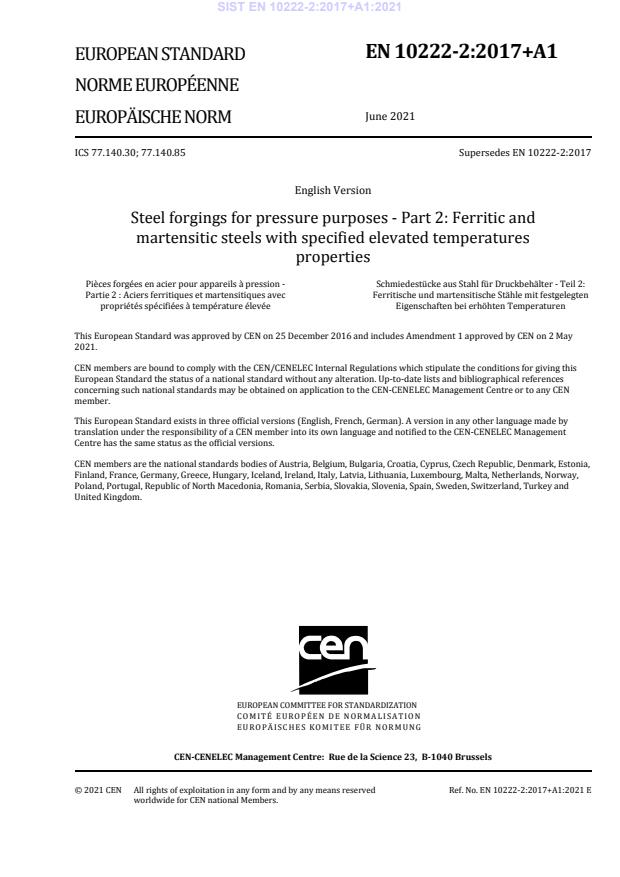
EN 10222-2:2017+A1
EUROPEAN STANDARD
NORME EUROPÉENNE
June 2021
EUROPÄISCHE NORM
ICS 77.140.30; 77.140.85 Supersedes EN 10222-2:2017
English Version
Steel forgings for pressure purposes - Part 2: Ferritic and
martensitic steels with specified elevated temperatures
properties
Pièces forgées en acier pour appareils à pression - Schmiedestücke aus Stahl für Druckbehälter - Teil 2:
Partie 2 : Aciers ferritiques et martensitiques avec Ferritische und martensitische Stähle mit festgelegten
propriétés spécifiées à température élevée Eigenschaften bei erhöhten Temperaturen
This European Standard was approved by CEN on 25 December 2016 and includes Amendment 1 approved by CEN on 2 May
2021.
CEN members are bound to comply with the CEN/CENELEC Internal Regulations which stipulate the conditions for giving this
European Standard the status of a national standard without any alteration. Up-to-date lists and bibliographical references
concerning such national standards may be obtained on application to the CEN-CENELEC Management Centre or to any CEN
member.
This European Standard exists in three official versions (English, French, German). A version in any other language made by
translation under the responsibility of a CEN member into its own language and notified to the CEN-CENELEC Management
Centre has the same status as the official versions.
CEN members are the national standards bodies of Austria, Belgium, Bulgaria, Croatia, Cyprus, Czech Republic, Denmark, Estonia,
Finland, France, Germany, Greece, Hungary, Iceland, Ireland, Italy, Latvia, Lithuania, Luxembourg, Malta, Netherlands, Norway,
Poland, Portugal, Republic of North Macedonia, Romania, Serbia, Slovakia, Slovenia, Spain, Sweden, Switzerland, Turkey and
United Kingdom.
EUROPEAN COMMITTEE FOR STANDARDIZATION
COMITÉ EUROPÉEN DE NORMALISATION
EUROPÄISCHES KOMITEE FÜR NORMUNG
CEN-CENELEC Management Centre: Rue de la Science 23, B-1040 Brussels
© 2021 CEN All rights of exploitation in any form and by any means reserved Ref. No. EN 10222-2:2017+A1:2021 E
worldwide for CEN national Members.
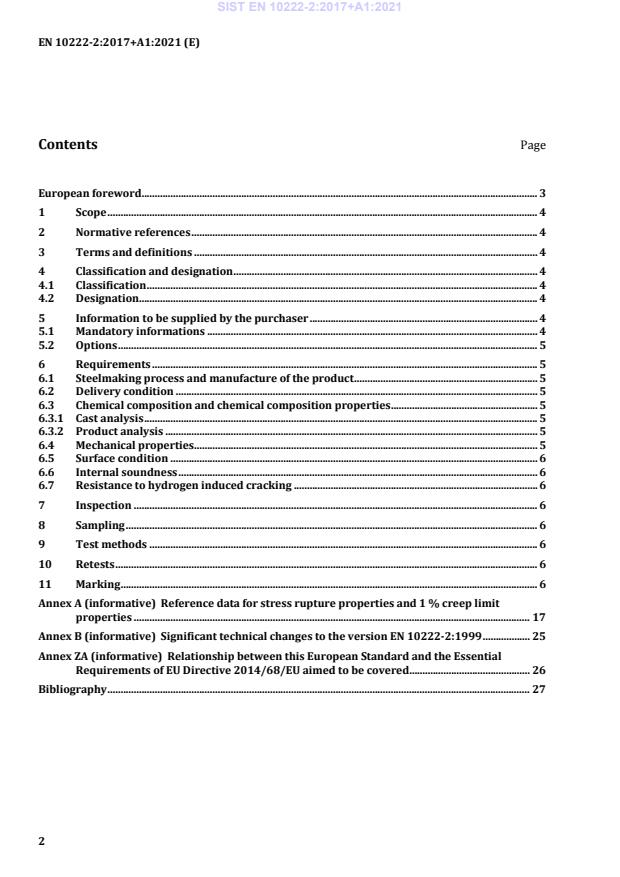
Contents Page
European foreword . 3
1 Scope . 4
2 Normative references . 4
3 Terms and definitions . 4
4 Classification and designation . 4
4.1 Classification . 4
4.2 Designation. 4
5 Information to be supplied by the purchaser . 4
5.1 Mandatory informations . 4
5.2 Options . 5
6 Requirements . 5
6.1 Steelmaking process and manufacture of the product . 5
6.2 Delivery condition . 5
6.3 Chemical composition and chemical composition properties . 5
6.3.1 Cast analysis . 5
6.3.2 Product analysis . 5
6.4 Mechanical properties . 5
6.5 Surface condition . 6
6.6 Internal soundness . 6
6.7 Resistance to hydrogen induced cracking . 6
7 Inspection . 6
8 Sampling . 6
9 Test methods . 6
10 Retests . 6
11 Marking . 6
Annex A (informative) Reference data for stress rupture properties and 1 % creep limit
properties . 17
Annex B (informative) Significant technical changes to the version EN 10222-2:1999 . 25
Annex ZA (informative) Relationship between this European Standard and the Essential
Requirements of EU Directive 2014/68/EU aimed to be covered . 26
Bibliography . 27
European foreword
This document (EN 10222-2:2017+A1:2021) has been prepared by Technical Committee
ECISS/TC 459/SC 11 “Steel castings and forgings”, the secretariat of which is held by AFNOR.
This European Standard shall be given the status of a national standard, either by publication of an
identical text or by endorsement, at the latest by December 2021, and conflicting national standards
shall be withdrawn at the latest by December 2021.
Attention is drawn to the possibility that some of the elements of this document may be the subject of
patent rights. CEN not be held responsible for identifying any or all such patent rights.
This document supersedes !EN 10222-2:2017".
This document includes Amendment 1 approved by CEN on 11 April 2021.
The start and finish of text introduced or altered by amendment is indicated in the text by tags !".
This document has been prepared under a mandate given to CEN by the European Commission and the
European Free Trade Association, and supports essential requirements of EU Directive 2014/68/EU.
For relationship with EU Directive 2014/68/EU, see informative Annex ZA, which is an integral part of
this document.
EN 10222 consists of the following parts under the general title “Steel forgings for pressure purposes”:
— Part 1: General requirements for open die forgings
— Part 2: Ferritic and martensitic steels with specified elevated temperature properties
— Part 3: Nickel steels with specified low temperature properties
— Part 4: Weldable fine grain steels with high proof strength
— Part 5: Martensitic, austenitic and austenitic-ferritic stainless steels.
!deleted sentence".
According to the CEN-CENELEC Internal Regulations, the national standards organisations of the
following countries are bound to implement this European Standard: Austria, Belgium, Bulgaria,
Croatia, Cyprus, Czech Republic, Denmark, Estonia, Finland, Former Yugoslav Republic of Macedonia,
France, Germany, Greece, Hungary, Iceland, Ireland, Italy, Latvia, Lithuania, Luxembourg, Malta,
Netherlands, Norway, Poland, Portugal, Romania, Serbia, Slovakia, Slovenia, Spain, Sweden, Switzerland,
Turkey and the United Kingdom.
1 Scope
This part of this European Standard specifies the technical delivery conditions for forgings for pressure
purposes, made of ferritic and martensitic steels with specified elevated temperature properties.
Chemical composition and mechanical properties are specified.
NOTE Once this standard is published in the EU Official Journal (OJEU) under Directive 2014/68/EU,
presumption of conformity to the Essential Safety Requirements (ESRs) of Directive 2014/68/EU is limited to
technical data of materials in this standard and does not presume adequacy of the material to a specific item of
equipment. Consequently, the assessment of the technical data stated in this material standard against the design
requirements of this specific item of equipment to verify that the ESRs of Directive 2014/68/EU are satisfied,
needs to be done. The series EN 10222–1 to EN 10222–5 is structured so that the data related to different
materials is in the part allocated for that material. The presumption of conformity to the Essential Safety
Requirements of Directive 2014/68/EU depends on both the text in part 1 and the data in part 2, 3, 4 or 5.
General information on technical delivery condition is given in EN 10021.
2 Normative references
The following documents, in whole or in part, are normatively referenced in this document and are
indispensable for its application. For dated references, only the edition cited applies. For undated
references, the latest edition of the referenced document (including any amendments) applies.
EN 10222-1:2017, Steel forgings for pressure purposes — Part 1: General requirements
3 Terms and definitions
For the purpose of this document, the terms and definitions given in EN 10222-1:2017 apply.
4 Classification and designation
4.1 Classification
In accordance with EN 10020, the grades P235GH, P245GH, P250GH, P265GH, P280GH, P295GH and
P305GH are non-alloy quality steels. All others are alloy special steels.
4.2 Designation
See EN 10222-1:2017.
5 Information to be supplied by the purchaser
5.1 Mandatory informations
See EN 10222-1:2017
5.2 Options
A number of options are specified in this European Standard and listed below. Additionally the relevant
options of EN 10222-1:2017 apply. If the purchaser does not give any information to implement any of
these options at the time of enquiry and order, the products shall be supplied in accordance with the
basic specification (see also EN 10222-1:2017).
1) test temperature for the tensile test at elevated temperature, if applicable (see 6.4);
2) normalized forming instead normalizing (see Table 1, footnote c);
3) carbon equivalent for non-alloy steels (see Table 2);
4) increased minimum chromium content (see Table 2, footnote b);
5) minimum impact energy values (see Table 4, footnote d);
6) test to evaluate the resistance to hydrogen induced cracking (see 6.7);
7) different test temperature for the impact energy and appropriate values (see Table 4, footnote e);
8) higher sulphur content for alloy steels (see Table 2, footnote e).
6 Requirements
6.1 Steelmaking process and manufacture of the product
Shall be in accordance with EN 10222-1:2017.
6.2 Delivery condition
The products shall be delivered in the heat treatment condition specified of Table 1.
6.3 Chemical composition and chemical composition properties
6.3.1 Cast analysis
The chemical composition (cast analysis), determined in accordance with EN 10222-1:2017 shall
conform the requirements of Table 2.
6.3.2 Product analysis
The product analysis shall not be deviate from the specified cast analysis (see 6.3.1) by more than the
values specified in Table 3.
6.4 Mechanical properties
When heat treated in accordance with Table 1, the mechanical properties at room temperature
determined in accordance with EN 10222-1:2017, shall conform to the requirements of Table 4.
Elevated temperature proof strength (Rp0,2) properties shall conform to the requirements of Table 5.
If verification of specified proof strength at elevated temperature is requested (see option in
EN 10222-1:2017), the testing temperature should be agreed at the time of enquiry and order.
Otherwise, the test shall be carried out at 300 °C.
Reference data for 1 % (plastic) creep strain and creep rupture are given in Annex A.
6.5 Surface condition
See EN 10222-1:2017.
6.6 Internal soundness
See EN 10222-1:2017.
6.7 Resistance to hydrogen induced cracking
Non-alloy and low alloy steels may be susceptible to cracking when exposed to corrosive H S containing
environments, usually referred to as „sour service“.
A test to evaluate the resistance to hydrogen induced cracking in accordance with EN 10229 may be
agreed at the time of enquiry and order.
7 Inspection
See EN 10222-1:2017.
8 Sampling
See EN 10222-1:2017.
9 Test methods
See EN 10222-1:2017.
10 Retests
See EN 10222-1:2017.
11 Marking
See EN 10222-1:2017.
!Table 1 — Heat treatment
Steel designation Heat treatment
Austenizing or solution
b
Tempering
Symbol
annealing
Name Number
Cooling Cooling
Temperature Temperature
a a
°C °C
in in
c
P235GH 1.0345 890 to 950 a – –
+N
+A f
– –
c
a
+N
P245GH 1.0352 890 to 930
+NT or a, o, p,
600 to 640 a, f
+QT w
c
P250GH 1.0460 890 to 950 a – –
+N
c
P265GH 1.0425 890 to 950 a – –
+N
c
a – –
+N
P280GH 1.0426 880 to 920
+NT or a, o, p,
600 to 640 a, f
+QT w
c
a – –
+N
P295GH 1.0481 890 to 950
+NT or a, o, p,
600 to 640 a, f
+QT w
c
a – –
+N
P305GH 1.0436 880 to 920
+NT or a, o, p,
620 to 660 a, f
+QT w
+N 890 to 950 a – –
16Mo3 1.5415
+QT 890 to 960 o, p, w 620 to 700 a, f
+NT a
13CrMo4–5 1.7335 890 to 950 630 to 740 a, f
+NT or a, o, p,
+QT w
+NT or
15MnMoV4–5 1.5402 875 to 925 a, w 600 to 675 a, f
+QT
18MnMoNi5–5 1.6308 +QT 850 to 925 w 625 to 675 a, f
+NT or
14MoV6–3 1.7715 950 to 990 a, o, p 670 to 720 a, f
+QT
15MnCrMoNiV5– +NT or
1.6920 900 to 950 a, w 625 to 675 a, f
3 +QT
+NT a, o, p
11CrMo9–10 1.7383 900 to 980 670 to 770 a, f
+NT or a, o, p,
+QT w
X16CrMo5–1 1.7366 +A 850 to 880 f - -
Steel designation Heat treatment
Austenizing or solution
b
Tempering
Symbol
annealing
Name Number
Cooling Cooling
Temperature Temperature
a a
°C °C
in in
+NT or
925 to 975 a, o, p 690 to750 a, f
+QT
X10CrMoVNb9–1 1.4903 +NT 1040 to 1090 a, o, p 730 to 780 a,
X20CrMoV11–1 1.4922 +QT 1020 to 1070 a, o, p 730 to 780 a, f
a
a = air; f = furnaced; o = oil; p = polymer; w = water.
b
A = annealed; N = normalized; QT = quenched and tempered; NT = normalized and tempered.
c
If agreed at time of enquiry and order normalizing “N” may be replaced by normalizing forming
Table 2 — Chemical composition
a
Chemical composition (cast analysis) %
Steel designation
Carbon
equival
Si P S Ti
ent
Name Number C Mn Al total N Cr Cu Mo Nb Ni V Others
max. max. max. max.
value
max. %
0,40
Cr+Cu+Mo+Ni ≤
c
1.0345 ≤ 0,16 0,35 to 0,025 0,010 ≥ 0,020 ≤ 0,012 ≤ 0,30 ≤ 0,30 ≤ 0,08 ≤ 0,01f ≤ 0,30 0,03 ≤ 0,02 –
P235GH
0,70
1,20
0,50
Cr+Cu+Mo+Ni ≤
c
1.0352 0,08 to 0,20 0,40 to 0,025 0,015 ≥ 0,020 ≤ 0,012 ≤ 0,30 ≤ 0,30 ≤ 0,08 ≤ 0,01 ≤ 0,30 – ≤ 0,02 0,41
P245GH
0,70
1,30
0,30
c
Cr+Cu+Mo+Ni ≤
P250GH
1.0460 0,18 to 0.23 0,40 to 0,025 0,015 ≥ 0,020 ≤ 0,012 ≤ 0,30 ≤ 0,30 ≤ 0,08 ≤ 0,01f ≤ 0,30 0,03 ≤ 0,02 0,43
0,70
d
0,90
0,60
Cr+Cu+Mo+Ni ≤
c
1.0425 ≤ 0,20 0,40 to 0,025 0,010 ≥ 0,020 ≤ 0,012 ≤ 0,30 ≤ 0,30 ≤ 0,08 ≤ 0,01f ≤ 0,30 0,03 ≤ 0,02 0,43
P265GH
0,70
1,40
0,90 Cr+Cu+Mo+Ni ≤
c
1.0426 0,08 to 0,20 0,40 0,025 0,015 ≥ 0,020 ≤ 0,012 ≤ 0,30 ≤ 0,30 ≤ 0,08 ≤ 0,01 ≤ 0,30 – ≤ 0,02 0,45
P280GH
to1,50 0,70
0,70
Cr+Cu+Mo+Ni ≤
c
1.0481 0,08 to 0,20 0,40 to 0,025 0,010 ≥ 0,020 ≤ 0,012 ≤ 0,30 ≤ 0,30 ≤ 0,08 ≤ 0,01f ≤ 0,30 0,03 ≤ 0,02 0,45
P295GH
0,70
1,50
0,90
Cr+Cu+Mo+Ni ≤
c
1.0436 0,15 to 0,20 0,40 to 0,025 0,015 ≥ 0,020 ≤ 0,012 ≤ 0,30 ≤ 0,30 ≤ 0,08 ≤ 0,01 ≤ 0,30 – ≤ 0,02 0,47
P305GH
0,70
1,60
0,40
0,25 to
e
1.5415 0,12 to 0,20 0,35 to 0,025 0,010 – ≤ 0,012 ≤ 0,30 ≤ 0,30 – ≤ 0,30 – – – –
16Mo3
0,35
0,90
0,40
13CrMo4 b
0,40 to
0,70
1.7335 0,08 to 0,18 0,35 to 0,025 0,010 – ≤ 0,012 ≤ 0,30 – ≤ 0,30 – – – –
e
0,60
–5 to 1,15
1,00
a
Chemical composition (cast analysis) %
Steel designation
Carbon
equival
Si P S Ti
ent
Name Number C Mn Al total N Cr Cu Mo Nb Ni V Others
max. max. max. max.
value
max. %
0,90
15MnMo 0,40 to 0,04 to
1.5402 ≤ 0,18 0,40 to 0,025 0,015 – – ≤ 0,030 ≤ 0,030 ≤ 0,01 ≤ 0,30 – – –
V4–5 0,60 0,08
1,40
1,15
18MnMo 0,45 to 0,50 to
1.6308 ≤ 0,20 0,40 to 0,025 0,015 – – ≤ 0,30 ≤ 0,30 ≤ 0,01 – ≤ 0,03 – –
Ni5–5 0,55 0,80
1,55
0,40
14MoV6–
0,30 to 0,50 to 0,22 to
1.7715 0,10 to 0,18 0,40 to 0,025 0,010 ≤ 0,020 – – – – – Sn ≤ 0,025 –
e
0,60 0,70 0,28
0,70
1,00
15MnCrM 0,50 to 0,20 to 0,30 to 0,05 to
1.6920 ≤ 0,17 0,40 to 0,025 0,015 – – – – – – –
oNiV5–3 1,00 0,35 0,70 0,10
1,50
0,40
11CrMo9
2,00 to 0,90 to
1.7383 0,08 to 0,15 0,50 to 0,020 0,010 – ≤ 0,012 ≤ 0,25 – – – – – –
e
2,50 1,10
–10
0,80
0,30
X16CrMo 4,00 to 0,45 to
1.7366 ≤ 0,18 0,40 to 0,025 0,015 – – – – – – – – –
5–1 6,00 0,65
0,80
0,30
X10CrMo 0,030 to 8,0 to 0,85 to 0,06 to 0,18 to
1.4903 0,08 to 0,12 0,50 to 0,020 0,005 ≤ 0,040 ≤ 0,30 ≤ 0,30 – – –
VNb9–1 0,070 9,5 1,05 0,10 0,25
0,60
0,30
X20CrMo 10,00 0,80 to 0,30 to 0,20 to
1.4922 0,17 to 0,23 0,40 to 0,025 0,015 – – – – – – –
V11–1 to12,50 1,20 0,80 0,35
1,00
a
Elements not listed in this table shall not be intentionally added to the steel without the approval of the purchase except for finishing the cast. All appropriate measures shall be taken to prevent the
addition from scrap or other materials used in steelmaking of these elements which may have adversely affect the mechanical properties and usability.
b
If resistance to pressurized hydrogen is of importance, a min. content of Cr of 0,80 % may be agreed at the time of enquiry and order.
a
Chemical composition (cast analysis) %
Steel designation
Carbon
equival
Si P S Ti
ent
Name Number C Mn Al total N Cr Cu Mo Nb Ni V Others
max. max. max. max.
value
max. %
c
A ratio Al/N ≥ 2 shall apply. If only aluminium is used for nitrogen binding, a ratio Al/N ≥ 2 shall apply.
d
For teq > 100 mm, the lower limit for Mn shall be increased to Mn ≥ 0,40 % (see EN 10222-1:2017, Table A.1).
e
For these steel grades a higher content of sulfur up to 0,015 % may be agreed at time of enquiry or order.
f
For these steel grades, a higher content of niobium up to 0,02 % may be agreed at time of enquiry or order.
Table 3 — Permissible deviations of the product analysis above the maximum or below the
minimum limits of the requirement of cast analysis
Specified value in the cast
a
Permissible deviations
analysis according to
of the product analysis
Element
Table 2
%
%
C ≤ 0,23 +0,02
Si ≤ 0,50 +0,05
≤ 1,00 +0,05
Mn
> 1,00 to ≤ 1,60 ±0,10
≤ 0,015 +0,003
P
> 0,015 to ≤ 0,025 +0,005
≤ 0,010 +0,003
S
> 0,010
...