

SIST EN 1900:2000
(Main)Materials and articles in contact with foodstuffs - Non-metallic tableware - Terminology
General Information
- Abstract
This European Standard defines terms related to certain materials for non-metallic tableware in contact with foodstuffs. It only includes those articles composed of the following materials: glass, glass ceramics, porcelain, vitreous china/vitrified tableware, stoneware, earthenware, common pottery or plastic.
- Status
- Published
- Publication Date
- 31-Mar-2000
- Technical Committee
- EPO - Packaging - sales and grouped
- Current Stage
- 6060 - National Implementation/Publication (Adopted Project)
- Start Date
- 01-Apr-2000
- Due Date
- 01-Apr-2000
- Completion Date
- 01-Apr-2000

Overview
SIST EN 1900:2000 is a European Standard established by CEN that provides precise terminology related to non-metallic tableware materials in contact with foodstuffs. This standard focuses exclusively on defining terms associated with tableware composed of various non-metallic materials such as glass, porcelain, vitreous china, stoneware, earthenware, common pottery, and plastics. By standardizing terminology, SIST EN 1900:2000 supports clear communication, consistency, and regulatory compliance in the manufacture, testing, and use of non-metallic food-contact tableware.
Key Topics
- Scope of Materials: The standard covers terminology for materials including:
- Glass and glass ceramics
- Porcelain and vitreous china/vitrified tableware
- Stoneware, earthenware, and common pottery
- Plastic tableware materials
- Terminology Definitions: Provides unified definitions for material types, manufacturing methods, and article characteristics used in non-metallic tableware.
- Food Contact Relevance: Focuses on materials and articles that come into direct contact with foodstuffs, ensuring appropriate understanding for safety and quality considerations.
- Language Standardization: Facilitates consistent use of terminology in various languages, supporting international trade and communication.
Applications
- Manufacturing: Helps manufacturers correctly classify and describe non-metallic tableware materials and articles, improving product labeling and compliance with food safety regulations.
- Quality Control and Testing: Serves as a reference for laboratories and quality assurance teams conducting testing and certification on tableware materials used in food contact.
- Regulatory Compliance: Assists regulatory bodies in assessing materials and articles against food safety standards by providing clear terminology and definitions.
- Industry Communication: Enhances communication among producers, suppliers, distributors, and consumers by standardizing vocabulary related to non-metallic tableware.
- Product Development: Aids designers and engineers in precisely specifying materials in new tableware products to meet consumer safety and functional requirements.
Related Standards
- EN 1388-1 and EN 1388-2 - Testing methods for ceramic ware and porcelain in contact with food.
- EN 1186 Series – Tests for migration of substances from plastics and other materials intended to come into contact with food.
- EN 12875 – Requirements and test methods for plastic dishwashing utensils in contact with food.
- Regulation (EC) No 1935/2004 – Framework regulation for materials and articles intended to come into contact with food in Europe.
- ISO 6486 – Ceramic ware - Determination of resistance to acids and bases, complementing terminology standards.
By adhering to SIST EN 1900:2000, industry stakeholders ensure consistent terminology use for non-metallic tableware materials, supporting food safety, quality assurance, and cross-border harmonization within the food contact materials sector.
Relations
- Effective Date
- 25-Aug-2026
- Effective Date
- 28-Jan-2026
- Effective Date
- 28-Jan-2026
Get Certified
Connect with accredited certification bodies for this standard

BSI Group
BSI (British Standards Institution) is the business standards company that helps organizations make excellence a habit.

Bureau Veritas
Bureau Veritas is a world leader in laboratory testing, inspection and certification services.

DNV
DNV is an independent assurance and risk management provider.
Sponsored listings
Frequently Asked Questions
SIST EN 1900:2000 is a standard published by the Slovenian Institute for Standardization (SIST). Its full title is "Materials and articles in contact with foodstuffs - Non-metallic tableware - Terminology". This standard covers: This European Standard defines terms related to certain materials for non-metallic tableware in contact with foodstuffs. It only includes those articles composed of the following materials: glass, glass ceramics, porcelain, vitreous china/vitrified tableware, stoneware, earthenware, common pottery or plastic.
This European Standard defines terms related to certain materials for non-metallic tableware in contact with foodstuffs. It only includes those articles composed of the following materials: glass, glass ceramics, porcelain, vitreous china/vitrified tableware, stoneware, earthenware, common pottery or plastic.
SIST EN 1900:2000 is classified under the following ICS (International Classification for Standards) categories: 01.040.97 - Domestic and commercial equipment. Entertainment. Sports (Vocabularies); 67.250 - Materials and articles in contact with foodstuffs; 97.040.60 - Cookware, cutlery and flatware. The ICS classification helps identify the subject area and facilitates finding related standards.
SIST EN 1900:2000 has the following relationships with other standards: It is inter standard links to SIST ISO 62:1996, SIST EN 1184:1998, SIST EN 1217:1998. Understanding these relationships helps ensure you are using the most current and applicable version of the standard.
SIST EN 1900:2000 is available in PDF format for immediate download after purchase. The document can be added to your cart and obtained through the secure checkout process. Digital delivery ensures instant access to the complete standard document.
Standards Content (Sample)
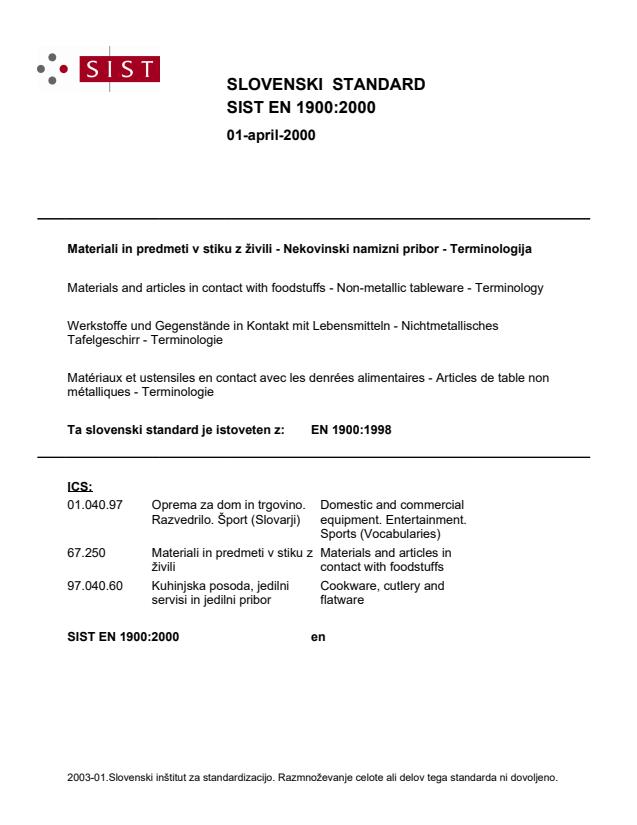
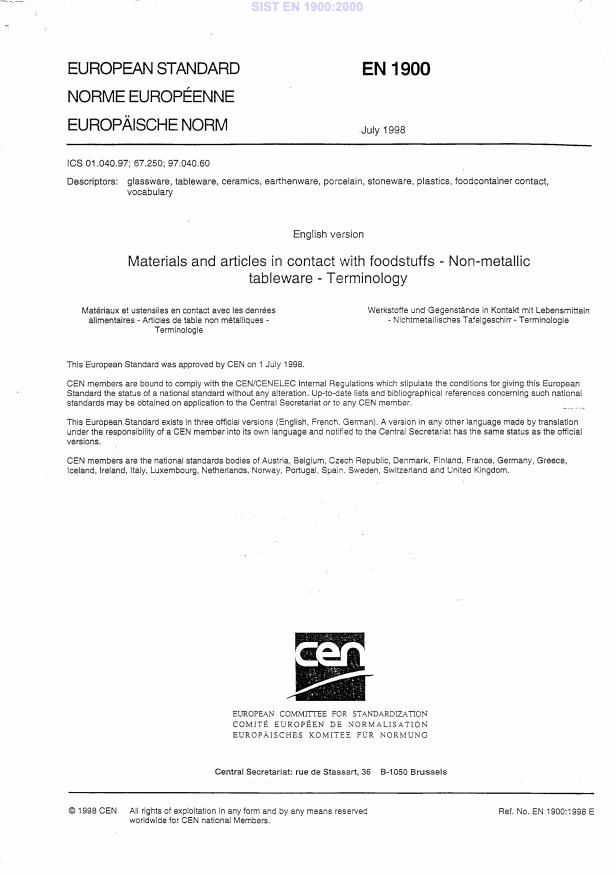
2003-01.Slovenski inštitut za standardizacijo. Razmnoževanje celote ali delov tega standarda ni dovoljeno.Materiali in predmeti v stiku z živili - Nekovinski namizni pribor - TerminologijaWerkstoffe und Gegenstände in Kontakt mit Lebensmitteln - Nichtmetallisches Tafelgeschirr - TerminologieMatériaux et ustensiles en contact avec les denrées alimentaires - Articles de table non métalliques - TerminologieMaterials and articles in contact with foodstuffs - Non-metallic tableware - Terminology97.040.60Kuhinjska posoda, jedilni servisi in jedilni priborCookware, cutlery and flatware67.250
...