

SIST EN IEC 61071:2025
(Main)Capacitors for power electronics (IEC 61071:2017)
General Information
- Abstract
NEW! IEC 61071:2017 is available as IEC 61071:2017 RLV which contains the International Standard and its Redline version, showing all changes of the technical content compared to the previous edition.
IEC 61071:2017 applies to capacitors for power electronics applications. The operating frequency of the systems in which these capacitors are used is usually up to 15 kHz, while the pulse frequencies may be up to 5 to 10 times the operating frequency. The document distinguishes between AC and DC capacitors which are considered as components when mounted in enclosures. This document covers an extremely wide range of capacitor technologies for numerous applications, e.g. overvoltage protection, DC and filtering, switching circuits, energy storage, auxiliary inverters, etc. This second edition cancels and replaces the first edition published in 2007. This edition constitutes a technical revision. This edition includes the following significant technical changes with respect to the previous edition:
- Introduction of new terms and definitions;
- clarifications for surge discharge test;
- indications for measuring procedure during thermal stability test;
- clarifications for self-healing test;
- clarifications for endurance test;
- clarifications for destruction test;
- update of normative references;
- general editorial review.
- Status
- Published
- Publication Date
- 31-Aug-2025
- Technical Committee
- I09 - Imaginarni 09
- Current Stage
- 6060 - National Implementation/Publication (Adopted Project)
- Start Date
- 26-Aug-2025
- Due Date
- 31-Oct-2025
- Completion Date
- 01-Sep-2025


Overview - EN IEC 61071:2025 (Capacitors for power electronics)
EN IEC 61071:2025 is the CENELEC adoption of IEC 61071 (edition 2 / IEC 61071:2017 RLV) and supersedes EN 61071:2007. It specifies requirements, tests and guidance for capacitors used in power electronics - typically operating up to about 15 kHz, with pulse frequencies up to 5–10× the operating frequency. The standard covers both AC and DC capacitors as components (including when mounted in enclosures) and addresses a wide range of capacitor technologies for power-electronic functions such as overvoltage protection, DC filtering, switching circuits, energy storage and auxiliary inverters.
Key topics and technical requirements
- Scope & service conditions: definitions of normal and unusual service environments, temperature limits, altitude and cooling considerations.
- Quality requirements & tests: classification into routine and type tests; procedures for capacitance and loss (tan δ) measurements.
- Electrical tests: voltage withstand between terminals and to case, AC tests, surge discharge tests and resonance frequency measurement.
- Reliability tests: thermal stability, endurance (life) tests, self‑healing tests, destruction tests and disconnecting tests for internal fuses.
- Mechanical & environmental tests: vibration, shock, solderability, damp heat and temperature-change tests in line with referenced IEC environmental standards.
- Safety & marking: discharge device requirements, case connections, environmental protection, rating plate and marking information.
- Significant editorial and technical updates vs. the 2007 edition include new terms/definitions, clarified procedures for surge discharge, thermal stability measuring, self‑healing, endurance and destruction tests, and updated normative references.
Practical applications and who uses this standard
EN IEC 61071:2025 is essential for:
- Capacitor manufacturers for design, type testing and certification of power capacitors.
- Power electronics designers and OEMs (inverters, motor drives, renewable power converters, EV power systems) selecting components for filtering, switching and energy storage.
- Test laboratories and certification bodies executing standardized type and routine tests.
- Specifiers and procurement teams ensuring components meet safety, reliability and lifecycle expectations.
Adopting this standard helps ensure compatibility, safety, and long-term reliability of capacitors in demanding pulsed and high-frequency power-electronic environments.
Related standards
EN IEC 61071:2025 references and aligns with several IEC standards relevant to environmental testing and safety, for example:
- IEC 60068 series (environmental tests)
- IEC 60664-1 (insulation coordination)
- IEC 60252-1, IEC 60146 and IEC 60110 series (relevant electrotechnical references)
Keywords: EN IEC 61071:2025, capacitors for power electronics, power capacitors, AC capacitors, DC capacitors, surge discharge test, thermal stability test, self‑healing test, endurance test, IEC 61071.
Relations
- Effective Date
- 01-Oct-2025
- Effective Date
- 03-Feb-2026
- Effective Date
- 03-Feb-2026
- Refers
SIST EN IEC 60269-1:2025 - Low-voltage fuses - Part 1: General requirements (IEC 60269-1:2024) - Effective Date
- 03-Feb-2026
- Effective Date
- 03-Feb-2026
- Effective Date
- 03-Feb-2026
- Effective Date
- 03-Feb-2026
- Effective Date
- 03-Feb-2026
- Refers
SIST EN 60068-2-6:2008 - Environmental testing - Part 2-6: Tests - Test Fc: Vibration (sinusoidal) - Effective Date
- 03-Feb-2026
- Effective Date
- 03-Feb-2026
- Effective Date
- 03-Feb-2026
Frequently Asked Questions
SIST EN IEC 61071:2025 is a standard published by the Slovenian Institute for Standardization (SIST). Its full title is "Capacitors for power electronics (IEC 61071:2017)". This standard covers: <span style="color:red">NEW! </span>IEC 61071:2017 is available as <a href="https://webstore.iec.ch/publication/61294">IEC 61071:2017 RLV</a> which contains the International Standard and its Redline version, showing all changes of the technical content compared to the previous edition. IEC 61071:2017 applies to capacitors for power electronics applications. The operating frequency of the systems in which these capacitors are used is usually up to 15 kHz, while the pulse frequencies may be up to 5 to 10 times the operating frequency. The document distinguishes between AC and DC capacitors which are considered as components when mounted in enclosures. This document covers an extremely wide range of capacitor technologies for numerous applications, e.g. overvoltage protection, DC and filtering, switching circuits, energy storage, auxiliary inverters, etc. This second edition cancels and replaces the first edition published in 2007. This edition constitutes a technical revision. This edition includes the following significant technical changes with respect to the previous edition: - Introduction of new terms and definitions; - clarifications for surge discharge test; - indications for measuring procedure during thermal stability test; - clarifications for self-healing test; - clarifications for endurance test; - clarifications for destruction test; - update of normative references; - general editorial review.
<span style="color:red">NEW! </span>IEC 61071:2017 is available as <a href="https://webstore.iec.ch/publication/61294">IEC 61071:2017 RLV</a> which contains the International Standard and its Redline version, showing all changes of the technical content compared to the previous edition. IEC 61071:2017 applies to capacitors for power electronics applications. The operating frequency of the systems in which these capacitors are used is usually up to 15 kHz, while the pulse frequencies may be up to 5 to 10 times the operating frequency. The document distinguishes between AC and DC capacitors which are considered as components when mounted in enclosures. This document covers an extremely wide range of capacitor technologies for numerous applications, e.g. overvoltage protection, DC and filtering, switching circuits, energy storage, auxiliary inverters, etc. This second edition cancels and replaces the first edition published in 2007. This edition constitutes a technical revision. This edition includes the following significant technical changes with respect to the previous edition: - Introduction of new terms and definitions; - clarifications for surge discharge test; - indications for measuring procedure during thermal stability test; - clarifications for self-healing test; - clarifications for endurance test; - clarifications for destruction test; - update of normative references; - general editorial review.
SIST EN IEC 61071:2025 is classified under the following ICS (International Classification for Standards) categories: 31.060.70 - Power capacitors. The ICS classification helps identify the subject area and facilitates finding related standards.
SIST EN IEC 61071:2025 has the following relationships with other standards: It is inter standard links to SIST EN 61071:2007, SIST EN IEC 60068-2-20:2021, SIST EN IEC 60068-2-21:2021, SIST EN IEC 60269-1:2025, SIST EN IEC 60695-2-11:2022, SIST EN IEC 60664-1:2020, SIST EN IEC 60068-2-78:2025, SIST EN IEC 60947-1:2021, SIST EN 60068-2-6:2008, SIST EN IEC 60068-2-14:2024, SIST EN IEC 60695-2-12:2022. Understanding these relationships helps ensure you are using the most current and applicable version of the standard.
SIST EN IEC 61071:2025 is associated with the following European legislation: EU Directives/Regulations: 2014/35/EU, 2014/53/EU; Standardization Mandates: M/511. When a standard is cited in the Official Journal of the European Union, products manufactured in conformity with it benefit from a presumption of conformity with the essential requirements of the corresponding EU directive or regulation.
SIST EN IEC 61071:2025 is available in PDF format for immediate download after purchase. The document can be added to your cart and obtained through the secure checkout process. Digital delivery ensures instant access to the complete standard document.
Standards Content (Sample)
SLOVENSKI STANDARD
01-oktober-2025
Nadomešča:
SIST EN 61071:2007
Kondenzatorji za močnostno elektroniko (IEC 61071:2017)
Capacitors for power electronics (IEC 61071:2017)
Kondensatoren der Leistungselektronik (IEC 61071:2017)
Condensateurs pour électronique de puissance (IEC 61071:2017)
Ta slovenski standard je istoveten z: EN IEC 61071:2025
ICS:
31.060.70 Močnostni kondenzatorji Power capacitors
2003-01.Slovenski inštitut za standardizacijo. Razmnoževanje celote ali delov tega standarda ni dovoljeno.
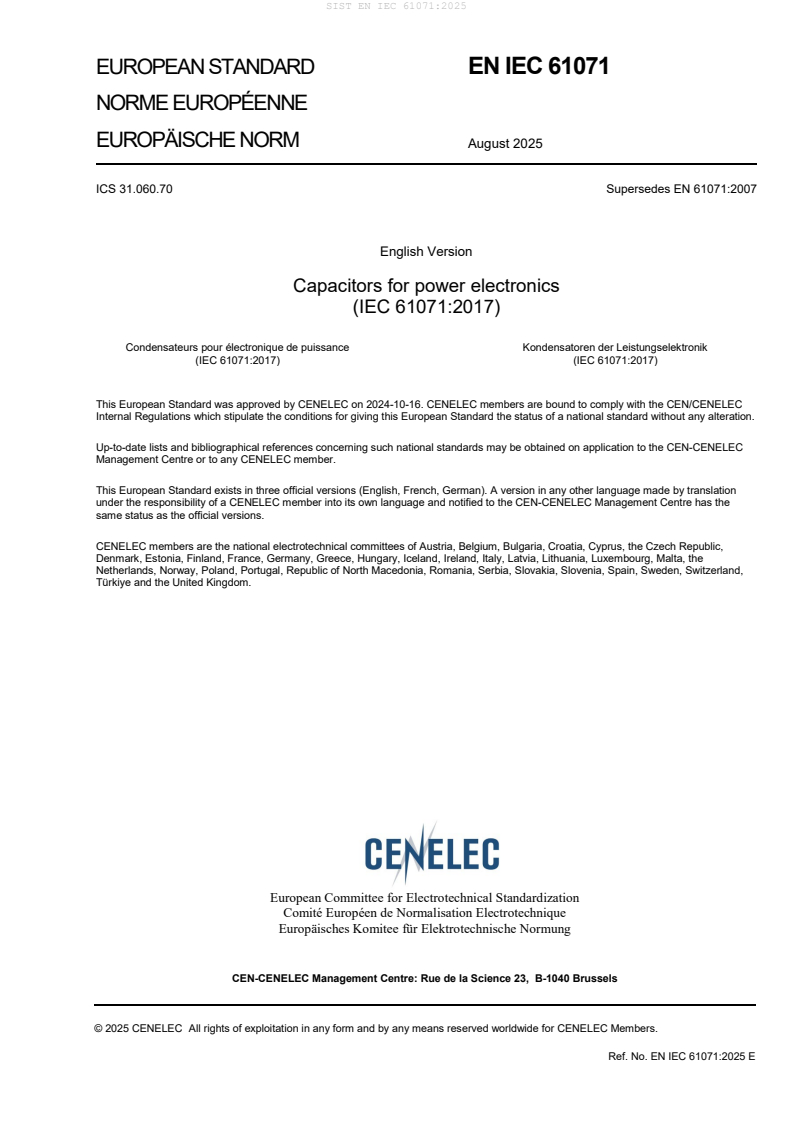
EUROPEAN STANDARD EN IEC 61071
NORME EUROPÉENNE
EUROPÄISCHE NORM August 2025
ICS 31.060.70 Supersedes EN 61071:2007
English Version
Capacitors for power electronics
(IEC 61071:2017)
Condensateurs pour électronique de puissance Kondensatoren der Leistungselektronik
(IEC 61071:2017) (IEC 61071:2017)
This European Standard was approved by CENELEC on 2024-10-16. CENELEC members are bound to comply with the CEN/CENELEC
Internal Regulations which stipulate the conditions for giving this European Standard the status of a national standard without any alteration.
Up-to-date lists and bibliographical references concerning such national standards may be obtained on application to the CEN-CENELEC
Management Centre or to any CENELEC member.
This European Standard exists in three official versions (English, French, German). A version in any other language made by translation
under the responsibility of a CENELEC member into its own language and notified to the CEN-CENELEC Management Centre has the
same status as the official versions.
CENELEC members are the national electrotechnical committees of Austria, Belgium, Bulgaria, Croatia, Cyprus, the Czech Republic,
Denmark, Estonia, Finland, France, Germany, Greece, Hungary, Iceland, Ireland, Italy, Latvia, Lithuania, Luxembourg, Malta, the
Netherlands, Norway, Poland, Portugal, Republic of North Macedonia, Romania, Serbia, Slovakia, Slovenia, Spain, Sweden, Switzerland,
Türkiye and the United Kingdom.
European Committee for Electrotechnical Standardization
Comité Européen de Normalisation Electrotechnique
Europäisches Komitee für Elektrotechnische Normung
CEN-CENELEC Management Centre: Rue de la Science 23, B-1040 Brussels
© 2025 CENELEC All rights of exploitation in any form and by any means reserved worldwide for CENELEC Members.
Ref. No. EN IEC 61071:2025 E
European foreword
The text of document 33/610/FDIS, future edition 2 of IEC 61071, prepared by TC 33 "Power
capacitors and their applications" was submitted to the IEC-CENELEC parallel vote and approved by
CENELEC as EN IEC 61071:2025.
The following dates are fixed:
• latest date by which the document has to be implemented at national (dop) 2026-08-31
level by publication of an identical national standard or by endorsement
• latest date by which the national standards conflicting with the (dow) 2028-08-31
document have to be withdrawn
This document supersedes EN 61071:2007 and all of its amendments and corrigenda (if any).
Attention is drawn to the possibility that some of the elements of this document may be the subject of
patent rights. CENELEC shall not be held responsible for identifying any or all such patent rights.
This document has been prepared under a standardization request addressed to CENELEC by the
European Commission. The Standing Committee of the EFTA States subsequently approves these
requests for its Member States.
Any feedback and questions on this document should be directed to the users’ national committee. A
complete listing of these bodies can be found on the CENELEC website.
Endorsement notice
The text of the International Standard IEC 61071:2017 was approved by CENELEC as a European
Standard without any modification.
In the official version, for Bibliography, the following notes have to be added for the standard indicated:
IEC 60146-1-1:2009 NOTE Approved as EN 60146-1-1:2010 (not modified)
IEC 61287-1:2014 NOTE Approved as EN 61287-1:2014 (not modified)
IEC 60110-1:1998 NOTE Approved as EN 60110-1:1998 (not modified)
IEC 60143 (series) NOTE Approved as EN IEC 60143 (series)
IEC 60252-1:2010 NOTE Approved as EN 60252-1:2011 (not modified)
IEC 60252-1:2010/A1:2013 NOTE Approved as EN 60252-1:2011/A1:2013 (not modified)
IEC 60358-1:2012 NOTE Approved as EN 60358-1:2012 (not modified)
IEC 60384-14:2013 NOTE Approved as EN 60384-14:2013 (not modified)
IEC 60831-1:2014 NOTE Approved as EN 60831-1:2014 (not modified)
IEC 60831-2:2014 NOTE Approved as EN 60831-2:2014 (not modified)
IEC 60871-1:2014 NOTE Approved as EN 60871-1:2014 (not modified)
IEC 60931-1:1996 NOTE Approved as EN 60931-1:1996 (not modified)
IEC 60931-2:1995 NOTE Approved as EN 60931-2:1996 (not modified)
IEC 61048:2006 NOTE Approved as EN 61048:2006 (not modified)
IEC 61048:2006/A1:2015 NOTE Approved as EN 61048:2006/A1:2016 (not modified)
IEC 61270-1:1996 NOTE Approved as EN 61270-1:1996 (not modified)
IEC 61881-1:2010 NOTE Approved as EN 61881-1:2011 (not modified)
IEC 61881-2:2012 NOTE Approved as EN 61881-2:2012 (not modified)
IEC 61881-3:2012 NOTE Approved as EN 61881-3:2012 (not modified)
IEC 61881-3:2012/A1:2013 NOTE Approved as EN 61881-3:2012/A1:2013 (not modified)
Annex ZA
(normative)
Normative references to international publications
with their corresponding European publications
The following documents are referred to in the text in such a way that some or all of their content
constitutes requirements of this document. For dated references, only the edition cited applies. For
undated references, the latest edition of the referenced document (including any amendments)
applies.
NOTE 1 Where an International Publication has been modified by common modifications, indicated by (mod),
the relevant EN/HD applies.
NOTE 2 Up-to-date information on the latest versions of the European Standards listed in this annex is available
here: www.cencenelec.eu.
Publication Year Title EN/HD Year
IEC 60068-2-6 - Environmental testing - Part 2-6: Tests - Test EN 60068-2-6 -
Fc: Vibration (sinusoidal)
IEC 60068-2-14 - Environmental testing - Part 2-14: Tests - Test EN IEC 60068-2-14 -
N: Change of temperature
IEC 60068-2-20 - Environmental testing - Part 2-20: Tests - Test EN IEC 60068-2-20 -
Ta and Tb: Test methods for solderability and
resistance to soldering heat of devices with
leads
IEC 60068-2-21 - Environmental testing - Part 2-21: Tests - Test EN IEC 60068-2-21 -
U: Robustness of terminations and integral
mounting devices
IEC 60068-2-78 - Environmental testing - Part 2-78: Tests - Test EN 60068-2-78 -
Cab: Damp heat, steady state
Low-voltage fuses - Part 1: General
IEC 60269-1 - EN IEC 60269-1 -
requirements
IEC 60664-1 - Insulation coordination for equipment within
EN IEC 60664-1 -
low-voltage supply systems - Part 1:
Principles, requirements and tests
IEC 60695-2-11 - Fire hazard testing - Part 2-11: Glowing/hot- EN IEC 60695-2-11 -
wire based test methods - Glow-wire
flammability test method for end products
(GWEPT)
IEC 60695-2-12 - Fire hazard testing - Part 2-12: Glowing/hot- EN IEC 60695-2-12 -
wire based test methods - Glow-wire
flammability index (GWFI) test method for
materials
IEC 60947-1 2007 Low-voltage switchgear and controlgear - Part - -
1: General rules
IEC 61071 ®
Edition 2.0 2017-08
INTERNATIONAL
STANDARD
NORME
INTERNATIONALE
Capacitors for power electronics
Condensateurs pour électronique de puissance
INTERNATIONAL
ELECTROTECHNICAL
COMMISSION
COMMISSION
ELECTROTECHNIQUE
INTERNATIONALE
ICS 31.060.70 ISBN 978-2-8322-4647-4
– 2 – IEC 61071:2017 © IEC 2017
CONTENTS
FOREWORD . 5
1 Scope . 7
2 Normative references . 7
3 Terms and definitions . 8
4 Service conditions . 14
4.1 Normal service conditions . 14
4.1.1 General . 14
4.1.2 Altitude . 14
4.1.3 Operating temperature (θ ) . 14
max
4.1.4 Operating temperature with forced cooling . 14
4.2 Unusual service conditions . 14
5 Quality requirements and tests . 15
5.1 Test requirements . 15
5.1.1 General . 15
5.1.2 Test conditions . 15
5.2 Classification of tests . 15
5.2.1 General . 15
5.2.2 Routine tests . 15
5.2.3 Type tests . 16
5.3 Capacitance and tan δ measurements (routine test) . 16
5.3.1 Measuring procedure . 16
5.3.2 Capacitance tolerances . 17
5.3.3 Loss requirements (tan δ) . 17
5.4 Measurement of the tangent of the loss angle (tan δ) of a capacitor (type test)
............................................................................................................................. 17
5.4.1 Measurements . 17
5.4.2 Loss requirements . 17
5.5 Voltage test between terminals . 17
5.5.1 General . 17
5.5.2 Routine test . 17
5.5.3 Type test . 18
5.6 AC voltage test between terminals and case . 18
5.6.1 Routine test . 18
5.6.2 Type test . 18
5.7 Test of internal discharge device . 19
5.8 Sealing test . 19
5.9 Surge discharge test . 19
5.10 Thermal stability test . 20
5.10.1 General . 20
5.10.2 Measuring procedure . 20
5.11 Self-healing test . 21
5.12 Resonance frequency measurement . 21
5.13 Environmental testing . 21
5.13.1 Change of temperature . 21
5.13.2 Damp heat, steady state . 22
5.14 Mechanical testing . 22
5.14.1 Mechanical tests of terminals . 22
IEC 61071:2017 © IEC 2017 – 3 –
5.14.2 External inspection . 22
5.14.3 Vibration and shocks . 22
5.15 Endurance test . 23
5.15.1 General . 23
5.15.2 Conditioning of the units before the test . 23
5.15.3 Initial capacitance and loss factor measurements . 23
5.15.4 Endurance test . 23
5.15.5 Final capacitance and tan δ measurement . 24
5.15.6 Acceptance criteria . 24
5.16 Destruction test . 24
5.16.1 General . 24
5.16.2 Test sequence for a.c. capacitors . 25
5.16.3 Test sequence for d.c. capacitors . 27
5.17 Disconnecting test on internal fuses . 29
5.17.1 General . 29
5.17.2 Disconnecting requirements . 30
5.17.3 Withstand requirements . 30
5.17.4 Test procedure . 30
5.17.5 Capacitance measurement . 31
5.17.6 Visual checking . 31
5.17.7 Voltage test . 31
6 Overloads . 32
6.1 Maximum permissible voltages . 32
7 Safety requirements . 32
7.1 Discharge device . 32
7.2 Case connections . 32
7.3 Protection of the environment . 33
7.4 Other safety requirements . 33
8 Markings. 33
8.1 Marking of the units – Rating plate . 33
9 Guidance on installation and operation . 34
9.1 General . 34
9.2 Choice of rated voltage . 34
9.3 Operating temperature . 34
9.3.1 General . 34
9.3.2 Installation . 35
9.3.3 Unusual cooling conditions . 35
9.4 Special service conditions . 35
9.5 Overvoltages . 36
9.6 Overcurrents . 36
9.7 Switching and protective devices . 36
9.8 Choice of creepage distance and clearance . 36
9.8.1 Creepage distance . 36
9.8.2 Air clearances. 36
9.9 Connections . 37
9.10 Parallel connections of capacitors . 37
9.11 Series connections of capacitors . 37
9.12 Magnetic losses and eddy currents . 37
– 4 – IEC 61071:2017 © IEC 2017
9.13 Guidance for internal fuse and disconnector protection in capacitors . 37
9.14 Guidance for unprotected capacitors . 38
Annex A (informative) Waveforms . 39
Annex B (normative) Operational limits of capacitors with sinusoidal voltages as a
function of frequency and at maximum temperature (θmax). 41
Annex C (normative) Resonance frequency measuring methods – Examples . 43
C.1 Method 1. 43
C.2 Method 2. 44
Bibliography . 45
Figure 1 – Destruction test arrangement . 26
Figure 2 – N source DC – Type 1 . 28
Figure 3 – N source DC – Type 2 . 29
Figure A.1 – Example of waveforms and their circuits . 40
Figure B.1 – Supply conditions . 41
Figure C.1 – Measuring circuit . 43
Figure C.2 – Relation between the voltage across the capacitor and the supply
frequency . 43
Figure C.3 – Discharge current wave shape . 44
Table 1 – Test voltage between terminals . 17
Table 2 – Testing the robustness of terminals . 22
Table 3 – Endurance test . 24
Table 4 – Destruction test as a function of type of safety system . 25
Table 5 – Maximum permissible voltages . 32
IEC 61071:2017 © IEC 2017 – 5 –
INTERNATIONAL ELECTROTECHNICAL COMMISSION
____________
CAPACITORS FOR POWER ELECTRONICS
FOREWORD
1) The International Electrotechnical Commission (IEC) is a worldwide organization for standardization comprising
all national electrotechnical committees (IEC National Committees). The object of IEC is to promote
international co-operation on all questions concerning standardization in the electrical and electronic fields. To
this end and in addition to other activities, IEC publishes International Standards, Technical Specifications,
Technical Reports, Publicly Available Specifications (PAS) and Guides (hereafter referred to as “IEC
Publication(s)”). Their preparation is entrusted to technical committees; any IEC National Committee interested
in the subject dealt with may participate in this preparatory work. International, governmental and non-
governmental organizations liaising with the IEC also participate in this preparation. IEC collaborates closely
with the International Organization for Standardization (ISO) in accordance with conditions determined by
agreement between the two organizations.
2) The formal decisions or agreements of IEC on technical matters express, as nearly as possible, an international
consensus of opinion on the relevant subjects since each technical committee has representation from all
interested IEC National Committees.
3) IEC Publications have the form of recommendations for international use and are accepted by IEC National
Committees in that sense. While all reasonable efforts are made to ensure that the technical content of IEC
Publications is accurate, IEC cannot be held responsible for the way in which they are used or for any
misinterpretation by any end user.
4) In order to promote international uniformity, IEC National Committees undertake to apply IEC Publications
transparently to the maximum extent possible in their national and regional publications. Any divergence
between any IEC Publication and the corresponding national or regional publication shall be clearly indicated in
the latter.
5) IEC itself does not provide any attestation of conformity. Independent certification bodies provide conformity
assessment services and, in some areas, access to IEC marks of conformity. IEC is not responsible for any
services carried out by independent certification bodies.
6) All users should ensure that they have the latest edition of this publication.
7) No liability shall attach to IEC or its directors, employees, servants or agents including individual experts and
members of its technical committees and IEC National Committees for any personal injury, property damage or
other damage of any nature whatsoever, whether direct or indirect, or for costs (including legal fees) and
expenses arising out of the publication, use of, or reliance upon, this IEC Publication or any other IEC
Publications.
8) Attention is drawn to the Normative references cited in this publication. Use of the referenced publications is
indispensable for the correct application of this publication.
9) Attention is drawn to the possibility that some of the elements of this IEC Publication may be the subject of
patent rights. IEC shall not be held responsible for identifying any or all such patent rights.
International Standard IEC 61071 has been prepared by IEC technical committee 33: Power
capacitors and their applications.
This second edition cancels and replaces the first edition published in 2007. This edition
constitutes a technical revision.
This edition includes the following significant technical changes with respect to the previous
edition:
• Introduction of new terms and definitions
• clarifications for surge discharge test
• indications for measuring procedure during thermal stability test
• clarifications for self-healing test
• clarifications for endurance test
• clarifications for destruction test
• update of normative references
• general editorial review
– 6 – IEC 61071:2017 © IEC 2017
The text of this International Standard is based on the following documents:
FDIS Report on voting
33/610/FDIS 33/612/RVD
Full information on the voting for the approval of this International Standard can be found in
the report on voting indicated in the above table.
This document has been drafted in accordance with the ISO/IEC Directives, Part 2.
The committee has decided that the contents of this document will remain unchanged until the
stability date indicated on the IEC website under "http://webstore.iec.ch" in the data related to
the specific document. At this date, the document will be
• reconfirmed,
• withdrawn,
• replaced by a revised edition, or
• amended.
IEC 61071:2017 © IEC 2017 – 7 –
CAPACITORS FOR POWER ELECTRONICS
1 Scope
This International Standard applies to capacitors for power electronics applications.
The operating frequency of the systems in which these capacitors are used is usually up to
15 kHz, while the pulse frequencies may be up to 5 to 10 times the operating frequency.
The document distinguishes between AC and DC capacitors which are considered as
components when mounted in enclosures.
This document covers an extremely wide range of capacitor technologies for numerous
applications, e.g. overvoltage protection, DC and filtering, switching circuits, energy storage,
auxiliary inverters, etc.
The following are excluded from this document:
• capacitors for induction heat-generating plants operating at frequencies range up to
50 kHz (see IEC 60110-1 and IEC 60110-2);
• capacitors for motor applications and the like (see IEC 60252-1 and IEC 60252 -2);
• capacitors to be used in circuits for blocking one or more harmonics in power supply
networks;
• small AC capacitors as used for fluorescent and discharge lamps (see IEC 61048 and
IEC 61049);
• capacitors for suppression of radio interference (see IEC 60384-14);
• shunt capacitors for AC power systems having a rated voltage above 1 000 V (see the
IEC 60871 standards);
• shunt power capacitors of the self-healing type for AC systems having a rated voltage up
to and including 1 000 V (see IEC 60831-1 and IEC 60831-2);
• shunt power capacitor of the non-self-healing type for AC systems having a rated voltage
up to and including 1 000 V (see the IEC 60931 standards);
• electronic capacitors not used in power circuits;
• series capacitors for power systems (see IEC 60143);
• coupling capacitors and capacitors dividers (see IEC 60358);
• capacitors for microwave ovens (see IEC 61270-1);
• capacitors for railway applications (see IEC 61881).
Examples of applications are given in 9.1.
2 Normative references
The following documents are referred to in the text in such a way that some or all of their
content constitutes requirements of this document. For dated references, only the edition
cited applies. For undated references, the latest edition of the referenced document (including
any amendments) applies.
IEC 60068-2-6, Environmental testing – Part 2-6: Tests – Test Fc: Vibration (sinusoidal)
– 8 – IEC 61071:2017 © IEC 2017
IEC 60068-2-14, Environmental testing – Part 2-14: Tests – Test N: Change of temperature
IEC 60068-2-20, Environmental testing – Part 2-20: Tests – Test T: Test methods for
solderability and resistance to soldering heat of devices with leads
IEC 60068-2-21, Environmental testing – Part 2-21: Tests – Test U: Robustness of
terminations and integral mounting devices
IEC 60068-2-78, Environmental testing – Part 2-78: Tests – Test Cab: Damp heat, steady
state
IEC 60269-1, Low-voltage fuses – Part 1: General requirements
IEC 60664-1, Insulation coordination for equipment within low-voltage systems – Part 1:
Principles, requirements and tests
IEC 60695-2-11, Fire hazard testing – Part 2-11: Glowing/hot-wire based test methods –
Glow-wire flammability test method for end-products (GWEPT)
IEC 60695-2-12, Fire hazard testing – Part 2-12: Glowing/hot-wire based test methods –
Glow-wire flammability index (GWFI) test method for materials
IEC 60947-1:2007, Low-voltage switchgear and controlgear – Part 1: General rules
3 Terms and definitions
For the purposes of this document, the following terms and definitions apply.
ISO and IEC maintain terminological databases for use in standardization at the following
addresses:
• IEC Electropedia: available at http://www.electropedia.org/
• ISO Online browsing platform: available at http://www.iso.org/obp
3.1
capacitor element (or element)
device consisting essentially of two electrodes separated by a dielectric
[SOURCE: IEC 60050-436:1990, 436-01-03]
3.2
capacitor unit (or unit)
assembly of one or more capacitor elements in the same container with terminals brought out
[SOURCE: IEC 60050-436:1990, 436-01-04]
3.3
capacitor bank
number of capacitor units connected so as to act together
[SOURCE: IEC 60050-436:1990, 436-01-06]
IEC 61071:2017 © IEC 2017 – 9 –
3.4
capacitor
general term used when it is not necessary to state whether reference is made to an element,
a unit or a capacitor bank
3.5
capacitor equipment
assembly of capacitor units and their accessories intended for connection in power electronic
equipment
3.6
capacitor for power electronics
power capacitor intended to be used in power electronic equipment and capable of operating
continuously under sinusoidal and non-sinusoidal current and voltage
3.7
metal-foil capacitor (non-self-healing)
capacitor in which the electrodes usually consist of metal foils separated by a dielectric
Note 1 to entry: In the event of a breakdown of the dielectric, the capacitor does not restore itself.
3.8
self-healing metallized dielectric capacitor
capacitor, of which at least one electrode consists of a metallic deposit on the dielectric
Note 1 to entry: In the event of local breakdown of the dielectric, the electric properties of the capacitor are
rapidly and essentially self-restored.
3.9
AC capacitor
capacitor essentially designed for operation with alternating voltage
Note 1 to entry: AC capacitors may be used with DC voltage up to the rated voltage only when authorized by the
capacitor manufacturer.
3.10
DC capacitor
capacitor essentially designed for operation with direct voltage
Note 1 to entry: DC capacitors may be used with a specified AC voltage only where authorized by the capacitor
manufacturer.
3.11
model capacitor
unit which simulates a complete unit or element in an electrical test, without reducing the
severity of the electrical, thermal or mechanical conditions
Note 1 to entry: The model unit may be of a different size from the complete unit.
Note 2 to entry: The combined sum of stresses should always be considered, for instance the sum of temperature
and mechanical conditions as well as electrical stresses.
3.12
internal (element) fuse
fuse connected inside a capacitor unit, in series with an element or a group of elements
[SOURCE: IEC 60050-436:1990, 436-03-16]
– 10 – IEC 61071:2017 © IEC 2017
3.13
safety devices
3.13.1
overpressure disconnector
disconnecting device inside a capacitor, designed to interrupt the current path in case of
abnormal increase of internal overpressure
3.13.2
overpressure detector
device designed to detect abnormal increase of the internal pressure, usually used to operate
an electrical switch and indirectly interrupt the current path
3.13.3
segmented metallization design
pattern design of the metal layer over the dielectric shaped in a way to allow a small part of it
to be isolated in case of local short circuit or breakdown, in order to restore the full
functionality of the unit with a negligible loss of capacitance
3.13.4
special unsegmented metallization design
design of the metal layer over the dielectric shaped in a way that safe self-healing features
operating at a voltage up to Us guarantee the full functionality of the unit with a negligible loss
of capacitance.
3.14
safety protection
protected capacitor
capacitor that can be submitted to the destruction test as described at 5.16
Note 1 to entry: protected capacitors alone are not sufficient to prevent all possible dangers in case of
malfunction.
3.15
unprotected capacitor
capacitor that don’t meet the destruction test as described at 5.16
3.16
discharge device of a capacitor
device which may be incorporated in a capacitor, capable of reducing the voltage between the
terminals practically to zero, within a given time, after the capacitor has been disconnected
from a network
[SOURCE: IEC 60050-436:1990, 436-03-15, modified ("to a given value" replaced by
"practically to zero")]
3.17
rated AC voltage
U
N
maximum operating peak recurrent voltage of either polarity of a reversing type waveform for
which the capacitor has been designed
Note 1 to entry: The waveform can have many shapes. Examples are given in Annex A.
Note 2 to entry: The mean value of the waveform may be positive or negative.
Note 3 to entry: It is important to note that the rated AC voltage is not an r.m.s. value.
IEC 61071:2017 © IEC 2017 – 11 –
3.18
rated DC voltage
U
NDC
maximum operating peak voltage of either polarity but of a non-reversing type waveform, for
which the capacitor has been designed, for continuous operation
Note 1 to entry: Damping capacitors, for gate turn-off thyristor (GTO) can be regarded as DC capacitors with a
ripple voltage equal to the rated DC voltage U = U .
NDC r
In the case of reversal voltage (U ), the use should be agreed between user and manufacturer.
rev
Note 2 to entry: If the reversal voltage is small (less than 10 %), the voltage waveform can be considered to be
non- reversing. For test purposes, U and U should be increased by Urev, the reversal voltage.
NDC r
3.19
ripple voltage
U
r
peak-to-peak alternating component of the unidirectional voltage
3.20
non-recurrent surge voltage
U
s
peak voltage induced by a switching or any other disturbance of the system which is allowed
for a limited number of times and for durations shorter than the basic period
3.21
insulation voltage
U
i
r.m.s. value of the sine wave voltage designed for the insulation between terminals of
capacitors to case or earth
3.22
maximum peak current
Î
maximum repetitive peak current that can occur during continuous operation
3.23
maximum current
I
max
maximum r.m.s. current for continuous operation
3.24
maximum surge current
Î
s
peak non-repetitive current induced by switching or any other disturbance of the system which
is allowed for a limited number of times, for durations shorter than the basic period
3.25
pulse frequency
f
p
repetition rate of periodic current pulses
3.26
current pulse width
τ
time of current flow during charging or discharging from one voltage value to another, of the
capacitor
Note 1 to entry: Pulse current waveform examples are shown in Annex A.
– 12 – IEC 61071:2017 © IEC 2017
3.27
resonance frequency
f
r
lowest frequency at which the impedance of the capacitor becomes minimum
3.28
duty cycle
3.28.1
continuous duty
operation time such that a capacitor is at thermal equilibrium for most of the time
3.28.2
intermittent duty
discontinuous working or operation with variable loads which should be described in terms of
ON/OFF or HIGH/LOW periods with their durations
3.29
thermal equilibrium
state of a capacitor when the temperature measured anywhere on its case or internally is less
than 3K above or below that temperature which would be reached after waiting an infinitely
long time under fixed conditions of ambient temperature, cooling, and internal power loss
3.30
thermal time constant
measure of the time required for a capacitor to reach thermal equilibrium after a change in
ambient temperature, cooling, or internal power loss
3.31
lowest operating temperature
θ
min
lowest temperature of the dielectric at which the capacitor may be energized
3.32
container temperature rise
∆θ
case
difference between the temperature of the hottest point of the container and the temperature
of the cooling air
3.33
cooling-air temperature
θ
amb
temperature of the cooling air measured at the hottest position of the capacitor, under steady-
state conditions, midway between two units
Note 1 to entry: If only one unit is involved, it is the temperature measured at a point approximately 0,1 m away
from the capacitor container and at two-thirds of the height from its base.
3.33.1
outlet fluid temperature for forced-cooled capacitors
temperature of the cooling fluid as it leaves the capacitor, measured at the hottest point
3.33.2
inlet fluid temperature for forced-cooled capacitors
temperature of the cooling fluid measured in the middle of the inlet fluid channel at a point not
influenced by the heat dissipation of the capacitor
IEC 61071:2017 © IEC 2017 – 13 –
3.34
maximum operating temperature
θ
max
highest temperature of the case at which the capacitor may be operated under steady state
condition
3.35
hotspot temperature
the highest temperature present inside the capacitor dielectric
3.36
steady-state conditions
thermal equilibrium attained by the capacitor at constant output and at constant cooling
conditions
3.37
capacitor losses
active power dissipated in the capacitor
Note 1 to entry: Unless otherwise stated, the capacitor losses are understood to include losses in fuses and
discharge resistors forming an integral part of the capacitor. At high frequency, the capacitor losses are
predominantly due to losses in connections, contacts and electrodes.
[SOURCE: IEC 60050-436:1990, 436-04-10]
3.38
tangent of the loss angle of a capacitor
tan δ
ratio between the equivalent series resistance and the capacitive reactance of a capacitor at a
specified sinusoidal alternating voltage, frequency and temperature
Note 1 to entry: tan δ = R ωC = tanδ + R ωC
esr d s
tanδ = dielectric loss factor
d
[SOURCE: IEC 60050-436:1990, 436-04-11]
3.39
equivalent series resistance of a capacitor
R
esr
effective resistance which, if connected in series with an ideal capacitor of capacitance value
equal to that of the capacitor in question, would have a power loss equal to active power
dissipated in that capacitor under specified operating conditions
3.40
series resistance
R
s
effective ohmic resistance of the conductors of a capacitor under specified operating
conditions
3.41
maximum power loss
P
max
maximum power loss at which the capacitor may be operated at the maximum case
temperature
– 14 – IEC 61071:2017 © IEC 2017
3.42
maximum frequency for maximum power loss and maximum current
f
frequency at which the maximum current (I ) produces the maximum power loss (P ) in
max max
the capacitor
Note 1 to entry: For explanation of f , see Figure B.1.
4 Service conditions
4.1 Normal service conditions
4.1.1 General
This standard gives requirements for capacitors intended for use in the following conditions.
4.1.2 Altitude
Altitude shall not exceed 1 000 m unless the effects on cooling and external insulation are
taken into account.
NOTE The effect of altitude on convection cooling and external insulation has to be taken into consideration, if
the altitude exceeds 1 000 m.
4.1.3 Operating temperature (θ )
max
The upper limit of the case temperature θ at which the capacitor may be operated, shall
max
normally be chosen from the values 45 °C, 55 °C, 70 °C and 85 °C. A different maximum
operating temperature shall be subject to agreement between manufacturer and user.
4.1.4 Operating temperature with forced cooling
If capacitors are intended for use with forced cooling using a fluid medium, the operating
temperature conditions specified in 4.1.3 shall be observed. The lowest inlet temperature for
the cooling fluid should be defined, taking into account the viscosity of the fluid.
There are two methods for specifying the upper temperature limit of the cooling medium,
using either the inlet or the outlet cooling fluid temperature.
Unless otherwise agreed, the choice of method shall be left to the capacitor manufacturer.
For the inlet method, the flow of cooling medium shall be specified.
4.2 Unusual service conditions
This standard does not apply to capacitors, whose service conditions are such as to be in
general incompatible with its requirements, unless otherwise agreed between the
manufacturer and the user.
Unusual service conditions require additional measurements, which ensure that the conditions
of this standard are complied with even under such unusual service conditions.
If such unusual service conditions exist then they shall be notified to the manufacturer of the
capacitor.
Unusual service conditions can include:
•
...