

SIST EN 301 681 V2.1.2:2017
(Main)Satellite Earth Stations and Systems (SES) - Harmonised Standard for Mobile Earth Stations (MESs) of Geostationary mobile satellite systems, including handheld earth stations, for Satellite Personal Communications Networks (S-PCN) under the Mobile Satellite Service (MSS) operating in the 1,5 GHz and 1,6 GHz frequency bands covering the essential requirements of article 3.2 of the Directive 2014/53/EU
General Information
- Abstract
REN/SES-00390
- Status
- Published
- Public Enquiry End Date
- 11-May-2016
- Publication Date
- 29-Nov-2016
- Technical Committee
- MOC - Mobile Communications
- Current Stage
- 6060 - National Implementation/Publication (Adopted Project)
- Start Date
- 21-Nov-2016
- Due Date
- 26-Jan-2017
- Completion Date
- 30-Nov-2016
Buy Documents
ETSI EN 301 681 V2.1.0 (2016-02) - Satellite Earth Stations and Systems (SES); Harmonised Standard for Mobile Earth Stations (MESs) of Geostationary mobile satellite systems, including handheld earth stations, for Satellite Personal Communications Networks (S-PCN) under the Mobile Satellite Service (MSS), operating in the 1,5 GHz and 1,6 GHz frequency bands covering the essential requirements of article 3.2 of the Directive 2014/53/EU
ETSI EN 301 681 V2.1.1 (2016-07) - Satellite Earth Stations and Systems (SES); Harmonised Standard for Mobile Earth Stations (MES) of Geostationary mobile satellite systems, including handheld earth stations, for Satellite Personal Communications Networks (S-PCN) under the Mobile Satellite Service (MSS), operating in the 1,5 GHz and 1,6 GHz frequency bands covering the essential requirements of article 3.2 of the Directive 2014/53/EU
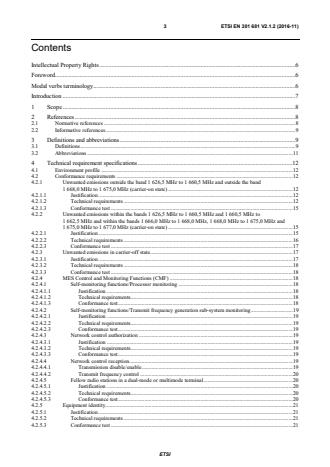
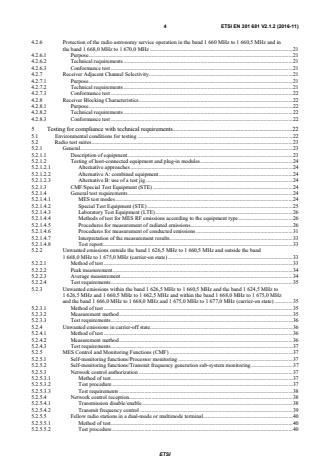
ETSI EN 301 681 V2.1.2 (2016-11) - Satellite Earth Stations and Systems (SES); Harmonised Standard for Mobile Earth Stations (MES) of Geostationary mobile satellite systems, including handheld earth stations, for Satellite Personal Communications Networks (S-PCN) under the Mobile Satellite Service (MSS), operating in the 1,5 GHz and 1,6 GHz frequency bands covering the essential requirements of article 3.2 of the Directive 2014/53/EU

Overview
SIST EN 301 681 V2.1.2:2017 is a harmonized European standard governing Mobile Earth Stations (MESs) for geostationary mobile satellite systems, including handheld earth stations, operating within Satellite Personal Communications Networks (S-PCN) under the Mobile Satellite Service (MSS). This standard specifically targets equipment operating in the 1.5 GHz and 1.6 GHz frequency bands, ensuring compliance with the essential requirements of article 3.2 of Directive 2014/53/EU (Radio Equipment Directive).
The standard is essential for manufacturers and technology providers aiming to ensure their mobile satellite communication equipment meets EU regulatory requirements, supports efficient spectrum usage, and avoids harmful interference.
Key Topics
- Operational Scope: Covers MES used in S-PCNs via geostationary satellites, including handheld, portable, vehicle-mounted, and fixed installations with both transmit and receive functions.
- Frequency Bands: Applicable to equipment operating in MSS bands:
- 1 626.5 MHz to 1 660.5 MHz (MES transmit)
- 1 668.0 MHz to 1 675.0 MHz (MES transmit)
- 1 525 MHz to 1 559 MHz (MES receive)
- 1 518.0 MHz to 1 525.0 MHz (MES receive)
- Market Compliance: Aligns with EU regulatory framework for radio equipment, specifically addressing efficient radio spectrum use and electromagnetic compatibility.
- Performance Criteria: Specifies minimum technical performance requirements for MES, including unwanted emissions, receiver selectivity, control and monitoring functions, and equipment identity.
- Testing Methods: Details standardized procedures for conformance testing, including laboratory setups, environmental conditions, and the use of specialized test equipment.
- Interference Prevention: Emphasizes limiting MES emissions to avoid interference with other spectrum users, including radio astronomy services.
Applications
SIST EN 301 681 V2.1.2:2017 is highly relevant to various sectors involved in mobile satellite communications, such as:
- Telecommunications Providers: Ensures that satellite communication terminals used in personal and critical communications networks comply with EU standards.
- Device Manufacturers: Guides the design and development of mobile earth stations, particularly for handheld, portable, and vehicle-mounted devices seeking CE marking in Europe.
- System Integrators: Assists in integrating compliant MES into broader communication, emergency response, or IoT solutions that leverage geostationary satellite connectivity.
- Testing Laboratories: Defines conformance testing protocols required for product certification and market access within the EU.
- Regulatory Bodies: Supports spectrum management and enforcement of regulations concerning efficient radio spectrum utilization and interference avoidance.
By following this standard, stakeholders can streamline market approval processes, reduce the risk of non-compliance penalties, and foster greater interoperability and reliability in satellite personal communications networks.
Related Standards
Professionals working with SIST EN 301 681 should also consult these related standards and resources for comprehensive compliance:
- ETSI EN 301 681 V2.1.2 (2016-11): The harmonized European original of this document, closely linked in content and application.
- Directive 2014/53/EU (Radio Equipment Directive): The primary European Union legal framework for all radio equipment, ensuring safety, EMC, and spectrum efficiency.
- CISPR 16-1-4: For radio disturbance and immunity measurement methods relevant to accurate emission testing.
- ETSI EG 201 399: A guide to the production of harmonized standards for radio and telecommunication equipment under European directives.
- ITU Recommendations: For broader context regarding international satellite frequency allocations and error performance measurements.
- Other SIST/EN Standards: Covering elements such as electrical safety, additional EMC requirements, and interoperability.
By integrating SIST EN 301 681 V2.1.2:2017 requirements into product development and testing workflows, organizations ensure that mobile earth stations are robust, interference-free, and ready for European and international markets.
Buy Documents
ETSI EN 301 681 V2.1.0 (2016-02) - Satellite Earth Stations and Systems (SES); Harmonised Standard for Mobile Earth Stations (MESs) of Geostationary mobile satellite systems, including handheld earth stations, for Satellite Personal Communications Networks (S-PCN) under the Mobile Satellite Service (MSS), operating in the 1,5 GHz and 1,6 GHz frequency bands covering the essential requirements of article 3.2 of the Directive 2014/53/EU
ETSI EN 301 681 V2.1.1 (2016-07) - Satellite Earth Stations and Systems (SES); Harmonised Standard for Mobile Earth Stations (MES) of Geostationary mobile satellite systems, including handheld earth stations, for Satellite Personal Communications Networks (S-PCN) under the Mobile Satellite Service (MSS), operating in the 1,5 GHz and 1,6 GHz frequency bands covering the essential requirements of article 3.2 of the Directive 2014/53/EU
ETSI EN 301 681 V2.1.2 (2016-11) - Satellite Earth Stations and Systems (SES); Harmonised Standard for Mobile Earth Stations (MES) of Geostationary mobile satellite systems, including handheld earth stations, for Satellite Personal Communications Networks (S-PCN) under the Mobile Satellite Service (MSS), operating in the 1,5 GHz and 1,6 GHz frequency bands covering the essential requirements of article 3.2 of the Directive 2014/53/EU
Get Certified
Connect with accredited certification bodies for this standard

ANCE
Mexican certification and testing association.

Intertek Slovenia
Intertek testing, inspection, and certification services in Slovenia.

LNE (Laboratoire National de Métrologie et d'Essais)
French national laboratory for metrology and testing.
Sponsored listings
Frequently Asked Questions
SIST EN 301 681 V2.1.2:2017 is a standard published by the Slovenian Institute for Standardization (SIST). Its full title is "Satellite Earth Stations and Systems (SES) - Harmonised Standard for Mobile Earth Stations (MESs) of Geostationary mobile satellite systems, including handheld earth stations, for Satellite Personal Communications Networks (S-PCN) under the Mobile Satellite Service (MSS) operating in the 1,5 GHz and 1,6 GHz frequency bands covering the essential requirements of article 3.2 of the Directive 2014/53/EU". This standard covers: REN/SES-00390
REN/SES-00390
SIST EN 301 681 V2.1.2:2017 is classified under the following ICS (International Classification for Standards) categories: 33.060.30 - Radio relay and fixed satellite communications systems. The ICS classification helps identify the subject area and facilitates finding related standards.
SIST EN 301 681 V2.1.2:2017 is associated with the following European legislation: EU Directives/Regulations: 1999/5/EC, 2014/53/EU. When a standard is cited in the Official Journal of the European Union, products manufactured in conformity with it benefit from a presumption of conformity with the essential requirements of the corresponding EU directive or regulation.
SIST EN 301 681 V2.1.2:2017 is available in PDF format for immediate download after purchase. The document can be added to your cart and obtained through the secure checkout process. Digital delivery ensures instant access to the complete standard document.
Standards Content (Sample)
Draft ETSI EN 301 681 V2.1.0 (2016-02)
HARMONISED EUROPEAN STANDARD
Satellite Earth Stations and Systems (SES);
Harmonised Standard for Mobile Earth Stations (MESs) of
Geostationary mobile satellite systems, including handheld
earth stations, for Satellite Personal Communications
Networks (S-PCN) under the Mobile
Satellite Service (MSS), operating in the 1,5 GHz and 1,6 GHz
frequency bands covering the essential requirements
of article 3.2 of the Directive 2014/53/EU
2 Draft ETSI EN 301 681 V2.1.0 (2016-02)
Reference
REN/SES-00390
Keywords
earth station, MES, mobile, MSS, radio, satellite,
S-PCN
ETSI
650 Route des Lucioles
F-06921 Sophia Antipolis Cedex - FRANCE
Tel.: +33 4 92 94 42 00 Fax: +33 4 93 65 47 16
Siret N° 348 623 562 00017 - NAF 742 C
Association à but non lucratif enregistrée à la
Sous-Préfecture de Grasse (06) N° 7803/88
Important notice
The present document can be downloaded from:
http://www.etsi.org/standards-search
The present document may be made available in electronic versions and/or in print. The content of any electronic and/or
print versions of the present document shall not be modified without the prior written authorization of ETSI. In case of any
existing or perceived difference in contents between such versions and/or in print, the only prevailing document is the
print of the Portable Document Format (PDF) version kept on a specific network drive within ETSI Secretariat.
Users of the present document should be aware that the document may be subject to revision or change of status.
Information on the current status of this and other ETSI documents is available at
https://portal.etsi.org/TB/ETSIDeliverableStatus.aspx
If you find errors in the present document, please send your comment to one of the following services:
https://portal.etsi.org/People/CommiteeSupportStaff.aspx
Copyright Notification
No part may be reproduced or utilized in any form or by any means, electronic or mechanical, including photocopying
and microfilm except as authorized by written permission of ETSI.
The content of the PDF version shall not be modified without the written authorization of ETSI.
The copyright and the foregoing restriction extend to reproduction in all media.
© European Telecommunications Standards Institute 2016.
All rights reserved.
TM TM TM
DECT , PLUGTESTS , UMTS and the ETSI logo are Trade Marks of ETSI registered for the benefit of its Members.
TM
3GPP and LTE™ are Trade Marks of ETSI registered for the benefit of its Members and
of the 3GPP Organizational Partners.
GSM® and the GSM logo are Trade Marks registered and owned by the GSM Association.
ETSI
3 Draft ETSI EN 301 681 V2.1.0 (2016-02)
Contents
Intellectual Property Rights . 6
Foreword . 6
Modal verbs terminology . 6
Introduction . 6
1 Scope . 8
2 References . 8
2.1 Normative references . 8
2.2 Informative references . 9
3 Definitions and abbreviations . 9
3.1 Definitions . 9
3.2 Abbreviations . 11
4 Technical requirement specifications . 11
4.1 Environment profile . 11
4.2 Conformance requirements . 12
4.2.1 Unwanted emissions outside the band 1 626,5 MHz to 1 660,5 MHz and outside the band
1 668,0 MHz to 1 675,0 MHz (carrier-on state) . 12
4.2.1.1 Justification . 12
4.2.1.2 Technical requirements . 12
4.2.1.3 Conformance test . 15
4.2.2 Unwanted emissions within the bands 1 626,5 MHz to 1 660,5 MHz and 1 660,5 MHz to
1 662,5 MHz and within the bands 1 666,0 MHz to 1 668,0 MHz, 1 668,0 MHz to 1 675,0 MHz and
1 675,0 MHz to 1 677,0 MHz (carrier-on state) . 15
4.2.2.1 Justification . 15
4.2.2.2 Technical requirements . 15
4.2.2.3 Conformance test . 17
4.2.3 Unwanted emissions in carrier-off state . 17
4.2.3.1 Justification . 17
4.2.3.2 Technical requirements . 18
4.2.3.3 Conformance test . 18
4.2.4 MES Control and Monitoring Functions (CMF) . 18
4.2.4.1 Self-monitoring functions/Processor monitoring . 18
4.2.4.1.1 Justification . 18
4.2.4.1.2 Technical requirements. 18
4.2.4.1.3 Conformance test . 18
4.2.4.2 Self-monitoring functions/Transmit frequency generation sub-system monitoring . 19
4.2.4.2.1 Justification . 19
4.2.4.2.2 Technical requirements. 19
4.2.4.2.3 Conformance test . 19
4.2.4.3 Network control authorization . 19
4.2.4.3.1 Justification . 19
4.2.4.3.2 Technical requirements. 19
4.2.4.3.3 Conformance test . 19
4.2.4.4 Network control reception . 19
4.2.4.4.1 Transmission disable/enable . 19
4.2.4.4.2 Transmit frequency control . 20
4.2.4.5 Fellow radio stations in a dual-mode or multimode terminal . 20
4.2.4.5.1 Justification . 20
4.2.4.5.2 Technical requirements. 20
4.2.4.5.3 Conformance test . 20
4.2.5 Equipment identity . 20
4.2.5.1 Justification . 20
4.2.5.2 Technical requirements . 20
4.2.5.3 Conformance test . 21
ETSI
4 Draft ETSI EN 301 681 V2.1.0 (2016-02)
4.2.6 Protection of the radio astronomy service operation in the band 1 660 MHz to 1 660,5 MHz and in
the band 1 668,0 MHz to 1 670,0 MHz . 21
4.2.6.1 Purpose . 21
4.2.6.2 Technical requirements . 21
4.2.6.3 Conformance test . 21
4.2.7 Receiver Adjacent Channel Selectivity. 21
4.2.7.1 Purpose . 21
4.2.7.2 Technical requirements . 21
4.2.7.3 Conformance test . 21
4.2.8 Receiver Blocking Characteristics . 22
4.2.8.1 Purpose . 22
4.2.8.2 Technical requirements . 22
4.2.8.3 Conformance test . 22
5 Testing for compliance with technical requirements . 22
5.1 Environmental conditions for testing . 22
5.2 Radio test suites . 22
5.2.1 General . 22
5.2.1.1 Description of equipment . 22
5.2.1.2 Testing of host-connected equipment and plug-in modules . 23
5.2.1.2.1 Alternative approaches . 23
5.2.1.2.2 Alternative A: combined equipment . 23
5.2.1.2.3 Alternative B: use of a test jig . 24
5.2.1.3 CMF/Special Test Equipment (STE) . 24
5.2.1.4 General test requirements . 24
5.2.1.4.1 MES test modes . 24
5.2.1.4.2 Special Test Equipment (STE) . 24
5.2.1.4.3 Laboratory Test Equipment (LTE) . 25
5.2.1.4.4 Methods of test for MES RF emissions according to the equipment type . 25
5.2.1.4.5 Procedures for measurement of radiated emissions . 26
5.2.1.4.6 Procedures for measurement of conducted emissions . 30
5.2.1.4.7 Interpretation of the measurement results . 32
5.2.1.4.8 Test report . 32
5.2.2 Unwanted emissions outside the band 1 626,5 MHz to 1 660,5 MHz and outside the band
1 668,0 MHz to 1 675,0 MHz (carrier-on state) . 32
5.2.2.1 Method of test . 32
5.2.2.2 Peak measurement . 33
5.2.2.3 Average measurement . 33
5.2.2.4 Test requirements . 33
5.2.3 Unwanted emissions within the band 1 626,5 MHz to 1 660,5 MHz and the band 1 624,5 MHz to
1 626,5 MHz and 1 660,5 MHz to 1 662,5 MHz and within the band 1 668,0 MHz to 1 675,0 MHz
and the band 1 666,0 MHz to 1 668,0 MHz and 1 675,0 MHz to 1 677,0 MHz (carrier-on state) . 34
5.2.3.1 Method of test . 34
5.2.3.2 Measurement method . 34
5.2.3.3 Test requirements . 35
5.2.4 Unwanted emissions in carrier-off state . 35
5.2.4.1 Method of test . 35
5.2.4.2 Measurement method . 35
5.2.4.3 Test requirements . 36
5.2.5 MES Control and Monitoring Functions (CMF) . 36
5.2.5.1 Self-monitoring functions/Processor monitoring . 36
5.2.5.2 Self-monitoring functions/Transmit frequency generation sub-system monitoring . 36
5.2.5.3 Network control authorization . 36
5.2.5.3.1 Method of test . 36
5.2.5.3.2 Test procedure . 36
5.2.5.3.3 Test requirements . 37
5.2.5.4 Network control reception . 37
5.2.5.4.1 Transmission disable/enable . 37
5.2.5.4.2 Transmit frequency control . 38
5.2.5.5 Fellow radio stations in a dual-mode or multimode terminal . 39
5.2.5.5.1 Method of test . 39
5.2.5.5.2 Test procedure . 39
ETSI
5 Draft ETSI EN 301 681 V2.1.0 (2016-02)
5.2.5.5.3 Test requirements . 39
5.2.6 Equipment identity . 39
5.2.6.1 Method of test . 39
5.2.6.2 Test procedure . 39
5.2.6.3 Test requirements . 39
5.2.7 Receiver Adjacent Channel Selectivity. 39
5.2.7.1 General . 39
5.2.7.2 Test arrangement . 39
5.2.7.3 Test Procedures . 40
5.2.8 Receiver Blocking Characteristics . 40
5.2.8.1 General . 40
5.2.8.2 Test arrangement . 40
5.2.8.3 Test procedures . 40
Annex A (normative): Relationship between the present document and the essential
requirements of Directive 2014/53/EU . 42
Annex B (informative): Bibliography . 44
History . 45
ETSI
6 Draft ETSI EN 301 681 V2.1.0 (2016-02)
Intellectual Property Rights
IPRs essential or potentially essential to the present document may have been declared to ETSI. The information
pertaining to these essential IPRs, if any, is publicly available for ETSI members and non-members, and can be found
in ETSI SR 000 314: "Intellectual Property Rights (IPRs); Essential, or potentially Essential, IPRs notified to ETSI in
respect of ETSI standards", which is available from the ETSI Secretariat. Latest updates are available on the ETSI Web
server (https://ipr.etsi.org/).
Pursuant to the ETSI IPR Policy, no investigation, including IPR searches, has been carried out by ETSI. No guarantee
can be given as to the existence of other IPRs not referenced in ETSI SR 000 314 (or the updates on the ETSI Web
server) which are, or may be, or may become, essential to the present document.
Foreword
This draft Harmonised European Standard (EN) has been produced by ETSI Technical Committee Satellite Earth
Stations and Systems (SES), and is now submitted for the combined Public Enquiry and Vote phase of the ETSI
standards EN Approval Procedure.
The present document has been prepared under the Commission's standardisation request C(2015) 5376 final [i.3] to
provide one voluntary means of conforming to the essential requirements of Directive 2014/53/EU on the harmonisation
of the laws of the Member States relating to the making available on the market of radio equipment and repealing
Directive 1999/5/EC [9].
Once the present document is cited in the Official Journal of the European Union under that Directive, compliance with
the normative clauses of the present document given in table A.1 confers, within the limits of the scope of the present
document, a presumption of conformity with the corresponding essential requirements of that Directive, and associated
EFTA regulations.
Proposed national transposition dates
Date of latest announcement of this EN (doa): 3 months after ETSI publication
Date of latest publication of new National Standard
or endorsement of this EN (dop/e): 6 months after doa
Date of withdrawal of any conflicting National Standard (dow): 18 months after doa
Modal verbs terminology
In the present document "shall", "shall not", "should", "should not", "may", "need not", "will", "will not", "can" and
"cannot" are to be interpreted as described in clause 3.2 of the ETSI Drafting Rules (Verbal forms for the expression of
provisions).
"must" and "must not" are NOT allowed in ETSI deliverables except when used in direct citation.
Introduction
The present document is part of a set of standards developed by ETSI and is designed to fit in a modular structure to
cover all radio equipment within the scope of the RE Directive [9]. The modular structure is shown in ETSI
EG 201 399 [i.1]. The determination of the parameters of the user earth stations using a given satellite for the protection
of the spectrum allocated to that satellite, is considered to be under the responsibility of the satellite operator or the
satellite network operators.
ETSI
7 Draft ETSI EN 301 681 V2.1.0 (2016-02)
Following the WRC-03 decision [i.4] to allocate to MSS the bands 1 518 MHz to 1 525 MHz (space to Earth) and
1 668 MHz to 1 675 MHz (Earth to space) and the conclusions of WRC-07,a new set of emission requirements for
LMESs that are capable of transmitting in the frequency band from 1 668,0 MHz to 1 675,0 MHz were specified.
The two parts of the L-band frequency allocations are treated as two sub-bands which may be used separately or in any
combination. The original L-band allocation is referenced in the present document as "sub-band 1" and the extended
L-band is referenced as "sub-band 2".
Table 3a is applicable for MESs that are capable of transmitting in any combination of either or both of these sub-bands.
Table 3a is recommended for all new MESs, including MESs that can only operate in sub-band 1.
The applicant may choose between table 3 and table 3a for new MESs that are capable of transmitting in only the
sub-band 1: the applicant has to declare which alternative is used.
The present document specifies a new set of receiver performance requirements for LMESs under the new Radio
Equipment Directive 2014/53/EU [9].
Figure 1: Void
ETSI
8 Draft ETSI EN 301 681 V2.1.0 (2016-02)
1 Scope
The present document applies to S-PCN MES for Geostationary mobile satellite systems with an EIRP less than or
equal to 15 dBW.
The present document sets out the minimum performance requirements and technical characteristics of Mobile Earth
Stations (MES) with both transmit and receive capabilities for operation in a Satellite Personal Communication
Network (S-PCN) in any combination of all or any part of the Mobile Satellite Service (MSS) frequency bands
sub-band 1 and sub-band 2 defined in table 1.
These MESs are controlled and monitored by a Network Control Facility (NCF). The NCF is outside the scope of the
present document.
Table 1: Mobile Satellite Service (MSS) frequency band
Sub-band Transmission path MSS frequency band
1 MESs transmit 1 1 626,5 MHz to 1 660,5 MHz
MESs receive 1 1 525 MHz to 1 559 MHz
2 MESs transmit 2 1 668,0 MHz to 1 675,0 MHz
MESs receive 2 1 518,0 MHz to 1 525,0 MHz
An S-PCN MES may be handheld, portable, vehicle-mounted, host connected, semi-fixed or fixed equipment, or may
be an element in a multimode terminal; it may consist of a number of modules with associated connections and user
interface, or may be a self contained single unit.
If the MES is an element in a multimode terminal, unless otherwise stated in the present document, its requirements
apply only to the S-PCN MES element of the terminal operating in the MSS frequency band given in table 1.
The present document is intended to cover the provisions of Directive 2014/53/EU [9] (RE Directive) article 3.2 which
states that "….radio equipment shall be so constructed that it both effectively uses and supports the efficient use of radio
spectrum in order to avoid harmful interference". In addition to the present document, other ENs that specify technical
requirements in respect of essential requirements under other parts of article 3 of the Radio Equipment Directive
(RED) [9] may apply to equipment within the scope of the present document.
NOTE: A list of such ENs is included on the web site http://www.newapproach.org.
2 References
2.1 Normative references
References are either specific (identified by date of publication and/or edition number or version number) or
non-specific. For specific references, only the cited version applies. For non-specific references, the latest version of the
referenced document (including any amendments) applies.
Referenced documents which are not found to be publicly available in the expected location might be found at
http://docbox.etsi.org/Reference.
NOTE: While any hyperlinks included in this clause were valid at the time of publication, ETSI cannot guarantee
their long term validity.
The following referenced documents are necessary for the application of the present document.
[1] Void.
[2] Void.
[3] Void.
[4] Recommendation ITU-T O.153 (1992): "Basic parameters for the measurement of error
performance at bit rates below the primary rate".
ETSI
9 Draft ETSI EN 301 681 V2.1.0 (2016-02)
[5] CISPR 16-1-4 (2010): "Specification for radio disturbance and immunity measuring apparatus and
methods - Part 1-4: Radio disturbance and immunity measuring apparatus - Antennas and test sites
for radiated disturbance measurements".
[6] Void.
[7] Void.
[8] Void.
[9] Directive 2014/53/EU of the European Parliament and of the Council of 16 April 2014 on the
harmonisation of the laws of the Member States relating to the making available on the market of
radio equipment and repealing Directive 1999/5/EC.
2.2 Informative references
References are either specific (identified by date of publication and/or edition number or version number) or
non-specific. For specific references, only the cited version applies. For non-specific references, the latest version of the
referenced document (including any amendments) applies.
NOTE: While any hyperlinks included in this clause were valid at the time of publication, ETSI cannot guarantee
their long term validity.
The following referenced documents are not necessary for the application of the present document but they assist the
user with regard to a particular subject area.
[i.1] ETSI EG 201 399 (3.1.1): "Electromagnetic compatibility and Radio spectrum Matters (ERM); A
guide to the production of Harmonized Standards for application under the Radio &
Telecommunication Terminal Equipment Directive 1999/5/EC (R&TTE) and a first guide on the
impact of the Radio Equipment Directive 2014/53/EU (RED) on Harmonized Standards".
[i.2] Void.
[i.3] Commission Implementing Decision C(2015) 5376 final of 4.8.2015 on a standardisation request
to the European Committee for Electrotechnical Standardisation and to the European
Telecommunications Standards Institute as regards radio equipment in support of Directive
2014/53/EU of the European Parliament and of the Council.
[i.4] WRC-03 decision.
NOTE: Available at http://www.itu.int/dms_pub/itu-s/oth/02/01/S020100002D4005PDFE.PDF.
3 Definitions and abbreviations
3.1 Definitions
For the purposes of the present document, the terms and definitions given in Directive 2014/53/EU [9] and the
following apply:
3dB Bandwidth (B3dB): total width of the signal spectrum 3 dB below the maximum in-band density
applicant: manufacturer or his authorized representative within the European Community or the person responsible for
placing the apparatus on the market
carrier-off state: state in which the MES is not transmitting a carrier
carrier-on state: state in which the MES is transmitting a carrier
carrier-on time (initial bursts): period when an MES is transmitting a signal
NOTE: For MESs that transmit in a non-continuous mode, the carrier-on time only includes the times when the
MES is transmitting a signal.
ETSI
10 Draft ETSI EN 301 681 V2.1.0 (2016-02)
conducted measurement: measurement of emissions from an antenna port of the MES made by direct wired
connection to the port
environmental profile: range of environmental conditions under which equipment within the scope of the present
document is required to comply with the provisions of the present document
Equivalent Isotropically Radiated Power (EIRP): product of transmitter power and the antenna gain in the direction
considered, relative to an isotropic source radiating uniformly in all directions
fellow radio station: one of the (other) modes of a multimode MES
handheld: indicates an MES which is self-contained and is small enough and light enough to be carried and used
during a call with one hand
host-connected: indicates an MES for which connection to or integration with host equipment is necessary to offer
functionality
host equipment: any equipment which has a complete user functionality when not connected to the MES, and to which
the MES provides additional functionality, and to which connection is necessary for the MES to offer functionality
in-band signals: signals which are located in the operating band plus an offset of 10 MHz outside this operating band
Installable Equipment (IE): equipment which is intended to be installed in a vehicle
NOTE: An IE may consist of one or several interconnected modules. The IE is composed of modules intended to
be externally mounted as declared by the applicant, and defined as Externally Mounted Equipment (EME)
and the remaining modules(s) as Internally Mounted Equipment (IME).
Laboratory Test Equipment (LTE): logical grouping that contains the standard test equipment provided by a test
laboratory
MSS band: continuous range of frequencies allocated by the ITU to the MSS
multimode: indicates equipment that accommodates radio stations of different radio networks
NCF control message: message, normally originating from a network, to a specified terminal or set of terminals of the
network which indicates to the terminal or set of terminals that it/they should carry out some specific action or should
enter or maintain some specific state
NOTE: For test purposes NCF control messages may originate from Special Test Equipment (STE).
network control channel: channel by which an MES receives general control information from the NCF of its S-PCN
nominated bandwidth (Bn): bandwidth of the MES radio frequency transmission that is nominated by the applicant
and that is wide enough to encompass all spectral elements of the transmission necessary for communication and which
have a level greater than the specified unwanted emissions limits; also the nominated bandwidth is centred on the
transmit frequency and does not exceed 180 % of the 3 dB bandwidth of the signal and is within the assigned part of the
MSS transmit frequency band within which the MES operates
NOTE: The nominated bandwidth is wide enough to take account of the transmit carrier frequency stability.
operational frequency range(s): sub-portion(s) of the band 1 626,5 MHz to 1 660,5 MHz and
1 668,0 MHz to 1 675,0 MHz in the earth-to-space direction to the MSS network, for which the equipment has been
designed as declared by the applicant
Portable Equipment (PE): equipment generally intended to be self-contained, free standing and portable
NOTE: A PE would normally consist of a single module, but may consist of several interconnected modules.
radiated measurement: measurement of an actual radiated field
Special Test Equipment (STE): equipment which allows a test laboratory to control the MES so that the tests required
by the present document can be performed
sub-band: contiguous portion of the operating band
NOTE: Two sub-bands are defined (see table 1).
ETSI
11 Draft ETSI EN 301 681 V2.1.0 (2016-02)
test laboratory: laboratory which performs the conformance testing of the MES against the present document
NOTE: The test laboratory may be the applicant's laboratory.
test load: substantially non-reactive, non-radiating power attenuator which is capable of safely dissipating the power
from the transmitter(s)
transmission format: physical characteristics of the signal that is transmitted by an MES
NOTE: An MES may use more than one transmission format within a single S-PCN.
unwanted emissions: emissions falling outside the nominated bandwidth in the carrier-on state and those generated in
the carrier-off state
3.2 Abbreviations
For the purposes of the present document, the following abbreviations apply:
B 3dB Bandwidth
3dB
B Nominated Bandwidth
n
BW Bandwidth
CDMA Code Division Multiple Access
CISPR International Special Committee on Radio Interference
CMF Control and Monitoring Functions
EIRP Equivalent Isotropically Radiated Power
EMC Electro-Magnetic Compatibility
EME Externally Mounted Equipment
EU European Union
EUT Equipment Under Test
IE Installable Equipment
IEC International Electrotechnical Commission/Committee
IME Internally Mounted Equipment
ITU International Telecommunications Union
ITU-T ITU Telecommunication Standardization Sector
LTE Laboratory Test Equipment
LTE Long Term Evolution
MES Mobile Earth Station
MIC MES Identification Code
MSS Mobile Satellite Service
NCF Network Control Facility
PCN Personal Communications Networks
PE Portable Equipment
R&TTE Radio and Telecommunications Terminal Equipment
RA Radio Astronomy
RE Radio Equipment
RED Radio Equipment Directive
RF Radio Frequency
S-PCN Satellite Personal Communications Network
STE Special Test Equipment
TDMA Time Division Multiple Access
WRC World Radiocommunication Conference
4 Technical requirement specifications
4.1 Environment profile
The technical requirements of the present document apply under the environmental profile for operation of the
equipment, which shall be declared by the applicant. The equipment shall comply with all the technical requirements of
the present document at all times when operating within the boundary limits of the declared operational environmental
profile.
ETSI
12 Draft ETSI EN 301 681 V2.1.0 (2016-02)
The environmental profile for operation of the equipment shall include the ranges of humidity, temperature and supply
voltage.
Table 2: Void
4.2 Conformance requirements
4.2.1 Unwanted emissions outside the band 1 626,5 MHz to 1 660,5 MHz
and outside the band 1 668,0 MHz to 1 675,0 MHz (carrier-on state)
4.2.1.1 Justification
The technical requirements presented in this clause shall apply to all MESs that are capable of transmitting either in
sub-band 1, sub-band 2, or in both sub-bands as defined in table 1 for the purpose of:
• protection of other radio services operating outside the band 1 626,5 MHz to 1 660,5 MHz from emissions
caused by S-PCN MESs transmitting within the sub-band 1 frequency band as defined in table 1; and
• protection of other radio services operating outside the band 1 668,0 MHz to 1 675,0 MHz from emissions
caused by S-PCN MESs transmitting within the sub-band 2 frequency band as defined in table 1.
4.2.1.2 Technical requirements
Unwanted emissions from Mobile Earth Stations (LMESs) outside the band 1 626,5 MHz to 1 660,5 MHz and outside
the band 1 668 MHz to 1 675 MHz shall be below the following limits.
Unless otherwise stated the specification in this clause shall apply to all types of MESs notwithstanding their
transmitting capabilities within the frequency bands as defined in table 1:
1) For MES that are capable of transmitting within only the sub-band 1 frequency band as defined in table 1, the
maximum EIRP spectral density of the unwanted emissions from the MES outside the band 1 626,5 MHz to
1 660,5 MHz shall not exceed the limits in either table 3 or table 3a. The applicant shall declare which
alternative shall be used.
2) For MES that are capable of transmitting within only sub-band 2 frequency band or within both the sub-band 1
and sub-band 2 frequency bands, the maximum EIRP spectral density of the unwanted emissions from the
MES outside the bands 1 626,5 MHz to 1 660,5 MHz and 1 668,0 MHz to 1 675,0 MHz shall not exceed the
limits in table 3a.
In tables 3 and 3a, whenever a change of limit between adjacent frequency bands occurs, the lower of the two limits
shall apply at the transition frequency.
Table 3: Unwanted emissions outside the band 1 626,5 MHz to 1 660,5 MHz for MES only capable of
transmitting within sub-band 1 frequency band as defined in table 1
Carrier - on state
Frequency
EIRP Measurement Measurement method
(MHz)
(dBW) bandwidth (see note 6)
30 to 1 000 -66 100 kHz Peak Hold
1 000 to 1 559 -61 1 MHz Average
1 559 to 1 605,0 -70 1 MHz Average
(see note 3) (see note 2)
1 605,0 to 1 612,5 -70 to -58,5 1 MHz Average
(see note 4) (see note 3)
1 612,5 to 1 616,5 -55 to -50 1 MHz Average
(see note 4)
1 616,5 to 1 621,5 -50 to -46 1 MHz Average
(see note 4)
1 621,5 to 1 624,5 -60 30 kHz Average
1 624,5 to 1 625,0 -60 to -57,5 30 kHz Average
(see notes 4, 5, 7)
1 625,0 to 1 625,125 -57,5 to -57,2 30 kHz Average
(see notes 4, 5, 7)
ETSI
13 Draft ETSI EN 301 681 V2.1.0 (2016-02)
Carrier - on state
Frequency
EIRP Measurement Measurement method
(MHz)
(dBW) bandwidth (see note 6)
1 625,125 to 1 625,8 -57,2 to -50 30 kHz Average
(see notes 4, 5, 7)
1 625,8 to 1 626,0 -50 to -47 30 kHz Average
(see notes 4, 5, 7)
1 626,0 to 1 626,2 -47 to -40 30 kHz Average
(see notes 4, 5, 7)
1 626,2 to 1 626,5 -40 30 kHz Average
(see notes 5, 7)
1 626,5 to 1 660,5 NOT APPLICABLE NOT APPLICABLE NOT APPLICABLE
1 660,5 to 1 662,5 The levels in table 4a shall apply from 1 660,5 MHz to 1 662,5 MHz
1 662,5 to 1 665,5 -60 30 kHz Average
1 665,5 to 1 670,5 -60 100 kHz Average
1 670,5 to 1 680,5 -60 300 kHz Average
1 680,5 to 1 690,5 -60 1 MHz Average
1 690,5 to 2 250 -60 3 MHz Average
2 250 to 12 750 -60 3 MHz Peak Hold
(see note 1)
NOTE 1: In the band 3 253,0 MHz to 3 321,0 MHz the maximum EIRP in one, and only one, 3 MHz
measurement bandwidth shall not exceed -38 dBW. Elsewhere in this band the power limit in table 3
shall be applied.
In each of the bands 4 879,5 MHz to 4 981,5 MHz, 6 506,0 MHz to 6 642,0 MHz and 8 132,5 MHz to
8 302,5 MHz the maximum EIRP in one, and only one, 3 MHz measurement bandwidth shall not
exceed -48 dBW. Elsewhere in this band the power limit in table 3 shall be applied.
NOTE 2: The average measurement method defined in clause 5.2.2.3 shall apply except that an averaging
period of 20 ms shall be used in the sub-band 1 573,42 MHz to 1 580,42 MHz.
NOTE 3: Measurement bandwidths less than 1 MHz are allowable provided the power in the narrower
bandwidth is integrated over 1 MHz.
NOTE 4: Linearly interpolated in dBW vs. Frequency.
NOTE 5: The power limits specified in the band 1 624,5 MHz to 1 626,5 MHz require further study. This study is
important to determine whether less stringent limits may enhance spectrum efficiency and utilization
immediately above 1 626,5 MHz.
NOTE 6: Peak Hold and Average measurements shall be performed as specified in clauses 5.2.2.2 and 5.2.2.3.
NOTE 7: For systems employing CDMA, the EIRP limits shall be decreased by 10 log (N) dB, where N is the
maximum number of MESs in the receive beam of the satellite to which these MESs are
communicating and which are expected to transmit simultaneously in the same frequency band within
that same beam. This number shall be declared by the manufacturer (N = 1 in
...
Final draft ETSI EN 301 681 V2.1.1 (2016-07)
HARMONISED EUROPEAN STANDARD
Satellite Earth Stations and Systems (SES);
Harmonised Standard for Mobile Earth Stations (MES) of
Geostationary mobile satellite systems, including handheld
earth stations, for Satellite Personal Communications
Networks (S-PCN) under the Mobile
Satellite Service (MSS), operating in the 1,5 GHz and 1,6 GHz
frequency bands covering the essential requirements
of article 3.2 of the Directive 2014/53/EU
2 Final draft ETSI EN 301 681 V2.1.1 (2016-07)
Reference
REN/SES-00390
Keywords
earth station, MES, mobile, MSS, radio, satellite,
S-PCN
ETSI
650 Route des Lucioles
F-06921 Sophia Antipolis Cedex - FRANCE
Tel.: +33 4 92 94 42 00 Fax: +33 4 93 65 47 16
Siret N° 348 623 562 00017 - NAF 742 C
Association à but non lucratif enregistrée à la
Sous-Préfecture de Grasse (06) N° 7803/88
Important notice
The present document can be downloaded from:
http://www.etsi.org/standards-search
The present document may be made available in electronic versions and/or in print. The content of any electronic and/or
print versions of the present document shall not be modified without the prior written authorization of ETSI. In case of any
existing or perceived difference in contents between such versions and/or in print, the only prevailing document is the
print of the Portable Document Format (PDF) version kept on a specific network drive within ETSI Secretariat.
Users of the present document should be aware that the document may be subject to revision or change of status.
Information on the current status of this and other ETSI documents is available at
https://portal.etsi.org/TB/ETSIDeliverableStatus.aspx
If you find errors in the present document, please send your comment to one of the following services:
https://portal.etsi.org/People/CommiteeSupportStaff.aspx
Copyright Notification
No part may be reproduced or utilized in any form or by any means, electronic or mechanical, including photocopying
and microfilm except as authorized by written permission of ETSI.
The content of the PDF version shall not be modified without the written authorization of ETSI.
The copyright and the foregoing restriction extend to reproduction in all media.
© European Telecommunications Standards Institute 2016.
All rights reserved.
TM TM TM
DECT , PLUGTESTS , UMTS and the ETSI logo are Trade Marks of ETSI registered for the benefit of its Members.
TM
3GPP and LTE™ are Trade Marks of ETSI registered for the benefit of its Members and
of the 3GPP Organizational Partners.
GSM® and the GSM logo are Trade Marks registered and owned by the GSM Association.
ETSI
3 Final draft ETSI EN 301 681 V2.1.1 (2016-07)
Contents
Intellectual Property Rights . 6
Foreword . 6
Modal verbs terminology . 6
Introduction . 7
1 Scope . 8
2 References . 8
2.1 Normative references . 8
2.2 Informative references . 9
3 Definitions and abbreviations . 9
3.1 Definitions . 9
3.2 Abbreviations . 11
4 Technical requirement specifications . 12
4.1 Environment profile . 12
4.2 Conformance requirements . 12
4.2.1 Unwanted emissions outside the band 1 626,5 MHz to 1 660,5 MHz and outside the band
1 668,0 MHz to 1 675,0 MHz (carrier-on state) . 12
4.2.1.1 Justification . 12
4.2.1.2 Technical requirements . 12
4.2.1.3 Conformance test . 15
4.2.2 Unwanted emissions within the bands 1 626,5 MHz to 1 660,5 MHz and 1 660,5 MHz to
1 662,5 MHz and within the bands 1 666,0 MHz to 1 668,0 MHz, 1 668,0 MHz to 1 675,0 MHz and
1 675,0 MHz to 1 677,0 MHz (carrier-on state) . 15
4.2.2.1 Justification . 15
4.2.2.2 Technical requirements . 16
4.2.2.3 Conformance test . 17
4.2.3 Unwanted emissions in carrier-off state . 17
4.2.3.1 Justification . 17
4.2.3.2 Technical requirements . 18
4.2.3.3 Conformance test . 18
4.2.4 MES Control and Monitoring Functions (CMF) . 18
4.2.4.1 Self-monitoring functions/Processor monitoring . 18
4.2.4.1.1 Justification . 18
4.2.4.1.2 Technical requirements. 18
4.2.4.1.3 Conformance test . 18
4.2.4.2 Self-monitoring functions/Transmit frequency generation sub-system monitoring . 19
4.2.4.2.1 Justification . 19
4.2.4.2.2 Technical requirements. 19
4.2.4.2.3 Conformance test . 19
4.2.4.3 Network control authorization . 19
4.2.4.3.1 Justification . 19
4.2.4.3.2 Technical requirements. 19
4.2.4.3.3 Conformance test . 19
4.2.4.4 Network control reception . 19
4.2.4.4.1 Transmission disable/enable . 19
4.2.4.4.2 Transmit frequency control . 20
4.2.4.5 Fellow radio stations in a dual-mode or multimode terminal . 20
4.2.4.5.1 Justification . 20
4.2.4.5.2 Technical requirements. 20
4.2.4.5.3 Conformance test . 20
4.2.5 Equipment identity . 21
4.2.5.1 Justification . 21
4.2.5.2 Technical requirements . 21
4.2.5.3 Conformance test . 21
ETSI
4 Final draft ETSI EN 301 681 V2.1.1 (2016-07)
4.2.6 Protection of the radio astronomy service operation in the band 1 660 MHz to 1 660,5 MHz and in
the band 1 668,0 MHz to 1 670,0 MHz . 21
4.2.6.1 Purpose . 21
4.2.6.2 Technical requirements . 21
4.2.6.3 Conformance test . 21
4.2.7 Receiver Adjacent Channel Selectivity. 21
4.2.7.1 Purpose . 21
4.2.7.2 Technical requirements . 21
4.2.7.3 Conformance test . 22
4.2.8 Receiver Blocking Characteristics . 22
4.2.8.1 Purpose . 22
4.2.8.2 Technical requirements . 22
4.2.8.3 Conformance test . 22
5 Testing for compliance with technical requirements . 22
5.1 Environmental conditions for testing . 22
5.2 Radio test suites . 23
5.2.1 General . 23
5.2.1.1 Description of equipment . 23
5.2.1.2 Testing of host-connected equipment and plug-in modules . 24
5.2.1.2.1 Alternative approaches . 24
5.2.1.2.2 Alternative A: combined equipment . 24
5.2.1.2.3 Alternative B: use of a test jig . 24
5.2.1.3 CMF/Special Test Equipment (STE) . 24
5.2.1.4 General test requirements . 24
5.2.1.4.1 MES test modes . 24
5.2.1.4.2 Special Test Equipment (STE) . 25
5.2.1.4.3 Laboratory Test Equipment (LTE) . 26
5.2.1.4.4 Methods of test for MES RF emissions according to the equipment type . 26
5.2.1.4.5 Procedures for measurement of radiated emissions . 26
5.2.1.4.6 Procedures for measurement of conducted emissions . 31
5.2.1.4.7 Interpretation of the measurement results . 33
5.2.1.4.8 Test report . 33
5.2.2 Unwanted emissions outside the band 1 626,5 MHz to 1 660,5 MHz and outside the band
1 668,0 MHz to 1 675,0 MHz (carrier-on state) . 33
5.2.2.1 Method of test . 33
5.2.2.2 Peak measurement . 34
5.2.2.3 Average measurement . 34
5.2.2.4 Test requirements . 35
5.2.3 Unwanted emissions within the band 1 626,5 MHz to 1 660,5 MHz and the band 1 624,5 MHz to
1 626,5 MHz and 1 660,5 MHz to 1 662,5 MHz and within the band 1 668,0 MHz to 1 675,0 MHz
and the band 1 666,0 MHz to 1 668,0 MHz and 1 675,0 MHz to 1 677,0 MHz (carrier-on state) . 35
5.2.3.1 Method of test . 35
5.2.3.2 Measurement method . 36
5.2.3.3 Test requirements . 36
5.2.4 Unwanted emissions in carrier-off state . 36
5.2.4.1 Method of test . 36
5.2.4.2 Measurement method . 37
5.2.4.3 Test requirements . 37
5.2.5 MES Control and Monitoring Functions (CMF) . 37
5.2.5.1 Self-monitoring functions/Processor monitoring . 37
5.2.5.2 Self-monitoring functions/Transmit frequency generation sub-system monitoring . 37
5.2.5.3 Network control authorization . 37
5.2.5.3.1 Method of test . 37
5.2.5.3.2 Test procedure . 38
5.2.5.3.3 Test requirements . 38
5.2.5.4 Network control reception . 38
5.2.5.4.1 Transmission disable/enable . 38
5.2.5.4.2 Transmit frequency control . 39
5.2.5.5 Fellow radio stations in a dual-mode or multimode terminal . 40
5.2.5.5.1 Method of test . 40
5.2.5.5.2 Test procedure . 40
ETSI
5 Final draft ETSI EN 301 681 V2.1.1 (2016-07)
5.2.5.5.3 Test requirements . 40
5.2.6 Equipment identity . 41
5.2.6.1 Method of test . 41
5.2.6.2 Test procedure . 41
5.2.6.3 Test requirements . 41
5.2.7 Receiver Adjacent Channel Selectivity. 41
5.2.7.1 General . 41
5.2.7.2 Test arrangement . 41
5.2.7.3 Test Procedures . 42
5.2.8 Receiver Blocking Characteristics . 42
5.2.8.1 General . 42
5.2.8.2 Test arrangement . 42
5.2.8.3 Test procedures . 42
Annex A (normative): Relationship between the present document and the essential
requirements of Directive 2014/53/EU . 44
Annex B (informative): Bibliography . 46
History . 47
ETSI
6 Final draft ETSI EN 301 681 V2.1.1 (2016-07)
Intellectual Property Rights
IPRs essential or potentially essential to the present document may have been declared to ETSI. The information
pertaining to these essential IPRs, if any, is publicly available for ETSI members and non-members, and can be found
in ETSI SR 000 314: "Intellectual Property Rights (IPRs); Essential, or potentially Essential, IPRs notified to ETSI in
respect of ETSI standards", which is available from the ETSI Secretariat. Latest updates are available on the ETSI Web
server (https://ipr.etsi.org/).
Pursuant to the ETSI IPR Policy, no investigation, including IPR searches, has been carried out by ETSI. No guarantee
can be given as to the existence of other IPRs not referenced in ETSI SR 000 314 (or the updates on the ETSI Web
server) which are, or may be, or may become, essential to the present document.
Foreword
This final draft Harmonised European Standard (EN) has been produced by ETSI Technical Committee Satellite Earth
Stations and Systems (SES), and is now submitted for the Vote phase of the ETSI standards EN Approval Procedure.
The present document has been prepared under the Commission's standardisation request C(2015) 5376 final [i.3] to
provide one voluntary means of conforming to the essential requirements of Directive 2014/53/EU on the harmonisation
of the laws of the Member States relating to the making available on the market of radio equipment and repealing
Directive 1999/5/EC [9].
Once the present document is cited in the Official Journal of the European Union under that Directive, compliance with
the normative clauses of the present document given in table A.1 confers, within the limits of the scope of the present
document, a presumption of conformity with the corresponding essential requirements of that Directive, and associated
EFTA regulations.
Proposed national transposition dates
Date of latest announcement of this EN (doa): 3 months after ETSI publication
Date of latest publication of new National Standard
or endorsement of this EN (dop/e): 6 months after doa
Date of withdrawal of any conflicting National Standard (dow): 18 months after doa
Modal verbs terminology
In the present document "shall", "shall not", "should", "should not", "may", "need not", "will", "will not", "can" and
"cannot" are to be interpreted as described in clause 3.2 of the ETSI Drafting Rules (Verbal forms for the expression of
provisions).
"must" and "must not" are NOT allowed in ETSI deliverables except when used in direct citation.
ETSI
7 Final draft ETSI EN 301 681 V2.1.1 (2016-07)
Introduction
The present document is part of a set of standards developed by ETSI and is designed to fit in a modular structure to
cover all radio equipment within the scope of the RE Directive [9]. The modular structure is shown in ETSI
EG 201 399 [i.1]. The determination of the parameters of the user earth stations using a given satellite for the protection
of the spectrum allocated to that satellite, is considered to be under the responsibility of the satellite operator or the
satellite network operators.
Following the WRC-03 decision [i.4] to allocate to MSS the bands 1 518 MHz to 1 525 MHz (space to Earth) and
1 668 MHz to 1 675 MHz (Earth to space) and the conclusions of WRC-07, a new set of emission requirements for
LMESs that are capable of transmitting in the frequency band from 1 668,0 MHz to 1 675,0 MHz were specified.
The two parts of the L-band frequency allocations are treated as two sub-bands which may be used separately or in any
combination. The original L-band allocation is referenced in the present document as "sub-band 1" and the extended
L-band is referenced as "sub-band 2".
Table 3a is applicable for MESs that are capable of transmitting in any combination of either or both of these sub-bands.
Table 3a is recommended for all new MESs, including MESs that can only operate in sub-band 1.
The applicant may choose between table 3 and table 3a for new MESs that are capable of transmitting in only the
sub-band 1: the applicant has to declare which alternative is used.
The present document specifies a new set of receiver performance requirements for LMESs under the new Radio
Equipment Directive 2014/53/EU [9].
Figure 1: Void
ETSI
8 Final draft ETSI EN 301 681 V2.1.1 (2016-07)
1 Scope
The present document applies to S-PCN MES for Geostationary mobile satellite systems with an EIRP less than or
equal to 15 dBW.
The present document sets out the minimum performance requirements and technical characteristics of Mobile Earth
Stations (MES) with both transmit and receive capabilities for operation in a Satellite Personal Communication
Network (S-PCN) in any combination of all or any part of the Mobile Satellite Service (MSS) frequency bands
sub-band 1 and sub-band 2 defined in table 1.
These MESs are controlled and monitored by a Network Control Facility (NCF). The NCF is outside the scope of the
present document.
Table 1: Mobile Satellite Service (MSS) frequency band
Sub-band Transmission path MSS frequency band
1 MESs transmit 1 1 626,5 MHz to 1 660,5 MHz
MESs receive 1 1 525 MHz to 1 559 MHz
2 MESs transmit 2 1 668,0 MHz to 1 675,0 MHz
MESs receive 2 1 518,0 MHz to 1 525,0 MHz
An S-PCN MES may be handheld, portable, vehicle-mounted, host connected, semi-fixed or fixed equipment, or may
be an element in a multimode terminal; it may consist of a number of modules with associated connections and user
interface, or may be a self-contained single unit.
If the MES is an element in a multimode terminal, unless otherwise stated in the present document, its requirements
apply only to the S-PCN MES element of the terminal operating in the MSS frequency band given in table 1.
The present document is intended to cover the provisions of Directive 2014/53/EU [9] (RE Directive) article 3.2 which
states that "….radio equipment shall be so constructed that it both effectively uses and supports the efficient use of radio
spectrum in order to avoid harmful interference". In addition to the present document, other ENs that specify technical
requirements in respect of essential requirements under other parts of article 3 of the Radio Equipment Directive
(RED) [9] may apply to equipment within the scope of the present document.
NOTE: A list of such ENs is included on the web site http://www.newapproach.org.
2 References
2.1 Normative references
References are either specific (identified by date of publication and/or edition number or version number) or
non-specific. For specific references, only the cited version applies. For non-specific references, the latest version of the
referenced document (including any amendments) applies.
Referenced documents which are not found to be publicly available in the expected location might be found at
http://docbox.etsi.org/Reference.
NOTE: While any hyperlinks included in this clause were valid at the time of publication, ETSI cannot guarantee
their long term validity.
The following referenced documents are necessary for the application of the present document.
[1] Void.
[2] Void.
[3] Void.
[4] Recommendation ITU-T O.153 (1992): "Basic parameters for the measurement of error
performance at bit rates below the primary rate".
ETSI
9 Final draft ETSI EN 301 681 V2.1.1 (2016-07)
[5] CISPR 16-1-4 (2010): "Specification for radio disturbance and immunity measuring apparatus and
methods - Part 1-4: Radio disturbance and immunity measuring apparatus - Antennas and test sites
for radiated disturbance measurements".
[6] Void.
[7] Void.
[8] Void.
[9] Directive 2014/53/EU of the European Parliament and of the Council of 16 April 2014 on the
harmonisation of the laws of the Member States relating to the making available on the market of
radio equipment and repealing Directive 1999/5/EC.
2.2 Informative references
References are either specific (identified by date of publication and/or edition number or version number) or
non-specific. For specific references, only the cited version applies. For non-specific references, the latest version of the
referenced document (including any amendments) applies.
NOTE: While any hyperlinks included in this clause were valid at the time of publication, ETSI cannot guarantee
their long term validity.
The following referenced documents are not necessary for the application of the present document but they assist the
user with regard to a particular subject area.
[i.1] ETSI EG 201 399 (V3.1.1): "Electromagnetic compatibility and Radio spectrum Matters (ERM);
A guide to the production of Harmonized Standards for application under the Radio &
Telecommunication Terminal Equipment Directive 1999/5/EC (R&TTE) and a first guide on the
impact of the Radio Equipment Directive 2014/53/EU (RED) on Harmonized Standards".
[i.2] Void.
[i.3] Commission Implementing Decision C(2015) 5376 final of 4.8.2015 on a standardisation request
to the European Committee for Electrotechnical Standardisation and to the European
Telecommunications Standards Institute as regards radio equipment in support of Directive
2014/53/EU of the European Parliament and of the Council.
[i.4] WRC-03 decision.
NOTE: Available at http://www.itu.int/dms_pub/itu-s/oth/02/01/S020100002D4005PDFE.PDF.
3 Definitions and abbreviations
3.1 Definitions
For the purposes of the present document, the terms and definitions given in Directive 2014/53/EU [9] and the
following apply:
3dB Bandwidth (B3dB): total width of the signal spectrum 3 dB below the maximum in-band density
applicant: manufacturer or his authorized representative within the European Community or the person responsible for
placing the apparatus on the market
carrier-off state: state in which the MES is not transmitting a carrier
carrier-on state: state in which the MES is transmitting a carrier
ETSI
10 Final draft ETSI EN 301 681 V2.1.1 (2016-07)
carrier-on time (initial bursts): period when an MES is transmitting a signal
NOTE: For MESs that transmit in a non-continuous mode, the carrier-on time only includes the times when the
MES is transmitting a signal.
conducted measurement: measurement of emissions from an antenna port of the MES made by direct wired
connection to the port
environmental profile: range of environmental conditions under which equipment within the scope of the present
document is required to comply with the provisions of the present document
Equivalent Isotropically Radiated Power (EIRP): product of transmitter power and the antenna gain in the direction
considered, relative to an isotropic source radiating uniformly in all directions
fellow radio station: one of the (other) modes of a multimode MES
handheld: indicates an MES which is self-contained and is small enough and light enough to be carried and used
during a call with one hand
host-connected: indicates an MES for which connection to or integration with host equipment is necessary to offer
functionality
host equipment: any equipment which has a complete user functionality when not connected to the MES, and to which
the MES provides additional functionality, and to which connection is necessary for the MES to offer functionality
in-band signals: signals which are located in the operating band plus an offset of 10 MHz outside this operating band
Installable Equipment (IE): equipment which is intended to be installed in a vehicle
NOTE: An IE may consist of one or several interconnected modules. The IE is composed of modules intended to
be externally mounted as declared by the applicant, and defined as Externally Mounted Equipment (EME)
and the remaining modules(s) as Internally Mounted Equipment (IME).
Laboratory Test Equipment (LTE): logical grouping that contains the standard test equipment provided by a test
laboratory
MSS band: continuous range of frequencies allocated by the ITU to the MSS
multimode: indicates equipment that accommodates radio stations of different radio networks
NCF control message: message, normally originating from a network, to a specified terminal or set of terminals of the
network which indicates to the terminal or set of terminals that it/they should carry out some specific action or should
enter or maintain some specific state
NOTE: For test purposes NCF control messages may originate from Special Test Equipment (STE).
network control channel: channel by which an MES receives general control information from the NCF of its S-PCN
nominated bandwidth (Bn): bandwidth of the MES radio frequency transmission that is nominated by the applicant
and that is wide enough to encompass all spectral elements of the transmission necessary for communication and which
have a level greater than the specified unwanted emissions limits; also the nominated bandwidth is centred on the
transmit frequency and does not exceed 180 % of the 3 dB bandwidth of the signal and is within the assigned part of the
MSS transmit frequency band within which the MES operates
NOTE: The nominated bandwidth is wide enough to take account of the transmit carrier frequency stability.
operational frequency range(s): sub-portion(s) of the band 1 626,5 MHz to 1 660,5 MHz and
1 668,0 MHz to 1 675,0 MHz in the earth-to-space direction to the MSS network, for which the equipment has been
designed as declared by the applicant
Portable Equipment (PE): equipment generally intended to be self-contained, free standing and portable
NOTE: A PE would normally consist of a single module, but may consist of several interconnected modules.
radiated measurement: measurement of an actual radiated field
ETSI
11 Final draft ETSI EN 301 681 V2.1.1 (2016-07)
Special Test Equipment (STE): equipment which allows a test laboratory to control the MES so that the tests required
by the present document can be performed
sub-band: contiguous portion of the operating band
NOTE: Two sub-bands are defined (see table 1).
test laboratory: laboratory which performs the conformance testing of the MES against the present document
NOTE: The test laboratory may be the applicant's laboratory.
test load: substantially non-reactive, non-radiating power attenuator which is capable of safely dissipating the power
from the transmitter(s)
transmission format: physical characteristics of the signal that is transmitted by an MES
NOTE: An MES may use more than one transmission format within a single S-PCN.
unwanted emissions: emissions falling outside the nominated bandwidth in the carrier-on state and those generated in
the carrier-off state
3.2 Abbreviations
For the purposes of the present document, the following abbreviations apply:
B 3dB Bandwidth
3dB
Nominated Bandwidth
B
n
BW Bandwidth
CDMA Code Division Multiple Access
CISPR International Special Committee on Radio Interference
CMF Control and Monitoring Functions
EIRP Equivalent Isotropically Radiated Power
EMC Electro-Magnetic Compatibility
EME Externally Mounted Equipment
EU European Union
EUT Equipment Under Test
IE Installable Equipment
IEC International Electrotechnical Commission/Committee
IME Internally Mounted Equipment
ITU International Telecommunications Union
ITU-T ITU Telecommunication Standardization Sector
LTE Laboratory Test Equipment
LTE Long Term Evolution
MES Mobile Earth Station
MIC MES Identification Code
MSS Mobile Satellite Service
NCF Network Control Facility
PCN Personal Communications Networks
PE Portable Equipment
R&TTE Radio and Telecommunications Terminal Equipment
RA Radio Astronomy
RE Radio Equipment
RED Radio Equipment Directive
RF Radio Frequency
S-PCN Satellite Personal Communications Network
STE Special Test Equipment
TDMA Time Division Multiple Access
WRC World Radiocommunication Conference
ETSI
12 Final draft ETSI EN 301 681 V2.1.1 (2016-07)
4 Technical requirement specifications
4.1 Environment profile
The technical requirements of the present document apply under the environmental profile for operation of the
equipment, which shall be declared by the applicant. The equipment shall comply with all the technical requirements of
the present document at all times when operating within the boundary limits of the declared operational environmental
profile.
The environmental profile for operation of the equipment shall include the ranges of humidity, temperature and supply
voltage.
Table 2: Void
4.2 Conformance requirements
4.2.1 Unwanted emissions outside the band 1 626,5 MHz to 1 660,5 MHz
and outside the band 1 668,0 MHz to 1 675,0 MHz (carrier-on state)
4.2.1.1 Justification
The technical requirements presented in this clause shall apply to all MESs that are capable of transmitting either in
sub-band 1, sub-band 2, or in both sub-bands as defined in table 1 for the purpose of:
• protection of other radio services operating outside the band 1 626,5 MHz to 1 660,5 MHz from emissions
caused by S-PCN MESs transmitting within the sub-band 1 frequency band as defined in table 1; and
• protection of other radio services operating outside the band 1 668,0 MHz to 1 675,0 MHz from emissions
caused by S-PCN MESs transmitting within the sub-band 2 frequency band as defined in table 1.
4.2.1.2 Technical requirements
Unwanted emissions from Mobile Earth Stations (LMESs) outside the band 1 626,5 MHz to 1 660,5 MHz and outside
the band 1 668 MHz to 1 675 MHz shall be below the following limits.
Unless otherwise stated the specification in this clause shall apply to all types of MESs notwithstanding their
transmitting capabilities within the frequency bands as defined in table 1:
1) For MES that are capable of transmitting within only the sub-band 1 frequency band as defined in table 1, the
maximum EIRP spectral density of the unwanted emissions from the MES outside the band 1 626,5 MHz to
1 660,5 MHz shall not exceed the limits in either table 3 or table 3a. The applicant shall declare which
alternative shall be used.
2) For MES that are capable of transmitting within only sub-band 2 frequency band or within both the sub-band 1
and sub-band 2 frequency bands, the maximum EIRP spectral density of the unwanted emissions from the
MES outside the bands 1 626,5 MHz to 1 660,5 MHz and 1 668,0 MHz to 1 675,0 MHz shall not exceed the
limits in table 3a.
In tables 3 and 3a, whenever a change of limit between adjacent frequency bands occurs, the lower of the two limits
shall apply at the transition frequency.
ETSI
13 Final draft ETSI EN 301 681 V2.1.1 (2016-07)
Table 3: Unwanted emissions outside the band 1 626,5 MHz to 1 660,5 MHz for MES only capable of
transmitting within sub-band 1 frequency band as defined in table 1
Carrier - on state
Frequency
EIRP Measurement Measurement method
(MHz)
(dBW) bandwidth (see note 6)
30 to 1 000 -66 100 kHz Peak Hold
1 000 to 1 559 -61 1 MHz Average
1 559 to 1 605,0 -70 1 MHz Average
(see note 3) (see note 2)
1 605,0 to 1 612,5 -70 to -58,5 1 MHz Average
(see note 4) (see note 3)
1 612,5 to 1 616,5 -55 to -50 1 MHz Average
(see note 4)
1 616,5 to 1 621,5 -50 to -46 1 MHz Average
(see note 4)
1 621,5 to 1 624,5 -60 30 kHz Average
1 624,5 to 1 625,0 -60 to -57,5 30 kHz Average
(see notes 4, 5, 7)
1 625,0 to 1 625,125 -57,5 to -57,2 30 kHz Average
(see notes 4, 5, 7)
1 625,125 to 1 625,8 -57,2 to -50 30 kHz Average
(see notes 4, 5, 7)
1 625,8 to 1 626,0 -50 to -47 30 kHz Average
(see notes 4, 5, 7)
1 626,0 to 1 626,2 -47 to -40 30 kHz Average
(see notes 4, 5, 7)
1 626,2 to 1 626,5 -40 30 kHz Average
(see notes 5, 7)
1 626,5 to 1 660,5 NOT APPLICABLE NOT APPLICABLE NOT APPLICABLE
1 660,5 to 1 662,5 The levels in table 4a shall apply from 1 660,5 MHz to 1 662,5 MHz
1 662,5 to 1 665,5 -60 30 kHz Average
1 665,5 to 1 670,5 -60 100 kHz Average
1 670,5 to 1 680,5 -60 300 kHz Average
1 680,5 to 1 690,5 -60 1 MHz Average
1 690,5 to 2 250 -60 3 MHz Average
2 250 to 12 750 -60 3 MHz Peak Hold
(see note 1)
NOTE 1: In the band 3 253,0 MHz to 3 321,0 MHz the maximum EIRP in one, and only one, 3 MHz
measurement bandwidth shall not exceed -38 dBW. Elsewhere in this band the power limit in table 3
shall be applied.
In each of the bands 4 879,5 MHz to 4 981,5 MHz, 6 506,0 MHz to 6 642,0 MHz and 8 132,5 MHz to
8 302,5 MHz the maximum EIRP in one, and only one, 3 MHz measurement bandwidth shall not
exceed -48 dBW. Elsewhere in this band the power limit in table 3 shall be applied.
NOTE 2: The average measurement method defined in clause 5.2.2.3 shall apply except that an averaging
period of 20 ms shall be used in the sub-band 1 573,42 MHz to 1 580,42 MHz.
NOTE 3: Measurement bandwidths less than 1 MHz are allowable provided the power in the narrower
bandwidth is integrated over 1 MHz.
NOTE 4: Linearly interpolated in dBW vs. Frequency.
NOTE 5: The power limits specified in the band 1 624,5 MHz to 1 626,5 MHz require further study. This study is
important to determine whether less stringent limits may enhance spectrum efficiency and utilization
immediately above 1 626,5 MHz.
NOTE 6: Peak Hold and Average measurements shall be performed as specified in clauses 5.2.2.2 and 5.2.2.3.
NOTE 7: For systems employing CDMA, the EIRP limits shall be decreased by 10 log (N) dB, where N is the
maximum number of MESs in the receive beam of the satellite to which these MESs are
communicating and which are expected to transmit simultaneously in the same frequency band within
that same beam. This number shall be declared by the manufacturer (N = 1 in a TDMA system).
ETSI
...
HARMONISED EUROPEAN STANDARD
Satellite Earth Stations and Systems (SES);
Harmonised Standard for Mobile Earth Stations (MES) of
Geostationary mobile satellite systems, including handheld
earth stations, for Satellite Personal Communications
Networks (S-PCN) under the Mobile Satellite Service (MSS),
operating in the 1,5 GHz and 1,6 GHz
frequency bands covering the essential requirements
of article 3.2 of the Directive 2014/53/EU
2 ETSI EN 301 681 V2.1.2 (2016-11)
Reference
REN/SES-00390
Keywords
earth station, MES, mobile, MSS, radio, satellite,
S-PCN
ETSI
650 Route des Lucioles
F-06921 Sophia Antipolis Cedex - FRANCE
Tel.: +33 4 92 94 42 00 Fax: +33 4 93 65 47 16
Siret N° 348 623 562 00017 - NAF 742 C
Association à but non lucratif enregistrée à la
Sous-Préfecture de Grasse (06) N° 7803/88
Important notice
The present document can be downloaded from:
http://www.etsi.org/standards-search
The present document may be made available in electronic versions and/or in print. The content of any electronic and/or
print versions of the present document shall not be modified without the prior written authorization of ETSI. In case of any
existing or perceived difference in contents between such versions and/or in print, the only prevailing document is the
print of the Portable Document Format (PDF) version kept on a specific network drive within ETSI Secretariat.
Users of the present document should be aware that the document may be subject to revision or change of status.
Information on the current status of this and other ETSI documents is available at
https://portal.etsi.org/TB/ETSIDeliverableStatus.aspx
If you find errors in the present document, please send your comment to one of the following services:
https://portal.etsi.org/People/CommiteeSupportStaff.aspx
Copyright Notification
No part may be reproduced or utilized in any form or by any means, electronic or mechanical, including photocopying
and microfilm except as authorized by written permission of ETSI.
The content of the PDF version shall not be modified without the written authorization of ETSI.
The copyright and the foregoing restriction extend to reproduction in all media.
© European Telecommunications Standards Institute 2016.
All rights reserved.
TM TM TM
DECT , PLUGTESTS , UMTS and the ETSI logo are Trade Marks of ETSI registered for the benefit of its Members.
TM
3GPP and LTE™ are Trade Marks of ETSI registered for the benefit of its Members and
of the 3GPP Organizational Partners.
GSM® and the GSM logo are Trade Marks registered and owned by the GSM Association.
ETSI
3 ETSI EN 301 681 V2.1.2 (2016-11)
Contents
Intellectual Property Rights . 6
Foreword . 6
Modal verbs terminology . 6
Introduction . 7
1 Scope . 8
2 References . 8
2.1 Normative references . 8
2.2 Informative references . 9
3 Definitions and abbreviations . 9
3.1 Definitions . 9
3.2 Abbreviations . 11
4 Technical requirement specifications . 12
4.1 Environment profile . 12
4.2 Conformance requirements . 12
4.2.1 Unwanted emissions outside the band 1 626,5 MHz to 1 660,5 MHz and outside the band
1 668,0 MHz to 1 675,0 MHz (carrier-on state) . 12
4.2.1.1 Justification . 12
4.2.1.2 Technical requirements . 12
4.2.1.3 Conformance test . 15
4.2.2 Unwanted emissions within the bands 1 626,5 MHz to 1 660,5 MHz and 1 660,5 MHz to
1 662,5 MHz and within the bands 1 666,0 MHz to 1 668,0 MHz, 1 668,0 MHz to 1 675,0 MHz and
1 675,0 MHz to 1 677,0 MHz (carrier-on state) . 15
4.2.2.1 Justification . 15
4.2.2.2 Technical requirements . 16
4.2.2.3 Conformance test . 17
4.2.3 Unwanted emissions in carrier-off state . 17
4.2.3.1 Justification . 17
4.2.3.2 Technical requirements . 18
4.2.3.3 Conformance test . 18
4.2.4 MES Control and Monitoring Functions (CMF) . 18
4.2.4.1 Self-monitoring functions/Processor monitoring . 18
4.2.4.1.1 Justification . 18
4.2.4.1.2 Technical requirements. 18
4.2.4.1.3 Conformance test . 18
4.2.4.2 Self-monitoring functions/Transmit frequency generation sub-system monitoring . 19
4.2.4.2.1 Justification . 19
4.2.4.2.2 Technical requirements. 19
4.2.4.2.3 Conformance test . 19
4.2.4.3 Network control authorization . 19
4.2.4.3.1 Justification . 19
4.2.4.3.2 Technical requirements. 19
4.2.4.3.3 Conformance test . 19
4.2.4.4 Network control reception . 19
4.2.4.4.1 Transmission disable/enable . 19
4.2.4.4.2 Transmit frequency control . 20
4.2.4.5 Fellow radio stations in a dual-mode or multimode terminal . 20
4.2.4.5.1 Justification . 20
4.2.4.5.2 Technical requirements. 20
4.2.4.5.3 Conformance test . 20
4.2.5 Equipment identity . 21
4.2.5.1 Justification . 21
4.2.5.2 Technical requirements . 21
4.2.5.3 Conformance test . 21
ETSI
4 ETSI EN 301 681 V2.1.2 (2016-11)
4.2.6 Protection of the radio astronomy service operation in the band 1 660 MHz to 1 660,5 MHz and in
the band 1 668,0 MHz to 1 670,0 MHz . 21
4.2.6.1 Purpose . 21
4.2.6.2 Technical requirements . 21
4.2.6.3 Conformance test . 21
4.2.7 Receiver Adjacent Channel Selectivity. 21
4.2.7.1 Purpose . 21
4.2.7.2 Technical requirements . 21
4.2.7.3 Conformance test . 22
4.2.8 Receiver Blocking Characteristics . 22
4.2.8.1 Purpose . 22
4.2.8.2 Technical requirements . 22
4.2.8.3 Conformance test . 22
5 Testing for compliance with technical requirements . 22
5.1 Environmental conditions for testing . 22
5.2 Radio test suites . 23
5.2.1 General . 23
5.2.1.1 Description of equipment . 23
5.2.1.2 Testing of host-connected equipment and plug-in modules . 24
5.2.1.2.1 Alternative approaches . 24
5.2.1.2.2 Alternative A: combined equipment . 24
5.2.1.2.3 Alternative B: use of a test jig . 24
5.2.1.3 CMF/Special Test Equipment (STE) . 24
5.2.1.4 General test requirements . 24
5.2.1.4.1 MES test modes . 24
5.2.1.4.2 Special Test Equipment (STE) . 25
5.2.1.4.3 Laboratory Test Equipment (LTE) . 26
5.2.1.4.4 Methods of test for MES RF emissions according to the equipment type . 26
5.2.1.4.5 Procedures for measurement of radiated emissions . 26
5.2.1.4.6 Procedures for measurement of conducted emissions . 31
5.2.1.4.7 Interpretation of the measurement results . 33
5.2.1.4.8 Test report . 33
5.2.2 Unwanted emissions outside the band 1 626,5 MHz to 1 660,5 MHz and outside the band
1 668,0 MHz to 1 675,0 MHz (carrier-on state) . 33
5.2.2.1 Method of test . 33
5.2.2.2 Peak measurement . 34
5.2.2.3 Average measurement . 34
5.2.2.4 Test requirements . 35
5.2.3 Unwanted emissions within the band 1 626,5 MHz to 1 660,5 MHz and the band 1 624,5 MHz to
1 626,5 MHz and 1 660,5 MHz to 1 662,5 MHz and within the band 1 668,0 MHz to 1 675,0 MHz
and the band 1 666,0 MHz to 1 668,0 MHz and 1 675,0 MHz to 1 677,0 MHz (carrier-on state) . 35
5.2.3.1 Method of test . 35
5.2.3.2 Measurement method . 35
5.2.3.3 Test requirements . 36
5.2.4 Unwanted emissions in carrier-off state . 36
5.2.4.1 Method of test . 36
5.2.4.2 Measurement method . 36
5.2.4.3 Test requirements . 37
5.2.5 MES Control and Monitoring Functions (CMF) . 37
5.2.5.1 Self-monitoring functions/Processor monitoring . 37
5.2.5.2 Self-monitoring functions/Transmit frequency generation sub-system monitoring . 37
5.2.5.3 Network control authorization . 37
5.2.5.3.1 Method of test . 37
5.2.5.3.2 Test procedure . 37
5.2.5.3.3 Test requirements . 38
5.2.5.4 Network control reception . 38
5.2.5.4.1 Transmission disable/enable . 38
5.2.5.4.2 Transmit frequency control . 39
5.2.5.5 Fellow radio stations in a dual-mode or multimode terminal . 40
5.2.5.5.1 Method of test . 40
5.2.5.5.2 Test procedure . 40
ETSI
5 ETSI EN 301 681 V2.1.2 (2016-11)
5.2.5.5.3 Test requirements . 40
5.2.6 Equipment identity . 40
5.2.6.1 Method of test . 40
5.2.6.2 Test procedure . 40
5.2.6.3 Test requirements . 40
5.2.7 Receiver Adjacent Channel Selectivity. 41
5.2.7.1 General . 41
5.2.7.2 Test arrangement . 41
5.2.7.3 Test Procedures . 41
5.2.8 Receiver Blocking Characteristics . 41
5.2.8.1 General . 41
5.2.8.2 Test arrangement . 42
5.2.8.3 Test procedures . 42
Annex A (normative): Relationship between the present document and the essential
requirements of Directive 2014/53/EU . 43
Annex B (informative): Bibliography . 45
History . 46
ETSI
6 ETSI EN 301 681 V2.1.2 (2016-11)
Intellectual Property Rights
IPRs essential or potentially essential to the present document may have been declared to ETSI. The information
pertaining to these essential IPRs, if any, is publicly available for ETSI members and non-members, and can be found
in ETSI SR 000 314: "Intellectual Property Rights (IPRs); Essential, or potentially Essential, IPRs notified to ETSI in
respect of ETSI standards", which is available from the ETSI Secretariat. Latest updates are available on the ETSI Web
server (https://ipr.etsi.org/).
Pursuant to the ETSI IPR Policy, no investigation, including IPR searches, has been carried out by ETSI. No guarantee
can be given as to the existence of other IPRs not referenced in ETSI SR 000 314 (or the updates on the ETSI Web
server) which are, or may be, or may become, essential to the present document.
Foreword
This Harmonised European Standard (EN) has been produced by ETSI Technical Committee Satellite Earth Stations
and Systems (SES).
The present document has been prepared under the Commission's standardisation request C(2015) 5376 final [i.3] to
provide one voluntary means of conforming to the essential requirements of Directive 2014/53/EU on the harmonisation
of the laws of the Member States relating to the making available on the market of radio equipment and repealing
Directive 1999/5/EC [i.5].
Once the present document is cited in the Official Journal of the European Union under that Directive, compliance with
the normative clauses of the present document given in table A.1 confers, within the limits of the scope of the present
document, a presumption of conformity with the corresponding essential requirements of that Directive, and associated
EFTA regulations.
National transposition dates
Date of adoption of this EN: 12 September 2016
Date of latest announcement of this EN (doa): 31 December 2016
Date of latest publication of new National Standard
or endorsement of this EN (dop/e): 30 June 2017
Date of withdrawal of any conflicting National Standard (dow): 30 June 2018
Modal verbs terminology
In the present document "shall", "shall not", "should", "should not", "may", "need not", "will", "will not", "can" and
"cannot" are to be interpreted as described in clause 3.2 of the ETSI Drafting Rules (Verbal forms for the expression of
provisions).
"must" and "must not" are NOT allowed in ETSI deliverables except when used in direct citation.
ETSI
7 ETSI EN 301 681 V2.1.2 (2016-11)
Introduction
The present document is part of a set of standards developed by ETSI and is designed to fit in a modular structure to
cover all radio equipment within the scope of the RE Directive [i.5]. The modular structure is shown in ETSI
EG 201 399 [i.1]. The determination of the parameters of the user earth stations using a given satellite for the protection
of the spectrum allocated to that satellite, is considered to be under the responsibility of the satellite operator or the
satellite network operators.
Following the WRC-03 decision [i.4] to allocate to MSS the bands 1 518 MHz to 1 525 MHz (space to Earth) and
1 668 MHz to 1 675 MHz (Earth to space) and the conclusions of WRC-07, a new set of emission requirements for
LMESs that are capable of transmitting in the frequency band from 1 668,0 MHz to 1 675,0 MHz were specified.
The two parts of the L-band frequency allocations are treated as two sub-bands which may be used separately or in any
combination. The original L-band allocation is referenced in the present document as "sub-band 1" and the extended
L-band is referenced as "sub-band 2".
Table 3a is applicable for MESs that are capable of transmitting in any combination of either or both of these sub-bands.
Table 3a is recommended for all new MESs, including MESs that can only operate in sub-band 1.
The applicant may choose between table 3 and table 3a for new MESs that are capable of transmitting in only the
sub-band 1: the applicant has to declare which alternative is used.
The present document specifies a new set of receiver performance requirements for LMESs under the new Radio
Equipment Directive 2014/53/EU [i.5].
Figure 1: Void
Recital 10 of Directive 2014/53/EU [i.5] states that "In order to ensure that radio equipment uses the radio spectrum
effectively and supports the efficient use of radio spectrum, radio equipment should be constructed so that: in the case
of a transmitter, when the transmitter is properly installed, maintained and used for its intended purpose it generates
radio waves emissions that do not create harmful interference, while unwanted radio waves emissions generated by the
transmitter (e.g. in adjacent channels) with a potential negative impact on the goals of radio spectrum policy should be
limited to such a level that, according to the state of the art, harmful interference is avoided; and, in the case of a
receiver, it has a level of performance that allows it to operate as intended and protects it against the risk of harmful
interference, in particular from shared or adjacent channels, and, in so doing, supports improvements in the efficient
use of shared or adjacent channels."
Recital 11 of Directive 2014/53/EU [i.5] states that "Although receivers do not themselves cause harmful interference,
reception capabilities are an increasingly important factor in ensuring the efficient use of radio spectrum by way of an
increased resilience of receivers against harmful interference and unwanted signals on the basis of the relevant
essential requirements of Union harmonisation legislation."
ETSI
8 ETSI EN 301 681 V2.1.2 (2016-11)
1 Scope
The present document applies to S-PCN MES for Geostationary mobile satellite systems with an EIRP less than or
equal to 15 dBW.
The present document sets out the minimum performance requirements and technical characteristics of Mobile Earth
Stations (MES) with both transmit and receive capabilities for operation in a Satellite Personal Communication
Network (S-PCN) in any combination of all or any part of the Mobile Satellite Service (MSS) frequency bands
sub-band 1 and sub-band 2 defined in table 1.
These MESs are controlled and monitored by a Network Control Facility (NCF). The NCF is outside the scope of the
present document.
Table 1: Mobile Satellite Service (MSS) frequency band
Sub-band Transmission path MSS frequency band
1 MESs transmit 1 1 626,5 MHz to 1 660,5 MHz
MESs receive 1 1 525 MHz to 1 559 MHz
2 MESs transmit 2 1 668,0 MHz to 1 675,0 MHz
MESs receive 2 1 518,0 MHz to 1 525,0 MHz
An S-PCN MES may be handheld, portable, vehicle-mounted, host connected, semi-fixed or fixed equipment, or may
be an element in a multimode terminal; it may consist of a number of modules with associated connections and user
interface, or may be a self-contained single unit.
If the MES is an element in a multimode terminal, unless otherwise stated in the present document, its requirements
apply only to the S-PCN MES element of the terminal operating in the MSS frequency band given in table 1.
The present document is intended to cover the provisions of Directive 2014/53/EU [i.5] (RE Directive) article 3.2 which
states that "….radio equipment shall be so constructed that it both effectively uses and supports the efficient use of radio
spectrum in order to avoid harmful interference". In addition to the present document, other ENs that specify technical
requirements in respect of essential requirements under other parts of article 3 of the Radio Equipment Directive
(RED) [i.5] may apply to equipment within the scope of the present document.
NOTE: A list of such ENs is included on the web site http://www.newapproach.org.
2 References
2.1 Normative references
References are either specific (identified by date of publication and/or edition number or version number) or
non-specific. For specific references, only the cited version applies. For non-specific references, the latest version of the
referenced document (including any amendments) applies.
Referenced documents which are not found to be publicly available in the expected location might be found at
http://docbox.etsi.org/Reference.
NOTE: While any hyperlinks included in this clause were valid at the time of publication, ETSI cannot guarantee
their long term validity.
The following referenced documents are necessary for the application of the present document.
[1] Void.
[2] Void.
[3] Void.
[4] Recommendation ITU-T O.153 (1992): "Basic parameters for the measurement of error
performance at bit rates below the primary rate".
ETSI
9 ETSI EN 301 681 V2.1.2 (2016-11)
[5] CISPR 16-1-4 (2010): "Specification for radio disturbance and immunity measuring apparatus and
methods - Part 1-4: Radio disturbance and immunity measuring apparatus - Antennas and test sites
for radiated disturbance measurements".
[6] Void.
[7] Void.
[8] Void.
2.2 Informative references
References are either specific (identified by date of publication and/or edition number or version number) or
non-specific. For specific references, only the cited version applies. For non-specific references, the latest version of the
referenced document (including any amendments) applies.
NOTE: While any hyperlinks included in this clause were valid at the time of publication, ETSI cannot guarantee
their long term validity.
The following referenced documents are not necessary for the application of the present document but they assist the
user with regard to a particular subject area.
[i.1] ETSI EG 201 399 (V3.1.1): "Electromagnetic compatibility and Radio spectrum Matters (ERM);
A guide to the production of Harmonized Standards for application under the Radio &
Telecommunication Terminal Equipment Directive 1999/5/EC (R&TTE) and a first guide on the
impact of the Radio Equipment Directive 2014/53/EU (RED) on Harmonized Standards".
[i.2] Void.
[i.3] Commission Implementing Decision C(2015) 5376 final of 4.8.2015 on a standardisation request
to the European Committee for Electrotechnical Standardisation and to the European
Telecommunications Standards Institute as regards radio equipment in support of Directive
2014/53/EU of the European Parliament and of the Council.
[i.4] WRC-03 decision.
NOTE: Available at http://www.itu.int/dms_pub/itu-s/oth/02/01/S020100002D4005PDFE.PDF.
[i.5] Directive 2014/53/EU of the European Parliament and of the Council of 16 April 2014 on the
harmonisation of the laws of the Member States relating to the making available on the market of
radio equipment and repealing Directive 1999/5/EC.
3 Definitions and abbreviations
3.1 Definitions
For the purposes of the present document, the terms and definitions given in Directive 2014/53/EU [i.5] and the
following apply:
3dB Bandwidth (B3dB): total width of the signal spectrum 3 dB below the maximum in-band density
applicant: manufacturer or his authorized representative within the European Community or the person responsible for
placing the apparatus on the market
carrier-off state: state in which the MES is not transmitting a carrier
carrier-on state: state in which the MES is transmitting a carrier
ETSI
10 ETSI EN 301 681 V2.1.2 (2016-11)
carrier-on time (initial bursts): period when an MES is transmitting a signal
NOTE: For MESs that transmit in a non-continuous mode, the carrier-on time only includes the times when the
MES is transmitting a signal.
conducted measurement: measurement of emissions from an antenna port of the MES made by direct wired
connection to the port
environmental profile: range of environmental conditions under which equipment within the scope of the present
document is required to comply with the provisions of the present document
Equivalent Isotropically Radiated Power (EIRP): product of transmitter power and the antenna gain in the direction
considered, relative to an isotropic source radiating uniformly in all directions
fellow radio station: one of the (other) modes of a multimode MES
handheld: indicates an MES which is self-contained and is small enough and light enough to be carried and used
during a call with one hand
host-connected: indicates an MES for which connection to or integration with host equipment is necessary to offer
functionality
host equipment: any equipment which has a complete user functionality when not connected to the MES, and to which
the MES provides additional functionality, and to which connection is necessary for the MES to offer functionality
in-band signals: signals which are located in the operating band plus an offset of 10 MHz outside this operating band
Installable Equipment (IE): equipment which is intended to be installed in a vehicle
NOTE: An IE may consist of one or several interconnected modules. The IE is composed of modules intended to
be externally mounted as declared by the applicant, and defined as Externally Mounted Equipment (EME)
and the remaining modules(s) as Internally Mounted Equipment (IME).
Laboratory Test Equipment (LTE): logical grouping that contains the standard test equipment provided by a test
laboratory
MSS band: continuous range of frequencies allocated by the ITU to the MSS
multimode: indicates equipment that accommodates radio stations of different radio networks
NCF control message: message, normally originating from a network, to a specified terminal or set of terminals of the
network which indicates to the terminal or set of terminals that it/they should carry out some specific action or should
enter or maintain some specific state
NOTE: For test purposes NCF control messages may originate from Special Test Equipment (STE).
network control channel: channel by which an MES receives general control information from the NCF of its S-PCN
nominated bandwidth (Bn): bandwidth of the MES radio frequency transmission that is nominated by the applicant
and that is wide enough to encompass all spectral elements of the transmission necessary for communication and which
have a level greater than the specified unwanted emissions limits; also the nominated bandwidth is centred on the
transmit frequency and does not exceed 180 % of the 3 dB bandwidth of the signal and is within the assigned part of the
MSS transmit frequency band within which the MES operates
NOTE: The nominated bandwidth is wide enough to take account of the transmit carrier frequency stability.
operational frequency range(s): sub-portion(s) of the band 1 626,5 MHz to 1 660,5 MHz and
1 668,0 MHz to 1 675,0 MHz in the earth-to-space direction to the MSS network, for which the equipment has been
designed as declared by the applicant
Portable Equipment (PE): equipment generally intended to be self-contained, free standing and portable
NOTE: A PE would normally consist of a single module, but may consist of several interconnected modules.
radiated measurement: measurement of an actual radiated field
ETSI
11 ETSI EN 301 681 V2.1.2 (2016-11)
Special Test Equipment (STE): equipment which allows a test laboratory to control the MES so that the tests required
by the present document can be performed
sub-band: contiguous portion of the operating band
NOTE: Two sub-bands are defined (see table 1).
test laboratory: laboratory which performs the conformance testing of the MES against the present document
NOTE: The test laboratory may be the applicant's laboratory.
test load: substantially non-reactive, non-radiating power attenuator which is capable of safely dissipating the power
from the transmitter(s)
transmission format: physical characteristics of the signal that is transmitted by an MES
NOTE: An MES may use more than one transmission format within a single S-PCN.
unwanted emissions: emissions falling outside the nominated bandwidth in the carrier-on state and those generated in
the carrier-off state
3.2 Abbreviations
For the purposes of the present document, the following abbreviations apply:
B 3dB Bandwidth
3dB
Nominated Bandwidth
B
n
BW Bandwidth
CDMA Code Division Multiple Access
CISPR International Special Committee on Radio Interference
CMF Control and Monitoring Functions
EIRP Equivalent Isotropically Radiated Power
EMC Electro-Magnetic Compatibility
EME Externally Mounted Equipment
EU European Union
EUT Equipment Under Test
IE Installable Equipment
IEC International Electrotechnical Commission/Committee
IME Internally Mounted Equipment
ITU International Telecommunications Union
ITU-T ITU Telecommunication Standardization Sector
LTE Laboratory Test Equipment
LTE Long Term Evolution
MES Mobile Earth Station
MIC MES Identification Code
MSS Mobile Satellite Service
NCF Network Control Facility
PCN Personal Communications Networks
PE Portable Equipment
R&TTE Radio and Telecommunications Terminal Equipment
RA Radio Astronomy
RE Radio Equipment
RED Radio Equipment Directive
RF Radio Frequency
S-PCN Satellite Personal Communications Network
STE Special Test Equipment
TDMA Time Division Multiple Access
WRC World Radiocommunication Conference
ETSI
12 ETSI EN 301 681 V2.1.2 (2016-11)
4 Technical requirement specifications
4.1 Environment profile
The technical requirements of the present document apply under the environmental profile for operation of the
equipment, which shall be declared by the applicant. The equipment shall comply with all the technical requirements of
the present document at all times when operating within the boundary limits of the declared operational environmental
profile.
The environmental profile for operation of the equipment shall include the ranges of humidity, temperature and supply
voltage.
Table 2: Void
4.2 Conformance requirements
4.2.1 Unwanted emissions outside the band 1 626,5 MHz to 1 660,5 MHz
and outside the band 1 668,0 MHz to 1 675,0 MHz (carrier-on state)
4.2.1.1 Justification
The technical requirements presented in this clause shall apply to all MESs that are capable of transmitting either in
sub-band 1, sub-band 2, or in both sub-bands as defined in table 1 for the purpose of:
• protection of other radio services operating outside the band 1 626,5 MHz to 1 660,5 MHz from emissions
caused by S-PCN MESs transmitting within the sub-band 1 frequency band as defined in table 1; and
• protection of other radio services operating outside the band 1 668,0 MHz to 1 675,0 MHz from emissions
caused by S-PCN MESs transmitting within the sub-band 2 frequency band as defined in table 1.
4.2.1.2 Technical requirements
Unwanted emissions from Mobile Earth Stations (LMESs) outside the band 1 626,5 MHz to 1 660,5 MHz and outside
the band 1 668 MHz to 1 675 MHz shall be below the following limits.
Unless otherwise stated the specification in this clause shall apply to all types of MESs notwithstanding their
transmitting capabilities within the frequency bands as defined in table 1:
1) For MES that are capable of transmitting within only the sub-band 1 frequency band as defined in table 1, the
maximum EIRP spectral density of the unwanted emissions from the MES outside the band 1 626,5 MHz to
1 660,5 MHz shall not exceed the limits in either table 3 or table 3a. The applicant shall declare which
alternative shall be used.
2) For MES that are capable of transmitting within only sub-band 2 frequency band or within both the sub-band 1
and sub-band 2 frequency bands, the maximum EIRP spectral density of the unwanted emissions from the
MES outside the bands 1 626,5 MHz to 1 660,5 MHz and 1 668,0 MHz to 1 675,0 MHz shall not exceed the
limits in table 3a.
In tables 3 and 3a, whenever a change of limit between adjacent frequency bands occurs, the lower of the two limits
shall apply at the transition frequency.
ETSI
13 ETSI EN 301 681 V2.1.2 (2016-11)
Table 3: Unwanted emissions outside the band 1 626,5 MHz to 1 660,5 MHz for MES only capable of
transmitting within sub-band 1 frequency band as defined in table 1
Carrier - on state
Frequency
EIRP Measurement Measurement method
(MHz)
(dBW) bandwidth (see note 6)
30 to 1 000 -66 100 kHz Peak Hold
1 000 to 1 559 -61 1 MHz Average
1 559 to 1 605,0 -70 1 MHz Average
(see note 3) (see note 2)
1 605,0 to 1 612,5 -70 to -58,5 1 MHz Average
(see note 4) (see note 3)
1 612,5 to 1 616,5 -55 to -50 1 MHz Average
(see note 4)
1 616,5 to 1 621,5 -50 to -46 1 MHz Average
(see note 4)
1 621,5 to 1 624,5 -60 30 kHz Average
1 624,5 to 1 625,0 -60 to -57,5 30 kHz Average
(see notes 4, 5, 7)
1 625,0 to 1 625,125 -57,5 to -57,2 30 kHz Average
(see notes 4, 5, 7)
1 625,125 to 1 625,8 -57,2 to -50 30 kHz Average
(see notes 4, 5, 7)
1 625,8 to 1 626,0 -50 to -47 30 kHz Average
(see notes 4, 5, 7)
1 626,0 to 1 626,2 -47 to -40 30 kHz Average
(see notes 4, 5, 7)
1 626,2 to 1 626,5 -40 30 kHz Average
(see notes 5, 7)
1 626,5 to 1 660,5 NOT APPLICABLE NOT APPLICABLE NOT APPLICABLE
1 660,5 to 1 662,5 The levels in table 4a shall apply from 1 660,5 MHz to 1 662,5 MHz
1 662,5 to 1 665,5 -60 30 kHz Average
1 665,5 to 1 670,5 -60 100 kHz Average
1 670,5 to 1 680,5 -60 300 kHz Average
1 680,5 to 1 690,5 -60 1 MHz Average
1 690,5 to 2 250 -60 3 MHz Average
2 250 to 12 750 -60 3 MHz Peak Hold
(see note 1)
NOTE 1: In the band 3 253,0 MHz to 3 321,0 MHz the maximum EIRP in one, and only one, 3 MHz
measurement bandwidth shall not exceed -38 dBW. Elsewhere in this band the power limit in table 3
shall be applied.
In each of the bands 4 879,5 MHz to 4 981,5 MHz, 6 506,0 MHz to 6 642,0 MHz and 8 132,5 MHz to
8 302,5 MHz the maximum EIRP in one, and only one, 3 MHz measurement bandwidth shall not
exceed -48 dBW. Elsewhere in t
...
2003-01.Slovenski inštitut za standardizacijo. Razmnoževanje celote ali delov tega standarda ni dovoljeno.RþQLPL*+]Satellite Earth Stations and Systems (SES) - Harmonised Standard for Mobile Earth Stations (MESs) of Geostationary mobile satellite systems, including handheld earth stations, for Satellite Personal Communications Networks (S-PCN) under the Mobile Satellite Service (MSS) operating in the 1,5 GHz and 1,6 GHz frequency bands covering the essential requirements of article 3.2 of the Directive 2014/53/EU33.060.30Radiorelejni in fiksni satelitski komunikacijski sistemiRadio relay and fixed satellite communications systemsICS:Ta slovenski standard je istoveten z:ETSI EN 301 681 V2.1.2 (2016-11)SIST EN 301 681 V2.1.2:2017en01-januar-2017SIST EN 301 681 V2.1.2:2017SLOVENSKI
STANDARD
HARMONISED EUROPEAN STANDARD SIST EN 301 681 V2.1.2:2017
ETSI ETSI EN 301 681 V2.1.2 (2016-11) 2
Reference REN/SES-00390 Keywords earth station, MES, mobile, MSS, radio, satellite, S-PCN ETSI 650 Route des Lucioles F-06921 Sophia Antipolis Cedex - FRANCE
Tel.: +33 4 92 94 42 00
Fax: +33 4 93 65 47 16
Siret N° 348 623 562 00017 - NAF 742 C Association à but non lucratif enregistrée à la Sous-Préfecture de Grasse (06) N° 7803/88
Important notice The present document can be downloaded from: http://www.etsi.org/standards-search The present document may be made available in electronic versions and/or in print. The content of any electronic and/or print versions of the present document shall not be modified without the prior written authorization of ETSI. In case of any existing or perceived difference in contents between such versions and/or in print, the only prevailing document is the print of the Portable Document Format (PDF) version kept on a specific network drive within ETSI Secretariat. Users of the present document should be aware that the document may be subject to revision or change of status. Information on the current status of this and other ETSI documents is available at https://portal.etsi.org/TB/ETSIDeliverableStatus.aspx If you find errors in the present document, please send your comment to one of the following services: https://portal.etsi.org/People/CommiteeSupportStaff.aspx Copyright Notification No part may be reproduced or utilized in any form or by any means, electronic or mechanical, including photocopying and microfilm except as authorized by written permission of ETSI. The content of the PDF version shall not be modified without the written authorization of ETSI. The copyright and the foregoing restriction extend to reproduction in all media.
© European Telecommunications Standards Institute 2016. All rights reserved.
DECTTM, PLUGTESTSTM, UMTSTM and the ETSI logo are Trade Marks of ETSI registered for the benefit of its Members. 3GPPTM and LTE™ are Trade Marks of ETSI registered for the benefit of its Members and of the 3GPP Organizational Partners. GSM® and the GSM logo are Trade Marks registered and owned by the GSM Association. SIST EN 301 681 V2.1.2:2017
ETSI ETSI EN 301 681 V2.1.2 (2016-11) 3 Contents Intellectual Property Rights . 6 Foreword . 6 Modal verbs terminology . 6 Introduction . 7 1 Scope . 8 2 References . 8 2.1 Normative references . 8 2.2 Informative references . 9 3 Definitions and abbreviations . 9 3.1 Definitions . 9 3.2 Abbreviations . 11 4 Technical requirement specifications . 12 4.1 Environment profile . 12 4.2 Conformance requirements . 12 4.2.1 Unwanted emissions outside the band 1 626,5 MHz to 1 660,5 MHz and outside the band 1 668,0 MHz to 1 675,0 MHz (carrier-on state) . 12 4.2.1.1 Justification . 12 4.2.1.2 Technical requirements . 12 4.2.1.3 Conformance test . 15 4.2.2 Unwanted emissions within the bands 1 626,5 MHz to 1 660,5 MHz and 1 660,5 MHz to 1 662,5 MHz and within the bands 1 666,0 MHz to 1 668,0 MHz, 1 668,0 MHz to 1 675,0 MHz and 1 675,0 MHz to 1 677,0 MHz (carrier-on state) . 15 4.2.2.1 Justification . 15 4.2.2.2 Technical requirements . 16 4.2.2.3 Conformance test . 17 4.2.3 Unwanted emissions in carrier-off state . 17 4.2.3.1 Justification . 17 4.2.3.2 Technical requirements . 18 4.2.3.3 Conformance test . 18 4.2.4 MES Control and Monitoring Functions (CMF) . 18 4.2.4.1 Self-monitoring functions/Processor monitoring . 18 4.2.4.1.1 Justification . 18 4.2.4.1.2 Technical requirements. 18 4.2.4.1.3 Conformance test . 18 4.2.4.2 Self-monitoring functions/Transmit frequency generation sub-system monitoring . 19 4.2.4.2.1 Justification . 19 4.2.4.2.2 Technical requirements. 19 4.2.4.2.3 Conformance test . 19 4.2.4.3 Network control authorization . 19 4.2.4.3.1 Justification . 19 4.2.4.3.2 Technical requirements. 19 4.2.4.3.3 Conformance test . 19 4.2.4.4 Network control reception . 19 4.2.4.4.1 Transmission disable/enable . 19 4.2.4.4.2 Transmit frequency control . 20 4.2.4.5 Fellow radio stations in a dual-mode or multimode terminal . 20 4.2.4.5.1 Justification . 20 4.2.4.5.2 Technical requirements. 20 4.2.4.5.3 Conformance test . 20 4.2.5 Equipment identity . 21 4.2.5.1 Justification . 21 4.2.5.2 Technical requirements . 21 4.2.5.3 Conformance test . 21 SIST EN 301 681 V2.1.2:2017
ETSI ETSI EN 301 681 V2.1.2 (2016-11) 4 4.2.6 Protection of the radio astronomy service operation in the band 1 660 MHz to 1 660,5 MHz and in the band 1 668,0 MHz to 1 670,0 MHz . 21 4.2.6.1 Purpose . 21 4.2.6.2 Technical requirements . 21 4.2.6.3 Conformance test . 21 4.2.7 Receiver Adjacent Channel Selectivity. 21 4.2.7.1 Purpose . 21 4.2.7.2 Technical requirements . 21 4.2.7.3 Conformance test . 22 4.2.8 Receiver Blocking Characteristics . 22 4.2.8.1 Purpose . 22 4.2.8.2 Technical requirements . 22 4.2.8.3 Conformance test . 22 5 Testing for compliance with technical requirements . 22 5.1 Environmental conditions for testing . 22 5.2 Radio test suites . 23 5.2.1 General . 23 5.2.1.1 Description of equipment . 23 5.2.1.2 Testing of host-connected equipment and plug-in modules . 24 5.2.1.2.1 Alternative approaches . 24 5.2.1.2.2 Alternative A: combined equipment . 24 5.2.1.2.3 Alternative B: use of a test jig . 24 5.2.1.3 CMF/Special Test Equipment (STE) . 24 5.2.1.4 General test requirements . 24 5.2.1.4.1 MES test modes . 24 5.2.1.4.2 Special Test Equipment (STE) . 25 5.2.1.4.3 Laboratory Test Equipment (LTE) . 26 5.2.1.4.4 Methods of test for MES RF emissions according to the equipment type . 26 5.2.1.4.5 Procedures for measurement of radiated emissions . 26 5.2.1.4.6 Procedures for measurement of conducted emissions . 31 5.2.1.4.7 Interpretation of the measurement results . 33 5.2.1.4.8 Test report . 33 5.2.2 Unwanted emissions outside the band 1 626,5 MHz to 1 660,5 MHz and outside the band 1 668,0 MHz to 1 675,0 MHz (carrier-on state) . 33 5.2.2.1 Method of test . 33 5.2.2.2 Peak measurement . 34 5.2.2.3 Average measurement . 34 5.2.2.4 Test requirements . 35 5.2.3 Unwanted emissions within the band 1 626,5 MHz to 1 660,5 MHz and the band 1 624,5 MHz to 1 626,5 MHz and 1 660,5 MHz to 1 662,5 MHz and within the band 1 668,0 MHz to 1 675,0 MHz and the band 1 666,0 MHz to 1 668,0 MHz and 1 675,0 MHz to 1 677,0 MHz (carrier-on state) . 35 5.2.3.1 Method of test . 35 5.2.3.2 Measurement method . 35 5.2.3.3 Test requirements . 36 5.2.4 Unwanted emissions in carrier-off state . 36 5.2.4.1 Method of test . 36 5.2.4.2 Measurement method . 36 5.2.4.3 Test requirements . 37 5.2.5 MES Control and Monitoring Functions (CMF) . 37 5.2.5.1 Self-monitoring functions/Processor monitoring . 37 5.2.5.2 Self-monitoring functions/Transmit frequency generation sub-system monitoring . 37 5.2.5.3 Network control authorization . 37 5.2.5.3.1 Method of test . 37 5.2.5.3.2 Test procedure . 37 5.2.5.3.3 Test requirements . 38 5.2.5.4 Network control reception . 38 5.2.5.4.1 Transmission disable/enable . 38 5.2.5.4.2 Transmit frequency control . 39 5.2.5.5 Fellow radio stations in a dual-mode or multimode terminal . 40 5.2.5.5.1 Method of test . 40 5.2.5.5.2 Test procedure . 40 SIST EN 301 681 V2.1.2:2017
ETSI ETSI EN 301 681 V2.1.2 (2016-11) 5 5.2.5.5.3 Test requirements . 40 5.2.6 Equipment identity . 40 5.2.6.1 Method of test . 40 5.2.6.2 Test procedure . 40 5.2.6.3 Test requirements . 40 5.2.7 Receiver Adjacent Channel Selectivity. 41 5.2.7.1 General . 41 5.2.7.2 Test arrangement . 41 5.2.7.3 Test Procedures . 41 5.2.8 Receiver Blocking Characteristics . 41 5.2.8.1 General . 41 5.2.8.2 Test arrangement . 42 5.2.8.3 Test procedures . 42 Annex A (normative): Relationship between the present document and the essential requirements of Directive 2014/53/EU . 43 Annex B (informative): Bibliography . 45 History . 46
ETSI ETSI EN 301 681 V2.1.2 (2016-11) 6 Intellectual Property Rights IPRs essential or potentially essential to the present document may have been declared to ETSI. The information pertaining to these essential IPRs, if any, is publicly available for ETSI members and non-members, and can be found in ETSI SR 000 314: "Intellectual Property Rights (IPRs); Essential, or potentially Essential, IPRs notified to ETSI in respect of ETSI standards", which is available from the ETSI Secretariat. Latest updates are available on the ETSI Web server (https://ipr.etsi.org/). Pursuant to the ETSI IPR Policy, no investigation, including IPR searches, has been carried out by ETSI. No guarantee can be given as to the existence of other IPRs not referenced in ETSI SR 000 314 (or the updates on the ETSI Web server) which are, or may be, or may become, essential to the present document. Foreword This Harmonised European Standard (EN) has been produced by ETSI Technical Committee Satellite Earth Stations and Systems (SES). The present document has been prepared under the Commission's standardisation request C(2015) 5376 final [i.3] to provide one voluntary means of conforming to the essential requirements of Directive 2014/53/EU on the harmonisation of the laws of the Member States relating to the making available on the market of radio equipment and repealing Directive 1999/5/EC [i.5]. Once the present document is cited in the Official Journal of the European Union under that Directive, compliance with the normative clauses of the present document given in table A.1 confers, within the limits of the scope of the present document, a presumption of conformity with the corresponding essential requirements of that Directive, and associated EFTA regulations.
National transposition dates Date of adoption of this EN: 12 September 2016 Date of latest announcement of this EN (doa): 31 December 2016 Date of latest publication of new National Standard or endorsement of this EN (dop/e):
30 June 2017 Date of withdrawal of any conflicting National Standard (dow): 30 June 2018
Modal verbs terminology In the present document "shall", "shall not", "should", "should not", "may", "need not", "will", "will not", "can" and "cannot" are to be interpreted as described in clause 3.2 of the ETSI Drafting Rules (Verbal forms for the expression of provisions). "must" and "must not" are NOT allowed in ETSI deliverables except when used in direct citation. SIST EN 301 681 V2.1.2:2017
ETSI ETSI EN 301 681 V2.1.2 (2016-11) 7 Introduction The present document is part of a set of standards developed by ETSI and is designed to fit in a modular structure to cover all radio equipment within the scope of the RE Directive [i.5]. The modular structure is shown in ETSI EG 201 399 [i.1]. The determination of the parameters of the user earth stations using a given satellite for the protection of the spectrum allocated to that satellite, is considered to be under the responsibility of the satellite operator or the satellite network operators. Following the WRC-03 decision [i.4] to allocate to MSS the bands 1 518 MHz to 1 525 MHz (space to Earth) and 1 668 MHz to 1 675 MHz (Earth to space) and the conclusions of WRC-07, a new set of emission requirements for LMESs that are capable of transmitting in the frequency band from 1 668,0 MHz to 1 675,0 MHz were specified. The two parts of the L-band frequency allocations are treated as two sub-bands which may be used separately or in any combination. The original L-band allocation is referenced in the present document as "sub-band 1" and the extended L-band is referenced as "sub-band 2". Table 3a is applicable for MESs that are capable of transmitting in any combination of either or both of these sub-bands. Table 3a is recommended for all new MESs, including MESs that can only operate in sub-band 1. The applicant may choose between table 3 and table 3a for new MESs that are capable of transmitting in only the sub-band 1: the applicant has to declare which alternative is used.
The present document specifies a new set of receiver performance requirements for LMESs under the new Radio Equipment Directive 2014/53/EU [i.5]. Figure 1: Void Recital 10 of Directive 2014/53/EU [i.5] states that "In order to ensure that radio equipment uses the radio spectrum effectively and supports the efficient use of radio spectrum, radio equipment should be constructed so that: in the case of a transmitter, when the transmitter is properly installed, maintained and used for its intended purpose it generates radio waves emissions that do not create harmful interference, while unwanted radio waves emissions generated by the transmitter (e.g. in adjacent channels) with a potential negative impact on the goals of radio spectrum policy should be limited to such a level that, according to the state of the art, harmful interference is avoided; and, in the case of a receiver, it has a level of performance that allows it to operate as intended and protects it against the risk of harmful interference, in particular from shared or adjacent channels, and, in so doing, supports improvements in the efficient use of shared or adjacent channels." Recital 11 of Directive 2014/53/EU [i.5] states that "Although receivers do not themselves cause harmful interference, reception capabilities are an increasingly important factor in ensuring the efficient use of radio spectrum by way of an increased resilience of receivers against harmful interference and unwanted signals on the basis of the relevant essential requirements of Union harmonisation legislation." SIST EN 301 681 V2.1.2:2017
ETSI ETSI EN 301 681 V2.1.2 (2016-11) 8 1 Scope The present document applies to S-PCN MES for Geostationary mobile satellite systems with an EIRP less than or equal to 15 dBW. The present document sets out the minimum performance requirements and technical characteristics of Mobile Earth Stations (MES) with both transmit and receive capabilities for operation in a Satellite Personal Communication Network (S-PCN) in any combination of all or any part of the Mobile Satellite Service (MSS) frequency bands sub-band 1 and sub-band 2 defined in table 1. These MESs are controlled and monitored by a Network Control Facility (NCF). The NCF is outside the scope of the present document. Table 1: Mobile Satellite Service (MSS) frequency band Sub-band Transmission path MSS frequency band 1 MESs transmit 1 1 626,5 MHz to 1 660,5 MHz MESs receive 1 1 525 MHz to 1 559 MHz 2 MESs transmit 2 1 668,0 MHz to 1 675,0 MHz MESs receive 2 1 518,0 MHz to 1 525,0 MHz
An S-PCN MES may be handheld, portable, vehicle-mounted, host connected, semi-fixed or fixed equipment, or may be an element in a multimode terminal; it may consist of a number of modules with associated connections and user interface, or may be a self-contained single unit. If the MES is an element in a multimode terminal, unless otherwise stated in the present document, its requirements apply only to the S-PCN MES element of the terminal operating in the MSS frequency band given in table 1. The present document is intended to cover the provisions of Directive 2014/53/EU [i.5] (RE Directive) article 3.2 which states that "….radio equipment shall be so constructed that it both effectively uses and supports the efficient use of radio spectrum in order to avoid harmful interference". In addition to the present document, other ENs that specify technical requirements in respect of essential requirements under other parts of article 3 of the Radio Equipment Directive (RED) [i.5] may apply to equipment within the scope of the present document. NOTE: A list of such ENs is included on the web site http://www.newapproach.org. 2 References 2.1 Normative references References are either specific (identified by date of publication and/or edition number or version number) or non-specific. For specific references, only the cited version applies. For non-specific references, the latest version of the referenced document (including any amendments) applies. Referenced documents which are not found to be publicly available in the expected location might be found at http://docbox.etsi.org/Reference. NOTE: While any hyperlinks included in this clause were valid at the time of publication, ETSI cannot guarantee their long term validity. The following referenced documents are necessary for the application of the present document. [1] Void. [2] Void. [3] Void. [4] Recommendation ITU-T O.153 (1992): "Basic parameters for the measurement of error performance at bit rates below the primary rate". SIST EN 301 681 V2.1.2:2017
ETSI ETSI EN 301 681 V2.1.2 (2016-11) 9 [5] CISPR 16-1-4 (2010): "Specification for radio disturbance and immunity measuring apparatus and methods - Part 1-4: Radio disturbance and immunity measuring apparatus - Antennas and test sites for radiated disturbance measurements". [6] Void. [7] Void. [8] Void. 2.2 Informative references References are either specific (identified by date of publication and/or edition number or version number) or non-specific. For specific references, only the cited version applies. For non-specific references, the latest version of the referenced document (including any amendments) applies. NOTE: While any hyperlinks included in this clause were valid at the time of publication, ETSI cannot guarantee their long term validity. The following referenced documents are not necessary for the application of the present document but they assist the user with regard to a particular subject area. [i.1] ETSI EG 201 399 (V3.1.1): "Electromagnetic compatibility and Radio spectrum Matters (ERM); A guide to the production of Harmonized Standards for application under the Radio & Telecommunication Terminal Equipment Directive 1999/5/EC (R&TTE) and a first guide on the impact of the Radio Equipment Directive 2014/53/EU (RED) on Harmonized Standards". [i.2] Void. [i.3] Commission Implementing Decision C(2015) 5376 final of 4.8.2015 on a standardisation request to the European Committee for Electrotechnical Standardisation and to the European Telecommunications Standards Institute as regards radio equipment in support of Directive 2014/53/EU of the European Parliament and of the Council. [i.4] WRC-03 decision. NOTE: Available at http://www.itu.int/dms_pub/itu-s/oth/02/01/S020100002D4005PDFE.PDF. [i.5] Directive 2014/53/EU of the European Parliament and of the Council of 16 April 2014 on the harmonisation of the laws of the Member States relating to the making available on the market of radio equipment and repealing Directive 1999/5/EC. 3 Definitions and abbreviations 3.1 Definitions For the purposes of the present document, the terms and definitions given in Directive 2014/53/EU [i.5] and the following apply: 3dB Bandwidth (B3dB): total width of the signal spectrum 3 dB below the maximum in-band density applicant: manufacturer or his authorized representative within the European Community or the person responsible for placing the apparatus on the market carrier-off state: state in which the MES is not transmitting a carrier carrier-on state: state in which the MES is transmitting a carrier SIST EN 301 681 V2.1.2:2017
ETSI ETSI EN 301 681 V2.1.2 (2016-11) 10 carrier-on time (initial bursts): period when an MES is transmitting a signal NOTE: For MESs that transmit in a non-continuous mode, the carrier-on time only includes the times when the MES is transmitting a signal. conducted measurement: measurement of emissions from an antenna port of the MES made by direct wired connection to the port environmental profile: range of environmental conditions under which equipment within the scope of the present document is required to comply with the provisions of the present document Equivalent Isotropically Radiated Power (EIRP): product of transmitter power and the antenna gain in the direction considered, relative to an isotropic source radiating uniformly in all directions fellow radio station: one of the (other) modes of a multimode MES handheld: indicates an MES which is self-contained and is small enough and light enough to be carried and used during a call with one hand host-connected: indicates an MES for which connection to or integration with host equipment is necessary to offer functionality host equipment: any equipment which has a complete user functionality when not connected to the MES, and to which the MES provides additional functionality, and to which connection is necessary for the MES to offer functionality in-band signals: signals which are located in the operating band plus an offset of 10 MHz outside this operating band Installable Equipment (IE): equipment which is intended to be installed in a vehicle NOTE: An IE may consist of one or several interconnected modules. The IE is composed of modules intended to be externally mounted as declared by the applicant, and defined as Externally Mounted Equipment (EME) and the remaining modules(s) as Internally Mounted Equipment (IME). Laboratory Test Equipment (LTE): logical grouping that contains the standard test equipment provided by a test laboratory MSS band: continuous range of frequencies allocated by the ITU to the MSS multimode: indicates equipment that accommodates radio stations of different radio networks NCF control message: message, normally originating from a network, to a specified terminal or set of terminals of the network which indicates to the terminal or set of terminals that it/they should carry out some specific action or should enter or maintain some specific state NOTE: For test purposes NCF control messages may originate from Special Test Equipment (STE). network control channel: channel by which an MES receives general control information from the NCF of its S-PCN nominated bandwidth (Bn): bandwidth of the MES radio frequency transmission that is nominated by the applicant and that is wide enough to encompass all spectral elements of the transmission necessary for communication and which have a level greater than the specified unwanted emissions limits; also the nominated bandwidth is centred on the transmit frequency and does not exceed 180 % of the 3 dB bandwidth of the signal and is within the assigned part of the MSS transmit frequency band within which the MES operates NOTE: The nominated bandwidth is wide enough to take account of the transmit carrier frequency stability. operational frequency range(s): sub-portion(s) of the band 1 626,5 MHz to 1 660,5 MHz and 1 668,0 MHz to 1 675,0 MHz in the earth-to-space direction to the MSS network, for which the equipment has been designed as declared by the applicant Portable Equipment (PE): equipment generally intended to be self-contained, free standing and portable NOTE: A PE would normally consist of a single module, but may consist of several interconnected modules. radiated measurement: measurement of an actual radiated field SIST EN 301 681 V2.1.2:2017
ETSI ETSI EN 301 681 V2.1.2 (2016-11) 11 Special Test Equipment (STE): equipment which allows a test laboratory to control the MES so that the tests required by the present document can be performed sub-band: contiguous portion of the operating band NOTE: Two sub-bands are defined (see table 1). test laboratory: laboratory which performs the conformance testing of the MES against the present document NOTE: The test laboratory may be the applicant's laboratory. test load: substantially non-reactive, non-radiating power attenuator which is capable of safely dissipating the power from the transmitter(s) transmission format: physical characteristics of the signal that is transmitted by an MES NOTE: An MES may use more than one transmission format within a single S-PCN. unwanted emissions: emissions falling outside the nominated bandwidth in the carrier-on state and those generated in the carrier-off state 3.2 Abbreviations For the purposes of the present document, the following abbreviations apply: B3dB 3dB Bandwidth Bn Nominated Bandwidth BW Bandwidth CDMA Code Division Multiple Access CISPR International Special Committee on Radio Interference
CMF Control and Monitoring Functions EIRP Equivalent Isotropically Radiated Power EMC Electro-Magnetic Compatibility EME Externally Mounted Equipment EU European Union EUT Equipment Under Test IE Installable Equipment IEC International Electrotechnical Commission/Committee IME Internally Mounted Equipment ITU International Telecommunications Union ITU-T ITU Telecommunication Standardization Sector LTE Laboratory Test Equipment LTE Long Term Evolution MES Mobile Earth Station MIC MES Identification Code MSS Mobile Satellite Service NCF Network Control Facility PCN Personal Communications Networks PE Portable Equipment R&TTE Radio and Telecommunications Terminal Equipment RA Radio Astronomy RE Radio Equipment RED Radio Equipment Directive RF Radio Frequency S-PCN Satellite Personal Communications Network STE Special Test Equipment TDMA Time Division Multiple Access WRC World Radiocommunication Conference SIST EN 301 681 V2.1.2:2017
ETSI ETSI EN 301 681 V2.1.2 (2016-11) 12 4 Technical requirement specifications 4.1 Environment profile The technical requirements of the present document apply under the environmental profile for operation of the equipment, which shall be declared by the applicant. The equipment shall comply with all the technical requirements of the present document at all times when operating within the boundary limits of the declared operational environmental profile. The environmental profile for operation of the equipment shall include the ranges of humidity, temperature and supply voltage. Table 2: Void 4.2 Conformance requirements 4.2.1 Unwanted emissions outside the band 1 626,5 MHz to 1 660,5 MHz and outside the band 1 668,0 MHz to 1 675,0 MHz (carrier-on state) 4.2.1.1 Justification The technical requirements presented in this clause shall apply to all MESs that are capable of transmitting either in sub-band 1, sub-band 2, or in both sub-bands as defined in table 1 for the purpose of: • protection of other radio services operating outside the band 1 626,5 MHz to 1 660,5 MHz from emissions caused by S-PCN MESs transmitting within the sub-band 1 frequency band as defined in table 1; and • protection of other radio services operating outside the band 1 668,0 MHz to 1 675,0 MHz from emissions caused by S-PCN MESs transmitting within the sub-band 2 frequency band as defined in table 1. 4.2.1.2 Technical requirements Unwanted emissions from Mobile Earth Stations (LMESs) outside the band 1 626,5 MHz to 1 660,5 MHz and outside the band 1 668 MHz to 1 675 MHz shall be below the following limits. Unless otherwise stated the specification in this clause shall apply to all types of MESs notwithstanding their transmitting capabilities within the frequency bands as defined in table 1: 1) For MES that are capable of transmitting within only the sub-band 1 frequency band as defined in table 1, the maximum EIRP spectral density of the unwanted emissions from the MES outside the band 1 626,5 MHz to 1 660,5 MHz shall not exceed the limits in either table 3 or table 3a. The applicant shall declare which alternative shall be used. 2) For MES that are capable of transmitting within only sub-band 2 frequency band or within both the sub-band 1 and sub-band 2 frequency bands, the maximum EIRP spectral density of the unwanted emissions from the MES outside the bands 1 626,5 MHz to 1 660,5 MHz and 1 668,0 MHz to 1 675,0 MHz shall not exceed the limits in table 3a. In tables 3 and 3a, whenever a change of limit between adjacent frequency bands occurs, the lower of the two limits shall apply at the transition frequency. SIST EN 301 681 V2.1.2:2017
ETSI ETSI EN 301 681 V2.1.2 (2016-11) 13 Table 3: Unwanted emissions outside the band 1 626,5 MHz to 1 660,5 MHz for MES only capable of transmitting within sub-band 1 frequency band as defined in table 1 Frequency (MHz) Carrier - on state EIRP (dBW) Measurement bandwidth Measurement method (see note 6) 30 to 1 000
-66 100 kHz Peak Hold 1 000 to 1 559
-61 1 MHz Average 1 559 to 1 605,0 -70 1 MHz (see note 3) Average (see note 2) 1 605,0 to 1 612,5
-70 to -58,5 (see note 4) 1 MHz (see note 3) Average
1 612,5 to 1 616,5
-55 to -50 (see note 4)
1 MHz Average 1 616,5 to 1 621,5
-50 to -46 (see note 4) 1 MHz Average 1 621,5 to 1 624,5
-60 30 kHz Average 1 624,5 to 1 625,0 -60 to -57,5
(see notes 4, 5, 7) 30 kHz Average 1 625,0 to 1 625,125 -57,5 to -57,2
(see notes 4, 5, 7) 30 kHz Average 1 625,125 to 1 625,8 -57,2 to -50
(see notes 4, 5, 7) 30 kHz Average 1 625,8 to 1 626,0 -50 to -47
(see notes 4, 5, 7) 30 kHz Average 1 626,0 to 1 626,2 -47 to -40
(see notes 4, 5, 7) 30 kHz Average 1 626,2 to 1 626,5
-40
(see notes 5, 7) 30 kHz Average 1 626,5 to 1 660,5
NOT APPLICABLE NOT APPLICABLE NOT APPLICABLE 1 660,5 to 1 662,5
The levels in table 4a shall apply from 1 660,5 MHz to 1 662,5 MHz 1 662,5 to 1 665,5
-60 30 kHz Average 1 665,5 to 1 670,5
-60 100 kHz Average 1 670,5 to 1 680,5
-60 300 kHz Average 1 680,5 to 1 690,5
-60 1 MHz Average 1 690,5 to 2 250
-60 3 MHz Average 2 250 to 12 750
(see note 1) -60 3 MHz Peak Hold
NOTE 1: In the band 3 253,0 MHz to 3 321,0 MHz the maximum EIRP in one, and only one, 3 MHz measurement bandwidth shall not exceed -38 dBW. Elsewhere in this band the power limit in table 3 shall be applied.
In each of the bands 4 879,5 MHz to 4 981,5 MHz, 6 506,0 MHz to 6 642,0 MHz and 8 132,5 MHz to 8 302,5 MHz the maximum EIRP in one, and only one, 3 MHz measurement bandwidth shall not exceed -48 dBW. Elsewhere in this band the power limit in table 3 shall be applied. NOTE 2: T
...