

SIST EN 378-2:2017/oprA1:2019
(Amendment)Refrigerating systems and heat pumps - Safety and environmental requirements - Part 2: Design, construction, testing, marking and documentation
General Information
- Abstract
This European Standard specifies the requirements for the safety of persons and property, provides guidance for the protection of the environment and establishes procedures for the operation, maintenance and repair of refrigerating systems and the recovery of refrigerants.
The term "refrigerating system" used in this European Standard includes heat pumps.
This Part 2 of this Standard is applicable to the design, construction and installation of refrigerating systems including piping, components and materials. It includes ancillary equipment not covered in FprEN 378-1:2016, FprEN 378-3:2016 or FprEN 378-4:2016 which is directly associated with these systems. It also specifies requirements for testing, commissioning, marking and documentation. Requirements for secondary heat transfer circuits are excluded except for any protection requirements associated with the refrigerating system. Ancillary equipment includes, for example, fans, fan motors, electrical motors and transmission assemblies for open compressor systems.
This standard applies:
a) to refrigerating systems, stationary or mobile, of all sizes except to vehicle air conditioning systems covered by a specific product standard, e.g. ISO 13043;
b) to secondary cooling or heating systems;
c) to the location of the refrigerating systems;
d) to replaced parts and added components after adoption of this standard if they are not identical in function and in the capacity.
Systems using refrigerants other than those listed in Annex E of FprEN-378 1:2016 are not covered by this standard.
This standard does not apply to goods in storage.
This standard is not applicable to refrigerating systems which were manufactured before the date of its publication as a European Standard except for extensions and modifications to the system which were implemented after publication.
This standard is applicable to new refrigerating systems, extensions or modifications of already existing systems, and for existing stationary systems, being transferred to and operated on another site.
This standard also applies in the case of the conversion of a system to another refrigerant type, in which case conformity to the relevant clauses of parts 1 to 4 of the standard shall be assessed.
- Status
- Not Published
- Public Enquiry End Date
- 30-Nov-2019
- Technical Committee
- I13 - Imaginarni 13
- Current Stage
- 98 - Abandoned project (Adopted Project)
- Start Date
- 21-May-2024
- Due Date
- 26-May-2024
- Completion Date
- 21-May-2024

Overview
SIST EN 378-2:2017/oprA1:2019 is the Slovenian adoption of the European Standard EN 378-2:2016/prA1. It provides detailed safety and environmental requirements focused on the design, construction, testing, marking, and documentation of refrigerating systems and heat pumps. This standard is intended to ensure the safety of persons and property while also offering guidance for environmental protection. The requirements cover new installations, system extensions or modifications, and cases where systems are moved to a new location or converted to use a different type of refrigerant.
The standard is applicable to stationary and mobile refrigerating systems (including heat pumps) used in various industrial, commercial, and residential applications, with explicit exceptions such as vehicle air conditioning systems governed by other product standards.
Key Topics
- Design & Construction: Specifies criteria for selecting components and materials, as well as assembly procedures for refrigerant circuits and ancillary equipment. Requirements address the incorporation of heat exchangers, piping, compressors, pumps, and safety devices.
- Testing Requirements: Outlines procedures for strength and leak testing of system components prior to commissioning. Stringent acceptance criteria are set for detecting potential refrigerant leaks, based on the global warming potential (GWP) of the refrigerants used.
- Marking & Documentation: Defines essential marking practices for components and systems to ensure traceability and compliance. Documentation requirements encompass system design, installation records, test results, and safety information for operation and maintenance.
- Environmental Protection: Includes guidance on minimizing refrigerant emissions and safe recovery methods, supporting broader efforts in environmental sustainability.
- Safety Measures: Emphasizes hazards connected to refrigerant leaks, flammable concentrations, risks of mechanical damage, and electrical safety. Additional requirements are defined for systems sited in confined spaces or using refrigerants of specific classes.
Applications
SIST EN 378-2:2017/oprA1:2019 is widely used across several sectors where refrigerating systems and heat pumps are essential:
- Commercial and Industrial Refrigeration: Includes cold storage, food processing facilities, supermarkets, and industrial cooling plants.
- Building HVAC Systems: Applies to commercial, institutional, and residential buildings employing chillers, air handling units, and centralized heat pumps.
- Process Cooling and Heating: Used in manufacturing sectors requiring controlled environments, such as pharmaceuticals or electronics.
- Retrofit and Upgrades: Ensures ongoing compliance and safety when systems are modified, extended, or relocated.
The standard applies to secondary cooling or heating systems and any replaced or upgraded components, provided these are not functionally identical to those they replace.
Related Standards
SIST EN 378-2:2017/oprA1:2019 is part of a broader suite of European standards governing refrigerating systems and heat pumps:
- EN 378-1:2016 - Basic definitions, classification, and selection criteria for refrigerating systems.
- EN 378-3:2016 - Installation requirements for safety, operation, and maintenance.
- EN 378-4:2016 - Safe operation, maintenance, repair, and recovery of refrigerants.
- EN ISO 10675-1/2 - Non-destructive radiographic testing of welds.
- EN 14276-1/2 - Pressure vessels for refrigerating systems and components.
- EN 60335-2-34, EN 12693 - Safety requirements for compressors.
- EN ISO 4126 - Pressure relief devices.
- EN 60079 series - Equipment for explosive atmospheres (electrical safety).
Compliance with SIST EN 378-2:2017/oprA1:2019 helps organizations meet legal and regulatory obligations, boost operational safety, and align with best environmental practices in refrigeration and heat pump technology.
For system designers, installers, and operators, following this standard minimizes risks, enhances reliability, and supports environmental sustainability throughout the lifecycle of refrigerating systems.
Relations
- Effective Date
- 08-May-2019
Get Certified
Connect with accredited certification bodies for this standard

DNV
DNV is an independent assurance and risk management provider.

Lloyd's Register
Lloyd's Register is a global professional services organisation specialising in engineering and technology.
DNV Energy Systems
Energy and renewable energy certification.
Sponsored listings
Frequently Asked Questions
SIST EN 378-2:2017/oprA1:2019 is a draft published by the Slovenian Institute for Standardization (SIST). Its full title is "Refrigerating systems and heat pumps - Safety and environmental requirements - Part 2: Design, construction, testing, marking and documentation". This standard covers: This European Standard specifies the requirements for the safety of persons and property, provides guidance for the protection of the environment and establishes procedures for the operation, maintenance and repair of refrigerating systems and the recovery of refrigerants. The term "refrigerating system" used in this European Standard includes heat pumps. This Part 2 of this Standard is applicable to the design, construction and installation of refrigerating systems including piping, components and materials. It includes ancillary equipment not covered in FprEN 378-1:2016, FprEN 378-3:2016 or FprEN 378-4:2016 which is directly associated with these systems. It also specifies requirements for testing, commissioning, marking and documentation. Requirements for secondary heat transfer circuits are excluded except for any protection requirements associated with the refrigerating system. Ancillary equipment includes, for example, fans, fan motors, electrical motors and transmission assemblies for open compressor systems. This standard applies: a) to refrigerating systems, stationary or mobile, of all sizes except to vehicle air conditioning systems covered by a specific product standard, e.g. ISO 13043; b) to secondary cooling or heating systems; c) to the location of the refrigerating systems; d) to replaced parts and added components after adoption of this standard if they are not identical in function and in the capacity. Systems using refrigerants other than those listed in Annex E of FprEN-378 1:2016 are not covered by this standard. This standard does not apply to goods in storage. This standard is not applicable to refrigerating systems which were manufactured before the date of its publication as a European Standard except for extensions and modifications to the system which were implemented after publication. This standard is applicable to new refrigerating systems, extensions or modifications of already existing systems, and for existing stationary systems, being transferred to and operated on another site. This standard also applies in the case of the conversion of a system to another refrigerant type, in which case conformity to the relevant clauses of parts 1 to 4 of the standard shall be assessed.
This European Standard specifies the requirements for the safety of persons and property, provides guidance for the protection of the environment and establishes procedures for the operation, maintenance and repair of refrigerating systems and the recovery of refrigerants. The term "refrigerating system" used in this European Standard includes heat pumps. This Part 2 of this Standard is applicable to the design, construction and installation of refrigerating systems including piping, components and materials. It includes ancillary equipment not covered in FprEN 378-1:2016, FprEN 378-3:2016 or FprEN 378-4:2016 which is directly associated with these systems. It also specifies requirements for testing, commissioning, marking and documentation. Requirements for secondary heat transfer circuits are excluded except for any protection requirements associated with the refrigerating system. Ancillary equipment includes, for example, fans, fan motors, electrical motors and transmission assemblies for open compressor systems. This standard applies: a) to refrigerating systems, stationary or mobile, of all sizes except to vehicle air conditioning systems covered by a specific product standard, e.g. ISO 13043; b) to secondary cooling or heating systems; c) to the location of the refrigerating systems; d) to replaced parts and added components after adoption of this standard if they are not identical in function and in the capacity. Systems using refrigerants other than those listed in Annex E of FprEN-378 1:2016 are not covered by this standard. This standard does not apply to goods in storage. This standard is not applicable to refrigerating systems which were manufactured before the date of its publication as a European Standard except for extensions and modifications to the system which were implemented after publication. This standard is applicable to new refrigerating systems, extensions or modifications of already existing systems, and for existing stationary systems, being transferred to and operated on another site. This standard also applies in the case of the conversion of a system to another refrigerant type, in which case conformity to the relevant clauses of parts 1 to 4 of the standard shall be assessed.
SIST EN 378-2:2017/oprA1:2019 is classified under the following ICS (International Classification for Standards) categories: 27.080 - Heat pumps; 27.200 - Refrigerating technology. The ICS classification helps identify the subject area and facilitates finding related standards.
SIST EN 378-2:2017/oprA1:2019 has the following relationships with other standards: It is inter standard links to SIST EN 378-2:2017. Understanding these relationships helps ensure you are using the most current and applicable version of the standard.
SIST EN 378-2:2017/oprA1:2019 is associated with the following European legislation: EU Directives/Regulations: 2006/42/EC, 2014/68/EU; Standardization Mandates: M/071, M/396. When a standard is cited in the Official Journal of the European Union, products manufactured in conformity with it benefit from a presumption of conformity with the essential requirements of the corresponding EU directive or regulation.
SIST EN 378-2:2017/oprA1:2019 is available in PDF format for immediate download after purchase. The document can be added to your cart and obtained through the secure checkout process. Digital delivery ensures instant access to the complete standard document.
Standards Content (Sample)
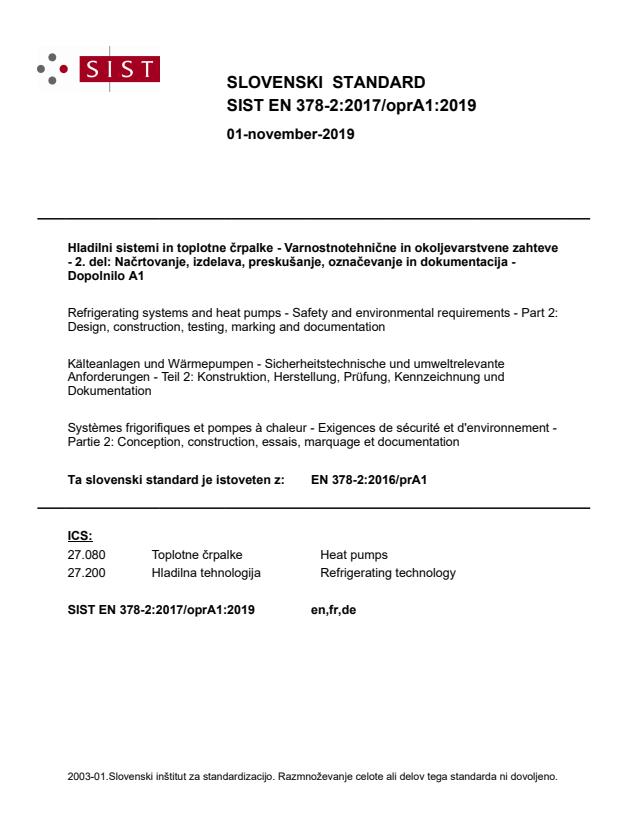
SLOVENSKI STANDARD
01-november-2019
Hladilni sistemi in toplotne črpalke - Varnostnotehnične in okoljevarstvene zahteve
- 2. del: Načrtovanje, izdelava, preskušanje, označevanje in dokumentacija -
Dopolnilo A1
Refrigerating systems and heat pumps - Safety and environmental requirements - Part 2:
Design, construction, testing, marking and documentation
Kälteanlagen und Wärmepumpen - Sicherheitstechnische und umweltrelevante
Anforderungen - Teil 2: Konstruktion, Herstellung, Prüfung, Kennzeichnung und
Dokumentation
Systèmes frigorifiques et pompes à chaleur - Exigences de sécurité et d'environnement -
Partie 2: Conception, construction, essais, marquage et documentation
Ta slovenski standard je istoveten z: EN 378-2:2016/prA1
ICS:
27.080 Toplotne črpalke Heat pumps
27.200 Hladilna tehnologija Refrigerating technology
2003-01.Slovenski inštitut za standardizacijo. Razmnoževanje celote ali delov tega standarda ni dovoljeno.
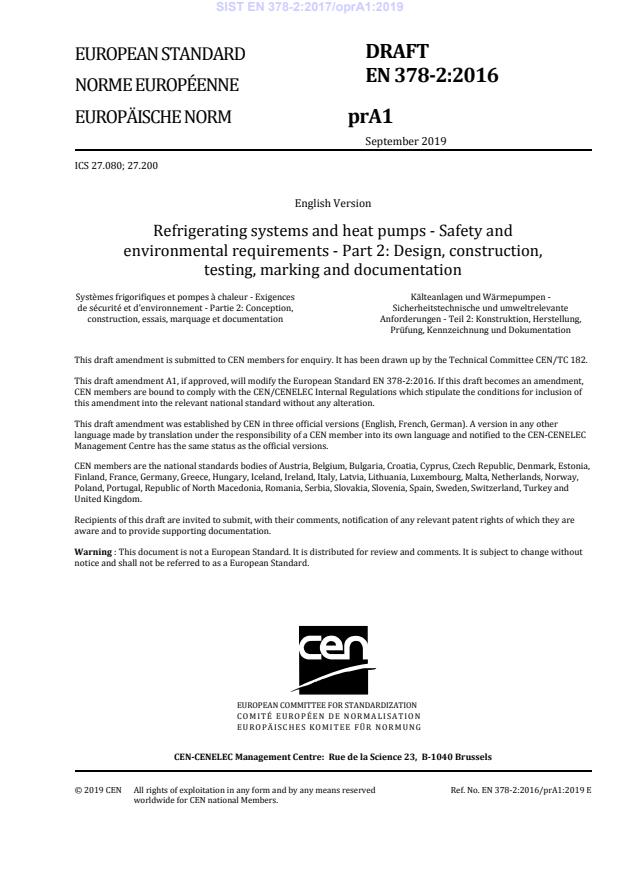
DRAFT
EUROPEAN STANDARD
EN 378-2:2016
NORME EUROPÉENNE
EUROPÄISCHE NORM
prA1
September 2019
ICS 27.080; 27.200
English Version
Refrigerating systems and heat pumps - Safety and
environmental requirements - Part 2: Design, construction,
testing, marking and documentation
Systèmes frigorifiques et pompes à chaleur - Exigences Kälteanlagen und Wärmepumpen -
de sécurité et d'environnement - Partie 2: Conception, Sicherheitstechnische und umweltrelevante
construction, essais, marquage et documentation Anforderungen - Teil 2: Konstruktion, Herstellung,
Prüfung, Kennzeichnung und Dokumentation
This draft amendment is submitted to CEN members for enquiry. It has been drawn up by the Technical Committee CEN/TC 182.
This draft amendment A1, if approved, will modify the European Standard EN 378-2:2016. If this draft becomes an amendment,
CEN members are bound to comply with the CEN/CENELEC Internal Regulations which stipulate the conditions for inclusion of
this amendment into the relevant national standard without any alteration.
This draft amendment was established by CEN in three official versions (English, French, German). A version in any other
language made by translation under the responsibility of a CEN member into its own language and notified to the CEN-CENELEC
Management Centre has the same status as the official versions.
CEN members are the national standards bodies of Austria, Belgium, Bulgaria, Croatia, Cyprus, Czech Republic, Denmark, Estonia,
Finland, France, Germany, Greece, Hungary, Iceland, Ireland, Italy, Latvia, Lithuania, Luxembourg, Malta, Netherlands, Norway,
Poland, Portugal, Republic of North Macedonia, Romania, Serbia, Slovakia, Slovenia, Spain, Sweden, Switzerland, Turkey and
United Kingdom.
Recipients of this draft are invited to submit, with their comments, notification of any relevant patent rights of which they are
aware and to provide supporting documentation.
Warning : This document is not a European Standard. It is distributed for review and comments. It is subject to change without
notice and shall not be referred to as a European Standard.
EUROPEAN COMMITTEE FOR STANDARDIZATION
COMITÉ EUROPÉEN DE NORMALISATION
EUROPÄISCHES KOMITEE FÜR NORMUNG
CEN-CENELEC Management Centre: Rue de la Science 23, B-1040 Brussels
© 2019 CEN All rights of exploitation in any form and by any means reserved Ref. No. EN 378-2:2016/prA1:2019 E
worldwide for CEN national Members.
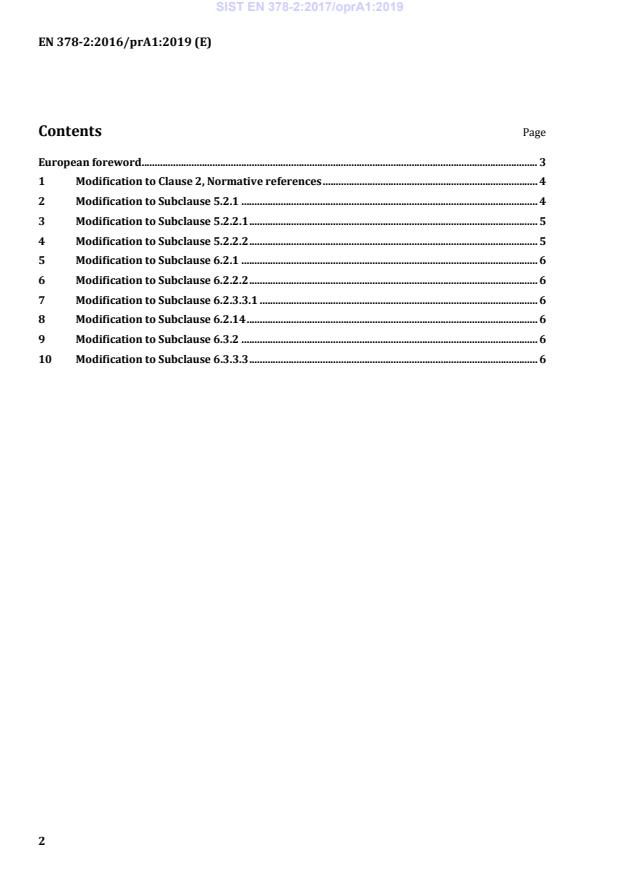
Contents Page
European foreword . 3
1 Modification to Clause 2, Normative references . 4
2 Modification to Subclause 5.2.1 . 4
3 Modification to Subclause 5.2.2.1 . 5
4 Modification to Subclause 5.2.2.2 . 5
5 Modification to Subclause 6.2.1 . 6
6 Modification to Subclause 6.2.2.2 . 6
7 Modification to Subclause 6.2.3.3.1 . 6
8 Modification to Subclause 6.2.14 . 6
9 Modification to Subclause 6.3.2 . 6
10 Modification to Subclause 6.3.3.3 . 6
European foreword
This document (EN 378-2:2016/prA1:2019) has been prepared by Technical Committee CEN/TC 182
“Refrigerating systems, safety and environmental requirements”, the secretariat of which is held by DIN.
This document is currently submitted to the CEN Enquiry.
This document has been prepared under a mandate given to CEN by the European Commission and the
European Free Trade Association, and supports essential requirements of EU Directive(s).
For relationship with EU Directive(s), see informative Annexes ZA and ZA, which are an integral part of
EN 378-2:2016.
1 Modification to Clause 2, Normative references
Replace the following references with the undated version of the same reference:
”EN ISO 10675-1, Non-destructive testing of welds — Acceptance levels for radiographic testing — Part 1:
Steel, nickel, titanium and their alloys (ISO 10675-1)
EN ISO 10675-2, Non-destructive testing of welds — Acceptance levels for radiographic testing — Part 2:
Aluminium and its alloys (ISO 10675-2)”
2 Modificat
...