

SIST ES 201 468 V1.7.1:2023
(Main)Additional ElectroMagnetic Compatibility (EMC) requirements and resistibility requirements for telecommunications equipment for enhanced availability of service in specific applications
General Information
- Abstract
The present document covers the emission, immunity and resistibility requirements for telecommunications equipment
where higher performance is required by operators to guarantee enhanced availability of service in specific applications.
The environments considered in the present document are defined in ETSI TR 101 651 [i.5] and are:
• telecommunication centres (classes 1 and 2 of ETSI TR 101 651 [i.5]);
• locations other than telecommunication centres (classes 3 and 4 of ETSI TR 101 651 [i.5]).
Data centres and similar facilities are also considered telecommunication centres, where they are within a dedicated
room with servers, storage devices and associated telecommunication equipment.
Considering that all kinds of equipment are not equally important, two equipment categories and associated EMC
requirements are introduced and are designated as:
• level 1 (see tables in clauses 9.1.1.1 to 9.1.1.5 and 9.2.1.1 to 9.2.1.5);
• level 2 (see tables in clauses 9.1.2.1 to 9.1.2.5 and 9.2.2.1 to 9.2.2.5);
the latter containing the more demanding requirements.
The appropriate level should be chosen by the operator considering the consequences of failure of the equipment which
may lead to impaired function, loss of service, failure to meet contractual obligations or bad publicity and loss of
reputation.
The present document is applicable to all equipment types, examples of which are listed below:
• switching equipment which includes trunk and local telephone exchanges, remote switching concentrators,
international switches, telex switches and network packet switches, base station controllers, radio network
controllers, network servers and gateways;
• non-radio transmission equipment which includes multiplexers, line equipment and repeaters, Synchronous
Digital Hierarchy (SDH), Digital Cross Connect (DXC), Asynchronous Transfer Mode (ATM) and network
terminations, transmission equipment used in the access network like xDSL;
• power supply equipment which includes central power plant, end of suite power supplies, power management
systems and other dedicated telecommunications network power supplies;
• supervisory equipment and dedicated Operation And Maintenance (OAM) equipment;
• tariff and billing equipment;
• data centre equipment which includes: Storage, Processor, Server intended to be used within
telecommunication network infrastructure.
- Status
- Published
- Publication Date
- 22-Jan-2023
- Technical Committee
- MOC - Mobile Communications
- Current Stage
- 6060 - National Implementation/Publication (Adopted Project)
- Start Date
- 17-Jan-2023
- Due Date
- 24-Mar-2023
- Completion Date
- 23-Jan-2023
Buy Documents
ETSI ES 201 468 V1.7.0 (2022-11) - Additional ElectroMagnetic Compatibility (EMC) requirements and resistibility requirements for telecommunications equipment for enhanced availability of service in specific applications
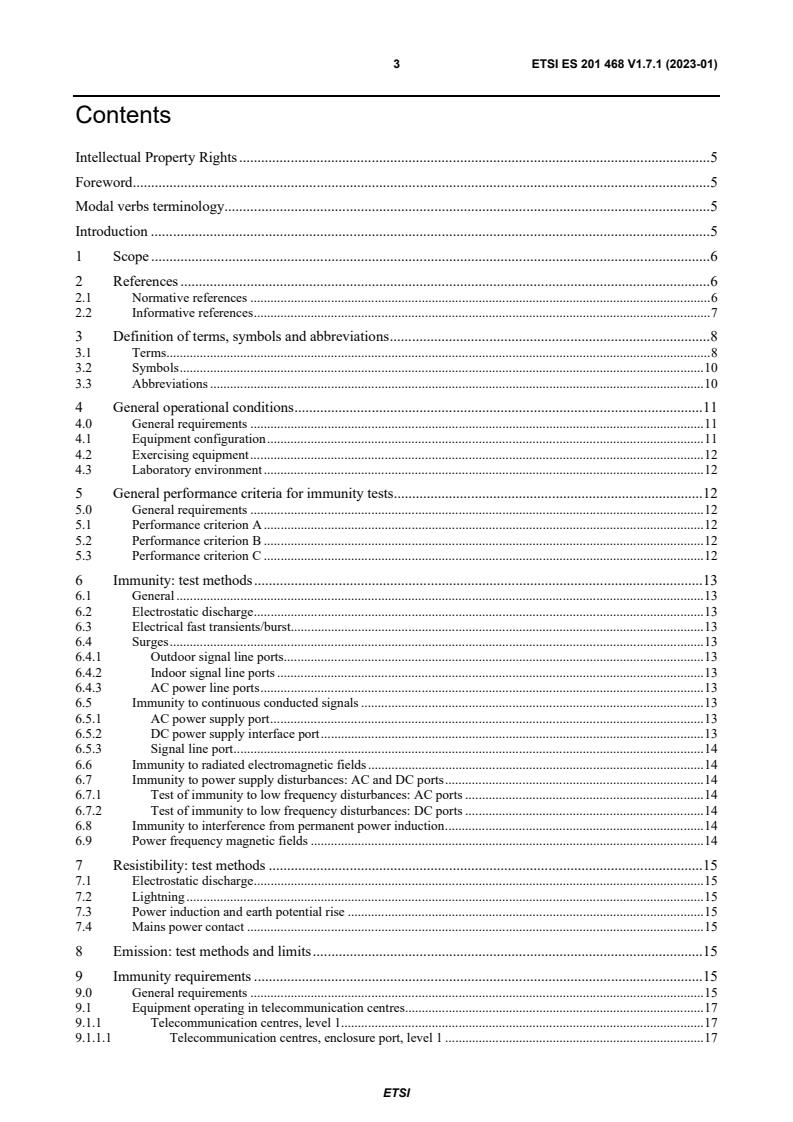
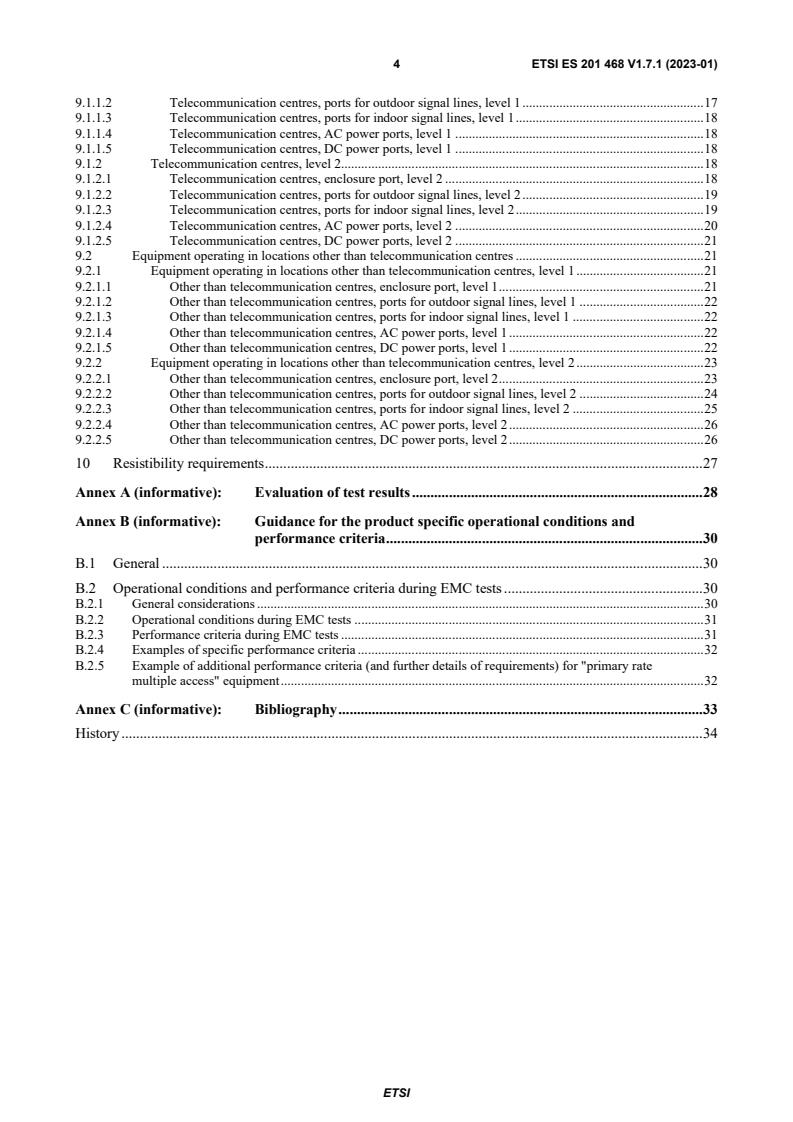
ETSI ES 201 468 V1.7.1 (2023-01) - Additional ElectroMagnetic Compatibility (EMC) requirements and resistibility requirements for telecommunications equipment for enhanced availability of service in specific applications

Overview
SIST ES 201 468 V1.7.1:2023 establishes additional ElectroMagnetic Compatibility (EMC) and resistibility requirements for telecommunications equipment aimed at ensuring enhanced service availability in specific applications. Developed by the Slovenian Institute for Standardization (SIST), this standard aligns with ETSI ES 201 468 and is particularly relevant in environments where network reliability and resilience are paramount. It defines criteria for both emission and immunity performance, as well as resistibility against power disturbances and surges, providing comprehensive guidance for operators deploying critical telecom infrastructure.
Key Topics
- ElectroMagnetic Compatibility (EMC): Sets higher performance requirements for the emission and immunity of telecommunications equipment, minimizing electromagnetic interference in sensitive environments.
- Resistibility Requirements: Specifies performance against electrical surges, electrostatic discharge, lightning, and other disturbances that could impact continuous operation.
- Environmental Classes: Differentiates between telecommunication centres (including data centres) and other operational locations, based on ETSI TR 101 651 classes 1-4.
- Equipment Categories: Introduces two categories:
- Level 1: For equipment where the consequences of failure are moderate, with basic but robust EMC requirements.
- Level 2: For critical systems where failure could have severe operational, financial, or reputational impact, with stricter EMC and resistibility demands.
- Operational Scope: Applies to all types of telecommunication equipment, including switching, transmission (non-radio), power supplies, supervisory and management devices, tariff and billing systems, and data centre hardware.
Applications
This standard is crucial for operators, system integrators, and manufacturers that manage or supply:
- Telecommunication Centres and Data Centres: Ensures high network availability in core facilities, including server rooms and cloud-computing infrastructures.
- Critical Network Elements:
- Switching Equipment: Local and trunk exchanges, remote concentrators, base station controllers, and gateways.
- Transmission Equipment: Multiplexers, SDH, DXC, ATM devices, network terminations, and access network technologies (such as xDSL).
- Power Supply Systems: Centralized network power plants, local power supplies, and power management systems dedicated to telecommunications.
- Supervisory and OAM Systems: Dedicated devices for network monitoring, operation, and maintenance functions.
- Billing and Tariff Equipment: Systems critical to financial transaction integrity within telecom networks.
Deploying equipment that meets SIST ES 201 468 V1.7.1:2023 requirements helps mitigate the risk of service outages, ensures compliance with contract and regulatory obligations, and enhances the overall reputation of service providers by maintaining uninterrupted connectivity.
Related Standards
For comprehensive compliance and integration, reference is often made to the following related international standards and technical reports:
- ETSI EN 300 386: Standard for EMC requirements in telecommunication network equipment.
- ETSI TR 101 651: Classification of electromagnetic environmental conditions for telecom networks.
- CENELEC Standards (EN 61000-4 series): Covers testing and measurement techniques for immunity to electrostatic discharge, electrical fast transients, surges, and power frequency magnetic fields.
- ITU-T Recommendations (K.20, K.21, K.45): Provides additional resistibility guidance specific to overvoltages and overcurrents in telecom equipment in various network environments.
- IEC and IEEE Standards: Vocabulary and definitions related to EMC, as well as technical specifications for electrical and signaling interfaces.
By adhering to SIST ES 201 468 V1.7.1:2023, stakeholders can ensure telecommunications equipment is robust, compliant, and capable of supporting enhanced service availability in mission-critical installations.
Buy Documents
ETSI ES 201 468 V1.7.0 (2022-11) - Additional ElectroMagnetic Compatibility (EMC) requirements and resistibility requirements for telecommunications equipment for enhanced availability of service in specific applications
ETSI ES 201 468 V1.7.1 (2023-01) - Additional ElectroMagnetic Compatibility (EMC) requirements and resistibility requirements for telecommunications equipment for enhanced availability of service in specific applications
Get Certified
Connect with accredited certification bodies for this standard

ANCE
Mexican certification and testing association.

Intertek Slovenia
Intertek testing, inspection, and certification services in Slovenia.

LNE (Laboratoire National de Métrologie et d'Essais)
French national laboratory for metrology and testing.
Sponsored listings
Frequently Asked Questions
SIST ES 201 468 V1.7.1:2023 is a standard published by the Slovenian Institute for Standardization (SIST). Its full title is "Additional ElectroMagnetic Compatibility (EMC) requirements and resistibility requirements for telecommunications equipment for enhanced availability of service in specific applications". This standard covers: The present document covers the emission, immunity and resistibility requirements for telecommunications equipment where higher performance is required by operators to guarantee enhanced availability of service in specific applications. The environments considered in the present document are defined in ETSI TR 101 651 [i.5] and are: • telecommunication centres (classes 1 and 2 of ETSI TR 101 651 [i.5]); • locations other than telecommunication centres (classes 3 and 4 of ETSI TR 101 651 [i.5]). Data centres and similar facilities are also considered telecommunication centres, where they are within a dedicated room with servers, storage devices and associated telecommunication equipment. Considering that all kinds of equipment are not equally important, two equipment categories and associated EMC requirements are introduced and are designated as: • level 1 (see tables in clauses 9.1.1.1 to 9.1.1.5 and 9.2.1.1 to 9.2.1.5); • level 2 (see tables in clauses 9.1.2.1 to 9.1.2.5 and 9.2.2.1 to 9.2.2.5); the latter containing the more demanding requirements. The appropriate level should be chosen by the operator considering the consequences of failure of the equipment which may lead to impaired function, loss of service, failure to meet contractual obligations or bad publicity and loss of reputation. The present document is applicable to all equipment types, examples of which are listed below: • switching equipment which includes trunk and local telephone exchanges, remote switching concentrators, international switches, telex switches and network packet switches, base station controllers, radio network controllers, network servers and gateways; • non-radio transmission equipment which includes multiplexers, line equipment and repeaters, Synchronous Digital Hierarchy (SDH), Digital Cross Connect (DXC), Asynchronous Transfer Mode (ATM) and network terminations, transmission equipment used in the access network like xDSL; • power supply equipment which includes central power plant, end of suite power supplies, power management systems and other dedicated telecommunications network power supplies; • supervisory equipment and dedicated Operation And Maintenance (OAM) equipment; • tariff and billing equipment; • data centre equipment which includes: Storage, Processor, Server intended to be used within telecommunication network infrastructure.
The present document covers the emission, immunity and resistibility requirements for telecommunications equipment where higher performance is required by operators to guarantee enhanced availability of service in specific applications. The environments considered in the present document are defined in ETSI TR 101 651 [i.5] and are: • telecommunication centres (classes 1 and 2 of ETSI TR 101 651 [i.5]); • locations other than telecommunication centres (classes 3 and 4 of ETSI TR 101 651 [i.5]). Data centres and similar facilities are also considered telecommunication centres, where they are within a dedicated room with servers, storage devices and associated telecommunication equipment. Considering that all kinds of equipment are not equally important, two equipment categories and associated EMC requirements are introduced and are designated as: • level 1 (see tables in clauses 9.1.1.1 to 9.1.1.5 and 9.2.1.1 to 9.2.1.5); • level 2 (see tables in clauses 9.1.2.1 to 9.1.2.5 and 9.2.2.1 to 9.2.2.5); the latter containing the more demanding requirements. The appropriate level should be chosen by the operator considering the consequences of failure of the equipment which may lead to impaired function, loss of service, failure to meet contractual obligations or bad publicity and loss of reputation. The present document is applicable to all equipment types, examples of which are listed below: • switching equipment which includes trunk and local telephone exchanges, remote switching concentrators, international switches, telex switches and network packet switches, base station controllers, radio network controllers, network servers and gateways; • non-radio transmission equipment which includes multiplexers, line equipment and repeaters, Synchronous Digital Hierarchy (SDH), Digital Cross Connect (DXC), Asynchronous Transfer Mode (ATM) and network terminations, transmission equipment used in the access network like xDSL; • power supply equipment which includes central power plant, end of suite power supplies, power management systems and other dedicated telecommunications network power supplies; • supervisory equipment and dedicated Operation And Maintenance (OAM) equipment; • tariff and billing equipment; • data centre equipment which includes: Storage, Processor, Server intended to be used within telecommunication network infrastructure.
SIST ES 201 468 V1.7.1:2023 is classified under the following ICS (International Classification for Standards) categories: 33.060.99 - Other equipment for radiocommunications; 33.100.01 - Electromagnetic compatibility in general. The ICS classification helps identify the subject area and facilitates finding related standards.
SIST ES 201 468 V1.7.1:2023 is available in PDF format for immediate download after purchase. The document can be added to your cart and obtained through the secure checkout process. Digital delivery ensures instant access to the complete standard document.
Standards Content (Sample)
Final draft ETSI ES 201 468 V1.7.0 (2022-11)
ETSI STANDARD
Additional ElectroMagnetic Compatibility (EMC)
requirements and resistibility requirements for
telecommunications equipment for enhanced availability
of service in specific applications
2 Final draft ETSI ES 201 468 V1.7.0 (2022-11)
Reference
RES/ERM-EMC-411
Keywords
EMC, management, network, power supply,
switching, testing, transmission
ETSI
650 Route des Lucioles
F-06921 Sophia Antipolis Cedex - FRANCE
Tel.: +33 4 92 94 42 00 Fax: +33 4 93 65 47 16
Siret N° 348 623 562 00017 - APE 7112B
Association à but non lucratif enregistrée à la
Sous-Préfecture de Grasse (06) N° w061004871
Important notice
The present document can be downloaded from:
http://www.etsi.org/standards-search
The present document may be made available in electronic versions and/or in print. The content of any electronic and/or
print versions of the present document shall not be modified without the prior written authorization of ETSI. In case of any
existing or perceived difference in contents between such versions and/or in print, the prevailing version of an ETSI
deliverable is the one made publicly available in PDF format at www.etsi.org/deliver.
Users of the present document should be aware that the document may be subject to revision or change of status.
Information on the current status of this and other ETSI documents is available at
https://portal.etsi.org/TB/ETSIDeliverableStatus.aspx
If you find errors in the present document, please send your comment to one of the following services:
https://portal.etsi.org/People/CommiteeSupportStaff.aspx
If you find a security vulnerability in the present document, please report it through our
Coordinated Vulnerability Disclosure Program:
https://www.etsi.org/standards/coordinated-vulnerability-disclosure
Notice of disclaimer & limitation of liability
The information provided in the present deliverable is directed solely to professionals who have the appropriate degree of
experience to understand and interpret its content in accordance with generally accepted engineering or
other professional standard and applicable regulations.
No recommendation as to products and services or vendors is made or should be implied.
No representation or warranty is made that this deliverable is technically accurate or sufficient or conforms to any law
ntation or warranty is made of merchantability or fitness
and/or governmental rule and/or regulation and further, no represe
for any particular purpose or against infringement of intellectual property rights.
In no event shall ETSI be held liable for loss of profits or any other incidental or consequential damages.
Any software contained in this deliverable is provided "AS IS" with no warranties, express or implied, including but not
limited to, the warranties of merchantability, fitness for a particular purpose and non-infringement of intellectual property
rights and ETSI shall not be held liable in any event for any damages whatsoever (including, without limitation, damages
for loss of profits, business interruption, loss of information, or any other pecuniary loss) arising out of or related to the use
of or inability to use the software.
Copyright Notification
No part may be reproduced or utilized in any form or by any means, electronic or mechanical, including photocopying and
microfilm except as authorized by written permission of ETSI.
The content of the PDF version shall not be modified without the written authorization of ETSI.
The copyright and the foregoing restriction extend to reproduction in all media.
© ETSI 2022.
All rights reserved.
ETSI
3 Final draft ETSI ES 201 468 V1.7.0 (2022-11)
Contents
Intellectual Property Rights . 5
Foreword . 5
Modal verbs terminology . 5
Introduction . 5
1 Scope . 6
2 References . 7
2.1 Normative references . 7
2.2 Informative references . 8
3 Definition of terms, symbols and abbreviations . 8
3.1 Terms . 8
3.2 Symbols . 11
3.3 Abbreviations . 11
4 General operational conditions . 11
4.0 General requirements . 11
4.1 Equipment configuration . 12
4.2 Exercising equipment . 12
4.3 Laboratory environment . 12
5 General performance criteria for immunity tests . 12
5.0 General requirements . 12
5.1 Performance criterion A . 13
5.2 Performance criterion B . 13
5.3 Performance criterion C . 13
6 Immunity: test methods . 13
6.1 General . 13
6.2 Electrostatic discharge . 13
6.3 Electrical fast transients/burst . 13
6.4 Surges . 13
6.4.1 Outdoor signal line ports . 13
6.4.2 Indoor signal line ports . 13
6.4.3 AC power line ports . 14
6.5 Immunity to continuous conducted signals . 14
6.5.1 AC power supply port . 14
6.5.2 DC power supply interface port . 14
6.5.3 Signal line port . 14
6.6 Immunity to radiated electromagnetic fields . 14
6.7 Immunity to power supply disturbances: AC and DC ports . 14
6.7.1 Test of immunity to low frequency disturbances: AC ports . 14
6.7.2 Test of immunity to low frequency disturbances: DC ports . 15
6.8 Immunity to interference from permanent power induction . 15
6.9 Power frequency magnetic fields . 15
7 Resistibility: test methods . 15
7.1 Electrostatic discharge . 15
7.2 Lightning . 15
7.3 Power induction and earth potential rise . 15
7.4 Mains power contact . 15
8 Emission: test methods and limits . 15
9 Immunity requirements . 15
9.0 General requirements . 15
9.1 Equipment operating in telecommunication centres . 17
9.1.1 Telecommunication centres, level 1. 17
9.1.1.1 Telecommunication centres, enclosure port, level 1 . 17
ETSI
4 Final draft ETSI ES 201 468 V1.7.0 (2022-11)
9.1.1.2 Telecommunication centres, ports for outdoor signal lines, level 1 . 17
9.1.1.3 Telecommunication centres, ports for indoor signal lines, level 1 . 18
9.1.1.4 Telecommunication centres, AC power ports, level 1 . 18
9.1.1.5 Telecommunication centres, DC power ports, level 1 . 18
9.1.2 Telecommunication centres, level 2. 18
9.1.2.1 Telecommunication centres, enclosure port, level 2 . 18
9.1.2.2 Telecommunication centres, ports for outdoor signal lines, level 2 . 19
9.1.2.3 Telecommunication centres, ports for indoor signal lines, level 2 . 19
9.1.2.4 Telecommunication centres, AC power ports, level 2 . 20
9.1.2.5 Telecommunication centres, DC power ports, level 2 . 21
9.2 Equipment operating in locations other than telecommunication centres . 21
9.2.1 Equipment operating in locations other than telecommunication centres, level 1 . 21
9.2.1.1 Other than telecommunication centres, enclosure port, level 1 . 21
9.2.1.2 Other than telecommunication centres, ports for outdoor signal lines, level 1 . 22
9.2.1.3 Other than telecommunication centres, ports for indoor signal lines, level 1 . 22
9.2.1.4 Other than telecommunication centres, AC power ports, level 1 . 22
9.2.1.5 Other than telecommunication centres, DC power ports, level 1 . 22
9.2.2 Equipment operating in locations other than telecommunication centres, level 2 . 23
9.2.2.1 Other than telecommunication centres, enclosure port, level 2 . 23
9.2.2.2 Other than telecommunication centres, ports for outdoor signal lines, level 2 . 24
9.2.2.3 Other than telecommunication centres, ports for indoor signal lines, level 2 . 25
9.2.2.4 Other than telecommunication centres, AC power ports, level 2 . 26
9.2.2.5 Other than telecommunication centres, DC power ports, level 2 . 26
10 Resistibility requirements . 27
Annex A (informative): Evaluation of test results . 28
Annex B (informative): Guidance for the product specific operational conditions and
performance criteria . 30
B.1 General . 30
B.2 Operational conditions and performance criteria during EMC tests . 30
B.2.1 General considerations . 30
B.2.2 Operational conditions during EMC tests . 31
B.2.3 Performance criteria during EMC tests . 31
B.2.4 Examples of specific performance criteria . 32
B.2.5 Example of additional performance criteria (and further details of requirements) for "primary rate
multiple access" equipment . 32
Annex C (informative): Bibliography . 33
History . 34
ETSI
5 Final draft ETSI ES 201 468 V1.7.0 (2022-11)
Intellectual Property Rights
Essential patents
IPRs essential or potentially essential to normative deliverables may have been declared to ETSI. The declarations
pertaining to these essential IPRs, if any, are publicly available for ETSI members and non-members, and can be
found in ETSI SR 000 314: "Intellectual Property Rights (IPRs); Essential, or potentially Essential, IPRs notified to
ETSI in respect of ETSI standards", which is available from the ETSI Secretariat. Latest updates are available on the
ETSI Web server (https://ipr.etsi.org/).
Pursuant to the ETSI Directives including the ETSI IPR Policy, no investigation regarding the essentiality of IPRs,
including IPR searches, has been carried out by ETSI. No guarantee can be given as to the existence of other IPRs not
referenced in ETSI SR 000 314 (or the updates on the ETSI Web server) which are, or may be, or may become,
essential to the present document.
Trademarks
The present document may include trademarks and/or tradenames which are asserted and/or registered by their owners.
ETSI claims no ownership of these except for any which are indicated as being the property of ETSI, and conveys no
right to use or reproduce any trademark and/or tradename. Mention of those trademarks in the present document does
not constitute an endorsement by ETSI of products, services or organizations associated with those trademarks.
DECT™, PLUGTESTS™, UMTS™ and the ETSI logo are trademarks of ETSI registered for the benefit of its
Members. 3GPP™ and LTE™ are trademarks of ETSI registered for the benefit of its Members and of the 3GPP
Organizational Partners. oneM2M™ logo is a trademark of ETSI registered for the benefit of its Members and of the ®
oneM2M Partners. GSM and the GSM logo are trademarks registered and owned by the GSM Association.
Foreword
This final draft ETSI Standard (ES) has been produced by ETSI Technical Committee Electromagnetic compatibility
and Radio spectrum Matters (ERM), and is now submitted for the ETSI standards Membership Approval Procedure.
The present document defines the EMC requirements of telecommunication network equipment for an increased
reliability and the resistibility requirements.
Modal verbs terminology
In the present document "shall", "shall not", "should", "should not", "may", "need not", "will", "will not", "can" and
"cannot" are to be interpreted as described in clause 3.2 of the ETSI Drafting Rules (Verbal forms for the expression of
provisions).
"must" and "must not" are NOT allowed in ETSI deliverables except when used in direct citation.
Introduction
The present document defines EMC requirements for telecommunications equipment to guarantee enhanced availability
of service in specific applications. Resistibility requirements are also defined with reference to ITU-T K series
recommendations.
ETSI
6 Final draft ETSI ES 201 468 V1.7.0 (2022-11)
1 Scope
The present document covers the emission, immunity and resistibility requirements for telecommunications equipment
where higher performance is required by operators to guarantee enhanced availability of service in specific applications.
The environments considered in the present document are defined in ETSI TR 101 651 [i.5] and are:
• telecommunication centres (classes 1 and 2 of ETSI TR 101 651 [i.5]);
• locations other than telecommunication centres (classes 3 and 4 of ETSI TR 101 651 [i.5]).
Data centres and similar facilities are also considered telecommunication centres, where they are within a dedicated
room with servers, storage devices and associated telecommunication equipment.
Considering that all kinds of equipment are not equally important, two equipment categories and associated EMC
requirements are introduced and are designated as:
• level 1 (see tables in clauses 9.1.1.1 to 9.1.1.5 and 9.2.1.1 to 9.2.1.5);
• level 2 (see tables in clauses 9.1.2.1 to 9.1.2.5 and 9.2.2.1 to 9.2.2.5);
the latter containing the more demanding requirements.
The appropriate level should be chosen by the operator considering the consequences of failure of the equipment which
may lead to impaired function, loss of service, failure to meet contractual obligations or bad publicity and loss of
reputation.
The present document is applicable to all equipment types, examples of which are listed below:
• switching equipment which includes trunk and local telephone exchanges, remote switching concentrators,
international switches, telex switches and network packet switches, base station controllers, radio network
controllers, network servers and gateways;
• non-radio transmission equipment which includes multiplexers, line equipment and repeaters, Synchronous
Digital Hierarchy (SDH), Digital Cross Connect (DXC), Asynchronous Transfer Mode (ATM) and network
terminations, transmission equipment used in the access network like xDSL;
• power supply equipment which includes central power plant, end of suite power supplies, power management
systems and other dedicated telecommunications network power supplies;
• supervisory equipment and dedicated Operation And Maintenance (OAM) equipment;
• tariff and billing equipment;
• data centre equipment which includes: Storage, Processor, Server intended to be used within
telecommunication network infrastructure.
ETSI
7 Final draft ETSI ES 201 468 V1.7.0 (2022-11)
2 References
2.1 Normative references
References are either specific (identified by date of publication and/or edition number or version number) or
non-specific. For specific references, only the cited version applies. For non-specific references, the latest version of the
referenced document (including any amendments) applies.
Referenced documents which are not found to be publicly available in the expected location might be found at
http://docbox.etsi.org/Reference.
NOTE: While any hyperlinks included in this clause were valid at the time of publication, ETSI cannot guarantee
their long term validity.
The following referenced documents are necessary for the application of the present document.
[1] ETSI EN 300 386 (V2.2.1): "Telecommunication network equipment; Harmonised Standard for
ElectroMagnetic Compatibility (EMC) requirements".
[2] EN 61000-4-2 (2009): "Electromagnetic compatibility (EMC) - Part 4-2: Testing and measurement
techniques - Electrostatic discharge immunity test" (produced by CENELEC).
[3] EN 61000-4-3 (2020): "Electromagnetic compatibility (EMC) - Part 4-3: Testing and measurement
techniques - Radiated, radio-frequency, electromagnetic field immunity test" (produced by
CENELEC).
[4] EN 61000-4-4 (2012): "Electromagnetic compatibility (EMC) - Part 4-4: Testing and measurement
techniques - Electrical fast transient/burst immunity test" (produced by CENELEC).
[5] EN 61000-4-5 (2014 + Amendment 1: 2017): "Electromagnetic compatibility (EMC) -
Part 4-5: Testing and measurement techniques - Surge immunity test" (produced by CENELEC).
[6] EN 61000-4-6 (2014): "Electromagnetic compatibility (EMC); Part 4-6: Testing and measurement
techniques - Immunity to conducted disturbances, induced by radio-frequency fields" (produced by
CENELEC).
[7] EN 61000-4-8 (2010): "Electromagnetic compatibility (EMC); Part 4-8: Testing and measurement
techniques - Power frequency magnetic field immunity test" (produced by CENELEC).
[8] EN 61000-4-11 (2020): "Electromagnetic compatibility (EMC); Part 4-11: Testing and
measurement techniques - Voltage dips, short interruptions and voltage variations immunity tests
for equipment with input current up to 16 A per phase" (produced by CENELEC).
[9] Recommendation ITU-T K.54 (12/2004): "Conducted immunity test method and level at
fundamental power frequencies".
[10] Recommendation ITU-T K.20 (06/2021): "Resistibility of telecommunication equipment installed
in a telecommunications centre to overvoltages and overcurrents".
[11] Recommendation ITU-T K.21 (08/2022): "Resistibility of telecommunication equipment installed
in customer premises to overvoltages and overcurrents".
[12] Recommendation ITU-T K.45 (10/2019): "Resistibility of telecommunication equipment installed
in the access and trunk networks to overvoltages and overcurrents".
[13] EN 61000-4-34 (2007 + Amendment A1: 2009): "Electromagnetic compatibility (EMC) -
Part 4-34: Testing and measurement techniques - Voltage dips, short interruptions and voltage
variations immunity tests for equipment with mains current more than 16 A per phase" (produced
by CENELEC).
[14] IEC 60050-714 (1992): "International Electrotechnical Vocabulary (IEV) - Part 714: Switching
and signalling in telecommunications".
ETSI
8 Final draft ETSI ES 201 468 V1.7.0 (2022-11)
2.2 Informative references
References are either specific (identified by date of publication and/or edition number or version number) or
non-specific. For specific references, only the cited version applies. For non-specific references, the latest version of the
referenced document (including any amendments) applies.
NOTE: While any hyperlinks included in this clause were valid at the time of publication, ETSI cannot guarantee
their long term validity.
The following referenced documents are not necessary for the application of the present document but they assist the
user with regard to a particular subject area.
[i.1] Recommendation ITU-T K.44 (10-2019): "Resistibility tests for telecommunication equipment
exposed to overvoltages and overcurrents - Basic Recommendation".
[i.2] ETSI EN 300 132-1 (V.2.1.1) (03-2019): "Environmental Engineering (EE); Power supply
interface at the input to Information and Communication Technology (ICT) equipment;
Part 1: Alternating Current (AC)".
[i.3] ETSI EN 300 132-2 (V2.7.1) (09-2022): "Environmental Engineering (EE); Power supply
interface at the input of Information and Communication Technology (ICT) equipment;
Part 2: -48 V Direct Current (DC)".
[i.4] IEC 60050-161 (1990): "International Electrotechnical Vocabulary (IEV); Part 161:
Electromagnetic compatibility".
[i.5] ETSI TR 101 651 (V2.1.1): "Classification of the electromagnetic environment conditions for
equipment in telecommunication networks".
[i.6] ETSI EN 300 132-3 (V2.2.1): "Environmental Engineering (EE); Power supply interface at the
input of Information and Communication Technology (ICT) equipment; Part 3: Up to 400 V
Direct Current (DC)".
[i.7] IEEE 1284™ (2000): "IEEE Standard Signalling Method for a Bidirectional Parallel Peripheral
Interface for Personal Computers".
[i.8] IEEE 1394™ (2008): "IEEE Standard for High Performance Serial Bus Bridges".
[i.9] Void.
[i.10] EN 55032 (2015 + Amendment A11: 2020 + Amendment A1: 2020): "Electromagnetic
compatibility of multimedia equipment - Emission requirements" (produced by CENELEC).
3 Definition of terms, symbols and abbreviations
3.1 Terms
For the purposes of the present document, the terms given in IEC 60050-161 [i.4] and the following apply:
NOTE: Where applicable, the clause number of IEC 60050-161 [i.4] is in parenthesis.
Audio (low) Frequency (AF): frequency interval from 0 Hz to 20 kHz
NOTE: It may sometimes be convenient to extend the use of this term to include the range of frequencies up to
150 kHz.
burst (161-02-07): sequence of a limited number of distinct pulses or an oscillation of limited duration
ETSI
9 Final draft ETSI ES 201 468 V1.7.0 (2022-11)
characteristic severity: characteristic severity for a certain detail parameter in an environmental class states a severity
which has only a low probability (generally less than 1 %) of being exceeded
NOTE: The term relates to duration, rate of occurrence or location. It applies to requirements on the environment
and to immunity requirements.
connection: temporary association of transmission channels or telecommunication circuits, switching or other
functional units set up to provide for the transfer of information between two or more points in a telecommunication
network (IEC 60050-714 [14])
continuous disturbance (161-02-11): electromagnetic disturbance the effects of which on a particular device or
equipment cannot be resolved into a succession of distinct effects
data centre: structure, or group of structures, dedicated to the centralized accommodation, interconnection and
operation of information technology and network telecommunications equipment providing data storage, processing and
transport services together with all the facilities and infrastructures for power distribution and environmental control
together with the necessary levels of resilience and security required to provide the desired service availability
discontinuous interference (161-02-13): electromagnetic interference occurring during certain time intervals separated
by interference-free intervals
duration (of a pulse): interval of time between the instants at which the instantaneous value of a pulse reaches 50 % of
the pulse magnitude for the first and last time
duration (of a voltage change) (161-08-03): interval of time for the voltage to increase or decrease from the initial
value to the final value
enclosure port: physical boundary of the Equipment Under Test (EUT) through which electromagnetic fields may
emanate or on which they may impinge
environment, environmental conditions: electromagnetic conditions external to the equipment, to which it is
subjected at a certain time
NOTE: The environmental conditions comprise a combination of single environmental parameters and their
severities.
environmental class: representation of the environment on locations with similar properties
NOTE: They are specified and standardized to provide an operational frame of reference for:
requirements on the environment;
immunity requirements.
The class is described using an envelope of environmental conditions expressed in terms of a number of
environmental parameters and their characteristic severities or other characteristics. The environmental
parameters specified for the class are limited to those which may affect equipment performance.
environmental parameters: present one or more properties of the electromagnetic environment
immunity (to a disturbance) (161-01-20): ability of a device, equipment or system to perform without degradation in
the presence of an electromagnetic disturbance
impulsive disturbance (161-02-09): electromagnetic disturbance which, when incident on a particular device or
equipment, manifests itself as a succession of distinct pulses or transients
level: measures on a relative scale how important it is that the equipment operates as specified
NOTE: Two levels are defined for the purpose of the present document and are designated as level 1 and level 2.
Level 1 should be selected if the equipment has moderate failure consequences. An equipment has
moderate failure consequences when:
a failure causes limited inconvenience;
repairs may be made without compromising the responsibilities of the network operator.
ETSI
10 Final draft ETSI ES 201 468 V1.7.0 (2022-11)
Level 2 should be selected if the equipment has severe failure consequences. An equipment has severe
failure consequences when:
failure compromises the function of vital, centralized systems, or services of commercially
sensitive or security related nature;
repair or restoration costs are high, or the time the equipment is out of service is unacceptably long;
corruption of charging or billing information occurs.
Network Termination Point (NTP): physical point at the boundary of the Public Switched Telecommunications
Networks (PSTN) intended to accept the connection of a Terminal Equipment
performance criterion: limits of acceptable behaviour of the equipment during and after the application of the
electromagnetic phenomenon
NOTE: Performance criteria A apply for continuous phenomena; performance criteria B and C apply for transient
phenomena; and performance criteria R apply for resistibility phenomena.
port: particular interface of the EUT with the external electromagnetic environment
pulse (161-02-02): abrupt variation of short duration of a physical quantity followed by a rapid return to the initial
value
quiescent level: steady state performance of the equipment operating as intended when configured for EMC immunity
testing prior to the application of any disturbance signal
Radio Frequencies (RF): frequency range above 150 kHz
rise time (of a pulse) (161-02-05): interval of time between the instants at which the instantaneous value of a pulse first
reaches a specified lower value and then a specified upper value
NOTE: Unless otherwise specified, the lower and upper values are fixed at 10 % and 90 % of the pulse
magnitude.
shielding effectiveness: for a given external source, the ratio of electric or magnetic field strength at a point before and
after the placement of the shield in question
signal line ports: these include wired network ports, RF ports or ports intended for the interconnection of components
of an EUT, or between an EUT and AE and used in accordance with relevant functional specifications
NOTE: E.g. for the maximum length of cable connected to it.
surge (voltage) (161-08-11): transient voltage wave propagating along a line or a circuit and characterized by a rapid
increase followed by a slower decrease of the voltage
telecommunications network: network operated under a licence granted by a national telecommunications authority,
which provides telecommunications between Network Termination Points (NTPs)
NOTE: I.e. excluding terminal equipment beyond the NTPs.
transient (adjective or noun) (161-02-01): pertaining to or designating a phenomenon or a quantity which varies
between two consecutive steady states during a time interval which is short compared with the timescale of interest
wired network ports: point of connection for voice, data and signalling transfers intended to interconnect widely
dispersed systems by direct connection to a single-user or multi-user communication network
NOTE 1: E.g. PSTN, ISDN, xDSL, LAN and similar networks.
NOTE 2: A port generally intended for interconnection of components of the EUT (e.g. RS-232, IEEE 1284™ [i.7]
(parallel printer), Universal Serial Bus (USB), IEEE 1394™ [i.8] ("Fire Wire"), etc.) and used in
accordance with its functional specifications (e.g. for the maximum length of cable connected to it), is not
considered to be a wired network port under this definition.
NOTE 3: See EN 55032 [i.10].
ETSI
11 Final draft ETSI ES 201 468 V1.7.0 (2022-11)
NOTE 4: These ports may support screened or unscreened cables and may also carry AC or DC power where this is
an integral part of the communication specification.
3.2 Symbols
Void.
3.3 Abbreviations
For the purposes of the present document, the following abbreviations apply:
AC Alternating Current
ADSL Asymmetric Digital Subscriber Line
AE Auxiliary Equipment
AM Amplitude Modulation
ATM Asynchronous Transfer Mode
CDN Coupling Decoupling Network
CRC Cyclic Redundancy Check
CRT Cathode Ray Tube
DC Direct Current
DXC Digital Cross Connect
EE Environmental Engineering
EMC ElectroMagnetic Compatibility
EN European Norm
ESD ElectroStatic Discharge
ETS European Telecommunications Standard
ETSI European Telecommunications Standards Institute
EUT Equipment Under Test
HDSL High bit-rate Digital Subscriber Line
IEC International Electrotechnical Commission
IEEE Institute of Electrical and Electronics Engineers
ISDN Integrated Services Digital Network
LAN Local Area Network
NTP Network Termination Point
OAM Operation And Maintenance
PSTN Public Switched Telecommunication Network
RF Radio Frequency
SDH Synchronous Digital Hierarchy
SDSL Symmetrical single pair high bit rate Digital Subscriber Line
USB Universal Serial Bus
VDSL Very high speed Digital Subscriber Line
4 General operational conditions
4.0 General requirements
This clause gives the general operational conditions. The product-specific operating conditions will be derived from the
product description and documentation and stated in the test report.
The general operational conditions shall allow for appropriate measuring of the emission and for testing of immunity.
The tests described shall be performed with the Equipment Under Test (EUT) powered up (i.e. connected to an
appropriate power supply) and operating in a manner which is as representative of normal operation as possible.
Details on the evaluation of test results are given in annex A.
ETSI
12 Final draft ETSI ES 201 468 V1.7.0 (2022-11)
4.1 Equipment configuration
Power and signal distribution, grounding, interconnecting cabling and physical placement of equipment of a test system
shall simulate the typical application and usage in so far as is practicable, and shall be in accordance with the relevant
product specifications.
The configuration that tends to maximize the EUT's emission or minimize its immunity is not usually intuitively
obvious and in most instances selection will involve some trial and error testing.
Where equipment may be connected with cables routed either overhead or from beneath (i.e. equipment mounted on a
raised floor) the equipment shall be tested in a manner representative of an installation using overhead cable routing.
EXAMPLE: Interface cables may be moved or equipment re-orientated during initial stages of testing and the
effects on the results observed.
Only configurations within the range of positions likely to occur in normal use need to be considered.
The configuration selected shall be fully detailed and documented in the test report, together with the justification for
selecting that particular configuration.
4.2 Exercising equipment
The exercising equipment and other auxiliary equipment shall be sufficiently decoupled from the EUT so that the
performance of such equipment does not significantly influence the test results.
4.3 Laboratory environment
For all the tests, the test laboratory environment shall be the one defined in the corresponding basic standards.
The electromagnetic environment of the test laboratory shall not influence the results.
The laboratory environment shall not exceed the limits specified by the manufacturer for normal operation of the EUT.
5 General performance criteria for immunity tests
5.0 General requirements
In this clause, general performance criteria are defined and equipment shall meet these criteria when tested according to
the requirements of clause 8.
The manufacturer has the obligation to express the specific performance criteria in terms which relate to the normal
performance of his specific product when used as intended according to the product description and documentation.
Interpretation of compliance
The equipment is deemed to comply with the EMC requirements if:
• it meets the test levels given in tables in clauses 9.1.1.1 to 9.2.2.5;
• it meets the performance criteria according to tables in clauses 9.1.1.1 to 9.2.2.5;
• it is operated according to the general and product specific operating conditions, given in clause 4 and in the
product documentation;
• the performance items, as derived from the product documentation, being monitored.
ETSI
13 Final draft ETSI ES 201 468 V1.7.0 (2022-11)
5.1 Performance criterion A
The EUT shall continue to operate as intended. No change of operational state is allowed. No loss or unintentional
change in critical stored data shall occur and no more than 5 % degradation in transmission performance or 5 %
additional errored frames above the quiescent level is allowed during the test.
For instance, it is not allowed to have more than 500 additional errored frames in any 10 000 transmitted frames.
5.2 Performance criterion B
Degradation of the performance below the level described in criterion A is permitted, provided the EUT self-recovers to
the condition established prior to the application of the test. The EUT shall operate as intended after the test. No change
of actual operating state or critical stored data is allowed.
5.3 Performance criterion C
Degradation of performance as described in criteria A and B is permitted provided that the EUT self-recovers to the
condition established prior to the application of the test, or can be restored after the test by the operator.
6 Immunity: test methods
6.1 General
Where reference is made in the present document to specific "test levels" to be used for the tests, it is implicitly required
that the EUT shall also fulfil the compliance criteria when tested at "test levels" lower than those specified. This
requirement does not apply, however, to tests for immunity to continuous phenomena.
6.2 Electrostatic discharge
The test method and laboratory conditions are described in EN 61000-4-2 [2] clauses 6, 7 and 8.
6.3 Electrical fast transients/burst
The test method to be used is described in EN 61000-4-4 [4] clauses 7.1, 7.2, 7.3 and 8.
6.4 Surges
6.4.1 Outdoor signal line ports
The immunity test method to be used for signal line ports is described in EN 61000-4-5 [5] clauses 7 and 8.
When normal operation cannot be achieved because of the impact of CDN on the EUT, the performance criterion has to
be surveyed on the neighbouring lines. In this case the test generator shall be connected via the coupling network to one
signal port. This port shall only be connected to the surge generator. During the test, the EUT and all ports (other than
the one connected to the generator) shall comply with the given compliance criteria. After the surge has been applied
the generator shall be disconnected from the port and the port checked against the performance criteria.
6.4.2 Indoor signal line ports
The immunity test method to be used for signal line ports is described in EN 61000-4-5 [5] clauses 7 and 8.
Signal lines, which according to the manufacturer's specification, shall not be longer than 30 m, shall not be subjected to
this test.
ETSI
14 Final draft ETSI ES 201 468 V1.7.0 (2022-11)
6.4.3 AC power line ports
The test method to be used for AC power line ports is described in EN 61000-4-5 [5] clauses 7 and 8.
6.5 Immunity to continuous conducted signals
6.5.1 AC power supply port
The test method to be used is described in EN 61000-4-6 [6] clauses 6, 7 and 8.
Power cables, which according to the manufacturer's specification shall not be longer than 3 m, shall not be subjected to
these tests.
6.5.2 DC power supply interface port
The test method to be used is described in EN 61000-4-6 [6] clauses 6, 7 and 8.
Power cables, which according to the manufacturer's specification shall not be longer than 3 m, shall not be subjected to
these tests.
The coupling/decoupling network type M1 (see EN 61000-4-6 [6]) shall be used when the DC return lead at the EUT
side is to be connected to the equipment protective earth. If the DC return lead is not connected to the equipment
protective earth then the coupling/decoupling network M2 shall be used.
6.5.3 Signal line port
The test method to be used is described in EN 61000-4-6 [6] clauses 6, 7 and 8.
Sig
...
ETSI STANDARD
Additional ElectroMagnetic Compatibility (EMC)
requirements and resistibility requirements for
telecommunications equipment for enhanced availability
of service in specific applications
2 ETSI ES 201 468 V1.7.1 (2023-01)
Reference
RES/ERM-EMC-411
Keywords
EMC, management, network, power supply,
switching, testing, transmission
ETSI
650 Route des Lucioles
F-06921 Sophia Antipolis Cedex - FRANCE
Tel.: +33 4 92 94 42 00 Fax: +33 4 93 65 47 16
Siret N° 348 623 562 00017 - APE 7112B
Association à but non lucratif enregistrée à la
Sous-Préfecture de Grasse (06) N° w061004871
Important notice
The present document can be downloaded from:
http://www.etsi.org/standards-search
The present document may be made available in electronic versions and/or in print. The content of any electronic and/or
print versions of the present document shall not be modified without the prior written authorization of ETSI. In case of any
existing or perceived difference in contents between such versions and/or in print, the prevailing version of an ETSI
deliverable is the one made publicly available in PDF format at www.etsi.org/deliver.
Users of the present document should be aware that the document may be subject to revision or change of status.
Information on the current status of this and other ETSI documents is available at
https://portal.etsi.org/TB/ETSIDeliverableStatus.aspx
If you find errors in the present document, please send your comment to one of the following services:
https://portal.etsi.org/People/CommiteeSupportStaff.aspx
If you find a security vulnerability in the present document, please report it through our
Coordinated Vulnerability Disclosure Program:
https://www.etsi.org/standards/coordinated-vulnerability-disclosure
Notice of disclaimer & limitation of liability
The information provided in the present deliverable is directed solely to professionals who have the appropriate degree of
experience to understand and interpret its content in accordance with generally accepted engineering or
other professional standard and applicable regulations.
No recommendation as to products and services or vendors is made or should be implied.
No representation or warranty is made that this deliverable is technically accurate or sufficient or conforms to any law
arranty is made of merchantability or fitness
and/or governmental rule and/or regulation and further, no representation or w
for any particular purpose or against infringement of intellectual property rights.
In no event shall ETSI be held liable for loss of profits or any other incidental or consequential damages.
Any software contained in this deliverable is provided "AS IS" with no warranties, express or implied, including but not
limited to, the warranties of merchantability, fitness for a particular purpose and non-infringement of intellectual property
rights and ETSI shall not be held liable in any event for any damages whatsoever (including, without limitation, damages
for loss of profits, business interruption, loss of information, or any other pecuniary loss) arising out of or related to the use
of or inability to use the software.
Copyright Notification
No part may be reproduced or utilized in any form or by any means, electronic or mechanical, including photocopying and
microfilm except as authorized by written permission of ETSI.
The content of the PDF version shall not be modified without the written authorization of ETSI.
The copyright and the foregoing restriction extend to reproduction in all media.
© ETSI 2023.
All rights reserved.
ETSI
3 ETSI ES 201 468 V1.7.1 (2023-01)
Contents
Intellectual Property Rights . 5
Foreword . 5
Modal verbs terminology . 5
Introduction . 5
1 Scope . 6
2 References . 6
2.1 Normative references . 6
2.2 Informative references . 7
3 Definition of terms, symbols and abbreviations . 8
3.1 Terms . 8
3.2 Symbols . 10
3.3 Abbreviations . 10
4 General operational conditions . 11
4.0 General requirements . 11
4.1 Equipment configuration . 11
4.2 Exercising equipment . 12
4.3 Laboratory environment . 12
5 General performance criteria for immunity tests . 12
5.0 General requirements . 12
5.1 Performance criterion A . 12
5.2 Performance criterion B . 12
5.3 Performance criterion C . 12
6 Immunity: test methods . 13
6.1 General . 13
6.2 Electrostatic discharge . 13
6.3 Electrical fast transients/burst . 13
6.4 Surges . 13
6.4.1 Outdoor signal line ports . 13
6.4.2 Indoor signal line ports . 13
6.4.3 AC power line ports . 13
6.5 Immunity to continuous conducted signals . 13
6.5.1 AC power supply port . 13
6.5.2 DC power supply interface port . 13
6.5.3 Signal line port . 14
6.6 Immunity to radiated electromagnetic fields . 14
6.7 Immunity to power supply disturbances: AC and DC ports . 14
6.7.1 Test of immunity to low frequency disturbances: AC ports . 14
6.7.2 Test of immunity to low frequency disturbances: DC ports . 14
6.8 Immunity to interference from permanent power induction . 14
6.9 Power frequency magnetic fields . 14
7 Resistibility: test methods . 15
7.1 Electrostatic discharge . 15
7.2 Lightning . 15
7.3 Power induction and earth potential rise . 15
7.4 Mains power contact . 15
8 Emission: test methods and limits . 15
9 Immunity requirements . 15
9.0 General requirements . 15
9.1 Equipment operating in telecommunication centres . 17
9.1.1 Telecommunication centres, level 1. 17
9.1.1.1 Telecommunication centres, enclosure port, level 1 . 17
ETSI
4 ETSI ES 201 468 V1.7.1 (2023-01)
9.1.1.2 Telecommunication centres, ports for outdoor signal lines, level 1 . 17
9.1.1.3 Telecommunication centres, ports for indoor signal lines, level 1 . 18
9.1.1.4 Telecommunication centres, AC power ports, level 1 . 18
9.1.1.5 Telecommunication centres, DC power ports, level 1 . 18
9.1.2 Telecommunication centres, level 2. 18
9.1.2.1 Telecommunication centres, enclosure port, level 2 . 18
9.1.2.2 Telecommunication centres, ports for outdoor signal lines, level 2 . 19
9.1.2.3 Telecommunication centres, ports for indoor signal lines, level 2 . 19
9.1.2.4 Telecommunication centres, AC power ports, level 2 . 20
9.1.2.5 Telecommunication centres, DC power ports, level 2 . 21
9.2 Equipment operating in locations other than telecommunication centres . 21
9.2.1 Equipment operating in locations other than telecommunication centres, level 1 . 21
9.2.1.1 Other than telecommunication centres, enclosure port, level 1 . 21
9.2.1.2 Other than telecommunication centres, ports for outdoor signal lines, level 1 . 22
9.2.1.3 Other than telecommunication centres, ports for indoor signal lines, level 1 . 22
9.2.1.4 Other than telecommunication centres, AC power ports, level 1 . 22
9.2.1.5 Other than telecommunication centres, DC power ports, level 1 . 22
9.2.2 Equipment operating in locations other than telecommunication centres, level 2 . 23
9.2.2.1 Other than telecommunication centres, enclosure port, level 2 . 23
9.2.2.2 Other than telecommunication centres, ports for outdoor signal lines, level 2 . 24
9.2.2.3 Other than telecommunication centres, ports for indoor signal lines, level 2 . 25
9.2.2.4 Other than telecommunication centres, AC power ports, level 2 . 26
9.2.2.5 Other than telecommunication centres, DC power ports, level 2 . 26
10 Resistibility requirements . 27
Annex A (informative): Evaluation of test results . 28
Annex B (informative): Guidance for the product specific operational conditions and
performance criteria . 30
B.1 General . 30
B.2 Operational conditions and performance criteria during EMC tests . 30
B.2.1 General considerations . 30
B.2.2 Operational conditions during EMC tests . 31
B.2.3 Performance criteria during EMC tests . 31
B.2.4 Examples of specific performance criteria . 32
B.2.5 Example of additional performance criteria (and further details of requirements) for "primary rate
multiple access" equipment . 32
Annex C (informative): Bibliography . 33
History . 34
ETSI
5 ETSI ES 201 468 V1.7.1 (2023-01)
Intellectual Property Rights
Essential patents
IPRs essential or potentially essential to normative deliverables may have been declared to ETSI. The declarations
pertaining to these essential IPRs, if any, are publicly available for ETSI members and non-members, and can be
found in ETSI SR 000 314: "Intellectual Property Rights (IPRs); Essential, or potentially Essential, IPRs notified to
ETSI in respect of ETSI standards", which is available from the ETSI Secretariat. Latest updates are available on the
ETSI Web server (https://ipr.etsi.org/).
Pursuant to the ETSI Directives including the ETSI IPR Policy, no investigation regarding the essentiality of IPRs,
including IPR searches, has been carried out by ETSI. No guarantee can be given as to the existence of other IPRs not
referenced in ETSI SR 000 314 (or the updates on the ETSI Web server) which are, or may be, or may become,
essential to the present document.
Trademarks
The present document may include trademarks and/or tradenames which are asserted and/or registered by their owners.
ETSI claims no ownership of these except for any which are indicated as being the property of ETSI, and conveys no
right to use or reproduce any trademark and/or tradename. Mention of those trademarks in the present document does
not constitute an endorsement by ETSI of products, services or organizations associated with those trademarks.
DECT™, PLUGTESTS™, UMTS™ and the ETSI logo are trademarks of ETSI registered for the benefit of its
Members. 3GPP™ and LTE™ are trademarks of ETSI registered for the benefit of its Members and of the 3GPP
Organizational Partners. oneM2M™ logo is a trademark of ETSI registered for the benefit of its Members and of the ®
oneM2M Partners. GSM and the GSM logo are trademarks registered and owned by the GSM Association.
Foreword
This ETSI Standard (ES) has been produced by ETSI Technical Committee Electromagnetic compatibility and Radio
spectrum Matters (ERM).
The present document defines the EMC requirements of telecommunication network equipment for an increased
reliability and the resistibility requirements.
Modal verbs terminology
In the present document "shall", "shall not", "should", "should not", "may", "need not", "will", "will not", "can" and
"cannot" are to be interpreted as described in clause 3.2 of the ETSI Drafting Rules (Verbal forms for the expression of
provisions).
"must" and "must not" are NOT allowed in ETSI deliverables except when used in direct citation.
Introduction
The present document defines EMC requirements for telecommunications equipment to guarantee enhanced availability
of service in specific applications. Resistibility requirements are also defined with reference to ITU-T K series
recommendations.
ETSI
6 ETSI ES 201 468 V1.7.1 (2023-01)
1 Scope
The present document covers the emission, immunity and resistibility requirements for telecommunications equipment
where higher performance is required by operators to guarantee enhanced availability of service in specific applications.
The environments considered in the present document are defined in ETSI TR 101 651 [i.5] and are:
• telecommunication centres (classes 1 and 2 of ETSI TR 101 651 [i.5]);
• locations other than telecommunication centres (classes 3 and 4 of ETSI TR 101 651 [i.5]).
Data centres and similar facilities are also considered telecommunication centres, where they are within a dedicated
room with servers, storage devices and associated telecommunication equipment.
Considering that all kinds of equipment are not equally important, two equipment categories and associated EMC
requirements are introduced and are designated as:
• level 1 (see tables in clauses 9.1.1.1 to 9.1.1.5 and 9.2.1.1 to 9.2.1.5);
• level 2 (see tables in clauses 9.1.2.1 to 9.1.2.5 and 9.2.2.1 to 9.2.2.5);
the latter containing the more demanding requirements.
The appropriate level should be chosen by the operator considering the consequences of failure of the equipment which
may lead to impaired function, loss of service, failure to meet contractual obligations or bad publicity and loss of
reputation.
The present document is applicable to all equipment types, examples of which are listed below:
• switching equipment which includes trunk and local telephone exchanges, remote switching concentrators,
international switches, telex switches and network packet switches, base station controllers, radio network
controllers, network servers and gateways;
• non-radio transmission equipment which includes multiplexers, line equipment and repeaters, Synchronous
Digital Hierarchy (SDH), Digital Cross Connect (DXC), Asynchronous Transfer Mode (ATM) and network
terminations, transmission equipment used in the access network like xDSL;
• power supply equipment which includes central power plant, end of suite power supplies, power management
systems and other dedicated telecommunications network power supplies;
• supervisory equipment and dedicated Operation And Maintenance (OAM) equipment;
• tariff and billing equipment;
• data centre equipment which includes: Storage, Processor, Server intended to be used within
telecommunication network infrastructure.
2 References
2.1 Normative references
References are either specific (identified by date of publication and/or edition number or version number) or
non-specific. For specific references, only the cited version applies. For non-specific references, the latest version of the
referenced document (including any amendments) applies.
Referenced documents which are not found to be publicly available in the expected location might be found at
http://docbox.etsi.org/Reference.
NOTE: While any hyperlinks included in this clause were valid at the time of publication, ETSI cannot guarantee
their long term validity.
ETSI
7 ETSI ES 201 468 V1.7.1 (2023-01)
The following referenced documents are necessary for the application of the present document.
[1] ETSI EN 300 386 (V2.2.1): "Telecommunication network equipment; Harmonised Standard for
ElectroMagnetic Compatibility (EMC) requirements".
[2] EN 61000-4-2 (2009): "Electromagnetic compatibility (EMC) - Part 4-2: Testing and measurement
techniques - Electrostatic discharge immunity test" (produced by CENELEC).
[3] EN 61000-4-3 (2020): "Electromagnetic compatibility (EMC) - Part 4-3: Testing and measurement
techniques - Radiated, radio-frequency, electromagnetic field immunity test" (produced by
CENELEC).
[4] EN 61000-4-4 (2012): "Electromagnetic compatibility (EMC) - Part 4-4: Testing and measurement
techniques - Electrical fast transient/burst immunity test" (produced by CENELEC).
[5] EN 61000-4-5 (2014 + Amendment 1: 2017): "Electromagnetic compatibility (EMC) -
Part 4-5: Testing and measurement techniques - Surge immunity test" (produced by CENELEC).
[6] EN 61000-4-6 (2014): "Electromagnetic compatibility (EMC); Part 4-6: Testing and measurement
techniques - Immunity to conducted disturbances, induced by radio-frequency fields" (produced by
CENELEC).
[7] EN 61000-4-8 (2010): "Electromagnetic compatibility (EMC); Part 4-8: Testing and measurement
techniques - Power frequency magnetic field immunity test" (produced by CENELEC).
[8] EN 61000-4-11 (2020): "Electromagnetic compatibility (EMC); Part 4-11: Testing and
measurement techniques - Voltage dips, short interruptions and voltage variations immunity tests
for equipment with input current up to 16 A per phase" (produced by CENELEC).
[9] Recommendation ITU-T K.54 (12/2004): "Conducted immunity test method and level at
fundamental power frequencies".
[10] Recommendation ITU-T K.20 (06/2021): "Resistibility of telecommunication equipment installed
in a telecommunications centre to overvoltages and overcurrents".
[11] Recommendation ITU-T K.21 (08/2022): "Resistibility of telecommunication equipment installed
in customer premises to overvoltages and overcurrents".
[12] Recommendation ITU-T K.45 (10/2019): "Resistibility of telecommunication equipment installed
in the access and trunk networks to overvoltages and overcurrents".
[13] EN 61000-4-34 (2007 + Amendment A1: 2009): "Electromagnetic compatibility (EMC) -
Part 4-34: Testing and measurement techniques - Voltage dips, short interruptions and voltage
variations immunity tests for equipment with mains current more than 16 A per phase" (produced
by CENELEC).
[14] IEC 60050-714 (1992): "International Electrotechnical Vocabulary (IEV) - Part 714: Switching
and signalling in telecommunications".
2.2 Informative references
References are either specific (identified by date of publication and/or edition number or version number) or
non-specific. For specific references, only the cited version applies. For non-specific references, the latest version of the
referenced document (including any amendments) applies.
NOTE: While any hyperlinks included in this clause were valid at the time of publication, ETSI cannot guarantee
their long term validity.
The following referenced documents are not necessary for the application of the present document but they assist the
user with regard to a particular subject area.
[i.1] Recommendation ITU-T K.44 (10-2019): "Resistibility tests for telecommunication equipment
exposed to overvoltages and overcurrents - Basic Recommendation".
ETSI
8 ETSI ES 201 468 V1.7.1 (2023-01)
[i.2] ETSI EN 300 132-1 (V.2.1.1) (03-2019): "Environmental Engineering (EE); Power supply
interface at the input to Information and Communication Technology (ICT) equipment;
Part 1: Alternating Current (AC)".
[i.3] ETSI EN 300 132-2 (V2.7.1) (09-2022): "Environmental Engineering (EE); Power supply
interface at the input of Information and Communication Technology (ICT) equipment;
Part 2: -48 V Direct Current (DC)".
[i.4] IEC 60050-161 (1990): "International Electrotechnical Vocabulary (IEV); Part 161:
Electromagnetic compatibility".
[i.5] ETSI TR 101 651 (V2.1.1): "Classification of the electromagnetic environment conditions for
equipment in telecommunication networks".
[i.6] ETSI EN 300 132-3 (V2.2.1): "Environmental Engineering (EE); Power supply interface at the
input of Information and Communication Technology (ICT) equipment; Part 3: Up to 400 V
Direct Current (DC)".
[i.7] IEEE 1284™ (2000): "IEEE Standard Signalling Method for a Bidirectional Parallel Peripheral
Interface for Personal Computers".
[i.8] IEEE 1394™ (2008): "IEEE Standard for High Performance Serial Bus Bridges".
[i.9] Void.
[i.10] EN 55032 (2015 + Amendment A11: 2020 + Amendment A1: 2020): "Electromagnetic
compatibility of multimedia equipment - Emission requirements" (produced by CENELEC).
3 Definition of terms, symbols and abbreviations
3.1 Terms
For the purposes of the present document, the terms given in IEC 60050-161 [i.4] and the following apply:
NOTE: Where applicable, the clause number of IEC 60050-161 [i.4] is in parenthesis.
Audio (low) Frequency (AF): frequency interval from 0 Hz to 20 kHz
NOTE: It may sometimes be convenient to extend the use of this term to include the range of frequencies up to
150 kHz.
burst (161-02-07): sequence of a limited number of distinct pulses or an oscillation of limited duration
characteristic severity: characteristic severity for a certain detail parameter in an environmental class states a severity
which has only a low probability (generally less than 1 %) of being exceeded
NOTE: The term relates to duration, rate of occurrence or location. It applies to requirements on the environment
and to immunity requirements.
connection: temporary association of transmission channels or telecommunication circuits, switching or other
functional units set up to provide for the transfer of information between two or more points in a telecommunication
network (IEC 60050-714 [14])
continuous disturbance (161-02-11): electromagnetic disturbance the effects of which on a particular device or
equipment cannot be resolved into a succession of distinct effects
data centre: structure, or group of structures, dedicated to the centralized accommodation, interconnection and
operation of information technology and network telecommunications equipment providing data storage, processing and
transport services together with all the facilities and infrastructures for power distribution and environmental control
together with the necessary levels of resilience and security required to provide the desired service availability
discontinuous interference (161-02-13): electromagnetic interference occurring during certain time intervals separated
by interference-free intervals
ETSI
9 ETSI ES 201 468 V1.7.1 (2023-01)
duration (of a pulse): interval of time between the instants at which the instantaneous value of a pulse reaches 50 % of
the pulse magnitude for the first and last time
duration (of a voltage change) (161-08-03): interval of time for the voltage to increase or decrease from the initial
value to the final value
enclosure port: physical boundary of the Equipment Under Test (EUT) through which electromagnetic fields may
emanate or on which they may impinge
environment, environmental conditions: electromagnetic conditions external to the equipment, to which it is
subjected at a certain time
NOTE: The environmental conditions comprise a combination of single environmental parameters and their
severities.
environmental class: representation of the environment on locations with similar properties
NOTE: They are specified and standardized to provide an operational frame of reference for:
requirements on the environment;
immunity requirements.
The class is described using an envelope of environmental conditions expressed in terms of a number of
environmental parameters and their characteristic severities or other characteristics. The environmental
parameters specified for the class are limited to those which may affect equipment performance.
environmental parameters: present one or more properties of the electromagnetic environment
immunity (to a disturbance) (161-01-20): ability of a device, equipment or system to perform without degradation in
the presence of an electromagnetic disturbance
impulsive disturbance (161-02-09): electromagnetic disturbance which, when incident on a particular device or
equipment, manifests itself as a succession of distinct pulses or transients
level: measures on a relative scale how important it is that the equipment operates as specified
NOTE: Two levels are defined for the purpose of the present document and are designated as level 1 and level 2.
Level 1 should be selected if the equipment has moderate failure consequences. An equipment has
moderate failure consequences when:
a failure causes limited inconvenience;
repairs may be made without compromising the responsibilities of the network operator.
Level 2 should be selected if the equipment has severe failure consequences. An equipment has severe
failure consequences when:
failure compromises the function of vital, centralized systems, or services of commercially
sensitive or security related nature;
repair or restoration costs are high, or the time the equipment is out of service is unacceptably long;
corruption of charging or billing information occurs.
Network Termination Point (NTP): physical point at the boundary of the Public Switched Telecommunications
Networks (PSTN) intended to accept the connection of a Terminal Equipment
performance criterion: limits of acceptable behaviour of the equipment during and after the application of the
electromagnetic phenomenon
NOTE: Performance criteria A apply for continuous phenomena; performance criteria B and C apply for transient
phenomena; and performance criteria R apply for resistibility phenomena.
port: particular interface of the EUT with the external electromagnetic environment
ETSI
10 ETSI ES 201 468 V1.7.1 (2023-01)
pulse (161-02-02): abrupt variation of short duration of a physical quantity followed by a rapid return to the initial
value
quiescent level: steady state performance of the equipment operating as intended when configured for EMC immunity
testing prior to the application of any disturbance signal
Radio Frequencies (RF): frequency range above 150 kHz
rise time (of a pulse) (161-02-05): interval of time between the instants at which the instantaneous value of a pulse first
reaches a specified lower value and then a specified upper value
NOTE: Unless otherwise specified, the lower and upper values are fixed at 10 % and 90 % of the pulse
magnitude.
shielding effectiveness: for a given external source, the ratio of electric or magnetic field strength at a point before and
after the placement of the shield in question
signal line ports: these include wired network ports, RF ports or ports intended for the interconnection of components
of an EUT, or between an EUT and AE and used in accordance with relevant functional specifications
NOTE: E.g. for the maximum length of cable connected to it.
surge (voltage) (161-08-11): transient voltage wave propagating along a line or a circuit and characterized by a rapid
increase followed by a slower decrease of the voltage
telecommunications network: network operated under a licence granted by a national telecommunications authority,
which provides telecommunications between Network Termination Points (NTPs)
NOTE: I.e. excluding terminal equipment beyond the NTPs.
transient (adjective or noun) (161-02-01): pertaining to or designating a phenomenon or a quantity which varies
between two consecutive steady states during a time interval which is short compared with the timescale of interest
wired network ports: point of connection for voice, data and signalling transfers intended to interconnect widely
dispersed systems by direct connection to a single-user or multi-user communication network
NOTE 1: E.g. PSTN, ISDN, xDSL, LAN and similar networks.
NOTE 2: A port generally intended for interconnection of components of the EUT (e.g. RS-232, IEEE 1284™ [i.7]
(parallel printer), Universal Serial Bus (USB), IEEE 1394™ [i.8] ("Fire Wire"), etc.) and used in
accordance with its functional specifications (e.g. for the maximum length of cable connected to it), is not
considered to be a wired network port under this definition.
NOTE 3: See EN 55032 [i.10].
NOTE 4: These ports may support screened or unscreened cables and may also carry AC or DC power where this is
an integral part of the communication specification.
3.2 Symbols
Void.
3.3 Abbreviations
For the purposes of the present document, the following abbreviations apply:
AC Alternating Current
ADSL Asymmetric Digital Subscriber Line
AE Auxiliary Equipment
AM Amplitude Modulation
ATM Asynchronous Transfer Mode
CDN Coupling Decoupling Network
ETSI
11 ETSI ES 201 468 V1.7.1 (2023-01)
CRC Cyclic Redundancy Check
CRT Cathode Ray Tube
DC Direct Current
DXC Digital Cross Connect
EE Environmental Engineering
EMC ElectroMagnetic Compatibility
EN European Norm
ESD ElectroStatic Discharge
ETS European Telecommunications Standard
ETSI European Telecommunications Standards Institute
EUT Equipment Under Test
HDSL High bit-rate Digital Subscriber Line
IEC International Electrotechnical Commission
IEEE Institute of Electrical and Electronics Engineers
ISDN Integrated Services Digital Network
LAN Local Area Network
NTP Network Termination Point
OAM Operation And Maintenance
PSTN Public Switched Telecommunication Network
RF Radio Frequency
SDH Synchronous Digital Hierarchy
SDSL Symmetrical single pair high bit rate Digital Subscriber Line
USB Universal Serial Bus
VDSL Very high speed Digital Subscriber Line
4 General operational conditions
4.0 General requirements
This clause gives the general operational conditions. The product-specific operating conditions will be derived from the
product description and documentation and stated in the test report.
The general operational conditions shall allow for appropriate measuring of the emission and for testing of immunity.
The tests described shall be performed with the Equipment Under Test (EUT) powered up (i.e. connected to an
appropriate power supply) and operating in a manner which is as representative of normal operation as possible.
Details on the evaluation of test results are given in annex A.
4.1 Equipment configuration
Power and signal distribution, grounding, interconnecting cabling and physical placement of equipment of a test system
shall simulate the typical application and usage in so far as is practicable, and shall be in accordance with the relevant
product specifications.
The configuration that tends to maximize the EUT's emission or minimize its immunity is not usually intuitively
obvious and in most instances selection will involve some trial and error testing.
Where equipment may be connected with cables routed either overhead or from beneath (i.e. equipment mounted on a
raised floor) the equipment shall be tested in a manner representative of an installation using overhead cable routing.
EXAMPLE: Interface cables may be moved or equipment re-orientated during initial stages of testing and the
effects on the results observed.
Only configurations within the range of positions likely to occur in normal use need to be considered.
The configuration selected shall be fully detailed and documented in the test report, together with the justification for
selecting that particular configuration.
ETSI
12 ETSI ES 201 468 V1.7.1 (2023-01)
4.2 Exercising equipment
The exercising equipment and other auxiliary equipment shall be sufficiently decoupled from the EUT so that the
performance of such equipment does not significantly influence the test results.
4.3 Laboratory environment
For all the tests, the test laboratory environment shall be the one defined in the corresponding basic standards.
The electromagnetic environment of the test laboratory shall not influence the results.
The laboratory environment shall not exceed the limits specified by the manufacturer for normal operation of the EUT.
5 General performance criteria for immunity tests
5.0 General requirements
In this clause, general performance criteria are defined and equipment shall meet these criteria when tested according to
the requirements of clause 8.
The manufacturer has the obligation to express the specific performance criteria in terms which relate to the normal
performance of his specific product when used as intended according to the product description and documentation.
Interpretation of compliance
The equipment is deemed to comply with the EMC requirements if:
• it meets the test levels given in tables in clauses 9.1.1.1 to 9.2.2.5;
• it meets the performance criteria according to tables in clauses 9.1.1.1 to 9.2.2.5;
• it is operated according to the general and product specific operating conditions, given in clause 4 and in the
product documentation;
• the performance items, as derived from the product documentation, being monitored.
5.1 Performance criterion A
The EUT shall continue to operate as intended. No change of operational state is allowed. No loss or unintentional
change in critical stored data shall occur and no more than 5 % degradation in transmission performance or 5 %
additional errored frames above the quiescent level is allowed during the test.
For instance, it is not allowed to have more than 500 additional errored frames in any 10 000 transmitted frames.
5.2 Performance criterion B
Degradation of the performance below the level described in criterion A is permitted, provided the EUT self-recovers to
the condition established prior to the application of the test. The EUT shall operate as intended after the test. No change
of actual operating state or critical stored data is allowed.
5.3 Performance criterion C
Degradation of performance as described in criteria A and B is permitted provided that the EUT self-recovers to the
condition established prior to the application of the test, or can be restored after the test by the operator.
ETSI
13 ETSI ES 201 468 V1.7.1 (2023-01)
6 Immunity: test methods
6.1 General
Where reference is made in the present document to specific "test levels" to be used for the tests, it is implicitly required
that the EUT shall also fulfil the compliance criteria when tested at "test levels" lower than those specified. This
requirement does not apply, however, to tests for immunity to continuous phenomena.
6.2 Electrostatic discharge
The test method and laboratory conditions are described in EN 61000-4-2 [2] clauses 6, 7 and 8.
6.3 Electrical fast transients/burst
The test method to be used is described in EN 61000-4-4 [4] clauses 7.1, 7.2, 7.3 and 8.
6.4 Surges
6.4.1 Outdoor signal line ports
The immunity test method to be used for signal line ports is described in EN 61000-4-5 [5] clauses 7 and 8.
When normal operation cannot be achieved because of the impact of CDN on the EUT, the performance criterion has to
be surveyed on the neighbouring lines. In this case the test generator shall be connected via the coupling network to one
signal port. This port shall only be connected to the surge generator. During the test, the EUT and all ports (other than
the one connected to the generator) shall comply with the given compliance criteria. After the surge has been applied
the generator shall be disconnected from the port and the port checked against the performance criteria.
6.4.2 Indoor signal line ports
The immunity test method to be used for signal line ports is described in EN 61000-4-5 [5] clauses 7 and 8.
Signal lines, which according to the manufacturer's specification, shall not be longer than 30 m, shall not be subjected to
this test.
6.4.3 AC power line ports
The test method to be used for AC power line ports is described in EN 61000-4-5 [5] clauses 7 and 8.
6.5 Immunity to continuous conducted signals
6.5.1 AC power supply port
The test method to be used is described in EN 61000-4-6 [6] clauses 6, 7 and 8.
Power cables, which according to the manufacturer's specification shall not be longer than 3 m, shall not be subjected to
these tests.
6.5.2 DC power supply interface port
The test method to be used is described in EN 61000-4-6 [6] clauses 6, 7 and 8.
Power cables, which according to the manufacturer's specification shall not be longer than 3 m, shall not be subjected to
these tests.
ETSI
14 ETSI ES 201 468 V1.7.1 (2023-01)
The coupling/decoupling network type M1 (see EN 61000-4-6 [6]) shall be used when the DC return lead at the EUT
side is to be connected to the equipment protective earth. If the DC return lead is not connected to the equipment
protective earth then the coupling/decoupling network M2 shall be used.
6.5.3 Signal line port
The test method to be used is described in EN 61000-4-6 [6] clauses 6, 7 and 8.
Signal cables, which according to the manufacturer's specification shall not be longer than 3 m, shall not be subjected to
these tests.
6.6 Immunity to radiated electromagnetic fields
The test method to be used is described in EN 61000-4-3 [3]
...
SLOVENSKI STANDARD
01-marec-2023
Dodatne zahteve za elektromagnetno združljivost (EMC) in odpornost
telekomunikacijske opreme za povečano razpoložljivost storitve v posebnih
oblikah uporabe
Additional ElectroMagnetic Compatibility (EMC) requirements and resistibility
requirements for telecommunications equipment for enhanced availability of service in
specific applications
Ta slovenski standard je istoveten z: ETSI ES 201 468 V1.7.1 (2023-01)
ICS:
33.060.99 Druga oprema za radijske Other equipment for
komunikacije radiocommunications
33.100.01 Elektromagnetna združljivost Electromagnetic compatibility
na splošno in general
2003-01.Slovenski inštitut za standardizacijo. Razmnoževanje celote ali delov tega standarda ni dovoljeno.
ETSI STANDARD
Additional ElectroMagnetic Compatibility (EMC)
requirements and resistibility requirements for
telecommunications equipment for enhanced availability
of service in specific applications
2 ETSI ES 201 468 V1.7.1 (2023-01)
Reference
RES/ERM-EMC-411
Keywords
EMC, management, network, power supply,
switching, testing, transmission
ETSI
650 Route des Lucioles
F-06921 Sophia Antipolis Cedex - FRANCE
Tel.: +33 4 92 94 42 00 Fax: +33 4 93 65 47 16
Siret N° 348 623 562 00017 - APE 7112B
Association à but non lucratif enregistrée à la
Sous-Préfecture de Grasse (06) N° w061004871
Important notice
The present document can be downloaded from:
http://www.etsi.org/standards-search
The present document may be made available in electronic versions and/or in print. The content of any electronic and/or
print versions of the present document shall not be modified without the prior written authorization of ETSI. In case of any
existing or perceived difference in contents between such versions and/or in print, the prevailing version of an ETSI
deliverable is the one made publicly available in PDF format at www.etsi.org/deliver.
Users of the present document should be aware that the document may be subject to revision or change of status.
Information on the current status of this and other ETSI documents is available at
https://portal.etsi.org/TB/ETSIDeliverableStatus.aspx
If you find errors in the present document, please send your comment to one of the following services:
https://portal.etsi.org/People/CommiteeSupportStaff.aspx
If you find a security vulnerability in the present document, please report it through our
Coordinated Vulnerability Disclosure Program:
https://www.etsi.org/standards/coordinated-vulnerability-disclosure
Notice of disclaimer & limitation of liability
The information provided in the present deliverable is directed solely to professionals who have the appropriate degree of
experience to understand and interpret its content in accordance with generally accepted engineering or
other professional standard and applicable regulations.
No recommendation as to products and services or vendors is made or should be implied.
No representation or warranty is made that this deliverable is technically accurate or sufficient or conforms to any law
arranty is made of merchantability or fitness
and/or governmental rule and/or regulation and further, no representation or w
for any particular purpose or against infringement of intellectual property rights.
In no event shall ETSI be held liable for loss of profits or any other incidental or consequential damages.
Any software contained in this deliverable is provided "AS IS" with no warranties, express or implied, including but not
limited to, the warranties of merchantability, fitness for a particular purpose and non-infringement of intellectual property
rights and ETSI shall not be held liable in any event for any damages whatsoever (including, without limitation, damages
for loss of profits, business interruption, loss of information, or any other pecuniary loss) arising out of or related to the use
of or inability to use the software.
Copyright Notification
No part may be reproduced or utilized in any form or by any means, electronic or mechanical, including photocopying and
microfilm except as authorized by written permission of ETSI.
The content of the PDF version shall not be modified without the written authorization of ETSI.
The copyright and the foregoing restriction extend to reproduction in all media.
© ETSI 2023.
All rights reserved.
ETSI
3 ETSI ES 201 468 V1.7.1 (2023-01)
Contents
Intellectual Property Rights . 5
Foreword . 5
Modal verbs terminology . 5
Introduction . 5
1 Scope . 6
2 References . 6
2.1 Normative references . 6
2.2 Informative references . 7
3 Definition of terms, symbols and abbreviations . 8
3.1 Terms . 8
3.2 Symbols . 10
3.3 Abbreviations . 10
4 General operational conditions . 11
4.0 General requirements . 11
4.1 Equipment configuration . 11
4.2 Exercising equipment . 12
4.3 Laboratory environment . 12
5 General performance criteria for immunity tests . 12
5.0 General requirements . 12
5.1 Performance criterion A . 12
5.2 Performance criterion B . 12
5.3 Performance criterion C . 12
6 Immunity: test methods . 13
6.1 General . 13
6.2 Electrostatic discharge . 13
6.3 Electrical fast transients/burst . 13
6.4 Surges . 13
6.4.1 Outdoor signal line ports . 13
6.4.2 Indoor signal line ports . 13
6.4.3 AC power line ports . 13
6.5 Immunity to continuous conducted signals . 13
6.5.1 AC power supply port . 13
6.5.2 DC power supply interface port . 13
6.5.3 Signal line port . 14
6.6 Immunity to radiated electromagnetic fields . 14
6.7 Immunity to power supply disturbances: AC and DC ports . 14
6.7.1 Test of immunity to low frequency disturbances: AC ports . 14
6.7.2 Test of immunity to low frequency disturbances: DC ports . 14
6.8 Immunity to interference from permanent power induction . 14
6.9 Power frequency magnetic fields . 14
7 Resistibility: test methods . 15
7.1 Electrostatic discharge . 15
7.2 Lightning . 15
7.3 Power induction and earth potential rise . 15
7.4 Mains power contact . 15
8 Emission: test methods and limits . 15
9 Immunity requirements . 15
9.0 General requirements . 15
9.1 Equipment operating in telecommunication centres . 17
9.1.1 Telecommunication centres, level 1. 17
9.1.1.1 Telecommunication centres, enclosure port, level 1 . 17
ETSI
4 ETSI ES 201 468 V1.7.1 (2023-01)
9.1.1.2 Telecommunication centres, ports for outdoor signal lines, level 1 . 17
9.1.1.3 Telecommunication centres, ports for indoor signal lines, level 1 . 18
9.1.1.4 Telecommunication centres, AC power ports, level 1 . 18
9.1.1.5 Telecommunication centres, DC power ports, level 1 . 18
9.1.2 Telecommunication centres, level 2. 18
9.1.2.1 Telecommunication centres, enclosure port, level 2 . 18
9.1.2.2 Telecommunication centres, ports for outdoor signal lines, level 2 . 19
9.1.2.3 Telecommunication centres, ports for indoor signal lines, level 2 . 19
9.1.2.4 Telecommunication centres, AC power ports, level 2 . 20
9.1.2.5 Telecommunication centres, DC power ports, level 2 . 21
9.2 Equipment operating in locations other than telecommunication centres . 21
9.2.1 Equipment operating in locations other than telecommunication centres, level 1 . 21
9.2.1.1 Other than telecommunication centres, enclosure port, level 1 . 21
9.2.1.2 Other than telecommunication centres, ports for outdoor signal lines, level 1 . 22
9.2.1.3 Other than telecommunication centres, ports for indoor signal lines, level 1 . 22
9.2.1.4 Other than telecommunication centres, AC power ports, level 1 . 22
9.2.1.5 Other than telecommunication centres, DC power ports, level 1 . 22
9.2.2 Equipment operating in locations other than telecommunication centres, level 2 . 23
9.2.2.1 Other than telecommunication centres, enclosure port, level 2 . 23
9.2.2.2 Other than telecommunication centres, ports for outdoor signal lines, level 2 . 24
9.2.2.3 Other than telecommunication centres, ports for indoor signal lines, level 2 . 25
9.2.2.4 Other than telecommunication centres, AC power ports, level 2 . 26
9.2.2.5 Other than telecommunication centres, DC power ports, level 2 . 26
10 Resistibility requirements . 27
Annex A (informative): Evaluation of test results . 28
Annex B (informative): Guidance for the product specific operational conditions and
performance criteria . 30
B.1 General . 30
B.2 Operational conditions and performance criteria during EMC tests . 30
B.2.1 General considerations . 30
B.2.2 Operational conditions during EMC tests . 31
B.2.3 Performance criteria during EMC tests . 31
B.2.4 Examples of specific performance criteria . 32
B.2.5 Example of additional performance criteria (and further details of requirements) for "primary rate
multiple access" equipment . 32
Annex C (informative): Bibliography . 33
History . 34
ETSI
5 ETSI ES 201 468 V1.7.1 (2023-01)
Intellectual Property Rights
Essential patents
IPRs essential or potentially essential to normative deliverables may have been declared to ETSI. The declarations
pertaining to these essential IPRs, if any, are publicly available for ETSI members and non-members, and can be
found in ETSI SR 000 314: "Intellectual Property Rights (IPRs); Essential, or potentially Essential, IPRs notified to
ETSI in respect of ETSI standards", which is available from the ETSI Secretariat. Latest updates are available on the
ETSI Web server (https://ipr.etsi.org/).
Pursuant to the ETSI Directives including the ETSI IPR Policy, no investigation regarding the essentiality of IPRs,
including IPR searches, has been carried out by ETSI. No guarantee can be given as to the existence of other IPRs not
referenced in ETSI SR 000 314 (or the updates on the ETSI Web server) which are, or may be, or may become,
essential to the present document.
Trademarks
The present document may include trademarks and/or tradenames which are asserted and/or registered by their owners.
ETSI claims no ownership of these except for any which are indicated as being the property of ETSI, and conveys no
right to use or reproduce any trademark and/or tradename. Mention of those trademarks in the present document does
not constitute an endorsement by ETSI of products, services or organizations associated with those trademarks.
DECT™, PLUGTESTS™, UMTS™ and the ETSI logo are trademarks of ETSI registered for the benefit of its
Members. 3GPP™ and LTE™ are trademarks of ETSI registered for the benefit of its Members and of the 3GPP
Organizational Partners. oneM2M™ logo is a trademark of ETSI registered for the benefit of its Members and of the ®
oneM2M Partners. GSM and the GSM logo are trademarks registered and owned by the GSM Association.
Foreword
This ETSI Standard (ES) has been produced by ETSI Technical Committee Electromagnetic compatibility and Radio
spectrum Matters (ERM).
The present document defines the EMC requirements of telecommunication network equipment for an increased
reliability and the resistibility requirements.
Modal verbs terminology
In the present document "shall", "shall not", "should", "should not", "may", "need not", "will", "will not", "can" and
"cannot" are to be interpreted as described in clause 3.2 of the ETSI Drafting Rules (Verbal forms for the expression of
provisions).
"must" and "must not" are NOT allowed in ETSI deliverables except when used in direct citation.
Introduction
The present document defines EMC requirements for telecommunications equipment to guarantee enhanced availability
of service in specific applications. Resistibility requirements are also defined with reference to ITU-T K series
recommendations.
ETSI
6 ETSI ES 201 468 V1.7.1 (2023-01)
1 Scope
The present document covers the emission, immunity and resistibility requirements for telecommunications equipment
where higher performance is required by operators to guarantee enhanced availability of service in specific applications.
The environments considered in the present document are defined in ETSI TR 101 651 [i.5] and are:
• telecommunication centres (classes 1 and 2 of ETSI TR 101 651 [i.5]);
• locations other than telecommunication centres (classes 3 and 4 of ETSI TR 101 651 [i.5]).
Data centres and similar facilities are also considered telecommunication centres, where they are within a dedicated
room with servers, storage devices and associated telecommunication equipment.
Considering that all kinds of equipment are not equally important, two equipment categories and associated EMC
requirements are introduced and are designated as:
• level 1 (see tables in clauses 9.1.1.1 to 9.1.1.5 and 9.2.1.1 to 9.2.1.5);
• level 2 (see tables in clauses 9.1.2.1 to 9.1.2.5 and 9.2.2.1 to 9.2.2.5);
the latter containing the more demanding requirements.
The appropriate level should be chosen by the operator considering the consequences of failure of the equipment which
may lead to impaired function, loss of service, failure to meet contractual obligations or bad publicity and loss of
reputation.
The present document is applicable to all equipment types, examples of which are listed below:
• switching equipment which includes trunk and local telephone exchanges, remote switching concentrators,
international switches, telex switches and network packet switches, base station controllers, radio network
controllers, network servers and gateways;
• non-radio transmission equipment which includes multiplexers, line equipment and repeaters, Synchronous
Digital Hierarchy (SDH), Digital Cross Connect (DXC), Asynchronous Transfer Mode (ATM) and network
terminations, transmission equipment used in the access network like xDSL;
• power supply equipment which includes central power plant, end of suite power supplies, power management
systems and other dedicated telecommunications network power supplies;
• supervisory equipment and dedicated Operation And Maintenance (OAM) equipment;
• tariff and billing equipment;
• data centre equipment which includes: Storage, Processor, Server intended to be used within
telecommunication network infrastructure.
2 References
2.1 Normative references
References are either specific (identified by date of publication and/or edition number or version number) or
non-specific. For specific references, only the cited version applies. For non-specific references, the latest version of the
referenced document (including any amendments) applies.
Referenced documents which are not found to be publicly available in the expected location might be found at
http://docbox.etsi.org/Reference.
NOTE: While any hyperlinks included in this clause were valid at the time of publication, ETSI cannot guarantee
their long term validity.
ETSI
7 ETSI ES 201 468 V1.7.1 (2023-01)
The following referenced documents are necessary for the application of the present document.
[1] ETSI EN 300 386 (V2.2.1): "Telecommunication network equipment; Harmonised Standard for
ElectroMagnetic Compatibility (EMC) requirements".
[2] EN 61000-4-2 (2009): "Electromagnetic compatibility (EMC) - Part 4-2: Testing and measurement
techniques - Electrostatic discharge immunity test" (produced by CENELEC).
[3] EN 61000-4-3 (2020): "Electromagnetic compatibility (EMC) - Part 4-3: Testing and measurement
techniques - Radiated, radio-frequency, electromagnetic field immunity test" (produced by
CENELEC).
[4] EN 61000-4-4 (2012): "Electromagnetic compatibility (EMC) - Part 4-4: Testing and measurement
techniques - Electrical fast transient/burst immunity test" (produced by CENELEC).
[5] EN 61000-4-5 (2014 + Amendment 1: 2017): "Electromagnetic compatibility (EMC) -
Part 4-5: Testing and measurement techniques - Surge immunity test" (produced by CENELEC).
[6] EN 61000-4-6 (2014): "Electromagnetic compatibility (EMC); Part 4-6: Testing and measurement
techniques - Immunity to conducted disturbances, induced by radio-frequency fields" (produced by
CENELEC).
[7] EN 61000-4-8 (2010): "Electromagnetic compatibility (EMC); Part 4-8: Testing and measurement
techniques - Power frequency magnetic field immunity test" (produced by CENELEC).
[8] EN 61000-4-11 (2020): "Electromagnetic compatibility (EMC); Part 4-11: Testing and
measurement techniques - Voltage dips, short interruptions and voltage variations immunity tests
for equipment with input current up to 16 A per phase" (produced by CENELEC).
[9] Recommendation ITU-T K.54 (12/2004): "Conducted immunity test method and level at
fundamental power frequencies".
[10] Recommendation ITU-T K.20 (06/2021): "Resistibility of telecommunication equipment installed
in a telecommunications centre to overvoltages and overcurrents".
[11] Recommendation ITU-T K.21 (08/2022): "Resistibility of telecommunication equipment installed
in customer premises to overvoltages and overcurrents".
[12] Recommendation ITU-T K.45 (10/2019): "Resistibility of telecommunication equipment installed
in the access and trunk networks to overvoltages and overcurrents".
[13] EN 61000-4-34 (2007 + Amendment A1: 2009): "Electromagnetic compatibility (EMC) -
Part 4-34: Testing and measurement techniques - Voltage dips, short interruptions and voltage
variations immunity tests for equipment with mains current more than 16 A per phase" (produced
by CENELEC).
[14] IEC 60050-714 (1992): "International Electrotechnical Vocabulary (IEV) - Part 714: Switching
and signalling in telecommunications".
2.2 Informative references
References are either specific (identified by date of publication and/or edition number or version number) or
non-specific. For specific references, only the cited version applies. For non-specific references, the latest version of the
referenced document (including any amendments) applies.
NOTE: While any hyperlinks included in this clause were valid at the time of publication, ETSI cannot guarantee
their long term validity.
The following referenced documents are not necessary for the application of the present document but they assist the
user with regard to a particular subject area.
[i.1] Recommendation ITU-T K.44 (10-2019): "Resistibility tests for telecommunication equipment
exposed to overvoltages and overcurrents - Basic Recommendation".
ETSI
8 ETSI ES 201 468 V1.7.1 (2023-01)
[i.2] ETSI EN 300 132-1 (V.2.1.1) (03-2019): "Environmental Engineering (EE); Power supply
interface at the input to Information and Communication Technology (ICT) equipment;
Part 1: Alternating Current (AC)".
[i.3] ETSI EN 300 132-2 (V2.7.1) (09-2022): "Environmental Engineering (EE); Power supply
interface at the input of Information and Communication Technology (ICT) equipment;
Part 2: -48 V Direct Current (DC)".
[i.4] IEC 60050-161 (1990): "International Electrotechnical Vocabulary (IEV); Part 161:
Electromagnetic compatibility".
[i.5] ETSI TR 101 651 (V2.1.1): "Classification of the electromagnetic environment conditions for
equipment in telecommunication networks".
[i.6] ETSI EN 300 132-3 (V2.2.1): "Environmental Engineering (EE); Power supply interface at the
input of Information and Communication Technology (ICT) equipment; Part 3: Up to 400 V
Direct Current (DC)".
[i.7] IEEE 1284™ (2000): "IEEE Standard Signalling Method for a Bidirectional Parallel Peripheral
Interface for Personal Computers".
[i.8] IEEE 1394™ (2008): "IEEE Standard for High Performance Serial Bus Bridges".
[i.9] Void.
[i.10] EN 55032 (2015 + Amendment A11: 2020 + Amendment A1: 2020): "Electromagnetic
compatibility of multimedia equipment - Emission requirements" (produced by CENELEC).
3 Definition of terms, symbols and abbreviations
3.1 Terms
For the purposes of the present document, the terms given in IEC 60050-161 [i.4] and the following apply:
NOTE: Where applicable, the clause number of IEC 60050-161 [i.4] is in parenthesis.
Audio (low) Frequency (AF): frequency interval from 0 Hz to 20 kHz
NOTE: It may sometimes be convenient to extend the use of this term to include the range of frequencies up to
150 kHz.
burst (161-02-07): sequence of a limited number of distinct pulses or an oscillation of limited duration
characteristic severity: characteristic severity for a certain detail parameter in an environmental class states a severity
which has only a low probability (generally less than 1 %) of being exceeded
NOTE: The term relates to duration, rate of occurrence or location. It applies to requirements on the environment
and to immunity requirements.
connection: temporary association of transmission channels or telecommunication circuits, switching or other
functional units set up to provide for the transfer of information between two or more points in a telecommunication
network (IEC 60050-714 [14])
continuous disturbance (161-02-11): electromagnetic disturbance the effects of which on a particular device or
equipment cannot be resolved into a succession of distinct effects
data centre: structure, or group of structures, dedicated to the centralized accommodation, interconnection and
operation of information technology and network telecommunications equipment providing data storage, processing and
transport services together with all the facilities and infrastructures for power distribution and environmental control
together with the necessary levels of resilience and security required to provide the desired service availability
discontinuous interference (161-02-13): electromagnetic interference occurring during certain time intervals separated
by interference-free intervals
ETSI
9 ETSI ES 201 468 V1.7.1 (2023-01)
duration (of a pulse): interval of time between the instants at which the instantaneous value of a pulse reaches 50 % of
the pulse magnitude for the first and last time
duration (of a voltage change) (161-08-03): interval of time for the voltage to increase or decrease from the initial
value to the final value
enclosure port: physical boundary of the Equipment Under Test (EUT) through which electromagnetic fields may
emanate or on which they may impinge
environment, environmental conditions: electromagnetic conditions external to the equipment, to which it is
subjected at a certain time
NOTE: The environmental conditions comprise a combination of single environmental parameters and their
severities.
environmental class: representation of the environment on locations with similar properties
NOTE: They are specified and standardized to provide an operational frame of reference for:
requirements on the environment;
immunity requirements.
The class is described using an envelope of environmental conditions expressed in terms of a number of
environmental parameters and their characteristic severities or other characteristics. The environmental
parameters specified for the class are limited to those which may affect equipment performance.
environmental parameters: present one or more properties of the electromagnetic environment
immunity (to a disturbance) (161-01-20): ability of a device, equipment or system to perform without degradation in
the presence of an electromagnetic disturbance
impulsive disturbance (161-02-09): electromagnetic disturbance which, when incident on a particular device or
equipment, manifests itself as a succession of distinct pulses or transients
level: measures on a relative scale how important it is that the equipment operates as specified
NOTE: Two levels are defined for the purpose of the present document and are designated as level 1 and level 2.
Level 1 should be selected if the equipment has moderate failure consequences. An equipment has
moderate failure consequences when:
a failure causes limited inconvenience;
repairs may be made without compromising the responsibilities of the network operator.
Level 2 should be selected if the equipment has severe failure consequences. An equipment has severe
failure consequences when:
failure compromises the function of vital, centralized systems, or services of commercially
sensitive or security related nature;
repair or restoration costs are high, or the time the equipment is out of service is unacceptably long;
corruption of charging or billing information occurs.
Network Termination Point (NTP): physical point at the boundary of the Public Switched Telecommunications
Networks (PSTN) intended to accept the connection of a Terminal Equipment
performance criterion: limits of acceptable behaviour of the equipment during and after the application of the
electromagnetic phenomenon
NOTE: Performance criteria A apply for continuous phenomena; performance criteria B and C apply for transient
phenomena; and performance criteria R apply for resistibility phenomena.
port: particular interface of the EUT with the external electromagnetic environment
ETSI
10 ETSI ES 201 468 V1.7.1 (2023-01)
pulse (161-02-02): abrupt variation of short duration of a physical quantity followed by a rapid return to the initial
value
quiescent level: steady state performance of the equipment operating as intended when configured for EMC immunity
testing prior to the application of any disturbance signal
Radio Frequencies (RF): frequency range above 150 kHz
rise time (of a pulse) (161-02-05): interval of time between the instants at which the instantaneous value of a pulse first
reaches a specified lower value and then a specified upper value
NOTE: Unless otherwise specified, the lower and upper values are fixed at 10 % and 90 % of the pulse
magnitude.
shielding effectiveness: for a given external source, the ratio of electric or magnetic field strength at a point before and
after the placement of the shield in question
signal line ports: these include wired network ports, RF ports or ports intended for the interconnection of components
of an EUT, or between an EUT and AE and used in accordance with relevant functional specifications
NOTE: E.g. for the maximum length of cable connected to it.
surge (voltage) (161-08-11): transient voltage wave propagating along a line or a circuit and characterized by a rapid
increase followed by a slower decrease of the voltage
telecommunications network: network operated under a licence granted by a national telecommunications authority,
which provides telecommunications between Network Termination Points (NTPs)
NOTE: I.e. excluding terminal equipment beyond the NTPs.
transient (adjective or noun) (161-02-01): pertaining to or designating a phenomenon or a quantity which varies
between two consecutive steady states during a time interval which is short compared with the timescale of interest
wired network ports: point of connection for voice, data and signalling transfers intended to interconnect widely
dispersed systems by direct connection to a single-user or multi-user communication network
NOTE 1: E.g. PSTN, ISDN, xDSL, LAN and similar networks.
NOTE 2: A port generally intended for interconnection of components of the EUT (e.g. RS-232, IEEE 1284™ [i.7]
(parallel printer), Universal Serial Bus (USB), IEEE 1394™ [i.8] ("Fire Wire"), etc.) and used in
accordance with its functional specifications (e.g. for the maximum length of cable connected to it), is not
considered to be a wired network port under this definition.
NOTE 3: See EN 55032 [i.10].
NOTE 4: These ports may support screened or unscreened cables and may also carry AC or DC power where this is
an integral part of the communication specification.
3.2 Symbols
Void.
3.3 Abbreviations
For the purposes of the present document, the following abbreviations apply:
AC Alternating Current
ADSL Asymmetric Digital Subscriber Line
AE Auxiliary Equipment
AM Amplitude Modulation
ATM Asynchronous Transfer Mode
CDN Coupling Decoupling Network
ETSI
11 ETSI ES 201 468 V1.7.1 (2023-01)
CRC Cyclic Redundancy Check
CRT Cathode Ray Tube
DC Direct Current
DXC Digital Cross Connect
EE Environmental Engineering
EMC ElectroMagnetic Compatibility
EN European Norm
ESD ElectroStatic Discharge
ETS European Telecommunications Standard
ETSI European Telecommunications Standards Institute
EUT Equipment Under Test
HDSL High bit-rate Digital Subscriber Line
IEC International Electrotechnical Commission
IEEE Institute of Electrical and Electronics Engineers
ISDN Integrated Services Digital Network
LAN Local Area Network
NTP Network Termination Point
OAM Operation And Maintenance
PSTN Public Switched Telecommunication Network
RF Radio Frequency
SDH Synchronous Digital Hierarchy
SDSL Symmetrical single pair high bit rate Digital Subscriber Line
USB Universal Serial Bus
VDSL Very high speed Digital Subscriber Line
4 General operational conditions
4.0 General requirements
This clause gives the general operational conditions. The product-specific operating conditions will be derived from the
product description and documentation and stated in the test report.
The general operational conditions shall allow for appropriate measuring of the emission and for testing of immunity.
The tests described shall be performed with the Equipment Under Test (EUT) powered up (i.e. connected to an
appropriate power supply) and operating in a manner which is as representative of normal operation as possible.
Details on the evaluation of test results are given in annex A.
4.1 Equipment configuration
Power and signal distribution, grounding, interconnecting cabling and physical placement of equipment of a test system
shall simulate the typical application and usage in so far as is practicable, and shall be in accordance with the relevant
product specifications.
The configuration that tends to maximize the EUT's emission or minimize its immunity is not usually intuitively
obvious and in most instances selection will involve some trial and error testing.
Where equipment may be connected with cables routed either overhead or from beneath (i.e. equipment mounted on a
raised floor) the equipment shall be tested in a manner representative of an installation using overhead cable routing.
EXAMPLE: Interface cables may be moved or equipment re-orientated during initial stages of testing and the
effects on the results observed.
Only configurations within the range of positions likely to occur in normal use need to be considered.
The configuration selected shall be fully detailed and documented in the test report, together with the justification for
selecting that particular configuration.
ETSI
12 ETSI ES 201 468 V1.7.1 (2023-01)
4.2 Exercising equipment
The exercising equipment and other auxiliary equipment shall be sufficiently decoupled from the EUT so that the
performance of such equipment does not significantly influence the test results.
4.3 Laboratory environment
For all the tests, the test laboratory environment shall be the one defined in the corresponding basic standards.
The electromagnetic environment of the test laboratory shall not influence the results.
The laboratory environment shall not exceed the limits specified by the manufacturer for normal operation of the EUT.
5 General performance criteria for immunity tests
5.0 General requirements
In this clause, general performance criteria are defined and equipment shall meet these criteria when tested according to
the requirements of clause 8.
The manufacturer has the obligation to express the specific performance criteria in terms which relate to the normal
performance of his specific product when used as intended according to the product description and documentation.
Interpretation of compliance
The equipment is deemed to comply with the EMC requirements if:
• it meets the test levels given in tables in clauses 9.1.1.1 to 9.2.2.5;
• it meets the performance criteria according to tables in clauses 9.1.1.1 to 9.2.2.5;
• it is operated according to the general and product specific operating conditions, given in clause 4 and in the
product documentation;
• the performance items, as derived from the product documentation, being monitored.
5.1 Performance criterion A
The EUT shall continue to operate as intended. No change of operational state is allowed. No loss or unintentional
change in critical stored data shall occur and no more than 5 % degradation in transmission performance or 5 %
additional errored frames above the quiescent level is allowed during the test.
For instance, it is not allowed to have more than 500 additional errored frames in any 10 000 transmitted frames.
5.2 Performance criterion B
Degradation of the performance below the level described in criterion A is permitted, provided the EUT self-recovers to
the condition established prior to the application of the test. The EUT shall operate as intended after the test. No change
of actual operating state or critical stored data is allowed.
5.3 Performance criterion C
Degradation of performance as described in criteria A and B is permitted provided that the EUT self-recovers to the
condition established prior to the application of the test, or can be restored after the test by the operator.
ETSI
13 ETSI ES 201 468 V1.7.1 (2023-01)
6 Immunity: test methods
6.1 General
Where reference is made in the present document to specific "test levels" to be used for the tests, it is implicitly required
that the EUT shall also fulfil the compliance criteria when tested at "test levels" lower than those specified. This
requirement does not apply, however, to tests for immunity to continuous phenomena.
6.2 Electrostatic discharge
The test method and laboratory conditions are described in EN 61000-4-2 [2] clauses 6, 7 and 8.
6.3 Electrical fast transients/burst
The test method to be used is described in EN 61000-4-4 [4] clauses 7.1, 7.2, 7.3 and 8.
6.4 Surges
6.4.1 Outdoor signal line ports
The immunity test method to be used for signal line ports is described in EN 61000-4-5 [5] clauses 7 and 8.
When normal operation cannot be achieved because of the impact of CDN on the EUT, the performance criterion has to
be surveyed on the neighbouring lines. In this case the test generator shall be connected via the coupling network to one
signal port. This port shall only be connected to the surge generator. During the test, the EUT and all ports (other than
the one connected to the generator) shall comply with the given compliance criteria. After the surge has been applied
the generator shall be disconnected from the port and the port checked against the performance criteria.
6.4.2 Indoor signal line ports
The immunity test method to be used for signal line ports is described in EN 61000-4-5 [5] clauses 7 and 8.
Signal lines, which according to the manufacturer's specification, shall not be longer than 30 m, shall not be subjected to
this test.
6.4.3 AC power line ports
The test method to be used for AC power line ports is
...