

SIST EN 303 413 V1.2.1:2021
(Main)Satellite Earth Stations and Systems (SES) - Global Navigation Satellite System (GNSS) receivers - Radio equipment operating in the 1 164 MHz to 1 300 MHz and 1 559 MHz to 1 610 MHz frequency bands - Harmonised Standard for access to radio spectrum
General Information
- Abstract
The present document specifies technical characteristics and methods of measurements for Global Navigation Satellite
System (GNSS) User Equipment (GUE).
Global Navigation Satellite System (GNSS) User Equipment (GUE) is capable of operating as part of one or more
RadioNavigation-Satellite Service (RNSS) systems in the RNSS frequency bands given in table 1-1.
Table 1-1: RadioNavigation-Satellite Service (RNSS) frequency bands
RNSS frequency bands Comments
1 164 MHz to 1 300 MHz space-to-Earth
1 559 MHz to 1 610 MHz space-to-Earth
A GUE receives radio signals from one or more GNSS constellation for the purpose of radiodetermination of the
position, velocity and/or other characteristics of an object or the obtaining of information relating to those parameters,
by means of the propagation properties of radio waves. RNSS is defined as "A radiodetermination-satellite service used
for the purpose of radionavigation" (No. 1.43 of the ITU Radio Regulations [i.13]).
The present document applies to all GUE operating in the bands given in table 1-1 with the ability to receive any GNSS
constellation (e.g. BeiDou (BDS), Galileo, Global Navigation Satellite System (GLONASS), Global Positioning System
(GPS), Space Based Augmentation System (SBAS)).
NOTE: The relationship between the present document and essential requirements of article 3.2 of Directive
2014/53/EU [i.1] is given in annex A.
- Status
- Published
- Public Enquiry End Date
- 28-Dec-2020
- Publication Date
- 28-Apr-2021
- Technical Committee
- MOC - Mobile Communications
- Current Stage
- 6060 - National Implementation/Publication (Adopted Project)
- Start Date
- 19-Apr-2021
- Due Date
- 24-Jun-2021
- Completion Date
- 29-Apr-2021
Buy Documents
ETSI EN 303 413 V1.2.0 (2020-09) - Satellite Earth Stations and Systems (SES); Global Navigation Satellite System (GNSS) receivers; Radio equipment operating in the 1 164 MHz to 1 300 MHz and 1 559 MHz to 1 610 MHz frequency bands; Harmonised Standard for access to radio spectrum
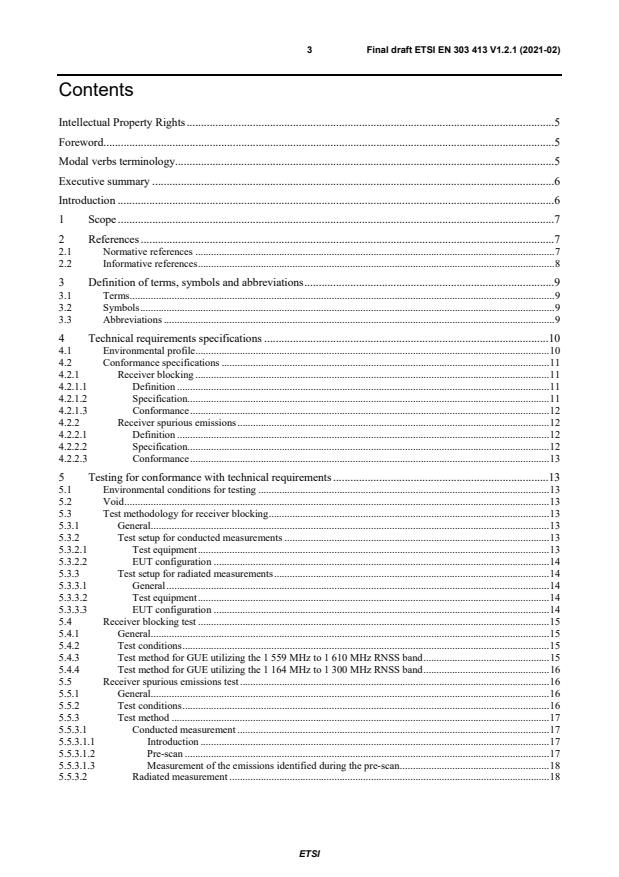
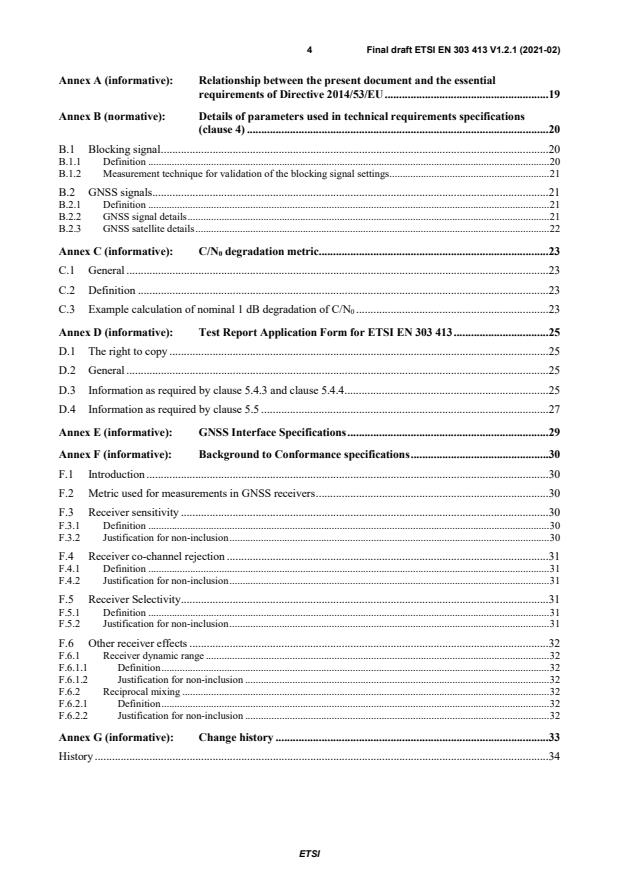
ETSI EN 303 413 V1.2.1 (2021-02) - Satellite Earth Stations and Systems (SES); Global Navigation Satellite System (GNSS) receivers; Radio equipment operating in the 1 164 MHz to 1 300 MHz and 1 559 MHz to 1 610 MHz frequency bands; Harmonised Standard for access to radio spectrum
ETSI EN 303 413 V1.2.1 (2021-04) - Satellite Earth Stations and Systems (SES); Global Navigation Satellite System (GNSS) receivers; Radio equipment operating in the 1 164 MHz to 1 300 MHz and 1 559 MHz to 1 610 MHz frequency bands; Harmonised Standard for access to radio spectrum

Overview
SIST EN 303 413 V1.2.1:2021 is a harmonized European standard that specifies technical characteristics and measurement methods for Global Navigation Satellite System (GNSS) User Equipment (GUE), focusing on radio equipment operating within the 1 164 MHz to 1 300 MHz and 1 559 MHz to 1 610 MHz frequency bands. Developed by the Slovenian Institute for Standardization (SIST) and aligned with ETSI EN 303 413, this standard ensures that GNSS receivers, such as those supporting GPS, Galileo, GLONASS, BeiDou (BDS), and SBAS, effectively access and utilize the designated radio spectrum without causing harmful interference.
This standard supports compliance with Article 3.2 of Directive 2014/53/EU (Radio Equipment Directive), which requires radio equipment to use the spectrum efficiently and avoid harmful interference.
Key Topics
Scope of GNSS User Equipment (GUE):
- Applies to all GNSS receivers capable of operating within the specified frequency bands.
- Covers equipment able to receive signals from any GNSS constellation, including GPS, Galileo, GLONASS, BeiDou, and augmentation systems like SBAS.
Frequency Bands:
- 1 164 MHz to 1 300 MHz (space-to-Earth)
- 1 559 MHz to 1 610 MHz (space-to-Earth)
Essential Technical Requirements:
- Receiver Blocking: Defines the GNSS receiver's ability to function correctly in the presence of unwanted signals in adjacent frequency bands, ensuring minimal degradation of carrier to noise-density ratio (C/N₀).
- Receiver Spurious Emissions: Limits on unintentional emissions to prevent interference with other radio services.
- Testing and Conformance: Specifies environmental conditions and test procedures to demonstrate compliance.
Harmonization with EU Legislation:
- Provides a presumption of conformity with essential spectrum access requirements when cited in the EU Official Journal.
- Ensures market access and legal compliance for radio equipment within the European Union.
Applications
SIST EN 303 413 V1.2.1:2021 is vital for manufacturers, integrators, and testing bodies working with:
- GNSS Receivers in Consumer Electronics: Smartphones, tablets, and wearable devices with built-in navigation capabilities.
- Automotive and Transportation Systems: In-vehicle navigation, fleet tracking, and intelligent transport infrastructure.
- Surveying, Mapping, and Geodesy Equipment: High-precision receivers used in land surveying, construction, and geographic information systems.
- Aviation and Maritime Navigation: Avionics and marine navigation instruments requiring robust and interference-resistant GNSS performance.
- Professional and Industrial Applications: Timing, synchronization, and asset tracking solutions.
By applying this standard, organizations ensure that their GNSS equipment reliably accesses the necessary frequency bands with minimal risks of interference, supporting robust positions, velocity, and timing data acquisition.
Related Standards
For comprehensive compliance and best practices, refer to these associated standards and references:
- ETSI EN 300 328: Wideband transmission systems; Data transmission equipment operating in the 2.4 GHz band.
- Directive 2014/53/EU: Radio Equipment Directive (RED) - requirements for placing radio equipment on the EU market.
- ITU Radio Regulations: Allocations and regulations for radiodetermination-satellite service (RNSS) frequency bands.
- CISPR 16-1-4, EN IEC 55016-1-1, EN 55032: Specifications for radio disturbance and immunity measuring apparatus and methods.
- ETSI EG 203 336: Guide for harmonized standards related to radio equipment directives.
For up-to-date regulatory and technical information, always consult the latest versions and amendments of the applicable documents.
Keywords: GNSS receivers standard, radio spectrum access, SIST EN 303 413, harmonized standard GNSS, radio equipment compliance, Directive 2014/53/EU, GNSS user equipment testing, spurious emissions, receiver blocking, GNSS frequency bands.
Buy Documents
ETSI EN 303 413 V1.2.0 (2020-09) - Satellite Earth Stations and Systems (SES); Global Navigation Satellite System (GNSS) receivers; Radio equipment operating in the 1 164 MHz to 1 300 MHz and 1 559 MHz to 1 610 MHz frequency bands; Harmonised Standard for access to radio spectrum
ETSI EN 303 413 V1.2.1 (2021-02) - Satellite Earth Stations and Systems (SES); Global Navigation Satellite System (GNSS) receivers; Radio equipment operating in the 1 164 MHz to 1 300 MHz and 1 559 MHz to 1 610 MHz frequency bands; Harmonised Standard for access to radio spectrum
ETSI EN 303 413 V1.2.1 (2021-04) - Satellite Earth Stations and Systems (SES); Global Navigation Satellite System (GNSS) receivers; Radio equipment operating in the 1 164 MHz to 1 300 MHz and 1 559 MHz to 1 610 MHz frequency bands; Harmonised Standard for access to radio spectrum
Get Certified
Connect with accredited certification bodies for this standard

ANCE
Mexican certification and testing association.

Intertek Slovenia
Intertek testing, inspection, and certification services in Slovenia.

LNE (Laboratoire National de Métrologie et d'Essais)
French national laboratory for metrology and testing.
Sponsored listings
Frequently Asked Questions
SIST EN 303 413 V1.2.1:2021 is a standard published by the Slovenian Institute for Standardization (SIST). Its full title is "Satellite Earth Stations and Systems (SES) - Global Navigation Satellite System (GNSS) receivers - Radio equipment operating in the 1 164 MHz to 1 300 MHz and 1 559 MHz to 1 610 MHz frequency bands - Harmonised Standard for access to radio spectrum". This standard covers: The present document specifies technical characteristics and methods of measurements for Global Navigation Satellite System (GNSS) User Equipment (GUE). Global Navigation Satellite System (GNSS) User Equipment (GUE) is capable of operating as part of one or more RadioNavigation-Satellite Service (RNSS) systems in the RNSS frequency bands given in table 1-1. Table 1-1: RadioNavigation-Satellite Service (RNSS) frequency bands RNSS frequency bands Comments 1 164 MHz to 1 300 MHz space-to-Earth 1 559 MHz to 1 610 MHz space-to-Earth A GUE receives radio signals from one or more GNSS constellation for the purpose of radiodetermination of the position, velocity and/or other characteristics of an object or the obtaining of information relating to those parameters, by means of the propagation properties of radio waves. RNSS is defined as "A radiodetermination-satellite service used for the purpose of radionavigation" (No. 1.43 of the ITU Radio Regulations [i.13]). The present document applies to all GUE operating in the bands given in table 1-1 with the ability to receive any GNSS constellation (e.g. BeiDou (BDS), Galileo, Global Navigation Satellite System (GLONASS), Global Positioning System (GPS), Space Based Augmentation System (SBAS)). NOTE: The relationship between the present document and essential requirements of article 3.2 of Directive 2014/53/EU [i.1] is given in annex A.
The present document specifies technical characteristics and methods of measurements for Global Navigation Satellite System (GNSS) User Equipment (GUE). Global Navigation Satellite System (GNSS) User Equipment (GUE) is capable of operating as part of one or more RadioNavigation-Satellite Service (RNSS) systems in the RNSS frequency bands given in table 1-1. Table 1-1: RadioNavigation-Satellite Service (RNSS) frequency bands RNSS frequency bands Comments 1 164 MHz to 1 300 MHz space-to-Earth 1 559 MHz to 1 610 MHz space-to-Earth A GUE receives radio signals from one or more GNSS constellation for the purpose of radiodetermination of the position, velocity and/or other characteristics of an object or the obtaining of information relating to those parameters, by means of the propagation properties of radio waves. RNSS is defined as "A radiodetermination-satellite service used for the purpose of radionavigation" (No. 1.43 of the ITU Radio Regulations [i.13]). The present document applies to all GUE operating in the bands given in table 1-1 with the ability to receive any GNSS constellation (e.g. BeiDou (BDS), Galileo, Global Navigation Satellite System (GLONASS), Global Positioning System (GPS), Space Based Augmentation System (SBAS)). NOTE: The relationship between the present document and essential requirements of article 3.2 of Directive 2014/53/EU [i.1] is given in annex A.
SIST EN 303 413 V1.2.1:2021 is classified under the following ICS (International Classification for Standards) categories: 33.060.20 - Receiving and transmitting equipment; 33.070.40 - Satellite. The ICS classification helps identify the subject area and facilitates finding related standards.
SIST EN 303 413 V1.2.1:2021 is associated with the following European legislation: EU Directives/Regulations: 2014/53/EU. When a standard is cited in the Official Journal of the European Union, products manufactured in conformity with it benefit from a presumption of conformity with the essential requirements of the corresponding EU directive or regulation.
SIST EN 303 413 V1.2.1:2021 is available in PDF format for immediate download after purchase. The document can be added to your cart and obtained through the secure checkout process. Digital delivery ensures instant access to the complete standard document.
Standards Content (Sample)
Draft ETSI EN 303 413 V1.2.0 (2020-09)
HARMONISED EUROPEAN STANDARD
Satellite Earth Stations and Systems (SES);
Global Navigation Satellite System (GNSS) receivers;
Radio equipment operating in the 1 164 MHz to 1 300 MHz
and 1 559 MHz to 1 610 MHz frequency bands;
Harmonised Standard for access to radio spectrum
2 Draft ETSI EN 303 413 V1.2.0 (2020-09)
Reference
REN/SES-00445
Keywords
GNSS, harmonised standard, navigation,
receiver, satellite
ETSI
650 Route des Lucioles
F-06921 Sophia Antipolis Cedex - FRANCE
Tel.: +33 4 92 94 42 00 Fax: +33 4 93 65 47 16
Siret N° 348 623 562 00017 - NAF 742 C
Association à but non lucratif enregistrée à la
Sous-Préfecture de Grasse (06) N° 7803/88
Important notice
The present document can be downloaded from:
http://www.etsi.org/standards-search
The present document may be made available in electronic versions and/or in print. The content of any electronic and/or
print versions of the present document shall not be modified without the prior written authorization of ETSI. In case of any
existing or perceived difference in contents between such versions and/or in print, the prevailing version of an ETSI
deliverable is the one made publicly available in PDF format at www.etsi.org/deliver.
Users of the present document should be aware that the document may be subject to revision or change of status.
Information on the current status of this and other ETSI documents is available at
https://portal.etsi.org/TB/ETSIDeliverableStatus.aspx
If you find errors in the present document, please send your comment to one of the following services:
https://portal.etsi.org/People/CommiteeSupportStaff.aspx
Copyright Notification
No part may be reproduced or utilized in any form or by any means, electronic or mechanical, including photocopying
and microfilm except as authorized by written permission of ETSI.
The content of the PDF version shall not be modified without the written authorization of ETSI.
The copyright and the foregoing restriction extend to reproduction in all media.
© ETSI 2020.
All rights reserved.
DECT™, PLUGTESTS™, UMTS™ and the ETSI logo are trademarks of ETSI registered for the benefit of its Members.
3GPP™ and LTE™ are trademarks of ETSI registered for the benefit of its Members and
of the 3GPP Organizational Partners.
oneM2M™ logo is a trademark of ETSI registered for the benefit of its Members and
of the oneM2M Partners. ®
GSM and the GSM logo are trademarks registered and owned by the GSM Association.
ETSI
3 Draft ETSI EN 303 413 V1.2.0 (2020-09)
Contents
Intellectual Property Rights . 5
Foreword . 5
Modal verbs terminology . 5
Executive summary . 6
Introduction . 6
1 Scope . 7
2 References . 7
2.1 Normative references . 7
2.2 Informative references . 8
3 Definition of terms, symbols and abbreviations . 9
3.1 Terms . 9
3.2 Symbols . 9
3.3 Abbreviations . 9
4 Technical requirements specifications . 10
4.1 Environmental profile . 10
4.2 Conformance specifications . 11
4.2.1 Receiver blocking . 11
4.2.1.1 Definition . 11
4.2.1.2 Specification. 11
4.2.1.3 Conformance . 12
4.2.2 Receiver spurious emissions . 12
4.2.2.1 Definition . 12
4.2.2.2 Specification. 12
4.2.2.3 Conformance . 13
5 Testing for conformance with technical requirements . 13
5.1 Environmental conditions for testing . 13
5.2 Void . 13
5.3 Test methodology for receiver blocking . 13
5.3.1 General . 13
5.3.2 Test setup for conducted measurements . 13
5.3.2.1 Test equipment . 13
5.3.2.2 EUT configuration . 14
5.3.3 Test setup for radiated measurements . 14
5.3.3.1 General . 14
5.3.3.2 Test equipment . 14
5.3.3.3 EUT configuration . 14
5.4 Receiver blocking test . 15
5.4.1 General . 15
5.4.2 Test conditions . 15
5.4.3 Test method for GUE utilizing the 1 559 MHz to 1 610 MHz RNSS band . 15
5.4.4 Test method for GUE utilizing the 1 164 MHz to 1 300 MHz RNSS band . 16
5.5 Receiver spurious emissions test . 16
5.5.1 General . 16
5.5.2 Test conditions . 16
5.5.3 Test method . 17
5.5.3.1 Conducted measurement . 17
5.5.3.1.1 Introduction . 17
5.5.3.1.2 Pre-scan . 17
5.5.3.1.3 Measurement of the emissions identified during the pre-scan . 18
5.5.3.2 Radiated measurement . 18
ETSI
4 Draft ETSI EN 303 413 V1.2.0 (2020-09)
Annex A (informative): Relationship between the present document and the essential
requirements of Directive 2014/53/EU . 19
Annex B (normative): Details of parameters used in technical requirements specifications
(clause 4) . 20
B.1 Blocking signal . 20
B.1.1 Definition . 20
B.1.2 Measurement technique for validation of the blocking signal settings . 21
B.2 GNSS signals . 21
B.2.1 Definition . 21
B.2.2 GNSS signal details . 21
B.2.3 GNSS satellite details . 22
Annex C (informative): C/N degradation metric. 23
C.1 General . 23
C.2 Definition . 23
C.3 Example calculation of nominal 1 dB degradation of C/N . 23
Annex D (informative): Test Report Application Form for ETSI EN 303 413 . 25
D.1 The right to copy . 25
D.2 General . 25
D.3 Information as required by clause 5.4.3 and clause 5.4.4 . 25
D.4 Information as required by clause 5.5 . 27
Annex E (informative): GNSS Interface Specifications . 29
Annex F (informative): Background to Conformance specifications . 30
F.1 Introduction . 30
F.2 Metric used for measurements in GNSS receivers . 30
F.3 Receiver sensitivity . 30
F.3.1 Definition . 30
F.3.2 Justification for non-inclusion . 30
F.4 Receiver co-channel rejection . 31
F.4.1 Definition . 31
F.4.2 Justification for non-inclusion . 31
F.5 Receiver Selectivity . 31
F.5.1 Definition . 31
F.5.2 Justification for non-inclusion . 31
F.6 Other receiver effects . 32
F.6.1 Receiver dynamic range . 32
F.6.1.1 Definition . 32
F.6.1.2 Justification for non-inclusion . 32
F.6.2 Reciprocal mixing . 32
F.6.2.1 Definition . 32
F.6.2.2 Justification for non-inclusion . 32
Annex G (informative): Change history . 33
History . 34
ETSI
5 Draft ETSI EN 303 413 V1.2.0 (2020-09)
Intellectual Property Rights
Essential patents
IPRs essential or potentially essential to normative deliverables may have been declared to ETSI. The information
pertaining to these essential IPRs, if any, is publicly available for ETSI members and non-members, and can be found
in ETSI SR 000 314: "Intellectual Property Rights (IPRs); Essential, or potentially Essential, IPRs notified to ETSI in
respect of ETSI standards", which is available from the ETSI Secretariat. Latest updates are available on the ETSI Web
server (https://ipr.etsi.org).
Pursuant to the ETSI IPR Policy, no investigation, including IPR searches, has been carried out by ETSI. No guarantee
can be given as to the existence of other IPRs not referenced in ETSI SR 000 314 (or the updates on the ETSI Web
server) which are, or may be, or may become, essential to the present document.
Trademarks
The present document may include trademarks and/or tradenames which are asserted and/or registered by their owners.
ETSI claims no ownership of these except for any which are indicated as being the property of ETSI, and conveys no
right to use or reproduce any trademark and/or tradename. Mention of those trademarks in the present document does
not constitute an endorsement by ETSI of products, services or organizations associated with those trademarks.
Foreword
This draft Harmonised European Standard (EN) has been produced by ETSI Technical Committee Satellite Earth
Stations and Systems (SES), and is now submitted for the combined Public Enquiry and Vote phase of the ETSI
standards EN Approval Procedure.
The present document has been prepared under the Commission's standardisation request C(2015) 5376 final [i.8] to
provide one voluntary means of conforming to the essential requirements of Directive 2014/53/EU on the harmonisation
of the laws of the Member States relating to the making available on the market of radio equipment and repealing
Directive 1999/5/EC [i.1].
Once the present document is cited in the Official Journal of the European Union under that Directive, compliance with
the normative clauses of the present document given in table A-1 confers, within the limits of the scope of the present
document, a presumption of conformity with the corresponding essential requirements of that Directive and associated
EFTA regulations.
Proposed national transposition dates
Date of latest announcement of this EN (doa): 3 months after ETSI publication
Date of latest publication of new National Standard
or endorsement of this EN (dop/e): 6 months after doa
Date of withdrawal of any conflicting National Standard (dow): 18 months after doa
Modal verbs terminology
In the present document "shall", "shall not", "should", "should not", "may", "need not", "will", "will not", "can" and
"cannot" are to be interpreted as described in clause 3.2 of the ETSI Drafting Rules (Verbal forms for the expression of
provisions).
"must" and "must not" are NOT allowed in ETSI deliverables except when used in direct citation.
ETSI
6 Draft ETSI EN 303 413 V1.2.0 (2020-09)
Executive summary
The present document gives the technical requirements (clause 4) and test methodology (clause 5) for presumption of
conformity of GNSS User Equipment with article 3.2 of the Radio Equipment Directive (2014/53/EU) [i.1].
Introduction
The present document defines technical requirements to support the essential requirements of article 3.2 of the Radio
Equipment Directive [i.1] which states "Radio equipment shall be so constructed that it both effectively uses and
supports the efficient use of radio spectrum in order to avoid harmful interference".
The present document does not contain any requirement, recommendation or information about the installation of the
GNSS user equipment.
ETSI
7 Draft ETSI EN 303 413 V1.2.0 (2020-09)
1 Scope
The present document specifies technical characteristics and methods of measurements for Global Navigation Satellite
System (GNSS) User Equipment (GUE).
Global Navigation Satellite System (GNSS) User Equipment (GUE) is capable of operating as part of one or more
RadioNavigation-Satellite Service (RNSS) systems in the RNSS frequency bands given in table 1-1.
Table 1-1: RadioNavigation-Satellite Service (RNSS) frequency bands
RNSS frequency bands Comments
1 164 MHz to 1 300 MHz space-to-Earth
1 559 MHz to 1 610 MHz space-to-Earth
A GUE receives radio signals from one or more GNSS constellation for the purpose of radiodetermination of the
position, velocity and/or other characteristics of an object or the obtaining of information relating to those parameters,
by means of the propagation properties of radio waves. RNSS is defined as "A radiodetermination-satellite service used
for the purpose of radionavigation" (No. 1.43 of the ITU Radio Regulations [i.13]).
The present document applies to all GUE operating in the bands given in table 1-1 with the ability to receive any GNSS
constellation (e.g. BeiDou (BDS), Galileo, Global Navigation Satellite System (GLONASS), Global Positioning System
(GPS), Space Based Augmentation System (SBAS)).
NOTE: The relationship between the present document and essential requirements of article 3.2 of Directive
2014/53/EU [i.1] is given in annex A.
2 References
2.1 Normative references
References are either specific (identified by date of publication and/or edition number or version number) or non-
specific. For specific references, only the cited version applies. For non-specific references, the latest version of the
referenced document (including any amendments) applies.
Referenced documents which are not found to be publicly available in the expected location might be found at
https://docbox.etsi.org/Reference/.
NOTE: While any hyperlinks included in this clause were valid at the time of publication, ETSI cannot guarantee
their long term validity.
The following referenced documents are necessary for the application of the present document.
[1] ETSI EN 300 328 (V2.2.2) (07-2019): "Wideband transmission systems; Data transmission
equipment operating in the 2,4 GHz band; Harmonised Standard for access to radio spectrum".
ETSI
8 Draft ETSI EN 303 413 V1.2.0 (2020-09)
2.2 Informative references
References are either specific (identified by date of publication and/or edition number or version number) or
non-specific. For specific references, only the cited version applies. For non-specific references, the latest version of the
referenced document (including any amendments) applies.
NOTE: While any hyperlinks included in this clause were valid at the time of publication, ETSI cannot guarantee
their long term validity.
The following referenced documents are not necessary for the application of the present document but they assist the
user with regard to a particular subject area.
[i.1] Directive 2014/53/EU of the European Parliament and of the Council of 16 April 2014 on the
harmonisation of the laws of the Member States relating to the making available on the market of
radio equipment and repealing Directive 1999/5/EC.
[i.2] ETSI EG 203 336 (V1.2.1) (2020-05): "Guide for the selection of technical parameters for the
production of Harmonised Standards covering article 3.1(b) and article 3.2 of
Directive 2014/53/EU".
[i.3] Recommendation ITU-R M.1787: "Description of systems and networks in the radionavigation-
satellite service (space-to-Earth and space-to-space) and technical characteristics of transmitting
space stations operating in the bands 1 164-1 215 MHz, 1 215-1 300 MHz and 1 559-1 610 MHz".
[i.4] Recommendation ITU-R M.1901: "Guidance on ITU-R Recommendations related to systems and
networks in the radionavigation-satellite service operating in the frequency bands
1 164-1 215 MHz, 1 215-1 300 MHz, 1 559-1 610 MHz, 5 000-5 010 MHz and
5 010-5 030 MHz".
[i.5] Recommendation ITU-R M.1902: "Characteristics and protection criteria for receiving earth
stations in the radionavigation-satellite service (space-to-Earth) operating in the band
1 215-1 300 MHz".
[i.6] Recommendation ITU-R M.1903: "Characteristics and protection criteria for receiving earth
stations in the radionavigation-satellite service (space-to-Earth) and receivers in the aeronautical
radionavigation service operating in the band 1 559-1 610 MHz".
[i.7] Recommendation ITU-R M.1905: "Characteristics and protection criteria for receiving earth
stations in the radionavigation-satellite service (space-to-Earth) operating in the band
1 164-1 215 MHz".
[i.8] Commission Implementing Decision C(2015) 5376 final of 4.8.2015 on a standardisation request
to the European Committee for Electrotechnical Standardisation and to the European
Telecommunications Standards Institute as regards radio equipment in support of
Directive 2014/53/EU of the European Parliament and of the Council.
[i.9] CISPR 16-1-4:2019: "Specification for radio disturbance and immunity measuring apparatus and
methods - Part 1-4: Radio disturbance and immunity measuring apparatus - Antennas and test sites
for radiated disturbance measurements".
[i.10] ETSI TR 102 273 (all parts): "Electromagnetic compatibility and Radio spectrum Matters (ERM);
Improvement on Radiated Methods of Measurement (using test site) and evaluation of the
corresponding measurement uncertainties".
[i.11] Void.
[i.12] Void.
[i.13] ITU Radio Regulations (edition of 2016).
[i.14] EN IEC 55016-1-1: "Specification for radio disturbance and immunity measuring apparatus and
methods - Part 1-1: Radio disturbance and immunity measuring apparatus - Measuring apparatus"
(produced by CENELEC).
ETSI
9 Draft ETSI EN 303 413 V1.2.0 (2020-09)
[i.15] EN 55016-2-3: "Specification for radio disturbance and immunity measuring apparatus and
methods - Part 2-3: Methods of measurements of disturbances and immunity - Radiated
disturbance measurements" (produced by CENELEC).
[i.16] EN 55032: "Electromagnetic compatibility of multimedia equipment - Emission requirements"
(produced by CENELEC).
3 Definition of terms, symbols and abbreviations
3.1 Terms
For the purposes of the present document, the terms given in Directive 2014/53/EU [i.1] and the following apply:
C/N : carrier to noise-density ratio, expressed in dB-Hz
NOTE: The ratio of the received (GNSS) signal carrier power C, in dBW or dBm, to the noise power spectral
density, in dBW/Hz or dBm/Hz, in the absence of interference.
C/(N +I): carrier to noise-and-interference-density ratio, C/(N +I), in dB-Hz
0 0
conducted measurements: measurements of the performance of the EUT made by direct wired connection to the
antenna port
Equipment Under Test (EUT): equipment under test and subject to the performance requirements of the present
document
GNSS User Equipment (GUE): radiodetermination equipment capable of receiving signals from one or more GNSS
constellation
NOTE: Such a receiver can acquire and then track GNSS signals to determine its location and/or velocity and/or
time and/or other related parameters.
radiated measurements: measurements of the performance of the EUT made by placing the EUT in a suitable shielded
container and radiating the required signals to the EUT
NOTE: I.e. without using a direct wired connection to the antenna port.
RadioNavigation-Satellite Service (RNSS): services used for the purpose of radionavigation, that is for the
determination of the position, velocity, and/or other characteristics of an object
NOTE: Includes the use of GNSS and other RNSS systems.
RNSS frequency band: continuous ranges of frequencies detailed in table 1-1, allocated by the ITU Radio
Regulations [i.13] to the RNSS
spurious emissions: any unintentional GUE emissions, whether inside or outside the receiver bandwidth
NOTE: Since a GNSS receiver is receive-only, any emission is unintentional.
3.2 Symbols
Void.
3.3 Abbreviations
For the purposes of the present document, the following abbreviations apply:
AM(R)S Aeronautical Mobile (Route) Service
ARNS Aeronautical RadioNavigation Service
AWGN Additive White Gaussian Noise
ETSI
10 Draft ETSI EN 303 413 V1.2.0 (2020-09)
BDS BeiDou Navigation Satellite System
NOTE: See Recommendation ITU-R M.1787 [i.3], annex 7.
CISPR Comité International Spécial des Perturbations Radioélectriques
DDC Digital Down Conversion
e.i.r.p. effective isotropically radiated power
e.r.p. effective radiated power
EC European Commission
EFTA European Free Trade Association
EGNOS European Geostationary Navigation Overlay Service
EU European Union
EUT Equipment Under Test
GAGAN GPS-Aided GEO Augmented Navigation System
GHz Gigahertz
GLONASS GLObalnaya NAvigatsionnaya Sputnikovaya Sistema
ГЛОНАСС which stands for Гло баль ная
NOTE: Latin transliteration of the Cyrillic abbreviation
нав игац ион ная с п у тн икова я система translating to Global Navigation Satellite System (see
Recommendation ITU-R M.1787 [i.3], annex 1).
GNSS Global Navigation Satellite System
GPS Global Positioning System
NOTE: See Recommendation ITU-R M.1787 [i.3], annex 2.
GUE GNSS User Equipment
Hz Hertz
IGSO Inclined Geosynchronous Satellite Orbit
ITU International Telecommunication Union
kHz Kilohertz
LO Local Oscillator
MEO Medium Earth Orbit
MHz Megahertz
MSAS MTSAT Satellite Based Augmentation Navigation System
MSS Mobile Satellite Service
OOBE Out-Of-Band Emissions
RF Radio Frequency
RMS Root Mean Square
RNSS RadioNavigation-Satellite Service
NOTE: See Recommendations ITU-R M.1901 [i.4], M.1902 [i.5], M.1903 [i.6], M.1905 [i.7].
SBAS Space Based Augmentation System
NOTE: See Recommendation ITU-R M.1787 [i.3], annex 8.
WAAS Wide Area Augmentation System
4 Technical requirements specifications
4.1 Environmental profile
The technical requirements of the present document apply under the environmental profile for operation of the GUE,
which shall be in accordance with its intended use. The GUE shall comply with all the technical requirements of the
present document at all times when operating within the boundary limits of the operational environmental profile
defined by its intended use.
ETSI
11 Draft ETSI EN 303 413 V1.2.0 (2020-09)
4.2 Conformance specifications
4.2.1 Receiver blocking
4.2.1.1 Definition
Receiver blocking is a measure of the capability of the GUE to receive a wanted signal without exceeding a given
degradation due to the presence of an unwanted input signal operating in accordance with the allocation table of the ITU
Radio Regulations [i.13] in frequency bands adjacent or near-adjacent to the relevant RNSS band.
4.2.1.2 Specification
The C/N metric reported by the GUE for all GNSS constellations and GNSS signals given in table 4-1 and supported
by the GUE shall not degrade by more than the value given in equation (4-1) when a blocking signal is applied. The
blocking signal is defined in table 4-4, with the frequencies and power levels defined in table 4-2 and/or in table 4-3
depending on the RNSS bands supported by the GUE.
Equation (4-1): Maximum degradation in C/N
Δ C/N ≤ 1 dB (4-1)
Table 4-1: GNSS constellations, GNSS signals and RNSS frequency bands
GNSS Constellation GNSS Signal Designations RNSS Frequency Band (MHz)
BDS B1I 1 559 to 1 610
B1C 1 559 to 1 610
Galileo E1 1 559 to 1 610
E5a 1 164 to 1 215
E5b 1 164 to 1 215
E6 1 215 to 1 300
GLONASS G1 1 559 to 1 610
G2 1 215 to 1 300
GPS L1 C/A 1 559 to 1 610
L1C 1 559 to 1 610
L2C 1 215 to 1 300
L5 1 164 to 1 215
SBAS L1 1 559 to 1 610
L5 1 164 to 1 215
Table 4-2: Frequency bands, blocking signal test point centre frequencies
and power levels for the 1 559 MHz to 1 610 MHz RNSS band
Frequency band Test point centre Blocking signal power Comments
(MHz) frequency (MHz) level (dBm)
1 518 to 1 525 1 524 -65 MSS (space-to-Earth) band
1 525 to 1 549 1 548 -95 MSS (space-to-Earth) band
1 549 to 1 559 1 554 -105 MSS (space-to-Earth) band
1 559 to 1 610 GUE RNSS band under test
1 610 to 1 626 1 615 -105 MSS (Earth-to-space) band
1 626 to 1 640 1 627 -85 MSS (Earth-to-space) band
ETSI
12 Draft ETSI EN 303 413 V1.2.0 (2020-09)
Table 4-3: Frequency bands, blocking signal test point centre frequencies
and power levels for the 1 164 MHz to 1 300 MHz RNSS band
Frequency band Test point centre Blocking signal power level Comments
(MHz) frequency (MHz) (dBm)
960 to 1 164 1 154 -75 AM(R)S, ARNS band
1 164 to 1 215 GUE RNSS band under test
1 215 to 1 260 GUE RNSS band under test
1 260 to 1 300 GUE RNSS band under test
1 300 to 1 350 1 310 -85 Radiolocation, ARNS, RNSS
(Earth-to-space) band
Table 4-4: Blocking signal
Parameter Value Comments
Frequency See table 4-2 and table 4-3
Power level See table 4-2 and table 4-3
Bandwidth 1 MHz See clause B.1 for details
Format AWGN
Annex B contains details of the blocking signal and the GNSS signals that shall be used in performing the conformance
tests. Annex C contains a detailed explanation of the C/N metric. Clause C.3 describes the calculation of the nominal
bounding value for the blocking signal power level at the points closest to the operating band given in table 4-2.
4.2.1.3 Conformance
A GUE utilizing the RNSS band 1 559 MHz to 1 610 MHz shall be presumed to conform to this technical requirements
specification if the C/N as reported by the GUE for each declared GNSS constellation and GNSS signal, does not
0,
degrade by more than the value given in equation (4-1) in the presence of the blocking signals in table 4-2.
A GUE also utilizing any of the RNSS band 1 164 MHz to 1 300 MHz shall be presumed to conform to this technical
requirements specification if the C/N as reported by the GUE for each declared GNSS constellation and GNSS signal,
0,
also does not degrade by more than the value given in equation (4-1) in the presence of the blocking signals in table 4-3.
The testing for conformance with the technical requirements specifications is given in clause 5.4.
4.2.2 Receiver spurious emissions
4.2.2.1 Definition
Receiver spurious emissions are emissions at any frequency when the GUE is active.
4.2.2.2 Specification
The receiver spurious emissions of the GUE shall not exceed the values given in table 4-5.
In case of a GUE with an external antenna connector, these limits apply to emissions at the antenna port (conducted).
For emissions radiated by the cabinet or for emissions radiated by a GUE with an integral antenna (without an antenna
connector), these limits are e.r.p. for emissions up to 1 GHz and e.i.r.p. for emissions above 1 GHz.
Table 4-5: Receiver spurious emission limits
Frequency range Maximum power Bandwidth
30 MHz to 1 GHz -57 dBm 100 kHz
1 GHz to 8,3 GHz -47 dBm 1 MHz
ETSI
13 Draft ETSI EN 303 413 V1.2.0 (2020-09)
4.2.2.3 Conformance
The conformance tests for this requirement are defined in clause 5.5.
5 Testing for conformance with technical requirements
5.1 Environmental conditions for testing
Tests defined in the present document shall be carried out at representative points within the boundary limits of the
operational environmental profile defined by its intended use.
Where technical performance varies subject to environmental conditions, tests shall be carried out under a sufficient
variety of environmental conditions (within the boundary limits of the operational environmental profile defined by its
intended use) to give confidence of compliance for the affected technical requirements.
Unless otherwise declared, the temperature and humidity conditions for tests shall be any convenient combination of
temperature and humidity within the following ranges:
• Temperature: +15 °C to +35 °C.
• Relative humidity: 20 % to 75 %.
5.2 Void
5.3 Test methodology for receiver blocking
5.3.1 General
For purposes of simplicity, accuracy, and ease of testing, conducted testing is preferred. If this is not feasible then
radiated testing may be used.
If special test equipment is used to perform the test, this shall be declared in the test report, for example, custom test
fixture, wire harness or adapter cable.
5.3.2 Test setup for conducted measurements
5.3.2.1 Test equipment
The following test equipment is recommended for performing the tests:
• GNSS signal generator capable of simulating the GNSS constellations and GNSS signals declared as
supported by the EUT.
• RF signal generator capable of generating the blocking signal specified in table 4-4.
• Filter for ensuring the test is not adversely affected by OOBE from the RF signal generator into the RNSS
band if necessary.
• RF power combiner for combining the GNSS signals and the blocking signal.
• A means for recording C/N as reported by the EUT before and after application of the blocking signal.
• A means for establishing the RF power of the test signals at the input to the EUT (this may be accomplished
by means of a directional coupler and power meter, or by appropriate calibration prior to the test).
ETSI
14 Draft ETSI EN 303 413 V1.2.0 (2020-09)
5.3.2.2 EUT configuration
For an EUT with an external, detachable, antenna, the EUT shall be connected to the test bed by means of the antenna
port. Alternatively, the EUT may be connected in the same manner as an EUT with an integrated antenna, described
below.
For an EUT with an integrated antenna, the antenna element shall be removed and a connection from the antenna to the
test bed shall be made in place of the antenna element.
A conceptual block diagram for conducted measurements is shown in figure 5-1.
An equipment list and block diagram shall be provided if the test setup differs from the diagram in figure 5-1.
The test bed shall be calibrated so that the blocking signal power levels of the test signals specified in table 4-2 and/or,
as applicable, table 4-3 are presented to the input of the EUT.
GNSS Signal
Generator
Power Equipment
Combiner Under Test
Blocking
Filter
Signal Generator
Figure 5-1: Conducted measurement setup for EUT receiver blocking
5.3.3 Test setup for radiated measurements
5.3.3.1 General
Radiated measurements may be performed if conducted measurements are not feasible. In this case the testing should
follow the guidance in ETSI TR 102 273 [i.10].
Radiated measurements require additional test elements and equipment in addition to those specified for conducted
measurements. Accordingly, if radiated measurements are performed then the details of the test setup and the
calibration details shall be provided in the test report.
5.3.3.2 Test equipment
In addition to the test equipment given in clause 5.3.2, the following items are necessary:
• RF anechoic chamber.
• RF amplifiers to overcome cabling losses and path loss in the chamber for the test signals if necessary.
• Transmit antennas for both the GNSS signals and blocking signal.
• A means for establishing and calibrating the RF power of both the GNSS signals and the blocking signal at the
antenna of the EUT (this may be accomplished in real-time by means of an RF field probe, or by calibration
(e.g. substitution method or analytically). Refer to CISPR 16-1-4 [i.9] for further information on appropriate
calibration of radiated measurements.
5.3.3.3 EUT configuration
A conceptual block diagram for radiated measurements is shown in figure 5-2.
An equipment list and block diagram shall be provided, if the test setup differs from the diagram in figure 5-2.
ETSI
15 Draft ETSI EN 303 413 V1.2.0 (2020-09)
The orientation of the EUT with respect to the transmitting antennas (normally boresight) shall be declared in the test
report.
The test bed shall be calibrated so that the blocking signal power levels specified in table 4-2 and, as applicable,
table 4-3 are incident upon the antenna of the EUT.
RF Anechoic Chamber
GNSS Signal
Generator
GNSS TX Antenna
RF Power Amplifier
Equipment
Under Test
Adj. Freq. Sig.
TX Antenna
Blocking
Signal Generator
RF Power Amplifier Filter
Figure 5-2: Radiated measurement setup for EUT receiver blocking
5.4 Receiver blocking test
5.4.1 General
Clause 5.4 contains the procedure for testing the receiver blocking.
5.4.2 Test conditions
The test equipment and EUT shall be configured according to figure 5-1 for conducted measurements or figure 5-2 if
radiated measurements are to be performed.
The test shall be performed in a clean RF environment, free from other sources of noise or interference that may affect
the test results.
5.4.3 Test method for GUE utilizing the 1 559 MHz to 1 610 MHz RNSS
band
1) Configure the GNSS signal generator to simulate the GNSS constellations and GNSS signals from table 4-1
declared as supported by the GUE, with power levels and other details as specified in clause B.2.
2) With the blocking signal switched off, the EUT shall be given sufficient time to acquire all simulated satellites
from the declared GNSS constellations.
3) Record the C/N value(s) reported by the EUT under the condition in step 2). Sufficient filtering shall be used
to obtain stable value(s). C/N may be averaged over time and across all the simulated satellites for a particular
GNSS constellation and GNSS signal. However, C/N shall not be averaged across different satellite signals in
the same GNSS constellation or across different GNSS constellations. For a multi-GNSS constellation and/or
multi-GNSS signal EUT, there shall be a separate C/N value recorded for each GNSS constellation and each
GNSS signal supported.
4) The blocking signal generator shall be configured to generate the signal defined in table 4-4, at the first test
point centre frequency and signal power level as specified in table 4-2.
ETSI
16 Draft ETSI EN 303 413 V1.2.0 (2020-09)
5) The blocking signal shall be switched on, and the EUT's C/N value(s) recorded as in step 3). The
difference(s) between this value(s) and the value(s) recorded in step 3) is the C/N degradation caused by the
blocking signal for this test point.
6) Test point Pass/Fail Criteria: If the C/N degradation from step 5) does not exceed the value in equation (4-1),
then this test point is set to "pass". If the C/N degradation exceeds the value in equation (4-1), then this test
point is set to "fail". For a multi-GNSS constellation and/or multi-GNSS signal EUT, there shall be a separate
pass/fail determination for each GNSS constellation and for each GNSS signal supported. If the C/N
degradation exceeds the value in equation (4-1) for any supported GNSS constellation or supported GNSS
signal, then this test point is set to "fail".
7) Step 1) through step 6) shall be repeated for all test point centre frequencies (and associated signal power
level) specified in table 4-2.
If the EUT passes the C/N degradation test for all test points for all GNSS constellations and all GNSS signals declared
as supported from table 4-1, the EUT shall be deemed to "pass". If the C/N degradation test fails for any GNSS
constellation or GNSS signal at any of the test points, the EUT
...
Final draft ETSI EN 303 413 V1.2.1 (2021-02)
HARMONISED EUROPEAN STANDARD
Satellite Earth Stations and Systems (SES);
Global Navigation Satellite System (GNSS) receivers;
Radio equipment operating in the 1 164 MHz to 1 300 MHz
and 1 559 MHz to 1 610 MHz frequency bands;
Harmonised Standard for access to radio spectrum
2 Final draft ETSI EN 303 413 V1.2.1 (2021-02)
Reference
REN/SES-00445
Keywords
GNSS, harmonised standard, navigation,
receiver, satellite
ETSI
650 Route des Lucioles
F-06921 Sophia Antipolis Cedex - FRANCE
Tel.: +33 4 92 94 42 00 Fax: +33 4 93 65 47 16
Siret N° 348 623 562 00017 - NAF 742 C
Association à but non lucratif enregistrée à la
Sous-Préfecture de Grasse (06) N° 7803/88
Important notice
The present document can be downloaded from:
http://www.etsi.org/standards-search
The present document may be made available in electronic versions and/or in print. The content of any electronic and/or
print versions of the present document shall not be modified without the prior written authorization of ETSI. In case of any
existing or perceived difference in contents between such versions and/or in print, the prevailing version of an ETSI
deliverable is the one made publicly available in PDF format at www.etsi.org/deliver.
Users of the present document should be aware that the document may be subject to revision or change of status.
Information on the current status of this and other ETSI documents is available at
https://portal.etsi.org/TB/ETSIDeliverableStatus.aspx
If you find errors in the present document, please send your comment to one of the following services:
https://portal.etsi.org/People/CommiteeSupportStaff.aspx
Copyright Notification
No part may be reproduced or utilized in any form or by any means, electronic or mechanical, including photocopying
and microfilm except as authorized by written permission of ETSI.
The content of the PDF version shall not be modified without the written authorization of ETSI.
The copyright and the foregoing restriction extend to reproduction in all media.
© ETSI 2021.
All rights reserved.
DECT™, PLUGTESTS™, UMTS™ and the ETSI logo are trademarks of ETSI registered for the benefit of its Members.
3GPP™ and LTE™ are trademarks of ETSI registered for the benefit of its Members and
of the 3GPP Organizational Partners.
oneM2M™ logo is a trademark of ETSI registered for the benefit of its Members and
of the oneM2M Partners. ®
GSM and the GSM logo are trademarks registered and owned by the GSM Association.
ETSI
3 Final draft ETSI EN 303 413 V1.2.1 (2021-02)
Contents
Intellectual Property Rights . 5
Foreword . 5
Modal verbs terminology . 5
Executive summary . 6
Introduction . 6
1 Scope . 7
2 References . 7
2.1 Normative references . 7
2.2 Informative references . 8
3 Definition of terms, symbols and abbreviations . 9
3.1 Terms . 9
3.2 Symbols . 9
3.3 Abbreviations . 9
4 Technical requirements specifications . 10
4.1 Environmental profile . 10
4.2 Conformance specifications . 11
4.2.1 Receiver blocking . 11
4.2.1.1 Definition . 11
4.2.1.2 Specification. 11
4.2.1.3 Conformance . 12
4.2.2 Receiver spurious emissions . 12
4.2.2.1 Definition . 12
4.2.2.2 Specification. 12
4.2.2.3 Conformance . 13
5 Testing for conformance with technical requirements . 13
5.1 Environmental conditions for testing . 13
5.2 Void . 13
5.3 Test methodology for receiver blocking . 13
5.3.1 General . 13
5.3.2 Test setup for conducted measurements . 13
5.3.2.1 Test equipment . 13
5.3.2.2 EUT configuration . 14
5.3.3 Test setup for radiated measurements . 14
5.3.3.1 General . 14
5.3.3.2 Test equipment . 14
5.3.3.3 EUT configuration . 14
5.4 Receiver blocking test . 15
5.4.1 General . 15
5.4.2 Test conditions . 15
5.4.3 Test method for GUE utilizing the 1 559 MHz to 1 610 MHz RNSS band . 15
5.4.4 Test method for GUE utilizing the 1 164 MHz to 1 300 MHz RNSS band . 16
5.5 Receiver spurious emissions test . 16
5.5.1 General . 16
5.5.2 Test conditions . 16
5.5.3 Test method . 17
5.5.3.1 Conducted measurement . 17
5.5.3.1.1 Introduction . 17
5.5.3.1.2 Pre-scan . 17
5.5.3.1.3 Measurement of the emissions identified during the pre-scan . 18
5.5.3.2 Radiated measurement . 18
ETSI
4 Final draft ETSI EN 303 413 V1.2.1 (2021-02)
Annex A (informative): Relationship between the present document and the essential
requirements of Directive 2014/53/EU . 19
Annex B (normative): Details of parameters used in technical requirements specifications
(clause 4) . 20
B.1 Blocking signal . 20
B.1.1 Definition . 20
B.1.2 Measurement technique for validation of the blocking signal settings . 21
B.2 GNSS signals . 21
B.2.1 Definition . 21
B.2.2 GNSS signal details . 21
B.2.3 GNSS satellite details . 22
Annex C (informative): C/N degradation metric. 23
C.1 General . 23
C.2 Definition . 23
C.3 Example calculation of nominal 1 dB degradation of C/N . 23
Annex D (informative): Test Report Application Form for ETSI EN 303 413 . 25
D.1 The right to copy . 25
D.2 General . 25
D.3 Information as required by clause 5.4.3 and clause 5.4.4 . 25
D.4 Information as required by clause 5.5 . 27
Annex E (informative): GNSS Interface Specifications . 29
Annex F (informative): Background to Conformance specifications . 30
F.1 Introduction . 30
F.2 Metric used for measurements in GNSS receivers . 30
F.3 Receiver sensitivity . 30
F.3.1 Definition . 30
F.3.2 Justification for non-inclusion . 30
F.4 Receiver co-channel rejection . 31
F.4.1 Definition . 31
F.4.2 Justification for non-inclusion . 31
F.5 Receiver Selectivity . 31
F.5.1 Definition . 31
F.5.2 Justification for non-inclusion . 31
F.6 Other receiver effects . 32
F.6.1 Receiver dynamic range . 32
F.6.1.1 Definition . 32
F.6.1.2 Justification for non-inclusion . 32
F.6.2 Reciprocal mixing . 32
F.6.2.1 Definition . 32
F.6.2.2 Justification for non-inclusion . 32
Annex G (informative): Change history . 33
History . 34
ETSI
5 Final draft ETSI EN 303 413 V1.2.1 (2021-02)
Intellectual Property Rights
Essential patents
IPRs essential or potentially essential to normative deliverables may have been declared to ETSI. The information
pertaining to these essential IPRs, if any, is publicly available for ETSI members and non-members, and can be found
in ETSI SR 000 314: "Intellectual Property Rights (IPRs); Essential, or potentially Essential, IPRs notified to ETSI in
respect of ETSI standards", which is available from the ETSI Secretariat. Latest updates are available on the ETSI Web
server (https://ipr.etsi.org/).
Pursuant to the ETSI IPR Policy, no investigation, including IPR searches, has been carried out by ETSI. No guarantee
can be given as to the existence of other IPRs not referenced in ETSI SR 000 314 (or the updates on the ETSI Web
server) which are, or may be, or may become, essential to the present document.
Trademarks
The present document may include trademarks and/or tradenames which are asserted and/or registered by their owners.
ETSI claims no ownership of these except for any which are indicated as being the property of ETSI, and conveys no
right to use or reproduce any trademark and/or tradename. Mention of those trademarks in the present document does
not constitute an endorsement by ETSI of products, services or organizations associated with those trademarks.
Foreword
This final draft Harmonised European Standard (EN) has been produced by ETSI Technical Committee Satellite Earth
Stations and Systems (SES), and is now submitted for the Vote phase of the ETSI standards EN Approval Procedure.
The present document has been prepared under the Commission's standardisation request C(2015) 5376 final [i.8] to
provide one voluntary means of conforming to the essential requirements of Directive 2014/53/EU on the harmonisation
of the laws of the Member States relating to the making available on the market of radio equipment and repealing
Directive 1999/5/EC [i.1].
Once the present document is cited in the Official Journal of the European Union under that Directive, compliance with
the normative clauses of the present document given in table A-1 confers, within the limits of the scope of the present
document, a presumption of conformity with the corresponding essential requirements of that Directive and associated
EFTA regulations.
Proposed national transposition dates
Date of latest announcement of this EN (doa): 3 months after ETSI publication
Date of latest publication of new National Standard
or endorsement of this EN (dop/e): 6 months after doa
Date of withdrawal of any conflicting National Standard (dow): 18 months after doa
Modal verbs terminology
In the present document "shall", "shall not", "should", "should not", "may", "need not", "will", "will not", "can" and
"cannot" are to be interpreted as described in clause 3.2 of the ETSI Drafting Rules (Verbal forms for the expression of
provisions).
"must" and "must not" are NOT allowed in ETSI deliverables except when used in direct citation.
ETSI
6 Final draft ETSI EN 303 413 V1.2.1 (2021-02)
Executive summary
The present document gives the technical requirements (clause 4) and test methodology (clause 5) for presumption of
conformity of GNSS User Equipment with article 3.2 of Directive 2014/53/EU [i.1].
Introduction
The present document defines technical requirements to support the essential requirements of article 3.2 of Directive
2014/53/EU [i.1] which states "Radio equipment shall be so constructed that it both effectively uses and supports the
efficient use of radio spectrum in order to avoid harmful interference".
The present document does not contain any requirement, recommendation or information about the installation of the
GNSS user equipment.
ETSI
7 Final draft ETSI EN 303 413 V1.2.1 (2021-02)
1 Scope
The present document specifies technical characteristics and methods of measurements for Global Navigation Satellite
System (GNSS) User Equipment (GUE).
Global Navigation Satellite System (GNSS) User Equipment (GUE) is capable of operating as part of one or more
RadioNavigation-Satellite Service (RNSS) systems in the RNSS frequency bands given in table 1-1.
Table 1-1: RadioNavigation-Satellite Service (RNSS) frequency bands
RNSS frequency bands Comments
1 164 MHz to 1 300 MHz space-to-Earth
1 559 MHz to 1 610 MHz space-to-Earth
A GUE receives radio signals from one or more GNSS constellation for the purpose of radiodetermination of the
position, velocity and/or other characteristics of an object or the obtaining of information relating to those parameters,
by means of the propagation properties of radio waves. RNSS is defined as "A radiodetermination-satellite service used
for the purpose of radionavigation" (No. 1.43 of the ITU Radio Regulations [i.13]).
The present document applies to all GUE operating in the bands given in table 1-1 with the ability to receive any GNSS
constellation (e.g. BeiDou (BDS), Galileo, Global Navigation Satellite System (GLONASS), Global Positioning System
(GPS), Space Based Augmentation System (SBAS)).
NOTE: The relationship between the present document and essential requirements of article 3.2 of Directive
2014/53/EU [i.1] is given in annex A.
2 References
2.1 Normative references
References are either specific (identified by date of publication and/or edition number or version number) or non-
specific. For specific references, only the cited version applies. For non-specific references, the latest version of the
referenced document (including any amendments) applies.
Referenced documents which are not found to be publicly available in the expected location might be found at
https://docbox.etsi.org/Reference/.
NOTE: While any hyperlinks included in this clause were valid at the time of publication, ETSI cannot guarantee
their long term validity.
The following referenced documents are necessary for the application of the present document.
[1] ETSI EN 300 328 (V2.2.2): "Wideband transmission systems; Data transmission equipment
operating in the 2,4 GHz band; Harmonised Standard for access to radio spectrum".
ETSI
8 Final draft ETSI EN 303 413 V1.2.1 (2021-02)
2.2 Informative references
References are either specific (identified by date of publication and/or edition number or version number) or
non-specific. For specific references, only the cited version applies. For non-specific references, the latest version of the
referenced document (including any amendments) applies.
NOTE: While any hyperlinks included in this clause were valid at the time of publication, ETSI cannot guarantee
their long term validity.
The following referenced documents are not necessary for the application of the present document but they assist the
user with regard to a particular subject area.
[i.1] Directive 2014/53/EU of the European Parliament and of the Council of 16 April 2014 on the
harmonisation of the laws of the Member States relating to the making available on the market of
radio equipment and repealing Directive 1999/5/EC.
[i.2] ETSI EG 203 336 (V1.2.1): "Guide for the selection of technical parameters for the production of
Harmonised Standards covering article 3.1(b) and article 3.2 of Directive 2014/53/EU".
[i.3] Recommendation ITU-R M.1787: "Description of systems and networks in the radionavigation-
satellite service (space-to-Earth and space-to-space) and technical characteristics of transmitting
space stations operating in the bands 1 164-1 215 MHz, 1 215-1 300 MHz and 1 559-1 610 MHz".
[i.4] Recommendation ITU-R M.1901: "Guidance on ITU-R Recommendations related to systems and
networks in the radionavigation-satellite service operating in the frequency bands
1 164-1 215 MHz, 1 215-1 300 MHz, 1 559-1 610 MHz, 5 000-5 010 MHz and
5 010-5 030 MHz".
[i.5] Recommendation ITU-R M.1902: "Characteristics and protection criteria for receiving earth
stations in the radionavigation-satellite service (space-to-Earth) operating in the band
1 215-1 300 MHz".
[i.6] Recommendation ITU-R M.1903: "Characteristics and protection criteria for receiving earth
stations in the radionavigation-satellite service (space-to-Earth) and receivers in the aeronautical
radionavigation service operating in the band 1 559-1 610 MHz".
[i.7] Recommendation ITU-R M.1905: "Characteristics and protection criteria for receiving earth
stations in the radionavigation-satellite service (space-to-Earth) operating in the band
1 164-1 215 MHz".
[i.8] Commission Implementing Decision C(2015) 5376 final of 4.8.2015 on a standardisation request
to the European Committee for Electrotechnical Standardisation and to the European
Telecommunications Standards Institute as regards radio equipment in support of
Directive 2014/53/EU of the European Parliament and of the Council.
[i.9] CISPR 16-1-4:2019: "Specification for radio disturbance and immunity measuring apparatus and
methods - Part 1-4: Radio disturbance and immunity measuring apparatus - Antennas and test sites
for radiated disturbance measurements".
[i.10] ETSI TR 102 273 (all parts): "Electromagnetic compatibility and Radio spectrum Matters (ERM);
Improvement on Radiated Methods of Measurement (using test site) and evaluation of the
corresponding measurement uncertainties".
[i.11] Void.
[i.12] Void.
[i.13] ITU Radio Regulations (edition of 2016).
[i.14] EN IEC 55016-1-1: "Specification for radio disturbance and immunity measuring apparatus and
methods - Part 1-1: Radio disturbance and immunity measuring apparatus - Measuring apparatus"
(produced by CENELEC).
ETSI
9 Final draft ETSI EN 303 413 V1.2.1 (2021-02)
[i.15] EN 55016-2-3: "Specification for radio disturbance and immunity measuring apparatus and
methods - Part 2-3: Methods of measurements of disturbances and immunity - Radiated
disturbance measurements" (produced by CENELEC).
[i.16] EN 55032: "Electromagnetic compatibility of multimedia equipment - Emission requirements"
(produced by CENELEC).
3 Definition of terms, symbols and abbreviations
3.1 Terms
For the purposes of the present document, the terms given in Directive 2014/53/EU [i.1] and the following apply:
C/N : carrier to noise-density ratio, expressed in dB-Hz
NOTE: The ratio of the received (GNSS) signal carrier power C, in dBW or dBm, to the noise power spectral
density, in dBW/Hz or dBm/Hz, in the absence of interference.
C/(N +I): carrier to noise-and-interference-density ratio, C/(N +I), in dB-Hz
0 0
conducted measurements: measurements of the performance of the EUT made by direct wired connection to the
antenna port
Equipment Under Test (EUT): equipment under test and subject to the performance requirements of the present
document
GNSS User Equipment (GUE): radiodetermination equipment capable of receiving signals from one or more GNSS
constellation
NOTE: Such a receiver can acquire and then track GNSS signals to determine its location and/or velocity and/or
time and/or other related parameters.
radiated measurements: measurements of the performance of the EUT made by placing the EUT in a suitable shielded
container and radiating the required signals to the EUT
NOTE: I.e. without using a direct wired connection to the antenna port.
RadioNavigation-Satellite Service (RNSS): services used for the purpose of radionavigation, that is for the
determination of the position, velocity, and/or other characteristics of an object
NOTE: Includes the use of GNSS and other RNSS systems.
RNSS frequency band: continuous ranges of frequencies detailed in table 1-1, allocated by the ITU Radio
Regulations [i.13] to the RNSS
spurious emissions: any unintentional GUE emissions, whether inside or outside the receiver bandwidth
NOTE: Since a GNSS receiver is receive-only, any emission is unintentional.
3.2 Symbols
Void.
3.3 Abbreviations
For the purposes of the present document, the following abbreviations apply:
AM(R)S Aeronautical Mobile (Route) Service
ARNS Aeronautical RadioNavigation Service
AWGN Additive White Gaussian Noise
ETSI
10 Final draft ETSI EN 303 413 V1.2.1 (2021-02)
BDS BeiDou Navigation Satellite System
NOTE: See Recommendation ITU-R M.1787 [i.3], annex 7.
CISPR Comité International Spécial des Perturbations Radioélectriques
DDC Digital Down Conversion
e.i.r.p. effective isotropically radiated power
e.r.p. effective radiated power
EC European Commission
EFTA European Free Trade Association
EGNOS European Geostationary Navigation Overlay Service
EU European Union
EUT Equipment Under Test
GAGAN GPS-Aided GEO Augmented Navigation System
GHz Gigahertz
GLONASS GLObalnaya NAvigatsionnaya Sputnikovaya Sistema
NOTE: Latin transliteration of the Cyrillic abbreviation ГЛОНАСС which stands for Глобальная
навигационная спутниковая система translating to Global Navigation Satellite System (see
Recommendation ITU-R M.1787 [i.3], annex 1).
GNSS Global Navigation Satellite System
GPS Global Positioning System
NOTE: See Recommendation ITU-R M.1787 [i.3], annex 2.
GUE GNSS User Equipment
Hz Hertz
IGSO Inclined Geosynchronous Satellite Orbit
ITU International Telecommunication Union
kHz Kilohertz
LO Local Oscillator
MEO Medium Earth Orbit
MHz Megahertz
MSAS MTSAT Satellite Based Augmentation Navigation System
MSS Mobile Satellite Service
OOBE Out-Of-Band Emissions
RF Radio Frequency
RMS Root Mean Square
RNSS RadioNavigation-Satellite Service
NOTE: See Recommendations ITU-R M.1901 [i.4], ITU-R M.1902 [i.5], ITU-R M.1903 [i.6], ITU-R M.1905
[i.7].
SBAS Space Based Augmentation System
NOTE: See Recommendation ITU-R M.1787 [i.3], annex 8.
WAAS Wide Area Augmentation System
4 Technical requirements specifications
4.1 Environmental profile
The technical requirements of the present document apply under the environmental profile for operation of the GUE,
which shall be in accordance with its intended use. The GUE shall comply with all the technical requirements of the
present document at all times when operating within the boundary limits of the operational environmental profile
defined by its intended use.
ETSI
11 Final draft ETSI EN 303 413 V1.2.1 (2021-02)
4.2 Conformance specifications
4.2.1 Receiver blocking
4.2.1.1 Definition
Receiver blocking is a measure of the capability of the GUE to receive a wanted signal without exceeding a given
degradation due to the presence of an unwanted input signal operating in accordance with the allocation table of the ITU
Radio Regulations [i.13] in frequency bands adjacent or near-adjacent to the relevant RNSS band.
4.2.1.2 Specification
The C/N metric reported by the GUE for all GNSS constellations and GNSS signals given in table 4-1 and supported
by the GUE shall not degrade by more than the value given in equation (4-1) when a blocking signal is applied. The
blocking signal is defined in table 4-4, with the frequencies and power levels defined in table 4-2 and/or in table 4-3
depending on the RNSS bands supported by the GUE.
Equation (4-1): Maximum degradation in C/N
Δ C/N ≤ 1 dB (4-1)
Table 4-1: GNSS constellations, GNSS signals and RNSS frequency bands
GNSS Constellation GNSS Signal Designations RNSS Frequency Band (MHz)
BDS B1I 1 559 to 1 610
B1C 1 559 to 1 610
Galileo E1 1 559 to 1 610
E5a 1 164 to 1 215
E5b 1 164 to 1 215
E6 1 215 to 1 300
GLONASS G1 1 559 to 1 610
G2 1 215 to 1 300
GPS L1 C/A 1 559 to 1 610
L1C 1 559 to 1 610
L2C 1 215 to 1 300
L5 1 164 to 1 215
SBAS L1 1 559 to 1 610
L5 1 164 to 1 215
Table 4-2: Frequency bands, blocking signal test point centre frequencies
and power levels for the 1 559 MHz to 1 610 MHz RNSS band
Frequency band Test point centre Blocking signal power Comments
(MHz) frequency (MHz) level (dBm)
1 518 to 1 525 1 524 -65 MSS (space-to-Earth) band
1 525 to 1 549 1 548 -95 MSS (space-to-Earth) band
1 549 to 1 559 1 554 -105 MSS (space-to-Earth) band
1 559 to 1 610 GUE RNSS band under test
1 610 to 1 626 1 615 -105 MSS (Earth-to-space) band
1 626 to 1 640 1 627 -85 MSS (Earth-to-space) band
ETSI
12 Final draft ETSI EN 303 413 V1.2.1 (2021-02)
Table 4-3: Frequency bands, blocking signal test point centre frequencies
and power levels for the 1 164 MHz to 1 300 MHz RNSS band
Frequency band Test point centre Blocking signal power level Comments
(MHz) frequency (MHz) (dBm)
960 to 1 164 1 154 -75 AM(R)S, ARNS band
1 164 to 1 215 GUE RNSS band under test
1 215 to 1 260 GUE RNSS band under test
1 260 to 1 300 GUE RNSS band under test
1 300 to 1 350 1 310 -85 Radiolocation, ARNS, RNSS
(Earth-to-space) band
Table 4-4: Blocking signal
Parameter Value Comments
Frequency See table 4-2 and table 4-3
Power level See table 4-2 and table 4-3
Bandwidth 1 MHz See clause B.1 for details
Format AWGN
Annex B contains details of the blocking signal and the GNSS signals that shall be used in performing the conformance
tests. Annex C contains a detailed explanation of the C/N metric. Clause C.3 describes the calculation of the nominal
bounding value for the blocking signal power level at the points closest to the operating band given in table 4-2.
4.2.1.3 Conformance
A GUE utilizing the RNSS band 1 559 MHz to 1 610 MHz shall be presumed to conform to this technical requirements
specification if the C/N as reported by the GUE for each declared GNSS constellation and GNSS signal, does not
0,
degrade by more than the value given in equation (4-1) in the presence of the blocking signals in table 4-2.
A GUE also utilizing any of the RNSS band 1 164 MHz to 1 300 MHz shall be presumed to conform to this technical
requirements specification if the C/N as reported by the GUE for each declared GNSS constellation and GNSS signal,
0,
also does not degrade by more than the value given in equation (4-1) in the presence of the blocking signals in table 4-3.
The testing for conformance with the technical requirements specifications is given in clause 5.4.
4.2.2 Receiver spurious emissions
4.2.2.1 Definition
Receiver spurious emissions are emissions at any frequency when the GUE is active.
4.2.2.2 Specification
The receiver spurious emissions of the GUE shall not exceed the values given in table 4-5.
In case of a GUE with an external antenna connector, these limits apply to emissions at the antenna port (conducted).
For emissions radiated by the cabinet or for emissions radiated by a GUE with an integral antenna (without an antenna
connector), these limits are e.r.p. for emissions up to 1 GHz and e.i.r.p. for emissions above 1 GHz.
Table 4-5: Receiver spurious emission limits
Frequency range Maximum power Bandwidth
30 MHz to 1 GHz -57 dBm 100 kHz
1 GHz to 8,3 GHz -47 dBm 1 MHz
ETSI
13 Final draft ETSI EN 303 413 V1.2.1 (2021-02)
4.2.2.3 Conformance
The conformance tests for this requirement are defined in clause 5.5.
5 Testing for conformance with technical requirements
5.1 Environmental conditions for testing
Tests defined in the present document shall be carried out at representative points within the boundary limits of the
operational environmental profile defined by its intended use.
Where technical performance varies subject to environmental conditions, tests shall be carried out under a sufficient
variety of environmental conditions (within the boundary limits of the operational environmental profile defined by its
intended use) to give confidence of compliance for the affected technical requirements.
Unless otherwise declared, the temperature and humidity conditions for tests shall be any convenient combination of
temperature and humidity within the following ranges:
• Temperature: +15 °C to +35 °C.
• Relative humidity: 20 % to 75 %.
5.2 Void
5.3 Test methodology for receiver blocking
5.3.1 General
For purposes of simplicity, accuracy, and ease of testing, conducted testing is preferred. If this is not feasible then
radiated testing may be used.
If special test equipment is used to perform the test, this shall be declared in the test report, for example, custom test
fixture, wire harness or adapter cable.
5.3.2 Test setup for conducted measurements
5.3.2.1 Test equipment
The following test equipment is recommended for performing the tests:
• GNSS signal generator capable of simulating the GNSS constellations and GNSS signals declared as
supported by the EUT.
• RF signal generator capable of generating the blocking signal specified in table 4-4.
• Filter for ensuring the test is not adversely affected by OOBE from the RF signal generator into the RNSS
band if necessary.
• RF power combiner for combining the GNSS signals and the blocking signal.
• A means for recording C/N as reported by the EUT before and after application of the blocking signal.
• A means for establishing the RF power of the test signals at the input to the EUT (this may be accomplished
by means of a directional coupler and power meter, or by appropriate calibration prior to the test).
ETSI
14 Final draft ETSI EN 303 413 V1.2.1 (2021-02)
5.3.2.2 EUT configuration
For an EUT with an external, detachable, antenna, the EUT shall be connected to the test bed by means of the antenna
port. Alternatively, the EUT may be connected in the same manner as an EUT with an integrated antenna, described
below.
For an EUT with an integrated antenna, the antenna element shall be removed and a connection from the antenna to the
test bed shall be made in place of the antenna element.
A conceptual block diagram for conducted measurements is shown in figure 5-1.
An equipment list and block diagram shall be provided if the test setup differs from the diagram in figure 5-1.
The test bed shall be calibrated so that the blocking signal power levels of the test signals specified in table 4-2 and/or,
as applicable, table 4-3 are presented to the input of the EUT.
GNSS Signal
Generator
Power Equipment
Combiner Under Test
Blocking
Filter
Signal Generator
Figure 5-1: Conducted measurement setup for EUT receiver blocking
5.3.3 Test setup for radiated measurements
5.3.3.1 General
Radiated measurements may be performed if conducted measurements are not feasible. In this case the testing should
follow the guidance in ETSI TR 102 273 [i.10].
Radiated measurements require additional test elements and equipment in addition to those specified for conducted
measurements. Accordingly, if radiated measurements are performed then the details of the test setup and the
calibration details shall be provided in the test report.
5.3.3.2 Test equipment
In addition to the test equipment given in clause 5.3.2, the following items are necessary:
• RF anechoic chamber.
• RF amplifiers to overcome cabling losses and path loss in the chamber for the test signals if necessary.
• Transmit antennas for both the GNSS signals and blocking signal.
• A means for establishing and calibrating the RF power of both the GNSS signals and the blocking signal at the
antenna of the EUT (this may be accomplished in real-time by means of an RF field probe, or by calibration
(e.g. substitution method or analytically). Refer to CISPR 16-1-4:2019 [i.9] for further information on
appropriate calibration of radiated measurements.
5.3.3.3 EUT configuration
A conceptual block diagram for radiated measurements is shown in figure 5-2.
An equipment list and block diagram shall be provided, if the test setup differs from the diagram in figure 5-2.
ETSI
15 Final draft ETSI EN 303 413 V1.2.1 (2021-02)
The orientation of the EUT with respect to the transmitting antennas (normally boresight) shall be declared in the test
report.
The test bed shall be calibrated so that the blocking signal power levels specified in table 4-2 and, as applicable,
table 4-3 are incident upon the antenna of the EUT.
RF Anechoic Chamber
GNSS Signal
Generator
GNSS TX Antenna
RF Power Amplifier
Equipment
Under Test
Adj. Freq. Sig.
TX Antenna
Blocking
Signal Generator
RF Power Amplifier Filter
Figure 5-2: Radiated measurement setup for EUT receiver blocking
5.4 Receiver blocking test
5.4.1 General
Clause 5.4 contains the procedure for testing the receiver blocking.
5.4.2 Test conditions
The test equipment and EUT shall be configured according to figure 5-1 for conducted measurements or figure 5-2 if
radiated measurements are to be performed.
The test shall be performed in a clean RF environment, free from other sources of noise or interference that may affect
the test results.
5.4.3 Test method for GUE utilizing the 1 559 MHz to 1 610 MHz RNSS
band
1) Configure the GNSS signal generator to simulate the GNSS constellations and GNSS signals from table 4-1
declared as supported by the GUE, with power levels and other details as specified in clause B.2.
2) With the blocking signal switched off, the EUT shall be given sufficient time to acquire all simulated satellites
from the declared GNSS constellations.
3) Record the C/N value(s) reported by the EUT under the condition in step 2). Sufficient filtering shall be used
to obtain stable value(s). C/N may be averaged over time and across all the simulated satellites for a particular
GNSS constellation and GNSS signal. However, C/N shall not be averaged across different satellite signals in
the same GNSS constellation or across different GNSS constellations. For a multi-GNSS constellation and/or
multi-GNSS signal EUT, there shall be a separate C/N value recorded for each GNSS constellation and each
GNSS signal supported.
4) The blocking signal generator shall be configured to generate the signal defined in table 4-4, at the first test
point centre frequency and signal power level as specified in table 4-2.
ETSI
16 Final draft ETSI EN 303 413 V1.2.1 (2021-02)
5) The blocking signal shall be switched on, and the EUT's C/N value(s) recorded as in step 3). The
difference(s) between this value(s) and the value(s) recorded in step 3) is the C/N degradation caused by the
blocking signal for this test point.
6) Test point Pass/Fail Criteria: If the C/N degradation from step 5) does not exceed the value in equation (4-1),
then this test point is set to "pass". If the C/N degradation exceeds the value in equation (4-1), then this test
point is set to "fail". For a multi-GNSS constellation and/or multi-GNSS signal EUT, there shall be a separate
pass/fail determination for each GNSS constellation and for each GNSS signal supported. If the C/N
degradation exceeds the value in equation (4-1) for any supported GNSS constellation or supported GNSS
signal, then this test point is set to "fail".
7) Step 1) through step 6) shall be repeated for all test point centre frequencies (and associated signal power
level) specified in table 4-2.
If the EUT passes the C/N degradation test for all test points for all GNSS constellations and all GNSS signals declared
as supported from table 4-1, the EUT shall be deemed to "pass". If the C/N degradation test fails for any GNSS
constellation or GNSS signal at any of the
...
HARMONISED EUROPEAN STANDARD
Satellite Earth Stations and Systems (SES);
Global Navigation Satellite System (GNSS) receivers;
Radio equipment operating in the 1 164 MHz to 1 300 MHz
and 1 559 MHz to 1 610 MHz frequency bands;
Harmonised Standard for access to radio spectrum
2 ETSI EN 303 413 V1.2.1 (2021-04)
Reference
REN/SES-00445
Keywords
GNSS, harmonised standard, navigation, receiver,
satellite
ETSI
650 Route des Lucioles
F-06921 Sophia Antipolis Cedex - FRANCE
Tel.: +33 4 92 94 42 00 Fax: +33 4 93 65 47 16
Siret N° 348 623 562 00017 - APE 7112B
Association à but non lucratif enregistrée à la
Sous-Préfecture de Grasse (06) N° w061004871
Important notice
The present document can be downloaded from:
http://www.etsi.org/standards-search
The present document may be made available in electronic versions and/or in print. The content of any electronic and/or
print versions of the present document shall not be modified without the prior written authorization of ETSI. In case of any
existing or perceived difference in contents between such versions and/or in print, the prevailing version of an ETSI
deliverable is the one made publicly available in PDF format at www.etsi.org/deliver.
Users of the present document should be aware that the document may be subject to revision or change of status.
Information on the current status of this and other ETSI documents is available at
https://portal.etsi.org/TB/ETSIDeliverableStatus.aspx
If you find errors in the present document, please send your comment to one of the following services:
https://portal.etsi.org/People/CommiteeSupportStaff.aspx
Notice of disclaimer & limitation of liability
The information provided in the present deliverable is directed solely to professionals who have the appropriate degree of
experience to understand and interpret its content in accordance with generally accepted engineering or
other professional standard and applicable regulations.
No recommendation as to products and services or vendors is made or should be implied.
In no event shall ETSI be held liable for loss of profits or any other incidental or consequential damages.
Any software contained in this deliverable is provided "AS IS" with no warranties, express or implied, including but not
limited to, the warranties of merchantability, fitness for a particular purpose and non-infringement of intellectual property
rights and ETSI shall not be held liable in any event for any damages whatsoever (including, without limitation, damages
for loss of profits, business interruption, loss of information, or any other pecuniary loss) arising out of or related to the use
of or inability to use the software.
Copyright Notification
No part may be reproduced or utilized in any form or by any means, electronic or mechanical, including photocopying and
microfilm except as authorized by written permission of ETSI.
The content of the PDF version shall not be modified without the written authorization of ETSI.
The copyright and the foregoing restriction extend to reproduction in all media.
© ETSI 2021.
All rights reserved.
ETSI
3 ETSI EN 303 413 V1.2.1 (2021-04)
Contents
Intellectual Property Rights . 5
Foreword . 5
Modal verbs terminology . 6
Executive summary . 6
Introduction . 6
1 Scope . 7
2 References . 7
2.1 Normative references . 7
2.2 Informative references . 7
3 Definition of terms, symbols and abbreviations . 9
3.1 Terms . 9
3.2 Symbols . 9
3.3 Abbreviations . 9
4 Technical requirements specifications . 10
4.1 Environmental profile . 10
4.2 Conformance specifications . 11
4.2.1 Receiver blocking . 11
4.2.1.1 Definition . 11
4.2.1.2 Specification. 11
4.2.1.3 Conformance . 12
4.2.2 Receiver spurious emissions . 12
4.2.2.1 Definition . 12
4.2.2.2 Specification. 12
4.2.2.3 Conformance . 13
5 Testing for conformance with technical requirements . 13
5.1 Environmental conditions for testing . 13
5.2 Void . 13
5.3 Test methodology for receiver blocking . 13
5.3.1 General . 13
5.3.2 Test setup for conducted measurements . 13
5.3.2.1 Test equipment . 13
5.3.2.2 EUT configuration . 14
5.3.3 Test setup for radiated measurements . 14
5.3.3.1 General . 14
5.3.3.2 Test equipment . 14
5.3.3.3 EUT configuration . 14
5.4 Receiver blocking test . 15
5.4.1 General . 15
5.4.2 Test conditions . 15
5.4.3 Test method for GUE utilizing the 1 559 MHz to 1 610 MHz RNSS band . 15
5.4.4 Test method for GUE utilizing the 1 164 MHz to 1 300 MHz RNSS band . 16
5.5 Receiver spurious emissions test . 16
5.5.1 General . 16
5.5.2 Test conditions . 16
5.5.3 Test method . 17
5.5.3.1 Conducted measurement . 17
5.5.3.1.1 Introduction . 17
5.5.3.1.2 Pre-scan . 17
5.5.3.1.3 Measurement of the emissions identified during the pre-scan . 18
5.5.3.2 Radiated measurement . 18
ETSI
4 ETSI EN 303 413 V1.2.1 (2021-04)
Annex A (informative): Relationship between the present document and the essential
requirements of Directive 2014/53/EU . 19
Annex B (normative): Details of parameters used in technical requirements specifications
(clause 4) . 20
B.1 Blocking signal . 20
B.1.1 Definition . 20
B.1.2 Measurement technique for validation of the blocking signal settings . 21
B.2 GNSS signals . 21
B.2.1 Definition . 21
B.2.2 GNSS signal details . 21
B.2.3 GNSS satellite details . 22
Annex C (informative): C/N degradation metric. 23
C.1 General . 23
C.2 Definition . 23
C.3 Example calculation of nominal 1 dB degradation of C/N . 23
Annex D (informative): Test Report Application Form for ETSI EN 303 413 . 25
D.1 The right to copy . 25
D.2 General . 25
D.3 Information as required by clause 5.4.3 and clause 5.4.4 . 25
D.4 Information as required by clause 5.5 . 27
Annex E (informative): GNSS Interface Specifications . 29
Annex F (informative): Background to Conformance specifications . 30
F.1 Introduction . 30
F.2 Metric used for measurements in GNSS receivers . 30
F.3 Receiver sensitivity . 30
F.3.1 Definition . 30
F.3.2 Justification for non-inclusion . 30
F.4 Receiver co-channel rejection . 31
F.4.1 Definition . 31
F.4.2 Justification for non-inclusion . 31
F.5 Receiver Selectivity . 31
F.5.1 Definition . 31
F.5.2 Justification for non-inclusion . 31
F.6 Other receiver effects . 32
F.6.1 Receiver dynamic range . 32
F.6.1.1 Definition . 32
F.6.1.2 Justification for non-inclusion . 32
F.6.2 Reciprocal mixing . 32
F.6.2.1 Definition . 32
F.6.2.2 Justification for non-inclusion . 32
Annex G (informative): Change history . 33
History . 34
ETSI
5 ETSI EN 303 413 V1.2.1 (2021-04)
Intellectual Property Rights
Essential patents
IPRs essential or potentially essential to normative deliverables may have been declared to ETSI. The declarations
pertaining to these essential IPRs, if any, are publicly available for ETSI members and non-members, and can be
found in ETSI SR 000 314: "Intellectual Property Rights (IPRs); Essential, or potentially Essential, IPRs notified to
ETSI in respect of ETSI standards", which is available from the ETSI Secretariat. Latest updates are available on the
ETSI Web server (https://ipr.etsi.org/).
Pursuant to the ETSI Directives including the ETSI IPR Policy, no investigation regarding the essentiality of IPRs,
including IPR searches, has been carried out by ETSI. No guarantee can be given as to the existence of other IPRs not
referenced in ETSI SR 000 314 (or the updates on the ETSI Web server) which are, or may be, or may become,
essential to the present document.
Trademarks
The present document may include trademarks and/or tradenames which are asserted and/or registered by their owners.
ETSI claims no ownership of these except for any which are indicated as being the property of ETSI, and conveys no
right to use or reproduce any trademark and/or tradename. Mention of those trademarks in the present document does
not constitute an endorsement by ETSI of products, services or organizations associated with those trademarks.
DECT™, PLUGTESTS™, UMTS™ and the ETSI logo are trademarks of ETSI registered for the benefit of its
Members. 3GPP™ and LTE™ are trademarks of ETSI registered for the benefit of its Members and of the 3GPP
Organizational Partners. oneM2M™ logo is a trademark of ETSI registered for the benefit of its Members and of the ®
oneM2M Partners. GSM and the GSM logo are trademarks registered and owned by the GSM Association.
Foreword
This Harmonised European Standard (EN) has been produced by ETSI Technical Committee Satellite Earth Stations
and Systems (SES).
The present document has been prepared under the Commission's standardisation request C(2015) 5376 final [i.8] to
provide one voluntary means of conforming to the essential requirements of Directive 2014/53/EU on the harmonisation
of the laws of the Member States relating to the making available on the market of radio equipment and repealing
Directive 1999/5/EC [i.1].
Once the present document is cited in the Official Journal of the European Union under that Directive, compliance with
the normative clauses of the present document given in table A-1 confers, within the limits of the scope of the present
document, a presumption of conformity with the corresponding essential requirements of that Directive and associated
EFTA regulations.
National transposition dates
Date of adoption of this EN: 12 April 2021
Date of latest announcement of this EN (doa): 31 July 2021
Date of latest publication of new National Standard
or endorsement of this EN (dop/e): 31 January 2022
Date of withdrawal of any conflicting National Standard (dow): 31 January 2023
ETSI
6 ETSI EN 303 413 V1.2.1 (2021-04)
Modal verbs terminology
In the present document "shall", "shall not", "should", "should not", "may", "need not", "will", "will not", "can" and
"cannot" are to be interpreted as described in clause 3.2 of the ETSI Drafting Rules (Verbal forms for the expression of
provisions).
"must" and "must not" are NOT allowed in ETSI deliverables except when used in direct citation.
Executive summary
The present document gives the technical requirements (clause 4) and test methodology (clause 5) for presumption of
conformity of GNSS User Equipment with article 3.2 of Directive 2014/53/EU [i.1].
Introduction
The present document defines technical requirements to support the essential requirements of article 3.2 of Directive
2014/53/EU [i.1] which states "Radio equipment shall be so constructed that it both effectively uses and supports the
efficient use of radio spectrum in order to avoid harmful interference".
The present document does not contain any requirement, recommendation or information about the installation of the
GNSS user equipment.
ETSI
7 ETSI EN 303 413 V1.2.1 (2021-04)
1 Scope
The present document specifies technical characteristics and methods of measurements for Global Navigation Satellite
System (GNSS) User Equipment (GUE).
Global Navigation Satellite System (GNSS) User Equipment (GUE) is capable of operating as part of one or more
RadioNavigation-Satellite Service (RNSS) systems in the RNSS frequency bands given in table 1-1.
Table 1-1: RadioNavigation-Satellite Service (RNSS) frequency bands
RNSS frequency bands Comments
1 164 MHz to 1 300 MHz space-to-Earth
1 559 MHz to 1 610 MHz space-to-Earth
A GUE receives radio signals from one or more GNSS constellation for the purpose of radiodetermination of the
position, velocity and/or other characteristics of an object or the obtaining of information relating to those parameters,
by means of the propagation properties of radio waves. RNSS is defined as "A radiodetermination-satellite service used
for the purpose of radionavigation" (No. 1.43 of the ITU Radio Regulations [i.13]).
The present document applies to all GUE operating in the bands given in table 1-1 with the ability to receive any GNSS
constellation (e.g. BeiDou (BDS), Galileo, Global Navigation Satellite System (GLONASS), Global Positioning System
(GPS), Space Based Augmentation System (SBAS)).
NOTE: The relationship between the present document and essential requirements of article 3.2 of Directive
2014/53/EU [i.1] is given in annex A.
2 References
2.1 Normative references
References are either specific (identified by date of publication and/or edition number or version number) or
non-specific. For specific references, only the cited version applies. For non-specific references, the latest version of the
referenced document (including any amendments) applies.
Referenced documents which are not found to be publicly available in the expected location might be found at
https://docbox.etsi.org/Reference/.
NOTE: While any hyperlinks included in this clause were valid at the time of publication, ETSI cannot guarantee
their long term validity.
The following referenced documents are necessary for the application of the present document.
[1] ETSI EN 300 328 (V2.2.2): "Wideband transmission systems; Data transmission equipment
operating in the 2,4 GHz band; Harmonised Standard for access to radio spectrum".
2.2 Informative references
References are either specific (identified by date of publication and/or edition number or version number) or
non-specific. For specific references, only the cited version applies. For non-specific references, the latest version of the
referenced document (including any amendments) applies.
NOTE: While any hyperlinks included in this clause were valid at the time of publication, ETSI cannot guarantee
their long term validity.
ETSI
8 ETSI EN 303 413 V1.2.1 (2021-04)
The following referenced documents are not necessary for the application of the present document but they assist the
user with regard to a particular subject area.
[i.1] Directive 2014/53/EU of the European Parliament and of the Council of 16 April 2014 on the
harmonisation of the laws of the Member States relating to the making available on the market of
radio equipment and repealing Directive 1999/5/EC.
[i.2] ETSI EG 203 336 (V1.2.1): "Guide for the selection of technical parameters for the production of
Harmonised Standards covering article 3.1(b) and article 3.2 of Directive 2014/53/EU".
[i.3] Recommendation ITU-R M.1787: "Description of systems and networks in the radionavigation-
satellite service (space-to-Earth and space-to-space) and technical characteristics of transmitting
space stations operating in the bands 1 164-1 215 MHz, 1 215-1 300 MHz and 1 559-1 610 MHz".
[i.4] Recommendation ITU-R M.1901: "Guidance on ITU-R Recommendations related to systems and
networks in the radionavigation-satellite service operating in the frequency bands
1 164-1 215 MHz, 1 215-1 300 MHz, 1 559-1 610 MHz, 5 000-5 010 MHz and
5 010-5 030 MHz".
[i.5] Recommendation ITU-R M.1902: "Characteristics and protection criteria for receiving earth
stations in the radionavigation-satellite service (space-to-Earth) operating in the band
1 215-1 300 MHz".
[i.6] Recommendation ITU-R M.1903: "Characteristics and protection criteria for receiving earth
stations in the radionavigation-satellite service (space-to-Earth) and receivers in the aeronautical
radionavigation service operating in the band 1 559-1 610 MHz".
[i.7] Recommendation ITU-R M.1905: "Characteristics and protection criteria for receiving earth
stations in the radionavigation-satellite service (space-to-Earth) operating in the band
1 164-1 215 MHz".
[i.8] Commission Implementing Decision C(2015) 5376 final of 4.8.2015 on a standardisation request
to the European Committee for Electrotechnical Standardisation and to the European
Telecommunications Standards Institute as regards radio equipment in support of
Directive 2014/53/EU of the European Parliament and of the Council.
[i.9] CISPR 16-1-4:2019: "Specification for radio disturbance and immunity measuring apparatus and
methods - Part 1-4: Radio disturbance and immunity measuring apparatus - Antennas and test sites
for radiated disturbance measurements".
[i.10] ETSI TR 102 273 (all parts): "Electromagnetic compatibility and Radio spectrum Matters (ERM);
Improvement on Radiated Methods of Measurement (using test site) and evaluation of the
corresponding measurement uncertainties".
[i.11] Void.
[i.12] Void.
[i.13] ITU Radio Regulations (edition of 2016).
[i.14] EN IEC 55016-1-1: "Specification for radio disturbance and immunity measuring apparatus and
methods - Part 1-1: Radio disturbance and immunity measuring apparatus - Measuring apparatus"
(produced by CENELEC).
[i.15] EN 55016-2-3: "Specification for radio disturbance and immunity measuring apparatus and
methods - Part 2-3: Methods of measurements of disturbances and immunity - Radiated
disturbance measurements" (produced by CENELEC).
[i.16] EN 55032: "Electromagnetic compatibility of multimedia equipment - Emission requirements"
(produced by CENELEC).
ETSI
9 ETSI EN 303 413 V1.2.1 (2021-04)
3 Definition of terms, symbols and abbreviations
3.1 Terms
For the purposes of the present document, the terms given in Directive 2014/53/EU [i.1] and the following apply:
C/N : carrier to noise-density ratio, expressed in dB-Hz
NOTE: The ratio of the received (GNSS) signal carrier power C, in dBW or dBm, to the noise power spectral
density, in dBW/Hz or dBm/Hz, in the absence of interference.
C/(N +I): carrier to noise-and-interference-density ratio, C/(N +I), in dB-Hz
0 0
conducted measurements: measurements of the performance of the EUT made by direct wired connection to the
antenna port
Equipment Under Test (EUT): equipment under test and subject to the performance requirements of the present
document
GNSS User Equipment (GUE): radiodetermination equipment capable of receiving signals from one or more GNSS
constellation
NOTE: Such a receiver can acquire and then track GNSS signals to determine its location and/or velocity and/or
time and/or other related parameters.
radiated measurements: measurements of the performance of the EUT made by placing the EUT in a suitable shielded
container and radiating the required signals to the EUT
NOTE: I.e. without using a direct wired connection to the antenna port.
RadioNavigation-Satellite Service (RNSS): services used for the purpose of radionavigation, that is for the
determination of the position, velocity, and/or other characteristics of an object
NOTE: Includes the use of GNSS and other RNSS systems.
RNSS frequency band: continuous ranges of frequencies detailed in table 1-1, allocated by the ITU Radio
Regulations [i.13] to the RNSS
spurious emissions: any unintentional GUE emissions, whether inside or outside the receiver bandwidth
NOTE: Since a GNSS receiver is receive-only, any emission is unintentional.
3.2 Symbols
Void.
3.3 Abbreviations
For the purposes of the present document, the following abbreviations apply:
AM(R)S Aeronautical Mobile (Route) Service
ARNS Aeronautical RadioNavigation Service
AWGN Additive White Gaussian Noise
BDS BeiDou Navigation Satellite System
NOTE: See Recommendation ITU-R M.1787 [i.3], annex 7.
CISPR Comité International Spécial des Perturbations Radioélectriques
DDC Digital Down Conversion
e.i.r.p. effective isotropically radiated power
e.r.p. effective radiated power
ETSI
10 ETSI EN 303 413 V1.2.1 (2021-04)
EC European Commission
EFTA European Free Trade Association
EGNOS European Geostationary Navigation Overlay Service
EU European Union
EUT Equipment Under Test
GAGAN GPS-Aided GEO Augmented Navigation System
GHz Gigahertz
GLONASS GLObalnaya NAvigatsionnaya Sputnikovaya Sistema
NOTE: Latin transliteration of the Cyrillic abbreviation ГЛОНАСС which stands for Глобальная
навигационная спутниковая система translating to Global Navigation Satellite System (see
Recommendation ITU-R M.1787 [i.3], annex 1).
GNSS Global Navigation Satellite System
GPS Global Positioning System
NOTE: See Recommendation ITU-R M.1787 [i.3], annex 2.
GUE GNSS User Equipment
Hz Hertz
IGSO Inclined Geosynchronous Satellite Orbit
ITU International Telecommunication Union
kHz Kilohertz
LO Local Oscillator
MEO Medium Earth Orbit
MHz Megahertz
MSAS MTSAT Satellite Based Augmentation Navigation System
MSS Mobile Satellite Service
OOBE Out-Of-Band Emissions
RF Radio Frequency
RMS Root Mean Square
RNSS RadioNavigation-Satellite Service
NOTE: See Recommendations ITU-R M.1901 [i.4], M.1902 [i.5], M.1903 [i.6] and M.1905 [i.7].
SBAS Space Based Augmentation System
NOTE: See Recommendation ITU-R M.1787 [i.3], annex 8.
WAAS Wide Area Augmentation System
4 Technical requirements specifications
4.1 Environmental profile
The technical requirements of the present document apply under the environmental profile for operation of the GUE,
which shall be in accordance with its intended use. The GUE shall comply with all the technical requirements of the
present document at all times when operating within the boundary limits of the operational environmental profile
defined by its intended use.
ETSI
11 ETSI EN 303 413 V1.2.1 (2021-04)
4.2 Conformance specifications
4.2.1 Receiver blocking
4.2.1.1 Definition
Receiver blocking is a measure of the capability of the GUE to receive a wanted signal without exceeding a given
degradation due to the presence of an unwanted input signal operating in accordance with the allocation table of the ITU
Radio Regulations [i.13] in frequency bands adjacent or near-adjacent to the relevant RNSS band.
4.2.1.2 Specification
The C/N metric reported by the GUE for all GNSS constellations and GNSS signals given in table 4-1 and supported
by the GUE shall not degrade by more than the value given in equation (4-1) when a blocking signal is applied. The
blocking signal is defined in table 4-4, with the frequencies and power levels defined in table 4-2 and/or in table 4-3
depending on the RNSS bands supported by the GUE.
Equation (4-1): Maximum degradation in C/N
Δ C/N ≤ 1 dB (4-1)
Table 4-1: GNSS constellations, GNSS signals and RNSS frequency bands
GNSS Constellation GNSS Signal Designations RNSS Frequency Band (MHz)
BDS B1I 1 559 to 1 610
B1C 1 559 to 1 610
Galileo E1 1 559 to 1 610
E5a 1 164 to 1 215
E5b 1 164 to 1 215
E6 1 215 to 1 300
GLONASS G1 1 559 to 1 610
G2 1 215 to 1 300
GPS L1 C/A 1 559 to 1 610
L1C 1 559 to 1 610
L2C 1 215 to 1 300
L5 1 164 to 1 215
SBAS L1 1 559 to 1 610
L5 1 164 to 1 215
Table 4-2: Frequency bands, blocking signal test point centre frequencies
and power levels for the 1 559 MHz to 1 610 MHz RNSS band
Frequency band Test point centre Blocking signal power Comments
(MHz) frequency (MHz) level (dBm)
1 518 to 1 525 1 524 -65 MSS (space-to-Earth) band
1 525 to 1 549 1 548 -95 MSS (space-to-Earth) band
1 549 to 1 559 1 554 -105 MSS (space-to-Earth) band
1 559 to 1 610 GUE RNSS band under test
1 610 to 1 626 1 615 -105 MSS (Earth-to-space) band
1 626 to 1 640 1 627 -85 MSS (Earth-to-space) band
ETSI
12 ETSI EN 303 413 V1.2.1 (2021-04)
Table 4-3: Frequency bands, blocking signal test point centre frequencies
and power levels for the 1 164 MHz to 1 300 MHz RNSS band
Frequency band Test point centre Blocking signal power level Comments
(MHz) frequency (MHz) (dBm)
960 to 1 164 1 154 -75 AM(R)S, ARNS band
1 164 to 1 215 GUE RNSS band under test
1 215 to 1 260 GUE RNSS band under test
1 260 to 1 300 GUE RNSS band under test
1 300 to 1 350 1 310 -85 Radiolocation, ARNS, RNSS
(Earth-to-space) band
Table 4-4: Blocking signal
Parameter Value Comments
Frequency See table 4-2 and table 4-3
Power level See table 4-2 and table 4-3
Bandwidth 1 MHz See clause B.1 for details
Format AWGN
Annex B contains details of the blocking signal and the GNSS signals that shall be used in performing the conformance
tests. Annex C contains a detailed explanation of the C/N metric. Clause C.3 describes the calculation of the nominal
bounding value for the blocking signal power level at the points closest to the operating band given in table 4-2.
4.2.1.3 Conformance
A GUE utilizing the RNSS band 1 559 MHz to 1 610 MHz shall be presumed to conform to this technical requirements
specification if the C/N as reported by the GUE for each declared GNSS constellation and GNSS signal, does not
0,
degrade by more than the value given in equation (4-1) in the presence of the blocking signals in table 4-2.
A GUE also utilizing any of the RNSS band 1 164 MHz to 1 300 MHz shall be presumed to conform to this technical
requirements specification if the C/N as reported by the GUE for each declared GNSS constellation and GNSS signal,
0,
also does not degrade by more than the value given in equation (4-1) in the presence of the blocking signals in table 4-3.
The testing for conformance with the technical requirements specifications is given in clause 5.4.
4.2.2 Receiver spurious emissions
4.2.2.1 Definition
Receiver spurious emissions are emissions at any frequency when the GUE is active.
4.2.2.2 Specification
The receiver spurious emissions of the GUE shall not exceed the values given in table 4-5.
In case of a GUE with an external antenna connector, these limits apply to emissions at the antenna port (conducted).
For emissions radiated by the cabinet or for emissions radiated by a GUE with an integral antenna (without an antenna
connector), these limits are e.r.p. for emissions up to 1 GHz and e.i.r.p. for emissions above 1 GHz.
Table 4-5: Receiver spurious emission limits
Frequency range Maximum power Bandwidth
30 MHz to 1 GHz -57 dBm 100 kHz
1 GHz to 8,3 GHz -47 dBm 1 MHz
ETSI
13 ETSI EN 303 413 V1.2.1 (2021-04)
4.2.2.3 Conformance
The conformance tests for this requirement are defined in clause 5.5.
5 Testing for conformance with technical requirements
5.1 Environmental conditions for testing
Tests defined in the present document shall be carried out at representative points within the boundary limits of the
operational environmental profile defined by its intended use.
Where technical performance varies subject to environmental conditions, tests shall be carried out under a sufficient
variety of environmental conditions (within the boundary limits of the operational environmental profile defined by its
intended use) to give confidence of compliance for the affected technical requirements.
Unless otherwise declared, the temperature and humidity conditions for tests shall be any convenient combination of
temperature and humidity within the following ranges:
• Temperature: +15 °C to +35 °C.
• Relative humidity: 20 % to 75 %.
5.2 Void
5.3 Test methodology for receiver blocking
5.3.1 General
For purposes of simplicity, accuracy, and ease of testing, conducted testing is preferred. If this is not feasible then
radiated testing may be used.
If special test equipment is used to perform the test, this shall be declared in the test report, for example, custom test
fixture, wire harness or adapter cable.
5.3.2 Test setup for conducted measurements
5.3.2.1 Test equipment
The following test equipment is recommended for performing the tests:
• GNSS signal generator capable of simulating the GNSS constellations and GNSS signals declared as
supported by the EUT.
• RF signal generator capable of generating the blocking signal specified in table 4-4.
• Filter for ensuring the test is not adversely affected by OOBE from the RF signal generator into the RNSS
band if necessary.
• RF power combiner for combining the GNSS signals and the blocking signal.
• A means for recording C/N as reported by the EUT before and after application of the blocking signal.
• A means for establishing the RF power of the test signals at the input to the EUT (this may be accomplished
by means of a directional coupler and power meter, or by appropriate calibration prior to the test).
ETSI
14 ETSI EN 303 413 V1.2.1 (2021-04)
5.3.2.2 EUT configuration
For an EUT with an external, detachable, antenna, the EUT shall be connected to the test bed by means of the antenna
port. Alternatively, the EUT may be connected in the same manner as an EUT with an integrated antenna, described
below.
For an EUT with an integrated antenna, the antenna element shall be removed and a connection from the antenna to the
test bed shall be made in place of the antenna element.
A conceptual block diagram for conducted measurements is shown in figure 5-1.
An equipment list and block diagram shall be provided if the test setup differs from the diagram in figure 5-1.
The test bed shall be calibrated so that the blocking signal power levels of the test signals specified in table 4-2 and/or,
as applicable, table 4-3 are presented to the input of the EUT.
GNSS Signal
Generator
Power Equipment
Combiner Under Test
Blocking
Filter
Signal Generator
Figure 5-1: Conducted measurement setup for EUT receiver blocking
5.3.3 Test setup for radiated measurements
5.3.3.1 General
Radiated measurements may be performed if conducted measurements are not feasible. In this case the testing should
follow the guidance in ETSI TR 102 273 [i.10].
Radiated measurements require additional test elements and equipment in addition to those specified for conducted
measurements. Accordingly, if radiated measurements are performed then the details of the test setup and the
calibration details shall be provided in the test report.
5.3.3.2 Test equipment
In addition to the test equipment given in clause 5.3.2, the following items are necessary:
• RF anechoic chamber.
• RF amplifiers to overcome cabling losses and path loss in the chamber for the test signals if necessary.
• Transmit antennas for both the GNSS signals and blocking signal.
• A means for establishing and calibrating the RF power of both the GNSS signals and the blocking signal at the
antenna of the EUT (this may be accomplished in real-time by means of an RF field probe, or by calibration
(e.g. substitution method or analytically)). Refer to CISPR 16-1-4:2019 [i.9] for further information on
appropriate calibration of radiated measurements.
5.3.3.3 EUT configuration
A conceptual block diagram for radiated measurements is shown in figure 5-2.
An equipment list and block diagram shall be provided, if the test setup differs from the diagram in figure 5-2.
ETSI
15 ETSI EN 303 413 V1.2.1 (2021-04)
The orientation of the EUT with respect to the transmitting antennas (normally boresight) shall be declared in the test
report.
The test bed shall be calibrated so that the blocking signal power levels specified in table 4-2 and, as applicable,
table 4-3 are incident upon the antenna of the EUT.
RF Anechoic Chamber
GNSS Signal
Generator
GNSS TX Antenna
RF Power Amplifier
Equipment
Under Test
Adj. Freq. Sig.
TX Antenna
Blocking
Signal Generator
RF Power Amplifier Filter
Figure 5-2: Radiated measurement setup for EUT receiver blocking
5.4 Receiver blocking test
5.4.1 General
Clause 5.4 contains the procedure for testing the receiver blocking.
5.4.2 Test conditions
The test equipment and EUT shall be configured according to figure 5-1 for conducted measurements or figure 5-2 if
radiated measurements are to be performed.
The test shall be performed in a clean RF environment, free from other sources of noise or interference that may affect
the test results.
5.4.3 Test method for GUE utilizing the 1 559 MHz to 1 610 MHz RNSS
band
1) Configure the GNSS signal generator to simulate the GNSS constellations and GNSS signals from table 4-1
declared as supported by the GUE, with power levels and other details as specified in clause B.2.
2) With the blocking signal switched off, the EUT shall be given sufficient time to acquire all simulated satellites
from the declared GNSS constellations.
3) Record the C/N value(s) reported by the EUT under the condition in step 2). Sufficient filtering shall be used
to obtain stable value(s). C/N may be averaged over time and across all the simulated satellites for a particular
GNSS constellation and GNSS signal. However, C/N shall not be averaged across different satellite signals in
the same GNSS constellation or across different GNSS constellations. For a multi-GNSS constellation and/or
multi-GNSS signal EUT, there shall be a separate C/N value recorded for each GNSS constellation and each
GNSS signal supported.
4) The blocking signal generator shall be configured to generate the signal defined in table 4-4, at the first test
point centre frequency and signal power level as specified in table 4-2.
ETSI
16 ETSI EN 303 413 V1.2.1 (2021-04)
5) The blocking signal shall be switched on, and the EUT's C/N value(s) recorded as in step 3). The
difference(s) between this value(s) and the value(s) recorded in step 3) is the C/N degradation caused by the
blocking signal for this test point.
6) Test point Pass/Fail Criteria: If the C/N degradation from step 5) does not exceed the value in equation (4-1),
then this test point is set to "pass". If the C/N
...
SLOVENSKI STANDARD
01-junij-2021
Satelitske zemeljske postaje in sistemi (SES) - Sprejemniki globalnih navigacijskih
satelitskih sistemov (GNSS) - Radijska oprema, ki deluje v frekvenčnih pasovih od
1164 MHz do 1300 MHz in od 1559 MHz do 1610 MHz - Harmonizirani standard za
dostop do radijskega spektra
Satellite Earth Stations and Systems (SES) - Global Navigation Satellite System (GNSS)
receivers - Radio equipment operating in the 1 164 MHz to 1 300 MHz and 1 559 MHz to
1 610 MHz frequency bands - Harmonised Standard for access to radio spectrum
Ta slovenski standard je istoveten z: ETSI EN 303 413 V1.2.1 (2021-04)
ICS:
33.060.20 Sprejemna in oddajna Receiving and transmitting
oprema equipment
33.070.40 Satelit Satellite
2003-01.Slovenski inštitut za standardizacijo. Razmnoževanje celote ali delov tega standarda ni dovoljeno.
HARMONISED EUROPEAN STANDARD
Satellite Earth Stations and Systems (SES);
Global Navigation Satellite System (GNSS) receivers;
Radio equipment operating in the 1 164 MHz to 1 300 MHz
and 1 559 MHz to 1 610 MHz frequency bands;
Harmonised Standard for access to radio spectrum
2 ETSI EN 303 413 V1.2.1 (2021-04)
Reference
REN/SES-00445
Keywords
GNSS, harmonised standard, navigation, receiver,
satellite
ETSI
650 Route des Lucioles
F-06921 Sophia Antipolis Cedex - FRANCE
Tel.: +33 4 92 94 42 00 Fax: +33 4 93 65 47 16
Siret N° 348 623 562 00017 - APE 7112B
Association à but non lucratif enregistrée à la
Sous-Préfecture de Grasse (06) N° w061004871
Important notice
The present document can be downloaded from:
http://www.etsi.org/standards-search
The present document may be made available in electronic versions and/or in print. The content of any electronic and/or
print versions of the present document shall not be modified without the prior written authorization of ETSI. In case of any
existing or perceived difference in contents between such versions and/or in print, the prevailing version of an ETSI
deliverable is the one made publicly available in PDF format at www.etsi.org/deliver.
Users of the present document should be aware that the document may be subject to revision or change of status.
Information on the current status of this and other ETSI documents is available at
https://portal.etsi.org/TB/ETSIDeliverableStatus.aspx
If you find errors in the present document, please send your comment to one of the following services:
https://portal.etsi.org/People/CommiteeSupportStaff.aspx
Notice of disclaimer & limitation of liability
The information provided in the present deliverable is directed solely to professionals who have the appropriate degree of
experience to understand and interpret its content in accordance with generally accepted engineering or
other professional standard and applicable regulations.
No recommendation as to products and services or vendors is made or should be implied.
In no event shall ETSI be held liable for loss of profits or any other incidental or consequential damages.
Any software contained in this deliverable is provided "AS IS" with no warranties, express or implied, including but not
limited to, the warranties of merchantability, fitness for a particular purpose and non-infringement of intellectual property
rights and ETSI shall not be held liable in any event for any damages whatsoever (including, without limitation, damages
for loss of profits, business interruption, loss of information, or any other pecuniary loss) arising out of or related to the use
of or inability to use the software.
Copyright Notification
No part may be reproduced or utilized in any form or by any means, electronic or mechanical, including photocopying and
microfilm except as authorized by written permission of ETSI.
The content of the PDF version shall not be modified without the written authorization of ETSI.
The copyright and the foregoing restriction extend to reproduction in all media.
© ETSI 2021.
All rights reserved.
ETSI
3 ETSI EN 303 413 V1.2.1 (2021-04)
Contents
Intellectual Property Rights . 5
Foreword . 5
Modal verbs terminology . 6
Executive summary . 6
Introduction . 6
1 Scope . 7
2 References . 7
2.1 Normative references . 7
2.2 Informative references . 7
3 Definition of terms, symbols and abbreviations . 9
3.1 Terms . 9
3.2 Symbols . 9
3.3 Abbreviations . 9
4 Technical requirements specifications . 10
4.1 Environmental profile . 10
4.2 Conformance specifications . 11
4.2.1 Receiver blocking . 11
4.2.1.1 Definition . 11
4.2.1.2 Specification. 11
4.2.1.3 Conformance . 12
4.2.2 Receiver spurious emissions . 12
4.2.2.1 Definition . 12
4.2.2.2 Specification. 12
4.2.2.3 Conformance . 13
5 Testing for conformance with technical requirements . 13
5.1 Environmental conditions for testing . 13
5.2 Void . 13
5.3 Test methodology for receiver blocking . 13
5.3.1 General . 13
5.3.2 Test setup for conducted measurements . 13
5.3.2.1 Test equipment . 13
5.3.2.2 EUT configuration . 14
5.3.3 Test setup for radiated measurements . 14
5.3.3.1 General . 14
5.3.3.2 Test equipment . 14
5.3.3.3 EUT configuration . 14
5.4 Receiver blocking test . 15
5.4.1 General . 15
5.4.2 Test conditions . 15
5.4.3 Test method for GUE utilizing the 1 559 MHz to 1 610 MHz RNSS band . 15
5.4.4 Test method for GUE utilizing the 1 164 MHz to 1 300 MHz RNSS band . 16
5.5 Receiver spurious emissions test . 16
5.5.1 General . 16
5.5.2 Test conditions . 16
5.5.3 Test method . 17
5.5.3.1 Conducted measurement . 17
5.5.3.1.1 Introduction . 17
5.5.3.1.2 Pre-scan . 17
5.5.3.1.3 Measurement of the emissions identified during the pre-scan . 18
5.5.3.2 Radiated measurement . 18
ETSI
4 ETSI EN 303 413 V1.2.1 (2021-04)
Annex A (informative): Relationship between the present document and the essential
requirements of Directive 2014/53/EU . 19
Annex B (normative): Details of parameters used in technical requirements specifications
(clause 4) . 20
B.1 Blocking signal . 20
B.1.1 Definition . 20
B.1.2 Measurement technique for validation of the blocking signal settings . 21
B.2 GNSS signals . 21
B.2.1 Definition . 21
B.2.2 GNSS signal details . 21
B.2.3 GNSS satellite details . 22
Annex C (informative): C/N degradation metric. 23
C.1 General . 23
C.2 Definition . 23
C.3 Example calculation of nominal 1 dB degradation of C/N . 23
Annex D (informative): Test Report Application Form for ETSI EN 303 413 . 25
D.1 The right to copy . 25
D.2 General . 25
D.3 Information as required by clause 5.4.3 and clause 5.4.4 . 25
D.4 Information as required by clause 5.5 . 27
Annex E (informative): GNSS Interface Specifications . 29
Annex F (informative): Background to Conformance specifications . 30
F.1 Introduction . 30
F.2 Metric used for measurements in GNSS receivers . 30
F.3 Receiver sensitivity . 30
F.3.1 Definition . 30
F.3.2 Justification for non-inclusion . 30
F.4 Receiver co-channel rejection . 31
F.4.1 Definition . 31
F.4.2 Justification for non-inclusion . 31
F.5 Receiver Selectivity . 31
F.5.1 Definition . 31
F.5.2 Justification for non-inclusion . 31
F.6 Other receiver effects . 32
F.6.1 Receiver dynamic range . 32
F.6.1.1 Definition . 32
F.6.1.2 Justification for non-inclusion . 32
F.6.2 Reciprocal mixing . 32
F.6.2.1 Definition . 32
F.6.2.2 Justification for non-inclusion . 32
Annex G (informative): Change history . 33
History . 34
ETSI
5 ETSI EN 303 413 V1.2.1 (2021-04)
Intellectual Property Rights
Essential patents
IPRs essential or potentially essential to normative deliverables may have been declared to ETSI. The declarations
pertaining to these essential IPRs, if any, are publicly available for ETSI members and non-members, and can be
found in ETSI SR 000 314: "Intellectual Property Rights (IPRs); Essential, or potentially Essential, IPRs notified to
ETSI in respect of ETSI standards", which is available from the ETSI Secretariat. Latest updates are available on the
ETSI Web server (https://ipr.etsi.org/).
Pursuant to the ETSI Directives including the ETSI IPR Policy, no investigation regarding the essentiality of IPRs,
including IPR searches, has been carried out by ETSI. No guarantee can be given as to the existence of other IPRs not
referenced in ETSI SR 000 314 (or the updates on the ETSI Web server) which are, or may be, or may become,
essential to the present document.
Trademarks
The present document may include trademarks and/or tradenames which are asserted and/or registered by their owners.
ETSI claims no ownership of these except for any which are indicated as being the property of ETSI, and conveys no
right to use or reproduce any trademark and/or tradename. Mention of those trademarks in the present document does
not constitute an endorsement by ETSI of products, services or organizations associated with those trademarks.
DECT™, PLUGTESTS™, UMTS™ and the ETSI logo are trademarks of ETSI registered for the benefit of its
Members. 3GPP™ and LTE™ are trademarks of ETSI registered for the benefit of its Members and of the 3GPP
Organizational Partners. oneM2M™ logo is a trademark of ETSI registered for the benefit of its Members and of the ®
oneM2M Partners. GSM and the GSM logo are trademarks registered and owned by the GSM Association.
Foreword
This Harmonised European Standard (EN) has been produced by ETSI Technical Committee Satellite Earth Stations
and Systems (SES).
The present document has been prepared under the Commission's standardisation request C(2015) 5376 final [i.8] to
provide one voluntary means of conforming to the essential requirements of Directive 2014/53/EU on the harmonisation
of the laws of the Member States relating to the making available on the market of radio equipment and repealing
Directive 1999/5/EC [i.1].
Once the present document is cited in the Official Journal of the European Union under that Directive, compliance with
the normative clauses of the present document given in table A-1 confers, within the limits of the scope of the present
document, a presumption of conformity with the corresponding essential requirements of that Directive and associated
EFTA regulations.
National transposition dates
Date of adoption of this EN: 12 April 2021
Date of latest announcement of this EN (doa): 31 July 2021
Date of latest publication of new National Standard
or endorsement of this EN (dop/e): 31 January 2022
Date of withdrawal of any conflicting National Standard (dow): 31 January 2023
ETSI
6 ETSI EN 303 413 V1.2.1 (2021-04)
Modal verbs terminology
In the present document "shall", "shall not", "should", "should not", "may", "need not", "will", "will not", "can" and
"cannot" are to be interpreted as described in clause 3.2 of the ETSI Drafting Rules (Verbal forms for the expression of
provisions).
"must" and "must not" are NOT allowed in ETSI deliverables except when used in direct citation.
Executive summary
The present document gives the technical requirements (clause 4) and test methodology (clause 5) for presumption of
conformity of GNSS User Equipment with article 3.2 of Directive 2014/53/EU [i.1].
Introduction
The present document defines technical requirements to support the essential requirements of article 3.2 of Directive
2014/53/EU [i.1] which states "Radio equipment shall be so constructed that it both effectively uses and supports the
efficient use of radio spectrum in order to avoid harmful interference".
The present document does not contain any requirement, recommendation or information about the installation of the
GNSS user equipment.
ETSI
7 ETSI EN 303 413 V1.2.1 (2021-04)
1 Scope
The present document specifies technical characteristics and methods of measurements for Global Navigation Satellite
System (GNSS) User Equipment (GUE).
Global Navigation Satellite System (GNSS) User Equipment (GUE) is capable of operating as part of one or more
RadioNavigation-Satellite Service (RNSS) systems in the RNSS frequency bands given in table 1-1.
Table 1-1: RadioNavigation-Satellite Service (RNSS) frequency bands
RNSS frequency bands Comments
1 164 MHz to 1 300 MHz space-to-Earth
1 559 MHz to 1 610 MHz space-to-Earth
A GUE receives radio signals from one or more GNSS constellation for the purpose of radiodetermination of the
position, velocity and/or other characteristics of an object or the obtaining of information relating to those parameters,
by means of the propagation properties of radio waves. RNSS is defined as "A radiodetermination-satellite service used
for the purpose of radionavigation" (No. 1.43 of the ITU Radio Regulations [i.13]).
The present document applies to all GUE operating in the bands given in table 1-1 with the ability to receive any GNSS
constellation (e.g. BeiDou (BDS), Galileo, Global Navigation Satellite System (GLONASS), Global Positioning System
(GPS), Space Based Augmentation System (SBAS)).
NOTE: The relationship between the present document and essential requirements of article 3.2 of Directive
2014/53/EU [i.1] is given in annex A.
2 References
2.1 Normative references
References are either specific (identified by date of publication and/or edition number or version number) or
non-specific. For specific references, only the cited version applies. For non-specific references, the latest version of the
referenced document (including any amendments) applies.
Referenced documents which are not found to be publicly available in the expected location might be found at
https://docbox.etsi.org/Reference/.
NOTE: While any hyperlinks included in this clause were valid at the time of publication, ETSI cannot guarantee
their long term validity.
The following referenced documents are necessary for the application of the present document.
[1] ETSI EN 300 328 (V2.2.2): "Wideband transmission systems; Data transmission equipment
operating in the 2,4 GHz band; Harmonised Standard for access to radio spectrum".
2.2 Informative references
References are either specific (identified by date of publication and/or edition number or version number) or
non-specific. For specific references, only the cited version applies. For non-specific references, the latest version of the
referenced document (including any amendments) applies.
NOTE: While any hyperlinks included in this clause were valid at the time of publication, ETSI cannot guarantee
their long term validity.
ETSI
8 ETSI EN 303 413 V1.2.1 (2021-04)
The following referenced documents are not necessary for the application of the present document but they assist the
user with regard to a particular subject area.
[i.1] Directive 2014/53/EU of the European Parliament and of the Council of 16 April 2014 on the
harmonisation of the laws of the Member States relating to the making available on the market of
radio equipment and repealing Directive 1999/5/EC.
[i.2] ETSI EG 203 336 (V1.2.1): "Guide for the selection of technical parameters for the production of
Harmonised Standards covering article 3.1(b) and article 3.2 of Directive 2014/53/EU".
[i.3] Recommendation ITU-R M.1787: "Description of systems and networks in the radionavigation-
satellite service (space-to-Earth and space-to-space) and technical characteristics of transmitting
space stations operating in the bands 1 164-1 215 MHz, 1 215-1 300 MHz and 1 559-1 610 MHz".
[i.4] Recommendation ITU-R M.1901: "Guidance on ITU-R Recommendations related to systems and
networks in the radionavigation-satellite service operating in the frequency bands
1 164-1 215 MHz, 1 215-1 300 MHz, 1 559-1 610 MHz, 5 000-5 010 MHz and
5 010-5 030 MHz".
[i.5] Recommendation ITU-R M.1902: "Characteristics and protection criteria for receiving earth
stations in the radionavigation-satellite service (space-to-Earth) operating in the band
1 215-1 300 MHz".
[i.6] Recommendation ITU-R M.1903: "Characteristics and protection criteria for receiving earth
stations in the radionavigation-satellite service (space-to-Earth) and receivers in the aeronautical
radionavigation service operating in the band 1 559-1 610 MHz".
[i.7] Recommendation ITU-R M.1905: "Characteristics and protection criteria for receiving earth
stations in the radionavigation-satellite service (space-to-Earth) operating in the band
1 164-1 215 MHz".
[i.8] Commission Implementing Decision C(2015) 5376 final of 4.8.2015 on a standardisation request
to the European Committee for Electrotechnical Standardisation and to the European
Telecommunications Standards Institute as regards radio equipment in support of
Directive 2014/53/EU of the European Parliament and of the Council.
[i.9] CISPR 16-1-4:2019: "Specification for radio disturbance and immunity measuring apparatus and
methods - Part 1-4: Radio disturbance and immunity measuring apparatus - Antennas and test sites
for radiated disturbance measurements".
[i.10] ETSI TR 102 273 (all parts): "Electromagnetic compatibility and Radio spectrum Matters (ERM);
Improvement on Radiated Methods of Measurement (using test site) and evaluation of the
corresponding measurement uncertainties".
[i.11] Void.
[i.12] Void.
[i.13] ITU Radio Regulations (edition of 2016).
[i.14] EN IEC 55016-1-1: "Specification for radio disturbance and immunity measuring apparatus and
methods - Part 1-1: Radio disturbance and immunity measuring apparatus - Measuring apparatus"
(produced by CENELEC).
[i.15] EN 55016-2-3: "Specification for radio disturbance and immunity measuring apparatus and
methods - Part 2-3: Methods of measurements of disturbances and immunity - Radiated
disturbance measurements" (produced by CENELEC).
[i.16] EN 55032: "Electromagnetic compatibility of multimedia equipment - Emission requirements"
(produced by CENELEC).
ETSI
9 ETSI EN 303 413 V1.2.1 (2021-04)
3 Definition of terms, symbols and abbreviations
3.1 Terms
For the purposes of the present document, the terms given in Directive 2014/53/EU [i.1] and the following apply:
C/N : carrier to noise-density ratio, expressed in dB-Hz
NOTE: The ratio of the received (GNSS) signal carrier power C, in dBW or dBm, to the noise power spectral
density, in dBW/Hz or dBm/Hz, in the absence of interference.
C/(N +I): carrier to noise-and-interference-density ratio, C/(N +I), in dB-Hz
0 0
conducted measurements: measurements of the performance of the EUT made by direct wired connection to the
antenna port
Equipment Under Test (EUT): equipment under test and subject to the performance requirements of the present
document
GNSS User Equipment (GUE): radiodetermination equipment capable of receiving signals from one or more GNSS
constellation
NOTE: Such a receiver can acquire and then track GNSS signals to determine its location and/or velocity and/or
time and/or other related parameters.
radiated measurements: measurements of the performance of the EUT made by placing the EUT in a suitable shielded
container and radiating the required signals to the EUT
NOTE: I.e. without using a direct wired connection to the antenna port.
RadioNavigation-Satellite Service (RNSS): services used for the purpose of radionavigation, that is for the
determination of the position, velocity, and/or other characteristics of an object
NOTE: Includes the use of GNSS and other RNSS systems.
RNSS frequency band: continuous ranges of frequencies detailed in table 1-1, allocated by the ITU Radio
Regulations [i.13] to the RNSS
spurious emissions: any unintentional GUE emissions, whether inside or outside the receiver bandwidth
NOTE: Since a GNSS receiver is receive-only, any emission is unintentional.
3.2 Symbols
Void.
3.3 Abbreviations
For the purposes of the present document, the following abbreviations apply:
AM(R)S Aeronautical Mobile (Route) Service
ARNS Aeronautical RadioNavigation Service
AWGN Additive White Gaussian Noise
BDS BeiDou Navigation Satellite System
NOTE: See Recommendation ITU-R M.1787 [i.3], annex 7.
CISPR Comité International Spécial des Perturbations Radioélectriques
DDC Digital Down Conversion
e.i.r.p. effective isotropically radiated power
e.r.p. effective radiated power
ETSI
10 ETSI EN 303 413 V1.2.1 (2021-04)
EC European Commission
EFTA European Free Trade Association
EGNOS European Geostationary Navigation Overlay Service
EU European Union
EUT Equipment Under Test
GAGAN GPS-Aided GEO Augmented Navigation System
GHz Gigahertz
GLONASS GLObalnaya NAvigatsionnaya Sputnikovaya Sistema
NOTE: Latin transliteration of the Cyrillic abbreviation ГЛОНАСС which stands for Глобальная
навигационная спутниковая система translating to Global Navigation Satellite System (see
Recommendation ITU-R M.1787 [i.3], annex 1).
GNSS Global Navigation Satellite System
GPS Global Positioning System
NOTE: See Recommendation ITU-R M.1787 [i.3], annex 2.
GUE GNSS User Equipment
Hz Hertz
IGSO Inclined Geosynchronous Satellite Orbit
ITU International Telecommunication Union
kHz Kilohertz
LO Local Oscillator
MEO Medium Earth Orbit
MHz Megahertz
MSAS MTSAT Satellite Based Augmentation Navigation System
MSS Mobile Satellite Service
OOBE Out-Of-Band Emissions
RF Radio Frequency
RMS Root Mean Square
RNSS RadioNavigation-Satellite Service
NOTE: See Recommendations ITU-R M.1901 [i.4], M.1902 [i.5], M.1903 [i.6] and M.1905 [i.7].
SBAS Space Based Augmentation System
NOTE: See Recommendation ITU-R M.1787 [i.3], annex 8.
WAAS Wide Area Augmentation System
4 Technical requirements specifications
4.1 Environmental profile
The technical requirements of the present document apply under the environmental profile for operation of the GUE,
which shall be in accordance with its intended use. The GUE shall comply with all the technical requirements of the
present document at all times when operating within the boundary limits of the operational environmental profile
defined by its intended use.
ETSI
11 ETSI EN 303 413 V1.2.1 (2021-04)
4.2 Conformance specifications
4.2.1 Receiver blocking
4.2.1.1 Definition
Receiver blocking is a measure of the capability of the GUE to receive a wanted signal without exceeding a given
degradation due to the presence of an unwanted input signal operating in accordance with the allocation table of the ITU
Radio Regulations [i.13] in frequency bands adjacent or near-adjacent to the relevant RNSS band.
4.2.1.2 Specification
The C/N metric reported by the GUE for all GNSS constellations and GNSS signals given in table 4-1 and supported
by the GUE shall not degrade by more than the value given in equation (4-1) when a blocking signal is applied. The
blocking signal is defined in table 4-4, with the frequencies and power levels defined in table 4-2 and/or in table 4-3
depending on the RNSS bands supported by the GUE.
Equation (4-1): Maximum degradation in C/N
Δ C/N ≤ 1 dB (4-1)
Table 4-1: GNSS constellations, GNSS signals and RNSS frequency bands
GNSS Constellation GNSS Signal Designations RNSS Frequency Band (MHz)
BDS B1I 1 559 to 1 610
B1C 1 559 to 1 610
Galileo E1 1 559 to 1 610
E5a 1 164 to 1 215
E5b 1 164 to 1 215
E6 1 215 to 1 300
GLONASS G1 1 559 to 1 610
G2 1 215 to 1 300
GPS L1 C/A 1 559 to 1 610
L1C 1 559 to 1 610
L2C 1 215 to 1 300
L5 1 164 to 1 215
SBAS L1 1 559 to 1 610
L5 1 164 to 1 215
Table 4-2: Frequency bands, blocking signal test point centre frequencies
and power levels for the 1 559 MHz to 1 610 MHz RNSS band
Frequency band Test point centre Blocking signal power Comments
(MHz) frequency (MHz) level (dBm)
1 518 to 1 525 1 524 -65 MSS (space-to-Earth) band
1 525 to 1 549 1 548 -95 MSS (space-to-Earth) band
1 549 to 1 559 1 554 -105 MSS (space-to-Earth) band
1 559 to 1 610 GUE RNSS band under test
1 610 to 1 626 1 615 -105 MSS (Earth-to-space) band
1 626 to 1 640 1 627 -85 MSS (Earth-to-space) band
ETSI
12 ETSI EN 303 413 V1.2.1 (2021-04)
Table 4-3: Frequency bands, blocking signal test point centre frequencies
and power levels for the 1 164 MHz to 1 300 MHz RNSS band
Frequency band Test point centre Blocking signal power level Comments
(MHz) frequency (MHz) (dBm)
960 to 1 164 1 154 -75 AM(R)S, ARNS band
1 164 to 1 215 GUE RNSS band under test
1 215 to 1 260 GUE RNSS band under test
1 260 to 1 300 GUE RNSS band under test
1 300 to 1 350 1 310 -85 Radiolocation, ARNS, RNSS
(Earth-to-space) band
Table 4-4: Blocking signal
Parameter Value Comments
Frequency See table 4-2 and table 4-3
Power level See table 4-2 and table 4-3
Bandwidth 1 MHz See clause B.1 for details
Format AWGN
Annex B contains details of the blocking signal and the GNSS signals that shall be used in performing the conformance
tests. Annex C contains a detailed explanation of the C/N metric. Clause C.3 describes the calculation of the nominal
bounding value for the blocking signal power level at the points closest to the operating band given in table 4-2.
4.2.1.3 Conformance
A GUE utilizing the RNSS band 1 559 MHz to 1 610 MHz shall be presumed to conform to this technical requirements
specification if the C/N as reported by the GUE for each declared GNSS constellation and GNSS signal, does not
0,
degrade by more than the value given in equation (4-1) in the presence of the blocking signals in table 4-2.
A GUE also utilizing any of the RNSS band 1 164 MHz to 1 300 MHz shall be presumed to conform to this technical
requirements specification if the C/N as reported by the GUE for each declared GNSS constellation and GNSS signal,
0,
also does not degrade by more than the value given in equation (4-1) in the presence of the blocking signals in table 4-3.
The testing for conformance with the technical requirements specifications is given in clause 5.4.
4.2.2 Receiver spurious emissions
4.2.2.1 Definition
Receiver spurious emissions are emissions at any frequency when the GUE is active.
4.2.2.2 Specification
The receiver spurious emissions of the GUE shall not exceed the values given in table 4-5.
In case of a GUE with an external antenna connector, these limits apply to emissions at the antenna port (conducted).
For emissions radiated by the cabinet or for emissions radiated by a GUE with an integral antenna (without an antenna
connector), these limits are e.r.p. for emissions up to 1 GHz and e.i.r.p. for emissions above 1 GHz.
Table 4-5: Receiver spurious emission limits
Frequency range Maximum power Bandwidth
30 MHz to 1 GHz -57 dBm 100 kHz
1 GHz to 8,3 GHz -47 dBm 1 MHz
ETSI
13 ETSI EN 303 413 V1.2.1 (2021-04)
4.2.2.3 Conformance
The conformance tests for this requirement are defined in clause 5.5.
5 Testing for conformance with technical requirements
5.1 Environmental conditions for testing
Tests defined in the present document shall be carried out at representative points within the boundary limits of the
operational environmental profile defined by its intended use.
Where technical performance varies subject to environmental conditions, tests shall be carried out under a sufficient
variety of environmental conditions (within the boundary limits of the operational environmental profile defined by its
intended use) to give confidence of compliance for the affected technical requirements.
Unless otherwise declared, the temperature and humidity conditions for tests shall be any convenient combination of
temperature and humidity within the following ranges:
• Temperature: +15 °C to +35 °C.
• Relative humidity: 20 % to 75 %.
5.2 Void
5.3 Test methodology for receiver blocking
5.3.1 General
For purposes of simplicity, accuracy, and ease of testing, conducted testing is preferred. If this is not feasible then
radiated testing may be used.
If special test equipment is used to perform the test, this shall be declared in the test report, for example, custom test
fixture, wire harness or adapter cable.
5.3.2 Test setup for conducted measurements
5.3.2.1 Test equipment
The following test equipment is recommended for performing the tests:
• GNSS signal generator capable of simulating the GNSS constellations and GNSS signals declared as
supported by the EUT.
• RF signal generator capable of generating the blocking signal specified in table 4-4.
• Filter for ensuring the test is not adversely affected by OOBE from the RF signal generator into the RNSS
band if necessary.
• RF power combiner for combining the GNSS signals and the blocking signal.
• A means for recording C/N as reported by the EUT before and after application of the blocking signal.
• A means for establishing the RF power of the test signals at the input to the EUT (this may be accomplished
by means of a directional coupler and power meter, or by appropriate calibration prior to the test).
ETSI
14 ETSI EN 303 413 V1.2.1 (2021-04)
5.3.2.2 EUT configuration
For an EUT with an external, detachable, antenna, the EUT shall be connected to the test bed by means of the antenna
port. Alternatively, the EUT may be connected in the same manner as an EUT with an integrated antenna, described
below.
For an EUT with an integrated antenna, the antenna element shall be removed and a connection from the antenna to the
test bed shall be made in place of the antenna element.
A conceptual block diagram for conducted measurements is shown in figure 5-1.
An equipment list and block diagram shall be provided if the test setup differs from the diagram in figure 5-1.
The test bed shall be calibrated so that the blocking signal power levels of the test signals specified in table 4-2 and/or,
as applicable, table 4-3 are presented to the input of the EUT.
GNSS Signal
Generator
Power Equipment
Combiner Under Test
Blocking
Filter
Signal Generator
Figure 5-1: Conducted measurement setup for EUT receiver blocking
5.3.3 Test setup for radiated measurements
5.3.3.1 General
Radiated measurements may be performed if conducted measurements are not feasible. In this case the testing should
follow the guidance in ETSI TR 102 273 [i.10].
Radiated measurements require additional test elements and equipment in addition to those specified for conducted
measurements. Accordingly, if radiated measurements are performed then the details of the test setup and the
calibration details shall be provided in the test report.
5.3.3.2 Test equipment
In addition to the test equipment given in clause 5.3.2, the following items are necessary:
• RF anechoic chamber.
• RF amplifiers to overcome cabling losses and path loss in the chamber for the test signals if necessary.
• Transmit antennas for both the GNSS signals and blocking signal.
• A means for establishing and calibrating the RF power of both the GNSS signals and the blocking signal at the
antenna of the EUT (this may be accomplished in real-time by means of an RF field probe, or by calibration
(e.g. substitution method or analytically)). Refer to CISPR 16-1-4:2019 [i.9] for further information on
appropriate calibration of radiated measurements.
5.3.3.3 EUT configuration
A conceptual block diagram for radiated measurements is shown in figure 5-2.
An equipment list and block diagram shall be provided, if the test setup differs from the diagram in figure 5-2.
ETSI
15 ETSI EN 303 413 V1.2.1 (2021-04)
The orientation of the EUT with respect to the transmitting antennas (normally boresight) shall be declared in the test
report.
The test bed shall be calibrated so that the blocking signal power levels specified in table 4-2 and, as applicable,
table 4-3 are incident upon the antenna of the EUT.
RF Anechoic Chamber
GNSS Signal
Generator
GNSS TX Antenna
RF Power Amplifier
Equipment
Under Test
Adj. Freq. Sig.
TX Antenna
Blocking
Signal Generator
RF Power Amplifier Filter
Figure 5-2: Radiated measurement setup for EUT receiver blocking
5.4 Receiver blocking test
5.4.1 General
Clause 5.4 contains the procedure for testing the receiver blocking.
5.4.2 Test conditions
The test equipment and EUT shall be configured according to figure 5-1 for conducted measurements or figure 5-2 if
radiated measurements are to be performed.
The test shall be performed in a clean RF environment, free from other sources of noise or interference that may affect
the test results.
5.4.3 Test method for GUE utilizing the 1 559 MHz to 1 610 MHz RNSS
band
1) Configure the GNSS signal generator to simulate the GNSS constellations and GNSS signals from table 4-1
declared as supported by the GUE, with powe
...