


SIST EN 13795-1:2019
Surgical clothing and drapes - Requirements and test methods - Part 1: Surgical drapes and gowns
Surgical clothing and drapes - Requirements and test methods - Part 1: Surgical drapes and gowns
Operacijska oblačila in pokrivala - Zahteve in preskusne metode - 1. del: Operacijska pokrivala in plašči
General Information
- Status
- Published
- Technical Committee
- COVID 19 - COVID 19 - ISO
- Current Stage



Frequently Asked Questions
SIST EN 13795-1:2019 is a standard published by the Slovenian Institute for Standardization (SIST). Its full title is "Surgical clothing and drapes - Requirements and test methods - Part 1: Surgical drapes and gowns". This standard covers: Surgical clothing and drapes - Requirements and test methods - Part 1: Surgical drapes and gowns
Surgical clothing and drapes - Requirements and test methods - Part 1: Surgical drapes and gowns
SIST EN 13795-1:2019 is associated with the following European legislation: EU Directives/Regulations: standardi COVID-19. When a standard is cited in the Official Journal of the European Union, products manufactured in conformity with it benefit from a presumption of conformity with the essential requirements of the corresponding EU directive or regulation.
SIST EN 13795-1:2019 is available in PDF format for immediate download after purchase. The document can be added to your cart and obtained through the secure checkout process. Digital delivery ensures instant access to the complete standard document.
Standards Content (Sample)
Posebna objava SIST z dovoljenjem CEN, CENELEC, ISO in IEC: Za potrebe zagotavljanja brezplačnega dostopa do vsebin standardov v času epidemije COVID-19.
Samo za branje. Kopiranje in posredovanje prepovedano. © SIST 2020-04-10
SLOVENSKI STANDARD
01-julij-2019
Nadomešča:
SIST EN 13795:2011+A1:2013
Operacijska oblačila in pokrivala - Zahteve in preskusne metode - 1. del:
Operacijska pokrivala in plašči
Surgical clothing and drapes - Requirements and test methods - Part 1: Surgical drapes
and gowns
Operationskleidung und -abdecktücher - Anforderungen und Prüfverfahren - Teil 1:
Operationsabdecktücher und -mäntel
Vêtements et champs chirurgicaux - Exigences et méthodes d’essai - Partie 1 : Champs
et casaques chirurgicaux
Ta slovenski standard je istoveten z: EN 13795-1:2019
ICS:
11.140 Oprema bolnišnic Hospital equipment
2003-01.Slovenski inštitut za standardizacijo. Razmnoževanje celote ali delov tega standarda ni dovoljeno.
Posebna objava SIST z dovoljenjem CEN, CENELEC, ISO in IEC: Za potrebe zagotavljanja brezplačnega dostopa do vsebin standardov v času epidemije COVID-19.
Samo za branje. Kopiranje in posredovanje prepovedano. © SIST 2020-04-10
Posebna objava SIST z dovoljenjem CEN, CENELEC, ISO in IEC: Za potrebe zagotavljanja brezplačnega dostopa do vsebin standardov v času epidemije COVID-19.
Samo za branje. Kopiranje in posredovanje prepovedano. © SIST 2020-04-10
EN 13795-1
EUROPEAN STANDARD
NORME EUROPÉENNE
April 2019
EUROPÄISCHE NORM
ICS 11.140 Supersedes EN 13795:2011+A1:2013
English Version
Surgical clothing and drapes - Requirements and test
methods - Part 1: Surgical drapes and gowns
Vêtements et champs chirurgicaux - Exigences et Operationskleidung und -abdecktücher -
méthodes d'essai - Partie 1 : Champs et casaques Anforderungen und Prüfverfahren - Teil 1:
chirurgicaux Operationsabdecktücher und -mäntel
This European Standard was approved by CEN on 24 October 2018.
CEN members are bound to comply with the CEN/CENELEC Internal Regulations which stipulate the conditions for giving this
European Standard the status of a national standard without any alteration. Up-to-date lists and bibliographical references
concerning such national standards may be obtained on application to the CEN-CENELEC Management Centre or to any CEN
member.
This European Standard exists in three official versions (English, French, German). A version in any other language made by
translation under the responsibility of a CEN member into its own language and notified to the CEN-CENELEC Management
Centre has the same status as the official versions.
CEN members are the national standards bodies of Austria, Belgium, Bulgaria, Croatia, Cyprus, Czech Republic, Denmark, Estonia,
Finland, Former Yugoslav Republic of Macedonia, France, Germany, Greece, Hungary, Iceland, Ireland, Italy, Latvia, Lithuania,
Luxembourg, Malta, Netherlands, Norway, Poland, Portugal, Romania, Serbia, Slovakia, Slovenia, Spain, Sweden, Switzerland,
Turkey and United Kingdom.
EUROPEAN COMMITTEE FOR STANDARDIZATION
COMITÉ EUROPÉEN DE NORMALISATION
EUROPÄISCHES KOMITEE FÜR NORMUNG
CEN-CENELEC Management Centre: Rue de la Science 23, B-1040 Brussels
© 2019 CEN All rights of exploitation in any form and by any means reserved Ref. No. EN 13795-1:2019 E
worldwide for CEN national Members.
Posebna objava SIST z dovoljenjem CEN, CENELEC, ISO in IEC: Za potrebe zagotavljanja brezplačnega dostopa do vsebin standardov v času epidemije COVID-19.
Samo za branje. Kopiranje in posredovanje prepovedano. © SIST 2020-04-10
EN 13795-1:2019 (E)
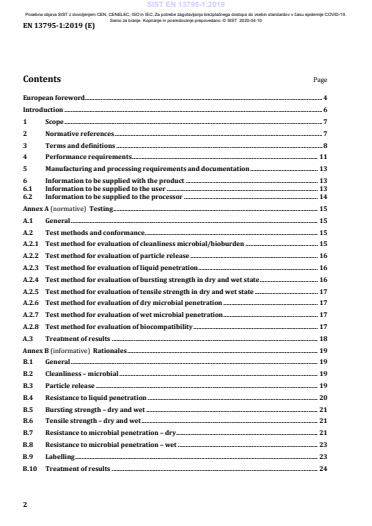
Contents Page
European foreword . 4
Introduction . 6
1 Scope . 7
2 Normative references . 7
3 Terms and definitions . 8
4 Performance requirements . 11
5 Manufacturing and processing requirements and documentation . 13
6 Information to be supplied with the product . 13
6.1 Information to be supplied to the user . 13
6.2 Information to be supplied to the processor . 14
Annex A (normative) Testing . 15
A.1 General . 15
A.2 Test methods and conformance . 15
A.2.1 Test method for evaluation of cleanliness microbial/bioburden . 15
A.2.2 Test method for evaluation of particle release . 16
A.2.3 Test method for evaluation of liquid penetration . 16
A.2.4 Test method for evaluation of bursting strength in dry and wet state . 16
A.2.5 Test method for evaluation of tensile strength in dry and wet state . 17
A.2.6 Test method for evaluation of dry microbial penetration . 17
A.2.7 Test method for evaluation of wet microbial penetration . 17
A.2.8 Test method for evaluation of biocompatibility . 17
A.3 Treatment of results . 18
Annex B (informative) Rationales . 19
B.1 General . 19
B.2 Cleanliness – microbial . 19
B.3 Particle release . 19
B.4 Resistance to liquid penetration . 20
B.5 Bursting strength – dry and wet . 21
B.6 Tensile strength – dry and wet . 21
B.7 Resistance to microbial penetration – dry . 21
B.8 Resistance to microbial penetration – wet . 23
B.9 Labelling . 23
B.10 Treatment of results . 24
Posebna objava SIST z dovoljenjem CEN, CENELEC, ISO in IEC: Za potrebe zagotavljanja brezplačnega dostopa do vsebin standardov v času epidemije COVID-19.
Samo za branje. Kopiranje in posredovanje prepovedano. © SIST 2020-04-10
EN 13795-1:2019 (E)
Annex C (informative) Information on further characteristics . 25
C.1 Comfort . 25
C.2 Adhesion for fixation for the purpose of wound isolation . 25
C.3 Liquid control . 25
C.4 Flammability . 26
C.5 Electrostatic discharge . 26
Annex D (informative) Environmental aspects . 27
Annex E (informative) Guidance to users for selecting products . 28
E.1 Performance levels . 28
E.2 Functional design. 28
E.2.1 General . 28
E.2.2 Critical and less critical areas . 28
E.2.3 Size . 29
E.2.4 Accessories . 29
E.2.5 Comfort . 29
E.2.5.1 General . 29
E.2.5.2 Surgical gowns . 29
E.2.5.3 Surgical drapes . 30
E.3 Practical trials . 30
Annex ZA (informative) Relationship between this European standard and the essential
requirements of Directive 93/42/EEC [1993 OJ L 169] aimed to be covered . 31
Bibliography . 32
Posebna objava SIST z dovoljenjem CEN, CENELEC, ISO in IEC: Za potrebe zagotavljanja brezplačnega dostopa do vsebin standardov v času epidemije COVID-19.
Samo za branje. Kopiranje in posredovanje prepovedano. © SIST 2020-04-10
EN 13795-1:2019 (E)
European foreword
This document (EN 13795-1:2019) has been prepared by Technical Committee CEN/TC 205 “Non-
active medical devices”, the secretariat of which is held by DIN.
This European Standard shall be given the status of a national standard, either by publication of an
identical text or by endorsement, at the latest by October 2019, and conflicting national standards shall
be withdrawn at the latest by October 2019.
Attention is drawn to the possibility that some of the elements of this document may be the subject of
patent rights. CEN shall not be held responsible for identifying any or all such patent rights.
Together with EN 13795-2:2019, this document supersedes EN 13795:2011+A1:2013.
This document has been prepared under a mandate given to CEN by the European Commission and the
European Free Trade Association, and supports essential requirements of EU Directive(s).
For relationship with EU Directive(s), see informative Annex ZA, which is an integral part of this
document.
EN 13795 consists of the following parts, under the general title Surgical clothing and drapes —
Requirements and test methods:
— Part 1: Surgical drapes and gowns
— Part 2: Clean air suits
The following changes have been introduced:
a) The product ‘clean-air suit’ has been moved to Part 2 of the EN 13795 standard series because of
distinctive requirements and test methods;
b) Alignment of the document title and the Scope;
c) Revision of the Normative references and the Bibliography;
d) Alignment of the Clause ‘Terms and definitions’;
e) Review of the performance requirements in Table 1 and Table 2 especially with regard to
‘Cleanliness - Particulate matter’ and ‘Linting’, which have been combined as ‘Particle release;
f) Movement of former Clause 5 ‘Testing’ to A.1 and editorial alignment;
g) Revision of Clause ‘Manufacturing and processing requirements‘ by adding of documentary
requirements and a section for the introduction of a QM system;
h) Enhancement and improved structuring of Clause ‘Information to be supplied by the manufacturer
or processor’;
i) Deletion of the former Annex A ‘Details of significant changes between this document and the
previous edition’ which consisted of 3 parts;
j) Complete revision and extension of Annex A ‘Testing’ (formerly Annex B ‘Test methods’);
Posebna objava SIST z dovoljenjem CEN, CENELEC, ISO in IEC: Za potrebe zagotavljanja brezplačnega dostopa do vsebin standardov v času epidemije COVID-19.
Samo za branje. Kopiranje in posredovanje prepovedano. © SIST 2020-04-10
EN 13795-1:2019 (E)
k) Inclusion of a new Annex B ‚Rationales‘ which provides precise reasons for the essential
requirements of this document and which is intended for users aware of the subject of this
document, but who have not participated in its development;
l) Deletion of the former Annex C ‘Prevention of infection in the operating room‘;
m) Revision and extension of Annex C (formerly Annex D) ‘Information on further characteristics‘; e.g.
inclusion of a Clause on ‚ Flammability‘ and ‘Electrostatic discharge’;
n) Inclusion of a new Annex D ‘Environmental aspects’;
o) Inclusion of a new Annex E ‘Guidance to users for selecting products‘;
p) Revision of Annex ZA on the relationship to the Medical Device Directive (93/42/EEC);
q) Complete editorial revision.
According to the CEN-CENELEC Internal Regulations, the national standards organisations of the
following countries are bound to implement this European Standard: Austria, Belgium, Bulgaria,
Croatia, Cyprus, Czech Republic, Denmark, Estonia, Finland, Former Yugoslav Republic of Macedonia,
France, Germany, Greece, Hungary, Iceland, Ireland, Italy, Latvia, Lithuania, Luxembourg, Malta,
Netherlands, Norway, Poland, Portugal, Romania, Serbia, Slovakia, Slovenia, Spain, Sweden, Switzerland,
Turkey and the United Kingdom.
Posebna objava SIST z dovoljenjem CEN, CENELEC, ISO in IEC: Za potrebe zagotavljanja brezplačnega dostopa do vsebin standardov v času epidemije COVID-19.
Samo za branje. Kopiranje in posredovanje prepovedano. © SIST 2020-04-10
EN 13795-1:2019 (E)
Introduction
The transmission of infective agents during invasive surgical procedures can occur in several ways (see
informative Annex B).
Surgical drapes, including the intended use as a sterile field, and surgical gowns are used to minimize
the spread of infective agents to and from patients’ operating wounds, thereby helping to prevent post-
operative wound infections (see Annex B).
The performance required of coverings for patients, clinical staff and equipment varies with, for
example, the type and duration of the procedure, the degree of wetness of the operation field, the
degree of mechanical stress on the materials and the susceptibility of the patient to infection.
The use of surgical gowns with resistance to the penetration of liquids can also diminish the risk to the
operating staff from infective agents carried in blood or body fluids.
This document is intended to assist the communication between manufacturers and third parties with
regard to material or product characteristics and performance requirements.
Therefore, Annex B provides comprehensive information on characteristics, measurement of
performance and performance requirements. Annex C clarifies that this document does not include
environmental provisions. Annex D provides information on characteristics regarded relevant in
context with surgical gowns and drapes, however but not covered normatively (i.e. without applicable
performance requirements). Annex E explains the concept of performance levels and provides guidance
to users for selecting products.
This document focuses on Essential Requirements arising from the Medical Device Directive
93/42/EEC, which are applicable to surgical drapes and gowns. The requirements and guidance in this
document are expected to be of help to manufacturers and users when designing, processing, assessing
and selecting products. It is the intention of this document to ensure the same level of safety from
single-use and reusable surgical clothing and drapes throughout their useful life.
Surgical gowns are used to minimize the transmission of infective agents between patients and clinical
staff during surgical and other invasive procedures. Hereby, surgical gowns contribute to the clinical
condition and the safety of patients as well as to the safety and health of users following up essential
requirement 1 of Directive 93/42/EEC on Medical Devices. This document addresses the same level of
protection for patients and users (i.e. the surgical team) by not differentiating the performance
requirements for surgical gowns respectively. However, this document does not formally address any
basic health and safety requirements of the Directive 89/686/EEC or Regulation (EU) 2016/425 on
Personal Protective Equipment and does not provide specific guidance for surgical gowns intended by
the manufacturer for dual use as medical device and personal protective equipment.
Posebna objava SIST z dovoljenjem CEN, CENELEC, ISO in IEC: Za potrebe zagotavljanja brezplačnega dostopa do vsebin standardov v času epidemije COVID-19.
Samo za branje. Kopiranje in posredovanje prepovedano. © SIST 2020-04-10
EN 13795-1:2019 (E)
1 Scope
This document specifies information to be supplied to users and third party verifiers in addition to the
usual labelling of medical devices (see EN 1041 and EN ISO 15223-1), concerning manufacturing and
processing requirements. This document gives information on the characteristics of single-use and
reusable surgical gowns and surgical drapes used as medical devices for patients, clinical staff and
equipment, intended to prevent the transmission of infective agents between clinical staff and patients
during surgical and other invasive procedures. This document specifies test methods for evaluating the
identified characteristics of surgical drapes and gowns and sets performance requirements for these
products.
This document does not cover requirements for resistance to penetration by laser radiation of products.
Suitable test methods for resistance to penetration by laser radiation, together with an appropriate
classification system, are given in EN ISO 11810.
This document does not cover requirements for incision drapes or films.
This document does not cover requirements for antimicrobial treatments for surgical gowns and
drapes. Antimicrobial treatment can cause environmental risks such as resistance and pollution.
However, antimicrobial treated surgical gowns and drapes fall under the scope of this document with
respect to their use as surgical gowns and drapes.
2 Normative references
The following documents are referred to in the text in such a way that some or all of their content
constitutes requirements of this document. For dated references, only the edition cited applies. For
undated references, the latest edition of the referenced document (including any amendments) applies.
EN ISO 811:2018, Textiles - Determination of resistance to water penetration - Hydrostatic pressure test
(ISO 811:2018)
EN 29073-3:1992, Textiles - Test methods for nonwovens - Part 3: Determination of tensile strength and
elongation
EN ISO 139:2005, Textiles — Standard atmospheres for conditioning and testing (ISO 139:2005 +
Amd. 1:2011)
EN ISO 9073-10:2004, Textiles - Test methods for nonwovens - Part 10: Lint and other particles
generation in the dry state (ISO 9073-10:2003)
EN ISO 10993-1:2009, Biological evaluation of medical devices - Part 1: Evaluation and testing within a
risk management process (ISO 10993-1:2009)
EN ISO 11737-1:2018, Sterilization of medical devices — Microbiological methods — Part 1:
Determination of a population of microorganisms on products (ISO 11737-1:2018)
EN ISO 13938-1:1999, Textiles - Bursting properties of fabrics - Part 1: Hydraulic method for
determination of bursting strength and bursting distension (ISO 13938-1:1999)
Impacted by EN ISO 139:2005+A1:2011
Posebna objava SIST z dovoljenjem CEN, CENELEC, ISO in IEC: Za potrebe zagotavljanja brezplačnega dostopa do vsebin standardov v času epidemije COVID-19.
Samo za branje. Kopiranje in posredovanje prepovedano. © SIST 2020-04-10
EN 13795-1:2019 (E)
EN ISO 22610:2006, Surgical drapes, gowns and clean air suits, used as medical devices, for patients,
clinical staff and equipment - Test method to determine the resistance to wet bacterial penetration (ISO
22610:2006)
EN ISO 22612:2005, Clothing for protection against infectious agents - Test method for resistance to dry
microbial penetration (ISO 22612:2005)
3 Terms and definitions
For the purposes of this document, the following terms and definitions apply.
ISO and IEC maintain terminological databases for use in standardization at the following addresses:
• IEC Electropedia: available at http://www.electropedia.org/
• ISO Online browsing platform: available at http://www.iso.org/obp
3.1
colony forming unit
CFU
unit by which the culturable number of microorganisms is expressed
Note 1 to entry: The culturable number is the number of microorganisms, single cells or aggregates, able to
form colonies on a solid nutrient medium.
3.2
cleanliness
freedom from unwanted foreign matter
Note 1 to entry: Such matter can be microorganisms, organic residues or particulate matter.
3.2.1
cleanliness — microbial
freedom from population of viable micro-organisms on a product and/or a package
Note 1 to entry: In practical use, microbial cleanliness is often referred to as ‘bioburden’.
3.3
critical product area
product area with a greater probability to be involved in the transfer of infective agents to or from the
wound, e.g. front and sleeves of surgical gowns
3.4
infective agent
micro-organism that has been shown to cause wound infections or that might cause infection in a
member of the surgical team or the patient
3.5
less critical product area
product area less likely to be involved in the transfer of infective agents to or from the wound
Posebna objava SIST z dovoljenjem CEN, CENELEC, ISO in IEC: Za potrebe zagotavljanja brezplačnega dostopa do vsebin standardov v času epidemije COVID-19.
Samo za branje. Kopiranje in posredovanje prepovedano. © SIST 2020-04-10
EN 13795-1:2019 (E)
3.6
manufacturer
natural or legal person with responsibility for the design, manufacture, packaging and labelling of a
device before it is placed on the market under his own name, regardless of whether these operations
are carried out by that person himself or on his behalf by a third party
Note 1 to entry: For more details, refer to the Medical Device Directive 93/42/EEC.
3.7
particle release
release of fibre fragments and other particles during mechanical stress simulating handling and use
3.8
performance level
discrete standard defined to classify products according to the performance requirements of this
document
Note 1 to entry: With the introduction of two performance levels, this document acknowledges the fact that
products are challenged to differing extents during surgical procedures, dependent upon the duration, mechanical
stress and liquid challenge throughout the surgical procedure.
3.8.1
standard performance
classification addressing minimum performance requirements for various characteristics of products
used as medical devices in invasive surgical procedures
3.8.2
high performance
classification addressing elevated performance requirements for various characteristics of products
used as medical devices in invasive surgical procedures
Note 1 to entry: Examples of surgical procedures where elevated performance level should be considered are
those where extensive exposure to liquid, mechanical stresses or longer surgical procedures can be expected.
3.9
processor
natural or legal person who processes products so that their performance complies with the
requirements of this document
Note 1 to entry: A processor who places a product on the market is a manufacturer in the sense of this
document.
Note 2 to entry: A processor of reusable products is often referred to as a ‘reprocessor’ and processing reusable
products is often referred to as ‘reprocessing’ (as e.g. in Medical Device Directive 93/42/EEC). References in
EN 13795-2 and this document to ‘processors’ include ‘reprocessors’ and to ‘processing’ include ‘reprocessing’.
3.10
product
surgical gown, surgical drape including equipment covering
Note 1 to entry: In cases of surgical packs, each gown or drape is regarded as a product.
Posebna objava SIST z dovoljenjem CEN, CENELEC, ISO in IEC: Za potrebe zagotavljanja brezplačnega dostopa do vsebin standardov v času epidemije COVID-19.
Samo za branje. Kopiranje in posredovanje prepovedano. © SIST 2020-04-10
EN 13795-1:2019 (E)
3.11
resistance to liquid penetration
ability of material to withstand the penetration of liquid(s) from one side of the material through to the
other
3.12
resistance to microbial penetration
ability of material(s) to withstand penetration of micro-organisms from one side of the material
through to the other
3.12.1
dry penetration
effect of a combination of air movement and mechanical action by vibration on microbial penetration in
dry condition
3.12.2
wet penetration
effect of combination of wetness, pressure and rubbing on microbial penetration
3.13
reusable product
product intended by the manufacturer to be reprocessed and reused
3.14
single-use product
product intended to be used once only for a single patient
3.15
sterile field
area created by sterile surgical drape material where aseptic technique is practised
Note 1 to entry: A sterile field can be practised e.g. on a back table.
3.16
surgical drape
drape covering the patient or equipment to prevent transfer of infective agents
3.17
surgical gown
gown worn by a member of a surgical team to prevent transfer of infective agents
3.18
surgical procedure
surgical intervention performed by a surgical team
3.18.1
invasive surgical procedure
surgical procedure penetrating skin or mucosa
Posebna objava SIST z dovoljenjem CEN, CENELEC, ISO in IEC: Za potrebe zagotavljanja brezplačnega dostopa do vsebin standardov v času epidemije COVID-19.
Samo za branje. Kopiranje in posredovanje prepovedano. © SIST 2020-04-10
EN 13795-1:2019 (E)
4 Performance requirements
To comply with this document, products shall meet all the requirements specified in this document
including Tables 1 or 2 (as appropriate to the product), when tested according to Annex A of this
document throughout their useful life.
The biocompatibility of the product shall be evaluated and approved for acceptable risk.
If the manufacturer does not differentiate product areas, all areas shall meet the requirements for
critical product areas.
If the intended purpose of a medical device specifies the use as a sterile field the requirements for
surgical drapes and equipment covers apply as per Table 2.
For general information on testing and details on the test methods given in this clause including
Tables 1 and 2 and their application for the purpose of this document, see Annex A.
NOTE 1 Performance requirements are specified depending on product area and performance level. However,
for some characteristics the performance requirement will apply for all performance levels and product areas of
the medical device.
NOTE 2 Information on characteristics, which cannot be properly evaluated (as ‘adhesion for fixation for the
purpose of wound isolation’ or ‘liquid control’) or which are not regarded normative (as ‘comfort’) is given in
Annex C.
Table 1 — Characteristics to be evaluated and performance requirements for surgical gowns
Requirement
Test method Standard performance High performance
(for normative
Characteristic Unit
Less Less
references see
Critical Critical
critical critical
Clause 2) product product
product product
area area
area area
Microbial penetration Not Not
a a
EN ISO 22612 CFU
≤ 300 ≤ 300
— Dry required required
Microbial penetration Not Not
I b b c
EN ISO 22610
B ≥ 2,8 6,0
— Wet required required
CFU/
Cleanliness microbial /
EN ISO 11737-1 ≤ 300 ≤ 300 ≤ 300 ≤ 300
Bioburden
100 cm
log
Particle release EN ISO 9073-10 ≤ 4,0 ≤ 4,0 ≤ 4,0 ≤ 4,0
(lint
count)
cm H O
Liquid penetration EN ISO 811 ≥ 20 ≥ 10 ≥ 100 ≥ 10
Bursting strength —
EN ISO 13938-1 kPa ≥ 40 ≥ 40 ≥ 40 ≥ 40
Dry
Posebna objava SIST z dovoljenjem CEN, CENELEC, ISO in IEC: Za potrebe zagotavljanja brezplačnega dostopa do vsebin standardov v času epidemije COVID-19.
Samo za branje. Kopiranje in posredovanje prepovedano. © SIST 2020-04-10
EN 13795-1:2019 (E)
Requirement
Test method Standard performance High performance
(for normative
Characteristic Unit
Less Less
references see
Critical Critical
critical critical
Clause 2)
product product
product product
area area
area area
Bursting strength — Not Not
EN ISO 13938-1 kPa ≥ 40 ≥ 40
Wet required required
Tensile strength — Dry EN 29073-3 N ≥ 20 ≥ 20 ≥ 20 ≥ 20
Tensile strength — Not Not
EN 29073-3 N ≥ 20 ≥ 20
Wet required required
a Test conditions: challenge concentration 10 CFU/g talcum and 30 min vibration time.
b The Least Significant Difference (LSD) for I when estimated using EN ISO 22610, was found to be 0,98 at the
B
95 % confidence level. This is the minimum difference needed to distinguish between two materials thought to
be different. Thus materials varying by up to 0,98 IB are probably not different; materials varying by more than
0,98 IB probably are different. (The 95 % confidence levels means that an observer would be correct 19 times
out of 20 to accept these alternatives.)
c IB = 6,0 for the purpose of this document means: no penetration. IB = 6,0 is the maximum achievable value.
Table 2 — Characteristics to be evaluated and performance requirements for surgical drapes
Requirement
Test method
Standard performance High performance
(for normative
Characteristic Unit
references see
Critical Less critical Critical Less critical
Clause 2)
product product product product
area area area area
Microbial penetration Not Not
a a
EN ISO 22612 CFU
≤ 300 ≤ 300
— Dry required required
Microbial penetration Not Not
I b b c
EN ISO 22610
B ≥ 2,8 6,0
— Wet required required
CFU/
Cleanliness microbial /
EN ISO 11737-1 ≤ 300 ≤ 300 ≤ 300 ≤ 300
Bioburden
100 cm
log
Particle release EN ISO 9073-10 ≤ 4,0 ≤ 4,0 ≤ 4,0 ≤ 4,0
(lint
count)
cm H O
Liquid penetration EN ISO 811 ≥ 30 ≥ 10 ≥ 100 ≥ 10
Bursting strength —
EN ISO 13938-1 kPa ≥ 40 ≥ 40 ≥ 40 ≥ 40
Dry
Posebna objava SIST z dovoljenjem CEN, CENELEC, ISO in IEC: Za potrebe zagotavljanja brezplačnega dostopa do vsebin standardov v času epidemije COVID-19.
Samo za branje. Kopiranje in posredovanje prepovedano. © SIST 2020-04-10
EN 13795-1:2019 (E)
Requirement
Test method
Standard performance High performance
(for normative
Characteristic Unit
references see
Critical Less critical Critical Less critical
Clause 2) product product product product
area area area area
Bursting strength — Not Not
EN ISO 13938-1 kPa ≥ 40 ≥ 40
Wet required required
Tensile strength — Dry EN 29073-3 N ≥ 15 ≥ 15 ≥ 20 ≥ 20
Tensile strength — Not Not
EN 29073-3 N ≥ 15 ≥ 20
Wet required required
a Test conditions: challenge concentration 10 CFU/g talcum and 30 min vibration time.
b The Least Significant Difference (LSD) for IB when estimated using EN ISO 22610, was found to be 0,98 at the
95 % confidence level. This is the minimum difference needed to distinguish between two materials thought to
be different. Thus materials varying by up to 0,98 I are probably not different; materials varying by more than
B
0,98 IB probably are different. (The 95 % confidence level means that an observer would be correct 19 times out
of 20 to accept these alternatives.)
c I = 6,0 for the purpose of this document means: no penetration. I = 6,0 is the maximum achievable value.
B B
5 Manufacturing and processing requirements and documentation
5.1 The manufacturer and processor shall document that the requirements of this document are met
and that the fitness for the intended purpose has been established for each use, both for single-use and
reusable medical devices.
5.2 The manufacturer/processor shall establish, document, implement and maintain a formal quality
management system, which includes risk management and maintain its effectiveness. This quality
management system shall include requirements throughout product realization, including
development, design, manufacture, testing, packaging, labelling, distribution and, for reusable products,
processing and life-cycle control.
Inputs for product realization shall include the outputs from risk management.
A quality system such as EN ISO 13485 is recommended, in case of processing of reusable products
applied in accordance with EN 14065.
Packaging for terminally sterilized medical devices is recommended according to EN ISO 11607 series
of standards.
For testing processes, quantitative physical, chemical and/or biological tests are preferred.
5.3 A clinical evaluation for surgical drapes and gowns shall be carried out and shall consider the
performance of the full draping and gowning system to establish fitness for purpose. The evaluation
shall include the critical review of the applicable clinical literature and the results of post market
surveillance and vigilance.
6 Information to be supplied with the product
6.1 Information to be supplied to the user
6.1.1 In addition to the information to be supplied according to the Medical Device Directive
93/42/EEC, if the manufacturer or processor differentiates between critical and less critical areas of the
product, he/she shall supply information to identify them.
Posebna objava SIST z dovoljenjem CEN, CENELEC, ISO in IEC: Za potrebe zagotavljanja brezplačnega dostopa do vsebin standardov v času epidemije COVID-19.
Samo za branje. Kopiranje in posredovanje prepovedano. © SIST 2020-04-10
EN 13795-1:2019 (E)
6.1.2 The following additional information shall be supplied on request:
a) the identity or information on the test methods used;
b) the results of testing and test conditions for the characteristics given in Clause 4.
6.1.3 The manufacturer shall inform the user of residual risks due to any shortcomings of the
protection measures adopted.
6.1.4 The manufacturer shall provide sufficient information about intended use of the product or
product system when conducting a surgical procedure. This shall include information on the
performance level of the product.
6.1.5 The manufacturer shall provide information on the flammability of the product and fire risks in
relation with it on request.
6.2 Information to be supplied to the processor
6.2.1 For reusable products the manufacturer shall obtain information to be supplied to the processor
on the number of reuses based on standardized processes, together with information on measures for
maintaining the technical and functional safety of the medical device and packaging.
6.2.2 For products to be terminally sterilized, the manufacturer shall supply instructions for the
sterilization processes to be applied.
Posebna objava SIST z dovoljenjem CEN, CENELEC, ISO in IEC: Za potrebe zagotavljanja brezplačnega dostopa do vsebin standardov v času epidemije COVID-19.
Samo za branje. Kopiranje in posredovanje prepovedano. © SIST 2020-04-10
EN 13795-1:2019 (E)
Annex A
(normative)
Testing
A.1 General
A.1.1 Testing for evaluation of the performance of products shall be done according to the test
methods specified in A.2. All test results and test conditions shall be recorded and retained.
A.1.2 Testing shall be performed on the finished product. If the product is to be used after
sterilization, testing shall be performed on products after sterilization with the exception of microbial
cleanliness. Testing shall include potential weak spots.
NOTE 1 Performance requirements can vary in relation to the areas of the product and the risk of involvement
in the transfer of infective agents to or from the wound.
NOTE 2 To ensure product performance, combinations of materials or products in systems can be used.
NOTE 3 In particular, all types of joints in critical areas such as, e.g. seams in sleeves of surgical gowns, are
regarded as potential weak spots.
A.1.3 During manufacture and processing, testing shall be conducted according to the requirements of
the manufacturer's and processor's quality system.
A.1.4 Alternative test methods for monitoring may be used provided that they are validated and
address the same characteristic and that the results have been shown to correlate with the test methods
given in this document.
A.1.5 Where the test methods of this document do not specify the atmosphere for pre-conditioning,
conditioning and testing, the specifications of EN ISO 139 shall be applied. Prior to testing, the samples
shall be conditioned in the relaxed state.
A.2 Test methods and conformance
A.2.1 Test method for evaluation of cleanliness microbial/bioburden
For evaluation of cleanliness — microbial, the product shall be tested according to EN ISO 11737-1.
NOTE EN ISO 11737-1 does not provide a fixed test method but specifies requirements for test methods and
test mechanisms. The requirements of EN ISO 11737-1 are such that different test methods developed in
accordance with it provide comparable results.
Five specimens shall be tested. The results shall be expressed as CFU/100 cm . Report the individual
and U (see A.3). U shall be equal to or less than the performance
results and determine Md q q
requirements in Tables 1 and 2.
Posebna objava SIST z dovoljenjem CEN, CENELEC, ISO in IEC: Za potrebe zagotavljanja brezplačnega dostopa do vsebin standardov v času epidemije COVID-19.
Samo za branje. Kopiranje in posredovanje prepovedano. © SIST 2020-04-10
EN 13795-1:2019 (E)
A.2.2 Test method for evaluation of particle release
For evaluation of particle release, the product shall be tested according to EN ISO 9073-10.
NOTE 1 EN ISO 9073-10 allows for the test method to be conducted in a laminar flow hood. It is important to
validate that laminar flow is occurring if equipment required for the test is located in the hood.
As specified in EN ISO 9073-10, ten specimens, five for each side of the material, shall be tested. The
result of the test, i.e. the coefficient of linting, shall be calculated for particles in the size range 3 µm to
25 µm and reported as log of the count value. Report the individual results and determine M and U
d q
(see A.3). U shall be equal to or less than the performance requirements in Tables 1 and 2.
q
NOTE 2 Particles of this size range are considered to be capable of carrying microorganisms.
A.2.3 Test method for evaluation of liquid penetration
For evaluation of liquid penetration, the product shall be tested according to EN ISO 811.
The following specific amendments to the procedure in EN ISO 811 apply for the purpose of this
document:
a) the test area shall be 100 cm ;
b) the rate of increase of water pressure shall be (10 ± 0,5) cm/min;
c) the temperature of the water shall be (20 ± 2) °C;
d) the side of the product in contact with the test liquid shall be the outer side.
Five specimens shall be tested. Report the individual results and determine M and L (see A.3). L shall
d q q
be equal to or greater than the performance requirements in Tables 1 and 2.
As the test may be stopped once, the test limit hydrostatic pressure is exceeded or the measurement
capability of the instrument is exceeded, the value to be used in the median and lower quartile
calculations for hydrostatic pressure testing shall be the lower of the breakthrough number or the
upper measurement capability if this has been exceeded.
A.2.4 Test method for evaluation of bursting strength in dry and wet state
For evaluation of bursting strength, the product shall be tested according to EN ISO 13938-1. The size of
the test area shall be 10 cm (35,7 mm diameter). The preparation of samples for wet state testing shall
be performed according to EN 29073-3.
The test conditions should be specified in the test report.
If there are differences in the test results of both sides of material, both sides should be tested and the
results should be recorded.
Five specimens shall be tested. The pressure needed to break or compromise the barrier of the sample
shall be reported. Report the individual results and determine M and L (see A.3). L shall be equal to or
d q q
greater than the performance requirements in Tables 1 and 2.
Posebna objava SIST z dovoljenjem C
...
Questions, Comments and Discussion
Ask us and Technical Secretary will try to provide an answer. You can facilitate discussion about the standard in here.
Loading comments...