

SIST EN 319 122-1 V1.3.1:2023
(Main)Electronic Signatures and Infrastructures (ESI) - CAdES digital signatures - Part 1: Building blocks and CAdES baseline signatures
General Information
- Abstract
The present document specifies CAdES digital signatures. CAdES signatures are built on CMS signatures [7], by
incorporation of signed and unsigned attributes, which fulfil certain common requirements (such as the long term
validity of digital signatures, for instance) in a number of use cases.
The present document specifies the ASN.1 definitions for the aforementioned attributes as well as their usage when
incorporating them to CAdES signatures.
The present document specifies formats for CAdES baseline signatures, which provide the basic features necessary for a
wide range of business and governmental use cases for electronic procedures and communications to be applicable to a
wide range of communities when there is a clear need for interoperability of digital signatures used in electronic
documents.
The present document defines four levels of CAdES baseline signatures addressing incremental requirements to
maintain the validity of the signatures over the long term, in a way that a certain level always addresses all the
requirements addressed at levels that are below it. Each level requires the presence of certain CAdES attributes, suitably
profiled for reducing the optionality as much as possible.
Procedures for creation, augmentation and validation of CAdES digital signatures are out of scope and specified in
ETSI EN 319 102-1 [i.5]. Guidance on creation, augmentation and validation of CAdES digital signatures including the
usage of the different properties defined in the present document is provided in ETSI TR 119 100 [i.4].
The present document aims at supporting digital signatures in different regulatory frameworks.
NOTE: Specifically, but not exclusively, CAdES digital signatures specified in the present document aim at
supporting electronic signatures, advanced electronic signatures, qualified electronic signatures,
electronic seals, advanced electronic seals, and qualified electronic seals as per Regulation (EU)
No 910/2014 [i.13].
- Status
- Published
- Public Enquiry End Date
- 25-Jun-2023
- Publication Date
- 17-Aug-2023
- Technical Committee
- SPN - Services and Protocols for Networks
- Current Stage
- 6060 - National Implementation/Publication (Adopted Project)
- Start Date
- 03-Jul-2023
- Due Date
- 07-Sep-2023
- Completion Date
- 18-Aug-2023
- Mandate
- M/460
Buy Documents
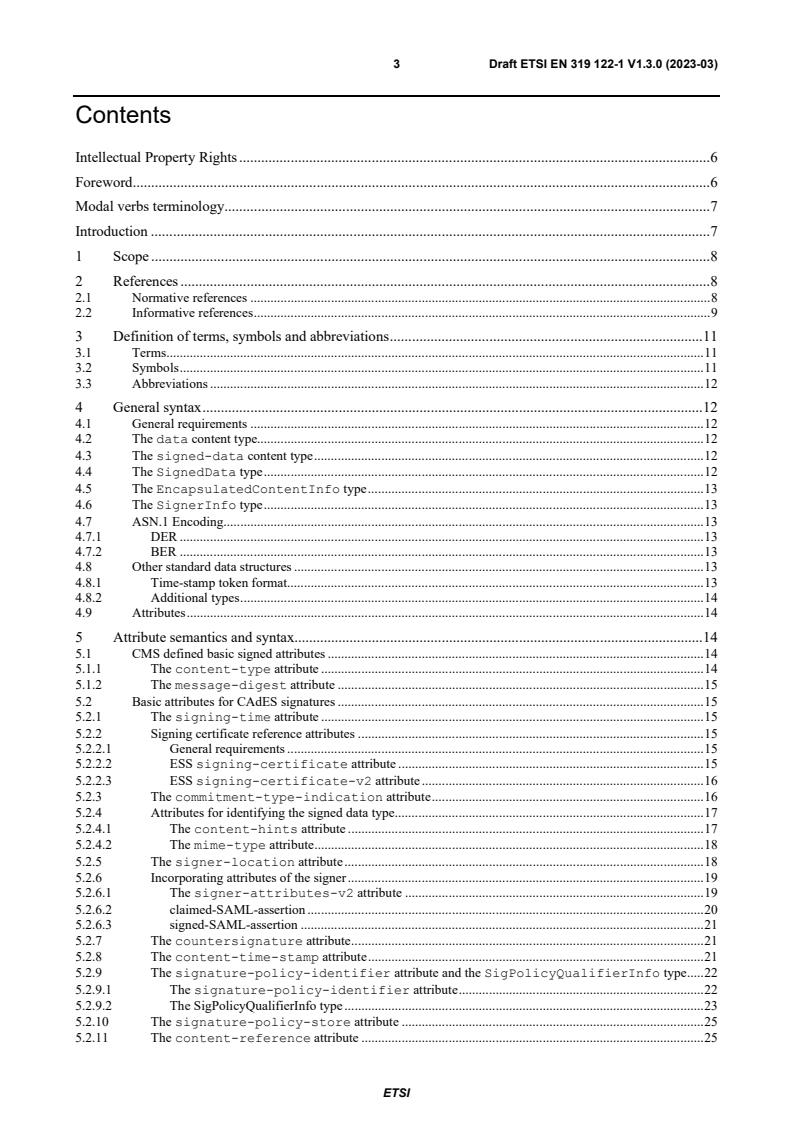
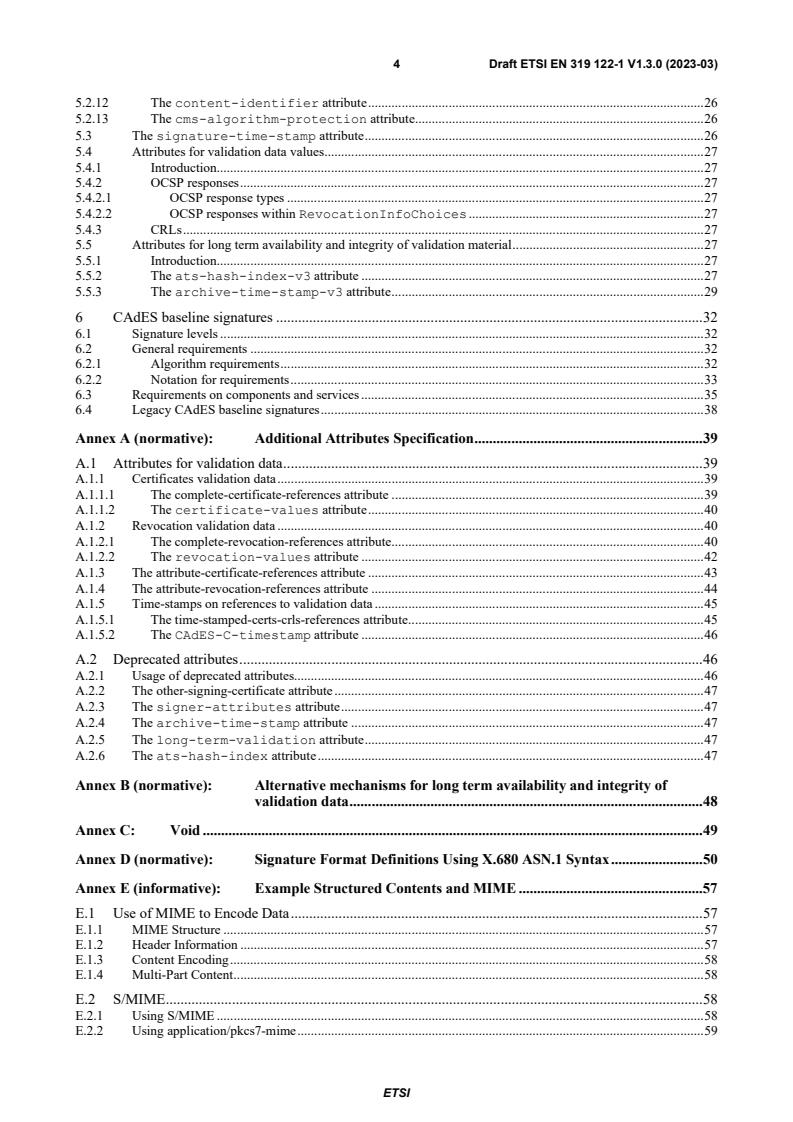
ETSI EN 319 122-1 V1.3.0 (2023-03) - Electronic Signatures and Infrastructures (ESI); CAdES digital signatures; Part 1: Building blocks and CAdES baseline signatures
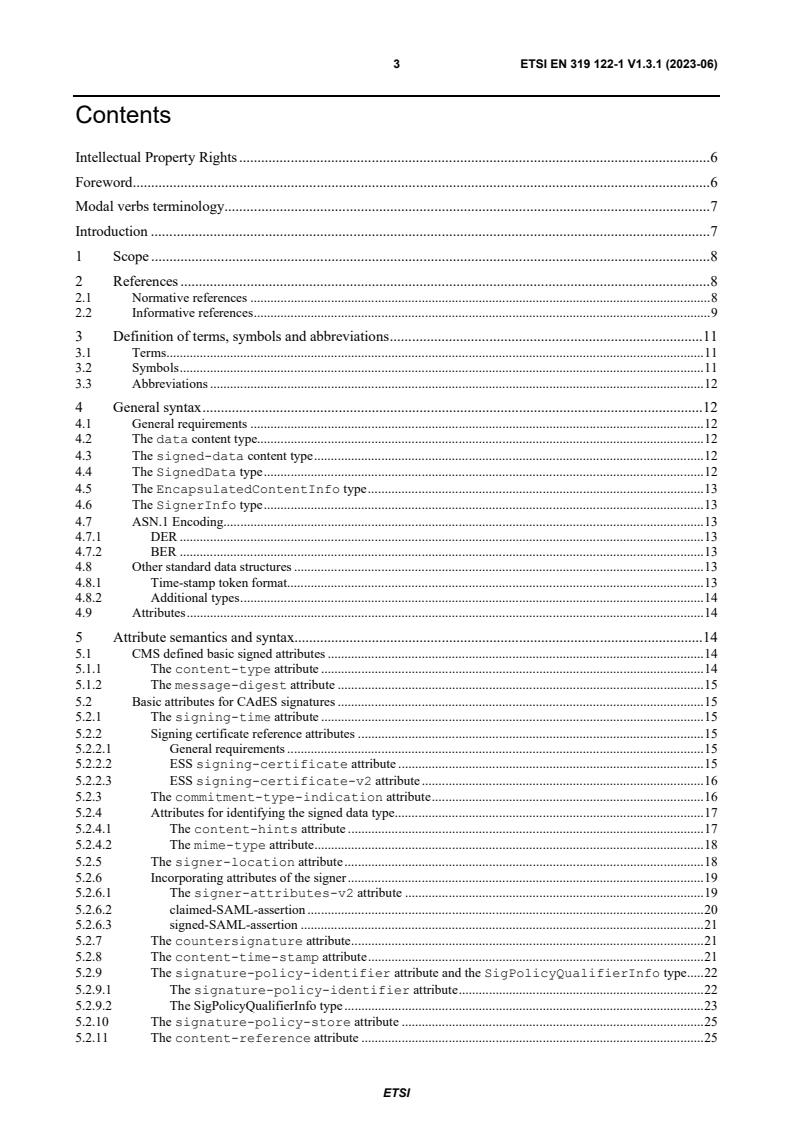
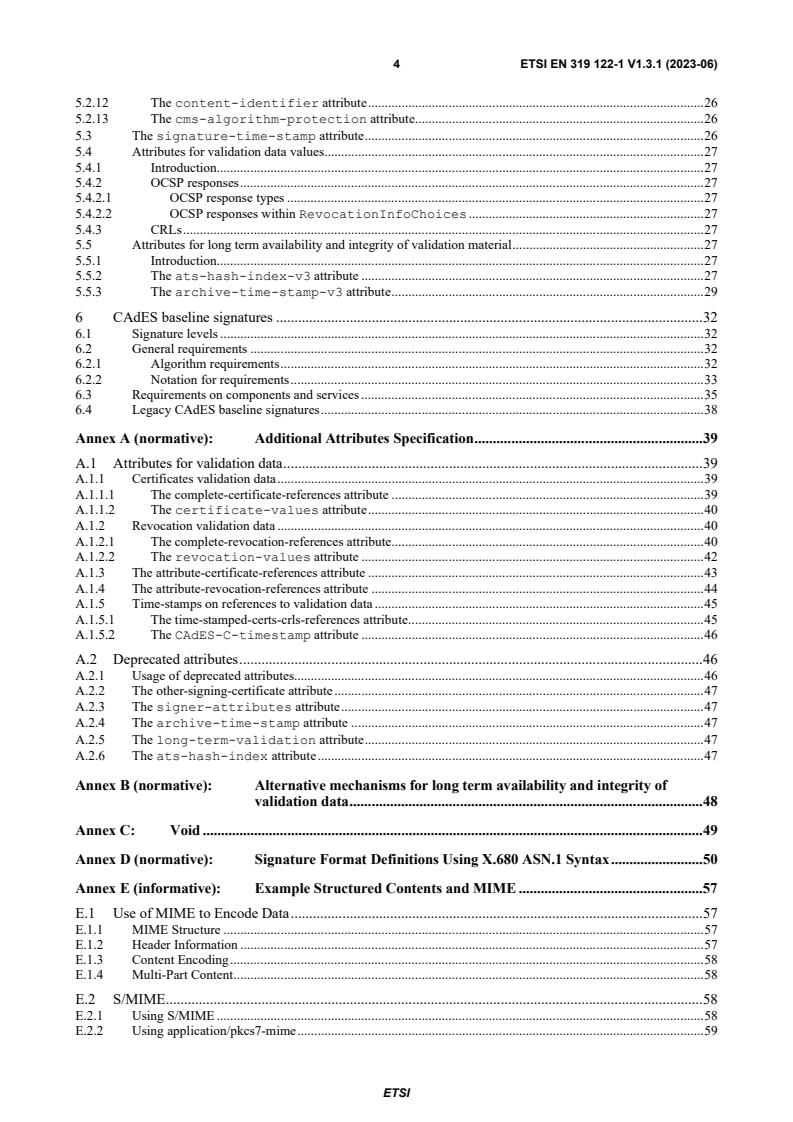
ETSI EN 319 122-1 V1.3.1 (2023-06) - Electronic Signatures and Infrastructures (ESI); CAdES digital signatures; Part 1: Building blocks and CAdES baseline signatures

Overview
SIST EN 319 122-1 V1.3.1:2023 (CAdES Part 1) specifies the building blocks and CAdES digital signature baseline formats used within Electronic Signatures and Infrastructures (ESI). Built on CMS (Cryptographic Message Syntax) signatures, this standard defines the ASN.1 syntax and the semantic use of signed and unsigned attributes needed to achieve common requirements such as long-term validity, interoperability and regulatory support (for example under EU eIDAS). The document defines four CAdES baseline signature levels, each incrementally adding attributes and constraints so higher levels subsume lower-level requirements.
Key technical topics and requirements
- ASN.1 definitions and encoding: formal type definitions and guidance on DER/BER encodings for CAdES attributes and structures.
- CMS-based structure: CAdES is built on CMS SignedData and EncapsulatedContentInfo, with precise signerInfo usage.
- Signed and unsigned attributes: semantics and syntax for attributes such as content-type, message-digest, signing-time, signing-certificate / signing-certificate-v2, commitment-type-indication, content-hints, mime-type, and signer-location.
- Validation and long-term data: attributes and formats to carry validation material (OCSP responses, CRLs, certificate values) and long-term integrity aids such as content-time-stamp, signature-time-stamp, and archive-time-stamp variants.
- Signature policy support: signature-policy-identifier and qualifiers for applying organizational or regulatory signature policies.
- Baseline signature levels: four defined levels that reduce optionality and specify required attributes to maintain signature validity over time.
- Algorithm and component requirements: profiles and constraints on algorithms and the components/services used to create and preserve signatures.
Note: Procedures for creation, augmentation and validation are out of scope (see ETSI EN 319 102-1) and guidance is provided in ETSI TR 119 100.
Practical applications and intended users
- Ensures interoperable, long-term digital signatures for business, government and cross-border electronic documents.
- Supports signature types under regulatory frameworks: electronic signatures, advanced electronic signatures, qualified electronic signatures, electronic seals, and variants under eIDAS.
- Target users: software developers, PKI and trust service providers, security architects, standards implementers, legal/compliance teams, and auditors implementing signature formats in document management, e‑filing, e‑government workflows, and archival systems.
Related standards
- ETSI EN 319 102-1 (creation/validation procedures)
- ETSI TR 119 100 (guidance on usage)
- CMS (RFC standards) and other ETSI/ISO PKI and timestamping specifications.
Keywords: CAdES digital signatures, ASN.1, CMS, baseline signatures, long-term validation, eIDAS, electronic signatures, ETSI, signature policy, OCSP, CRL.
Buy Documents
ETSI EN 319 122-1 V1.3.0 (2023-03) - Electronic Signatures and Infrastructures (ESI); CAdES digital signatures; Part 1: Building blocks and CAdES baseline signatures
ETSI EN 319 122-1 V1.3.1 (2023-06) - Electronic Signatures and Infrastructures (ESI); CAdES digital signatures; Part 1: Building blocks and CAdES baseline signatures
Get Certified
Connect with accredited certification bodies for this standard

BSI Group
BSI (British Standards Institution) is the business standards company that helps organizations make excellence a habit.

NYCE
Mexican standards and certification body.
Sponsored listings
Frequently Asked Questions
SIST EN 319 122-1 V1.3.1:2023 is a standard published by the Slovenian Institute for Standardization (SIST). Its full title is "Electronic Signatures and Infrastructures (ESI) - CAdES digital signatures - Part 1: Building blocks and CAdES baseline signatures". This standard covers: The present document specifies CAdES digital signatures. CAdES signatures are built on CMS signatures [7], by incorporation of signed and unsigned attributes, which fulfil certain common requirements (such as the long term validity of digital signatures, for instance) in a number of use cases. The present document specifies the ASN.1 definitions for the aforementioned attributes as well as their usage when incorporating them to CAdES signatures. The present document specifies formats for CAdES baseline signatures, which provide the basic features necessary for a wide range of business and governmental use cases for electronic procedures and communications to be applicable to a wide range of communities when there is a clear need for interoperability of digital signatures used in electronic documents. The present document defines four levels of CAdES baseline signatures addressing incremental requirements to maintain the validity of the signatures over the long term, in a way that a certain level always addresses all the requirements addressed at levels that are below it. Each level requires the presence of certain CAdES attributes, suitably profiled for reducing the optionality as much as possible. Procedures for creation, augmentation and validation of CAdES digital signatures are out of scope and specified in ETSI EN 319 102-1 [i.5]. Guidance on creation, augmentation and validation of CAdES digital signatures including the usage of the different properties defined in the present document is provided in ETSI TR 119 100 [i.4]. The present document aims at supporting digital signatures in different regulatory frameworks. NOTE: Specifically, but not exclusively, CAdES digital signatures specified in the present document aim at supporting electronic signatures, advanced electronic signatures, qualified electronic signatures, electronic seals, advanced electronic seals, and qualified electronic seals as per Regulation (EU) No 910/2014 [i.13].
The present document specifies CAdES digital signatures. CAdES signatures are built on CMS signatures [7], by incorporation of signed and unsigned attributes, which fulfil certain common requirements (such as the long term validity of digital signatures, for instance) in a number of use cases. The present document specifies the ASN.1 definitions for the aforementioned attributes as well as their usage when incorporating them to CAdES signatures. The present document specifies formats for CAdES baseline signatures, which provide the basic features necessary for a wide range of business and governmental use cases for electronic procedures and communications to be applicable to a wide range of communities when there is a clear need for interoperability of digital signatures used in electronic documents. The present document defines four levels of CAdES baseline signatures addressing incremental requirements to maintain the validity of the signatures over the long term, in a way that a certain level always addresses all the requirements addressed at levels that are below it. Each level requires the presence of certain CAdES attributes, suitably profiled for reducing the optionality as much as possible. Procedures for creation, augmentation and validation of CAdES digital signatures are out of scope and specified in ETSI EN 319 102-1 [i.5]. Guidance on creation, augmentation and validation of CAdES digital signatures including the usage of the different properties defined in the present document is provided in ETSI TR 119 100 [i.4]. The present document aims at supporting digital signatures in different regulatory frameworks. NOTE: Specifically, but not exclusively, CAdES digital signatures specified in the present document aim at supporting electronic signatures, advanced electronic signatures, qualified electronic signatures, electronic seals, advanced electronic seals, and qualified electronic seals as per Regulation (EU) No 910/2014 [i.13].
SIST EN 319 122-1 V1.3.1:2023 is classified under the following ICS (International Classification for Standards) categories: 35.040.01 - Information coding in general. The ICS classification helps identify the subject area and facilitates finding related standards.
SIST EN 319 122-1 V1.3.1:2023 is associated with the following European legislation: Standardization Mandates: M/460. When a standard is cited in the Official Journal of the European Union, products manufactured in conformity with it benefit from a presumption of conformity with the essential requirements of the corresponding EU directive or regulation.
SIST EN 319 122-1 V1.3.1:2023 is available in PDF format for immediate download after purchase. The document can be added to your cart and obtained through the secure checkout process. Digital delivery ensures instant access to the complete standard document.
Standards Content (Sample)
Draft ETSI EN 319 122-1 V1.3.0 (2023-03)
EUROPEAN STANDARD
Electronic Signatures and Infrastructures (ESI);
CAdES digital signatures;
Part 1: Building blocks and CAdES baseline signatures
2 Draft ETSI EN 319 122-1 V1.3.0 (2023-03)
Reference
REN/ESI-0019122-1v1.3.1
Keywords
ASN.1, CAdES, electronic signature, profile,
security
ETSI
650 Route des Lucioles
F-06921 Sophia Antipolis Cedex - FRANCE
Tel.: +33 4 92 94 42 00 Fax: +33 4 93 65 47 16
Siret N° 348 623 562 00017 - APE 7112B
Association à but non lucratif enregistrée à la
Sous-Préfecture de Grasse (06) N° w061004871
Important notice
The present document can be downloaded from:
https://www.etsi.org/standards-search
The present document may be made available in electronic versions and/or in print. The content of any electronic and/or
print versions of the present document shall not be modified without the prior written authorization of ETSI. In case of any
existing or perceived difference in contents between such versions and/or in print, the prevailing version of an ETSI
deliverable is the one made publicly available in PDF format at www.etsi.org/deliver.
Users of the present document should be aware that the document may be subject to revision or change of status.
Information on the current status of this and other ETSI documents is available at
https://portal.etsi.org/TB/ETSIDeliverableStatus.aspx
If you find errors in the present document, please send your comment to one of the following services:
https://portal.etsi.org/People/CommiteeSupportStaff.aspx
If you find a security vulnerability in the present document, please report it through our
Coordinated Vulnerability Disclosure Program:
https://www.etsi.org/standards/coordinated-vulnerability-disclosure
Notice of disclaimer & limitation of liability
The information provided in the present deliverable is directed solely to professionals who have the appropriate degree of
experience to understand and interpret its content in accordance with generally accepted engineering or
other professional standard and applicable regulations.
No recommendation as to products and services or vendors is made or should be implied.
In no event shall ETSI be held liable for loss of profits or any other incidental or consequential damages.
Any software contained in this deliverable is provided "AS IS" with no warranties, express or implied, including but not
limited to, the warranties of merchantability, fitness for a particular purpose and non-infringement of intellectual property
rights and ETSI shall not be held liable in any event for any damages whatsoever (including, without limitation, damages
for loss of profits, business interruption, loss of information, or any other pecuniary loss) arising out of or related to the use
of or inability to use the software.
Copyright Notification
No part may be reproduced or utilized in any form or by any means, electronic or mechanical, including photocopying and
microfilm except as authorized by written permission of ETSI.
The content of the PDF version shall not be modified without the written authorization of ETSI.
The copyright and the foregoing restriction extend to reproduction in all media.
© ETSI 2023.
All rights reserved.
ETSI
3 Draft ETSI EN 319 122-1 V1.3.0 (2023-03)
Contents
Intellectual Property Rights . 6
Foreword . 6
Modal verbs terminology . 7
Introduction . 7
1 Scope . 8
2 References . 8
2.1 Normative references . 8
2.2 Informative references . 9
3 Definition of terms, symbols and abbreviations . 11
3.1 Terms . 11
3.2 Symbols . 11
3.3 Abbreviations . 12
4 General syntax . 12
4.1 General requirements . 12
4.2 The data content type. 12
4.3 The signed-data content type . 12
4.4 The SignedData type . 12
4.5 The EncapsulatedContentInfo type . 13
4.6 The SignerInfo type . 13
4.7 ASN.1 Encoding . 13
4.7.1 DER . 13
4.7.2 BER . 13
4.8 Other standard data structures . 13
4.8.1 Time-stamp token format . 13
4.8.2 Additional types . 14
4.9 Attributes . 14
5 Attribute semantics and syntax . 14
5.1 CMS defined basic signed attributes . 14
5.1.1 The content-type attribute . 14
5.1.2 The message-digest attribute . 15
5.2 Basic attributes for CAdES signatures . 15
5.2.1 The signing-time attribute . 15
5.2.2 Signing certificate reference attributes . 15
5.2.2.1 General requirements . 15
5.2.2.2 ESS signing-certificate attribute . 15
5.2.2.3 ESS signing-certificate-v2 attribute . 16
5.2.3 The commitment-type-indication attribute . 16
5.2.4 Attributes for identifying the signed data type . 17
5.2.4.1 The content-hints attribute . 17
5.2.4.2 The mime-type attribute . 18
5.2.5 The signer-location attribute . 18
5.2.6 Incorporating attributes of the signer . 19
5.2.6.1 The signer-attributes-v2 attribute . 19
5.2.6.2 claimed-SAML-assertion . 20
5.2.6.3 signed-SAML-assertion . 21
5.2.7 The countersignature attribute . 21
5.2.8 The content-time-stamp attribute . 21
5.2.9 The signature-policy-identifier attribute and the SigPolicyQualifierInfo type . 22
5.2.9.1 The signature-policy-identifier attribute . 22
5.2.9.2 The SigPolicyQualifierInfo type . 23
5.2.10 The signature-policy-store attribute . 25
5.2.11 The content-reference attribute . 25
ETSI
4 Draft ETSI EN 319 122-1 V1.3.0 (2023-03)
5.2.12 The content-identifier attribute . 26
5.2.13 The cms-algorithm-protection attribute . 26
5.3 The signature-time-stamp attribute . 26
5.4 Attributes for validation data values . 27
5.4.1 Introduction. 27
5.4.2 OCSP responses . 27
5.4.2.1 OCSP response types . 27
5.4.2.2 OCSP responses within RevocationInfoChoices . 27
5.4.3 CRLs . 27
5.5 Attributes for long term availability and integrity of validation material . 27
5.5.1 Introduction. 27
5.5.2 The ats-hash-index-v3 attribute . 27
5.5.3 The archive-time-stamp-v3 attribute . 29
6 CAdES baseline signatures . 32
6.1 Signature levels . 32
6.2 General requirements . 32
6.2.1 Algorithm requirements . 32
6.2.2 Notation for requirements . 33
6.3 Requirements on components and services . 35
6.4 Legacy CAdES baseline signatures . 38
Annex A (normative): Additional Attributes Specification . 39
A.1 Attributes for validation data . 39
A.1.1 Certificates validation data . 39
A.1.1.1 The complete-certificate-references attribute . 39
A.1.1.2 The certificate-values attribute . 40
A.1.2 Revocation validation data . 40
A.1.2.1 The complete-revocation-references attribute. 40
A.1.2.2 The revocation-values attribute . 42
A.1.3 The attribute-certificate-references attribute . 43
A.1.4 The attribute-revocation-references attribute . 44
A.1.5 Time-stamps on references to validation data . 45
A.1.5.1 The time-stamped-certs-crls-references attribute . 45
A.1.5.2 The CAdES-C-timestamp attribute . 46
A.2 Deprecated attributes . 46
A.2.1 Usage of deprecated attributes . 46
A.2.2 The other-signing-certificate attribute . 47
A.2.3 The signer-attributes attribute . 47
A.2.4 The archive-time-stamp attribute . 47
A.2.5 The long-term-validation attribute . 47
A.2.6 The ats-hash-index attribute . 47
Annex B (normative): Alternative mechanisms for long term availability and integrity of
validation data . 48
Annex C: Void . 49
Annex D (normative): Signature Format Definitions Using X.680 ASN.1 Syntax . 50
Annex E (informative): Example Structured Contents and MIME . 57
E.1 Use of MIME to Encode Data . 57
E.1.1 MIME Structure . 57
E.1.2 Header Information . 57
E.1.3 Content Encoding . 58
E.1.4 Multi-Part Content . 58
E.2 S/MIME . 58
E.2.1 Using S/MIME . 58
E.2.2 Using application/pkcs7-mime . 59
ETSI
5 Draft ETSI EN 319 122-1 V1.3.0 (2023-03)
E.2.3 Using multipart/signed and application/pkcs7-signature . 59
E.3 Use of MIME in the signature . 60
Annex F (informative): Change History . 62
History . 63
ETSI
6 Draft ETSI EN 319 122-1 V1.3.0 (2023-03)
Intellectual Property Rights
Essential patents
IPRs essential or potentially essential to normative deliverables may have been declared to ETSI. The declarations
pertaining to these essential IPRs, if any, are publicly available for ETSI members and non-members, and can be
found in ETSI SR 000 314: "Intellectual Property Rights (IPRs); Essential, or potentially Essential, IPRs notified to
ETSI in respect of ETSI standards", which is available from the ETSI Secretariat. Latest updates are available on the
ETSI Web server (https://ipr.etsi.org/).
Pursuant to the ETSI Directives including the ETSI IPR Policy, no investigation regarding the essentiality of IPRs,
including IPR searches, has been carried out by ETSI. No guarantee can be given as to the existence of other IPRs not
referenced in ETSI SR 000 314 (or the updates on the ETSI Web server) which are, or may be, or may become,
essential to the present document.
Trademarks
The present document may include trademarks and/or tradenames which are asserted and/or registered by their owners.
ETSI claims no ownership of these except for any which are indicated as being the property of ETSI, and conveys no
right to use or reproduce any trademark and/or tradename. Mention of those trademarks in the present document does
not constitute an endorsement by ETSI of products, services or organizations associated with those trademarks.
DECT™, PLUGTESTS™, UMTS™ and the ETSI logo are trademarks of ETSI registered for the benefit of its
Members. 3GPP™ and LTE™ are trademarks of ETSI registered for the benefit of its Members and of the 3GPP
Organizational Partners. oneM2M™ logo is a trademark of ETSI registered for the benefit of its Members and of the ®
oneM2M Partners. GSM and the GSM logo are trademarks registered and owned by the GSM Association.
Foreword
This draft European Standard (EN) has been produced by ETSI Technical Committee Electronic Signatures and
Infrastructures (ESI), and is now submitted for the combined Public Enquiry and Vote phase of the ETSI standards EN
Approval Procedure.
The present document is part 1 of a multi-part deliverable covering CAdES digital signatures, as identified below:
ETSI EN 319 122-1: "Building blocks and CAdES baseline signatures";
ETSI EN 319 122-2: "Extended CAdES signatures";
ETSI TS 119 122-3: "Incorporation of Evidence Record Syntax (ERS) mechanisms in CAdES".
The present document partly contains an evolved specification of the ETSI TS 101 733 [1] and ETSI TS 103 173 [i.1].
Proposed national transposition dates
Date of latest announcement of this EN (doa): 3 months after ETSI publication
Date of latest publication of new National Standard
or endorsement of this EN (dop/e): 6 months after doa
Date of withdrawal of any conflicting National Standard (dow): 6 months after doa
ETSI
7 Draft ETSI EN 319 122-1 V1.3.0 (2023-03)
Modal verbs terminology
In the present document "shall", "shall not", "should", "should not", "may", "need not", "will", "will not", "can" and
"cannot" are to be interpreted as described in clause 3.2 of the ETSI Drafting Rules (Verbal forms for the expression of
provisions).
"must" and "must not" are NOT allowed in ETSI deliverables except when used in direct citation.
Introduction
Electronic commerce has emerged as a frequent way of doing business between companies across local, wide area and
global networks. Trust in this way of doing business is essential for the success and continued development of
electronic commerce. It is therefore important that companies using this electronic means of doing business have
suitable security controls and mechanisms in place to protect their transactions and to ensure trust and confidence with
their business partners. In this respect digital signatures are an important security component that can be used to protect
information and provide trust in electronic business.
The present document is intended to cover digital signatures supported by PKI and public key certificates, and aims to
meet the general requirements of the international community to provide trust and confidence in electronic transactions,
including, amongst other, applicable requirements from Regulation (EU) No 910/2014 [i.13].
The present document can be used for any transaction between an individual and a company, between two companies,
between an individual and a governmental body, etc. The present document is independent of any environment. It can
be applied to any environment e.g. smart cards, GSM SIM cards, special programs for electronic signatures, etc.
The present document is part of a rationalized framework of standards (see ETSI TR 119 000 [i.2]). See ETSI
TR 119 100 [i.4] for getting guidance on how to use the present document within the aforementioned framework.
ETSI
8 Draft ETSI EN 319 122-1 V1.3.0 (2023-03)
1 Scope
The present document specifies CAdES digital signatures. CAdES signatures are built on CMS signatures [7], by
incorporation of signed and unsigned attributes, which fulfil certain common requirements (such as the long term
validity of digital signatures, for instance) in a number of use cases.
The present document specifies the ASN.1 definitions for the aforementioned attributes as well as their usage when
incorporating them to CAdES signatures.
The present document specifies formats for CAdES baseline signatures, which provide the basic features necessary for a
wide range of business and governmental use cases for electronic procedures and communications to be applicable to a
wide range of communities when there is a clear need for interoperability of digital signatures used in electronic
documents.
The present document defines four levels of CAdES baseline signatures addressing incremental requirements to
maintain the validity of the signatures over the long term, in a way that a certain level always addresses all the
requirements addressed at levels that are below it. Each level requires the presence of certain CAdES attributes, suitably
profiled for reducing the optionality as much as possible.
Procedures for creation, augmentation and validation of CAdES digital signatures are out of scope and specified in
ETSI EN 319 102-1 [i.5]. Guidance on creation, augmentation and validation of CAdES digital signatures including the
usage of the different properties defined in the present document is provided in ETSI TR 119 100 [i.4].
The present document aims at supporting digital signatures in different regulatory frameworks.
NOTE: Specifically, but not exclusively, CAdES digital signatures specified in the present document aim at
supporting electronic signatures, advanced electronic signatures, qualified electronic signatures,
electronic seals, advanced electronic seals, and qualified electronic seals as per Regulation (EU)
No 910/2014 [i.13].
2 References
2.1 Normative references
References are either specific (identified by date of publication and/or edition number or version number) or
non-specific. For specific references, only the cited version applies. For non-specific references, the latest version of the
referenced document (including any amendments) applies.
Referenced documents which are not found to be publicly available in the expected location might be found at
https://docbox.etsi.org/Reference.
NOTE: While any hyperlinks included in this clause were valid at the time of publication, ETSI cannot guarantee
their long term validity.
The following referenced documents are necessary for the application of the present document.
[1] ETSI TS 101 733 (V2.2.1): "Electronic Signatures and Infrastructures (ESI); CMS Advanced
Electronic Signatures (CAdES)".
[2] IETF RFC 2045 (1996): "Multipurpose Internet Mail Extensions (MIME) Part One: Format of
Internet Message Bodies".
[3] IETF RFC 2634 (1999): "Enhanced Security Services for S/MIME".
[4] IETF RFC 3161 (2001): "Internet X.509 Public Key Infrastructure Time-Stamp Protocol (TSP)".
[5] IETF RFC 5035 (2007): "Enhanced Security Services (ESS) Update: Adding CertID Algorithm
Agility".
ETSI
9 Draft ETSI EN 319 122-1 V1.3.0 (2023-03)
[6] IETF RFC 5280 (2008): "Internet X.509 Public Key Infrastructure Certificate and Certificate
Revocation List (CRL) Profile".
NOTE: Obsoletes IETF RFC 3280.
[7] IETF RFC 5652 (2009): "Cryptographic Message Syntax (CMS)".
NOTE: Obsoletes IETF RFC 3852.
[8] IETF RFC 5755 (2010): "An Internet Attribute Certificate Profile for Authorization".
NOTE: Obsoletes IETF RFC 3281.
[9] IETF RFC 5816 (2010): "ESSCertIDv2 Update for RFC 3161".
[10] IETF RFC 5911 (2010): "New ASN.1 Modules for Cryptographic Message Syntax (CMS) and
S/MIME".
[11] IETF RFC 5912 (2010): "New ASN.1 Modules for the Public Key Infrastructure Using X.509
(PKIX)".
NOTE: Updated by IETF RFC 6268.
[12] IETF RFC 6268 (2011): "Additional New ASN.1 Modules for the Cryptographic Message Syntax
(CMS) and the Public Key Infrastructure Using X.509 (PKIX)".
[13] IETF RFC 5940 (2010): "Additional Cryptographic Message Syntax (CMS) Revocation
Information Choices".
[14] IETF RFC 6960 (2013): "X.509 Internet Public Key Infrastructure Online Certificate Status
Protocol - OCSP".
NOTE: Obsoletes IETF RFC 2560.
[15] Recommendation ITU-T X.520 (11/2008)/ISO/IEC 9594-6:2008): "Information technology -
Open Systems Interconnection - The Directory: Selected attribute types".
[16] Recommendation ITU-T X.680 (11/2008): "Information technology - Abstract Syntax Notation
One (ASN.1): Specification of basic notation".
[17] Recommendation ITU-T X.690 (11/2008): "Information technology - ASN.1 encoding rules:
Specification of Basic Encoding Rules (BER), Canonical Encoding Rules (CER) and
Distinguished Encoding Rules (DER)".
[18] OASIS Standard: "Security Assertion Markup Language (SAML) V2.0".
[19] IETF RFC 6211 (2011): "Cryptographic Message Syntax (CMS) Algorithm Identifier Protection
Attribute".
2.2 Informative references
References are either specific (identified by date of publication and/or edition number or version number) or
non-specific. For specific references, only the cited version applies. For non-specific references, the latest version of the
referenced document (including any amendments) applies.
NOTE: While any hyperlinks included in this clause were valid at the time of publication, ETSI cannot guarantee
their long term validity.
The following referenced documents are not necessary for the application of the present document but they assist the
user with regard to a particular subject area.
[i.1] ETSI TS 103 173 (V2.2.1): "Electronic Signatures and Infrastructures (ESI); CAdES Baseline
Profile".
ETSI
10 Draft ETSI EN 319 122-1 V1.3.0 (2023-03)
[i.2] ETSI TR 119 000: "Electronic Signatures and Infrastructures (ESI); The framework for
standardization of signatures: overview".
[i.3] ETSI TR 119 001: "Electronic Signatures and Infrastructures (ESI); The framework for
standardization of signatures; Definitions and abbreviations".
[i.4] ETSI TR 119 100: "Electronic Signatures and Infrastructures (ESI); Guidance on the use of
standards for signature creation and validation".
[i.5] ETSI EN 319 102-1: "Electronic Signatures and Infrastructures (ESI); Procedures for Creation and
Validation of AdES Digital Signatures; Part 1: Creation and Validation".
[i.6] ETSI EN 319 122-2: "Electronic Signatures and Infrastructures (ESI); CAdES digital signatures;
Part 2: Extended CAdES signatures".
[i.7] ETSI TS 119 172-1: "Electronic Signatures and Infrastructures (ESI); Signature policies; Part 1:
Building blocks and table of contents for human readable signature policy documents".
[i.8] ETSI TS 119 312: "Electronic Signatures and Infrastructures (ESI); Cryptographic Suites".
[i.9] ETSI EN 319 422: "Electronic Signatures and Infrastructures (ESI); Time-stamping protocol and
time-stamp token profiles".
[i.10] Void.
[i.11] ETSI TS 119 612: "Electronic Signatures and Infrastructures (ESI); Trusted Lists".
[i.12] Commission Decision 2009/767/EC of 16 October 2009 amended by CD 2010/425/EU of 28 July
2010, setting out measures facilitating the use of procedures by electronic means through the
"points of single contact" under Directive 2006/123/EC of the European Parliament and of the
Council on services in the internal market.
[i.13] Regulation (EU) No 910/2014 of the European Parliament and of the Council of 23 July 2014 on
electronic identification and trust services for electronic transactions in the internal market and
repealing Directive 1999/93/EC. OJ L 257, 28.8.2014, p. 73-114.
[i.14] IETF RFC 3851 (2004): "Secure/Multipurpose Internet Mail Extensions (S/MIME) Version 3.1
Message Specification".
[i.15] IETF RFC 4998 (2007): "Evidence Record Syntax (ERS)".
[i.16] Void.
[i.17] Recommendation ITU-T X.501 (2008)/ISO/IEC 9594-1 (2008): "Information technology - Open
Systems Interconnection - The Directory: Models".
[i.18] Recommendation ITU-T X.509 (2008)/ISO/IEC 9594-8 (2008): "Information technology - Open
Systems Interconnection - The Directory: Public-key and Attribute Certificate frameworks".
[i.19] Recommendation ITU-T X.683 (2008): "Information technology - Abstract Syntax Notation One
(ASN.1): Parameterization of ASN.1 specifications".
[i.20] ETSI TS 119 511: "Electronic Signatures and Infrastructures (ESI); Policy and security
requirements for trust service providers providing long-term preservation of digital signatures or
general data using digital signature techniques".
[i.21] IETF RFC 8017 (2016): "PKCS #1: RSA Cryptography Specifications Version 2.2".
[i.22] IETF RFC 5753 (2010): "Use of Elliptic Curve Cryptography (ECC) Algorithms in Cryptographic
Message Syntax (CMS)".
ETSI
11 Draft ETSI EN 319 122-1 V1.3.0 (2023-03)
3 Definition of terms, symbols and abbreviations
3.1 Terms
For the purposes of the present document, the terms given in ETSI TR 119 001 [i.3] and the following apply:
CAdES signature: digital signature that satisfies the requirements specified within ETSI EN 319 122 part 1 (the
present document) or part 2 [i.6]
Certificate Revocation List (CRL): signed list indicating a set of public key certificates that are no longer considered
valid by the certificate issuer
digital signature: data appended to, or cryptographic transformation (see cryptography) of a data unit that allows a
recipient of the data unit to prove the source and integrity of the data unit and protect against forgery e.g. by the
recipient
digital signature value: result of the cryptographic transformation of a data unit that allows a recipient of the data unit
to prove the source and integrity of the data unit and protect against forgery e.g. by the recipient
electronic time-stamp: data in electronic form which binds other electronic data to a particular time establishing
evidence that these data existed at that time
NOTE: In the case of IETF RFC 3161 [4] protocol, the electronic time-stamp is referring to the
timeStampToken field within the TimeStampResp element (the TSA's response returned to the
requesting client).
Legacy CAdES 101 733 signature: digital signature generated according to ETSI TS 101 733 [1]
Legacy CAdES baseline signature: digital signature generated according to ETSI TS 103 173 [i.1]
Legacy CAdES signature: legacy CAdES 101 733 signature or a legacy CAdES baseline signature
signature augmentation policy: set of rules, applicable to one or more digital signatures, that defines the technical and
procedural requirements for their augmentation, in order to meet a particular business need, and under which the digital
signature(s) can be determined to be conformant
signature creation policy: set of rules, applicable to one or more digital signatures, that defines the technical and
procedural requirements for their creation, in order to meet a particular business need, and under which the digital
signature(s) can be determined to be conformant
signature policy: signature creation policy, signature augmentation policy, signature validation policy or any
combination thereof, applicable to the same signature or set of signatures
signature validation policy: set of rules, applicable to one or more digital signatures, that defines the technical and
procedural requirements for their validation, in order to meet a particular business need, and under which the digital
signature(s) can be determined to be valid
validation data: data that is used to validate a digital signature
3.2 Symbols
Void.
ETSI
12 Draft ETSI EN 319 122-1 V1.3.0 (2023-03)
3.3 Abbreviations
For the purposes of the present document, the abbreviations given in ETSI TR 119 001 [i.3] and the following apply:
ATSv2 archive-time-stamp attribute
NOTE: As defined in clause A.2.4.
ATSv3 archive-time-stamp-v3 attribute
NOTE: As defined in clause 5.5.3.
4 General syntax
4.1 General requirements
CAdES signatures shall build on Cryptographic Message Syntax (CMS), as defined in IETF RFC 5652 [7], by
incorporation of signed and unsigned attributes as defined in clause 5.1.
CAdES signatures shall comply with clauses 2, 3, 4 and 5 of IETF RFC 5652 [7].
The following clauses list the types that are used in the attributes described in clause 5.1.
4.2 The data content type
The data content type shall be as defined in CMS (IETF RFC 5652 [7], clause 4). It is used to refer to arbitrary octet
strings.
NOTE: The data content type is identified by the object identifier id-data OBJECT IDENTIFIER ::= {
iso(1) member-body(2) us(840) rsadsi(113549) pkcs(1) pkcs7(7) 1 }.
4.3 The signed-data content type
The signed-data content type shall be as defined in CMS (IETF RFC 5652 [7], clause 5). It represents the content
to sign and one or more signature values.
4.4 The SignedData type
The SignedData type shall be as defined in CMS (IETF RFC 5652 [7], clause 5.1). The CMSVersion shall be set
as specified in clause 5.1 of IETF RFC 5652 [7].
SignedData.xxx refers to the element xxx within the SignedData type, like for example
SignedData.certificates, or SignedData.crls. In the same way, if xxx is of type XXX,
SignedData.xxx.yyy is used to refer to the element yyy of type XXX, like for example
SignedData.crls.crl or SignedData.crls.other.
NOTE: Clause 5.1 of IETF RFC 5652 [7] requires that the CMS SignedData version be set to 3 if certificates
from SignedData is present AND (any version 1 attribute certificates are present OR any
SignerInfo structures are version 3 OR eContentType from encapContentInfo is other than
id-data). Otherwise, the CMS SignedData version is required to be set to 1.
ETSI
13 Draft ETSI EN 319 122-1 V1.3.0 (2023-03)
4.5 The EncapsulatedContentInfo type
The EncapsulatedContentInfo type shall be as defined in CMS (IETF RFC 5652 [7], clause 5.2).
For the purpose of long-term validation, either the eContent should be present, or the data that is signed should be
archived in such a way as to preserve any data encoding.
NOTE 1: It is important that the OCTET STRING used to generate the signature remains the same every time
either the verifier or an arbitrator validates the signature.
NOTE 2: The eContent is optional in CMS:
When it is present, this allows the signed data to be encapsulated in the SignedData structure
which then contains both the signed data and the signature. However, the signed data can only be
accessed by a verifier able to decode the ASN.1 encoded SignedData structure.
When it is missing, this allows the signed data to be sent or stored separately from the signature,
and the SignedData structure only contains the signature. Under these circumstances, the data
object that is signed needs to be stored and distributed in such a way as to preserve any data
encoding.
4.6 The SignerInfo type
The SignerInfo type of the digital signature shall be as defined in CMS (IETF RFC 5652 [7], clause 5.3).
The per-signer information is represented in the type SignerInfo. In the case of multiple parallel signatures, there is
one instance of this field for each signer.
The degenerate case where there are no signers shall not be used.
4.7 ASN.1 Encoding
4.7.1 DER
Distinguished Encoding Rules (DER) for ASN.1 types shall be as defined in Recommendation ITU-T X.690 [17].
4.7.2 BER
If Basic Encoding Rules (BER) are used for some ASN.1 types, it shall be as defined in Recommendation ITU-T
X.690 [17].
4.8 Other standard data structures
4.8.1 Time-stamp token format
The TimeStampToken type shall be as defined in IETF RFC 3161 [4] and updated by IETF RFC 5816 [9].
NOTE: Time-stamp tokens are profiled in ETSI EN 319 422 [i.9].
ETSI
14 Draft ETSI EN 319 122-1 V1.3.0 (2023-03)
4.8.2 Additional types
The VisibleString, BMPString, IA5String, GeneralizedTime and UTCTime types shall be as defined in
Recommendation ITU-T X.680 [16].
The DirectoryString type shall be as defined in Recommendation ITU-T X.520 [15].
The AttributeCertificate type shall be as defined in IETF RFC 5755 [8] which is compatible with the
definition in Recommendation ITU-T X.509 [i.18].
The ResponderID, OCSPResponse and BasicOCSPResponse types shall be as defined in IETF RFC 6960 [14].
The Name, Certificate and AlgorithmIdentifier types shall be as defined in IETF RFC 5280 [6].
The Attribute type shall be as defined in IETF RFC 5280 [6] which is compatible with the definition in
Recommendation ITU-T X.501 [i.17].
The CertificateList type shall be as defined in IETF RFC 5280 [6] which is compatible with the X.509 v2 CRL
syntax in Recommendation ITU-T X.509 [i.18].
The RevocationInfoChoices type shall be as defined in IETF RFC 5652 [7].
4.9 Attributes
Clause 5 provides details on attributes specified within CMS (IETF RFC 5652 [7]), ESS (IETF RFC 2634 [3] and
IETF RFC 5035 [5]), and defines new attributes for building CAdES signatures.
The clause distinguishes between two main types of attributes: signed attributes and unsigned attributes. The first ones
are attributes that are covered by the digital signature value produced by the signer using his/her private key, which
implies that the signer has processed these attributes before creating the signature. The unsigned attributes are added by
the signer, by the verifier or by other parties after the production of the signature. They are not secured by the signature
in the SignerInfo element (the one computed by the signer); however they can be actually covered by subsequent
times-stamp attributes.
Signed and unsigned attributes are stored, respectively, in the signedAttrs and unsignedAttrs fields of
SignerInfo (see clause 4.6).
NOTE: The signedAttrs fields of the SignerInfo are DER encoded (see clause 4.7.1) as stated in IETF
RFC 5652 [7], clause 5.3.
5 Attribute semantics and syntax
5.1 CMS defined basic signed attributes
5.1.1 The content-type attribute
Semantics
The content-type attribute is a signed attribute.
The content-type attribute indicates the type of the signed content.
Syntax
The content-type attribute shall be as defined in CMS (IETF RFC 5652 [7], clause 11.1).
NOTE: As stated in IETF RFC 5652 [7], the content of ContentType (the value of the attribute content-
type) is the same as the eContentType of the EncapsulatedContentInfo value being signed.
ETSI
15 Draft ETSI EN 319 122-1 V1.3.0 (2023-03)
5.1.2 The message-digest attribute
Semantics
The message-digest attribute is a signed attribute.
The message-digest attribute specifies the message digest of the content being signed.
Syntax
The message-digest attribute shall be as defined in CMS (IETF RFC 5652 [7], clause 11.2).
The message digest calculation process shall be as defined in CMS (IETF RFC 5652 [7], clause 5.4).
5.2 Basic attributes for CAdES signatures
5.2.1 The signing-time attribute
Semantics
The signing-time attribute is a signed attribute.
The signing-time attribute shall specify the time at which the signer claims to having performed the signing
process.
Syntax
The signing-time att
...
EUROPEAN STANDARD
Electronic Signatures and Infrastructures (ESI);
CAdES digital signatures;
Part 1: Building blocks and CAdES baseline signatures
2 ETSI EN 319 122-1 V1.3.1 (2023-06)
Reference
REN/ESI-0019122-1v1.3.1
Keywords
ASN.1, CAdES, electronic signature, profile,
security
ETSI
650 Route des Lucioles
F-06921 Sophia Antipolis Cedex - FRANCE
Tel.: +33 4 92 94 42 00 Fax: +33 4 93 65 47 16
Siret N° 348 623 562 00017 - APE 7112B
Association à but non lucratif enregistrée à la
Sous-Préfecture de Grasse (06) N° w061004871
Important notice
The present document can be downloaded from:
https://www.etsi.org/standards-search
The present document may be made available in electronic versions and/or in print. The content of any electronic and/or
print versions of the present document shall not be modified without the prior written authorization of ETSI. In case of any
existing or perceived difference in contents between such versions and/or in print, the prevailing version of an ETSI
deliverable is the one made publicly available in PDF format at www.etsi.org/deliver.
Users of the present document should be aware that the document may be subject to revision or change of status.
Information on the current status of this and other ETSI documents is available at
https://portal.etsi.org/TB/ETSIDeliverableStatus.aspx
If you find errors in the present document, please send your comment to one of the following services:
https://portal.etsi.org/People/CommiteeSupportStaff.aspx
If you find a security vulnerability in the present document, please report it through our
Coordinated Vulnerability Disclosure Program:
https://www.etsi.org/standards/coordinated-vulnerability-disclosure
Notice of disclaimer & limitation of liability
The information provided in the present deliverable is directed solely to professionals who have the appropriate degree of
experience to understand and interpret its content in accordance with generally accepted engineering or
other professional standard and applicable regulations.
No recommendation as to products and services or vendors is made or should be implied.
In no event shall ETSI be held liable for loss of profits or any other incidental or consequential damages.
Any software contained in this deliverable is provided "AS IS" with no warranties, express or implied, including but not
limited to, the warranties of merchantability, fitness for a particular purpose and non-infringement of intellectual property
rights and ETSI shall not be held liable in any event for any damages whatsoever (including, without limitation, damages
for loss of profits, business interruption, loss of information, or any other pecuniary loss) arising out of or related to the use
of or inability to use the software.
Copyright Notification
No part may be reproduced or utilized in any form or by any means, electronic or mechanical, including photocopying and
microfilm except as authorized by written permission of ETSI.
The content of the PDF version shall not be modified without the written authorization of ETSI.
The copyright and the foregoing restriction extend to reproduction in all media.
© ETSI 2023.
All rights reserved.
ETSI
3 ETSI EN 319 122-1 V1.3.1 (2023-06)
Contents
Intellectual Property Rights . 6
Foreword . 6
Modal verbs terminology . 7
Introduction . 7
1 Scope . 8
2 References . 8
2.1 Normative references . 8
2.2 Informative references . 9
3 Definition of terms, symbols and abbreviations . 11
3.1 Terms . 11
3.2 Symbols . 11
3.3 Abbreviations . 12
4 General syntax . 12
4.1 General requirements . 12
4.2 The data content type. 12
4.3 The signed-data content type . 12
4.4 The SignedData type . 12
4.5 The EncapsulatedContentInfo type . 13
4.6 The SignerInfo type . 13
4.7 ASN.1 Encoding . 13
4.7.1 DER . 13
4.7.2 BER . 13
4.8 Other standard data structures . 13
4.8.1 Time-stamp token format . 13
4.8.2 Additional types . 14
4.9 Attributes . 14
5 Attribute semantics and syntax . 14
5.1 CMS defined basic signed attributes . 14
5.1.1 The content-type attribute . 14
5.1.2 The message-digest attribute . 15
5.2 Basic attributes for CAdES signatures . 15
5.2.1 The signing-time attribute . 15
5.2.2 Signing certificate reference attributes . 15
5.2.2.1 General requirements . 15
5.2.2.2 ESS signing-certificate attribute . 15
5.2.2.3 ESS signing-certificate-v2 attribute . 16
5.2.3 The commitment-type-indication attribute . 16
5.2.4 Attributes for identifying the signed data type . 17
5.2.4.1 The content-hints attribute . 17
5.2.4.2 The mime-type attribute . 18
5.2.5 The signer-location attribute . 18
5.2.6 Incorporating attributes of the signer . 19
5.2.6.1 The signer-attributes-v2 attribute . 19
5.2.6.2 claimed-SAML-assertion . 20
5.2.6.3 signed-SAML-assertion . 21
5.2.7 The countersignature attribute . 21
5.2.8 The content-time-stamp attribute . 21
5.2.9 The signature-policy-identifier attribute and the SigPolicyQualifierInfo type . 22
5.2.9.1 The signature-policy-identifier attribute . 22
5.2.9.2 The SigPolicyQualifierInfo type . 23
5.2.10 The signature-policy-store attribute . 25
5.2.11 The content-reference attribute . 25
ETSI
4 ETSI EN 319 122-1 V1.3.1 (2023-06)
5.2.12 The content-identifier attribute . 26
5.2.13 The cms-algorithm-protection attribute . 26
5.3 The signature-time-stamp attribute . 26
5.4 Attributes for validation data values . 27
5.4.1 Introduction. 27
5.4.2 OCSP responses . 27
5.4.2.1 OCSP response types . 27
5.4.2.2 OCSP responses within RevocationInfoChoices . 27
5.4.3 CRLs . 27
5.5 Attributes for long term availability and integrity of validation material . 27
5.5.1 Introduction. 27
5.5.2 The ats-hash-index-v3 attribute . 27
5.5.3 The archive-time-stamp-v3 attribute . 29
6 CAdES baseline signatures . 32
6.1 Signature levels . 32
6.2 General requirements . 32
6.2.1 Algorithm requirements . 32
6.2.2 Notation for requirements . 33
6.3 Requirements on components and services . 35
6.4 Legacy CAdES baseline signatures . 38
Annex A (normative): Additional Attributes Specification . 39
A.1 Attributes for validation data . 39
A.1.1 Certificates validation data . 39
A.1.1.1 The complete-certificate-references attribute . 39
A.1.1.2 The certificate-values attribute . 40
A.1.2 Revocation validation data . 40
A.1.2.1 The complete-revocation-references attribute. 40
A.1.2.2 The revocation-values attribute . 42
A.1.3 The attribute-certificate-references attribute . 43
A.1.4 The attribute-revocation-references attribute . 44
A.1.5 Time-stamps on references to validation data . 45
A.1.5.1 The time-stamped-certs-crls-references attribute . 45
A.1.5.2 The CAdES-C-timestamp attribute . 46
A.2 Deprecated attributes . 46
A.2.1 Usage of deprecated attributes . 46
A.2.2 The other-signing-certificate attribute . 47
A.2.3 The signer-attributes attribute . 47
A.2.4 The archive-time-stamp attribute . 47
A.2.5 The long-term-validation attribute . 47
A.2.6 The ats-hash-index attribute . 47
Annex B (normative): Alternative mechanisms for long term availability and integrity of
validation data . 48
Annex C: Void . 49
Annex D (normative): Signature Format Definitions Using X.680 ASN.1 Syntax . 50
Annex E (informative): Example Structured Contents and MIME . 57
E.1 Use of MIME to Encode Data . 57
E.1.1 MIME Structure . 57
E.1.2 Header Information . 57
E.1.3 Content Encoding . 58
E.1.4 Multi-Part Content . 58
E.2 S/MIME . 58
E.2.1 Using S/MIME . 58
E.2.2 Using application/pkcs7-mime . 59
ETSI
5 ETSI EN 319 122-1 V1.3.1 (2023-06)
E.2.3 Using multipart/signed and application/pkcs7-signature . 59
E.3 Use of MIME in the signature . 60
Annex F (informative): Change History . 62
History . 63
ETSI
6 ETSI EN 319 122-1 V1.3.1 (2023-06)
Intellectual Property Rights
Essential patents
IPRs essential or potentially essential to normative deliverables may have been declared to ETSI. The declarations
pertaining to these essential IPRs, if any, are publicly available for ETSI members and non-members, and can be
found in ETSI SR 000 314: "Intellectual Property Rights (IPRs); Essential, or potentially Essential, IPRs notified to
ETSI in respect of ETSI standards", which is available from the ETSI Secretariat. Latest updates are available on the
ETSI Web server (https://ipr.etsi.org/).
Pursuant to the ETSI Directives including the ETSI IPR Policy, no investigation regarding the essentiality of IPRs,
including IPR searches, has been carried out by ETSI. No guarantee can be given as to the existence of other IPRs not
referenced in ETSI SR 000 314 (or the updates on the ETSI Web server) which are, or may be, or may become,
essential to the present document.
Trademarks
The present document may include trademarks and/or tradenames which are asserted and/or registered by their owners.
ETSI claims no ownership of these except for any which are indicated as being the property of ETSI, and conveys no
right to use or reproduce any trademark and/or tradename. Mention of those trademarks in the present document does
not constitute an endorsement by ETSI of products, services or organizations associated with those trademarks.
DECT™, PLUGTESTS™, UMTS™ and the ETSI logo are trademarks of ETSI registered for the benefit of its
Members. 3GPP™ and LTE™ are trademarks of ETSI registered for the benefit of its Members and of the 3GPP
Organizational Partners. oneM2M™ logo is a trademark of ETSI registered for the benefit of its Members and of the ®
oneM2M Partners. GSM and the GSM logo are trademarks registered and owned by the GSM Association.
Foreword
This European Standard (EN) has been produced by ETSI Technical Committee Electronic Signatures and
Infrastructures (ESI).
The present document is part 1 of a multi-part deliverable covering CAdES digital signatures, as identified below:
ETSI EN 319 122-1: "Building blocks and CAdES baseline signatures";
ETSI EN 319 122-2: "Extended CAdES signatures";
ETSI TS 119 122-3: "Incorporation of Evidence Record Syntax (ERS) mechanisms in CAdES".
The present document partly contains an evolved specification of the ETSI TS 101 733 [1] and ETSI TS 103 173 [i.1].
National transposition dates
Date of adoption of this EN: 26 June 2023
Date of latest announcement of this EN (doa): 30 September 2023
Date of latest publication of new National Standard
or endorsement of this EN (dop/e): 31 March 2024
Date of withdrawal of any conflicting National Standard (dow): 31 March 2024
ETSI
7 ETSI EN 319 122-1 V1.3.1 (2023-06)
Modal verbs terminology
In the present document "shall", "shall not", "should", "should not", "may", "need not", "will", "will not", "can" and
"cannot" are to be interpreted as described in clause 3.2 of the ETSI Drafting Rules (Verbal forms for the expression of
provisions).
"must" and "must not" are NOT allowed in ETSI deliverables except when used in direct citation.
Introduction
Electronic commerce has emerged as a frequent way of doing business between companies across local, wide area and
global networks. Trust in this way of doing business is essential for the success and continued development of
electronic commerce. It is therefore important that companies using this electronic means of doing business have
suitable security controls and mechanisms in place to protect their transactions and to ensure trust and confidence with
their business partners. In this respect digital signatures are an important security component that can be used to protect
information and provide trust in electronic business.
The present document is intended to cover digital signatures supported by PKI and public key certificates, and aims to
meet the general requirements of the international community to provide trust and confidence in electronic transactions,
including, amongst other, applicable requirements from Regulation (EU) No 910/2014 [i.13].
The present document can be used for any transaction between an individual and a company, between two companies,
between an individual and a governmental body, etc. The present document is independent of any environment. It can
be applied to any environment e.g. smart cards, GSM SIM cards, special programs for electronic signatures, etc.
The present document is part of a rationalized framework of standards (see ETSI TR 119 000 [i.2]). See ETSI
TR 119 100 [i.4] for getting guidance on how to use the present document within the aforementioned framework.
ETSI
8 ETSI EN 319 122-1 V1.3.1 (2023-06)
1 Scope
The present document specifies CAdES digital signatures. CAdES signatures are built on CMS signatures [7], by
incorporation of signed and unsigned attributes, which fulfil certain common requirements (such as the long term
validity of digital signatures, for instance) in a number of use cases.
The present document specifies the ASN.1 definitions for the aforementioned attributes as well as their usage when
incorporating them to CAdES signatures.
The present document specifies formats for CAdES baseline signatures, which provide the basic features necessary for a
wide range of business and governmental use cases for electronic procedures and communications to be applicable to a
wide range of communities when there is a clear need for interoperability of digital signatures used in electronic
documents.
The present document defines four levels of CAdES baseline signatures addressing incremental requirements to
maintain the validity of the signatures over the long term, in a way that a certain level always addresses all the
requirements addressed at levels that are below it. Each level requires the presence of certain CAdES attributes, suitably
profiled for reducing the optionality as much as possible.
Procedures for creation, augmentation and validation of CAdES digital signatures are out of scope and specified in
ETSI EN 319 102-1 [i.5]. Guidance on creation, augmentation and validation of CAdES digital signatures including the
usage of the different properties defined in the present document is provided in ETSI TR 119 100 [i.4].
The present document aims at supporting digital signatures in different regulatory frameworks.
NOTE: Specifically, but not exclusively, CAdES digital signatures specified in the present document aim at
supporting electronic signatures, advanced electronic signatures, qualified electronic signatures,
electronic seals, advanced electronic seals, and qualified electronic seals as per Regulation (EU)
No 910/2014 [i.13].
2 References
2.1 Normative references
References are either specific (identified by date of publication and/or edition number or version number) or
non-specific. For specific references, only the cited version applies. For non-specific references, the latest version of the
referenced document (including any amendments) applies.
Referenced documents which are not found to be publicly available in the expected location might be found at
https://docbox.etsi.org/Reference.
NOTE: While any hyperlinks included in this clause were valid at the time of publication, ETSI cannot guarantee
their long term validity.
The following referenced documents are necessary for the application of the present document.
[1] ETSI TS 101 733 (V2.2.1): "Electronic Signatures and Infrastructures (ESI); CMS Advanced
Electronic Signatures (CAdES)".
[2] IETF RFC 2045 (1996): "Multipurpose Internet Mail Extensions (MIME) Part One: Format of
Internet Message Bodies".
[3] IETF RFC 2634 (1999): "Enhanced Security Services for S/MIME".
[4] IETF RFC 3161 (2001): "Internet X.509 Public Key Infrastructure Time-Stamp Protocol (TSP)".
[5] IETF RFC 5035 (2007): "Enhanced Security Services (ESS) Update: Adding CertID Algorithm
Agility".
ETSI
9 ETSI EN 319 122-1 V1.3.1 (2023-06)
[6] IETF RFC 5280 (2008): "Internet X.509 Public Key Infrastructure Certificate and Certificate
Revocation List (CRL) Profile".
NOTE: Obsoletes IETF RFC 3280.
[7] IETF RFC 5652 (2009): "Cryptographic Message Syntax (CMS)".
NOTE: Obsoletes IETF RFC 3852.
[8] IETF RFC 5755 (2010): "An Internet Attribute Certificate Profile for Authorization".
NOTE: Obsoletes IETF RFC 3281.
[9] IETF RFC 5816 (2010): "ESSCertIDv2 Update for RFC 3161".
[10] IETF RFC 5911 (2010): "New ASN.1 Modules for Cryptographic Message Syntax (CMS) and
S/MIME".
[11] IETF RFC 5912 (2010): "New ASN.1 Modules for the Public Key Infrastructure Using X.509
(PKIX)".
NOTE: Updated by IETF RFC 6268.
[12] IETF RFC 6268 (2011): "Additional New ASN.1 Modules for the Cryptographic Message Syntax
(CMS) and the Public Key Infrastructure Using X.509 (PKIX)".
[13] IETF RFC 5940 (2010): "Additional Cryptographic Message Syntax (CMS) Revocation
Information Choices".
[14] IETF RFC 6960 (2013): "X.509 Internet Public Key Infrastructure Online Certificate Status
Protocol - OCSP".
NOTE: Obsoletes IETF RFC 2560.
[15] Recommendation ITU-T X.520 (11/2008)/ISO/IEC 9594-6:2008): "Information technology -
Open Systems Interconnection - The Directory: Selected attribute types".
[16] Recommendation ITU-T X.680 (11/2008): "Information technology - Abstract Syntax Notation
One (ASN.1): Specification of basic notation".
[17] Recommendation ITU-T X.690 (11/2008): "Information technology - ASN.1 encoding rules:
Specification of Basic Encoding Rules (BER), Canonical Encoding Rules (CER) and
Distinguished Encoding Rules (DER)".
[18] OASIS Standard: "Security Assertion Markup Language (SAML) V2.0".
[19] IETF RFC 6211 (2011): "Cryptographic Message Syntax (CMS) Algorithm Identifier Protection
Attribute".
2.2 Informative references
References are either specific (identified by date of publication and/or edition number or version number) or
non-specific. For specific references, only the cited version applies. For non-specific references, the latest version of the
referenced document (including any amendments) applies.
NOTE: While any hyperlinks included in this clause were valid at the time of publication, ETSI cannot guarantee
their long term validity.
The following referenced documents are not necessary for the application of the present document but they assist the
user with regard to a particular subject area.
[i.1] ETSI TS 103 173 (V2.2.1): "Electronic Signatures and Infrastructures (ESI); CAdES Baseline
Profile".
ETSI
10 ETSI EN 319 122-1 V1.3.1 (2023-06)
[i.2] ETSI TR 119 000: "Electronic Signatures and Infrastructures (ESI); The framework for
standardization of signatures: overview".
[i.3] ETSI TR 119 001: "Electronic Signatures and Infrastructures (ESI); The framework for
standardization of signatures; Definitions and abbreviations".
[i.4] ETSI TR 119 100: "Electronic Signatures and Infrastructures (ESI); Guidance on the use of
standards for signature creation and validation".
[i.5] ETSI EN 319 102-1: "Electronic Signatures and Infrastructures (ESI); Procedures for Creation and
Validation of AdES Digital Signatures; Part 1: Creation and Validation".
[i.6] ETSI EN 319 122-2: "Electronic Signatures and Infrastructures (ESI); CAdES digital signatures;
Part 2: Extended CAdES signatures".
[i.7] ETSI TS 119 172-1: "Electronic Signatures and Infrastructures (ESI); Signature policies; Part 1:
Building blocks and table of contents for human readable signature policy documents".
[i.8] ETSI TS 119 312: "Electronic Signatures and Infrastructures (ESI); Cryptographic Suites".
[i.9] ETSI EN 319 422: "Electronic Signatures and Infrastructures (ESI); Time-stamping protocol and
time-stamp token profiles".
[i.10] Void.
[i.11] ETSI TS 119 612: "Electronic Signatures and Infrastructures (ESI); Trusted Lists".
[i.12] Commission Decision 2009/767/EC of 16 October 2009 amended by CD 2010/425/EU of 28 July
2010, setting out measures facilitating the use of procedures by electronic means through the
"points of single contact" under Directive 2006/123/EC of the European Parliament and of the
Council on services in the internal market.
[i.13] Regulation (EU) No 910/2014 of the European Parliament and of the Council of 23 July 2014 on
electronic identification and trust services for electronic transactions in the internal market and
repealing Directive 1999/93/EC. OJ L 257, 28.8.2014, p. 73-114.
[i.14] IETF RFC 3851 (2004): "Secure/Multipurpose Internet Mail Extensions (S/MIME) Version 3.1
Message Specification".
[i.15] IETF RFC 4998 (2007): "Evidence Record Syntax (ERS)".
[i.16] Void.
[i.17] Recommendation ITU-T X.501 (2008)/ISO/IEC 9594-1 (2008): "Information technology - Open
Systems Interconnection - The Directory: Models".
[i.18] Recommendation ITU-T X.509 (2008)/ISO/IEC 9594-8 (2008): "Information technology - Open
Systems Interconnection - The Directory: Public-key and Attribute Certificate frameworks".
[i.19] Recommendation ITU-T X.683 (2008): "Information technology - Abstract Syntax Notation One
(ASN.1): Parameterization of ASN.1 specifications".
[i.20] ETSI TS 119 511: "Electronic Signatures and Infrastructures (ESI); Policy and security
requirements for trust service providers providing long-term preservation of digital signatures or
general data using digital signature techniques".
[i.21] IETF RFC 8017 (2016): "PKCS #1: RSA Cryptography Specifications Version 2.2".
[i.22] IETF RFC 5753 (2010): "Use of Elliptic Curve Cryptography (ECC) Algorithms in Cryptographic
Message Syntax (CMS)".
ETSI
11 ETSI EN 319 122-1 V1.3.1 (2023-06)
3 Definition of terms, symbols and abbreviations
3.1 Terms
For the purposes of the present document, the terms given in ETSI TR 119 001 [i.3] and the following apply:
CAdES signature: digital signature that satisfies the requirements specified within ETSI EN 319 122 part 1 (the
present document) or part 2 [i.6]
Certificate Revocation List (CRL): signed list indicating a set of public key certificates that are no longer considered
valid by the certificate issuer
digital signature: data appended to, or cryptographic transformation (see cryptography) of a data unit that allows a
recipient of the data unit to prove the source and integrity of the data unit and protect against forgery e.g. by the
recipient
digital signature value: result of the cryptographic transformation of a data unit that allows a recipient of the data unit
to prove the source and integrity of the data unit and protect against forgery e.g. by the recipient
electronic time-stamp: data in electronic form which binds other electronic data to a particular time establishing
evidence that these data existed at that time
NOTE: In the case of IETF RFC 3161 [4] protocol, the electronic time-stamp is referring to the
timeStampToken field within the TimeStampResp element (the TSA's response returned to the
requesting client).
Legacy CAdES 101 733 signature: digital signature generated according to ETSI TS 101 733 [1]
Legacy CAdES baseline signature: digital signature generated according to ETSI TS 103 173 [i.1]
Legacy CAdES signature: legacy CAdES 101 733 signature or a legacy CAdES baseline signature
signature augmentation policy: set of rules, applicable to one or more digital signatures, that defines the technical and
procedural requirements for their augmentation, in order to meet a particular business need, and under which the digital
signature(s) can be determined to be conformant
signature creation policy: set of rules, applicable to one or more digital signatures, that defines the technical and
procedural requirements for their creation, in order to meet a particular business need, and under which the digital
signature(s) can be determined to be conformant
signature policy: signature creation policy, signature augmentation policy, signature validation policy or any
combination thereof, applicable to the same signature or set of signatures
signature validation policy: set of rules, applicable to one or more digital signatures, that defines the technical and
procedural requirements for their validation, in order to meet a particular business need, and under which the digital
signature(s) can be determined to be valid
validation data: data that is used to validate a digital signature
3.2 Symbols
Void.
ETSI
12 ETSI EN 319 122-1 V1.3.1 (2023-06)
3.3 Abbreviations
For the purposes of the present document, the abbreviations given in ETSI TR 119 001 [i.3] and the following apply:
ATSv2 archive-time-stamp attribute
NOTE: As defined in clause A.2.4.
ATSv3 archive-time-stamp-v3 attribute
NOTE: As defined in clause 5.5.3.
MIME Multipurpose Internet Mail Extensions
4 General syntax
4.1 General requirements
CAdES signatures shall build on Cryptographic Message Syntax (CMS), as defined in IETF RFC 5652 [7], by
incorporation of signed and unsigned attributes as defined in clause 5.1.
CAdES signatures shall comply with clauses 2, 3, 4 and 5 of IETF RFC 5652 [7].
The following clauses list the types that are used in the attributes described in clause 5.1.
4.2 The data content type
The data content type shall be as defined in CMS (IETF RFC 5652 [7], clause 4). It is used to refer to arbitrary octet
strings.
NOTE: The data content type is identified by the object identifier id-data OBJECT IDENTIFIER ::= {
iso(1) member-body(2) us(840) rsadsi(113549) pkcs(1) pkcs7(7) 1 }.
4.3 The signed-data content type
The signed-data content type shall be as defined in CMS (IETF RFC 5652 [7], clause 5). It represents the content
to sign and one or more signature values.
4.4 The SignedData type
The SignedData type shall be as defined in CMS (IETF RFC 5652 [7], clause 5.1). The CMSVersion shall be set
as specified in clause 5.1 of IETF RFC 5652 [7].
SignedData.xxx refers to the element xxx within the SignedData type, like for example
SignedData.certificates, or SignedData.crls. In the same way, if xxx is of type XXX,
SignedData.xxx.yyy is used to refer to the element yyy of type XXX, like for example
SignedData.crls.crl or SignedData.crls.other.
NOTE: Clause 5.1 of IETF RFC 5652 [7] requires that the CMS SignedData version be set to 3 if certificates
from SignedData is present AND (any version 1 attribute certificates are present OR any
SignerInfo structures are version 3 OR eContentType from encapContentInfo is other than
id-data). Otherwise, the CMS SignedData version is required to be set to 1.
ETSI
13 ETSI EN 319 122-1 V1.3.1 (2023-06)
4.5 The EncapsulatedContentInfo type
The EncapsulatedContentInfo type shall be as defined in CMS (IETF RFC 5652 [7], clause 5.2).
For the purpose of long-term validation, either the eContent should be present, or the data that is signed should be
archived in such a way as to preserve any data encoding.
NOTE 1: It is important that the OCTET STRING used to generate the signature remains the same every time
either the verifier or an arbitrator validates the signature.
NOTE 2: The eContent is optional in CMS:
When it is present, this allows the signed data to be encapsulated in the SignedData structure
which then contains both the signed data and the signature. However, the signed data can only be
accessed by a verifier able to decode the ASN.1 encoded SignedData structure.
When it is missing, this allows the signed data to be sent or stored separately from the signature,
and the SignedData structure only contains the signature. Under these circumstances, the data
object that is signed needs to be stored and distributed in such a way as to preserve any data
encoding.
4.6 The SignerInfo type
The SignerInfo type of the digital signature shall be as defined in CMS (IETF RFC 5652 [7], clause 5.3).
The per-signer information is represented in the type SignerInfo. In the case of multiple parallel signatures, there is
one instance of this field for each signer.
The degenerate case where there are no signers shall not be used.
4.7 ASN.1 Encoding
4.7.1 DER
Distinguished Encoding Rules (DER) for ASN.1 types shall be as defined in Recommendation ITU-T X.690 [17].
4.7.2 BER
If Basic Encoding Rules (BER) are used for some ASN.1 types, it shall be as defined in Recommendation ITU-T
X.690 [17].
4.8 Other standard data structures
4.8.1 Time-stamp token format
The TimeStampToken type shall be as defined in IETF RFC 3161 [4] and updated by IETF RFC 5816 [9].
NOTE: Time-stamp tokens are profiled in ETSI EN 319 422 [i.9].
ETSI
14 ETSI EN 319 122-1 V1.3.1 (2023-06)
4.8.2 Additional types
The VisibleString, BMPString, IA5String, GeneralizedTime and UTCTime types shall be as defined in
Recommendation ITU-T X.680 [16].
The DirectoryString type shall be as defined in Recommendation ITU-T X.520 [15].
The AttributeCertificate type shall be as defined in IETF RFC 5755 [8] which is compatible with the
definition in Recommendation ITU-T X.509 [i.18].
The ResponderID, OCSPResponse and BasicOCSPResponse types shall be as defined in IETF RFC 6960 [14].
The Name, Certificate and AlgorithmIdentifier types shall be as defined in IETF RFC 5280 [6].
The Attribute type shall be as defined in IETF RFC 5280 [6] which is compatible with the definition in
Recommendation ITU-T X.501 [i.17].
The CertificateList type shall be as defined in IETF RFC 5280 [6] which is compatible with the X.509 v2 CRL
syntax in Recommendation ITU-T X.509 [i.18].
The RevocationInfoChoices type shall be as defined in IETF RFC 5652 [7].
4.9 Attributes
Clause 5 provides details on attributes specified within CMS (IETF RFC 5652 [7]), ESS (IETF RFC 2634 [3] and
IETF RFC 5035 [5]), and defines new attributes for building CAdES signatures.
The clause distinguishes between two main types of attributes: signed attributes and unsigned attributes. The first ones
are attributes that are covered by the digital signature value produced by the signer using his/her private key, which
implies that the signer has processed these attributes before creating the signature. The unsigned attributes are added by
the signer, by the verifier or by other parties after the production of the signature. They are not secured by the signature
in the SignerInfo element (the one computed by the signer); however they can be actually covered by subsequent
times-stamp attributes.
Signed and unsigned attributes are stored, respectively, in the signedAttrs and unsignedAttrs fields of
SignerInfo (see clause 4.6).
NOTE: The signedAttrs fields of the SignerInfo are DER encoded (see clause 4.7.1) as stated in IETF
RFC 5652 [7], clause 5.3.
5 Attribute semantics and syntax
5.1 CMS defined basic signed attributes
5.1.1 The content-type attribute
Semantics
The content-type attribute is a signed attribute.
The content-type attribute indicates the type of the signed content.
Syntax
The content-type attribute shall be as defined in CMS (IETF RFC 5652 [7], clause 11.1).
NOTE: As stated in IETF RFC 5652 [7], the content of ContentType (the value of the attribute content-
type) is the same as the eContentType of the EncapsulatedContentInfo value being signed.
ETSI
15 ETSI EN 319 122-1 V1.3.1 (2023-06)
5.1.2 The message-digest attribute
Semantics
The message-digest attribute is a signed attribute.
The message-digest attribute specifies the message digest of the content being signed.
Syntax
The message-digest attribute shall be as defined in CMS (IETF RFC 5652 [7], clause 11.2).
The message digest calculation process shall be as defined in CMS (IETF RFC 5652 [7], clause 5.4).
5.2 Basic attributes for CAdES signatures
5.2.1 The signing-time attribute
Semantics
The signing-time attribute is a signed attribute.
The signing-time attribute shall specify the time at which the signer claims to having performed the signing
process.
Syntax
The signing-time attribute shall be as defined in CMS (IETF RFC 5652 [7], clause 11.3).
5.2.2 Signing certificate reference attributes
5.2.2.1 General requirements
Semantics
...
SLOVENSKI STANDARD
01-september-2023
Elektronski podpisi in infrastruktura (ESI) - Digitalni podpisi CAdES - 1. del:
Gradniki in izhodiščni podpisi CAdES
Electronic Signatures and Infrastructures (ESI) - CAdES digital signatures - Part 1:
Building blocks and CAdES baseline signatures
Ta slovenski standard je istoveten z: ETSI EN 319 122-1 V1.3.1 (2023-06)
ICS:
35.040.01 Kodiranje informacij na Information coding in general
splošno
2003-01.Slovenski inštitut za standardizacijo. Razmnoževanje celote ali delov tega standarda ni dovoljeno.
EUROPEAN STANDARD
Electronic Signatures and Infrastructures (ESI);
CAdES digital signatures;
Part 1: Building blocks and CAdES baseline signatures
2 ETSI EN 319 122-1 V1.3.1 (2023-06)
Reference
REN/ESI-0019122-1v1.3.1
Keywords
ASN.1, CAdES, electronic signature, profile,
security
ETSI
650 Route des Lucioles
F-06921 Sophia Antipolis Cedex - FRANCE
Tel.: +33 4 92 94 42 00 Fax: +33 4 93 65 47 16
Siret N° 348 623 562 00017 - APE 7112B
Association à but non lucratif enregistrée à la
Sous-Préfecture de Grasse (06) N° w061004871
Important notice
The present document can be downloaded from:
https://www.etsi.org/standards-search
The present document may be made available in electronic versions and/or in print. The content of any electronic and/or
print versions of the present document shall not be modified without the prior written authorization of ETSI. In case of any
existing or perceived difference in contents between such versions and/or in print, the prevailing version of an ETSI
deliverable is the one made publicly available in PDF format at www.etsi.org/deliver.
Users of the present document should be aware that the document may be subject to revision or change of status.
Information on the current status of this and other ETSI documents is available at
https://portal.etsi.org/TB/ETSIDeliverableStatus.aspx
If you find errors in the present document, please send your comment to one of the following services:
https://portal.etsi.org/People/CommiteeSupportStaff.aspx
If you find a security vulnerability in the present document, please report it through our
Coordinated Vulnerability Disclosure Program:
https://www.etsi.org/standards/coordinated-vulnerability-disclosure
Notice of disclaimer & limitation of liability
The information provided in the present deliverable is directed solely to professionals who have the appropriate degree of
experience to understand and interpret its content in accordance with generally accepted engineering or
other professional standard and applicable regulations.
No recommendation as to products and services or vendors is made or should be implied.
In no event shall ETSI be held liable for loss of profits or any other incidental or consequential damages.
Any software contained in this deliverable is provided "AS IS" with no warranties, express or implied, including but not
limited to, the warranties of merchantability, fitness for a particular purpose and non-infringement of intellectual property
rights and ETSI shall not be held liable in any event for any damages whatsoever (including, without limitation, damages
for loss of profits, business interruption, loss of information, or any other pecuniary loss) arising out of or related to the use
of or inability to use the software.
Copyright Notification
No part may be reproduced or utilized in any form or by any means, electronic or mechanical, including photocopying and
microfilm except as authorized by written permission of ETSI.
The content of the PDF version shall not be modified without the written authorization of ETSI.
The copyright and the foregoing restriction extend to reproduction in all media.
© ETSI 2023.
All rights reserved.
ETSI
3 ETSI EN 319 122-1 V1.3.1 (2023-06)
Contents
Intellectual Property Rights . 6
Foreword . 6
Modal verbs terminology . 7
Introduction . 7
1 Scope . 8
2 References . 8
2.1 Normative references . 8
2.2 Informative references . 9
3 Definition of terms, symbols and abbreviations . 11
3.1 Terms . 11
3.2 Symbols . 11
3.3 Abbreviations . 12
4 General syntax . 12
4.1 General requirements . 12
4.2 The data content type. 12
4.3 The signed-data content type . 12
4.4 The SignedData type . 12
4.5 The EncapsulatedContentInfo type . 13
4.6 The SignerInfo type . 13
4.7 ASN.1 Encoding . 13
4.7.1 DER . 13
4.7.2 BER . 13
4.8 Other standard data structures . 13
4.8.1 Time-stamp token format . 13
4.8.2 Additional types . 14
4.9 Attributes . 14
5 Attribute semantics and syntax . 14
5.1 CMS defined basic signed attributes . 14
5.1.1 The content-type attribute . 14
5.1.2 The message-digest attribute . 15
5.2 Basic attributes for CAdES signatures . 15
5.2.1 The signing-time attribute . 15
5.2.2 Signing certificate reference attributes . 15
5.2.2.1 General requirements . 15
5.2.2.2 ESS signing-certificate attribute . 15
5.2.2.3 ESS signing-certificate-v2 attribute . 16
5.2.3 The commitment-type-indication attribute . 16
5.2.4 Attributes for identifying the signed data type . 17
5.2.4.1 The content-hints attribute . 17
5.2.4.2 The mime-type attribute . 18
5.2.5 The signer-location attribute . 18
5.2.6 Incorporating attributes of the signer . 19
5.2.6.1 The signer-attributes-v2 attribute . 19
5.2.6.2 claimed-SAML-assertion . 20
5.2.6.3 signed-SAML-assertion . 21
5.2.7 The countersignature attribute . 21
5.2.8 The content-time-stamp attribute . 21
5.2.9 The signature-policy-identifier attribute and the SigPolicyQualifierInfo type . 22
5.2.9.1 The signature-policy-identifier attribute . 22
5.2.9.2 The SigPolicyQualifierInfo type . 23
5.2.10 The signature-policy-store attribute . 25
5.2.11 The content-reference attribute . 25
ETSI
4 ETSI EN 319 122-1 V1.3.1 (2023-06)
5.2.12 The content-identifier attribute . 26
5.2.13 The cms-algorithm-protection attribute . 26
5.3 The signature-time-stamp attribute . 26
5.4 Attributes for validation data values . 27
5.4.1 Introduction. 27
5.4.2 OCSP responses . 27
5.4.2.1 OCSP response types . 27
5.4.2.2 OCSP responses within RevocationInfoChoices . 27
5.4.3 CRLs . 27
5.5 Attributes for long term availability and integrity of validation material . 27
5.5.1 Introduction. 27
5.5.2 The ats-hash-index-v3 attribute . 27
5.5.3 The archive-time-stamp-v3 attribute . 29
6 CAdES baseline signatures . 32
6.1 Signature levels . 32
6.2 General requirements . 32
6.2.1 Algorithm requirements . 32
6.2.2 Notation for requirements . 33
6.3 Requirements on components and services . 35
6.4 Legacy CAdES baseline signatures . 38
Annex A (normative): Additional Attributes Specification . 39
A.1 Attributes for validation data . 39
A.1.1 Certificates validation data . 39
A.1.1.1 The complete-certificate-references attribute . 39
A.1.1.2 The certificate-values attribute . 40
A.1.2 Revocation validation data . 40
A.1.2.1 The complete-revocation-references attribute. 40
A.1.2.2 The revocation-values attribute . 42
A.1.3 The attribute-certificate-references attribute . 43
A.1.4 The attribute-revocation-references attribute . 44
A.1.5 Time-stamps on references to validation data . 45
A.1.5.1 The time-stamped-certs-crls-references attribute . 45
A.1.5.2 The CAdES-C-timestamp attribute . 46
A.2 Deprecated attributes . 46
A.2.1 Usage of deprecated attributes . 46
A.2.2 The other-signing-certificate attribute . 47
A.2.3 The signer-attributes attribute . 47
A.2.4 The archive-time-stamp attribute . 47
A.2.5 The long-term-validation attribute . 47
A.2.6 The ats-hash-index attribute . 47
Annex B (normative): Alternative mechanisms for long term availability and integrity of
validation data . 48
Annex C: Void . 49
Annex D (normative): Signature Format Definitions Using X.680 ASN.1 Syntax . 50
Annex E (informative): Example Structured Contents and MIME . 57
E.1 Use of MIME to Encode Data . 57
E.1.1 MIME Structure . 57
E.1.2 Header Information . 57
E.1.3 Content Encoding . 58
E.1.4 Multi-Part Content . 58
E.2 S/MIME . 58
E.2.1 Using S/MIME . 58
E.2.2 Using application/pkcs7-mime . 59
ETSI
5 ETSI EN 319 122-1 V1.3.1 (2023-06)
E.2.3 Using multipart/signed and application/pkcs7-signature . 59
E.3 Use of MIME in the signature . 60
Annex F (informative): Change History . 62
History . 63
ETSI
6 ETSI EN 319 122-1 V1.3.1 (2023-06)
Intellectual Property Rights
Essential patents
IPRs essential or potentially essential to normative deliverables may have been declared to ETSI. The declarations
pertaining to these essential IPRs, if any, are publicly available for ETSI members and non-members, and can be
found in ETSI SR 000 314: "Intellectual Property Rights (IPRs); Essential, or potentially Essential, IPRs notified to
ETSI in respect of ETSI standards", which is available from the ETSI Secretariat. Latest updates are available on the
ETSI Web server (https://ipr.etsi.org/).
Pursuant to the ETSI Directives including the ETSI IPR Policy, no investigation regarding the essentiality of IPRs,
including IPR searches, has been carried out by ETSI. No guarantee can be given as to the existence of other IPRs not
referenced in ETSI SR 000 314 (or the updates on the ETSI Web server) which are, or may be, or may become,
essential to the present document.
Trademarks
The present document may include trademarks and/or tradenames which are asserted and/or registered by their owners.
ETSI claims no ownership of these except for any which are indicated as being the property of ETSI, and conveys no
right to use or reproduce any trademark and/or tradename. Mention of those trademarks in the present document does
not constitute an endorsement by ETSI of products, services or organizations associated with those trademarks.
DECT™, PLUGTESTS™, UMTS™ and the ETSI logo are trademarks of ETSI registered for the benefit of its
Members. 3GPP™ and LTE™ are trademarks of ETSI registered for the benefit of its Members and of the 3GPP
Organizational Partners. oneM2M™ logo is a trademark of ETSI registered for the benefit of its Members and of the ®
oneM2M Partners. GSM and the GSM logo are trademarks registered and owned by the GSM Association.
Foreword
This European Standard (EN) has been produced by ETSI Technical Committee Electronic Signatures and
Infrastructures (ESI).
The present document is part 1 of a multi-part deliverable covering CAdES digital signatures, as identified below:
ETSI EN 319 122-1: "Building blocks and CAdES baseline signatures";
ETSI EN 319 122-2: "Extended CAdES signatures";
ETSI TS 119 122-3: "Incorporation of Evidence Record Syntax (ERS) mechanisms in CAdES".
The present document partly contains an evolved specification of the ETSI TS 101 733 [1] and ETSI TS 103 173 [i.1].
National transposition dates
Date of adoption of this EN: 26 June 2023
Date of latest announcement of this EN (doa): 30 September 2023
Date of latest publication of new National Standard
or endorsement of this EN (dop/e): 31 March 2024
Date of withdrawal of any conflicting National Standard (dow): 31 March 2024
ETSI
7 ETSI EN 319 122-1 V1.3.1 (2023-06)
Modal verbs terminology
In the present document "shall", "shall not", "should", "should not", "may", "need not", "will", "will not", "can" and
"cannot" are to be interpreted as described in clause 3.2 of the ETSI Drafting Rules (Verbal forms for the expression of
provisions).
"must" and "must not" are NOT allowed in ETSI deliverables except when used in direct citation.
Introduction
Electronic commerce has emerged as a frequent way of doing business between companies across local, wide area and
global networks. Trust in this way of doing business is essential for the success and continued development of
electronic commerce. It is therefore important that companies using this electronic means of doing business have
suitable security controls and mechanisms in place to protect their transactions and to ensure trust and confidence with
their business partners. In this respect digital signatures are an important security component that can be used to protect
information and provide trust in electronic business.
The present document is intended to cover digital signatures supported by PKI and public key certificates, and aims to
meet the general requirements of the international community to provide trust and confidence in electronic transactions,
including, amongst other, applicable requirements from Regulation (EU) No 910/2014 [i.13].
The present document can be used for any transaction between an individual and a company, between two companies,
between an individual and a governmental body, etc. The present document is independent of any environment. It can
be applied to any environment e.g. smart cards, GSM SIM cards, special programs for electronic signatures, etc.
The present document is part of a rationalized framework of standards (see ETSI TR 119 000 [i.2]). See ETSI
TR 119 100 [i.4] for getting guidance on how to use the present document within the aforementioned framework.
ETSI
8 ETSI EN 319 122-1 V1.3.1 (2023-06)
1 Scope
The present document specifies CAdES digital signatures. CAdES signatures are built on CMS signatures [7], by
incorporation of signed and unsigned attributes, which fulfil certain common requirements (such as the long term
validity of digital signatures, for instance) in a number of use cases.
The present document specifies the ASN.1 definitions for the aforementioned attributes as well as their usage when
incorporating them to CAdES signatures.
The present document specifies formats for CAdES baseline signatures, which provide the basic features necessary for a
wide range of business and governmental use cases for electronic procedures and communications to be applicable to a
wide range of communities when there is a clear need for interoperability of digital signatures used in electronic
documents.
The present document defines four levels of CAdES baseline signatures addressing incremental requirements to
maintain the validity of the signatures over the long term, in a way that a certain level always addresses all the
requirements addressed at levels that are below it. Each level requires the presence of certain CAdES attributes, suitably
profiled for reducing the optionality as much as possible.
Procedures for creation, augmentation and validation of CAdES digital signatures are out of scope and specified in
ETSI EN 319 102-1 [i.5]. Guidance on creation, augmentation and validation of CAdES digital signatures including the
usage of the different properties defined in the present document is provided in ETSI TR 119 100 [i.4].
The present document aims at supporting digital signatures in different regulatory frameworks.
NOTE: Specifically, but not exclusively, CAdES digital signatures specified in the present document aim at
supporting electronic signatures, advanced electronic signatures, qualified electronic signatures,
electronic seals, advanced electronic seals, and qualified electronic seals as per Regulation (EU)
No 910/2014 [i.13].
2 References
2.1 Normative references
References are either specific (identified by date of publication and/or edition number or version number) or
non-specific. For specific references, only the cited version applies. For non-specific references, the latest version of the
referenced document (including any amendments) applies.
Referenced documents which are not found to be publicly available in the expected location might be found at
https://docbox.etsi.org/Reference.
NOTE: While any hyperlinks included in this clause were valid at the time of publication, ETSI cannot guarantee
their long term validity.
The following referenced documents are necessary for the application of the present document.
[1] ETSI TS 101 733 (V2.2.1): "Electronic Signatures and Infrastructures (ESI); CMS Advanced
Electronic Signatures (CAdES)".
[2] IETF RFC 2045 (1996): "Multipurpose Internet Mail Extensions (MIME) Part One: Format of
Internet Message Bodies".
[3] IETF RFC 2634 (1999): "Enhanced Security Services for S/MIME".
[4] IETF RFC 3161 (2001): "Internet X.509 Public Key Infrastructure Time-Stamp Protocol (TSP)".
[5] IETF RFC 5035 (2007): "Enhanced Security Services (ESS) Update: Adding CertID Algorithm
Agility".
ETSI
9 ETSI EN 319 122-1 V1.3.1 (2023-06)
[6] IETF RFC 5280 (2008): "Internet X.509 Public Key Infrastructure Certificate and Certificate
Revocation List (CRL) Profile".
NOTE: Obsoletes IETF RFC 3280.
[7] IETF RFC 5652 (2009): "Cryptographic Message Syntax (CMS)".
NOTE: Obsoletes IETF RFC 3852.
[8] IETF RFC 5755 (2010): "An Internet Attribute Certificate Profile for Authorization".
NOTE: Obsoletes IETF RFC 3281.
[9] IETF RFC 5816 (2010): "ESSCertIDv2 Update for RFC 3161".
[10] IETF RFC 5911 (2010): "New ASN.1 Modules for Cryptographic Message Syntax (CMS) and
S/MIME".
[11] IETF RFC 5912 (2010): "New ASN.1 Modules for the Public Key Infrastructure Using X.509
(PKIX)".
NOTE: Updated by IETF RFC 6268.
[12] IETF RFC 6268 (2011): "Additional New ASN.1 Modules for the Cryptographic Message Syntax
(CMS) and the Public Key Infrastructure Using X.509 (PKIX)".
[13] IETF RFC 5940 (2010): "Additional Cryptographic Message Syntax (CMS) Revocation
Information Choices".
[14] IETF RFC 6960 (2013): "X.509 Internet Public Key Infrastructure Online Certificate Status
Protocol - OCSP".
NOTE: Obsoletes IETF RFC 2560.
[15] Recommendation ITU-T X.520 (11/2008)/ISO/IEC 9594-6:2008): "Information technology -
Open Systems Interconnection - The Directory: Selected attribute types".
[16] Recommendation ITU-T X.680 (11/2008): "Information technology - Abstract Syntax Notation
One (ASN.1): Specification of basic notation".
[17] Recommendation ITU-T X.690 (11/2008): "Information technology - ASN.1 encoding rules:
Specification of Basic Encoding Rules (BER), Canonical Encoding Rules (CER) and
Distinguished Encoding Rules (DER)".
[18] OASIS Standard: "Security Assertion Markup Language (SAML) V2.0".
[19] IETF RFC 6211 (2011): "Cryptographic Message Syntax (CMS) Algorithm Identifier Protection
Attribute".
2.2 Informative references
References are either specific (identified by date of publication and/or edition number or version number) or
non-specific. For specific references, only the cited version applies. For non-specific references, the latest version of the
referenced document (including any amendments) applies.
NOTE: While any hyperlinks included in this clause were valid at the time of publication, ETSI cannot guarantee
their long term validity.
The following referenced documents are not necessary for the application of the present document but they assist the
user with regard to a particular subject area.
[i.1] ETSI TS 103 173 (V2.2.1): "Electronic Signatures and Infrastructures (ESI); CAdES Baseline
Profile".
ETSI
10 ETSI EN 319 122-1 V1.3.1 (2023-06)
[i.2] ETSI TR 119 000: "Electronic Signatures and Infrastructures (ESI); The framework for
standardization of signatures: overview".
[i.3] ETSI TR 119 001: "Electronic Signatures and Infrastructures (ESI); The framework for
standardization of signatures; Definitions and abbreviations".
[i.4] ETSI TR 119 100: "Electronic Signatures and Infrastructures (ESI); Guidance on the use of
standards for signature creation and validation".
[i.5] ETSI EN 319 102-1: "Electronic Signatures and Infrastructures (ESI); Procedures for Creation and
Validation of AdES Digital Signatures; Part 1: Creation and Validation".
[i.6] ETSI EN 319 122-2: "Electronic Signatures and Infrastructures (ESI); CAdES digital signatures;
Part 2: Extended CAdES signatures".
[i.7] ETSI TS 119 172-1: "Electronic Signatures and Infrastructures (ESI); Signature policies; Part 1:
Building blocks and table of contents for human readable signature policy documents".
[i.8] ETSI TS 119 312: "Electronic Signatures and Infrastructures (ESI); Cryptographic Suites".
[i.9] ETSI EN 319 422: "Electronic Signatures and Infrastructures (ESI); Time-stamping protocol and
time-stamp token profiles".
[i.10] Void.
[i.11] ETSI TS 119 612: "Electronic Signatures and Infrastructures (ESI); Trusted Lists".
[i.12] Commission Decision 2009/767/EC of 16 October 2009 amended by CD 2010/425/EU of 28 July
2010, setting out measures facilitating the use of procedures by electronic means through the
"points of single contact" under Directive 2006/123/EC of the European Parliament and of the
Council on services in the internal market.
[i.13] Regulation (EU) No 910/2014 of the European Parliament and of the Council of 23 July 2014 on
electronic identification and trust services for electronic transactions in the internal market and
repealing Directive 1999/93/EC. OJ L 257, 28.8.2014, p. 73-114.
[i.14] IETF RFC 3851 (2004): "Secure/Multipurpose Internet Mail Extensions (S/MIME) Version 3.1
Message Specification".
[i.15] IETF RFC 4998 (2007): "Evidence Record Syntax (ERS)".
[i.16] Void.
[i.17] Recommendation ITU-T X.501 (2008)/ISO/IEC 9594-1 (2008): "Information technology - Open
Systems Interconnection - The Directory: Models".
[i.18] Recommendation ITU-T X.509 (2008)/ISO/IEC 9594-8 (2008): "Information technology - Open
Systems Interconnection - The Directory: Public-key and Attribute Certificate frameworks".
[i.19] Recommendation ITU-T X.683 (2008): "Information technology - Abstract Syntax Notation One
(ASN.1): Parameterization of ASN.1 specifications".
[i.20] ETSI TS 119 511: "Electronic Signatures and Infrastructures (ESI); Policy and security
requirements for trust service providers providing long-term preservation of digital signatures or
general data using digital signature techniques".
[i.21] IETF RFC 8017 (2016): "PKCS #1: RSA Cryptography Specifications Version 2.2".
[i.22] IETF RFC 5753 (2010): "Use of Elliptic Curve Cryptography (ECC) Algorithms in Cryptographic
Message Syntax (CMS)".
ETSI
11 ETSI EN 319 122-1 V1.3.1 (2023-06)
3 Definition of terms, symbols and abbreviations
3.1 Terms
For the purposes of the present document, the terms given in ETSI TR 119 001 [i.3] and the following apply:
CAdES signature: digital signature that satisfies the requirements specified within ETSI EN 319 122 part 1 (the
present document) or part 2 [i.6]
Certificate Revocation List (CRL): signed list indicating a set of public key certificates that are no longer considered
valid by the certificate issuer
digital signature: data appended to, or cryptographic transformation (see cryptography) of a data unit that allows a
recipient of the data unit to prove the source and integrity of the data unit and protect against forgery e.g. by the
recipient
digital signature value: result of the cryptographic transformation of a data unit that allows a recipient of the data unit
to prove the source and integrity of the data unit and protect against forgery e.g. by the recipient
electronic time-stamp: data in electronic form which binds other electronic data to a particular time establishing
evidence that these data existed at that time
NOTE: In the case of IETF RFC 3161 [4] protocol, the electronic time-stamp is referring to the
timeStampToken field within the TimeStampResp element (the TSA's response returned to the
requesting client).
Legacy CAdES 101 733 signature: digital signature generated according to ETSI TS 101 733 [1]
Legacy CAdES baseline signature: digital signature generated according to ETSI TS 103 173 [i.1]
Legacy CAdES signature: legacy CAdES 101 733 signature or a legacy CAdES baseline signature
signature augmentation policy: set of rules, applicable to one or more digital signatures, that defines the technical and
procedural requirements for their augmentation, in order to meet a particular business need, and under which the digital
signature(s) can be determined to be conformant
signature creation policy: set of rules, applicable to one or more digital signatures, that defines the technical and
procedural requirements for their creation, in order to meet a particular business need, and under which the digital
signature(s) can be determined to be conformant
signature policy: signature creation policy, signature augmentation policy, signature validation policy or any
combination thereof, applicable to the same signature or set of signatures
signature validation policy: set of rules, applicable to one or more digital signatures, that defines the technical and
procedural requirements for their validation, in order to meet a particular business need, and under which the digital
signature(s) can be determined to be valid
validation data: data that is used to validate a digital signature
3.2 Symbols
Void.
ETSI
12 ETSI EN 319 122-1 V1.3.1 (2023-06)
3.3 Abbreviations
For the purposes of the present document, the abbreviations given in ETSI TR 119 001 [i.3] and the following apply:
ATSv2 archive-time-stamp attribute
NOTE: As defined in clause A.2.4.
ATSv3 archive-time-stamp-v3 attribute
NOTE: As defined in clause 5.5.3.
MIME Multipurpose Internet Mail Extensions
4 General syntax
4.1 General requirements
CAdES signatures shall build on Cryptographic Message Syntax (CMS), as defined in IETF RFC 5652 [7], by
incorporation of signed and unsigned attributes as defined in clause 5.1.
CAdES signatures shall comply with clauses 2, 3, 4 and 5 of IETF RFC 5652 [7].
The following clauses list the types that are used in the attributes described in clause 5.1.
4.2 The data content type
The data content type shall be as defined in CMS (IETF RFC 5652 [7], clause 4). It is used to refer to arbitrary octet
strings.
NOTE: The data content type is identified by the object identifier id-data OBJECT IDENTIFIER ::= {
iso(1) member-body(2) us(840) rsadsi(113549) pkcs(1) pkcs7(7) 1 }.
4.3 The signed-data content type
The signed-data content type shall be as defined in CMS (IETF RFC 5652 [7], clause 5). It represents the content
to sign and one or more signature values.
4.4 The SignedData type
The SignedData type shall be as defined in CMS (IETF RFC 5652 [7], clause 5.1). The CMSVersion shall be set
as specified in clause 5.1 of IETF RFC 5652 [7].
SignedData.xxx refers to the element xxx within the SignedData type, like for example
SignedData.certificates, or SignedData.crls. In the same way, if xxx is of type XXX,
SignedData.xxx.yyy is used to refer to the element yyy of type XXX, like for example
SignedData.crls.crl or SignedData.crls.other.
NOTE: Clause 5.1 of IETF RFC 5652 [7] requires that the CMS SignedData version be set to 3 if certificates
from SignedData is present AND (any version 1 attribute certificates are present OR any
SignerInfo structures are version 3 OR eContentType from encapContentInfo is other than
id-data). Otherwise, the CMS SignedData version is required to be set to 1.
ETSI
13 ETSI EN 319 122-1 V1.3.1 (2023-06)
4.5 The EncapsulatedContentInfo type
The EncapsulatedContentInfo type shall be as defined in CMS (IETF RFC 5652 [7], clause 5.2).
For the purpose of long-term validation, either the eContent should be present, or the data that is signed should be
archived in such a way as to preserve any data encoding.
NOTE 1: It is important that the OCTET STRING used to generate the signature remains the same every time
either the verifier or an arbitrator validates the signature.
NOTE 2: The eContent is optional in CMS:
When it is present, this allows the signed data to be encapsulated in the SignedData structure
which then contains both the signed data and the signature. However, the signed data can only be
accessed by a verifier able to decode the ASN.1 encoded SignedData structure.
When it is missing, this allows the signed data to be sent or stored separately from the signature,
and the SignedData structure only contains the signature. Under these circumstances, the data
object that is signed needs to be stored and distributed in such a way as to preserve any data
encoding.
4.6 The SignerInfo type
The SignerInfo type of the digital signature shall be as defined in CMS (IETF RFC 5652 [7], clause 5.3).
The per-signer information is represented in the type SignerInfo. In the case of multiple parallel signatures, there is
one instance of this field for each signer.
The degenerate case where there are no signers shall not be used.
4.7 ASN.1 Encoding
4.7.1 DER
Distinguished Encoding Rules (DER) for ASN.1 types shall be as defined in Recommendation ITU-T X.690 [17].
4.7.2 BER
If Basic Encoding Rules (BER) are used for some ASN.1 types, it shall be as defined in Recommendation ITU-T
X.690 [17].
4.8 Other standard data structures
4.8.1 Time-stamp token format
The TimeStampToken type shall be as defined in IETF RFC 3161 [4] and updated by IETF RFC 5816 [9].
NOTE: Time-stamp tokens are profiled in ETSI EN 319 422 [i.9].
ETSI
14 ETSI EN 319 122-1 V1.3.1 (2023-06)
4.8.2 Additional types
The VisibleString, BMPString, IA5String, GeneralizedTime and UTCTime types shall be as defined in
Recommendation ITU-T X.680 [16].
The DirectoryString type shall be as defined in Recommendation ITU-T X.520 [15].
The AttributeCertificate type shall be as defined in IETF RFC 5755 [8] which is compatible with the
definition in Recommendation ITU-T X.509 [i.18].
The ResponderID, OCSPResponse and BasicOCSPResponse types shall be as defined in IETF RFC 6960 [14].
The Name, Certificate and AlgorithmIdentifier types shall be as defined in IETF RFC 5280 [6].
The Attribute type shall be as defined in IETF RFC 5280 [6] which is compatible with the definition in
Recommendation ITU-T X.501 [i.17].
The CertificateList type shall be as defined in IETF RFC 5280 [6] which is compatible with the X.509 v2 CRL
syntax in Recommendation ITU-T X.509 [i.18].
The RevocationInfoChoices type shall be as defined in IETF RFC 5652 [7].
4.9 Attributes
Clause 5 provides details on attributes specified within CMS (IETF RFC 5652 [7]), ESS (IETF RFC 2634 [3] and
IETF RFC 5035 [5]), and defines new attributes for building CAdES signatures.
The clause distinguishes between two main types of attributes: signed attributes and unsigned attributes. The first ones
are attributes that are covered by the digital signature value produced by the signer using his/her private key, which
implies that the signer has processed these attributes before creating the signature. The unsigned attributes are added by
the signer, by the verifier or by other parties after the production of the signature. They are not secured by the signature
in the SignerInfo element (the one computed by the signer); however they can be actually covered by subsequent
times-stamp attributes.
Signed and unsigned attributes are stored, respectively, in the signedAttrs and unsignedAttrs fields of
SignerInfo (see clause 4.6).
NOTE: The signedAttrs fields of the SignerInfo are DER encoded (see clause 4.7.1) as stated in IETF
RFC 5652 [7], clause 5.3.
5 Attribute semantics and syntax
5.1 CMS defined basic signed attributes
5.1.1 The content-type attribute
Semantics
The content-type attribute is a signed attribute.
The content-type attribute indicates the type of the signed content.
Syntax
The
...