

SIST EN 15876:2025
(Main)Electronic fee collection - Evaluation of on-board and roadside equipment for conformity to EN 15509
General Information
- Abstract
This document specifies the test suite structure (TSS) and test purposes (TPs) for evaluation of on-board equipment (OBE) and roadside equipment (RSE) to EN 15509.
Normative Annex A presents the test purposes for the OBE.
Normative Annex B presents the test purposes for the RSE.
Normative Annex C provides the protocol conformance test report (PCTR) proforma for OBE.
Normative Annex D provides the PCTR proforma for RSE.
- Status
- Published
- Public Enquiry End Date
- 28-Oct-2024
- Publication Date
- 15-Jun-2025
- Technical Committee
- ITC - Information technology
- Current Stage
- 6060 - National Implementation/Publication (Adopted Project)
- Start Date
- 15-May-2025
- Due Date
- 20-Jul-2025
- Completion Date
- 16-Jun-2025

Overview
SIST EN 15876:2025 defines how to evaluate on‑board equipment (OBE) and roadside equipment (RSE) for conformity to EN 15509 (the DSRC Electronic Fee Collection interoperability profile). The standard specifies the Test Suite Structure (TSS) and the individual Test Purposes (TPs) used for conformance testing, and includes protocol conformance test report (PCTR) proformas for both OBE and RSE.
Key elements:
- Normative Annex A: TPs for OBE
- Normative Annex B: TPs for RSE
- Normative Annex C: PCTR proforma for OBE
- Normative Annex D: PCTR proforma for RSE
Key technical topics and requirements
- Test Suite Structure (TSS): Organized by layers and function (Physical, DLC - MAC/LLC, Application - functions/data/security, OBE transactions). Each group separates valid (BV) and invalid (BI) behaviour tests.
- Test Purposes (TPs): Clearly defined objectives for individual tests. TPs are classified as identical, derived, or specific relative to base standards and include:
- Reference (clause or table to be validated)
- Initial conditions
- Stimulus and expected behaviour per EN 15509
- TP Naming Conventions: Unique IDs using the pattern TP///- (e.g., group = PHY, iut = OBE/RSE, x = BV or BI).
- Conformance Reporting: Conformity assessment bodies complete the PCTR forms (Annex C/D). The PCTR is a basis for the manufacturer’s declaration of conformity.
- Test scope notes: Physical layer radio tests must be performed in a radio‑wave laboratory and are not part of the abstract test suite (ATS).
Practical applications and users
This standard is practical for:
- Manufacturers of OBEs/RSUs seeking to demonstrate compliance with EN 15509
- Test laboratories and radio‑wave facilities executing conformance testing
- Certification and conformity assessment bodies preparing PCTR and issuing certificates
- Toll operators, transport authorities, and procurement teams who reference standardized conformance criteria in tenders to ensure DSRC interoperability
- System integrators and suppliers building interoperable electronic fee collection (EFC) solutions
Benefits:
- Provides a reproducible, transparent framework for verifying interoperability requirements
- Simplifies product assessment, certification, and procurement referencing
- Aligns conformance testing with ETSI and ISO base standards to avoid duplication
Related standards
Normative references include (among others):
- EN 15509:2023 (EFC interoperability profile for DSRC)
- EN ISO 14906:2023, EN ISO 14907‑2:2021
- ETSI TS 104 022:2024; ETSI EN 300 674‑2‑1:2022; ETSI EN 300 674‑2‑2:2019
- ISO/TS 17573‑2:2020
SIST EN 15876:2025 is an essential standard when implementing, testing, or certifying DSRC-based electronic fee collection systems for interoperability and regulatory compliance.
Relations
- Effective Date
- 01-Jul-2025
- Effective Date
- 28-Jan-2026
- Effective Date
- 28-Jan-2026
- Effective Date
- 28-Jan-2026
- Effective Date
- 28-Jan-2026
- Refers
SIST EN 15509:2023 - Electronic fee collection - Interoperability application profile for DSRC - Effective Date
- 28-Jan-2026
- Effective Date
- 28-Jan-2026
- Effective Date
- 28-Jan-2026
- Effective Date
- 28-Jan-2026
- Effective Date
- 28-Jan-2026
- Effective Date
- 28-Jan-2026
Get Certified
Connect with accredited certification bodies for this standard

BSI Group
BSI (British Standards Institution) is the business standards company that helps organizations make excellence a habit.

TÜV Rheinland
TÜV Rheinland is a leading international provider of technical services.

TÜV SÜD
TÜV SÜD is a trusted partner of choice for safety, security and sustainability solutions.
Sponsored listings
Frequently Asked Questions
SIST EN 15876:2025 is a standard published by the Slovenian Institute for Standardization (SIST). Its full title is "Electronic fee collection - Evaluation of on-board and roadside equipment for conformity to EN 15509". This standard covers: This document specifies the test suite structure (TSS) and test purposes (TPs) for evaluation of on-board equipment (OBE) and roadside equipment (RSE) to EN 15509. Normative Annex A presents the test purposes for the OBE. Normative Annex B presents the test purposes for the RSE. Normative Annex C provides the protocol conformance test report (PCTR) proforma for OBE. Normative Annex D provides the PCTR proforma for RSE.
This document specifies the test suite structure (TSS) and test purposes (TPs) for evaluation of on-board equipment (OBE) and roadside equipment (RSE) to EN 15509. Normative Annex A presents the test purposes for the OBE. Normative Annex B presents the test purposes for the RSE. Normative Annex C provides the protocol conformance test report (PCTR) proforma for OBE. Normative Annex D provides the PCTR proforma for RSE.
SIST EN 15876:2025 is classified under the following ICS (International Classification for Standards) categories: 03.220.20 - Road transport; 35.240.60 - IT applications in transport; 43.040.15 - Car informatics. On board computer systems. The ICS classification helps identify the subject area and facilitates finding related standards.
SIST EN 15876:2025 has the following relationships with other standards: It is inter standard links to SIST EN 15876:2023, SIST EN ISO 14907-2:2021, SIST EN ISO 14816:2006, SIST EN ISO 14906:2023, SIST EN 12834:2004, SIST EN 15509:2023, SIST EN ISO 14816:2006/A1:2019, SIST EN ISO 3166-1:2020, SIST EN ISO 13140:2025, SIST EN ISO 13143:2025, SIST EN ISO 13143-1:2021. Understanding these relationships helps ensure you are using the most current and applicable version of the standard.
SIST EN 15876:2025 is associated with the following European legislation: Standardization Mandates: M/338. When a standard is cited in the Official Journal of the European Union, products manufactured in conformity with it benefit from a presumption of conformity with the essential requirements of the corresponding EU directive or regulation.
SIST EN 15876:2025 is available in PDF format for immediate download after purchase. The document can be added to your cart and obtained through the secure checkout process. Digital delivery ensures instant access to the complete standard document.
Standards Content (Sample)
SLOVENSKI STANDARD
01-julij-2025
Nadomešča:
SIST EN 15876:2023
Elektronsko pobiranje pristojbin - Vrednotenje skladnosti opreme v vozilu in v
obcestni napravi s standardom EN 15509
Electronic fee collection - Evaluation of on-board and roadside equipment for conformity
to EN 15509
Elektronische Gebührenerhebung - Konformitätsprüfung von Fahrzeuggeräten und
straßenseitigen Einrichtungen nach EN 15509
Perception de télépéage - Évaluation de l’équipement embarqué et de l’équipement au
sol à l'EN 15509
Ta slovenski standard je istoveten z: EN 15876:2025
ICS:
03.220.20 Cestni transport Road transport
35.240.60 Uporabniške rešitve IT v IT applications in transport
prometu
43.040.15 Avtomobilska informatika. Car informatics. On board
Vgrajeni računalniški sistemi computer systems
2003-01.Slovenski inštitut za standardizacijo. Razmnoževanje celote ali delov tega standarda ni dovoljeno.
EN 15876
EUROPEAN STANDARD
NORME EUROPÉENNE
April 2025
EUROPÄISCHE NORM
ICS 35.240.60 Supersedes EN 15876:2023
English Version
Electronic fee collection - Evaluation of on-board and
roadside equipment for conformity to EN 15509
Perception de télépéage - Évaluation de la conformité Elektronische Gebührenerhebung -
de l'équipement embarqué et de l'équipement au sol à Konformitätsprüfung von Fahrzeuggeräten und
l'EN 15509 straßenseitigen Einrichtungen nach EN 15509
This European Standard was approved by CEN on 13 January 2025.
CEN members are bound to comply with the CEN/CENELEC Internal Regulations which stipulate the conditions for giving this
European Standard the status of a national standard without any alteration. Up-to-date lists and bibliographical references
concerning such national standards may be obtained on application to the CEN-CENELEC Management Centre or to any CEN
member.
This European Standard exists in three official versions (English, French, German). A version in any other language made by
translation under the responsibility of a CEN member into its own language and notified to the CEN-CENELEC Management
Centre has the same status as the official versions.
CEN members are the national standards bodies of Austria, Belgium, Bulgaria, Croatia, Cyprus, Czech Republic, Denmark, Estonia,
Finland, France, Germany, Greece, Hungary, Iceland, Ireland, Italy, Latvia, Lithuania, Luxembourg, Malta, Netherlands, Norway,
Poland, Portugal, Republic of North Macedonia, Romania, Serbia, Slovakia, Slovenia, Spain, Sweden, Switzerland, Türkiye and
United Kingdom.
EUROPEAN COMMITTEE FOR STANDARDIZATION
COMITÉ EUROPÉEN DE NORMALISATION
EUROPÄISCHES KOMITEE FÜR NORMUNG
CEN-CENELEC Management Centre: Rue de la Science 23, B-1040 Brussels
© 2025 CEN All rights of exploitation in any form and by any means reserved Ref. No. EN 15876:2025 E
worldwide for CEN national Members.
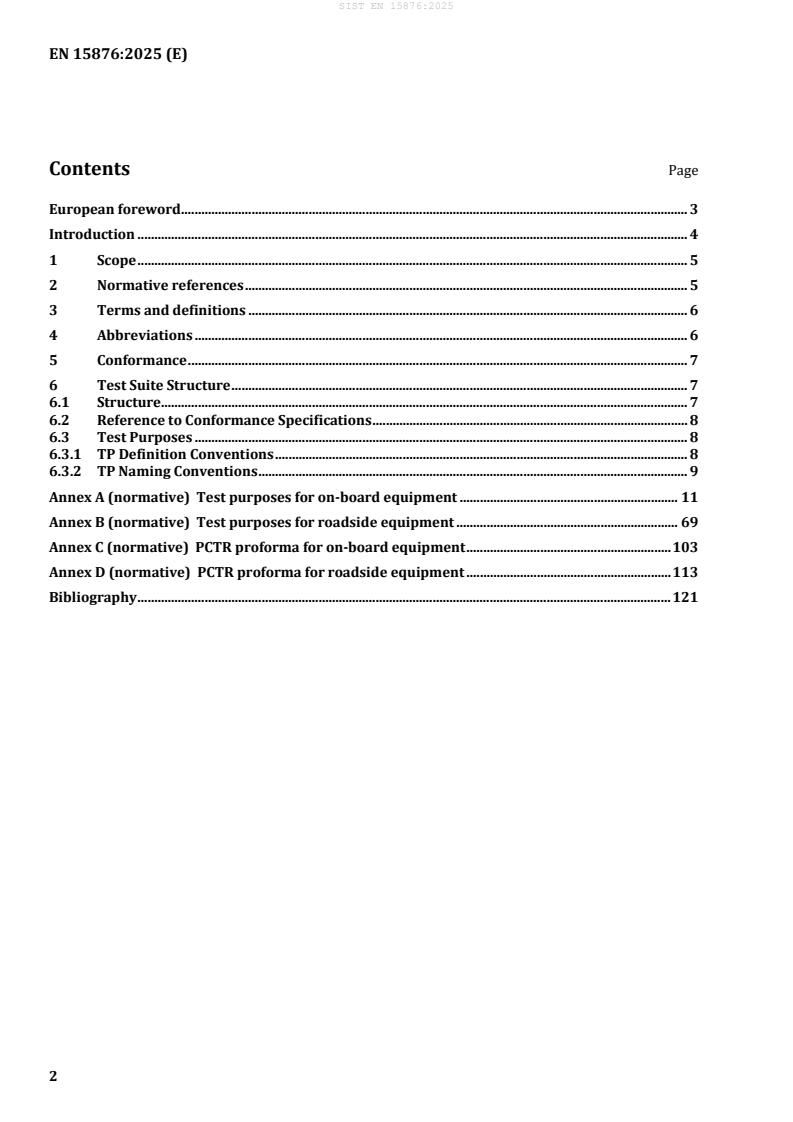
Contents Page
European foreword . 3
Introduction . 4
1 Scope . 5
2 Normative references . 5
3 Terms and definitions . 6
4 Abbreviations . 6
5 Conformance . 7
6 Test Suite Structure . 7
6.1 Structure . 7
6.2 Reference to Conformance Specifications . 8
6.3 Test Purposes . 8
6.3.1 TP Definition Conventions . 8
6.3.2 TP Naming Conventions . 9
Annex A (normative) Test purposes for on-board equipment . 11
Annex B (normative) Test purposes for roadside equipment . 69
Annex C (normative) PCTR proforma for on-board equipment . 103
Annex D (normative) PCTR proforma for roadside equipment . 113
Bibliography . 121
European foreword
This document (EN 15876:2025) has been prepared by Technical Committee CEN/TC 278, “Intelligent
transport systems”, the secretariat of which is held by NEN.
This European Standard shall be given the status of a national standard, either by publication of an
identical text or by endorsement, at the latest by October 2025, and conflicting national standards shall
be withdrawn at the latest by October 2025.
Attention is drawn to the possibility that some of the elements of this document may be the subject of
patent rights. CEN shall not be held responsible for identifying any or all such patent rights.
This document supersedes EN 15876:2023.
This fourth edition of EN 15876 incorporates the following main modifications compared with the
previous version:
Correction of the superseded references to ESTI EN 300 674 1:2004 , which are replaced by
references to ESTI EN 300 674 2 1:2022, ESTI EN 300 674 2 2:2019 and ETSI TS 104 022:2024;
Amendments to improve clarity of the document.
Any feedback and questions on this document should be directed to the users’ national standards body.
A complete listing of these bodies can be found on the CEN website.
According to the CEN-CENELEC Internal Regulations, the national standards organisations of the
following countries are bound to implement this European Standard: Austria, Belgium, Bulgaria, Croatia,
Cyprus, Czech Republic, Denmark, Estonia, Finland, France, Germany, Greece, Hungary, Iceland, Ireland,
Italy, Latvia, Lithuania, Luxembourg, Malta, Netherlands, Norway, Poland, Portugal, Republic of North
Macedonia, Romania, Serbia, Slovakia, Slovenia, Spain, Sweden, Switzerland, Türkiye and the United
Kingdom.
Introduction
CEN/TC 278 has produced a set of standards that support interoperable DSRC-EFC-systems e.g.,
EN ISO 14906 (a "toolbox" for defining EFC-application transaction) and EN ISO 14907-2 (EFC
application interface conformance tests for on-board units). However, these standards are only of an
enabling nature and do not ensure technical interoperability. Therefore, EN 15509, Electronic fee
collection ― Interoperability application profile for DSRC was developed to support technical
interoperability between EFC-systems.
This document specifies the test suite structure and the test purposes for conformity evaluation of on-
board and roadside equipment designed for compliance with the requirements of EN 15509. A test
standard for evaluation of conformity of on-board and roadside equipment is a necessary element for
coherent, practical and effective appraisal of products' compliance to EN 15509.
EN 15876 provides the necessary foundation for verification of the implementation of the
interoperability requirements as stated in EN 15509:
— industry is provided with an easy-to-use toolbox for product assessment;
— operators can easily assess conformity to EN 15509 and reference to the standard in tendering
processes;
— authorities and joint undertakings may reference to the test standard when stating interoperability
requirements;
— certification organisations are given an effective tool for certification of products.
1 Scope
This document specifies the test suite structure (TSS) and test purposes (TPs) for evaluation of on-board
equipment (OBE) and roadside equipment (RSE) to EN 15509.
Normative Annex A presents the test purposes for the OBE.
Normative Annex B presents the test purposes for the RSE.
Normative Annex C provides the protocol conformance test report (PCTR) proforma for OBE.
Normative Annex D provides the PCTR proforma for RSE.
2 Normative references
The following documents are referred to in the text in such a way that some or all of their content
constitutes requirements of this document. For dated references, only the edition cited applies. For
undated references, the latest edition of the referenced document (including any amendments) applies.
EN 15509:2023, Electronic fee collection — Interoperability application profile for DSRC
EN 12834:2003, Road transport and traffic telematics - Dedicated Short Range Communication (DSRC) -
DSRC application layer
EN ISO 3166-1:2020, Codes for the representation of names of countries and their subdivisions — Part 1:
Country code (ISO 3166-1)
EN ISO 14816:2019, Road transport and traffic telematics — Automatic vehicle and equipment
identification — Numbering and data structure (ISO 14816)
EN ISO 14906:2023, Electronic fee collection — Application interface definition for dedicated short-range
communication (ISO 14906:2022)
EN ISO 14907-2:2021, Electronic fee collection — Test procedures for user and fixed equipment — Part 2:
Conformance test for the on-board unit application interface (ISO 14907-2:2021)
ISO/TS 17573-2:2020, Electronic fee collection — Systems architecture for vehicle-related tolling Part 2:
Vocabulary
ETSI TS 104 022:2024, Transport and Traffic Telematics (TTT); Dedicated Short Range Communication
(DSRC) transmission equipment (500 kbit/s / 250 kbit/s) operating in the 5 795 MHz to 5 815 MHz
frequency band; performance tests
ETSI EN 300 674-2-1:2022, Transport and Traffic Telematics (TTT); Dedicated Short Range
Communication (DSRC) transmission equipment (500 kbit/s / 250 kbit/s) operating in the 5 795 MHz to
5 815 MHz frequency band; Part 2: Harmonised Standard for access to radio spectrum; Sub-part 1: Road
Side Units (RSU)
ETSI EN 300 674-2-2:2019, Transport and Traffic Telematics (TTT); Dedicated Short Range
Communication (DSRC) transmission equipment (500 kbit/s / 250 kbit/s) operating in 5 795 MHz to
5 815 MHz frequency band; Part 2: Harmonised Standard for access to radio spectrum; Sub-part 2: On-
Board Units (OBU)
ETSI/TS 102 486-1-2:2008, Intelligent Transport Systems (ITS); Road Transport and Traffic Telematics
(RTTT); Test specifications for Dedicated Short Range Communication (DSRC) transmission equipment;
Part 1: DSRC data link layer: medium access and logical link control; Sub-Part 2: Test Suite Structure and
Test Purposes (TSS&TP)
ETSI/TS 102 486-2-2:2008, Intelligent Transport Systems (ITS); Road Transport and Traffic Telematics
(RTTT); Test specifications for Dedicated Short Range Communication (DSRC) transmission equipment;
Part 2: DSRC application layer; Sub-Part 2: Test Suite Structure and Test Purposes (TSS&TP)
3 Terms and definitions
For the purposes of this document, the terms and definitions given in ISO/TS 17573-2:2020 apply.
ISO and IEC maintain terminology databases for use in standardization at the following addresses:
— IEC Electropedia: available at https://www.electropedia.org/
— ISO Online browsing platform: available at https://www.iso.org/obp
4 Abbreviations
For the purposes of this document, the following abbreviations apply throughout the document unless
otherwise specified.
APDU application protocol data unit
AP application process
ATS abstract test suite
BI behaviour invalid (i.e., invalid behaviour tests)
BST beacon service table
BV behaviour valid (i.e., valid behaviour tests)
DSRC dedicated short-range communication
EFC electronic fee collection
ICS implementation conformance statement
IUT implementation under test
LLC logical link control
LPDU LLC protocol data unit
MAC medium access control
OBE on-board equipment
OBU on-board unit
PCTR protocol conformance test report
PDU protocol data unit
PICS protocol implementation conformance statement
PIXIT protocol implementation extra information for testing
RSE roadside equipment
RSU roadside unit
SCTR system conformance test report
TP test purposes
TSS test suite structure
VST vehicle service table
5 Conformance
The conformance tests shall be performed as specified in Annex A and Annex B.
The conformity assessment body of the OBE and RSE, respectively, is responsible for providing a
conformance test report.
The conformity assessment body of the OBE shall complete the protocol conformance test report (PCTR)
for the OBE as specified in Annex C.
The conformity assessment body of the RSE shall complete the PCTR for the RSE as specified in Annex D.
NOTE The PCTR forms a basis for the manufacturer’s declaration of conformity.
6 Test Suite Structure
6.1 Structure
Table 1 shows the test suite structure (TSS) including its subgroups specified for the conformance testing.
Table 1 — Test Suite Structure
Group Type of IUT Behaviour
Physical layer OBE Valid behaviour
Invalid behaviour
RSE Valid behaviour
Invalid behaviour
DLC MAC sublayer OBE Valid behaviour
Invalid behaviour
RSE Valid behaviour
Invalid behaviour
DLC LLC sublayer OBE Valid behaviour
Invalid behaviour
RSE Valid behaviour
Invalid behaviour
Application layer – Functions OBE Valid behaviour
Invalid behaviour
RSE Valid behaviour
Invalid behaviour
Application Layer – Data OBE Valid behaviour
Invalid behaviour
RSE Valid behaviour
Invalid behaviour
Application Layer – Security OBE Valid behaviour
Level 0
Invalid behaviour
RSE Valid behaviour
Invalid behaviour
Application Layer – Security OBE Valid behaviour
Group Type of IUT Behaviour
Level 1
Invalid behaviour
RSE Valid behaviour
Invalid behaviour
Application Layer – OBE Valid behaviour
Transactions
Invalid behaviour
RSE Valid behaviour
Invalid behaviour
Physical layer tests are to be performed in a radio wave laboratory. They will not form part of the abstract
test suite (ATS).
6.2 Reference to Conformance Specifications
Conformance to a profile standard implies conformance to the related base standards; hence, a number
of test cases for the profile standard are exactly the same as the conformance test cases for the related
base standards. Other test cases are derived from the base standards conformance test cases, by applying
some restrictions or choices in e.g. the parameters values, according to the elements stated in the profile
standard. Finally, specific conformance test cases for the profile standard are identified for statements
contained in the profile standard, which have no equivalence in the base standards. These latter cases
cover for example the security algorithms and functions that are specified in the profile standard. This
document considers existing conformance test purposes for the base standards by referencing them, so
that:
a) For test purposes that are identical to those specified in the base standards conformance test cases
(see e.g. ETSI/TS 102 486-1-2:2008 or ETSI/TS 102 486-2-2:2008) a direct reference is reported.
For reader's convenience, the title or a verbal description of the referenced test purpose is given,
together with the reference.
b) For test purposes that are derived from those specified in the base standards conformance test cases,
a direct reference is reported, plus an indication on how the referred test purpose has to be modified
for the profile conformance testing.
c) For test purposes that are specific to the standard profile, a complete description is given.
An indication on whether a test purpose is identical, derived, or specific is given in each test purpose.
6.3 Test Purposes
6.3.1 TP Definition Conventions
The TPs are specified in tables with a header that contains a TP ID as specified in the sub-clause 6.3.2 and
a title. The content of these tables is following the rules shown in Table 2.
Table 2 — TP Table and Header Content
TP ID The TP ID is a unique identifier. It is specified according to the TP naming
conventions specified in the sub-clause 6.3.2 below.
Title Short description of Test Purpose objective.
Detailed description This line is optional and supplements the title.
Reference The reference contains the references of the subject to be validated by the
actual TP (specification reference, clause, and paragraph).
TP origin It indicates if the TP is identical to a TP specified in another test standard,
derived from a TP specified in another test standard, or specific for this profile
standard.
Initial condition The condition specifies in which initial state the IUT shall be to apply the actual
TP.
Stimulus and Specification of the events the tester shall perform, and the events required by
expected behaviour the IUT to conform to EN 15509:2023.
Note that the reference field generally points to the clause of the base standard EN 15509:2023. As the
same standard contains the Protocol Implementation Conformance Statement proforma, where
appropriate a reference to the relevant table of the PICS is given either in this field or in the text
introducing the group of Test Purposes.
6.3.2 TP Naming Conventions
Each TP is given a unique identification. This unique identification is built up to contain the following
string of information:
TP///-
TP : to indicate that it is a Test Purpose;
: which group among those specified in Table 1 — Test Suite Structure does the TP
apply to;
: type of IUT (i.e. OBE or RSE);
X : type of testing (i.e. Valid Behaviour tests – BV, or Invalid Behaviour tests – BI);
: sequential TP number (01-99).
The naming conventions are as described in Table 3 — TP Naming Conventions.
Table 3 — TP Naming Conventions
Identifier: TP///
>-
PHY Physical layer
MAC MAC sublayer
LLC LLC sublayer
AP-0BAS Application layer – I Kernel support Security level 0
AP-0FUN Application layer – T Kernel support Security level 0
AP-0DAT Application layer – Data attributes support Security Level 0
AP-0SEC Application layer – Security Level 0 support
AP-0TRA Application layer – Transaction support Security level 0
AP-1BAS Application layer – I Kernel support Security level 1
AP-1FUN Application layer – T Kernel support Security level 1
Identifier: TP///
>-
AP-1DAT Application layer – Data attributes support Security Level 1
AP-1SEC Application layer – Security Level 1 support
AP-1TRA Application layer – Transaction support Security level 1
AP-0BAS Application layer – Initialisation phase support Security level 0
AP-0GET Application layer - GET-rq PDU test purposes, security level 0
AP-0SET Application layer - SET-rq PDU test purposes, security level 0
AP-0STA Application layer - GET-STAMPED-rq PDU test purposes, security
level 0
AP-0MMI Application layer - SET-MMI-rq PDU test purposes security level 0
AP-0ECH Application layer - ECHO-rq PDU test purposes, security level 0
AP-0REL Application layer - EVENT-REPORT-rq PDU test purposes,
security level 0
AP-1BAS Application layer - initialization phase test purposes, security
level 1
AP-1GET Application layer - GET-rq PDU test purposes, security level 1
AP-1SET Application layer - SET-rq PDU test purposes, security level 1
AP-1STA Application layer - GET-STAMPED-rq PDU test purposes, security
level 1
AP-1MMI Application layer - SET-MMI-rq PDU test purposes security level 1
AP-1ECH Application layer - ECHO-rq PDU test purposes, security level 1
= type of IUT OBE On-board equipment
RSE Roadside equipment
x = Type of testing BV Valid Behaviour Tests
BI Invalid Behaviour Tests
= sequential (01-99) Test Purpose Number
number
Annex A
(normative)
Test purposes for on-board equipment
A.1 General
This annex specifies the test purposes (TP) for the conformity evaluation of on-board equipment (OBE)
to EN 15509:2023.
OBE and OBU have been used as terms with the same or similar meaning in the standardization of DSRC
and DSRC-based EFC within CEN and ETSI. Previously developed relevant standards used the term OBU
with the meaning OBE as specified in this document. When referring to relevant tests in other documents,
this document uses the terms of the referenced source, which explains why the term OBU is often used in
this Annex.
A.2 Physical Layer
A.2.1 BV Test Purposes
Table A.1 to Table A.9 specify the physical layer BV test purposes.
Test subgroup objective:
— to test the behaviour of the IUT in relation to syntactically and contextual correct behaviour of the
test system.
Table A.1 — TP/PHY/OBU/BV/01 — Dynamic range – sensitivity
TP Origin Identical to ETSI EN 300 674-2-2:2019, Clause 5.3.2.2.
Reference EN 15509:2023, 6.1.2
Initial condition In accordance with ETSI EN 300 674-2-2:2019, Clause 5.3.2.2.1.
Stimulus and
In accordance with ETSI EN 300 674-2-2:2019, Clause 5.3.2.2 and Clause 4.3.2.2.
Expected Behaviour
Table A.2 — TP/PHY/OBU/BV/02 — Dynamic range – upper power limit for communication
TP Origin Identical to ETSI TS 104 022:2024, Clause 9.1.
Reference EN 15509:2023, 6.1.2
Initial condition In accordance with ETSI TS 104 022:2024, Clause 9.1.1.
Stimulus and
In accordance with ETSI TS 104 022:2024, Clause 9.1 and Clause 7.2.1. .
Expected Behaviour
Table A.3 — TP/PHY/OBU/BV/03 — Cut-off power level
TP Origin Identical to ETSI TS 104 022:2024, Clause 9.2.
Reference EN 15509:2023, 6.1.2
Initial condition In accordance with ETSI TS 104 022:2024, Clause 9.2.1.
Stimulus and
In accordance with ETSI TS 104 022:2024, Clause 9.2 and Clause 7.2.2.
Expected Behaviour
Table A.4 — TP/PHY/OBU/BV/04 — Conversion gain
TP Origin Identical to ETSI TS 104 022:2024, Clause 9.3.
Reference EN 15509:2023, 6.1.2
Initial condition In accordance with ETSI TS 104 022:2024, Clause 9.3.1.
Stimulus and
In accordance with ETSI TS 104 022:2024, Clause 9.3 and Clause 7.2.3.
Expected Behaviour
Table A.5 — TP/PHY/OBU/BV/05 — Maximum equivalent isotropic radiated power
TP Origin Identical to ETSI EN 300 674-2-2:2019, Clause 5.3.1.2.
Reference EN 15509:2023, 6.1.2
Initial condition In accordance with ETSI EN 300 674-2-2:2019, Clause 5.3.1.2.1.
Stimulus and
In accordance with ETSI EN 300 674-2-2:2019, Clause 5.3.1.2 and Clause 4.3.1.2.
Expected Behaviour
Table A.6 — TP/PHY/OBU/BV/06 — Frequency error
TP Origin Identical to ETSI EN 300 674-2-2:2019, Clause 5.3.1.3.
Reference EN 15509:2023, 6.1.2
Initial condition In accordance with ETSI EN 300 674-2-2:2019, Clause 5.3.1.3.1.
Stimulus and
In accordance with ETSI EN 300 674-2-2:2019, Clause 5.3.1.3 and Clause 4.3.1.3.
Expected Behaviour
Table A.7 — TP/PHY/OBU/BV/07 — Transmitter spectrum mask
TP Origin Identical to ETSI EN 300 674-2-2:2019, Clause 5.3.1.1.
Reference EN 15509:2023, 6.1.2
Initial condition In accordance with ETSI EN 300 674-2-2:2019, Clause 5.3.1.1.1.
Stimulus and
In accordance with ETSI EN 300 674-2-2:2019, Clause 5.3.1.1 and Clause 4.3.1.1.
Expected Behaviour
Table A.8 — TP/PHY/OBU/BV/08 — Transmitter unwanted emissions
TP Origin Identical to ETSI EN 300 674-2-2:2019, Clause 5.3.1.4.
Reference EN 15509:2023, 6.1.2
Initial condition In accordance with ETSI EN 300 674-2-2:2019, Clause 5.3.1.4.1.
Stimulus and
In accordance with ETSI EN 300 674-2-2:2019, , Clause 5.3.1.4 and Clause 4.3.1.4.
Expected Behaviour
Table A.9 — TP/PHY/OBU/BV/09 — Receiver spurious emissions
TP Origin Identical to ETSI EN 300 674-2-2:2019, Clause 5.3.2.1.
Reference EN 15509:2023, 6.1.2
Initial condition In accordance with ETSI EN 300 674-2-2:2019, Clause 5.3.2.1.1.
Stimulus and In accordance with ETSI EN 300 674-2-21:2019, Clause 5.3.2.1 and Clause
Expected Behaviour 4.3.2.1.
A.2.2 BI Test Purposes
BI test purposes group do not apply for Layer 1.
A.3 MAC
A.3.1 BV Test Purposes
Table A.10 to Table A.17 specify the MAC BV test purposes.
Test subgroup objective:
— to test the behaviour of the IUT in relation to syntactically and contextual correct behaviour of the
test system.
Table A.10 — TP/MAC/OBU/BV/01 — Receive downlink frames – maximum length
TP Origin Identical to ETSI/TS 102 486-1-2:2008 TP/MAC/OBU/BV/01.
Reference EN 15509:2023, 6.1.2
Initial condition In accordance with ETSI/TS 102 486-1-2:2008 TP/MAC/OBU/BV/01.
Stimulus and
In accordance with ETSI/TS 102 486-1-2:2008 TP/MAC/OBU/BV/01.
Expected Behaviour
Table A.11 — TP/MAC/OBU/BV/02 — Receive downlink frames within T1
TP Origin Identical to ETSI/TS 102 486-1-2:2008 TP/MAC/OBU/BV/02.
Reference EN 15509:2023, 6.1.2
Initial condition In accordance with ETSI/TS 102 486-1-2:2008 TP/MAC/OBU/BV/02.
Stimulus and
In accordance with ETSI/TS 102 486-1-2:2008 TP/MAC/OBU/BV/02.
Expected Behaviour
Table A.12 — TP/MAC/OBU/BV/03 — Timing constraints for public uplink windows
TP Origin Identical to ETSI/TS 102 486-1-2:2008 TP/MAC/OBU/BV/03.
Reference EN 15509:2023, 6.1.2
Initial condition In accordance with ETSI/TS 102 486-1-2:2008 TP/MAC/OBU/BV/03.
Stimulus and
In accordance with ETSI/TS 102 486-1-2:2008 TP/MAC/OBU/BV/03.
Expected Behaviour
Table A.13 — TP/MAC/OBU/BV/04 — Receive downlink frames within T2
TP Origin Identical to ETSI/TS 102 486-1-2:2008 TP/MAC/OBU/BV/04.
Reference EN 15509:2023, 6.1.2
Initial condition In accordance with ETSI/TS 102 486-1-2:2008 TP/MAC/OBU/BV/04.
Stimulus and
In accordance with ETSI/TS 102 486-1-2:2008 TP/MAC/OBU/BV/04.
Expected Behaviour
Table A.14 — TP/MAC/OBU/BV/05 — Timing constraints for private uplink windows
TP Origin Identical to ETSI/TS 102 486-1-2:2008 TP/MAC/OBU/BV/05.
Reference EN 15509:2023, 6.1.2
Initial condition In accordance with ETSI/TS 102 486-1-2:2008 TP/MAC/OBU/BV/05.
Stimulus and
In accordance with ETSI/TS 102 486-1-2:2008 TP/MAC/OBU/BV/05.
Expected Behaviour
Table A.15 — TP/MAC/OBU/BV/06 — S-bit and L-bit in MAC control field
TP Origin Identical to ETSI/TS 102 486-1-2:2008 TP/MAC/OBU/BV/06.
Reference EN 15509:2023, 6.1.2
Initial condition In accordance with ETSI/TS 102 486-1-2:2008 TP/MAC/OBU/BV/06.
Stimulus and
In accordance with ETSI/TS 102 486-1-2:2008 TP/MAC/OBU/BV/06.
Expected Behaviour
Table A.16 — TP/MAC/OBU/BV/07 — Manage S-bit state variable
TP Origin Identical to ETSI/TS 102 486-1-2:2008 TP/MAC/OBU/BV/07.
Reference EN 15509:2023, 6.1.2
Initial condition In accordance with ETSI/TS 102 486-1-2:2008 TP/MAC/OBU/BV/07.
Stimulus and
In accordance with ETSI/TS 102 486-1-2:2008 TP/MAC/OBU/BV/07.
Expected Behaviour
Table A.17 — TP/MAC/OBU/BV/08 — Random selection of N5 public uplink windows
TP Origin Identical to ETSI/TS 102 486-1-2:2008 TP/MAC/OBU/BV/08.
Reference EN 15509:2023, 6.1.2
Initial condition In accordance with ETSI/TS 102 486-1-2:2008 TP/MAC/OBU/BV/08.
Stimulus and
In accordance with ETSI/TS 102 486-1-2:2008 TP/MAC/OBU/BV/08.
Expected Behaviour
A.3.2 BI Test Purposes
Table A.18 to Table A.41 specify the MAC BI test purposes.
Test subgroup objective:
— to check the behaviour of the IUT in response to invalid stimuli and behaviour from the test tool.
Table A.18 — TP/MAC/OBU/BI/01 — Manage double-bit errors in the LID, MAC control and
LPDU fields
TP Origin Identical to ETSI/TS 102 486-1-2:2008 TP/MAC/OBU/BI/01.
Reference EN 15509:2023, 6.1.2
Initial condition In accordance with ETSI/TS 102 486-1-2:2008 TP/MAC/OBU/BI/01.
Stimulus and
In accordance with ETSI/TS 102 486-1-2:2008 TP/MAC/OBU/BI/01.
Expected Behaviour
Table A.19 — TP/MAC/OBU/BI/02 — Detect and manage double-bit errors in the FCS field
TP Origin Identical to ETSI/TS 102 486-1-2:2008 TP/MAC/OBU/BI/02.
Reference EN 15509:2023, 6.1.2
Initial condition In accordance with ETSI/TS 102 486-1-2:2008 TP/MAC/OBU/BI/02.
Stimulus and
In accordance with ETSI/TS 102 486-1-2:2008 TP/MAC/OBU/BI/02.
Expected Behaviour
Table A.20 — TP/MAC/OBU/BI/03 — Detect and manage a block of 15 bits errors
TP Origin Identical to ETSI/TS 102 486-1-2:2008 TP/MAC/OBU/BI/03.
Reference EN 15509:2023, 6.1.2
Initial condition In accordance with ETSI/TS 102 486-1-2:2008 TP/MAC/OBU/BI/03.
Stimulus and
In accordance with ETSI/TS 102 486-1-2:2008 TP/MAC/OBU/BI/03.
Expected Behaviour
Table A.21 — TP/MAC/OBU/BI/04 — Detect and manage the abort sequence in the LPDU field
TP Origin Identical to ETSI/TS 102 486-1-2:2008 TP/MAC/OBU/BI/04.
Reference EN 15509:2023, 6.1.2
Initial condition In accordance with ETSI/TS 102 486-1-2:2008 TP/MAC/OBU/BI/04.
Stimulus and
In accordance with ETSI/TS 102 486-1-2:2008 TP/MAC/OBU/BI/04.
Expected Behaviour
Table A.22 — TP/MAC/OBU/BI/05 — Detect and manage the abort sequence at the end of a
downlink frame
TP Origin Identical to ETSI/TS 102 486-1-2:2008 TP/MAC/OBU/BI/05.
Reference EN 15509:2023, 6.1.2
Initial condition In accordance with ETSI/TS 102 486-1-2:2008 TP/MAC/OBU/BI/05.
Stimulus and
In accordance with ETSI/TS 102 486-1-2:2008 TP/MAC/OBU/BI/05.
Expected Behaviour
Table A.23 — TP/MAC/OBU/BI/06 — Detect and manage a too long downlink frame in
accordance with N2
TP Origin Identical to ETSI/TS 102 486-1-2:2008 TP/MAC/OBU/BI/06.
Reference EN 15509:2023, 6.1.2
Initial condition In accordance with ETSI/TS 102 486-1-2:2008 TP/MAC/OBU/BI/06.
Stimulus and
In accordance with ETSI/TS 102 486-1-2:2008 TP/MAC/OBU/BI/06.
Expected Behaviour
Table A.24 — TP/MAC/OBU/BI/07 — Detect and manage wrong format of LID
TP Origin Identical to ETSI/TS 102 486-1-2:2008 TP/MAC/OBU/BI/07.
Reference EN 15509:2023, 6.1.2
Initial condition In accordance with ETSI/TS 102 486-1-2:2008 TP/MAC/OBU/BI/07.
Stimulus and
In accordance with ETSI/TS 102 486-1-2:2008 TP/MAC/OBU/BI/07.
Expected Behaviour
Table A.25 — TP/MAC/OBU/BI/08 — Detect and manage missing MAC control field
TP Origin Identical to ETSI/TS 102 486-1-2:2008 TP/MAC/OBU/BI/08.
Reference EN 15509:2023, 6.1.2
Initial condition In accordance with ETSI/TS 102 486-1-2:2008 TP/MAC/OBU/BI/08.
Stimulus and
In accordance with ETSI/TS 102 486-1-2:2008 TP/MAC/OBU/BI/08.
Expected Behaviour
Table A.26 — TP/MAC/OBU/BI/09 — Detect and manage wrong A-bit in MAC control field in
broadcast frame
TP Origin Identical to ETSI/TS 102 486-1-2:2008 TP/MAC/OBU/BI/09.
Reference EN 15509:2023, 6.1.2
Initial condition In accordance with ETSI/TS 102 486-1-2:2008 TP/MAC/OBU/BI/09.
Stimulus and
In accordance with ETSI/TS 102 486-1-2:2008 TP/MAC/OBU/BI/09.
Expected Behaviour
Table A.27 — TP/MAC/OBU/BI/10 — Detect and manage wrong D-bit in MAC control field in
broadcast frame
TP Origin Identical to ETSI/TS 102 486-1-2:2008 TP/MAC/OBU/BI/10.
Reference EN 15509:2023, 6.1.2
Initial condition In accordance with ETSI/TS 102 486-1-2:2008 TP/MAC/OBU/BI/10.
Stimulus and
In accordance with ETSI/TS 102 486-1-2:2008 TP/MAC/OBU/BI/10.
Expected Behaviour
Table A.28 — TP/MAC/OBU/BI/11 — Detect and manage wrong D-bit in MAC control field in
private frame
TP Origin Identical to ETSI/TS 102 486-1-2:2008 TP/MAC/OBU/BI/11.
Reference EN 15509:2023, 6.1.2
Initial condition In accordance with ETSI/TS 102 486-1-2:2008 TP/MAC/OBU/BI/11.
Stimulus and
In accordance with ETSI/TS 102 486-1-2:2008 TP/MAC/OBU/BI/11.
Expected Behaviour
Table A.29 — TP/MAC/OBU/BI/12 — Detect and manage wrong L-bit in MAC control field in
broadcast frame
TP Origin Identical to ETSI/TS 102 486-1-2:2008 TP/MAC/OBU/BI/12.
Reference EN 15509:2023, 6.1.2
Initial condition In accordance with ETSI/TS 102 486-1-2:2008 TP/MAC/OBU/BI/12.
Stimulus and
In accordance with ETSI/TS 102 486-1-2:2008 TP/MAC/OBU/BI/12.
Expected Behaviour
Table A.30 — TP/MAC/OBU/BI/13 — Detect and manage wrong L-bit in MAC control field in
private frame
TP Origin Identical to ETSI/TS 102 486-1-2:2008 TP/MAC/OBU/BI/13.
Reference EN 15509:2023, 6.1.2
Initial condition In accordance with ETSI/TS 102 486-1-2:2008 TP/MAC/OBU/BI/13.
Stimulus and
In accordance with ETSI/TS 102 486-1-2:2008 TP/MAC/OBU/BI/13.
Expected Behaviour
Table A.31 — TP/MAC/OBU/BI/14 — Detect and manage wrong C/R–bit in MAC control field of a
PrWa frame
TP Origin Identical to ETSI/TS 102 486-1-2:2008 TP/MAC/OBU/BI/14.
Reference EN 15509:2023, 6.1.2
Initial condition In accordance with ETSI/TS 102 486-1-2:2008 TP/MAC/OBU/BI/14.
Stimulus and
In accordance with ETSI/TS 102 486-1-2:2008 TP/MAC/OBU/BI/14.
Expected Behaviour
Table A.32 — TP/MAC/OBU/BI/15 — Detect and manage a wrong MAC control field
TP Origin Identical to ETSI/TS 102 486-1-2:2008 TP/MAC/OBU/BI/15.
Reference EN 15509:2023, 6.1.2
Initial condition In accordance with ETSI/TS 102 486-1-2:2008 TP/MAC/OBU/BI/15.
Stimulus and
In accordance with ETSI/TS 102 486-1-2:2008 TP/MAC/OBU/BI/15.
Expected Behaviour
Table A.33 — TP/MAC/OBU/BI/16 — Detect and manage blocked signals
TP Origin Identical to ETSI/TS 102 486-1-2:2008 TP/MAC/OBU/BI/16.
Reference EN 15509:2023, 6.1.2
Initial condition In accordance with ETSI/TS 102 486-1-2:2008 TP/MAC/OBU/BI/16.
Stimulus and
In accordance with ETSI/TS 102 486-1-2:2008 TP/MAC/OBU/BI/16.
Expected Behaviour
Table A.34 — TP/MAC/OBU/BI/17 — Detect and manage blocked end flag
TP Origin Identical to ETSI/TS 102 486-1-2:2008 TP/MAC/OBU/BI/17.
Reference EN 15509:2023, 6.1.2
Initial condition In accordance with ETSI/TS 102 486-1-2:2008 TP/MAC/OBU/BI/17.
Stimulus and
In accordance with ETSI/TS 102 486-1-2:2008 TP/MAC/OBU/BI/17.
Expected Behaviour
Table A.35 — TP/MAC/OBU/BI/18 — Detect and manage blocked start flag
TP Origin Identical to ETSI/TS 102 486-1-2:2008 TP/MAC/OBU/BI/18.
Reference EN 15509:2023, 6.1.2
Initial condition In accordance with ETSI/TS 102 486-1-2:2008 TP/MAC/OBU/BI/18.
Stimulus and
In accordance with ETSI/TS 102 486-1-2:2008 TP/MAC/OBU/BI/18.
Expected Behaviour
Table A.36 — TP/MAC/OBU/BI/19 — Detect and manage broadcast LID where expecting private
LID
TP Origin Identical to ETSI/TS 102 486-1-2:2008 TP/MAC/OBU/BI/19.
Reference EN 15509:2023, 6.1.2
Initial condition In accordance with ETSI/TS 102 486-1-2:2008 TP/MAC/OBU/BI/19.
Stimulus and
In accordance with ETSI/TS 102 486-1-2:2008 TP/MAC/OBU/BI/19.
Expected Behaviour
Table A.37 — TP/MAC/OBU/BI/20 — Detect and manage multicast LID where expecting private
LID
TP Origin Identical to ETSI/TS 102 486-1-2:2008 TP/MAC/OBU/BI/20.
Reference EN 15509:2023, 6.1.2
Initial condition In accordance with ETSI/TS 102 486-1-2:2008 TP/MAC/OBU/BI/20.
Stimulus and
In accordance with ETSI/TS 102 486-1-2:2008 TP/MAC/OBU/BI/20.
Expected Behaviour
Table A.38 — TP/MAC/OBU/BI/21 — Detect and manage wrong A-bit in MAC control field in
private frame
TP Origin Identical to ETSI/TS 102 486-1-2:2008 TP/MAC/OBU/BI/21.
Reference EN 15509:2023, 6.1.2
Initial condition In accordance with ETSI/TS 102 486-1-2:2008 TP/MAC/OBU/BI/21.
Stimulus and
In accordance with ETSI/TS 102 486-1-2:2008 TP/MAC/OBU/BI/21.
Expected Behaviour
Table A.39 — TP/MAC/OBU/BI/22 — Manage wrong A-bit in MAC control field in private
downlink frame with ACn
TP Origin Identical to ETSI/TS 102 486-1-2:2008 TP/MAC/OBU/BI/22.
Reference EN 15509:2023, 6.1.2
Initial condition In accordance with ETSI/TS 102 486-1-2:2008 TP/MAC/OBU/BI/22.
Stimulus and
In accordance with ETSI/TS 102 486-1-2:2008 TP/MAC/OBU/BI/22.
Expected Behaviour
Table A.40 — TP/MAC/OBU/BI/23 — Detect and manage wrong private LID
TP Origin Identical to ETSI/TS 102 486-1-2:2008 TP/MAC/OBU/BI/23.
Reference EN 15509:2023, 6.1.2
Initial condition In accordance with ETSI/TS 102 486-1-2:2008 TP/MAC/OBU/BI/23.
Stimulus and
In accordance with ETSI/TS 102 486-1-2:2008 TP/MAC/OBU/BI/23.
Expected Behaviour
Table A.41 — TP/MAC/OBU/BI/24 — Verify that the OBU can manage retransmission of PrWRq
TP Origin Identical to ETSI/TS 102 486-1-2:2008 TP/MAC/OBU/BI/24.
Reference EN 15509:2023, 6.1.2
Initial condition In accordance with ETSI/TS 102 486-1-2:2008 TP/MAC/OBU/BI/24.
Stimulus and
In accordance with ETSI/TS 102 486-1-2:2008 TP/MAC/OBU/BI/24.
Expected Behaviour
A.4 LLC
A.4.1 BV Test Purposes
Table A.42 to Table A.46 specify the LLC BV test purposes.
Test subgroup objective:
— to test the behaviour of the IUT in relation to syntactically and contextual correct behaviour of the
test system.
Table A.42 — TP/LLC/OBU/BV/01 — Exchange UI commands
TP Origin Identical to ETSI/TS 102 486-1-2:2008 TP/LLC/OBU/BV/01.
Reference EN 15509:2023, 6.1.2
Initial condition In accordance with ETSI/TS 102 486-1-2:2008 TP/LLC/OBU/BV/01.
Stimulus and
In accordance with ETSI/TS 102 486-1-2:2008 TP/LLC/OBU/BV/01.
Expected Behaviour
Table A.43 — TP/LLC/OBU/BV/02 — Manage ACn data transmission
TP Origin Identical to ETSI/TS 102 486-1-2:2008 TP/LLC/OBU/BV/02.
Reference EN 15509:2023, 6.1.2
Initial condition In accordance with ETSI/TS 102 486-1-2:2008 TP/LLC/OBU/BV/02.
Stimulus and
In accordance with ETSI/TS 102 486-1-2:2008 TP/LLC/OBU/BV/02.
Expected Behaviour
Table A.44 — TP/LLC/OBU/BV/03 — Manage ACn data exchange
TP Origin Identical to ETSI/TS 102 486-1-2:2008 TP/LLC/OBU/BV/03.
Reference EN 15509:2023, 6.1.2
Initial condition In accordance with ETSI/TS 102 486-1-2:2008 TP/LLC/OBU/BV/03.
Stimulus and
In accordance with ETSI/TS 102 486-1-2:2008 TP/LLC/OBU/BV/03.
Expected Behaviour
Table A.45 — TP/LLC/OBU/BV/04 — Empty Test Purpose, left to keep numbering aligned with
ETSI/TS 102 486-1-2:2008
TP Origin
Reference
Initial condition
Stimulus and
Expected Behaviour
Table A.46 — TP/LLC/OBU/BV/05 — Manage data response Procedure I
TP Origin Identical to ETSI/TS 102 486-1-2:2008 TP/LLC/OBU/BV/05.
Reference EN 15509:2023, 6.1.2
Initial condition In accordance with ETSI/TS 102 486-1-2:2008 TP/LLC/OBU/BV/05.
Stimulus and
In accordance with ETSI/TS 102 486-1-2:2008 TP/LLC/OBU/BV/05.
Expected Behaviour
A.4.2 BI Test Purposes
Table A.47 to Table A.53 specify the LLC BI test purposes.
Test subgroup objective:
— to check the behaviour of the IUT in response to invalid stimuli and behaviour from the test tool.
Table A.47 — TP/LLC/OBU/BI/01 — Detect and manage corrupted LLC control field when
expecting UI command
TP Origin Identical to ETSI/TS 102 486-1-2:2008 TP/LLC/OBU/BI/01.
Reference EN 15509:2023, 6.1.2
Initial condition In accordance with ETSI/TS 102 486-1-2:2008 TP/LLC/OBU/BI/01.
Stimulus and
In accordance with ETSI/TS 102 486-1-2:2008 TP/LLC/OBU/BI/01.
Expected Behaviour
Table A.48 — TP/LLC/OBU/BI/02 — Detect and manage invalid LPDU with fractional number of
octets in length
TP Origin Identical to ETSI/TS 102 486-1-2:2008 TP/LLC/OBU/BI/02.
Reference EN 15509:2023, 6.1.2
Initial condition In accordance with ETSI/TS 102 486-1-2:2008 TP/LLC/OBU/BI/02.
Stimulus and
In accordance with ETSI/TS 102 486-1-2:2008 TP/LLC/OBU/BI/02.
Expected Behaviour
Table A.49 — TP/LLC/OBU/BI/03 — Detect and manage corrupted LLC control field when
expecting ACn command
TP Origin Identical to ETSI/TS 102 486-1-2:2008 TP/LLC/OBU/BI/03.
Reference EN 15509:2023, 6.1.2
Initial condition In accordance with ETSI/TS 102 486-1-2:2008 TP/LLC/OBU/BI/03.
Stimulus and
In accordance with ETSI/TS 102 486-1-2:2008 TP/LLC/OBU/BI/03.
Expected Behaviour
Table A.50 — TP/LLC/OBU/BI/04 — Detect and manage LPDU containing acknowledged
connectionless LLC command control field when LID is multicast or broadcast
TP Origin Identical to ETSI/TS 102 486-1-2:2008 TP/LLC/OBU/BI/04.
Reference EN 15509:2023, 6.1.2
Initial condition In accordance with ETSI/TS 102 486-1-2:2008 TP/LLC/OBU/BI/04.
Stimulus and
In accordance with ETSI/TS 102 486-1-2:2008 TP/LLC/OBU/BI/04.
Expected Behaviour
Table A.51 — TP/LLC/OBU/BI/05 — Detect and manage invalid LPDU with fractional number of
octets in length
TP Origin Identical to ETSI/TS 102 486-1-2:2008 TP/LLC/OBU/BI/05.
Reference EN 15509:2023, 6.1.2
Initial condition In accordance with ETSI/TS 102 486-1-2:2008 TP/LLC/OBU/BI/05.
Stimulus and
In accordance with ETSI/TS 102 486-1-2:2008 TP/LLC/OBU/BI/05.
Expected Behaviour
Table A.52 — TP/LLC/OBU/BI/06 — Detect and manage an invalid ACn command with P=1 and
no LSDU.
TP Origin Identical to ETSI/TS 102 486-1-2:2008 TP/LLC/OBU/BI/06.
Reference EN 15509:2023, 6.1.2
Initial condition In accordance with ETSI/TS 102 486-1-2:2008 TP/LLC/OBU/BI/06.
Stimulus and
In accordance with ETSI/TS 102 486-1-2:2008 TP/LLC/OBU/BI/06.
Expected Behaviour
Table A.53 — TP/LLC/OBU/BI/07 — Detect and manage duplicate ACn commands
TP Origin Identical to ETSI/TS 102 486-1-2:2008 TP/LLC/OBU/BI/07.
Reference EN 15509:2023, 6.1.2
Initial condition In accordance with ETSI/TS 102 486-1-2:2008 TP/LLC/OBU/BI/07.
Stimulus and
In accordance with ETSI/TS 102 486-1-2:2008 TP/LLC/OBU/BI/07.
Expected Behaviour
A.5 Application Layer
A.5.1 General
For the description of the application layer test purposes, a special notation and symbol convention is
used. Table A.54 explains this convention.
Table A.54 — Description of TP Symbols
SYMBOL DESCRIPTION
XXX.rq ⇒ The Tester sends the XXX.rq PDU to the IUT
⇐ YYY.rs The IUT sends the YYY.rs PDU to the Tester
A ≡ B Test Purpose A "is congruent to" Test Purpose B. The notation Test Purpose
A ≡ Test Purpose B means that the Test Purpose A is the same as Test
Purpose B. If differences in parameters or parameter values have to be
applied, these differences are indicated in the text immediately below.
A → B Object A "is transformed" into Object B. So a notation like "Table X → Table
Y" means that, for the scope of the Test Purpose, any reference of Table X
should be changed into references
...