

SIST EN 17879:2024
(Main)Event structures - Safety requirements
General Information
- Abstract
This document specifies the minimum requirements necessary to ensure the safe design, calculation, manufacture, assembly, operation, disassembly, inspection and maintenance of the following, but not limited to:
• structures e.g. stage roofs, stage floors, follow spot towers, PA towers,
• LED support structures,
• one-off event structures,
• hospitality structures,
• temporary spectator facilities.
The above hereafter called event structures are structures intended to be installed and dismantled specifically for an event.
This document does not cover:
• Spectator facilities – EN 13200-series,
• Temporary structure – Tents – safety by EN 13782,
• Fairground and amusement park machinery and structures as per EN 13814 series,
• Temporary works equipment covered by CEN/TC 53,
• Inflatable play equipment-safety requirements and test methods as per EN 14960,
• Entertainment Technology as described by CEN TC 433.
NOTE This document is not applicable to event structures which are designed, manufactured, placed on the market or put in service before the date of publication of this document by CEN.
- Status
- Published
- Public Enquiry End Date
- 04-Oct-2022
- Publication Date
- 10-Jan-2024
- Technical Committee
- I13 - Imaginarni 13
- Current Stage
- 6060 - National Implementation/Publication (Adopted Project)
- Start Date
- 03-Jan-2024
- Due Date
- 09-Mar-2024
- Completion Date
- 11-Jan-2024

Overview
EN 17879:2023 - Event structures - Safety requirements is a CEN European Standard specifying minimum safety requirements for temporary event structures intended to be installed and dismantled specifically for an event (set-up for no more than 90 days). The standard covers the safe design, calculation, manufacture, assembly, operation, disassembly, inspection and maintenance of structures such as stage roofs, stage floors, follow‑spot and PA towers, LED support structures, one‑off event structures, hospitality structures and temporary spectator facilities.
Key topics and technical requirements
- Scope and exclusions
- Applies to event structures set up for events (≤ 90 days).
- Explicitly excludes standards already covered elsewhere (e.g. EN 13200-series for spectator facilities, EN 13782 for tents, EN 13814 for fairground machinery, EN 14960 for inflatable play equipment, and temporary works covered by CEN/TC 53).
- Design and analysis
- Analysis follows relevant Eurocode parts (EN 1990 series and specific Eurocodes for steel, aluminium, timber and geotechnical design).
- Requires limit state and stability checks (including buckling and deformation verification) and checks for overturning, sliding and uplift.
- Material and fire performance
- Structural materials (except some timber/plywood use) must meet fire‑retardant requirements (EN 13501‑1 class B-S2, D0 or equivalent).
- Fabric/cladding materials should comply with EN 15619 or be justified by technical data.
- Design classes and durability
- Reliability class: RC2 (per EN 1990).
- Consequence class: CC2.
- Execution class: EXC2; Service class SC2; Production category PC2.
- Typical design working life: 15 years (general rule).
- Operational management
- Requires an Operational Management Plan (OMP) and, where relevant, a Wind Management Plan (WMP) that include Operational Wind Speed (OWS) limits and procedures for safe operation, set‑up and dismantling.
- Documentation, inspection and maintenance
- Technical documentation and design drawings for verification (Annex B) and guidance on inspection, approval and maintenance procedures (Annexes C and D).
Applications and who uses it
- Practitioners who design, manufacture or erect temporary event structures: structural engineers, fabricators, riggers, event producers, safety managers and venue operators.
- Useful for risk assessors, competent/qualified persons performing inspections, and authorities reviewing event approvals.
- Practical uses: safe specification and verification of stage roofs, lighting and PA support structures, one‑off festival structures, hospitality and temporary spectator facilities.
Related standards
- EN 1090 (execution of steel/aluminium structures)
- EN 1990 / EN 1991 / EN 1993 / EN 1999 (Eurocodes cited)
- EN 13200 series, EN 13782, EN 13814, EN 14960, EN 15619
Keywords: EN 17879:2023, event structures safety, stage roof safety, temporary event structures, Operational Management Plan, wind management, Eurocode compliance.
Relations
- Effective Date
- 25-Mar-2026
- Effective Date
- 28-Jan-2026
- Effective Date
- 28-Jan-2026
- Effective Date
- 28-Jan-2026
- Effective Date
- 28-Jan-2026
- Effective Date
- 28-Jan-2026
- Refers
SIST EN 1991-1-4:2005 - Eurocode 1: Actions on structures - Part 1-4: General actions - Wind actions - Effective Date
- 28-Jan-2026
- Effective Date
- 28-Jan-2026
- Effective Date
- 28-Jan-2026
- Effective Date
- 28-Jan-2026
- Effective Date
- 28-Jan-2026
- Effective Date
- 28-Jan-2026
- Effective Date
- 28-Jan-2026
- Refers
kSIST FprEN 1999-1-1:2022 - Eurocode 9 - Design of aluminium structures - Part 1-1: General rules - Effective Date
- 28-Jan-2026
- Effective Date
- 28-Jan-2026
Get Certified
Connect with accredited certification bodies for this standard

DIBt (Deutsches Institut für Bautechnik)
German Institute for Building Technology.
DIN CERTCO
DIN Group product certification.

Aboma Certification B.V.
Specialized in construction, metal, and transport sectors.
Sponsored listings
Frequently Asked Questions
SIST EN 17879:2024 is a standard published by the Slovenian Institute for Standardization (SIST). Its full title is "Event structures - Safety requirements". This standard covers: This document specifies the minimum requirements necessary to ensure the safe design, calculation, manufacture, assembly, operation, disassembly, inspection and maintenance of the following, but not limited to: • structures e.g. stage roofs, stage floors, follow spot towers, PA towers, • LED support structures, • one-off event structures, • hospitality structures, • temporary spectator facilities. The above hereafter called event structures are structures intended to be installed and dismantled specifically for an event. This document does not cover: • Spectator facilities – EN 13200-series, • Temporary structure – Tents – safety by EN 13782, • Fairground and amusement park machinery and structures as per EN 13814 series, • Temporary works equipment covered by CEN/TC 53, • Inflatable play equipment-safety requirements and test methods as per EN 14960, • Entertainment Technology as described by CEN TC 433. NOTE This document is not applicable to event structures which are designed, manufactured, placed on the market or put in service before the date of publication of this document by CEN.
This document specifies the minimum requirements necessary to ensure the safe design, calculation, manufacture, assembly, operation, disassembly, inspection and maintenance of the following, but not limited to: • structures e.g. stage roofs, stage floors, follow spot towers, PA towers, • LED support structures, • one-off event structures, • hospitality structures, • temporary spectator facilities. The above hereafter called event structures are structures intended to be installed and dismantled specifically for an event. This document does not cover: • Spectator facilities – EN 13200-series, • Temporary structure – Tents – safety by EN 13782, • Fairground and amusement park machinery and structures as per EN 13814 series, • Temporary works equipment covered by CEN/TC 53, • Inflatable play equipment-safety requirements and test methods as per EN 14960, • Entertainment Technology as described by CEN TC 433. NOTE This document is not applicable to event structures which are designed, manufactured, placed on the market or put in service before the date of publication of this document by CEN.
SIST EN 17879:2024 is classified under the following ICS (International Classification for Standards) categories: 91.040.99 - Other buildings; 97.200.10 - Theatre, stage and studio equipment. The ICS classification helps identify the subject area and facilitates finding related standards.
SIST EN 17879:2024 has the following relationships with other standards: It is inter standard links to kSIST FprEN 1991-1-4:2025, SIST EN 1090-4:2018, SIST EN 13782:2015, kSIST FprEN 1990:2022, kSIST FprEN 1993-1-1:2022, kSIST FprEN 1991-1-3:2024, SIST EN 1991-1-4:2005, SIST EN 13501-1:2019, SIST EN 1090-3:2019, kSIST FprEN 1995-1-1:2025, SIST EN 15619:2014, kSIST FprEN 1993-1-8:2023, SIST EN 1090-1:2009+A1:2012, kSIST FprEN 1999-1-1:2022, kSIST FprEN 1997-1:2024. Understanding these relationships helps ensure you are using the most current and applicable version of the standard.
SIST EN 17879:2024 is associated with the following European legislation: Standardization Mandates: M/233. When a standard is cited in the Official Journal of the European Union, products manufactured in conformity with it benefit from a presumption of conformity with the essential requirements of the corresponding EU directive or regulation.
SIST EN 17879:2024 is available in PDF format for immediate download after purchase. The document can be added to your cart and obtained through the secure checkout process. Digital delivery ensures instant access to the complete standard document.
Standards Content (Sample)
SLOVENSKI STANDARD
01-februar-2024
Strukture dogodkov - Varnostne zahteve
Event structures - Safety requirements
Event-Strukturen - Sicherheit
Structures événementielles - Exigences de sécurité
Ta slovenski standard je istoveten z: EN 17879:2023
ICS:
91.040.99 Druge stavbe Other buildings
97.200.10 Gledališka, odrska in Theatre, stage and studio
studijska oprema ter delovne equipment
postaje
2003-01.Slovenski inštitut za standardizacijo. Razmnoževanje celote ali delov tega standarda ni dovoljeno.
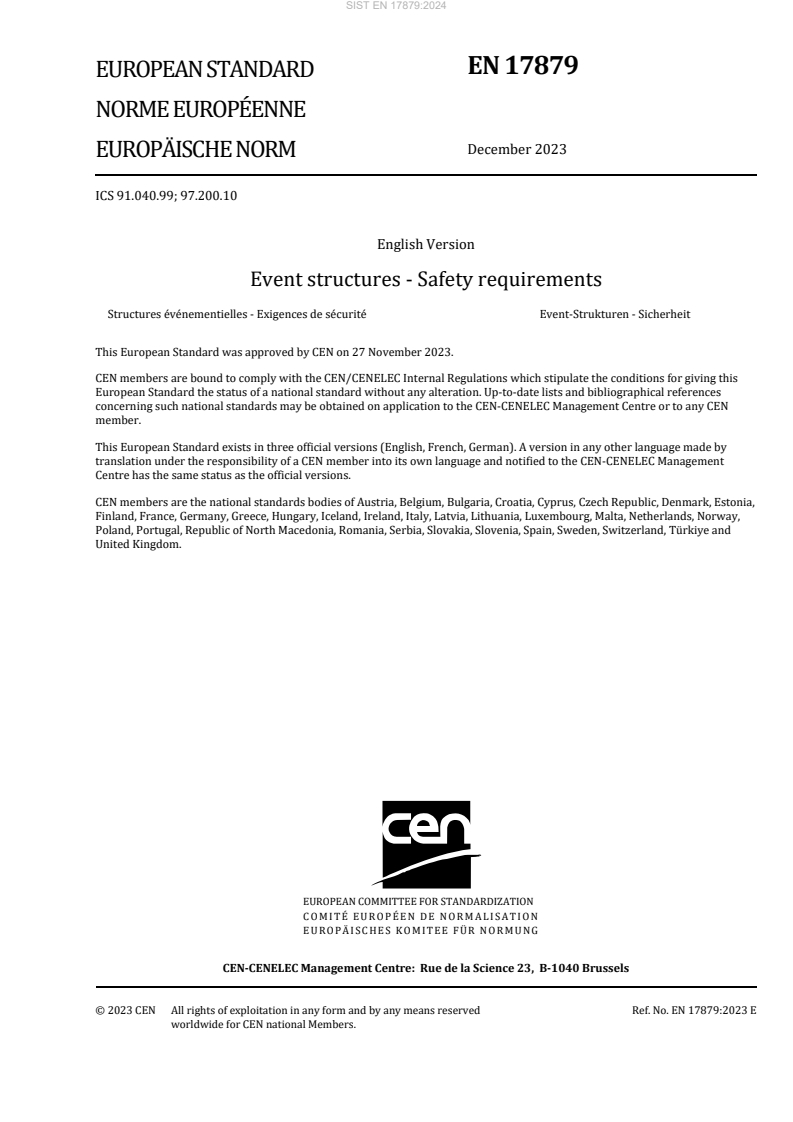
EN 17879
EUROPEAN STANDARD
NORME EUROPÉENNE
December 2023
EUROPÄISCHE NORM
ICS 91.040.99; 97.200.10
English Version
Event structures - Safety requirements
Structures événementielles - Exigences de sécurité Event-Strukturen - Sicherheit
This European Standard was approved by CEN on 27 November 2023.
CEN members are bound to comply with the CEN/CENELEC Internal Regulations which stipulate the conditions for giving this
European Standard the status of a national standard without any alteration. Up-to-date lists and bibliographical references
concerning such national standards may be obtained on application to the CEN-CENELEC Management Centre or to any CEN
member.
This European Standard exists in three official versions (English, French, German). A version in any other language made by
translation under the responsibility of a CEN member into its own language and notified to the CEN-CENELEC Management
Centre has the same status as the official versions.
CEN members are the national standards bodies of Austria, Belgium, Bulgaria, Croatia, Cyprus, Czech Republic, Denmark, Estonia,
Finland, France, Germany, Greece, Hungary, Iceland, Ireland, Italy, Latvia, Lithuania, Luxembourg, Malta, Netherlands, Norway,
Poland, Portugal, Republic of North Macedonia, Romania, Serbia, Slovakia, Slovenia, Spain, Sweden, Switzerland, Türkiye and
United Kingdom.
EUROPEAN COMMITTEE FOR STANDARDIZATION
COMITÉ EUROPÉEN DE NORMALISATION
EUROPÄISCHES KOMITEE FÜR NORMUNG
CEN-CENELEC Management Centre: Rue de la Science 23, B-1040 Brussels
© 2023 CEN All rights of exploitation in any form and by any means reserved Ref. No. EN 17879:2023 E
worldwide for CEN national Members.
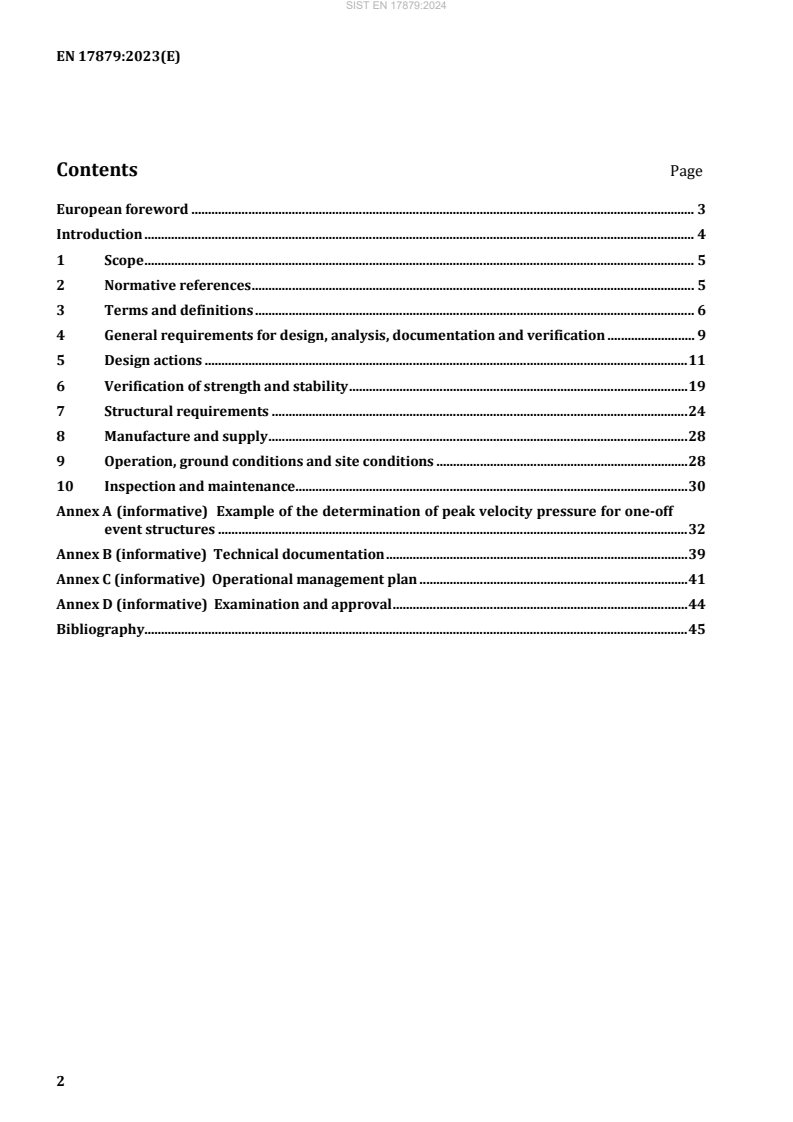
Contents Page
European foreword . 3
Introduction . 4
1 Scope . 5
2 Normative references . 5
3 Terms and definitions . 6
4 General requirements for design, analysis, documentation and verification . 9
5 Design actions . 11
6 Verification of strength and stability . 19
7 Structural requirements . 24
8 Manufacture and supply . 28
9 Operation, ground conditions and site conditions . 28
10 Inspection and maintenance . 30
Annex A (informative) Example of the determination of peak velocity pressure for one-off
event structures . 32
Annex B (informative) Technical documentation . 39
Annex C (informative) Operational management plan . 41
Annex D (informative) Examination and approval . 44
Bibliography. 45
European foreword
This document (EN 17879:2023) has been prepared by Technical Committee CEN/TC 152 “Fairground
and amusement park machinery and structures – Safety”, the secretariat of which is held by UNI.
This European Standard shall be given the status of a national standard, either by publication of an
identical text or by endorsement, at the latest by June 2024, and conflicting national standards shall be
withdrawn at the latest by June 2024.
Attention is drawn to the possibility that some of the elements of this document may be the subject of
patent rights. CEN shall not be held responsible for identifying any or all such patent rights.
Any feedback and questions on this document should be directed to the users’ national standards body.
A complete listing of these bodies can be found on the CEN website.
According to the CEN-CENELEC Internal Regulations, the national standards organisations of the
following countries are bound to implement this European Standard: Austria, Belgium, Bulgaria, Croatia,
Cyprus, Czech Republic, Denmark, Estonia, Finland, France, Germany, Greece, Hungary, Iceland, Ireland,
Italy, Latvia, Lithuania, Luxembourg, Malta, Netherlands, Norway, Poland, Portugal, Republic of North
Macedonia, Romania, Serbia, Slovakia, Slovenia, Spain, Sweden, Switzerland, Türkiye and the United
Kingdom.
Introduction
The object of this document is to provide safety requirements for event structures. Examples of event
structures covered by this standard are, but not limited to, stage roofs, stage walls, stage platforms,
support structures for entertainment technology equipment, technical accommodations, raised
platforms for public and bespoke structures. These safety requirements are aimed to safe-guard persons
and objects against damage caused by design, manufacturing and operation of these structures.
These safety requirements have been drawn up according to past experience and risk analysis. Existing
national rules concerning health and safety of workers remain untouched.
Attentions is drawn to the fact that in certain countries additional/different requirements may be
applicable due to existing national regulations or equivalent.
1 Scope
This document specifies the minimum requirements necessary to ensure the safe design, calculation,
manufacture, assembly, operation, disassembly, inspection and maintenance of the following, but not
limited to:
• structures e.g. stage roofs, stage floors, follow spot towers, PA towers,
• LED support structures,
• one-off event structures,
• hospitality structures,
• temporary spectator facilities.
The above hereafter called event structures are structures intended to be installed and dismantled
specifically for an event.
This document does not cover:
• Spectator facilities – EN 13200-series,
• Temporary structure – Tents – safety by EN 13782,
• Fairground and amusement park machinery and structures as per EN 13814 series,
• Temporary works equipment covered by CEN/TC 53,
• Inflatable play equipment-safety requirements and test methods as per EN 14960,
• Entertainment Technology as described by CEN TC 433.
NOTE This document is not applicable to event structures which are designed, manufactured, placed on the
market or put in service before the date of publication of this document by CEN.
2 Normative references
The following documents are referred to in the text in such a way that some or all of their content
constitutes requirements of this document. For dated references, only the edition cited applies. For
undated references, the latest edition of the referenced document (including any amendments) applies.
EN 1090, (all parts) Execution of steel structures and aluminium structures
EN 1990:2023, Eurocode - Basis of structural and geotechnical design
EN 1991-1-3, Eurocode 1 - Actions on structures - Part 1-3: General actions - Snow loads
EN 1991-1-4, Eurocode 1: Actions on structures - Part 1-4: General actions - Wind actions
EN 1993-1-1:2022, Eurocode 3 - Design of steel structures - Part 1-1: General rules and rules for buildings
EN 1993-1-8, Eurocode 3: Design of steel structures - Part 1-8: Design of joints
EN 1995-1-1, Eurocode 5: Design of timber structures - Part 1-1: General - Common rules and rules for
buildings
EN 1997-1, Eurocode 7: Geotechnical design – Part 1: General rules
EN 1999-1-1:2023, Eurocode 9 - Design of aluminium structures - Part 1-1: General rules
EN 13200-6, Spectator facilities - Part 6: Demountable stands
EN 13501-1, Fire classification of construction products and building elements - Part 1: Classification using
data from reaction to fire test
EN 13782, Temporary structure - Tents - Safety
EN 15619, Rubber or plastic coated fabrics - Safety of temporary structures (tents) - Specification for coated
fabrics intended for tents and related structures
3 Terms and definitions
For the purposes of this document, the following terms and definitions apply.
ISO and IEC maintain terminology databases for use in standardization at the following addresses:
— ISO Online browsing platform: available at https://www.iso.org/obp/
— IEC Electropedia: available at https://www.electropedia.org/
3.1
active viewing zone
part of the viewing platform where a crowd can congregate and has a clear line of sight to the external
focus point
Note 1 to entry: The minimum depth of an active viewing zone is 1 m.
3.2
analysis of use
documented assessment of the use of a structure or a part of it in order to determine the necessary safety
requirements, maximum loads, etc
Note 1 to entry: Examples are, but not limited to; extremely heavy scenery, excessive point loads, moving objects,
performance areas with guaranteed low loads, etc.
3.3
approval
confirmation by a qualified person that the examination has been carried out with a positive result
3.4
competent person
competent person is a person who has sufficient training and experience to take responsibility for an
identified task
3.5
depending action
action that cannot be considered without the presence of another action
Under preparation. Stage at the time of publication prEN 1997-1.
Note 1 to entry: For example; if wind load on a video screen is part of a load combination, the weight of the screen
will also be taken in account.
3.6
event structure
structure to be set-up for no more than 90 days to be used for events
Note 1 to entry: For the purpose of readability throughout this document, the “term” structure refers to an event
structure unless otherwise stated.
3.7
event
public or private occasion at which visitors are present
Note 1 to entry: Examples are, but not limited to: artistic performances, product presentations, theatre shows,
concerts, festivals, exhibitions, parties, meetings.
3.8
examination
comparison of the technical documentation and the set-up event structure
3.9
exclusive action
action that cannot occur in combination with another (specific) action
3.10
external focus point
place outside of the structure such as a sport event or (music) performance causing the risk of public
gathering on active viewing zone of platform for viewing
3.11
guardrail
physical barrier to protect persons from falling off raised areas
Note 1 to entry: Examples are stages or platforms.
3.12
handrail
upper horizontal ledger of the guardrail
3.13
inspection
visual check for intactness of all components of an event structure carried out by a competent person
3.14
maintenance
measures to ensure the intactness of all components of an event structure following the instructions
given in the technical documentation
Note 1 to entry: Examples of maintenance are adjustment, cleaning, regular replacement etc.
3.15
modification
any alteration of an event structure which results in a departure from the original design specification
3.16
one-off event structure
event structure designed to be used for one specific event only
3.17
Operational Management Plan
OMP
written compilation of all measures to be taken to provide safe operation of an event structure including
set-up, operation, and dismantling
3.18
Operational Wind Speed
OWS
allowable 3 second gust wind speed that an event structure is designed to withstand in operational state
3.19
qualified person
qualified person is one who by possession of a recognized degree, certificate, or professional standing, or
who by extensive knowledge, training and experience, has successfully demonstrated their ability to
solve or resolve problems relating to the subject matter, the work, or the project
3.20
repair
restorations of worn, damaged or decayed parts back to the original design specification
3.21
roof system
event structure covering a stage or spectator facilities in order to shelter performers, equipment and
public from weather conditions
3.22
stage
raised platform intended to be used for performing and to support equipment
3.23
set-up
assembling of an event structure on site
3.24
service area
area where publicly accessible utilities are found
Note 1 to entry: This includes passages, concourses, ramps and stairs between the viewing area and the external
area.
Note 2 to entry: Examples of utilities are: toilets, first aid, cafeterias, souvenirs shops.
3.25
sightline
line joining the eye of a spectator and the point of interest on the activity area without optical interruption
3.26
temporary (grand)stand
temporary, tiered structure providing a viewing area, set-up with the intention to provide a sightline for
every spectator on the structure
Note 1 to entry: A temporary grand stand is having just one row of standing or seated spectators per tier.
3.27
temporary spectator facility
structure accessible for visitors of the event, possibly also providing area(s) designated for spectators to
congregation/dance/interact without having a sightline
Note 1 to entry: This includes structures in service areas, where publicly accessible utilities are found.
3.28
user
person or organization that has the general control of an Event Structure
Note 1 to entry: The user can be a natural or legal person, which is the owner of the event structure or a
concessionaire or tenant, to which the owner has given control over the Event structure for a certain time (event
time, installation time).
3.29
Wind Management Plan
WMP
written compilation of all measures to be taken to maintain personal safety and structural safety of the
event structure as part of an operational management plan
4 General requirements for design, analysis, documentation and verification
4.1 General
Materials used in event structures shall comply to the specifications defined in the relevant European
Standards.
Materials not complying with this document may be used if their serviceability and characteristic data
have been proven.
4.2 Design
4.2.1 Selection of structural materials
Structural materials, except timber and plywood used for spreaders, packing plates and floors (stages,
stands, platforms, etc.) and their adjacent stairs, ramps and walkways, shall be at least fire retardant
according to EN 13501-1, class B—S2, D0, or equivalent national standards on fire behaviour. Safety
cables and cables for wind-bracing shall be of non-inflammable material.
4.2.2 Selection of covering materials
Rubber and plastic coated fabrics shall comply to EN 15619. A corresponding declaration or certificate
shall be provided by the supplier.
For other fabric materials and cladding elements of:
• cotton fabrics;
• synthetic fabrics;
• solid covering and sheeting such as sectional metal sheets, wood or plastic panels and multi
components elements.
The following requirements apply:
• fabric materials designated for structural use shall conform to EN standards or, in their absence, to
agreement by the parties involved;
• it shall be ensured that the material and the connections specified, provide sufficient resistance
against environmental influences and tensile strength to ensure safe and durable performance of the
textile cover.
4.2.3 Design Classes
4.2.3.1 Reliability management (RC)
The reliability management shall be RC2 based on Table B.3 of EN 1990:2023.
4.2.3.2 Design working life
As a general rule the design working life shall be 15 years.
4.2.3.3 Consequence classes (CC)
The consequence classes shall be CC2 based on Table B.1 of EN 1990:2023.
4.2.4 Durability
4.2.4.1 Execution class (EXC)
The execution class shall be EXC2 when predominately statically loaded based on, EN1999-1-1:2023,
Table A.3, EN 1993-1-1:2022, Table C.1, or according to the relevant EN-Standard.
4.2.4.2 Service Class (SC)
The service class shall be SC2, based on EN 1995-1-1.
4.2.4.3 Production category (PC)
The production class shall be PC2, based on EN 1999-1-1:2023, EN 1993-1-1:2022 or the relevant EN
standard for welded structures.
4.3 Principles of analysis
Analysis shall follow the relevant parts of the Eurocode, if not otherwise stated in this document and shall
comprise:
• limit states analysis (according to theory of 1st or 2nd order);
• stability limit state analysis: (i.e. bar buckling, plate and shell buckling);
• verification of deformation limit states (if required);
• verification of safety against overturning, sliding and uplift.
Event Structures shall be assumed to be predominantly statically loaded.
4.4 Documentation
4.4.1 Design documents
The design documents shall include information for the verification of the strength, stability, stiffness,
resistance and operational safety, design drawings of the intended configurations and relevant material
certificates. See Annex B for a complete list.
4.4.2 Description of construction, assembly and operation
The structures design, utilization, static system and operation shall be described in a document. This shall
include all relevant assumptions, limitations, configurations, main dimensions, design particulars and
materials.
Instructions for safe assembly and operation shall be provided in a manual or technical documentation.
4.4.3 Construction drawings
Construction drawings shall exist for all assemblies, sub-assemblies and individual components of the
event structure. The drawings shall contain all relevant dimensions, cross sections and details of
materials needed for analysis and approval.
4.5 Verification
Verification shall, as a minimum, include the following details:
• design loads, taking into account the possible operating conditions or installations alternatives.
Special loads imposed during set-up should be recognized;
• equivalent static loads for dynamic impacts;
• information concerning material and components;
• main dimensions and cross-section values of all load bearing structural components;
• determination of the most unfavourable stresses and details relating to the strength of the load
bearing structural components and of the fasteners;
• if calculations are insufficient to evaluate limit states of parts the analysis may be assisted by testing
at an independent testing body. There, the testing body shall commit the appropriate number of tests,
samples, the testing procedure, the reporting etc., according to the relevant EN standards or in
absence of the relevant EN standards by agreement with the parties involved.
5 Design actions
5.1 General
Actions, loads, design and structural assumptions for load bearing parts of event structures shall be
chosen in the following sequence:
• according to this document;
• to a standard listed in the normative references of this document.
NOTE National regulation can overrule this standard or the standards listed in the normative references (e.g.
wind, seismic, etc.).
5.2 Permanent actions
5.2.1 General
Permanent actions are the actual dead loads of the load bearing structure, ballast and cladding.
5.2.2 Permanent actions for temporary demountable structures
For temporary demountable structures, usually a precise assumption of the permanent actions is
possible.
Where significant variations can occur (e.g. due to dry or wet conditions of materials) the values Gk
sup
and Gk shall be considered. Elsewhere a single characteristic value Gk is sufficient:
inf
Gk characteristic value of permanent action;
upper characteristic value of permanent action;
Gk
sup
lower characteristic value of permanent action.
Gk
inf
5.3 Variable load
5.3.1 General
Variable actions consist of the external loads and imposed loads acting on a structural component or
structure and may vary in magnitude, direction and point of application between or during events.
Amplifying factors due to dynamic loading and/or resonance effects need to be taken into account where
applicable.
5.3.2 Actions from entertainment technology equipment and decoration objects
Actions resulting from entertainment technology equipment (e.g. lighting fixtures, PA systems, cables,
LED screens) and decoration objects shall be considered according to the technical data provided by the
relevant manufacturer, supplier, installer or user.
Swinging of objects shall be avoided by suitable structural measures. If this is not possible, the resulting
forces shall be considered.
NOTE 1 Stabilizing with in-plane tensioning devices is not regarded as being suitable structural measures as it
creates unpredictable increasing forces.
Actions resulting from entertainment technology equipment and decoration objects should be generally
considered as being variable actions.
NOTE 2 The actions of entertainment technology equipment and decoration objects can be considered as
permanent actions if they have been pre-planned in detail and the self-weight has been checked and confirmed prior
the installation and will be present during the full period of use of the structure.
5.3.3 Favourable and unfavourable actions
Weights of entertainment technology or decoration can be considered for stability analysis, if these
weights exist permanently and are accurately known.
5.3.4 Imposed loads
5.3.4.1 General
Imposed loads consist of the external loads and imposed deformations acting on a structural component,
which may vary in magnitude, direction and point of application (variation in time and space) during
normal operation.
5.3.4.2 Vertical imposed loads of floors
Categories of floors and the corresponding vertically uniformly distributed load shall be taken from
Table 1.
Table 1 — Vertical imposed loads of floors
Category of loaded floors and raised floors Vertical uniformly
distributed load
(kN/m )
LC1 Areas with no public access where low loads are expected. 1,5
LC2 Areas with limited and controlled public access, such as storage 3,5
areas, backstage areas, side stage areas, hospitality platforms,
exhibition booths and VIP-platforms, with the exception of the
active viewing zones if present.
LC3 Areas with public access such as viewing platforms where dense 5,0
crowds or high loads are anticipated, hospitality platforms,
exhibition booths, VIP-platforms, public walkways, stairs, escape
routes, ramps and their landings and active viewing zones of
areas with limited and controlled access. Stages with or without
public access.
LC4 Design specific loads deviating from LC1, LC2, LC3 shall only be
applied after analysis of use.
Different load classes can be applied on different defined areas of the same structure. These shall be
clearly outlined in all documentation.
EXAMPLE A designated path on a stage where heavy scenery can travel, can be designed for a higher load than
the rest of the stage.
5.3.4.3 Horizontal imposed loads of floors
All structures shall be designed for a minimum horizontal load of 5 % of the vertical imposed loads.
The following structures shall be designed with a minimum horizontal imposed load of 10 % of the
vertical imposed load:
— Structures with a vertical imposed load according to LC3, of Table 1, or more,
— Structures subject to dynamic horizontal imposed loading due to synchronized movement.
The vertical imposed load, horizontal imposed load and wind load shall be combined into a load
combination.
Resonance effects are not taken into account. The event structures shall not be susceptible to
unfavourable dynamic response.
5.3.4.4 Horizontal imposed loads on guardrails
Necessary guardrails shall be designed according to the values specified in Table 2.
Table 2 — Imposed loads on guardrails
Minimum
uniformly
Minimum
distributed
Imposed load
guardrail
load on
Category of guardrail on top rail
height
(kN/m length) surface of
(m)
infill panel
(kN/m )
C1 Protection against falling, no public access
0,3 - 0,8
C2 Guardrails for areas with public access
1,0 2 1,1
C3
Guardrails in areas where high crowd densities are to be
expected. Such as guardrail perpendicular to the 2,0 2 1,1
direction of crowd movement.
C4
Specific guardrail deviating from C1, C2, C3 shall only be
- - -
applied after an analysis of use.
Intermediate rail shall have at least 50 % of the capacity of the handrail. When calculating load strength
of the railing, the load of the handrail and intermediate rail or infill panel shall not be combined.
5.3.5 Wind loads
5.3.5.1 General
The wind loads are based on the principles of the EN 1991-1-4 adapted to the special nature of event
structures with regard to the following:
• duration and period of installation;
• location and local conditions;
• historically available data;
• use under supervision, like wind monitoring;
• possibilities for measures as (but not limited to):
• protection and/or strengthening;
• remove large wind surfaces, like skins and wind loaded decoration;
• evacuating the area around the structure.
Based on the above summary, it is justified to reduce the applicable wind load at event structure with the
semi-probabilistic approach of the Eurocode Series.
5.3.5.2 Operational state and design limit state
An event structure, as considered in this standard, can be considered in two serviceability levels.
• Operational state – describes a fully operational state of the structure. Upon reaching the applicable
gust wind speed for this service state, the described operational measures belonging to the structure
shall be taken.
• Design limit state – describes the design limit state for wind loading of an event structure. Upon
reaching the applicable gust wind speed for design limit state, the structural integrity (like strength,
stiffness, and stability) is maintained.
In operational state, an event structure, as considered in this standard, shall be designed to withstand a
minimum gust wind speed of 20 m/s (72 km/h), measured at 10 m height on the location of the structure.
Gust wind speeds for structures in operational state can be found in Table 3.
Table 3 — Minimum gust wind speed for structures in operational state
Operational State
Structure reference 0 m – 5 m 5 m – 10 m – 15 m – 20 m – 25 m –
height 10 m 15 m 20 m 25 m 30 m
0,18 0,25 0,29 0,32 0,34 0,36
kN/m
qp z
( )
m/s 17,0 20,0 21,5 22,6 23,3 24,0
Vz
( )
Gust
For design limit state, an event structure, as considered in this standard, shall be designed according to
the philosophy of the EN 1991-1-4 with applicable national annex taking into account a recommended
probability factor c = 0,85.
prob
In general, an event structure is a predesigned structure installed on a wide variety of locations and
environments. It is therefore recommended that the design limit state used for the design of the event
structure covers a wide range of wind areas.
Strongly recommended minimum peak velocity pressure for design limit state for touring event
structures shall be taken from Table 4.
Table 4 — Minimum peak gust wind speed for structure in design limit state
Design limit state
Structure reference 0 m – 5 m 5 m – 10 m – 15 m – 20 m – 25 m –
height 10 m 15 m 20 m 25 m 30 m
0,45 0,60 0,69 0,76 0,82 0,87
kN/m
qp z
( )
m/s 26,8 31,0 33,2 34,9 36,2 37,3
Vz
( )
Gust
In practice this means, that using event structures at more open terrain, the chances of taking operational
measures at the event structure are higher or higher wind pressures shall be considered (according to
EN 1991-1-4 with c = 0,85).
prob
In case an event structure is a so-called one-off event structure designed for one event at one specific
location – a reduced design limit state can be agreed upon with a solid risk analysis.
The risk analysis can be based on the probabilistic concept with generalized extreme value (GEV)
distribution as used for the EN 1991-1-4 calculation method, with the local applicable wind conditions,
verified by the historically available wind speed data over the minimum the past 20 years.
With the historically available data and the use of the Gumbel method with Lieblein BLUE, a solid
determination of the applicable design limit state peak velocity pressure can be obtained for one-off event
structures.
Annex A gives an example of how to evaluate the historical gust wind speed data. For the applicable
design limit state for peak velocity pressure at a one-off event structure, determined with the Gumbel
method with Lieblein BLUE, a minimum of 10 year return period shall be used.
For a one-off event structure, the design limit state for peak velocity pressure shall be equal or higher
than the values mentioned in the operational state table.
5.3.6 Peak velocity pressure profile
The peak velocity pressure and the corresponding reference height ze can be determined from Figure 1
and can be used for Operational state and Design limit state wind pressure (in conjunction with Table 3
and Table 4).
Figure 1 — Peak velocity pressure profile
5.3.7 Equivalent horizontal load at indoor situation
If a structure; (for example, “Exhibition booths, rigs, decorative structures, set scenery”) is built inside a
building (for example, Expo hall) and no direct wind load is present. To check the stability of the structure,
the most unfavourable of options below shall be applied:
• If the structure is prone to overturning and/or sliding due to an equivalent load of 0,125 kN/m
applied to the projected area of the structure in the main structural directions, the structure shall be
verified for this load, in combination with other variable loads. From a height of 4 m on, this load can
be reduced to 0,025kN/m .
NOTE 1 This load can only apply, if relevant differences in air pressure are to be expected at the venue due to
large openable building openings, if the structure is higher as 2,0 m.
• A horizontal line load equivalent to the values given in Table 2 at a height of 1 m shall be applied in
the main structural directions, combined with other variable loads.
• A minimum horizontal load of 2,5 % of the total vertical load shall be applied at the height of the
centre of gravity, combined with other variable loads.
NOTE 2 If an event structure is built inside a tent structure that is likely to have side walls removed, an equivalent
horizontal load in the main structural directions of the event structure can be taken into account with a value of
0,36 x Wind pressure at eave height of the tent structure, combined with other variable loads.
NOTE 3 If an enclosed space is created inside a structure, static air pressure due to temperature differences can
occur and can be taken into account. For example the chimney effect at the fly tower of theatres or tall fabric walls
enclosing a space.
5.3.8 Aerodynamic factors for event structures
In general the aerodynamic behaviour of an event structure shall be obtained from EN 1991-1-4 or
through wind tunnel test.
NOTE 1 Wind tunnel testing can be done in accordance with EN 1990:2023 and (local) regulations or standards
for wind tunnel testing.
NOTE 2 CFD analysis can be used to verify why which aerodynamic factors are chosen.
In the absence of internal pressure coefficients applicable for a structure with one open side in EN 1991-
1-4, the applicable internal pressure coefficients shown in Figure 2 shall be applied.
Figure 2 — Internal pressure coefficient for a one side wall opened event structure
5.3.9 Wind on free standing double curved load bearing membrane structures
In case of a free standing double curved load bearing membrane structure, the special behaviour of the
structure shall be taken into account. Due to large deformations of the membrane the pressure
coefficients differ from rigid structures. Pressure coefficients shall be taken from Figure 3.
Figure 3 — Pressure coefficients for free standing double curved load bearing membrane
structures
5.3.10 Wind loading for existing event structures
Event structures developed prior to this standard with static analysis report using previous standards
can be used, provided that a document is available that states the corresponding (and deviating) gust
wind speeds for in service and, if applicable, reduced and/or out of service states, as well as any necessary
measures that have to be taken to secure safety of the structure.
5.4 Snow loads
Snow loads shall be applied in accordance with EN 1991-1-3. Snow loads need not to be taken into
account for event structures if:
• set-up in areas, where there is no likelihood of snow or;
• operated at a time of the year, where the likelihood of snow can be discounted or;
• where by design or operating conditions snow settling on the event structure is prevented;
• where pre-planned operation action prevents snow from settling on the event structure. This last
condition may be achieved by:
• sufficient heating equipment is installed and is ready for use and;
• heating is started prior to snow fall. The event structures roof cladding shall be sufficiently
heated to reduce the snow loads.
NOTE If the roof cladding is not sufficiently heated there is a danger of icing.
A reduced snow load of sk = 0,20 kN/m (snowload on the ground) can be applied for event structures
on the overall roof area, where a snow depth not exceeding h = 8 cm can be ensured at any time by
removing snow.
The above restrictions concerning snow loads shall be stated in the design documents.
5.5 Seismic forces
Seismic forces shall be applied in accordance to locally required or internationally accepted standards.
5.6 Load combinations
The design values of the actions may be simplified with the following combinations and partial safety
factors:
γγGQ+
Gk Q,1 k ,1
E = max (1)
d
γγGQ+∑
G k Q,,i k i
where:
is the design value of effect of actions;
E
d
is the partial safety factor for permanent actions;
γ = 1,35
G
is the partial safety factor for favourable permanent actions;
γ = 1,00
G
is the partial safety factor for only one variable action;
= 1,50
γ
Q,1
is the partial safety factor for more variable actions;
γ = 1,35
Q,i
is the characteristic value of permanent action;
G =
k
is the characteristic value for only one of the variable actions;
Q =
k ,1
is the characteristic value for more variable actions.
Q =
ki,
NOTE An action from entertainment technology equipment can be considered as permanent action in case
they align according to 5.3.2 NOTE 3.
6 Verification of strength and stability
6.1 General
The limit states due to all different actions shall be determined separately for the design actions of
Clause 5. It shall be verified that no relevant limit state exceeds the design properties. The limit states due
to the combinations of actions shall be calculated. It shall be verified that the design value of internal
forces or moments does not exceed the corresponding design resistance of the respective part and the
ultimate or serviceability limit state is not exceeded.
Special consideration shall be given to the limit state verification regarding deformation and stability, as
the deformation limit can be a decisive value. Any favourable effect resulting from the 2nd order theory
may be taken into account. All verifications shall be performed for the most unfavourable loading. In this
connection, the permanent, variable and accidental actions shall always be assumed to have the position
and magnitude which result in the most unfavourable limit states for the structural and mechanical
components to be calculated. For structural and mechanical components and items of equipment which
are not permanent fixtures, it shall also be ascertained whether more unfavourable conditions are likely
to arise if such items are displaced or removed.
If computer processing for calculation is used, special consideration shall be given to the requirements
for the review of computer calculations during the design approval. Clear information concerning the
software, formula, units etc. shall be submitted. Input and output shall be completely provided. The
correctness of the input assumptions and the output shall be comprehensively reviewed during design
approval.
The effects of imperfections, including residual stressed and geometrical imperfections, such as out of
vertical, out of straight and unavoidable minor eccentricities shall be taken into account by suitable
equivalent imperfections.
The method of application shall be in accordance with the respective specifications in the relevant design
standards, for example, for steel EN 1993-1-1:2022 and for aluminium EN 1999-1-1:2023.
6.2 Verification of strength of materials and components
6.2.1 General
The complete analysis of materials and components of an event structure shall be based on European
standards, unless stated in this paragraph.
It shall be verified that:
ER≤ (2)
dd
where:
is the design value of effect of actions;
E
d
is the corresponding design value of resistance.
R
d
6.2.2 Resistance design values for materials
The resistance design values, R , for materials, shall be evaluated in accordance with the following
d
formula:
RR= /γ (3)
d k M
where:
is the characteristic value of the resistance;
R
k
is the partial safety factor for a material property.
γ
M
Values for materials shall be derived from their respective European Standard.
6.2.3 Resistance design values for structural components
6.2.3.1 General
The resistance design values R for structural components shall be evaluated in accordance with the
d
following formula:
RR= /γ (4)
d min M
where:
is the minimum breaking load from the relevant EU standard;
R
min
is the partial safety factor for a material property for both nonlinear behaviour or linear
γ
M
behaviour, including a risk of damage for frequent dismounting.
The partial safety factor will depend on the intended application.
The partial safety factor of lifting accessories used as structural components can be reduced if the
Working Load Limit (WLL) or similar rating and the associated factor of safety against failure is known.
Structural components with unknown strength are not allowed.
6.2.3.2 Steel wire ropes, fibre ropes, and chains under static load
Ropes and Chains are used e.g. for guying, anchoring or dead hanging.
For steel wire ropes a partial safety factor of γ = 2,0 on the design value shall be used. The appropriate
M
reduction for end fittings of steel wire ropes shall be considered.
For fibre ropes made from natural and/or synthetic fibres, the values given in Table 5 shall apply.
Table 5 — Partial safety factors for natural or synthetic fibre ropes
Rope diameter (mm) Partial safety factor
12 4
14 3,3
16 3,3
18 2,7
20 or thicker 2,7
NOTE 1 These values are based on the fact that knots reduce the strength of the rope. The reduction of the
strength can easily reach 50 %.
If other end connections of ropes are chosen (e.g. splicing), that prove a higher connection capacity, the
values of Table 5 may be adjusted respectively.
Rope connections shall be formed in such a way that there is neither a possibility of kinks or knots arising,
nor of excessive stressing of individual wires.
Ropes of any kind shall not bear on sharp edges.
For long link steel chains a partial safety factor of γ = 4,0 shall be used.
M
For short link steel chains a partial safety factor of γ = 2,0 shall be used.
M
NOTE 2 For short link steel chains that are placed on the market as “ready to use” lifting accessories according
to the EG Machinery Directive and are intended to be used as main suspensions of event structures, e.g. dead hang
chains for roof structures, a partial safety factor of γ = 4,0 can be used, due to the fact that they can be subject to
m
wear and tear when used as lifting accessories in other applications.
6.2.3.3 Straps / Web lashing under static load
For straps or web lashing with ratchets, the partial safety factor of γ = 2,0 shall be used on the complete
M
assembly regarding minimum breaking force. Ratchets shall be secured against accidental opening.
6.2.3.4 Connectors and adjusters
Connecting elements e.g. shackles, hooks, shortening devices the safety factor of γ = 2,0 shall be used
M
on the specified minimum breaking force.
For adjusters like turn buckles, the specified minimum breaking force needs to be known and the safety
factor of γ = 2,0 shall be used.
M
Open hooks shall not be used in wind bracings. Hooks with a safety latch are not considered to be open
hooks.
6.2.4 Supports
The structural strength of supports, transmitting loads onto the surface of the ground or floor, shall be
verified considering the vertical and horizontal loads applied.
Adjustable supports for levelling (e.g. screwjacks) might be subject to limitations and conditions such as
maximum extension and/or need for cross-bracing, which shall be documented.
----------
...