

SIST EN 14112:2021
(Main)Fat and oil derivatives - Fatty Acid Methyl Esters (FAME) - Determination of oxidation stability (accelerated oxidation test)
General Information
- Abstract
This document specifies a method for the determination of the oxidation stability of fatty acid methyl esters (FAME) at 110 °C, by means of measuring the induction period up to 48 h.
For induction periods higher than 8,5 h the precision is not covered by the precision statement of this method.
NOTE 1 EN 15751 [1] describes a similar test method for oxidation stability determination of pure fatty acid methyl esters and of blends of FAME with petroleum-based diesel containing 2 % (V/V) of FAME at minimum.
NOTE 2 Limited studies on EN 15751 with EHN (2-ethyl hexyl nitrate) on FAME blends indicated that the stability is reduced to an extent which is within the reproducibility of the test method. It is likely that the oxidation stability of pure FAMEs is also reduced in the presence of EHN when EN 14112 is used for testing.
NOTE 3 For the purposes of this document, the term ''% (V/V)'' is used to represent the volume fraction.
- Status
- Published
- Public Enquiry End Date
- 19-Feb-2020
- Publication Date
- 10-Dec-2020
- Technical Committee
- KŽP - Agricultural food products
- Current Stage
- 6060 - National Implementation/Publication (Adopted Project)
- Start Date
- 08-Dec-2020
- Due Date
- 12-Feb-2021
- Completion Date
- 11-Dec-2020



Overview
EN 14112:2020 is a CEN standard that specifies an accelerated oxidation test for determining the oxidation stability of fatty acid methyl esters (FAME) - the primary component class of many biodiesel fuels. The method measures the induction period at a test temperature of 110 °C, with measurements recorded up to 48 hours. For induction periods longer than 8.5 h, the method’s precision statement does not apply.
Key topics and technical requirements
- Scope and purpose: Determines the induction period (time until rapid formation of oxidation products) for FAME under accelerated conditions to assess oxidative stability.
- Principle: Dry, purified air is passed through a heated FAME sample. Volatile oxidation products (mainly carboxylic acids) are absorbed in water and detected as a rapid increase in conductivity - the end point of the induction period.
- Test temperature: Nominally 110 °C (temperature control and correction procedures are required).
- Apparatus: Includes a gas membrane pump (flow ~10 ± 1.0 L/h), reaction vessels, closed measurement cells with conductivity electrodes, heating block or oil bath, molecular sieve air filter, and calibrated thermometer/Pt100 element.
- Sampling and sample handling: Sampling compliant with EN ISO 3170 / EN ISO 3171; samples should be homogenized, stored to minimize air contact and measured promptly.
- Cleaning and preparation: Detailed cleaning, solvent rinsing and drying procedures are specified to avoid contamination; disposable reaction vessels are recommended to reduce carryover.
- Measurement and evaluation: Conductivity recording and procedures for automatic and manual evaluation are provided. The standard includes guidance on temperature correction (ΔT) between block and sample.
- Limitations: Precision data in the standard do not cover induction periods > 8.5 h. Notes mention potential effects of additives such as EHN (2‑ethyl hexyl nitrate) and reference similar test methods.
Practical applications and users
- Who uses it: Biodiesel producers, fuel quality control laboratories, testing organisations, research labs studying FAME oxidation, and regulatory bodies assessing fuel stability.
- Why use it: Provides a standardized, reproducible accelerated-test method to:
- Assess FAME blend stability and shelf life.
- Compare feedstocks or production batches.
- Support product specifications for biodiesel and FAME-containing diesel blends.
- Evaluate effects of additives or contaminants on oxidative behaviour.
Related standards
- EN 15751 - describes a similar oxidation stability test for pure FAME and FAME blends with diesel (minimum 2 % V/V FAME) and is explicitly referenced in EN 14112.
- Sampling standards: EN ISO 3170, EN ISO 3171.
Keywords: EN 14112:2020, FAME, oxidation stability, accelerated oxidation test, induction period, biodiesel, Rancimat-style test, fuel quality, EN 15751.
Relations
- Effective Date
- 01-Jan-2021
- Effective Date
- 28-Jan-2026
- Effective Date
- 28-Jan-2026
- Effective Date
- 28-Jan-2026
Get Certified
Connect with accredited certification bodies for this standard

BSI Group
BSI (British Standards Institution) is the business standards company that helps organizations make excellence a habit.

Bureau Veritas
Bureau Veritas is a world leader in laboratory testing, inspection and certification services.

DNV
DNV is an independent assurance and risk management provider.
Sponsored listings
Frequently Asked Questions
SIST EN 14112:2021 is a standard published by the Slovenian Institute for Standardization (SIST). Its full title is "Fat and oil derivatives - Fatty Acid Methyl Esters (FAME) - Determination of oxidation stability (accelerated oxidation test)". This standard covers: This document specifies a method for the determination of the oxidation stability of fatty acid methyl esters (FAME) at 110 °C, by means of measuring the induction period up to 48 h. For induction periods higher than 8,5 h the precision is not covered by the precision statement of this method. NOTE 1 EN 15751 [1] describes a similar test method for oxidation stability determination of pure fatty acid methyl esters and of blends of FAME with petroleum-based diesel containing 2 % (V/V) of FAME at minimum. NOTE 2 Limited studies on EN 15751 with EHN (2-ethyl hexyl nitrate) on FAME blends indicated that the stability is reduced to an extent which is within the reproducibility of the test method. It is likely that the oxidation stability of pure FAMEs is also reduced in the presence of EHN when EN 14112 is used for testing. NOTE 3 For the purposes of this document, the term ''% (V/V)'' is used to represent the volume fraction.
This document specifies a method for the determination of the oxidation stability of fatty acid methyl esters (FAME) at 110 °C, by means of measuring the induction period up to 48 h. For induction periods higher than 8,5 h the precision is not covered by the precision statement of this method. NOTE 1 EN 15751 [1] describes a similar test method for oxidation stability determination of pure fatty acid methyl esters and of blends of FAME with petroleum-based diesel containing 2 % (V/V) of FAME at minimum. NOTE 2 Limited studies on EN 15751 with EHN (2-ethyl hexyl nitrate) on FAME blends indicated that the stability is reduced to an extent which is within the reproducibility of the test method. It is likely that the oxidation stability of pure FAMEs is also reduced in the presence of EHN when EN 14112 is used for testing. NOTE 3 For the purposes of this document, the term ''% (V/V)'' is used to represent the volume fraction.
SIST EN 14112:2021 is classified under the following ICS (International Classification for Standards) categories: 67.200.10 - Animal and vegetable fats and oils. The ICS classification helps identify the subject area and facilitates finding related standards.
SIST EN 14112:2021 has the following relationships with other standards: It is inter standard links to SIST EN 14112:2016, SIST EN ISO 3171:1999, SIST EN ISO 3170:2025, SIST-TP CEN/TR 17225:2018. Understanding these relationships helps ensure you are using the most current and applicable version of the standard.
SIST EN 14112:2021 is available in PDF format for immediate download after purchase. The document can be added to your cart and obtained through the secure checkout process. Digital delivery ensures instant access to the complete standard document.
Standards Content (Sample)
SLOVENSKI STANDARD
01-januar-2021
Nadomešča:
SIST EN 14112:2016
Derivati maščob in olj - Metilni estri maščobnih kislin (FAME) - Določevanje
oksidativne stabilnosti (metoda s pospešeno oksidacijo)
Fat and oil derivatives - Fatty Acid Methyl Esters (FAME) - Determination of oxidation
stability (accelerated oxidation test)
Erzeugnisse aus pflanzlichen und tierischen Fetten und Ölen - Fettsäure-Methylester
(FAME) - Bestimmung der Oxidationsstabilität (beschleunigte Oxidationsprüfung)
Produits dérivés des corps gras - Esters méthyliques d'acides gras (EMAG) -
Détermination de la stabilité à l'oxydation (Essai d'oxydation accélérée)
Ta slovenski standard je istoveten z: EN 14112:2020
ICS:
67.200.10 Rastlinske in živalske Animal and vegetable fats
maščobe in olja and oils
2003-01.Slovenski inštitut za standardizacijo. Razmnoževanje celote ali delov tega standarda ni dovoljeno.
EN 14112
EUROPEAN STANDARD
NORME EUROPÉENNE
November 2020
EUROPÄISCHE NORM
ICS 67.200.10 Supersedes EN 14112:2016
English Version
Fat and oil derivatives - Fatty Acid Methyl Esters (FAME) -
Determination of oxidation stability (accelerated oxidation
test)
Produits dérivés des corps gras - Esters méthyliques Erzeugnisse aus pflanzlichen und tierischen Fetten und
d'acides gras (EMAG) - Détermination de la stabilité à Ölen - Fettsäure-Methylester (FAME) - Bestimmung
l'oxydation (Essai d'oxydation accélérée) der Oxidationsstabilität (beschleunigte
Oxidationsprüfung)
This European Standard was approved by CEN on 25 October 2020.
CEN members are bound to comply with the CEN/CENELEC Internal Regulations which stipulate the conditions for giving this
European Standard the status of a national standard without any alteration. Up-to-date lists and bibliographical references
concerning such national standards may be obtained on application to the CEN-CENELEC Management Centre or to any CEN
member.
This European Standard exists in three official versions (English, French, German). A version in any other language made by
translation under the responsibility of a CEN member into its own language and notified to the CEN-CENELEC Management
Centre has the same status as the official versions.
CEN members are the national standards bodies of Austria, Belgium, Bulgaria, Croatia, Cyprus, Czech Republic, Denmark, Estonia,
Finland, France, Germany, Greece, Hungary, Iceland, Ireland, Italy, Latvia, Lithuania, Luxembourg, Malta, Netherlands, Norway,
Poland, Portugal, Republic of North Macedonia, Romania, Serbia, Slovakia, Slovenia, Spain, Sweden, Switzerland, Turkey and
United Kingdom.
EUROPEAN COMMITTEE FOR STANDARDIZATION
COMITÉ EUROPÉEN DE NORMALISATION
EUROPÄISCHES KOMITEE FÜR NORMUNG
CEN-CENELEC Management Centre: Rue de la Science 23, B-1040 Brussels
© 2020 CEN All rights of exploitation in any form and by any means reserved Ref. No. EN 14112:2020 E
worldwide for CEN national Members.
Contents Page
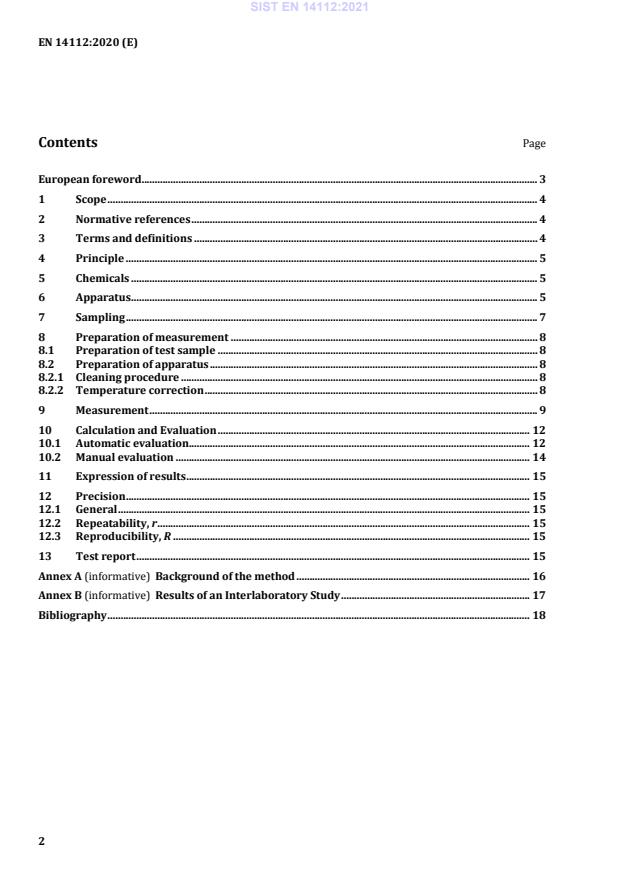
European foreword . 3
1 Scope . 4
2 Normative references . 4
3 Terms and definitions . 4
4 Principle . 5
5 Chemicals . 5
6 Apparatus . 5
7 Sampling . 7
8 Preparation of measurement . 8
8.1 Preparation of test sample . 8
8.2 Preparation of apparatus . 8
8.2.1 Cleaning procedure . 8
8.2.2 Temperature correction . 8
9 Measurement . 9
10 Calculation and Evaluation . 12
10.1 Automatic evaluation . 12
10.2 Manual evaluation . 14
11 Expression of results . 15
12 Precision . 15
12.1 General . 15
12.2 Repeatability, r . 15
12.3 Reproducibility, R . 15
13 Test report . 15
Annex A (informative) Background of the method . 16
Annex B (informative) Results of an Interlaboratory Study . 17
Bibliography . 18
European foreword
This document (EN 14112:2020) has been prepared by Technical Committee CEN/TC 307 “Oilseeds, vegetable
and animal fats and oils and their by-products - Methods of sampling and analysis”, the secretariat of which is
held by AFNOR.
This European Standard shall be given the status of a national standard, either by publication of an identical
text or by endorsement, at the latest by May 2021, and conflicting national standards shall be withdrawn at the
latest by May 2021.
Attention is drawn to the possibility that some of the elements of this document may be the subject of patent
rights. CEN shall not be held responsible for identifying any or all such patent rights.
This document supersedes EN 14112:2016.
Significant changes between this document and EN 14112:2016 are:
— change of Figure 2, removal of dimension between air inlet and heating block;
— introduction removed;
— document revised editorially.
According to the CEN-CENELEC Internal Regulations, the national standards organisations of the following
countries are bound to implement this European Standard: Austria, Belgium, Bulgaria, Croatia, Cyprus, Czech
Republic, Denmark, Estonia, Finland, France, Germany, Greece, Hungary, Iceland, Ireland, Italy, Latvia,
Lithuania, Luxembourg, Malta, Netherlands, Norway, Poland, Portugal, Republic of North Macedonia, Romania,
Serbia, Slovakia, Slovenia, Spain, Sweden, Switzerland, Turkey and the United Kingdom.
1 Scope
This document specifies a method for the determination of the oxidation stability of fatty acid methyl esters
(FAME) at 110 °C, by means of measuring the induction period up to 48 h.
For induction periods higher than 8,5 h the precision is not covered by the precision statement of this method.
NOTE 1 EN 15751 [1] describes a similar test method for oxidation stability determination of pure fatty acid methyl
esters and of blends of FAME with petroleum-based diesel containing 2 % (V/V) of FAME at minimum.
NOTE 2 Limited studies on EN 15751 with EHN (2-ethyl hexyl nitrate) on FAME blends indicated that the stability is
reduced to an extent which is within the reproducibility of the test method. It is likely that the oxidation stability of pure
FAMEs is also reduced in the presence of EHN when EN 14112 is used for testing.
NOTE 3 For the purposes of this document, the term “% (V/V)” is used to represent the volume fraction.
2 Normative references
The following documents are referred to in the text in such a way that some or all of their content constitutes
requirements of this document. For dated references, only the edition cited applies. For undated references, the
latest edition of the referenced document (including any amendments) applies.
EN ISO 3170, Petroleum liquids - Manual sampling (ISO 3170)
EN ISO 3171, Petroleum liquids - Automatic pipeline sampling (ISO 3171)
3 Terms and definitions
For the purposes of this document, the following terms and definitions apply.
ISO and IEC maintain terminological databases for use in standardization at the following addresses:
• IEC Electropedia: available at http://www.electropedia.org/
• ISO Online browsing platform: available at https://www.iso.org/obp
3.1
induction period
time which passes between the moment when the measurement is started and the moment when the formation
of oxidation products begins to increase rapidly
3.2
oxidation stability
induction period determined according to the procedure specified in this document, expressed in hours
4 Principle
A stream of purified (dried) air is passed through the sample which has been heated to the target temperature
which is 110 °C in the usual application of the method. Volatile compounds are formed during the oxidation
process. They are passed, together with the air, into a flask containing demineralized or distilled water, and
equipped with a conductivity electrode. The electrode is connected to a measuring and recording device. It
indicates the end of the induction period by rapid increase of the conductivity due to the dissociation of volatile
carboxylic acids produced during the oxidation process and absorbed in the water. For more details on the
background of the method see Annex A.
5 Chemicals
Use only chemicals of analytical grade and distilled or demineralized water.
5.1 Ternary solvent mixture, consisting of methanol/toluene/acetone 1:1:1 (by volume).
5.2 Alkaline laboratory glass cleaning solution.
5.3 2-Propanol.
6 Apparatus
Usual laboratory equipment and glassware, together with the following:
6.1 Device for the determination of oxidation stability, comprising the following parts (see Figures 1
1)
and 2) .
6.1.1 Air filter, comprising a tube fitted with filter paper at the ends and filled with a molecular sieve (6.6),
connected to the suction end of a pump.
6.1.2 Gas membrane pump, with an adjustable flow rate of (10 ± 1,0) l/h.
6.1.3 Reaction vessels of borosilicate glass, provided with a sealing cap. The sealing cap shall be fitted with a
gas inlet and outlet tube.
6.1.4 Closed measurement cells, of approximately 150 ml capacity, with an air inlet tube extending to the
bottom inside of the vessel. The cell shall have ventilation holes at the top.
6.1.5 Electrodes, for measuring conductivity within a range of 0 μS/cm to 300 μS/cm aligned with the
dimensions of the measurement cell (6.1.4).
6.1.6 Measuring and recording apparatus, comprising:
a) an amplifier; and
b) a recorder registering the signal of each of the electrodes (6.1.5).
1) Rancimat is the trade name of a product supplied by Metrohm AG, Herisau, Switzerland; OSI is the trade name of a product supplied
by Omnion Inc., Rockland, Massachusetts, USA. This information is given for the convenience of users of this document and does not
constitute an endorsement by CEN or CENELEC of the products named. Equivalent products may be used if they can be shown to lead to
the same results.
6.1.7 Contact thermometer graduated in 0,1 °C or Pt 100 element to measure the block temperature, with
attachments for relay connection and an adjustable heating element; temperature scale 0 °C to 150 °C.
6.1.8 Heating source, 6.1.8.1 or 6.1.8.2
6.1.8.1 Heating block, made of cast aluminium, adjustable to a temperature up to (150 ± 0,1) °C. The block
shall be provided with holes for the reaction vessels (6.1.3) and an aperture for the contact thermometer
(6.1.7).
6.1.8.2 Heating bath, filled with oil suitable for temperatures up to 150 °C, and adjustable to the
nearest 0,1 °C.
6.2 Certified and calibrated thermometer or Pt100 element, with a temperature range up to 150 °C,
graduated in 0,1 °C.
Key
1 air filter (6.1.1) 5 electrode (6.1.5)
2 gas membrane pump with flow rate control (6.1.2) 6 measuring and recording apparatus (6.1.6)
3 reaction vessel (6.1.3) 7 contact thermometer or Pt 100 element (6.1.7)
4 measurement cell (6.1.4) 8 heating block (6.1.8.1)
Figure 1 — Schematic overview of apparatus
Key
1 measurement cell (6.1.4) 5 sample
2 electrode (6.1.5) 6 heating block (6.1.8.1)
3 distilled/demineralized water 7 air inlet
4 reaction vessel (6.1.3)
Figure 2 — Diagrammatic representation of heating block, reaction vessel and measurement cell
6.3 Measuring pipettes and/or measuring cylinders.
6.4 Oven, adjustable to a temperature up to (150 ± 3) °C.
6.5 Connecting hoses, flexible and made of inert material [polytetrafluoroethylene (PTFE) or silicone].
6.6 Molecular sieve, with moisture indicator, pore size 0,3 nm, dried in an oven set at 150 °C and cooled
down to room temperature in a desiccator before use.
6.7 Balance, capable of weighing with an accuracy of ± 0,1 g or less.
7 Sampling
Unless otherwise specified, sampling shall be conducted according to EN ISO 3170 or EN ISO 3171 and/or
should be in accordance with the requirements of national standards or regulations for the sampling.
It is important that the laboratory receives a sample which is truly representative and has not been damaged or
changed during tran
...