

oSIST prEN 13670:2007
(Main)Execution of concrete structures
General Information
- Abstract
The project will be the revision of ENV 136-1: 2000 with the intention to convert the prestandard into a European standard. The European standard will provide common requirements for the execution of concrete structures. It will be applicable to temporary as
well as permanent concrete structures. The standard will not cover the specification, production and conformity of concrete as well as contractual issues or responsibilities for the identified actions.
- Status
- Withdrawn
- Public Enquiry End Date
- 29-May-2007
- Withdrawal Date
- 17-May-2010
- Technical Committee
- BBB - Concrete, reinforced concrete and prestressed concrete
- Current Stage
- 98 - Abandoned project (Adopted Project)
- Start Date
- 11-Oct-2013
- Due Date
- 16-Oct-2013
- Completion Date
- 11-Oct-2013


Overview
oSIST prEN 13670:2007, titled Execution of Concrete Structures, is a European standard developed by the European Committee for Standardization (CEN). It serves as a revision of the earlier ENV 136-1:2000 prestandard, aiming to establish unified requirements for executing both temporary and permanent concrete structures across Europe. The document addresses critical aspects of concrete construction practice but explicitly excludes the specification, production, and conformity assessment of concrete itself, as well as contractual responsibilities related to concrete actions.
This standard provides comprehensive guidance on the technical execution of concrete works, encompassing planning, management, materials handling, and quality control processes. It incorporates important considerations for falsework, formwork, reinforcement, prestressing, concreting, precast elements, and geometrical tolerances.
Key Topics
Execution Management
oSIST prEN 13670:2007 defines management practices for concrete execution including documentation, quality plans, and quality management strategies. It prescribes inspection rules for materials, products, and execution quality. Procedures for handling non-conformities are outlined to ensure compliance with technical requirements throughout the project lifecycle.Falsework and Formwork
The standard covers design, material selection, installation, and removal of falsework and formwork, emphasizing safety and structural integrity. It also addresses special considerations for inserts, embedded components, and temporary openings within formwork systems.Reinforcement and Prestressing
Guidelines include processes for cutting, bending, welding, transporting, and placing reinforcement steel. For prestressed concrete, the standard specifies requirements for materials such as tendons, sheaths, anchorage devices, and grout materials. It details tensioning methods and protective measures like grouting and greasing to enhance durability.Concreting Operations
The document provides recommendations for pre-concreting activities, delivery, site transport, placing, compaction, curing, and post-concreting procedures. It addresses special concreting techniques such as lightweight aggregate concrete, self-compacting concrete, sprayed concrete, slipforming, and underwater concreting.Precast Concrete Elements
Execution of precast concrete structures is detailed with focus on factory production, site handling, storage, placement, adjustment, and jointing of prefabricated components.Geometrical Tolerances
oSIST prEN 13670:2007 defines acceptable tolerances for dimensions, alignments, surfaces, and holes in concrete structures to ensure structural integrity and aesthetic quality.
Applications
oSIST prEN 13670:2007 is essential for contractors, engineers, quality managers, and construction professionals involved in:
- Construction of new concrete structures including buildings, bridges, tunnels, and infrastructure.
- Execution of complex concrete works requiring strict quality assurance.
- Managing temporary concrete installations for construction support.
- Precast concrete fabrication and on-site assembly.
- Projects demanding compliance with European construction standards and harmonized good practice.
Adhering to oSIST prEN 13670:2007 supports safe execution, consistency in workmanship, and improved structural performance of concrete works.
Related Standards
oSIST prEN 13670:2007 is closely linked to other European standards and technical regulations including:
- EN 1992 (Eurocode 2) - Design of concrete structures, which sets the structural design rules complementing execution requirements.
- ENV 13670-1:2000 - The previous execution prestandard which oSIST prEN 13670:2007 is intended to supersede.
- CEN/TC 104 series - Standards on concrete products and related execution practices.
- EN 206 - Concerning specification, performance, and conformity of concrete materials (excluded from this standard’s scope but complementary).
- EN 13369 - Common rules for precast concrete products.
Practitioners should integrate oSIST prEN 13670:2007 execution guidelines with these standards to fully cover design, production, and construction phases in concrete projects.
Keywords: oSIST prEN 13670:2007, execution of concrete structures, concrete construction standards, European concrete standards, formwork, falsework, reinforcement, prestressing, concreting operations, precast concrete, geometrical tolerances, quality management in concrete, CEN technical standards.
Relations
- Effective Date
- 28-Jan-2026
- Effective Date
- 08-Jun-2022
- Effective Date
- 22-Dec-2008
Get Certified
Connect with accredited certification bodies for this standard

DIBt (Deutsches Institut für Bautechnik)
German Institute for Building Technology.
DIN CERTCO
DIN Group product certification.

Aboma Certification B.V.
Specialized in construction, metal, and transport sectors.
Sponsored listings
Frequently Asked Questions
oSIST prEN 13670:2007 is a draft published by the Slovenian Institute for Standardization (SIST). Its full title is "Execution of concrete structures". This standard covers: The project will be the revision of ENV 136-1: 2000 with the intention to convert the prestandard into a European standard. The European standard will provide common requirements for the execution of concrete structures. It will be applicable to temporary as well as permanent concrete structures. The standard will not cover the specification, production and conformity of concrete as well as contractual issues or responsibilities for the identified actions.
The project will be the revision of ENV 136-1: 2000 with the intention to convert the prestandard into a European standard. The European standard will provide common requirements for the execution of concrete structures. It will be applicable to temporary as well as permanent concrete structures. The standard will not cover the specification, production and conformity of concrete as well as contractual issues or responsibilities for the identified actions.
oSIST prEN 13670:2007 is classified under the following ICS (International Classification for Standards) categories: 91.080.40 - Concrete structures. The ICS classification helps identify the subject area and facilitates finding related standards.
oSIST prEN 13670:2007 has the following relationships with other standards: It is inter standard links to SIST EN 446:2008, SIST ENV 13670-1:2003, SIST ENV 13670-1:2003. Understanding these relationships helps ensure you are using the most current and applicable version of the standard.
oSIST prEN 13670:2007 is associated with the following European legislation: EU Directives/Regulations: 305/2011, 89/106/EEC. When a standard is cited in the Official Journal of the European Union, products manufactured in conformity with it benefit from a presumption of conformity with the essential requirements of the corresponding EU directive or regulation.
oSIST prEN 13670:2007 is available in PDF format for immediate download after purchase. The document can be added to your cart and obtained through the secure checkout process. Digital delivery ensures instant access to the complete standard document.
Standards Content (Sample)
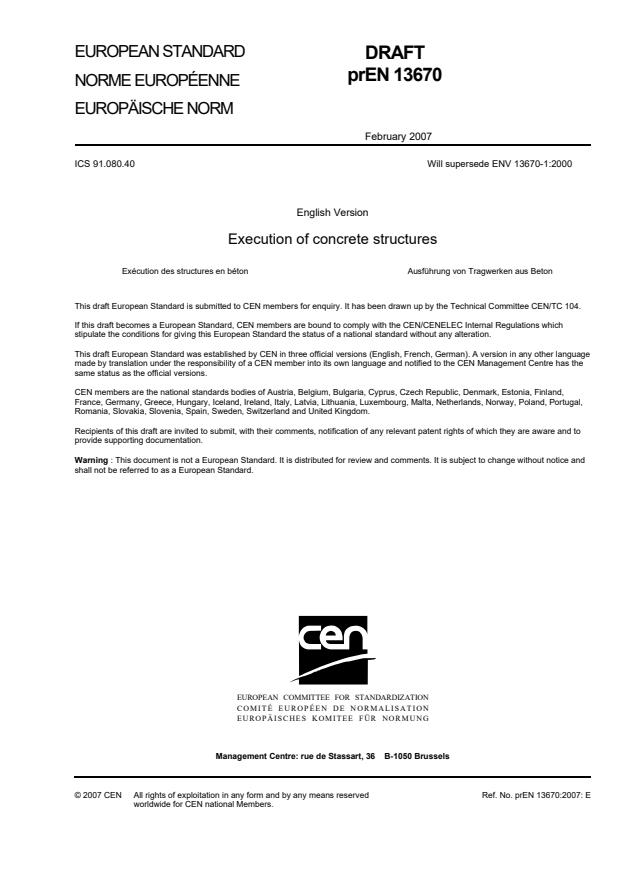
SLOVENSKI STANDARD
01-maj-2007
Izvajanje betonskih konstrukcij
Execution of concrete structures
Ausführung von Tragwerken aus Beton
Exécution des structures en béton
Ta slovenski standard je istoveten z: prEN 13670
ICS:
91.080.40 Betonske konstrukcije Concrete structures
2003-01.Slovenski inštitut za standardizacijo. Razmnoževanje celote ali delov tega standarda ni dovoljeno.
EUROPEAN STANDARD
DRAFT
NORME EUROPÉENNE
EUROPÄISCHE NORM
February 2007
ICS 91.080.40 Will supersede ENV 13670-1:2000
English Version
Execution of concrete structures
Exécution des structures en béton Ausführung von Tragwerken aus Beton
This draft European Standard is submitted to CEN members for enquiry. It has been drawn up by the Technical Committee CEN/TC 104.
If this draft becomes a European Standard, CEN members are bound to comply with the CEN/CENELEC Internal Regulations which
stipulate the conditions for giving this European Standard the status of a national standard without any alteration.
This draft European Standard was established by CEN in three official versions (English, French, German). A version in any other language
made by translation under the responsibility of a CEN member into its own language and notified to the CEN Management Centre has the
same status as the official versions.
CEN members are the national standards bodies of Austria, Belgium, Bulgaria, Cyprus, Czech Republic, Denmark, Estonia, Finland,
France, Germany, Greece, Hungary, Iceland, Ireland, Italy, Latvia, Lithuania, Luxembourg, Malta, Netherlands, Norway, Poland, Portugal,
Romania, Slovakia, Slovenia, Spain, Sweden, Switzerland and United Kingdom.
Recipients of this draft are invited to submit, with their comments, notification of any relevant patent rights of which they are aware and to
provide supporting documentation.
Warning : This document is not a European Standard. It is distributed for review and comments. It is subject to change without notice and
shall not be referred to as a European Standard.
EUROPEAN COMMITTEE FOR STANDARDIZATION
COMITÉ EUROPÉEN DE NORMALISATION
EUROPÄISCHES KOMITEE FÜR NORMUNG
Management Centre: rue de Stassart, 36 B-1050 Brussels
© 2007 CEN All rights of exploitation in any form and by any means reserved Ref. No. prEN 13670:2007: E
worldwide for CEN national Members.
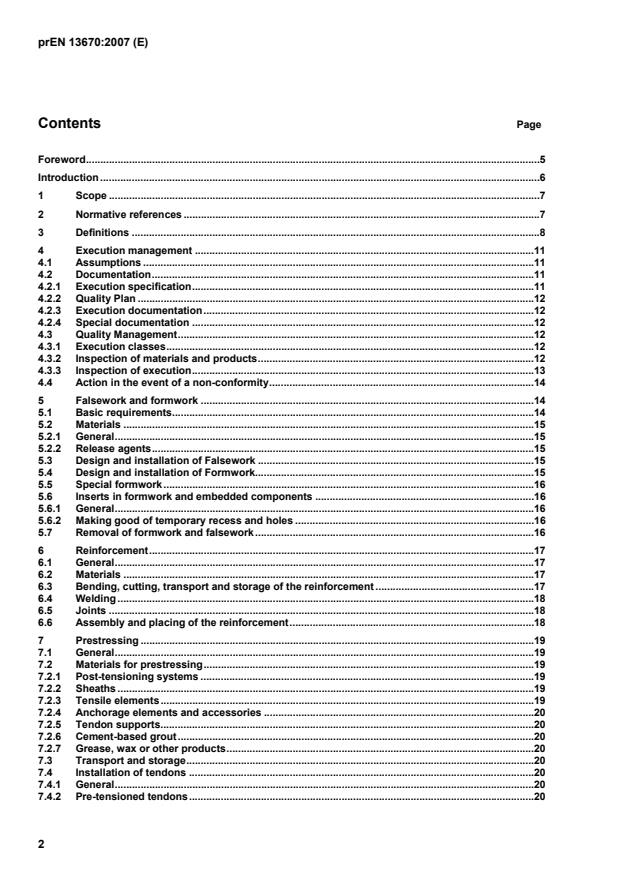
Contents Page
Foreword.5
Introduction .6
1 Scope .7
2 Normative references .7
3 Definitions .8
4 Execution management .11
4.1 Assumptions .11
4.2 Documentation.11
4.2.1 Execution specification.11
4.2.2 Quality Plan .12
4.2.3 Execution documentation.12
4.2.4 Special documentation .12
4.3 Quality Management.12
4.3.1 Execution classes.12
4.3.2 Inspection of materials and products.12
4.3.3 Inspection of execution.13
4.4 Action in the event of a non-conformity.14
5 Falsework and formwork .14
5.1 Basic requirements.14
5.2 Materials .15
5.2.1 General.15
5.2.2 Release agents.15
5.3 Design and installation of Falsework .15
5.4 Design and installation of Formwork.15
5.5 Special formwork.16
5.6 Inserts in formwork and embedded components .16
5.6.1 General.16
5.6.2 Making good of temporary recess and holes .16
5.7 Removal of formwork and falsework.16
6 Reinforcement.17
6.1 General.17
6.2 Materials .17
6.3 Bending, cutting, transport and storage of the reinforcement .17
6.4 Welding .18
6.5 Joints .18
6.6 Assembly and placing of the reinforcement.18
7 Prestressing .19
7.1 General.19
7.2 Materials for prestressing.19
7.2.1 Post-tensioning systems .19
7.2.2 Sheaths .19
7.2.3 Tensile elements.19
7.2.4 Anchorage elements and accessories .20
7.2.5 Tendon supports.20
7.2.6 Cement-based grout.20
7.2.7 Grease, wax or other products.20
7.3 Transport and storage.20
7.4 Installation of tendons .20
7.4.1 General.20
7.4.2 Pre-tensioned tendons.20
7.4.3 Post-tensioned bonded tendons .21
7.4.4 Internal and external unbonded tendons.21
7.5 Tensioning .21
7.5.1 General .21
7.5.2 Pre-tensioned tendons.21
7.5.3 Post-tensioned bonded tendons .21
7.5.4 Internal and external unbonded tendons.22
7.6 Protective measures (grouting, greasing) .22
7.6.1 General .22
7.6.2 Pre-tensioned tendons.22
7.6.3 Post-tensioned bonded tendons .22
7.6.4 Internal or external unbonded tendons.22
7.6.5 Grouting operations .22
7.6.6 Greasing operations.22
8 Concreting.23
8.1 Specification of concrete.23
8.2 Pre-concreting operations.23
8.3 Delivery, reception and site transport of fresh concrete .23
8.4 Placing and compaction .24
8.4.1 General .24
8.4.2 Lightweight Aggregate Concrete.24
8.4.3 Self Compacting Concrete.24
8.4.4 Sprayed concrete .24
8.4.5 Slipforming.24
8.4.6 Underwater concreting .25
8.5 Curing and protection.25
8.6 Post-concreting operations.26
8.7 Concreting of composite structures .26
8.8 Surface Finish.26
9 Execution with precast concrete elements.26
9.1 General .26
9.2 Factory produced precast elements.27
9.3 Site manufactured components.27
9.4 Handling and storage.27
9.4.1 General .27
9.4.2 Handling .27
9.4.3 Storage .27
9.5 Placing and adjustment .27
9.5.1 General .27
9.5.2 Placing.28
9.6 Jointing and completion works .28
9.6.1 General .28
9.6.2 In situ works.28
9.6.3 Structural joints .28
10 Geometrical tolerances.29
10.1 General .29
10.2 Reference system.30
10.3 Base supports (foundations).30
10.4 Columns and walls .30
10.5 Beams and slabs .32
10.6 Sections.32
10.7 Surfaces and edge straightness .35
10.8 Tolerances for holes and inserts .35
Annex A (informative) Guidance on documentation .36
Annex B (informative) Guidance on Quality Management.40
Annex C (informative) Guidance on falsework and formwork.42
Annex D (informative) Guidance on reinforcement .44
Annex E (informative) Guidance on prestressing .45
Annex F (informative) Guidance on concreting .47
Annex G (informative) Guidance on geometrical tolerances.53
Annex H (informative) Guidance on National Annex .60
Foreword
This document (prEN 13670:2007) has been prepared by Technical Committee CEN/TC 104 “Concrete and
related products”, the secretariat of which is held by DIN.
This document is currently submitted to the CEN Enquiry.
This document will supersede ENV 13670-1:2000.
Because of the close connection between design rules and rules for execution, CEN/TC 104/SC 2 has
developed this standard in liaison with CEN/TC 250/SC 2, and CEN TC 229.
Introduction
This European Standard applies to the execution of concrete structures to achieve the intended level of safety
and serviceability during its service life, as given by EN 1990 – Basis of structural design, and
EN 1992 – Design of concrete structures and EN 1994 Design of composite steel and concrete structures,
with the Nationally Determined Parameters (NDPs) applicable in the place of use.
This European Standard has three functions:
– to transfer the requirements set during design to the constructor i.e. to be link between design and
execution;
– to give a set of standardized technical requirements for the execution when ordering a concrete structure;
− to serve as a check list for the designer to ensure that he provides the constructor with all relevant
technical information for the execution of the structure (see Annex A).
In order to achieve these objectives the design shall result in a set of documents and drawings giving all
information required for the execution of the work in accordance with the plans. This set of documents is in
this European Standard referred to as the "execution specification". The standard leaves a number of items
open to be decided in the execution specification.
In areas where national provisions shall apply these should be referred in the execution specification.
It is in this European Standard recognised that areas such as detailed requirements for competence of
personnel, and details related to the Quality Management are within the competence of the Member States.
If the national CEN member publishes a National Annex to this Standard, it may refer to national standards
approved and published by the CEN member or national provisions, which supplement this standard,
alternatively the supplementing rules can be given directly in the National Annex.
National building legislation
and
National building regulation
(in the place of use)
EN 1990 (Eurocode)
Basis of structural design
EN 1992 (Eurocode 2)
Design of concrete structures
EN 13670
Execution of concrete structures
EN 206-1 EN 10080 prEN 10138 or ETA EN 13369 and hEN's for
Concrete Reinforcement Tendons & PT kits
Precast concrete products
Product and test Product and test Product and test Product and test
standards standards standards standards
System of European Standards as basis for design, execution and materials selection for concrete
works (only main modules)
1 Scope
(1) This European Standard gives common requirements for execution of concrete structures.
(2) This standard expects the execution specification to state all the specific requirements relevant to the
particular structure.
(3) This standard is applicable to temporary as well as permanent concrete structures.
(4) Additional or different requirements should be considered and, if required, given in the execution
specification when using:
– lightweight aggregate concrete;
– other materials (e.g. fibres) or constituent materials;
− special technologies/innovative designs.
(5) This standard does not apply to concrete members used only as equipment or construction aids for the
execution.
(6) This standard does not cover the specification, production and conformity of concrete.
(7) This standard is not applicable to the production of precast concrete elements made in accordance with
product standards.
(8) This standard does not cover the requirements for concrete members in special geotechnical works such
as pile foundations, ground anchors, slurry walls, etc.
(9) This standard does not cover safety and health aspects of execution, or third party safety requirements.
(10) This standard does not cover contractual issues or responsibilities for the identified actions.
2 Normative references
(1) The following referenced documents are indispensable for the application of this document. For dated
references, only the edition cited applies. For undated references, the latest edition of the referenced
document (including any amendments) applies.
EN 206-1 Concrete – Part 1: Specification, performance, production and conformity
EN 446 Grout for prestressing tendons – Grouting procedures
EN 447 Grout for prestressing tendons – Specifications for common grout
EN 523 Steel strip sheaths for prestressing tendons – Terminology – Requirements and quality control
EN 1065 Adjustable telescopic steel props – Product specifications, design and assessment by
calculation and tests
EN 1990 Eurocode – Basis of structural design
EN 1991 Eurocode 1: Actions on structures
EN 1992 Eurocode 2: Design of concrete structures
EN 1994 Eurocode 4: Design of composite steel and concrete structures
EN10080 Steel for the reinforcement of concrete – Weldable reinforcing steel
1)
prEN 10138 Prestressing steels
prEN ISO 17660-1 Welding – Welding of reinforcing steel – Part 1: Load bearing welded joints
prEN ISO 17660-2 Welding – Welding of reinforcing steel – Part 2: Non-load bearing welded joints
3 Definitions
For the purposes of this standard, the following definitions apply:
3.1
backpropping
propping installed at levels below the slab that supports the falsework in order to distribute the load to suitable
support
3.2
chair for reinforcement
device used to secure the position between reinforcement layers e.g. supporting top reinforcement in a slab
3.3
construction works
everything that is constructed or results from construction operations (EN 1990)
NOTE The term covers both building and civil engineering works. It refers to the complete construction comprising
both structural and non-structural components
3.4
constructor
the organization executing the works
3.5
erection specification
documents covering all drawings, technical data and requirements required for the safe erection of precast
elements
3.6
execution
all activities carried out for the physical completion of the work, i.e. procurement, scaffolding, formwork,
reinforcing, concreting, curing, erection of precast elements etc., and the inspection and documentation
thereof
3.7
execution class
classified set of requirements specifying quality levels for the execution of the works generally or an individual
component
1) European Standard for prestressing steels (prEN 10138) is presently in preparation. Until it is issued and
implemented, national standards apply, in lieu of national standards ISO 6934 may be applied.
3.8
execution specification
documents covering all drawings, technical data and requirements necessary for the execution of a particular
project prepared supplementing and qualifying the requirements of this European Standard, as well as
referring the national provisions relevant in the place of use
NOTE The execution specification is not one document but signifies the total sum of documents required for the
execution of the work as provided by design to the constructor. and includes the project specification.
3.9
falsework
temporary support for a part of a structure while it is not self-supporting and for associated service load
3.10
formwork
a structure, permanent or temporary, for containing poured concrete, moulding it to the required dimensions
and supporting it until it is able to support itself. Formwork consists of the face contact material and the
bearers directly supporting the face contact material
3.11
inspection
conformity evaluation by observation and judgement accompanied as appropriate by measurement, testing or
gauging
[EN-ISO 9000]
3.12
method statement
documentation describing the methods and procedures to be used to perform the work
3.13
permitted deviation
permitted algebraic differences between the limits of size and the corresponding reference size (see
ISO 1803-1 Building construction – Tolerances – Vocabulary – Part 1: General terms)
3.14
precast concrete element
concrete element cast and cured in a place other than the final location of use (factory produced or site
manufactured). Precast concrete element manufactured in compliance with relevant European product
standard is called precast concrete product
NOTE In this standard the shorter terms "precast element" and "precast product" are used.
3.15
project specification
a project specific document describing the requirements applicable for the particular project
3.16
quality plan
document specifying which procedures and associated resources shall be applied by whom and when to meet
the requirements of the specific project
3.17
reference line
line defined in the execution specification to which sizes are related
3.18
secondary line
any line used for the purpose of setting-out the proposed building and for checking the conformity of the
building or building parts (see ISO 4463-1:1998 Measurement methods for building. Setting out
measurements - Part 1: Planning and organization measuring procedures, acceptance criteria)
3.19
spacer
device used to secure correct spacing between the form and the reinforcement
3.20
surface finish
description of the appearance of the concrete surface including aspects of geometry, texture, colour etc.
3.21
temporary structure
structure designed for a short design working life (see EN 1990)
3.22
tolerance
difference between upper limit of size and the lower limit of size (see ISO 1803 Building construction –
Tolerances-Expression of dimensional accuracy – Principles and terminology)
Tolerances for precast concrete elements are subdivided as follows:
– production tolerances i.e. geometrical tolerances as defined in the product standards;
– erection tolerances i.e. geometrical tolerances relating to location, verticality, horizontality or other
characteristics of the construction assembly;
− construction tolerances i.e. geometrical tolerances that are a combination of production, site construction
and erection tolerances.
NOTE Tolerance is an absolute value without sign, it is however commonly expressed by "± permitted deviation" so
that the value of tolerance is implicit.
3.23.1
normal tolerances
the basic limits for geometrical deviations that ensures that the structure:
– satisfies the design assumptions;
− achieves other functional requirements of the construction works.
NOTE In this standard, normal tolerances are referred to as tolerance class 1.
3.24.2
special tolerances
other tolerances than normal tolerances
3.25
works
in the sense of this standard, those parts of the construction works that are structural concrete work and are
described in the execution specification
4 Execution management
4.1 Assumptions
(1) This European standard assumes:
– the availability of a comprehensive design of the structure
– a project management in charge of the supervision of the works which will enable the execution of a
conforming structure;
− a site management which will take charge of the organisation of the works and enable the correct and safe
use of the equipment and machinery, the satisfactory quality of materials, the execution of a conforming
structure and its safe use up to the delivery of the works.
(2) When precast elements are used, the following additional assumptions are made:
– the availability of a specific design of the precast elements conforming to the relevant standards;
– the availability of a design coordination between precast elements and site manufactured components;
– a technical specification of the precast structure with instructions for installation;
− there is an erection management to direct the erection team.
(3) This European standard presupposes that the work is carried out with the necessary skill and adequate
equipment and resources to perform the work in accordance with this European Standard and the
requirements of the execution specification.
NOTE In some countries, there are special requirements regarding the level of knowledge, training and experience of
personnel involved in the different tasks
(4) It is assumed that the constructor will comply with national regulations and standards e.g. with respect to:
– quality management
– qualifications for the personnel doing the various activities covered by this standard;
– health and safety aspects of construction;
– environmental aspects.
(5) This standard assumes that the finished structure after completion is used as intended in the design and
submitted to the planned inspection and maintenance necessary to achieve the intended design working life
and to detect weaknesses or any unexpected behaviour.
4.2 Documentation
4.2.1 Execution specification
(1) Before commencement of execution of any part of the works, the execution specification relevant to that
part of the works shall be complete and available.
(2) The following items shall be included in the execution specification:
– a reference to this European standard and, if published, its National Annex;
– a reference to other relevant European standards and ETA's;
– a reference to other relevant national regulations and standards;
– a project specification giving information and requirements for the particular project prepared to
supplement and qualify the requirements of the above listed documents;
− drawings and other technical documents needed for the execution.
NOTE Annex A, Table A1 contains a checklist of requirements and information that may have to be included in the
execution specification as appropriate.
(3) In addition where relevant, procedures shall be established for:
– making alterations to previously agreed requirements;
− the distribution, the filing and recording of technical documents used for the works.
4.2.2 Quality Plan
(1) Where a quality plan is required by the execution specification, it shall be available at site.
(2) There may be one quality plan covering all activities or one overall plan supplemented by separate plans
for the various phases and activities to be performed.
4.2.3 Execution documentation
(1) A record shall be made giving the required information as specified for the Execution Class in tables 1, 2
and 3.
4.2.4 Special documentation
(1) If special documentation is required, the type and extent of the documentation shall be stated in the
execution specification.
4.3 Quality Management
4.3.1 Execution classes
(1) Supervision and inspection shall ensure that the works are completed in accordance with the execution
specification.
(2) Inspection in this context refers to verifying conformity of the properties of products and materials to be
used as well as inspection of the execution of the works.
(3) Requirements for quality management are specified using one of the following 3 classes, for which the
required strictness increases from class 1 to class 3:
– Execution Class 1;
– Execution Class 2;
– Execution Class 3.
(4) The execution class may refer to the complete structure, to components of the structure or to certain
materials/technologies used for the execution.
(5) The execution class to be used shall be stated in the execution specification.
(6) This European Standard does not deal with provisions related to degree of independence of the personnel
performing the inspection.
(7) Further detailing of the requirements for the quality management regime in excess of what is given in this
document, may be stated in the execution specification.
4.3.2 Inspection of materials and products
(1) The inspection requirements for conformity with the execution specification are given in Table 1.
Table 1 – Inspection for materials and products
Subject Execution Class 1 Execution Class 2 Execution Class 3
Materials for scaffold, In accordance with 5.1 and 5.2
1)
formwork and falsework
1)
Reinforcing steel In accordance with 6.2
Prestressing system Not to be used in this class In accordance with 7.2
1)
components
1), 3)
Fresh concrete; In accordance with 8.1 and 8.2
ready-mixed or site-mixed
At reception of ready-mixed concrete a delivery ticket shall be present
1), 2)
Other items In accordance with the execution specification
1)
Precast elements In accordance with 9.2 and 9.3
Inspection report Not required Required
1)
Products bearing the CE-mark or certified by an approved certification body shall be checked against the delivery ticket and
visually inspected. In cases of doubt, further inspection shall be undertaken to check that the product conforms to its specification.
Other products shall be subject to inspection and acceptance testing as defined in the execution specification
2)
For example, items such as embedded steel components etc.
3)
If prescribed concrete is used, the relevant properties are to be checked by tests
4.3.3 Inspection of execution
(1) The inspection requirements for conformity with the execution specification are given in Table 2 and 3.
Table 2 – Subjects of execution
Subject Execution Class 1 Execution Class 2 Execution Class 3
Scaffolding, formwork According to requirements given in 5
and falsework
Ordinary reinforcement According to requirements given in 6
Prestressing Not to be used in this According to requirements given in 7
reinforcement class
Embedded items According to requirements given in 5.6
Erection of precast According to requirements given in 9
elements
Site transport and According to requirements given in 8
casting and curing of
concrete
As-built geometry Not required According to execution specification
Table 3 – Type and documentation of inspection
Execution Class 1 Execution Class 2 Execution Class 3
Type of inspection Visual inspection and Visual inspection and Visual inspection Detailed
random measurements systematic and regular inspection of all works which
measurements of major works are significant for the load-
bearing capacity and durability
of the structure
Party which carries out Self inspection Self inspection Self inspection
the inspection
Inspection in accordance with Inspection in accordance with
the procedures of the the procedures of the
constructor constructor
Possible additional Additional requirements by
requirements by execution project execution specification
specification
Extent All works In addition to the self In addition to the self
inspection, there shall be a inspection, there shall be a
systematic and regular systematic and regular
inspection of the works inspection of the works
Inspection report Not required Required Required
4.4 Action in the event of a non-conformity
(1) Where inspection reveals a non-conformity, appropriate action shall be taken to ensure that the structure
remains able to perform as designed for its intended design purpose.
(2) The following aspects shall be investigated in the listed order:
– the implications of the non-conformity on further execution and fitness for intended design purpose;
– the measures necessary to make the component acceptable;
− the necessity of rejection and replacement of the non-repairable component.
(3) If required in the execution specification, the rectification of non-conformity shall be in accordance with a
procedure stated in the execution specification or agreed.
5 Falsework and formwork
5.1 Basic requirements
(1) Falsework and formwork including their supports and foundations shall be designed and constructed so
that they are:
– capable of resisting any foreseeable action to which they are submitted during the construction process;
− stiff enough to ensure that the tolerances specified for the structure are satisfied and the integrity of the
structural member is not affected.
(2) The form, function, appearance and durability of the permanent works shall not be impaired or damaged
due to the performance of the falsework, formwork and backpropping or their removal.
(3) Falsework and formwork shall comply with this standard and the relevant European Standard if available
or be demonstrateably fit for the intended use.
NOTE Falsework and formwork that comply with European Standards prepared for systems for temporary equipment
should be deemed to satisfy this standard (e.g. EN 12812, EN 12813 and EN 15113-1).
5.2 Materials
5.2.1 General
(1) Any material may be used which leads to the fulfilment of the criteria for the structure given in 5.1 and
clause 8. They shall conform to relevant product standards or where none exist the characteristics of the
specific material shall be taken into account.
5.2.2 Release agents
(1) Release agents where used shall be selected and applied in such a way that they are not harmful to
concrete, reinforcing steel, prestressing steel or formwork and in such a way that they have no detrimental
effects on the permanent structure.
(2) Release agents shall have no unintended effect on the colour, surface quality of the permanent structure
or specified subsequent coatings.
5.3 Design and installation of Falsework
(1) A method statement, where required by the execution specification, shall give the design parameters/class
adopted and describe the method of erection and dismantling of temporary structures including backpropping.
It shall specify the requirements for handling, adjusting, intentional precambering, loading, unkeying, striking
and dismantling.
(2) The design of the falsework shall take into account the deformation during and after concreting to prevent
deleterious cracking in the young concrete.
(3) The layout of falsework shall not restrain the elastic deformation of the concrete during post-tensioning.
(4) Where the design of the finished permanent structure requires support of part of the structure until further
parts or supporting structures, including backfilling, are completed, such requirements shall be stated in the
execution specification.
5.4 Design and installation of Formwork
(1) A method statement, where required by the execution specification, shall describe the methods of support,
erection and dismantling. It shall specify the requirements for handling, adjusting, tying, intentional
precambering, loading, unkeying, striking and dismantling.
(2) Formwork shall keep the concrete in its required shape until it is sufficiently hardened.
(3) Formwork and the joints between boards or panels shall be sufficiently tight so as to prevent loss of fines.
(4) Formwork likely to absorb significant amounts of water from the concrete or facilitate evaporation shall be
suitably treated to reduce water uptake from the concrete, unless intended specifically for that purpose.
(5) The internal surface of the formwork shall be clean. If the formwork is required by the execution
specification to produce visible concrete surfaces, the treatment of the formwork surfaces shall be such that
the specified finish is achievable.
(6) Where the design of the finished permanent structure requires particular surface finish it shall be stated in
the execution specification.
(7) Where the design of the finished permanent structure requires temporary support and/or specific deflection
criteria it shall be stated in the execution specification.
(8) The formwork shall not restrain the elastic deformation of the concrete during post-tensioning.
(9) When using slipforming, the design of the system shall take into account the properties of the formwork
material and make provision for controlling the geometry of the works.
5.5 Special formwork
(1) Requirements shall be given in the execution specification.
5.6 Inserts in formwork and embedded components
5.6.1 General
(1) Temporary inserts to keep the formwork in place, bars, ducts and similar items to be cast within the section
and embedded components shall:
– be fixed robustly enough to ensure that they will keep their prescribed position during concreting;
– be provided with adequate corrosion protection;
– be of sufficient strength and stiffness to preserve its shape during the concreting operation
– be given the specified concrete cover unless surface treated;
– not introduce unacceptable actions on the structure;
– not react harmfully with the concrete, the reinforcement or prestressing steel;
– not produce
...