

SIST EN 10360:2015
(Main)Hot, warm or cold forgings - Repair conditions prior to delivery
General Information
- Abstract
This European Standard defines the forged components surface repair conditions and control to preserve their functionality.
- Status
- Published
- Public Enquiry End Date
- 14-Jan-2014
- Publication Date
- 06-Sep-2015
- Technical Committee
- IFEK - Ferrous metals
- Current Stage
- 6060 - National Implementation/Publication (Adopted Project)
- Start Date
- 03-Sep-2015
- Due Date
- 08-Nov-2015
- Completion Date
- 07-Sep-2015

Overview
EN 10360:2015 - "Hot, warm or cold forging - Repair conditions prior to delivery" is a CEN European Standard that defines the conditions, methods and controls for surface repair of forged components (primarily iron and steel forgings) so that their functionality is preserved prior to delivery. It covers definitions, prohibited repair areas, permitted removal methods, surface condition requirements after repair, acceptance rules and operator training requirements.
Key topics and requirements
- Scope & definitions
- Defines key terms such as functionality, repair, prohibited repair area, surface imperfection and surface defect.
- Prohibited repair areas
- Areas where repair is not permitted must be specified by the purchaser at enquiry/order; additional areas resulting from manufacturing must be mutually agreed.
- Removal methods
- Surface defects can be removed by grinding, scraping, polishing, chipping, machining or other processes that preserve functionality.
- Welding or powder metallurgy repairs are allowed only with purchaser agreement.
- Process controls
- Equipment and methods must suit the material grade, defect location/shape and component geometry.
- Manufacturers must develop methods to avoid masking defects and should, where applicable, process by successive passes perpendicular to the defect direction.
- Re-testing by the original NDT method is possible after agreement between purchaser and manufacturer.
- Surface condition after repair
- Repaired areas must not show excessive temperature effects, sharp edges, chatter marks or grooves; small pits may remain if they follow the surrounding surface continuity.
- Post-repair operations
- Surface-restoring operations (e.g., shot‑blasting) may be carried out to restore pre-repair properties if agreed; otherwise left to manufacturer discretion.
- Acceptance & tolerances
- Repaired components must meet specified dimensional and surface tolerances; reference standards (e.g., EN 10243-1 / EN 10243-2) apply unless otherwise agreed.
- Operator training
- Manufacturers must train, qualify and monitor personnel authorized to perform repairs.
Applications and who uses this standard
EN 10360:2015 is used by:
- Forging manufacturers and subcontractors who perform repairs on hot, warm or cold forgings
- Quality managers, production engineers and NDT inspectors responsible for surface repair control and acceptance
- Purchasers and procurement teams specifying repair allowances, prohibited repair areas and acceptance criteria
- OEMs and end-users in industries such as automotive, aerospace, oil & gas, and heavy machinery that rely on forged components
Practical benefits include consistent repair practices, controlled preservation of component functionality, clearer purchaser/manufacturer agreements, and traceable acceptance criteria.
Related standards
- ISO 7788:1985 - Surface finish requirements for hot‑rolled steel plates
- EN 10243‑1 / EN 10243‑2 - Tolerances for steel die forgings (referenced for dimensional acceptance)
Get Certified
Connect with accredited certification bodies for this standard

Element Materials Technology
Materials testing and product certification.

Inštitut za kovinske materiale in tehnologije
Institute of Metals and Technology. Materials testing, metallurgical analysis, NDT.
Sponsored listings
Frequently Asked Questions
SIST EN 10360:2015 is a standard published by the Slovenian Institute for Standardization (SIST). Its full title is "Hot, warm or cold forgings - Repair conditions prior to delivery". This standard covers: This European Standard defines the forged components surface repair conditions and control to preserve their functionality.
This European Standard defines the forged components surface repair conditions and control to preserve their functionality.
SIST EN 10360:2015 is classified under the following ICS (International Classification for Standards) categories: 77.140.85 - Iron and steel forgings. The ICS classification helps identify the subject area and facilitates finding related standards.
SIST EN 10360:2015 is available in PDF format for immediate download after purchase. The document can be added to your cart and obtained through the secure checkout process. Digital delivery ensures instant access to the complete standard document.
Standards Content (Sample)
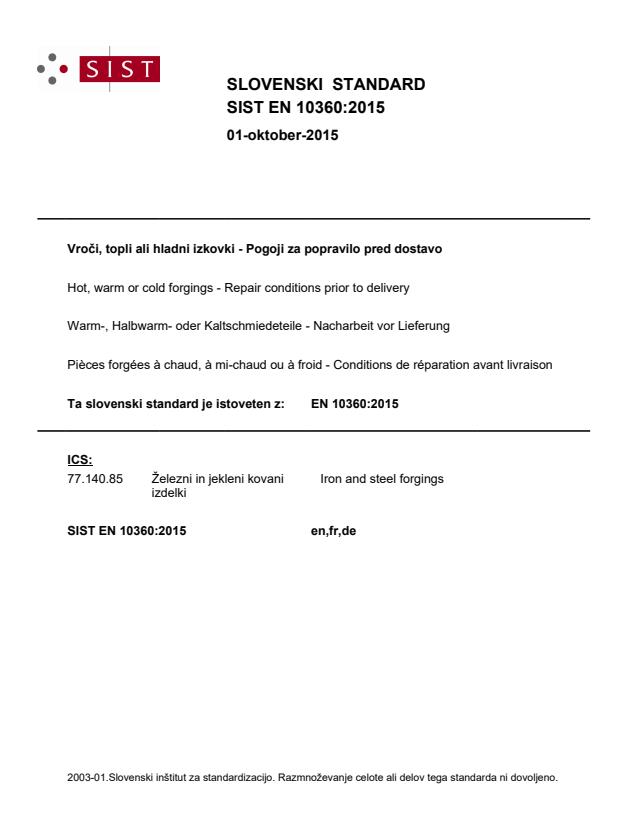
2003-01.Slovenski inštitut za standardizacijo. Razmnoževanje celote ali delov tega standarda ni dovoljeno.RWarm-, Halbwarm- oder Kaltschmiedeteile - Nacharbeit vor LieferungPièces forgées à chaud, à mi-chaud ou à froid - Conditions de réparation avant livraisonHot, warm or cold forgings - Repair conditions prior to delivery77.140.85Železni in jekleni kovani izdelkiIron and steel forgingsICS:Ta slovenski standard je istoveten z:EN 10360:2015SIST EN 10360:2015en,fr,de01-oktober-2015SIST EN 10360:2015SLOVENSKI
STANDARD
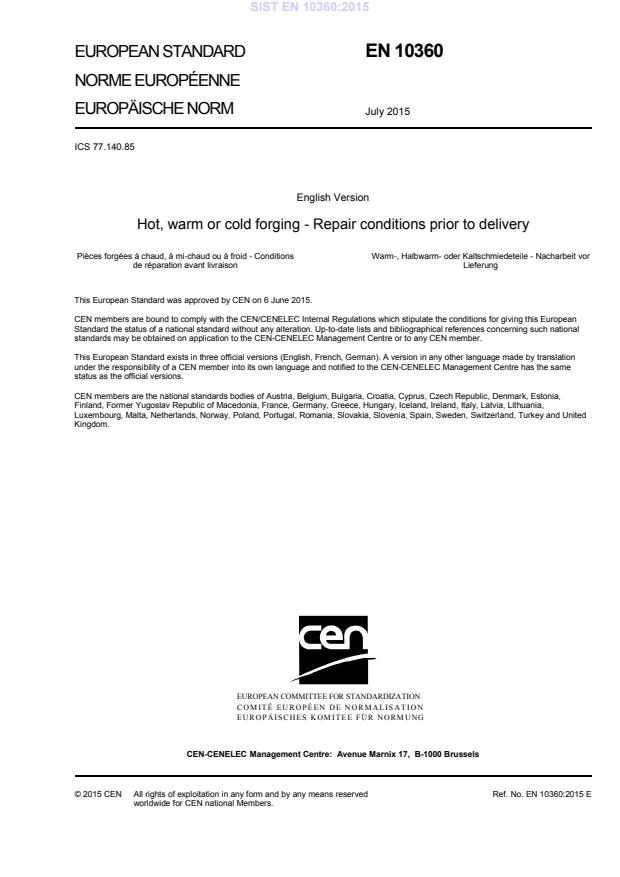
EUROPEAN STANDARD NORME EUROPÉENNE EUROPÄISCHE NORM
EN 10360
July 2015 ICS 77.140.85 English Version
Hot, warm or cold forging - Repair conditions prior to delivery
Pièces forgées à chaud, à mi-chaud ou à froid - Conditions de réparation avant livraison
Warm-, Halbwarm- oder Kaltschmiedeteile - Nacharbeit vor Lieferung This European Standard was approved by CEN on 6 June 2015.
CEN members are bound to comply with the CEN/CENELEC Internal Regulations which stipulate the conditions for giving this European Standard the status of a national standard without any alteration. Up-to-date lists and bibliographical references concerning such national standards may be obtained on application to the CEN-CENELEC Management Centre or to any CEN member.
This European Standard exists in three official versions (English, French, German). A version in any other language made by translation under the responsibility of a CEN member into its own language and notified to the CEN-CENELEC Management Centre has the same status as the official versions.
CEN members are the national standards bodies of Austria, Belgium, Bulgaria, Croatia, Cyprus, Czech Republic, Denmark, Estonia, Finland, Former Yugoslav Republic of Macedonia, France, Germany, Greece, Hungary, Iceland, Ireland, Italy, Latvia, Lithuania, Luxembourg, Malta, Netherlands, Norway, Poland, Portugal, Romania, Slovakia, Slovenia, Spain, Sweden, Switzerland, Turkey and United Kingdom.
EUROPEAN COMMITTEE FOR STANDARDIZATION
COMITÉ EUROPÉEN DE NORMALISATION EUROPÄISCHES KOMITEE FÜR NORMUNG
CEN-CENELEC Management Centre:
Avenue Marnix 17,
B-1000 Brussels © 2015 CEN All rights of exploitation in any form and by any means reserved worldwide for CEN national Members. Ref. No. EN 10360:2015 ESIST EN 10360:2015
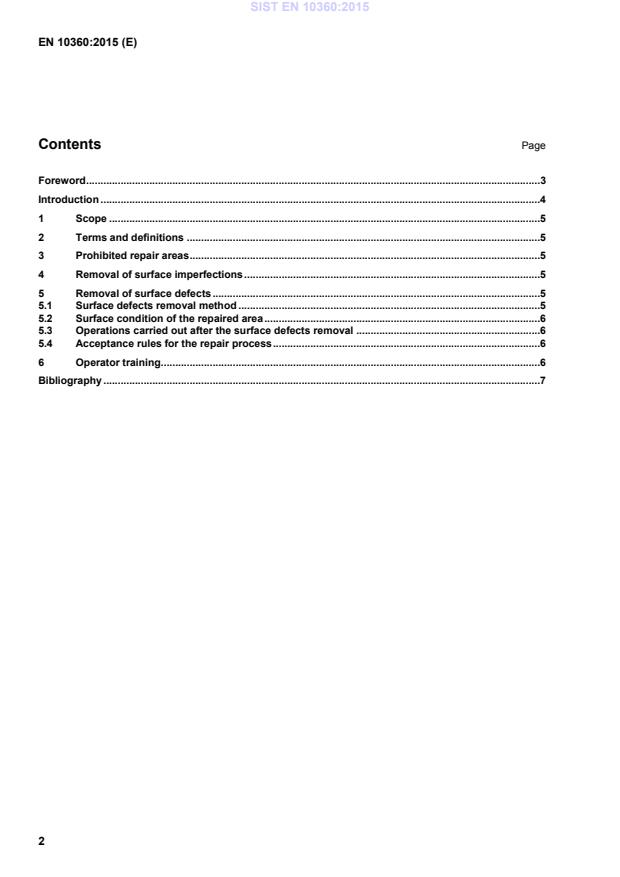
Foreword .3 Introduction .4 1 Scope .5 2 Terms and definitions .5 3 Prohibited repair areas .5 4 Removal of surface imperfections .5 5 Removal of surface defects .5 5.1 Surface defects removal method .5 5.2 Surface condition of the repaired area .6 5.3 Operations carried out after the surface defects removal .6 5.4 Acceptance rules for the repair process .6 6 Operator training.6 Bibliography .7
...