

oSIST prEN IEC 62941:2024
(Main)Terrestrial photovoltaic (PV) modules - Quality system for PV module manufacturing
General Information
- Abstract
- Status
- Not Published
- Public Enquiry End Date
- 19-May-2024
- Technical Committee
- PVS - Solar photovoltaic energy systems
- Current Stage
- 4020 - Public enquire (PE) (Adopted Project)
- Start Date
- 20-Mar-2024
- Due Date
- 07-Aug-2024
- Completion Date
- 21-May-2024

Overview
prEN IEC 62941:2024 - "Terrestrial photovoltaic (PV) modules - Quality system for PV module manufacturing" defines a quality-system framework specific to the manufacture of terrestrial PV modules. It is intended to increase confidence in the ongoing consistency of performance and reliability of PV modules that have achieved design, type and safety qualification (for example, modules certified to IEC 61215, IEC 62108 (CPV) and IEC 61730). The document assumes an organization already meets ISO 9001 (or equivalent) and provides sector-specific best practices for product design, manufacturing processes, material selection and factory audit criteria. Note: the version circulated as a Committee Draft for Vote (CDV) is subject to change; a proposed stability date is 2029.
Key topics and requirements
- Scope & applicability: Applies to manufacturers of certified terrestrial PV modules; covers flat-plate and CPV but notes CPV/nonconventional processes may require different controls.
- Support & resources: Requirements for resources, succession planning and warranty-support resources.
- Monitoring & measurement: Control of measuring equipment, IV/performance rating equipment, solar simulator control and traceability of calibration.
- Documented information: Control and retention of documentation and records used for process control and audits.
- Operation & control: Operational planning, customer communication, feasibility review, and manufacturing process design inputs/outputs.
- Control plans: Documented control plans for production, measurement procedures and solar simulator use.
- External providers: Controls for suppliers, extent of controls and information flow to/from external providers.
- Production practices: Identification, traceability, preservation, validation of processes and post-delivery activities.
- Nonconforming outputs & improvement: Containment, corrective/preventive actions, internal audits, continual improvement and performance evaluation.
- Measurement uncertainty & standards linkage: References to IV measurement standards and uncertainty guidance (IEC 60904-series, ISO/IEC Guide 98-3).
Practical applications & users
Who benefits:
- PV module manufacturers and quality managers implementing factory-level quality systems.
- Certification bodies and auditors using factory audit criteria.
- Test laboratories and calibration houses managing IV and solar-simulator measurements.
- Procurement, OEMs and component suppliers aligning supplier controls and traceability.
Practical uses:
- Establishing or improving manufacturing control plans and measurement systems.
- Preparing for design/type re-testing and factory audits.
- Ensuring production-line IV measurement consistency and traceability.
- Reducing risk of nonconforming modules and improving warranty handling.
Related standards
Key referenced documents include IEC 61215, IEC 61730, IEC 62108, IEC 60904 series (IV and solar simulators), IEC TR 60904-14, IEC 60812 (FMEA) and ISO 9001:2015. These form the normative backbone for test, measurement and quality practices described in prEN IEC 62941:2024.
Relations
- Effective Date
- 25-Apr-2023
Get Certified
Connect with accredited certification bodies for this standard

DNV
DNV is an independent assurance and risk management provider.

BSI Group
BSI (British Standards Institution) is the business standards company that helps organizations make excellence a habit.

Bureau Veritas
Bureau Veritas is a world leader in laboratory testing, inspection and certification services.
Sponsored listings
Frequently Asked Questions
oSIST prEN IEC 62941:2024 is a draft published by the Slovenian Institute for Standardization (SIST). Its full title is "Terrestrial photovoltaic (PV) modules - Quality system for PV module manufacturing". This standard covers: Terrestrial photovoltaic (PV) modules - Quality system for PV module manufacturing
Terrestrial photovoltaic (PV) modules - Quality system for PV module manufacturing
oSIST prEN IEC 62941:2024 is classified under the following ICS (International Classification for Standards) categories: 03.120.99 - Other standards related to quality; 27.160 - Solar energy engineering. The ICS classification helps identify the subject area and facilitates finding related standards.
oSIST prEN IEC 62941:2024 has the following relationships with other standards: It is inter standard links to SIST EN IEC 62941:2020. Understanding these relationships helps ensure you are using the most current and applicable version of the standard.
oSIST prEN IEC 62941:2024 is available in PDF format for immediate download after purchase. The document can be added to your cart and obtained through the secure checkout process. Digital delivery ensures instant access to the complete standard document.
Standards Content (Sample)
SLOVENSKI STANDARD
01-maj-2024
Prizemni fotonapetostni (PV) moduli - Sistem kakovosti za proizvodnjo PV-
modulov
Terrestrial photovoltaic (PV) modules - Quality system for PV module manufacturing
Terrestrische Photovoltaik(PV)-Module - Qualitätssystem zur Fertigung von PV-Modulen
Modules photovoltaïques (PV) pour applications terrestres - Système de qualité pour la
fabrication des modules photovoltaïques
Ta slovenski standard je istoveten z: prEN IEC 62941:2024
ICS:
03.120.99 Drugi standardi v zvezi s Other standards related to
kakovostjo quality
27.160 Sončna energija Solar energy engineering
2003-01.Slovenski inštitut za standardizacijo. Razmnoževanje celote ali delov tega standarda ni dovoljeno.
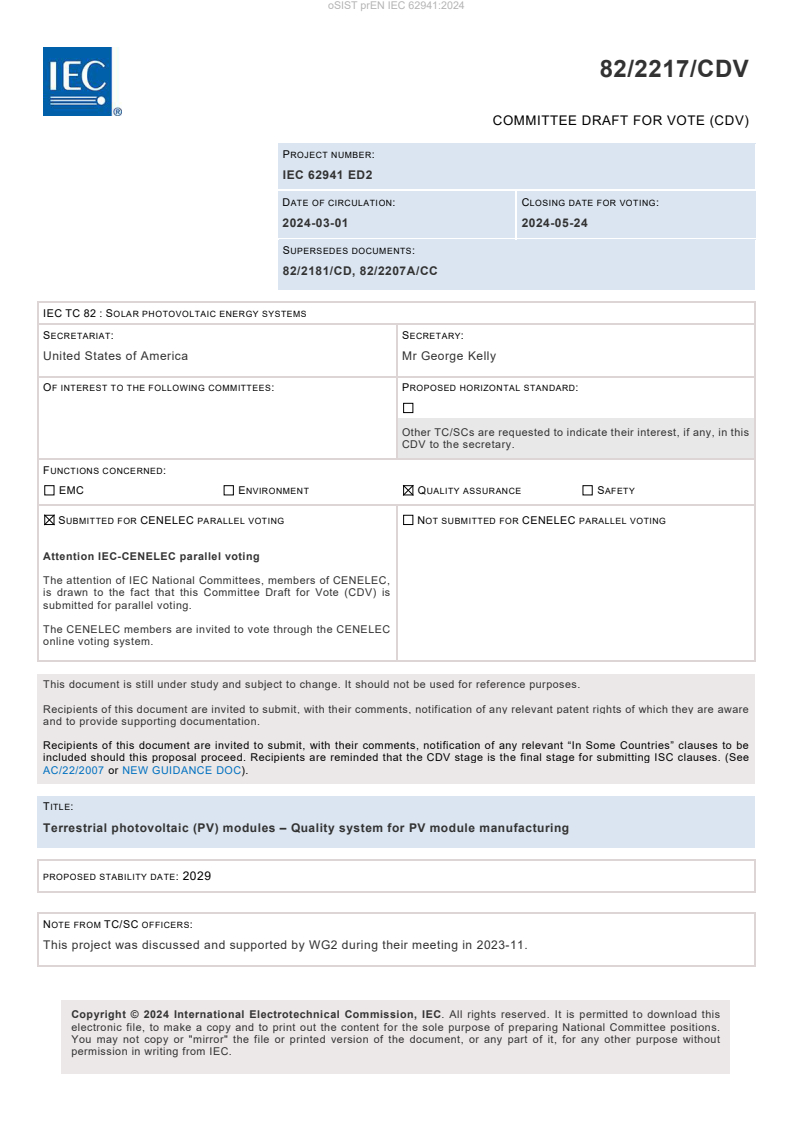
82/2217/CDV
COMMITTEE DRAFT FOR VOTE (CDV)
PROJECT NUMBER:
IEC 62941 ED2
DATE OF CIRCULATION: CLOSING DATE FOR VOTING:
2024-03-01 2024-05-24
SUPERSEDES DOCUMENTS:
82/2181/CD, 82/2207A/CC
IEC TC 82 : SOLAR PHOTOVOLTAIC ENERGY SYSTEMS
SECRETARIAT: SECRETARY:
United States of America Mr George Kelly
OF INTEREST TO THE FOLLOWING COMMITTEES: PROPOSED HORIZONTAL STANDARD:
Other TC/SCs are requested to indicate their interest, if any, in this
CDV to the secretary.
FUNCTIONS CONCERNED:
EMC ENVIRONMENT QUALITY ASSURANCE SAFETY
SUBMITTED FOR CENELEC PARALLEL VOTING NOT SUBMITTED FOR CENELEC PARALLEL VOTING
Attention IEC-CENELEC parallel voting
The attention of IEC National Committees, members of CENELEC,
is drawn to the fact that this Committee Draft for Vote (CDV) is
submitted for parallel voting.
The CENELEC members are invited to vote through the CENELEC
online voting system.
This document is still under study and subject to change. It should not be used for reference purposes.
Recipients of this document are invited to submit, with their comments, notification of any relevant patent rights of which they are aware
and to provide supporting documentation.
Recipients of this document are invited to submit, with their comments, notification of any relevant “In Some Countries” clauses to be
included should this proposal proceed. Recipients are reminded that the CDV stage is the final stage for submitting ISC clauses. (See
AC/22/2007 or NEW GUIDANCE DOC).
TITLE:
Terrestrial photovoltaic (PV) modules – Quality system for PV module manufacturing
PROPOSED STABILITY DATE: 2029
NOTE FROM TC/SC OFFICERS:
This project was discussed and supported by WG2 during their meeting in 2023-11.
electronic file, to make a copy and to print out the content for the sole purpose of preparing National Committee positions.
You may not copy or "mirror" the file or printed version of the document, or any part of it, for any other purpose without
permission in writing from IEC.
82/2217/CDV – 2 – IEC CD 62941 © IEC 2024
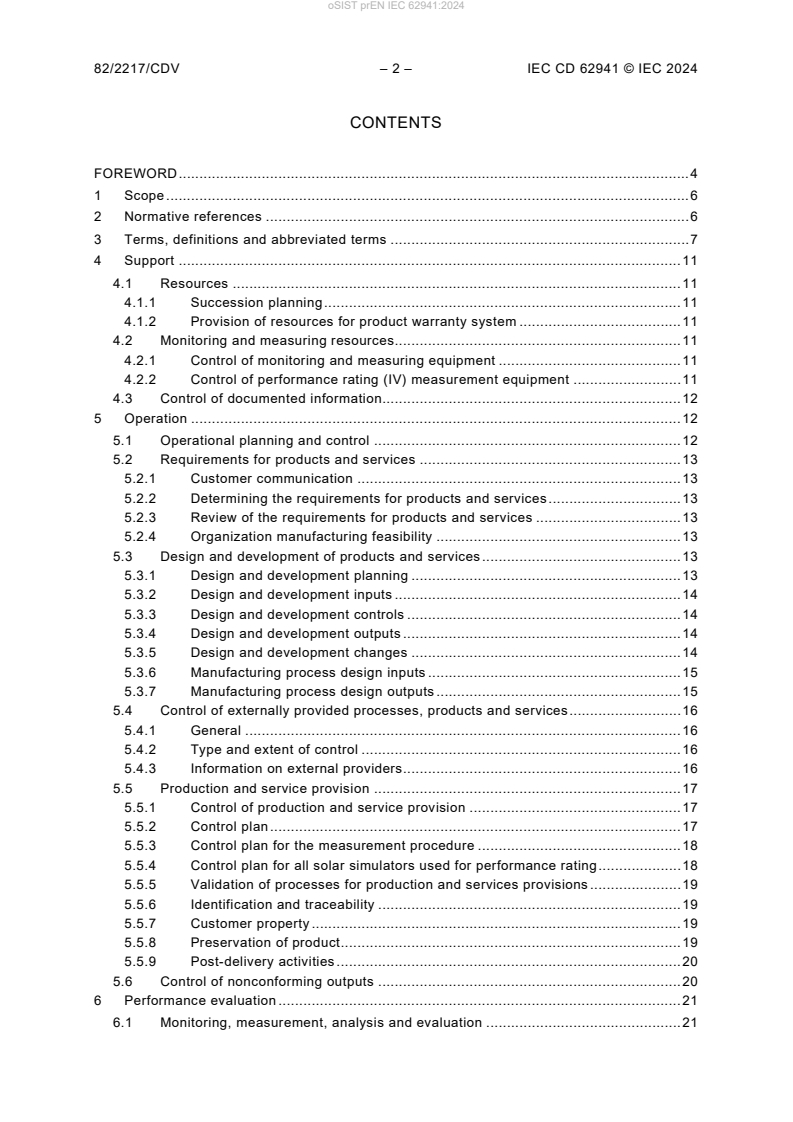
CONTENTS
FOREWORD . 4
1 Scope . 6
2 Normative references . 6
3 Terms, definitions and abbreviated terms . 7
4 Support . 11
4.1 Resources . 11
4.1.1 Succession planning . 11
4.1.2 Provision of resources for product warranty system . 11
4.2 Monitoring and measuring resources. 11
4.2.1 Control of monitoring and measuring equipment . 11
4.2.2 Control of performance rating (IV) measurement equipment . 11
4.3 Control of documented information. 12
5 Operation . 12
5.1 Operational planning and control . 12
5.2 Requirements for products and services . 13
5.2.1 Customer communication . 13
5.2.2 Determining the requirements for products and services . 13
5.2.3 Review of the requirements for products and services . 13
5.2.4 Organization manufacturing feasibility . 13
5.3 Design and development of products and services . 13
5.3.1 Design and development planning . 13
5.3.2 Design and development inputs . 14
5.3.3 Design and development controls . 14
5.3.4 Design and development outputs . 14
5.3.5 Design and development changes . 14
5.3.6 Manufacturing process design inputs . 15
5.3.7 Manufacturing process design outputs . 15
5.4 Control of externally provided processes, products and services . 16
5.4.1 General . 16
5.4.2 Type and extent of control . 16
5.4.3 Information on external providers . 16
5.5 Production and service provision . 17
5.5.1 Control of production and service provision . 17
5.5.2 Control plan . 17
5.5.3 Control plan for the measurement procedure . 18
5.5.4 Control plan for all solar simulators used for performance rating . 18
5.5.5 Validation of processes for production and services provisions . 19
5.5.6 Identification and traceability . 19
5.5.7 Customer property . 19
5.5.8 Preservation of product . 19
5.5.9 Post-delivery activities . 20
5.6 Control of nonconforming outputs . 20
6 Performance evaluation . 21
6.1 Monitoring, measurement, analysis and evaluation . 21
IEC CD 62941 © IEC 2024 – 3 – 82/2217/CDV
6.1.1 Monitoring and measurement of a manufacturing process . 21
6.1.2 Monitoring and measurement of product . 21
6.1.3 Ongoing product monitoring . 22
6.2 Customer satisfaction . 22
6.3 Analysis and evaluation . 22
6.4 Internal audit . 22
7 Improvement . 22
7.1 Corrective and preventive action . 22
7.2 Continual improvement . 23
Annex A (informative) Correspondence between ISO 9001:2015 and IEC 62941 . 24
Bibliography . 27
82/2217/CDV – 4 – IEC CD 62941 © IEC 2024
INTERNATIONAL ELECTROTECHNICAL COMMISSION
____________
TERRESTRIAL PHOTOVOLTAIC (PV) MODULES –
QUALITY SYSTEM FOR PV MODULE MANUFACTURING
FOREWORD
1) The International Electrotechnical Commission (IEC) is a worldwide organization for standardization comprising
all national electrotechnical committees (IEC National Committees). The object of IEC is to promote international
co-operation on all questions concerning standardization in the electrical and electronic fields. To this end and
in addition to other activities, IEC publishes International Standards, Technical Specifications, Technical Reports,
Publicly Available Specifications (PAS) and Guides (hereafter referred to as “IEC Publication(s)”). Their
preparation is entrusted to technical committees; any IEC National Committee interested in the subject dealt with
may participate in this preparatory work. International, governmental and non-governmental organizations liaising
with the IEC also participate in this preparation. IEC collaborates closely with the International Organization for
Standardization (ISO) in accordance with conditions determined by agreement between the two organizations.
2) The formal decisions or agreements of IEC on technical matters express, as nearly as possible, an international
consensus of opinion on the relevant subjects since each technical committee has representation from all
interested IEC National Committees.
3) IEC Publications have the form of recommendations for international use and are accepted by IEC National
Committees in that sense. While all reasonable efforts are made to ensure that the technical content of IEC
Publications is accurate, IEC cannot be held responsible for the way in which they are used or for any
misinterpretation by any end user.
4) In order to promote international uniformity, IEC National Committees undertake to apply IEC Publications
transparently to the maximum extent possible in their national and regional publications. Any divergence between
any IEC Publication and the corresponding national or regional publication shall be clearly indicated in the latter.
5) IEC itself does not provide any attestation of conformity. Independent certification bodies provide conformity
assessment services and, in some areas, access to IEC marks of conformity. IEC is not responsible for any
services carried out by independent certification bodies.
6) All users should ensure that they have the latest edition of this publication.
7) No liability shall attach to IEC or its directors, employees, servants or agents including individual experts and
members of its technical committees and IEC National Committees for any personal injury, property damage or
other damage of any nature whatsoever, whether direct or indirect, or for costs (including legal fees) and
expenses arising out of the publication, use of, or reliance upon, this IEC Publication or any other IEC Publications.
8) Attention is drawn to the Normative references cited in this publication. Use of the referenced publications is
indispensable for the correct application of this publication.
9) Attention is drawn to the possibility that some of the elements of this IEC Publication may be the subject of patent
rights. IEC shall not be held responsible for identifying any or all such patent rights.
International Standard IEC 62941 has been prepared by IEC technical committee 82: Solar
photovoltaic energy systems.
The text of this International Standard is based on the following documents:
FDIS Report on voting
82/1635/FDIS 82/1641/RVD
Full information on the voting for the approval of this International Standard can be found in the
report on voting indicated in the above table.
IEC CD 62941 © IEC 2024 – 5 – 82/2217/CDV
This document has been drafted in accordance with the ISO/IEC Directives, Part 2.
The committee has decided that the contents of this document will remain unchanged until the
stability date indicated on the IEC website under "http://webstore.iec.ch" in the data related to
the specific document. At this date, the document will be
• reconfirmed,
• withdrawn,
• replaced by a revised edition, or
• amended.
82/2217/CDV – 6 – IEC CD 62941 © IEC 2024
1 TERRESTRIAL PHOTOVOLTAIC (PV) MODULES –
2 QUALITY SYSTEM FOR PV MODULE MANUFACTURING
5 1.Scope
6 This document is applicable to organizations manufacturing photovoltaic (PV) modules certified
7 to IEC 61215 series and IEC 62108 for design qualification and type approval and IEC 61730
8 for safety qualification. The design qualification and type approval of PV modules depend on
9 appropriate methods for product and process design, as well as appropriate control of materials
10 and processes used to manufacture the product. This document lays out best practices for
11 product design, manufacturing processes, and selection and control of materials used in the
12 manufacture of PV modules that have met the requirements of IEC 61215 series and IEC 61730.
13 These standards also form the basis for factory audit criteria of such sites by various certifying
14 and auditory bodies.
15 The object of this document is to provide a framework for the improved confidence in the
16 ongoing consistency of performance and reliability of certified PV modules. The requirements
17 of this document are defined with the assumption that the quality management system of the
18 organization has already fulfilled the requirements of ISO 9001 or equivalent quality
19 management system. This document is not intended to replace or remove any requirements of
20 ISO 9001 or equivalent quality management system. By maintaining a manufacturing system in
21 accordance with this document, PV modules are expected to maintain their performance as
22 determined from the test sequences in IEC 61215 seriesand IEC 61730.
23 NOTE: Reference to IEC 61730 means reference to both parts 1 and 2.
24 This document is applicable to all PV modules independent of design and technology, i.e. flat
25 panel, concentrator photovoltaic (CPV). Quality controls for CPV and nonconventional flat-plate
26 manufacturing will differ somewhat from those of more conventional designs; this document has
27 not considered these differences.
28 2. Normative references
29 The following documents are referred to in the text in such a way that some or all of their content
30 constitutes requirements of this document. For dated references, only the edition cited applies.
31 For undated references, the latest edition of the referenced document (including any
32 amendments) applies.
33 IEC 60812: Failure modes and effects analysis (FMEA and FMECA)
34 IEC 60891, Photovoltaic devices – Procedure for temperature and irradiance corrections to
35 measured I-V characteristics
36 IEC 60904-1, Photovoltaic devices – Part 1: Measurement of photovoltaic current-voltage
37 characteristics
38 IEC 60904-2, Photovoltaic devices – Part 2: Requirements for photovoltaic reference devices
39 IEC 60904-3, Photovoltaic devices – Part 3: Measurement principles for terrestrial photovoltaic
40 (PV) solar devices with reference spectral irradiance data
41 IEC 60904-4, Photovoltaic devices – Part 4: Reference solar devices – Procedures for
42 establishing calibration traceability
IEC CD 62941 © IEC 2024 – 7 – 82/2217/CDV
43 IEC 60904-7, Photovoltaic devices – Part 7: Computation of the spectral mismatch correction
44 for measurements of photovoltaic devices
45 IEC 60904-9, Photovoltaic devices – Part 9: Solar simulator performance requirements
46 IEC TR 60904-14, Photovoltaic devices - Part 14: Guidelines for production line measurements
47 of single-junction PV module maximum power output and reporting at standard test conditions
48 IEC 61215 (all parts), Terrestrial photovoltaic (PV) modules – Design qualification and type
49 approval
50 IEC 61340-5-1, Electrostatics - Part 5-1: Protection of electronic devices from electrostatic
51 phenomena - General requirements
52 IEC 61730-1, Photovoltaic (PV) module safety qualification – Part 1: Requirements for
53 construction
54 IEC 61730-2, Photovoltaic (PV) module safety qualification – Part 2: Requirements for testing
55 IEC TS 61836, Solar photovoltaic energy systems – Terms, definitions and symbols
56 IEC 61853-1, Photovoltaic (PV) module performance testing and energy rating – Part 1:
57 Irradiance and temperature performance measurements and power rating
58 IEC 62108, Concentrator photovoltaic (CPV) modules and assemblies – Design qualification
59 and type approval
60 IEC 62759-1, Photovoltaic (PV) modules – Transportation testing – Part 1: Transportation and
61 shipping of module package units
62 IEC TS 62915, Photovoltaic (PV) modules – Type approval, design and safety qualification –
63 Retesting
64 ISO/IEC Guide 98-3, Uncertainty of measurement – Part 3: Guide to the expression of
65 uncertainty in measurement
66 ISO 9001:2015, Quality management systems – Requirements
67 3.Terms, definitions and abbreviated terms
68 For the purposes of this document, the terms and definitions given in IEC TS 61836 and the
69 following apply.
70 ISO and IEC maintain terminological databases for use in standardization at the following
71 addresses:
72 • IEC Electropedia: available at http://www.electropedia.org/
73 • ISO Online browsing platform: available at http://www.iso.org/obp
74 3.1
75 containment
76 action taken to protect the customer from the effect of a harmful situation
77 Note 1 to entry: Containment may include correcting an existing situation or adding additional screening or retesting.
82/2217/CDV – 8 – IEC CD 62941 © IEC 2024
78 3.2
79 control plan
80 documented description of the systems and processes, and controls required for maintaining
81 the product and process quality as well as reaction to non-conformance
82 3.3
83 customer
84 end user, investor, installer who purchases modules from the organization for their own use
85 3.4
86 design lifetime
87 design target period during which PV modules are expected to safely satisfy the specified
88 performance under the specified conditions
89 Note 1 to entry: Specified conditions include application of use, installation environment configurations and
90 operation conditions of the PV module in use. The design target period is set considering changes in performance of
91 PV modules due to aging degradation of parts and materials used in the stated environment.
92 3.5
93 Design Failure Mode and Effects Analysis
94 DFMEA
95 application of the Failure Mode and Effects Analysis (FMEA) method specifically to design
96 activities related to the product/service
97 3.6
98 Define, Measure, Analyse, Improve, Control
99 DMAIC
100 data-driven quality strategy for improving processes and an integral part of a Six Sigma quality
101 initiative
102 3.7
103 Electrostatic discharge
104 ESD
105 transfer of electric charge between bodies of different electric potential in proximity or through
106 direct contact
107 Note 1 to entry: Electrostatic discharge (ESD) events are known to damage semiconductor devices such as diodes.
108 3.8
109 Failure, Modes and Effects Analysis
110 FMEA
111 document that defines the design, process, or solution with requirements and includes potential
112 modes, causes and severity of effects of failure, along with an evaluation of the likelihood of
113 their occurrence and ease of detection
114 Note 1 to entry: FMEA provides a mechanism to prioritize the risks and take appropriate mitigation steps.
115 3.9
116 key materials
117 those materials that affect safety, reliability, product performance, or lifetime of the PV module
118 Note 1 to entry: Key materials may include indirect materials. Those materials which are used during the
119 manufacturing process of PV modules, but are not found in the end product. In most chemical processes, catalyzers
120 are indirect materials.
121 3.10
122 key process
123 processes that need special attention to ensure designed safety, reliability, product
124 performance and/or lifetime of the PV module
IEC CD 62941 © IEC 2024 – 9 – 82/2217/CDV
125 3.11
126 organization
127 entity that supplies modules to the customer and that has responsibility for design, production,
128 and after-sales service for the modules or entity that owns the trademark of the PV modules
129 Note 1 to entry: The organization may subcontract some of its responsibilities for design, production, and the after-
130 sales service.
131 3.12
132 out of control action plan
133 OCAP
134 supporting document to an SPC (Statistical Process Control) chart
135 Note 1 to entry: An OCAP is typically presented as a flowchart that guides manufacturing floor employees' reactions
136 to out-of-control situations.
137 Note 2 to entry: An OCAP consists of activators (which define out-of-control conditions); checkpoints (which are
138 likely causes for the conditions); and terminators (which contain the action that should resolve the conditions).
139 Note 3 to entry: OCAPs should be dynamic and updated continually as and when new knowledge and information
140 become available. A frequently occurring OCAP activator is an indication of a systemic issue in the process.
141 3.13
142 Plan, Do, Check, Act
143 PDCA
144 four-step process for quality improvement
145 Note 1 to entry: In the first step (Plan), a way to affect improvement is developed. In the second step (Do), the plan
146 is carried out, preferably on a small scale. In the third step (Check), a study takes place between what was predicted
147 and what was observed in the previous step. In the last step (Act), action is taken on the causal system to affect the
148 desired change.
149 3.14
150 Process Failure Modes and Effects Analysis
151 PFMEA
152 application of the FMEA method specifically to manufacturing process and activities to the
153 product/service
154 3.15
155 Product requirement
156 properties that product is required to possess or be furnished
157 3.16
158 prototype
159 early sample, model, or release of a product built to test a concept or process, but may not
160 have been produced with the intended future processes
161 3.17
162 Quality Management System
163 QMS
164 formalized system that documents the structure, responsibilities, and procedures required to
165 achieve effective quality management
166 3.18
167 quality plan
168 document, or several documents, that together specify quality standards, practices, resources,
169 specifications, and the sequence of activities relevant to a particular product, service, project,
170 or contract
82/2217/CDV – 10 – IEC CD 62941 © IEC 2024
171 3.19
172 reliability
173 ability of an item to perform a required function under given conditions for a given time interval
174 3.20
175 repeatability
176 closeness of agreement between the results of successive measurements of the same
177 measurand, carried out under the same conditions of measurement, i.e.:
178 – by the same measurement procedure,
179 – by the same observer,
180 – with the same measuring instruments, used under the same conditions,
181 – in the same laboratory,
182 – at relatively short intervals of time
183 Note 1 to entry: The concept of "measurement procedure" is defined in CGM200:2007,VIM:2007,2.5.
184 3.21
185 reproducibility
186 closeness of agreement between the results of measurements of the same value of a quantity,
187 when the individual measurements are made under different conditions of measurement:
188 – principle of measurement,
189 – method of measurement,
190 – observer,
191 – measuring instruments,
192 – reference standards,
193 – laboratory,
194 – under conditions of use of the instruments, different from those customarily used,
195 – after intervals of time relatively long compared with the duration of a single measurement
196 Note 1 to entry: The concepts of "principle of measurement" and "method of measurement" are respectively defined
197 in JCGM200:2007, VIM 2.3 and 2.4.
198 Note 2 to entry: "reproducibility" also applies to the instance where only certain of the above conditions are taken
199 into account, provided that these are stated.
200 3.22
201 statistical capability
202 statistical measure of the inherent process variability of a given characteristic in comparison to
203 the specification limits
204 3.23
205 statistical process control
206 SPC
207 application of statistical techniques to control and monitor process. It is used to determine the
208 stability and predictability of a process
209 3.24
210 supplier
211 provider of materials to an organization that builds, manufactures and/or assembles PV
212 modules
IEC CD 62941 © IEC 2024 – 11 – 82/2217/CDV
213 4.Support
214 4.1 Resources
215 4.1.1 Succession planning
216 The organization shall plan for succession for key functions that affect customer satisfaction,
217 quality, reliability, safety, and performance.
218 4.1.2 Provision of resources for product warranty system
219 In addition to the basic QMS-required resource planning, the organization shall determine and
220 provide the resources needed to maintain the product warranty system, including provision of
221 after-sales service and for identifying cause of failure and any appropriate follow-up actions
222 such as adjustment to quality control plan or warranty recall. For repairable products, the
223 organization shall determine and include staffing and training of service personnel to do in-field
224 service and adequately plan for maintaining spare part depots and service centres to ensure
225 the necessary quality of service for customers.
226 4.1.2.1 Effective training and education program
227 The organization shall develop and maintain effective training and education program for those
228 in charge of operation and maintenance of the key processes
229 A qualification system is recommended to secure necessary knowledge and skills of those
230 workers
231 4.2 Monitoring and measuring resources
232 4.2.1 Control of monitoring and measuring equipment
233 Monitoring and measurement equipment referenced in the control plan shall be characterized
234 by measurement system analysis to understand gauge capabilities (repeatability and
235 reproducibility).
236 Software shall be considered an integral part of monitoring and measuring equipment and shall
237 be appropriately controlled and validated. For changes that affect configuration, including
238 software, the organization shall revalidate monitoring and measurement equipment.
239 For monitoring and measurement equipment determined to be out of tolerance at the time of
240 calibration, corrective actions shall be taken to determine impact to the product and documented
241 per 4.1.
242 4.2.2 Control of performance rating (IV) measurement equipment
243 For the equipment used to measure the power performance of the module, the organization
244 shall maintain a control program compliant to IEC 60891 and IEC 60904 series of standards.
245 Records of compliance shall be maintained.
246 Solar simulators shall be initially qualified according to IEC 60904-9 and shall include
247 characterization of spectrum quality, uniformity of irradiance, and temporal instability of
248 irradiance. Solar simulator manufacturer’s data may be used to initially validate that the solar
249 simulator meets the requirements of the organization.
250 Solar simulators and the methodology used for performance rating shall have an initial estimate
251 of the uncertainty according to ISO/IEC Guide 98-3. The uncertainty analysis shall be re-
252 evaluated at least annually. When any critical change is found in measurement uncertainty,
82/2217/CDV – 12 – IEC CD 62941 © IEC 2024
253 root cause analysis shall be made prior to taking a corrective action. This information shall be
254 recorded and maintained.
255 Solar simulators with a BBB rating or better are suggested for performance rating of modules,
256 but the simulator requirement may vary with the solar cell technology, the geometry of the
257 module, the match between the reference module and the test modules, and the power
258 measurement uncertainty if it is indicated on the product literature.
259 The organization shall retain all calibration documents including the reference device calibration
260 certificate, or a report that can be traceable to international or national measurement standards.
261 This information shall be traceable for each module manufactured and made available to
262 customers upon request.
263 4.3 Control of documented information
264 Records related to design, qualification, engineering changes, monitoring, and measurement of
265 manufacturing processes and products, final testing, and customer details that are necessary
266 to secure the warranty condition and that are defined by the organization, shall be retained for
267 at least the warranty period.
268 5.Operation
269 5.1 Operational planning and control
270 In planning product realization, the organization shall also determine the following, as
271 appropriate:
272 a) Product certification requirements.
273 b) Design lifetime aligned with the stated warranty under specific conditions and a documented
274 method to ensure compliance to stated warranty by a combination of product reliability and
275 after-sales services.
276 c) Recycling requirements at the end of the modules’ lifetime.
277 d) Quality assurance and control measures to be applied to production to meet requirements
278 of the applicable PV standards.
279 e) More than one key process shall be defined and documented in the QMS to promote special
280 attention to keep performance of the process as designed.
281 f) ESD safe environmental area.
282 The organization shall identify the ESD sensitive materials and components and shall
283 determine an ESD safe environmental area and maintain an ESD safe environment at the
284 raw material storage, processing, assembly areas, and all through packaging and shipping.
285 ESD requirements should consider ANSI/ESD S20.20, or equivalent standards.
286 If ESD protection is sufficient, and it can be determined that the electrostatic potential of the
287 work areas is low, it would not be necessary to create a designated ‘ESD safe environmental
288 area’.
289 g) Packaging, storage and transportation requirements.
290 Use IEC 62759-1 as a guide to the design requirements for module transportationCustomer
291 requirements and references to related technical specifications, as applicable, shall be
292 included in the planning of product realization as a component of the quality plan.
293 NOTE Since the geographies where the modules will be installed may not be identified when they are shipped,
294 the organization is asked to pay best attention to the generic recycling requirements at the end of the modules’
295 lifetime.
IEC CD 62941 © IEC 2024 – 13 – 82/2217/CDV
296 5.2 Requirements for products and services
297 5.2.1 Customer communication
298 The organization shall also determine and implement effective arrangements for communicating
299 with customers in relation to the following:
300 a) Safety, workmanship warranty, output power warranty, and installation guidelines including
301 electrical and mechanical installation instruction.
302 b) Application notes detailing specific attention and care needed to secure module design
303 lifetime in the installed configuration.
304 c) The definition of a warrantable defect or safety critical defect and the rules or process to
305 manage stated defects, and
306 d) Product recall notices.
307 5.2.2 Determining the requirements for products and services
308 The organization shall determine product warranty workmanship and power degradation and its
309 relationship to design lifetime under specified and intended use conditions.
310 The organization shall incorporate requirements arising from selection of product certifications
311 and desired accelerated stress test performance.,applicable previous failure information,
312 customer complaints, competitive analysis, supplier feedback, and other relevant inputs. The
313 organization shall maintain traceability to these requirements.
314 The organization shall establish a method for specifying the nameplate power of a module with
315 an allowed tolerance at standard test conditions per IEC 61215 series, or IEC 62108 (see 4.2.1
316 and 4.2.2 for proper control of solar simulators).
317 5.2.3 Review of the requirements for products and services
318 The organization shall ensure that all modified products, not covered by the retest guidelines
319 as defined in IEC TS 62915, are qualified to all related type designs and that the modified
320 products are evaluated for impact on the safety, performance and warranty.
321 5.2.4 Organization manufacturing feasibility
322 The organization shall investigate, conduct risk analysis, confirm and document the
323 manufacturing feasibility at the necessary scale of the proposed products in the contract where
324 applicable.
325 The organization shall manage the risks prior to manufacturing transfer.
326 The organization shall confirm consistency of quality of the modules between before and after
327 manufacturing transfer. The confirmation process and the results shall be documented and
328 recorded.
329 5.3 Design and development of products and services
330 5.3.1 Design and development planning
331 The organization shall include production processes in the design and development planning.
332 The organization shall also determine:
333 a) The responsibilities and authorities for a project design and development team.
82/2217/CDV – 14 – IEC CD 62941 © IEC 2024
334 b) The process to conduct DFMEAs as defined in IEC 60812 or equivalent, reliability testing,
335 design lifetime evaluation, and product specification generation, and
336 c) The requirements for PFMEAs as defined in IEC 60812 or equivalent, specifications, layouts,
337 control plan, and work instructions.
338 5.3.2 Design and development inputs
339 The inputs shall also include the following:
340 a) Functional, performance, and safety requirements including design lifetime, power,
341 maintainability, durability, transportation, timing, and costs, and including the material
342 requirements defined in IEC 61730-1.
343 b) Identification of product, traceability, and packaging requirements.
344 c) Requirements for proper handling of product and components for ESD and
345 d) Lessons learned from previous designs.
346 NOTE IEC 62759-1 defines transportation testing for designing packaging materials.
347 5.3.3 Design and development controls
348 The organization shall include standard requirements from applicable IEC and national
349 standards for validation of the design.
350 Performance testing activities including durability of prototype modules shall be monitored for
351 timely completion and conformance to requirements. Performance testing shall conform to a
352 product and process approval procedure including a reliability test plan similar to applicable
353 standards. As a minimum, prototyped or pre-production PV modules shall be tested to a
354 minimum set of stress levels as defined in IEC 61215 series, IEC 61730-1, IEC 61730-2, IEC
355 TS 62915, and IEC 62108, as applicable
356 Validation of the design lifetime shall be confirmed with relevant internal data or published
357 documents and recorded. The records shall be disclosed to the auditor if requested.
358 Product approval should be subsequent to the verification of the manufacturing process. This
359 product and manufacturing process approval procedure should also be applied to suppliers of
360 key materials.
361 NOTE IEC 61215 series does not intend to test long term reliability of PV modules, but IEC 63209-1 does provide
362 some guidance on testing for longer term reliability Design and development outputs
363 Design and development outputs shall also include the following:
364 a) an installation manual for safe and proper installation and use.
365 b) DFMEAs as defined in IEC 60812, or equivalent, which are to be updated during design
366 reviews, and a related design qualification/verification and reliability test plan, and
367 c) characteristics of the product that cannot be fully verified later by non-destructive methods
368 and the designated means to control those characteristics for adequate product
369 performance.
370 5.3.4 Design and development changes
371 The organization shall implement a change management system for materials and processes
372 and ensure all changes impacting form, fit and function adhere to product requirements and
373 defined internal/external qualification and certification requirements such as IEC TS 62915.
374 The change management system shall cover key processes, such as , lamination and cell
375 interconnection process.
IEC CD 62941 © IEC 2024 – 15 – 82/2217/CDV
376 Adequate design verification and validation requirements for product and process changes,
377 especially for key process change, shall be defined and documented in QMS.
378 Traceability of changes shall be documented and maintained in the organization’s QMS.
379 All design and development changes shall be evaluated for risks and documented in the
380 appropriate FMEA as defined in IEC 60812 or equivalent.
381 Qualification, safety, compliance, and reliability tests shall be documented.
382 The conditions of qualification, safety and reliability tests should be defined by taking into
383 consideration the specified conditions required by IEC 61215 series, IEC 61730-1, IEC 61730-
384 2, IEC TS 62915, and IEC 62108, as applicable
385 Such changes shall not be released to customers before applicable tests are verified to be
386 satisfactory. Certification of the change may be necessary prior to release to a customer. If the
387 change has impact to form, fit, function, safety, performance, or decrease in reliability of the
388 product, notification to the appropriate customer is required.
389 5.3.5 Manufacturing process design inputs
390 The organization shall identify, document, and review the manufacturing process design input
391 requirements, including the following:
392 a) Product design output data and key materials used in manufacturing.
393 b) Targets for productivity, process capability and cost.
394 c) Customers’ requirements, if any, and
395 d) Lessons learned from previous developments.
396 NOTE The manufacturing process design includes the use of error-proofing methods and statistical process
397 control methods to a degree appropriate to the magnitude of the problems and commensurate with the risks
398 encountered.
399 5.3.6 Manufacturing process design outputs
400 The manufacturing process design output shall be expressed in terms that can be verified
401 against manufacturing process design input requirements and validated. The manufacturing
402 process design output shall include data for quality, and reliability including the following:
403 a) Specifications and drawings.
404 b) Manufacturing process flow chart/layout.
405 c) Manufacturing PFMEAs as defined in IEC 60812 or equivalent risk management tool.
406 d) Control plan (see 5.5.2).
407 e) Work instructions.
408 f) Process approval acceptance criteria.
409 g) An ESD protection plan if necessary.
410 h) Error-proofing methods, as appropriate.
411 i) Methods for product identification and traceability.
412 j) Methods for detection and feedback of product/manufacturing process nonconformities,
413 and
414 k) Process for handling raw materials from the time of their receipt.
415 l) PFMEAs, or equivalent, should cover the process from material receipt to product delivery,
416 and where appropriate, installation and maintenance.
82/2217/CDV – 16 – IEC CD 62941 © IEC 2024
417 5.4 Control of externally provided processes, products and services
418 5.4.1 General
419 Materials, components, and sub-assemblies that have a safety, performance, or reliability
420 implication on the finished product and that are purchased from or prepared by a supplier
421 require a level of control adequate to ensure that the overall risks are minimal.
422 The organization shall define a process for the supplier’s notification of changes and ensure
423 that the supplier maintain traceability of relevant changes. It is the responsibility of the
424 organization or the manufacturer to ensure that the components, sub-assemblies and
425 assemblies completed by subcontractors meet the quality plans, including relevant safety
426 performance and certification requirements.
427 The organization shall complete the following actions to ensure their suppliers can meet product
428 requirements by doing the following:
429 a) Set up a QMS. QMS requirements for key materials may include ISO 9001 compliance.
430 b) Evaluate the quality performance of key materials and audit the supplier of key materials on
431 a regular basis.
432 c) Ensure that materials used in the product conform with material specifications provided by
433 the organization.
434 d) Periodically carry out onsite audits to check that:
435 • the material produced is conformal with applicable organization or manufacturer
436 specifications;
437 • the supplier has the capability to deliver the goods on time;
438 • the supplier maintains product quality consistently, notifies and seeks approval when there
439 is any change of products, process, and manufacturing location, or significant process
440 excursion that may affect form, fit, function, reliability, or performance.
441 • Urge the supplier to improve its quality performance if necessary, and
442 • Apply methods for incoming inspections and preparation of raw materials.
443 5.4.2 Type and extent of control
444 The organization shall have a consistent process to ensure the
...