

SIST EN 4179:2022
(Main)Aerospace series - Qualification and approval of personnel for non-destructive testing
General Information
- Abstract
1.1 Purpose
This document establishes the minimum requirements for the qualification and certification of personnel performing non-destructive testing (NDT), non-destructive inspection (NDI), or non-destructive evaluation (NDE) in the aerospace manufacturing, service, maintenance and overhaul industries. For the purposes of this document, the term NDT will be used and will be considered equivalent to NDI and NDE.
In Europe, the term "approval" is used to denote a written statement by an employer that an individual meets specific requirements and has operating approval. The term "certification" as defined in 3.2 is used throughout this document as a substitute for the term "approval". Except when otherwise specified in the written practice, certification in accordance with this document includes operating approval.
1.2 Applicability
1.2.1 General
This document applies to personnel using NDT methods to test and/or accept materials, products, components, assemblies or sub-assemblies. This document also applies to personnel: directly responsible for the technical adequacy of the NDT methods used, who approve NDT procedures and/or work instructions, who audit NDT facilities, or who provide technical NDT support or training.
This document does not apply to individuals who only have administrative or supervisory authority over NDT personnel or to research personnel developing NDT technology for subsequent implementation and approval by a certified Level 3.
Personnel performing specialized inspections using certain direct readout instruments as determined by a Level 3 person certified in the test method, do not require qualification or certification to this document.
1.2.2 Implementation
This document addresses the use of a National Aerospace NDT Board (NANDTB). NANDTBs are only used as specified according to Annex C and it is not mandatory to have such a board for compliance with this document. Personnel certified to previous revisions of NAS 410 or EN 4179 need not recertify to the requirements of this document until their current certification expires.
1.3 Test Methods
1.3.1 Common test methods
This document contains detailed requirements for the following common NDT methods:
Eddy Current Testing (ET)
Magnetic Particle Testing (MT)
Penetrant Testing (PT)
Radiographic Testing (RT)
Thermographic Testing (TT)
Ultrasonic Testing (UT)
1.3.2 Other test methods
When invoked by engineering, quality, cognizant engineering organization or prime contractor requirements, this document applies to other current and emerging NDT methods used to determine the acceptability or suitability for intended service of a material, part, component, assembly or sub-assembly. Such test methods can include, but are not limited to, acoustic emission testing (AT), neutron radiography, leak testing, holography, and shearography. The requirements for personnel training, experience, and examination for these other test methods are established in accordance with 6.4 and are documented by the employer.
- Status
- Withdrawn
- Public Enquiry End Date
- 31-May-2021
- Publication Date
- 11-Jan-2022
- Withdrawal Date
- 09-Feb-2026
- Technical Committee
- I13 - Imaginarni 13
- Current Stage
- 9900 - Withdrawal (Adopted Project)
- Start Date
- 10-Feb-2026
- Due Date
- 05-Mar-2026
- Completion Date
- 10-Feb-2026
Buy Documents

Overview
EN 4179:2021 - Aerospace series: Qualification and approval of personnel for non-destructive testing - defines the minimum requirements for qualification, certification and operating approval of personnel who perform or are responsible for non-destructive testing (NDT/NDI/NDE) in aerospace manufacturing, service, maintenance and overhaul. The standard clarifies the employer’s role in issuing a written certification (operating approval), establishes the scope of applicability, and updates rules for implementation across Europe (including optional use of a National Aerospace NDT Board - NANDTB).
Key topics and requirements
- Scope and applicability: Applies to personnel who perform NDT to test or accept materials, components, assemblies or who approve procedures, audit NDT facilities, provide technical support or training. Excludes purely administrative supervisors and certain research-only roles.
- Certification vs approval: Certification is a written statement by the employer that an individual meets EN 4179 requirements; certification normally includes operating approval unless otherwise specified.
- Common test methods covered: Eddy Current Testing (ET), Magnetic Particle Testing (MT), Penetrant Testing (PT), Radiographic Testing (RT), Thermographic Testing (TT), Ultrasonic Testing (UT).
- Other/ emerging methods: The standard also applies to additional methods (e.g., acoustic emission, neutron radiography, leak testing, shearography) when invoked by engineering or prime-contractor requirements; employer documents training and exams per clause 6.4.
- Personnel levels and processes: Defines Level 1, Level 2 and Level 3 roles (including Level 1-Limited provisions in Annex B), training, experience, visual acuity, examination types (practical, specific, general, basic), and the Responsible Level 3 duties.
- Recertification and NANDTB: Includes a credit system for Level 3 recertification (Annex A) and optional national board procedures and record retention guidance (Annex C).
- Written practice: Employers must maintain a documented written practice that implements EN 4179 requirements for examinations, training and certification.
Applications - who uses EN 4179:2021
- Aerospace employers, OEMs and prime contractors for establishing NDT certification programs
- Responsible Level 3 personnel and Examiners who design training, administer exams and approve procedures
- NDT technicians (Levels 1–3) to verify qualification and scope of certification
- Quality, maintenance and overhaul organizations for personnel approval, audits and supplier control
- Regulators and contracting authorities specifying aerospace NDT compliance
Related standards
- NAS 410 (previous common aerospace NDT certification reference) - personnel certified to earlier NAS 410/EN 4179 revisions remain valid until expiry
- ISO 18490 - referenced for evaluation of visual acuity of NDT personnel
Keywords: EN 4179:2021, aerospace NDT, qualification, certification, NANDTB, Level 3, Eddy Current, Ultrasonic, Radiographic, Penetrant, Magnetic Particle, Thermographic, written practice.
Relations
- Effective Date
- 01-Feb-2022
- Effective Date
- 28-Jan-2026
- Effective Date
- 28-Jan-2026
- Effective Date
- 28-Jan-2026
- Effective Date
- 28-Jan-2026
- Effective Date
- 28-Jan-2026
- Effective Date
- 28-Jan-2026
- Effective Date
- 28-Jan-2026
- Effective Date
- 28-Jan-2026
- Effective Date
- 28-Jan-2026
- Effective Date
- 28-Jan-2026
- Effective Date
- 28-Jan-2026
- Effective Date
- 28-Jan-2026
- Effective Date
- 28-Jan-2026
- Effective Date
- 12-Feb-2025
Buy Documents
Get Certified
Connect with accredited certification bodies for this standard

BSI Group
BSI (British Standards Institution) is the business standards company that helps organizations make excellence a habit.

Bureau Veritas
Bureau Veritas is a world leader in laboratory testing, inspection and certification services.

DNV
DNV is an independent assurance and risk management provider.
Sponsored listings
Frequently Asked Questions
SIST EN 4179:2022 is a standard published by the Slovenian Institute for Standardization (SIST). Its full title is "Aerospace series - Qualification and approval of personnel for non-destructive testing". This standard covers: 1.1 Purpose This document establishes the minimum requirements for the qualification and certification of personnel performing non-destructive testing (NDT), non-destructive inspection (NDI), or non-destructive evaluation (NDE) in the aerospace manufacturing, service, maintenance and overhaul industries. For the purposes of this document, the term NDT will be used and will be considered equivalent to NDI and NDE. In Europe, the term "approval" is used to denote a written statement by an employer that an individual meets specific requirements and has operating approval. The term "certification" as defined in 3.2 is used throughout this document as a substitute for the term "approval". Except when otherwise specified in the written practice, certification in accordance with this document includes operating approval. 1.2 Applicability 1.2.1 General This document applies to personnel using NDT methods to test and/or accept materials, products, components, assemblies or sub-assemblies. This document also applies to personnel: directly responsible for the technical adequacy of the NDT methods used, who approve NDT procedures and/or work instructions, who audit NDT facilities, or who provide technical NDT support or training. This document does not apply to individuals who only have administrative or supervisory authority over NDT personnel or to research personnel developing NDT technology for subsequent implementation and approval by a certified Level 3. Personnel performing specialized inspections using certain direct readout instruments as determined by a Level 3 person certified in the test method, do not require qualification or certification to this document. 1.2.2 Implementation This document addresses the use of a National Aerospace NDT Board (NANDTB). NANDTBs are only used as specified according to Annex C and it is not mandatory to have such a board for compliance with this document. Personnel certified to previous revisions of NAS 410 or EN 4179 need not recertify to the requirements of this document until their current certification expires. 1.3 Test Methods 1.3.1 Common test methods This document contains detailed requirements for the following common NDT methods: Eddy Current Testing (ET) Magnetic Particle Testing (MT) Penetrant Testing (PT) Radiographic Testing (RT) Thermographic Testing (TT) Ultrasonic Testing (UT) 1.3.2 Other test methods When invoked by engineering, quality, cognizant engineering organization or prime contractor requirements, this document applies to other current and emerging NDT methods used to determine the acceptability or suitability for intended service of a material, part, component, assembly or sub-assembly. Such test methods can include, but are not limited to, acoustic emission testing (AT), neutron radiography, leak testing, holography, and shearography. The requirements for personnel training, experience, and examination for these other test methods are established in accordance with 6.4 and are documented by the employer.
1.1 Purpose This document establishes the minimum requirements for the qualification and certification of personnel performing non-destructive testing (NDT), non-destructive inspection (NDI), or non-destructive evaluation (NDE) in the aerospace manufacturing, service, maintenance and overhaul industries. For the purposes of this document, the term NDT will be used and will be considered equivalent to NDI and NDE. In Europe, the term "approval" is used to denote a written statement by an employer that an individual meets specific requirements and has operating approval. The term "certification" as defined in 3.2 is used throughout this document as a substitute for the term "approval". Except when otherwise specified in the written practice, certification in accordance with this document includes operating approval. 1.2 Applicability 1.2.1 General This document applies to personnel using NDT methods to test and/or accept materials, products, components, assemblies or sub-assemblies. This document also applies to personnel: directly responsible for the technical adequacy of the NDT methods used, who approve NDT procedures and/or work instructions, who audit NDT facilities, or who provide technical NDT support or training. This document does not apply to individuals who only have administrative or supervisory authority over NDT personnel or to research personnel developing NDT technology for subsequent implementation and approval by a certified Level 3. Personnel performing specialized inspections using certain direct readout instruments as determined by a Level 3 person certified in the test method, do not require qualification or certification to this document. 1.2.2 Implementation This document addresses the use of a National Aerospace NDT Board (NANDTB). NANDTBs are only used as specified according to Annex C and it is not mandatory to have such a board for compliance with this document. Personnel certified to previous revisions of NAS 410 or EN 4179 need not recertify to the requirements of this document until their current certification expires. 1.3 Test Methods 1.3.1 Common test methods This document contains detailed requirements for the following common NDT methods: Eddy Current Testing (ET) Magnetic Particle Testing (MT) Penetrant Testing (PT) Radiographic Testing (RT) Thermographic Testing (TT) Ultrasonic Testing (UT) 1.3.2 Other test methods When invoked by engineering, quality, cognizant engineering organization or prime contractor requirements, this document applies to other current and emerging NDT methods used to determine the acceptability or suitability for intended service of a material, part, component, assembly or sub-assembly. Such test methods can include, but are not limited to, acoustic emission testing (AT), neutron radiography, leak testing, holography, and shearography. The requirements for personnel training, experience, and examination for these other test methods are established in accordance with 6.4 and are documented by the employer.
SIST EN 4179:2022 is classified under the following ICS (International Classification for Standards) categories: 03.100.30 - Management of human resources; 19.100 - Non-destructive testing; 49.020 - Aircraft and space vehicles in general. The ICS classification helps identify the subject area and facilitates finding related standards.
SIST EN 4179:2022 has the following relationships with other standards: It is inter standard links to SIST EN 4179:2017, SIST EN 4261:2022, SIST EN 1371-2:2015, SIST EN 4050-1:2014, SIST EN 4678:2011, SIST EN 2002-21:2020, SIST EN 2002-16:2020, SIST EN ISO/ASTM 52942:2020, SIST EN 4258:2024, SIST EN 4258:2001, SIST EN 16603-32-01:2014, SIST EN 4867:2019, SIST EN ISO 18490:2015, SIST EN 3718:2012, SIST EN 4179:2026. Understanding these relationships helps ensure you are using the most current and applicable version of the standard.
SIST EN 4179:2022 is associated with the following European legislation: EU Directives/Regulations: 2021-01-1888. When a standard is cited in the Official Journal of the European Union, products manufactured in conformity with it benefit from a presumption of conformity with the essential requirements of the corresponding EU directive or regulation.
SIST EN 4179:2022 is available in PDF format for immediate download after purchase. The document can be added to your cart and obtained through the secure checkout process. Digital delivery ensures instant access to the complete standard document.
Standards Content (Sample)
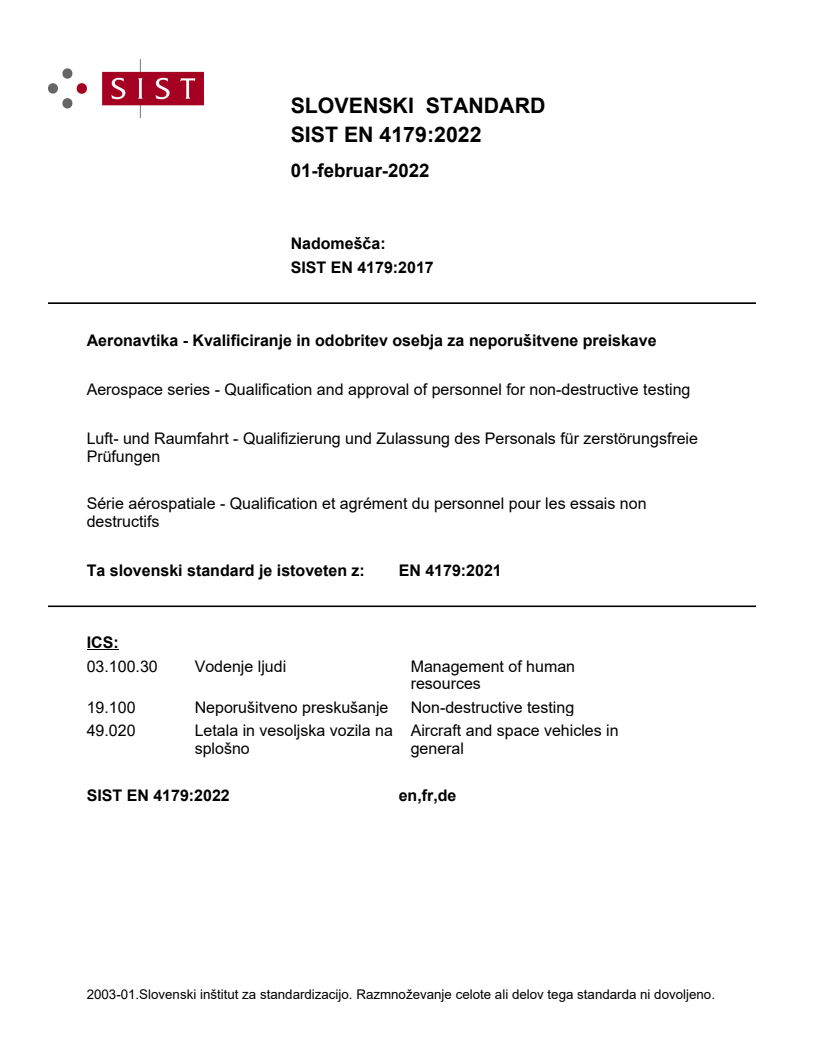
SLOVENSKI STANDARD
01-februar-2022
Nadomešča:
SIST EN 4179:2017
Aeronavtika - Kvalificiranje in odobritev osebja za neporušitvene preiskave
Aerospace series - Qualification and approval of personnel for non-destructive testing
Luft- und Raumfahrt - Qualifizierung und Zulassung des Personals für zerstörungsfreie
Prüfungen
Série aérospatiale - Qualification et agrément du personnel pour les essais non
destructifs
Ta slovenski standard je istoveten z: EN 4179:2021
ICS:
03.100.30 Vodenje ljudi Management of human
resources
19.100 Neporušitveno preskušanje Non-destructive testing
49.020 Letala in vesoljska vozila na Aircraft and space vehicles in
splošno general
2003-01.Slovenski inštitut za standardizacijo. Razmnoževanje celote ali delov tega standarda ni dovoljeno.
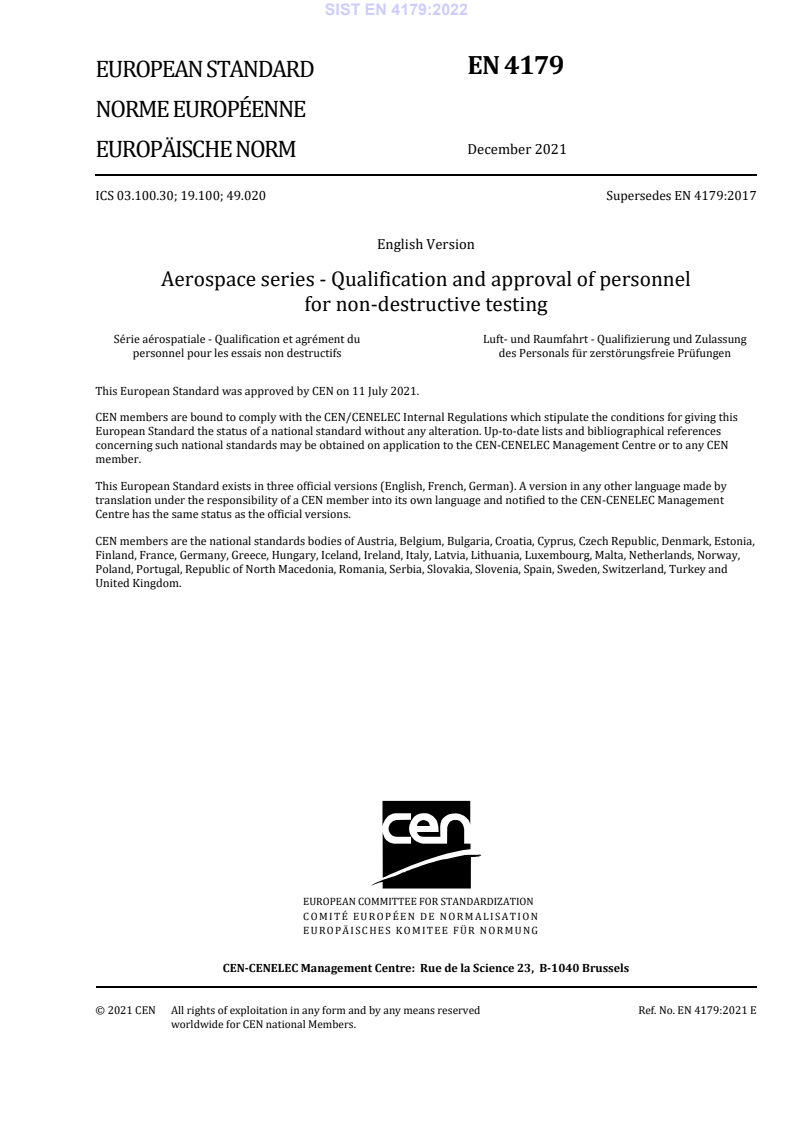
EN 4179
EUROPEAN STANDARD
NORME EUROPÉENNE
December 2021
EUROPÄISCHE NORM
ICS 03.100.30; 19.100; 49.020 Supersedes EN 4179:2017
English Version
Aerospace series - Qualification and approval of personnel
for non-destructive testing
Série aérospatiale - Qualification et agrément du Luft- und Raumfahrt - Qualifizierung und Zulassung
personnel pour les essais non destructifs des Personals für zerstörungsfreie Prüfungen
This European Standard was approved by CEN on 11 July 2021.
CEN members are bound to comply with the CEN/CENELEC Internal Regulations which stipulate the conditions for giving this
European Standard the status of a national standard without any alteration. Up-to-date lists and bibliographical references
concerning such national standards may be obtained on application to the CEN-CENELEC Management Centre or to any CEN
member.
This European Standard exists in three official versions (English, French, German). A version in any other language made by
translation under the responsibility of a CEN member into its own language and notified to the CEN-CENELEC Management
Centre has the same status as the official versions.
CEN members are the national standards bodies of Austria, Belgium, Bulgaria, Croatia, Cyprus, Czech Republic, Denmark, Estonia,
Finland, France, Germany, Greece, Hungary, Iceland, Ireland, Italy, Latvia, Lithuania, Luxembourg, Malta, Netherlands, Norway,
Poland, Portugal, Republic of North Macedonia, Romania, Serbia, Slovakia, Slovenia, Spain, Sweden, Switzerland, Turkey and
United Kingdom.
EUROPEAN COMMITTEE FOR STANDARDIZATION
COMITÉ EUROPÉEN DE NORMALISATION
EUROPÄISCHES KOMITEE FÜR NORMUNG
CEN-CENELEC Management Centre: Rue de la Science 23, B-1040 Brussels
© 2021 CEN All rights of exploitation in any form and by any means reserved Ref. No. EN 4179:2021 E
worldwide for CEN national Members.
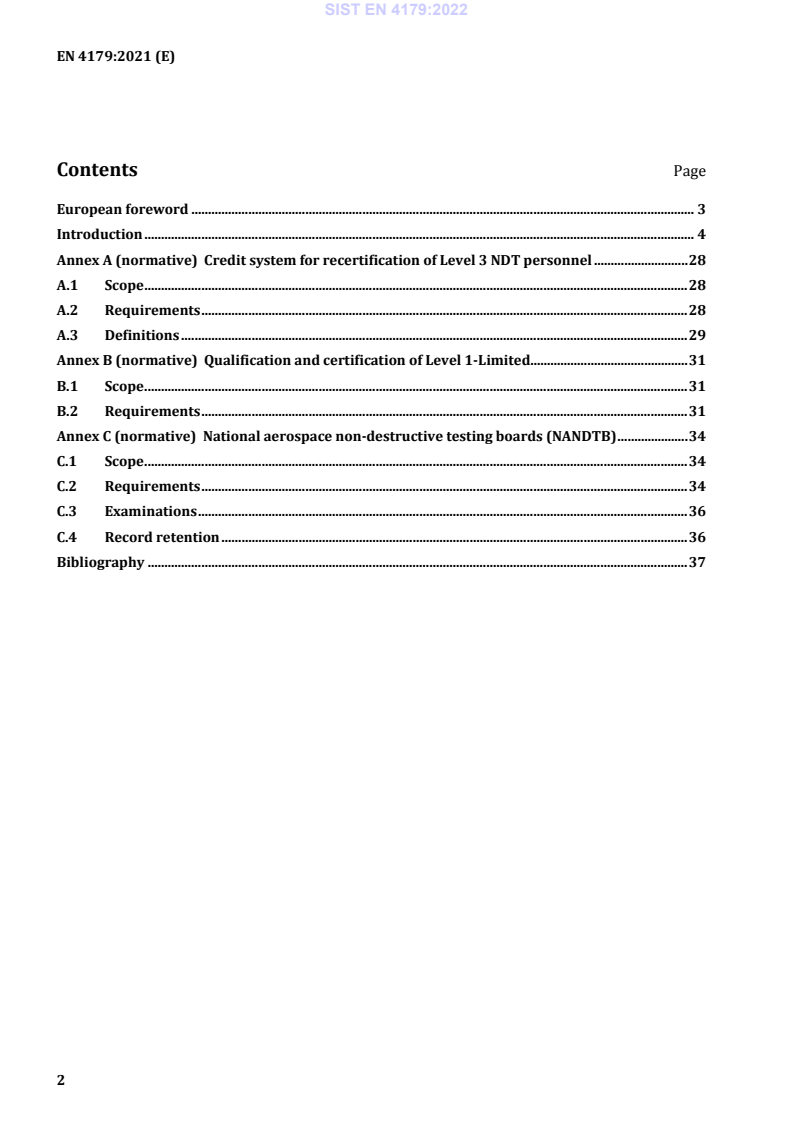
Contents Page
European foreword . 3
Introduction . 4
Annex A (normative) Credit system for recertification of Level 3 NDT personnel . 28
A.1 Scope . 28
A.2 Requirements . 28
A.3 Definitions . 29
Annex B (normative) Qualification and certification of Level 1-Limited. 31
B.1 Scope . 31
B.2 Requirements . 31
Annex C (normative) National aerospace non-destructive testing boards (NANDTB) . 34
C.1 Scope . 34
C.2 Requirements . 34
C.3 Examinations . 36
C.4 Record retention . 36
Bibliography . 37
European foreword
This document (EN 4179:2021) has been prepared by the Aerospace and Defence Industries
Association of Europe — Standardization (ASD-STAN).
After enquiries and votes carried out in accordance with the rules of this Association, this document has
received the approval of the National Associations and the Official Services of the member countries of
ASD-STAN, prior to its presentation to CEN.
This European Standard shall be given the status of a national standard, either by publication of an
identical text or by endorsement, at the latest by June 2022, and conflicting national standards shall be
withdrawn at the latest by June 2022.
Attention is drawn to the possibility that some of the elements of this document may be the subject of
patent rights. CEN [and/or CENELEC] shall not be held responsible for identifying any or all such patent
rights.
This document supersedes EN 4179:2017.
According to the CEN-CENELEC Internal Regulations, the national standards organizations of the
following countries are bound to implement this European Standard: Austria, Belgium, Bulgaria,
Croatia, Cyprus, Czech Republic, Denmark, Estonia, Finland, France, Germany, Greece, Hungary, Iceland,
Ireland, Italy, Latvia, Lithuania, Luxembourg, Malta, Netherlands, Norway, Poland, Portugal, Republic of
North Macedonia, Romania, Serbia, Slovakia, Slovenia, Spain, Sweden, Switzerland, Turkey and the
United Kingdom.
Any feedback and questions on this document should be directed to the users’ national standards body.
A complete listing of these bodies can be found on the CEN website.
Introduction
In the event of a conflict between the text of this document and the references cited herein, the
requirements of this document take precedence. Nothing in this document supersedes applicable laws
and regulations unless a specific exemption has been obtained.
1 Scope
1.1 Purpose
This document establishes the minimum requirements for the qualification and certification of
personnel performing non-destructive testing (NDT), non-destructive inspection (NDI), or non-
destructive evaluation (NDE) in the aerospace manufacturing, service, maintenance and overhaul
industries. For the purposes of this document, the term NDT will be used and will be considered
equivalent to NDI and NDE.
In Europe, the term “approval” is used to denote a written statement by an employer that an individual
meets specific requirements and has operating approval. The term “certification” as defined in 3.2 is
used throughout this document as a substitute for the term “approval”. Except when otherwise
specified in the written practice, certification in accordance with this document includes operating
approval.
1.2 Applicability
1.2.1 General
This document applies to personnel using NDT methods to test and/or accept materials, products,
components, assemblies or sub-assemblies. This document also applies to personnel: directly
responsible for the technical adequacy of the NDT methods used, who approve NDT procedures and/or
work instructions, who audit NDT facilities, or who provide technical NDT support or training.
This document does not apply to individuals who only have administrative or supervisory authority
over NDT personnel or to research personnel developing NDT technology for subsequent
implementation and approval by a certified Level 3.
Personnel performing specialized inspections using certain direct readout instruments as determined
by a Level 3 person certified in the test method, do not require qualification or certification to this
document.
1.2.2 Implementation
This document addresses the use of a National Aerospace NDT Board (NANDTB). NANDTBs are only
used as specified according to Annex C and it is not mandatory to have such a board for compliance with
this document. Personnel certified to previous revisions of NAS 410 or EN 4179 need not recertify to
the requirements of this document until their current certification expires.
1.3 Test Methods
1.3.1 Common test methods
This document contains detailed requirements for the following common NDT methods:
Eddy Current Testing (ET)
Magnetic Particle Testing (MT)
Penetrant Testing (PT)
Radiographic Testing (RT)
Thermographic Testing (TT)
Ultrasonic Testing (UT)
1.3.2 Other test methods
When invoked by engineering, quality, cognizant engineering organization or prime contractor
requirements, this document applies to other current and emerging NDT methods used to determine
the acceptability or suitability for intended service of a material, part, component, assembly or sub-
assembly. Such test methods can include, but are not limited to, acoustic emission testing (AT), neutron
radiography, leak testing, holography, and shearography. The requirements for personnel training,
experience, and examination for these other test methods are established in accordance with 6.4 and
are documented by the employer.
2 Normative references
The following documents are referred to in the text in such a way that some or all of their content
constitutes requirements of this document. For dated references, only the edition cited applies. For
undated references, the latest edition of the referenced document (including any amendments) applies.
ISO 18490, Non-destructive testing — Evaluation of vision acuity of NDT personnel
3 Terms and definitions
For the purposes of this document, the following terms and definitions apply.
ISO and IEC maintain terminological databases for use in standardization at the following addresses:
• ISO Online browsing platform: available at https://www.iso.org/obp
• IEC Electropedia: available at https://www.electropedia.org/
3.1
basic examination
examination utilized to verify a Level 3 candidate’s knowledge of NDT methods used by the employer at
a Level 2 proficiency
3.2
certification
written statement by an employer that an individual has met the applicable requirements of this
document
3.3
closed book examination
examination administered without access to any reference materials
3.4
cognizant engineering organization
engineering or NDT organization of the prime contractor, OEM (Original Equipment Manufacturer), or
end user authorized to make NDT-related decisions and give NDT-related approvals
3.5
committee meetings
panel meetings
meetings, conferences, symposia, seminars, trade association meetings, panels, organized or sponsored
by a regional, national or international NDT organization or technical society
Published by: ISO International Organization for Standardization http://www.iso.ch/.
Note 1 to entry: Foreign or international meetings qualify if the sponsor(s) are national or international.
3.6
committee projects
specific identifiable official activities of regional or national technical societies, committees or work
groups
EXAMPLE round robins or individual studies, preparation of guidelines, appendices, specifications,
recommended practices, procedures, codes or standards.
Note 1 to entry: Documentation may include memos or reports, drafts of committee output documents, or official
written comments submitted by the candidate on such documents.
3.7
direct observation
observer's viewing of the NDT process in a manner that permits uninterrupted, visual and verbal two-
way contact with the trainee
3.8
direct-readout instrument
instruments that physically display measurements in dimensional or electrical units (e.g. inches,
millimetres or % IACS) either as digital readout or an analog display, such as a scale/pointer
configuration, and do not require special skills or knowledge to set up the instrument and do not
involve adjusting signal displays such as gates, delays, gain, or phase to obtain measurements
EXAMPLE Common direct readout instruments include basic ultrasonic thickness gauges without an
oscilloscope display, and eddy current coating thickness gauges.
3.9
documented
condition of being recorded in written or electronic form
3.10
employer
organization employing or contracting the services of one or more individuals who perform NDT
Note 1 to entry: Self-employed individuals are included in this definition.
3.11
evaluation
review following interpretation of the indications noted during an NDT inspection to determine
whether the indications meet specified acceptance criteria or to determine the significance of the
indication
3.12
examination
formal, controlled, documented testing conducted in accordance with a documented written practice to
verify a candidate’s visual capability, skill or knowledge of an NDT method
3.13
examiner
Level 3 person certified to this document and designated by the Responsible Level 3 person to
administer all or part of the qualification process in the NDT method(s) in which the Examiner is
certified
3.14
experience
actual performance of an NDT method conducted in the work environment resulting in the acquisition
of knowledge and skill
Note 1 to entry: This does not include formal classroom training but may include laboratory and on-the-job
training as defined by the employer’s written practice.
3.15
formal education
engineering or science studies at a technical school, college, or university
3.16
formal training
organized and documented program of learning activities designed to impart the knowledge and skills
necessary to be qualified to this document
Note 1 to entry: Formal training may be a mix of classroom, practical and programmed self-instruction as
approved by the Responsible Level 3 Person or Examiner.
3.17
general examination
written examination addressing the basic principles and theory of an NDT method
3.18
indication
response or evidence of a condition resulting from an NDT inspection that requires interpretation
3.19
instructor
individual designated or approved by the Responsible Level 3 person or Examiner to provide training
for NDT personnel
3.20
interpretation
determination of whether indications are relevant or non-relevant
3.21
test method
1 (one) of the disciplines of non-destructive testing (e.g. ultrasonic testing, radiographic testing) within
which different test techniques may exist
3.22
National Aerospace NDT Board
NANDTB
independent aerospace organization representing a nation's aerospace industry that is chartered by the
participating prime contractors and recognized by the nation’s regulatory agencies to provide or
support NDT qualification and/or examination services in accordance with Annex C of this document
3.23
non-film radiography
radiographic imaging that does not use a film-based recording medium
Note 1 to entry: Non-Film radiography includes, but may not be limited to, Computed Radiography, Digital
Radiography, Radioscopy, and Computed Tomography.
3.24
on-the-job training
training in the work environment to gain experience in learning instrument set-up, equipment
operation, applying the process, and recognition, interpretation and evaluation of indications under
appropriate technical guidance
3.25
open book examination
examination administered with access to specific reference material that is provided with or referenced
in the examination
3.26
operating approval
written statement issued by the employer, based upon the scope of certification, authorizing the
individual to carry out defined tasks
Note 1 to entry: Such authorization can be dependent on the employer having provided job or task-specific
training.
3.27
outside agency
independent company or organization outside the employer who provides NDT services to implement
the requirements of this document, such as training and examination of NDT personnel
Note 1 to entry: Consultants and self-employed individuals are included in this definition.
3.28
practical examination
examination to demonstrate an individual's ability to conduct an NDT method as used by the employer
Note 1 to entry: Questions and answers need not be written, but a checklist shall be used, and observations and
results shall be documented.
3.29
prime contractor
organization having overall responsibility for design, control and delivery of a system, component or
product
3.30
procedure
written general “how to” instruction for conducting a given process
Note 1 to entry: Procedures are then used to develop work instructions, as defined in 3.38.
3.31
qualification
skills, training, knowledge, examinations, experience and visual capability required for personnel to
properly perform to a particular level
3.32
responsible Level 3 person
Level 3 person designated by the employer with the responsibility and authority to ensure that the
requirements of this document are met and to act on behalf of the employer
3.33
specific examination
written examination to determine an individual's understanding of operating procedures, codes,
standards, product knowledge, test techniques, equipment and specifications for an NDT method as
used by the employer
3.34
sub-contractor
organization responsible to the prime contractor for the manufacture or maintenance of aerospace
products
Note 1 to entry: For the purposes of this document, this includes suppliers and processors.
3.35
task
activity for which Level 3 certification is required, e.g. approval of an NDT Technique Instruction or
NDT procedure
3.36
test technique
category within a test method as defined in the written practice by the employer
3.37
test sample
part or image containing one or more known and documented natural or artificial discontinuities, flaws
or conditions used in the practical examination to demonstrate the candidate's proficiency in an NDT
method.
Note 1 to entry: Test samples can refer to actual hardware, fabricated test parts, or, when applicable, images of
actual hardware such as radiographs.
3.38
work instruction
document detailing the NDT technique and testing parameters to be used for the inspection of a specific
component, group of parts (e.g. “aluminium extrusions” or “steel brackets”), or assembly
Note 1 to entry: These are sometimes referred to in the industry as “test technique sheets” or “data cards”. Such
work instructions are based on procedures defined in 3.30.
3.39
written
retrievable electronic or hard copy
3.40
written practice
document that describes an employer’s requirements and methodology for controlling and
administering the NDT personnel qualification and certification process
4 General requirements
4.1 Written practice
4.1.1 Qualification and certification
The employer shall develop and maintain a written practice for the qualification and certification of
NDT personnel that meets the requirements of this document. The written practice shall address the
procedural details necessary for the employer to implement an NDT qualification and certification
program and shall include the details of the NDT qualification and certification process, including:
a) The levels of qualification and certification used by the employer;
b) Personnel duties and responsibilities;
c) Training and experience requirements;
d) Certification and recertification requirements;
e) Records and record keeping requirements;
f) Requirements for expiration, suspension, revocation and reinstatement of certifications;
g) Process for annual proficiency review.
The written practice shall be approved by the Responsible Level 3 person. The written practice shall be
available for review by the employer’s customer(s) and regulatory agencies.
4.1.2 Additional requirements
The written practice shall include any additional requirements levied by the employer or cognizant
engineering organization, such as additional certification levels or increased experience requirements.
4.1.3 NDT techniques
The written practice shall include the specific test technique(s) within each test method and the actions
to be taken concerning additional training and experience, as well as the written and practical testing,
when additional test techniques are introduced for a currently certified individual.
4.1.4 Training outlines
The written practice shall reference or include the NDT training outlines used by the employer. If an
outside agency is used to provide training, the Responsible Level 3 person shall verify that the training
meets the employer's requirements.
4.1.5 Examination practices
The written practice shall include the designation of the individual(s) or organization(s) responsible for
administering examinations, the number of examination questions to be administered, and the specific
visual acuity examination method to be used. If required, the use of a general examination for
recertification shall be documented in the written practice.
4.1.6 Administration
The written practice shall include the identification of the individual(s) or organization(s) responsible
for administering and maintaining all or part of the employer's certification program.
4.1.7 Records
The written practice shall include the designation of the individual(s) or organization(s) responsible for
maintaining the qualification and certification records and where such records shall be kept.
4.2 Test Methods
For the common test methods listed in 1.3.1, the minimum requirements for training, experience and
examination are detailed in Clause 6 and Clause 7. These requirements shall serve as a guideline for
other current or emerging test methods as defined in 1.3.2.
4.3 Responsibility
4.3.1 General
a) The employer is responsible for the implementation of, and compliance with, this document and for
certifying qualified personnel.
b) In addition, the prime contractor shall be responsible for compliance to this document by their sub-
contractors.
c) Employers using outside agencies shall be responsible for assuring that the appropriate
requirements of this document are met.
d) The employer is solely responsible for the certification of its employees and cannot certify for
another employer.
e) Individuals cannot qualify themselves.
f) Self-employed individuals may certify themselves provided they have a written practice and have
been qualified to the requirements of this document by another individual certified to Level 3 in
accordance with this document.
4.3.2 Responsible Level 3 person
a) The employer shall identify in writing a “Responsible Level 3 person” to act on its behalf in matters
regarding the NDT qualification and certification process.
b) The Responsible Level 3 person shall be certified in accordance with this document as a Level 3
person in one or more NDT methods and shall have a thorough knowledge of the written
instructions, codes, specifications and standards used by the employer.
c) The Responsible Level 3 person shall also have a thorough knowledge of the materials,
components, product technologies, NDT methods and NDT techniques used by the employer.
d) Additional Examiners as defined in this document may be identified and delegated in writing as
necessary to provide coverage for all test methods used by the employer.
e) The Responsible Level 3 person may be an outside agency but in this case he/she can only qualify
personnel, as only the employer can certify personnel.
f) The Responsible Level 3 person shall be responsible for implementation of this document and the
overall administration of the qualification and certification program.
4.3.3 Outside agency
a) An employer may use a Level 3 person certified in accordance with this document from an outside
agency to develop a certification program, act as the Responsible Level 3 person, examine NDT
personnel or perform any other qualification or Level 3 function.
b) An outside agency may qualify, but not certify personnel.
c) The employer shall document the suitability of any outside agency selected to perform any function
in meeting the requirements of this document. This documentation shall be of sufficient detail to
justify the outside agency’s ability to perform the required Level 3 function(s).
5 Qualification and certification levels
5.1 Levels of qualification and certification
5.1.1 General
a) The 4 (four) basic levels of certification are
• Level 1-Limited,
• Level 1,
• Level 2 and
• Level 3.
b) The employer may subdivide, add or limit levels as appropriate, but cannot eliminate or reduce the
minimum requirements for each level.
c) If the employer does not wish to use all of the levels, those levels to be used shall be documented in
the employer’s written practice.
d) Where other variations or subdivisions are implemented, the requirements and responsibilities
shall also be detailed in the employer’s written practice.
e) NDT personnel shall not independently perform the functions listed in 5.1.3, 5.1.4, 5.1.5 and 5.1.6 if
not certified to the appropriate level in the applicable test technique/test method.
5.1.2 Trainee
An individual who is documented as participating in a training program for an NDT method and is in the
process of becoming qualified for certification to Level 1, Level 1-Limited or directly to Level 2 shall be
considered a trainee. In the test technique/test method in which they are preparing for certification,
trainees shall:
a) be documented as a trainee and be actively participating in a training program for a stated NDT
method for a limited and specified period of time;
b) obtain experience under the direct observation of a Level 2 or Level 3 person in the same test
method;
c) obtain experience under the direct observation of a Level 1 person or instructor only when
approved by the responsible Level 3 person;
d) not make accept or reject decisions;
e) not independently conduct tests;
f) not independently perform any other NDT function.
5.1.3 Level 1-Limited
Annex B defines the requirements for Level 1-Limited.
5.1.4 Level 1
In the test method in which certified, Level 1 persons shall:
a) be able to follow work instructions;
b) have the skills and knowledge to process parts, document results and perform equipment
standardization in accordance with approved work instructions;
c) have the skills and knowledge to carry out any necessary preparation of parts before or after
testing in accordance with approved work instructions;
d) have the skills and knowledge to conduct system performance checks in accordance with the
applicable process standard;
e) receive guidance or supervision from a certified Level 2 or Level 3 person in that test method when
necessary;
f) when specified in the written practice and approved by the Responsible Level 3 person, Level 1
persons may perform interpretations and evaluations of specific product(s) or product form(s) for
acceptance or rejection in accordance with approved work instructions.
5.1.5 Level 2
In the test method in which certified, Level 2 persons shall:
a) have the skills and knowledge to set up and standardize equipment, process parts, interpret and
evaluate for acceptance or rejection, and document results;
b) be thoroughly familiar with the scope and limitations of the test technique/test method;
c) have the skills and knowledge to conduct system performance checks in accordance with the
applicable process standard;
d) be capable of providing the necessary guidance and/or supervision to trainees and Level 1
personnel;
e) be familiar with the codes, standards, and other contractual documents that control the test method
as used by the employer;
f) when specified in the written practice, be capable of developing work instructions from approved
general procedures. Such work instructions shall require final approval by a Level 3 person
certified in the test method;
g) have a basic knowledge of relevant product manufacturing and inspection technology;
h) when specified in the written practice, have a basic knowledge of aircraft or vehicle maintenance.
5.1.6 Level 3
In the test method in which certified, Level 3 persons shall:
a) have the skills and knowledge to interpret codes, standards, and other contractual documents that
control the NDT method(s);
b) be capable of assuming technical responsibility for the NDT facility and NDT staff;
c) be capable of selecting the test method and test technique for a specific test;
d) be capable of preparing and verifying the adequacy of procedures and work instructions;
e) approve NDT procedures and work instructions for technical adequacy;
f) have a general knowledge of other NDT methods and product manufacturing and test technologies
used by the employer;
g) when specified in the written practice, have a basic knowledge of aircraft or vehicle maintenance;
h) be capable of providing or directing training, examination, and certification of personnel;
i) conduct NDT for the acceptance of parts and document the results if a demonstration of proficiency
in this ability was included in the practical examination;
j) when required by the written practice, be capable of auditing outside agencies to ensure the
requirements of the written practice are met.
5.1.7 Auditor
a) Personnel performing technical NDT audits, surveys or assessments shall have the training, skills
and knowledge to understand the processes and procedures utilized in the application of NDT
processes.
b) The individual shall be familiar with the applicable codes, standards, and other contractual
documents that control the applicable test method(s).
6 Training and experience
6.1 Training
6.1.1 General
a) Candidates for certification to all levels shall complete sufficient formal training to become
proficient with the principles and practices of the applicable test method and test technique(s) and
be capable of carrying out the duties specified in Clause 5.
b) Formal training shall be conducted prior to, or in conjunction with, on-the-job training. All
completed NDT training shall be documented.
c) The minimum training hours for Level 1 and Level 2 are provided in Table 1 and Table 2 for the
specified NDT methods.
d) Individuals cannot certify to Level 3 without prior certification to Level 2 in the test method.
e) Military equivalency of training and experience can be determined by the Responsible Level 3
person or Examiner in accordance with 6.1.4 and 6.3.3 for certification to Level 3.
f) 40 additional hours of training is required for current certified Level 3 radiography personnel
transitioning to either film or non-film radiography.
g) General, specific and practical training may be obtained with the employer or outside agency but
shall always be supplemented by practical on-the-job training with the employer.
Table 1 — Minimum formal training hours for Level 1 and Level 2
Level 2 with Level 2 without
Level 1 previous Level 1 previous Level 1
certification certification
PT 16 16 32
MT 16 16 32
TT 20 40 60
ET 40 40 80
UT 40 40 80
RT
40 40 80
film or
non-film
RT
60 60 120
film and
non-film
Table 2 — RT formal training hours for transition to film and non-film
Additional formal training hours
Current
Current Current Level 1 to
Level 1 Level 2 Level 2 film
and non-film
20 40 80
6.1.2 Training outlines
All training shall be conducted in accordance with a detailed outline approved by the Responsible
Level 3 person or Examiner. The outline shall include a list of references from which the training
material is derived. As a minimum the training shall include:
a) basic theory;
b) test principles, including choice of NDT methods, relevance to different materials and part and test
variables;
c) product forms and materials, defect formation and characterization;
d) equipment operation and standardization;
e) the importance of process controls;
f) the importance of appropriate processing steps and parameters;
g) safety regulations;
h) applicable test techniques and the advantages and disadvantages of each;
i) limitations and capabilities of each test method and test technique;
j) applicable specifications, codes, operating procedures and work instructions;
k) if applicable, evaluation, interpretation and documentation of test results.
l) if an outside agency is used to provide training, the Responsible Level 3 person shall verify that the
training meets the employer's requirements.
6.1.3 Previous training
a) For personnel credited with previous training, or personnel not certified within 12 months of their
training, refresher training shall be provided.
b) Previous training shall be documented to be accepted by the employer.
c) As a minimum, refresher training shall cover products, equipment set-up, operation and
standardization, specific operating procedures, applicable test techniques, interpretation and
evaluation of NDT results, safety, and applicable codes, standards and specifications.
d) For documentation of previous training, records other than original records may be accepted if
adequacy and equivalency have been determined to be acceptable by the Responsible Level 3
person or Examiner.
6.1.4 Equivalent training
For personnel previously certified under NAS 410 or other recognized NDT qualification program, the
adequacy and equivalency of their previous training to the requirements of Table 1 and Table 2 shall be
determined and documented by the Responsible Level 3 person or Examiner. All or a portion of
previous hours may be accepted as applicable.
6.1.5 Health and safety training
a) It is expected that all regulations relating to hazardous substances, accident prevention and safe
working practices are strictly adhered to.
b) It is expected that safety-related training requirements are determined in accordance with local
codes and regulations.
c) Prior to certification, all candidates seeking radiography qualification shall have received
instruction on the hazards and safety requirements associated with ionizing radiation and are
expected to be knowledgeable of, and comply with, the applicable regulations and laws.
6.2 Training and examination personnel
6.2.1 Responsible Level 3 person
The Responsible Level 3 person shall maintain overall control and cognizance over the NDT training
program, including designating or approving qualified Examiners, instructors and outside agencies.
6.2.2 Examiners
a) When necessary, Examiners shall be designated or approved in writing by the Responsible Level 3
person.
b) All Examiners shall be certified in accordance with this document.
As determined and documented by the Responsible Level 3 person, an Examiner can prepare,
administer and grade written or practical NDT examinations, and administer all or part of the
qualification process in the test method in which he/she is certified.
6.2.3 Instructors
a) Instructors shall have the skills and knowledge to plan, organize, and present classroom training
and practical exercises in accordance with approved training outlines.
b) Instructors shall be designated or approved by the Responsible Level 3 person or Examiner.
6.2.4 Outside agencies
When an outside agency is used, the outside agency shall provide the employer with the names,
evidence of qualifications and, if applicable, evidence of certifications held by the personnel conducting
the training and examination.
6.3 Experience
6.3.1 General
a) Candidates for certification to Level 1-Limited, Level 1, Level 2 or Level 3 shall have sufficient
practical experience to ensure that they are capable of performing the duties of the level for which
certification is sought.
b) The minimum experience requirements for Level 1 and Level 2 are provided in Table 3 and Table 4,
as applicable.
c) The requirements for Level 3 are in Table 5 and 6.4.3, as applicable.
d) As documented in the written practice, on-the-job training for the purpose of gaining experience
shall be overseen by personnel certified in accordance with this document.
e) For trainees gaining experience, documentation shall be available for review to indicate individual,
date, description of activity within the test method, hours, and certified personnel providing direct
observation.
f) Additional experience requirements for current Level 3 radiography personnel transitioning to
either film or non-film radiography are 240 hours with guidance or supervision from an examiner,
instructor, or outside agency.
6.3.2 Previous experience
a) A candidate's experience with a previous employer may be accepted by the current employer only
if such experience is documented and approved by the Responsible Level 3 person or Examiner.
All or a portion of previous hours may be accepted as applicable.
b) For documentation of previous experience, records other than original records may be accepted if
adequacy and equivalency have been determined to be acceptable by the Responsible Level 3
person or Examiner.
6.3.3 Equivalent experience
For personnel previously certified under NAS 410 or other recognized NDT qualification programs,
the adequacy and equivalency of their previous experience to the requirements of Table 3, Table 4, or
Table 5 shall be determined and documented by the Responsible Level 3 person or Examiner.
Table 3 — Minimum experience requirements for Level 1 and Level 2
Experience time in hours
Level 1 Level 2 with Level 2 without
(Trainee previous Level 1 previous Level 1
experience) certification certification
PT 130 270 400
MT 130 400 530
TT 200 400 600
ET 200 600 800
UT 200 600 800
RT
200 600 800
film or
non-film
RT
220 780 1 000
film and
non-film
Table 4 — RT experience requirements for transition to film and non-film
Additional Minimum Experience Time in
Hours
Current
Current Current Level 1 to
Level 1 Level 2 Level 2 film
and non-film
20 200 800
Table 5 — Minimum experience requirements for Level 3 in common test methods
College or University Level 2 Experience
None 4 (four) years
2 (two) years of engineering or science study
2 (two) years
at a technical school, college or university
3–4 (three-four) years science or engineering
1 (one) year
undergraduate degree
6.4 Emerging NDT methods
6.4.1 Minimum hours
The minimum required training and experience hours for test methods used by the employer that are
not listed in 1.3.1, Table 1, and Table 3 shall be established by the Responsible Level 3 person.
6.4.2 Levels 1 and 2
When determining training or experience hours for new test methods not listed in Table 1 and Table 3,
the minimum hours shall be based on the requirements for a test method of similar complexity listed in
Table 1 and Table 3.
This only applies to “other” or emerging test methods as defined in 1.3.2 and cannot be applied to
penetrant testing, magnetic particle testing, ultrasonic testing, radiographic testing, thermographic
testing, or eddy current testing.
6.4.3 Level 3
When approved by the cognizant engineering organization and authorized by the employer’s written
practice, an employer may qualify and certify its first Level 3 in a new NDT method not listed in 1.3.1
provided:
a) the candidate has the skill and ability to carry out the Level 3 responsibilities in 5.1.6;
b) all of the requirements in Table 6 are met;
c) the requirements of 6.4.1, 6.4.2 and 6.4.3 only apply to “other” or emerging test methods as defined
in 1.3.2 and cannot be applied to penetrant testing, magnetic particle testing, ultrasonic testing,
radiographic testing, thermographic testing, or eddy current testing.
Table 6 — Minimum requirements for first Level 3 person in an emerging NDT method
Instruction/ Other NDT
College or University Experience
Study Certifications
At least
No engineering or science
1 (one) previous Level 3
study at a technical school, 80 h 300 h
or 2 (two) Level 2
college or university
certifications held
At least
2 (two) years of engineering or
1 (one) previous Level 3
science study at a technical 60 h 200 h
or 2 (two) Level 2
school, college or university
certifications held
3–4 (three-four) year science At least
or engineering undergraduate 40 h 200 h 1 (one) previous Level 2
degree certification held.
7 Examinations
7.1 Purpose
7.1.1 General
a) Examinations to verify the technical qualifications of candidates shall consist of a general, specific
and practical examination for each test method in which the candidate is to be certified.
b) Specific examinations shall be administered after a minimum of 75 % of Table 3 requirements have
been completed.
c) Table 3 requirements shall be completed prior to administration of practical examination.
d) An examination for visual acuity shall also be conducted prior to the candidate’s first certification
and periodically thereafter.
e) The requirements for the vision examination, the questions or question database used for the
general and specific examinations and the checklist for the practical examination shall be available
for review by the employer’s customers.
f) Examinations and test samples shall be made available to the candidates only during
administration of the examinations.
g) Verbal translation of written examinations is not permitted.
7.1.2 Vision examination
a) The vision examination for all levels shall ensure that the applicant’s near vision and colour
perception meet the requirements of Table 7.
b) Vision requirements do not apply to instructors or auditors.
c) Near vision tests shall be administered annually and colour perception tests shall be administered
at least every 5 (five) years.
d) The employer shall ensure the flow-down of the Table 7 vision requirements to all necessary
personnel and/or facilities.
e) Snellen and Jae
...
S L O V E N S K I SIST EN 4179
S T A N D A R D februar 2022
Aeronavtika – Kvalificiranje in odobritev osebja za neporušitvene preiskave
Aerospace series – Qualification and approval of personnel for non-destructive
testing
Série aérospatiale – Qualification et agrément du personnel pour les essais non
destructifs
Luft- und Raumfahrt – Qualifizierung und Zulassung des Personals für
zerstörungsfreie Prüfungen
Referenčna oznaka
ICS 03.100.30; 19.100; 49.020 SIST EN 4179:2022 (sl)
Nadaljevanje na straneh II in od 1 do 38
2022-07. Slovenski inštitut za standardizacijo. Razmnoževanje ali kopiranje celote ali delov tega dokumenta ni dovoljeno.
SIST EN 4179 : 2022
NACIONALNI UVOD
Standard SIST EN 4179 (sl), Aeronavtika – Kvalificiranje in odobritev osebja za neporušitvene
preiskave, 2022, ima status slovenskega standarda in je enakovreden evropskemu standardu EN 4179
(en), Aerospace series – Qualification and approval of personnel for non-destructive testing, 2021.
Ta standard nadomešča SIST EN 4179:2017.
NACIONALNI PREDGOVOR
Evropski standard EN 4179:2021 je pripravilo tehnično delovno telo ASD-STAN – Aerospace.
Slovenski standard SIST EN 4179:2022 je prevod evropskega standarda EN 4179:2021. V primeru
spora glede besedila slovenskega prevoda v tem standardu je odločilen izvirni evropski standard v
angleškem jeziku. Slovensko izdajo standarda je potrdil Strokovni svet SIST za splošno področje.
Odločitev za izdajo tega standarda je 7. januarja 2022 sprejel Strokovni svet SIST za splošno področje.
ZVEZA S STANDARDI
S privzemom tega evropskega standarda veljajo za omejeni namen referenčnih standardov vsi
standardi, navedeni v izvirniku, razen standarda, ki je že sprejet v nacionalno standardizacijo:
SIST EN ISO 18490 (en) Neporušitvene preiskave – Vrednotenje ostrine vida za osebje, ki izvaja
neporušitvene preskave (NDT) (ISO 18490)
OSNOVA ZA IZDAJO STANDARDA
– privzem standarda EN 4179:2021
PREDHODNA IZDAJA
– SIST EN 4179:2017, Aeronavtika – Kvalificiranje in odobritev osebja za neporušitvene preiskave
OPOMBE
– Povsod, kjer se v besedilu standarda uporablja izraz "evropski standard", v SIST EN 4179:2022 to
pomeni "slovenski standard".
– Nacionalni uvod in nacionalni predgovor nista sestavni del standarda.
– Ta nacionalni dokument je istoveten EN 4179:2021 in je objavljen z dovoljenjem
CEN-CENELEC
Upravni center
Rue de la Science 23
B-1040 Bruselj
This national document is identical with EN 4179:2021 and is published with the permission of
CEN-CENELEC
Management Centre
Rue de la Science 23
B-1040 Brussels
II
EVROPSKI STANDARD EN 4179
EUROPEAN STANDARD
NORME EUROPÉENNE
december 2021
EUROPÄISCHE NORM
ICS 03.100.30; 19.100; 49.020
Slovenska izdaja
Aeronavtika – Kvalificiranje in odobritev osebja za neporušitvene
preiskave
Aerospace series – Qualification Série aérospatiale – Luft- und Raumfahrt –
and approval of personnel for Qualification et agrément du Qualifizierung und Zulassung
non-destructive testing personnel pour les essais non des Personals für
destructifs zerstörungsfreie Prüfungen
Ta evropski standard je CEN sprejel 11. julija 2021.
Člani CEN morajo izpolnjevati notranje predpise CEN/CENELEC, ki določajo pogoje, pod katerimi dobi
ta evropski standard status nacionalnega standarda brez kakršnihkoli sprememb. Sezname najnovejših
izdaj teh nacionalnih standardov in njihove bibliografske podatke je mogoče na zahtevo dobiti pri
Upravnem centru CEN-CENELEC ali pri članih CEN.
Ta evropski standard obstaja v treh uradnih izdajah (angleški, francoski in nemški). Izdaje v drugih
jezikih, ki jih člani CEN na lastno odgovornost prevedejo in izdajo ter priglasijo pri Upravnem centru
CEN-CENELEC, veljajo kot uradne izdaje.
Člani CEN so nacionalni organi za standarde Avstrije, Belgije, Bolgarije, Cipra, Češke republike,
Danske, Estonije, Finske, Francije, Grčije, Hrvaške, Irske, Islandije, Italije, Latvije, Litve, Luksemburga,
Madžarske, Malte, Nemčije, Nizozemske, Norveške, Poljske, Portugalske, Republike Severna
Makedonija, Romunije, Slovaške, Slovenije, Srbije, Španije, Švedske, Švice, Turčije in Združenega
kraljestva.
CEN
Evropski komite za standardizacijo
European committee for standardization
Comité européen de normalisation
Europäisches komitee für normung
Upravni center CEN-CENELEC: Rue de la Science 23, B-1040 Bruselj
© 2021 CEN Lastnice avtorskih pravic so vse države članice CEN. Ref. oznaka EN 4179:2021 E
SIST EN 4179 : 2022
VSEBINA Stran
Evropski predgovor . 5
Uvod . 6
1 Področje uporabe . 7
1.1 Namen . 7
1.2 Uporaba . 7
1.2.1 Splošno . 7
1.2.2 Izvajanje . 7
1.3 Preskusne metode . 7
1.3.1 Splošne preskusne metode . 7
1.3.2 Druge preskusne metode . 8
2 Zveze s standardi . 8
3 Izrazi in definicije . 8
4 Splošne zahteve .12
4.1 Pisni postopek .12
4.1.1 Kvalifikacija in certificiranje .12
4.1.2 Dodatne zahteve .13
4.1.3 Tehnike neporušitvene preiskave .13
4.1.4 Načrti usposabljanja .13
4.1.5 Izpitni postopki .13
4.1.6 Izvajanje .13
4.1.7 Zapisi .13
4.2 Preskusne metode .13
4.3 Odgovornost .13
4.3.1 Splošno .13
4.3.2 Odgovorna oseba z opravljeno 3. stopnjo .14
4.3.3 Zunanja agencija .14
5 Stopnje kvalifikacije in certificiranja .14
5.1 Kvalifikacije in certificiranja – stopnje .14
5.1.1 Splošno .14
5.1.2 Pripravnik .15
5.1.3 1. stopnja – omejena .15
5.1.4 1. stopnja .15
5.1.5 2. stopnja .15
5.1.6 3. stopnja .16
5.1.7 Presojevalec .16
6 Usposabljanje in izkušnje .17
6.1 Usposabljanje .17
6.1.1 Splošno .17
6.1.2 Načrti usposabljanja .18
6.1.3 Predhodno usposabljanje .18
SIST EN 4179 : 2022
6.1.4 Enakovredno usposabljanje .18
6.1.5 Usposabljanje o zdravju in varnosti .18
6.2 Osebje za usposabljanje in izvajanje izpitov .19
6.2.1 Odgovorna oseba z opravljeno 3. stopnjo .19
6.2.2 Ocenjevalci .19
6.2.3 Inštruktorji .19
6.2.4 Zunanje agencije .19
6.3 Izkušnje .19
6.3.1 Splošno .19
6.3.2 Predhodne izkušnje .20
6.3.3 Enakovredne izkušnje .20
6.4 Nove metode neporušitvene preiskave .21
6.4.1 Minimalno število ur .21
6.4.2 1 in 2. stopnja .21
6.4.3 3. stopnja .21
7 Izpiti .22
7.1 Namen .22
7.1.1 Splošno .22
7.1.2 Pregled vida .22
7.1.3 Splošni izpit .23
7.1.4 Specifični izpit .23
7.1.5 Praktični izpit .23
7.2 Izvajanje izpitov .25
7.2.1 Splošno .25
7.2.2 Ko izpite izvaja zunanja agencija .25
7.2.3 Točkovanje .25
7.2.4 Ponovno opravljanje izpitov .26
8 Certificiranje .26
8.1 Splošno .26
8.2 Zapisi .26
8.2.1 Minimalne zahteve .26
8.2.2 Razpoložljivost zapisov .27
8.3 Izguba certifikata .27
8.3.1 Potek .27
8.3.2 Začasni preklic .27
8.3.3 Odvzem .27
8.4 Obnovitev certifikata .27
8.5 Ponovno certificiranje .27
8.5.1 1. in 2. stopnja .27
8.5.2 3. stopnja .28
8.5.3 Praktični izpit .28
8.6 Letni pregled strokovnosti .28
SIST EN 4179 : 2022
Dodatek A: Točkovalni sistem za ponovno certificiranje osebja za neporušitvene
preiskave z opravljeno 3. stopnjo .29
A.1 Področje uporabe .29
A.2 Zahteve .29
A.3 Definicije .29
Dodatek B (normativni): Kvalificiranje in certificiranje za 1. stopnjo – omejeno .32
B.1 Področje uporabe .32
B.2 Zahteve .32
Dodatek C (normativni): Nacionalni aeronavtični odbori za neporušitvene preiskave (NANDTB) .35
C.1 Področje uporabe .35
C.2 Zahteve .35
C.3 Izpiti .37
C.4 Ohranjanje zapisov .37
Literatura .38
SIST EN 4179 : 2022
Evropski predgovor
Ta dokument (EN 4179:2021) je pripravila organizacija Aerospace and Defence Industries Association
of Europe – Standardization (ASD-STAN) (Evropsko združenje letalske, vesoljske in obrambne
industrije – Oddelek za standardizacijo (ASD-STAN)).
Po poizvedbah in glasovanjih, izvedenih v skladu s pravili tega združenja, so ta dokument odobrili
nacionalna združenja in uradni organi držav članic Evropskega združenja letalske, vesoljske in
obrambne industrije, preden je bil predstavljen CEN.
Ta evropski standard mora dobiti status nacionalnega standarda bodisi z objavo istovetnega besedila
ali z razglasitvijo najpozneje do junija 2022, nacionalne standarde, ki so v nasprotju s tem standardom,
pa je treba razveljaviti najpozneje do junija 2022.
Upoštevati je treba možnost, da so nekateri deli tega dokumenta lahko predmet patentnih pravic. CEN
[in/ali CENELEC] ne prevzema odgovornosti za opredelitev nekaterih ali vseh takih patentnih pravic.
Ta dokument nadomešča standard EN 4179:2017.
Po določilih notranjih predpisov CEN/CENELEC so ta evropski standard dolžne privzeti nacionalne
organizacije za standarde naslednjih držav: Avstrije, Belgije, Bolgarije, Cipra, Češke republike, Danske,
Estonije, Finske, Francije, Grčije, Hrvaške, Irske, Islandije, Italije, Latvije, Litve, Luksemburga,
Madžarske, Malte, Nemčije, Nizozemske, Norveške, Poljske, Portugalske, Republike Severna
Makedonija, Romunije, Slovaške, Slovenije, Srbije, Španije, Švedske, Švice, Turčije in Združenega
kraljestva.
Uporabnik naj vse povratne informacije ali vprašanja o tem dokumentu posreduje nacionalnemu organu
za standarde v svoji državi. Celoten seznam teh organov je na voljo na spletnem mestu CEN.
SIST EN 4179 : 2022
Uvod
Če je besedilo tega dokumenta v nasprotju z v njem citiranimi sklicevanji, imajo prednost zahteve tega
dokumenta. Nič v tem dokumentu nima prednosti pred pristojnimi zakoni in predpisi, razen če je bila
pridobljena izjema.
SIST EN 4179 : 2022
1 Področje uporabe
1.1 Namen
Ta dokument določa minimalne zahteve za kvalificiranje in certificiranje osebja, ki izvaja neporušitvene
preiskave (NDT), neporušitveno pregledovanje (NDI) ali neporušitveno vrednotenje (NDE) v letalski in
vesoljski proizvodnji, servisu, vzdrževanju in obnovi. V tem dokumentu je izraz neporušitvene preiskave
(NDT) uporabljen in obravnavan kot enakovreden neporušitvenemu pregledovanju in neporušitvenemu
vrednotenju (NDI in NDE).
V Evropi se izraz "odobritev" uporablja za pisno izjavo delodajalca, da posameznik izpolnjuje posebne
zahteve in ima operativno pooblastilo. Izraz "certifikat", kakor je opredeljen v točki 3.2, je v tem
dokumentu uporabljen kot nadomestek za izraz "odobritev". Razen če ni v pisnih postopkih določeno
drugače, certifikat v skladu s tem dokumentom vključuje tudi operativno pooblastilo.
1.2 Uporaba
1.2.1 Splošno
Ta dokument se uporablja za osebje, ki z metodami neporušitvenih preiskav preskuša in/ali odobrava
materiale, izdelke, komponente, sklope in podsklope. Ta dokument se uporablja tudi za osebje, ki je
neposredno odgovorno za tehnično primernost uporabljenih metod neporušitvenih preiskav, ki odobri
postopke neporušitvene preiskave in/ali navodila za delo, ki izvaja revizijo prostorov za neporušitvene
preiskave ali ki zagotavlja tehnično podporo oziroma usposabljanje za neporušitvene preiskave.
Ta dokument se ne uporablja za posameznike, ki imajo samo administrativno ali nadzorno pristojnost
nad osebjem, ki izvaja neporušitvene preiskave, ali za raziskovalno osebje, ki razvija tehnologijo za
neporušitvene preiskave za nadaljnjo uvedbo in za odobritev pri certificiranju na 3. stopnji.
Osebje, ki izvaja specializirane preglede z določenimi instrumenti za neposredne odčitke, kot jih je
določila oseba z opravljeno 3. stopnjo, certificirana za preskusno metodo, ne potrebuje kvalifikacij ali
certificiranja na podlagi tega dokumenta.
1.2.2 Izvajanje
Ta dokument naslavlja uporabo nacionalnega aeronavtičnega odbora za neporušitvene preiskave
(NANDTB). Nacionalni aeronavtični odbori za neporušitvene preiskave se uporabljajo samo, kot je
določeno v dodatku C, za skladnost s tem dokumentom pa tak odbor ni obvezen. Osebju, ki je
certificirano v skladu s prejšnjimi revizijami standarda NAS 410 ali EN 4179, se ni treba ponovno
certificirati v skladu z zahtevami tega dokumenta, dokler njihov trenutni certifikat ne poteče.
1.3 Preskusne metode
1.3.1 Splošne preskusne metode
Ta dokument vsebuje podrobne zahteve za naslednje splošne metode neporušitvenih preiskav:
preiskava z vrtinčnimi tokovi (ET)
preiskava z magnetnimi delci (MT)
preiskava s penetranti (PT)
radiografska preiskava (RT)
termografska preiskava (TT)
ultrazvočna preiskava (UT)
SIST EN 4179 : 2022
1.3.2 Druge preskusne metode
Kadar se na ta dokument sklicuje organizacija za inženiring ali kakovost ali pristojna inženirska
organizacija ali se uporablja za zahteve glavnega pogodbenika, se dokument uporablja za druge
trenutne in nove metode neporušitvenih preiskav, ki se uporabljajo za določanje sprejemljivosti ali
primernosti materiala, dela, komponente, sklopa ali podsklopa za predvideno uporabo. Take preskusne
metode lahko vključujejo preskušanje akustične emisije (AT), nevtronsko radiografijo, preskušanje
tesnjenja, holografijo in merjenje z uporovnim merilnim lističem, vendar niso omejene na našteto.
Zahteve glede usposabljanja, izkušenj in izpitov osebja za te druge preskusne metode je treba določiti
v skladu s točko 6.4 in jih mora delodajalec dokumentirati.
2 Zveze s standardi
Standard se v besedilu sklicuje na naslednje dokumente tako, da njihov del ali celotna vsebina
predstavlja zahteve tega dokumenta. Pri datiranih sklicevanjih se uporablja samo navedena izdaja. Pri
nedatiranih sklicevanjih se uporablja zadnja izdaja citiranega dokumenta (vključno z morebitnimi
dopolnili).
ISO 18490 Neporušitvene preiskave – Vrednotenje ostrine vida za osebje, ki izvaja
1)
neporušitvene preiskave
3 Izrazi in definicije
V tem dokumentu se uporabljajo naslednji izrazi in definicije.
ISO in IEC hranita terminološke zbirke podatkov za uporabo pri standardizaciji na naslednjih naslovih:
– platforma za brskanje po spletu ISO: na voljo na spletnem mestu https://www.iso.org/obp
– IEC Electropedia: na voljo na spletnem mestu https://www.electropedia.org/
3.1
osnovni izpit
izpit za preverjanje znanja kandidata o metodah neporušitvenih preiskav na 3. stopnji, ki jih uporablja
delodajalec na 2. stopnji
3.2
certifikat
pisna izjava delodajalca, da je posameznik izpolnil ustrezne zahteve tega dokumenta
3.3
izpit brez pripomočkov
izpit, ki se opravlja brez dostopa do kakršnihkoli referenčnih gradiv
3.4
pristojna inženirska organizacija
organizacija za inženiring ali za neporušitvene preiskave glavnega pogodbenika, proizvajalca originalne
opreme (OEM) ali končnega uporabnika, pooblaščenega za sprejemanje odločitev, povezanih z
neporušitvenimi preiskavami, in za izdajanje odobritev, povezanih z neporušitvenimi preiskavami
3.5
srečanja odborov
srečanja svetov
srečanja, konference, simpoziji, seminarji, srečanja panožnih združenj, okrogle mize, ki jih organizira ali
financira regionalna, nacionalna ali mednarodna organizacija za neporušitvene preiskave oziroma
tehnično združenje
1)
Izdala Mednarodna organizacija za standardizacijo (ISO), http://www.iso.ch/.
SIST EN 4179 : 2022
OPOMBA 1: Tuja ali mednarodna srečanja izpolnjujejo pogoje, če so sponzorji nacionalni ali mednarodni.
3.6
projekti odborov
posebne določljive uradne dejavnosti regionalnih ali nacionalnih tehničnih združenj, odborov ali delovnih
skupin
PRIMER: Primerjalne ali individualne študije, priprava smernic, prilog, specifikacij, priporočenih praks, postopkov, kodeksov
ali standardov.
OPOMBA 1: Dokumentacija lahko zajema zapisnike ali poročila, osnutke izhodnih dokumentov odbora ali uradne pisne
komentarje, ki jih je kandidat oddal za take dokumente.
3.7
neposredno opazovanje
opazovalčevo spremljanje procesa neporušitvene preiskave na način, ki omogoča nemoten, vizualen in
verbalen dvosmerni stik s pripravnikom
3.8
instrument za neposredni odčitek
instrumenti, ki fizično prikazujejo meritve v dimenzijskih ali električnih enotah (npr. palcih, milimetrih ali
% IACS) v obliki digitalnega odčitka ali analognega prikaza, kot je konfiguracija skale/kazalca, in za
pridobitev meritev ne zahtevajo posebnih veščin ali znanja glede nastavitev instrumenta ter ne zajemajo
prilagajanja prikazov signala, kot so prehodi, zakasnitve, povečanje ali faza
PRIMER: Pogosti instrumenti za neposredni odčitek so na primer osnovni ultrazvočni merilniki debeline brez
osciloskopskega prikaza in merilniki debeline premaza ki delujejo z vrtinčnimi tokovi.
3.9
dokumentirano
pogoj beleženja v pisni ali elektronski obliki
3.10
delodajalec
organizacija, ki zaposluje ali pogodbeno najema storitve enega ali več posameznikov, ki izvajajo
neporušitvene preiskave
OPOMBA 1: V to definicijo so zajeti tudi samozaposleni posamezniki.
3.11
vrednotenje
pregled, ki sledi interpretaciji kazanj, zabeleženih med pregledom pri neporušitveni preiskavi, da se
ugotovi, ali kazanja ustrezajo podanim merilom sprejemljivosti, ali da se določi pomembnost kazanja
3.12
izpit
formalen, nadzorovan, dokumentiran preizkus znanja, izveden v skladu z dokumentiranim pisnim
postopkom za preverjanje kandidatove ostrine vida, veščin ali znanja o metodah neporušitvene
preiskave
3.13
ocenjevalec
oseba, ki je certificirana za 3. stopnjo po tem dokumentu in ki jo odgovorna oseba z opravljeno 3. stopnjo
določi za izvajanje celotnega ali dela postopka preverjanja usposobljenosti iz ene ali več metod
neporušitvenih preiskav, za katere je ocenjevalec certificiran
3.14
izkušnje
dejansko izvajanje metode neporušitvene preiskave, ki se opravlja v delovnem okolju, katerega rezultat
je pridobivanje znanja in veščin
SIST EN 4179 : 2022
OPOMBA 1: To ne vključuje formalnega usposabljanja v učilnici, lahko pa vključuje usposabljanje v laboratoriju in na delovnem
mestu, kot je določeno v delodajalčevem pisnem postopku.
3.15
formalna izobrazba
študij na področju inženiringa ali znanosti na tehnični šoli, višji šoli ali univerzi
3.16
formalno usposabljanje
organiziran in dokumentiran program učnih aktivnosti, zasnovan za pridobivanje znanja in veščin,
potrebnih za usposobljenost po tem dokumentu
OPOMBA 1: Formalno usposabljanje je lahko kombinacija izobraževanja v učilnici ter praktičnega in programiranega
samoizobraževanja, kot ga je odobrila odgovorna oseba z opravljeno 3. stopnjo ali ocenjevalec.
3.17
splošni izpit
pisni izpit s področja osnovnih načel in teorije metode neporušitvene preiskave
3.18
kazanje
odziv ali dokaz stanja, ki izhaja iz pregleda neporušitvene preiskave in zahteva interpretacijo
3.19
inštruktor
posameznik, ki ga je določila ali odobrila odgovorna oseba z opravljeno 3 stopnjo ali ocenjevalec, da
izvede usposabljanje osebja za neporušitvene preiskave
3.20
interpretacija
določitev, ali so kazanja relevantna ali nerelevantna
3.21
preskusna metoda
ena (1) od disciplin neporušitvene preiskave (npr. ultrazvočna preiskava, radiografska preiskava),
znotraj katere lahko obstajajo različne preskusne tehnike
3.22
nacionalni aeronavtični odbor za neporušitvene preiskave
NANDTB
neodvisna aeronavtična organizacija, ki zastopa nacionalno aeronavtično industrijo in so jo ustanovili
sodelujoči glavni pogodbeniki ter jo nacionalni upravni organi priznavajo kot organizacijo, ki ponuja ali
podpira usposabljanje iz neporušitvenih preiskav in/ali izpitne storitve v skladu z dodatkom C tega
dokumenta
3.23
nefilmska radiografija
radiografsko slikanje, ki kot medij snemanja ne uporablja filma
OPOMBA 1: Nefilmska radiografija vključuje računalniško radiografijo, digitalno radiografijo, radioskopijo in računalniško
tomografijo, vendar ni omejena na našteto
3.24
usposabljanje na delovnem mestu
usposabljanje v delovnem okolju z namenom pridobivanja izkušenj in spoznavanja nastavitev
instrumentov, delovanja opreme, uporabe postopka ter prepoznavanja, interpretacije in vrednotenja
kazanj pod ustreznim tehničnim vodenjem
SIST EN 4179 : 2022
3.25
izpit z uporabo pripomočkov
izpit, pri katerem se lahko uporablja posebno referenčno gradivo, na katero se izpit nanaša ali sklicuje
3.26
operativno pooblastilo
pisna izjava delodajalca, ki temelji na obsegu certificiranja in posameznika pooblašča za izvajanje
opredeljenih opravil
OPOMBA 1: Tako pooblastilo je lahko odvisno od tega, ali je delodajalec zagotovil usposabljanje za določeno delovno mesto
ali opravilo.
3.27
zunanja agencija
neodvisno podjetje ali organizacija zunaj delodajalčeve, ki ponuja storitve neporušitvenih preiskav za
izvajanje zahtev tega dokumenta, kot sta usposabljanje in izpitno preverjanje osebja za neporušitvene
preiskave
OPOMBA 1: V to definicijo so zajeti tudi svetovalci in samozaposleni posamezniki.
3.28
praktični izpit
izpit, ki izkazuje posameznikovo sposobnost izvajati metodo neporušitvene preiskave, kot jo uporablja
delodajalec
OPOMBA 1: Vprašanja in odgovori niso nujno pisni, vendar je treba uporabiti kontrolni seznam ter ugotovitve in rezultate
dokumentirati.
3.29
glavni pogodbenik
organizacija, ki nosi splošno odgovornost za načrtovanje, nadzor in dostavo sistema, komponente ali
izdelka
3.30
postopek
pisna splošna navodila za izvajanje danega procesa
OPOMBA 1: Postopki se nato uporabljajo za razvoj navodil za delo, kot je opredeljeno v točki 3.38.
3.31
kvalifikacija
veščine, usposabljanje, znanje, izpiti, izkušnje in ostrina vida, ki jih osebje potrebuje za pravilno izvajanje
na določeni stopnji
3.32
odgovorna oseba z opravljeno 3. stopnjo
oseba z opravljeno 3. stopnjo, ki jo imenuje delodajalec, z odgovornostjo in pooblastili, s katerimi
zagotovi izpolnjevanje zahtev tega dokumenta in delovanje v imenu delodajalca
3.33
specifični izpit
pisni izpit, s katerim se preveri posameznikovo razumevanje delovnih postopkov, kod, standardov,
poznavanja izdelkov, preskusne tehnike, opreme in specifikacij za metodo neporušitvene preiskave, kot
jo uporablja delodajalec
3.34
podpogodbenik
organizacija, ki glavnemu pogodbeniku odgovarja za proizvodnjo ali vzdrževanje aeronavtičnih izdelkov
SIST EN 4179 : 2022
OPOMBA 1: V tem dokumentu to vključuje dobavitelje in obdelovalce.
3.35
opravilo
aktivnost, za katero se zahteva certifikat 3. stopnje, npr. odobritev navodil o tehniki neporušitvene
preiskave ali postopka neporušitvene preiskave
3.36
preskusna tehnika
kategorija v okviru preskusne metode, kot jo je v pisnem postopku opredelil delodajalec
3.37
preskusni vzorec
del ali slika, ki zajema eno ali več znanih in dokumentiranih naravnih ali umetnih nepravilnosti, napak ali
stanj in se uporablja pri praktičnem izpitu za ugotovitev kandidatove strokovnosti na področju metode
neporušitvene preiskave
OPOMBA 1: Preskusni vzorci se lahko nanašajo na dejansko strojno opremo, izdelane preskusne dele, ali če je ustrezno, slike
dejanske strojne opreme, kot so radiografske slike.
3.38
navodila za delo
dokument, ki podrobno opredeljuje tehniko neporušitvene preiskave in parametre preiskave, ki jih je
treba uporabiti za pregled določene komponente, skupine delov (npr. "aluminijastih iztiskovancev" ali
"jeklenih okvirjev") ali sklopa
OPOMBA 1: V panogi jih včasih poimenujejo "listi preskusne tehnike" ali "podatkovne kartice". Taka navodila za delo temeljijo
na postopkih, določenih v točki 3.30.
3.39
pisno
v elektronski ali natisnjeni obliki
3.40
pisni postopek
dokument, ki opisuje delodajalčeve zahteve in metodologijo za nadziranje ter administriranje
kvalificiranja in certificiranja osebja za neporušitvene preiskave
4 Splošne zahteve
4.1 Pisni postopek
4.1.1 Kvalifikacija in certificiranje
Delodajalec mora razviti in vzdrževati pisni postopek za kvalificiranje in certificiranje osebja za
neporušitvene preiskave, ki bo izpolnjeval zahteve tega dokumenta. Pisni postopek mora naslavljati
potrebne postopkovne podrobnosti, na podlagi katerih bo delodajalec izvajal program preverjanja
kvalificiranja in certificiranja za neporušitvene preiskave, in vključevati podrobnosti postopka
kvalificiranja in certificiranja za neporušitvene preiskave, vključno z naslednjimi:
a) stopnje kvalifikacije in certificiranja, ki jih uporablja delodajalec,
b) dolžnosti in odgovornosti osebja,
c) zahteve glede usposabljanja in izkušenj,
d) zahteve glede certificiranja in ponovnega certificiranja,
e) zahteve glede zapisov in vodenja zapisov,
f) zahteve glede poteka, začasnega preklica, odvzema in obnovitve certifikata,
g) postopek za letni pregled strokovnosti.
SIST EN 4179 : 2022
Pisni postopek mora odobriti odgovorna oseba z opravljeno 3. stopnjo. Pisni postopek mora biti na voljo
za pregled delodajalčevim strankam in upravnim organom.
4.1.2 Dodatne zahteve
Pisni postopek mora zajemati vse dodatne zahteve, ki jih je določil delodajalec ali pristojna inženirska
organizacija, kot so dodatne stopnje certificiranja ali povečane zahteve glede izkušenj.
4.1.3 Tehnike neporušitvene preiskave
Pisni postopek mora vključevati eno ali več specifičnih preskusnih tehnik znotraj vsake preskusne
metode in dejanja, ki jih je treba izvesti glede dodatnega usposabljanja in izkušenj, prav tako pa tudi
pisno in praktično preskušanje, kadar so uvedene dodatne preskusne tehnike za trenutno certificiranega
posameznika.
4.1.4 Načrti usposabljanja
Pisni postopek se mora sklicevati na načrte usposabljanja za neporušitvene preiskave, ki jih uporablja
delodajalec. Če se za izvedbo usposabljanja najame zunanja agencija, mora odgovorna oseba z
opravljeno 3. stopnjo preveriti, ali usposabljanje izpolnjuje delodajalčeve zahteve.
4.1.5 Izpitni postopki
Pisni postopek mora zajemati imenovanje enega ali več posameznikov ali organizacij, odgovornih za
izvajanje izpitov, število izpitnih vprašanj in točno določeno metodo preskusa ostrine vida, ki bo
uporabljena. Če je za ponovno certificiranje potreben splošni izpit, ga je treba dokumentirati v pisnem
postopku.
4.1.6 Izvajanje
Pisni postopek mora zajemati identifikacijo enega ali več posameznikov ali organizacij, odgovornih za
izvajanje in vzdrževanje celotnega delodajalčevega programa certificiranja ali njegovega dela.
4.1.7 Zapisi
Pisni postopek mora vključevati oznako enega ali več posameznikov oziroma organizacij, odgovornih
za vzdrževanje zapisov o kvalificiranju in certificiranju, ter mesto, kje je treba take zapise hraniti.
4.2 Preskusne metode
Za splošne preskusne metode, navedene v točki 1.3.1, so minimalne zahteve glede usposabljanja,
izkušenj in izpitov podrobno opredeljene v točkah 6 in 7. Te zahteve morajo služiti kot vodilo za druge
trenutne ali nove preskusne metode, kot je opredeljeno v točki 1.3.2.
4.3 Odgovornost
4.3.1 Splošno
a) Delodajalec je odgovoren za uvedbo tega dokumenta in skladnost z njim ter za certificiranje
kvalificiranega osebja.
b) Dodatno je glavni pogodbenik odgovoren za skladnost s tem dokumentom tudi za svoje
podpogodbenike.
c) Delodajalec, ki najema zunanje agencije, je odgovoren za zagotavljanje izpolnjevanja ustreznih
zahtev tega dokumenta.
d) Delodajalec je sam odgovoren za certificiranje svojih zaposlenih in ne more izvajati certificiranja za
drugega delodajalca.
SIST EN 4179 : 2022
e) Posamezniki ne morejo sami pridobiti kvalifikacije.
f) Samozaposleni posamezniki lahko certificirajo sami sebe pod pogojem, da imajo pisni postopek in
so se kvalificirali glede zahtev tega dokumenta pri drugem posamezniku, certificiranem za
3. stopnjo v skladu s tem dokumentom.
4.3.2 Odgovorna oseba z opravljeno 3. stopnjo
a) Delodajalec mora v pisni obliki identificirati "odgovorno osebo z opravljeno 3. stopnjo", ki bo
delovala v njegovem imenu pri zadevah, povezanih s postopkom kvalificiranja in certificiranja za
neporušitvene preiskave.
b) Odgovorna oseba z opravljeno 3. stopnjo mora biti certificirana v skladu s tem dokumentom po
zahtevah za osebo z opravljeno 3. stopnjo, in sicer za eno ali več metod neporušitvene preiskave,
in mora temeljito poznati pisna navodila, kodekse, specifikacije in standarde, ki jih uporablja
delodajalec.
c) Imeti mora tudi poglobljeno znanje o materialih, komponentah, tehnologijah izdelkov, metodah
neporušitvenih preiskav in tehnikah neporušitvenih preiskav, ki jih uporablja delodajalec.
d) Po potrebi je mogoče pisno identificirati in določiti dodatne ocenjevalce, kot je določeno v tem
dokumentu, da se zagotovi pokritost za vse preskusne metode, ki jih uporablja delodajalec.
e) Odgovorna oseba z opravljeno 3. stopnjo je lahko zunanja agencija, vendar lahko ta v tem primeru
ugotavlja samo kvalificiranost osebja, saj sme certificiranje osebja izvajati samo delodajalec.
f) Odgovorna oseba z opravljeno 3. stopnjo je odgovorna za uvedbo tega dokumenta ter splošno
izvajanje programa kvalificiranja in certificiranja.
4.3.3 Zunanja agencija
a) Delodajalec lahko najame osebo z opravljeno 3. stopnjo, certificirano v skladu s tem dokumentom,
iz zunanje agencije, da razvije program certificiranja, deluje kot odgovorna oseba z opravljeno
3. stopnjo, izvaja izpite osebja za neporušitvene preiskave ali izvaja katerokoli drugo kvalifikacijo
ali funkcijo na 3. stopnji.
b) Zunanja agencija lahko preveri kvalificiranost osebja, ne more pa ga certificirati.
c) Delodajalec mora dokumentirati primernost morebitne zunanje agencije, ki jo izbere za izvajanje
katerekoli funkcije za izpolnjevanje zahtev tega dokumenta. Ta dokumentacija mora biti dovolj
podrobna, da lahko upraviči zmožnost zunanje agencije za izvajanje ene ali več zahtevanih funkcij
na 3. stopnji.
5 Stopnje kvalifikacije in certificiranja
5.1 Kvalifikacije in certificiranja – stopnje
5.1.1 Splošno
a) Štiri osnovne stopnje certificiranja so:
– 1. stopnja – omejena,
– 1. stopnja,
– 2. stopnja in
– 3. stopnja.
b) Delodajalec lahko stopnje razdeli na podstopnje, jih doda ali omeji, kot je ustrezno, ne more pa
odpraviti ali zmanjšati minimalnih zahtev, ki veljajo za posamezno stopnjo.
SIST EN 4179 : 2022
c) Če delodajalec ne želi uporabiti vseh stopenj, mora v svojem pisnem postopku dokumentirati tiste,
ki bodo uporabljene.
d) Kadar so uvedene druge različice ali razdelitev na podstopnje, je treba v delodajalčevem pisnem
postopku podrobno opisati tudi zahteve in odgovornosti zanje.
e) Osebje za neporušitvene preiskave ne sme neodvisno izvajati funkcij, navedenih v točkah 5.1.3,
5.1.4, 5.1.5 in 5.1.6, če ni certificirano za ustrezno stopnjo iz ustrezne preskusne tehnike/preskusne
metode.
5.1.2 Pripravnik
Kot pripravnik se obravnava posameznik, ki je dokumentiran kot sodelujoči v programu usposabljanja
za metodo neporušitvene preiskave in je v procesu kvalificiranja za certificiranje za 1. stopnjo, 1. stopnjo
– omejeno ali neposredno za 2. stopnjo. Za preskusno tehniko/preskusno metodo, za katero se
pripravlja za certificiranje, mora pripravnik:
a) biti dokumentiran kot pripravnik in aktivno sodelovati v programu usposabljanja za navedeno
metodo neporušitvene preiskave v omejenem in določenem časovnem obdobju,
b) pridobiti izkušnje pod neposrednim opazovanjem osebe, ki ima za isto preskusno metodo
pridobljeno 2. ali 3. stopnjo,
c) pridobiti izkušnje pod neposrednim opazovanjem osebe s 1. stopnjo ali inštruktorja samo, kadar je
to odobrila odgovorna oseba z opravljeno 3. stopnjo,
d) ne sme sprejemati odločitev glede sprejema ali zavrnitve,
e) ne sme neodvisno izvajati preskusov,
f) ne sme neodvisno izvajati nobene druge funkcije neporušitvene preiskave.
5.1.3 1. stopnja – omejena
Zahteve za 1. stopnjo – omejeno opredeljuje dodatek B.
5.1.4 1. stopnja
Za preskusno metodo, za katero se certificirajo, morajo osebe z opravljeno 1. stopnjo:
a) biti zmožne slediti navodilom za delo,
b) imeti veščine in znanje za obdelavo delov, dokumentiranje rezultatov in standardiziranje opreme v
skladu z odobrenimi navodili za delo,
c) imeti veščine in znanje za izvajanje kakršnekoli potrebne priprave delov pred preskusom ali po
njem v skladu z odobrenimi navodili za delo,
d) imeti veščine in znanje za preverjanje delovanja sistemov v skladu z ustreznim standardom
obdelave,
e) delati pod vodstvom
...