

SIST EN 15433-5:2008
Transportation loads - Measurement and evaluation of dynamic-mechanical loads - Part 5: Derivation of Test Specifications
General Information
- Abstract
This standard gives guidelines for the derivation of test specifications from data acquired according to EN 15433-2, EN 15433-3 and EN 15433-4.
NOTE To simulate transportation loads, it is helpful to work with standardized load assumptions that are based on the actual loads acquired according to EN 15433-2 up to EN 15433-4. The derivation of test specifications is based fundamentally on considerations concerning the reproduction of damage, whereby time compressed fatigue simulation in particular has to be considered for the determination of the test intensity.
- Status
- Published
- Publication Date
- 08-Jan-2008
- Technical Committee
- EPO - Packaging - sales and grouped
- Current Stage
- 6060 - National Implementation/Publication (Adopted Project)
- Start Date
- 03-Jan-2008
- Due Date
- 09-Mar-2008
- Completion Date
- 09-Jan-2008


Overview - EN 15433-5:2007 (CEN)
EN 15433-5:2007 is the CEN guideline for deriving laboratory test specifications from in-service measurements of transportation loads. It explains how to transform acceleration-time data and analysed spectra (acquired per EN 15433-2, EN 15433-3 and EN 15433-4) into reproducible test spectra and test durations that represent real-world dynamic mechanical loads. The standard emphasises the reproduction of damage mechanisms, notably time‑compressed fatigue simulation, to determine appropriate test intensity.
Key topics and technical requirements
- Source data: Use measured acceleration-time functions and power spectral density (PSD) plots produced in accordance with EN 15433-2/3/4.
- Derivation parameters: Consider transportation means, route (road categories), duration, vehicle velocity, load factor, measuring point on the cargo platform, and other boundary conditions. Record which parameters were used and the cases for which the specification is valid.
- Spectra processing: Create envelopes around original spectra, smooth and reduce spectra as required, and derive test spectra representative of the severest load direction (often Z-axis).
- Time compression & fatigue: When actual transport durations are long, apply state‑of‑the‑art time compression factors for accelerated fatigue tests and report the compression factor in the test report.
- Vehicle and route splitting: For realistic simulation, split the transport route into road categories and proportionally combine spectra from vehicle/road segments (e.g., motorway vs. primary road).
- Worst‑case location: Measure at multiple points on the cargo platform to identify the most damaging location and axes (longitudinal, lateral, vertical).
- Documentation: Document derivation procedure, assumptions, and chosen spectra; follow state‑of‑the‑art procedures and reference normative parts of the EN 15433 series.
Practical applications and users
Who uses EN 15433-5:
- Packaging engineers designing packaging to protect goods against dynamic transport loads.
- Test laboratories developing reproducible test specifications and vibration/shock test profiles.
- Transport and logistics planners assessing route and vehicle impacts on product damage.
- Product designers and reliability engineers validating fatigue and mechanical robustness.
- Standards bodies and conformity assessors linking measured transport loads to test criteria.
Practical benefits:
- Produce standardized, evidence‑based test spectra for vibration and shock testing.
- Improve packing design and reduce over‑ or under‑engineering.
- Support compliance with packaging and waste directives by matching packaging to expected transport loads.
Related standards
- EN 15433-1 to EN 15433-6 (series on transportation loads)
- EN 15433-2, EN 15433-3, EN 15433-4 (data acquisition, validity/editing, evaluation)
- EN 15433-6 (automatic recording of random shocks)
- EN 24178:1992 (information to be recorded for distribution trials)
- European Directive 94/62/EC (context for packaging requirements)
Keywords: EN 15433-5:2007, transportation loads, dynamic mechanical loads, test specifications, test spectra, time-compressed fatigue simulation, PSD, acceleration-time functions, packaging test standards.
Relations
- Effective Date
- 28-Jan-2026
Get Certified
Connect with accredited certification bodies for this standard

BRCGS (Brand Reputation Compliance Global Standards)
Global food safety and quality standards owner.
Sponsored listings
Frequently Asked Questions
SIST EN 15433-5:2008 is a standard published by the Slovenian Institute for Standardization (SIST). Its full title is "Transportation loads - Measurement and evaluation of dynamic-mechanical loads - Part 5: Derivation of Test Specifications". This standard covers: This standard gives guidelines for the derivation of test specifications from data acquired according to EN 15433-2, EN 15433-3 and EN 15433-4. NOTE To simulate transportation loads, it is helpful to work with standardized load assumptions that are based on the actual loads acquired according to EN 15433-2 up to EN 15433-4. The derivation of test specifications is based fundamentally on considerations concerning the reproduction of damage, whereby time compressed fatigue simulation in particular has to be considered for the determination of the test intensity.
This standard gives guidelines for the derivation of test specifications from data acquired according to EN 15433-2, EN 15433-3 and EN 15433-4. NOTE To simulate transportation loads, it is helpful to work with standardized load assumptions that are based on the actual loads acquired according to EN 15433-2 up to EN 15433-4. The derivation of test specifications is based fundamentally on considerations concerning the reproduction of damage, whereby time compressed fatigue simulation in particular has to be considered for the determination of the test intensity.
SIST EN 15433-5:2008 is classified under the following ICS (International Classification for Standards) categories: 55.180.01 - Freight distribution of goods in general. The ICS classification helps identify the subject area and facilitates finding related standards.
SIST EN 15433-5:2008 has the following relationships with other standards: It is inter standard links to SIST EN 15433-1:2008. Understanding these relationships helps ensure you are using the most current and applicable version of the standard.
SIST EN 15433-5:2008 is available in PDF format for immediate download after purchase. The document can be added to your cart and obtained through the secure checkout process. Digital delivery ensures instant access to the complete standard document.
Standards Content (Sample)
2003-01.Slovenski inštitut za standardizacijo. Razmnoževanje celote ali delov tega standarda ni dovoljeno.Transportation loads - Measurement and evaluation of dynamic-mechanical loads - Part 5: Derivation of Test SpecificationsNLKCharges de transport - Mesurage et évaluation des charges mécaniques dynamiques - Partie 5 : Dérivation des spécifications d’essaiTransportbelastungen - Messen und Auswerten von mechanisch-dynamischen Belastungen - Teil 5: Ableitung von PrüfvorschriftenTa slovenski standard je istoveten z:EN 15433-5:2007SIST EN 15433-5:2008en,de55.180.01ICS:SLOVENSKI
STANDARDSIST EN 15433-5:200801-februar-2008
EUROPEAN STANDARDNORME EUROPÉENNEEUROPÄISCHE NORMEN 15433-5December 2007ICS 55.180.01 English VersionTransportation loads - Measurement and evaluation of dynamicmechanical loads - Part 5: Derivation of Test SpecificationsCharges de transport - Mesurage et analyse des chargesmécaniques dynamiques - Partie 5: Dérivation desspécifications d'essaiTransportbelastungen - Messen und Auswerten vonmechanisch-dynamischen Belastungen - Teil 5: Ableitungvon PrüfvorschriftenThis European Standard was approved by CEN on 28 October 2007.CEN members are bound to comply with the CEN/CENELEC Internal Regulations which stipulate the conditions for giving this EuropeanStandard the status of a national standard without any alteration. Up-to-date lists and bibliographical references concerning such nationalstandards may be obtained on application to the CEN Management Centre or to any CEN member.This European Standard exists in three official versions (English, French, German). A version in any other language made by translationunder the responsibility of a CEN member into its own language and notified to the CEN Management Centre has the same status as theofficial versions.CEN members are the national standards bodies of Austria, Belgium, Bulgaria, Cyprus, Czech Republic, Denmark, Estonia, Finland,France, Germany, Greece, Hungary, Iceland, Ireland, Italy, Latvia, Lithuania, Luxembourg, Malta, Netherlands, Norway, Poland, Portugal,Romania, Slovakia, Slovenia, Spain, Sweden, Switzerland and United Kingdom.EUROPEAN COMMITTEE FOR STANDARDIZATIONCOMITÉ EUROPÉEN DE NORMALISATIONEUROPÄISCHES KOMITEE FÜR NORMUNGManagement Centre: rue de Stassart, 36
B-1050 Brussels© 2007 CENAll rights of exploitation in any form and by any means reservedworldwide for CEN national Members.Ref. No. EN 15433-5:2007: E
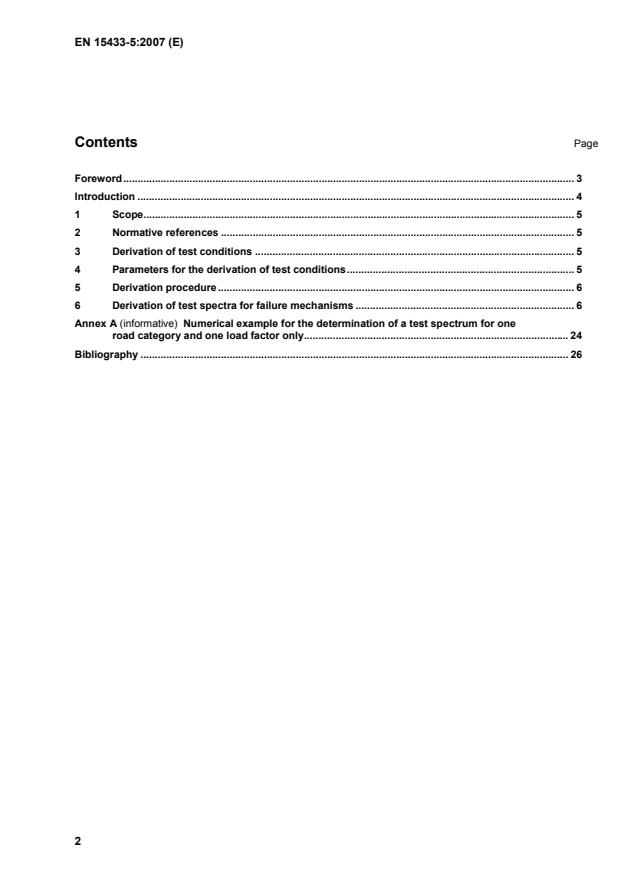
Page Foreword.3 Introduction.4 1 Scope.5 2 Normative references.5 3 Derivation of test conditions.5 4 Parameters for the derivation of test conditions.5 5 Derivation procedure.6 6 Derivation of test spectra for failure mechanisms.6 Annex A (informative)
Numerical example for the determination of a test spectrum for one road category and one load factor only.24 Bibliography.26
Introduction This standard was originally prepared by working group NAVp-1.4, Requirements and Testing, of the German Standardization Institute (DIN).
It is part of a complete normative concept to acquire and describe the loads acting on goods and influencing them during transport, handling and storage. This standard becomes significant when related to the realisation of the European Directive on Packaging and Packaging Waste (Directive 94/62 EC, 20 December 1994). This directive specifies requirements on the avoidance or reduction of packaging waste, and requires that the amount of packaging material is adjusted to the expected transportation load, in order to protect the transportation item adequately. However, this presumes some knowledge of the transportation loads occurring during shipment. At present, basic standards, based on scientifically confirmed values, which can adequately describe and characterize the magnitudes of transportation loads, especially in the domain of dynamic mechanical loads do not exist nationally or internationally.
Reasons for this are mainly the absence of published data, insufficient description of the measurements or restrictions on the dissemination of this information. This standard will enable the measurement and evaluation of dynamic mechanical transportation loads, thus enabling the achievement of standardized and adequately documented load values. This series of standards consists of the following parts: Part 1: General requirements;
Part 2: Data acquisition and general requirements for measuring equipment; Part 3: Data validity check and data editing for evaluation; Part 4: Data evaluation;
Part 5: Derivation of Test Specifications;
Part 6: Automatic recording systems for measuring randomly occurring shock during monitoring of transports.
The duration of the simulation corresponds with the duration of the actual transportation. NOTE In practice, however, tests have to be performed by test laboratories, which do not have measured values for that particular case available.
In such cases, a standard load should be used.
If transport processes are to be time-compressed because the actual transport duration is too long, then the assumption concerning the time compression should comply with the state of the art. The time compression factor should be mentioned in the test report. 4 Parameters for the derivation of test conditions For each derivation of a test condition, the following parameters can have an influence on the derived result: transportation means; transportation route; duration of transportation; transportation conditions; viewed aspect of damage; dynamic mechanical particularities; other boundary conditions. NOTE For more details reference should be made to EN 24178:1992 Complete, filled transport packages - Distribution trials - Information to be recorded For each derivation, the parameters that have been taken into consideration should be recorded, along with the cases for which they are valid. The derivation procedure chosen should also be recorded.
NOTE 1 It is assumed that these procedures will continue to develop following publication of this standard. Clause 6 shows an example procedure that aims to break down the material through forced or fatigue rupture. NOTE 2 Any expert can perform the derivation of a test spectrum.
Derivations of test spectra should comply with the corresponding state of the art.
In order to derive relevant test spectra, the measured acceleration-time signals should be analysed and evaluated according to EN 15433-2, EN 15433-3 and EN 15433-4. 6 Derivation of test spectra for failure mechanisms 6.1 General Transportation damage due to material failure is usually based on forced or fatigue rupture. Standardised load profiles should be made available for such situations. In most cases, the acquired data are not suitable for testing purposes, since they represent only the momentary value of the load as it appears at any time during transport. Furthermore, due to cost reasons, the test duration has to be much shorter than the actual transportation duration. The guidelines given in this standard should therefore be used to derive a test specification. Before deriving a test specification from analysed data, it should be ascertained that all power spectral density (PSD) plots are analysed according to EN 15433-4 and originate from that particular location of the load platform on the transportation means, producing at any time the severest load on the transported item. The longitudinal and lateral loads acting on the transported item should also be considered. In general, the spectra for the foreseen test specifications should be of no other transportation means, but those used to transport that particular item. This is because larger or smaller vehicles can show marked differences compared to the one used for the actual transport. If a transportation route is unknown, and if the transported item is to be transported as a single item on different transportation means, then the spectra of the transportation means creating the most severe load should be used to simulate the transportation load. If large quantities of a specific product have to be transported over long distances, it is essential to know the transportation route, the transportation means, the transportation speed, and the load factor (as a percentage of the maximum permissible payload). From these parameters the load spectrum can be derived, which will result in a suitable transportation test and therefore also result in suitable transportation packing. An optimal simulation of the transportation load can be achieved if, besides the transportation means, the road sections are also considered.
This means that for a specific road transportation, the load spectra of a particular vehicle on different road categories, the driving duration on these same road categories, and the load factor of that particular vehicle are known. If sea transportation is performed, then the ship size and category, as well as load factor, and the state of the sea and the time spent under those conditions, should be known. Hence it can be shown that a complete simulation is to be split proportionally into part simulations.
6.2
Road category
6.3
Vehicle category
6.4
Measuring points on the cargo platform
6.5
Vehicle velocity (km/h)
6.6
Original spectra
6.7
Envelope around the original spectra
6.8
Smoothed spectra
6.9
Reduced spectrum
6.10
Test spectrum for motorway
Example Allocation of different road categories to the total driving distance GOAL Test spectrum for motorway only corresponding to 6.10
Key
Motorway 2
Primary road 3
Other road 4
Test spectrum and
test duration ABCDE1238080801RT231/4 L1/4 L1/2 LLYX4 X-axis
Hz
Y-axis
PSD Figure 1 — Road transportation; derivation of a test spectrum (example)
The measuring points should be located, whenever possible, on the bottom side of the cargo platform in order not to interfere with the loading and unloading operations.
The recommended speeds specified in EN 15433-2:2007, Annex A, should be observed, in order to compare these results with other evaluations.
In order to derive relevant test spectra and to compare them with other derived data, the data acquisition, data validity check and editing, and data analysis should be performed in accordance with EN 15433-2, EN 15433-3 and EN 15433-4. Figure 3 shows schematically the spectra acquired from three measuring points (e.g. 1, 2, 3 in Figure 2), from five measuring axes (e.g. 1x, 1y, 1z, 2z, 3z), at three different speeds, and with three load factors. For one road category only, this results in 5 × 3 × 3 = 45 analysed spectra (not to be mistaken with the amount of measurements, of which not all can be analysed). NOTE For example, Figure 4, Figure 5 and Figure 6 represent the analy
...