

SIST EN 1628:2021
(Main)Pedestrian doorsets, windows, curtain walling, grilles and shutters - Burglar resistance - Test method for the determination of resistance under static loading
General Information
- Abstract
This document specifies a test method for the determination of resistance to static loading in order to assess the burglar resistant properties of pedestrian doorsets, windows, curtain walling, grilles and shutters. It is applicable to the following opening functions: Turning, tilting, folding, turn-tilting, top or bottom hung, sliding (horizontally and vertically), pivoted (horizontally and vertically), projecting, and rolling as well as non-openable constructions.
It is acknowledged that there are two aspects to the burglar resistance performance of construction products, their normal resistance to forced operation and their ability to remain fixed to the building. This test method does not evaluate the performance of the fixing to the building.
The manufacturer's installation instructions will give guidance on the fixing of the product.
An example for the contents of the manufacturer’s installation instructions is given in EN 1627:2021, Annex A.
This document does not apply to walls and roofs, as well as for doors, gates and barriers, intended for installation in areas in the reach of persons, and for which the main intended uses are giving safe access for goods and vehicles accompanied or driven by persons in industrial, commercial or residential premises, as covered by EN 13241:2003+A2:2016.
NOTE It is important that construction products that can be reached or driven through by vehicles are protected by appropriate measures such as barriers, extensible ramps, etc.
- Status
- Published
- Public Enquiry End Date
- 19-Jul-2019
- Publication Date
- 17-Jun-2021
- Technical Committee
- ISTP - Doors and windows
- Current Stage
- 6060 - National Implementation/Publication (Adopted Project)
- Start Date
- 14-Jun-2021
- Due Date
- 19-Aug-2021
- Completion Date
- 18-Jun-2021



Overview
SIST EN 1628:2021 specifies a standardized test method to determine the burglar resistance of pedestrian doorsets, windows, curtain walling, grilles and shutters under static loading. The standard is intended to assess how these construction products resist forced, static loads applied to different opening functions (turning, tilting, folding, sliding, pivoted, projecting, rolling and non‑openable constructions). It is a European (CEN) standard replacing the 2011/2015 edition and forms part of the EN 1627–1630 series for burglar resistance testing and classification.
Key topics and technical requirements
- Scope and exclusions: Applies to pedestrian openings and non‑vehicle access applications. It does not evaluate the performance of the product fixing to the building; installation guidance is provided by the manufacturer (see EN 1627:2021, Annex A). It excludes walls, roofs and vehicle-access doors/gates covered by EN 13241:2003+A2:2016.
- Apparatus and fixtures: Describes the required test rig, load applicators (hydraulic rams), hooks, straps (to EN 12195‑2), pressure pads, measuring equipment and sub‑frames.
- Example equipment parameters included: test‑rig stiffness (15 kN load ≤5 mm deflection), gap gauges (A = 10 mm, B = 25 mm, C = elliptical 250×150 mm), and sub‑frame dimensions (metal tube 120×120×5 mm or timber 100×70 mm).
- Test specimen: Each specimen must be fully functioning, complete with frames, hardware, guides and accessories.
- Procedure and measurement: Defines climatic conditions, loading points for product groups (groups 1–4), loading directions, progressive static loading and failure criteria. Annexes provide test equipment drawings, test sequences for resistance classes 1–6 and specific details for hardware displacement.
- Tolerances and reporting: Gives tolerances for load, dimensions, angle, time and environmental conditions and specifies required test report content.
Practical applications and users
SIST EN 1628:2021 is used by:
- Manufacturers for product development and type testing to demonstrate static resistance performance.
- Independent test laboratories conducting standardized static loading tests for certification and classification.
- Specifiers, architects and consultants assessing security performance for building projects and procurement.
- Compliance and certification bodies applying the EN 1627–1630 classification scheme.
Typical uses include verifying product suitability for burglary risk mitigation, supporting product datasheets, meeting procurement specifications, and informing installation and risk‑assessment decisions.
Related standards
- EN 1627:2021 - Requirements and classification for burglar resistance
- EN 1629:2021 - Dynamic loading test method
- EN 1630:2021 - Manual burglary attempt test method
- EN 13241:2003+A2:2016 - Industrial/commercial doors (vehicle access)
- EN 356:1999 - Security glazing testing
Keywords: SIST EN 1628:2021, burglar resistance, static loading test, doorsets, windows, curtain walling, grilles, shutters, test method, EN 1627.
Relations
- Effective Date
- 01-Sep-2021
- Effective Date
- 28-Jan-2026
- Effective Date
- 28-Jan-2026
- Effective Date
- 28-Jan-2026
- Effective Date
- 28-Jan-2026
- Effective Date
- 28-Jan-2026
- Effective Date
- 28-Jan-2026
- Effective Date
- 28-Jan-2026
- Effective Date
- 28-Jan-2026
- Effective Date
- 28-Jan-2026
- Effective Date
- 28-Jan-2026
- Effective Date
- 28-Jan-2026
- Effective Date
- 28-Jan-2026
- Effective Date
- 28-Jan-2026
- Referred By
SIST EN 15713:2023 - Secure destruction of confidential and sensitive material - Code of practice - Effective Date
- 28-Jan-2026
Get Certified
Connect with accredited certification bodies for this standard

DIBt (Deutsches Institut für Bautechnik)
German Institute for Building Technology.
DIN CERTCO
DIN Group product certification.

Kiwa BDA Testing
Building and construction product certification.
Sponsored listings
Frequently Asked Questions
SIST EN 1628:2021 is a standard published by the Slovenian Institute for Standardization (SIST). Its full title is "Pedestrian doorsets, windows, curtain walling, grilles and shutters - Burglar resistance - Test method for the determination of resistance under static loading". This standard covers: This document specifies a test method for the determination of resistance to static loading in order to assess the burglar resistant properties of pedestrian doorsets, windows, curtain walling, grilles and shutters. It is applicable to the following opening functions: Turning, tilting, folding, turn-tilting, top or bottom hung, sliding (horizontally and vertically), pivoted (horizontally and vertically), projecting, and rolling as well as non-openable constructions. It is acknowledged that there are two aspects to the burglar resistance performance of construction products, their normal resistance to forced operation and their ability to remain fixed to the building. This test method does not evaluate the performance of the fixing to the building. The manufacturer's installation instructions will give guidance on the fixing of the product. An example for the contents of the manufacturer’s installation instructions is given in EN 1627:2021, Annex A. This document does not apply to walls and roofs, as well as for doors, gates and barriers, intended for installation in areas in the reach of persons, and for which the main intended uses are giving safe access for goods and vehicles accompanied or driven by persons in industrial, commercial or residential premises, as covered by EN 13241:2003+A2:2016. NOTE It is important that construction products that can be reached or driven through by vehicles are protected by appropriate measures such as barriers, extensible ramps, etc.
This document specifies a test method for the determination of resistance to static loading in order to assess the burglar resistant properties of pedestrian doorsets, windows, curtain walling, grilles and shutters. It is applicable to the following opening functions: Turning, tilting, folding, turn-tilting, top or bottom hung, sliding (horizontally and vertically), pivoted (horizontally and vertically), projecting, and rolling as well as non-openable constructions. It is acknowledged that there are two aspects to the burglar resistance performance of construction products, their normal resistance to forced operation and their ability to remain fixed to the building. This test method does not evaluate the performance of the fixing to the building. The manufacturer's installation instructions will give guidance on the fixing of the product. An example for the contents of the manufacturer’s installation instructions is given in EN 1627:2021, Annex A. This document does not apply to walls and roofs, as well as for doors, gates and barriers, intended for installation in areas in the reach of persons, and for which the main intended uses are giving safe access for goods and vehicles accompanied or driven by persons in industrial, commercial or residential premises, as covered by EN 13241:2003+A2:2016. NOTE It is important that construction products that can be reached or driven through by vehicles are protected by appropriate measures such as barriers, extensible ramps, etc.
SIST EN 1628:2021 is classified under the following ICS (International Classification for Standards) categories: 13.310 - Protection against crime; 91.060.50 - Doors and windows. The ICS classification helps identify the subject area and facilitates finding related standards.
SIST EN 1628:2021 has the following relationships with other standards: It is inter standard links to SIST EN 1628:2012+A1:2016, SIST EN 356:2000, SIST EN 12519:2018, SIST EN 1629:2021, SIST EN 13241:2003+A2:2016, SIST EN 12195-2:2001, SIST EN 13119:2016, SIST EN 12216:2018, SIST EN 14351-1:2006+A1:2010, SIST EN 1627:2021, SIST EN 14351-2:2019, SIST EN 14351-1:2006+A2:2016, SIST EN 13659:2015, SIST EN 1630:2021, SIST EN 15713:2023. Understanding these relationships helps ensure you are using the most current and applicable version of the standard.
SIST EN 1628:2021 is available in PDF format for immediate download after purchase. The document can be added to your cart and obtained through the secure checkout process. Digital delivery ensures instant access to the complete standard document.
Standards Content (Sample)
SLOVENSKI STANDARD
01-september-2021
Nadomešča:
SIST EN 1628:2012+A1:2016
Vrata, okna, obešene fasade, mreže in polkna - Protivlomna odpornost - Preskusna
metoda za ugotavljanje odpornosti proti statičnim obremenitvam
Pedestrian doorsets, windows, curtain walling, grilles and shutters - Burglar resistance -
Test method for the determination of resistance under static loading
Türen, Fenster, Vorhangfassaden, Gitterelemente und Abschlüsse - Einbruchhemmung -
Prüfverfahren für die Ermittlung der Widerstandsfähigkeit unter statischer Belastung
Blocs-portes pour piétons, fenêtres, façades rideaux, grilles et fermetures - Résistance à
l'effraction - Méthode d'essai pour la détermination de la résistance à la charge statique
Ta slovenski standard je istoveten z: EN 1628:2021
ICS:
13.310 Varstvo pred kriminalom Protection against crime
91.060.50 Vrata in okna Doors and windows
2003-01.Slovenski inštitut za standardizacijo. Razmnoževanje celote ali delov tega standarda ni dovoljeno.
EN 1628
EUROPEAN STANDARD
NORME EUROPÉENNE
June 2021
EUROPÄISCHE NORM
ICS 13.310; 91.060.50 Supersedes EN 1628:2011+A1:2015
English Version
Pedestrian doorsets, windows, curtain walling, grilles and
shutters - Burglar resistance - Test method for the
determination of resistance under static loading
Blocs-portes pour piétons, fenêtres, façades rideaux, Türen, Fenster, Vorhangfassaden, Gitterelemente und
grilles et fermetures - Résistance à l'effraction - Abschlüsse - Einbruchhemmung - Prüfverfahren für die
Méthode d'essai pour la détermination de la résistance Ermittlung der Widerstandsfähigkeit unter statischer
à la charge statique Belastung
This European Standard was approved by CEN on 19 March 2021.
CEN members are bound to comply with the CEN/CENELEC Internal Regulations which stipulate the conditions for giving this
European Standard the status of a national standard without any alteration. Up-to-date lists and bibliographical references
concerning such national standards may be obtained on application to the CEN-CENELEC Management Centre or to any CEN
member.
This European Standard exists in three official versions (English, French, German). A version in any other language made by
translation under the responsibility of a CEN member into its own language and notified to the CEN-CENELEC Management
Centre has the same status as the official versions.
CEN members are the national standards bodies of Austria, Belgium, Bulgaria, Croatia, Cyprus, Czech Republic, Denmark, Estonia,
Finland, France, Germany, Greece, Hungary, Iceland, Ireland, Italy, Latvia, Lithuania, Luxembourg, Malta, Netherlands, Norway,
Poland, Portugal, Republic of North Macedonia, Romania, Serbia, Slovakia, Slovenia, Spain, Sweden, Switzerland, Turkey and
United Kingdom.
EUROPEAN COMMITTEE FOR STANDARDIZATION
COMITÉ EUROPÉEN DE NORMALISATION
EUROPÄISCHES KOMITEE FÜR NORMUNG
CEN-CENELEC Management Centre: Rue de la Science 23, B-1040 Brussels
© 2021 CEN All rights of exploitation in any form and by any means reserved Ref. No. EN 1628:2021 E
worldwide for CEN national Members.
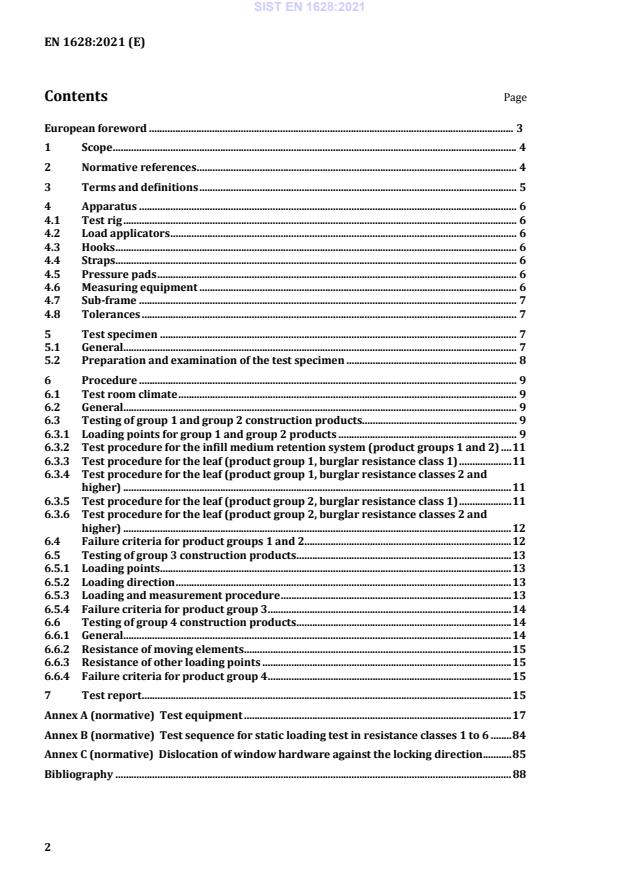
Contents Page
European foreword . 3
1 Scope . 4
2 Normative references . 4
3 Terms and definitions . 5
4 Apparatus . 6
4.1 Test rig . 6
4.2 Load applicators . 6
4.3 Hooks . 6
4.4 Straps. 6
4.5 Pressure pads . 6
4.6 Measuring equipment . 6
4.7 Sub-frame . 7
4.8 Tolerances . 7
5 Test specimen . 7
5.1 General. 7
5.2 Preparation and examination of the test specimen . 8
6 Procedure . 9
6.1 Test room climate . 9
6.2 General. 9
6.3 Testing of group 1 and group 2 construction products . 9
6.3.1 Loading points for group 1 and group 2 products . 9
6.3.2 Test procedure for the infill medium retention system (product groups 1 and 2) . 11
6.3.3 Test procedure for the leaf (product group 1, burglar resistance class 1) . 11
6.3.4 Test procedure for the leaf (product group 1, burglar resistance classes 2 and
higher) . 11
6.3.5 Test procedure for the leaf (product group 2, burglar resistance class 1) . 11
6.3.6 Test procedure for the leaf (product group 2, burglar resistance classes 2 and
higher) . 12
6.4 Failure criteria for product groups 1 and 2. 12
6.5 Testing of group 3 construction products . 13
6.5.1 Loading points . 13
6.5.2 Loading direction . 13
6.5.3 Loading and measurement procedure . 13
6.5.4 Failure criteria for product group 3 . 14
6.6 Testing of group 4 construction products . 14
6.6.1 General. 14
6.6.2 Resistance of moving elements . 15
6.6.3 Resistance of other loading points . 15
6.6.4 Failure criteria for product group 4 . 15
7 Test report . 15
Annex A (normative) Test equipment . 17
Annex B (normative) Test sequence for static loading test in resistance classes 1 to 6 . 84
Annex C (normative) Dislocation of window hardware against the locking direction . 85
Bibliography . 88
European foreword
This document (EN 1628:2021) has been prepared by Technical Committee CEN/TC 33 “Doors, windows,
shutters, building hardware and curtain walling”, the secretariat of which is held by AFNOR.
This European Standard shall be given the status of a national standard, either by publication of
an identical text or by endorsement, at the latest by December 2021, and conflicting national standards
shall be withdrawn at the latest by December 2021.
Attention is drawn to the possibility that some of the elements of this document may be the subject of
patent rights. CEN shall not be held responsible for identifying any or all such patent rights.
This document will supersede EN 1628:2011+A1:2015.
Significant changes in this revision are:
a) Updated editions of Normative References;
b) Gap gauge C in Figure A.14 replaced gauge 3 in Figure A.13.
This European Standard is one of a series of standards for burglar resistant pedestrian doorsets,
windows, curtain walling, grilles and shutters. The other standards in the series are:
— EN 1627:2021, Pedestrian doorsets, windows, curtain walling, grilles and shutters — Burglar
resistance — Requirements and classification;
— EN 1629:2021, Pedestrian doorsets, windows, curtain walling, grilles and shutters — Burglar
resistance — Test method for the determination of resistance under dynamic loading;
— EN 1630:2021, Pedestrian doorsets, windows, curtain walling, grilles and shutters — Burglar
resistance — Test method for the determination of resistance to manual burglary attempts.
According to the CEN-CENELEC Internal Regulations, the national standards organisations of the
following countries are bound to implement this European Standard: Austria, Belgium, Bulgaria, Croatia,
Cyprus, Czech Republic, Denmark, Estonia, Finland, France, Germany, Greece, Hungary, Iceland, Ireland,
Italy, Latvia, Lithuania, Luxembourg, Malta, Netherlands, Norway, Poland, Portugal, Republic of North
Macedonia, Romania, Serbia, Slovakia, Slovenia, Spain, Sweden, Switzerland, Turkey and the United
Kingdom.
1 Scope
This document specifies a test method for the determination of resistance to static loading in order to
assess the burglar resistant properties of pedestrian doorsets, windows, curtain walling, grilles and
shutters. It is applicable to the following opening functions: Turning, tilting, folding, turn-tilting, top or
bottom hung, sliding (horizontally and vertically), pivoted (horizontally and vertically), projecting, and
rolling as well as non-openable constructions.
It is acknowledged that there are two aspects to the burglar resistance performance of construction
products, their normal resistance to forced operation and their ability to remain fixed to the building.
This test method does not evaluate the performance of the fixing to the building.
The manufacturer's installation instructions will give guidance on the fixing of the product.
An example for the contents of the manufacturer’s installation instructions is given in EN 1627:2021,
Annex A.
This document does not apply to walls and roofs, as well as for doors, gates and barriers, intended for
installation in areas in the reach of persons, and for which the main intended uses are giving safe access
for goods and vehicles accompanied or driven by persons in industrial, commercial or residential
premises, as covered by EN 13241:2003+A2:2016.
NOTE It is important that construction products that can be reached or driven through by vehicles are
protected by appropriate measures such as barriers, extensible ramps, etc.
2 Normative references
The following documents are referred to in the text in such a way that some or all of their content
constitutes requirements of this document. For dated references, only the edition cited applies. For
undated references, the latest edition of the referenced document (including any amendments) applies.
EN 356:1999, Glass in building — Security glazing — Testing and classification of resistance against
manual attack
EN 1627:2021, Pedestrian doorsets, windows, curtain walling, grilles and shutters — Burglar resistance —
Requirements and classification
EN 1629:2021, Pedestrian doorsets, windows, curtain walling, grilles and shutters — Burglar resistance —
Test method for the determination of resistance under dynamic loading
EN 1630:2021, Pedestrian doorsets, windows, curtain walling, grilles and shutters — Burglar resistance —
Test method for the determination of resistance to manual burglary attempts
EN 12195-2:2000, Load restraint assemblies on road vehicles — Safety — Part 2: Web lashing made from
man-made fibres
EN 12216:2018, Shutters, external blinds, internal blinds — Terminology, glossary and definitions
EN 12519:2018, Windows and pedestrian doors — Terminology
EN 13119:2016, Curtain walling — Terminology
EN 13241:2003+A2:2016, Industrial, commercial, garage doors and gates — Product standard,
performance characteristics
3 Terms and definitions
For the purposes of this document, the terms and definitions given in EN 1627:2021, EN 12519:2018,
EN 12216:2018, EN 13119:2016 and the following apply.
ISO and IEC maintain terminological databases for use in standardization at the following addresses:
— IEC Electropedia: available at https://www.electropedia.org/
— ISO Online browsing platform: available at https://www.iso.org/obp
3.1
test specimen
complete, fully functioning construction product as detailed in the scope of this document
3.2
sub-frame
standard surrounding frame into which the test specimen is mounted for testing purpose
3.3
test rig
surrounding substantial steel frame with movable steel supports into which the sub-frames containing
test specimens of various dimensions can be mounted
3.4
load applicator
hydraulic ram or similar loading device that can apply the test forces required
3.5
pressure pad
pad fitted to the active end of the load applicator to spread the load
3.6
locking points
all connecting points between the opening element and the fixed element including the following:
— main lock;
— bolts of additional locks or multi-point locks;
— hinges;
— hinge bolts or dog bolts;
— fixings of fixed elements;
— roller and slide bearings in guides of sliding elements;
— junction of grille bars.
Note 1 to entry: Locating wedges are not considered to be building hardware or attachment points unless they
also act as a security claw/dogbolt.
3.7
passive leaf
leaf of a multi-leafed window or door, intended to be moved after the active leaf
3.8
active leaf
leaf of a multi-leafed window or door intended to be moved first to provide opening
4 Apparatus
4.1 Test rig
The test rig is consisting of a rigid steel frame with movable steel supports into which test specimens of
various dimensions can be mounted, is shown in Annex A - Figure A.5. The stiffness of the rig shall be
such that a 15 kN force applied to any of the defined points and normal to the plane of the frame shall not
cause a deflection of more than 5 mm. The test rig shall not impede the execution of the test.
4.2 Load applicators
The load applicators consisting of a hydraulic ram or similar loading device shall be capable of applying
the required test forces progressively and without shock.
4.3 Hooks
A hook is shown in Figure A.12.
4.4 Straps
Straps shall conform to EN 12195-2:2000 or equivalent and have a minimum tensile strength of 5 kN.
These straps may be used to apply some of the loads.
4.5 Pressure pads
Pressure pads and loading equipment are shown in Figures A.6 to A.11.
4.6 Measuring equipment
The measurement equipment is consisting of the following:
a) equipment to display and/or record the forces being applied;
b) a chronometer with seconds display for measuring the loading times;
c) equipment for determining temperature and relative humidity;
d) calliper and/or depth gauge;
e) angle measuring instrument;
f) three gap gauges as shown in Figures A.13 and A.14: gap gauge A shall be 10 mm in diameter, gap
gauge B shall be 25 mm in diameter, gap gauge C shall have an elliptical form with a major diameter
of 250 mm and a minor diameter of 150 mm.
NOTE The various gap gauges detailed in A.10 are used to evaluate the resistance to an applied load. They
represent an acceptable level of deformation of the various products above which vulnerabilities can be
exposed. They are not intended to represent any particular attack method but are used as a simple method to
establish failure.
4.7 Sub-frame
The sub-frame shall simulate the support given to the product when installed into a building. It shall
typically consist of the following:
a) for group 1 to group 4 products, a rectangular minimum metal tube 120 mm × 120 mm × 5 mm or a
rectangular timber frame minimum 100 mm × 70 mm;
NOTE High quality wood, e.g. glue laminated timber.
b) additionally for group 3 and group 4 products, a steel tube minimum 40 mm × 40 mm × 3 mm; and a
base plate of 8 mm steel, consisting of several segments which shall be removable for the purposes
of loading, if necessary.
See Figures A.15 to A.32.
4.8 Tolerances
Unless stated otherwise in this document, the following tolerances shall apply to the test equipment:
Load ±5 %
Dimensions < 20 mm ±0,5 mm
≥ 20 to 500 mm ±1,0 mm
≥ 500 to 2 000 mm ±2,0 mm
≥ 2 000 mm ±3,0 mm
Angle ±2°
Time ±1 %
Temperature ±2 °C
Relative humidity ±5 %
5 Test specimen
5.1 General
Each test specimen shall be a functioning product complete with its frames, building hardware, guide
rails, curtain, tube, roller box and accessories, as appropriate. When testing roller shutters at least two
test specimens consisting of separate sections of the guide rails shall be supplied for test. These sections
shall be 1 m in length (see Figure A.56).
The test specimen shall be fixed square and plumb and without twist or bend into a sub-frame. The
manufacturer shall ensure that the method of fixing, packing supports, sealing requirements, etc. of the
test specimen into the sub-frame are in accordance with their installation instructions (see Figures A.15
to A.63). The sub-frame shall be supported by the test rig so that there will be no movement of the sub-
frame during the test.
NOTE Products that are intended to be installed in orientations other than vertical (e.g. roof lights) can be
installed in the vertical orientation for the purpose of this test.
For the purposes of this document, the test specimen shall be glazed according to the relevant glazing
resistance class of EN 356:1999, corresponding to the resistance class of the construction product
according to EN 1627:2021, as shown in Table 1. The glass pane offering the highest security level, when
used in an insulating glass unit, is normally positioned on the non-attack side. For the purpose of this test,
the glass pane offering the highest security level shall be positioned on the attack side of the sample.
Products shall be glazed in accordance with the manufacturer’s specification.
Table 1 — Glazing requirements for the test specimen
Resistance class Minimum resistance class of glazing according to
EN 356:1999 fitted on the test specimen for testing
purpose
RC 1 N P4 A
RC 1 a
P4 A
RC 2 N P4 A
RC 2 a
P4 A
RC 3 a
P5 A
RC 4 a
P6 B
RC 5 a
P7 B
RC 6 a
P8 B
a
The glazing type fitted on the test specimen shall be the type (or one of the types) used for
classification purposes.
If a glass unit with a higher security level is used within the specimen used for the tests, it may not be
possible to assess the use of glass units with a lower grade within those products without conducting
further tests. This is because higher grades of glass can increase the rigidity of the product.
The test specimen used in this test may also be used for the dynamic test in accordance with
EN 1629:2021 and the pre-test in accordance with EN 1630:2021, provided that any damage caused by
these tests will not affect the result of the pre-test (see also EN 1627:2021, Clause 11).
5.2 Preparation and examination of the test specimen
The specimen shall be stored for at least 8 hours in a temperature range between 15 °C and 30 °C until
the start of the test to ensure that it is fully tempered for the test.
The test specimen and sub-frame mounted in the test rig shall be visually examined for damage, defects
or other particular conditions of finish, etc. These shall be recorded.
The top of the sub-frame should be propped local to the locking points, if necessary.
Each test specimen shall be examined and the direction to disengage each locking point shall be noted.
During testing the test specimen shall be closed and locked at the declared secured condition in
accordance with the manufacturer's instructions.
All locking hardware that can be disengaged from the attack side without the use of a key or tool shall be
disengaged during all tests.
Products in resistance class 1 shall additionally be prepared prior to the static loading test by removing
all parts on the attack side that can be unscrewed, dismounted or disassembled using the tools described
in EN 1630:2021, Annex A, tool set A1. Parts must not be damaged during this procedure. The total time
for this preparation procedure shall not exceed 3 min.
The parts removed during this preparation shall be recorded.
6 Procedure
6.1 Test room climate
The test room temperature shall be maintained between 15 °C and 30 °C.
The relative humidity in the test room shall be between 30 % and 70 %.
6.2 General
The specified test loads detailed in EN 1627:2021 shall be applied in the order specified in EN 1627:2021,
7.1 at the various loading points using the load applicator. The ability of the products to resist static
loading shall be assessed by means of a gap gauge, as shown in Figures A.13 and A.14.
The complete test procedure shall be carried out as shown in Annex B, Figure B.1.
Should the glass break during any tests, the test programme shall proceed with the broken glass in situ.
Adhesive film may be applied to the glass to protect the tester.
When propping is needed, the restraint shall have a nominal contact area of 100 mm by 50 mm and offer
restraint in the opposite direction to the applied load.
Where it is not possible to use the 100 mm by 50 mm prop smaller props may be used. Where a smaller
prop is used, it should be as large as possible (up to 100 mm by 50 mm). The test report shall document
where smaller props are used and the size of the prop.
The prop shall be located as close to the loading point as is practical, but shall not give additional support
to the leaf/infill/beading under test, see Figure A.38. Load F2 is applied without propping the inactive
leaf on elements with more than one leaf.
Fixed construction products and side/overpanels, that have no openable element, shall be tested in a
similar manner to openable elements for group 1 and group 2 products. That is, the F1 and F3 loads will
be applied to the infill and supporting frame in accordance with 6.3.1.1 and 6.3.1.3.
NOTE Side/overpanels are fanlights (EN 12519) with or without glass.
Test method for dislocation of window hardware against the locking direction, see Annex C.
6.3 Testing of group 1 and group 2 construction products
6.3.1 Loading points for group 1 and group 2 products
6.3.1.1 Loading point F1: infilling corner
The specified load shall be applied, in turn, to each corner of the infilling medium at a point as shown in
Figure A.1, unless the infilling medium is circular, in which case four points shall be selected at
approximately equidistant intervals around the edge. The load shall be applied in a direction to
disassemble the infilling medium retention system and perpendicular to the plane of the test specimen.
The F1 loads to infills will be applied with the pressure pad located nominally 5 mm from the edge of the
infill, as described in Figure A.1. F1 loads on infills will be applied in the direction to disassemble the
glazing/infill, i.e. loading from the outside on internally glazed windows and vice versa. Where it is
unclear as to which side is the direction to disassemble the glazing/infill, e.g. cassette systems of
symmetrical systems, the load will be applied from the attack side. An optional wood or plastic panel to
protect the glazing may be used to prevent glass breakage.
6.3.1.2 Loading point F2: leaf corner
The specified load shall be applied, in turn, to each corner of the leaf if the adjacent locking point has a
greater distance A than 350 mm from the corner as shown in Figure A.33. If no corner exists (e.g. circular
product) apply the loads half way between locking points. It shall be applied in a direction to open the
leaf and perpendicular to the plane of the test specimen. The distance of a hardware loading point from
a corner shall be measured from the corner of the frame rebate to the centre of that hardware loading
point.
F2 loads will be applied progressively and without shock over a period of 10 s to 20 s within 5° of
perpendicular to plane and will be maintained for a period of 8 s to 12 s.
6.3.1.3 Loading point F3: locking points
The specified load shall be applied, in turn, to each locking point as defined in 3.6 and shown in
Figures A.2 to A.4. If the distance between two adjacent locking points is less than 200 mm then a single
loading point shall be used located at the midpoint between the two locking points. The load shall be
applied in a direction to open the leaf. For locking points on adjacent edges the sum on their distance
from the corner shall be used. The load shall be applied in a direction to open the leaf. Where the locking
point has a contact length of greater than 200 mm (e.g. piano hinge or locking bar) then a load shall be
applied at each end. Once two loading points have been combined, they cannot be further combined with
other loading points.
For fixed construction products and side/overpanels the specified load shall be applied, in turn, to any
fixing securing the infill frame into the main frame as shown in Figure A.37 a) to A.37 b) 2).
On fixed construction products that consist of a single element secured directly to the substrate then the
specified load shall be applied at:
— 200 mm intervals around the edge of the product, where a fixed product is secured using a
continuous fixing system (e.g. structural sealant) as shown in Figure A.37 c) 2).
— Each fixing point to the substrate as shown in Figure A.37 c) 1).
On elements with openable parts, the fixing of the mainframe adjacent to the openable sash is indirectly
tested by loading the locking points with F3.
6.3.1.4 Loading point: F3.a: locking points
The specified load shall be applied to the leaf and, where necessary, to the frame, in a direction to
disengage the associated locking point as shown in Figure A.41 to A.50. The load F3.a shall be applied in
the plane of the specimen and only in association with the load applied to loading point F3 and to products
in burglar resistance class 1N, as defined in EN 1627:2021.
Where a separating force is required, a load shall also be applied to other parts of the product. The load
F3.a shall be applied and maintained until the load applied to loading point F3 has been applied and
removed.
There is no fixed correlation between the attack side and the loading direction, because in a realistic
attack with tools, forces are applied in the direction of opening or contrary to the direction of assembly.
The loading direction is therefore dependent on the construction and function of the test specimen. For
products where both sides are considered to be the attack side then no additional static tests are
necessary.
6.3.2 Test procedure for the infill medium retention system (product groups 1 and 2)
For the purpose of this test, the leaf of the test specimen shall be restrained to resist any deflection
between leaf and frame due to the loads applied to the infilling medium. The restraint shall have a
nominal contact area of 100 mm × 50 mm and offer restraint in the opposite directions to the applied
load.
The load F1 shall be applied progressively and without shock over a period of 10 s to 20 s and within 5°
of perpendicular to plane to each corner of the infill medium. The load shall be maintained for a period of
8 s to 12 s. If the retention system exhibits any sign of disengagement at a corner, the loading test shall
be continued along each section of the retention system in an attempt to defeat the system. Subsequent
loads shall be applied at intervals of a minimum of 50 mm.
When propping is needed, see 6.2.
6.3.3 Test procedure for the leaf (product group 1, burglar resistance class 1)
The loads shall be applied to the points in the order shown in Figures A.33 to A.38, A.42 to A.45, A.47,
A.50 and A.52. For side hung products the first point to be loaded shall be the uppermost point on the
hinged side. Each subsequent point down the hinged side then along the bottom, up the locking side and
across the top shall be tested in turn. The load shall be applied in a direction to open the leaf and
perpendicular to the plane of the test specimen.
For products that contain two or more leaves, propping of the passive leaf shall be provided as shown in
Figure A.38. The passive leaf shall be tested first.
In the case of a loading point at the corner of the leaf and without an adjacent locking point within
350 mm, the load F2 shall be applied.
In the case of a loading point requiring an inplane load F3a, this load shall be applied first. With this load
maintained, the corresponding load F3 shall be applied. In the case of a loading point that requires two
or more inplane loads, all these loads shall be applied and maintained before the application of the
relevant F3 load.
F3.a loads shall each be applied progressively and without shock over a period not exceeding 30 s. They
shall be maintained until the F3 load has been applied and maintained for the required period.
Each F3 load shall be applied progressively and without shock over a period of 10 s to 20 s and within 5°
of perpendicular to the plane of the test specimen. These loads shall be maintained for a period of 8 s to
12 s.
All loads shall be removed without shock.
All loading points shall be tested unless a product failure occurs.
When propping is needed, see 6.2.
6.3.4 Test procedure for the leaf (product group 1, burglar resistance classes 2 and higher)
The test procedure for construction products in burglar resistance classes 2 and higher (product group 1)
shall be as detailed in 6.3.3 except that the inplane load F3.a shall be omitted.
6.3.5 Test procedure for the leaf (product group 2, burglar resistance class 1)
6.3.5.1 Sliding door/window
The loads shall be applied as shown in Figures A.11, A.39 and A.51.
The first test shall assess the locking mechanism ability to resist a load applied at the locking points in
the direction to open the sliding leaf (force axis is in plane of the leaf).
At first, the load F3.a shall be applied in a direction to disengage the locking hardware. It shall be applied
progressively and without shock over a period not exceeding 30 s. With this load F3.a maintained, a
second load F3 shall be applied in the direction to open the sliding leaf.
The second load shall be applied progressively and without shock over a period not exceeding 30 s. This
load shall be maintained for a period of 8 s to 12 s. After that the load F3 and subsequently also the load
F3.a is removed without shock.
The second test shall assess the retention of the sliding leaf in its frame. The load F3 applied to the locking
points shall be applied perpendicular to the plane of the sliding leaf at the points as shown in Figure A.39
(rectangles in the leaf corners).
In all cases, the F3 load shall be applied progressively and without shock over a period of 10 s to 20 s and
within 5° of the desired direction. These loads shall be maintained for a period of 8 s to 12 s.
After that the load shall be removed without shock.
All loading points shall be tested unless a product failure occurs.
As a rule Tilt and Slide windows and Folding Sliding windows should be tested as product group 1 in the
case that the design of the hardware and its initial movement to open the window is like Tilt and Turn or
a Turn window (to disengage the locking mechanism).
6.3.5.2 Lift and slide door/window
The loads shall be applied as shown in Figures A.11 and A.40.
The first test shall assess the locking mechanism ability to resist a load applied at the locking points in
the direction to open the lift and slide leaf (force axis is in plane of the leaf).
At first, the load F3.a (e.g. in Figure A.40 - bottom corner of the leaf to lift up) shall be applied in a direction
to disengage the locking hardware and/or to lift up the leaf. It shall be applied progressively and without
shock over a period not exceeding 30 s. With this load F3.a maintained, a second load F3 shall be applied
in the direction to open the lift and slide leaf. The second load shall be applied progressively and without
shock over a period not exceeding 30 s. This load shall be maintained for a period of 8 s to 12 s. After that
the load F3 and subsequently also the load F3.a is removed without shock.
The second test shall assess the retention of the lift and slide leaf in its frame. The load F3 applied to the
locking points shall be applied perpendicular to the plane of the lift and slide leaf at the point as shown
in Figure A.40 (rectangles in the leaf corners).
In all cases, the F3 load shall be applied progressively and without shock over a period of 10 s to 20 s and
within 5° of the desired direction. These loads shall be maintained for a period of 8 s to 12 s.
After that the load shall be removed without shock.
All loading points shall be tested unless a product failure occurs.
6.3.6 Test procedure for the leaf (product group 2, burglar resistance classes 2 and higher)
The test procedure for construction products in class 2 is as detailed in 6.3.5.1 or 6.3.5.2 except that the
level of load F3.a is increased to equal the F3 load.
The test procedure for construction products in classes 3 and higher shall be as detailed in 6.3.5.1 or
6.3.5.2 except that the inplane load F3.a shall be omitted.
6.4 Failure criteria for product groups 1 and 2
The ability of the product to resist the static load shall be assessed with the use of the gap gauges. Failure
shall be deemed to have occurred if the appropriate gap gauge can pass through any aperture in the test
specimen either with or without the application of the test loads. Where loads are applied to loading
points F1 and F2, gap gauge B shall be used to assess the deflection of the leaf. Where loads are applied
to loading point F3, gap gauge A shall be used. Use of the gap gauge shall not apply additional loads to the
test specimen. The gap gauge may be passed through the aperture at any angle.
Passage of the gap gauge through letter plates does not constitute a failure.
6.5 Testing of group 3 construction products
6.5.1 Loading points
6.5.1.1 General
Loads shall be applied to the weakest points of the test specimen at the loading points F1, F1.1, F2 and F3
for the static testing of roller shutters, as described in 6.5.1.2 to 6.5.1.5 and as shown in Figures A.56 to
A.59.
6.5.1.2 Loading point F1: connection between guide rail and roller curtain
Loading point F1 for roller shutters shall correspond to loading point F1 for infilling corners of doorsets
and windows, as shown in Figure A.59.
6.5.1.3 Loading point F1.1: Guide rails as separate components
Loading point F1.1 is a point located on the guide rail of group 3 products. The load is applied to the guide
rail as a separate component, as shown in Figure A.56.
6.5.1.4 Loading point F2: extraction of bottom lath and roller curtain
Loading point F2 for the roller curtain and the bottom lath in the middle between the guide rails, as shown
in Figures A.58, shall correspond with the loading point F2 for, doorsets and windows.
6.5.1.5 Loading point F3: Lift up of roller curtain
Loading points F3 shall correspond with those at the locking points of doorsets and windows, as shown
in Figure A.57. Any additional locks shall also be loaded by this method.
6.5.2 Loading direction
The loading direction for the loading points F1, F1.1 and F2, as shown in Figures A.58 and A.59 shall be
dependent on the attack side (levering out of the curtain ends). Test specimens with two defined attack
sides shall undergo two tests.
The loading on the loading points F3, as shown in Figure A.57, shall be applied in the direction of opening
(e.g. sliding up of a roller shutter with an overhead roller tube).
6.5.3 Loading and measurement procedure
6.5.3.1 Guide rail deflection test
The guide rail deflection test shall be carried out on each guide rail submitted for test. The rail exhibiting
the highest angular measurement shall be selected for the tests described in 6.5.3.2 and 6.5.3.3.
The test shall be carried out on guide rails as separate components. The installation of the guide rails shall
be in accordance with the manufacturer’s published mounting instructions, e.g. the cavity fills and the
distance A between the fixing points of the guide rails. The leg of the guide rail on the attack side shall be
loaded, as shown in Figure A.56. The load F1.1 shall be applied progressively and without shock over a
period of 10 s to 20 s. It shall be maintained for 8 s to 12 s. The angular displacement shall be measured
with the load F1.1 applied as shown in Figure A.56.
6.5.3.2 Curtain lift test
The curtain lift test shall be carried out on a complete roller shutter or roller grille assembly. In order that
the load can be applied the corresponding segment of the test frame base plate may be removed. The
following sequence of the loading procedure shall be maintained: left - right - middle. The load F3 for
roller shutters as shown in Figure A.57 and for roller grilles as shown in Figure A.62 shall be applied to
the bottom section of the roller shutter or roller grille in an upward direction at the points and in the
order shown in Figure A.57 or A.62. This load is not related to the attack side.
Any additional locking points – e.g. a lock in the bottom lath – shall also be loaded by this method. Under
the loading F3 all parts of the lock shall remain in the locked condition.
The load should be applied in a vertical direction. This could be achieved by use of an appropriate
pressure pad or by a webbing sling passed under the curtain.
6.5.3.3 Lath engagement
The minimum depth of engagement of the shutter laths into the guide rails shall be established by moving
the shutter laths away from the loading point until the ends make contact with the other guide rail. The
engagement shall either be measured and recorded or a reference mark shall be made on the laths.
6.5.3.4 Static test on guide rail and curtain
The required load F1 shall be applied progressively and without shock over a period of 10 s to 20 s to the
side of the roller shutter laths as shown in Figure A.59. This load shall be maintained for 8 s to 12 s and
the engagement under load of the shutter laths shall be measured and recorded or a second reference
mark shall be used. The load shall be removed without shock. This procedure shall be repeated at the
same points as shown in Figure A.59. This procedure is repeated using load F2 as shown in Figure A.58.
6.5.4 Failure criteria for product group 3
6.5.4.1 Guide rail deflection
Failure shall be deemed to have occurred if the deflection of the guide rail is more than 30° whilst the test
load is applied.
6.5.4.2 Curtain lift
The deflection of the bottom section of the roller shutter shall be assessed with the use of gap gauge C. If
the gauge can pass through any aperture whilst the test loads are applied, then failure has occurred.
6.5.4.3 Lath engagement
Failure shall be deemed to have occurred if the minimum engagement and the engagement under load is
less than 10 mm.
6.5.4.4 Static test on guide rail and curtain
Failure shall be deemed to have occurred if the minimum engagement and the engagement under load is
less than 10 mm.
6.6 Testing of group 4 construction products
6.6.1 General
Two test sequences shall be carried out on group 4 construction products. The first shall assess the ability
of the product to resist forced operation of its normal opening method. The second shall assess the ability
of other loading points to resist the applied loads (e.g. loading F2.2 between two junction points).
In order to define the direction and location of the test loads, the products are further grouped according
to their normal operating mode.
6.6.2 Resistance of moving elements
Products with a rigid element that requires a turning movement to open shall be tested using the methods
described in 6.3.3 and 6.3.4 depending upon the burglar resistance class.
Products with a rigid element that requires a sliding movement to open shall be tested using the methods
described in 6.3.5 and 6.3.6 depending upon the burglar resistance class.
Products such as roller grilles shall be tested using the methods described in 6.5.
For the loading on roller grilles, as shown in Figure A.62, the corresponding segment of the base plate has
to be removed. The following sequence of the loading procedure shall be maintained: left - right - middle.
This load is not related to the attack side.
Any additional locking points – e.g. a lock in the bottom lath – shall also be loaded by this method.
For such additional locking points the pressure pad 2 can be used. Under the loading F3.2 all parts of the
lock shal
...