

SIST EN 50065-4-2:2003
(Main)Signalling on low-voltage electrical installations in the frequency range 3 kHz to 148,5 kHz and 1,6 MHz to 30 MHz -- Part 4-2: Low voltage decoupling filters - Safety requirements
General Information
- Abstract
This product safety standard applies to electrical equipment, such as decoupling filters and phase couplers in a mains communication system for a phase to neutral voltage not exceeding AC 250 V and a nominal current not exceeding 125 A, intended for household and similar fixed-electrical installations including residential, commercial and light industrial buildings
- Status
- Published
- Publication Date
- 31-Jan-2003
- Technical Committee
- KIN - Mains communicating systems
- Current Stage
- 6060 - National Implementation/Publication (Adopted Project)
- Start Date
- 01-Feb-2003
- Due Date
- 01-Feb-2003
- Completion Date
- 01-Feb-2003
- Directive
- 2006/95/EC - Directive 2006/95/EC of the European Parliament and of the Council of 12 December 2006 on the harmonisation of the laws of Member States relating to electrical equipment designed for use within certain voltage limits (codified version)OJ Ref: C 348/03 OJ Date: 28-Nov-2013
2014/35/EU - Directive 2014/35/EU of the European Parliament and of the Council of 26 February 2014 on the harmonisation of the laws of the Member States relating to the making available on the market of electrical equipment designed for use within certain voltage limitsOJ Ref: C 249/03 OJ Date: 08-Jul-2016



Overview
EN 50065-4-2:2001 (CLC/CENELEC) is the European product safety standard for low voltage decoupling filters and phase couplers used in mains communication systems operating in the frequency range 3 kHz to 148.5 kHz (also relevant to related EN 50065 parts up to 148.5 kHz). It applies to equipment for fixed electrical installations with phase-to-neutral voltage up to AC 250 V and nominal currents up to 125 A, intended for household, residential, commercial and light industrial buildings. The standard defines safety requirements, classification, testing and marking to ensure reliable, safe operation in mains-communication systems.
Key Topics
- Scope & rating: nominal voltages (standard values) and nominal currents up to 125 A; conductor cross-sections and installation classes.
- Definitions: decoupling filter, phase coupler, fault conditions, enclosed/unenclosed equipment, terminal types.
- Type testing: tests are carried out as type tests; sample scheme (9 samples in specified groupings) and ambient test conditions described.
- Safety requirements: protection against electric shock, protective earthing, insulation resistance, dielectric strength, creepage and clearance distances.
- Construction & components: terminals (screw/screwless), marking, mechanical strength, resistance to ageing, humidity, heat, fire and tracking, and resistance to transients and short-circuit conditions.
- Thermal & electrical tests: temperature rise limits, test currents, torques for connection screws, conditional short-circuit current and SCPD requirements.
- Marking & classification: required marking (voltage, current, manufacturer, IP rating, temperature class) and environmental/installation classifications (IP, EN 60721).
Applications
EN 50065-4-2 is practical for:
- Manufacturers of decoupling filters, phase couplers and mains-communication components-use it to design and certify safe products.
- Test laboratories performing type tests, dielectric, thermal and mechanical safety verification.
- System integrators and specifiers selecting compliant filters and couplers for PLC (power-line communication) and other mains signalling systems in homes, offices and light industry.
- Authorities and procurement teams requiring evidence of compliance with Low Voltage Directive safety essentials.
Related standards
- EN 50065 series (Parts 1, 2-x, 4-1, 4-3, 4-4, 4-5, 4-6) - broader signalling and filter specifications
- EN 60065, EN 60529 (IP code), EN 60695 (fire testing), HD 625.1 (insulation coordination) and IEC normative references cited in the standard
By following EN 50065-4-2, stakeholders ensure safe, reliable low-voltage decoupling filters and phase couplers for mains communication while meeting European safety and testing expectations.
Relations
- Effective Date
- 03-Feb-2026
- Effective Date
- 03-Feb-2026
- Effective Date
- 03-Feb-2026
- Effective Date
- 03-Feb-2026
- Effective Date
- 03-Feb-2026
- Effective Date
- 21-Sep-2010
- Effective Date
- 21-Sep-2010
- Effective Date
- 14-May-2019
Get Certified
Connect with accredited certification bodies for this standard

ANCE
Mexican certification and testing association.

Intertek Slovenia
Intertek testing, inspection, and certification services in Slovenia.

LNE (Laboratoire National de Métrologie et d'Essais)
French national laboratory for metrology and testing.
Sponsored listings
Frequently Asked Questions
SIST EN 50065-4-2:2003 is a standard published by the Slovenian Institute for Standardization (SIST). Its full title is "Signalling on low-voltage electrical installations in the frequency range 3 kHz to 148,5 kHz and 1,6 MHz to 30 MHz -- Part 4-2: Low voltage decoupling filters - Safety requirements". This standard covers: This product safety standard applies to electrical equipment, such as decoupling filters and phase couplers in a mains communication system for a phase to neutral voltage not exceeding AC 250 V and a nominal current not exceeding 125 A, intended for household and similar fixed-electrical installations including residential, commercial and light industrial buildings
This product safety standard applies to electrical equipment, such as decoupling filters and phase couplers in a mains communication system for a phase to neutral voltage not exceeding AC 250 V and a nominal current not exceeding 125 A, intended for household and similar fixed-electrical installations including residential, commercial and light industrial buildings
SIST EN 50065-4-2:2003 is classified under the following ICS (International Classification for Standards) categories: 31.160 - Electric filters; 33.040.30 - Switching and signalling systems. The ICS classification helps identify the subject area and facilitates finding related standards.
SIST EN 50065-4-2:2003 has the following relationships with other standards: It is inter standard links to SIST EN 50065-4-3:2023, SIST EN 50065-4-4:2023, SIST EN 50065-4-6:2023, SIST EN 50065-4-5:2023, SIST EN 50065-4-1:2023, SIST EN 50065-4-2:2003/A1:2004, SIST EN 50065-4-2:2003/A2:2005, oSIST prEN 50065-4-2:2021. Understanding these relationships helps ensure you are using the most current and applicable version of the standard.
SIST EN 50065-4-2:2003 is associated with the following European legislation: EU Directives/Regulations: 2006/95/EC, 2014/35/EU, 73/23/EEC. When a standard is cited in the Official Journal of the European Union, products manufactured in conformity with it benefit from a presumption of conformity with the essential requirements of the corresponding EU directive or regulation.
SIST EN 50065-4-2:2003 is available in PDF format for immediate download after purchase. The document can be added to your cart and obtained through the secure checkout process. Digital delivery ensures instant access to the complete standard document.
Standards Content (Sample)
SLOVENSKI SIST EN 50065-4-2:2003
STANDARD
februar 2003
Signalling on low voltage electrical installations in the frequency range 3 kHz to
148,5 kHz - Part 4-2: Low voltage decoupling filters - Safety requirements
ICS 31.160; 33.040.30 Referenčna številka
© Standard je založil in izdal Slovenski inštitut za standardizacijo. Razmnoževanje ali kopiranje celote ali delov tega dokumenta ni dovoljeno
EUROPEAN STANDARD EN 50065-4-2
NORME EUROPÉENNE
EUROPÄISCHE NORM August 2001
ICS 31.160; 33.040.30
English version
Signalling on low voltage electrical installations
in the frequency range 3 kHz to 148,5 kHz
Part 4-2: Low voltage decoupling filters -
Safety requirements
Transmission de signaux sur les réseaux Signalübertragung auf elektrischen
électriques basse tension dans la bande Niederspannungsnetzen im
de fréquences de 3 kHz à 148,5 kHz Frequenzbereich 3 kHz bis 148,5 kHz
Partie 4-2: Filtres basse tension de Teil 4-2: Niederspannungs-
découplage - Entkopplungsfilter -
Exigences de sécurité Sicherheitsanforderungen
This European Standard was approved by CENELEC on 2000-11-01. CENELEC members are bound to
comply with the CEN/CENELEC Internal Regulations which stipulate the conditions for giving this European
Standard the status of a national standard without any alteration.
Up-to-date lists and bibliographical references concerning such national standards may be obtained on
application to the Central Secretariat or to any CENELEC member.
This European Standard exists in three official versions (English, French, German). A version in any other
language made by translation under the responsibility of a CENELEC member into its own language and
notified to the Central Secretariat has the same status as the official versions.
CENELEC members are the national electrotechnical committees of Austria, Belgium, Czech Republic,
Denmark, Finland, France, Germany, Greece, Iceland, Ireland, Italy, Luxembourg, Netherlands, Norway,
Portugal, Spain, Sweden, Switzerland and United Kingdom.
CENELEC
European Committee for Electrotechnical Standardization
Comité Européen de Normalisation Electrotechnique
Europäisches Komitee für Elektrotechnische Normung
Central Secretariat: rue de Stassart 35, B - 1050 Brussels
© 2001 CENELEC - All rights of exploitation in any form and by any means reserved worldwide for CENELEC members.
Ref. No. EN 50065-4-2:2001 E
Foreword
This European Standard was prepared by SC 205A, Mains communicating systems, of Technical
Committee CENELEC TC 205, Home and Building Electronic Systems (HBES).
This European Standard has been prepared under a mandate given to CENELEC by the European
Commission and covers the essential requirements of the Low Voltage Directive 73/23/EEC.
The text of the draft was submitted to the Unique Acceptance Procedure and was approved by CENELEC
as EN 50065-4-2 on 2000-11-01.
The following dates were fixed:
- latest date by which the EN has to be implemented
at national level by publication of an identical
national standard or by endorsement (dop) 2002-02-01
- latest date by which the national standards conflicting
with the EN have to be withdrawn (dow) 2003-11-01
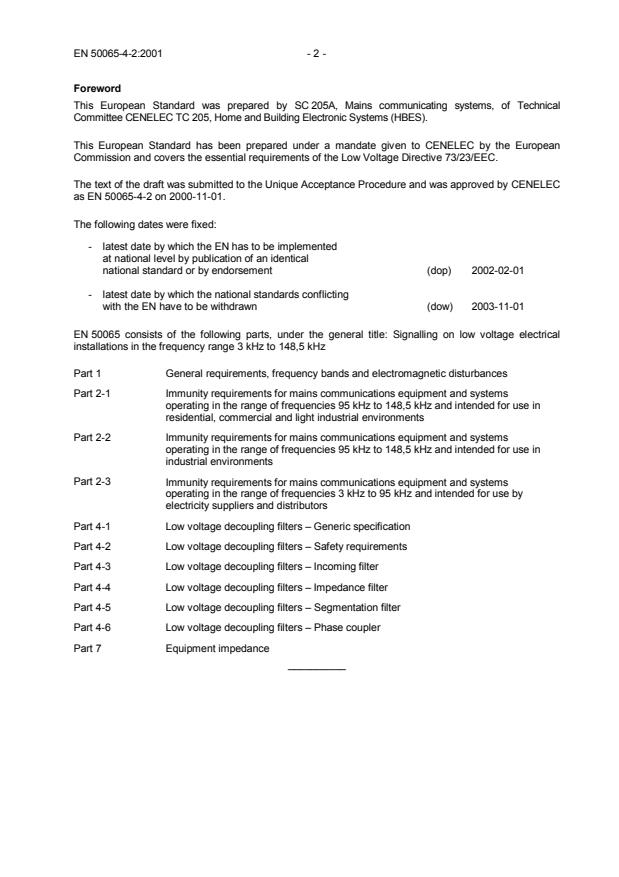
EN 50065 consists of the following parts, under the general title: Signalling on low voltage electrical
installations in the frequency range 3 kHz to 148,5 kHz
Part 1 General requirements, frequency bands and electromagnetic disturbances
Part 2-1 Immunity requirements for mains communications equipment and systems
operating in the range of frequencies 95 kHz to 148,5 kHz and intended for use in
residential, commercial and light industrial environments
Part 2-2 Immunity requirements for mains communications equipment and systems
operating in the range of frequencies 95 kHz to 148,5 kHz and intended for use in
industrial environments
Part 2-3 Immunity requirements for mains communications equipment and systems
operating in the range of frequencies 3 kHz to 95 kHz and intended for use by
electricity suppliers and distributors
Part 4-1 Low voltage decoupling filters – Generic specification
Part 4-2 Low voltage decoupling filters – Safety requirements
Part 4-3 Low voltage decoupling filters – Incoming filter
Part 4-4 Low voltage decoupling filters – Impedance filter
Part 4-5 Low voltage decoupling filters – Segmentation filter
Part 4-6 Low voltage decoupling filters – Phase coupler
Part 7 Equipment impedance
__________
- 3 - EN 50065-4-2:2001
Contents
1 Scope. 4
2 Normative references. 4
3 Definitions . 5
4 General requirements . 6
5 General notes on tests. 6
6 Rating . 6
7 Classification. 7
8 Marking. 7
9 Dimensions. 9
10 Protection against electric shock. 9
11 Provision for protective earthing.10
12 Terminals . 11
13 Construction. 12
14 Resistance to ageing, to harmful ingress of water and to humidity . 13
15 Insulation resistance and dielectric strength. 16
16 Temperature rise . 17
17 Mechanical strength. 19
18 Resistance to heat. 20
19 Screws, current-carrying parts and connections . 20
20 Creepage distances, clearances and distances through sealing compound. 22
21 Resistance to abnormal heat, to fire and to tracking. 25
22 Resistance to rusting. 26
23 Components . 26
24 Abnormal conditions. 27
25 Protection against short-circuit. 29
26 Resistance to transients . 29
Tables
Table 1 Symbols for identification of the termination . 8
Table 2 Connectable cross-sections of copper conductors . 12
Table 3 Test current . 18
Table 4 Permissible temperature rise.18
Table 5 Related torque. 19
Table 6 Creepage distances and clearances . 23
Table 7 Creepage distances for printed circuit board . 22
Table 8 Minimum clearances for printed circuit board. 24
1 Scope
This product safety standard applies to electrical equipment, such as decoupling filters and phase
couplers in a mains communication system for a phase to neutral voltage not exceeding AC 250 V and a
nominal current not exceeding 125 A, intended for household and similar fixed-electrical installations
including residential, commercial and light industrial buildings
2 Normative references
This European Standard incorporated by dated or undated reference, provisions from other publications.
These normative references are cited at the appropriate places in the text and the publications are listed
hereafter. For dated references, subsequent amendments to or revisions of any of these publications
apply to this European Standard only when incorporated in it by amendment or revision. For updated
references the latest edition of the publication referred to applies.
EN 60065 Audio, video and similar electronic apparatus – Safety requirements
(IEC 60065)
EN 60068-2-75 1997 Environmental testing – Part 2-75: Tests – Test Eh Hammer tests
(IEC 60068-2-75:1997)
EN 60127 series Miniature fuses (IEC 60127 series)
EN 60417 series Graphical symbols for use on equipment (IEC 60417 series)
EN 60529 Degrees of protection provided by enclosures (IP code) (IEC 60529)
EN 60669-1 1999 Switches for household and similar fixed electrical installations –
Part 1: General requirements (IEC 60669-1:1998, mod.)
EN 60695-2-1/X 1996 Fire hazard testing- Part 2: Test methods (IEC 60695-2-1/X:1994)
EN 60721-3-3 1995 Classification of environmental conditions – Part 3: Classification of groups of
environmental parameters and their severities – Section 3: Stationary use at
weather protected locations (IEC 60721-3-3:1994)
EN 60999-1 2000 Connecting devices – Safety requirements for screw-type and screwless-type
clamping units for electrical copper conductors – Part 1: General requirements
and particular requirements for conductors from 0,5 mm up to
35 mm (included) (IEC 60999-1:1999)
EN 132400 1994 Sectional Specification: Fixed capacitors for electromagnetic interference
suppression and connection to the supply mains (Assessment level D)
HD 214 S2 1980 Method of determining the comparative and the proof tracking indices of solid
insulating materials under moist conditions (IEC 60112:1979)
HD 384.4.442 S11997 Electrical installations of buildings – Part 4: Protection for safety –
Chapter 44 Protection against overvoltages - Section 442: Protection of low-
voltage installations against faults between high-voltage systems and earth
(related to IEC 60364-4-442:1993 + A1:1995)
HD 625.1 S1 1996 Insulation coordination for equipment within low-voltage systems –
Part 1: Principles, requirements and tests (IEC 60664-1:1992, mod.)
IEC 60695–10-2 1995 Fire hazard testing – Part 10: Guidance and test methods for the minimisation
of the effects of abnormal heat on electrotechnical products involved in fires –
Section 2 Method for testing products made from non-metallic materials for
resistance to heat using the ball pressure test
- 5 - EN 50065-4-2:2001
IEC 60999-2 1995 Connecting devices – Safety requirements for screw-type and screw-less
clamping units for electrical copper conductors – Part 2: Particular requirements
2 2
for conductors from 35 mm up to 300 mm
3 Definitions
Where the term’s voltage and current are used, they imply r.m.s. values, unless otherwise specified.
For the purpose of this standard, the following definitions apply:
3.1
decoupling filter
a device which attenuates incoming or outgoing signals within a specified frequency range
3.2
phase coupler
a device which transmits a signal within a specified frequency range from one phase to another in a multi-
phase installation
3.3
fault conditions
abnormal conditions which may occur during normal operation
3.4
enclosed equipment
equipment which is mounted and/or applied without an additional enclosure
3.5
unenclosed equipment
equipment intended to be built into an enclosure which completely covers the equipment
3.6
partly enclosed equipment
equipment intended to be built into an appropriate enclosure which only covers the unenclosed part of the
equipment
NOTE Flush-mounted equipment intended to be located in a box is an example of such equipment.
3.7
terminal
the conductive part of one pole, composed of one or more clamping unit(s) and insulation if necessary
3.8
screw-type terminal
a clamping unit for the connection and subsequent disconnection of one conductor or the interconnection
and subsequent disconnection of two ore more conductors, the connection being made, directly or
indirectly, by means of screws or nuts of any kind
3.9
screwless-type terminal
a clamping unit for the connection and subsequent disconnection of one conductor or the interconnection
and subsequent disconnection of two ore more conductors, the connection being made, directly or
indirectly, by means other than screws
3.10
nominal voltage
the voltage assigned to the equipment by the manufacturer
3.11
nominal current
the nominal maximum operating current assigned to the equipment by the manufacturer
3.12
conditional short-circuit current
a value of the AC component of a prospective current, which the equipment protected by a suitable short-
circuit protective device (hereafter referred to as SCPD) in series can withstand under specified
conditions of use and behaviour.
4 General requirements
Equipment and its enclosures shall be so designed and constructed that, in normal use, their
performance is reliable and without danger to the user or the surroundings.
In general, compliance is checked by carrying out all the tests specified, where applicable.
5 General notes on tests
Tests according to this standard are type tests.
5.1 The samples are tested as delivered and under normal conditions of use, having regard to the
classification of the equipment and to the manufacturer's installation instructions.
5.2 Unless otherwise specified, the tests are carried out in the order of the clauses at an ambient
temperature of 20 °C ± 5 °C.
5.3 The required number of samples shall be 9.
Three samples are subjected to all the relevant tests, except the test of clauses 23 and 24 where three
other samples are used, and the tests of clauses 25 and 26 where another three samples are used.
5.4 Equipment is deemed not to comply with this standard if any sample does not pass the tests of 21.1,
25 and 26, and if there are more failures than that of one sample in any of the other tests.
If no sample has failed during the tests of 21.1, 25 and 26, but one sample has failed in another way
during any of the other tests, the test which caused the failure and those preceding which may have
influenced the result of that test, are repeated on another set of samples, as specified in 5.4, all of which
shall then comply with the repeated tests.
NOTE 1 In general, it will be necessary only to repeat the test that caused the failure, unless the sample fails in the mechanical
strength test of clause 17, in which case the ageing test of clause 14 is repeated.
NOTE 2 The applicant may submit, together with the number of samples specified in 5.4, the additional set of samples which may
be required should one sample fail. The testing laboratory will then, without further request, test the additional samples and will
reject only if a further failure occurs. If the additional set of samples is not submitted at the same time, a failure of one sample will
entail a rejection.
6 Rating
6.1 Standard values of nominal voltages are AC 230 V and AC 400 V.
If a different nominal voltage is applied this value shall not be less than 220 V.
6.2 Standard values of nominal currents are 10 A, 16 A, 20 A, 25 A, 32 A, 40 A, 50 A, 63 A, 80 A, 100 A
and 125 A.
6.3 Standard cross-sectional areas of conductors are 1,5 mm², 2,5 mm², 4 mm², 6 mm², 10 mm²,
16 mm², 25 mm², 35 mm² and 50 mm²
Compliance with the requirements of 6.1 to 6.3 is checked by inspection of the marking.
- 7 - EN 50065-4-2:2001
7 Classification
7.1 Equipment is classified as follows:
7.1.1 According to protection against direct contact and external influences:
− enclosed equipment (minimum IP2X) for separate mounting;
− unenclosed equipment for mounting in an adequate enclosure.
NOTE 1 The degrees of protection are based on EN 60529.
NOTE 2 For unenclosed the protection against electric shock is given by the enclosure in which the equipment is intended to be
mounted. For enclosed equipment, the protection against electric shock is provided by compliance with the requirements of
clause 10.
7.1.2 According to the degree of protection against ingress of water:
The degrees of protection are based on EN 60529.
7.1.3 According to the method of mounting
− surface-type equipment;
− flush-type equipment;
− panel board equipment.
7.1.4 According to environmental temperature conditions
The classifications are based on EN 60721-3-3.
− class 3K4 + 5 °C to + 40 °C for indoor locations
− class 3K5 - 5 °C to + 45 °C for unprotected indoor locations
− class 3K6 - 25 °C to + 55 °C for outdoor locations
− class 3K8H - 25 °C to + 70 °C for severe environments
7.1.5 According to the rated impulse withstand voltage
The rated impulse withstand voltages are based on HD 625.1.
- 4000 V according to overvoltage category III;
- 6000 V according to overvoltage category IV.
8 Marking
8.1 As a minimum the equipment shall be marked with:
a) nominal voltage(s) in volts ~;
b) nominal current in amperes;
c) manufacturer's or responsible vendor's name, trade mark or identification mark;
d) type of filter or phase coupler and reference or catalogue number;
e) symbol for temperature range, if different from class 3K4;
f) symbol for degree of protection, if higher than IP2X;
g) symbol for degree of protection against ingress of water, if higher than IPX0. In such case
the symbol for degree of protection against harmful ingress of solid foreign bodies shall also
be marked, even if not higher than IP2X.
h) marking with conditional short-circuit current and suitable SCPD shall be given in the
manufacturer’s catalogues
8.2 Symbols for marking shall be used as follows:
Amperes A
Volt V
Alternating current ~
Degree of protection against moisture
IPX4 or IPX5
The letter “X” shall be replaced by the relevant number.
The figure for the current rating shall be placed before or above that for the nominal voltage and
separated from the latter by an oblique line or a dash.
NOTE The marking for current, voltage and nature of supply may be, for instance, as follows: 16 A 230 V~or 16/230~.
8.3 The manufacturer's or responsible vendor's name, trademark or identification mark, type reference
and nominal current shall be on the main part of the equipment.
Parts such as cover plates, which are necessary for safety purposes and are intended to be sold
separately, shall be marked with the manufacturer's or responsible vendor's name, trade mark or
identification mark and type reference.
The symbol for degree of protection, if applicable, shall be marked on the outside of its associated
enclosure so as to be easily discernible when the equipment is mounted and wired as in normal use.
NOTE 1 Additional type references may be marked on the main part, or on the outside or the inside of the associated enclosure.
NOTE 2 The term "main" part means the part carrying the terminals and any part integral with them; it does not include parts
intended to be sold separately.
8.4 Terminals
The side name (Input side, output side) and the respective termination shall be marked, when
appropriate, in such a way that they are clearly distinguished (e.g. using a different colour for each side).
These indications shall not be placed on screws or any other easily removable parts.
NOTE "Easily removable parts" are those parts, which can be removed during the normal installation of the equipment.
For example a typical marking scheme is given in Table 1.
Table 1 - Symbols for identification of the termination
Single phase Three phase
Point of connection Identification Point of connection Identification
Line L 1st Phase L1,
2nd Phase L2,
3rd Phase L3
Neutral N Neutral N
Earth EN 60417 Earth EN 60417
Symbols 5019 Symbols 5019
Communication 1 C1 Communication 1 C1
Communication 2 C2 Communication 2 C2
Terminals associated with any one pole shall have similar identification differing from that of the terminals
associated with the other poles, unless the relationship is self-evident.
- 9 - EN 50065-4-2:2001
8.5 Terminals shall additionally be marked in accordance with 7.4 in EN 60999-1.
Compliance is checked by inspection.
8.6 Marking shall be durable and easily legible.
Compliance is checked by inspection and by the following test.
The test is made by rubbing the marking by hand for 15 s with a piece of cloth soaked with water and
again for 15 s with a piece of cloth soaked with petroleum spirit.
Marking made by impression, moulding, pressing or engraving is not subjected to this test.
NOTE 1 The petroleum spirit used should consist of a solvent hexane with a content of aromatics of maximum 0,1 % by volume, a
value of 29 % for kauri-butanol, an initial boiling-point of approximately 65 °C, a dry-point of approximately 69 °C and a density of
approximately 0,68 g/cm³.
NOTE 2 The type reference may be marked with paint or ink, protected, if necessary, by vanish.
8.7 The correct installation and use of the equipment shall be indicated in an installation instruction
delivered with the equipment. A phase coupler shall be delivered with a marking plate with the following
text:
Phase Coupler !
Must be disconnected while working on the installation.
The marking plate shall be fastened to the panel board in which the phase coupler is installed.
The installation instruction and the text of the marking plate shall be written in the official language(s) of
the country in which the equipment is to be sold.
Compliance is checked by inspection.
NOTE In the following country the marking plate is not necessary: Germany.
9 Dimensions
Equipment shall comply with the appropriate standard sheets.
Compliance is checked by inspection and by measurement.
10 Protection against electric shock
10.1 Equipment shall be so designed that live parts are not accessible when the equipment is mounted
and wired as for normal use, even after removal of parts which can be removed without the aid of a tool.
Compliance is checked by inspection and, if necessary, by the following test.
The sample is mounted as in normal use and fitted with conductors of the smallest cross-sectional area
specified in clause 12. The test is repeated using conductors of the largest cross-sectional area specified
in clause 12.
The standard test finger specified in EN 60529 is applied to the sample in every possible position, an
electrical indicator, with a voltage not less than 40 V and not more than 50 V, being used to show contact
with the relevant part.
Equipment, having enclosures or covers in thermoplastic or elastomeric material, is subjected to the
following additional test, which is carried out at an ambient temperature according to the maximal
temperature specified under the environmental classification ± 2 °C.
The equipment shall be installed as in normal use at this temperature and preheated with the nominal
current and voltage connected for at least one hour.
During this additional test, the equipment is subjected for 1 min to a force of 75 N, applied through the tip
of a straight unjointed test finger of the same dimensions as the standard test finger.
This test finger, with an electrical indicator as described above, is applied to all places where yielding of
insulating material could impair the safety of the equipment. The test is not made on membranes. A force
of only 10 N is applied to thin-walled knock-outs.
During this test, the equipment with its associated mounting means shall not deform to such an extent
that live parts can be touched by the unjointed test finger.
NOTE Membranes are tested according to 14.4.1 only.
10.2 Accessible parts shall be of insulating material with the exception of small screws and the like
which are isolated from live parts and which are used for fixing bases or cover plates.
However accessible parts may be made of metal if the requirements of either 10.2.1 or 10.2.2 are fulfilled.
10.2.1 Covers or cover plates shall be separated from live parts by supplementary insulation, made by
insulating linings or insulating barriers fixed to the covers or cover plates, or to the body of the equipment
in such a way that this supplementary insulation
− cannot be removed without being permanently damaged, or
− is so designed that it cannot be replaced in an incorrect position and that, if they omitted, the
equipment is rendered inoperable or manifestly incomplete. There shall be no:
− risk of accidental connection between live parts and metal covers or cover plates, for
example through their fixing screws, even if a conductor should come away from its
terminal,
− risk of a reduction of creepage distances or clearances below the values specified in
clause 20.
10.2.2 Accessible conductive parts, which are not separated from live parts by supplementary insulation,
made by insulating linings or insulating barriers, shall be permanently and reliably connected to the
protective earth terminal.
Compliance with 10.2.1 and 10.2.2 is checked by inspection and by the tests of clauses 15 and 20. For
10.2.2 the additional requirements in clause 11 shall be tested.
NOTE Insulating coating sprayed on the inside or on the outside of the metal covers or cover plates is not deemed to be an
insulating lining or barrier for the purpose of this subclause.
11 Provision for protective earthing
11.1 Earthing terminals shall be terminals with screw clamping or with other means of comparable
effectiveness and shall comply with the appropriate requirements of clause 12.
They shall be of the same size as the corresponding terminals for the supply conductors except that any
additional external earthing terminal shall be of a size suitable for conductors of at least 6 mm².
- 11 - EN 50065-4-2:2001
11.2 Decoupling filters having more than one cable inlet shall be provided with an internal earthing
terminal allowing the connection of an incoming and outgoing conductor for the continuity of the earthing
circuit.
Compliance with the requirements of 11.1and 11.2 are checked by inspection and the tests of clause 12.
11.3 The connection between the earthing terminal and accessible metal parts to be connected thereto
shall be of low resistance.
Compliance is checked by the following test:
A current derived from a.c. source having a no-load voltage not exceeding 12 V and equal to 1,5 times
rated current or 25 A, whichever is greater, is passed between the earthing terminal and each of the
accessible metal parts in turn
The voltage drop between the earthing terminal and the accessible metal part is measured, and the
resistance calculated from the current and this voltage drop.
In no case the resistance shall exceed 0,05 Ω.
12 Terminals
The requirements in 12.1 and 12.2 are only for clamping units connected to power circuits.
12.1 General
12.1.1 Equipment shall be provided with terminals having screw-type or screwless-type clamping units.
12.1.2 Clamping units shall allow the conductor to be connected without special preparation.
12.1.3 The means for clamping the conductors in the clamping units shall not serve to fix any other
component, although they may hold the clamping units in place or prevent them from turning.
Compliance is checked by inspection and by the test of 12.2 as applicable.
12.2 Screw-type and screwless-type clamping units with clamping for external copper
conductors
12.2.1 Screw-type and screwless-type clamping units shall comply with EN 60999-1 or IEC 60999-2.
All the tests shall be with the clamping units mounted in the equipment.
The clamping units shall be tested with the cross-sectional area of conductors given in Table 2.
Table 2 - Connectable cross-sections of copper conductors
Type of conductor and cross-sectional area
Ranges of nominal current In (mm²)
(A)
Rigid Flexible
(solid or stranded)
In ≤ 10 1 to 2,5 1 to 1,5
10 < In ≤ 16 1,5 to 4 1 to 2,5
16 < In ≤ 25 2,5 to 6 1,5 to 4
25 < In ≤ 32 4 to 10 2,5 to 6
32 < In ≤ 40 6 to 16 -
40 < In ≤ 63 10 to 25 -
63 < In ≤ 80 16 to 35 -
80 < In ≤ 125 25 to 50 -
In addition to 9.5 and 9.6 in EN 60999-1: “During the test the clamping units shall not work loose from
their fixings to the equipment.”
Subclauses 8.16 and 9.9 in EN 60999-1 are not applicable.
The test current in 9.10 in EN 60999-1 shall be according to Table 3 in clause 16 of this standard.
13 Construction
13.1 Insulating linings and barriers shall have adequate mechanical strength and shall be secured in a
reliable manner.
Compliance is checked by inspection after the tests of clause 17.
13.2 Equipment shall be constructed so as to permit:
− easy introduction and connection of the conductors in to the terminals;
− correct positioning of the conductors;
− easy fixing of the equipment;
− equipment intended for walls or boxes shall have adequate space between the underside of the base
and the enclosure (cover or box) so that, after installation of the equipment, the insulation of the
conductors is not pressed against live parts of different polarity.
Surface-type equipment shall be constructed so that the fixing means do not damage the insulation of the
cables during the installation.
NOTE 1 This requirement does not imply that the metal parts of the terminals are necessarily protected by insulation barriers or
insulating shoulders, to avoid contact, due to incorrect installation of the terminal metal parts, with the insulation of the conductor.
NOTE 2 For surface-type equipment, mounted on a mounting plate, a wiring channel may be needed to comply with this
requirement.
Compliance is checked by inspection and by an installation test using conductors of the largest cross-
sectional area specified in Table 2 - Connectable cross-sections of copper conductors.
13.3 Covers and cover plates shall be held in place at two or more points by effective fixings such that
their removal requires the use of a tool.
NOTE 1 It is recommended that the screws for fixing covers or cover plates be captive.
NOTE 2 The use of tight fitting washers of cardboard or the like is deemed to be an adequate method for securing screws which
must be captive.
- 13 - EN 50065-4-2:2001
If the fixings of covers or cover plates serve also to fix the base, there shall be sufficient means to ensure
the correct position of the base after removal of the cover or cover plate.
Means for fixing covers or cover plates shall not serve to fix any other part.
NOTE 3 Decorative covers, cover plates or parts thereof, not providing protection against electric shock, are not considered as
covers or cover plates in the meaning of this subclause.
Compliance is checked by inspection and by an installation test.
13.4 Enclosed or partly enclosed equipment with the degree of protection IPX0 shall be so constructed
that, when the equipment is fixed and wired as in normal use, there are no free openings in the enclosure.
Compliance is checked by inspection and by an installation test with conductors of the smallest cross-
sectional area specified in Table 2.
NOTE Small gaps between enclosures and conduits or cables are neglected.
13.5 In equipment with a degree of protection higher than IPX0, membranes, screwed glands and
similar provisions shall be so designed that the part forming the tight inlet for the cable is replaceable.
Compliance is checked by inspection.
14 Resistance to ageing, to harmful ingress of water and to humidity
The following requirements are based on EN 60669-1.
14.1 Resistance to ageing
Equipment shall be resistant to ageing.
Compliance is checked by the following test:
Equipment, complete with enclosure, and mounted as for normal use, is subjected to at test in a heating
cabinet with an atmosphere having the composition and pressure of the ambient air and ventilated by
natural circulation.
Equipment which is required to be marked with degree of protection shall be tested after having been
mounted and assembled as specified in 14.2.1.
The temperature of the cabinet is 70 °C ± 2 °C.
The samples are kept in the cabinet for 7 days (168 h).
The use of an electrically heated cabinet is recommended.
Natural circulation may be provided by holes in the walls of the cabinet.
After the treatment, the samples are removed from the cabinet and kept at room temperature and relative
humidity between 45 % and 55 % for at least 4 days (96 h).
The samples shall show no crack visible to the naked eye, nor shall the material have become sticky or
greasy, this being judged as follows:
With the forefinger wrapped in a dry piece of rough cloth the sample is pressed with a force of 5 N.
No traces of the cloth shall remain on the sample and the material of the sample shall not stick to the
cloth.
After the test the samples shall show no damage which could impair compliance with this standard.
NOTE The force of 5 N can be obtained in the following way:
The sample is placed on one of the pans of a balance and the other pan is loaded with a mass equal to the mass of the sample plus
500 g. Equilibrium is then restored by pressing the sample with the forefinger wrapped in a dry piece of rough cloth.
14.2 Resistance to harmful ingress of water
The enclosure of equipment, which is required to be marked with degree of protection, shall provide a
degree of protection against harmful ingress of water in accordance with the classification of the
equipment.
Compliance is checked by the appropriate test specified below.
NOTE The tests are based on EN 60529.
14.2.1 Surface-type equipment is mounted on a vertical surface with the open drain hole in the lowest
position.
Flush-type equipment is fixed vertically in an appropriate enclosure which is placed in a recess in a block
of hardwood.
Unclosed equipment is tested under simulation of conditions of normal use, taking into account the
manufacturer’s instructions. Fixing screws for enclosures are tightened with a torque equal to two-thirds
of the values specified in Table 4 of EN 60999-1.
Glands are tightened with a torque equal to two-thirds of that applied during the test of 17.3. Parts which
can be removed without the aid of a tool are removed.
NOTE Glands are not filled with any form of sealing compound.
14.2.2 Equipment with the degree of protection IPX4 is subjected to the test specified for equipment with
the degree of protection IPX4 according to the requirements of EN 60529.
14.2.3 Equipment with the degree of protection IPX5 is subjected to the test specified for equipment with
the degree of protection IPX5 according to the requirements of EN 60529.
Immediately after the tests specified in 14.2.2 and 14.2.3, the samples shall withstand an electric strength
test as specified in 15.2 and inspection shall show that water has not entered the samples to any
appreciable extent and has not reached live parts.
14.3 Resistance to humidity
Equipment shall be proof against humid conditions which may occur in normal use.
Compliance is checked by the humidity test described in this subclause, followed immediately by the
measurement of the insulation resistance and by the electric strength test specified in clause 15.
Inlet openings, if any, are left open; if knock-outs are provided, one of them is opened.
Parts which can be removed without the aid of a tool, are removed and subjected to the humidity
treatment with the main part; spring lids are open during this treatment.
- 15 - EN 50065-4-2:2001
The humidity treatment is carried out in a humidity cabinet containing air with a relative humidity
maintained between 91 % and 95 %.
The temperature of the air in which the samples are placed is maintained within ± 1 °C of any convenient
value between 20 °C and 30 °C.
Before being placed in the humidity cabinet, the samples are brought to a temperature between
T(ambient temperature) and T + 4 °C.
The samples are kept in the cabinet for:
2 days (48 h) For equipment with degree of protection IP20;
7 days (168 h) For equipment other than IP20.
NOTE 1 In most cases, the samples may be brought to the specified temperature by keeping them at this temperature for at least
4 h before the humidity treatment.
NOTE 2 A relative humidity between 91 % and 95 % can be obtained by placing in the humidity cabinet a saturated solution of
sodium sulphate (Na2SO4) or potassium nitrate (KNO3) in water having a sufficiently large contact surface with the air.
NOTE 3 In order to achieve the specified conditions within the cabinet, it is necessary to ensure constant circulation of the air
within and, in general, to use a thermally insulated cabinet.
After this test, the samples shall show no damage within the meaning of this standard.
14.4 Requirements for membranes in inlet openings
14.4.1 Membranes shall be reliably fixed and shall not be displaced by the mechanical and the thermal
stresses occurring in normal use.
Membranes shall be replaceable.
Compliance is checked by inspection and by the following test:
After the treatment specified in 14.1, membranes are tested when assembled in the equipment.
The equipment is then placed for 2 h in a heating cabinet as described in 14.1, the temperature being
maintained at Tmax ± 2 °C, where Tmax is the maximal ambient temperature according to the
temperature classification in 7.1.4.
Immediately after this period, a force of 30 N is applied for 5 s to various parts of the membranes by
means of the tip of a straight standard test finger as specified in EN 60529.
During these tests, the membranes shall not deform to such an extent that live parts become accessible.
After the tests, the membranes shall show no harmful deformation which would lead to non-compliance
with the requirements of protection according to 14.2.
For membranes likely to be subjected to an axial pull during normal use, an axial pull of 30 N is applied
for 5 s.
During this test, the membranes shall not come out.
The test is then repeated with membranes, which have not been subjected to any treatment.
14.4.2 Membranes shall be so designed and made of such material that the introduction of the cables
into the equipment is permitted when the ambient temperature is low.
Compliance is checked by the following test:
The equipment is fitted with membranes, which have not been subjected to any ageing treatment, those
without any opening being suitably pierced.
The equipment is then kept, for 2 h, in a refrigerator in which the temperature is maintained at
Tmin ± 2 °C, where Tmin is the minimal ambient temperature according to the temperature classification
in 7.1.4, but it shall be lower or equal to – 15 °C.
After this period, the equipment is removed from the refrigerator and immediately afterwards, while the
equipment is still cold, it shall be possible to introduce, without undue force, cables of the heaviest type
through the membranes.
After the tests of 14.4.1 and 14.4.2, the membranes shall show no harmful deformation, cracks or similar
deformation which would lead to non-compliance with this standard.
15 Insulation resistance and dielectric strength
15.1 The insulation resistance of the equipment shall be adequate.
Compliance is checked by the following tests which are made immediately after the test of 14.3, in the
humidity cabinet or in the room in which the samples were brought to the prescribed temperature, after
reassembly of those parts which have been removed without the aid of a tool.
The insulation resistance is measured with a voltage of approximately DC 500 V applied, the
measurement being made 1 min after application of the voltage.
The insulation resistance is measured shall not be less than 5 MΩ:
− between all terminals connected together and metal foil in contact with the outer surface of accessible
parts;
− for equipment having a metal enclosure, between the outer surface and metal foil in contact with the
inner surface of the internal enclosure or the insulating lining;
− between live parts and terminals for looping-in of external conductors;
− between live parts and the mounting surface of the equipment, including the means for fixing and
parts of protective conductor circuit.
The insulation resistance is measured shall not be less than 2 MΩ between live parts of different polarity.
NOTE While wrapping the metal foil around the outer surface or placing it in contact with the inner surface of parts of insulating
material, it is pressed against holes or grooves by means of a straight test finger of the same dimensions as the standard test finger.
15.2 The dielectric strength of the equipment shall be adequate.
15.2.1 The insulation is subjected for 5 s to a sinusoidal voltage, having a frequency of 50 Hz or 60 Hz.
The value of the test voltage and the points of application are:
− 3 kV between all terminals and metal foil in contact with the outer surface of accessible parts;
− 1,5 kV between the outer metal surface and a metal foil in contact with the inner surface of the
internal enclosure or the insulated lining;
− 1,5 kV between live parts and terminals for looping-in of external conductors;
- 17 - EN 50065-4-2:2001
− 1,5 kV between live parts and the surface on which they are mounted, including the means for fixing
and parts of protective conductor circuit.
Initially, not more than half the prescribed voltage is applied; then it is raised in less than 1 s to the full
value.
No flashover or breakdown shall occur during the test.
NOTE 1 The values are based on HD 384.4.442 S1. The following formula is used: U + 1200 V and rounded, where U is the
0 0
voltage between line and neutral.
NOTE 2 While wrapping the metal foil around the outer surface or placing it in contact with the inner surface of parts of insulating
material, it is pressed against holes or grooves by means of a straight unjointed test finger of the same dimensions as the standard
test finger.
NOTE 3 The high-voltage transformer used for the test shall be so designed that, when the output terminals are short-circuited
after the output voltage has been adjusted to the appropriate test voltage, the output current is at least 200 mA.
NOTE 4 The overcurrent relay should not trip when the output current is less than 100 mA.
NOTE 5 Care is taken that the r.m.s. value of the test voltage applied is measured within ± 3 %.
NOTE 6 Glow discharges without drop in voltage are neglected.
15.2.2 The insulation shall withstand an impulse voltage according to HD 625.1. The value of the test
voltage and the points of application are:
For overvoltage category III according to 7.1.5:
− 6 kV between a
...