

SIST EN 17658:2023
(Main)Chemical disinfectants and antiseptics - Chemical textile disinfection for the domestic area - Test method and requirements (phase 2, step 2)
General Information
- Abstract
This document specifies a test method and the minimum performance requirements for the microbicidal efficacy of a chemical product intended for use in a wash process in a domestic environment, in a domestic wash equipment at low temperatures (≤40 °C). This procedure does not apply to certain types of laundry disinfection technologies which require specific devices (i.e. active substances generated in situ using specific devices). This method is not limited to certain types of textiles, types of products or steps in the washing cycle.
According to a phase 2, step 2 test definition, this document establishes the efficacy in laboratory test simulating practical use conditions of a chemical product.
This document cannot be applied when the disinfection is medical indicated (medical area) or in hygiene-sensitive areas where professional reprocessing of laundry is required (i.e. food, healthcare, medical and cleanroom sectors, PPE, and workwear). In those cases, EN 16616 and EN 14065 will apply.
NOTE This method corresponds to a phase 2, step 2 test (see EN 14885).
EN 14885 specifies in detail the relationship of the various tests to one another and to “use recommendations”.
- Status
- Published
- Public Enquiry End Date
- 02-May-2021
- Publication Date
- 08-Mar-2023
- Technical Committee
- KDS - Cosmetics, chemical disinfectants and surface active agents
- Current Stage
- 6060 - National Implementation/Publication (Adopted Project)
- Start Date
- 26-Oct-2022
- Due Date
- 31-Dec-2022
- Completion Date
- 09-Mar-2023

Overview
SIST EN 17658:2023 specifies standardized test methods and minimum performance requirements for evaluating the microbicidal efficacy of chemical disinfectants and antiseptics used for textile disinfection in domestic laundry processes. Designed for low temperature (≤ 40 °C) applications within household washing equipment, this standard validates whether a chemical product-used during either the main wash or rinse cycle-effectively sanitizes textiles by reducing bacteria and yeasts, and limits cross-contamination and microorganism transfer between textiles. It does not cover medical or professional environments, nor technologies requiring specialized in-situ devices.
Key Topics
- Scope and Limitations
- Applies to domestic textile disinfection using chemical agents during main wash or rinse cycles at or below 40 °C.
- Not restricted to particular textile types, laundry products, or any step within the wash cycle.
- Excludes technologies that need specific in-situ generation equipment and all professional/medical reprocessing (e.g. food, healthcare, PPE).
- Test Methodology
- Follows phase 2, step 2 laboratory simulation of practical use.
- Employs standardized lab tumbling devices to replicate real-world laundering conditions, with precise control of agitation and temperature.
- Uses inoculated textile carriers and simulates dirty and clean conditions to challenge the efficacy of the disinfection process.
- Microbicidal Efficacy Requirements
- Sets minimum microbial reduction levels for bacteria and yeasts (e.g., Escherichia coli, Staphylococcus aureus, Candida albicans).
- Mandates control of cross-contamination levels within carriers and wash liquor.
- Test Organisms and Reagents
- Specifies reference strains for bacteria and yeasts.
- Calls for standard culture media, neutralizers, and interfering substances to ensure reliable, repeatable results.
- Reporting and Validation
- Outlines requirements for test reporting, validation controls, and expressing results.
- Emphasizes the importance of reproducibility and clarity for manufacturers and evaluators.
Applications
- Product Development and Quality Assurance
- Enables manufacturers of chemical textile disinfectants and laundry additives to scientifically establish product claims under simulated real-life conditions.
- Essential for product registration, quality benchmarking, and marketing claims (e.g., "removes bacteria at 30 °C").
- Consumer Safety and Hygiene
- Assures domestic users that products meet minimum standards for hygiene, even at low wash temperatures.
- Supports effective infection control in households, preventing microbial transmission through laundry.
- Retail, Regulatory, and Certification Use
- Facilitates regulatory compliance for consumer laundry disinfectants in the EU and beyond.
- Provides a common experimental framework for product comparison and certification.
- Environmental and Energy Considerations
- Encourages more energy-efficient laundering by providing standardized ways to define efficacy at reduced temperatures, aligning with modern textile care requirements.
Related Standards
- EN 14885: Lays out the general framework and phases for testing the activity of chemical disinfectants and antiseptics, and situates EN 17658 within phase 2, step 2.
- EN 1276 / EN 1650: Quantitative suspension tests for specific bactericidal and fungicidal/yeasticidal activity in food, industry, domestic, and institutional areas.
- EN 16616 / EN 14065: Apply to professional and medical laundry disinfection, not the domestic use defined in EN 17658.
- EN 12353: Guidelines for preservation of test organisms used in efficacy testing.
Practical Value
By introducing a harmonized and scientifically rigorous method, SIST EN 17658:2023 supports manufacturers, testing labs, and regulators in demonstrating and verifying the efficacy and safety of chemical products for domestic textile disinfection. This standard ensures reliable performance at energy-saving low temperatures-vital for modern textile care and public health. When adhering to EN 17658, manufacturers can confidently label their products for effective domestic use, giving consumers and retailers peace of mind regarding hygiene and product reliability.
Relations
- Effective Date
- 28-Jan-2026
- Effective Date
- 28-Jan-2026
- Effective Date
- 28-Jan-2026
- Effective Date
- 28-Jan-2026
Get Certified
Connect with accredited certification bodies for this standard

ECOCERT
Organic and sustainability certification.

Eurofins Food Testing Global
Global leader in food, environment, and pharmaceutical product testing.

Intertek Bangladesh
Intertek certification and testing services in Bangladesh.
Sponsored listings
Frequently Asked Questions
SIST EN 17658:2023 is a standard published by the Slovenian Institute for Standardization (SIST). Its full title is "Chemical disinfectants and antiseptics - Chemical textile disinfection for the domestic area - Test method and requirements (phase 2, step 2)". This standard covers: This document specifies a test method and the minimum performance requirements for the microbicidal efficacy of a chemical product intended for use in a wash process in a domestic environment, in a domestic wash equipment at low temperatures (≤40 °C). This procedure does not apply to certain types of laundry disinfection technologies which require specific devices (i.e. active substances generated in situ using specific devices). This method is not limited to certain types of textiles, types of products or steps in the washing cycle. According to a phase 2, step 2 test definition, this document establishes the efficacy in laboratory test simulating practical use conditions of a chemical product. This document cannot be applied when the disinfection is medical indicated (medical area) or in hygiene-sensitive areas where professional reprocessing of laundry is required (i.e. food, healthcare, medical and cleanroom sectors, PPE, and workwear). In those cases, EN 16616 and EN 14065 will apply. NOTE This method corresponds to a phase 2, step 2 test (see EN 14885). EN 14885 specifies in detail the relationship of the various tests to one another and to “use recommendations”.
This document specifies a test method and the minimum performance requirements for the microbicidal efficacy of a chemical product intended for use in a wash process in a domestic environment, in a domestic wash equipment at low temperatures (≤40 °C). This procedure does not apply to certain types of laundry disinfection technologies which require specific devices (i.e. active substances generated in situ using specific devices). This method is not limited to certain types of textiles, types of products or steps in the washing cycle. According to a phase 2, step 2 test definition, this document establishes the efficacy in laboratory test simulating practical use conditions of a chemical product. This document cannot be applied when the disinfection is medical indicated (medical area) or in hygiene-sensitive areas where professional reprocessing of laundry is required (i.e. food, healthcare, medical and cleanroom sectors, PPE, and workwear). In those cases, EN 16616 and EN 14065 will apply. NOTE This method corresponds to a phase 2, step 2 test (see EN 14885). EN 14885 specifies in detail the relationship of the various tests to one another and to “use recommendations”.
SIST EN 17658:2023 is classified under the following ICS (International Classification for Standards) categories: 71.100.35 - Chemicals for industrial and domestic disinfection purposes. The ICS classification helps identify the subject area and facilitates finding related standards.
SIST EN 17658:2023 has the following relationships with other standards: It is inter standard links to SIST EN 12353:2022, SIST EN 1650:2019, SIST EN 1276:2019, SIST EN 14885:2022. Understanding these relationships helps ensure you are using the most current and applicable version of the standard.
SIST EN 17658:2023 is available in PDF format for immediate download after purchase. The document can be added to your cart and obtained through the secure checkout process. Digital delivery ensures instant access to the complete standard document.
Standards Content (Sample)
SLOVENSKI STANDARD
01-april-2023
Kemična razkužila in antiseptiki - Kemično razkuževanje tekstila za domačo
uporabo - Preskusne metode in zahteve (faza 2, stopnja 2)
Chemical disinfectants and antiseptics - Chemical textile disinfection for the domestic
area - Test method and requirements (phase 2, step 2)
Chemische Desinfektionsmittel und Antiseptika - Chemische Textildesinfektion für den
häuslichen Bereich - Prüfverfahren und Anforderungen (Phase 2, Stufe 2)
Antiseptiques et désinfectants chimiques - Désinfection chimique du textile pour le
domaine domestique - Méthode d'essai et prescriptions (phase 2, étape 2)
Ta slovenski standard je istoveten z: EN 17658:2022
ICS:
71.100.35 Kemikalije za dezinfekcijo v Chemicals for industrial and
industriji in doma domestic disinfection
purposes
2003-01.Slovenski inštitut za standardizacijo. Razmnoževanje celote ali delov tega standarda ni dovoljeno.
EN 17658
EUROPEAN STANDARD
NORME EUROPÉENNE
September 2022
EUROPÄISCHE NORM
ICS 71.100.35
English Version
Chemical disinfectants and antiseptics - Chemical textile
disinfection for the domestic area - Test method and
requirements (phase 2, step 2)
Antiseptiques et désinfectants chimiques - Désinfection Chemische Desinfektionsmittel und Antiseptika -
chimique du textile pour le domaine domestique - Chemische Textildesinfektion für den häuslichen
Méthode d'essai et prescriptions (phase 2, étape 2) Bereich - Prüfverfahren und Anforderungen (Phase 2,
Stufe 2)
This European Standard was approved by CEN on 15 August 2022.
CEN members are bound to comply with the CEN/CENELEC Internal Regulations which stipulate the conditions for giving this
European Standard the status of a national standard without any alteration. Up-to-date lists and bibliographical references
concerning such national standards may be obtained on application to the CEN-CENELEC Management Centre or to any CEN
member.
This European Standard exists in three official versions (English, French, German). A version in any other language made by
translation under the responsibility of a CEN member into its own language and notified to the CEN-CENELEC Management
Centre has the same status as the official versions.
CEN members are the national standards bodies of Austria, Belgium, Bulgaria, Croatia, Cyprus, Czech Republic, Denmark, Estonia,
Finland, France, Germany, Greece, Hungary, Iceland, Ireland, Italy, Latvia, Lithuania, Luxembourg, Malta, Netherlands, Norway,
Poland, Portugal, Republic of North Macedonia, Romania, Serbia, Slovakia, Slovenia, Spain, Sweden, Switzerland, Türkiye and
United Kingdom.
EUROPEAN COMMITTEE FOR STANDARDIZATION
COMITÉ EUROPÉEN DE NORMALISATION
EUROPÄISCHES KOMITEE FÜR NORMUNG
CEN-CENELEC Management Centre: Rue de la Science 23, B-1040 Brussels
© 2022 CEN All rights of exploitation in any form and by any means reserved Ref. No. EN 17658:2022 E
worldwide for CEN national Members.
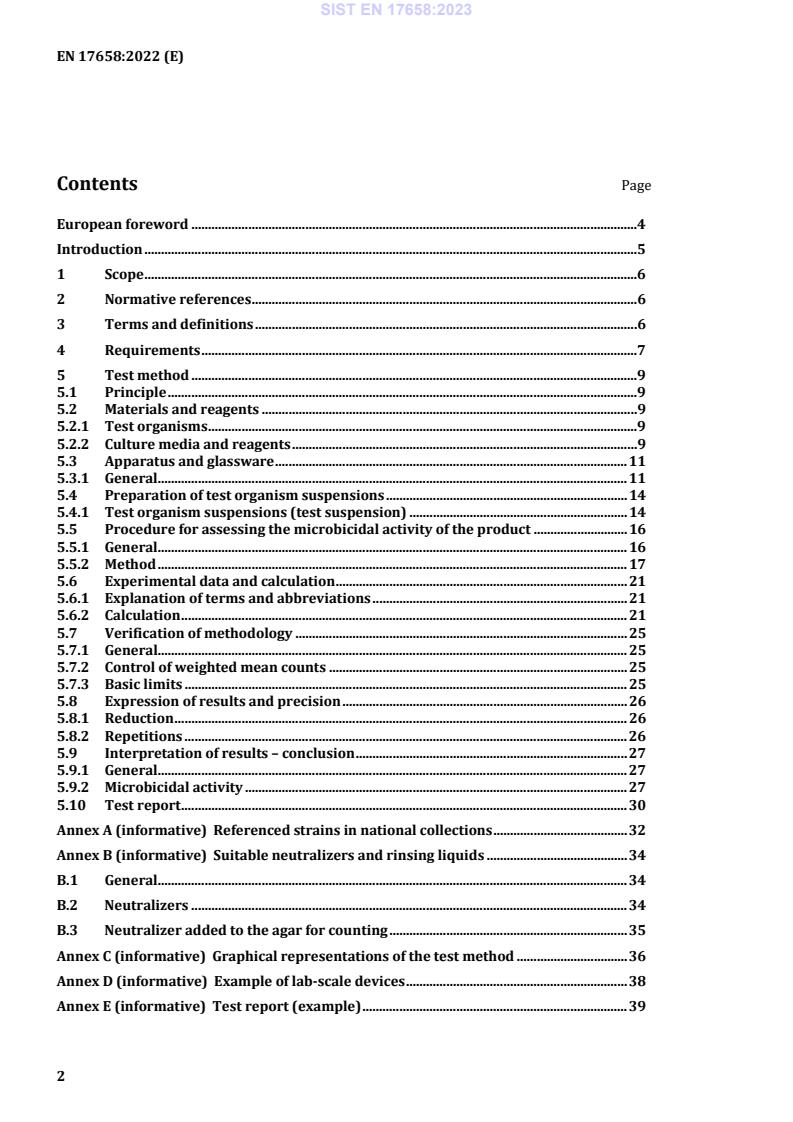
Contents Page
European foreword .4
Introduction .5
1 Scope .6
2 Normative references .6
3 Terms and definitions .6
4 Requirements .7
5 Test method .9
5.1 Principle .9
5.2 Materials and reagents .9
5.2.1 Test organisms .9
5.2.2 Culture media and reagents .9
5.3 Apparatus and glassware . 11
5.3.1 General. 11
5.4 Preparation of test organism suspensions . 14
5.4.1 Test organism suspensions (test suspension) . 14
5.5 Procedure for assessing the microbicidal activity of the product . 16
5.5.1 General. 16
5.5.2 Method . 17
5.6 Experimental data and calculation . 21
5.6.1 Explanation of terms and abbreviations . 21
5.6.2 Calculation . 21
5.7 Verification of methodology . 25
5.7.1 General. 25
5.7.2 Control of weighted mean counts . 25
5.7.3 Basic limits . 25
5.8 Expression of results and precision . 26
5.8.1 Reduction . 26
5.8.2 Repetitions . 26
5.9 Interpretation of results – conclusion . 27
5.9.1 General. 27
5.9.2 Microbicidal activity . 27
5.10 Test report . 30
Annex A (informative) Referenced strains in national collections . 32
Annex B (informative) Suitable neutralizers and rinsing liquids . 34
B.1 General. 34
B.2 Neutralizers . 34
B.3 Neutralizer added to the agar for counting . 35
Annex C (informative) Graphical representations of the test method . 36
Annex D (informative) Example of lab-scale devices . 38
Annex E (informative) Test report (example) . 39
Annex F (informative) SBL2004 composition . 46
Annex G (informative) Stainers and markers validated . 47
Bibliography . 48
European foreword
This document (EN 17658:2022) has been prepared by Technical Committee CEN/TC 216 “Chemical
disinfectants and antiseptics”, the secretariat of which is held by AFNOR.
This European Standard shall be given the status of a national standard, either by publication of an
identical text or by endorsement, at the latest by March 2023, and conflicting national standards shall
be withdrawn at the latest by March 2023.
Attention is drawn to the possibility that some of the elements of this document may be the subject
of patent rights. CEN shall not be held responsible for identifying any or all such patent rights.
Any feedback and questions on this document should be directed to the users’ national standards
body. A complete listing of these bodies can be found on the CEN website.
According to the CEN-CENELEC Internal Regulations, the national standards organisations of the
following countries are bound to implement this European Standard: Austria, Belgium, Bulgaria,
Croatia, Cyprus, Czech Republic, Denmark, Estonia, Finland, France, Germany, Greece, Hungary,
Iceland, Ireland, Italy, Latvia, Lithuania, Luxembourg, Malta, Netherlands, Norway, Poland, Portugal,
Republic of North Macedonia, Romania, Serbia, Slovakia, Slovenia, Spain, Sweden, Switzerland,
Türkiye and the United Kingdom.
Introduction
In the last few years, the need of energy saving has led to decreasing washing temperature of
domestic laundry to ≤ 40 °C. This fact compromises the level of microorganisms in the laundry items
after the washing process. Moreover, the fashion trends on textile design and fibre technology
provides cloth items that need to be washed in special care conditions (cool water, short cycles, soft
chemistry) in order to preserve their properties but at the same time without compromising their
hygienic level.
Chemistry plays an important role to provide good hygienic conditions to domestic laundry under
such described conditions.
This document is a phase 2 step 2 test, specifies a lab-scale methodology for establishing if a chemical
product used in any of the domestic laundry procedures (main wash and rinse cycle) have a
microbicidal activity (bactericidal and yeasticidal activity) on contaminated textiles, washing bath
and, an effect in avoiding cross contamination of microorganisms from contaminated textiles to non-
contaminated textiles.
This lab-scale methodology is carried out by using a tumbling device able to rotate an exposure
chamber 360° around a horizontal axis (Rotawash, Launderometer, Gyrowash, Linitester and Mathis
BFA have been validated in the Ring Trial). This tumbling device maintains optimal agitation
[constant 40 r/min (±2 r/min)] and precise temperature for consistently reliable test results.
Microorganisms are inoculated on textile carriers that are introduced in an exposure chamber to
simulate practical conditions including contact time, temperature, test organisms and interfering
substance (conditions which may influence the action of the product in practice). The manufacturer’s
instructions should be sufficient to allow the method in this document to be carried out fully [dosing,
washing phase (main wash, rinse cycle) temperature and washing time].
This test pretends to generate a common experimental framework in which products can be tested
to specify their effective dosage for each chosen experimental condition. Instructions for use
generated from the results of this test are the responsibility of manufacturers of products.
1 Scope
This document specifies a test method and the minimum performance requirements for the
microbicidal efficacy of a chemical product intended for use in a wash process in a domestic
environment, in a domestic wash equipment at low temperatures (≤40 °C). This procedure does not
apply to certain types of laundry disinfection technologies which require specific devices (i.e. active
substances generated in situ using specific devices). This method is not limited to certain types of
textiles, types of products or steps in the washing cycle.
According to a phase 2, step 2 test definition, this document establishes the efficacy in laboratory test
simulating practical use conditions of a chemical product.
This document cannot be applied when the disinfection is medical indicated (medical area) or in
hygiene-sensitive areas where professional reprocessing of laundry is required (i.e. food, healthcare,
medical and cleanroom sectors, PPE, and workwear). In those cases, EN 16616 and EN 14065 will
apply.
NOTE This method corresponds to a phase 2, step 2 test (see EN 14885).
EN 14885 specifies in detail the relationship of the various tests to one another and to “use
recommendations”.
2 Normative references
The following documents are referred to in the text in such a way that some or all of their content
constitutes requirements of this document. For dated references, only the edition cited applies. For
undated references, the latest edition of the referenced document (including any amendments)
applies.
EN 1276, Chemical disinfectants and antiseptics - Quantitative suspension test for the evaluation of
bactericidal activity of chemical disinfectants and antiseptics used in food, industrial, domestic and
institutional areas - Test method and requirements (phase 2, step 1)
EN 1650, Chemical disinfectants and antiseptics - Quantitative suspension test for the evaluation of
fungicidal or yeasticidal activity of chemical disinfectants and antiseptics used in food, industrial,
domestic and institutional areas - Test method and requirements (phase 2, step 1)
EN 12353, Chemical disinfectants and antiseptics - Preservation of test organisms used for the
determination of bactericidal (including Legionella), mycobactericidal, sporicidal, fungicidal and
virucidal (including bacteriophages) activity
EN 14885:2022, Chemical disinfectants and antiseptics — Application of European Standards
for chemical disinfectants and antiseptics
3 Terms and definitions
For the purposes of this document, the terms and definitions given in EN 14885 and the following
apply.
ISO and IEC maintain terminological databases for use in standardization at the following addresses:
— IEC Electropedia: available at https://www.electropedia.org/
— ISO Online browsing platform: available at https://www.iso.org/obp
3.1
liquor ratio
ratio of the weight of dry textile in kilogram and volume of wash liquor expressed in litre (w/v)
3.2
disinfection process
process taking into account practical conditions of application of the product including contact time,
temperature, test organisms and interfering substances to disinfect the textile
3.3
treatment of contaminated textile
handling the textile according to the disinfection process to obtain disinfected textile
3.4
domestic laundry disinfection
treatment of textile (e.g., clothing, kitchen cloths, bed sheet, tablecloth…) with chemical products to
inactivate microbial load, the purpose of this level of disinfection being to prevent the transmission
of laundry microbiota (cloth, washing machine, wash water) between contaminated and non-
contaminated textiles
3.5
biocidal treatment to avoid malodour and aesthetic damage caused by microorganisms
reducing the microorganisms to a level that prevents negative impact to the laundry; damage to
aesthetics (e.g., spotting, discolouration, staining) or accumulation of microbial contamination
causing mal odour
4 Requirements
The product shall demonstrate at least the following lg reduction when tested in accordance with
Table 1 and fulfil the basic limits in 5.7.3.
a) Main wash
1) Domestic laundry disinfection
at least a reduction of bacteria on contaminated carriers of 4 lg, and a reduction of Candida
albicans of 3 lg. If an additionally fungicidal activity is claimed a reduction of 3 lg shall be
reached. Further, no more than 1,54 lg/carrier are to be detected in cross contamination
carriers, and no more than 1,15 lg/ml in wash water.
2) Biocidal treatment to avoid malodour and aesthetic damage caused by microorganisms
at least a reduction of bacteria on contaminated carriers of 3 lg, and a reduction of Candida
albicans of 3 lg. If an additionally fungicidal activity is claimed a reduction of 3 lg shall be
reached. Further, no more than 1,70 lg/carrier are to be detected in cross contamination
carriers, and no more than 2 lg/ml in wash water.
b) Rinse cycle
1) Domestic laundry disinfection
at least a reduction of bacteria on contaminated carriers of 3 lg, and a reduction of Candida
albicans of 3 lg. If an additionally fungicidal activity is claimed a reduction of 3 lg shall be
reached. Further, no more than 1,54 lg/carrier are to be detected in cross contamination
carriers, and no more than 1,15 lg/ml in wash water.
2) Biocidal treatment to avoid malodour and aesthetic damage caused by microorganisms
at least a reduction of bacteria on contaminated carriers of 2 lg, and a reduction of Candida
albicans of 2 lg. If an additionally fungicidal activity is claimed a reduction of 2 lg shall be
reached. Further, no more than 1,70 lg/carrier are to be detected in cross contamination
carriers, and no more than 2 lg/ml in wash water.
Table 1 — Minimum and additional test conditions
Test Domestic laundry disinfection Biocidal treatment to avoid
parameters malodour and aesthetic damage
caused by microorganisms
Main wash Rinse cycle Main wash Rinse cycle
Test Escherichia coli, Enterococcus hirae, E. coli, E. hirae, P. aeruginosa, S. aureus,
organisms Pseudomans aeruginosa, Staphylococcus
C. albicans
aureus,
Candida albicans
Additionally Additional test organism(s): Additional test organism(s):
a a
- Dermatophytes - Dermatophytes
- Organisms associated with malodour
b
Test As recommended As recommended As recommended As recommended
temperature by the by the by the by the
manufacturer manufacturer manufacturer manufacturer
c c c c
and ≤ 40 °C and ≤ 20 °C and ≤ 40 °C and ≤ 20 °C
Contact time As recommended As recommended As recommended As recommended
by the by the by the by the
c c c c
manufacturer manufacturer manufacturer manufacturer
Soiling Dirty: 3,5 g textile Clean: BSA in Dirty: 3,5 g textile Clean: BSA in
SBL2004 embedding matrix SBL2004 embedding matrix
(100g ballast (100g ballast
fabric) fabric)
Liquor ratio Between 1:2 and Between 1:2 and Between 1:2 and Between 1:2 and
1:10 1:10 1:10 1:10
To specify by the To specify by the To specify by the To specify by the
manufacturer manufacturer manufacturer manufacturer
a
See Annex A for example of dermatophytes. This information is given for the convenience of users of this
document and does not constitute an endorsement by CEN.
b
See Annex A for examples of microorganisms related with malodour. This information is given for the
convenience of users of this document and does not constitute an endorsement by CEN.
c
The temperature and the contact time shall be chosen on the basis of the practical conditions of the
product application and within the responsibility of the manufacturer.
5 Test method
5.1 Principle
Textile carriers made of cotton fabric (5.3.2.18) will be contaminated with test suspension of
microorganisms in BSA (bovine serum albumin). After drying the carriers will be placed in a tumbling
lab testing device containing textile ballast load in which the domestic disinfection process is
simulated. Main wash cycle and/or rinse cycle can be simulated. At the end of the disinfection step,
the product effect will be stopped by transferring the carriers into neutralizer solution (5.2.2.7) and
by shaking at 1 000 r/min in a mixer (5.3.2.6) to extract the remaining microorganisms from the
carriers. The amount of recovered microorganisms will be determined and the reduction rate will be
calculated compared to an untreated control. In addition, the transfer rate to uninoculated carriers
and contamination of the wash liquor will be determined as well.
5.2 Materials and reagents
5.2.1 Test organisms
The bactericidal activity shall be evaluated using the following strains as test organisms
Pseudomonas aeruginosa ATCC 15442
Escherichia coli ATCC 10536
Staphylococcus aureus ATCC 6538
Enterococcus hirae ATCC 10541
The yeasticidal activity shall be evaluated using the following test organism:
Candida albicans ATCC 10231
NOTE See Annex A for strain reference in some other culture collections.
The required incubation temperatures for these test organisms are (36 ± 1) °C or (37 ± 1) °C (5.3.2.3)
[C. albicans (30 ± 1) °C]. The same temperature shall be used for all incubations performed during a
test and its controls and validation.
If additional test organisms are used, they shall be incubated under optimum growth conditions
(temperature, time, atmosphere, and media) noted in the test report. If the additional test organisms
selected do not correspond to the specified strains/species, their suitability for supplying the
required inocula shall be verified. If these additional test organisms are not classified at a reference
centre, their identification characteristics shall be stated. In addition, they shall be held by the testing
laboratory or national culture collection stored under a reference for five years.
5.2.2 Culture media and reagents
5.2.2.1 General
All weights of chemical substances given in this document refer to the anhydrous salts. Hydrated
forms may be used as an alternative, but the weights required shall be adjusted to allow for
consequent molecular weight differences.
The reagents shall be of analytical grade and/or appropriate for microbiological purposes. They shall
be free from substances that are toxic or inhibitory to the growth of test organisms.
The ATCC numbers are the collection numbers of strains supplied by the American Type Culture Collection
(ATCC). This information is given for the convenience of users of this document and does not constitute an
endorsement by CEN of the product named.
To improve reproducibility, it is recommended that commercially available dehydrated material is
used for the preparation of culture media. The manufacturer's instructions relating to the
preparation of these products should be rigorously followed.
For each culture medium and reagent, a limitation for use should be fixed.
5.2.2.2 Water used for preparation of media
The water shall be fresh distilled water and not just demineralized water. Sterilize in the autoclave
(5.3.2.1 a)).
NOTE 1 Sterilization is not necessary if the water is used e.g. for preparation of culture media and
subsequently sterilized.
NOTE 2 If distilled water of adequate quality is not available, water for injections (according to European
Pharmacopoeia) [1]) can be used.
5.2.2.3 Water of standardized hardness
For the preparation of 1 l of hard water, the procedure is as follows:
— Prepare solution A: Dissolve 19,84 g magnesium chloride (MgCl ) and 46,24 g calcium chloride
(CaCl ) in water (5.2.2.2) and dilute to 1 000 ml. Sterilize by membrane filtration (5.3.2.7) or in
the autoclave [(5.3.2.1 a)]. Autoclaving – if used – may cause a loss of liquid. In this case make up
to 1 000 ml with water (5.2.2.2) under aseptic conditions. Store the solution in the refrigerator
(5.3.2.8) at (2 to 8) °C for no longer than one month.
— Prepare solution B: Dissolve 35,02 g sodium bicarbonate (NaHCO ) in water (5.2.2.2) and dilute
to 1 000 ml. Sterilize by membrane filtration (5.3.2.7). Store the solution in the refrigerator
(5.3.2.8) at (2 to 8) °C for no longer than one week.
— Place 600 ml to 700 ml of water (5.2.2.2) in a 1 000 ml volumetric flask (5.3.2.12) and add with
the use of a pipette (5.3.2.9) 6,0 ml of solution A, then 8,0 ml of solution B. Mix and dilute to
1 000 ml with water (5.2.2.2). The pH of the hard water shall be 7,0 ± 0,2, when measured at
(20 ± 1) °C (5.3.2.4). If necessary, adjust the pH by using a solution of approximately 40 g/l
(about 1 mol/l) of sodium hydroxide (NaOH) or approximately 36,5 g/l (about 1 mol/l) of
hydrochloric acid (HCl).
The hard water shall be freshly prepared under aseptic conditions and used within 12 h.
5.2.2.4 Tryptone Soy Agar (TSA)
Tryptone, pancreatic digest of casein 15,0 g
Soy peptone, papaic digest of soybean meal 5,0 g
Sodium chloride (NaCl) 5,0 g
Agar 15,0 g
Water (5.2.2.2) to 1 000,0 ml
Sterilize in the autoclave [5.3.2.1 a)]. After sterilization the pH of the medium shall be equivalent to
7,2 ± 0,2 when measured at (20 ± 1) °C.
In case of encountering problems with neutralization (5.5.1.2 and 5.5.1.3) it may be necessary to add
neutralizer to the TSA. Annex B gives guidance on the neutralizers that may be used.
5.2.2.5 Malt Extract Agar (MEA)
Malt extract 30,0 g
Agar 15,0 g
Water (5.2.2.2) to 1 000,0 ml
Sterilize in the autoclave [5.3.2.1 a)]. After sterilization the pH of the medium shall be equivalent to
5,6 ± 0,2 when measured at (20 ± 1) °C.
5.2.2.6 Diluent
Tryptone, pancreatic digest of casein 1,0 g
Sodium chloride (NaCl) 8,5 g
Water (5.2.2.2) to 1 000,0 ml
Sterilize in the autoclave [5.3.2.1 a)]. After sterilization, the pH of the diluent shall be equivalent to
7,0 ± 0,2 when measured at (20 ± 1) °C.
5.2.2.7 Neutralizer
Information on neutralizers that have been found to be suitable for some categories of products is
given in Annex B.
5.2.2.8 Interfering substance
5.2.2.8.1 Clean conditions
Prepare test suspensions with a 3 g/l BSA solution.
5.2.2.8.2 Dirty conditions
Prepare test suspensions with a 3 g/l BSA solution.
For main wash conditions 3,5 g SBL2004 (SBL 2004, wfk Testgewebe, Brüggen, Germany) swatches
containing approx. 1,2 g standard soil (WFK item number 2814003) will be needed for each test
canister. For SBL2004 composition see Annex F.
5.3 Apparatus and glassware
5.3.1 General
Sterilize all glassware and parts of the apparatus that will come into contact with the culture media
and reagents or the sample, except those which are supplied sterile, by one of the following methods:
a) by moist heat, in the autoclave [5.3.2.1 a)];
b) by dry heat, in the hot air oven [5.3.2.1 b)].
5.3.2 Usual microbiological laboratory equipment
and, in particular, the following:
Disposable sterile equipment is an acceptable alternative to reusable glassware.
5.3.2.1 Apparatus for sterilization (moist and dry heat)
+3
a) for moist heat sterilization, an autoclave capable of being maintained at ( 121 ) °C for a
minimum contact time of 15 min [2];
+5
b) for dry heat sterilization, a hot air oven capable of being maintained at ( 180 ) °C for a minimum
+5 +5
contact time of 30 min, at ( 170 ) °C for a minimum contact time of 1 h or at ( 160 ) °C for a
0 0
minimum contact time of 2 h.
5.3.2.2 Water baths, capable of being controlled between (20 ± 1) °C, and (45 ± 1) °C.
5.3.2.3 Incubator, capable of being controlled either at (36 ± 1) °C or (37 ± 1) °C for bactericidal
activity, and (30 ± 1) °C for yeasticidal activity. The same temperature shall be used for incubations
performed during a test and its controls and validation.
5.3.2.4 pH-meter, having an inaccuracy of calibration of no more than ± 0,1 pH units at
(20 ± 1) °C.
A puncture electrode or a flat membrane electrode should be used for measuring the pH of the agar
media (5.2.2.4 to 5.2.2.5).
5.3.2.5 Stopwatch
5.3.2.6 Shakers
a) Electromechanical agitator, e.g. vortex mixer;
b) mixer (at 1 000 r/min).
5.3.2.7 Membrane filtration apparatus, constructed of a material compatible with the
substances to be filtered, with a filter holder of at least 50 ml volume, and suitable for use of filters of
diameter 47 mm to 50 mm and 0,45 µm pore size for sterilization of hard water (5.2.2.3).
5.3.2.8 Refrigerator, capable of being controlled at (2 to 8) °C.
5.3.2.9 Graduated pipettes, of nominal capacities 10 ml, 1 ml, 0,1 ml, and 0,01 ml or calibrated
automatic pipettes.
5.3.2.10 Sterile syringes, of nominal capacities 90 ml, and 10 ml.
5.3.2.11 Petri dishes, (plates) of size 90 mm to 100 mm.
5.3.2.12 Volumetric flasks
5.3.2.13 Centrifuge (4 700 g).
5.3.2.14 Coned bottom screw cap tubes (contents of 50 ml, diameter: about 28 mm).
5.3.2.15 Polypropylene micro tubes (contents 2 ml) for recovery of the test organisms from the
carriers.
5.3.2.16 Stainless steel sieve (the holes shall be smaller than 1 cm × 1 cm).
5.3.2.17 Metal beads (0,9 g approx.; 0,6 cm approx.).
5.3.2.18 Cotton carriers, 1 cm (i.e. wfk 10 A, wfk Testgewebe, Brüggen, Germany): The carriers
are prepared by using standard cotton fabric thoroughly cut into 1 cm pieces, cooked in double-
distilled water three times and sterilized in the autoclave [see 5.3.2.1 a)].
2 2
Mass per unit area: (170 ± 10) g/m (real 160 g/m )
Fibrous material (warp and weft): cotton, double corded
Fibre length (warp and weft): at least 27 mm
Yarn linear density (warp and weft): (295 ± 10) dtex
Yarn twist (warp and weft): Z-twist (700 ± 25) t/m
Weave: plain weave 1
Threads per unit length: 270 threads/dm each
The cotton control cloth shall be bleached, unfinished and not brightened.
After three washes the maximum tensile strength, wet, in the warp should be (63 ± 5) daN.
NOTE Cotton proofed in accordance with DIN ISO 2267 [3] fulfils the requirements.
5.3.2.19 Carriers staining
In order to recognize which microorganism has been inoculated in each carrier, each carrier shall be
stained with a different colour.
It shall be validated that the dye used is not toxic for any of the microorganisms to be tested.
Stainers validated for this purpose:
a) Marabu textile markers;
b) Simplicol textile dye intensive;
c) Iberia tinte.
For further information see Annex G.
5.3.2.20 Ballast load
Textile of polyester/ cotton (65 % polyester / 35 % cotton) shall be used as ballast load (i.e. wfk 20 A,
wfk Testgewebe, Brüggen, Germany).
5.3.2.20.1 Main wash cycle
Total amount of ballast load: 96,5 g polyester/ cotton textile in addition to 3,5 g of SBL2004. In case
the used lab tumbling testing device uses another exposure chamber of another volume, test volumes
and ballast loads indicated below have to be adjusted accordingly.
Cut 96,5 g of ballast fabric in to 10 cm × 10 cm squares. Boil with sterile distilled water two times. Air
dry fabric until completely dry. Introduce 96,5 g of ballast into a container or inside the canister and
autoclave for 15 min at 121 °C, ensure fabric is completely dry before use.
The ballast load for product testing should not be used more than once. For water control ballast can
be reused 3 times before discarding.
5.3.2.20.2 Rinse cycle
Total amount of ballast load: 100 g polyester/cotton textile. In case the used lab tumbling testing
device uses another exposure chamber of another volume, test volumes and ballast loads indicated
below have to be adjusted accordingly.
Cut 100 g of ballast fabric in to 10 cm × 10 cm squares. Boil with sterile distilled water two times. Air
dry fabric until completely dry. Introduce 100 g of ballast into a container or inside the canister and
autoclave for 15 min at 121 °C, ensure fabric is completely dry before use.
5.3.2.21 Tumbling device
The tumbling device shall warranty the following specifications (see Annex D):
a) tumbling device to rotate canister 360° around horizontal axis;
b) diameter at 40 r/min to 60 r/min;
c) bath/air temperature 20 °C – 40 °C;
d) accuracy ± 1 °C.
5.3.2.22 Exposure chamber, Metal canister (1 000 ml). Other volumes are possible, depending
on the type of tumbling device.
5.3.2.23 Container, capable of holding 100 g of ballast (autoclavable).
5.4 Preparation of test organism suspensions
5.4.1 Test organism suspensions (test suspension)
5.4.1.1 General
For each test organism a test suspension to perform the test shall be prepared.
5.4.1.2 Preservation and stock cultures of test organisms
The test organisms and their stock cultures shall be prepared and kept in accordance with EN 12353.
5.4.1.3 Working culture and test organisms
5.4.1.3.1 Bacteria
In order to prepare the working culture of the bacteria, subculture from the stock culture by
streaking onto at least approximately two plates containing TSA (5.2.2.4) and incubate at (36 ± 1) °C
or (37 ± 1) °C (5.3.2.3).
After 24 h incubation at (36 ± 1) °C or (37 ± 1) °C, prepare a second subculture from the first
subculture in the same way and incubate.
Do not take a third subculture.
5.4.1.3.2 Yeasts
Candida albicans
In order to prepare the working culture of Candida albicans, subculture from the stock culture by
streaking onto MEA (5.2.2.5) and incubate (5.3.2.3) at (30 ± 1) °C. After 42 h to 48 h prepare a second
subculture from the first subculture in the same way and incubate for 42 h to 48 h.
From this second subculture, a third subculture may be produced in the same way. The second and
third subcultures shall be the working culture(s). Do not take a fourth subculture.
5.4.1.4 Test suspension (N)
5.4.1.4.1 Bacterial test suspension
Transfer loopfuls of the second subculture to diluent (5.2.2.6) and adjust the organism stock above
9 8
1,5 × 10 cfu/ml for P. aeruginosa and E. coli, and above 1,5 × 10 cfu/ml for E. hirae and S. aureus,
using a spectrophotometer with a wavelength of 620 nm. Record volume.
Centrifuge the suspension for 5 min at 4 700 g. Remove all the supernatant and resuspend the pellet
with 0,3 g/l BSA solution, equal to the volume of diluent recorded in the previous step. The number
of cells in the suspension shall be above 1,5 × 10 cfu/ml for P. aeruginosa and E. coli, and above
1,5 × 10 cfu/ml for E. hirae and S. aureus.
−7 −8
For counting P. aeruginosa and E. coli prepare 10 and 10 dilutions of the test suspension using
−6 −7
the diluent (5.2.2.6). For counting E. hirae and S. aureus, prepare 10 and 10 dilutions. Mix [5.3.2.6
a)]. Take a sample of 1,0 ml of each dilution in duplicate and inoculate using the pour plate or the
spread plate technique.
a) When using the pour plate technique, transfer each 1 ml sample into separate Petri dishes and
add 15 ml to 20 ml melted TSA (5.2.2.4), cooled to (45 ± 1) °C.
b) When using the spread plate technique, spread each 1,0 ml sample – divided into portions of
approximately equal size – on an appropriate number (at least two) of surface dried plates
containing TSA (5.2.2.4).
For incubation and counting see 5.5.2.9.
5.4.1.4.2 Yeast test suspension (N)
5.4.1.4.2.1 Candida albicans
Transfer loopfuls of the second subculture to diluent (5.2.2.6) and adjust the organism stock above
1,5 × 10 cfu/ml using a spectrophotometer with a wavelength of 620 nm. Record volume.
Centrifuge the suspension for 5 min at 4 700 g. Remove all the supernatant and resuspend the pellet
with 0,3 g/l BSA solution, equal to the volume of diluent recorded in the previous step. The number
of cells in the suspension shall be above 1,5 × 10 cfu/ml.
−5 −6
a) For counting, prepare 10 and 10 dilutions of the test suspension using the diluent (5.2.2.6).
Mix [5.3.2.6 a)]. Take a sample of 1,0 ml of each dilution in duplicate and inoculate using the pour
plate or the spread plate technique.
1) When using the pour plate technique, transfer each 1 ml sample into separate Petri dishes
and add 15 ml to 20 ml melted MEA (5.2.2.5), cooled to (45 ± 1) °C.
2) When using the spread plate technique, spread each 1,0 ml sample – divided into portions
of approximately equal size – on an appropriate number (at least two) of surface dried plates
containing MEA (5.2.2.5).
For incubation and counting see 5.5.2.9.
5.4.1.5 Inoculation of the carriers
Figure 1 — Carriers drying process
Inoculate each sterile carrier (in a sterile Petri dish) with 30 µl of prepared inoculum. At least two
carriers per each microorganism and test run. Dispense a single drop in the middle of the carrier (see
Figure C.1).
Dry carriers at a flow cabinet until dry, preferable not longer than 30 min (see Figure 1). Use the
prepared carriers immediately after the end of the drying time.
5.5 Procedure for assessing the microbicidal activity of the product
5.5.1 General
5.5.1.1 Experimental conditions (obligatory and additional)
a) Processes with temperatures ≤ 40 °C:
— test organisms:
— bactericidal activity: P. aeruginosa, E. coli, S. aureus and E. hirae
— yeasticidal activity: C. albicans
besides the obligatory test organisms additional test organisms may be selected
according to the practical use considered for the product;
— test temperature:
the tests are carried out at the process temperatures;
— interfering substance:
the obligatory interfering substance to be tested is 3 g/l BSA (see 5.2.2.8.1) in the embedding
matrix and 3,5 g SBL2004 swatches (see 5.2.2.8.1) per canister in the main wash cycle test.
5.5.1.2 Choice of neutralizer
The validation of the neutralization and the verification of the absence of toxicity of the neutralizer
(5.2.2.7) shall be proofed during the corresponding phase 2, step 1 tests in accordance with EN 1276,
EN 1650.
In special circumstances it may be necessary to add neutralizer to the growing medium (5.2.2.4,
5.2.2.5).
The choice of the neutralizer shall be documented and justified in the test report.
5.5.1.3 General instructions for validation and control procedures
The neutralization and/or removal of the microbicidal activity of the product shall be controlled and
validated for each of the used test organisms and for each experimental condition (interfering
substance, temperature, contact time). These procedures (experimental condition control,
neutralizer control and method validation) shall be performed with the same neutralizer used in the
test.
If because of problems with neutralization a neutralizer (5.5.1.2) shall be added to the agar used for
the validation and control procedures. The agar used for the test shall contain the same amount of
this neutralizer as well.
5.5.1.4 Precautions for manipulation of test organisms
Do not touch the upper part of the test tube sides when adding the test or the validation suspensions.
5.5.2 Method
5.5.2.1 General
Ballast load is specified in 5.3.2.20. The type of device used shall be specified in the test report and
fulfil the requirements given in 5.3.2.21.
The dosages of the product, as well as the bath parameters, are set according to manufacturer's
instructions.
NOTE The temperature measurement with a separate calibrated data logger placed in a different canister
is preferred. Other calibrated equipment, e.g. calibrated sensors, can also be used.
Both the device and the product to be tested shall be preheated to the test temperature. The
disinfection time starts when the required washing temperature is reached. During the disinfection
process, attention shall be paid to temperature deviations. Variations shall be specified in the report.
5.5.2.2 Canister preparation
Check canister (5.3.2.22) for signs of damage or corrosion before testing. Prepare by washing inside
with neutralizer then rinsing with distilled water until neutralizer is completely removed. Place
rubber ring seal into the canister then rest lid and autoclave at 121 °C for 15 min. Ensure canister is
completely dry before use.
5.5.2.3 Preparation of the testing canister
a) Main wash
In sterile conditions add to the canister 100 g total fabric ballast (96,5 g of ballast fabric
(5.3.2.20) and 3,5 g of Interfering substance (5.2.2.8.2) in the following order (see Figure 3):
1) add half of total ballast fabric (5.3.2.20) one by one with each square folded in half. At each
addition rotate the half square by 45° to ensure even distribution throughout the canister
(see Figure 2);
2) add interfering substance (5.2.2.8.2) on top of the column created by step 1);
3) add the remaining ballast fabric (5.3.2.20) repeating procedure of step 1);
4) add 8 metal beads (5.3.2.17) to the top of the ballast load.
Figure 2 — Distribution of fabric ballast
Key
A: 8 steel beads
B: 48,25 g ballast load
C: 3,5 g SBL2004
D: 48,25 g ballast load
Figure 3 — Main wash canister distribution
b) Rinse cycle
In sterile conditions add to the canister 100 g total fabric ballast (5.3.2.20) in the following order:
1) add total ballast fabric one by one with each square folded in half. At each addition rotate
the half square by 45° to ensure even distribution throughout the canister (see Figure 4);
2) add 8 metal beads (5.3.2.17) to the top of the ballast load.
Key
A: 8 steel beads
B: 100 g ballast load
Figure 4 — Rinse cycle canister distribution
5.5.2.4 Preparation of test product dilutions
Prepare a sufficient volume of diluted product to the test concentration using water of standardized
hardness preheated to the desired temperature if needed. Maintain at test temperature until test
time starts.
5.5.2.5 Test procedure 'N ' (Determination of microbicidal concentrations) and reference
a
'N ' (Microbial content on carriers)
a) Using sterile forceps, aseptically place one inoculated carrier for each test organism to the test
canister. Add 4 sterile untreated carriers for determination of cross contamination (RI). Add the
corresponding volume of water of standardized hardness containing diluted test product and
immediately start timer (see Figure C.2). Close the canister with lid and rubber seal. Lock in place
and secure on lab-scale tumbling device (5.3.2.21).
Select the appropriate test temperature and contact time for appropriate test parameters.
b) After contact time recover 15 ml of wash water with a syringe and mix with 15 ml of neutralizer
−1
(double concentrated). Perform dilution 10 . Plate 2 ml of the 1:1 mixture onto five TSA plates
−1
...