

SIST EN 14325:2018+A1:2024
(Main + Amendment)Protective clothing against chemicals - Test methods and performance classification of chemical protective clothing materials, seams, joins and assemblages
General Information
- Abstract
This European Standard specifies the performance classification and test methods for materials used in chemical protective clothing, including gloves and footwear. The gloves and boots should have the same chemical protective barrier requirements as the fabric when an integral part of the clothing. This is a reference standard to which chemical protective clothing performance standards may refer in whole or in part, but this standard is not exhaustive in the sense that product standards may well require testing according to test method standards which are not included in this standard.
While these performance levels are intended to relate to the usage to which the chemical protective clothing is to be put, it is essential that the chemical protective clothing manufacturer or supplier indicate the intended use of the protective clothing and that the user (specifier) carries out a risk assessment in order to establish the correct performance level for the intended task.
- Status
- Published
- Publication Date
- 11-Jun-2024
- Technical Committee
- OVP - Personal protecting equipment
- Current Stage
- 6060 - National Implementation/Publication (Adopted Project)
- Start Date
- 22-May-2024
- Due Date
- 27-Jul-2024
- Completion Date
- 12-Jun-2024

Overview
EN 14325:2018+A1:2024 - Protective clothing against chemicals - sets out test methods and performance classification for materials, seams, joins and assemblages used in chemical protective clothing. Published by CEN and amended in 2024, this European reference standard covers flexible materials (including gloves and footwear when they are integral to the garment) and provides a harmonized framework for assessing mechanical and chemical resistance properties. It is intended as a reference to which product standards may refer in whole or in part.
Key topics and technical requirements
This standard defines how to determine and classify key performance properties of chemical protective clothing materials and assemblies. Major technical topics include:
- Material performance classification and how to derive property values for rating and classification.
- Pre-treatment and conditioning (cleaning, disinfection, abrasion, flexing) prior to testing.
- Mechanical resistance tests: abrasion resistance (Martindale), compression-folding (Schildknecht) flex cracking, trapezoidal tear, tensile strength, puncture resistance, seam strength and pull strength of joins and assemblages.
- Chemical resistance tests: resistance to permeation by liquids and gases (breakthrough time and cumulative permeation mass), repellency to liquids, resistance to penetration by liquids.
- Heat and ignition properties: resistance to ignition and resistance to flame where applicable.
- Specific requirements for seams, joins and assembled items (including boots, gloves, harnesses, lifelines and exhalation valves).
- Reporting and user information: required test-report content and guidance that manufacturers must state intended use and users must perform risk assessment.
EN 14325 is not exhaustive; product standards may require additional test-method standards.
Practical applications
This standard is used to:
- Select and validate materials and seam constructions during design of chemical protective suits, coveralls, gloves and boots.
- Establish performance specifications for procurement and supplier evaluation.
- Guide third‑party test laboratories in performing standardized mechanical and permeation tests.
- Support conformity assessment and technical dossiers for PPE product standards that reference EN 14325.
- Inform workplace risk assessments by linking material performance to intended use.
Keywords: chemical protective clothing, test methods, performance classification, seams, permeation, abrasion, EN 14325:2018+A1:2024.
Who should use this standard
- PPE manufacturers and material suppliers
- Test laboratories and conformity assessment bodies
- Safety managers, procurement specialists and specifiers in chemical industries
- Standards developers and regulators
Related standards
Normative references commonly used alongside EN 14325 include:
- ISO 6529 (permeation)
- EN ISO 12947-2 (abrasion)
- EN ISO 13934-1 (tensile)
- EN ISO 6530 (liquid penetration)
- EN 863 (puncture)
Note: Always combine EN 14325 guidance with a documented risk assessment to select the correct performance level for the intended task.
Relations
- Effective Date
- 28-Jan-2026
- Effective Date
- 28-Jan-2026
- Effective Date
- 28-Jan-2026
- Refers
SIST EN ISO 139:2005 - Textiles - Standard atmospheres for conditioning and testing (ISO 139:2005) - Effective Date
- 28-Jan-2026
- Effective Date
- 28-Jan-2026
- Effective Date
- 28-Jan-2026
- Effective Date
- 28-Jan-2026
- Refers
SIST EN 863:1996 - Protective clothing - Mechanical properties - Test method: Puncture resistance - Effective Date
- 28-Jan-2026
- Effective Date
- 28-Jan-2026
- Effective Date
- 28-Jan-2026
- Effective Date
- 28-Jan-2026
- Effective Date
- 28-Jan-2026
- Effective Date
- 28-Jan-2026
- Effective Date
- 28-Jan-2026
- Effective Date
- 01-Jul-2024
Get Certified
Connect with accredited certification bodies for this standard

CIS Institut d.o.o.
Personal Protective Equipment (PPE) certification body. Notified Body NB-2890 for EU Regulation 2016/425 PPE.

Kiwa BDA Testing
Building and construction product certification.
Kmetijski inštitut Slovenije
Agricultural Institute of Slovenia. Soil testing, plant health, agricultural product analysis.
Sponsored listings
Frequently Asked Questions
SIST EN 14325:2018+A1:2024 is a standard published by the Slovenian Institute for Standardization (SIST). Its full title is "Protective clothing against chemicals - Test methods and performance classification of chemical protective clothing materials, seams, joins and assemblages". This standard covers: This European Standard specifies the performance classification and test methods for materials used in chemical protective clothing, including gloves and footwear. The gloves and boots should have the same chemical protective barrier requirements as the fabric when an integral part of the clothing. This is a reference standard to which chemical protective clothing performance standards may refer in whole or in part, but this standard is not exhaustive in the sense that product standards may well require testing according to test method standards which are not included in this standard. While these performance levels are intended to relate to the usage to which the chemical protective clothing is to be put, it is essential that the chemical protective clothing manufacturer or supplier indicate the intended use of the protective clothing and that the user (specifier) carries out a risk assessment in order to establish the correct performance level for the intended task.
This European Standard specifies the performance classification and test methods for materials used in chemical protective clothing, including gloves and footwear. The gloves and boots should have the same chemical protective barrier requirements as the fabric when an integral part of the clothing. This is a reference standard to which chemical protective clothing performance standards may refer in whole or in part, but this standard is not exhaustive in the sense that product standards may well require testing according to test method standards which are not included in this standard. While these performance levels are intended to relate to the usage to which the chemical protective clothing is to be put, it is essential that the chemical protective clothing manufacturer or supplier indicate the intended use of the protective clothing and that the user (specifier) carries out a risk assessment in order to establish the correct performance level for the intended task.
SIST EN 14325:2018+A1:2024 is classified under the following ICS (International Classification for Standards) categories: 13.340.10 - Protective clothing. The ICS classification helps identify the subject area and facilitates finding related standards.
SIST EN 14325:2018+A1:2024 has the following relationships with other standards: It is inter standard links to SIST-TP CEN ISO/TR 11610:2004, SIST EN ISO 13934-1:2013, SIST EN ISO 12947-2:2017, SIST EN ISO 139:2005, SIST EN ISO 6530:2005, SIST EN ISO 7854:1999, SIST EN 13274-4:2001, SIST EN 863:1996, SIST EN ISO 9073-4:2021, SIST EN ISO 811:2018, SIST EN ISO 13935-2:2014, SIST EN 1073-1:2016, SIST EN 1073-1:2016+A1:2018, SIST EN 14126:2003, SIST EN 14325:2018/kprA1:2025. Understanding these relationships helps ensure you are using the most current and applicable version of the standard.
SIST EN 14325:2018+A1:2024 is associated with the following European legislation: EU Directives/Regulations: 2016/425, 89/686/EEC; Standardization Mandates: M/031. When a standard is cited in the Official Journal of the European Union, products manufactured in conformity with it benefit from a presumption of conformity with the essential requirements of the corresponding EU directive or regulation.
SIST EN 14325:2018+A1:2024 is available in PDF format for immediate download after purchase. The document can be added to your cart and obtained through the secure checkout process. Digital delivery ensures instant access to the complete standard document.
Standards Content (Sample)
SLOVENSKI STANDARD
01-julij-2024
Varovalne obleke pred kemikalijami - Preskusne metode in zahteve za razvrščanje
materialov za izdelavo varovalnih oblek, šivanje, spajanje in sestavljanje (vključno
z dopolnilom A1)
Protective clothing against chemicals - Test methods and performance classification of
chemical protective clothing materials, seams, joins and assemblages
Schutzkleidung gegen Chemikalien - Prüfverfahren und Leistungseinstufung für
Materialien, Nähte, Verbindungen und Verbünde
Habillement de protection contre les produits chimiques - Méthodes d'essai et
classification de performance des matériaux, coutures, jonctions et assemblages des
vêtements de protection chimique
Ta slovenski standard je istoveten z: EN 14325:2018+A1:2024
ICS:
13.340.10 Varovalna obleka Protective clothing
2003-01.Slovenski inštitut za standardizacijo. Razmnoževanje celote ali delov tega standarda ni dovoljeno.
EN 14325:2018+A1
EUROPEAN STANDARD
NORME EUROPÉENNE
May 2024
EUROPÄISCHE NORM
ICS 13.340.10 Supersedes EN 14325:2018
English Version
Protective clothing against chemicals - Test methods and
performance classification of chemical protective clothing
materials, seams, joins and assemblages
Habillement de protection contre les produits Schutzkleidung gegen Chemikalien - Prüfverfahren und
chimiques - Méthodes d'essai et classification de Leistungseinstufung für Materialien, Nähte,
performance des matériaux, coutures, jonctions et Verbindungen und Verbünde
assemblages des vêtements de protection chimique
This European Standard was approved by CEN on 16 October 2017 and includes Amendment approved by CEN on 8 April 2024.
CEN members are bound to comply with the CEN/CENELEC Internal Regulations which stipulate the conditions for giving this
European Standard the status of a national standard without any alteration. Up-to-date lists and bibliographical references
concerning such national standards may be obtained on application to the CEN-CENELEC Management Centre or to any CEN
member.
This European Standard exists in three official versions (English, French, German). A version in any other language made by
translation under the responsibility of a CEN member into its own language and notified to the CEN-CENELEC Management
Centre has the same status as the official versions.
CEN members are the national standards bodies of Austria, Belgium, Bulgaria, Croatia, Cyprus, Czech Republic, Denmark, Estonia,
Finland, France, Germany, Greece, Hungary, Iceland, Ireland, Italy, Latvia, Lithuania, Luxembourg, Malta, Netherlands, Norway,
Poland, Portugal, Republic of North Macedonia, Romania, Serbia, Slovakia, Slovenia, Spain, Sweden, Switzerland, Türkiye and
United Kingdom.
EUROPEAN COMMITTEE FOR STANDARDIZATION
COMITÉ EUROPÉEN DE NORMALISATION
EUROPÄISCHES KOMITEE FÜR NORMUNG
CEN-CENELEC Management Centre: Rue de la Science 23, B-1040 Brussels
© 2024 CEN All rights of exploitation in any form and by any means reserved Ref. No. EN 14325:2018+A1:2024 E
worldwide for CEN national Members.
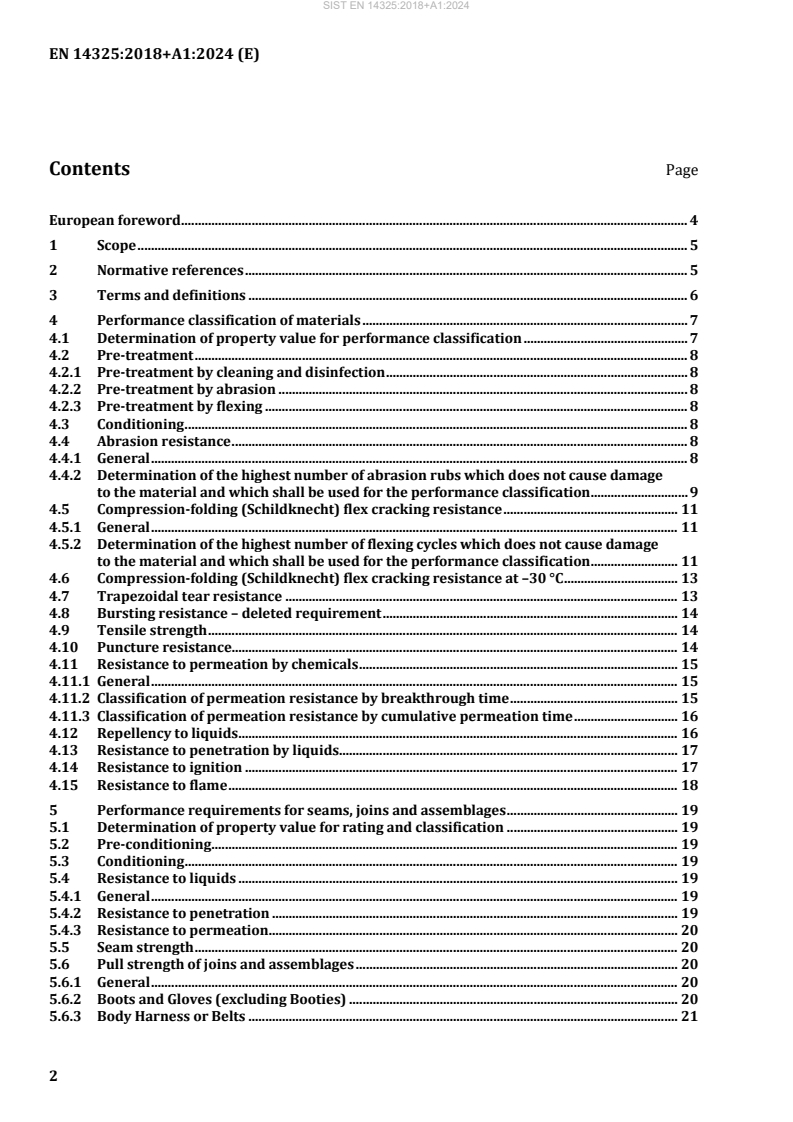
Contents Page
European foreword . 4
1 Scope . 5
2 Normative references . 5
3 Terms and definitions . 6
4 Performance classification of materials . 7
4.1 Determination of property value for performance classification . 7
4.2 Pre-treatment . 8
4.2.1 Pre-treatment by cleaning and disinfection . 8
4.2.2 Pre-treatment by abrasion . 8
4.2.3 Pre-treatment by flexing . 8
4.3 Conditioning . 8
4.4 Abrasion resistance . 8
4.4.1 General . 8
4.4.2 Determination of the highest number of abrasion rubs which does not cause damage
to the material and which shall be used for the performance classification . 9
4.5 Compression-folding (Schildknecht) flex cracking resistance . 11
4.5.1 General . 11
4.5.2 Determination of the highest number of flexing cycles which does not cause damage
to the material and which shall be used for the performance classification . 11
4.6 Compression-folding (Schildknecht) flex cracking resistance at –30 °C . 13
4.7 Trapezoidal tear resistance . 13
4.8 Bursting resistance – deleted requirement . 14
4.9 Tensile strength . 14
4.10 Puncture resistance. 14
4.11 Resistance to permeation by chemicals . 15
4.11.1 General . 15
4.11.2 Classification of permeation resistance by breakthrough time . 15
4.11.3 Classification of permeation resistance by cumulative permeation time . 16
4.12 Repellency to liquids . 16
4.13 Resistance to penetration by liquids. 17
4.14 Resistance to ignition . 17
4.15 Resistance to flame . 18
5 Performance requirements for seams, joins and assemblages . 19
5.1 Determination of property value for rating and classification . 19
5.2 Pre-conditioning . 19
5.3 Conditioning . 19
5.4 Resistance to liquids . 19
5.4.1 General . 19
5.4.2 Resistance to penetration . 19
5.4.3 Resistance to permeation . 20
5.5 Seam strength . 20
5.6 Pull strength of joins and assemblages . 20
5.6.1 General . 20
5.6.2 Boots and Gloves (excluding Booties) . 20
5.6.3 Body Harness or Belts . 21
5.6.4 Lifelines . 21
5.6.5 Exhalation Valves . 21
6 Test report . 22
7 Instructions for use . 22
Annex A (normative) Abrasive paper . 23
A.1 Quality of materials . 23
Annex B (normative) Assessment, evaluation and determination of the property values for
rating and for performance classification . 24
B.1 Expression of results . 24
B.2 Outlying data . 24
B.3 Uncertainty of measurement . 25
B.4 Classification of results . 25
Annex C (normative) Use of time to cumulative mass for reporting material permeation
resistance. 26
C.1 Introduction. 26
C.2 General . 26
C.3 Basis for classification system . 27
C.4 Alternative cumulative permeated mass . 27
C.5 Conversion from permeation breakthrough time classification to classification by
time to cumulative permeated mass . 27
C.6 Cumulative permeated mass values as function of toxicity . 28
Annex D (normative) Specification for pressure pot and leak-tightness of equipment . 30
D.1 Equipment specification . 30
D.2 Volume of pressure pot and apparatus . 32
D.2.1 For flexcracking specimens . 32
D.2.2 For abrasion specimens . 32
D.3 Leak tightness test . 32
Bibliography . 33
European foreword
This document (EN 14325:2018+A1:2024) has been prepared by Technical Committee CEN/TC 162
“Protective clothing including hand and arm protection and lifejackets”, the secretariat of which is held
by DIN.
This European Standard shall be given the status of a national standard, either by publication of an
identical text or by endorsement, at the latest by November 2024, and conflicting national standards
shall be withdrawn at the latest by November 2024.
Attention is drawn to the possibility that some of the elements of this document may be the subject of
patent rights. CEN not be held responsible for identifying any or all such patent rights.
This document includes Amendment 1 approved by CEN on 8 April 2024.
This document supersedes !EN 14325:2018".
The start and finish of text introduced or altered by amendment is indicated in the text by tags !".
!deleted sentence"
According to the CEN/CENELEC Internal Regulations, the national standards organizations of the
following countries are bound to implement this European Standard: Austria, Belgium, Bulgaria,
Croatia, Cyprus, Czech Republic, Denmark, Estonia, Finland, Former Yugoslav Republic of Macedonia,
France, Germany, Greece, Hungary, Iceland, Ireland, Italy, Latvia, Lithuania, Luxembourg, Malta,
Netherlands, Norway, Poland, Portugal, Romania, Serbia, Slovakia, Slovenia, Spain, Sweden, Switzerland,
Turkey and the United Kingdom.
1 Scope
This European Standard specifies the performance classification and test methods for materials used in
chemical protective clothing, including gloves and footwear. The gloves and boots should have the same
chemical protective barrier requirements as the fabric when an integral part of the clothing. This is a
reference standard to which chemical protective clothing performance standards may refer in whole or
in part, but this standard is not exhaustive in the sense that product standards may well require testing
according to test method standards which are not included in this standard.
While these performance levels are intended to relate to the usage to which the chemical protective
clothing is to be put, it is essential that the chemical protective clothing manufacturer or supplier
indicate the intended use of the protective clothing and that the user (specifier) carries out a risk
assessment in order to establish the correct performance level for the intended task.
2 Normative references
The following documents, in whole or in part, are normatively referenced in this document and are
indispensable for its application. For dated references, only the edition cited applies. For undated
references, the latest edition of the referenced document (including any amendments) applies.
EN 863:1995, Protective clothing - Mechanical properties - Test method: Puncture resistance
EN 13274-4:2001, Respiratory protective devices — Methods of test — Part 4: Flame tests
!EN ISO 811:2018, Textiles - Determination of resistance to water penetration - Hydrostatic pressure
test (ISO 811:2018)"
EN ISO 139:2005, Textiles - Standard atmospheres for conditioning and testing (ISO 139:2005)
EN ISO 6530:2005, Protective clothing - Protection against liquid chemicals - Test method for resistance of
materials to penetration by liquids (ISO 6530:2005)
EN ISO 7854:1997, Rubber- or plastics-coated fabrics - Determination of resistance to damage by flexing
(ISO 7854:1995)
!EN ISO 9073-4:2021, Nonwovens - Test methods - Part 4: Determination of tear resistance by the
trapezoid procedure (ISO 9073-4:2021)"
CEN ISO/TR 11610:2004, Protective clothing — Vocabulary (ISO/TR 11610:2004)
EN ISO 12947-2:2016, Textiles - Determination of the abrasion resistance of fabrics by the Martindale
method - Part 2: Determination of specimen breakdown (ISO 12947-2:2016)
EN ISO 13934-1:2013, Textiles - Tensile properties of fabrics - Part 1: Determination of maximum force
and elongation at maximum force using the strip method (ISO 13934-1:2013)
EN ISO 13935-2:2014, Textiles - Seam tensile properties of fabrics and made-up textile articles - Part 2:
Determination of maximum force to seam rupture using the grab method (ISO 13935-2:2014)
ISO 6529:2013, Protective clothing — Protection against chemicals — Determination of resistance of
protective clothing materials to permeation by liquids and gases
3 Terms and definitions
For the purposes of this document, the terms and definitions given in CEN ISO/TR 11610 and the
following apply.
3.1
abrasion rub
one revolution of the outer drives of the Martindale abrasion tester
[SOURCE: EN ISO 12947-1:1998]
3.2
abrasion cycle
completion of all the translational abrasion movements tracing a Lissajous figure comprising 16 rubs,
i.e. 16 revolutions of the two outer drives and 15 revolutions of the inner drive of the Martindale
abrasion tester
[SOURCE: EN ISO 12947-1:1998]
3.3
material
one or several substances, in form of flexible planar structure, of which an item of clothing is made,
excluding hardware and labels
3.3.1
single layer material
material consisting of only one layer
3.3.2
multilayer material
material consisting of several layers, which may be either permanently bonded together or intimately
combined prior to the garment manufacturing stage, or which can be separated without any damage to
each individual layer
Note 1 to entry: By “permanently bonded together” is meant for example by coating, laminating, gluing. By
“intimately combined” is meant for example by weaving, quilting.
3.3.3
multilayer material consisting of separate layers
multilayer material, where individual layers that are neither permanently bonded together nor
intimately combined, can be separated without any damage to the individual layers
3.4
specimen breakdown
in abrasion resistance or flex cracking resistance testing, the visually observed deterioration in a
specimen after exposure to a specified number of abrasion rubs or cycles of flexing
EXAMPLE
— In woven fabrics, when two separate threads are completely broken;
— in knitted fabrics, when one thread is broken down;
— in pile fabrics, when the pile is fully worn off;
— in nonwovens, when the first hole resulting from the wear is of a diameter at least equal to 0,5 mm;
— in coated material, when coating surface has the first hole resulting from the wear of a diameter at least equal
to 0,5 mm.
Note 1 to entry: The hole does not have to be through all materials for it to be a specimen breakdown.
[SOURCE: EN ISO 12947-2:2016]
4 Performance classification of materials
4.1 Determination of property value for performance classification
A number of performance classification levels are identified for the various properties of materials to be
found in this standard.
The value of each property defined in 4.4 to 4.15 and which shall be used for performance classification,
shall be determined in accordance with !Annex B" including the calculation of uncertainty of
measurement for all the results.
If not specified otherwise within 4.4, 4.5, 4.6, 4.7, 4.9 or within the specific test method itself, a material
with different behaviour in the length and cross directions, shall be tested for its performance in both
directions. The performance classification shall be based on the results obtained for the direction
resulting in the lower performance classification when evaluated according to !Annex B".
For a material with different surface characteristics, the fabric side that will appear on the outside of the
apparel shall be tested for all test methods that are linked to surface performance (i.e. 4.4, 4.5, 4.6, 4.8,
4.11, 4.12, 4.13, 4.14, 4.15,) and the performance classification shall be based on the results for this side.
If the chemical protective clothing consists of multiple layers of materials, with or without separable
layers, all layers shall be tested together with the chemical protective clothing outer surface being
tested for those properties which are linked to surface performance.
For materials, which require pre-treatment, the performance classification shall be based on the lowest
performance classification obtained on either testing new (not pre-treated) and/or pre-treated
materials based on evidence. The performance classification tests shall be performed on the worst case.
If insufficient evidence is available to determine whether the test shall be performed as new or pre-
treated, the test shall be performed in both conditions.
4.2 Pre-treatment
4.2.1 Pre-treatment by cleaning and disinfection
Before each test, all chemical protective clothing material samples, with the exception of limited-use
chemical protective clothing, shall undergo pre-treatment by cleaning and disinfection as applicable.
If the manufacturer’s instructions indicate that cleaning or disinfection is not allowed, i.e. limited use
garments, then testing shall be carried out on new material.
Where applicable according to manufacturer’s instruction, the cleaning and disinfection shall be in line
with the manufacturer’s instructions, on the basis of standardized procedures. If the number of cleaning
and disinfection cycles is not specified, the tests shall be carried out after 5 cycles of pre-treatment, each
consisting of one wash cycle, one dry cycle and one disinfection cycle carried out in the sequence as
indicated by the manufacturer’s instructions. This shall be reflected in the information supplied by the
manufacturer. If the garment can be washed or alternatively dry-cleaned it shall only be washed, dried
and disinfected. If only dry-cleaning is allowed, the garment shall only be dry-cleaned and disinfected in
accordance with the manufacturer’s instructions.
4.2.2 Pre-treatment by abrasion
Specimens, which have been pre-treated according to 4.2.1, may also be pre-treated by one of the
numbers of abrasion rubs given in Table 1 in accordance with the method described in 4.4.1 and as
specified in the product standard or as defined by the manufacturer, whichever is the larger, prior to
testing according to 4.11.
4.2.3 Pre-treatment by flexing
Specimens, which have been pre-treated according to 4.2.1, may also be pre-treated by one of the
numbers of flexing cycles given in Table 2 in accordance with the method described in 4.5.1 and as
specified in the product standard or as defined by the manufacturer, whichever is the larger, prior to
testing according to 4.11.
4.3 Conditioning
Unless otherwise indicated in the product standard, all specimens shall be conditioned by storage at
(20 ± 2) °C and (65 ± 5) % relative humidity in accordance with EN ISO 139 for at least 24 h. If
applicable, the tests shall be started within 5 min of removing the specimen from the conditioning
atmosphere, unless otherwise indicated in the test method standard.
Conditioning may be omitted or aligned with the conditions of 4.3 if it can be shown that test results are
not affected by the foreseeable changes of temperature and relative humidity.
4.4 Abrasion resistance
4.4.1 General
A set of four test specimens of a material sample, where each specimen shall consist of all layers, shall
be tested in accordance with EN ISO 12947-2 in the inverted mode, i.e. a test specimen of at least
140 mm diameter placed on the abradant table and an abradant of at least 30 mm diameter mounted in
the test piece holder, using abrasive paper specified in !Annex A" and with an applied downward
pressure of 9 kPa. The abrasion resistance of the chemical protective clothing material shall be
classified according to the levels of performance given in Table 1, using the highest number of abrasion
rubs, determined according to 4.4.2, which do not cause damage to the material.
4.4.2 Determination of the highest number of abrasion rubs which does not cause damage to the
material and which shall be used for the performance classification
4.4.2.1 General
To determine the level of performance, the leak tightness of each of the four test specimens of a
material sample shall be determined after a number of abrasion rubs. An additional sample will be used
to determine the leak tightness prior abrasion.
!There are three methods of leak tightness assessment, the pressure pot, the hydrostatic head and
visual inspection.
• The pressure pot shall be used for materials holding the pressure according to 4.4.2.2.
• The hydrostatic head shall be used for air permeable materials which cannot hold the pressure
according to 4.4.2.2, but can be tested according to 4.4.2.3.
NOTE 1 When evidence is presented that air permeable materials cannot hold the pressure according to
4.4.2.2, this does not need to be re-confirmed.
• Visual inspection is permitted when the material does not permit either of the above quantitative
assessment methods in this subclause to be performed. In this case, this shall be reported in the test
report and also in the Instructions for Use indicating that the visual inspection is qualitative and
does not provide evidence of liquid tightness after abrasion. If this assessment is performed
through visual inspection, the maximum classification that can be claimed is a Class 3.
NOTE 2 When evidence is presented that neither of the above two quantitative assessment methods in this
subclause can be performed due to the nature of the material, this does not need to be re-confirmed."
Table 1 — Classification of abrasion resistance
Class Number of rubs
6 > 2 000
5 > 1000
4 > 400
3 > 100
2 > 40
1 > 10
4.4.2.2 Pressure pot end-point determination
To verify if the use of the pressure pot method is possible, unabraded reference specimen shall be
clamped in the round test pot apparatus, designed according to the specifications given in !Annex D
(see Figure D.1)", with a diameter appropriate to hold the test specimen, and the pressure in the test
pot shall then be reduced by 1 kPa from atmospheric pressure. !Preferably the specimen’s exterior
face of the fabric shall not be exposed to the pressure; if this is not possible then reverse the face of the
fabric." The increase of pressure after 1 min shall be measured and recorded. If the pressure increase
for the unabraded specimens is less than 100 Pa, then the pressure pot method is applicable and the
leak tightness shall be determined as follows:
For each test specimen, the tested area of the abraded specimen is clamped in the round test pot
apparatus shown in !Figure D.1" and the pressure in the test pot shall then be reduced by 1 kPa.
The increase of pressure after 1 min shall be measured and recorded. The difference in the change of
pressure in 1 min between a specimen prior to abrasion and the same specimen after abrasion shall be
calculated. The maximum resultant value of the difference in the change of pressure in 1 min between
abraded and non-abraded shall be determined for the set of specimens. If the maximum resultant value
does not exceed 100 Pa in 1 min, a new set of test specimens shall be abraded to a higher level of
number of rubs according to the levels of numbers of rubs in Table 1, until the level is reached at which
the maximum resultant value exceeds 100 Pa in 1 min. The highest level of number of rubs, at which the
sample still passes, shall be used for the performance classification.
NOTE The pressure pot method can typically not be applied in case of a too high level of air-permeability
and/or breathability of the specimen prior to pre-treatment, e.g. such as flexing or abrasion.
4.4.2.3 Hydrostatic head end-point determination
!The end point, i.e. the highest number of abrasion rubs which does not cause damage to the
material, shall be determined by the measurement of hydrostatic head method according to EN ISO 811
using a rate of increase in pressure of (0,98 ± 0,05) kPa/min (or 10 cm/min). The hydrostatic head of
the specimens of the set of four test specimens (prior to any abrasion) shall be measured and in order
for this test method to be applicable, the hydrostatic head for each of the four test specimens shall be
above 300 mm.
For each test specimen after abrasion, the tested area of the abraded specimen is clamped into the
hydrostatic test apparatus and the hydrostatic head measured. If the hydrostatic head of all the
specimens in a set of four test specimens exceeds 200 mm, a new set of specimens shall be abraded to a
higher number of rubs according to the levels of numbers of rubs in Table 1, until the level is reached at
which the hydrostatic head of any of the four specimens is less than 200 mm. The highest level of
number of rubs, at which hydrostatic head of the set of all test specimens is still above 200 mm, shall be
used for the performance classification."
4.4.2.4 Visual inspection end-point determination
!Visual inspection is permitted when the nature of the material does not permit the end point
assessment to be performed by either the pressure pot, or hydrostatic head, as defined by 4.4.2.1." If
one of the four test specimens shows a specimen breakdown (according to definition 3.4) after having
been pre-treated by a number of abrasion rubs, the material is considered to have failed the abrasion
resistance requirement for this number of rubs. The highest number of rubs, at which any of the
specimens does not show a specimen breakdown (according to definition 3.4), shall be used for the
performance classification. Please see limitation to the performance classification and the requirements
in the Instruction for Use in 4.4.2.1.
4.5 Compression-folding (Schildknecht) flex cracking resistance
4.5.1 General
A set of six test specimens of a material sample (three in machine and three in cross direction), where
each specimen shall consist of all layers shall be tested. The specimens shall be tested in accordance
with EN ISO 7854, method B. The compression folding flex cracking resistance of the chemical
protective clothing material shall be classified according to the levels of performance given in Table 2 of
4.5.2, using the highest number of flexing cycles which do not cause damage the material’s leak
tightness according to 4.5.2.
4.5.2 Determination of the highest number of flexing cycles which does not cause damage to the
material and which shall be used for the performance classification
4.5.2.1 General
To determine the level of performance, the leak tightness of each of the six test specimens of a material
sample shall be determined after a number of flexing cycles. An additional sample will be used to
determine the leak tightness prior flexing.
!There are three methods of leak tightness assessment, the pressure pot, the hydrostatic head and
visual inspection.
• The pressure pot shall be used for materials holding the pressure according to 4.5.2.2.
• The hydrostatic head shall be used for air permeable materials which cannot hold the pressure
according to 4.5.2.2, but can be tested according to 4.5.2.3.
NOTE 1 When evidence is presented that air permeable materials cannot hold the pressure according to
4.5.2.2, this does not need to be re-confirmed.
• Visual inspection is permitted when the nature of the material does not permit either of the above
quantitative assessment methods in this subclause to be performed. In this case, this shall be
reported in the test report and also in the Instructions for Use indicating that the visual inspection
is qualitative and does not provide evidence of liquid tightness after flex cracking. Visual inspection
shall not be used for the performance classification of “Type 1” through “Type 3” (EN 943-1,
EN 943-2, EN 14605).
NOTE 2 When evidence is presented that neither of the above requirements in this subclause can be met,
these do not need to be re-confirmed.
The specimen shall be clamped in a rectangular test pot apparatus, designed according to the
specifications given in Annex D (see Figure D.2), with the rectangular dimensions appropriate to hold
the test specimen."
Table 2 — Classification of leak tightness after compression-folding (Schildknecht) flex cracking
resistance
Class Number of cycles
6 > 50 000
5 > 20 000
4 > 8 000
3 > 3 000
2 > 1250
1 > 500
4.5.2.2 Pressure pot end-point determination
To verify if the use of the pressure pot method is possible, unflexed reference specimen shall be placed
in the pressure pot, and the pressure in the test pot shall then be reduced by 1 kPa from atmospheric
pressure. Preferably the specimen’s exterior face of the fabric shall not be exposed to the pressure, if
this is not possible then reverse the face of the fabric prior to reverting to testing using the hydrostatic
head. The increase of pressure after 1 min shall be measured and recorded. If the pressure increase for
the unflexed specimens is less than 100 Pa, then the pressure pot method is applicable.
For each test specimen, the tested area of the flexed specimen is clamped in a rectangular test pot
apparatus and the pressure in the test pot shown in !Figure D.2" shall then be reduced by 1 kPa.
The increase of pressure after 1 min shall be measured and recorded. The difference in the change of
pressure in 1 min between a specimen prior to flexing and the same specimen after flexing shall be
calculated. The maximum resultant value of the difference in the change of pressure in 1 min between
flexed and non-flexed shall be determined for the set of specimens. If the maximum resultant value does
not exceed 100 Pa in 1 min, a new set of test specimens shall be flexed to a higher level of number of
flexing cycles according to the levels of numbers of flexing cycles in Table 2, until the level is reached at
which the maximum resultant value does not exceed 100 Pa in 1 min. The highest level of number of
cycles, at which the sample still passes, shall be used for the performance classification.
NOTE The pressure pot method can typically not be applied in case of a too high level of air-permeability
and/or breathability of the specimen prior to pre-treatment, e.g. such as flexing.
4.5.2.3 Hydrostatic head end-point determination
!The end point, i.e. the number of flexing cycles which cause compression-folding damage to the
material, shall be determined by the measurement of hydrostatic head method according to EN ISO 811
using a rate of increase in pressure of (0,98 ± 0,05) kPa/min (or 10 cm/min). The hydrostatic head of
the specimens of the set of the six test specimens prior to any flexing shall be measured and in order for
this assessment test method to be applicable, the hydrostatic head for each of the six test specimens
shall be above 300 mm.
For each test specimen, after flexing, the tested area of the flexed specimen is clamped into the
hydrostatic test apparatus and the hydrostatic head measured. If the hydrostatic head of all the
specimens in a set of six test specimens exceeds 200 mm, a new set of specimens shall be flexed to a
number of flexing cycles according to the levels of numbers of flexing cycles in Table 2, until the level is
reached at which the hydrostatic head of any of the six specimens is less than 200 mm. The highest level
of number of cycles, at which the hydrostatic head of the set of all test specimens is still above 200 mm,
shall be used for the performance classification."
An adaptor head of diameter 45mm to 60mm may be required for hydrostatic test apparatus. The test
piece for hydrostatic-head testing shall be taken from the central portion of the flexed specimen
symmetrically.
4.5.2.4 Visual inspection end-point determination
!Visual inspection is permitted when the nature of the material does not permit the end point
assessment to be performed by neither the pressure pot nor hydrostatic head as defined by 4.5.2.1."
If one of the six test specimens shows a specimen breakdown (according to definition 3.4) after having
been pre-treated by a number of flexing cycles, the material is considered to have failed the flex
cracking resistance requirement for this number of cycles. The highest number of flex cracking cycles, at
which all the specimens still do not show specimen breakdown (according to definition 3.4), shall be
used for the performance classification. Please see limitation to the performance classification and the
requirements in the Instruction for Use in 4.5.2.1.
4.6 Compression-folding (Schildknecht) flex cracking resistance at –30 °C
The determination of the compression-folding flex cracking resistance at –30 °C shall be carried out like
the determination of the flex cracking resistance according to 4.5, but with the following modifications:
a) testing shall be carried out at –30 °C;
b) classification shall be carried out according to the number of cycles in Table 3.
Table 3 — Classification of compression-folding (Schildknecht) flex cracking resistance at low
temperatures
Class Number of cycles
6 > 4 000
5 > 2 000
4 > 1 000
3 > 500
2 > 200
1 > 100
4.7 Trapezoidal tear resistance
Test specimens shall be tested in accordance with EN ISO 9073-4. If the chemical protective clothing
consists of multiple layers of materials, with or without separable layers, all layers shall be tested
together. Each specimen shall be tested with a pre-extension of 2 N. !The force applied to each of the
five specimens shall be recorded as arithmetic mean of the maximum force of each specimen taken
during testing. The maximum force of each specimen is rounded to the nearest 0,1 N. Calculate the
arithmetic mean of the maximum force in both the machine and cross-machine directions respectively,
round the arithmetic mean to the nearest 0,1 N, the results are expressed as the arithmetic mean."
The chemical protective clothing material shall be classified according to the levels of performance
given in Table 4. The arithmetic mean trapezoidal tear resistance value, determined according to
!Annex B", shall be used for the purpose of performance rating and classification.
Table 4 — Classification of trapezoidal tear resistance
Class Trapezoidal tear resistance
6 > 150 N
5 > 100 N
4 > 60 N
3 > 40 N
2 > 20 N
1 > 10 N
4.8 Bursting resistance – deleted requirement
Clause deliberately left blank to maintain continuity of numbering with previous edition.
4.9 Tensile strength
When tested in accordance with EN ISO 13934-1 the chemical protective clothing material shall be
classified according to the levels of performance given in Table 5. If the chemical protective clothing
consists of multiple layers of materials, with or without separable layers, all layers shall be tested
together. The resultant arithmetic mean of the maximum force for 5 specimens of a sample set (e.g.
5 machine and 5 cross), determined according to EN ISO 13934-1 and in accordance with
!Annex B", shall be used for the purpose of performance rating and classification.
Table 5 — Classification of tensile strength
Class Tensile strength
6 > 1 000 N
5 > 500 N
4 > 250 N
3 > 100 N
2 > 60 N
1 > 30 N
4.10 Puncture resistance
Five representative specimens of the chemical protective clothing material shall be tested in accordance
with EN 863 and classified according to the levels of performance given in Table 6. Where there are
multiple force peaks, the highest peak shall be taken as the result. The arithmetic mean puncture
resistance value, determined according to !Annex B", shall be used for the purpose of performance
rating and classification.
Table 6 — Classification of puncture resistance
Class Puncture resistance
6 > 250 N
5 > 150 N
4 > 100 N
3 > 50 N
2 > 10 N
1 > 5 N
4.11 Resistance to permeation by chemicals
4.11.1 General
Specimens intended to be reused shall be pre-treated by cleaning and disinfection according to 4.2.1
and, if required and indicated in the manufacturer’s instructions, may be pre-treated by abrasion
according to 4.2.2 and/or flexing according to 4.2.3.
4.11.2 Classification of permeation resistance by breakthrough time
Testing shall be carried out in accordance with ISO 6529, Method A (liquids) or Method B (gases), at a
·min), the chemical
temperature of (23 ± 1) °C. Using a normalized permeation rate of 1,0 µg/(cm
protective clothing material shall be classified according to the levels of performance given in Table 7
for each chemical tested.
The resultant average normalized breakthrough time value, determined according to ISO 6529 and in
accordance with !Annex B", shall be used for the purpose of performance rating and classification.
In addition to the breakthrough time permeation resistance class, also the cumulative mass at the time
corresponding to the claimed breakthrough time class shall be determined and reported.
Table 7 — Classification of permeation resistance by normalized breakthrough time
Class Normalised breakthrough time
6 ≥ 480 min
5 ≥ 240 min
4 ≥ 120 min
3 ≥ 60 min
2 ≥ 30 min
1 ≥ 10 min
NOTE 1 It can be dangerous to base considerations of safe wear time of given chemical protective clothing only
on the value of normalized breakthrough time for a specifi
...