

SIST EN 13445-3:2026
(Main)Unfired pressure vessels - Part 3: Design
- Abstract
This Part of this document specifies requirements for the design of unfired pressure vessels covered by EN 13445-1: 2026 and constructed of steels in accordance with EN 13445-2:2026.
EN 13445-5: 2026, Annex C specifies requirements for the design of access and inspection openings, closing mechanisms and special locking elements.
This Part applies to design of vessels before putting into service. It may be used for in service calculation or analysis subject to appropriate adjustment.
- Status
- Published
- Publication Date
- 19-Aug-2026
- Technical Committee
- TLP - Pressure vessels
- Current Stage
- 6060 - National Implementation/Publication (Adopted Project)
- Start Date
- 05-Aug-2026
- Due Date
- 10-Oct-2026
- Completion Date
- 20-Aug-2026

SIST EN 13445-3:2026 is the CEN part of the EN 13445 series that sets the design rules for unfired pressure vessels made of steels. It tells engineers how to size and check shells, openings, flanges, tubesheets, bellows and support-related details before a vessel is put into service, and it can also be used for in-service calculation or analysis with suitable adjustment. It is intended to be used with the other relevant EN 13445 parts, especially EN 13445-1:2026, EN 13445-2:2026 and EN 13445-5:2026.
What does SIST EN 13445-3:2026 specify?
SIST EN 13445-3:2026 specifies the design requirements for unfired pressure vessels covered by EN 13445-1:2026 and built from steels in accordance with EN 13445-2:2026. It is the design part of the series, so it focuses on calculation and verification rather than fabrication or inspection.
The document applies to vessels before first use. It also points to EN 13445-5:2026, Annex C for access and inspection openings, closing mechanisms and special locking elements.
The standard is organized in three layers:
- Clauses 1 to 4 set the scope, references, terms and symbols.
- Clauses 5 to 22 give the design basis and the component-specific rules.
- Annexes A to NB and Annexes Y and ZA provide alternative methods, supporting procedures, worked examples, monitoring guidance and EU linkage.
| Annex | What it covers |
|---|---|
| Annex A (normative) | Design requirements for pressure bearing welds |
| Annex B (normative) | Design by Analysis - Direct Route |
| Annex C (normative) | Design by analysis - Method based on stress categories |
| Annex D (informative) | Verification of the shape of vessels subject to external pressure |
| Annex E (normative) | Procedure for calculating the departure from the true circle of cylinders and cones |
| Annex F (normative) | Allowable external pressure for vessels outside circularity tolerance |
| Annex G (normative) | Alternative design rules for flanges and gasketed flange connections |
| Annex H (informative) | Gasket factors m and y |
| Annex I (normative) | Additional information on heat exchanger tubesheet design |
| Annex J (normative) | Alternative method for the design of heat exchanger tubesheets |
| Annex K (informative) | Additional information on expansion bellows design |
| Annex L (informative) | Basis for design rules related to additional non-pressure loads |
| Annex M (informative) | In service monitoring of vessels operating in fatigue or creep service |
| Annex N (informative) | Bibliography to Clause 18 |
| Annex NA (informative) | Examples of determining structural hot-spot stress by finite element analysis |
| Annex NB (informative) | Cycle counting and determination of equivalent stress range |
| Annex Y | Significant technical changes between this edition and the previous edition |
| Annex ZA | Relationship with EU Legislation |
What are the key requirements of SIST EN 13445-3:2026?
SIST EN 13445-3:2026 is mainly a calculation standard. Its core requirements define when the rules may be used, how loads and stresses are classified, and which calculation route applies to each vessel part.
Design basis and load cases
Clause 5 limits use of SIST EN 13445-3:2026 to cases where materials and welds are not subject to localized corrosion in the contained or foreseeable product, and where the temperature is either below the creep range or supported by time-dependent material data. In practice, the designer must first check the service environment and temperature range before relying on the formulae.
Clause 5.3 distinguishes normal operating, exceptional and testing load cases, and it defines design pressure, design temperature, calculation pressure and calculation temperature. That matters because the same vessel part can have different allowable values depending on whether it is in service, under an upset condition or under test.
Design methods and weld influence
Clause 5.4 allows design by formulae, design by analysis through Annex B or Annex C, and experimental techniques through Annex T. This gives the designer a route for both standard geometries and more complex parts that need analytical or test-based justification.
Clause 5.6 uses the joint coefficient z for certain welded components, with the value linked to the testing group of the governing welded joint. In practice, the weld layout can control the required thickness, so the main load-bearing weld must be identified early.
Clause 5.7 sends pressure-bearing weld requirements to Annex A. That means weld detail, weld type and service condition are part of the structural design, not just fabrication planning.
Material stress limits
Clause 6 gives the maximum allowed values of the nominal design stress for pressure parts, with separate treatment for different steel groups, austenitic steels, cast steels and anchor bolting. The practical effect is that material category and temperature directly set the stress value used in the thickness formulae.
For anchor bolting, Clause 6.7 gives a separate design stress route. That matters for heads, covers and other bolted closures where the bolts may govern the safety margin.
Component rules
Clauses 7 to 10 cover the main pressure-retaining shapes: cylinders, spheres, dished ends, cones, shell openings and flat ends. These clauses are the everyday design core for vessel shells, heads, nozzles and end closures.
Clause 8 handles external pressure and stiffened or unstiffened shells, including circularity tolerance and, where needed, Annex F for vessels that exceed the circularity limit. In practice, fabrication ovality can reduce collapse resistance, so the manufactured shape has to be checked as well as the nominal thickness.
Clause 9 covers openings in shells, including reinforcement of isolated and multiple openings and openings near shell discontinuities. This is the part to use when a nozzle, manway or similar penetration must be shown to preserve the shell strength around the cut-out.
Clause 10 covers unpierced and pierced flat ends, bolted circular flat ends, non-circular flat ends and annular plates. It tells the designer how to size covers and end plates that bend rather than carry load mainly in membrane stress.
Flanges, tubesheets and bellows
Clause 11 covers circular bolted flange connections, including narrow face, full face, reverse and seal welded flanges. Annex G provides an alternative method for narrow face gasket design, especially where thermal cycling, controlled bolt tightening, extra loads or tightness requirements matter.
Clause 12 extends the flange approach to bolted domed ends. Clause 13 gives the design rules for U-tube, fixed tubesheet and floating tubesheet heat exchangers, based on classical elastic shell theory, with Annex J as an alternative limit load method.
Clause 14 covers expansion bellows of U-shaped and toroidal type under pressure and cyclic displacement. This is the part that matters when flexibility is needed for thermal expansion but pressure capacity still has to be demonstrated.
Additional loads, fatigue, creep and special structures
Clause 16 treats additional non-pressure loads such as nozzle loads, line loads, lifting lugs, saddle supports, ring supports, bracket supports, legs, skirts and global loads on cylindrical and conical shells. This means the vessel must be checked for support and handling loads, not only internal pressure.
Clauses 17 and 18 provide simplified and detailed fatigue life assessment. If the vessel sees repeated pressure or thermal cycles, the design has to account for cycle count, stress range and cumulative damage, not just static strength.
Clause 19 covers creep design for time-dependent high-temperature service. Clause 22 gives static analysis rules for tall vertical vessels on skirts, including loads, load combinations, shell-skirt joints, anchor bolts, base ring assembly, foundation loads and vortex shedding.
What terms does SIST EN 13445-3:2026 define?
- Action - An imposed thermo-mechanical influence such as pressure, force or temperature that causes stress or strain.
- Analysis thickness - The effective thickness available to resist a given load case.
- Calculation pressure - The differential pressure used in the design calculations for a component.
- Calculation temperature - The temperature used in the design calculations for a component.
- Design pressure - The pressure at the top of each chamber chosen for deriving the calculation pressure of each component.
- Design temperature - The temperature chosen for deriving the calculation temperature of each component.
- Load case - A combination of coincident actions.
- Nominal design stress - The stress value used in the formulae for calculating pressure components.
- Creep range - The temperature range in which material properties used in design are time dependent.
- Joint coefficient - The factor z used for certain welded components to reflect the governing welded joint.
Who uses SIST EN 13445-3:2026?
SIST EN 13445-3:2026 is used by pressure vessel designers, calculation engineers and stress analysts who need a code route for sizing shells, ends, nozzles, flanges, tubesheets and bellows. It is also used by manufacturers and fabrication teams because several clauses tie design directly to weld details, testing groups and component geometry.
Quality managers, inspection personnel and technical buyers use SIST EN 13445-3:2026 when they need to check that a vessel design has a clear calculation basis and that the chosen design method matches the component and load case. It is especially relevant where fatigue, creep, external pressure or additional non-pressure loads may govern the design.
What changed in SIST EN 13445-3:2026 from the previous edition?
SIST EN 13445-3:2026 supersedes EN 13445-3:2021+A1:2026. Annex Y gives the significant technical changes between this European Standard and the previous edition.
Which standards are used with SIST EN 13445-3:2026?
SIST EN 13445-3:2026 relies on several companion standards for common definitions, materials, loads, weld details and component-related design data.
| Reference | What it contributes |
|---|---|
| EN 13445-1:2026 | General rules, shared terminology and the parent framework for unfired pressure vessels |
| EN 13445-2:2026 | Material requirements and the material-related definitions used by this part |
| EN 13445-5:2026 | Testing-group rules and, in Annex C, access and inspection openings, closing mechanisms and special locking elements |
| EN 1092-1:2018 | Steel flanges used in flange-related design |
| EN 1591-1:2013 | Calculation method for gasketed circular flange connections |
| EN 1708-1:2010 | Basic weld joint details in steel for pressurized components |
| EN 1990:2023 | Basis of structural and geotechnical design |
| EN 1991-1-4:2005 | Wind actions |
| EN 1991-1-6:2005 | Actions during execution |
| EN 1992-1-1:2023 | Concrete design for foundations and related structures |
| EN 1998-1:2004 | Seismic actions and earthquake resistance |
| EN 10204:2004 | Inspection document types for metallic products |
| EN 10222-1:2017 | Steel forgings for pressure purposes |
| EN 837-1:1996 | Bourdon tube pressure gauges |
| EN 837-3:1996 | Diaphragm and capsule pressure gauges |
| EN 286-2:1992 | Simple unfired pressure vessels for air or nitrogen |
| EN 764-1:2015+A1:2016 | Pressure, temperature, volume and nominal size terminology |
| EN 764-2:2012 | Quantities, symbols and units |
| EN 764-3:2002 | Definition of parties involved |
| EN 12195-1:2010 | Securing forces for transport and handling on road vehicles |
What does the SIST EN 13445-3:2026 document contain?
SIST EN 13445-3:2026 is a formula-driven design document with many tables, figures and calculation procedures. It includes tables for symbols, nominal design stress, joint coefficients and stiffener-related values, plus numerous figures for shell forms, nozzle positions, flange arrangements, tubesheet configurations, bellows types and support details.
It also contains worked calculation routes for thickness, reinforcement, stress limits, fatigue assessment and creep design. Annex NA gives examples of structural hot-spot stress by finite element analysis using shell or solid elements, and Annex NB deals with cycle counting and equivalent stress range, which are the practical inputs for fatigue assessment.
Relations
- Effective Date
- 01-Dec-2026
- Refers
SIST EN ISO 4014:2022 - Fasteners - Hexagon head bolts - Product grades A and B (ISO 4014:2022) - Effective Date
- 29-Jul-2026
- Effective Date
- 29-Jul-2026
- Effective Date
- 29-Jul-2026
- Effective Date
- 29-Jul-2026
- Refers
SIST EN 1991-1-4:2005 - Eurocode 1: Actions on structures - Part 1-4: General actions - Wind actions - Effective Date
- 29-Jul-2026
- Effective Date
- 29-Jul-2026
- Refers
SIST EN 1708-1:2010 - Welding - Basic welded joint details in steel - Part 1: Pressurized components - Effective Date
- 29-Jul-2026
- Effective Date
- 29-Jul-2026
- Effective Date
- 29-Jul-2026
- Effective Date
- 29-Jul-2026
- Effective Date
- 29-Jul-2026
- Effective Date
- 29-Jul-2026
- Effective Date
- 29-Jul-2026
- Effective Date
- 29-Jul-2026
Get Certified
Connect with accredited certification bodies for this standard

Institut za varilstvo d.o.o. (Welding Institute)
Slovenia's leading welding institute since 1952. ISO 3834, EN 1090, pressure equipment certification, NDT personnel, welder qualification. Only IIW Au
Sponsored listings
Frequently Asked Questions
SIST EN 13445-3:2026 is a standard published by the Slovenian Institute for Standardization (SIST). Its full title is "Unfired pressure vessels - Part 3: Design". This standard covers: This Part of this document specifies requirements for the design of unfired pressure vessels covered by EN 13445-1: 2026 and constructed of steels in accordance with EN 13445-2:2026. EN 13445-5: 2026, Annex C specifies requirements for the design of access and inspection openings, closing mechanisms and special locking elements. This Part applies to design of vessels before putting into service. It may be used for in service calculation or analysis subject to appropriate adjustment.
This Part of this document specifies requirements for the design of unfired pressure vessels covered by EN 13445-1: 2026 and constructed of steels in accordance with EN 13445-2:2026. EN 13445-5: 2026, Annex C specifies requirements for the design of access and inspection openings, closing mechanisms and special locking elements. This Part applies to design of vessels before putting into service. It may be used for in service calculation or analysis subject to appropriate adjustment.
SIST EN 13445-3:2026 is classified under the following ICS (International Classification for Standards) categories: 23.020.30 - Pressure vessels, gas cylinders; 23.020.32 - Pressure vessels. The ICS classification helps identify the subject area and facilitates finding related standards.
SIST EN 13445-3:2026 has the following relationships with other standards: It is inter standard links to SIST EN 13445-3:2021+A1:2026, SIST EN ISO 4014:2022, SIST EN 10204:2004, SIST EN 10222-1:2017, SIST EN 764-2:2012, SIST EN 1991-1-4:2005, SIST EN ISO 4016:2022, SIST EN 1708-1:2010, SIST EN 1591-1:2014, SIST EN 1092-1:2018, SIST EN 1991-1-4:2005/A1:2010, SIST EN 12195-1:2011, SIST EN 764-3:2002, SIST EN 12952-3:2023, kSIST FprEN 1992-1-1:2023. Understanding these relationships helps ensure you are using the most current and applicable version of the standard.
SIST EN 13445-3:2026 is associated with the following European legislation: EU Directives/Regulations: 2014/68/EU; Standardization Mandates: M/601. When a standard is cited in the Official Journal of the European Union, products manufactured in conformity with it benefit from a presumption of conformity with the essential requirements of the corresponding EU directive or regulation.
SIST EN 13445-3:2026 is available in PDF format for immediate download after purchase. The document can be added to your cart and obtained through the secure checkout process. Digital delivery ensures instant access to the complete standard document.
Standards Content (Sample)
SLOVENSKI STANDARD
01-september-2026
Nadomešča:
SIST EN 13445-3:2021+A1:2026
Nekurjene tlačne posode - 3. del: Konstruiranje
Unfired pressure vessels - Part 3: Design
Unbefeuerte Druckbehälter - Teil 3: Konstruktion
Récipients sous pression non soumis à la flamme - Partie 3: Conception
Ta slovenski standard je istoveten z: EN 13445-3:2026
ICS:
23.020.32 Tlačne posode Pressure vessels
2003-01.Slovenski inštitut za standardizacijo. Razmnoževanje celote ali delov tega standarda ni dovoljeno.
EN 13445-3
EUROPEAN STANDARD
NORME EUROPÉENNE
July 2026
EUROPÄISCHE NORM
ICS 23.020.30 Supersedes EN 13445-3:2021+A1:2026
English Version
Unfired pressure vessels - Part 3: Design
Récipients sous pression non soumis à la flamme - Unbefeuerte Druckbehälter - Teil 3: Konstruktion
Partie 3: Conception
This European Standard was approved by CEN on 24 June 2026.
CEN members are bound to comply with the CEN/CENELEC Internal Regulations which stipulate the conditions for giving this
European Standard the status of a national standard without any alteration. Up-to-date lists and bibliographical references
concerning such national standards may be obtained on application to the CEN-CENELEC Management Centre or to any CEN
member.
This European Standard exists in three official versions (English, French, German). A version in any other language made by
translation under the responsibility of a CEN member into its own language and notified to the CEN-CENELEC Management
Centre has the same status as the official versions.
CEN members are the national standards bodies of Austria, Belgium, Bulgaria, Croatia, Cyprus, Czech Republic, Denmark, Estonia,
Finland, France, Germany, Greece, Hungary, Iceland, Ireland, Italy, Latvia, Lithuania, Luxembourg, Malta, Netherlands, Norway,
Poland, Portugal, Republic of North Macedonia, Romania, Serbia, Slovakia, Slovenia, Spain, Sweden, Switzerland, Türkiye and
United Kingdom.
EUROPEAN COMMITTEE FOR STANDARDIZATION
COMITÉ EUROPÉEN DE NORMALISATION
EUROPÄISCHES KOMITEE FÜR NORMUNG
CEN-CENELEC Management Centre: Rue de la Science 23, B-1040 Brussels
© 2026 CEN All rights of exploitation in any form and by any means reserved Ref. No. EN 13445-3:2026 E
worldwide for CEN national Members.
EN 13445‐3:2026 (E)
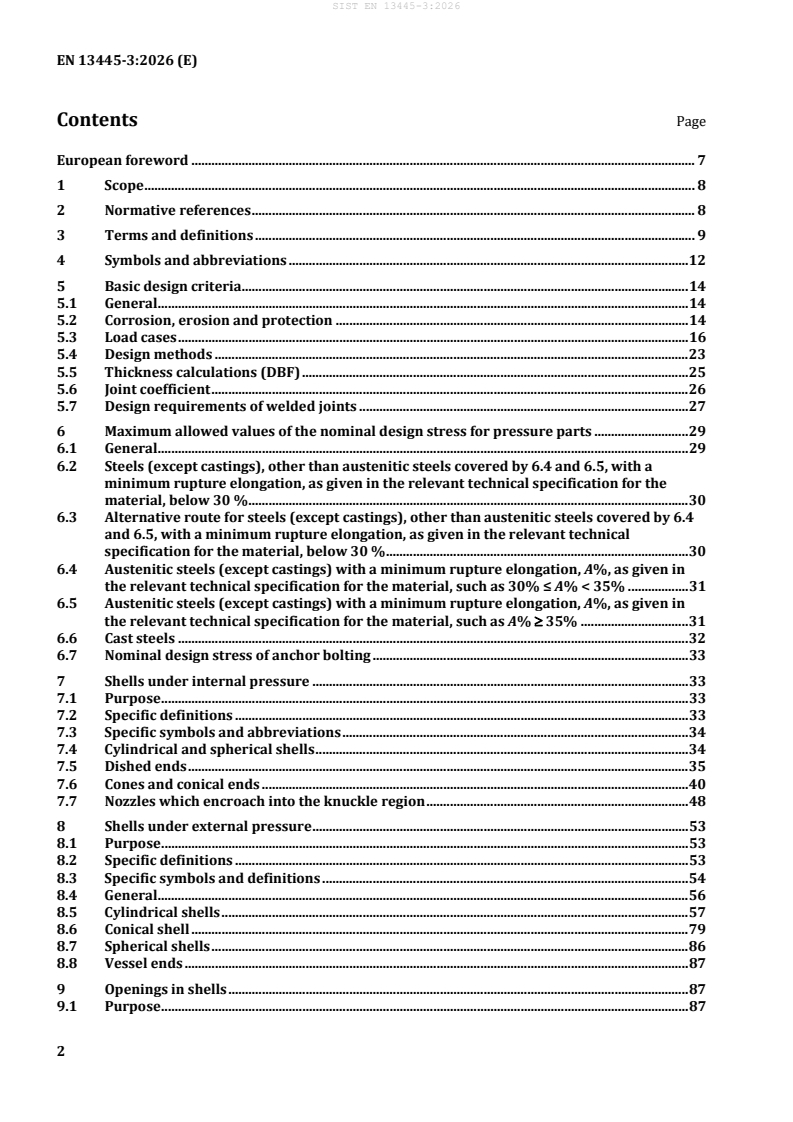
Contents Page
European foreword . 7
1 Scope . 8
2 Normative references . 8
3 Terms and definitions . 9
4 Symbols and abbreviations . 12
5 Basic design criteria . 14
5.1 General . 14
5.2 Corrosion, erosion and protection . 14
5.3 Load cases . 16
5.4 Design methods . 23
5.5 Thickness calculations (DBF) . 25
5.6 Joint coefficient . 26
5.7 Design requirements of welded joints . 27
6 Maximum allowed values of the nominal design stress for pressure parts . 29
6.1 General . 29
6.2 Steels (except castings), other than austenitic steels covered by 6.4 and 6.5, with a
minimum rupture elongation, as given in the relevant technical specification for the
material, below 30 % . 30
6.3 Alternative route for steels (except castings), other than austenitic steels covered by 6.4
and 6.5, with a minimum rupture elongation, as given in the relevant technical
specification for the material, below 30 % . 30
6.4 Austenitic steels (except castings) with a minimum rupture elongation, A%, as given in
the relevant technical specification for the material, such as 30% ≤ A% < 35% . 31
6.5 Austenitic steels (except castings) with a minimum rupture elongation, A%, as given in
the relevant technical specification for the material, such as A% 35% . 31
6.6 Cast steels . 32
6.7 Nominal design stress of anchor bolting . 33
7 Shells under internal pressure . 33
7.1 Purpose . 33
7.2 Specific definitions . 33
7.3 Specific symbols and abbreviations . 34
7.4 Cylindrical and spherical shells . 34
7.5 Dished ends . 35
7.6 Cones and conical ends . 40
7.7 Nozzles which encroach into the knuckle region . 48
8 Shells under external pressure . 53
8.1 Purpose . 53
8.2 Specific definitions . 53
8.3 Specific symbols and definitions . 54
8.4 General . 56
8.5 Cylindrical shells . 57
8.6 Conical shell . 79
8.7 Spherical shells . 86
8.8 Vessel ends . 87
9 Openings in shells . 87
9.1 Purpose . 87
EN 13445‐3:2026 (E)
9.2 Specific definitions . 88
9.3 Specific symbols and abbreviations . 89
9.4 General . 92
9.5 Isolated openings . 105
9.6 Multiple openings . 122
9.7 Openings close to a shell discontinuity . 133
10 Flat ends . 140
10.1 Purpose . 140
10.2 Specific definitions . 140
10.3 Specific symbols and abbreviations . 141
10.4 Unpierced circular flat ends welded to cylindrical shells . 142
10.5 Unpierced bolted circular flat ends . 149
10.6 Pierced circular flat ends . 152
10.7 Flat ends of non‐circular or annular shape . 157
11 Flanges . 161
11.1 Purpose . 161
11.2 Specific definitions . 161
11.3 Specific symbols and abbreviations . 162
11.4 General . 164
11.5 Narrow face gasketed flanges . 168
11.6 Full face flanges with soft ring type gaskets . 185
11.7 Seal welded flanges . 188
11.8 Reverse narrow face flanges . 188
11.9 Reverse full face flanges . 191
11.10 Full face flanges with metal to metal contact . 195
12 Bolted domed ends. 197
12.1 Purpose . 197
12.2 Specific definitions . 197
12.3 Specific symbols and abbreviations . 197
12.4 General . 198
12.5 Bolted domed ends with narrow face gaskets . 198
12.6 Bolted domed ends with full face joints . 199
13 Heat Exchanger Tubesheets . 201
13.1 Purpose . 201
13.2 Specific definitions . 201
13.3 Specific symbols and abbreviations . 201
13.4 U‐tube tubesheet heat exchangers . 204
13.5 Fixed tubesheet heat exchangers . 217
13.6 Floating tubesheet heat exchangers . 245
13.7 Tubesheet characteristics . 262
13.8 Maximum permissible tube to tubesheet joint stress . 269
13.9 Maximum permissible longitudinal compressive stress for tubes. 270
13.10 Design of tubesheet flange extension with a narrow face gasket . 273
13.11 Design of tubesheet flange extension with a full face gasket . 276
13.12 Special tube‐to‐tubesheet welded joints . 279
14 Expansion bellows . 282
14.1 Purpose . 282
14.2 Specific definitions . 282
14.3 Specific symbols and abbreviations . 284
14.4 Conditions of applicability . 286
EN 13445‐3:2026 (E)
14.5 U‐shaped reinforced bellows . 288
14.6 U‐shaped reinforced bellows . 304
14.7 Toroidal bellows . 312
14.8 Fabrication . 318
14.9 Inspection and testing . 320
14.10 Bellows subjected to axial, lateral or angular displacements . 322
15 Pressure vessels of rectangular section . 327
15.1 Purpose . 327
15.2 Specific definitions . 327
15.3 Specific symbols and abbreviations . 327
15.4 General . 330
15.5 Unreinforced vessels . 330
15.6 Reinforced vessels . 338
15.7 Openings . 347
16 Additional non‐pressure loads . 348
16.1 Purpose . 348
16.2 Specific definitions . 349
16.3 Specific symbols and abbreviations . 349
16.4 Local loads on nozzles in spherical shells . 350
16.5 Local loads on nozzles in cylindrical shells . 360
16.6 Line loads . 369
16.7 Lifting lugs . 375
16.8 Horizontal vessels on saddle supports . 379
16.9 Horizontal vessels on ring supports . 393
16.10 Vertical vessels on bracket supports . 398
16.11 Vertical vessels with supporting legs . 422
16.12 Vertical vessels with skirts . 424
16.13 Vertical vessels with ring supports . 456
16.14 Global loads on cylindrical shells . 466
16.15 Global loads on conical shells and conical transition without knuckles . 476
17 Simplified assessment of fatigue life . 482
17.1 Purpose . 482
17.2 Specific definitions . 483
17.3 Specific symbols and abbreviations . 485
17.4 Conditions of applicability . 487
17.5 General . 488
17.6 Determination of allowable number of pressure and thermal cycles . 494
17.7 Assessment rule. 520
17.8 Design and manufacture . 520
17.9 Testing . 521
18 Detailed assessment of fatigue life . 521
18.1 Purpose . 521
18.2 Specific definitions . 524
18.3 Specific symbols and abbreviations . 528
18.4 Limitations . 530
18.5 Process for detailed fatigue assessment. 532
18.6 Determination of stresses for fatigue assessment of welded components and zones . 534
18.7 Stresses for fatigue assessment of unwelded components and bolts . 536
18.8 Elastic‐plastic conditions . 538
18.9 Cycles of equivalent stress range Δσ . 540
eq
18.10 Fatigue strength of welded components . 540
EN 13445‐3:2026 (E)
18.11 Fatigue strength of unwelded components . 564
18.12 Fatigue strength of steel bolts . 570
18.13 Cumulative fatigue damage index . 572
19 Creep design . 573
19.1 Purpose . 573
19.2 Specific definitions . 573
19.3 Specific symbols and abbreviations . 574
19.4 Design in the creep range . 574
19.5 Nominal design stress in the creep range . 575
19.6 Weld joint factor in the creep range . 578
19.7 Pressure loading of predominantly non‐cyclic nature in the creep range . 579
19.8 Design procedures for DBF . 579
20 Design rules for reinforced flat walls . 582
20.1 General . 582
20.2 Stayed flat walls . 582
20.3 Specific definitions for stayed flat walls . 582
20.4 Required thickness of stayed flat walls . 582
20.5 Required dimensions and layout of staybolts and stays . 582
20.6 Requirements for threaded staybolts . 583
20.7 Requirements for welded‐in staybolts and welded stays . 583
20.8 Tables for stayed flat walls . 584
20.9 Figures for Stayed Flat Walls . 584
21 Circular flat ends with radial reinforcement ribs . 586
21.1 Purpose . 586
21.2 Specific definitions . 586
21.3 Specific symbols and abbreviations . 589
21.4 Ends without additional peripheral bending moment . 590
21.5 Ends with additional peripheral bending moment . 592
21.6 Openings . 594
21.7 Welds . 594
21.8 Central Ring . 595
22 Static analysis of tall vertical vessels on skirts . 596
22.1 Purpose . 596
22.2 Specific definitions . 596
22.3 Specific symbols and abbreviations . 596
22.4 Loads . 598
22.5 Load combinations . 601
22.6 Stress analysis of pressure vessel shells and skirts . 601
22.7 Design of joint between skirt and pressure vessel (at dished end or cylindrical shell) . 602
22.8 Design of anchor bolts and base ring assembly . 602
22.9 Foundation loads . 602
22.10 Vortex shedding . 603
Annex A (normative) Design requirements for pressure bearing welds . 606
Annex B (normative) Design by Analysis – Direct Route . 623
Annex C (normative) Design by analysis — Method based on stress categories . 653
Annex D (informative) Verification of the shape of vessels subject to external pressure . 674
Annex E (normative) Procedure for calculating the departure from the true circle of cylinders
and cones . 681
EN 13445‐3:2026 (E)
Annex F (normative) Allowable external pressure for vessels outside circularity tolerance . 684
Annex G (normative) Alternative design rules for flanges and gasketed flange connections . 686
Annex H (informative) Gasket factors m and y . 736
Annex I (normative) Additional information on heat exchanger tubesheet design . 739
Annex J (normative) Alternative method for the design of heat exchanger tubesheets . 743
Annex K (informative) Additional information on expansion bellows design . 790
Annex L (informative) Basis for design rules related to additional non‐pressure loads. 798
Annex M (informative) In service monitoring of vessels operating in fatigue or creep service 800
Annex N (informative) Bibliography to Clause 18 . 803
Annex NA (informative) Examples of determination of the structural hot‐spot stress by finite
element analysis using shell or solid elements . 804
Annex NB (informative) Cycle counting and determination of equivalent stress range . 814
Annex NC (informative) Fatigue assessment of partial penetration welds . 847
Annex ND (informative) Examples of stress concentrations σ and stress concentration
total
factors K . 854
t
Annex O (informative) Physical properties of steels . 858
Annex P (normative) Classification of weld details to be assessed using principal stresses . 866
Annex Q (normative) Simplified procedure for the fatigue assessment of unwelded zones . 879
Annex R (informative) Coefficients for creep‐rupture model equations for extrapolation of
creep‐rupture strength . 880
Annex S (informative) Extrapolation of the nominal design stress based on time‐independent
behaviour in the creep range . 887
Annex T (normative) Design by experimental methods . 894
Annex U (informative) Guidance on negligibility of additional thermal cycles in fatigue and
ratcheting assessment. 907
Annex V (informative) Consider a buffer for unknown nozzle loads — Opening design for
unknown nozzle loads . 915
Annex Y (informative) History of EN 13445‐3 . 916
Annex ZA (informative) Relationship between this European Standard and the essential
requirements of Directive 2014/68/EU aimed to be covered . 917
EN 13445‐3:2026 (E)
European foreword
This document (EN 13445-3:2026) has been prepared by Technical Committee CEN/TC 54 “Unfired
pressure vessels”, the secretariat of which is held by BSI.
This European Standard shall be given the status of a national standard, either by publication of an
identical text or by endorsement, at the latest by December 2026, and conflicting national standards
shall be withdrawn at the latest by December 2026.
Attention is drawn to the possibility that some of the elements of this document may be the subject
of patent rights. CEN shall not be held responsible for identifying any or all such patent rights.
This document supersedes EN 13445-3:2021+A1:2026.
Annex Y provides details of significant technical changes between this European Standard and the
previous edition.
This document has been prepared under a standardization request addressed to CEN by the
European Commission. The Standing Committee of the EFTA States subsequently approves these
requests for its Member States.
For the relationship with EU Legislation, see informative Annex ZA, which is an integral part of this
document.
A list of all parts in the EN 13445 series can be found on the CEN website.
Although these Parts may be obtained separately, it should be recognized that the Parts are
interdependent. As such, the manufacture of unfired pressure vessels requires the application of all
the relevant Parts in order for the requirements of the Standard to be satisfactorily fulfilled.
Corrections to the standard interpretations where several options seem possible are conducted
through the Migration Help Desk (MHD). Information related to the Help Desk can be found at
https://unm.fr/en/maintenance-agencies/maintenance-agency-en-13445/. A form for submitting
questions can be downloaded from the link to the MHD website. After subject experts have agreed
an answer, the answer will be communicated to the questioner. Corrected pages will be given specific
issue number and issued by CEN according to CEN Rules. Interpretation sheets will be posted on the
website of the MHD.
Any feedback and questions on this document should be directed to the users’ national standards
body. A complete listing of these bodies can be found on the CEN website.
According to the CEN-CENELEC Internal Regulations, the national standards organizations of the
following countries are bound to implement this European Standard: Austria, Belgium, Bulgaria,
Croatia, Cyprus, Czech Republic, Denmark, Estonia, Finland, France, Germany, Greece, Hungary,
Iceland, Ireland, Italy, Latvia, Lithuania, Luxembourg, Malta, Netherlands, Norway, Poland, Portugal,
Republic of North Macedonia, Romania, Serbia, Slovakia, Slovenia, Spain, Sweden, Switzerland,
Türkiye and the United Kingdom.
EN 13445‐3:2026 (E)
1 Scope
This Part of this document specifies requirements for the design of unfired pressure vessels covered by
EN 13445-1:2026 and constructed of steels in accordance with EN 13445-2:2026.
EN 13445-5:2026, Annex C specifies requirements for the design of access and inspection openings,
closing mechanisms and special locking elements.
This Part applies to design of vessels before putting into service. It may be used for in service calculation
or analysis subject to appropriate adjustment.
2 Normative references
The following documents are referred to in the text in such a way that some or all of their content
constitutes requirements of this document. For dated references, only the edition cited applies. For
undated references, the latest edition of the referenced document (including any amendments) applies.
EN 286-2:1992, Simple unfired pressure vessels designed to contain air or nitrogen — Part 2: Pressure
vessels for air braking and auxiliary systems for motor vehicles and their trailers
EN 764-1:2015+A1:2016, Pressure equipment — Terminology — Part 1: Pressure, temperature, volume,
nominal size
EN 764-2:2012, Pressure equipment — Part 2: Quantities, symbols and units
EN 764-3:2002, Pressure equipment — Part 3: Definition of parties involved
EN 837-1:1996, Pressure gauges — Part 1: Bourdon tube pressure gauges — Dimensions, metrology,
requirements and testing
EN 837-3:1996, Pressure gauges — Part 3: Diaphragm and capsule pressure gauges — Dimensions,
metrology, requirements and testing
EN 1092-1:2018, Flanges and their joints — Circular flanges for pipes, valves, fittings and accessories, PN‐
designated — Part 1: Steel flanges
EN 1591-1:2013, Flanges and their joints — Design rules for gasketed circular flange connections —
Calculation method
EN 1708-1:2010, Welding — Basic weld joint details in steel — Part 1: Pressurized components
EN 1990:2023, Eurocode — Basis of structural and geotechnical design
1)
EN 1991-1-4:2005 , Eurocode 1: Actions on structures — Part 1‐4: General actions — Wind actions
2)
EN 1991-1-6:2005 , Eurocode 1 — Actions on structures — Part 1‐6: General actions — Actions during
execution
EN 1992-1-1:2023, Eurocode 2 — Design of concrete structures — Part 1‐1: General rules and rules for
buildings, bridges and civil engineering structures
1)
EN 1991-1-4:2005 is impacted by the stand-alone amendment EN 1991-1-4:2005/A1:2010 and the
corrigendum EN 1991-1-4:2005/AC:2010.
2)
EN 1991-1-6:2005 is impacted by the corrigendum EN 1991-1-6:2005/AC:2013.
EN 13445‐3:2026 (E)
3)
EN 1998-1:2004 , Design of structures for earthquake resistance — Part 1: General rules, seismic actions
and rules for buildings
EN 10204:2004, Metallic products — Type of inspection documents
EN 10222-1:2017, Steel forgings for pressure purposes — Part 1: General requirements for open die
forgings
4)
EN 12195-1:2010 , Load restraining on road vehicles — Safety — Part 1: Calculation of securing forces
EN 12952-3:2022, Water‐tube boilers and auxiliary installations — Part 3: Design and calculation for
pressure parts of the boiler
EN 12953-3:2016, Shell boilers — Part 3: Design and calculation for pressure parts.
EN 13445-1:2026, Unfired pressure vessels — Part 1: General
EN 13445-2:2026, Unfired pressure vessels — Part 2: Materials
EN 13445-4:2026, Unfired pressure vessels — Part 4: Fabrication
EN 13445-5:2026, Unfired pressure vessels — Part 5: Inspection and testing
EN 13445-8:2026, Unfired pressure vessels — Part 8: Additional requirements for pressure vessels of
aluminium and aluminium alloys
EN 13555:2021, Flanges and their joints — Gasket parameters and test procedures relevant to the design
rules for gasketed circular flange connections
EN ISO 4014:2022, Fasteners — Hexagon head bolts — Product grades A and B (ISO 4014:2022)
EN ISO 4016:2022, Fasteners — Hexagon head bolts — Product grade C (ISO 4016:2022)
EN ISO 15613:2004, Specification and qualification of welding procedures for metallic materials —
Qualification based on pre‐production welding test (ISO 15613:2004)
ISO 261:1998, ISO general purpose metric threads — General plan
3 Terms and definitions
For the purposes of this Part of this document, the terms and definitions given in EN 13445-1:2026,
EN 13445-2:2026 and the following apply:
ISO and IEC maintain terminology databases for use in standardization at the following addresses:
IEC Electropedia: available at http://www.electropedia.org/
ISO Online browsing platform: available at http://www.iso.org/obp
NOTE EN 13445-1:2026 and EN 13445-2:2026 have adopted terminology, symbols and definitions of
EN 764-1:2015+A1:2016, EN 764-2:2012 and EN 764-3:2002.
3)
EN 1998-1:2004 is impacted by the stand-alone amendment EN 1998-1:2004/A1:2013
4)
EN 12195-1:2010 is impacted by the corrigendum EN 12195-1:2010/AC:2014
EN 13445‐3:2026 (E)
3.1
action
imposed thermo-mechanical influence which causes stress and/or strain in a structure, e.g. an imposed
pressure, force, temperature
3.2
analysis thickness
effective thickness available to resist the loading depending on the load case, see 5.3.2
3.3
assumed thickness
thickness assumed by the designer between the minimum required shell thickness e and the shell
analysis thickness e
a
3.4
calculation pressure
differential pressure used for the purpose of the design calculations for a component
[SOURCE: EN 764-1:2015+A1:2016]
3.5
calculation temperature
temperature used for the purpose of the design calculations for a component
[SOURCE: EN 764-1:2015+A1:2016]
3.6
chamber
fluid space within a unit of pressure equipment
[SOURCE: EN 764-1:2015+A1:2016]
3.7
component
part of pressure equipment which can be considered as an individual item for the calculation
[SOURCE: EN 764-1:2015+A1:2016]
3.8
creep range
temperature range in which material characteristics used in design are time dependent
Note 1 to entry:
...