

SIST EN 300 674-2-1 V2.1.1:2016
(Main)Transport and Traffic Telematics (TTT) - Dedicated Short Range Communication (DSRC) transmission equipment (500 kbit/s / 250 kbit/s) operating in the 5,8 GHz Industrial, Scientific and Medical (ISM) band - Part 2: Harmonised Standard covering the essential requirements of article 3.2 of the Directive 2014/53/EU - Sub-part 1: Road Side Units (RSU)
General Information
- Abstract
The present document applies to Transport and Traffic Telematics (TTT) systems:
• with a Radio Frequency (RF) output connection and specified antenna or with an integral antenna;
• for data transmission only;
• operating on radio frequencies in the 5,725 GHz to 5,875 GHz Short Range Devices frequency band.
The applicability of the present document covers only the Road Side Units (RSU).
The present document does not necessarily include all the characteristics which may be required by a user, nor does it
necessarily represent the optimum performance achievable.
The present document complies with the Commission Implementing Decision 2013/752/EU [1] and CEPT/ERC
Recommendation 70-03 [2]. It is a specific standard covering various TTT applications.
The present document contains requirements to demonstrate that radio equipment both effectively uses and supports the
efficient use of radio spectrum in order to avoid harmful interference.
- Status
- Published
- Public Enquiry End Date
- 26-Apr-2016
- Publication Date
- 12-Oct-2016
- Technical Committee
- MOC - Mobile Communications
- Current Stage
- 6060 - National Implementation/Publication (Adopted Project)
- Start Date
- 19-Sep-2016
- Due Date
- 24-Nov-2016
- Completion Date
- 13-Oct-2016
- Mandate
- M/338
Buy Documents
ETSI EN 300 674-2-1 V2.0.2 (2016-01) - Transport and Traffic Telematics (TTT); Dedicated Short Range Communication (DSRC) transmission equipment (500 kbit/s / 250 kbit/s) operating in the 5,8 GHz Industrial, Scientific and Medical (ISM) band; Part 2: Harmonised Standard covering the essential requirements of article 3.2 of the Directive 2014/53/EU; Sub-part 1: Road Side Units (RSU)
ETSI EN 300 674-2-1 V2.1.0 (2016-07) - Transport and Traffic Telematics (TTT); Dedicated Short Range Communication (DSRC) transmission equipment (500 kbit/s / 250 kbit/s) operating in the 5 795 MHz to 5 815 MHz frequency band; Part 2: Harmonised Standard covering the essential requirements of article 3.2 of the Directive 2014/53/EU; Sub-part 1: Road Side Units (RSU)
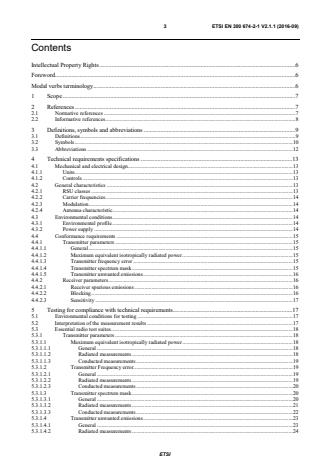
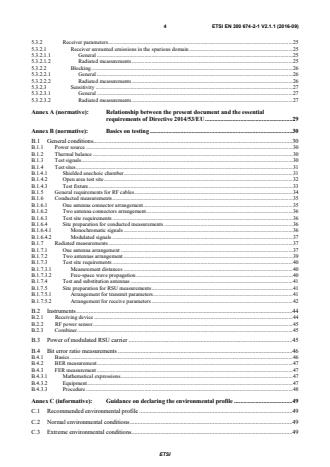
ETSI EN 300 674-2-1 V2.1.1 (2016-09) - Transport and Traffic Telematics (TTT); Dedicated Short Range Communication (DSRC) transmission equipment (500 kbit/s / 250 kbit/s) operating in the 5 795 MHz to 5 815 MHz frequency band; Part 2: Harmonised Standard covering the essential requirements of article 3.2 of the Directive 2014/53/EU; Sub-part 1: Road Side Units (RSU)

Overview
SIST EN 300 674-2-1 V2.1.1:2016 is a harmonised European standard developed by SIST for Transport and Traffic Telematics (TTT). This standard specifically addresses the requirements for Dedicated Short Range Communication (DSRC) transmission equipment, focusing on Road Side Units (RSU) operating within the 5.8 GHz Industrial, Scientific, and Medical (ISM) band. Covering data transmission at 500 kbit/s and 250 kbit/s, the document aims to demonstrate compliance with Article 3.2 of Directive 2014/53/EU, ensuring that radio equipment effectively uses and supports efficient use of the radio spectrum to avoid harmful interference.
The standard applies exclusively to RSUs with either a specified antenna or integral antenna, intended for road transport environments. It considers various real-world conditions and legislative frameworks, including alignment with the Commission Implementing Decision 2013/752/EU and CEPT/ERC Recommendation 70-03.
Key Topics
Scope and Applicability:
- Focuses on RSUs for data transmission within 5.725 GHz to 5.875 GHz frequency band.
- Outlines types of antennas and device configurations included.
- Exclusive to Road Side Units, not On-Board Units.
Regulatory Compliance:
- Addresses essential requirements of Article 3.2 of Directive 2014/53/EU.
- Aligns with European Commission Implementing Decision 2013/752/EU and CEPT/ERC Recommendation 70-03 for efficient spectrum use.
Radio Frequency Characteristics:
- Operating within defined sub-bands and channel assignments.
- Specifies general transmitter/receiver requirements to avoid unwanted emissions and interference.
Design and Performance Parameters:
- Requirements on mechanical and electrical design.
- Environmental conditions for equipment.
- Parameters like maximum equivalent isotropically radiated power (EIRP), spectrum mask, and transmitter frequency error.
Conformance Testing:
- Describes procedures and conditions for radio performance and compliance verification.
- Details test site, measurement, and equipment considerations to align with standard requirements.
Applications
The application of SIST EN 300 674-2-1 V2.1.1:2016 is critical in supporting a safe, efficient, and reliable road transport ecosystem through DSRC technology. Typical use cases include:
Electronic Toll Collection:
Allows automated toll transactions, minimizing congestion and improving user experience.Smart Traffic Management: Enables rapid communication between infrastructure and vehicles, supporting dynamic traffic control, congestion information, and road hazard warnings.
Fleet and Asset Tracking:
Facilitates real-time location and coordination of commercial vehicles, improving operational efficiency.Urban Mobility Solutions: Supports intelligent transportation systems (ITS) enabling services such as bus lane management, priority signaling for emergency vehicles, and integration with public transport systems.
Implementing this standard ensures interoperable, safe, and legally compliant RSUs that fit into Europe’s smart mobility frameworks.
Related Standards
For comprehensive system and regulatory alignment, consider the following related standards:
- SIST EN 300 674-2-2: Addresses requirements for On-Board Units (OBU) for DSRC.
- CEN EN 12253: Specifies the physical layer for DSRC at 5.8 GHz.
- CEN EN 12795: Covers DSRC data link layer, including medium access and logical link control.
- CEN EN 12834: Details the DSRC application layer requirements.
- ISO 14906: Defines the application interface for electronic fee collection via DSRC.
- CEPT/ERC Recommendation 70-03: Concerns the use of Short Range Devices (SRD).
- Directive 2014/53/EU: European legislative framework for radio equipment compliance.
Keywords: Transport and Traffic Telematics, Dedicated Short Range Communication, DSRC, Road Side Units, 5.8 GHz ISM band, radio equipment directive, spectrum efficiency, electronic toll collection, traffic management, smart mobility.
By following SIST EN 300 674-2-1 V2.1.1:2016, organizations ensure their RSUs contribute to a harmonized, efficient, and interoperable European transport infrastructure.
Buy Documents
ETSI EN 300 674-2-1 V2.0.2 (2016-01) - Transport and Traffic Telematics (TTT); Dedicated Short Range Communication (DSRC) transmission equipment (500 kbit/s / 250 kbit/s) operating in the 5,8 GHz Industrial, Scientific and Medical (ISM) band; Part 2: Harmonised Standard covering the essential requirements of article 3.2 of the Directive 2014/53/EU; Sub-part 1: Road Side Units (RSU)
ETSI EN 300 674-2-1 V2.1.0 (2016-07) - Transport and Traffic Telematics (TTT); Dedicated Short Range Communication (DSRC) transmission equipment (500 kbit/s / 250 kbit/s) operating in the 5 795 MHz to 5 815 MHz frequency band; Part 2: Harmonised Standard covering the essential requirements of article 3.2 of the Directive 2014/53/EU; Sub-part 1: Road Side Units (RSU)
ETSI EN 300 674-2-1 V2.1.1 (2016-09) - Transport and Traffic Telematics (TTT); Dedicated Short Range Communication (DSRC) transmission equipment (500 kbit/s / 250 kbit/s) operating in the 5 795 MHz to 5 815 MHz frequency band; Part 2: Harmonised Standard covering the essential requirements of article 3.2 of the Directive 2014/53/EU; Sub-part 1: Road Side Units (RSU)
Get Certified
Connect with accredited certification bodies for this standard

BSI Group
BSI (British Standards Institution) is the business standards company that helps organizations make excellence a habit.

NYCE
Mexican standards and certification body.

ANCE
Mexican certification and testing association.
Sponsored listings
Frequently Asked Questions
SIST EN 300 674-2-1 V2.1.1:2016 is a standard published by the Slovenian Institute for Standardization (SIST). Its full title is "Transport and Traffic Telematics (TTT) - Dedicated Short Range Communication (DSRC) transmission equipment (500 kbit/s / 250 kbit/s) operating in the 5,8 GHz Industrial, Scientific and Medical (ISM) band - Part 2: Harmonised Standard covering the essential requirements of article 3.2 of the Directive 2014/53/EU - Sub-part 1: Road Side Units (RSU)". This standard covers: The present document applies to Transport and Traffic Telematics (TTT) systems: • with a Radio Frequency (RF) output connection and specified antenna or with an integral antenna; • for data transmission only; • operating on radio frequencies in the 5,725 GHz to 5,875 GHz Short Range Devices frequency band. The applicability of the present document covers only the Road Side Units (RSU). The present document does not necessarily include all the characteristics which may be required by a user, nor does it necessarily represent the optimum performance achievable. The present document complies with the Commission Implementing Decision 2013/752/EU [1] and CEPT/ERC Recommendation 70-03 [2]. It is a specific standard covering various TTT applications. The present document contains requirements to demonstrate that radio equipment both effectively uses and supports the efficient use of radio spectrum in order to avoid harmful interference.
The present document applies to Transport and Traffic Telematics (TTT) systems: • with a Radio Frequency (RF) output connection and specified antenna or with an integral antenna; • for data transmission only; • operating on radio frequencies in the 5,725 GHz to 5,875 GHz Short Range Devices frequency band. The applicability of the present document covers only the Road Side Units (RSU). The present document does not necessarily include all the characteristics which may be required by a user, nor does it necessarily represent the optimum performance achievable. The present document complies with the Commission Implementing Decision 2013/752/EU [1] and CEPT/ERC Recommendation 70-03 [2]. It is a specific standard covering various TTT applications. The present document contains requirements to demonstrate that radio equipment both effectively uses and supports the efficient use of radio spectrum in order to avoid harmful interference.
SIST EN 300 674-2-1 V2.1.1:2016 is classified under the following ICS (International Classification for Standards) categories: 33.060.99 - Other equipment for radiocommunications; 35.240.60 - IT applications in transport. The ICS classification helps identify the subject area and facilitates finding related standards.
SIST EN 300 674-2-1 V2.1.1:2016 is associated with the following European legislation: EU Directives/Regulations: 2005-01-1864; Standardization Mandates: M/338. When a standard is cited in the Official Journal of the European Union, products manufactured in conformity with it benefit from a presumption of conformity with the essential requirements of the corresponding EU directive or regulation.
SIST EN 300 674-2-1 V2.1.1:2016 is available in PDF format for immediate download after purchase. The document can be added to your cart and obtained through the secure checkout process. Digital delivery ensures instant access to the complete standard document.
Standards Content (Sample)
Draft ETSI EN 300 674-2-1 V2.0.2 (2016-01)
HARMONISED EUROPEAN STANDARD
Transport and Traffic Telematics (TTT);
Dedicated Short Range Communication (DSRC) transmission
equipment (500 kbit/s / 250 kbit/s) operating in the 5,8 GHz
Industrial, Scientific and Medical (ISM) band;
Part 2: Harmonised Standard covering the essential
requirements of article 3.2 of the Directive 2014/53/EU;
Sub-part 1: Road Side Units (RSU)
2 Draft ETSI EN 300 674-2-1 V2.0.2 (2016-01)
Reference
REN/ERM-TG37-26
Keywords
data, DSRC, radio, regulation, RTTT, testing
ETSI
650 Route des Lucioles
F-06921 Sophia Antipolis Cedex - FRANCE
Tel.: +33 4 92 94 42 00 Fax: +33 4 93 65 47 16
Siret N° 348 623 562 00017 - NAF 742 C
Association à but non lucratif enregistrée à la
Sous-Préfecture de Grasse (06) N° 7803/88
Important notice
The present document can be downloaded from:
http://www.etsi.org/standards-search
The present document may be made available in electronic versions and/or in print. The content of any electronic and/or
print versions of the present document shall not be modified without the prior written authorization of ETSI. In case of any
existing or perceived difference in contents between such versions and/or in print, the only prevailing document is the
print of the Portable Document Format (PDF) version kept on a specific network drive within ETSI Secretariat.
Users of the present document should be aware that the document may be subject to revision or change of status.
Information on the current status of this and other ETSI documents is available at
http://portal.etsi.org/tb/status/status.asp
If you find errors in the present document, please send your comment to one of the following services:
https://portal.etsi.org/People/CommiteeSupportStaff.aspx
Copyright Notification
No part may be reproduced or utilized in any form or by any means, electronic or mechanical, including photocopying
and microfilm except as authorized by written permission of ETSI.
The content of the PDF version shall not be modified without the written authorization of ETSI.
The copyright and the foregoing restriction extend to reproduction in all media.
© European Telecommunications Standards Institute 2016.
All rights reserved.
TM TM TM
DECT , PLUGTESTS , UMTS and the ETSI logo are Trade Marks of ETSI registered for the benefit of its Members.
TM
3GPP and LTE™ are Trade Marks of ETSI registered for the benefit of its Members and
of the 3GPP Organizational Partners.
GSM® and the GSM logo are Trade Marks registered and owned by the GSM Association.
ETSI
3 Draft ETSI EN 300 674-2-1 V2.0.2 (2016-01)
Contents
Intellectual Property Rights . 6
Foreword . 6
Modal verbs terminology . 6
1 Scope . 7
2 References . 7
2.1 Normative references . 7
2.2 Informative references . 8
3 Definitions, symbols and abbreviations . 9
3.1 Definitions . 9
3.2 Symbols . 10
3.3 Abbreviations . 12
4 Technical requirements specifications . 13
4.1 Mechanical and electrical design . 13
4.1.1 Units. 13
4.1.2 Controls . 13
4.2 General characteristics . 13
4.2.1 RSU classes . 13
4.2.2 Carrier frequencies . 14
4.2.3 Modulation . 14
4.2.4 Antenna characteristic . 14
4.3 Environmental conditions . 14
4.3.1 Environmental profile . 14
4.3.2 Power supply . 14
4.4 Conformance requirements . 14
4.4.1 Transmitter parameters . 14
4.4.1.1 General . 14
4.4.1.2 Maximum equivalent isotropically radiated power . 15
4.4.1.3 Transmitter frequency error . 15
4.4.1.4 Transmitter spectrum mask . 15
4.4.1.5 Transmitter unwanted emissions . 15
4.4.2 Receiver parameters . 16
4.4.2.1 Receiver spurious emissions . 16
4.4.2.2 Blocking . 16
4.4.2.3 Sensitivity . 16
5 Testing for compliance with technical requirements . 17
5.1 Environmental conditions for testing . 17
5.2 Interpretation of the measurement results . 17
5.3 Essential radio test suites . 17
5.3.1 Transmitter parameters . 17
5.3.1.1 Maximum equivalent isotropically radiated power . 17
5.3.1.1.1 General . 17
5.3.1.1.2 Radiated measurements . 18
5.3.1.1.3 Conducted measurements . 18
5.3.1.2 Transmitter Frequency error. 19
5.3.1.2.1 General . 19
5.3.1.2.2 Radiated measurements . 19
5.3.1.2.3 Conducted measurements . 19
5.3.1.3 Transmitter spectrum mask . 20
5.3.1.3.1 General . 20
5.3.1.3.2 Radiated measurements . 20
5.3.1.3.3 Conducted measurements . 21
5.3.1.4 Transmitter unwanted emissions . 23
5.3.1.4.1 General . 23
5.3.1.4.2 Radiated measurements . 24
ETSI
4 Draft ETSI EN 300 674-2-1 V2.0.2 (2016-01)
5.3.2 Receiver parameters . 25
5.3.2.1 Receiver unwanted emissions in the spurious domain . 25
5.3.2.1.1 General . 25
5.3.2.1.2 Radiated measurements . 25
5.3.2.2 Blocking . 25
5.3.2.2.1 General . 25
5.3.2.2.2 Radiated measurements . 25
5.3.2.3 Sensitivity . 26
5.3.2.3.1 General . 26
5.3.2.3.2 Radiated measurements . 26
Annex A (normative): Relationship between the present document and the essential
requirements of Directive 2014/53/EU . 28
Annex B (normative): Basics on testing . 29
B.1 General conditions . 29
B.1.1 Power source . 29
B.1.2 Thermal balance . 29
B.1.3 Test signals . 29
B.1.4 Test sites . 30
B.1.4.1 Shielded anechoic chamber. 30
B.1.4.2 Open area test site . 31
B.1.4.3 Test fixture . 32
B.1.5 General requirements for RF cables . 33
B.1.6 Conducted measurements . 34
B.1.6.1 One antenna connector arrangement . 34
B.1.6.2 Two antenna connectors arrangement. 35
B.1.6.3 Test site requirements . 35
B.1.6.4 Site preparation for conducted measurements . 35
B.1.6.4.1 Monochromatic signals . 35
B.1.6.4.2 Modulated signals . 36
B.1.7 Radiated measurements . 36
B.1.7.1 One antenna arrangement . 36
B.1.7.2 Two antennas arrangement . 38
B.1.7.3 Test site requirements . 39
B.1.7.3.1 Measurement distances . 39
B.1.7.3.2 Free-space wave propagation . 39
B.1.7.4 Test and substitution antennas . 40
B.1.7.5 Site preparation for RSU measurements . 40
B.1.7.5.1 Arrangement for transmit parameters. 40
B.1.7.5.2 Arrangement for receive parameters . 41
B.2 Instruments . 43
B.2.1 Receiving device . 43
B.2.2 RF power sensor . 44
B.2.3 Combiner . 44
B.3 Power of modulated RSU carrier . 44
B.4 Bit error ratio measurements . 45
B.4.1 Basics . 45
B.4.2 BER measurement . 46
B.4.3 FER measurement . 46
B.4.3.1 Mathematical expressions . 46
B.4.3.2 Equipment . 46
B.4.3.3 Procedure . 47
Annex C (informative): Guidance on declaring the environmental profile . 48
C.1 Recommended environmental profile . 48
C.2 Normal environmental conditions . 48
C.3 Extreme environmental conditions . 48
ETSI
5 Draft ETSI EN 300 674-2-1 V2.0.2 (2016-01)
Annex D (informative): Bibliography . 49
Annex E (informative): Change History . 50
History . 51
ETSI
6 Draft ETSI EN 300 674-2-1 V2.0.2 (2016-01)
Intellectual Property Rights
IPRs essential or potentially essential to the present document may have been declared to ETSI. The information
pertaining to these essential IPRs, if any, is publicly available for ETSI members and non-members, and can be found
in ETSI SR 000 314: "Intellectual Property Rights (IPRs); Essential, or potentially Essential, IPRs notified to ETSI in
respect of ETSI standards", which is available from the ETSI Secretariat. Latest updates are available on the ETSI Web
server (https://ipr.etsi.org/).
Pursuant to the ETSI IPR Policy, no investigation, including IPR searches, has been carried out by ETSI. No guarantee
can be given as to the existence of other IPRs not referenced in ETSI SR 000 314 (or the updates on the ETSI Web
server) which are, or may be, or may become, essential to the present document.
Foreword
This draft Harmonised European Standard (EN) has been produced by ETSI Technical Committee Electromagnetic
compatibility and Radio spectrum Matters (ERM), and is now submitted for the combined Public Enquiry and Vote
phase of the ETSI standards EN Approval Procedure.
The present document has been prepared under the Commission's standardisation request C(2015) 5376 final [i.6] to
provide one voluntary means of conforming to the essential requirements of Directive 2014/53/EU on the harmonisation
of the laws of the Member States relating to the making available on the market of radio equipment and repealing
Directive 1999/5/EC [i.5].
Once the present document is cited in the Official Journal of the European Union under that Directive, compliance with
the normative clauses of the present document given in table A.1 confers, within the limits of the scope of the present
document, a presumption of conformity with the corresponding essential requirements of that Directive and associated
EFTA regulations.
The present document is part 2, sub-part 1 of a multi-part deliverable covering Transport and Traffic Telematics (TTT);
Dedicated Short Range Communication (DSRC) transmission equipment (500 kbit/s / 250 kbit/s) operating in the
5,8 GHz Industrial, Scientific and Medical (ISM) band, as identified below:
Part 1: "General characteristics and test methods for Road Side Units (RSU) and On-Board Units (OBU)";
Part 2: "Harmonised Standard covering the essential requirements of article 3.2 of the Directive
2014/53/EU";
Sub-part 1: "Road Side Units (RSU)";
Sub-part 2: "On-Board Units (OBU)".
Proposed national transposition dates
Date of latest announcement of this EN (doa): 3 months after ETSI publication
Date of latest publication of new National Standard
or endorsement of this EN (dop/e): 6 months after doa
Date of withdrawal of any conflicting National Standard (dow): 2017-06-12
Modal verbs terminology
In the present document "shall", "shall not", "should", "should not", "may", "need not", "will", "will not", "can" and
"cannot" are to be interpreted as described in clause 3.2 of the ETSI Drafting Rules (Verbal forms for the expression of
provisions).
"must" and "must not" are NOT allowed in ETSI deliverables except when used in direct citation.
ETSI
7 Draft ETSI EN 300 674-2-1 V2.0.2 (2016-01)
1 Scope
The present document applies to Transport and Traffic Telematics (TTT) systems:
• with a Radio Frequency (RF) output connection and specified antenna or with an integral antenna;
• for data transmission only;
• operating on radio frequencies in the 5,725 GHz to 5,875 GHz Industrial, Scientific and Medical (ISM)
frequency band.
The applicability of the present document covers only the Road Side Units (RSU).
The present document does not necessarily include all the characteristics which may be required by a user, nor does it
necessarily represent the optimum performance achievable.
The present document complies with the Commission Implementing Decision 2013/752/EU [1] and CEPT/ERC
Recommendation 70-03 [2]. It is a specific standard covering various TTT applications.
The present document applies to the following radio equipment types operating in all or in part of the following service
frequency bands given in table 1.
Table 1: Frequency bands and centre frequencies f allocated for DSRC
Tx
Pan European Service Frequencies National Service Frequencies
Channel 1 5,795 GHz to 5,800 GHz, f = 5,7975 GHz
tX
Channel 2 5,800 GHz to 5,805 GHz, f = 5,8025 GHz
tX
Channel 3 5,805 GHz to 5,810 GHz, f = 5,8075 GHz
tX
Channel 4 5,810 GHz to 5,815 GHz, f = 5,8125 GHz
tX
The present document contains requirements to demonstrate that radio equipment both effectively uses and supports the
efficient use of radio spectrum in order to avoid harmful interference.
2 References
2.1 Normative references
References are either specific (identified by date of publication and/or edition number or version number) or
non-specific. For specific references, only the cited version applies. For non-specific references, the latest version of the
referenced document (including any amendments) applies.
Referenced documents which are not found to be publicly available in the expected location might be found at
http://docbox.etsi.org/Reference.
NOTE: While any hyperlinks included in this clause were valid at the time of publication, ETSI cannot guarantee
their long term validity.
The following referenced documents are necessary for the application of the present document.
[1] Commission Decision 2013/752/EU: "Commission Implementing Decision of 11 December 2013
amending Decision 2006/771/EC on harmonisation of the radio spectrum for use by short-range
devices and repealing Decision 2005/928/EC".
[2] CEPT/ERC Recommendation 70-03: "Relating to the use of Short Range Devices (SRD)".
[3] CEN EN 12253:2004: "Road transport and traffic telematics - Dedicated short-range
communication - Physical layer using microwave at 5,8 GHz".
[4] ETSI TR 100 028 (V1.4.1 - all parts) (12-2001): "Electromagnetic compatibility and Radio
spectrum Matters (ERM); Uncertainties in the measurement of mobile radio equipment
characteristics".
ETSI
8 Draft ETSI EN 300 674-2-1 V2.0.2 (2016-01)
[5] IEC 60721-3-4:1995 including Amendment 1:1996: "Classification of environmental conditions -
Part 3: Classification of groups of environmental parameters and their severities - Section 4:
Stationary use at non-weatherprotected locations".
[6] IEC 60721-3-5:1997: "Classification of environmental conditions - Part 3: Classification of groups
of environmental parameters and their severities - Section 5: Ground vehicle installations".
[7] CEN EN 12795:2003: "Road transport and traffic telematics - Dedicated Short Range
Communication (DSRC) - DSRC data link layer: medium access and logical link control".
[8] CEN EN 12834:2003: "Road transport and traffic telematics - Dedicated Short Range
Communication (DSRC) - DSRC application layer".
[9] ISO 14906 (2011): "Electronic fee collection -- Application interface definition for dedicated
short-range communication".
[10] CEPT/ERC Recommendation 74-01E (2011): "Unwanted emissions in the spurious domain".
[11] ETSI TR 102 273-2 (V1.2.1) (12-2001): "Electromagnetic compatibility and Radio spectrum
Matters (ERM); Improvement on Radiated Methods of Measurement (using test site) and
evaluation of the corresponding measurement uncertainties; Part 2: Anechoic chamber".
[12] ETSI TR 102 273-6 (V1.2.1) (12-2001): "Electromagnetic compatibility and Radio spectrum
Matters (ERM); Improvement on Radiated Methods of Measurement (using test site) and
evaluation of the corresponding measurement uncertainties; Part 6: Test fixtures".
[13] CISPR 16-1 (2015): "Specification for radio disturbance and immunity measuring apparatus and
methods - Part 1: Radio disturbance and immunity measuring apparatus".
2.2 Informative references
References are either specific (identified by date of publication and/or edition number or version number) or
non-specific. For specific references, only the cited version applies. For non-specific references, the latest version of the
referenced document (including any amendments) applies.
NOTE: While any hyperlinks included in this clause were valid at the time of publication, ETSI cannot guarantee
their long term validity.
The following referenced documents are not necessary for the application of the present document but they assist the
user with regard to a particular subject area.
[i.1] ETSI EN 300 674-1: "Electromagnetic compatibility and Radio spectrum Matters (ERM); Road
Transport and Traffic Telematics (RTTT); Dedicated Short Range Communication (DSRC)
transmission equipment (500 kbit/s / 250 kbit/s) operating in the 5,8 GHz Industrial, Scientific and
Medical (ISM) band; Part 1: General characteristics and test methods for Road Side Units (RSU)
and On-Board Units (OBU)".
[i.2] ETSI EN 300 674-2-2: "Electromagnetic compatibility and Radio spectrum Matters (ERM);
Transport and Traffic Telematics (TTT); Dedicated Short Range Communication (DSRC)
transmission equipment (500 kbit/s / 250 kbit/s) operating in the 5,8 GHz Industrial, Scientific and
Medical (ISM) band; Part 2: Harmonised Standard covering the essential requirements of
article 3.2 of Directive 2014/53/EU; Sub-part 2: On-Board Units (OBU)".
[i.3] ETSI TR 102 273-4 (V1.2.1): "Electromagnetic compatibility and Radio spectrum Matters (ERM);
Improvement on Radiated Methods of Measurement (using test site) and evaluation of the
corresponding measurement uncertainties; Part 4: Open area test site".
[i.4] Commission Directive 95/54/EC of 31 October 1995 adapting to technical progress Council
Directive 72/245/EEC on the approximation of the laws of the Member States relating to the
suppression of radio interference produced by spark-ignition engines fitted to motor vehicles and
amending Directive 70/156/EEC on the approximation of the laws of the Member States relating
to the type-approval of motor vehicles and their trailers.
ETSI
9 Draft ETSI EN 300 674-2-1 V2.0.2 (2016-01)
[i.5] Directive 2014/53/EU of the European Parliament and of the Council of 16 April 2014 on the
harmonisation of the laws of the Member States relating to the making available on the market of
radio equipment and repealing Directive 1999/5/EC.
[i.6] Commission Implementing Decision C(2015) 5376 final of 4.8.2015 on a standardisation request
to the European Committee for Electrotechnical Standardisation and to the European
Telecommunications Standards Institute as regards radio equipment in support of Directive
2014/53/EU of the European Parliament and of the Council.
3 Definitions, symbols and abbreviations
3.1 Definitions
For the purposes of the present document, the terms and definitions given in Directive 2014/53/EU [i.5] and the
following apply:
adjacent channel: channel at a distance of 5 MHz relative to the centre frequency, i.e. in the channel at the next upper
or lower centre frequency
bit: acronym for "binary digit" which can have one out of two possible values
EXAMPLE: 0/1, or +1/-1, or low/high.
bit rate: in a bit stream, the number of bits occurring per unit time, usually expressed in bits per second
boresight: direction of maximum radiation of a directional antenna
NOTE: If boresight cannot be determined unambiguously, then boresight may be declared by the manufacturer.
carrier frequency: frequency f to which the RSU transmitter is tuned
Tx
NOTE: In DSRC, the carrier frequency is in the centre of a channel, see table 2 of the present document.
carrier signal or carrier: harmonic signal whose nominal single frequency f can vary within a range specified by the
Tx
carrier frequency tolerance and which is capable of being modulated by a second, symbol-carrying signal
channel: continuous part of the radio-frequency spectrum to be used for a specified emission or transmission
NOTE: A radio-frequency channel may be defined by two specified limits, or by its centre frequency and its
bandwidth, or any equivalent indication. It is often designated by a sequential number. A radio-frequency
channel may be time-shared in order to allow radio communication in both directions by simplex
operation. The term "channel" is sometimes used to denote two associated radio-frequency channels, each
of which is used for one of two directions of transmission, i.e. in fact a telecommunication circuit.
co-channel: transmission using the same channel (frequency band of 5 MHz width)
cross-polar discrimination (XPD): ratio P / P of power P of the left hand circular polarized wave to the
LHCP RHCP LHCP
power P of the right hand circular wave when the total power of the transmitted wave is P + P
RHCP LHCP RHCP
downlink: transmission in direction from RSU to OBU
ellipticity of polarization: ratio of the polarization main axes of an elliptic polarized radio wave
EXAMPLE: The ellipticity of circular polarized radio waves is one.
The ellipticity of linear polarized waves is infinity.
environmental profile: range of environmental conditions under which equipment within the scope of the present
document is required to comply with the provisions of the present document
equivalent isotropically radiated power: signal power fed into an ideal loss-less antenna radiating equally in all
directions that generates the same power flux at a reference distance as the one generated by a signal fed into the
antenna under consideration in a predefined direction within its far field region
integral antenna: antenna, with or without a connector, designed as an indispensable part of the equipment
ETSI
10 Draft ETSI EN 300 674-2-1 V2.0.2 (2016-01)
OBU sleep mode: optional mode for battery powered OBUs that allows to save battery power
NOTE: In this mode, the OBU can only detect the presence of a DSRC downlink signal to initiate under certain
defined conditions a transition to the stand-by mode.
OBU stand-by mode: mode, in which the OBU is capable of receiving DSRC downlink signals, but is never
transmitting
operating frequency: nominal frequency at which equipment is operated; also referred to as the operating centre
frequency
NOTE: Equipment may be able to operate at more than one operating frequency.
out-of-band emissions: emissions on a frequency or frequencies immediately outside the necessary bandwidth which
results from the modulation process and which cannot be reduced without affecting the corresponding transmission of
information, but excluding spurious emissions (see also CEPT/ERC Recommendation 74-01E [10])
polarization: locus of the tip of the electrical field vector in a plane perpendicular to the direction of transmission
EXAMPLE: Horizontal and vertical linear polarization
Left and right hand circular polarization.
Portable Equipment (PE): generally intended to be self-contained, free standing and portable
NOTE: A PE would normally consist of a single module, but may consist of several interconnected modules. It is
powered by one or more internal batteries.
radiated measurements: measurements which involve the measurement of a radiated electromagnetic field
spurious emissions: emission on a frequency, or frequencies, which are outside an exclusion band of ±2,5 times the
channel spacing around the selected centre frequency f , and the level of which may be reduced without affecting the
Tx
corresponding transmission of information
NOTE: Spurious emissions include harmonic emissions, parasitic emissions, intermodulation products and
frequency conversion products but exclude out-of-band emissions (see also CEPT/ERC
Recommendation 74-01E [10]).
uplink: transmission in direction from OBU to RSU
3.2 Symbols
For the purposes of the present document, the following symbols apply:
A Amplitude of CW signal
CW
A Amplitude of modulated signal
mod
ATN Attenuation of attenuator AT2
AT2
ATN Attenuation of balun BLN
BLN
Attenuation of calibrated coaxial cable 1
ATN
CA1
BER Bit Error Ratio
C Number of frames transmitted
F
C Number of erroneous frames received
E
d Distance between phase centres of transmitting and receiving antenna
d Horizontal displacement of TTA and RTA antenna phase centres
displace
d Distance from transmitting antenna to first Fresnel ellipse
F1
d Distance from first Fresnel ellipse to receiving antenna
F2
D Distance between neighbouring ferrite beads
fb
D Directivity relative to an isotropic radiator
i
D Largest linear dimension of test antenna
0,TA
D Largest linear dimension of EUT antenna
0,EUT
EIRP Maximum e.i.r.p. of RSU
max
EIRP Maximum e.i.r.p. generated by the OBU in a single side band
MaxObuTx
ETSI
11 Draft ETSI EN 300 674-2-1 V2.0.2 (2016-01)
EIRP e.i.r.p. generated by the OBU within a single side band
ObuTx
EIRP e.i.r.p. generated by the OBU antenna
OBU
EIRP e.i.r.p. referred to transmitter spectrum mask
TSM
Δf Frequency error of RSU
RSU
Δf Sub-carrier frequency error
s
f Frequency
f Centre frequency of receiving device or of MSS2 used for calibration
c
FER Frame error ratio
f Actual centre frequency of the lower and upper side band of the OBU uplink channel
ObuTx
f Frequency of MSS1
MSS1
Offset frequency
f
offset
f Nominal OBU sub-carrier frequency
s
f Nominal RSU carrier frequency
Tx
f Actual centre frequency of the downlink carrier
Tx,actual
f Nominal centre frequency of unwanted signal
u
f , f Centre frequencies of unwanted signal
u1 u2
G Conversion gain
c
G Correction gain
corr
G Gain of OBU receiving antenna
OBU,Rx
G Gain of OBU transmitting antenna
OBU,Tx
G Gain of receiving substitution antenna
RSA
G Gain of test antenna
TA
G Gain of transmitting substitution antenna
TSA
G Gain of RSU transmitting antenna
RSU,Tx
k Expansion factor (coverage factor)
lg(.) Logarithm to the base ten
m Modulation index
N Total number of transmitted bits within a single frame
P Power of CW signal
CW
P Power limit for communication (upper)
D11a
P Power limit for communication (lower)
D11b
P Incident signal power as received by an ideal isotropical receiving antenna
inc
P Incident signal power obtained from a scanning process
inc,scan
P P in dBm
inc,dBm inc
P Signal power of left hand circular polarized wave
LHCP
P Maximum signal power
max
P Power of modulated signal
mod
P Output signal power of MSS1
MMS1
P Output signal power of MSS2
MMS2
P Incident signal power to OBU, referred to an ideal isotropical receiving antenna
ObuRx
P Signal power of wave with corresponding polarization
pol
P Signal power of wave featuring vertical polarization
v
P Signal power of wave featuring horizontal polarization
h
P Signal power measured by the power meter 1
PM1
Reference signal power limit in Watt
P
ref
P Reference signal power limit in dBm
ref,dBm
P Retransmitted signal power
reTx
P Signal power obtained from receiving substitution antenna
RSA
P Signal power of right hand circular polarized wave
RHCP
P Signal power within single side band
ssb
P Declared sensitivity of receiver
sens
ETSI
12 Draft ETSI EN 300 674-2-1 V2.0.2 (2016-01)
P Signal power of spurious signal
spurious
P Sum of signal power P + P , or P + P + . + P , whichever applies
tot 1 2 1 2 5
P P in dBm
tot,dBm tot
P Transmitter spectrum mask
TSM
P Power of unwanted signal at RSU antenna
u
P Unwanted signal power limit at RSU antenna
u max
P Signal power of wanted signal
w
P Reference signal power of 1 mW corresponding to 0 dBm
RBW Resolution bandwidth
T Duration of CW signal
CW
T Duration of modulated signal
mod
V , V Maximal amplitude of modulated output signal of RSU caused by data bit 1, or 0
max min
α Tilt angle of test antenna
α Displacement angle between TTA and RTA
displace
θ Angle relative to OBU boresight indicating worst case direction
θ° Value of θ measured in degree
Wavelength
λ
ρ Reflection coefficient at antenna connector of the receiving substitution antenna
RSA
ρ Reflection coefficient at antenna connector of the transmitting substitution antenna
TSA
3.3 Abbreviations
For the purposes of the present document the abbreviations given in CEN EN 12253 [3] and the following apply:
AT1 Attenuator 1
AT2 Attenuator 2
BER Bit Error Ratio
BLN Balun
BST Beacon Service table
CC Coaxial Circulator
CISPR Comité International Spécial des Perturbations Radioélectriques
CRC Cyclic Redundancy Checking
CW Continuous Wave
DC Direct Current
doa date of announcement
dop date of publication
dow date of withdrawal
DSRC Dedicated Short Range Communication
e.i.r.p. Equivalent Isotropically Radiated Power also called EIRP, eirp, E.I.R.P.
EC European Community
ECC European Community Commission
EFC Electronic Fee Collection
EFTA European Free Trade Association
EUT Equipment Under Test
FCCA Ferrited Coaxial CAble
FCCA1 Ferrited Coaxial CAble 1
FER Frame Error Ratio
IEC International Electrotechnical Commission
ISM Industrial, Scientific, Medical
LHCP Left Hand Circular Polarized
LOS Line-Of-Sight
LP Linear Polarized
M Centre point between phase centres of TTA and RTA
centre
MSS1 Monochromatic Signal Source 1
MSS2 Monochromatic Signal Source 2
OBU On Board Unit
PE Portable Equipment
PM1 Power Meter 1
ETSI
13 Draft ETSI EN 300 674-2-1 V2.0.2 (2016-01)
-6
ppm parts per million (10 )
RBW Resolution BandWidth
RD Receiving Device
REC RECommendation
RF Radio Frequency
RRxA RSU Receiving Antenna
RSA Receiving Substitution Antenna
RSU Road Side Unit
RTA Receiving Test Antenna
RTTT Road Transport and Traffic Telematics
RTxA RSU Transmitting Antenna
Rx Receiver
SMS1 Signal or Message Source 1
SR Special Report
TA Test Antenna
TM1 Test Message 1
TS1 Test Signal 1
TS2 Test Signal 2
TSA Transmitting Substitution Antenna
TSM Transmitter Spectrum Mask
TTA Transmitting Test Antenna
TTT Transport and Traffic Telematics
Tx Transmitter
VBW Video BandWidth
VST Vehicle Service Table
VSWR Voltage Standing Wave Ratio
XP Cross Polarized
XPD Cross-Polar Discrimination
4 Technical requirements specifications
4.1 Mechanical and electrical design
4.1.1 Units
The present document specifies the characteristics of Road Side Units.
Transmitters and receivers may be individual or combination units; some units may be transmitter only, some units may
be receiver only and some units may combine transmitter and receiver functionalities.
4.1.2 Controls
Those controls which if maladjusted might increase the interference possibilities to and from the equipment shall only
be accessible by partial or complete disassembly of the device and requiring the use of tools.
4.2 General characteristics
4.2.1 RSU classes
There exist three classes of RSUs which are distinguished by the parameter D2 (4) "in band spurious emissions with
modulated carrier wave" of CEN EN 12253 [3].
Those classes are called class A, class B and class C, see table 3. The manufacturer shall declare to which class the
equipment complies with.
NOTE: The use of class A for new equipment is not recommended.
ETSI
14 Draft ETSI EN 300 674-2-1 V2.0.2 (2016-01)
4.2.2 Carrier frequencies
The present document applies to RSUs operating in some or all of the following channels detailed in table 2.
The centre frequencies f indicated in table 2 are referred to as parameter D1 in CEN EN 12253 [3].
Tx
Table 2: Frequency bands and centre frequencies f allocated for DSRC
Tx
Pan European Service Frequencies National Service Frequencies
Channel 1 5,795 GHz to 5,800 GHz, f = 5,7975 GHz
Tx
Channel 2 5,800 GHz to 5,805 GHz, f = 5,8025 GHz
Tx
5,805 GHz to 5,810 GHz, f = 5,8075 GHz
Channel 3
Tx
Channel 4 5,810 GHz to 5,815 GHz, f = 5,8125 GHz
Tx
Where equipment can be adjusted to operate at different operating frequencies other than channel 1 and channel 2, a
...
Final draft ETSI EN 300 674-2-1 V2.1.0 (2016-07)
HARMONISED EUROPEAN STANDARD
Transport and Traffic Telematics (TTT);
Dedicated Short Range Communication (DSRC)
transmission equipment (500 kbit/s / 250 kbit/s)
operating in the 5 795 MHz to 5 815 MHz frequency band;
Part 2: Harmonised Standard covering the essential
requirements of article 3.2 of the Directive 2014/53/EU;
Sub-part 1: Road Side Units (RSU)
2 Final draft ETSI EN 300 674-2-1 V2.1.0 (2016-07)
Reference
REN/ERM-TG37-26
Keywords
data, DSRC, Harmonised standard, radio,
regulation, RTTT, testing
ETSI
650 Route des Lucioles
F-06921 Sophia Antipolis Cedex - FRANCE
Tel.: +33 4 92 94 42 00 Fax: +33 4 93 65 47 16
Siret N° 348 623 562 00017 - NAF 742 C
Association à but non lucratif enregistrée à la
Sous-Préfecture de Grasse (06) N° 7803/88
Important notice
The present document can be downloaded from:
http://www.etsi.org/standards-search
The present document may be made available in electronic versions and/or in print. The content of any electronic and/or
print versions of the present document shall not be modified without the prior written authorization of ETSI. In case of any
existing or perceived difference in contents between such versions and/or in print, the only prevailing document is the
print of the Portable Document Format (PDF) version kept on a specific network drive within ETSI Secretariat.
Users of the present document should be aware that the document may be subject to revision or change of status.
Information on the current status of this and other ETSI documents is available at
https://portal.etsi.org/TB/ETSIDeliverableStatus.aspx
If you find errors in the present document, please send your comment to one of the following services:
https://portal.etsi.org/People/CommiteeSupportStaff.aspx
Copyright Notification
No part may be reproduced or utilized in any form or by any means, electronic or mechanical, including photocopying
and microfilm except as authorized by written permission of ETSI.
The content of the PDF version shall not be modified without the written authorization of ETSI.
The copyright and the foregoing restriction extend to reproduction in all media.
© European Telecommunications Standards Institute 2016.
All rights reserved.
TM TM TM
DECT , PLUGTESTS , UMTS and the ETSI logo are Trade Marks of ETSI registered for the benefit of its Members.
TM
3GPP and LTE™ are Trade Marks of ETSI registered for the benefit of its Members and
of the 3GPP Organizational Partners.
GSM® and the GSM logo are Trade Marks registered and owned by the GSM Association.
ETSI
3 Final draft ETSI EN 300 674-2-1 V2.1.0 (2016-07)
Contents
Intellectual Property Rights . 6
Foreword . 6
Modal verbs terminology . 6
1 Scope . 7
2 References . 7
2.1 Normative references . 7
2.2 Informative references . 8
3 Definitions, symbols and abbreviations . 9
3.1 Definitions . 9
3.2 Symbols . 10
3.3 Abbreviations . 12
4 Technical requirements specifications . 13
4.1 Mechanical and electrical design . 13
4.1.1 Units. 13
4.1.2 Controls . 13
4.2 General characteristics . 13
4.2.1 RSU classes . 13
4.2.2 Carrier frequencies . 14
4.2.3 Modulation . 14
4.2.4 Antenna characteristic . 14
4.3 Environmental conditions . 14
4.3.1 Environmental profile . 14
4.3.2 Power supply . 14
4.4 Conformance requirements . 15
4.4.1 Transmitter parameters . 15
4.4.1.1 General . 15
4.4.1.2 Maximum equivalent isotropically radiated power . 15
4.4.1.3 Transmitter frequency error . 15
4.4.1.4 Transmitter spectrum mask . 15
4.4.1.5 Transmitter unwanted emissions . 16
4.4.2 Receiver parameters . 16
4.4.2.1 Receiver spurious emissions . 16
4.4.2.2 Blocking . 16
4.4.2.3 Sensitivity . 17
5 Testing for compliance with technical requirements . 17
5.1 Environmental conditions for testing . 17
5.2 Interpretation of the measurement results . 17
5.3 Essential radio test suites . 18
5.3.1 Transmitter parameters . 18
5.3.1.1 Maximum equivalent isotropically radiated power . 18
5.3.1.1.1 General . 18
5.3.1.1.2 Radiated measurements . 18
5.3.1.1.3 Conducted measurements . 19
5.3.1.2 Transmitter Frequency error. 19
5.3.1.2.1 General . 19
5.3.1.2.2 Radiated measurements . 19
5.3.1.2.3 Conducted measurements . 20
5.3.1.3 Transmitter spectrum mask . 20
5.3.1.3.1 General . 20
5.3.1.3.2 Radiated measurements . 21
5.3.1.3.3 Conducted measurements . 22
5.3.1.4 Transmitter unwanted emissions . 23
5.3.1.4.1 General . 23
5.3.1.4.2 Radiated measurements . 24
ETSI
4 Final draft ETSI EN 300 674-2-1 V2.1.0 (2016-07)
5.3.2 Receiver parameters . 25
5.3.2.1 Receiver unwanted emissions in the spurious domain . 25
5.3.2.1.1 General . 25
5.3.2.1.2 Radiated measurements . 25
5.3.2.2 Blocking . 26
5.3.2.2.1 General . 26
5.3.2.2.2 Radiated measurements . 26
5.3.2.3 Sensitivity . 27
5.3.2.3.1 General . 27
5.3.2.3.2 Radiated measurements . 27
Annex A (normative): Relationship between the present document and the essential
requirements of Directive 2014/53/EU . 29
Annex B (normative): Basics on testing . 30
B.1 General conditions . 30
B.1.1 Power source . 30
B.1.2 Thermal balance . 30
B.1.3 Test signals . 30
B.1.4 Test sites . 31
B.1.4.1 Shielded anechoic chamber. 31
B.1.4.2 Open area test site . 32
B.1.4.3 Test fixture . 33
B.1.5 General requirements for RF cables . 34
B.1.6 Conducted measurements . 35
B.1.6.1 One antenna connector arrangement . 35
B.1.6.2 Two antenna connectors arrangement. 36
B.1.6.3 Test site requirements . 36
B.1.6.4 Site preparation for conducted measurements . 36
B.1.6.4.1 Monochromatic signals . 36
B.1.6.4.2 Modulated signals . 37
B.1.7 Radiated measurements . 37
B.1.7.1 One antenna arrangement . 37
B.1.7.2 Two antennas arrangement . 39
B.1.7.3 Test site requirements . 40
B.1.7.3.1 Measurement distances . 40
B.1.7.3.2 Free-space wave propagation . 40
B.1.7.4 Test and substitution antennas . 41
B.1.7.5 Site preparation for RSU measurements . 41
B.1.7.5.1 Arrangement for transmit parameters. 41
B.1.7.5.2 Arrangement for receive parameters . 42
B.2 Instruments . 44
B.2.1 Receiving device . 44
B.2.2 RF power sensor . 45
B.2.3 Combiner . 45
B.3 Power of modulated RSU carrier . 45
B.4 Bit error ratio measurements . 46
B.4.1 Basics . 46
B.4.2 BER measurement . 47
B.4.3 FER measurement . 47
B.4.3.1 Mathematical expressions . 47
B.4.3.2 Equipment . 47
B.4.3.3 Procedure . 48
Annex C (informative): Guidance on declaring the environmental profile . 49
C.1 Recommended environmental profile . 49
C.2 Normal environmental conditions . 49
C.3 Extreme environmental conditions . 49
ETSI
5 Final draft ETSI EN 300 674-2-1 V2.1.0 (2016-07)
Annex D (informative): Bibliography . 50
Annex E (informative): Change History . 51
History . 52
ETSI
6 Final draft ETSI EN 300 674-2-1 V2.1.0 (2016-07)
Intellectual Property Rights
IPRs essential or potentially essential to the present document may have been declared to ETSI. The information
pertaining to these essential IPRs, if any, is publicly available for ETSI members and non-members, and can be found
in ETSI SR 000 314: "Intellectual Property Rights (IPRs); Essential, or potentially Essential, IPRs notified to ETSI in
respect of ETSI standards", which is available from the ETSI Secretariat. Latest updates are available on the ETSI Web
server (https://ipr.etsi.org/).
Pursuant to the ETSI IPR Policy, no investigation, including IPR searches, has been carried out by ETSI. No guarantee
can be given as to the existence of other IPRs not referenced in ETSI SR 000 314 (or the updates on the ETSI Web
server) which are, or may be, or may become, essential to the present document.
Foreword
This final draft Harmonised European Standard (EN) has been produced by ETSI Technical Committee
Electromagnetic compatibility and Radio spectrum Matters (ERM), and is now submitted for the Vote phase of the
ETSI standards EN Approval Procedure.
The present document has been prepared under the Commission's standardisation request C(2015) 5376 final [i.6] to
provide one voluntary means of conforming to the essential requirements of Directive 2014/53/EU on the harmonisation
of the laws of the Member States relating to the making available on the market of radio equipment and repealing
Directive 1999/5/EC [i.5].
Once the present document is cited in the Official Journal of the European Union under that Directive, compliance with
the normative clauses of the present document given in table A.1 confers, within the limits of the scope of the present
document, a presumption of conformity with the corresponding essential requirements of that Directive and associated
EFTA regulations.
The present document is part 2, sub-part 1 of a multi-part deliverable covering Transport and Traffic Telematics (TTT);
Dedicated Short Range Communication (DSRC) transmission equipment (500 kbit/s / 250 kbit/s) operating in the
5 795 MHz to 5 815 MHz frequency band, as identified below:
Part 1: "General characteristics and test methods for Road Side Units (RSU) and On-Board Units (OBU)";
Part 2: "Harmonised Standard covering the essential requirements of article 3.2 of Directive 2014/53/EU";
Sub-part 1: "Road Side Units (RSU)";
Sub-part 2: "On-Board Units (OBU)".
Proposed national transposition dates
Date of latest announcement of this EN (doa): 3 months after ETSI publication
Date of latest publication of new National Standard
or endorsement of this EN (dop/e): 6 months after doa
Date of withdrawal of any conflicting National Standard (dow): 2017-06-12
Modal verbs terminology
In the present document "shall", "shall not", "should", "should not", "may", "need not", "will", "will not", "can" and
"cannot" are to be interpreted as described in clause 3.2 of the ETSI Drafting Rules (Verbal forms for the expression of
provisions).
"must" and "must not" are NOT allowed in ETSI deliverables except when used in direct citation.
ETSI
7 Final draft ETSI EN 300 674-2-1 V2.1.0 (2016-07)
1 Scope
The present document applies to Transport and Traffic Telematics (TTT) systems:
• with a Radio Frequency (RF) output connection and specified antenna or with an integral antenna;
• for data transmission only;
• operating on radio frequencies in the 5,725 GHz to 5,875 GHz Short Range Devices frequency band.
The applicability of the present document covers only the Road Side Units (RSU).
The present document does not necessarily include all the characteristics which may be required by a user, nor does it
necessarily represent the optimum performance achievable.
The present document complies with the Commission Implementing Decision 2013/752/EU [1] and CEPT/ERC
Recommendation 70-03 [2]. It is a specific standard covering various TTT applications.
The present document applies to the following radio equipment types operating in all or in part of the following service
frequency bands given in table 1.
Table 1: Frequency bands and centre frequencies f allocated for DSRC
Tx
Pan European Service Frequencies National Service Frequencies
Channel 1 5,795 GHz to 5,800 GHz, f = 5,7975 GHz
tX
Channel 2 5,800 GHz to 5,805 GHz, f = 5,8025 GHz
tX
Channel 3 5,805 GHz to 5,810 GHz, f = 5,8075 GHz
tX
5,810 GHz to 5,815 GHz, f = 5,8125 GHz
Channel 4
tX
The present document contains requirements to demonstrate that radio equipment both effectively uses and supports the
efficient use of radio spectrum in order to avoid harmful interference.
2 References
2.1 Normative references
References are either specific (identified by date of publication and/or edition number or version number) or
non-specific. For specific references, only the cited version applies. For non-specific references, the latest version of the
referenced document (including any amendments) applies.
Referenced documents which are not found to be publicly available in the expected location might be found at
http://docbox.etsi.org/Reference.
NOTE: While any hyperlinks included in this clause were valid at the time of publication, ETSI cannot guarantee
their long term validity.
The following referenced documents are necessary for the application of the present document.
[1] Commission Implementing Decision 2013/752/EU of 11 December 2013 amending Decision
2006/771/EC on harmonisation of the radio spectrum for use by short-range devices and repealing
Decision 2005/928/EC.
[2] CEPT/ERC Recommendation 70-03 (2016): "Relating to the use of Short Range Devices (SRD)".
[3] CEN EN 12253:2004: "Road transport and traffic telematics - Dedicated short-range
communication - Physical layer using microwave at 5,8 GHz".
ETSI
8 Final draft ETSI EN 300 674-2-1 V2.1.0 (2016-07)
[4] ETSI TR 100 028 (V1.4.1 - all parts) (12-2001): "Electromagnetic compatibility and Radio
spectrum Matters (ERM); Uncertainties in the measurement of mobile radio equipment
characteristics".
[5] IEC 60721-3-4:1995 including Amendment 1:1996: "Classification of environmental conditions -
Part 3: Classification of groups of environmental parameters and their severities - Section 4:
Stationary use at non-weatherprotected locations".
[6] IEC 60721-3-5:1997: "Classification of environmental conditions - Part 3: Classification of groups
of environmental parameters and their severities - Section 5: Ground vehicle installations".
[7] CEN EN 12795:2003: "Road transport and traffic telematics - Dedicated Short Range
Communication (DSRC) - DSRC data link layer: medium access and logical link control".
[8] CEN EN 12834:2003: "Road transport and traffic telematics - Dedicated Short Range
Communication (DSRC) - DSRC application layer".
[9] ISO 14906 (2011): "Electronic fee collection -- Application interface definition for dedicated
short-range communication".
[10] CEPT/ERC Recommendation 74-01E (2011): "Unwanted emissions in the spurious domain".
[11] ETSI TR 102 273-2 (V1.2.1) (12-2001): "Electromagnetic compatibility and Radio spectrum
Matters (ERM); Improvement on Radiated Methods of Measurement (using test site) and
evaluation of the corresponding measurement uncertainties; Part 2: Anechoic chamber".
[12] ETSI TR 102 273-6 (V1.2.1) (12-2001): "Electromagnetic compatibility and Radio spectrum
Matters (ERM); Improvement on Radiated Methods of Measurement (using test site) and
evaluation of the corresponding measurement uncertainties; Part 6: Test fixtures".
[13] CISPR 16-1 (2015): "Specification for radio disturbance and immunity measuring apparatus and
methods - Part 1: Radio disturbance and immunity measuring apparatus".
2.2 Informative references
References are either specific (identified by date of publication and/or edition number or version number) or
non-specific. For specific references, only the cited version applies. For non-specific references, the latest version of the
referenced document (including any amendments) applies.
NOTE: While any hyperlinks included in this clause were valid at the time of publication, ETSI cannot guarantee
their long term validity.
The following referenced documents are not necessary for the application of the present document but they assist the
user with regard to a particular subject area.
[i.1] Void.
[i.2] Void.
[i.3] ETSI TR 102 273-4 (V1.2.1): "Electromagnetic compatibility and Radio spectrum Matters (ERM);
Improvement on Radiated Methods of Measurement (using test site) and evaluation of the
corresponding measurement uncertainties; Part 4: Open area test site".
[i.4] Commission Directive 95/54/EC of 31 October 1995 adapting to technical progress Council
Directive 72/245/EEC on the approximation of the laws of the Member States relating to the
suppression of radio interference produced by spark-ignition engines fitted to motor vehicles and
amending Directive 70/156/EEC on the approximation of the laws of the Member States relating
to the type-approval of motor vehicles and their trailers.
[i.5] Directive 2014/53/EU of the European Parliament and of the Council of 16 April 2014 on the
harmonisation of the laws of the Member States relating to the making available on the market of
radio equipment and repealing Directive 1999/5/EC.
ETSI
9 Final draft ETSI EN 300 674-2-1 V2.1.0 (2016-07)
[i.6] Commission Implementing Decision C(2015) 5376 final of 4.8.2015 on a standardisation request
to the European Committee for Electrotechnical Standardisation and to the European
Telecommunications Standards Institute as regards radio equipment in support of Directive
2014/53/EU of the European Parliament and of the Council.
3 Definitions, symbols and abbreviations
3.1 Definitions
For the purposes of the present document, the terms and definitions given in Directive 2014/53/EU [i.5] and the
following apply:
adjacent channel: channel at a distance of 5 MHz relative to the centre frequency, i.e. in the channel at the next upper
or lower centre frequency
bit: acronym for "binary digit" which can have one out of two possible values
EXAMPLE: 0/1, or +1/-1, or low/high.
bit rate: in a bit stream, the number of bits occurring per unit time, usually expressed in bits per second
boresight: direction of maximum radiation of a directional antenna
NOTE: If boresight cannot be determined unambiguously, then boresight may be declared by the manufacturer.
carrier frequency: frequency f to which the RSU transmitter is tuned
Tx
NOTE: In DSRC, the carrier frequency is in the centre of a channel, see table 2 of the present document.
carrier signal or carrier: harmonic signal whose nominal single frequency f can vary within a range specified by the
Tx
carrier frequency tolerance and which is capable of being modulated by a second, symbol-carrying signal
channel: continuous part of the radio-frequency spectrum to be used for a specified emission or transmission
NOTE: A radio-frequency channel may be defined by two specified limits, or by its centre frequency and its
bandwidth, or any equivalent indication. It is often designated by a sequential number. A radio-frequency
channel may be time-shared in order to allow radio communication in both directions by simplex
operation. The term "channel" is sometimes used to denote two associated radio-frequency channels, each
of which is used for one of two directions of transmission, i.e. in fact a telecommunication circuit.
co-channel: transmission using the same channel (frequency band of 5 MHz width)
cross-polar discrimination (XPD): ratio P / P of power P of the left hand circular polarized wave to the
LHCP RHCP LHCP
power P of the right hand circular wave when the total power of the transmitted wave is P + P
RHCP LHCP RHCP
downlink: transmission in direction from RSU to OBU
ellipticity of polarization: ratio of the polarization main axes of an elliptic polarized radio wave
EXAMPLE: The ellipticity of circular polarized radio waves is one.
The ellipticity of linear polarized waves is infinity.
environmental profile: range of environmental conditions under which equipment within the scope of the present
document is required to comply with the provisions of the present document
equivalent isotropically radiated power: signal power fed into an ideal loss-less antenna radiating equally in all
directions that generates the same power flux at a reference distance as the one generated by a signal fed into the
antenna under consideration in a predefined direction within its far field region
integral antenna: antenna, with or without a connector, designed as an indispensable part of the equipment
ETSI
10 Final draft ETSI EN 300 674-2-1 V2.1.0 (2016-07)
OBU sleep mode: optional mode for battery powered OBUs that allows to save battery power
NOTE: In this mode, the OBU can only detect the presence of a DSRC downlink signal to initiate under certain
defined conditions a transition to the stand-by mode.
OBU stand-by mode: mode, in which the OBU is capable of receiving DSRC downlink signals, but is never
transmitting
operating frequency: nominal frequency at which equipment is operated; also referred to as the operating centre
frequency
NOTE: Equipment may be able to operate at more than one operating frequency.
out-of-band emissions: emissions on a frequency or frequencies immediately outside the necessary bandwidth which
results from the modulation process and which cannot be reduced without affecting the corresponding transmission of
information, but excluding spurious emissions (see also CEPT/ERC Recommendation 74-01E [10])
polarization: locus of the tip of the electrical field vector in a plane perpendicular to the direction of transmission
EXAMPLE: Horizontal and vertical linear polarization.
Left and right hand circular polarization.
Portable Equipment (PE): generally intended to be self-contained, free standing and portable
NOTE: A PE would normally consist of a single module, but may consist of several interconnected modules. It is
powered by one or more internal batteries.
radiated measurements: measurements which involve the measurement of a radiated electromagnetic field
spurious emissions: emission on a frequency, or frequencies, which are outside an exclusion band of ±2,5 times the
channel spacing around the selected centre frequency f , and the level of which may be reduced without affecting the
Tx
corresponding transmission of information
NOTE: Spurious emissions include harmonic emissions, parasitic emissions, intermodulation products and
frequency conversion products but exclude out-of-band emissions (see also CEPT/ERC
Recommendation 74-01E [10]).
uplink: transmission in direction from OBU to RSU
3.2 Symbols
For the purposes of the present document, the following symbols apply:
A Amplitude of CW signal
CW
A Amplitude of modulated signal
mod
ATN Attenuation of attenuator AT2
AT2
ATN Attenuation of balun BLN
BLN
Attenuation of calibrated coaxial cable 1
ATN
CA1
BER Bit Error Ratio
C Number of frames transmitted
F
C Number of erroneous frames received
E
d Distance between phase centres of transmitting and receiving antenna
d Horizontal displacement of TTA and RTA antenna phase centres
displace
d Distance from transmitting antenna to first Fresnel ellipse
F1
d Distance from first Fresnel ellipse to receiving antenna
F2
D Distance between neighbouring ferrite beads
fb
D Directivity relative to an isotropic radiator
i
D Largest linear dimension of test antenna
0,TA
D Largest linear dimension of EUT antenna
0,EUT
EIRP Maximum e.i.r.p. of RSU
max
ETSI
11 Final draft ETSI EN 300 674-2-1 V2.1.0 (2016-07)
EIRP Maximum e.i.r.p. generated by the OBU in a single side band
MaxObuTx
EIRP e.i.r.p. generated by the OBU within a single side band
ObuTx
EIRP e.i.r.p. generated by the OBU antenna
OBU
EIRP e.i.r.p. referred to transmitter spectrum mask
TSM
Δf Frequency error of RSU
RSU
Δf Sub-carrier frequency error
s
f Frequency
f Centre frequency of receiving device or of MSS2 used for calibration
c
FER Frame error ratio
f Actual centre frequency of the lower and upper side band of the OBU uplink channel
ObuTx
Frequency of MSS1
f
MSS1
f Offset frequency
offset
f Nominal OBU sub-carrier frequency
s
f Nominal RSU carrier frequency
Tx
f Actual centre frequency of the downlink carrier
Tx,actual
f Nominal centre frequency of unwanted signal
u
f , f Centre frequencies of unwanted signal
u1 u2
G Conversion gain
c
G Correction gain
corr
G Gain of OBU receiving antenna
OBU,Rx
G Gain of OBU transmitting antenna
OBU,Tx
G Gain of receiving substitution antenna
RSA
G Gain of test antenna
TA
G Gain of transmitting substitution antenna
TSA
G Gain of RSU transmitting antenna
RSU,Tx
k Expansion factor (coverage factor)
lg(.) Logarithm to the base ten
m Modulation index
N Total number of transmitted bits within a single frame
P Power of CW signal
CW
P Power limit for communication (upper)
D11a
P Power limit for communication (lower)
D11b
P Incident signal power as received by an ideal isotropical receiving antenna
inc
P Incident signal power obtained from a scanning process
inc,scan
P P in dBm
inc,dBm inc
P Signal power of left hand circular polarized wave
LHCP
P Maximum signal power
max
P Power of modulated signal
mod
P Output signal power of MSS1
MMS1
P Output signal power of MSS2
MMS2
P Incident signal power to OBU, referred to an ideal isotropical receiving antenna
ObuRx
P Signal power of wave with corresponding polarization
pol
P Signal power of wave featuring vertical polarization
v
P Signal power of wave featuring horizontal polarization
h
Signal power measured by the power meter 1
P
PM1
P Reference signal power limit in Watt
ref
P Reference signal power limit in dBm
ref,dBm
P Retransmitted signal power
reTx
P Signal power obtained from receiving substitution antenna
RSA
P Signal power of right hand circular polarized wave
RHCP
P Signal power within single side band
ssb
ETSI
12 Final draft ETSI EN 300 674-2-1 V2.1.0 (2016-07)
P Declared sensitivity of receiver
sens
P Signal power of spurious signal
spurious
P Sum of signal power P + P , or P + P + . + P , whichever applies
tot 1 2 1 2 5
P P in dBm
tot,dBm tot
P Transmitter spectrum mask
TSM
P Power of unwanted signal at RSU antenna
u
P Unwanted signal power limit at RSU antenna
u max
P Signal power of wanted signal
w
P Reference signal power of 1 mW corresponding to 0 dBm
RBW Resolution bandwidth
T Duration of CW signal
CW
T Duration of modulated signal
mod
V , V Maximal amplitude of modulated output signal of RSU caused by data bit 1, or 0
max min
α Tilt angle of test antenna
α Displacement angle between TTA and RTA
displace
θ Angle relative to OBU boresight indicating worst case direction
θ° Value of θ measured in degree
Wavelength
λ
ρ Reflection coefficient at antenna connector of the receiving substitution antenna
RSA
ρ Reflection coefficient at antenna connector of the transmitting substitution antenna
TSA
3.3 Abbreviations
For the purposes of the present document, the abbreviations given in CEN EN 12253 [3] and the following apply:
AT1 Attenuator 1
AT2 Attenuator 2
BER Bit Error Ratio
BLN Balun
BST Beacon Service table
CC Coaxial Circulator
CISPR Comité International Spécial des Perturbations Radioélectriques
CRC Cyclic Redundancy Checking
CW Continuous Wave
DC Direct Current
doa date of announcement
dop date of publication
dow date of withdrawal
DSRC Dedicated Short Range Communication
e.i.r.p. Equivalent Isotropically Radiated Power also called EIRP, eirp, E.I.R.P.
EC European Community
EFC Electronic Fee Collection
EFTA European Free Trade Association
EUT Equipment Under Test
FCCA Ferrited Coaxial CAble
FCCA1 Ferrited Coaxial CAble 1
FER Frame Error Ratio
IEC International Electrotechnical Commission
LHCP Left Hand Circular Polarized
LOS Line-Of-Sight
LP Linear Polarized
M Centre point between phase centres of TTA and RTA
centre
MSS1 Monochromatic Signal Source 1
MSS2 Monochromatic Signal Source 2
OBU On Board Unit
PE Portable Equipment
PM1 Power Meter 1
ETSI
13 Final draft ETSI EN 300 674-2-1 V2.1.0 (2016-07)
-6
ppm parts per million (10 )
RBW Resolution BandWidth
RD Receiving Device
REC RECommendation
RF Radio Frequency
RRxA RSU Receiving Antenna
RSA Receiving Substitution Antenna
RSU Road Side Unit
RTA Receiving Test Antenna
RTTT Road Transport and Traffic Telematics
RTxA RSU Transmitting Antenna
Rx Receiver
SMS1 Signal or Message Source 1
SR Special Report
TA Test Antenna
TM1 Test Message 1
TS1 Test Signal 1
TS2 Test Signal 2
TSA Transmitting Substitution Antenna
TSM Transmitter Spectrum Mask
TTA Transmitting Test Antenna
TTT Transport and Traffic Telematics
Tx Transmitter
VBW Video BandWidth
VST Vehicle Service Table
VSWR Voltage Standing Wave Ratio
XP Cross Polarized
XPD Cross-Polar Discrimination
4 Technical requirements specifications
4.1 Mechanical and electrical design
4.1.1 Units
The present document specifies the characteristics of Road Side Units.
Transmitters and receivers may be individual or combination units; some units may be transmitter only, some units may
be receiver only and some units may combine transmitter and receiver functionalities.
4.1.2 Controls
Those controls which if maladjusted might increase the interference possibilities to and from the equipment shall only
be accessible by partial or complete disassembly of the device and requiring the use of tools.
4.2 General characteristics
4.2.1 RSU classes
There exist three classes of RSUs which are distinguished by the parameter D2 (4) "in band spurious emissions with
modulated carrier wave" of CEN EN 12253 [3].
Those classes are called class A, class B and class C, see table 3. The manufacturer shall declare to which class the
equipment complies with.
NOTE: The use of class A for new equipment is not recommended.
ETSI
14 Final draft ETSI EN 300 674-2-1 V2.1.0 (2016-07)
4.2.2 Carrier frequencies
The present document applies to RSUs operating in some or all of the following channels detailed in table 2.
The centre frequencies f indicated in table 2 are referred to as parameter D1 in CEN EN 12253 [3].
Tx
Table 2: Frequency bands and centre frequencies f allocated for DSRC
Tx
Pan European Service Frequencies National Service Frequencies
Channel 1 5,795 GHz to 5,800 GHz, f = 5,7975 GHz
Tx
Channel 2 5,800 GHz to 5,805 GHz, f = 5,8025 GHz
Tx
5,805 GHz to 5,810 GHz, f = 5,8075 GHz
Channel 3
Tx
Channel 4 5,810 GHz to 5,815 GHz, f = 5,8125 GHz
Tx
Where equipment can be adjusted to operate at different operating frequencies other than channel 1 and channel 2, a
minimum of two operating frequencies shall be chosen for the tests described in the present document such that the
lower and higher limits of the manufacturer's declared operating ranges of the equipment are covered.
4.2.3 Modulation
The carrier of frequency f , see table 2, shall be modulated in accordance with parameters D6 and D6a in
Tx
CEN EN 12253 [3].
4.2.4 Antenna characteristic
All RSU antennas shall be LHCP in accordance with parameters D5 and D5a in CEN EN 12253 [3].
4.3 Environmental conditions
4.3.1 Environmental profile
The technical requirements of the present document apply under the environmental profile for operation of the
equipment, which shall be declared by the manufacturer. The equipment shall comply with all the technical
requirements of the present document at all times when operating within the boundary limits of the
...
HARMONISED EUROPEAN STANDARD
Transport and Traffic Telematics (TTT);
Dedicated Short Range Communication (DSRC)
transmission equipment (500 kbit/s / 250 kbit/s)
operating in the 5 795 MHz to 5 815 MHz frequency band;
Part 2: Harmonised Standard covering the essential
requirements of article 3.2 of the Directive 2014/53/EU;
Sub-part 1: Road Side Units (RSU)
2 ETSI EN 300 674-2-1 V2.1.1 (2016-09)
Reference
REN/ERM-TG37-26
Keywords
data, DSRC, harmonised standard, radio,
regulation, RTTT, testing
ETSI
650 Route des Lucioles
F-06921 Sophia Antipolis Cedex - FRANCE
Tel.: +33 4 92 94 42 00 Fax: +33 4 93 65 47 16
Siret N° 348 623 562 00017 - NAF 742 C
Association à but non lucratif enregistrée à la
Sous-Préfecture de Grasse (06) N° 7803/88
Important notice
The present document can be downloaded from:
http://www.etsi.org/standards-search
The present document may be made available in electronic versions and/or in print. The content of any electronic and/or
print versions of the present document shall not be modified without the prior written authorization of ETSI. In case of any
existing or perceived difference in contents between such versions and/or in print, the only prevailing document is the
print of the Portable Document Format (PDF) version kept on a specific network drive within ETSI Secretariat.
Users of the present document should be aware that the document may be subject to revision or change of status.
Information on the current status of this and other ETSI documents is available at
https://portal.etsi.org/TB/ETSIDeliverableStatus.aspx
If you find errors in the present document, please send your comment to one of the following services:
https://portal.etsi.org/People/CommiteeSupportStaff.aspx
Copyright Notification
No part may be reproduced or utilized in any form or by any means, electronic or mechanical, including photocopying
and microfilm except as authorized by written permission of ETSI.
The content of the PDF version shall not be modified without the written authorization of ETSI.
The copyright and the foregoing restriction extend to reproduction in all media.
© European Telecommunications Standards Institute 2016.
All rights reserved.
TM TM TM
DECT , PLUGTESTS , UMTS and the ETSI logo are Trade Marks of ETSI registered for the benefit of its Members.
TM
3GPP and LTE™ are Trade Marks of ETSI registered for the benefit of its Members and
of the 3GPP Organizational Partners.
GSM® and the GSM logo are Trade Marks registered and owned by the GSM Association.
ETSI
3 ETSI EN 300 674-2-1 V2.1.1 (2016-09)
Contents
Intellectual Property Rights . 6
Foreword . 6
Modal verbs terminology . 6
1 Scope . 7
2 References . 7
2.1 Normative references . 7
2.2 Informative references . 8
3 Definitions, symbols and abbreviations . 9
3.1 Definitions . 9
3.2 Symbols . 10
3.3 Abbreviations . 12
4 Technical requirements specifications . 13
4.1 Mechanical and electrical design . 13
4.1.1 Units. 13
4.1.2 Controls . 13
4.2 General characteristics . 13
4.2.1 RSU classes . 13
4.2.2 Carrier frequencies . 14
4.2.3 Modulation . 14
4.2.4 Antenna characteristic . 14
4.3 Environmental conditions . 14
4.3.1 Environmental profile . 14
4.3.2 Power supply . 14
4.4 Conformance requirements . 15
4.4.1 Transmitter parameters . 15
4.4.1.1 General . 15
4.4.1.2 Maximum equivalent isotropically radiated power . 15
4.4.1.3 Transmitter frequency error . 15
4.4.1.4 Transmitter spectrum mask . 15
4.4.1.5 Transmitter unwanted emissions . 16
4.4.2 Receiver parameters . 16
4.4.2.1 Receiver spurious emissions . 16
4.4.2.2 Blocking . 16
4.4.2.3 Sensitivity . 17
5 Testing for compliance with technical requirements . 17
5.1 Environmental conditions for testing . 17
5.2 Interpretation of the measurement results . 17
5.3 Essential radio test suites . 18
5.3.1 Transmitter parameters . 18
5.3.1.1 Maximum equivalent isotropically radiated power . 18
5.3.1.1.1 General . 18
5.3.1.1.2 Radiated measurements . 18
5.3.1.1.3 Conducted measurements . 19
5.3.1.2 Transmitter Frequency error. 19
5.3.1.2.1 General . 19
5.3.1.2.2 Radiated measurements . 19
5.3.1.2.3 Conducted measurements . 20
5.3.1.3 Transmitter spectrum mask . 20
5.3.1.3.1 General . 20
5.3.1.3.2 Radiated measurements . 21
5.3.1.3.3 Conducted measurements . 22
5.3.1.4 Transmitter unwanted emissions . 23
5.3.1.4.1 General . 23
5.3.1.4.2 Radiated measurements . 24
ETSI
4 ETSI EN 300 674-2-1 V2.1.1 (2016-09)
5.3.2 Receiver parameters . 25
5.3.2.1 Receiver unwanted emissions in the spurious domain . 25
5.3.2.1.1 General . 25
5.3.2.1.2 Radiated measurements . 25
5.3.2.2 Blocking . 26
5.3.2.2.1 General . 26
5.3.2.2.2 Radiated measurements . 26
5.3.2.3 Sensitivity . 27
5.3.2.3.1 General . 27
5.3.2.3.2 Radiated measurements . 27
Annex A (normative): Relationship between the present document and the essential
requirements of Directive 2014/53/EU . 29
Annex B (normative): Basics on testing . 30
B.1 General conditions . 30
B.1.1 Power source . 30
B.1.2 Thermal balance . 30
B.1.3 Test signals . 30
B.1.4 Test sites . 31
B.1.4.1 Shielded anechoic chamber. 31
B.1.4.2 Open area test site . 32
B.1.4.3 Test fixture . 33
B.1.5 General requirements for RF cables . 34
B.1.6 Conducted measurements . 35
B.1.6.1 One antenna connector arrangement . 35
B.1.6.2 Two antenna connectors arrangement. 36
B.1.6.3 Test site requirements . 36
B.1.6.4 Site preparation for conducted measurements . 36
B.1.6.4.1 Monochromatic signals . 36
B.1.6.4.2 Modulated signals . 37
B.1.7 Radiated measurements . 37
B.1.7.1 One antenna arrangement . 37
B.1.7.2 Two antennas arrangement . 39
B.1.7.3 Test site requirements . 40
B.1.7.3.1 Measurement distances . 40
B.1.7.3.2 Free-space wave propagation . 40
B.1.7.4 Test and substitution antennas . 41
B.1.7.5 Site preparation for RSU measurements . 41
B.1.7.5.1 Arrangement for transmit parameters. 41
B.1.7.5.2 Arrangement for receive parameters . 42
B.2 Instruments . 44
B.2.1 Receiving device . 44
B.2.2 RF power sensor . 45
B.2.3 Combiner . 45
B.3 Power of modulated RSU carrier . 45
B.4 Bit error ratio measurements . 46
B.4.1 Basics . 46
B.4.2 BER measurement . 47
B.4.3 FER measurement . 47
B.4.3.1 Mathematical expressions . 47
B.4.3.2 Equipment . 47
B.4.3.3 Procedure . 48
Annex C (informative): Guidance on declaring the environmental profile . 49
C.1 Recommended environmental profile . 49
C.2 Normal environmental conditions . 49
C.3 Extreme environmental conditions . 49
ETSI
5 ETSI EN 300 674-2-1 V2.1.1 (2016-09)
Annex D (informative): Bibliography . 50
Annex E (informative): Change History . 51
History . 52
ETSI
6 ETSI EN 300 674-2-1 V2.1.1 (2016-09)
Intellectual Property Rights
IPRs essential or potentially essential to the present document may have been declared to ETSI. The information
pertaining to these essential IPRs, if any, is publicly available for ETSI members and non-members, and can be found
in ETSI SR 000 314: "Intellectual Property Rights (IPRs); Essential, or potentially Essential, IPRs notified to ETSI in
respect of ETSI standards", which is available from the ETSI Secretariat. Latest updates are available on the ETSI Web
server (https://ipr.etsi.org/).
Pursuant to the ETSI IPR Policy, no investigation, including IPR searches, has been carried out by ETSI. No guarantee
can be given as to the existence of other IPRs not referenced in ETSI SR 000 314 (or the updates on the ETSI Web
server) which are, or may be, or may become, essential to the present document.
Foreword
This Harmonised European Standard (EN) has been produced by ETSI Technical Committee Electromagnetic
compatibility and Radio spectrum Matters (ERM).
The present document has been prepared under the Commission's standardisation request C(2015) 5376 final [i.6] to
provide one voluntary means of conforming to the essential requirements of Directive 2014/53/EU on the harmonisation
of the laws of the Member States relating to the making available on the market of radio equipment and repealing
Directive 1999/5/EC [i.5].
Once the present document is cited in the Official Journal of the European Union under that Directive, compliance with
the normative clauses of the present document given in table A.1 confers, within the limits of the scope of the present
document, a presumption of conformity with the corresponding essential requirements of that Directive and associated
EFTA regulations.
The present document is part 2, sub-part 1 of a multi-part deliverable covering Transport and Traffic Telematics (TTT);
Dedicated Short Range Communication (DSRC) transmission equipment (500 kbit/s / 250 kbit/s) operating in the
5 795 MHz to 5 815 MHz frequency band, as identified below:
Part 1: "General characteristics and test methods for Road Side Units (RSU) and On-Board Units (OBU)";
Part 2: "Harmonised Standard covering the essential requirements of article 3.2 of Directive 2014/53/EU";
Sub-part 1: "Road Side Units (RSU)";
Sub-part 2: "On-Board Units (OBU)".
National transposition dates
Date of adoption of this EN: 12 September 2016
Date of latest announcement of this EN (doa): 31 December 2016
Date of latest publication of new National Standard
or endorsement of this EN (dop/e): 30 June 2017
Date of withdrawal of any conflicting National Standard (dow): 30 June 2018
Modal verbs terminology
In the present document "shall", "shall not", "should", "should not", "may", "need not", "will", "will not", "can" and
"cannot" are to be interpreted as described in clause 3.2 of the ETSI Drafting Rules (Verbal forms for the expression of
provisions).
"must" and "must not" are NOT allowed in ETSI deliverables except when used in direct citation.
ETSI
7 ETSI EN 300 674-2-1 V2.1.1 (2016-09)
1 Scope
The present document applies to Transport and Traffic Telematics (TTT) systems:
• with a Radio Frequency (RF) output connection and specified antenna or with an integral antenna;
• for data transmission only;
• operating on radio frequencies in the 5,725 GHz to 5,875 GHz Short Range Devices frequency band.
The applicability of the present document covers only the Road Side Units (RSU).
The present document does not necessarily include all the characteristics which may be required by a user, nor does it
necessarily represent the optimum performance achievable.
The present document complies with the Commission Implementing Decision 2013/752/EU [1] and CEPT/ERC
Recommendation 70-03 [2]. It is a specific standard covering various TTT applications.
The present document applies to the following radio equipment types operating in all or in part of the following service
frequency bands given in table 1.
Table 1: Frequency bands and centre frequencies f allocated for DSRC
Tx
Pan European Service Frequencies National Service Frequencies
Channel 1 5,795 GHz to 5,800 GHz, f = 5,7975 GHz
tX
Channel 2 5,800 GHz to 5,805 GHz, f = 5,8025 GHz
tX
Channel 3 5,805 GHz to 5,810 GHz, f = 5,8075 GHz
tX
5,810 GHz to 5,815 GHz, f = 5,8125 GHz
Channel 4
tX
The present document contains requirements to demonstrate that radio equipment both effectively uses and supports the
efficient use of radio spectrum in order to avoid harmful interference.
2 References
2.1 Normative references
References are either specific (identified by date of publication and/or edition number or version number) or
non-specific. For specific references, only the cited version applies. For non-specific references, the latest version of the
referenced document (including any amendments) applies.
Referenced documents which are not found to be publicly available in the expected location might be found at
http://docbox.etsi.org/Reference.
NOTE: While any hyperlinks included in this clause were valid at the time of publication, ETSI cannot guarantee
their long term validity.
The following referenced documents are necessary for the application of the present document.
[1] Commission Implementing Decision 2013/752/EU of 11 December 2013 amending Decision
2006/771/EC on harmonisation of the radio spectrum for use by short-range devices and repealing
Decision 2005/928/EC.
[2] CEPT/ERC Recommendation 70-03 (2016): "Relating to the use of Short Range Devices (SRD)".
[3] CEN EN 12253:2004: "Road transport and traffic telematics - Dedicated short-range
communication - Physical layer using microwave at 5,8 GHz".
ETSI
8 ETSI EN 300 674-2-1 V2.1.1 (2016-09)
[4] ETSI TR 100 028 (V1.4.1) (12-2001) (all parts): "Electromagnetic compatibility and Radio
spectrum Matters (ERM); Uncertainties in the measurement of mobile radio equipment
characteristics".
[5] IEC 60721-3-4:1995 including Amendment 1:1996: "Classification of environmental conditions -
Part 3: Classification of groups of environmental parameters and their severities - Section 4:
Stationary use at non-weatherprotected locations".
[6] IEC 60721-3-5:1997: "Classification of environmental conditions - Part 3: Classification of groups
of environmental parameters and their severities - Section 5: Ground vehicle installations".
[7] CEN EN 12795:2003: "Road transport and traffic telematics - Dedicated Short Range
Communication (DSRC) - DSRC data link layer: medium access and logical link control".
[8] CEN EN 12834:2003: "Road transport and traffic telematics - Dedicated Short Range
Communication (DSRC) - DSRC application layer".
[9] ISO 14906 (2011): "Electronic fee collection -- Application interface definition for dedicated
short-range communication".
[10] CEPT/ERC Recommendation 74-01E (2011): "Unwanted emissions in the spurious domain".
[11] ETSI TR 102 273-2 (V1.2.1) (12-2001): "Electromagnetic compatibility and Radio spectrum
Matters (ERM); Improvement on Radiated Methods of Measurement (using test site) and
evaluation of the corresponding measurement uncertainties; Part 2: Anechoic chamber".
[12] ETSI TR 102 273-6 (V1.2.1) (12-2001): "Electromagnetic compatibility and Radio spectrum
Matters (ERM); Improvement on Radiated Methods of Measurement (using test site) and
evaluation of the corresponding measurement uncertainties; Part 6: Test fixtures".
[13] CISPR 16-1 (2015): "Specification for radio disturbance and immunity measuring apparatus and
methods - Part 1: Radio disturbance and immunity measuring apparatus".
2.2 Informative references
References are either specific (identified by date of publication and/or edition number or version number) or
non-specific. For specific references, only the cited version applies. For non-specific references, the latest version of the
referenced document (including any amendments) applies.
NOTE: While any hyperlinks included in this clause were valid at the time of publication, ETSI cannot guarantee
their long term validity.
The following referenced documents are not necessary for the application of the present document but they assist the
user with regard to a particular subject area.
[i.1] Void.
[i.2] Void.
[i.3] ETSI TR 102 273-4 (V1.2.1): "Electromagnetic compatibility and Radio spectrum Matters (ERM);
Improvement on Radiated Methods of Measurement (using test site) and evaluation of the
corresponding measurement uncertainties; Part 4: Open area test site".
[i.4] Commission Directive 95/54/EC of 31 October 1995 adapting to technical progress Council
Directive 72/245/EEC on the approximation of the laws of the Member States relating to the
suppression of radio interference produced by spark-ignition engines fitted to motor vehicles and
amending Directive 70/156/EEC on the approximation of the laws of the Member States relating
to the type-approval of motor vehicles and their trailers.
[i.5] Directive 2014/53/EU of the European Parliament and of the Council of 16 April 2014 on the
harmonisation of the laws of the Member States relating to the making available on the market of
radio equipment and repealing Directive 1999/5/EC.
ETSI
9 ETSI EN 300 674-2-1 V2.1.1 (2016-09)
[i.6] Commission Implementing Decision C(2015) 5376 final of 4.8.2015 on a standardisation request
to the European Committee for Electrotechnical Standardisation and to the European
Telecommunications Standards Institute as regards radio equipment in support of Directive
2014/53/EU of the European Parliament and of the Council.
3 Definitions, symbols and abbreviations
3.1 Definitions
For the purposes of the present document, the terms and definitions given in Directive 2014/53/EU [i.5] and the
following apply:
adjacent channel: channel at a distance of 5 MHz relative to the centre frequency, i.e. in the channel at the next upper
or lower centre frequency
bit: acronym for "binary digit" which can have one out of two possible values
EXAMPLE: 0/1, or +1/-1, or low/high.
bit rate: in a bit stream, the number of bits occurring per unit time, usually expressed in bits per second
boresight: direction of maximum radiation of a directional antenna
NOTE: If boresight cannot be determined unambiguously, then boresight may be declared by the manufacturer.
carrier frequency: frequency f to which the RSU transmitter is tuned
Tx
NOTE: In DSRC, the carrier frequency is in the centre of a channel, see table 2 of the present document.
carrier signal or carrier: harmonic signal whose nominal single frequency f can vary within a range specified by the
Tx
carrier frequency tolerance and which is capable of being modulated by a second, symbol-carrying signal
channel: continuous part of the radio-frequency spectrum to be used for a specified emission or transmission
NOTE: A radio-frequency channel may be defined by two specified limits, or by its centre frequency and its
bandwidth, or any equivalent indication. It is often designated by a sequential number. A radio-frequency
channel may be time-shared in order to allow radio communication in both directions by simplex
operation. The term "channel" is sometimes used to denote two associated radio-frequency channels, each
of which is used for one of two directions of transmission, i.e. in fact a telecommunication circuit.
co-channel: transmission using the same channel (frequency band of 5 MHz width)
cross-polar discrimination (XPD): ratio P / P of power P of the left hand circular polarized wave to the
LHCP RHCP LHCP
power P of the right hand circular wave when the total power of the transmitted wave is P + P
RHCP LHCP RHCP
downlink: transmission in direction from RSU to OBU
ellipticity of polarization: ratio of the polarization main axes of an elliptic polarized radio wave
EXAMPLE: The ellipticity of circular polarized radio waves is one.
The ellipticity of linear polarized waves is infinity.
environmental profile: range of environmental conditions under which equipment within the scope of the present
document is required to comply with the provisions of the present document
equivalent isotropically radiated power: signal power fed into an ideal loss-less antenna radiating equally in all
directions that generates the same power flux at a reference distance as the one generated by a signal fed into the
antenna under consideration in a predefined direction within its far field region
integral antenna: antenna, with or without a connector, designed as an indispensable part of the equipment
ETSI
10 ETSI EN 300 674-2-1 V2.1.1 (2016-09)
OBU sleep mode: optional mode for battery powered OBUs that allows to save battery power
NOTE: In this mode, the OBU can only detect the presence of a DSRC downlink signal to initiate under certain
defined conditions a transition to the stand-by mode.
OBU stand-by mode: mode, in which the OBU is capable of receiving DSRC downlink signals, but is never
transmitting
operating frequency: nominal frequency at which equipment is operated; also referred to as the operating centre
frequency
NOTE: Equipment may be able to operate at more than one operating frequency.
out-of-band emissions: emissions on a frequency or frequencies immediately outside the necessary bandwidth which
results from the modulation process and which cannot be reduced without affecting the corresponding transmission of
information, but excluding spurious emissions (see also CEPT/ERC Recommendation 74-01E [10])
polarization: locus of the tip of the electrical field vector in a plane perpendicular to the direction of transmission
EXAMPLE: Horizontal and vertical linear polarization.
Left and right hand circular polarization.
Portable Equipment (PE): generally intended to be self-contained, free standing and portable
NOTE: A PE would normally consist of a single module, but may consist of several interconnected modules. It is
powered by one or more internal batteries.
radiated measurements: measurements which involve the measurement of a radiated electromagnetic field
spurious emissions: emission on a frequency, or frequencies, which are outside an exclusion band of ±2,5 times the
channel spacing around the selected centre frequency f , and the level of which may be reduced without affecting the
Tx
corresponding transmission of information
NOTE: Spurious emissions include harmonic emissions, parasitic emissions, intermodulation products and
frequency conversion products but exclude out-of-band emissions (see also CEPT/ERC
Recommendation 74-01E [10]).
uplink: transmission in direction from OBU to RSU
3.2 Symbols
For the purposes of the present document, the following symbols apply:
A Amplitude of CW signal
CW
A Amplitude of modulated signal
mod
ATN Attenuation of attenuator AT2
AT2
ATN Attenuation of balun BLN
BLN
Attenuation of calibrated coaxial cable 1
ATN
CA1
BER Bit Error Ratio
C Number of frames transmitted
F
C Number of erroneous frames received
E
d Distance between phase centres of transmitting and receiving antenna
d Horizontal displacement of TTA and RTA antenna phase centres
displace
d Distance from transmitting antenna to first Fresnel ellipse
F1
d Distance from first Fresnel ellipse to receiving antenna
F2
D Distance between neighbouring ferrite beads
fb
D Directivity relative to an isotropic radiator
i
D Largest linear dimension of test antenna
0,TA
D Largest linear dimension of EUT antenna
0,EUT
EIRP Maximum e.i.r.p. of RSU
max
ETSI
11 ETSI EN 300 674-2-1 V2.1.1 (2016-09)
EIRP Maximum e.i.r.p. generated by the OBU in a single side band
MaxObuTx
EIRP e.i.r.p. generated by the OBU within a single side band
ObuTx
EIRP e.i.r.p. generated by the OBU antenna
OBU
EIRP e.i.r.p. referred to transmitter spectrum mask
TSM
Δf Frequency error of RSU
RSU
Δf Sub-carrier frequency error
s
f Frequency
f Centre frequency of receiving device or of MSS2 used for calibration
c
FER Frame error ratio
f Actual centre frequency of the lower and upper side band of the OBU uplink channel
ObuTx
Frequency of MSS1
f
MSS1
f Offset frequency
offset
f Nominal OBU sub-carrier frequency
s
f Nominal RSU carrier frequency
Tx
f Actual centre frequency of the downlink carrier
Tx,actual
f Nominal centre frequency of unwanted signal
u
f , f Centre frequencies of unwanted signal
u1 u2
G Conversion gain
c
G Correction gain
corr
G Gain of OBU receiving antenna
OBU,Rx
G Gain of OBU transmitting antenna
OBU,Tx
G Gain of receiving substitution antenna
RSA
G Gain of test antenna
TA
G Gain of transmitting substitution antenna
TSA
G Gain of RSU transmitting antenna
RSU,Tx
k Expansion factor (coverage factor)
lg(.) Logarithm to the base ten
m Modulation index
N Total number of transmitted bits within a single frame
P Power of CW signal
CW
P Power limit for communication (upper)
D11a
P Power limit for communication (lower)
D11b
P Incident signal power as received by an ideal isotropical receiving antenna
inc
P Incident signal power obtained from a scanning process
inc,scan
P P in dBm
inc,dBm inc
P Signal power of left hand circular polarized wave
LHCP
P Maximum signal power
max
P Power of modulated signal
mod
P Output signal power of MSS1
MMS1
P Output signal power of MSS2
MMS2
P Incident signal power to OBU, referred to an ideal isotropical receiving antenna
ObuRx
P Signal power of wave with corresponding polarization
pol
P Signal power of wave featuring vertical polarization
v
P Signal power of wave featuring horizontal polarization
h
Signal power measured by the power meter 1
P
PM1
P Reference signal power limit in Watt
ref
P Reference signal power limit in dBm
ref,dBm
P Retransmitted signal power
reTx
P Signal power obtained from receiving substitution antenna
RSA
P Signal power of right hand circular polarized wave
RHCP
P Signal power within single side band
ssb
ETSI
12 ETSI EN 300 674-2-1 V2.1.1 (2016-09)
P Declared sensitivity of receiver
sens
P Signal power of spurious signal
spurious
P Sum of signal power P + P , or P + P + . + P , whichever applies
tot 1 2 1 2 5
P P in dBm
tot,dBm tot
P Transmitter spectrum mask
TSM
P Power of unwanted signal at RSU antenna
u
P Unwanted signal power limit at RSU antenna
u max
P Signal power of wanted signal
w
P Reference signal power of 1 mW corresponding to 0 dBm
RBW Resolution bandwidth
T Duration of CW signal
CW
T Duration of modulated signal
mod
V , V Maximal amplitude of modulated output signal of RSU caused by data bit 1, or 0
max min
α Tilt angle of test antenna
α Displacement angle between TTA and RTA
displace
θ Angle relative to OBU boresight indicating worst case direction
θ° Value of θ measured in degree
Wavelength
λ
ρ Reflection coefficient at antenna connector of the receiving substitution antenna
RSA
ρ Reflection coefficient at antenna connector of the transmitting substitution antenna
TSA
3.3 Abbreviations
For the purposes of the present document, the abbreviations given in CEN EN 12253 [3] and the following apply:
AT1 Attenuator 1
AT2 Attenuator 2
BER Bit Error Ratio
BLN Balun
BST Beacon Service Table
CC Coaxial Circulator
CISPR Comité International Spécial des Perturbations Radioélectriques
CRC Cyclic Redundancy Checking
CW Continuous Wave
DC Direct Current
doa date of announcement
dop date of publication
dow date of withdrawal
DSRC Dedicated Short Range Communication
e.i.r.p. Equivalent Isotropically Radiated Power also called EIRP, eirp, E.I.R.P.
EC European Community
EFC Electronic Fee Collection
EFTA European Free Trade Association
EUT Equipment Under Test
FCCA Ferrited Coaxial CAble
FCCA1 Ferrited Coaxial CAble 1
FER Frame Error Ratio
IEC International Electrotechnical Commission
LHCP Left Hand Circular Polarized
LOS Line-Of-Sight
LP Linear Polarized
M Centre point between phase centres of TTA and RTA
centre
MSS1 Monochromatic Signal Source 1
MSS2 Monochromatic Signal Source 2
OBU On Board Unit
PE Portable Equipment
PM1 Power Meter 1
ETSI
13 ETSI EN 300 674-2-1 V2.1.1 (2016-09)
-6
ppm parts per million (10 )
RBW Resolution BandWidth
RD Receiving Device
REC RECommendation
RF Radio Frequency
RRxA RSU Receiving Antenna
RSA Receiving Substitution Antenna
RSU Road Side Unit
RTA Receiving Test Antenna
RTTT Road Transport and Traffic Telematics
RTxA RSU Transmitting Antenna
Rx Receiver
SMS1 Signal or Message Source 1
SR Special Report
TA Test Antenna
TM1 Test Message 1
TS1 Test Signal 1
TS2 Test Signal 2
TSA Transmitting Substitution Antenna
TSM Transmitter Spectrum Mask
TTA Transmitting Test Antenna
TTT Transport and Traffic Telematics
Tx Transmitter
VBW Video BandWidth
VST Vehicle Service Table
VSWR Voltage Standing Wave Ratio
XP Cross Polarized
XPD Cross-Polar Discrimination
4 Technical requirements specifications
4.1 Mechanical and electrical design
4.1.1 Units
The present document specifies the characteristics of Road Side Units.
Transmitters and receivers may be individual or combination units; some units may be transmitter only, some units may
be receiver only and some units may combine transmitter and receiver functionalities.
4.1.2 Controls
Those controls which if maladjusted might increase the interference possibilities to and from the equipment shall only
be accessible by partial or complete disassembly of the device and requiring the use of tools.
4.2 General characteristics
4.2.1 RSU classes
There exist three classes of RSUs which are distinguished by the parameter D2 (4) "in band spurious emissions with
modulated carrier wave" of CEN EN 12253 [3].
Those classes are called class A, class B and class C, see table 3. The manufacturer shall declare to which class the
equipment complies with.
NOTE: The use of class A for new equipment is not recommended.
ETSI
14 ETSI EN 300 674-2-1 V2.1.1 (2016-09)
4.2.2 Carrier frequencies
The present document applies to RSUs operating in some or all of the following channels detailed in table 2.
The centre frequencies f indicated in table 2 are referred to as parameter D1 in CEN EN 12253 [3].
Tx
Table 2: Frequency bands and centre frequencies f allocated for DSRC
Tx
Pan European Service Frequencies National Service Frequencies
Channel 1 5,795 GHz to 5,800 GHz, f = 5,7975 GHz
Tx
Channel 2 5,800 GHz to 5,805 GHz, f = 5,8025 GHz
Tx
5,805 GHz to 5,810 GHz, f = 5,8075 GHz
Channel 3
Tx
Channel 4 5,810 GHz to 5,815 GHz, f = 5,8125 GHz
Tx
Where equipment can be adjusted to operate at different operating frequencies other than channel 1 and channel 2, a
minimum of two operating frequencies shall be chosen for the tests described in the present document such that the
lower and higher limits of the manufacturer's declared operating ranges of the equipment are covered.
4.2.3 Modulation
The carrier of frequency f , see table 2, shall be modulated in accordance with parameters D6 and D6a in
Tx
CEN EN 12253 [3].
4.2.4 Antenna characteristic
All RSU antennas shall be LHCP in accordance with parameters D5 and D5a in CEN EN 12253 [3].
4.3 Environmental conditions
4.3.1 Environmental profile
The technical requirements of the present document apply under the environmental profile for operation of the
equipment, which shall be declared by the manufacturer. The equipment shall comply with all the technical
requirements of the present document at all times when operating within the boundary limits of the declared operational
environmental profile.
Recommended environmental profile parameters are summarized in annex C.
4.3.2 Power supply
All the characteristics and essential requirements applying to RSUs shall be fulfilled within the range of all declared
...
2003-01.Slovenski inštitut za standardizacijo. Razmnoževanje celote ali delov tega standarda ni dovoljeno.QRXSRUDEQLãNRTransport and Traffic Telematics (TTT) - Dedicated Short Range Communication (DSRC) transmission equipment (500 kbit/s / 250 kbit/s) operating in the 5,8 GHz Industrial, Scientific and Medical (ISM) band - Part 2: Harmonised Standard covering the essential requirements of article 3.2 of the Directive 2014/53/EU -
Sub-part 1: Road Side Units (RSU)35.240.60Uporabniške rešitve IT v prometuIT applications in transport33.060.99Druga oprema za radijske komunikacijeOther equipment for radiocommunicationsICS:Ta slovenski standard je istoveten z:ETSI EN 300 674-2-1 V2.1.1 (2016-09)SIST EN 300 674-2-1 V2.1.1:2016en01-november-2016SIST EN 300 674-2-1 V2.1.1:2016SLOVENSKI
STANDARD
HARMONISED EUROPEAN STANDARD SIST EN 300 674-2-1 V2.1.1:2016
ETSI ETSI EN 300 674-2-1 V2.1.1 (2016-09)2
Reference REN/ERM-TG37-26 Keywords data, DSRC, harmonised standard, radio, regulation, RTTT, testing ETSI 650 Route des Lucioles F-06921 Sophia Antipolis Cedex - FRANCE
Tel.: +33 4 92 94 42 00
Fax: +33 4 93 65 47 16
Siret N° 348 623 562 00017 - NAF 742 C Association à but non lucratif enregistrée à la Sous-Préfecture de Grasse (06) N° 7803/88
Important notice The present document can be downloaded from: http://www.etsi.org/standards-search The present document may be made available in electronic versions and/or in print. The content of any electronic and/or print versions of the present document shall not be modified without the prior written authorization of ETSI. In case of any existing or perceived difference in contents between such versions and/or in print, the only prevailing document is the print of the Portable Document Format (PDF) version kept on a specific network drive within ETSI Secretariat. Users of the present document should be aware that the document may be subject to revision or change of status. Information on the current status of this and other ETSI documents is available at https://portal.etsi.org/TB/ETSIDeliverableStatus.aspx If you find errors in the present document, please send your comment to one of the following services: https://portal.etsi.org/People/CommiteeSupportStaff.aspx Copyright Notification No part may be reproduced or utilized in any form or by any means, electronic or mechanical, including photocopying and microfilm except as authorized by written permission of ETSI. The content of the PDF version shall not be modified without the written authorization of ETSI. The copyright and the foregoing restriction extend to reproduction in all media.
© European Telecommunications Standards Institute 2016. All rights reserved.
DECTTM, PLUGTESTSTM, UMTSTM and the ETSI logo are Trade Marks of ETSI registered for the benefit of its Members. 3GPPTM and LTE™ are Trade Marks of ETSI registered for the benefit of its Members and of the 3GPP Organizational Partners. GSM® and the GSM logo are Trade Marks registered and owned by the GSM Association. SIST EN 300 674-2-1 V2.1.1:2016
ETSI ETSI EN 300 674-2-1 V2.1.1 (2016-09)3 Contents Intellectual Property Rights . 6 Foreword . 6 Modal verbs terminology . 6 1 Scope . 7 2 References . 7 2.1 Normative references . 7 2.2 Informative references . 8 3 Definitions, symbols and abbreviations . 9 3.1 Definitions . 9 3.2 Symbols . 10 3.3 Abbreviations . 12 4 Technical requirements specifications . 13 4.1 Mechanical and electrical design . 13 4.1.1 Units. 13 4.1.2 Controls . 13 4.2 General characteristics . 13 4.2.1 RSU classes . 13 4.2.2 Carrier frequencies . 14 4.2.3 Modulation . 14 4.2.4 Antenna characteristic . 14 4.3 Environmental conditions . 14 4.3.1 Environmental profile . 14 4.3.2 Power supply . 14 4.4 Conformance requirements . 15 4.4.1 Transmitter parameters . 15 4.4.1.1 General . 15 4.4.1.2 Maximum equivalent isotropically radiated power . 15 4.4.1.3 Transmitter frequency error . 15 4.4.1.4 Transmitter spectrum mask . 15 4.4.1.5 Transmitter unwanted emissions . 16 4.4.2 Receiver parameters . 16 4.4.2.1 Receiver spurious emissions . 16 4.4.2.2 Blocking . 16 4.4.2.3 Sensitivity . 17 5 Testing for compliance with technical requirements . 17 5.1 Environmental conditions for testing . 17 5.2 Interpretation of the measurement results . 17 5.3 Essential radio test suites . 18 5.3.1 Transmitter parameters . 18 5.3.1.1 Maximum equivalent isotropically radiated power . 18 5.3.1.1.1 General . 18 5.3.1.1.2 Radiated measurements . 18 5.3.1.1.3 Conducted measurements . 19 5.3.1.2 Transmitter Frequency error. 19 5.3.1.2.1 General . 19 5.3.1.2.2 Radiated measurements . 19 5.3.1.2.3 Conducted measurements . 20 5.3.1.3 Transmitter spectrum mask . 20 5.3.1.3.1 General . 20 5.3.1.3.2 Radiated measurements . 21 5.3.1.3.3 Conducted measurements . 22 5.3.1.4 Transmitter unwanted emissions . 23 5.3.1.4.1 General . 23 5.3.1.4.2 Radiated measurements . 24 SIST EN 300 674-2-1 V2.1.1:2016
ETSI ETSI EN 300 674-2-1 V2.1.1 (2016-09)4 5.3.2 Receiver parameters . 25 5.3.2.1 Receiver unwanted emissions in the spurious domain . 25 5.3.2.1.1 General . 25 5.3.2.1.2 Radiated measurements . 25 5.3.2.2 Blocking . 26 5.3.2.2.1 General . 26 5.3.2.2.2 Radiated measurements . 26 5.3.2.3 Sensitivity . 27 5.3.2.3.1 General . 27 5.3.2.3.2 Radiated measurements . 27 Annex A (normative): Relationship between the present document and the essential requirements of Directive 2014/53/EU . 29 Annex B (normative): Basics on testing . 30 B.1 General conditions . 30 B.1.1 Power source . 30 B.1.2 Thermal balance . 30 B.1.3 Test signals . 30 B.1.4 Test sites . 31 B.1.4.1 Shielded anechoic chamber. 31 B.1.4.2 Open area test site . 32 B.1.4.3 Test fixture . 33 B.1.5 General requirements for RF cables . 34 B.1.6 Conducted measurements . 35 B.1.6.1 One antenna connector arrangement . 35 B.1.6.2 Two antenna connectors arrangement. 36 B.1.6.3 Test site requirements . 36 B.1.6.4 Site preparation for conducted measurements . 36 B.1.6.4.1 Monochromatic signals . 36 B.1.6.4.2 Modulated signals . 37 B.1.7 Radiated measurements . 37 B.1.7.1 One antenna arrangement . 37 B.1.7.2 Two antennas arrangement . 39 B.1.7.3 Test site requirements . 40 B.1.7.3.1 Measurement distances . 40 B.1.7.3.2 Free-space wave propagation . 40 B.1.7.4 Test and substitution antennas . 41 B.1.7.5 Site preparation for RSU measurements . 41 B.1.7.5.1 Arrangement for transmit parameters. 41 B.1.7.5.2 Arrangement for receive parameters . 42 B.2 Instruments . 44 B.2.1 Receiving device . 44 B.2.2 RF power sensor . 45 B.2.3 Combiner . 45 B.3 Power of modulated RSU carrier . 45 B.4 Bit error ratio measurements . 46 B.4.1 Basics . 46 B.4.2 BER measurement . 47 B.4.3 FER measurement . 47 B.4.3.1 Mathematical expressions . 47 B.4.3.2 Equipment . 47 B.4.3.3 Procedure . 48 Annex C (informative): Guidance on declaring the environmental profile . 49 C.1 Recommended environmental profile . 49 C.2 Normal environmental conditions . 49 C.3 Extreme environmental conditions . 49 SIST EN 300 674-2-1 V2.1.1:2016
ETSI ETSI EN 300 674-2-1 V2.1.1 (2016-09)5 Annex D (informative): Bibliography . 50 Annex E (informative): Change History . 51 History . 52
ETSI ETSI EN 300 674-2-1 V2.1.1 (2016-09)6 Intellectual Property Rights IPRs essential or potentially essential to the present document may have been declared to ETSI. The information pertaining to these essential IPRs, if any, is publicly available for ETSI members and non-members, and can be found in ETSI SR 000 314: "Intellectual Property Rights (IPRs); Essential, or potentially Essential, IPRs notified to ETSI in respect of ETSI standards", which is available from the ETSI Secretariat. Latest updates are available on the ETSI Web server (https://ipr.etsi.org/). Pursuant to the ETSI IPR Policy, no investigation, including IPR searches, has been carried out by ETSI. No guarantee can be given as to the existence of other IPRs not referenced in ETSI SR 000 314 (or the updates on the ETSI Web server) which are, or may be, or may become, essential to the present document. Foreword This Harmonised European Standard (EN) has been produced by ETSI Technical Committee Electromagnetic compatibility and Radio spectrum Matters (ERM). The present document has been prepared under the Commission's standardisation request C(2015) 5376 final [i.6] to provide one voluntary means of conforming to the essential requirements of Directive 2014/53/EU on the harmonisation of the laws of the Member States relating to the making available on the market of radio equipment and repealing Directive 1999/5/EC [i.5]. Once the present document is cited in the Official Journal of the European Union under that Directive, compliance with the normative clauses of the present document given in table A.1 confers, within the limits of the scope of the present document, a presumption of conformity with the corresponding essential requirements of that Directive and associated EFTA regulations. The present document is part 2, sub-part 1 of a multi-part deliverable covering Transport and Traffic Telematics (TTT); Dedicated Short Range Communication (DSRC) transmission equipment (500 kbit/s / 250 kbit/s) operating in the 5 795 MHz to 5 815 MHz frequency band, as identified below: Part 1: "General characteristics and test methods for Road Side Units (RSU) and On-Board Units (OBU)"; Part 2: "Harmonised Standard covering the essential requirements of article 3.2 of Directive 2014/53/EU"; Sub-part 1: "Road Side Units (RSU)"; Sub-part 2: "On-Board Units (OBU)".
National transposition dates Date of adoption of this EN: 12 September 2016 Date of latest announcement of this EN (doa): 31 December 2016 Date of latest publication of new National Standard or endorsement of this EN (dop/e):
30 June 2017 Date of withdrawal of any conflicting National Standard (dow): 30 June 2018
Modal verbs terminology In the present document "shall", "shall not", "should", "should not", "may", "need not", "will", "will not", "can" and "cannot" are to be interpreted as described in clause 3.2 of the ETSI Drafting Rules (Verbal forms for the expression of provisions). "must" and "must not" are NOT allowed in ETSI deliverables except when used in direct citation. SIST EN 300 674-2-1 V2.1.1:2016
ETSI ETSI EN 300 674-2-1 V2.1.1 (2016-09)7 1 Scope The present document applies to Transport and Traffic Telematics (TTT) systems: • with a Radio Frequency (RF) output connection and specified antenna or with an integral antenna; • for data transmission only; • operating on radio frequencies in the 5,725 GHz to 5,875 GHz Short Range Devices frequency band. The applicability of the present document covers only the Road Side Units (RSU). The present document does not necessarily include all the characteristics which may be required by a user, nor does it necessarily represent the optimum performance achievable. The present document complies with the Commission Implementing Decision 2013/752/EU [1] and CEPT/ERC Recommendation 70-03 [2]. It is a specific standard covering various TTT applications. The present document applies to the following radio equipment types operating in all or in part of the following service frequency bands given in table 1. Table 1: Frequency bands and centre frequencies fTx allocated for DSRC
Pan European Service Frequencies National Service Frequencies
Channel 1 5,795 GHz to 5,800 GHz, ftX = 5,7975 GHz
Channel 2 5,800 GHz to 5,805 GHz, ftX = 5,8025 GHz
Channel 3
5,805 GHz to 5,810 GHz, ftX = 5,8075 GHz Channel 4
5,810 GHz to 5,815 GHz, ftX = 5,8125 GHz
The present document contains requirements to demonstrate that radio equipment both effectively uses and supports the efficient use of radio spectrum in order to avoid harmful interference. 2 References 2.1 Normative references References are either specific (identified by date of publication and/or edition number or version number) or non-specific. For specific references, only the cited version applies. For non-specific references, the latest version of the referenced document (including any amendments) applies. Referenced documents which are not found to be publicly available in the expected location might be found at http://docbox.etsi.org/Reference. NOTE: While any hyperlinks included in this clause were valid at the time of publication, ETSI cannot guarantee their long term validity. The following referenced documents are necessary for the application of the present document. [1] Commission Implementing Decision 2013/752/EU of 11 December 2013 amending Decision 2006/771/EC on harmonisation of the radio spectrum for use by short-range devices and repealing Decision 2005/928/EC. [2] CEPT/ERC Recommendation 70-03 (2016): "Relating to the use of Short Range Devices (SRD)". [3] CEN EN 12253:2004: "Road transport and traffic telematics - Dedicated short-range communication - Physical layer using microwave at 5,8 GHz". SIST EN 300 674-2-1 V2.1.1:2016
ETSI ETSI EN 300 674-2-1 V2.1.1 (2016-09)8 [4] ETSI TR 100 028 (V1.4.1) (12-2001) (all parts): "Electromagnetic compatibility and Radio spectrum Matters (ERM); Uncertainties in the measurement of mobile radio equipment characteristics". [5] IEC 60721-3-4:1995 including Amendment 1:1996: "Classification of environmental conditions - Part 3: Classification of groups of environmental parameters and their severities - Section 4: Stationary use at non-weatherprotected locations". [6] IEC 60721-3-5:1997: "Classification of environmental conditions - Part 3: Classification of groups of environmental parameters and their severities - Section 5: Ground vehicle installations". [7] CEN EN 12795:2003: "Road transport and traffic telematics - Dedicated Short Range Communication (DSRC) - DSRC data link layer: medium access and logical link control". [8] CEN EN 12834:2003: "Road transport and traffic telematics - Dedicated Short Range Communication (DSRC) - DSRC application layer". [9] ISO 14906 (2011): "Electronic fee collection -- Application interface definition for dedicated short-range communication". [10] CEPT/ERC Recommendation 74-01E (2011): "Unwanted emissions in the spurious domain". [11] ETSI TR 102 273-2 (V1.2.1) (12-2001): "Electromagnetic compatibility and Radio spectrum Matters (ERM); Improvement on Radiated Methods of Measurement (using test site) and evaluation of the corresponding measurement uncertainties; Part 2: Anechoic chamber". [12] ETSI TR 102 273-6 (V1.2.1) (12-2001): "Electromagnetic compatibility and Radio spectrum Matters (ERM); Improvement on Radiated Methods of Measurement (using test site) and evaluation of the corresponding measurement uncertainties; Part 6: Test fixtures". [13] CISPR 16-1 (2015): "Specification for radio disturbance and immunity measuring apparatus and methods - Part 1: Radio disturbance and immunity measuring apparatus". 2.2 Informative references References are either specific (identified by date of publication and/or edition number or version number) or non-specific. For specific references, only the cited version applies. For non-specific references, the latest version of the referenced document (including any amendments) applies. NOTE: While any hyperlinks included in this clause were valid at the time of publication, ETSI cannot guarantee their long term validity. The following referenced documents are not necessary for the application of the present document but they assist the user with regard to a particular subject area. [i.1] Void. [i.2] Void. [i.3] ETSI TR 102 273-4 (V1.2.1): "Electromagnetic compatibility and Radio spectrum Matters (ERM); Improvement on Radiated Methods of Measurement (using test site) and evaluation of the corresponding measurement uncertainties; Part 4: Open area test site". [i.4] Commission Directive 95/54/EC of 31 October 1995 adapting to technical progress Council Directive 72/245/EEC on the approximation of the laws of the Member States relating to the suppression of radio interference produced by spark-ignition engines fitted to motor vehicles and amending Directive 70/156/EEC on the approximation of the laws of the Member States relating to the type-approval of motor vehicles and their trailers. [i.5] Directive 2014/53/EU of the European Parliament and of the Council of 16 April 2014 on the harmonisation of the laws of the Member States relating to the making available on the market of radio equipment and repealing Directive 1999/5/EC. SIST EN 300 674-2-1 V2.1.1:2016
ETSI ETSI EN 300 674-2-1 V2.1.1 (2016-09)9 [i.6] Commission Implementing Decision C(2015) 5376 final of 4.8.2015 on a standardisation request to the European Committee for Electrotechnical Standardisation and to the European Telecommunications Standards Institute as regards radio equipment in support of Directive 2014/53/EU of the European Parliament and of the Council. 3 Definitions, symbols and abbreviations 3.1 Definitions For the purposes of the present document, the terms and definitions given in Directive 2014/53/EU [i.5] and the following apply: adjacent channel: channel at a distance of 5 MHz relative to the centre frequency, i.e. in the channel at the next upper or lower centre frequency bit: acronym for "binary digit" which can have one out of two possible values EXAMPLE: 0/1, or +1/-1, or low/high. bit rate: in a bit stream, the number of bits occurring per unit time, usually expressed in bits per second boresight: direction of maximum radiation of a directional antenna NOTE: If boresight cannot be determined unambiguously, then boresight may be declared by the manufacturer. carrier frequency: frequency fTx to which the RSU transmitter is tuned NOTE: In DSRC, the carrier frequency is in the centre of a channel, see table 2 of the present document. carrier signal or carrier: harmonic signal whose nominal single frequency fTx can vary within a range specified by the carrier frequency tolerance and which is capable of being modulated by a second, symbol-carrying signal channel: continuous part of the radio-frequency spectrum to be used for a specified emission or transmission NOTE: A radio-frequency channel may be defined by two specified limits, or by its centre frequency and its bandwidth, or any equivalent indication. It is often designated by a sequential number. A radio-frequency channel may be time-shared in order to allow radio communication in both directions by simplex operation. The term "channel" is sometimes used to denote two associated radio-frequency channels, each of which is used for one of two directions of transmission, i.e. in fact a telecommunication circuit. co-channel: transmission using the same channel (frequency band of 5 MHz width) cross-polar discrimination (XPD): ratio PLHCP / PRHCP of power PLHCP of the left hand circular polarized wave to the power PRHCP of the right hand circular wave when the total power of the transmitted wave is PLHCP + PRHCP downlink: transmission in direction from RSU to OBU ellipticity of polarization: ratio of the polarization main axes of an elliptic polarized radio wave EXAMPLE: The ellipticity of circular polarized radio waves is one. The ellipticity of linear polarized waves is infinity. environmental profile: range of environmental conditions under which equipment within the scope of the present document is required to comply with the provisions of the present document equivalent isotropically radiated power: signal power fed into an ideal loss-less antenna radiating equally in all directions that generates the same power flux at a reference distance as the one generated by a signal fed into the antenna under consideration in a predefined direction within its far field region integral antenna: antenna, with or without a connector, designed as an indispensable part of the equipment SIST EN 300 674-2-1 V2.1.1:2016
ETSI ETSI EN 300 674-2-1 V2.1.1 (2016-09)10 OBU sleep mode: optional mode for battery powered OBUs that allows to save battery power NOTE: In this mode, the OBU can only detect the presence of a DSRC downlink signal to initiate under certain defined conditions a transition to the stand-by mode. OBU stand-by mode: mode, in which the OBU is capable of receiving DSRC downlink signals, but is never transmitting operating frequency: nominal frequency at which equipment is operated; also referred to as the operating centre frequency NOTE: Equipment may be able to operate at more than one operating frequency. out-of-band emissions: emissions on a frequency or frequencies immediately outside the necessary bandwidth which results from the modulation process and which cannot be reduced without affecting the corresponding transmission of information, but excluding spurious emissions (see also CEPT/ERC Recommendation 74-01E [10]) polarization: locus of the tip of the electrical field vector in a plane perpendicular to the direction of transmission EXAMPLE: Horizontal and vertical linear polarization. Left and right hand circular polarization. Portable Equipment (PE): generally intended to be self-contained, free standing and portable NOTE: A PE would normally consist of a single module, but may consist of several interconnected modules. It is powered by one or more internal batteries. radiated measurements: measurements which involve the measurement of a radiated electromagnetic field spurious emissions: emission on a frequency, or frequencies, which are outside an exclusion band of ±2,5 times the channel spacing around the selected centre frequency fTx, and the level of which may be reduced without affecting the corresponding transmission of information NOTE: Spurious emissions include harmonic emissions, parasitic emissions, intermodulation products and frequency conversion products but exclude out-of-band emissions (see also CEPT/ERC Recommendation 74-01E [10]). uplink: transmission in direction from OBU to RSU 3.2 Symbols For the purposes of the present document, the following symbols apply: ACW Amplitude of CW signal Amod Amplitude of modulated signal ATNAT2 Attenuation of attenuator AT2 ATNBLN Attenuation of balun BLN ATNCA1 Attenuation of calibrated coaxial cable 1 BER Bit Error Ratio CF Number of frames transmitted CE Number of erroneous frames received d Distance between phase centres of transmitting and receiving antenna ddisplace Horizontal displacement of TTA and RTA antenna phase centres dF1 Distance from transmitting antenna to first Fresnel ellipse dF2 Distance from first Fresnel ellipse to receiving antenna Dfb Distance between neighbouring ferrite beads Di Directivity relative to an isotropic radiator D0,TA Largest linear dimension of test antenna D0,EUT Largest linear dimension of EUT antenna EIRPmax Maximum e.i.r.p. of RSU SIST EN 300 674-2-1 V2.1.1:2016
ETSI ETSI EN 300 674-2-1 V2.1.1 (2016-09)11 EIRPMaxObuTx Maximum e.i.r.p. generated by the OBU in a single side band EIRPObuTx e.i.r.p. generated by the OBU within a single side band EIRPOBU e.i.r.p. generated by the OBU antenna EIRPTSM e.i.r.p. referred to transmitter spectrum mask ΔfRSU Frequency error of RSU Δfs Sub-carrier frequency error f Frequency fc Centre frequency of receiving device or of MSS2 used for calibration FER Frame error ratio fObuTx Actual centre frequency of the lower and upper side band of the OBU uplink channel fMSS1 Frequency of MSS1 foffset Offset frequency fs Nominal OBU sub-carrier frequency fTx Nominal RSU carrier frequency fTx,actual Actual centre frequency of the downlink carrier fu Nominal centre frequency of unwanted signal fu1, fu2 Centre frequencies of unwanted signal Gc Conversion gain Gcorr Correction gain GOBU,Rx Gain of OBU receiving antenna GOBU,Tx Gain of OBU transmitting antenna GRSA Gain of receiving substitution antenna GTA Gain of test antenna GTSA Gain of transmitting substitution antenna GRSU,Tx Gain of RSU transmitting antenna k Expansion factor (coverage factor) lg(.) Logarithm to the base ten m Modulation index N Total number of transmitted bits within a single frame PCW Power of CW signal PD11a Power limit for communication (upper) PD11b Power limit for communication (lower) Pinc Incident signal power as received by an ideal isotropical receiving antenna Pinc,scan Incident signal power obtained from a scanning process Pinc,dBm Pinc in dBm PLHCP Signal power of left hand circular polarized wave Pmax Maximum signal power Pmod Power of modulated signal PMMS1 Output signal power of MSS1 PMMS2 Output signal power of MSS2 PObuRx Incident signal power to OBU, referred to an ideal isotropical receiving antenna Ppol Signal power of wave with corresponding polarization Pv Signal power of wave featuring vertical polarization Ph Signal power of wave featuring horizontal polarization PPM1 Signal power measured by the power meter 1 Pref Reference signal power limit in Watt Pref,dBm Reference signal power limit in dBm PreTx Retransmitted signal power PRSA Signal power obtained from receiving substitution antenna PRHCP Signal power of right hand circular polarized wave Pssb Signal power within single side band SIST EN 300 674-2-1 V2.1.1:2016
ETSI ETSI EN 300 674-2-1 V2.1.1 (2016-09)12 Psens Declared sensitivity of receiver Pspurious Signal power of spurious signal Ptot Sum of signal power P1 + P2, or P1 + P2 + . + P5, whichever applies Ptot,dBm Ptot in dBm PTSM Transmitter spectrum mask Pu Power of unwanted signal at RSU antenna Pu max Unwanted signal power limit at RSU antenna Pw Signal power of wanted signal P0 Reference signal power of 1 mW corresponding to 0 dBm RBW Resolution bandwidth TCW Duration of CW signal Tmod Duration of modulated signal Vmax, Vmin Maximal amplitude of modulated output signal of RSU caused by data bit 1, or 0 α Tilt angle of test antenna αdisplace Displacement angle between TTA and RTA θ Angle relative to OBU boresight indicating worst case direction θ ° Value of θ measured in degree λ Wavelength ρRSA Reflection coefficient at antenna connector of the receiving substitution antenna ρTSA Reflection coefficient at antenna connector of the transmitting substitution antenna 3.3 Abbreviations For the purposes of the present document, the abbreviations given in CEN EN 12253 [3] and the following apply: AT1 Attenuator 1 AT2 Attenuator 2 BER Bit Error Ratio BLN Balun BST Beacon Service Table CC Coaxial Circulator CISPR Comité International Spécial des Perturbations Radioélectriques CRC Cyclic Redundancy Checking CW Continuous Wave DC Direct Current doa date of announcement dop date of publication dow date of withdrawal DSRC Dedicated Short Range Communication e.i.r.p. Equivalent Isotropically Radiated Power also called EIRP, eirp, E.I.R.P. EC European Community EFC Electronic Fee Collection EFTA European Free Trade Association EUT Equipment Under Test FCCA Ferrited Coaxial CAble FCCA1 Ferrited Coaxial CAble 1 FER Frame Error Ratio IEC International Electrotechnical Commission LHCP Left Hand Circular Polarized LOS Line-Of-Sight LP Linear Polarized Mcentre Centre point between phase centres of TTA and RTA MSS1 Monochromatic Signal Source 1 MSS2 Monochromatic Signal Source 2 OBU On Board Unit PE Portable Equipment PM1 Power Meter 1 SIST EN 300 674-2-1 V2.1.1:2016
ETSI ETSI EN 300 674-2-1 V2.1.1 (2016-09)13 ppm parts per million (10-6) RBW Resolution BandWidth RD Receiving Device REC RECommendation RF Radio Frequency RRxA RSU Receiving Antenna RSA Receiving Substitution Antenna RSU Road Side Unit RTA Receiving Test Antenna RTTT Road Transport and Traffic Telematics RTxA RSU Transmitting Antenna Rx Receiver SMS1 Signal or Message Source 1 SR Special Report TA Test Antenna TM1 Test Message 1 TS1 Test Signal 1 TS2 Test Signal 2 TSA Transmitting Substitution Antenna TSM Transmitter Spectrum Mask TTA Transmitting Test Antenna TTT Transport and Traffic Telematics Tx Transmitter VBW Video BandWidth VST Vehicle Service Table VSWR Voltage Standing Wave Ratio XP Cross Polarized XPD Cross-Polar Discrimination 4 Technical requirements specifications 4.1 Mechanical and electrical design 4.1.1 Units The present document specifies the characteristics of Road Side Units. Transmitters and receivers may be individual or combination units; some units may be transmitter only, some units may be receiver only and some units may combine transmitter and receiver functionalities. 4.1.2 Controls Those controls which if maladjusted might increase the interference possibilities to and from the equipment shall only be accessible by partial or complete disassembly of the device and requiring the use of tools. 4.2 General characteristics 4.2.1 RSU classes There exist three classes of RSUs which are distinguished by the parameter D2 (4) "in band spurious emissions with modulated carrier wave" of CEN EN 12253 [3]. Those classes are called class A, class B and class C, see table 3. The manufacturer shall declare to which class the equipment complies with. NOTE: The use of class A for new equipment is not recommended. SIST EN 300 674-2-1 V2.1.1:2016
ETSI ETSI EN 300 674-2-1 V2.1.1 (2016-09)14 4.2.2 Carrier frequencies The present document applies to RSUs operating in some or all of the following channels detailed in table 2. The centre frequencies fTx indicated in table 2 are referred to as parameter D1 in CEN EN 12253 [3]. Table 2: Frequency bands and centre frequencies fTx allocated for DSRC
Pan European Service Frequencies National Service Frequencies
Channel 1 5,795 GHz to 5,800 GHz, fTx = 5,7975 GHz
Channel 2 5,800 GHz to 5,805 GHz, fTx = 5,8025 GHz
Channel 3
5,805 GHz to 5,810 GHz, fTx = 5,8075 GHz Channel 4
5,810 GHz to 5,815 GHz, fTx = 5,8125 GHz
Where equipment can be adjusted to operate at different operating frequencies other than channel 1 and channel 2, a minimum of two operating frequencies shall be chosen for the tests described in the present document such that the lower and higher limits of the manufacturer's declared operating ranges of the equipment are covered. 4.2.3 Modulation The carrier of frequency fTx, see table 2, shall be modulated in accordance with parameters D6 and D6a in CEN EN 12253 [3]. 4.2.4 Antenna characteristic All RSU antennas shall be LHCP in accordance with parameters D5 and D5a in CEN EN 12253 [3]. 4.3 Environmental conditions 4.3.1 Environmental profile The technical requirements of the present document apply under the environmental profile for operation of the equipment, which shall be declared by the manufacturer. The equipment shall comply with all the technical requirements of the present document at all times when operating within the boundary limits of the declared operational environmental profile. Recommended environmental profile parameters are summarized in annex C. 4.3.2 Power supply All the characteristics and essential requirements applying to RSUs shall be fulfilled within the range of all declared operational conditions of the power supply. Power supply may be a built in battery, an external battery or a stabilized power supply, etc. NOTE: If an RSU is supplied by the battery of a vehicle,
...