

oSIST prEN IEC 61800-9-1:2025
(Main)Adjustable speed electrical power drive systems (PDS) - Part 9-1: Ecodesign for motor systems - General requirements for setting energy efficiency standards
General Information
- Abstract
- Status
- Not Published
- Public Enquiry End Date
- 30-Dec-2025
- Technical Committee
- MOV - Measuring equipment for electromagnetic quantities
- Current Stage
- 4020 - Public enquire (PE) (Adopted Project)
- Start Date
- 04-Nov-2025
- Due Date
- 24-Mar-2026
- Completion Date
- 27-Jan-2026

Overview
prEN IEC 61800-9-1:2025 - "Adjustable speed electrical power drive systems (PDS) - Part 9-1: Ecodesign for motor systems" defines the general methodology for setting energy efficiency standards for motor systems supplied by starters or variable voltage/frequency converters. Published as part of the IEC 61800 series, this second-edition draft (CDV 2025) updates the 2017 edition and establishes a harmonized framework for comparing and improving energy performance across motor systems, helping manufacturers, regulators and end‑users with transparent, consistent metrics.
Key topics and requirements
- General methodology for ecodesign and energy efficiency standards
- Establishes a consistent approach to characterize motor system energy performance and provides a basis for minimum energy performance standards (MEPS).
- Extended product approach
- Describes responsibilities and elements when treating an embedded motor system as an extended product (motor + PDS + load).
- Semi Analytic Model (SAM)
- Introduces the SAM concept to model loss contributions and operational behavior of motor systems for energy evaluation.
- Operating points and loss mapping
- Specifies speed vs. torque operating points and methods to determine relative power losses across the operating envelope, including field‑weakening ranges (up to 200% of rated speed).
- Merging SAMs
- Guidance for combining SAMs of individual components (converter, motor, load) into a single extended product energy model.
- Energy consumption calculation
- Methods to calculate energy consumption from duty profiles and operating points over time (see Annex B and Annex C).
- Indexing and evaluation examples
- Annex D provides practical examples of indexing and evaluating energy consumption to derive energy efficiency indicators (EEI).
- Stakeholder roles
- Clarifies roles of technical committees, product manufacturers, regulators and test laboratories in defining and applying standards.
Practical applications and users
Who uses this standard:
- Motor and power drive system manufacturers seeking consistent ecodesign targets and performance classification
- OEMs integrating PDS into pump, fan and other motor-driven systems
- Regulators and policy makers developing MEPS and energy labeling
- Test labs and certification bodies performing energy performance assessments
- Energy managers and sustainability teams conducting lifecycle energy assessments
Practical benefits:
- Enables transparent benchmarking of motor system energy performance
- Helps optimize product design and system integration for energy savings
- Provides regulators with robust, technically grounded indicators (EEI) for policy and compliance
Related standards
- IEC 61800 series (other parts cover ratings, EMC, safety, interfaces)
- IEC Guide 119 (group energy efficiency publications)
- IEC 60034‑30‑1 (classification of motor losses and efficiency where applicable)
Keywords: ecodesign, energy efficiency, motor systems, PDS, IEC 61800-9-1, semi analytic model, SAM, energy efficiency index, EEI, duty profile, operating points.
Relations
- Effective Date
- 04-Nov-2025
Get Certified
Connect with accredited certification bodies for this standard

DNV
DNV is an independent assurance and risk management provider.

Lloyd's Register
Lloyd's Register is a global professional services organisation specialising in engineering and technology.
DNV Energy Systems
Energy and renewable energy certification.
Sponsored listings
Frequently Asked Questions
oSIST prEN IEC 61800-9-1:2025 is a draft published by the Slovenian Institute for Standardization (SIST). Its full title is "Adjustable speed electrical power drive systems (PDS) - Part 9-1: Ecodesign for motor systems - General requirements for setting energy efficiency standards". This standard covers: Adjustable speed electrical power drive systems (PDS) - Part 9-1: Ecodesign for motor systems - General requirements for setting energy efficiency standards
Adjustable speed electrical power drive systems (PDS) - Part 9-1: Ecodesign for motor systems - General requirements for setting energy efficiency standards
oSIST prEN IEC 61800-9-1:2025 is classified under the following ICS (International Classification for Standards) categories: 27.015 - Energy efficiency. Energy conservation in general; 29.200 - Rectifiers. Convertors. Stabilized power supply. The ICS classification helps identify the subject area and facilitates finding related standards.
oSIST prEN IEC 61800-9-1:2025 has the following relationships with other standards: It is inter standard links to SIST EN 61800-9-1:2017. Understanding these relationships helps ensure you are using the most current and applicable version of the standard.
oSIST prEN IEC 61800-9-1:2025 is available in PDF format for immediate download after purchase. The document can be added to your cart and obtained through the secure checkout process. Digital delivery ensures instant access to the complete standard document.
Standards Content (Sample)
SLOVENSKI STANDARD
01-december-2025
Električni pogonski sistemi z nastavljivo hitrostjo (PDS) - 9-1. del: Okoljsko
primerna zasnova za motorne sisteme - Splošne zahteve za pripravo standardov
za energijsko učinkovitost
Adjustable speed electrical power drive systems (PDS) - Part 9-1: Ecodesign for motor
systems - General requirements for setting energy efficiency standards
Ta slovenski standard je istoveten z: prEN IEC 61800-9-1:2025
ICS:
27.015 Energijska učinkovitost. Energy efficiency. Energy
Ohranjanje energije na conservation in general
splošno
29.200 Usmerniki. Pretvorniki. Rectifiers. Convertors.
Stabilizirano električno Stabilized power supply
napajanje
2003-01.Slovenski inštitut za standardizacijo. Razmnoževanje celote ali delov tega standarda ni dovoljeno.
22G/525/CDV
COMMITTEE DRAFT FOR VOTE (CDV)
PROJECT NUMBER:
IEC 61800-9-1 ED2
DATE OF CIRCULATION: CLOSING DATE FOR VOTING:
2025-10-31 2026-01-23
SUPERSEDES DOCUMENTS:
22G/481/RR
IEC SC 22G : ADJUSTABLE SPEED ELECTRIC POWER DRIVE SYSTEMS (PDS)
SECRETARIAT: SECRETARY:
United States of America Mr Christopher Johnson
OF INTEREST TO THE FOLLOWING COMMITTEES: HORIZONTAL FUNCTION(S):
TC 2 TC 22/SC 22G Horizontal Group Energy Efficiency
ASPECTS CONCERNED:
Energy Efficiency
SUBMITTED FOR CENELEC PARALLEL VOTING NOT SUBMITTED FOR CENELEC PARALLEL VOTING
Attention IEC-CENELEC parallel voting
The attention of IEC National Committees, members of
CENELEC, is drawn to the fact that this Committee Draft
for Vote (CDV) is submitted for parallel voting.
The CENELEC members are invited to vote through the
CENELEC online voting system.
This document is still under study and subject to change. It should not be used for reference purposes.
Recipients of this document are invited to submit, with their comments, notification of any relevant patent rights of
which they are aware and to provide supporting documentation.
Recipients of this document are invited to submit, with their comments, notification of any relevant “In Some
Countries” clauses to be included should this proposal proceed. Recipients are reminded that the CDV stage is
the final stage for submitting ISC clauses. (SEE AC/22/2007 OR NEW GUIDANCE DOC).
TITLE:
Adjustable speed electrical power drive systems (PDS) - Part 9-1: Ecodesign for motor systems
- General requirements for setting energy efficiency standards
PROPOSED STABILITY DATE: 2029
NOTE FROM TC/SC OFFICERS:
download this electronic file, to make a copy and to print out the content for the sole purpose of preparing National
Committee positions. You may not copy or "mirror" the file or printed version of the document, or any part of it,
for any other purpose without permission in writing from IEC.
IEC CDV 61800-9-1 ED2 © IEC 2025
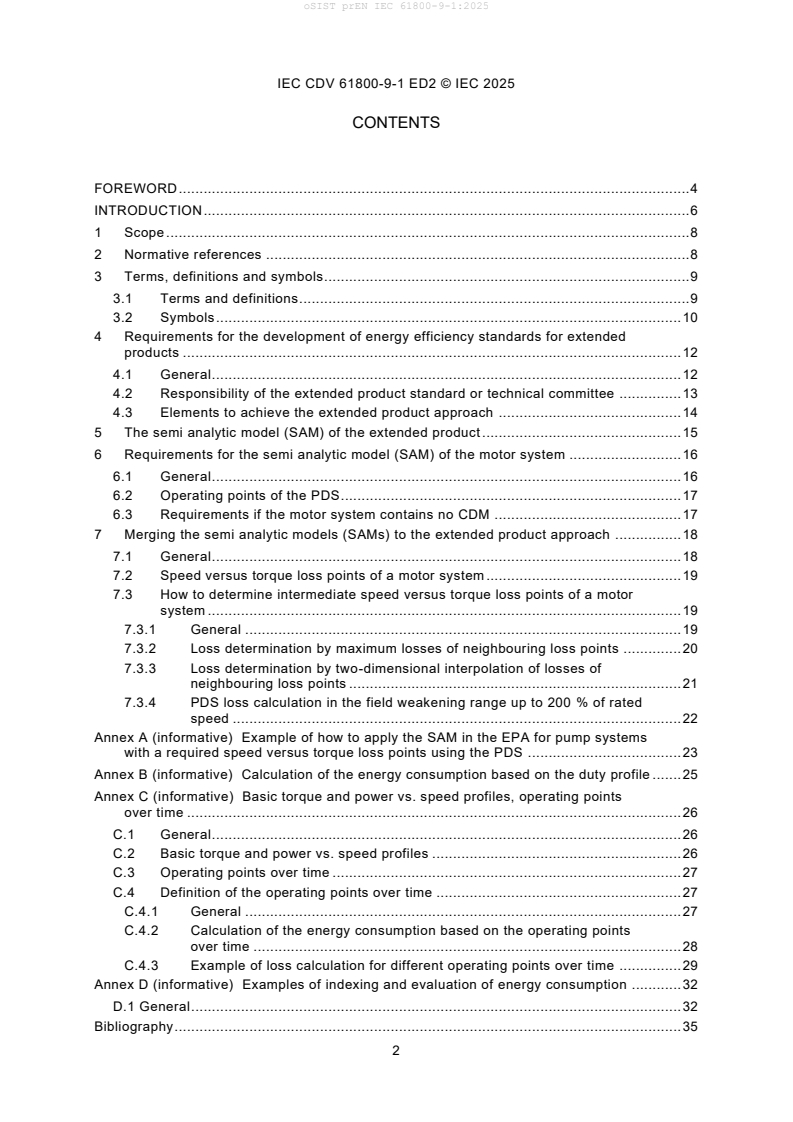
CONTENTS
FOREWORD . 4
INTRODUCTION . 6
1 Scope . 8
2 Normative references . 8
3 Terms, definitions and symbols. 9
3.1 Terms and definitions . 9
3.2 Symbols . 10
4 Requirements for the development of energy efficiency standards for extended
products . 12
4.1 General . 12
4.2 Responsibility of the extended product standard or technical committee . 13
4.3 Elements to achieve the extended product approach . 14
5 The semi analytic model (SAM) of the extended product . 15
6 Requirements for the semi analytic model (SAM) of the motor system . 16
6.1 General . 16
6.2 Operating points of the PDS . 17
6.3 Requirements if the motor system contains no CDM . 17
7 Merging the semi analytic models (SAMs) to the extended product approach . 18
7.1 General . 18
7.2 Speed versus torque loss points of a motor system . 19
7.3 How to determine intermediate speed versus torque loss points of a motor
system . 19
7.3.1 General . 19
7.3.2 Loss determination by maximum losses of neighbouring loss points . 20
7.3.3 Loss determination by two-dimensional interpolation of losses of
neighbouring loss points . 21
7.3.4 PDS loss calculation in the field weakening range up to 200 % of rated
speed . 22
Annex A (informative) Example of how to apply the SAM in the EPA for pump systems
with a required speed versus torque loss points using the PDS . 23
Annex B (informative) Calculation of the energy consumption based on the duty profile . 25
Annex C (informative) Basic torque and power vs. speed profiles, operating points
over time . 26
C.1 General . 26
C.2 Basic torque and power vs. speed profiles . 26
C.3 Operating points over time . 27
C.4 Definition of the operating points over time . 27
C.4.1 General . 27
C.4.2 Calculation of the energy consumption based on the operating points
over time . 28
C.4.3 Example of loss calculation for different operating points over time . 29
Annex D (informative) Examples of indexing and evaluation of energy consumption . 32
D.1 General . 32
Bibliography . 35
IEC CDV 61800-9-1 ED2 © IEC 2025
Figure 1 – Illustration of core requirements of energy efficiency standardization . 6
Figure 2 – Illustration of the extended product with embedded motor system . 9
Figure 3 – Stakeholders and responsibilities for determination of the energy efficiency
indicator for an extended product . 13
Figure 4 – Illustration of the operating points (shaft speed, torque) for the
determination of relative losses of the power drive system (PDS) . 17
Figure 5 – Speed versus torque relative power loss operating points to determine the
motor starter or softstarter losses . 18
Figure 6 – Responsibilities and workflow to derive the energy efficiency indicator (EEI)
of an extended product . 19
Figure 7 – Four segments of deviating operating points of a PDS . 20
Figure 8 – Two-dimensional interpolation for deviating operating points . 21
Figure A.1 – Three points of relative losses and shaded area of interest for the pump
manufacturers while defining their EEI (energy efficiency index) . 23
Figure A.2 – Example – How the SAMs of the PDS and the pump system shall interact
to the resulting efficiency index of a pump system . 24
Figure C.1 – Typical basic torque and power vs. speed profiles . 26
Figure C.2 – Example of operating points over time . 28
Table 1 – Illustration of how to combine essential elements of the efficiency
contributions . 15
Table C.1 – Operating points over time for the investigated examples . 29
Table C.2 – Losses in the specified operating points for configuration 1 . 29
Table C.3 – Losses in the specified operating points for configuration 2 . 29
IEC CDV 61800-9-1 ED2 © IEC 2025
INTERNATIONAL ELECTROTECHNICAL COMMISSION
____________
ADJUSTABLE SPEED ELECTRICAL POWER DRIVE SYSTEMS (PDS) –
Part 9-1: Ecodesign for motor systems –
General requirements for setting energy efficiency standards
FOREWORD
1) The International Electrotechnical Commission (IEC) is a worldwide organization for standardization comprising
all national electrotechnical committees (IEC National Committees). The object of IEC is to promote international
co-operation on all questions concerning standardization in the electrical and electronic fields. To this end and
in addition to other activities, IEC publishes International Standards, Technical Specifications, Technical Reports,
Publicly Available Specifications (PAS) and Guides (hereafter referred to as “IEC Publication(s)”). Their
preparation is entrusted to technical committees; any IEC National Committee interested in the subject dealt with
may participate in this preparatory work. International, governmental and non-governmental organizations liaising
with the IEC also participate in this preparation. IEC collaborates closely with the International Organization for
Standardization (ISO) in accordance with conditions determined by agreement between the two organizations.
2) The formal decisions or agreements of IEC on technical matters express, as nearly as possible, an international
consensus of opinion on the relevant subjects since each technical committee has representation from all
interested IEC National Committees.
3) IEC Publications have the form of recommendations for international use and are accepted by IEC National
Committees in that sense. While all reasonable efforts are made to ensure that the technical content of IEC
Publications is accurate, IEC cannot be held responsible for the way in which they are used or for any
misinterpretation by any end user.
4) In order to promote international uniformity, IEC National Committees undertake to apply IEC Publications
transparently to the maximum extent possible in their national and regional publications. Any divergence between
any IEC Publication and the corresponding national or regional publication shall be clearly indicated in the latter.
5) IEC itself does not provide any attestation of conformity. Independent certification bodies provide conformity
assessment services and, in some areas, access to IEC marks of conformity. IEC is not responsible for any
services carried out by independent certification bodies.
6) All users should ensure that they have the latest edition of this publication.
7) No liability shall attach to IEC or its directors, employees, servants or agents including individual experts and
members of its technical committees and IEC National Committees for any personal injury, property damage or
other damage of any nature whatsoever, whether direct or indirect, or for costs (including legal fees) and
expenses arising out of the publication, use of, or reliance upon, this IEC Publication or any other IEC
Publications.
8) Attention is drawn to the Normative references cited in this publication. Use of the referenced publications is
indispensable for the correct application of this publication.
9) Attention is drawn to the possibility that some of the elements of this IEC Publication may be the subject of patent
rights. IEC shall not be held responsible for identifying any or all such patent rights.
IEC 61800-9-1 has been prepared by subcommittee 22G: Adjustable speed electric drive
systems (PDS), of IEC technical committee 22: Power electronic systems and equipment. It is
an International Standard.
It has the status of a group energy efficiency publication in accordance with IEC Guide 119.
This second edition cancels and replaces the first edition published in 2017. This edition
constitutes a technical revision.
This edition includes the following significant technical changes with respect to the previous
edition:
a) Addition of Annex D - Examples of indexing and evaluation of energy consumption
b) Correction of errors of symbols in several formula and tables
IEC CDV 61800-9-1 ED2 © IEC 2025
The text of this International Standard is based on the following documents:
Draft Report on voting
22G/XX/FDIS 22G/XX/RVD
Full information on the voting for its approval can be found in the report on voting indicated in
the above table.
The language used for the development of this International Standard is English .
This document was drafted in accordance with ISO/IEC Directives, Part 2, and developed in
accordance with ISO/IEC Directives, Part 1 and ISO/IEC Directives, IEC Supplement, available
at www.iec.ch/members_experts/refdocs. The main document types developed by IEC are
described in greater detail at www.iec.ch/publications.
A list of all parts in the IEC 61800 series, published under the general title Adjustable speed
electrical power drive systems (PDS), can be found on the IEC website.
The committee has decided that the contents of this document will remain unchanged until the
stability date indicated on the IEC website under webstore.iec.ch in the data related to the
specific document. At this date, the document will be
• reconfirmed,
• withdrawn,
• replaced by a revised edition, or
• amended.
IMPORTANT – The "colour inside" logo on the cover page of this document indicates
that it contains colours which are considered to be useful for the correct understanding
of its contents. Users should therefore print this document using a colour printer.
IEC CDV 61800-9-1 ED2 © IEC 2025
INTRODUCTION
IEC SC 22G includes the standardization task force for dealing with energy efficiency of motor
systems. It has close collaboration with several other technical committees (for example,
IEC TC 2, IEC SC 121A).
IEC SC 22G maintains responsibility for all relevant aspects in the field of energy efficiency and
ecodesign requirements for power electronics, switchgear, control gear and power drive
systems and their industrial applications.
The core requirements of energy efficiency standardization are illustrated in Figure 2. The work
has been agreed to provide the reasonable target as a best compromise.
Figure 1 – Illustration of core requirements
of energy efficiency standardization
The IEC 61800 series do not deal with mechanical engineering components.
NOTE Geared motors (motors with directly adapted gearboxes) are treated like power drive systems (converter plus
motor). See IEC 60034-30-1 for classification of the losses of a geared motor. The efficiency classes of gearboxes
as individual components are under consideration.
IEC 61800-9-1 is a subpart of the IEC 61800 series, which has the following structure:
– Part 1: General requirements – Rating specifications for low voltage adjustable speed DC
power drive systems
– Part 2: General requirements – Rating specifications for adjustable speed AC power drive
systems
– Part 3: EMC requirements and specific test methods
– Part 5: Safety requirements
– Part 6: Guide for determination of types of load duty and corresponding current ratings
– Part 7: Generic interface and use of profiles for power drive systems
– Part 8: Specification of voltage on the power interface
– Part 9: Ecodesign for motor systems
IEC CDV 61800-9-1 ED2 © IEC 2025
Each part is further subdivided into several subparts, published either as International
Standards or as Technical Specifications or Technical Reports, some of which have already
been published. Others will be published with the part number followed by a dash and a second
number identifying the subdivision (for example, IEC 61800-9-2).
This subpart of IEC 61800-9 is an International Standard for characterizing the energy efficiency
of motor systems when supplied by a motor starter or by a variable voltage/frequency converter.
The goal of this document is to establish a clear and simple system for the comparison of the
energy performance of motor systems that can help manufacturers to improve their products,
to give users the necessary transparency and information and to provide a robust reference
base for regulators and minimum energy performance standards.
The IEC 61800-9 series (ecodesign for motor systems) consist of the following subparts:
– Subpart 9-1: General requirements for setting energy efficiency standards
– Subpart 9-2: Energy efficiency determination and classification
IEC CDV 61800-9-1 ED2 © IEC 2025
ADJUSTABLE SPEED ELECTRICAL POWER DRIVE SYSTEMS (PDS) –
Part 9-1: Ecodesign for motor systems –
General requirements for setting energy efficiency standards
1 Scope
This part of IEC 61800 specifies the general methodology to energy efficiency standardization
for any extended product by using the guidance of the extended product approach (EPA).
This document is a group energy efficiency publication as defined in IEC Guide 119 with the
energy efficiency function to establish a clear and simple system methodology for the
comparison of the energy performance of motor systems to help product and system
improvement.
It enables product committees for driven equipment connected to motor systems (so called
extended products) to interface with the relative power losses of the connected motor system
(e.g. power drive system) in order to calculate the system energy efficiency for the whole
application.
This is based on specified calculation models for speed/load profiles, the duty profiles and
relative power losses of appropriate torque versus speed operating points.
This document is applicable to motor systems operated by a motor starter or by a converter
(power drive system).
This document does not specify requirements for environmental impact declarations.
Power drive systems designed to drive DC motors are not included in the scope of this
document.
2 Normative references
The following documents are referred to in the text in such a way that some or all of their content
constitutes requirements of this document. For dated references, only the edition cited applies.
For undated references, the latest edition of the referenced document (including any
amendments) applies.
IEC 60050-161, International Electrotechnical Vocabulary – Part 161: Electromagnetic
compatibility, available at www.electropedia.org
IEC 60034-2-3, Rotating electrical machines – Part 2-3: Specific test methods for determining
losses and efficiency of converter-fed AC motors
IEC 61800-9-2:—, Adjustable speed electrical power drive systems – Part 9-2: Ecodesign for
motor systems – Energy efficiency determination and classification
IEC Guide 119:2017, Preparation of energy efficiency publications and the use of basic energy
efficiency publications and group energy efficiency publications
IEC CDV 61800-9-1 ED2 © IEC 2025
3 Terms, definitions and symbols
3.1 Terms and definitions
For the purposes of this document, the terms and definitions given in IEC 60050-161 and the
following apply.
ISO and IEC maintain terminology databases for use in standardization at the following
addresses:
• IEC Electropedia: available at https://www.electropedia.org/
• ISO Online browsing platform: available at https://www.iso.org/obp
3.1.1
duty profile
annual distribution load points with associated time fraction
Note 1 to entry: The duty profile may consist of only one operating point.
3.1.2
energy efficiency indicator
EEI
generic value describing the energy efficiency of an extended product operating with a specified
duty profile
Note 1 to entry: Examples of EEI include the energy efficiency index defined by the pump industry to characterize
pump systems, or the weighted average electrical power described in Annex B.
3.1.3
extended product
EP
driven equipment together with its connected motor system (e.g. a PDS)
Note 1 to entry: See Figure 2.
Figure 2 – Illustration of the extended product with embedded motor system
IEC CDV 61800-9-1 ED2 © IEC 2025
3.1.4
extended product approach
EPA
methodology to determine the energy efficiency indicator (EEI) of the extended product (EP)
using the speed torque profiles of the driven equipment, the power losses of the motor system
and the duty profile of the application
Note 1 to entry: The fan energy index (FEI) is used as the energy index for the fan industry.
3.1.5
extended product standard committee
body in charge of the standardization of the energy efficiency indicators for a given extended
product
Note 1 to entry: Extended product committees can be ISO or IEC technical committees, or other relevant bodies.
3.1.6
load-time profile
fraction of time spent at each operating point during the total operating time or a complete cycle
of operation of the extended product
Note 1 to entry: Typically, a load-time profile is represented by a histogram.
Note 2 to entry: The standby mode can be included in the load-time profile.
3.1.7
motor control equipment
CDM or motor starter
3.1.8
motor system
motor control equipment and motor
3.1.9
semi analytic model
SAM
determination model for the losses of a motor system or a driven equipment
Note 1 to entry: SAMs include physical and mathematical parameters and calculation algorithm of the subparts of
an EP. SAMs are necessary to determine the typical relative power losses of the subparts of an EP in order to
determine its overall losses.
3.1.10
transmission
component which connects the motor shaft to the load machine e.g. fan, pump or compressor
Note 1 to entry: A component can be for example a coupling or a gear box.
3.2 Symbols
3.2.1
E
Electrical
electrical energy [kWh] consumption of an application during a certain runtime period
3.2.2
k
P
ratio of the weighted average electrical power consumption P of an application to the
Electrical
reference power consumption P
Reference
IEC CDV 61800-9-1 ED2 © IEC 2025
3.2.3
P
Electrical
power consumption [kW] of an application over time
3.2.4
P
Electrical Max
power consumption [kW] at 100 % speed and 100 % load
3.2.5
P
i
power consumption [kW] at operating point i
3.2.6
P
L,control
power losses [kW] of the motor control equipment
3.2.7
P
n
nominal power of an equipment which is typical for its population of the same rating
Note 1 to entry: See IEC 60034-1 for motors.
3.2.8
P
out,CDM
output power [kW] of CDM obtained from the power loss measurement
3.2.9
P
out,PDS
output power of PDS obtained from the power loss measurement
3.2.10
P
r
rated power of equipment which is assigned by its manufacturer
3.2.11
P
Reference
power consumption used for reference, defined by the extended product committee
3.2.12
P
L
electrical power losses
Note 1 to entry: In P , P and P , the index "CDM" refers to the complete drive module, "Mot" refers to
L,CDM L,Mot L,Aux
the motor, and "Aux" refers to the auxiliary devices like cables, transformers or filters. The relative power losses are
the per unit losses relative to the nominal power of the device.
3.2.13
P
L,CDM
power losses of a CDM
3.2.14
P
L,CDM,determined
power losses of a CDM from the power loss determination method
IEC CDV 61800-9-1 ED2 © IEC 2025
3.2.15
P
L,CDM,relative
power losses of a CDM, with reference to its rated apparent power
3.2.16
P
L,inverter
power losses in the inverter section of a CDM
3.2.17
P
L,PDS,determined
power losses of PDS from the power loss determination method
3.2.18
P
L,Mot
total losses of a motor according to according to IEC 60034-2-3:2020 when supplied by a
converter (non-sinusoidal power supply)
3.2.19
t
W
working time of an equipment
3.2.20
T
i
torque [Nm] at operating point i
3.2.21
TimeFraction
i
T
f
percentage of time (time fraction) an extended product is operated at one specific operating
point i
4 Requirements for the development of energy efficiency standards for
extended products
4.1 General
This document specifies a methodology to determine the energy efficiency indicator of an
application, based on the concept of semi analytic models (SAM). The methodology shall be
referred to as an extended product approach (EPA).
The responsibilities and tasks of the different stakeholders creating or using these extended
products standards, as well as the data flows in-between, are specified as follows.
a) Specific information about the equipment shall be considered:
– The torque versus speed profile of the driven load as specified by the load manufacturer
or other pertinent entity (e.g. regulatory authority, other specified organization) .
– The losses of the motor system or its constituents (motor, CDM or motor starter) at
reference part-load operating points. These shall be provided by the different
manufacturers as specified in IEC 61800-9-2.
b) Information about the application shall be considered:
– The duty profile of the driven equipment. Pertinent entities can for example define typical
applications of their extended products, each associated with a typical duty profile.
IEC CDV 61800-9-1 ED2 © IEC 2025
c) The extended product approach permits the determination of an energy efficiency indicator
(losses, efficiency, energy consumption, etc.):
– Other pertinent entity(ies) (e.g. regulatory authority, other specified organization) shall
define how to combine the losses of the motor system and the losses of the load, to
obtain an overall energy efficiency indicator for the extended product within the defined
application.
– IEC TR 62837:2013 suggests the definition and use of key performance indicators (KPIs)
for energy efficiency through automation systems that are in accordance with the
principle of this document.
The interactions between the different stakeholders are shown in Figure 3.
NOTE 1 Motor and CDM manufacturers can provide data directly to the motor system manufacturer.
NOTE 2 If the motor system is based on a starter, then only the motor losses are needed as input to the EPA.
Figure 3 – Stakeholders and responsibilities for determination
of the energy efficiency indicator for an extended product
4.2 Responsibility of the extended product standard or technical committee
Based on the general principles described in this document, it shall be the responsibility of the
entity(ies) dealing with a type of extended product (e.g. regulatory authority, other specified
organization) to specify the semi analytic model of the driven load and of the extended product
for the product-specific application(s).
Pertinent entity(ies) (e.g. regulatory authority, other specified organization) can specify and
standardize
– one or more torque versus speed profiles (load profiles) as described in Annex C
considering typical loads,
IEC CDV 61800-9-1 ED2 © IEC 2025
– one or more duty profiles as described in Annex C considering typical service conditions,
– an appropriate method for determining the losses at intermediate operating points based on
the data from the motor, CDM and PDS (see 7.3),
– a semi analytic model for the extended product considering the extended product approach
(EPA) as described in Clause 7, using the part-load operating points of the motor system as
determined according to IEC 61800-9-2:—, Annex E, and
– a method for determining an energy efficiency indicator for the extended product under their
responsibility (see Annex B for example).
The extended product standard or technical committee shall consider the permissible tolerances
for the part-load losses of the motor system as defined in IEC 61800-9-2.
NOTE The motor system data can consist of PDS data as well as individual data for CDM and motor. IEC 61800-9-
2 provides information about the determination of PDS data based on individual motor and CDM data .
This document specifies eight points for the part-load operating points among which extended
products could select appropriate reference for use by the semi analytic model. The semi
analytic model of the extended product shall not require more than this information. If more
operating points are required, those values shall be determined by interpolation. The semi
analytical model of the extended product may also use less than eight operating points.
Annex A provides a demonstration of a pump system application with a quadratic torque load.
4.3 Elements to achieve the extended product approach
The semi analytic model (SAM) model of the extended product allows combining the losses at
the reference operating points to derive the losses at any other operating point. Elements
required for the extended product approach are described in Table 1 and Figure 6.
To determine the overall losses or efficiency of an extended product implemented in an
application, it is required to go through several steps.
Several elements shall be combined.
a) The SAM of the motor system, specified in IEC 61800-9-2, giving its relative losses at
several normalized operating points. The motor system can be a power drive system (PDS)
or can consist of a motor and a motor starter (contactor, soft starter, etc.).
– When the motor system is a PDS, the SAM of the motor system is based on the concept
of reference PDS (RPDS). It is a "typical" PDS to which the physical PDS under
consideration is compared in terms of energy efficiency.
– When the motor system is based on a motor starter, the calculation of the losses is
simpler; there is no need to use any reference motor starter.
b) The SAM of the driven equipment (pump, compressor, fan, etc.), giving the losses or
efficiency of the load machine at specified operating points. It is the responsibility of the
equipment manufacturer or the associated product committee.
c) The extended product approach, combining the SAM of the motor system and the SAM of
the driven equipment (and also if necessary efficiency values for the transmission). It is the
responsibility of the manufacturer of the extended product or the associated pertinent entity.
– The extended product approach uses application-related data (required operating points,
duty profile, working time, etc.), in order to determine the energy efficiency of the
application.
– This approach allows comparing the energy efficiency of several motor systems for a
given application, or several modes of operation of a given extended produc t. For
example, but not limited to,
IEC CDV 61800-9-1 ED2 © IEC 2025
• a motor system implementing a motor starter compared to a motor system
implementing a CDM,
• an extended product implementing a single driven machine compared to one
implementing cascaded smaller machines, or
• continuous-duty application at low load compared to part-time operation at higher
load.
Table 1 – Illustration of how to combine essential elements of the efficiency
contributions
Elements
required for the
Input Output Reference Responsibility
extended product
approach
SAM of the motor Characteristics of the Relative losses of the IEC 61800-9-2 IEC SC 22G, TC 2
system motor system motor system at
(physical components, standardized operating
rated powers, etc.) points (or
interpolated/extrapolated)
operating points
SAM of the EP Output of the SAM of Relative losses of the EP EP standard Load machine
the motor system and at user defined operating associated product
characteristics of the points committee (e.g.
driven equipment ISO TC 115, TC 117,
(load machine) TC 118)
Extended product Output of the SAM of Energy efficiency of EP standard Extended product
approach the EP, and extended product for the associated product
requirements about application committee (e.g.
the application ISO TC 115, TC 117,
(available duty TC 118)
profiles, operating
time, etc.) and
tolerances
5 The semi analytic model (SAM) of the extended product
SAMs are necessary to determine the typical relative power losses of the subparts according
to the extended product approach in order to determine its overall losses.
Best practices for the SAM of the extended product show that the following aspects shall be
minimally considered:
– user defined operating (service) conditions to derive the losses of the driven equipment ;
– torque versus speed profile (operating profile) of the driven equipment;
– histogram of required power versus time (the duty profile) of the driven equipment ;
– tolerance of the loss parameters of the driven equipment;
– the embedded relative losses of the motor system according to the data determined
according to IEC 61800-9-2.
The outcome of the SAM shall be used to calculate the energy efficiency indicator (EEI) which
shall permit the ability to be quantitatively distinct between typical efficient and typical inefficient
applications.
The energy efficiency rating shall be included in the user’s documentation or catalogue.
IEC CDV 61800-9-1 ED2 © IEC 2025
In order to judge a system concerning energy efficiency, all components of the system have to
be taken into account. Speed regulation by using a power drive system (PDS) is advantageous
in a plurality of cases, but on the other hand it also creates additional losses.
The power savings that can be achieved depend on the operating point(s) (OP) at which the
extended product is operated as required by the application.
Therefore, it is necessary to have information about the application and its duty, and this
information should be provided by technical committees determining the SAM for the application
specific extended product.
Two application-relative characteristics are particularly useful for describing the extended
product and the way it is operated.
a) The torque or power versus speed profile. This profile describes how the torque required by
a machine depends on its speed. It depends on the type of machine (motor, pump, fan , etc.)
on the system it serves.
b) The duty profile. If specified by the application, this graph describes the various required
power levels, including standby, and the fraction of time during which the machine is
operated at these levels. It depends on the matching of the components that make it up and
its operation in practice.
These two characteristics can be used as input data to compare potential control solutions in
terms of energy efficiency.
Annex C provides examples of typical torque or power versus speed profiles as well as an
example of operating points over time profile. It also illustrates how to combine both to
determine the weighted electrical power consumed by the application, used as an energy
efficiency indicator to compare several motor control architectures in terms of energy savings.
These examples show that different motor control architectures can result in a very different EE
results. It is therefore important to consider the application in order to select the most energy -
efficient motor system.
6 Requirements for the semi analytic model (SAM) of the motor system
6.1 General
The SAM of the motor system (e.g. a PDS) shall include all parameters which are necessary
for the determination of the relative power losses for specific different torque versus speed
operating points.
The determination of the EE of an extended product needs a description of the relative losses
of the motor system in order to justify the most efficient solution.
For further requirements of the SAM of the motor system, see IEC 61800-9-2.
For the SAM of the motor system, the relative losses (specific loss in operation point divided by
nominal power of the motor system) shall be used for specification in order to cover also cases
where the speed of the extended product is zero.
NOTE This is not aligned with the so called efficiency (η) of line fed motors which is directly given as a percentage
of the mechanical output power to the sum of input electrical power and the power losses .
IEC CDV 61800-9-1 ED2 © IEC 2025
6.2 Operating points of the PDS
In order to set only a few appropriate measurement points or calculation results to develop the
energy consumption of different extended products, eight points in the torque versus speed
diagram shall be specified (see Figure 4).
These relative losses (containing the relative losses of the motor system), are the output of the
SAM for the motor system and one input of the SAM for the extended product (see Table 1).
Figure 4 – Illustration of the operating points (shaft speed, torque)
for the determination of relative losses of the power drive system (PDS)
NOTE 1 7.3 gives methods to determine the PDS losses in the whole area shown in Figure 4 up to 100 % speed
and torque.
NOTE 2 IEC 61800-9-2:2022, Annex I, gives information on loss determination of the PDS losses above 100 %
speed and torque.
6.3 Requirements if the motor system contains no CDM
If the motor system contains a motor starter or softstarter, the possible operating points are
located at just on one relative speed (100 %). See Figure 5.
The additional power losses of AC motor starters according to IEC 60947-4-1 or a bypassed
AC semiconductor motor starter according to IEC 60947-4-2 are considered small. The
procedures to determine the relative losses of the motor system containing a motor starter out
of the calculation or measurement are given in IEC 61800-9-2.
In this case, no "reference motor starter" or "nor reference softstarter" is defined or required.
IEC CDV 61800-9-1 ED2 © IEC 2025
Figure 5 – Speed versus torque relative power loss operating points
to determine the motor starter or softstarter losses
7 Merging the semi analytic models (SAMs) to the extended product approach
7.1 General
Clause 7 describes how the SAMs of a motor system and the extended product shall be merged
together in order to gain the determination for the EE value according to the extended product
approach.
The interface between both is the set of relative losses with tolerances of the determined torque
versus speed operating points.
The different models and responsibilities for achieving the efficiency classification of an
extended product shall merge to the complete efficiency determination of the EPA, in
accordance to Figure 6.
IEC CDV 61800-9-1 ED2 © IEC 2025
Figure 6 – Responsibilities and workflow to derive the energy
efficiency indicator (EEI) of an extended product
7.2 Speed versus torque loss points of a motor system
All extended products shall be described by the physical drive power required, which is the
product of torque and speed at a defined set of operating points. This corresponds to typical
overall power losses P estimated from the knowledge of operation/application data and duty
L
profiles (see Annex C).
The whole chart in Figure 4 would theoretically contain an infinite number of such operating
points. If the actual operating points are not known, reference operating points are used to
determine the losses. To limit the amount of determined data, the number of such reference
operating points
– shall match to the needs of the extended product approach (see Annex C for typical
examples), and
– shall be selected among the operating points defined in Figure 4 and Figure 5 according to
the technology of the motor system.
7.3 How to determine intermediate speed versus torque loss points of a motor
system
7.3.1 General
In case where the operating points defined in Figure 4 are not sufficiently matched to the actual
torque versus speed characteristics, the following rule shall be used to determine intermediate
values for the SAM of the motor system.
IEC CDV 61800-9-1 ED2 © IEC 2025
In case that the motor system is a PDS, the losses of the CDM shall be calculated first according
to IEC 61800-9-2. In the next step, the motor losses shall be determined. In the third step, the
PDS losses shall be calculated.
In order to determine the relative losses of a motor system at an arbitrary operating point, one
of the following calculation models can be used:
a) two-dimensional linear interpolation between neighbouring operating points;
b) two-dimensional linear extrapolation with neighbouring operating points as long as the
extrapolation result remains within the four segments of Figure 7;
For the models a) and b), the operating area shown in Figure 7 shall be divided into four
segments.
Figure 7 – Four segments of deviating operating points of a PDS
Segment 1 covers the operating points up to 50 % relative PDS speed and above 50 % relative
torque.
Segment 2 covers the operating points above 50 % relative PDS
...