

SIST EN 14470-2:2007
(Main)Fire safety storage cabinets - Part 2: Safety cabinets for pressurised gas cylinders
General Information
- Abstract
This European standard is a product specification, giving performance requirements for fire safety cabinets used for storing pressurised gas cylinders. It is applicable to cabinets with a total internal volume suitable to store pressurised gas cylinders with a total volume not exceeding 220 l, including cylinders of purging gases.
NOTE 1 This means that up to four gas cylinders of 50 l or up to three gas cylinders of 70 l can be stored in a single cabinet.
NOTE 2 It is intended that the pressurised gas cylinders can be in use while in the cabinet.
NOTE 3 Attention is drawn to national regulations which can apply with regard to the storage and use of pressurised gas cylinders.
NOTE 4 The safety cabinet can be free standing, restrained to a wall or mounted on wheels or castors.
This standard is not applicable to brick enclosures, walk-in storage rooms or cabinets which do not take their weight on their base.
Requirements are given in respect to the construction of the cabinet and its capacity to resist fire conditions on the outside. A type test is included, which is based on the already existing fire resistance (heating curve) tests given in EN 14470-1.
The tests described in this European Standard are type tests (for the storage of flammable liquids EN 14470-1 is applicable – the criteria for failure are different – see Annex A).
- Status
- Published
- Publication Date
- 31-Jan-2007
- Technical Committee
- I13 - Imaginarni 13
- Current Stage
- 6060 - National Implementation/Publication (Adopted Project)
- Start Date
- 01-Feb-2007
- Due Date
- 01-Feb-2007
- Completion Date
- 01-Feb-2007


Overview
EN 14470-2:2006 is a European product standard that specifies performance and test requirements for fire safety storage cabinets for pressurised gas cylinders. It applies to cabinets whose total internal capacity is suitable for cylinders with a combined volume up to 220 L (for example, up to four 50 L or three 70 L cylinders). The standard covers construction, ventilation, cylinder restraining, installation features and a mandatory type test of fire resistance to ensure safe storage and limited fire contribution.
Key topics and technical requirements
- Scope & classification
- Cabinets intended for normal room temperature storage; cylinders may remain in use while stored.
- Classified by fire-resistance performance as Type G15, G30, G60 or G90 (time for temperature rise of 50 K on the valve spanner flat).
- Fire resistance test
- Type testing is required using furnace tests based on EN 1363-1 heating curves. Temperature on the cylinder valve spanner flat must not increase more than 50 K during the rated period.
- Ventilation & purging
- Cabinets must have inlet and exhaust connections. For ventilated cabinets (doors closed/locked) extraction rates:
- Flammable or supporting gases: ≥ 10 air changes/hour
- Toxic gases: ≥ 120 air changes/hour
- Pressure drop must not exceed 150 Pa; ventilation must create a lower pressure inside the cabinet and operate top and bottom to purge minor leaks.
- Inlet and exhaust vents must close automatically during fire and are part of the fire test.
- Cabinets must have inlet and exhaust connections. For ventilated cabinets (doors closed/locked) extraction rates:
- Penetrations & services
- Gas pipeline penetrations limited (max 3 per cylinder, recommended ≤10 mm dia); electrical penetrations limited (max 2 per cylinder, ≤20 mm dia). Unused penetrations must be sealed per manufacturer instructions.
- Construction & safety features
- Cylinder restraining system to prevent tipping; cabinet design to allow safe insertion/removal (ramps or mechanical aids allowed, but not aluminium).
- Cabinets can be free-standing, wall-restrained, or on wheels/castors; not applicable to brick enclosures or walk-in rooms.
- Information, marking & documentation
- Manufacturers must supply installation and safety instructions, maintenance recommendations, conformity declaration, and label cabinets with class (e.g., G60), safety signs (ISO 3864), manufacturer details and inlet/exhaust markings.
Applications and users
- Practical use: laboratories, research facilities, educational institutions, and industrial sites that store small numbers of pressurised gas cylinders (including purge gases).
- Primary users: safety officers, laboratory managers, facility engineers, cabinet manufacturers, installers, and testing/certification bodies responsible for compliant gas cylinder storage and emergency planning.
- Benefit: Provides tested fire-resistance performance and ventilation criteria to reduce the risk of cylinder failure in a fire, allowing evacuation and controlled fire-fighting response.
Related standards
- EN 14470-1 - safety storage cabinets for flammable liquids (related test methods)
- EN 1363-1 - fire resistance tests - general requirements
- EN ISO 13943 - fire safety vocabulary
- ISO 3864 - graphical symbols - safety colours and safety signs
Keywords: EN 14470-2, fire safety storage cabinets, pressurised gas cylinders, safety cabinets, fire resistance, ventilation, type test, laboratory safety.
Relations
- Effective Date
- 25-Aug-2026
- Effective Date
- 25-Aug-2026
- Effective Date
- 09-Feb-2026
- Effective Date
- 28-Jan-2026
- Effective Date
- 28-Jan-2026
- Effective Date
- 28-Jan-2026
- Effective Date
- 28-Jan-2026
- Referred By
SIST-TS CEN/TS 17441:2020 - Laboratory installations - Ventilation systems in laboratories - Effective Date
- 28-Jan-2026
Get Certified
Connect with accredited certification bodies for this standard

ECOCERT
Organic and sustainability certification.

CIS Institut d.o.o.
Personal Protective Equipment (PPE) certification body. Notified Body NB-2890 for EU Regulation 2016/425 PPE.

Eurofins Food Testing Global
Global leader in food, environment, and pharmaceutical product testing.
Sponsored listings
Frequently Asked Questions
SIST EN 14470-2:2007 is a standard published by the Slovenian Institute for Standardization (SIST). Its full title is "Fire safety storage cabinets - Part 2: Safety cabinets for pressurised gas cylinders". This standard covers: This European standard is a product specification, giving performance requirements for fire safety cabinets used for storing pressurised gas cylinders. It is applicable to cabinets with a total internal volume suitable to store pressurised gas cylinders with a total volume not exceeding 220 l, including cylinders of purging gases. NOTE 1 This means that up to four gas cylinders of 50 l or up to three gas cylinders of 70 l can be stored in a single cabinet. NOTE 2 It is intended that the pressurised gas cylinders can be in use while in the cabinet. NOTE 3 Attention is drawn to national regulations which can apply with regard to the storage and use of pressurised gas cylinders. NOTE 4 The safety cabinet can be free standing, restrained to a wall or mounted on wheels or castors. This standard is not applicable to brick enclosures, walk-in storage rooms or cabinets which do not take their weight on their base. Requirements are given in respect to the construction of the cabinet and its capacity to resist fire conditions on the outside. A type test is included, which is based on the already existing fire resistance (heating curve) tests given in EN 14470-1. The tests described in this European Standard are type tests (for the storage of flammable liquids EN 14470-1 is applicable – the criteria for failure are different – see Annex A).
This European standard is a product specification, giving performance requirements for fire safety cabinets used for storing pressurised gas cylinders. It is applicable to cabinets with a total internal volume suitable to store pressurised gas cylinders with a total volume not exceeding 220 l, including cylinders of purging gases. NOTE 1 This means that up to four gas cylinders of 50 l or up to three gas cylinders of 70 l can be stored in a single cabinet. NOTE 2 It is intended that the pressurised gas cylinders can be in use while in the cabinet. NOTE 3 Attention is drawn to national regulations which can apply with regard to the storage and use of pressurised gas cylinders. NOTE 4 The safety cabinet can be free standing, restrained to a wall or mounted on wheels or castors. This standard is not applicable to brick enclosures, walk-in storage rooms or cabinets which do not take their weight on their base. Requirements are given in respect to the construction of the cabinet and its capacity to resist fire conditions on the outside. A type test is included, which is based on the already existing fire resistance (heating curve) tests given in EN 14470-1. The tests described in this European Standard are type tests (for the storage of flammable liquids EN 14470-1 is applicable – the criteria for failure are different – see Annex A).
SIST EN 14470-2:2007 is classified under the following ICS (International Classification for Standards) categories: 13.220.40 - Ignitability and burning behaviour of materials and products; 23.020.35 - Gas cylinders; 71.040.10 - Chemical laboratories. Laboratory equipment. The ICS classification helps identify the subject area and facilitates finding related standards.
SIST EN 14470-2:2007 has the following relationships with other standards: It is inter standard links to SIST ISO 3864-3:2008, SIST ISO 3864-2:2008, SIST ISO 3864-1:2003, SIST EN 4611-006:2012, SIST EN 1363-1:1999, SIST EN ISO 13943:2002, SIST EN 4614:2009, SIST-TS CEN/TS 17441:2020. Understanding these relationships helps ensure you are using the most current and applicable version of the standard.
SIST EN 14470-2:2007 is available in PDF format for immediate download after purchase. The document can be added to your cart and obtained through the secure checkout process. Digital delivery ensures instant access to the complete standard document.
Standards Content (Sample)
6,67(16/29(16.,IHEUXDU67$1'$5'2JQMHYDUQHRPDUHGHO2JQMHYDUQHRPDUH]DVKUDQMHYDQMHSOLQVNLKMHNOHQNSRGWODNRP)LUHVDIHW\VWRUDJHFDELQHWV3DUW6DIHW\FDELQHWVIRUSUHVVXULVHGJDVF\OLQGHUV !"#$%&'( )&!*- . 5HIHUHQþQDãWHYLOND6,67(1HQIUGH,&6
EUROPEAN STANDARDNORME EUROPÉENNEEUROPÄISCHE NORMEN 14470-2August 2006ICS 13.220.40; 71.040.10 English VersionFire safety storage cabinets - Part 2: Safety cabinets forpressurised gas cylindersArmoires de stockage de sécurité incendie - Partie 2 :Armoires de stockage de sécurité pour bouteilles de gazcompriméFeuerwiderstandsfähige Lagerschränke - Teil 2:Sicherheitsschränke für DruckgasflaschenThis European Standard was approved by CEN on 21 July 2006.CEN members are bound to comply with the CEN/CENELEC Internal Regulations which stipulate the conditions for giving this EuropeanStandard the status of a national standard without any alteration. Up-to-date lists and bibliographical references concerning such nationalstandards may be obtained on application to the Central Secretariat or to any CEN member.This European Standard exists in three official versions (English, French, German). A version in any other language made by translationunder the responsibility of a CEN member into its own language and notified to the Central Secretariat has the same status as the officialversions.CEN members are the national standards bodies of Austria, Belgium, Cyprus, Czech Republic, Denmark, Estonia, Finland, France,Germany, Greece, Hungary, Iceland, Ireland, Italy, Latvia, Lithuania, Luxembourg, Malta, Netherlands, Norway, Poland, Portugal, Romania,Slovakia, Slovenia, Spain, Sweden, Switzerland and United Kingdom.EUROPEAN COMMITTEE FOR STANDARDIZATIONCOMITÉ EUROPÉEN DE NORMALISATIONEUROPÄISCHES KOMITEE FÜR NORMUNGManagement Centre: rue de Stassart, 36
B-1050 Brussels© 2006 CENAll rights of exploitation in any form and by any means reservedworldwide for CEN national Members.Ref. No. EN 14470-2:2006: E
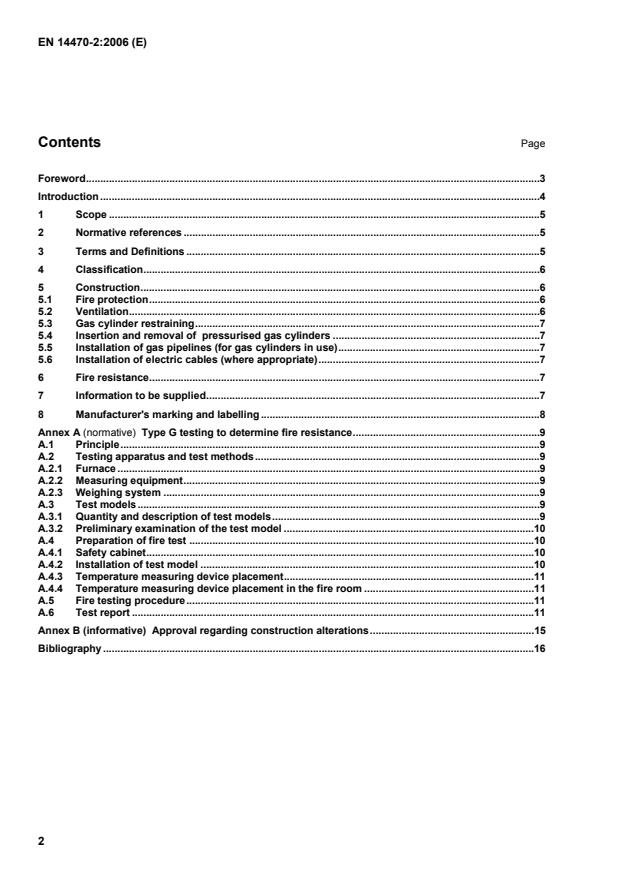
pressurised gas cylinders.7 5.5 Installation of gas pipelines (for gas cylinders in use).7 5.6 Installation of electric cables (where appropriate).7 6 Fire resistance.7 7 Information to be supplied.7 8 Manufacturer's marking and labelling.8 Annex A (normative)
Type G testing to determine fire resistance.9 A.1 Principle.9 A.2 Testing apparatus and test methods.9 A.2.1 Furnace.9 A.2.2 Measuring equipment.9 A.2.3 Weighing system.9 A.3 Test models.9 A.3.1 Quantity and description of test models.9 A.3.2 Preliminary examination of the test model.10 A.4 Preparation of fire test.10 A.4.1 Safety cabinet.10 A.4.2 Installation of test model.10 A.4.3 Temperature measuring device placement.11 A.4.4 Temperature measuring device placement in the fire room.11 A.5 Fire testing procedure.11 A.6 Test report.11 Annex B (informative)
Approval regarding construction alterations.15 Bibliography.16
This standard is not applicable to brick enclosures, walk-in storage rooms or cabinets which do not take their weight on their base. Requirements are given in respect to the construction of the cabinet and its capacity to resist fire conditions on the outside. A type test is included, which is based on the already existing fire resistance (heating curve) tests given in EN 14470-1. The tests described in this European Standard are type tests (for the storage of flammable liquids EN 14470-1 is applicable – the criteria for failure are different – see Annex A).
2 Normative references The following referenced documents are indispensable for the application of this European Standard. For dated references, only the edition cited applies. For undated references, the latest edition of the referenced document (including any amendments) applies. EN 1363-1:1999, Fire resistance tests — Part 1: General requirements EN ISO 13943:2000, Fire safety — Vocabulary (ISO 13943:2000) ISO 3864 (all parts), Graphical symbols - Safety colours and safety signs 3 Terms and Definitions For the purposes of this document, the terms and definitions given in EN ISO 13943:2000 and the following apply. 3.1 type specimen of a design manufactured with the characteristics intended for serial production 3.2 type testing conformity testing on the basis of one or more specimens of product representative of the production
T is the temperature taken on the surface of the gas cylinder valve spanner flat. 5 Construction 5.1 Fire protection The cabinet shall be designed and constructed to ensure that, in the event of a fire, the contents of the cabinet do not contribute any additional risks or spread the fire for at least 15 minutes. 5.2 Ventilation 5.2.1 Cabinets shall be equipped with openings for inlet and exhaust air, which allows for connection of an exhaust air system to the cabinet. In a ventilated cabinet in which ventilation is taking place, with the doors closed, latched and locked, the following extraction rates shall apply: when using flammable and fire supporting gas, at least 10 air changes of the cabinet's volume per hour; when using toxic gas, at least 120 air changes of the cabinet's volume per hour. Under the above conditions the pressure drop shall not exceed 150 Pa. The ventilation system shall maintain a lower pressure in the cabinet than in the surrounding atmosphere. Ventilation shall take place on the top and bottom of the cabinet. Design of the air circulation system within the cabinet shall ensure adequate purging from minor leakage.
This shall be tested by visual inspection and by measuring the air flow and pressure drop while the cabinet is empty. NOTE The inlet pressure drop and the number of air changes have been chosen to provide purging efficiency.
5.2.2 In the event of a fire, the inlet and exhaust vents shall close automatically. The vents' closing system shall be tested as part of the fire-resistance test in Annex A.
...