

SIST EN 12312-3:2017+A1:2020
(Main)Aircraft ground support equipment - Specific requirements - Part 3: Conveyor belt vehicles
General Information
- Abstract
This European Standard specifies the technical requirements to minimise the hazards listed in Clause 4 which can arise during the commissioning, the operation and the maintenance of conveyor belt vehicles when used as intended, including misuse reasonably foreseeable by the manufacturer, when carried out in accordance with the specifications given by the manufacturer or his authorised representative. It also takes into account some requirements recognised as essential by authorities, aircraft and ground support equipment (GSE) manufacturers as well as airlines and handling agencies.
This European Standard applies to
a) self-propelled conveyor belt vehicles with or without driver's accommodation,
b) self-propelled conveyor belt vehicles equipped with a van body,
c) towed conveyor belt vehicles,
intended to be used for manual loading/unloading of aircraft.
This European Standard does not apply to any extensions or appurtenances of conveyor belt vehicles entering the aircraft cargo compartment in order to facilitate loading and unloading therein ("Aircraft Bulk Loading Systems", ABLS).
This European Standard does not apply to pneumatic systems and to cable-less remote controls.
This part of EN 12312 is not applicable to conveyor belt vehicles which were manufactured before the date of publication of this European Standard by CEN.
This part of EN 12312 when used in conjunction with EN 1915-1, EN 1915-2, EN 1915-3 and EN 1915-4 provides the requirements for conveyor belt vehicles.
- Status
- Published
- Publication Date
- 13-Aug-2020
- Technical Committee
- I13 - Imaginarni 13
- Current Stage
- 6060 - National Implementation/Publication (Adopted Project)
- Start Date
- 12-Aug-2020
- Due Date
- 17-Oct-2020
- Completion Date
- 14-Aug-2020
- Directive
- 2006/42/EC - Directive 2006/42/EC of the European Parliament and of the Council of 17 May 2006 on machinery, and amending Directive 95/16/EC (recast)OJ Ref: L 366, L 366 (C), TIP C, 7.9.2026 UMIK 20.1.2027 OJ Date: 15-Oct-2021 Conflicting Date: 20-Jan-2027



Overview
EN 12312-3:2017+A1:2020 is the CEN European standard that defines safety, functional and performance requirements for conveyor belt vehicles used as aircraft ground support equipment (GSE). It specifies technical measures to minimise hazards during commissioning, operation and maintenance - including reasonably foreseeable misuse - for self‑propelled, van‑bodied and towed conveyor belt vehicles intended for manual loading/unloading of aircraft. The standard excludes Aircraft Bulk Loading Systems (ABLS), pneumatic systems and cable‑less remote controls, and does not apply to vehicles manufactured before its publication.
Key topics and technical requirements
The standard addresses the principal hazards and provides prescriptive and performance‑based requirements, including:
- List of hazards (normative): identification and risk assessment of significant hazards related to conveyor belt vehicles.
- General safety requirements: compliance with EN 1915‑1/2/3/4 and risk‑reduction measures, driver protection (seat‑belt/hip guard), and protection against falling loads.
- Boom design: structural and functional provisions for belt booms, including telescopic booms and lifting devices.
- Access and guard‑rails: requirements for safe access to the boom and allowable gap sizes, foldable/adjustable elements and guard‑rail design.
- Guide rails and trays: lateral devices to prevent loads from falling off the belt and requirements for end trays.
- Performance (loads & speeds): limits and rules for load handling and driving speeds, especially when the boom is raised.
- Controls and emergency stop: control layout, safe control behaviour during aircraft operations and emergency stop design in accord with EN ISO 13850/13849.
- Ergonomics and information for use: manual handling, operator ergonomics, marking, warnings and instructions (aircraft types, cargo doors, adverse weather restrictions).
- Verification and normative annexes: testing, verification methods and normative annexes covering drawing‑in hazards, pulleys/idlers, end cross arms and safety distances.
Applications and users
EN 12312‑3 is intended for:
- GSE manufacturers designing or certifying conveyor belt vehicles
- Airlines, ground handlers and maintenance organisations assessing GSE safety and compliance
- Regulatory and procurement teams specifying safe loading/unloading equipment
- Test laboratories and conformity assessors verifying compliance with EU Machinery Directive (2006/42/EC)
Practical applications include safe design, selection, operation instructions, risk assessments and maintenance planning for aircraft conveyor belt vehicles.
Related standards
This part of EN 12312 is used alongside:
- EN 1915‑1 / EN 1915‑2 / EN 1915‑3 / EN 1915‑4 (GSE general requirements)
- EN ISO 12100 (risk assessment)
- EN ISO 13849‑1, EN ISO 13850 (safety controls)
- EN 349, EN 1837, ISO 11532, ISO 11228 series
Keywords: EN 12312-3:2017+A1:2020, conveyor belt vehicles, aircraft ground support equipment, GSE safety, boom design, guard-rails, emergency stop.
Relations
- Effective Date
- 17-Sep-2026
- Effective Date
- 28-Jan-2026
- Effective Date
- 28-Jan-2026
- Effective Date
- 28-Jan-2026
- Effective Date
- 28-Jan-2026
- Effective Date
- 28-Jan-2026
- Effective Date
- 28-Jan-2026
- Effective Date
- 28-Jan-2026
- Effective Date
- 28-Jan-2026
- Effective Date
- 28-Jan-2026
- Effective Date
- 28-Jan-2026
- Effective Date
- 28-Jan-2026
- Effective Date
- 28-Jan-2026
- Effective Date
- 28-Jan-2026
- Effective Date
- 28-Jan-2026
Get Certified
Connect with accredited certification bodies for this standard

BUREAU VERITAS Certification Germany
Bureau Veritas certification in Germany.

Element Materials Technology
Materials testing and product certification.

AQMS Ltd.
AQMS provides ISO certification to SMEs across the UK.
Sponsored listings
Frequently Asked Questions
SIST EN 12312-3:2017+A1:2020 is a standard published by the Slovenian Institute for Standardization (SIST). Its full title is "Aircraft ground support equipment - Specific requirements - Part 3: Conveyor belt vehicles". This standard covers: This European Standard specifies the technical requirements to minimise the hazards listed in Clause 4 which can arise during the commissioning, the operation and the maintenance of conveyor belt vehicles when used as intended, including misuse reasonably foreseeable by the manufacturer, when carried out in accordance with the specifications given by the manufacturer or his authorised representative. It also takes into account some requirements recognised as essential by authorities, aircraft and ground support equipment (GSE) manufacturers as well as airlines and handling agencies. This European Standard applies to a) self-propelled conveyor belt vehicles with or without driver's accommodation, b) self-propelled conveyor belt vehicles equipped with a van body, c) towed conveyor belt vehicles, intended to be used for manual loading/unloading of aircraft. This European Standard does not apply to any extensions or appurtenances of conveyor belt vehicles entering the aircraft cargo compartment in order to facilitate loading and unloading therein ("Aircraft Bulk Loading Systems", ABLS). This European Standard does not apply to pneumatic systems and to cable-less remote controls. This part of EN 12312 is not applicable to conveyor belt vehicles which were manufactured before the date of publication of this European Standard by CEN. This part of EN 12312 when used in conjunction with EN 1915-1, EN 1915-2, EN 1915-3 and EN 1915-4 provides the requirements for conveyor belt vehicles.
This European Standard specifies the technical requirements to minimise the hazards listed in Clause 4 which can arise during the commissioning, the operation and the maintenance of conveyor belt vehicles when used as intended, including misuse reasonably foreseeable by the manufacturer, when carried out in accordance with the specifications given by the manufacturer or his authorised representative. It also takes into account some requirements recognised as essential by authorities, aircraft and ground support equipment (GSE) manufacturers as well as airlines and handling agencies. This European Standard applies to a) self-propelled conveyor belt vehicles with or without driver's accommodation, b) self-propelled conveyor belt vehicles equipped with a van body, c) towed conveyor belt vehicles, intended to be used for manual loading/unloading of aircraft. This European Standard does not apply to any extensions or appurtenances of conveyor belt vehicles entering the aircraft cargo compartment in order to facilitate loading and unloading therein ("Aircraft Bulk Loading Systems", ABLS). This European Standard does not apply to pneumatic systems and to cable-less remote controls. This part of EN 12312 is not applicable to conveyor belt vehicles which were manufactured before the date of publication of this European Standard by CEN. This part of EN 12312 when used in conjunction with EN 1915-1, EN 1915-2, EN 1915-3 and EN 1915-4 provides the requirements for conveyor belt vehicles.
SIST EN 12312-3:2017+A1:2020 is classified under the following ICS (International Classification for Standards) categories: 49.100 - Ground service and maintenance equipment; 53.040.10 - Conveyors. The ICS classification helps identify the subject area and facilitates finding related standards.
SIST EN 12312-3:2017+A1:2020 has the following relationships with other standards: It is inter standard links to kSIST FprEN ISO 31915-3:2026, SIST EN 1915-3:2005+A1:2009, SIST EN 1915-4:2005+A1:2009, SIST EN 1175:2026, SIST EN 4604-001:2009, SIST EN ISO 13850:2016, SIST EN 4533-003:2009, SIST EN 1837:2021, SIST EN ISO 13854:2020, SIST EN 15811:2015, SIST EN ISO 12100:2011, SIST EN ISO 13849-1:2016, SIST EN ISO 14122-1:2016, SIST EN ISO 1346:2021, SIST EN ISO 9554:2019. Understanding these relationships helps ensure you are using the most current and applicable version of the standard.
SIST EN 12312-3:2017+A1:2020 is associated with the following European legislation: EU Directives/Regulations: 2006/42/EC; Standardization Mandates: M/396. When a standard is cited in the Official Journal of the European Union, products manufactured in conformity with it benefit from a presumption of conformity with the essential requirements of the corresponding EU directive or regulation.
SIST EN 12312-3:2017+A1:2020 is available in PDF format for immediate download after purchase. The document can be added to your cart and obtained through the secure checkout process. Digital delivery ensures instant access to the complete standard document.
Standards Content (Sample)
SLOVENSKI STANDARD
01-oktober-2020
Podporna oprema na tleh za letalski promet - Posebne zahteve - 3. del: Tračni
transporterji
Aircraft ground support equipment - Specific requirements - Part 3: Conveyor belt
vehicles
Luftfahrt-Bodengeräte - Besondere Anforderungen - Teil 3: Förderbandwagen
Matériel au sol pour aéronefs - Exigences particulières - Partie 3 : Convoyeurs à bande
Ta slovenski standard je istoveten z: EN 12312-3:2017+A1:2020
ICS:
49.100 Oprema za servis in Ground service and
vzdrževanje na tleh maintenance equipment
53.040.10 Transporterji Conveyors
2003-01.Slovenski inštitut za standardizacijo. Razmnoževanje celote ali delov tega standarda ni dovoljeno.
EN 12312-3:2017+A1
EUROPEAN STANDARD
NORME EUROPÉENNE
July 2020
EUROPÄISCHE NORM
ICS 49.100 Supersedes EN 12312-3:2017
English Version
Aircraft ground support equipment - Specific
requirements - Part 3: Conveyor belt vehicles
Matériel au sol pour aéronefs - Exigences particulières Luftfahrt-Bodengeräte - Besondere Anforderungen -
- Partie 3 : Convoyeurs à bande Teil 3: Förderbandwagen
This European Standard was approved by CEN on 30 October 2016 and includes Amendment 1 approved by CEN on 22 June
2020.
CEN members are bound to comply with the CEN/CENELEC Internal Regulations which stipulate the conditions for giving this
European Standard the status of a national standard without any alteration. Up-to-date lists and bibliographical references
concerning such national standards may be obtained on application to the CEN-CENELEC Management Centre or to any CEN
member.
This European Standard exists in three official versions (English, French, German). A version in any other language made by
translation under the responsibility of a CEN member into its own language and notified to the CEN-CENELEC Management
Centre has the same status as the official versions.
CEN members are the national standards bodies of Austria, Belgium, Bulgaria, Croatia, Cyprus, Czech Republic, Denmark, Estonia,
Finland, France, Germany, Greece, Hungary, Iceland, Ireland, Italy, Latvia, Lithuania, Luxembourg, Malta, Netherlands, Norway,
Poland, Portugal, Republic of North Macedonia, Romania, Serbia, Slovakia, Slovenia, Spain, Sweden, Switzerland, Turkey and
United Kingdom.
EUROPEAN COMMITTEE FOR STANDARDIZATION
COMITÉ EUROPÉEN DE NORMALISATION
EUROPÄISCHES KOMITEE FÜR NORMUNG
CEN-CENELEC Management Centre: Rue de la Science 23, B-1040 Brussels
© 2020 CEN All rights of exploitation in any form and by any means reserved Ref. No. EN 12312-3:2017+A1:2020 E
worldwide for CEN national Members.
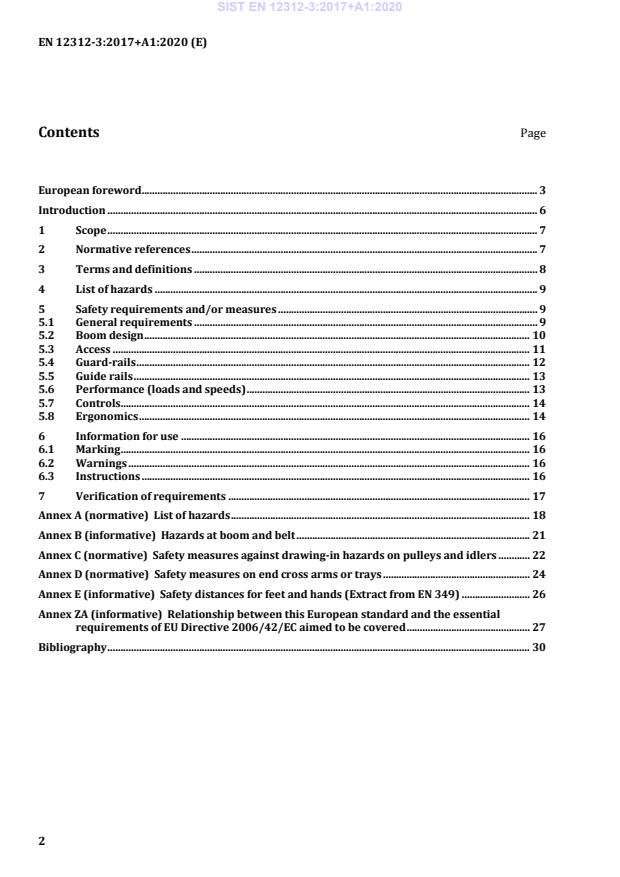
Contents Page
European foreword . 3
Introduction . 6
1 Scope . 7
2 Normative references . 7
3 Terms and definitions . 8
4 List of hazards . 9
5 Safety requirements and/or measures . 9
5.1 General requirements . 9
5.2 Boom design . 10
5.3 Access . 11
5.4 Guard-rails . 12
5.5 Guide rails . 13
5.6 Performance (loads and speeds) . 13
5.7 Controls . 14
5.8 Ergonomics . 14
6 Information for use . 16
6.1 Marking . 16
6.2 Warnings . 16
6.3 Instructions . 16
7 Verification of requirements . 17
Annex A (normative) List of hazards . 18
Annex B (informative) Hazards at boom and belt . 21
Annex C (normative) Safety measures against drawing-in hazards on pulleys and idlers . 22
Annex D (normative) Safety measures on end cross arms or trays . 24
Annex E (informative) Safety distances for feet and hands (Extract from EN 349) . 26
Annex ZA (informative) Relationship between this European standard and the essential
requirements of EU Directive 2006/42/EC aimed to be covered . 27
Bibliography . 30
European foreword
This document (EN 12312-3:2017+A1:2020) has been prepared by Technical Committee CEN/TC 274
“Aircraft ground support equipment”, the secretariat of which is held by DIN.
This European Standard shall be given the status of a national standard, either by publication of an
identical text or by endorsement, at the latest by January 2021, and conflicting national standards shall
be withdrawn at the latest by January 2021.
Attention is drawn to the possibility that some of the elements of this document may be the subject of
patent rights. CEN shall not be held responsible for identifying any or all such patent rights.
This document includes Amendment 1 approved by CEN on 2020-05-22.
This document supersedes ! EN 12312-3:2017".
The start and finish of text introduced or altered by amendment is indicated in the text by tags !".
This document has been prepared under a mandate given to CEN by the European Commission and the
European Free Trade Association, and supports essential requirements of EU Directive 2006/42/EC on
machinery.
For relationship with EU Directive 2006/42/EC on machinery, see informative Annex ZA, which is an
integral part of this document.
EN 12312, Aircraft ground support equipment ― Specific requirements, consists of the following parts:
— Part 1: Passenger stairs;
— Part 2: Catering vehicles;
— Part 3: Conveyor belt vehicles (the present document);
— Part 4: Passenger boarding bridges;
— Part 5: Aircraft fuelling equipment;
— Part 6: Deicers and deicing/antiicing equipment;
— Part 7: Aircraft movement equipment;
— Part 8: Maintenance or service stairs and platforms;
— Part 9: Container/Pallet loaders;
— Part 10: Container/Pallet transfer transporters;
— Part 11: Container/Pallet dollies and loose load trailers;
— Part 12: Potable water service equipment;
— Part 13: Lavatory service equipment;
— Part 14: Disabled/incapacitated passenger boarding vehicles;
— Part 15: Baggage and equipment tractors;
— Part 16: Air start equipment;
— Part 17: Air conditioning equipment;
— Part 18: Nitrogen or Oxygen units;
— Part 19: Aircraft jacks, axle jacks and hydraulic tail stanchions;
— Part 20: Electrical ground power units.
Annexes A, C and D are normative. Annexes B, E and ZA are informative.
The main changes compared to the previous edition EN 12312-3:2003+A1:2009 are:
a) A1:2009 was incorporated;
b) the Introduction was updated in relation to the deviation from recommended criteria;
c) the Scope was updated to cover reasonably foreseeable misuse;
d) Clause 2, Normative references, was updated;
e) List of hazards was updated to exclude hazards due to traffic and repair and was moved to Annex A;
f) 5.1, General requirements, was changed to include a seat-belt or hip guard and further provisions
regarding the driver’s accommodation, e.g. protection from falling loads as well as compliance with
EN 1915-3 and EN 1915-4;
g) 5.2, Boom design was completely revised;
h) 5.3, Access was added, thus making it necessary to re-number the following clauses and subclauses
i) 5.3 Guard-rails, guide rails was re-numbered as 5.4 and divided into 5.4 Guard-rails (covering the
original 5.3.1 through 5.3.5) and 5.5 Guide rails (covering the original 5.3.6 through 5.3.9), it was
expanded to cover foldable and adjustable elements, including the size of allowable gaps;
j) 5.4 Performance (loads and speeds) was re-numbered as 5.6 and contains new provisions regarding
the driving speeds while in raised position and a seat-belt;
k) 5.5 Controls was re-numbered as 5.7 and contains new provisions regarding controls, also during
aircraft loading/unloading operations, and the emergency stop;
l) 5.8, Ergonomics was added;
m) 6.3, Instructions, was extended to cover information about aircraft types and cargo doors, safe
positions for opening/closing of cargo doors, belt bottom tray and restricted operation in adverse
weather conditions;
n) Clause 7, Verification of requirements, was updated;
o) informative Annex A, Typical designs of conveyor belt vehicles, was deleted and replaced by
normative Annex A, List of hazards;
p) informative Annex C, Hazards at boom an belt, was re-numbered as informative Annex B and nip
points were re-named as drawing-in points;
q) informative Annex D, Safety measures against drawing-in hazards on pulleys and idlers was changed
into normative Annex C with the same title and updated;
r) informative Annex E, Safety measures on end cross arms or trays, was changed into normative
Annex D with the same title;
s) informative Annex F, Safety distances for feet and hands (Extract from EN 349), was re-numbered as
informative Annex E;
t) Annex ZA referring to the Machinery Directive 98/37/EC was replaced by Annex ZA referring to the
new Machinery directive 2006/42/EC;
u) the Bibliography was updated.
According to the CEN-CENELEC Internal Regulations, the national standards organisations of the
following countries are bound to implement this European Standard: Austria, Belgium, Bulgaria,
Croatia, Cyprus, Czech Republic, Denmark, Estonia, Finland, Former Yugoslav Republic of Macedonia,
France, Germany, Greece, Hungary, Iceland, Ireland, Italy, Latvia, Lithuania, Luxembourg, Malta,
Netherlands, Norway, Poland, Portugal, Romania, Serbia, Slovakia, Slovenia, Spain, Sweden, Switzerland,
Turkey and the United Kingdom.
Introduction
This European Standard specifies health and safety requirements, as well as some functional and
performance requirements, for conveyor belt vehicles intended for loading/unloading of individual
items of baggage or cargo on/off all aircraft types commonly in service in civil air transport.
The minimum essential criteria are considered to be of primary importance in providing safe,
serviceable, economical and practical conveyor belt vehicles. Deviations should occur only after careful
consideration, extensive testing, risk assessment and thorough service evaluation have shown
alternative methods or conditions to be satisfactory. Such deviations are outside the scope of this
standard and a manufacturer should be able to demonstrate an equivalent level of protection.
This European Standard is a Type C standard as stated in EN ISO 12100.
When provisions of this Type C standard are different from those that are stated in Type A or B
standards, the provisions of this Type C standard take precedence over the provisions of the other
standards for machines that have been designed and built according to the provisions of this Type C
standard. Deviations from requirements do not fall within the presumption of conformity given by the
standard.
1 Scope
This European Standard specifies the technical requirements to minimize the hazards listed in Clause 4
that can arise during the commissioning, operation and maintenance of conveyor belt vehicles when
used as intended, including misuse reasonably foreseeable by the manufacturer, when carried out in
accordance with the specifications given by the manufacturer or his authorized representative. It also
takes into account some requirements recognized as essential by authorities, aircraft and ground
support equipment (GSE) manufacturers as well as airlines and handling agencies.
This European Standard applies to
a) self-propelled conveyor belt vehicles with or without driver's accommodation,
b) self-propelled conveyor belt vehicles equipped with a van body,
c) towed conveyor belt vehicles,
intended to be used for manual loading/unloading of aircraft.
This European Standard does not apply to any extensions or appurtenances of conveyor belt vehicles
entering the aircraft cargo compartment in order to facilitate loading and unloading therein (“Aircraft
Bulk Loading Systems”, ABLS).
This European Standard does not apply to pneumatic systems and to cable-less remote controls.
This part of EN 12312 is not applicable to conveyor belt vehicles that were manufactured before the
date of publication of this European Standard by CEN.
This part of EN 12312 when used in conjunction with EN 1915-1, EN 1915-2, EN 1915-3 and EN 1915-4
provides the requirements for conveyor belt vehicles.
2 Normative references
The following documents, in whole or in part, are normatively referenced in this document and are
indispensable for its application. For dated references, only the edition cited applies. For undated
references, the latest edition of the referenced document (including any amendments) applies.
EN 349, Safety of machinery — Minimum gaps to avoid crushing of parts of the human body
EN 1175-1, Safety of industrial trucks — Electrical requirements — Part 1: General requirements for
battery powered trucks
EN 1837, Safety of machinery — Integral lighting of machines
EN 1915-1:2013, Aircraft ground support equipment - General requirements - Part 1: Basic safety
requirements
EN 1915-2:2001+A1:2009, Aircraft ground support equipment - General requirements - Part 2: Stability
and strength requirements, calculations and test methods
EN 1915-3, Aircraft ground support equipment — General requirements — Part 3: Vibration
measurement methods and reduction
EN 1915-4, Aircraft ground support equipment — General requirements — Part 4: Noise measurement
methods and reduction
EN ISO 12100:2010, Safety of machinery - General principles for design - Risk assessment and risk
reduction (ISO 12100:2010)
EN ISO 13849-1:2015, Safety of machinery - Safety-related parts of control systems - Part 1: General
principles for design (ISO 13849-1:2015)
EN ISO 13850:2015, Safety of machinery - Emergency stop function - Principles for design (ISO
13850:2015)
EN ISO 14122-1, Safety of machinery - Permanent means of access to machinery - Part 1: Choice of fixed
means and general requirements of access (ISO 14122-1:2016)
ISO 11532:2012, Aircraft ground equipment — Graphical symbols
ISO 11228-1, Ergonomics — Manual handling — Part 1: Lifting and carrying
ISO 11228-3, Ergonomics — Manual handling — Part 3: Handling of low loads at high frequency
DIN 51130:2014-02, Testing of floor coverings — Determination of the anti-slip property — Workrooms
and fields of activities with slip danger — Walking method — Ramp test
3 Terms and definitions
For the purposes of this document, the terms and definitions given in EN ISO 12100 and
EN 1915-1:2013 and the following apply.
3.1
conveyor belt vehicle
vehicle comprising a chassis, a boom with a belt, and a lifting device
3.2
boom
load carrying assembly which includes a belt to move the load, and any possible tray attached to it
3.3
telescopic boom
load carrying assembly, adjustable in length
3.4
lifting device
system to vary the height of the boom
3.5
incline
angle of the boom to a horizontal plane
3.6
guide rail
lateral device attached to the boom to prevent loads from falling off the sides
3.7
tray
loading platform fitted at either end of the boom and independent of the belt
3.8
contact protection system
device at the end of the boom to disconnect the power source during approach/travel to the aircraft
4 List of hazards
The list of risks and hazards (given in Annex A) is based on EN ISO 12100:2010 and contains the
hazards and hazardous situations, as far as they are dealt with in this European Standard, identified by
risk assessment as significant for conveyor belt vehicles and which require action to eliminate or reduce
risks. Not covered are risks and hazards due to the traffic and repair.
5 Safety requirements and/or measures
5.1 General requirements
5.1.1 Conveyor belt vehicles shall conform to the relevant requirements of EN 1915-1, EN 1915-2,
EN 1915-3 and EN 1915-4 unless otherwise specified in this European Standard. They shall also
conform to the specific requirements of this European Standard.
5.1.2 Strength calculations shall be carried out in accordance with EN 1915-2.
5.1.3 Stability calculations shall be carried out according to EN 1915-2. Special attention shall be paid
to travel conditions.
5.1.4 Driver's accommodation of self-propelled vehicles shall be fitted with at least a two-point seat
belt. A hip guard shall be provided for non-fully enclosed accommodation.
Driver accommodation shall provide unobstructed visibility across the boom when it is in the lowered
driving position.
Driver position controls shall be protected against a load falling from the boom.
5.1.5 The electrical system of battery powered conveyor belt vehicles shall conform to EN 1175-1,
with the exception of standard automotive chassis.
5.1.6 The boom shall protrude at least at the ramp side.
5.1.7 The conveyor belt vehicle shall be capable of servicing any aircraft sill height, for which it is
designed, with the opposite end within the height range specified in 5.2.9 and 5.8.4.
NOTE See 6.3, Instructions for use, for listing by the manufacturer of aircraft types the conveyor is intended
to serve
5.1.8 Where adjustment of elevation of both ends of the boom is provided it shall be possible to adjust
the ends independently from each other.
5.1.9 Independent of the position of the boom it shall be possible to gain access to service points
requiring frequent use (e.g. daily) at any time without operating the power source.
5.1.10 All sharp edges or corners resulting from the manufacturing process shall be chamfered or
rounded with a minimum radius of 3 mm.
5.1.11 Where a sprung front axle is used, the suspension shall be restricted so as to limit vertical
movement at the aircraft end of the boom, when the conveyor belt vehicle is being driven, e.g. by using
shock absorbers.
5.1.12 Where power operated stabilizers are provided, it shall be possible to retract the stabilizers in
the event of primary power loss by auxiliary means, e.g. hand pump.
5.1.13 Structural parts or stabilizers of pedestrian controlled self-propelled conveyor belt vehicles
shall not protrude from the overall length within the operating range of the tiller.
5.1.14 Where lights for the illumination of working areas or positioning lights are fitted, their design
shall conform to EN 1837. The minimum luminous flux of the lamp shall be 250 lm.
5.2 Boom design
5.2.1 The design of the boom, where intended, shall be such that it can be used by the operator as a
ramp to gain access to the hold door and safely open or close it, enter the hold or exit from it (see
EN 1915-1:2013, Introduction, f) — negotiation).
NOTE Requirements for guard-rails, see 5.4 and 5.5.
5.2.2 Access from the ground to the chassis and from the chassis to the belt shall meet the
requirements of EN 1915-1:2013, 5.14 and 5.3 hereafter.
5.2.3 The boom shall be connected to the lifting system by a means that prevents unintended
disconnection.
5.2.4 The lifting device of the boom shall be protected against unintentional movement, e.g. on
hydraulic cylinders by a lock-valve mounted directly to the cylinder.
5.2.5 Drawing-in to trapping points at conveyor belt pulleys shall be prevented by one of the
measures described at Annex C, or equivalent. Annex B provides examples of drawing-in points.
5.2.6 Where a tray is mounted at either end of the boom, protection against trapping of limbs
between the tray and the running belt shall be provided by construction in accordance with Figure D.2
and Figure D.3 or by safety distances in accordance with Figure D.1 (see Annex E).
5.2.7 Protection against crushing and shearing between the boom and accessible fixed parts shall be
provided, e.g. by shielding with protective plates. It shall meet the requirements of EN 1915-1:2013,
5.15, in particular where the conveyor belt vehicle is equipped with driver’s accommodation.
5.2.8 The end of the boom interfacing with the aircraft shall be protected by suitable means, e.g.
bumpers and/or side wheels.
The aircraft protection device(s) shall:
a) be of a non-marking semi-soft material with a Shore surface hardness not exceeding A50,
b) ensure a minimum 60 mm crushing capability,
c) be designed to minimize any force exerted onto the aircraft cargo compartment doorframe.
It is recommended that the static force equivalent does not exceed 1 500 N distributed over the length,
or 1 500 N on any 100 mm x 100 mm contact area.
The aircraft interface device may include a contact detection feature able to provide an electrical signal
when contact with the aircraft is achieved at any point and which can be used to stop movement. In this
case, the related interlocking systems shall achieve Performance Level “b” according to
EN ISO 13849-1:2015.
5.2.9 The boom height shall be such that, when in working position on all aircraft types intended to
be serviced, the belt at the ramp end shall have an adjustable height range between !0,55 m" or
less to 0,85 m or more.
See Clause 5.8 on ergonomic recommendations and EN 1915-1:2013, Introduction, f) – negotiation,
taking into account the height of the loose load trailers at the airport of use.
The ground clearance shall allow without interference the traversing of two surfaces intersecting at an
angle of ± 3° (5 %) either in bridging or cresting. Where this is not possible, a safety interlock shall be
provided to prohibit vehicle travel if the ramp end of the boom is too low and may touch the ground as a
result of vehicle movement on its suspensions. In this case, the related interlocking systems shall
achieve Performance Level “b” according to EN ISO 13849-1:2015.
The maximum boom incline in the working position when the aircraft end is highest and the ramp end
lowest should not exceed 22° (40 %) (see 5.3.3).
NOTE See 6.3, Instructions for use, for listing by the manufacturer of the aircraft types the conveyor is
intended to serve.
5.2.10 The minimum belt width shall be 600 mm. The belt shall be weather proof and where linking
means are used, care shall be taken to avoid protruding parts or gaps.
5.2.11 The belt shall have an anti-slip surface (see 5.3.3) and shall be designed to provide for drainage
of water.
5.2.12 The belt shall be supported by rollers and/or other devices to allow safe conveyance of load(s)
and for safe walking purposes preferably by plates.
5.2.13 The friction between drive drum and belt shall be sufficient to exclude slipping under maximum
payload.
The influence of weather conditions to be expected on the airport of use should be taken into account
(see EN 1915-1:2013, Introduction, f) — negotiation).
5.2.14 A belt tensioning system covering the foreseeable elongation of the belt shall be installed. The
adjustment shall be possible without dismounting of parts or use of special tools.
5.2.15 The belt drive system shall include a safety device which operates whenever the motive power
is cut off or fails, to prevent a loaded belt from free running due to the potential energy of the load.
5.3 Access
5.3.1 Personnel access with protection against the risk of falling shall be provided:
a) from the ground to the rear / lower part of the boom,
b) for walking on the belt to reach the aircraft cargo compartment door (see 5.3.3),
c) from the belt into the aircraft cargo compartment.
5.3.2 The means of access from ground to belt shall consist in steps located in the aft part of the
vehicle. The belt surface may constitute the upper landing, and a fixed part of the vehicle's chassis may
be used as one of the steps providing its surface is anti-slip and the riser height remains constant.
The access steps shall be provided on their outer side(s) with a fixed guard-rail meeting the
requirements of EN 1915-1:2013, Annex D.3 f), ensuring a safe transition to and from the boom's guard-
rail (see 5.4.1). Any gap between the two guard-rails due to boom position shall so far as practicable not
exceed 120 mm.
5.3.3 Access to/from the aircraft cargo compartment door level may be by walking up/down the
surface of the belt. For this purpose:
a) the boom inclination shall be kept as low as possible consistent with the aircraft to be served and,
as a deviation from EN ISO 14122-1, should not exceed 22° (40 %).
NOTE See 6.3, Instructions for use, for listing by the manufacturer of the aircraft types the convey
...