

SIST ISO 3691:1999
(Main)Powered industrial trucks -- Safety code
General Information
- Abstract
Specifies the safety requirements for the manufacture, application, operation and maintenance of powered industrial trucks.
- Status
- Published
- Publication Date
- 31-May-1999
- Technical Committee
- DTN - Lift and transport appliances
- Current Stage
- 6060 - National Implementation/Publication (Adopted Project)
- Start Date
- 01-Jun-1999
- Due Date
- 01-Jun-1999
- Completion Date
- 01-Jun-1999
Buy Documents

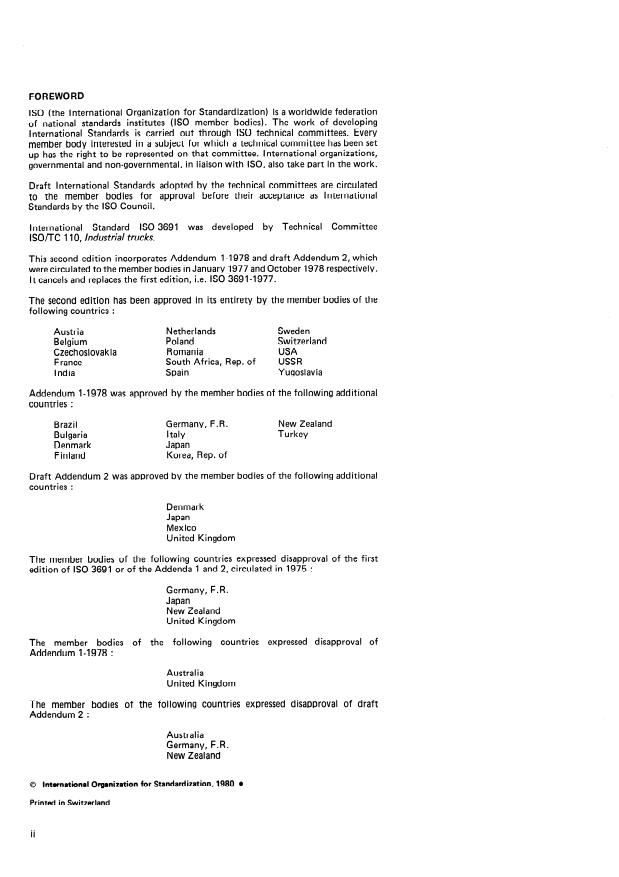
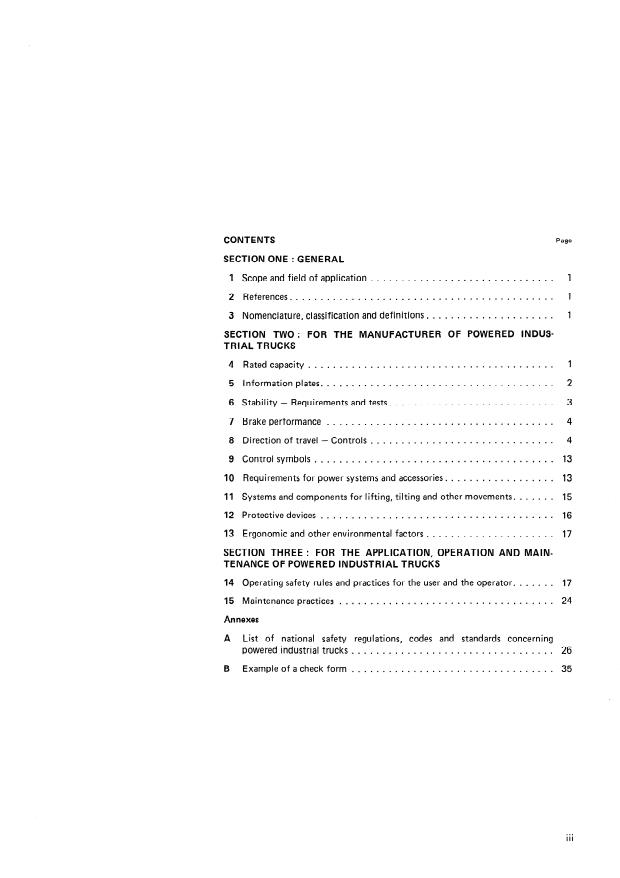

ISO 3691:1980 - Powered industrial trucks -- Safety code
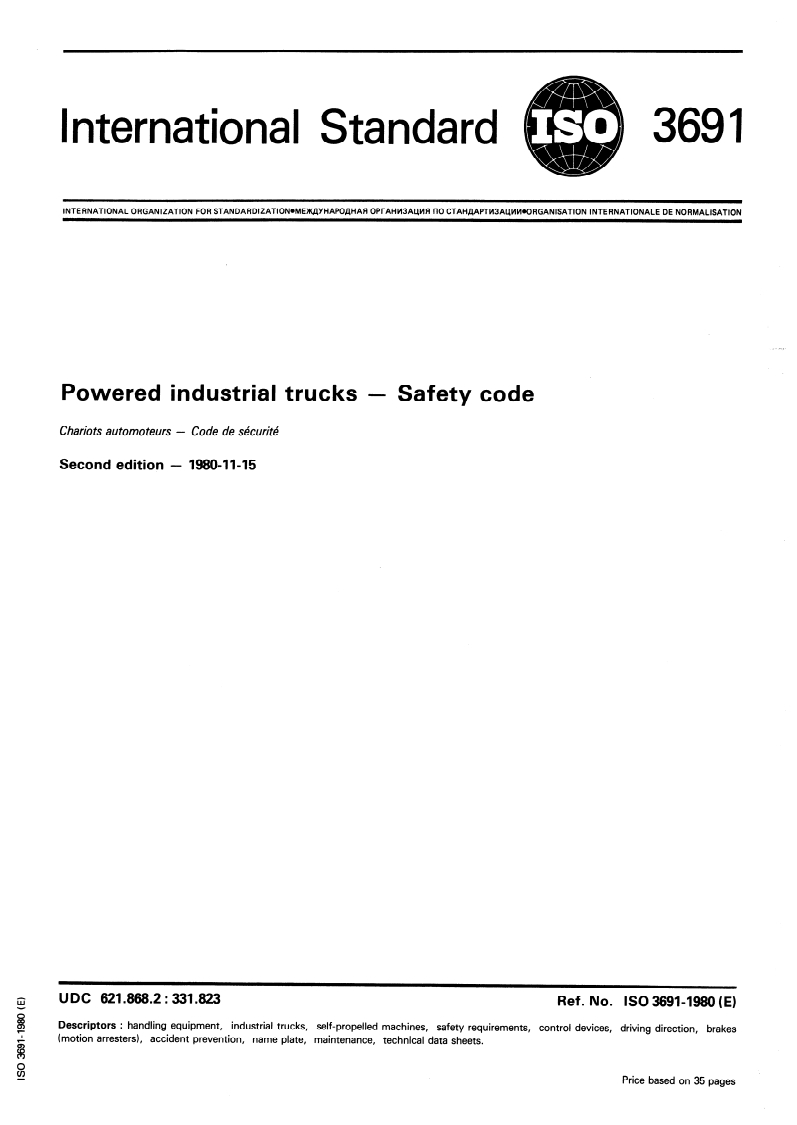
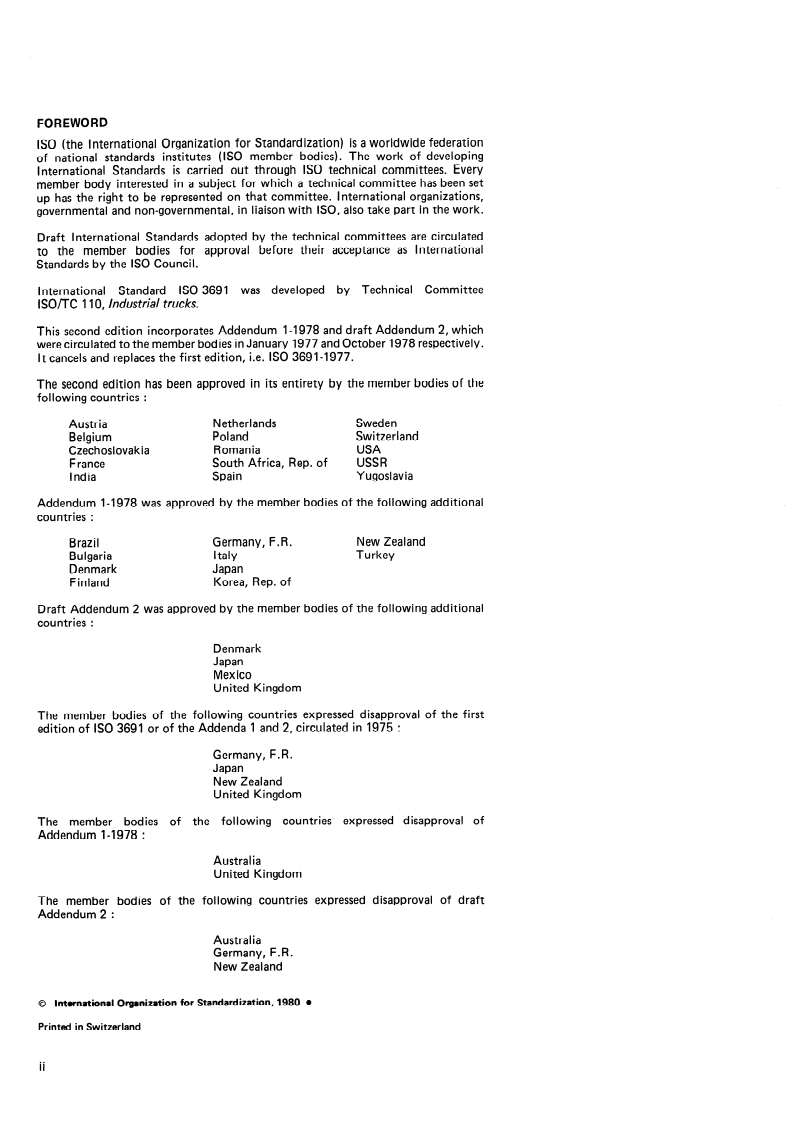

ISO 3691:1980 - Powered industrial trucks — Safety code/1/1980

ISO 3691:1980 - Chariots automoteurs -- Code de sécurité

ISO 3691:1980 - Chariots automoteurs -- Code de sécurité

ISO 3691:1980 - Chariots automoteurs — Code de sécurité/1/1980
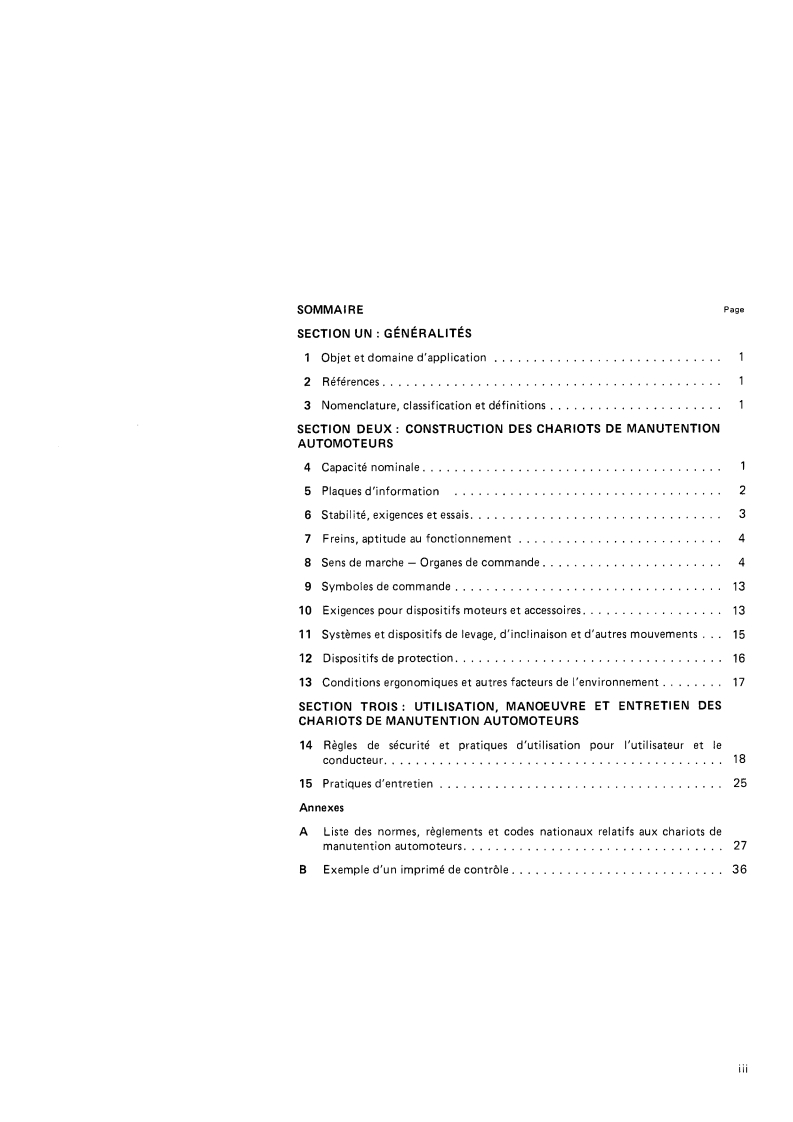

ISO 3691:1980 - Chariots automoteurs — Code de sécurité/1/1980
Overview
SIST ISO 3691:1999 Powered industrial trucks -- Safety code establishes essential safety requirements for the manufacture, application, operation, and maintenance of powered industrial trucks. Powered industrial trucks include self-propelled vehicles such as forklifts, pallet trucks, platform trucks, and industrial tractors used for the handling and movement of materials across a range of industrial environments. This international standard is key for manufacturers, equipment operators, safety professionals, and facility managers who are responsible for maintaining a safe, efficient, and legally compliant workplace.
Key Topics
The standard covers several core elements vital to the life cycle and safe operation of powered industrial trucks:
- Safety Requirements: Criteria for truck construction, rated capacities, and performance specifications, ensuring trucks are suitable for intended loads and operations.
- Identification and Information Plates: Requirements for durable, visible plates specifying truck manufacturer, capacity, weight, and special attachments for traceability and proper use.
- Control Devices and Symbols: Standardization of control layout, movement direction, and the use of uniform symbols to minimize user error and enhance operator safety.
- Stability and Brake Performance: Guidelines and reference to test methods for maintaining truck stability and effective braking systems under diverse operational conditions.
- Operating and Maintenance Practices: Best practices for daily use, operator conduct, and maintenance routines to prevent accidents and extend equipment life.
- Attachments and Special Configurations: Requirements for safe integration and identification of removable or specialized equipment (e.g., order pickers, side loaders).
- Documentation and Technical Data: Necessity for comprehensive technical documents, including check forms and maintenance records.
Applications
Companies and individuals apply SIST ISO 3691:1999 in:
- Industrial and Warehouse Operations: Standardizing safe handling and stacking procedures, thereby reducing workplace accidents related to powered trucks.
- Truck Manufacturing: Ensuring new powered industrial trucks are designed and built to meet internationally recognized safety specifications.
- Equipment Procurement: Assisting buyers in evaluating compliance and compatibility with safety codes before purchasing powered industrial trucks.
- Operator Training: Providing a framework for instructing operators on proper use, control identification, and adherence to safety practices.
- Workplace Auditing and Compliance: Referencing the standard for safety inspections, risk assessments, and compliance with regulatory or insurance requirements.
Implementing the guidelines of SIST ISO 3691 fosters a safety-first culture, minimizes downtime due to accidents or equipment failure, and harmonizes operational protocols across multinational sites.
Related Standards
SIST ISO 3691:1999 is closely associated with other international standards that address specific aspects of powered industrial truck safety:
- ISO 5053: Terminology and classification of powered industrial trucks
- ISO 1074: Counterbalanced lift trucks - Stability tests
- ISO 5766 / ISO 5767: Stability tests for pallet-stackers and platforms
- ISO 6055: Overhead guards for high-lift rider trucks
- ISO 6292 / ISO 6500: Brake performance and requirements
- ISO 3287: Control symbols for powered trucks
These related standards complement SIST ISO 3691 by providing detailed rules for specific testing scenarios, performance measures, equipment components, and symbols, thus helping organizations maintain a comprehensive and robust safety management system for all powered industrial trucks.
Keywords: powered industrial trucks, safety code, forklift safety, industrial truck operation, maintenance practices, control devices, stability tests, ISO 3691, truck manufacturing safety, workplace accident prevention, equipment compliance, international safety standards
Relations
- Effective Date
- 06-Jun-2022
- Effective Date
- 12-May-2008
- Effective Date
- 12-May-2008
- Effective Date
- 12-May-2008
- Effective Date
- 12-May-2008
Buy Documents
ISO 3691:1980 - Powered industrial trucks -- Safety code
ISO 3691:1980 - Powered industrial trucks — Safety code/1/1980
ISO 3691:1980 - Chariots automoteurs -- Code de sécurité
ISO 3691:1980 - Chariots automoteurs -- Code de sécurité
ISO 3691:1980 - Chariots automoteurs — Code de sécurité/1/1980
ISO 3691:1980 - Chariots automoteurs — Code de sécurité/1/1980
Frequently Asked Questions
SIST ISO 3691:1999 is a standard published by the Slovenian Institute for Standardization (SIST). Its full title is "Powered industrial trucks -- Safety code". This standard covers: Specifies the safety requirements for the manufacture, application, operation and maintenance of powered industrial trucks.
Specifies the safety requirements for the manufacture, application, operation and maintenance of powered industrial trucks.
SIST ISO 3691:1999 is classified under the following ICS (International Classification for Standards) categories: 53.060 - Industrial trucks. The ICS classification helps identify the subject area and facilitates finding related standards.
SIST ISO 3691:1999 has the following relationships with other standards: It is inter standard links to SIST ISO 3691:1999/AMD1:1999, ISO 3691-6:2013, ISO 3691-5:2009; is excused to ISO 3691:1980/Amd 1:1983, SIST ISO 3691:1999/AMD1:1999. Understanding these relationships helps ensure you are using the most current and applicable version of the standard.
SIST ISO 3691:1999 is available in PDF format for immediate download after purchase. The document can be added to your cart and obtained through the secure checkout process. Digital delivery ensures instant access to the complete standard document.
Standards Content (Sample)
SLOVENSKI STANDARD
01-junij-1999
Vozila za talni transport - Gnana vozila za talni transport - Pravilnik o varstvu pri
delu
Powered industrial trucks -- Safety code
Chariots automoteurs -- Code de sécurité
Ta slovenski standard je istoveten z: ISO 3691:1980
ICS:
53.060 Industrijski tovornjaki Industrial trucks
2003-01.Slovenski inštitut za standardizacijo. Razmnoževanje celote ali delov tega standarda ni dovoljeno.
International Standard
INTERNATIONAL ORGANIZATION FOR STANDARDIZATIONWlE~YHAPO~HAR OP~AHM3Al@lfl fl0 CTAH~PTM3AlJMM.ORGANlSATlON INTERNATIONALE DE NORMALISATION
-
Powered industrial trucks - Safety code
Chariots automoteurs - Code de s&wit&
Second edition - 1980-11-15
UDC 621.868.2: 331.823
Ref. No. IS0 36914980 (E)
Descriptors : handling equipment, industrial trucks, self-propelled machines, safety requirements,
control devices, driving direction, brakes
(motion arresters), accident prevention, name plate, maintenance, technical data sheets.
Price based on 35 pages
FOREWORD
IS0 (the International Organization for Standardization) is a worldwide federation
of national standards institutes (IS0 member bodies). The work of developing
International Standards is carried out through IS0 technical committees. Every
member body interested in a subject for which a technical committee has been set
up has the right to be represented on that committee. International organizations,
governmental and non-governmental, in liaison with ISO, also take part in the work.
Draft International Standards adopted by the technical committees are circulated
to the member bodies for approval before their acceptance as International
Standards by the IS0 Council.
International Standard IS0 3691 was developed by Technical Committee
ISOITC 1 IO, Industrial trucks.
This second edition incorporates Addendum 1-1978 and draft Addendum 2, which
were circulated to the member bodies in January 1977 and October 1978 respectively.
It cancels and replaces the first edition, i.e. IS0 3691-1977.
in its entirety by the member bodies of the
The second edition has been approved
following countries
Netherlands Sweden
Austria
Switzerland
Belgium Poland
Romania USA
Czechoslovakia
France South Africa, Rep. of USSR
Spain Yugoslavia
India
Addendum 1-1978 was approved by the member bodies of the following additional
countries :
Brazil Germany, F.R. New Zealand
Turkey
Bulgaria Italy
Denmark Japan
Finland Korea, Rep. of
Draft Addendum 2 was approved by the member bodies of the following additional
countries :
Denmark
Japan
Mex ice
United Kingdom
The member bodies of the following countries expressed disapproval of the first
edition of IS0 3691 or of the Addenda 1 and 2, circulated in 1975 :
Germany, F.R.
Japan
New Zealand
United Kingdom
The member bodies of the following countries expressed disapproval of
Addendum 1-1978 :
Australia
United Kingdom
expressed disapproval of draft
The member bodies of the following countries
Addendum 2
Australia
Germany, F.R.
New Zealand
0 International Organization for Standardization, 1980 l
Printed in Switzerland
ii
Page
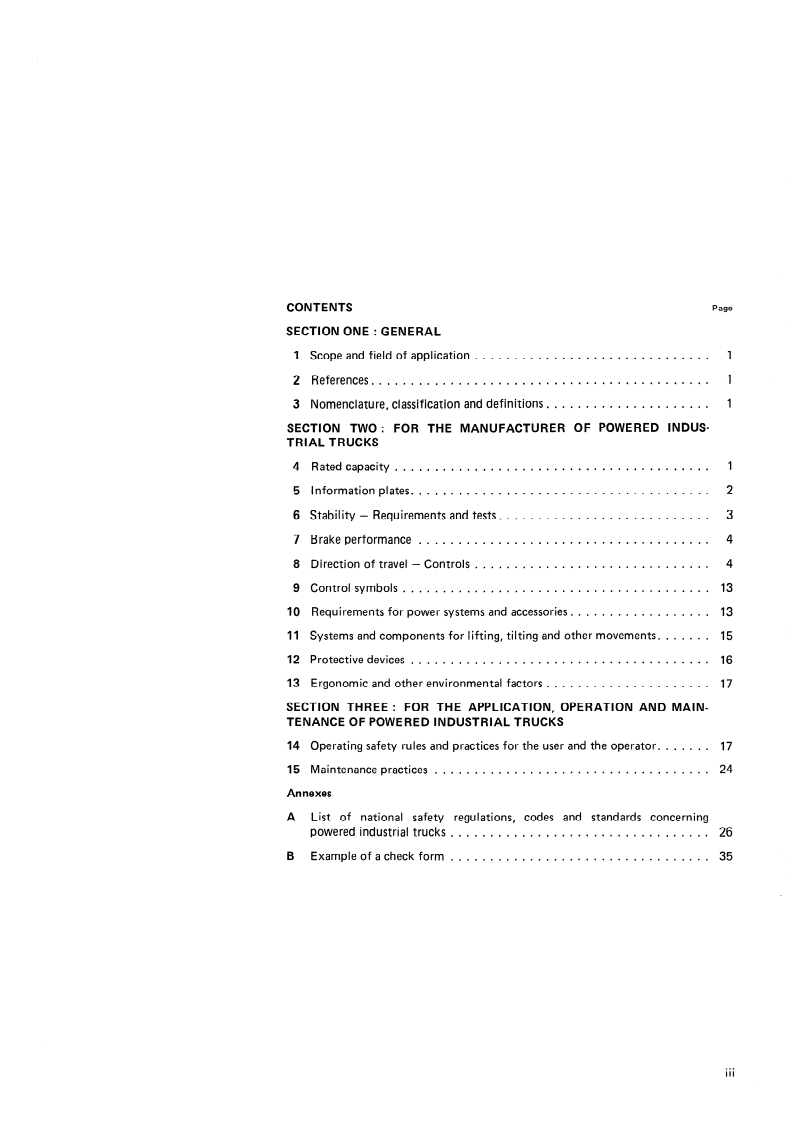
CONTENTS
SECTION ONE : GENERAL
1 Scope and field of application . . . . . . . . . . . . . . . . . . . . . . . . . . . . . .
2 References. . . . . . . . . . . . . . . . . . . . . . . . . . . . . . . . . . . . . . . . . . .
3 Nomenclature, classification and definitions. . . . . . . . . . . . . . . . . . . . .
SECTION TWO: FOR THE MANUFACTURER OF POWERED INDUS-
TRIAL TRUCKS
4 Rated capacity. . . . . . . . . . . . . . . . . . . . . . . . . . . . . . . . . . . . . . . .
5 Information plates. . . . . . . . . . . . . . . . . . . . . . . . . . . . . . . . . . . . . .
6 Stability - Requirements and tests. . . . . . . . . . . . . . . . . . . . . . . . . . .
7 Brake performance . . . . . . . . . . . . . . . . . . . . . . . . . . . . . . . . . . . . .
8 Direction of travel - Controls . . . . . . . . . . . . . . . . . . . . . . . . . . . . . .
9 Control symbols . . . . . . . . . . . . . . . . . . . . . . . . . . . . . . . . . . . . . . .
10 Requirements for power systems and accessories. . . . . . . . . . . . . . . . . .
11 Systems and components for lifting, tilting and other movements. . . . . . .
12 Protective devices . . . . . . . . . . . . . . . . . . . . . . . . . . . . . . . . . . . . . . 16
13 Ergonomic and other environmental factors. . . . . . . . . . . . l . . . . . . . . 17
SECTION THREE : FOR THE APPLICATION, OPERATION AND MAIN-
TENANCE OF POWERED INDUSTRIAL TRUCKS
I7
14 Operating safety rules and practices for the user and the operator. . . . . . .
15 Maintenance practices . . . . . . . . . . . . . . . . . . . . . . . . . . . . . . . . . . . 24
Annexes
A List of national safety regulations, codes and standards concerning
powered industrial trucks . . . . . . . . . . . . . . . . . . . . . . . . . . . . . . . . . 26
B Example of a check form . . . . . . . . . . . . . . . . . . . . . . . . . . . . . . . . . 35
This page intentionally left blank
IS0 36914980 (E)
INTERNATIONAL STANDARD
Powered industrial trucks - Safety code
SECTION ONE : GENERAL
1 SCOPE AND FIELD OF APPLICATION IS0 5767, Industrial trucks operating in special condition
of stacking with mast tilted forward - Stability tests?
This International Standard specifies the safety requirements
IS0 6055, High-lift rider trucks - Overhead guards -
for the manufacture, application, operation and main-
Specification and testing.
tenance of powered industrial trucks.
IS0 629211, Powered industrial trucks - Brake perform-
The term “powered industrial trucks” applies to mobile,
ance - Part I : High-lift, low-lift and non-lifting.2)
power-driven vehicles used to carry, push, pull, lift, stack
or tier any type of load, as described in clause 3.
IS0 6500, Powered industrial trucks - Service brakes -
Component strength-performance requirements.
The word “shall” is to be understood as expressing a
mandatory requirement and the word “should” as
expressing a recommended requirement.
3 NOMENCLATURE, CLASSIFICATION AND DEFI-
NITIONS
2 REFERENCES
3.1 The classification and nomenclature for powered
IS0 1074, Counterbalanced lift trucks - Stability - Basic
industrial trucks are given in IS0 5053/l. The definitions
tests.
will be covered in an International Standard currently
under study.
IS0 1084, Industrial tractors - Definition and nominal
rating.
3.2 In addition, for the purposes of this International
I SO 12 14/I, Powered industrial trucks - Parameters for
Standard, the following definitions and classifications
designation of ra ted capacity and capacity - Part I : Powered
apply :
high lift trucks. 1 )
IS0 2330, Fork lift trucks - Fork arms - Technical 3.2.1 low-lift truck : A self-loading truck equipped with
characteristics and testing. an elevating mechanism designed to raise the load to a
height just sufficient to permit horizontal movement.
IS0 3184, Reach and straddle fork lift trucks - Stability
tests.
: Either a self-loading truck equipped
3.2.2 high-lift truck
IS0 3287, Powered industrial trucks - Control symbols?) with an elevating mechanism designed to permit stacking
and tiering or an order-picker truck (whether self-loading or
IS0 505311, Powered industrial trucks - Terminology -
not) equipped with a similar elevating mechanism.
Part 1 : Classification and nomenclature. 2,
NOTE - Sub-clauses 32.1 and 3.2.2 are presented for use pending
IS0 5766, Pallet-stackers and high-lift platform trucks -
the publication of the International Standard currently under
study for the definitions of powered industrial trucks.
Stability tests. 2,
SECTION TWO : FOR THE MANUFACTURER OF POWERED INDUSTRIAL TRUCKS
ing or lifting in normal operation under conditions as set
4 RATED CAPACITY (CapacitB nominale)
forth in 4.1 to 4.5, based on the strength of the various
components of the truck and, when applicable, also based
The manufacturer ’s rated capacity of a powered industrial
on the stability requirements and tests as set forth in
platform or lift truck is the maximum load, established by
the manufacturer, that a given truck is capable of transport- clause 6 of this International Standard.
1) At present at the stage of draft. (Revision of WI/R 1214-1971)
2) At present at the stage of draft.
IS0 3691=1980(E)
having a width over the fork arms or platform up to and
Alternative capacity ratings may also be established.
including 690 mm (27 in) and for an elevation of 3,3 m
The loads shall be expressed in kilograms (kg) and the
(130 in) for trucks having a width over the fork arms or
dimensions in metres (m) or millimetres (mm) in countries
platform greater than 690 mm (27 in).
using the International System of Units (SI).
The distance D shall be 400, 500 or 600 mm for trucks
The loads shall be expressed in pounds (lb) and the
delivered in countries using the International System of
dimensions in inches (in) in countries using the Imperial
Units (SI), and 16, 20 or 24 in in countries using the
System.
Imperial System.
The rated capacity of a towing tractor corresponds to the
The above text is valid until a new Internation al Standard
NOTE -
maximum draw-bar pull, established by the manufacturer,
defining the rated capacity of these trucks is available.
that the tractor is capable of developing in normal
operation under specified conditions.
4.2.4 Order-picker trucks
4.25 Side-loading fork lift trucks
4.1 Fixed-platform trucks
4.3 Low-lift trucks (pallet, stillage and platform)
The rated capacity of a fixed-platform truck is the
maximum load, established by the manufacturer, uniformly
The rated capacity of a low-lift truck is the uniformly
distributed over the load-carrying platform, which the truck
distributed load, established by the manufacturer, which
is capable of transporting under normal conditions of
it is capable of transporting.
operation.
4.4 Tractors
4.2 High-lift trucks
This term applies to industrial tractors defined in clause 2
of IS0 1084.
4.2.1 Counterbalanced fork lift trucks
The nominal capacity of a tractor is defined in clause 3,
“Nominal rating ”, of IS0 1084.
The rated capacity of a counterbalanced fork lift truck is as
defined in clause 2 of lSO/R 1214.
4.5 Removable attachments
The rated capacity of a removable attachment is the
maximum load at a specified load centre distance, establish-
ed by its manufacturer, that the attachment is capable of
The standard load centre distances shall be as defined in
handling in normal operation under specified conditions.
clause 4 of lSO/R 1214.
4.2.2 Reach and straddle trucks
5 INFORMATION PLATES
The rated capacity of a reach truck or of a straddle fork lift
truck is the maximum load, established by the manufac-
5.1 Powered industrial trucks
turer, which it is capable of transporting and lifting at a
distance D measured between the load centre of gravity and
Every powered industrial truck shall bear a durable identifi-
the front face of the shank of the fork, with vertical mast
cation plate, permanently attached in a prominent position,
and horizontal fork, and for an elevation of 3,3 m (130 in).
which shall indicate the condition of the truck when
delivered from the manufacturer and give the following
The distance D shall be 400, 500 or 600 mm for trucks
information in indelible characters :
delivered in countries using the International System of
Units (SI), and 16, 20 or 24 in in countries using the
5.1 .I Engine trucks
Imperial System.
a) name of truck manufacturer (and importer, if
NOTE - The above text is valid until a new Internation al Standard
defining the rated capacity of these trucks is available. required) and also, if desired, the manufacturer ’s trade-
mark;
b) type;
4.2.3 Pallet-s tacker and high-lift platform trucks
production or serial number;
cl
The rated capacity of a pallet-stacker or high-lift platform
truck is the maximum load, established by the manufac-
d) unladen weight in working condition, without
turer, which it is capable of transporting and lifting at a
removable attachments but complete with fork arms in
distance D measured between the load centre of gravity and
the case of a fork-lift truck;
the front face of the shank of the fork or abutment of the
platform and for an elevation of 2,5 m (100 in) for trucks 4 capacity at maximum elevation.
IS0 36914980 (E)
5.1.2 Electric trucks
b) type;
a) name of truck manufacturer (and importer, if
serial number;
cl
required) and also, if desired, the manufacturer ’s trade-
nominal voltage;
mark; 4
b) type; e) capacity in ampere hours at the 5-hour rate;
production or serial number;
cl f) weight, in working order with removable container
(and ballast) if used.
d) unladen weight in working condition, without
removable attachments but complete with fork arms in
Alternatively, the battery weight may be stamped on the
the case of fork lift trucks;
removable container (and bal I ast) nea r the lifting means.
capacity at maximum elevation;
5.4 Special use
weight of unladen truck without battery;
f 1
If a truck is to be operated under conditions other than the
minimum and maximum allowable battery weight;
it shall bear a durable plate,
normal working conditions,
nominal battery voltage for which the truck system
h) in a prominent position, giving the following information :
is ar ranged.
a) designation of the special condition(s) of use;
5.1.3 Trucks with front end attachments
one of the conditions
capacity for
b)
of use.
In addition to the information listed in either 5.1.1 or
5.1.2, the identification plate shall also bear the following
information :
type of attachment;
a)
weight of unladen truck in
b) working condition,
wi thout fork arms but fitted with th
e attachm ent; 6 STABILITY - REQUIREMENTS AND TESTS
d capacity of the truck and attachment combinations Powered industrial trucks shall meet the requirements for
at maximum elevation.
stability when tested in accordance with the relevant IS0
NOTES publications referred in 6.1 to 6.7. The tests set forth in
these publications are intended to ensure that high-lift in-
1 It is
also permissible to indicate the manufacturer ’s
dustrial trucks have satisfactory stability characteristics
capaci on the plate.
w
when properly operated under normal operating conditions.
2 The load capacity may be indicated on a separate plate,if desired.
The tests are to be carried out by the manufacturer on
3 When a truck or attachment is imported by a person other than
prototype trucks which are fully representative of series
the original manufacturer, it is the responsibility of the importer
production trucks.
to affix an additional plate bearing his name as well as the
requirements of 5.1 .I, 5.1 .2 and 5.1.3.
5.2 Removable attachments
6.1 Counterbalanced trucks
Every removab
le attachment shall carry a sepa rate identifi-
See IS0 1074.
cation plate giv ing the following in
formation :
if
manufacturer (and importer
ame of attachment
a) n
6.2 Reach (retractable mast or forks) and straddle fork
requ i red);
lift trucks (pedestrian and rider controlled)
b) type;
See IS0 3184.
c) production or serial number;
weight of the attachment and distance of its centre
d)
6.3 Pallet-stacker and high-lift platform trucks (pedestrian
ravity from the attachment mounting face;
and rider controlled)
of cl
e) rated capacity of the attachment.
See IS0 5766.
NOTE - The following warning shall be added :
“WARNING. Actual load may be restricted by reference to the
6.4 Order-picker trucks
capacity of the truck.”
An International Standard is currently under study.
5.3 Batteries for electric trucks
an identification plate
The traction batteries shall carry
6.5 Side-loading fork lift trucks
showing :
An International Standard is currently under study.
a) name of battery manufacturer;
IS0 36914980 (E)
8.2.3.1 SIT-ON TRUCKS
6.6 Rough terrain trucks
An International Standard is currently under study.
8.2.3.1 .I Trucks where the load is leading when the truck
travels in the forward direction
6.7 Trucks operating in the special condition of stacking
with the mast tilted forward a) Counterbalanced fork lift truck
See IS0 5767.
NOTE - When available, references to the relevant IS0 publication
concerning additional stability tests will be added.
FIGURE 1
7 BRAKE PERFORMANCE
The brakes fitted on a powered industrial truck or tractor
b) Straddle or reach (with retractable mast or fork)
shall meet the performance requirements set forth in
truck
IS0 6292/l and IS0 6500.
8 DIRECTION OF TRAVEL - CONTROLS
8.1 General
FIGURE 2
The best controls are those which most closely agree with
natural human instinct. Such controls are sometimes called
c) Shunting tractor
“directional” where control movement is in the same
direction as the desired movement of the truck or accessory.
Some controls such as “forward” and “reverse” are obvious
and easy to make “directional ”.
Other control movements are less obviously directional and
call for a thorough study and/or testing to determine the
most natural human reaction. Recommendations for
preferred motions and placement of controls are intended
FIGURE 3
to establish uniform practices in this area.
Still other controls involve no element of “naturalness ”,
and the naming then has to be done on an arbitrary basis.
Trucks where the load is trailing when the truck
8.2.3.1.2
The arbitrary method should be used only after a thorough
travels in the forward direction
study reveals no natural tendency or ease for a given type
of direction of control. Such arbitrarily named controls
a) Straddle or reach (with retractable mast or fork)
would be one of the greatest areas for lack of uniformity
truck where the operator is seated sideways
unless co-ordinated by some standards-making body.
8.2 Front-end and forward directions of travel
8.2.1 Front end of a truck
The front end of a truck is the end nearest the arrow in
figures 1 to 18.
FIGURE 4
8.2.2 Rear end, left-hand, and right-hand side of a truck
b) Towing tractor - Front-end control
The rear end, left-hand, and right-hand side of a truck are in
conformity with the definition given in 8.2.1.
‘1
Y
I
8.2.3 Forward direction of travel
I
I ’
The forward direction of travel is the direction indicated
,J
by the arrow in figures 1 to 18. All sketches show plan
views of trucks. FIGURE 5
IS0 36914980 (E)
8.2.3.2.2.2 Trucks where the load is trailing when the
c) Towing tractor - Rear-end control
truck travels in the forward direction
a) Straddle or reach truck (with retractable mast or
fork), with the operator standing sideways
FIGURE 6
d) Fixed-platform truck
FIGURE 11
b) High-lift or low-lift platform truck
FIGURE 7
8.2.3.2 STAND-ON TRUCKS
8.2.3.2 .I Cen tre con trol
Trucks where the load is leading when the truck travels in
FIGURE 12
the forward direction
a) Counterbalanced fork lift truck
.
.
L
II
cl
I ,D
1 J
6 4 -
FIGURE 13
FIGURE 8
c) Fixed-platform truck
8.2.3.2.2 End control
8.2.3.2.2.1 Trucks where the load is leading when the
truck travels in the forward direction
Counterbalanced fork lift truck
a)
FIGURE 14
FIGURE 9
Order-picker truck
b) Straddle or reach (with retractable mast or fork)
truck
FIGURE 10
FIGURE 14 a)
IS0 3691-1980 (E)
8.2.3.3 PEDESTRIAN-CONTROLLED TRUCKS d) Where a steering hand wheel and knob are used,
either the configuration shall be of a design which will
Trucks where the load is trailing when the truck travels in
minimize the hazard from a spinning hand wheel due to
the forward direction
road reaction feedback, or the steering mechanism shall
be of a type which prevents road reactions from causing
a) Pallet truck
the steering hand wheel to spin.
e) It is recommended that steering knobs, when used, be
of a type which is engaged by the operator ’s hand from the
top, and within the periphery of the steering hand wheel.
FIGURE 15
8.3.1.1 STEERING WHEELS
b) High-lift or low-lift platform truck
8.3.1.1 On all trucks on which the operator faces in the
normal line of travel and which are steered by means of a
steering wheel (horizontal, inclined or vertical), a clockwise
rotation of the steering wheel shall steer the truck to the
right in the forward direction of travel.
FIGURE 16
c) Counterbalanced fork lift truck
FIGURE 19
FIGURE 17
d) Tractor
FIGURE 19 a)
models 8.2.3.1.2 a)
NOTE - Considerable numbers of trucks of
FIGURE 18
and 8.2.3.2.2 have been built with a steering reverse of the above
standard. Such trucks may still be operated, provided that the
function and mode of operation of the controls is clearly indicated.
8.3 Steering controls
8.3.1.1.2 On all trucks on which the operator faces at a
right angle to the normal line of travel and which are
8.3.1 Steering - Rider trucks
steered by means of a steering wheel (horizontal, inclined
or vertical), a clockwise rotation of the steering wheel shall
a) All steering controls shall be confined within the
steer the truck clockwise when the truck is travelling with
plan view outline of the truck, or guarded to prevent
the load trailing. (See the note in 8.3.1.1.1, which also
injury to the operator during movement of the controls
applies in this case.)
when passing obstacles, walls, columns, etc.
b) Where steering must be accomplished with one hand,
steering knobs are necessary for safe operation. Steering
knobs, when used, shall be mounted within the
periphery of the steering handwheel and provision shall
be made to prevent injury to the operator ’s hand.
c) When conditions of use would result in steering
shocks being generated, the transmission of such shocks
to the steering hand wheel shall be limited to the extent
FIGURE 20
necessary to avoid injury to the driver ’s hand or arm.
IS0 36914980 (E)
direction of travel (figure 22). (See the note in 8.3.1 .I .I,
which also applies in this case.)
FIGURE 20 a)
8.3.1.2 TILLERS
FIGURE 22
8.3.2 Steering handle - Motorized hand and hand/rider
8.3.1.2.1 Tillers operating in a horizontalplane
trucks
On trucks steered by a tiller which moves in the horizontal
plane and which in the neutral position is parallel to the
8.3.2.1 The handle on the tongue shall be provided with
longitudinal axis of the truck, or on trucks steered by a
suitable means to protect the operator ’s hand against injury
tiller which rotates. on a shaft parallel to the longitudinal
from swinging doors, walls, columns, etc.
axis of the truck and which in the neutral position stands
upright, when the driver is facing in the direction of travel,
8.3.2.2 Motorized hand/rider trucks employing a steering
movement of the tiller to his right shall steer the truck to
tongue control which extends beyond the confines of the
his right.
truck shall steer as follows :
With the walking operator facing in the direction of travel,
.
with the load trailing, clockwise movement of the steering
tongue shall steer the truck clockwise,
With the riding operator facing in the direction of travel,
with the load trailing, clockwise movement of the steering
2 tongue shall steer the truck clockwise.
8.3.3 Pivoting steering controls
?
FIGURE 21
On trucks which are steered by means of a pivoting control
operated by foot (figure 23) or by hand (figure 24), a
clockwise rotation of this control, looking in the forward
direction of travel, shall steer the truck to the right.
FIGURE 21 a)
8.3.1.2.2 Tillers operating in a vertical plane
On stand-on lift platform trucks (8.2.3.2.2.2 b)) and fixed-
platform trucks (8.2.3.2.2.2 c)) which are steered by means
of a tiller situated on the right of the operator and
operating in a vertical plane, raising the tiller (clockwise
rotating) shall steer the truck to the right in the forward FIGURE 23
IS0 3691-1980 (E)
8.4.1.3 DIRECTION-CHANGE LEVERS
The direction levers on internal combustion engine powered
trucks and the control levers on electric trucks shall be
that their operation would
arranged in such a way
correspond to the required direction of travel (figure 26).
FIG URE 24
8.4 Driving and braking controls
A parking brake (or mechanism) which may be part of or
include the service brake shall be provided on all powered
industrial trucks. The parking brake (or mechanism) shall
be manually or automatically applied, and shall remain
applied until intentionally released.
e
A means shall be provided whereby the control circuit(s) in
FIGURE 26
the case of electric trucks and the ignition and/or starting
means in the case of internal combustion engine trucks may
KES- ELECTRIC-
be disconnected or rendered inoperative. 8.4.1.4 SAFETY CONTROL A ND BRA
POWER ED SIT-DOWN RIDER INDUST RIAL TRUCKS
Means shall be provided to open automa tically the travel
8.4.1 Sit-down rider trucks
circuit when the operator leaves th e truck.
Travel control shall be so arranged that the truck will move
only when the direction control is actuated and will not
8.4.1.1 PEDALS
move at a speed greater than inching speed unless control
The accelerator, brake pedals (and clutch pedal when fitted)
has been actuated for both speed and direction. Where no
of all sit-down ride-trucks shall be arranged as shown in
neutral position is provided, the truck shall not move unless
figure 25.
the speed control is activated.
Where the pedal arrangement differs from that shown in
The accelerator, if foot operated, shall be located for
figure 25, its function shall be clearly indicated both in the
operation by the right foot and shall increase travel speed
driving instructions and on the truck itself.
when depressed.
Se rvice brakes, if foot operated, shall be applied by
de pressi ng the pedal.
When a single pedal is used to control both the above
functions (i.e. acceleration and braking), it shall be located
for operation by the right foot and shall release the brakes
and increase travel speed when depressed. Conversely, it
shall reduce travel speed and apply the brakes when
released.
8.1.4.5 SAFETY CONTROL AND BRAKES - INTERNAL
C
COMBUSTION ENGINE POWERED SIT-DOWN RIDER
INDUSTRIAL TRUCKS
a : clutch
b : brake
Travel control shall be so arranged that the truck will move
only when the direction control is actuated and will not
c : accelerator
move at a speed greater than inching speed unless control
View from driver ’s position
has been actuated for both speed and direction.
rgized
FIGURE 25 foot ope rated, shall be ene
Service br bakes, if bY
ing the pedal
depress
If a combination clutch-and-brake pedal is used, the initial
pedal movement shall disengage the clutch and the final
8.4.1.2 GEAR-CHANGE LEVER
pedal movement shall apply the brakes, and the pedal shall
The positions for gear engagement shall be clearly indicated. be operated by the left foot.
IS0 3691-1980(E)
when 8.4.2.3 PUSH-BUTTONS
The accelerator, if foot operated, shall increase speed
depressed.
8.4.2.3.1 When the direction of travel is selected by push-
If a combination pedal controls both acceleration and
buttons arranged vertically one above the other, pressing
brakes, depressing the accelerator portion shall increase
the upper button shall drive the truck in the forward
speed and depressing the brake portion shall apply the
direction of travel such as defined in 8.2.3 (figure 29).
brakes, and the combination pedal shall be operated by the
right foot.
The clutch pedal, if used, shall disengage the clutch when
depressed with the left foot.
8.4.2 Stand-on rider trucks
8.4.2.1 PEDALS
The depressing of the pedal on which the operator ’s foot
will remain while the truck is in motion shall release the
brake and allow the truck to travel (figure 27). The service
brake should be applied by lifting the foot. Where the
service brake is applied with a downward movement of
the pedal, pressing down upon the brake pedal shall apply
FIGURE 29
the service brake.
8.4.2.3.2 When the direction of travel is selected by push-
buttons arranged horizontally, the direction controlled by
each button shall be clearly indicated.
8.4.2.3.3 All directional control push-buttons shall return
to neutral position when released.
-b AKES - ELECTRIC
8.4.2.4 SAFETY CONTROL AND BR
POWERED STAND-ON INDUSTRIAL TRUCKS
Means shall be provided to open autom atically the travel
a : brakes applied circuit when the operator leaves the truck
b : brakes released
Means shall be provided so that the travel circuit can be
FIGURE 27
activated only by releasing the parking brake and resetting
the speed and/or directional control(s) when the operator
assumes the driving position.
8.4.2.2 !.-EV E RS
The provisions of 8.4.1.2 and 8.4.1.3 apply also to stand-on
trucks.
8.4.2.5 SAFETY CONTROL AND BRAKES- INTERNAL
Where a lever is provided, depressing the lever on which the COMBUSTION ENGINE POWERED STAND-ON INDUS-
operator ’s hand will remain while the truck is in motion TRIAL TRUCKS
shall release the brake and allow the truck to travel
The accelerator , if foot operated,
shall increase the speed
(figure 28, position b)). Releasing the lever shall apply the
when depressed with the right foot.
brakes (figure 28, position a)).
a
Travel control shall be so arranged that the truck will not
move until the direction control has been actuated and will
not move at a speed greater than inching speed unless
control has been actuated for both speed and direction.
8.4.3 Pedestrian con trolled trucks
8.4.3.1 ELECTRIC TRUCKS (PEDESTRIAN)
b
8.4.3.1.1 Forward and reverse motion of the truck shall be
FIGURE 28
controlled or selected by means of a control device readily
IS0 3691-1980(E)
accessible when the handle grip of the steering tongue is
When the brake is electrically operated, the release of the
grasped. This control device shall operate directionally in
tiller or of the travel control switch shall automatically cut
off the power and apply the brake (principle of “dead man”
one of the following manners :
control), whatever the position of the handle.
a) The control shall have a forward motion for forward
travel and a rearward motion for reverse travel.
NOTE - The requirements of 8.4.3.1.2 do not preclude controlled
“free-wheeling” when the power is off.
b) The control shall consist of two buttons located at
the top of the control handle when the steering tongue is
approximately vertical, arranged so that the forward one
8.4.3.2 INTERNAL COMBUSTION ENGINE POWERED
(F) is for forward travel and the rearward one (R) for
TRUCKS (PEDESTRIAN CONTROLLED)
reverse travel (figure 30).
c) The control shall have rotary motion, the rotation
The tiller shall be movable in a vertical plane. Where the
being in the same direction as drive wheel rotation
driving mechanism between the engine and wheels is
(figure 31).
mechanical (i.e. not generator motor drive), the brake shall
be applied and the engine power disconnected from the
The travel control shall be clearly and durably identified to
wheel(s) when the tiller is moved above or below the
indicate function and direction of motion.
horizontal (positions B or B’ in figure 32).
8.4.3.1.2 The tongue shall be movable in a vertical plane.
When the brake is mechanically operated, and the tongue is
in the vertical (B) or horizontal (B ’) positions, the brake
shall be applied and the power switched off, unless it has
already been switched off by the operation of the travel
control switch (figure 31 a)).
(RI U=)
FIGURE 30
B - B’ : Brake on
7 -
Power off
A : Brake off
Power on
FIGURE 32
8.4.4 High -lift order-picker trucks
FIGURE 31
8.4.4.1 Controls shall be provided which will de-activate
B ! \ travel controls when the operator leaves the truck.
’ A
Means shall be provided to render inoperative all operating
1’ 0
0’
I 1
controls other than those on the elevatable platform when
I / //’
/ the controls on the elevatable platform have been selected
/
/
for use. Only one location of controls shall be capable of
‘-A B’
being operated at one time.
\
Means shall be provided for an operator on the elevatable
platform to shut off the power to the truck.
A : Brake off. Power
available
Travel controls shall be so arranged that the truck will move
B : Brake on. Power off.
only when the direction and speed controls have been
actuated. Travel speed shall be such that at all operating
B ’: Brake on. Power off.
platform heights, the stability requirements of the relevant
FIGURE 31 a) International Standards are complied with.
IS0 36914980 (E)
b) In the event of a single lever and gate being used, its
8.4.5 Braking
sequence of operation shall be as indicated in 8.5.1.2.1 a)
See clause 7.
(figure 34).
8.5 Controls for the movement of loads
A: Hoist
8.5.1 Control by levers
B: Tilt
C : Auxiliary
FIGURE 34
8.5.1.1 LOCATION
The levers should preferably be located so as to be operated
by the operator ’s right hand, and clearly separated from the
drive controls.
8.1.5.2.2 On fork lift trucks with retractable mast or fork.
The first lever (A) shall be used for lifting and lowering the
Control levers should be clearly marked to indicate
load and the second lever (B ’) shall be used for the dis-
function. When graphic symbols are used they shall
placement of the mast or forks. The third lever (B) shall
conform to IS0 3287 and each symbol shall be affixed on
be used for tilting, if provided, and the others (C) for
or in close proximity to the control lever to which it
auxiliary devices (figure 35).
applies.
8.5.1.2 VERTICAL LEVERS
A B’ B C
8.5.1.2.1 a) When the control levers are operated in a
vertical plane, as shown in figure 33, that nearest to the
operator (A) shall be for lifting and lowering the load, and
B’
: Reach
the adjacent one (B) for tilting the load forward and back-
: Auxiliary .
C
ward. Other levers (C), if necessary, shall be used for
FIGURE 35
controlling auxiliary devices.
Exception : The requirements of this clause do not apply
to fork lift trucks equipped with retractable mast or forks.
8.5.1.3 HORIZONTAL LEVERS
See 8.5.1.2.2.
8.5.1.3.1 a) When the control levers are operated in a
horizontal plane (under the steering wheel for instance), as
shown in figure 36, the highest (A) shall be for lifting and
lowering the load, that immediately below (B) for tilting
the mast, and the others under this (C) for controlling
auxiliary devices.
A: Hoist
A: Hoist
B: Tilt
B: Tilt
C : Auxiliary
C : Auxiliary
FIGURE 33 FIGURE 36
IS0 36914980 (E)
b) In the event of a single lever and gate being used,
Considerable numbers of trucks have been built which are
its sequence of operation shall be as indicated in
divergent from the prescriptions of 8.5.1 .I to 8.5.1.4. Such
8.5.1.3.1 a). trucks may still be operated, provided that the function and
mode of operation of the levers is clearly indicated.
8.5.1.3.2 On fork lift trucks with retractable mast or fork,
the second lever (B ’) shall be used for the displacement of
8.5.1.4.2 On fork lift trucks with retractable mast or fork,
the mast or fork. The third lever (B) shall be used for tilting retracting shall be effected by pulling the lever (B ’) and
if provided, and the others (C) for auxiliary devices extending by pushing it (figure 40).
(figure 37).
Extension
--
--m A
B’
-- I)-
,B
r
C
- --
I r--
I
t
I
t
I
Retraction
FIGURE 37
FIGURE 40
8.5.1.4 MOVEMENT
8.5.1.5 AUXILIARY DEVICES
8.5.1.4.1 a) In the case of levers located as prescribed in
The operation of control levers for auxiliary devices should
8.5.1.2 and 8.5.1.3, lifting shall be effected by pulling the
be as far as possible instinctive.
lever (A), and lowering by pushing it. Backward tilt shall be
effected by pulling the lever (B), and forward tilt by Examples :
pushing it (figure 38).
Clamps : pull lever to close arms, push lever to open arms
(figure 41).
Tilting
Lifting Tilting
bat kward
FIGURE 38
b) In the case of a single lever located under the
FIGURE 41
steering wheel and working in a + type selector gate, its
operation in the vertical plane shall be for lifting (UP (H)
for lifting and DOWN (D) for lowering) and in the
Rotat ing hand : pull lever to see the head
rotate clockw ise,
horizontal plane for tilting (PULL (E) for backward and
push I eve r to see it rotate anti -clockwise (fi
gure 42).
PUSH (F) for forward tilting) (figure 39).
FIGURE 39
FIGURE 42
IS0 3691-1980 (E)
8.5.3 Rotary controls
Tipping scoop : pull lever to return scoop, push lever to tip
scoop (figure 43).
The upper surface of a rotary control device shall move in
the same directional sense as levers.
8.5.4 Special con trots
Special controls (such as for preselective or automatic
devices) shall be identified and should preferably be in
accordance with the above prescriptions.
9 CONTROL SYMBOLS
Symbols, when used, on powered industrial trucks shall
be in accordance with IS0 3287.
FIGURE 43
IQ REQUIREMENTS FOR POWER SYSTEMS AND
ACCESSORIES
Side-shifter : pull lever to see fork shift to the right of the
10.1 Non-hazardous atmospheres
operator (figure 44).
10.1 .I In ternal combustion engine driven trucks (diesel,
pe trot and liquid petroleum gas (L PG))
10.1.1.1 EXHAUST AND COOLING SYSTEMS
The exhaust system shall be arranged with due consider-
ation for the comfort and well-being of the operator and
other personnel. The air flow through the cooling system
shall also be arranged in a manner to avoid discomfort to
the operator.
10.1.1.2 FUEL TANK
FIGURE 44
A fuel tank shall not be located directly over the engine. If
a tank is within or contiguous to the engine compartment,
the tank and/or fill arrangement shall be isolated from the
electrical and exhaust systems by a separate enclosure or
8.5.1.6 IDENTIFICATION
by baffles.
When there are several levers, the functions of each lever
The tank location and the facilities for filling shall be
shall be clearly and durably marked to indicate the
such that spillage or leakage will drain to the ground and
individual function.
not onto the engine or onto electrical or exhaust-system
parts, or into the operator ’s compartment. Fuel spillage
shall not be possible under operating conditions.
8.5.1.7 SELF-CENTRING
A fuel tank and fill fitting shall be so located as to minimize
All levers shall be self-centring.
the possibility of damage to the tank or its fittings.
8.5.2 Control by push-buttons
10.1.1.3 FUEL-SYSTEM COMPONENTS
Where the operation of lifting, lowering, tilting and
All fuel-system components shall be firmly secured to the
auxiliary devices is controlled by means of push-buttons,
truck, and the fastenings arranged to minimize the effects
these buttons shall be neutralizing upon release and
of vibration.
arranged so that pushing a button produces the same effect
as moving a lever in that same direction relative to the
operator. For example, actuating the rearward button (in
IO .I .2 Additional requirements for in ternal combustion
relation to the operator ’s position) of a pair of buttons
engine driven trucks using L PG
positioned in a line parallel to the longitudinal axis of the
truck shall serve the same function as the motion of a
10.1.2.1 CONTAINERS
control lever to the rear.
10.1.2.1.1 The container(s) for LPG may be either
The function of each button shall be clearly and durably
permanently fixed on the truck or quickly removable. The
indicated.
IS0 3691=1980(E)
container(s) shall conform to the rules concerning pressure 10.1.2.1.7 When containers are removable, their fastening
vessels in force in the country where the trucks are shall permit easy handling and easy checking of installation
operated. after the exchange of containers.
10.1.2.1.2 Containers shall be fitted on the truck in such a
10.1.2.1.8 When removable containers are installed, they
manner as to be protected against atmospheric corrosion,
shall be so located on the truck that the safety pressure-
corrosion and from corrosive action of the products
relief valve (see 10.1.2.1.5) opening is always in communi-
handled by the truck.
cation with the vapour space (top) of the container. This
may be accomplished by an indexing pin which positions
10.1.2.1.3 The containers shall be firmly secured to the
the container when the container is properly installed.
truck, and the fastening shall be unaffected by vibration.
10.1.2.1.4 Containers, whether fixed or removable, shall
10.1.2.1.9 If a spare or additional container is carried on
be equipped with a device to prevent the sudden emission
the truck, it shall be secured in an approved fitting in
of a large volume of gas, particularly in the case of a pipe
accordance with 10.1.2.1.3 and 10.1.2.1.8.
failure. The fuel take-off on the container shall be equipped
with an easily accessible, manually operated valve. The fuel
shall be taken off in liquid form unless the container and
10.1.2.1 .I0 It is recommended that weatherproof caps
the engine are specially equipped for direct vapour with-
be provided in order to protect connections when
drawal.
containers are stored in the open.
10.1.2.1.5 All containers shall have the following fittings :
a) A suitable safety pressure-relief valve connected to
10.1.2.2 PIPING
the vapour space of the container. Where such containers
are fitted inside compartments of vehicles, the discharge
side of the relief valve shall be piped to atmosphere.
10.1.2.2.1 Connecting piping and all associated parts shall
b) A fixed maximum-level indicating device.
be easily accessible, protected against damage and wear,
and flexible enough to withstand vibration and deformation
c) Where containers are fitted inside compartments of
in service. Pipework shall be so arranged that damage or
vehicles, the discharge side of any maximum-level
leaks are easily detectable and shall be installed in such a
indicating device which relies on bleeding gas to atmos-
way that it cannot be damaged by the hot parts of the
phere shall terminate at a readily visible position on the
engine. Fully rigid pipes for connecting the container to
outside of the vehicle.
equipment on the engine shall not be used.
1) The maximum-level indicating device which relies
on bleeding to atmosphere shall be designed so that
the bleed hole is not larger than I,5 mm diameter
10.1.2.2.2 Hoses and all connections shall be capable of
and also that the parts of the device cannot be
withstanding a pressure of 30 bar ’). They shall be replaced
completely withdrawn in normal gauging operations.
at the first indication of damage or deterioration.
2) All maximum liquid-level devices shall be suitable
for the LPG in use and shall indicate the maximum
product level which shall not exceed that permitted
10.1.2.2.3 The container and its connections shall be
by regulations or recommendations applying in the
installed in such a way that there are no projections outside
country of use.
the overall contour of the truck. Container connections
3) If a liquid-level gauge is fitted, it shall not
...
International Standard
INTERNATIONAL ORGANIZATION FOR STANDARDIZATIONWlE~YHAPO~HAR OP~AHM3Al@lfl fl0 CTAH~PTM3AlJMM.ORGANlSATlON INTERNATIONALE DE NORMALISATION
-
Powered industrial trucks - Safety code
Chariots automoteurs - Code de s&wit&
Second edition - 1980-11-15
UDC 621.868.2: 331.823
Ref. No. IS0 36914980 (E)
Descriptors : handling equipment, industrial trucks, self-propelled machines, safety requirements,
control devices, driving direction, brakes
(motion arresters), accident prevention, name plate, maintenance, technical data sheets.
Price based on 35 pages
FOREWORD
IS0 (the International Organization for Standardization) is a worldwide federation
of national standards institutes (IS0 member bodies). The work of developing
International Standards is carried out through IS0 technical committees. Every
member body interested in a subject for which a technical committee has been set
up has the right to be represented on that committee. International organizations,
governmental and non-governmental, in liaison with ISO, also take part in the work.
Draft International Standards adopted by the technical committees are circulated
to the member bodies for approval before their acceptance as International
Standards by the IS0 Council.
International Standard IS0 3691 was developed by Technical Committee
ISOITC 1 IO, Industrial trucks.
This second edition incorporates Addendum 1-1978 and draft Addendum 2, which
were circulated to the member bodies in January 1977 and October 1978 respectively.
It cancels and replaces the first edition, i.e. IS0 3691-1977.
in its entirety by the member bodies of the
The second edition has been approved
following countries
Netherlands Sweden
Austria
Switzerland
Belgium Poland
Romania USA
Czechoslovakia
France South Africa, Rep. of USSR
Spain Yugoslavia
India
Addendum 1-1978 was approved by the member bodies of the following additional
countries :
Brazil Germany, F.R. New Zealand
Turkey
Bulgaria Italy
Denmark Japan
Finland Korea, Rep. of
Draft Addendum 2 was approved by the member bodies of the following additional
countries :
Denmark
Japan
Mex ice
United Kingdom
The member bodies of the following countries expressed disapproval of the first
edition of IS0 3691 or of the Addenda 1 and 2, circulated in 1975 :
Germany, F.R.
Japan
New Zealand
United Kingdom
The member bodies of the following countries expressed disapproval of
Addendum 1-1978 :
Australia
United Kingdom
expressed disapproval of draft
The member bodies of the following countries
Addendum 2
Australia
Germany, F.R.
New Zealand
0 International Organization for Standardization, 1980 l
Printed in Switzerland
ii
Page
CONTENTS
SECTION ONE : GENERAL
1 Scope and field of application . . . . . . . . . . . . . . . . . . . . . . . . . . . . . .
2 References. . . . . . . . . . . . . . . . . . . . . . . . . . . . . . . . . . . . . . . . . . .
3 Nomenclature, classification and definitions. . . . . . . . . . . . . . . . . . . . .
SECTION TWO: FOR THE MANUFACTURER OF POWERED INDUS-
TRIAL TRUCKS
4 Rated capacity. . . . . . . . . . . . . . . . . . . . . . . . . . . . . . . . . . . . . . . .
5 Information plates. . . . . . . . . . . . . . . . . . . . . . . . . . . . . . . . . . . . . .
6 Stability - Requirements and tests. . . . . . . . . . . . . . . . . . . . . . . . . . .
7 Brake performance . . . . . . . . . . . . . . . . . . . . . . . . . . . . . . . . . . . . .
8 Direction of travel - Controls . . . . . . . . . . . . . . . . . . . . . . . . . . . . . .
9 Control symbols . . . . . . . . . . . . . . . . . . . . . . . . . . . . . . . . . . . . . . .
10 Requirements for power systems and accessories. . . . . . . . . . . . . . . . . .
11 Systems and components for lifting, tilting and other movements. . . . . . .
12 Protective devices . . . . . . . . . . . . . . . . . . . . . . . . . . . . . . . . . . . . . . 16
13 Ergonomic and other environmental factors. . . . . . . . . . . . l . . . . . . . . 17
SECTION THREE : FOR THE APPLICATION, OPERATION AND MAIN-
TENANCE OF POWERED INDUSTRIAL TRUCKS
I7
14 Operating safety rules and practices for the user and the operator. . . . . . .
15 Maintenance practices . . . . . . . . . . . . . . . . . . . . . . . . . . . . . . . . . . . 24
Annexes
A List of national safety regulations, codes and standards concerning
powered industrial trucks . . . . . . . . . . . . . . . . . . . . . . . . . . . . . . . . . 26
B Example of a check form . . . . . . . . . . . . . . . . . . . . . . . . . . . . . . . . . 35
This page intentionally left blank
IS0 36914980 (E)
INTERNATIONAL STANDARD
Powered industrial trucks - Safety code
SECTION ONE : GENERAL
1 SCOPE AND FIELD OF APPLICATION IS0 5767, Industrial trucks operating in special condition
of stacking with mast tilted forward - Stability tests?
This International Standard specifies the safety requirements
IS0 6055, High-lift rider trucks - Overhead guards -
for the manufacture, application, operation and main-
Specification and testing.
tenance of powered industrial trucks.
IS0 629211, Powered industrial trucks - Brake perform-
The term “powered industrial trucks” applies to mobile,
ance - Part I : High-lift, low-lift and non-lifting.2)
power-driven vehicles used to carry, push, pull, lift, stack
or tier any type of load, as described in clause 3.
IS0 6500, Powered industrial trucks - Service brakes -
Component strength-performance requirements.
The word “shall” is to be understood as expressing a
mandatory requirement and the word “should” as
expressing a recommended requirement.
3 NOMENCLATURE, CLASSIFICATION AND DEFI-
NITIONS
2 REFERENCES
3.1 The classification and nomenclature for powered
IS0 1074, Counterbalanced lift trucks - Stability - Basic
industrial trucks are given in IS0 5053/l. The definitions
tests.
will be covered in an International Standard currently
under study.
IS0 1084, Industrial tractors - Definition and nominal
rating.
3.2 In addition, for the purposes of this International
I SO 12 14/I, Powered industrial trucks - Parameters for
Standard, the following definitions and classifications
designation of ra ted capacity and capacity - Part I : Powered
apply :
high lift trucks. 1 )
IS0 2330, Fork lift trucks - Fork arms - Technical 3.2.1 low-lift truck : A self-loading truck equipped with
characteristics and testing. an elevating mechanism designed to raise the load to a
height just sufficient to permit horizontal movement.
IS0 3184, Reach and straddle fork lift trucks - Stability
tests.
: Either a self-loading truck equipped
3.2.2 high-lift truck
IS0 3287, Powered industrial trucks - Control symbols?) with an elevating mechanism designed to permit stacking
and tiering or an order-picker truck (whether self-loading or
IS0 505311, Powered industrial trucks - Terminology -
not) equipped with a similar elevating mechanism.
Part 1 : Classification and nomenclature. 2,
NOTE - Sub-clauses 32.1 and 3.2.2 are presented for use pending
IS0 5766, Pallet-stackers and high-lift platform trucks -
the publication of the International Standard currently under
study for the definitions of powered industrial trucks.
Stability tests. 2,
SECTION TWO : FOR THE MANUFACTURER OF POWERED INDUSTRIAL TRUCKS
ing or lifting in normal operation under conditions as set
4 RATED CAPACITY (CapacitB nominale)
forth in 4.1 to 4.5, based on the strength of the various
components of the truck and, when applicable, also based
The manufacturer ’s rated capacity of a powered industrial
on the stability requirements and tests as set forth in
platform or lift truck is the maximum load, established by
the manufacturer, that a given truck is capable of transport- clause 6 of this International Standard.
1) At present at the stage of draft. (Revision of WI/R 1214-1971)
2) At present at the stage of draft.
IS0 3691=1980(E)
having a width over the fork arms or platform up to and
Alternative capacity ratings may also be established.
including 690 mm (27 in) and for an elevation of 3,3 m
The loads shall be expressed in kilograms (kg) and the
(130 in) for trucks having a width over the fork arms or
dimensions in metres (m) or millimetres (mm) in countries
platform greater than 690 mm (27 in).
using the International System of Units (SI).
The distance D shall be 400, 500 or 600 mm for trucks
The loads shall be expressed in pounds (lb) and the
delivered in countries using the International System of
dimensions in inches (in) in countries using the Imperial
Units (SI), and 16, 20 or 24 in in countries using the
System.
Imperial System.
The rated capacity of a towing tractor corresponds to the
The above text is valid until a new Internation al Standard
NOTE -
maximum draw-bar pull, established by the manufacturer,
defining the rated capacity of these trucks is available.
that the tractor is capable of developing in normal
operation under specified conditions.
4.2.4 Order-picker trucks
4.25 Side-loading fork lift trucks
4.1 Fixed-platform trucks
4.3 Low-lift trucks (pallet, stillage and platform)
The rated capacity of a fixed-platform truck is the
maximum load, established by the manufacturer, uniformly
The rated capacity of a low-lift truck is the uniformly
distributed over the load-carrying platform, which the truck
distributed load, established by the manufacturer, which
is capable of transporting under normal conditions of
it is capable of transporting.
operation.
4.4 Tractors
4.2 High-lift trucks
This term applies to industrial tractors defined in clause 2
of IS0 1084.
4.2.1 Counterbalanced fork lift trucks
The nominal capacity of a tractor is defined in clause 3,
“Nominal rating ”, of IS0 1084.
The rated capacity of a counterbalanced fork lift truck is as
defined in clause 2 of lSO/R 1214.
4.5 Removable attachments
The rated capacity of a removable attachment is the
maximum load at a specified load centre distance, establish-
ed by its manufacturer, that the attachment is capable of
The standard load centre distances shall be as defined in
handling in normal operation under specified conditions.
clause 4 of lSO/R 1214.
4.2.2 Reach and straddle trucks
5 INFORMATION PLATES
The rated capacity of a reach truck or of a straddle fork lift
truck is the maximum load, established by the manufac-
5.1 Powered industrial trucks
turer, which it is capable of transporting and lifting at a
distance D measured between the load centre of gravity and
Every powered industrial truck shall bear a durable identifi-
the front face of the shank of the fork, with vertical mast
cation plate, permanently attached in a prominent position,
and horizontal fork, and for an elevation of 3,3 m (130 in).
which shall indicate the condition of the truck when
delivered from the manufacturer and give the following
The distance D shall be 400, 500 or 600 mm for trucks
information in indelible characters :
delivered in countries using the International System of
Units (SI), and 16, 20 or 24 in in countries using the
5.1 .I Engine trucks
Imperial System.
a) name of truck manufacturer (and importer, if
NOTE - The above text is valid until a new Internation al Standard
defining the rated capacity of these trucks is available. required) and also, if desired, the manufacturer ’s trade-
mark;
b) type;
4.2.3 Pallet-s tacker and high-lift platform trucks
production or serial number;
cl
The rated capacity of a pallet-stacker or high-lift platform
truck is the maximum load, established by the manufac-
d) unladen weight in working condition, without
turer, which it is capable of transporting and lifting at a
removable attachments but complete with fork arms in
distance D measured between the load centre of gravity and
the case of a fork-lift truck;
the front face of the shank of the fork or abutment of the
platform and for an elevation of 2,5 m (100 in) for trucks 4 capacity at maximum elevation.
IS0 36914980 (E)
5.1.2 Electric trucks
b) type;
a) name of truck manufacturer (and importer, if
serial number;
cl
required) and also, if desired, the manufacturer ’s trade-
nominal voltage;
mark; 4
b) type; e) capacity in ampere hours at the 5-hour rate;
production or serial number;
cl f) weight, in working order with removable container
(and ballast) if used.
d) unladen weight in working condition, without
removable attachments but complete with fork arms in
Alternatively, the battery weight may be stamped on the
the case of fork lift trucks;
removable container (and bal I ast) nea r the lifting means.
capacity at maximum elevation;
5.4 Special use
weight of unladen truck without battery;
f 1
If a truck is to be operated under conditions other than the
minimum and maximum allowable battery weight;
it shall bear a durable plate,
normal working conditions,
nominal battery voltage for which the truck system
h) in a prominent position, giving the following information :
is ar ranged.
a) designation of the special condition(s) of use;
5.1.3 Trucks with front end attachments
one of the conditions
capacity for
b)
of use.
In addition to the information listed in either 5.1.1 or
5.1.2, the identification plate shall also bear the following
information :
type of attachment;
a)
weight of unladen truck in
b) working condition,
wi thout fork arms but fitted with th
e attachm ent; 6 STABILITY - REQUIREMENTS AND TESTS
d capacity of the truck and attachment combinations Powered industrial trucks shall meet the requirements for
at maximum elevation.
stability when tested in accordance with the relevant IS0
NOTES publications referred in 6.1 to 6.7. The tests set forth in
these publications are intended to ensure that high-lift in-
1 It is
also permissible to indicate the manufacturer ’s
dustrial trucks have satisfactory stability characteristics
capaci on the plate.
w
when properly operated under normal operating conditions.
2 The load capacity may be indicated on a separate plate,if desired.
The tests are to be carried out by the manufacturer on
3 When a truck or attachment is imported by a person other than
prototype trucks which are fully representative of series
the original manufacturer, it is the responsibility of the importer
production trucks.
to affix an additional plate bearing his name as well as the
requirements of 5.1 .I, 5.1 .2 and 5.1.3.
5.2 Removable attachments
6.1 Counterbalanced trucks
Every removab
le attachment shall carry a sepa rate identifi-
See IS0 1074.
cation plate giv ing the following in
formation :
if
manufacturer (and importer
ame of attachment
a) n
6.2 Reach (retractable mast or forks) and straddle fork
requ i red);
lift trucks (pedestrian and rider controlled)
b) type;
See IS0 3184.
c) production or serial number;
weight of the attachment and distance of its centre
d)
6.3 Pallet-stacker and high-lift platform trucks (pedestrian
ravity from the attachment mounting face;
and rider controlled)
of cl
e) rated capacity of the attachment.
See IS0 5766.
NOTE - The following warning shall be added :
“WARNING. Actual load may be restricted by reference to the
6.4 Order-picker trucks
capacity of the truck.”
An International Standard is currently under study.
5.3 Batteries for electric trucks
an identification plate
The traction batteries shall carry
6.5 Side-loading fork lift trucks
showing :
An International Standard is currently under study.
a) name of battery manufacturer;
IS0 36914980 (E)
8.2.3.1 SIT-ON TRUCKS
6.6 Rough terrain trucks
An International Standard is currently under study.
8.2.3.1 .I Trucks where the load is leading when the truck
travels in the forward direction
6.7 Trucks operating in the special condition of stacking
with the mast tilted forward a) Counterbalanced fork lift truck
See IS0 5767.
NOTE - When available, references to the relevant IS0 publication
concerning additional stability tests will be added.
FIGURE 1
7 BRAKE PERFORMANCE
The brakes fitted on a powered industrial truck or tractor
b) Straddle or reach (with retractable mast or fork)
shall meet the performance requirements set forth in
truck
IS0 6292/l and IS0 6500.
8 DIRECTION OF TRAVEL - CONTROLS
8.1 General
FIGURE 2
The best controls are those which most closely agree with
natural human instinct. Such controls are sometimes called
c) Shunting tractor
“directional” where control movement is in the same
direction as the desired movement of the truck or accessory.
Some controls such as “forward” and “reverse” are obvious
and easy to make “directional ”.
Other control movements are less obviously directional and
call for a thorough study and/or testing to determine the
most natural human reaction. Recommendations for
preferred motions and placement of controls are intended
FIGURE 3
to establish uniform practices in this area.
Still other controls involve no element of “naturalness ”,
and the naming then has to be done on an arbitrary basis.
Trucks where the load is trailing when the truck
8.2.3.1.2
The arbitrary method should be used only after a thorough
travels in the forward direction
study reveals no natural tendency or ease for a given type
of direction of control. Such arbitrarily named controls
a) Straddle or reach (with retractable mast or fork)
would be one of the greatest areas for lack of uniformity
truck where the operator is seated sideways
unless co-ordinated by some standards-making body.
8.2 Front-end and forward directions of travel
8.2.1 Front end of a truck
The front end of a truck is the end nearest the arrow in
figures 1 to 18.
FIGURE 4
8.2.2 Rear end, left-hand, and right-hand side of a truck
b) Towing tractor - Front-end control
The rear end, left-hand, and right-hand side of a truck are in
conformity with the definition given in 8.2.1.
‘1
Y
I
8.2.3 Forward direction of travel
I
I ’
The forward direction of travel is the direction indicated
,J
by the arrow in figures 1 to 18. All sketches show plan
views of trucks. FIGURE 5
IS0 36914980 (E)
8.2.3.2.2.2 Trucks where the load is trailing when the
c) Towing tractor - Rear-end control
truck travels in the forward direction
a) Straddle or reach truck (with retractable mast or
fork), with the operator standing sideways
FIGURE 6
d) Fixed-platform truck
FIGURE 11
b) High-lift or low-lift platform truck
FIGURE 7
8.2.3.2 STAND-ON TRUCKS
8.2.3.2 .I Cen tre con trol
Trucks where the load is leading when the truck travels in
FIGURE 12
the forward direction
a) Counterbalanced fork lift truck
.
.
L
II
cl
I ,D
1 J
6 4 -
FIGURE 13
FIGURE 8
c) Fixed-platform truck
8.2.3.2.2 End control
8.2.3.2.2.1 Trucks where the load is leading when the
truck travels in the forward direction
Counterbalanced fork lift truck
a)
FIGURE 14
FIGURE 9
Order-picker truck
b) Straddle or reach (with retractable mast or fork)
truck
FIGURE 10
FIGURE 14 a)
IS0 3691-1980 (E)
8.2.3.3 PEDESTRIAN-CONTROLLED TRUCKS d) Where a steering hand wheel and knob are used,
either the configuration shall be of a design which will
Trucks where the load is trailing when the truck travels in
minimize the hazard from a spinning hand wheel due to
the forward direction
road reaction feedback, or the steering mechanism shall
be of a type which prevents road reactions from causing
a) Pallet truck
the steering hand wheel to spin.
e) It is recommended that steering knobs, when used, be
of a type which is engaged by the operator ’s hand from the
top, and within the periphery of the steering hand wheel.
FIGURE 15
8.3.1.1 STEERING WHEELS
b) High-lift or low-lift platform truck
8.3.1.1 On all trucks on which the operator faces in the
normal line of travel and which are steered by means of a
steering wheel (horizontal, inclined or vertical), a clockwise
rotation of the steering wheel shall steer the truck to the
right in the forward direction of travel.
FIGURE 16
c) Counterbalanced fork lift truck
FIGURE 19
FIGURE 17
d) Tractor
FIGURE 19 a)
models 8.2.3.1.2 a)
NOTE - Considerable numbers of trucks of
FIGURE 18
and 8.2.3.2.2 have been built with a steering reverse of the above
standard. Such trucks may still be operated, provided that the
function and mode of operation of the controls is clearly indicated.
8.3 Steering controls
8.3.1.1.2 On all trucks on which the operator faces at a
right angle to the normal line of travel and which are
8.3.1 Steering - Rider trucks
steered by means of a steering wheel (horizontal, inclined
or vertical), a clockwise rotation of the steering wheel shall
a) All steering controls shall be confined within the
steer the truck clockwise when the truck is travelling with
plan view outline of the truck, or guarded to prevent
the load trailing. (See the note in 8.3.1.1.1, which also
injury to the operator during movement of the controls
applies in this case.)
when passing obstacles, walls, columns, etc.
b) Where steering must be accomplished with one hand,
steering knobs are necessary for safe operation. Steering
knobs, when used, shall be mounted within the
periphery of the steering handwheel and provision shall
be made to prevent injury to the operator ’s hand.
c) When conditions of use would result in steering
shocks being generated, the transmission of such shocks
to the steering hand wheel shall be limited to the extent
FIGURE 20
necessary to avoid injury to the driver ’s hand or arm.
IS0 36914980 (E)
direction of travel (figure 22). (See the note in 8.3.1 .I .I,
which also applies in this case.)
FIGURE 20 a)
8.3.1.2 TILLERS
FIGURE 22
8.3.2 Steering handle - Motorized hand and hand/rider
8.3.1.2.1 Tillers operating in a horizontalplane
trucks
On trucks steered by a tiller which moves in the horizontal
plane and which in the neutral position is parallel to the
8.3.2.1 The handle on the tongue shall be provided with
longitudinal axis of the truck, or on trucks steered by a
suitable means to protect the operator ’s hand against injury
tiller which rotates. on a shaft parallel to the longitudinal
from swinging doors, walls, columns, etc.
axis of the truck and which in the neutral position stands
upright, when the driver is facing in the direction of travel,
8.3.2.2 Motorized hand/rider trucks employing a steering
movement of the tiller to his right shall steer the truck to
tongue control which extends beyond the confines of the
his right.
truck shall steer as follows :
With the walking operator facing in the direction of travel,
.
with the load trailing, clockwise movement of the steering
tongue shall steer the truck clockwise,
With the riding operator facing in the direction of travel,
with the load trailing, clockwise movement of the steering
2 tongue shall steer the truck clockwise.
8.3.3 Pivoting steering controls
?
FIGURE 21
On trucks which are steered by means of a pivoting control
operated by foot (figure 23) or by hand (figure 24), a
clockwise rotation of this control, looking in the forward
direction of travel, shall steer the truck to the right.
FIGURE 21 a)
8.3.1.2.2 Tillers operating in a vertical plane
On stand-on lift platform trucks (8.2.3.2.2.2 b)) and fixed-
platform trucks (8.2.3.2.2.2 c)) which are steered by means
of a tiller situated on the right of the operator and
operating in a vertical plane, raising the tiller (clockwise
rotating) shall steer the truck to the right in the forward FIGURE 23
IS0 3691-1980 (E)
8.4.1.3 DIRECTION-CHANGE LEVERS
The direction levers on internal combustion engine powered
trucks and the control levers on electric trucks shall be
that their operation would
arranged in such a way
correspond to the required direction of travel (figure 26).
FIG URE 24
8.4 Driving and braking controls
A parking brake (or mechanism) which may be part of or
include the service brake shall be provided on all powered
industrial trucks. The parking brake (or mechanism) shall
be manually or automatically applied, and shall remain
applied until intentionally released.
e
A means shall be provided whereby the control circuit(s) in
FIGURE 26
the case of electric trucks and the ignition and/or starting
means in the case of internal combustion engine trucks may
KES- ELECTRIC-
be disconnected or rendered inoperative. 8.4.1.4 SAFETY CONTROL A ND BRA
POWER ED SIT-DOWN RIDER INDUST RIAL TRUCKS
Means shall be provided to open automa tically the travel
8.4.1 Sit-down rider trucks
circuit when the operator leaves th e truck.
Travel control shall be so arranged that the truck will move
only when the direction control is actuated and will not
8.4.1.1 PEDALS
move at a speed greater than inching speed unless control
The accelerator, brake pedals (and clutch pedal when fitted)
has been actuated for both speed and direction. Where no
of all sit-down ride-trucks shall be arranged as shown in
neutral position is provided, the truck shall not move unless
figure 25.
the speed control is activated.
Where the pedal arrangement differs from that shown in
The accelerator, if foot operated, shall be located for
figure 25, its function shall be clearly indicated both in the
operation by the right foot and shall increase travel speed
driving instructions and on the truck itself.
when depressed.
Se rvice brakes, if foot operated, shall be applied by
de pressi ng the pedal.
When a single pedal is used to control both the above
functions (i.e. acceleration and braking), it shall be located
for operation by the right foot and shall release the brakes
and increase travel speed when depressed. Conversely, it
shall reduce travel speed and apply the brakes when
released.
8.1.4.5 SAFETY CONTROL AND BRAKES - INTERNAL
C
COMBUSTION ENGINE POWERED SIT-DOWN RIDER
INDUSTRIAL TRUCKS
a : clutch
b : brake
Travel control shall be so arranged that the truck will move
only when the direction control is actuated and will not
c : accelerator
move at a speed greater than inching speed unless control
View from driver ’s position
has been actuated for both speed and direction.
rgized
FIGURE 25 foot ope rated, shall be ene
Service br bakes, if bY
ing the pedal
depress
If a combination clutch-and-brake pedal is used, the initial
pedal movement shall disengage the clutch and the final
8.4.1.2 GEAR-CHANGE LEVER
pedal movement shall apply the brakes, and the pedal shall
The positions for gear engagement shall be clearly indicated. be operated by the left foot.
IS0 3691-1980(E)
when 8.4.2.3 PUSH-BUTTONS
The accelerator, if foot operated, shall increase speed
depressed.
8.4.2.3.1 When the direction of travel is selected by push-
If a combination pedal controls both acceleration and
buttons arranged vertically one above the other, pressing
brakes, depressing the accelerator portion shall increase
the upper button shall drive the truck in the forward
speed and depressing the brake portion shall apply the
direction of travel such as defined in 8.2.3 (figure 29).
brakes, and the combination pedal shall be operated by the
right foot.
The clutch pedal, if used, shall disengage the clutch when
depressed with the left foot.
8.4.2 Stand-on rider trucks
8.4.2.1 PEDALS
The depressing of the pedal on which the operator ’s foot
will remain while the truck is in motion shall release the
brake and allow the truck to travel (figure 27). The service
brake should be applied by lifting the foot. Where the
service brake is applied with a downward movement of
the pedal, pressing down upon the brake pedal shall apply
FIGURE 29
the service brake.
8.4.2.3.2 When the direction of travel is selected by push-
buttons arranged horizontally, the direction controlled by
each button shall be clearly indicated.
8.4.2.3.3 All directional control push-buttons shall return
to neutral position when released.
-b AKES - ELECTRIC
8.4.2.4 SAFETY CONTROL AND BR
POWERED STAND-ON INDUSTRIAL TRUCKS
Means shall be provided to open autom atically the travel
a : brakes applied circuit when the operator leaves the truck
b : brakes released
Means shall be provided so that the travel circuit can be
FIGURE 27
activated only by releasing the parking brake and resetting
the speed and/or directional control(s) when the operator
assumes the driving position.
8.4.2.2 !.-EV E RS
The provisions of 8.4.1.2 and 8.4.1.3 apply also to stand-on
trucks.
8.4.2.5 SAFETY CONTROL AND BRAKES- INTERNAL
Where a lever is provided, depressing the lever on which the COMBUSTION ENGINE POWERED STAND-ON INDUS-
operator ’s hand will remain while the truck is in motion TRIAL TRUCKS
shall release the brake and allow the truck to travel
The accelerator , if foot operated,
shall increase the speed
(figure 28, position b)). Releasing the lever shall apply the
when depressed with the right foot.
brakes (figure 28, position a)).
a
Travel control shall be so arranged that the truck will not
move until the direction control has been actuated and will
not move at a speed greater than inching speed unless
control has been actuated for both speed and direction.
8.4.3 Pedestrian con trolled trucks
8.4.3.1 ELECTRIC TRUCKS (PEDESTRIAN)
b
8.4.3.1.1 Forward and reverse motion of the truck shall be
FIGURE 28
controlled or selected by means of a control device readily
IS0 3691-1980(E)
accessible when the handle grip of the steering tongue is
When the brake is electrically operated, the release of the
grasped. This control device shall operate directionally in
tiller or of the travel control switch shall automatically cut
off the power and apply the brake (principle of “dead man”
one of the following manners :
control), whatever the position of the handle.
a) The control shall have a forward motion for forward
travel and a rearward motion for reverse travel.
NOTE - The requirements of 8.4.3.1.2 do not preclude controlled
“free-wheeling” when the power is off.
b) The control shall consist of two buttons located at
the top of the control handle when the steering tongue is
approximately vertical, arranged so that the forward one
8.4.3.2 INTERNAL COMBUSTION ENGINE POWERED
(F) is for forward travel and the rearward one (R) for
TRUCKS (PEDESTRIAN CONTROLLED)
reverse travel (figure 30).
c) The control shall have rotary motion, the rotation
The tiller shall be movable in a vertical plane. Where the
being in the same direction as drive wheel rotation
driving mechanism between the engine and wheels is
(figure 31).
mechanical (i.e. not generator motor drive), the brake shall
be applied and the engine power disconnected from the
The travel control shall be clearly and durably identified to
wheel(s) when the tiller is moved above or below the
indicate function and direction of motion.
horizontal (positions B or B’ in figure 32).
8.4.3.1.2 The tongue shall be movable in a vertical plane.
When the brake is mechanically operated, and the tongue is
in the vertical (B) or horizontal (B ’) positions, the brake
shall be applied and the power switched off, unless it has
already been switched off by the operation of the travel
control switch (figure 31 a)).
(RI U=)
FIGURE 30
B - B’ : Brake on
7 -
Power off
A : Brake off
Power on
FIGURE 32
8.4.4 High -lift order-picker trucks
FIGURE 31
8.4.4.1 Controls shall be provided which will de-activate
B ! \ travel controls when the operator leaves the truck.
’ A
Means shall be provided to render inoperative all operating
1’ 0
0’
I 1
controls other than those on the elevatable platform when
I / //’
/ the controls on the elevatable platform have been selected
/
/
for use. Only one location of controls shall be capable of
‘-A B’
being operated at one time.
\
Means shall be provided for an operator on the elevatable
platform to shut off the power to the truck.
A : Brake off. Power
available
Travel controls shall be so arranged that the truck will move
B : Brake on. Power off.
only when the direction and speed controls have been
actuated. Travel speed shall be such that at all operating
B ’: Brake on. Power off.
platform heights, the stability requirements of the relevant
FIGURE 31 a) International Standards are complied with.
IS0 36914980 (E)
b) In the event of a single lever and gate being used, its
8.4.5 Braking
sequence of operation shall be as indicated in 8.5.1.2.1 a)
See clause 7.
(figure 34).
8.5 Controls for the movement of loads
A: Hoist
8.5.1 Control by levers
B: Tilt
C : Auxiliary
FIGURE 34
8.5.1.1 LOCATION
The levers should preferably be located so as to be operated
by the operator ’s right hand, and clearly separated from the
drive controls.
8.1.5.2.2 On fork lift trucks with retractable mast or fork.
The first lever (A) shall be used for lifting and lowering the
Control levers should be clearly marked to indicate
load and the second lever (B ’) shall be used for the dis-
function. When graphic symbols are used they shall
placement of the mast or forks. The third lever (B) shall
conform to IS0 3287 and each symbol shall be affixed on
be used for tilting, if provided, and the others (C) for
or in close proximity to the control lever to which it
auxiliary devices (figure 35).
applies.
8.5.1.2 VERTICAL LEVERS
A B’ B C
8.5.1.2.1 a) When the control levers are operated in a
vertical plane, as shown in figure 33, that nearest to the
operator (A) shall be for lifting and lowering the load, and
B’
: Reach
the adjacent one (B) for tilting the load forward and back-
: Auxiliary .
C
ward. Other levers (C), if necessary, shall be used for
FIGURE 35
controlling auxiliary devices.
Exception : The requirements of this clause do not apply
to fork lift trucks equipped with retractable mast or forks.
8.5.1.3 HORIZONTAL LEVERS
See 8.5.1.2.2.
8.5.1.3.1 a) When the control levers are operated in a
horizontal plane (under the steering wheel for instance), as
shown in figure 36, the highest (A) shall be for lifting and
lowering the load, that immediately below (B) for tilting
the mast, and the others under this (C) for controlling
auxiliary devices.
A: Hoist
A: Hoist
B: Tilt
B: Tilt
C : Auxiliary
C : Auxiliary
FIGURE 33 FIGURE 36
IS0 36914980 (E)
b) In the event of a single lever and gate being used,
Considerable numbers of trucks have been built which are
its sequence of operation shall be as indicated in
divergent from the prescriptions of 8.5.1 .I to 8.5.1.4. Such
8.5.1.3.1 a). trucks may still be operated, provided that the function and
mode of operation of the levers is clearly indicated.
8.5.1.3.2 On fork lift trucks with retractable mast or fork,
the second lever (B ’) shall be used for the displacement of
8.5.1.4.2 On fork lift trucks with retractable mast or fork,
the mast or fork. The third lever (B) shall be used for tilting retracting shall be effected by pulling the lever (B ’) and
if provided, and the others (C) for auxiliary devices extending by pushing it (figure 40).
(figure 37).
Extension
--
--m A
B’
-- I)-
,B
r
C
- --
I r--
I
t
I
t
I
Retraction
FIGURE 37
FIGURE 40
8.5.1.4 MOVEMENT
8.5.1.5 AUXILIARY DEVICES
8.5.1.4.1 a) In the case of levers located as prescribed in
The operation of control levers for auxiliary devices should
8.5.1.2 and 8.5.1.3, lifting shall be effected by pulling the
be as far as possible instinctive.
lever (A), and lowering by pushing it. Backward tilt shall be
effected by pulling the lever (B), and forward tilt by Examples :
pushing it (figure 38).
Clamps : pull lever to close arms, push lever to open arms
(figure 41).
Tilting
Lifting Tilting
bat kward
FIGURE 38
b) In the case of a single lever located under the
FIGURE 41
steering wheel and working in a + type selector gate, its
operation in the vertical plane shall be for lifting (UP (H)
for lifting and DOWN (D) for lowering) and in the
Rotat ing hand : pull lever to see the head
rotate clockw ise,
horizontal plane for tilting (PULL (E) for backward and
push I eve r to see it rotate anti -clockwise (fi
gure 42).
PUSH (F) for forward tilting) (figure 39).
FIGURE 39
FIGURE 42
IS0 3691-1980 (E)
8.5.3 Rotary controls
Tipping scoop : pull lever to return scoop, push lever to tip
scoop (figure 43).
The upper surface of a rotary control device shall move in
the same directional sense as levers.
8.5.4 Special con trots
Special controls (such as for preselective or automatic
devices) shall be identified and should preferably be in
accordance with the above prescriptions.
9 CONTROL SYMBOLS
Symbols, when used, on powered industrial trucks shall
be in accordance with IS0 3287.
FIGURE 43
IQ REQUIREMENTS FOR POWER SYSTEMS AND
ACCESSORIES
Side-shifter : pull lever to see fork shift to the right of the
10.1 Non-hazardous atmospheres
operator (figure 44).
10.1 .I In ternal combustion engine driven trucks (diesel,
pe trot and liquid petroleum gas (L PG))
10.1.1.1 EXHAUST AND COOLING SYSTEMS
The exhaust system shall be arranged with due consider-
ation for the comfort and well-being of the operator and
other personnel. The air flow through the cooling system
shall also be arranged in a manner to avoid discomfort to
the operator.
10.1.1.2 FUEL TANK
FIGURE 44
A fuel tank shall not be located directly over the engine. If
a tank is within or contiguous to the engine compartment,
the tank and/or fill arrangement shall be isolated from the
electrical and exhaust systems by a separate enclosure or
8.5.1.6 IDENTIFICATION
by baffles.
When there are several levers, the functions of each lever
The tank location and the facilities for filling shall be
shall be clearly and durably marked to indicate the
such that spillage or leakage will drain to the ground and
individual function.
not onto the engine or onto electrical or exhaust-system
parts, or into the operator ’s compartment. Fuel spillage
shall not be possible under operating conditions.
8.5.1.7 SELF-CENTRING
A fuel tank and fill fitting shall be so located as to minimize
All levers shall be self-centring.
the possibility of damage to the tank or its fittings.
8.5.2 Control by push-buttons
10.1.1.3 FUEL-SYSTEM COMPONENTS
Where the operation of lifting, lowering, tilting and
All fuel-system components shall be firmly secured to the
auxiliary devices is controlled by means of push-buttons,
truck, and the fastenings arranged to minimize the effects
these buttons shall be neutralizing upon release and
of vibration.
arranged so that pushing a button produces the same effect
as moving a lever in that same direction relative to the
operator. For example, actuating the rearward button (in
IO .I .2 Additional requirements for in ternal combustion
relation to the operator ’s position) of a pair of buttons
engine driven trucks using L PG
positioned in a line parallel to the longitudinal axis of the
truck shall serve the same function as the motion of a
10.1.2.1 CONTAINERS
control lever to the rear.
10.1.2.1.1 The container(s) for LPG may be either
The function of each button shall be clearly and durably
permanently fixed on the truck or quickly removable. The
indicated.
IS0 3691=1980(E)
container(s) shall conform to the rules concerning pressure 10.1.2.1.7 When containers are removable, their fastening
vessels in force in the country where the trucks are shall permit easy handling and easy checking of installation
operated. after the exchange of containers.
10.1.2.1.2 Containers shall be fitted on the truck in such a
10.1.2.1.8 When removable containers are installed, they
manner as to be protected against atmospheric corrosion,
shall be so located on the truck that the safety pressure-
corrosion and from corrosive action of the products
relief valve (see 10.1.2.1.5) opening is always in communi-
handled by the truck.
cation with the vapour space (top) of the container. This
may be accomplished by an indexing pin which positions
10.1.2.1.3 The containers shall be firmly secured to the
the container when the container is properly installed.
truck, and the fastening shall be unaffected by vibration.
10.1.2.1.4 Containers, whether fixed or removable, shall
10.1.2.1.9 If a spare or additional container is carried on
be equipped with a device to prevent the sudden emission
the truck, it shall be secured in an approved fitting in
of a large volume of gas, particularly in the case of a pipe
accordance with 10.1.2.1.3 and 10.1.2.1.8.
failure. The fuel take-off on the container shall be equipped
with an easily accessible, manually operated valve. The fuel
shall be taken off in liquid form unless the container and
10.1.2.1 .I0 It is recommended that weatherproof caps
the engine are specially equipped for direct vapour with-
be provided in order to protect connections when
drawal.
containers are stored in the open.
10.1.2.1.5 All containers shall have the following fittings :
a) A suitable safety pressure-relief valve connected to
10.1.2.2 PIPING
the vapour space of the container. Where such containers
are fitted inside compartments of vehicles, the discharge
side of the relief valve shall be piped to atmosphere.
10.1.2.2.1 Connecting piping and all associated parts shall
b) A fixed maximum-level indicating device.
be easily accessible, protected against damage and wear,
and flexible enough to withstand vibration and deformation
c) Where containers are fitted inside compartments of
in service. Pipework shall be so arranged that damage or
vehicles, the discharge side of any maximum-level
leaks are easily detectable and shall be installed in such a
indicating device which relies on bleeding gas to atmos-
way that it cannot be damaged by the hot parts of the
phere shall terminate at a readily visible position on the
engine. Fully rigid pipes for connecting the container to
outside of the vehicle.
equipment on the engine shall not be used.
1) The maximum-level indicating device which relies
on bleeding to atmosphere shall be designed so that
the bleed hole is not larger than I,5 mm diameter
10.1.2.2.2 Hoses and all connections shall be capable of
and also that the parts of the device cannot be
withstanding a pressure of 30 bar ’). They shall be replaced
completely withdrawn in normal gauging operations.
at the first indication of damage or deterioration.
2) All maximum liquid-level devices shall be suitable
for the LPG in use and shall indicate the maximum
product level which shall not exceed that permitted
10.1.2.2.3 The container and its connections shall be
by regulations or recommendations applying in the
installed in such a way that there are no projections outside
country of use.
the overall contour of the truck. Container connections
3) If a liquid-level gauge is fitted, it shall not vent
shall be protected by a rigid guard.
to atmosphere.
10.1.2.1.6 If containers are installed in a compartment, 10.1.2.2.4 Any section of pipework containing LPG
this compartment shall have permanent openings at the top between two shut-off valves, which may be closed, shall be
and bottom allowing adequate ventilation to ouside atmos- protected against excessive pressure by means of a suitable
phere. pressure-relief valve.
1) 1 bar = 105 Pa= 105 N/m*
IS0 3691-1980(E)
10.1.2.2.5 The use of aluminium piping in the liquid lines 10.1.3.3 ELECTRICAL EQUIPMENT
is not permissible.
When the truck is in operational condition, live parts shal I
be protected aga inst accidental sh ort-circuiting.
10.1.2.3 EQUIPMENT
10.1.3.4 RESISTORS
10.1.2.3.1 The supply of gas shall be automatically cut
off when the engine stops, whether or not the ignition
All resis tors shall be located so as to avoid
overhe
...
International Standard
INTERNATIONAL ORGANIZATION FOR STANDARDIZATIONWlE~YHAPO~HAR OP~AHM3Al@lfl fl0 CTAH~PTM3AlJMM.ORGANlSATlON INTERNATIONALE DE NORMALISATION
-
Powered industrial trucks - Safety code
Chariots automoteurs - Code de s&wit&
Second edition - 1980-11-15
UDC 621.868.2: 331.823
Ref. No. IS0 36914980 (E)
Descriptors : handling equipment, industrial trucks, self-propelled machines, safety requirements,
control devices, driving direction, brakes
(motion arresters), accident prevention, name plate, maintenance, technical data sheets.
Price based on 35 pages
FOREWORD
IS0 (the International Organization for Standardization) is a worldwide federation
of national standards institutes (IS0 member bodies). The work of developing
International Standards is carried out through IS0 technical committees. Every
member body interested in a subject for which a technical committee has been set
up has the right to be represented on that committee. International organizations,
governmental and non-governmental, in liaison with ISO, also take part in the work.
Draft International Standards adopted by the technical committees are circulated
to the member bodies for approval before their acceptance as International
Standards by the IS0 Council.
International Standard IS0 3691 was developed by Technical Committee
ISOITC 1 IO, Industrial trucks.
This second edition incorporates Addendum 1-1978 and draft Addendum 2, which
were circulated to the member bodies in January 1977 and October 1978 respectively.
It cancels and replaces the first edition, i.e. IS0 3691-1977.
in its entirety by the member bodies of the
The second edition has been approved
following countries
Netherlands Sweden
Austria
Switzerland
Belgium Poland
Romania USA
Czechoslovakia
France South Africa, Rep. of USSR
Spain Yugoslavia
India
Addendum 1-1978 was approved by the member bodies of the following additional
countries :
Brazil Germany, F.R. New Zealand
Turkey
Bulgaria Italy
Denmark Japan
Finland Korea, Rep. of
Draft Addendum 2 was approved by the member bodies of the following additional
countries :
Denmark
Japan
Mex ice
United Kingdom
The member bodies of the following countries expressed disapproval of the first
edition of IS0 3691 or of the Addenda 1 and 2, circulated in 1975 :
Germany, F.R.
Japan
New Zealand
United Kingdom
The member bodies of the following countries expressed disapproval of
Addendum 1-1978 :
Australia
United Kingdom
expressed disapproval of draft
The member bodies of the following countries
Addendum 2
Australia
Germany, F.R.
New Zealand
0 International Organization for Standardization, 1980 l
Printed in Switzerland
ii
Page
CONTENTS
SECTION ONE : GENERAL
1 Scope and field of application . . . . . . . . . . . . . . . . . . . . . . . . . . . . . .
2 References. . . . . . . . . . . . . . . . . . . . . . . . . . . . . . . . . . . . . . . . . . .
3 Nomenclature, classification and definitions. . . . . . . . . . . . . . . . . . . . .
SECTION TWO: FOR THE MANUFACTURER OF POWERED INDUS-
TRIAL TRUCKS
4 Rated capacity. . . . . . . . . . . . . . . . . . . . . . . . . . . . . . . . . . . . . . . .
5 Information plates. . . . . . . . . . . . . . . . . . . . . . . . . . . . . . . . . . . . . .
6 Stability - Requirements and tests. . . . . . . . . . . . . . . . . . . . . . . . . . .
7 Brake performance . . . . . . . . . . . . . . . . . . . . . . . . . . . . . . . . . . . . .
8 Direction of travel - Controls . . . . . . . . . . . . . . . . . . . . . . . . . . . . . .
9 Control symbols . . . . . . . . . . . . . . . . . . . . . . . . . . . . . . . . . . . . . . .
10 Requirements for power systems and accessories. . . . . . . . . . . . . . . . . .
11 Systems and components for lifting, tilting and other movements. . . . . . .
12 Protective devices . . . . . . . . . . . . . . . . . . . . . . . . . . . . . . . . . . . . . . 16
13 Ergonomic and other environmental factors. . . . . . . . . . . . l . . . . . . . . 17
SECTION THREE : FOR THE APPLICATION, OPERATION AND MAIN-
TENANCE OF POWERED INDUSTRIAL TRUCKS
I7
14 Operating safety rules and practices for the user and the operator. . . . . . .
15 Maintenance practices . . . . . . . . . . . . . . . . . . . . . . . . . . . . . . . . . . . 24
Annexes
A List of national safety regulations, codes and standards concerning
powered industrial trucks . . . . . . . . . . . . . . . . . . . . . . . . . . . . . . . . . 26
B Example of a check form . . . . . . . . . . . . . . . . . . . . . . . . . . . . . . . . . 35
This page intentionally left blank
IS0 36914980 (E)
INTERNATIONAL STANDARD
Powered industrial trucks - Safety code
SECTION ONE : GENERAL
1 SCOPE AND FIELD OF APPLICATION IS0 5767, Industrial trucks operating in special condition
of stacking with mast tilted forward - Stability tests?
This International Standard specifies the safety requirements
IS0 6055, High-lift rider trucks - Overhead guards -
for the manufacture, application, operation and main-
Specification and testing.
tenance of powered industrial trucks.
IS0 629211, Powered industrial trucks - Brake perform-
The term “powered industrial trucks” applies to mobile,
ance - Part I : High-lift, low-lift and non-lifting.2)
power-driven vehicles used to carry, push, pull, lift, stack
or tier any type of load, as described in clause 3.
IS0 6500, Powered industrial trucks - Service brakes -
Component strength-performance requirements.
The word “shall” is to be understood as expressing a
mandatory requirement and the word “should” as
expressing a recommended requirement.
3 NOMENCLATURE, CLASSIFICATION AND DEFI-
NITIONS
2 REFERENCES
3.1 The classification and nomenclature for powered
IS0 1074, Counterbalanced lift trucks - Stability - Basic
industrial trucks are given in IS0 5053/l. The definitions
tests.
will be covered in an International Standard currently
under study.
IS0 1084, Industrial tractors - Definition and nominal
rating.
3.2 In addition, for the purposes of this International
I SO 12 14/I, Powered industrial trucks - Parameters for
Standard, the following definitions and classifications
designation of ra ted capacity and capacity - Part I : Powered
apply :
high lift trucks. 1 )
IS0 2330, Fork lift trucks - Fork arms - Technical 3.2.1 low-lift truck : A self-loading truck equipped with
characteristics and testing. an elevating mechanism designed to raise the load to a
height just sufficient to permit horizontal movement.
IS0 3184, Reach and straddle fork lift trucks - Stability
tests.
: Either a self-loading truck equipped
3.2.2 high-lift truck
IS0 3287, Powered industrial trucks - Control symbols?) with an elevating mechanism designed to permit stacking
and tiering or an order-picker truck (whether self-loading or
IS0 505311, Powered industrial trucks - Terminology -
not) equipped with a similar elevating mechanism.
Part 1 : Classification and nomenclature. 2,
NOTE - Sub-clauses 32.1 and 3.2.2 are presented for use pending
IS0 5766, Pallet-stackers and high-lift platform trucks -
the publication of the International Standard currently under
study for the definitions of powered industrial trucks.
Stability tests. 2,
SECTION TWO : FOR THE MANUFACTURER OF POWERED INDUSTRIAL TRUCKS
ing or lifting in normal operation under conditions as set
4 RATED CAPACITY (CapacitB nominale)
forth in 4.1 to 4.5, based on the strength of the various
components of the truck and, when applicable, also based
The manufacturer ’s rated capacity of a powered industrial
on the stability requirements and tests as set forth in
platform or lift truck is the maximum load, established by
the manufacturer, that a given truck is capable of transport- clause 6 of this International Standard.
1) At present at the stage of draft. (Revision of WI/R 1214-1971)
2) At present at the stage of draft.
IS0 3691=1980(E)
having a width over the fork arms or platform up to and
Alternative capacity ratings may also be established.
including 690 mm (27 in) and for an elevation of 3,3 m
The loads shall be expressed in kilograms (kg) and the
(130 in) for trucks having a width over the fork arms or
dimensions in metres (m) or millimetres (mm) in countries
platform greater than 690 mm (27 in).
using the International System of Units (SI).
The distance D shall be 400, 500 or 600 mm for trucks
The loads shall be expressed in pounds (lb) and the
delivered in countries using the International System of
dimensions in inches (in) in countries using the Imperial
Units (SI), and 16, 20 or 24 in in countries using the
System.
Imperial System.
The rated capacity of a towing tractor corresponds to the
The above text is valid until a new Internation al Standard
NOTE -
maximum draw-bar pull, established by the manufacturer,
defining the rated capacity of these trucks is available.
that the tractor is capable of developing in normal
operation under specified conditions.
4.2.4 Order-picker trucks
4.25 Side-loading fork lift trucks
4.1 Fixed-platform trucks
4.3 Low-lift trucks (pallet, stillage and platform)
The rated capacity of a fixed-platform truck is the
maximum load, established by the manufacturer, uniformly
The rated capacity of a low-lift truck is the uniformly
distributed over the load-carrying platform, which the truck
distributed load, established by the manufacturer, which
is capable of transporting under normal conditions of
it is capable of transporting.
operation.
4.4 Tractors
4.2 High-lift trucks
This term applies to industrial tractors defined in clause 2
of IS0 1084.
4.2.1 Counterbalanced fork lift trucks
The nominal capacity of a tractor is defined in clause 3,
“Nominal rating ”, of IS0 1084.
The rated capacity of a counterbalanced fork lift truck is as
defined in clause 2 of lSO/R 1214.
4.5 Removable attachments
The rated capacity of a removable attachment is the
maximum load at a specified load centre distance, establish-
ed by its manufacturer, that the attachment is capable of
The standard load centre distances shall be as defined in
handling in normal operation under specified conditions.
clause 4 of lSO/R 1214.
4.2.2 Reach and straddle trucks
5 INFORMATION PLATES
The rated capacity of a reach truck or of a straddle fork lift
truck is the maximum load, established by the manufac-
5.1 Powered industrial trucks
turer, which it is capable of transporting and lifting at a
distance D measured between the load centre of gravity and
Every powered industrial truck shall bear a durable identifi-
the front face of the shank of the fork, with vertical mast
cation plate, permanently attached in a prominent position,
and horizontal fork, and for an elevation of 3,3 m (130 in).
which shall indicate the condition of the truck when
delivered from the manufacturer and give the following
The distance D shall be 400, 500 or 600 mm for trucks
information in indelible characters :
delivered in countries using the International System of
Units (SI), and 16, 20 or 24 in in countries using the
5.1 .I Engine trucks
Imperial System.
a) name of truck manufacturer (and importer, if
NOTE - The above text is valid until a new Internation al Standard
defining the rated capacity of these trucks is available. required) and also, if desired, the manufacturer ’s trade-
mark;
b) type;
4.2.3 Pallet-s tacker and high-lift platform trucks
production or serial number;
cl
The rated capacity of a pallet-stacker or high-lift platform
truck is the maximum load, established by the manufac-
d) unladen weight in working condition, without
turer, which it is capable of transporting and lifting at a
removable attachments but complete with fork arms in
distance D measured between the load centre of gravity and
the case of a fork-lift truck;
the front face of the shank of the fork or abutment of the
platform and for an elevation of 2,5 m (100 in) for trucks 4 capacity at maximum elevation.
IS0 36914980 (E)
5.1.2 Electric trucks
b) type;
a) name of truck manufacturer (and importer, if
serial number;
cl
required) and also, if desired, the manufacturer ’s trade-
nominal voltage;
mark; 4
b) type; e) capacity in ampere hours at the 5-hour rate;
production or serial number;
cl f) weight, in working order with removable container
(and ballast) if used.
d) unladen weight in working condition, without
removable attachments but complete with fork arms in
Alternatively, the battery weight may be stamped on the
the case of fork lift trucks;
removable container (and bal I ast) nea r the lifting means.
capacity at maximum elevation;
5.4 Special use
weight of unladen truck without battery;
f 1
If a truck is to be operated under conditions other than the
minimum and maximum allowable battery weight;
it shall bear a durable plate,
normal working conditions,
nominal battery voltage for which the truck system
h) in a prominent position, giving the following information :
is ar ranged.
a) designation of the special condition(s) of use;
5.1.3 Trucks with front end attachments
one of the conditions
capacity for
b)
of use.
In addition to the information listed in either 5.1.1 or
5.1.2, the identification plate shall also bear the following
information :
type of attachment;
a)
weight of unladen truck in
b) working condition,
wi thout fork arms but fitted with th
e attachm ent; 6 STABILITY - REQUIREMENTS AND TESTS
d capacity of the truck and attachment combinations Powered industrial trucks shall meet the requirements for
at maximum elevation.
stability when tested in accordance with the relevant IS0
NOTES publications referred in 6.1 to 6.7. The tests set forth in
these publications are intended to ensure that high-lift in-
1 It is
also permissible to indicate the manufacturer ’s
dustrial trucks have satisfactory stability characteristics
capaci on the plate.
w
when properly operated under normal operating conditions.
2 The load capacity may be indicated on a separate plate,if desired.
The tests are to be carried out by the manufacturer on
3 When a truck or attachment is imported by a person other than
prototype trucks which are fully representative of series
the original manufacturer, it is the responsibility of the importer
production trucks.
to affix an additional plate bearing his name as well as the
requirements of 5.1 .I, 5.1 .2 and 5.1.3.
5.2 Removable attachments
6.1 Counterbalanced trucks
Every removab
le attachment shall carry a sepa rate identifi-
See IS0 1074.
cation plate giv ing the following in
formation :
if
manufacturer (and importer
ame of attachment
a) n
6.2 Reach (retractable mast or forks) and straddle fork
requ i red);
lift trucks (pedestrian and rider controlled)
b) type;
See IS0 3184.
c) production or serial number;
weight of the attachment and distance of its centre
d)
6.3 Pallet-stacker and high-lift platform trucks (pedestrian
ravity from the attachment mounting face;
and rider controlled)
of cl
e) rated capacity of the attachment.
See IS0 5766.
NOTE - The following warning shall be added :
“WARNING. Actual load may be restricted by reference to the
6.4 Order-picker trucks
capacity of the truck.”
An International Standard is currently under study.
5.3 Batteries for electric trucks
an identification plate
The traction batteries shall carry
6.5 Side-loading fork lift trucks
showing :
An International Standard is currently under study.
a) name of battery manufacturer;
IS0 36914980 (E)
8.2.3.1 SIT-ON TRUCKS
6.6 Rough terrain trucks
An International Standard is currently under study.
8.2.3.1 .I Trucks where the load is leading when the truck
travels in the forward direction
6.7 Trucks operating in the special condition of stacking
with the mast tilted forward a) Counterbalanced fork lift truck
See IS0 5767.
NOTE - When available, references to the relevant IS0 publication
concerning additional stability tests will be added.
FIGURE 1
7 BRAKE PERFORMANCE
The brakes fitted on a powered industrial truck or tractor
b) Straddle or reach (with retractable mast or fork)
shall meet the performance requirements set forth in
truck
IS0 6292/l and IS0 6500.
8 DIRECTION OF TRAVEL - CONTROLS
8.1 General
FIGURE 2
The best controls are those which most closely agree with
natural human instinct. Such controls are sometimes called
c) Shunting tractor
“directional” where control movement is in the same
direction as the desired movement of the truck or accessory.
Some controls such as “forward” and “reverse” are obvious
and easy to make “directional ”.
Other control movements are less obviously directional and
call for a thorough study and/or testing to determine the
most natural human reaction. Recommendations for
preferred motions and placement of controls are intended
FIGURE 3
to establish uniform practices in this area.
Still other controls involve no element of “naturalness ”,
and the naming then has to be done on an arbitrary basis.
Trucks where the load is trailing when the truck
8.2.3.1.2
The arbitrary method should be used only after a thorough
travels in the forward direction
study reveals no natural tendency or ease for a given type
of direction of control. Such arbitrarily named controls
a) Straddle or reach (with retractable mast or fork)
would be one of the greatest areas for lack of uniformity
truck where the operator is seated sideways
unless co-ordinated by some standards-making body.
8.2 Front-end and forward directions of travel
8.2.1 Front end of a truck
The front end of a truck is the end nearest the arrow in
figures 1 to 18.
FIGURE 4
8.2.2 Rear end, left-hand, and right-hand side of a truck
b) Towing tractor - Front-end control
The rear end, left-hand, and right-hand side of a truck are in
conformity with the definition given in 8.2.1.
‘1
Y
I
8.2.3 Forward direction of travel
I
I ’
The forward direction of travel is the direction indicated
,J
by the arrow in figures 1 to 18. All sketches show plan
views of trucks. FIGURE 5
IS0 36914980 (E)
8.2.3.2.2.2 Trucks where the load is trailing when the
c) Towing tractor - Rear-end control
truck travels in the forward direction
a) Straddle or reach truck (with retractable mast or
fork), with the operator standing sideways
FIGURE 6
d) Fixed-platform truck
FIGURE 11
b) High-lift or low-lift platform truck
FIGURE 7
8.2.3.2 STAND-ON TRUCKS
8.2.3.2 .I Cen tre con trol
Trucks where the load is leading when the truck travels in
FIGURE 12
the forward direction
a) Counterbalanced fork lift truck
.
.
L
II
cl
I ,D
1 J
6 4 -
FIGURE 13
FIGURE 8
c) Fixed-platform truck
8.2.3.2.2 End control
8.2.3.2.2.1 Trucks where the load is leading when the
truck travels in the forward direction
Counterbalanced fork lift truck
a)
FIGURE 14
FIGURE 9
Order-picker truck
b) Straddle or reach (with retractable mast or fork)
truck
FIGURE 10
FIGURE 14 a)
IS0 3691-1980 (E)
8.2.3.3 PEDESTRIAN-CONTROLLED TRUCKS d) Where a steering hand wheel and knob are used,
either the configuration shall be of a design which will
Trucks where the load is trailing when the truck travels in
minimize the hazard from a spinning hand wheel due to
the forward direction
road reaction feedback, or the steering mechanism shall
be of a type which prevents road reactions from causing
a) Pallet truck
the steering hand wheel to spin.
e) It is recommended that steering knobs, when used, be
of a type which is engaged by the operator ’s hand from the
top, and within the periphery of the steering hand wheel.
FIGURE 15
8.3.1.1 STEERING WHEELS
b) High-lift or low-lift platform truck
8.3.1.1 On all trucks on which the operator faces in the
normal line of travel and which are steered by means of a
steering wheel (horizontal, inclined or vertical), a clockwise
rotation of the steering wheel shall steer the truck to the
right in the forward direction of travel.
FIGURE 16
c) Counterbalanced fork lift truck
FIGURE 19
FIGURE 17
d) Tractor
FIGURE 19 a)
models 8.2.3.1.2 a)
NOTE - Considerable numbers of trucks of
FIGURE 18
and 8.2.3.2.2 have been built with a steering reverse of the above
standard. Such trucks may still be operated, provided that the
function and mode of operation of the controls is clearly indicated.
8.3 Steering controls
8.3.1.1.2 On all trucks on which the operator faces at a
right angle to the normal line of travel and which are
8.3.1 Steering - Rider trucks
steered by means of a steering wheel (horizontal, inclined
or vertical), a clockwise rotation of the steering wheel shall
a) All steering controls shall be confined within the
steer the truck clockwise when the truck is travelling with
plan view outline of the truck, or guarded to prevent
the load trailing. (See the note in 8.3.1.1.1, which also
injury to the operator during movement of the controls
applies in this case.)
when passing obstacles, walls, columns, etc.
b) Where steering must be accomplished with one hand,
steering knobs are necessary for safe operation. Steering
knobs, when used, shall be mounted within the
periphery of the steering handwheel and provision shall
be made to prevent injury to the operator ’s hand.
c) When conditions of use would result in steering
shocks being generated, the transmission of such shocks
to the steering hand wheel shall be limited to the extent
FIGURE 20
necessary to avoid injury to the driver ’s hand or arm.
IS0 36914980 (E)
direction of travel (figure 22). (See the note in 8.3.1 .I .I,
which also applies in this case.)
FIGURE 20 a)
8.3.1.2 TILLERS
FIGURE 22
8.3.2 Steering handle - Motorized hand and hand/rider
8.3.1.2.1 Tillers operating in a horizontalplane
trucks
On trucks steered by a tiller which moves in the horizontal
plane and which in the neutral position is parallel to the
8.3.2.1 The handle on the tongue shall be provided with
longitudinal axis of the truck, or on trucks steered by a
suitable means to protect the operator ’s hand against injury
tiller which rotates. on a shaft parallel to the longitudinal
from swinging doors, walls, columns, etc.
axis of the truck and which in the neutral position stands
upright, when the driver is facing in the direction of travel,
8.3.2.2 Motorized hand/rider trucks employing a steering
movement of the tiller to his right shall steer the truck to
tongue control which extends beyond the confines of the
his right.
truck shall steer as follows :
With the walking operator facing in the direction of travel,
.
with the load trailing, clockwise movement of the steering
tongue shall steer the truck clockwise,
With the riding operator facing in the direction of travel,
with the load trailing, clockwise movement of the steering
2 tongue shall steer the truck clockwise.
8.3.3 Pivoting steering controls
?
FIGURE 21
On trucks which are steered by means of a pivoting control
operated by foot (figure 23) or by hand (figure 24), a
clockwise rotation of this control, looking in the forward
direction of travel, shall steer the truck to the right.
FIGURE 21 a)
8.3.1.2.2 Tillers operating in a vertical plane
On stand-on lift platform trucks (8.2.3.2.2.2 b)) and fixed-
platform trucks (8.2.3.2.2.2 c)) which are steered by means
of a tiller situated on the right of the operator and
operating in a vertical plane, raising the tiller (clockwise
rotating) shall steer the truck to the right in the forward FIGURE 23
IS0 3691-1980 (E)
8.4.1.3 DIRECTION-CHANGE LEVERS
The direction levers on internal combustion engine powered
trucks and the control levers on electric trucks shall be
that their operation would
arranged in such a way
correspond to the required direction of travel (figure 26).
FIG URE 24
8.4 Driving and braking controls
A parking brake (or mechanism) which may be part of or
include the service brake shall be provided on all powered
industrial trucks. The parking brake (or mechanism) shall
be manually or automatically applied, and shall remain
applied until intentionally released.
e
A means shall be provided whereby the control circuit(s) in
FIGURE 26
the case of electric trucks and the ignition and/or starting
means in the case of internal combustion engine trucks may
KES- ELECTRIC-
be disconnected or rendered inoperative. 8.4.1.4 SAFETY CONTROL A ND BRA
POWER ED SIT-DOWN RIDER INDUST RIAL TRUCKS
Means shall be provided to open automa tically the travel
8.4.1 Sit-down rider trucks
circuit when the operator leaves th e truck.
Travel control shall be so arranged that the truck will move
only when the direction control is actuated and will not
8.4.1.1 PEDALS
move at a speed greater than inching speed unless control
The accelerator, brake pedals (and clutch pedal when fitted)
has been actuated for both speed and direction. Where no
of all sit-down ride-trucks shall be arranged as shown in
neutral position is provided, the truck shall not move unless
figure 25.
the speed control is activated.
Where the pedal arrangement differs from that shown in
The accelerator, if foot operated, shall be located for
figure 25, its function shall be clearly indicated both in the
operation by the right foot and shall increase travel speed
driving instructions and on the truck itself.
when depressed.
Se rvice brakes, if foot operated, shall be applied by
de pressi ng the pedal.
When a single pedal is used to control both the above
functions (i.e. acceleration and braking), it shall be located
for operation by the right foot and shall release the brakes
and increase travel speed when depressed. Conversely, it
shall reduce travel speed and apply the brakes when
released.
8.1.4.5 SAFETY CONTROL AND BRAKES - INTERNAL
C
COMBUSTION ENGINE POWERED SIT-DOWN RIDER
INDUSTRIAL TRUCKS
a : clutch
b : brake
Travel control shall be so arranged that the truck will move
only when the direction control is actuated and will not
c : accelerator
move at a speed greater than inching speed unless control
View from driver ’s position
has been actuated for both speed and direction.
rgized
FIGURE 25 foot ope rated, shall be ene
Service br bakes, if bY
ing the pedal
depress
If a combination clutch-and-brake pedal is used, the initial
pedal movement shall disengage the clutch and the final
8.4.1.2 GEAR-CHANGE LEVER
pedal movement shall apply the brakes, and the pedal shall
The positions for gear engagement shall be clearly indicated. be operated by the left foot.
IS0 3691-1980(E)
when 8.4.2.3 PUSH-BUTTONS
The accelerator, if foot operated, shall increase speed
depressed.
8.4.2.3.1 When the direction of travel is selected by push-
If a combination pedal controls both acceleration and
buttons arranged vertically one above the other, pressing
brakes, depressing the accelerator portion shall increase
the upper button shall drive the truck in the forward
speed and depressing the brake portion shall apply the
direction of travel such as defined in 8.2.3 (figure 29).
brakes, and the combination pedal shall be operated by the
right foot.
The clutch pedal, if used, shall disengage the clutch when
depressed with the left foot.
8.4.2 Stand-on rider trucks
8.4.2.1 PEDALS
The depressing of the pedal on which the operator ’s foot
will remain while the truck is in motion shall release the
brake and allow the truck to travel (figure 27). The service
brake should be applied by lifting the foot. Where the
service brake is applied with a downward movement of
the pedal, pressing down upon the brake pedal shall apply
FIGURE 29
the service brake.
8.4.2.3.2 When the direction of travel is selected by push-
buttons arranged horizontally, the direction controlled by
each button shall be clearly indicated.
8.4.2.3.3 All directional control push-buttons shall return
to neutral position when released.
-b AKES - ELECTRIC
8.4.2.4 SAFETY CONTROL AND BR
POWERED STAND-ON INDUSTRIAL TRUCKS
Means shall be provided to open autom atically the travel
a : brakes applied circuit when the operator leaves the truck
b : brakes released
Means shall be provided so that the travel circuit can be
FIGURE 27
activated only by releasing the parking brake and resetting
the speed and/or directional control(s) when the operator
assumes the driving position.
8.4.2.2 !.-EV E RS
The provisions of 8.4.1.2 and 8.4.1.3 apply also to stand-on
trucks.
8.4.2.5 SAFETY CONTROL AND BRAKES- INTERNAL
Where a lever is provided, depressing the lever on which the COMBUSTION ENGINE POWERED STAND-ON INDUS-
operator ’s hand will remain while the truck is in motion TRIAL TRUCKS
shall release the brake and allow the truck to travel
The accelerator , if foot operated,
shall increase the speed
(figure 28, position b)). Releasing the lever shall apply the
when depressed with the right foot.
brakes (figure 28, position a)).
a
Travel control shall be so arranged that the truck will not
move until the direction control has been actuated and will
not move at a speed greater than inching speed unless
control has been actuated for both speed and direction.
8.4.3 Pedestrian con trolled trucks
8.4.3.1 ELECTRIC TRUCKS (PEDESTRIAN)
b
8.4.3.1.1 Forward and reverse motion of the truck shall be
FIGURE 28
controlled or selected by means of a control device readily
IS0 3691-1980(E)
accessible when the handle grip of the steering tongue is
When the brake is electrically operated, the release of the
grasped. This control device shall operate directionally in
tiller or of the travel control switch shall automatically cut
off the power and apply the brake (principle of “dead man”
one of the following manners :
control), whatever the position of the handle.
a) The control shall have a forward motion for forward
travel and a rearward motion for reverse travel.
NOTE - The requirements of 8.4.3.1.2 do not preclude controlled
“free-wheeling” when the power is off.
b) The control shall consist of two buttons located at
the top of the control handle when the steering tongue is
approximately vertical, arranged so that the forward one
8.4.3.2 INTERNAL COMBUSTION ENGINE POWERED
(F) is for forward travel and the rearward one (R) for
TRUCKS (PEDESTRIAN CONTROLLED)
reverse travel (figure 30).
c) The control shall have rotary motion, the rotation
The tiller shall be movable in a vertical plane. Where the
being in the same direction as drive wheel rotation
driving mechanism between the engine and wheels is
(figure 31).
mechanical (i.e. not generator motor drive), the brake shall
be applied and the engine power disconnected from the
The travel control shall be clearly and durably identified to
wheel(s) when the tiller is moved above or below the
indicate function and direction of motion.
horizontal (positions B or B’ in figure 32).
8.4.3.1.2 The tongue shall be movable in a vertical plane.
When the brake is mechanically operated, and the tongue is
in the vertical (B) or horizontal (B ’) positions, the brake
shall be applied and the power switched off, unless it has
already been switched off by the operation of the travel
control switch (figure 31 a)).
(RI U=)
FIGURE 30
B - B’ : Brake on
7 -
Power off
A : Brake off
Power on
FIGURE 32
8.4.4 High -lift order-picker trucks
FIGURE 31
8.4.4.1 Controls shall be provided which will de-activate
B ! \ travel controls when the operator leaves the truck.
’ A
Means shall be provided to render inoperative all operating
1’ 0
0’
I 1
controls other than those on the elevatable platform when
I / //’
/ the controls on the elevatable platform have been selected
/
/
for use. Only one location of controls shall be capable of
‘-A B’
being operated at one time.
\
Means shall be provided for an operator on the elevatable
platform to shut off the power to the truck.
A : Brake off. Power
available
Travel controls shall be so arranged that the truck will move
B : Brake on. Power off.
only when the direction and speed controls have been
actuated. Travel speed shall be such that at all operating
B ’: Brake on. Power off.
platform heights, the stability requirements of the relevant
FIGURE 31 a) International Standards are complied with.
IS0 36914980 (E)
b) In the event of a single lever and gate being used, its
8.4.5 Braking
sequence of operation shall be as indicated in 8.5.1.2.1 a)
See clause 7.
(figure 34).
8.5 Controls for the movement of loads
A: Hoist
8.5.1 Control by levers
B: Tilt
C : Auxiliary
FIGURE 34
8.5.1.1 LOCATION
The levers should preferably be located so as to be operated
by the operator ’s right hand, and clearly separated from the
drive controls.
8.1.5.2.2 On fork lift trucks with retractable mast or fork.
The first lever (A) shall be used for lifting and lowering the
Control levers should be clearly marked to indicate
load and the second lever (B ’) shall be used for the dis-
function. When graphic symbols are used they shall
placement of the mast or forks. The third lever (B) shall
conform to IS0 3287 and each symbol shall be affixed on
be used for tilting, if provided, and the others (C) for
or in close proximity to the control lever to which it
auxiliary devices (figure 35).
applies.
8.5.1.2 VERTICAL LEVERS
A B’ B C
8.5.1.2.1 a) When the control levers are operated in a
vertical plane, as shown in figure 33, that nearest to the
operator (A) shall be for lifting and lowering the load, and
B’
: Reach
the adjacent one (B) for tilting the load forward and back-
: Auxiliary .
C
ward. Other levers (C), if necessary, shall be used for
FIGURE 35
controlling auxiliary devices.
Exception : The requirements of this clause do not apply
to fork lift trucks equipped with retractable mast or forks.
8.5.1.3 HORIZONTAL LEVERS
See 8.5.1.2.2.
8.5.1.3.1 a) When the control levers are operated in a
horizontal plane (under the steering wheel for instance), as
shown in figure 36, the highest (A) shall be for lifting and
lowering the load, that immediately below (B) for tilting
the mast, and the others under this (C) for controlling
auxiliary devices.
A: Hoist
A: Hoist
B: Tilt
B: Tilt
C : Auxiliary
C : Auxiliary
FIGURE 33 FIGURE 36
IS0 36914980 (E)
b) In the event of a single lever and gate being used,
Considerable numbers of trucks have been built which are
its sequence of operation shall be as indicated in
divergent from the prescriptions of 8.5.1 .I to 8.5.1.4. Such
8.5.1.3.1 a). trucks may still be operated, provided that the function and
mode of operation of the levers is clearly indicated.
8.5.1.3.2 On fork lift trucks with retractable mast or fork,
the second lever (B ’) shall be used for the displacement of
8.5.1.4.2 On fork lift trucks with retractable mast or fork,
the mast or fork. The third lever (B) shall be used for tilting retracting shall be effected by pulling the lever (B ’) and
if provided, and the others (C) for auxiliary devices extending by pushing it (figure 40).
(figure 37).
Extension
--
--m A
B’
-- I)-
,B
r
C
- --
I r--
I
t
I
t
I
Retraction
FIGURE 37
FIGURE 40
8.5.1.4 MOVEMENT
8.5.1.5 AUXILIARY DEVICES
8.5.1.4.1 a) In the case of levers located as prescribed in
The operation of control levers for auxiliary devices should
8.5.1.2 and 8.5.1.3, lifting shall be effected by pulling the
be as far as possible instinctive.
lever (A), and lowering by pushing it. Backward tilt shall be
effected by pulling the lever (B), and forward tilt by Examples :
pushing it (figure 38).
Clamps : pull lever to close arms, push lever to open arms
(figure 41).
Tilting
Lifting Tilting
bat kward
FIGURE 38
b) In the case of a single lever located under the
FIGURE 41
steering wheel and working in a + type selector gate, its
operation in the vertical plane shall be for lifting (UP (H)
for lifting and DOWN (D) for lowering) and in the
Rotat ing hand : pull lever to see the head
rotate clockw ise,
horizontal plane for tilting (PULL (E) for backward and
push I eve r to see it rotate anti -clockwise (fi
gure 42).
PUSH (F) for forward tilting) (figure 39).
FIGURE 39
FIGURE 42
IS0 3691-1980 (E)
8.5.3 Rotary controls
Tipping scoop : pull lever to return scoop, push lever to tip
scoop (figure 43).
The upper surface of a rotary control device shall move in
the same directional sense as levers.
8.5.4 Special con trots
Special controls (such as for preselective or automatic
devices) shall be identified and should preferably be in
accordance with the above prescriptions.
9 CONTROL SYMBOLS
Symbols, when used, on powered industrial trucks shall
be in accordance with IS0 3287.
FIGURE 43
IQ REQUIREMENTS FOR POWER SYSTEMS AND
ACCESSORIES
Side-shifter : pull lever to see fork shift to the right of the
10.1 Non-hazardous atmospheres
operator (figure 44).
10.1 .I In ternal combustion engine driven trucks (diesel,
pe trot and liquid petroleum gas (L PG))
10.1.1.1 EXHAUST AND COOLING SYSTEMS
The exhaust system shall be arranged with due consider-
ation for the comfort and well-being of the operator and
other personnel. The air flow through the cooling system
shall also be arranged in a manner to avoid discomfort to
the operator.
10.1.1.2 FUEL TANK
FIGURE 44
A fuel tank shall not be located directly over the engine. If
a tank is within or contiguous to the engine compartment,
the tank and/or fill arrangement shall be isolated from the
electrical and exhaust systems by a separate enclosure or
8.5.1.6 IDENTIFICATION
by baffles.
When there are several levers, the functions of each lever
The tank location and the facilities for filling shall be
shall be clearly and durably marked to indicate the
such that spillage or leakage will drain to the ground and
individual function.
not onto the engine or onto electrical or exhaust-system
parts, or into the operator ’s compartment. Fuel spillage
shall not be possible under operating conditions.
8.5.1.7 SELF-CENTRING
A fuel tank and fill fitting shall be so located as to minimize
All levers shall be self-centring.
the possibility of damage to the tank or its fittings.
8.5.2 Control by push-buttons
10.1.1.3 FUEL-SYSTEM COMPONENTS
Where the operation of lifting, lowering, tilting and
All fuel-system components shall be firmly secured to the
auxiliary devices is controlled by means of push-buttons,
truck, and the fastenings arranged to minimize the effects
these buttons shall be neutralizing upon release and
of vibration.
arranged so that pushing a button produces the same effect
as moving a lever in that same direction relative to the
operator. For example, actuating the rearward button (in
IO .I .2 Additional requirements for in ternal combustion
relation to the operator ’s position) of a pair of buttons
engine driven trucks using L PG
positioned in a line parallel to the longitudinal axis of the
truck shall serve the same function as the motion of a
10.1.2.1 CONTAINERS
control lever to the rear.
10.1.2.1.1 The container(s) for LPG may be either
The function of each button shall be clearly and durably
permanently fixed on the truck or quickly removable. The
indicated.
IS0 3691=1980(E)
container(s) shall conform to the rules concerning pressure 10.1.2.1.7 When containers are removable, their fastening
vessels in force in the country where the trucks are shall permit easy handling and easy checking of installation
operated. after the exchange of containers.
10.1.2.1.2 Containers shall be fitted on the truck in such a
10.1.2.1.8 When removable containers are installed, they
manner as to be protected against atmospheric corrosion,
shall be so located on the truck that the safety pressure-
corrosion and from corrosive action of the products
relief valve (see 10.1.2.1.5) opening is always in communi-
handled by the truck.
cation with the vapour space (top) of the container. This
may be accomplished by an indexing pin which positions
10.1.2.1.3 The containers shall be firmly secured to the
the container when the container is properly installed.
truck, and the fastening shall be unaffected by vibration.
10.1.2.1.4 Containers, whether fixed or removable, shall
10.1.2.1.9 If a spare or additional container is carried on
be equipped with a device to prevent the sudden emission
the truck, it shall be secured in an approved fitting in
of a large volume of gas, particularly in the case of a pipe
accordance with 10.1.2.1.3 and 10.1.2.1.8.
failure. The fuel take-off on the container shall be equipped
with an easily accessible, manually operated valve. The fuel
shall be taken off in liquid form unless the container and
10.1.2.1 .I0 It is recommended that weatherproof caps
the engine are specially equipped for direct vapour with-
be provided in order to protect connections when
drawal.
containers are stored in the open.
10.1.2.1.5 All containers shall have the following fittings :
a) A suitable safety pressure-relief valve connected to
10.1.2.2 PIPING
the vapour space of the container. Where such containers
are fitted inside compartments of vehicles, the discharge
side of the relief valve shall be piped to atmosphere.
10.1.2.2.1 Connecting piping and all associated parts shall
b) A fixed maximum-level indicating device.
be easily accessible, protected against damage and wear,
and flexible enough to withstand vibration and deformation
c) Where containers are fitted inside compartments of
in service. Pipework shall be so arranged that damage or
vehicles, the discharge side of any maximum-level
leaks are easily detectable and shall be installed in such a
indicating device which relies on bleeding gas to atmos-
way that it cannot be damaged by the hot parts of the
phere shall terminate at a readily visible position on the
engine. Fully rigid pipes for connecting the container to
outside of the vehicle.
equipment on the engine shall not be used.
1) The maximum-level indicating device which relies
on bleeding to atmosphere shall be designed so that
the bleed hole is not larger than I,5 mm diameter
10.1.2.2.2 Hoses and all connections shall be capable of
and also that the parts of the device cannot be
withstanding a pressure of 30 bar ’). They shall be replaced
completely withdrawn in normal gauging operations.
at the first indication of damage or deterioration.
2) All maximum liquid-level devices shall be suitable
for the LPG in use and shall indicate the maximum
product level which shall not exceed that permitted
10.1.2.2.3 The container and its connections shall be
by regulations or recommendations applying in the
installed in such a way that there are no projections outside
country of use.
the overall contour of the truck. Container connections
3) If a liquid-level gauge is fitted, it shall not vent
shall be protected by a rigid guard.
to atmosphere.
10.1.2.1.6 If containers are installed in a compartment, 10.1.2.2.4 Any section of pipework containing LPG
this compartment shall have permanent openings at the top between two shut-off valves, which may be closed, shall be
and bottom allowing adequate ventilation to ouside atmos- protected against excessive pressure by means of a suitable
phere. pressure-relief valve.
1) 1 bar = 105 Pa= 105 N/m*
IS0 3691-1980(E)
10.1.2.2.5 The use of aluminium piping in the liquid lines 10.1.3.3 ELECTRICAL EQUIPMENT
is not permissible.
When the truck is in operational condition, live parts shal I
be protected aga inst accidental sh ort-circuiting.
10.1.2.3 EQUIPMENT
10.1.3.4 RESISTORS
10.1.2.3.1 The supply of gas shall be automatically cut
off when the engine stops, whether or not the ignition
All resis tors shall be located so as to avoid
overhe
...
Norme internationale @ 3691
INTERNATIONAL ORGANIZATION FOR STANDARDIZATION*ME)KCIYHAPOjIHAR OPTAHMBAWIR fl0 CTAHjIAfTH3AUMMOORGANlSATlON INTERNATIONALE DE NORMALISATION
Chariots automoteurs - Code de sécurité
Powered industrial trucks - Safety code
Deuxième édition - 1980-11-15
- CDU 621.868.2 : 331.823
Réf. no : IS0 391-1980 (FI
k
O
Descripteurs : matériel de manutention, chariot de manutention, machine automotrice, règle de sécurité, dispositif de commande, sens de
manœuvre, frein, prévention des accidents, plaque signalétique, entretien, fiche technique.
E
O
cn
Prix basé sur 35 pages
AVANT-PROPOS
L’ISO (Organisation internationale de normalisation) est une fédération mondiale
d‘organismes nationaux de normalisation (comités membres de I‘ISO). L’élaboration
des Normes internationales est confiée aux comités techniques de I’ISO. Chaque
comité membre intéressé par une étude a le droit de faire partie du comité technique
correspondant. Les organisations internationales, gouvernementales et non
gouvernementales, en liaison avec I’ISO, participent également aux travaux.
Les projets de Normes internationales adoptés par les comités techniques sont
soumis aux comités membres pour approbation, avant leur acceptation comme
Normes internationales par le Conseil de I‘ISO.
La Norme internationale IS0 3691 a été élaborée par le comité technique ISO/TC 110,
Chariots de manutention.
Cette deuxième édition incorpore l‘Additif 1-1978 et le projet d’Additif 2, qui
furent soumis aux comités membres en janvier 1977 et octobre 1978 respectivement.
Elle annule et remplace la première edition (IS0 3691-1977).
La deuxième édition a été approuvée dans sa totalité par les comités membres des
pays suivants :
Afrique du Sud, Rép. d’ Inde Suisse
Autriche Pays-Bas Tchécoslovaquie
Belgique Pologne URSS
Espagne Roumanie USA
France Suède Yougoslavie
L’Additif 1-1978 a de plus été approuvé par les comités membres des pays suivants :
Allemagne, R.F. Danemark Nouvelle-Zélande
Brésil Finlande Turquie
Bulgarie Italie
Corée, Rép. de Japon
Le projet d’Additif 2 a de plus été approuvé par les comités membres des pays
suivants :
Danemark
Japon
Mexique
Royaume-Uni
Les comités membres des pays suivants ont désapprouvé soit la première édition
de I’ISO 3691 soit ses Additifs 1 et 2, soumis en 1975 :
Allemagne, R.F.
Japon
Nouvelle-Zélande
R oyaume-U ni
Les comités membres des pays suivants ont désapprouvé l’Additif 1-1978
Australie
Royaume-Uni
Les comités membres des pays suivants ont désapprouvé le projet d’Additif 2 :
Allemagne, R.F.
Australie
Nouvelle-Zélande
O Organisation internationale de normalisation, 1980 O
Imprim6 en Suisse
II
SOMMAIRE Page
SECTION UN : GÉNÉRALITÉS
1 Objet et domaine d’application .
2 Références .
3 Nomenclature. classification et définitions .
SECTION DEUX : CONSTRUCTION DES CHARIOTS DE MANUTENTION
AUTOMOTEURS
4 Capacité nominale .
5 Plaques d‘information .
6 Stabilité. exigences et essais .
7 Freins. aptitude au fonctionnement .
8 Sens de marche - Organes de commande . 4
9 Symboles de commande . 13
10 Exigences pour dispositifs moteurs et accessoires . 13
11 Systèmes et dispositifs de levage, d‘inclinaison et d‘autres mouvements .
12 Dispositifs de protection . 16
13 Conditions ergonomiques et autres facteurs de l’environnement 17
SECTION TROIS : UTILISATION. MANOEUVRE ET ENTRETIEN DES
CHARIOTS DE MANUTENTION AUTOMOTEURS
14 Règles de sécurité et pratiques d’utilisation pour l’utilisateur et le
conducteur .
15 Pratiques d’entretien .
Annexes
Liste des normes. règlements et codes nationaux relatifs aux chariots de
A
manutention automoteurs . 27
B Exemple d‘un imprimé de contrôle . 36
...
III
IS0 3691-1980 (F)
NORME INTERNATIONALE
Chariots automoteurs - Code de sécurité
SECTION UN : GÉNÉRALITÉS
1 OBJET ET DOMAINE D'APPLICATION IS0 5767, Chariots travaillant dans des conditions spéciales,
avec m$t incliné en avant - Essais de stabilité.
La présente Norme internationale prescrit les règles de
sécurité pour la construction, l'utilisation, la manoeuvre et IS0 6055, Chariots de manutention à grande levée à
l'entretien des chariots de manutention automoteurs. conducteur porté - ProtGge-conducteurs - Spécifications
et essais.
Les termes ((chariots de manutention automoteurs)) s'appli-
quent aux véhicules automoteurs utilisés pour porter, IS0 629211, Chariots de manutention automoteurs - Capa-
pousser, tirer, élever ou gerber les différentes sortes de cité de freinage - Partie 1 : Chariots élévateurs à grande
charges, tels que décrits au chapitre 3. Ievge, àpetite levée et non dévateurs.2)
Le terme ((doit)) (shall) doit être compris comme étant une IS0 6500, Chariots de manutention automoteurs - Freins
obligation, et le terme ((devrait)) (should) comme une de service - Exigences de résistance mécanique pour les
recommandation. composants.
3 NOMENCLATURE, CLASSIFICATION ET DÉFINI-
2 RÉFÉRENCES
TIONS
IS0 1074, Chariots élévateurs travaillant en porte-à-faux -
3.1 La classification et la nomenclature des chariots de
Stabilité - Essais de base.
manutention automoteurs feront l'objet de I'ISO 505311.
Les définitions feront l'objet d'une Norme internationale
IS0 1084, Tracteurs industriels - Definition et force
actuellement à I'étude.
nominale.
IS0 121411, Chariots de manutention automoteurs -
3.2 De plus, pour les besoins de la présente Norme inter-
Parametres pour la designation de la capacitg nominale et
nationale, les définitions et classifications suivantes sont
de la capacité effective - Partie 1 : Chariots automoteurs à
applicables :
grande levée. 1 )
IS0 2330, Chariots elévateurs à fourche - Bras de four-
3.2.1 chariot élévateur à petite levée : Chariot autochargeur
che - Caractéristiques techniques et essais. muni d'un mécanisme élévateur concu pour lever la charge
à une hauteur juste suffisante pour permettre son transport.
IS0 3184, Chariots à mât ou fourche retractable et chariots
à fourche entre longerons - Essais de stabilite.
3.2.2 chariot élévateur à grande levée : Chariot autochargeur
IS0 3287, Chariots de manutention automoteurs - Sym- muni d'un mécanisme élévateur conçu pour permettre le
boles pour organes de commande. gerbage et le stockage en casiers, ou chariot à poste de
conduite élevable équipé d'un mécanisme élévateur similaire
IS0 505311, Chariots de manutention automoteurs -
(qu'il soit autochargeur ou non).
Terminologie - Partie 1 : Classification et nomenclature. 2,
NOTE - Les paragraphes 3.2.1 et 3.2.2 sont donnés à titre d'infor-
IS0 5766, Chariots à fourche recouvrante et chariots à
mation, en attendant la publication de la Norme internationale à
I'etude concernant les définitions des chariots automoteurs.
plate-forme à grande levée - Essais de stabilitg.
SECTION DEUX : CONSTRUCTION DES CHARIOTS DE MANUTENTION AUTOMOTEURS
chariot désigné peut porter ou lever en service normal,
4 CAPACITÉ NOMINALE (Rated capacity)
dans les conditions définies de 4.1 à 4.5, en tenant compte
de la résistance des différents composants du chariot et,
La capacité nominale, indiquée par le constructeur, d'un
lorsque c'est possible, des exigences et essais de stabilité
chariot de manutention automoteur, porteur ou élévateur,
définis au chapitre 6 de la présente Norme internationale.
est la charge maximale autorisée par le constructeur, que le
Actuellement au stade de projet. (Revision de I'ISO/R 1214-1971.)
1)
Actuellement au stade de projet.
2)
IS0 3691-1980 (FI
On peut établir également des capacités intermédiaires. de 2,5 m (100 in) pour les chariots dont la largeur sur bras
ou plate-forme est inférieure ou égale a 690 mm
de fourche
Les charges doivent être exprimées en kilogrammes (kg) et
(27 in) et pour une élévation de 3,3 m (130 in) pour les
les dimensions en mètres (m) ou en millimètres (mm) dans
chariots dont la largeur sur bras de fourche ou plate-forme
les pays utilisant le Système international d'unités (SI).
est supérieure à 690 mm (27 in).
Les charges doivent être exprimkes en livres (Ib) et les
La distance D doit &re de 400, 500 ou 600 mm pour les
dimensions en pouces (in) dans les pays utilisant le Système
chariots livrés dans les pays utilisant le Système interna-
impé rial.
tional (SI) et de 16, 20 ou 24 in pour les pays utilisant le
Système impérial.
La capacité nominale d'un chariot tracteur correspond à
NOTE ~ Le texte ci-dessus est valable jusqu'à ce qu'une nouvelle
l'effort au crochet maximal indiqué par le constructeur,
Norme internationale, définissant la capacité nominale de ces
que le tracteur peut développer en service normal dans
chariots, soit disponible.
des conditions déterminées.
4.2.4 Chariots a poste de conduite élevable sans dispositif
4.1 Chariots porteurs
de chargement
La capacité nominale d'un chariot porteur est la charge
4.2.5 Chariots à prise latérale
maximale, autorisée par le constructeur, uniformément
répartie sur la plate-forme porteuse, que le chariot peut
4.3 Chariots élévateurs à petite levee (à palette, a plateaux
porter dans des conditions de service normales.
de chargement ou à plate-forme)
La capacité nominale d'un chariot élévateur à petite levée
4.2 Chariots élevateurs à grande levée
est la charge uniformément répartie autorisée par le cons-
et que le chariot peut transporter.
tructeur
4.2.1 Chariots élévateurs à fourche en porte-à-faux
La capacité nominale d'un chariot élévateur à fourche en
4.4 Tracteurs
porte-à-faux est celle définie au chapitre 3 de I'ISO 1214.
Ce terme s'applique aux tracteurs de manutention définis
La désignation de la capacité nominale doit correspondre
au chapitre 2 de I'ISO 1084.
aux capacités définies en fonction de la hauteur de levée
La capacité nominale d'un tracteur est définie au chapitre 3,
maximale E du chariot, comme indiqué au chapitre 4 de
((Force nominale)), de I'ISO 1084.
I'ISO 1214.
La distance normalisée du centre de charge doit être définie
4.5 Equipements amovibles
comme au chaPitre 5 de I'ISO 1214.
La capacité nominale d'un équipement amovible est la
4.2.2 Chariots Si m8t ou fourche rétractable et chariots a charge maximale, à une distance du centre de charge
fourche entre longerons spécifiée par le constructeur, que I'équipement peut porter
en service normal et dans des conditions déterminées.
La capacité nominale d'un chariot à mat ou fourche rétrac-
table ou d'un chariot à fourche entre longerons est la charge
maximale, autorisée par le constructeur, que le chariot peut
5 PLAQUES D'INFORMATION
porter ou lever à une distance D, mesurée entre le centre de
gravité de la charge et la face avant de la partie verticale de
5.1 Chariots de manutention automoteurs
la fourche, avec mât vertical et fourche horizontale, et pour
une hauteur de levée de 3,3 m (130 in).
Tout chariot de manutention automoteur doit porter une
plaque d'identification durable, fixée de facon permanente
La distance D doit etre de 400, 500 ou 600 mm pour les
en un endroit bien visible, qui doit indiquer I'état du
chariots livrés dans les pays utilisant le Système interna-
chariot lorsqu'il est livré par le constructeur et portant, en
tional (SI), et de 16, 20 ou 24 in dans les pays utilisant le
caractères indélébiles, les indications suivantes :
Système impérial.
NOTE - Le texte ci-dessus est valable jusqu'a ce qu'une nouvelle
5.1 .I Chariots thermiques
Norme internationale, définissant la capacité nominale de ces
chariots, soit disponible.
a) nom du constructeur du chariot (et de l'importateur
si nécessaire), et, éventuellement, marque de fabrique;
4.2.3 Chariots B fourche recouvrante et chariots à plate-
b) type;
forme à grande levée
c) no de fabrication ou de série;
La capacité nominale d'un chariot à fourche recouvrante
ou d'un chariot à plate-forme à grande levée est la charge
d) masse du chariot à vide en état de marche sans les
maximale, autorisée par le constructeur, que le chariot peut
équipements amovibles, mais avec les bras de fourche
porter ou lever à une distance D, mesurée entre le centre de
le cas d'un chariot à fourche;
dans
gravité de la charge et la face avant de la partie verticale de
capacité nominale à la hauteur d'élévation maximale.
e)
la fourche ou la butée de la plate-forme, pour une élévation
IS0 3691-1980 (F)
b) type;
5.1.2 Chariots électriques
a) nom du constructeur du chariot (et de l’importateur c) no de fabrication;
si nécessaire), et, éventuellement, marque de fabrique;
d) tension nominale en volts;
b) type;
e) capacité en ampèredheure au régime de décharge
c) no de fabrication ou de série;
en 5 h;
d) masse du chariot a vide en état de marche, sans les masse en ordre de marche avec le coffre interchan-
f)
équipements amovibles, mais avec les bras de fourche
geable (et le lest) s’ils existent.
dans le cas d’un chariot élévateur a fourche;
En variante, la masse de la batterie peut être poinconnée sur
e) capacité nominale à la hauteur d’élévation maximale;
le boîtier interchangeable (et le lest) près des dispositifs de
I evage.
f) masse du chariot à vide, sans batterie;
g) masse admissible minimale et maximale de la batterie; 5.4 Utilisation spéciale
h) tension nominale en volts de la batterie pour laquelle Si un chariot est appelé à travailler dans des conditions
est équipé le chariot. autres que les conditions normales d‘utilisation, il doit
porter une plaque durable située dans un endroit bien
5.1.3 Chariots avec équipements a l’avant
visible et donnant les indications suivantes :
En complément des indications énuméréesen 5.1 .I ou 5.1.2,
a) désignation de la (des) condition(s) spéciale(s)
la plaque d’identification doit également porter les infor-
d’utilisation;
mations suivantes :
b) capacité pour chacune des conditions spéciales
a) type de I‘équipement;
d’utilisation.
b) masse du chariot à vide en état de marche, sans les
bras de fourche, mais muni de I’équipement;
c) capacité nominale du chariot et de I’équipement
6 STABILITÉ, EXIGENCES ET ESSAIS
combinés, à la hauteur d‘élévation maximale.
Les chariots de manutention automoteurs doivent satis-
NOTES
faire aux exigences de stabilité lorsqu’ils sont essayés en
1 II est également autorisé d’indiquer sur la plaque la capacité
conformité avec les normes IS0 énumérées de 6.1 a 6.7.
nominale indiquée par le constructeur.
Les essais spécifiés dans ces normes sont destinés à assurer
2 La capacité de charge peut être indiquée sur une plaque séparée.
que les chariots élévateurs à grande levée aient des carac-
téristiques de stabilité suffisantes lorsqu‘ils sont utilisés
3 Lorsqu’un chariot ou un Qquipement est importé par un orga-
nisme autre que le constructeur, il est laissé à l‘initiative de I‘impor- essais
correctement dans des conditions normales. Les
tateUr le soin de fixer une plaque supplémentaire portant son nom,
doivent être effectués par le constructeur sur des proto-
ainsi que les indications énumdrées en 5.1 .l, 5.1.2 et 5.1.3.
types qui sont pleinement représentatifs des chariots
produits en série.
5.2 Equipements amovibles
Tout équipement amovible doit comporter une plaque
6.1 Chariots en porte-à-faux
:
d’identification séparée donnant les indications suivantes
Voir IS0 1074.
a) nom du constructeur de I‘équipement (et de I‘impor-
tateur, si demandé);
6.2 Chariots à mât ou fourche rétractable et chariots à
fourche entre longerons
b) type;
Voir IS0 3184.
c) numéro de fabrication ou de série;
d) masse de I‘équipement et distance de son centre de
6.3 Chariots à fourche recouvrante et chariots à plate-
gravité au tablier porte-équipement;
forme à grande levee
e) capacité nominale de I’équipement.
Voir IS0 5766.
NOTE - L‘indication suivante doit être ajoutée :
((AVERTISSEMENT - La charge réelle peut être réduite en 6.4 Chariots à poste de conduite élevable, sans dispositif
fonction de la capacité du chariot.))
de chargement
5.3 Batteries pour chariots électriques Une Norme internationale est actuellement à I’étude.
Les batteries de traction doivent porter une plaque d‘iden-
6.5 Chariots élbvateurs a prise latérale
tification donnant les indications suivantes :
Une Norme internationale est actuellement à I‘étude.
a) nom du constructeur de la batterie;
IS0 3691-1980 (F)
6.6 Chariots tous terrains 8.2.3 Sens de marche avant
Une Norme internationale est actuellement à I‘étude. Le sens de la marche avant est celui donné par le sens de la
flèche dans les figures 1 a 18. Tous les croquis montrent des
Chariots travaillant dans des conditions spéciales, avec vues en plan des chariots.
6.7
mât incliné en avant
8.2.3.1 CHARIOTS À CONDUCTEUR ASSIS
Voir IS0 5767.
8.2.3.1 .I Chariots OÙ /a charge est 2 l’avant dans /e sens de
NOTE - Lorsqu‘elles seront disponibles, les références aux essais de
stabilité seront ajoutées par la norme IS0 appropriée.
marche avant
a) Chariot élévateur à fourche en porte-à-faux
7 FREINS, APTITUDE AU FONCTIONNEMENT
Les freins utilisés sur les chariots de manutention auto-
moteurs ou sur les chariots tracteurs doivent répondre aux
exigences de fonctionnement spécifiées dans i’lS0 6292/1
et I‘ISO 6500.
FIGURE 1
b) Chariot élévateur à mât ou fourche rétractable ou I
8 SENS DE MARCHE - ORGANES DE COMMANDE
fourche entre longerons
/ I1 1
8.1 Généralités
Les meilleurs organes de commande sont ceux qui s’accor-
O
dent le plus étroitement avec l’instinct humain naturel. De
tels organes de commande sont quelquefois appelés ((direc-
tionnels)), Ià OÙ le mouvement de l’organe de commande va
FIGURE 2
dans le même sens que le mouvement désiré sur le chariot
c) Tracteur-pousseur
ou l‘accessoire. Certaines commandes telles que ((marche
avant)) ou ((marche arrière, sont évidentes et faciles à
rendre ctd irectionnelles)).
D‘autres mouvements des organes de commande ne sont pas
directionnels de facon aussi évidente et nécessitent une
essais pour déterminer la
étude approfondie, et/ou des
réaction humaine la plus naturelle. Des recommandations
FIGURE 3
pour des mouvements préférentiels et l’emplacement des
organes de commande ont pour objet d’établir des pratiques
uniformes dans ce domaine.
8.2.3.1.2 Chariots OÙ la charge est a l’arrière dans le sens
Cependant, d‘autres organes de commande ne font inter-
de marche avant
venir aucun Clément dit ((naturel)) et leur dénomination
doit être faite de manière arbitraire. Cette méthode a) Chariot élévateur à mât ou fourche rétractable ou à
arbitraire ne devrait &re utilisée qu’après qu’une étude fourche entre longerons, à conducteur de côté
approfondie aura révélé l’absence de tendances naturelles
ou de facilités pour un type donné de sens de commande.
Des commandes ainsi dénommées arbitrairement seraient
l’un des terrains le plus favorables au manque d’uniformité,
à moins d‘être coordonnées par quelque organisme de nor-
malisation.
FIGURE 4
8.2 Avant et sens de marche avant
b) Chariot tracteur - Conducteur à l‘avant
8.2.1 Avant des chariots
L’avant d‘un chariot est l’extrémité située du côté de la
flèche dans les figures 1 à 18.
8.2.2 Arrière, gauche et droite des chariots
L’arrière, la gauche et la droite d’un chariot découlent de
la définition donnée en 8.2.1.
FIGURE 5
IS0 3691-1980 (F)
8.2.3.2.2.2 Chariots OÙ la charge està l’arrière dans le sens
c) Chariot tracteur - Conducteur à l’arrière
de marche avant
a) Chariot élévateur a mât ou fourche rétractable ou à
fourche entre longerons, avec le conducteur debout de
côté
FIGURE 6
d) Chariotà plate-forme fixe
m FIGURE 11
b) Chariot élévateur à plate-forme à grande levée ou a
petite levée
FIGURE 7
8.2.3.2 CHARIOTS À CONDUCTEUR DEBOUT
8.2.3.2 .I Poste de commande central
Chariots où la charge est à l’avant dans le sens de marche FIGURE 12
avant
a) Chariot élévateur à fourche en porte-à-faux
n
\
b
i 3
FIGURE 8
FIGURE 13
8.2.3.2.2 Poste de commande d l’extrémité
c) Chariot à plate-forme fixe
8.2.3.2.2.1 Chariots où la charge est à l‘avant dans le sens
de marche avant
a) Chariot élévateur a fourche en porte-à-faux
rl
FIGURE 14
d) Chariot à poste de conduite élevable, sans dispositif
FIGURE 9
de chargement
b) Chariot élévateur à mât ou fourche rétractable ou a
fourche entre longerons
‘Q
-
FIGURE 10 FIGURE 14 a)
IS0 3691-1980 (F)
d) Lorsqu’un volant de direction avec bouton est
8.2.3.3 CHARIOTS À CONDUCTEUR À PIED
utilisé, sa construction doit être telle qu’elle réduise le
Chariots OÙ la charge est à l’arrière dans le sens de marche
danger provoqué par le retour rapide du volant après
avant
un virage, ou alors le mécanisme de direction doit être
concu de facon à empêcher tout retour rapide du volant.
a) Transpalette
e) II est recommandé que les boutons de direction,
O lorsqu’ils sont utilisés, soient d‘un type qui puisse être
saisi par le haut, par la main du conducteur, et à
l‘intérieur de la périphérie du volant de direction.
8.3.1.1 DIRECTION DES ROUES
FIGURE 15
8.3.1 .I .I Sur tous les chariots OÙ le conducteur est tourné
Chariot à plate-forme à grande levée ou a petite levée
b)
dans le sens normal de marche et qui sont dirigés au moyen
d’un volant (horizontal, incliné ou vertical), une rotation du
volant dans le sens d’horloge dirigera le chariot vers la
droite dans le sens de marche avant.
FIGURE 16
Q
c) Chariot élévateur à fourche en porte-à-faux
\
FIGURE 19
I€€PD. FIGURE 17
d) Tracteur
II
FIGURE 19 a)
/\m ‘I c r3
,J
NOTE - Des quantités considérables de chariots suivant les modèles
FIGURE 18
8.2.3.1.2 a) et 8.2.3.2.2 ont été construits avec un système de direc-
tion à l‘inverse de la normalisation ci-dessus. De tels chariotspeuvent
continuer à être utilisés pourvu que le fonctionnement et le mode
8.3 Organes de direction
de manœuvre des organes de commandes soient clairement indiques.
8.3.1 Direction - Chariots à conducteur port6
8.3.1.1.2 Sur tous les chariots OÙ le conducteur fait face a
a) Tous les organes de direction doivent être inclus a
angle droit par rapport au sens de marche normal et qui
l‘intérieur du contour en plan du chariot, ou protégés
sont dirigés au moyen d’un volant (horizontal, incliné ou
pour éviter toute blessure au conducteur pendant le
vertical) une rotation du volant dans le sens d’horloge
mouvement des commandes lors du passage devant des
dirigera le chariot dans le sens d’horloge quand le chariot
obstacles, des murs, des colonnes, etc.
se déplace avec la charge a l’arrière. (Voir note en 8.3.1 .I .I,
b) Lorsque la direction doit être actionnée à l’aide
qui s’applique également‘dans ce cas.)
d’une seule main, des boutons de direction sont néces-
saires pour une manœuvre sans danger. Les boutons,
lorsqu’ils sont utilisés, doivent etre montés à l’intérieur
de la périphérie du volant et toute disposition doit être
prise pour empêcher que le conducteur ne se blesse les
mains.
Si, dans certaines conditions d‘utilisation, il risque
c)
de se produire des chocs dans le système de direction, la
transmission de ceux-ci dans le volant doit être limitée a
\
une valeur qui élimine tout risque de danger pour la
main ou le bras du conducteur. FIGURE 20
IS0 3691-1980 (FI
avant (figure 22). (Voir note en 8.3.1.1, qui s’applique
également dans ce cas.)
f
\
FIGURE 20 a)
8.3.1.2 GUIDONS
Guidons se déplacant dans le plan horizontal FIGURE 22
8.3.1.2.1
Sur les chariots dirigés au moyen d’un guidon se déplacant
8.3.2 Timon - Chariots ii main motorisés et a main moto-
dans un plan horizontal, et qui, à la position neutre, est
à conducteur porté
risés
parallèle à l’axe longitudinal du chariot, ou dirigés au
moyen d’un guidon tournant sur un arbre parallèle a l‘axe
8.3.2.1 La poignée sur le timon doit être pourvue de
longitudinal du chariot et qui se tient verticalement vers le
moyens appropriés pour protéger les mains du conducteur
haut en position neutre, lorsque le conducteur est tourné
contre les dangers provenant des portes battantes, des murs,
dans le sens de la marche, le mouvement du guidon vers sa
des coionnes, etc.
droite dirigera le chariot vers la droite du conducteur.
8.3.2.2 Les chariots à main motorisés a conducteur porté
utilisant une commande de direction a timon qui dépasse
le contour du chariot doivent être dirigés comme suit :
- avec le conducteur a pied, tourné dans le sens de la
marche, la charge derrière, le déplacement du timon
dans le sens d’horloge dirigera le chariot dans le sens
d’horloge;
- avec le conducteur porté sur le chariot et tourné
dans le sens de la marche, la charge derriere, le déplace-
ment du timon dans le sens d‘horloge dirigera le chariot
FIGURE 21 dans le sens d‘horloge.
8.3.3 Commandes de direction pivotantes
Sur les chariots dirigés au moyen d’une commande pivo-
tante manœuvrée au pied (figure 23) ou a la main (figure 24),
une rotation de cette commande dans le sens d’horloge, en
regardant dans le sens de marche avant, -:iC?ra le chariot
vers la droite.
FIGURE 21 a)
8.3.1.2.2 Guidons se déplacant dans le plan vertical
Sur les chariots élévateurs à plate-forme (8.2.3.2.2.2 b)) et
porteurs a plate-forme fixe (8.2.3.2.2.2 c)) à conducteur
debout, qui sont dirigés au moyen d’un guidon situé à
droite du conducteur et se déplaçant dans un plan vertical,
en levant le levier (rotation dans le sens d’horloge) on
dirigera le chariot vers la droite dans le sens de marche FIGURE 23
IS0 3691-1980 (F)
8.4.1.3 LEVIERS DE CHANGEMENT DE MARCHE
Les leviers de changement de sens de marche sur les chariots
thermiques et les leviers de combinateurs sur les chariots
électriques doivent être disposés de telle sorte que leur sens
de manaeuvre corresponde au sens de marche désiré
(figure 26).
FIGURE 24
8.4 Organes de marche et de freinage
Un frein (ou un mécanisme) d'immobilisation, qui peut être
partie du frein de service, doit être prévu sur tous les
chariots de manutention automoteurs. Le frein (ou méca-
nisme) d'immobilisation doit être applicable manuellement
ou automatiquement, et doit rester serré jusqu'au
desserrage intentionnel.
FIGURE 26
On doit prévoir des dispositifs par lesquels les circuits de
commande, dans le cas des chariots électriques, et les
circuits d'allumage et/ou les dispositifs de démarrage, dans
8.4.1.4 COMMANDE DE SECURITE ET FREINS - CHA
le cas des chariots thermiques, peuvent être déconnectés ou
RIOTS ELECTRIQUES A CONDUCTEUR ASSIS
rendus inopérants.
On doit prévoir un moyen de couper automatiquement le
circuit de traction lorsque le conducteur quitte le chariot.
8.4.1 Chariotsà conducteur assis
La commande de translation doit être prévue de telle facon
que le chariot ne puisse se mettre en marche que lorsque la
commande de sens de marche est actionnée et ne puisse se
8.4.1.1 PÉDALES
déplacer à une vitesse supérieure à la vitesse d'approche à
moins que les commandes de vitesse et de sens de marche
Les pédales d'accélérateur, de frein, et, s'il en existe, d'em-
n'aient été actionnées. S'il n'y a pas de position neutre, le
brayage des chariots à conducteur assis doivent être dispo-
chariot ne doit pas se déplacer sans que la commande de
sées conformément a la figure 25.
vitesse soit actionnée.
Lorsque la disposition des pédales diffère de celle de la
L'accélérateur, s'il est commandé au pied, doit être actionné
figure 25, leur fonction doit être clairement indiquée dans
par le pied droit, et doit augmenter la vitesse lorsqu'on
la notice de conduite et sur le chariot lui-même.
appuie dessus.
Les freins de service, s'ils sont actionnés au pied, doivent
être serrés en appuyant sur la pédale.
Si une seule pédale est utilisée pour commander à la fois
les deux opérations ci-dessus (accélération et freinage), elle
doit être actionnée par le pied droit et doit desserrer les
freins et augmenter la vitesse lorsqu'on appuie dessus.
Réciproquement, elle doit réduire la vitesse et appliquer
les freins quand elle sera relâchée.
8.4.1.5 COMMANDE OE SÉCURITÉ ET FREINS -CHA-
RIOTS THERMIQUES À CONDUCTEUR ASSIS
C
La commande de translation doit être prévue de telle facon
a : embrayage
le chariot ne puisse se déplacer que lorsque la com-
que
b : frein
mande de sens de marche est actionnée. Le chariot ne
C : accélérateur
pourra se déplacer I une vitesse supérieure a la vitesse
à moins que les commandes de vitesse et de
d'approche,
Vue depuis le siège du conducteur
sens de marche aient été actionnées,
FIGURE 25
Les freins de service, s'ils sont actionnés au pied, doivent
être actionnés en appuyant sur la pédale.
8.4.1.2 LEVIERS DE CHANGEMENT DE VITESSE
est utilisée pour l'embrayage et le
Si une pédale combinée
Les positions des vitesses doivent être clairement repérées. frein, le mouvement initial de la pédale doit débrayer, et
IS0 3691-1980 (F)
le mouvement final de la pédale doit serrer les freins; la 8.4.2.3 BOUTONS-POUSSOI RS
le pied gauche.
pédale doit être actionnée par
Lorsque le sens de marche est commandé par des
8.4.2.3.1
L’accélérateur, s’il est commandé au pied, doit augmenter
boutons-poussoirs disposés verticalement l’un au-dessus de
la vitesse lorsqu‘on appuie dessus.
l’autre, le bouton du haut doit correspondre au sens normal
Si une pédale combinée commande a la fois l’accélérateur et
de marche du chariot tel que défini en 8.2.3 (figure 29).
les freins, en appuyant sur la partie accélérateur on augmen-
tera la vitesse et en appuyant sur la partie freins, on action-
nera les freins; la pédale combinée doit être actionnée par le
pied droit.
Si elle est utilisée, la pédale d’embrayage doit réaliser le
débrayage lorsqu’elle est pressée par le pied gauche.
8.4.2 Chariots à conducteur debout
8.4.2.1 PÉDALES
Le fait d’appuyer sur une pédale sur laquelle le pied du
conducteur restera pendant la marche du chariot doit
desserrer les freins et permettre la translation du chariot
(figure 27). Le frein de service devrait être actionné en
levant le pied. Lorsque le frein de service est serré par le
FIGURE 29
mouvement d‘une pédale vers le bas, une pression sur la
pédale de frein actionnera le frein de service. 8.4.2.3.2 Lorsque le sens de marche est commandé par des
boutons-poussoirs disposés horizontalement, le sens de
marche commandé par chacun des boutons doit être claire-
ment indiqué.
8.4.2.3.3 Tous les boutons-poussoirs de commande de
a
sens de marche doivent retourner a la position neutre
/
lorsqu’ils sont relâchés.
8.4.2.4 COMMANDE DE SÉCURITÉ ET FREINS -CHA-
RIOTS ÉLECTRIQUES À CONDUCTEUR DEBOUT
On doit prévoir un moyen pour couper automatiquement le
circuit de traction, lorsque le conducteur quitte le chariot.
On doit prévoir un moyen tel que le circuit de traction ne
a : frein serré
puisse être remis sous tension qu’une fois le frein à main
b : frein desserré
desserré, et après avoir actionné de nouveau l’organe de
commande de vitesse et/ou l’organe de commande de sens
FIGURE
de marche, lorsque le conducteur prend sa position de
8.4.2.2 LEVIERS conduite.
Les dispositions de 8.4.1.2 et 8.4.1.3 s’appliquent également
8.4.2.5 COMMANDE DE SÉCURITÉ ET FREINS -CHA-
aux chariots à conducteur debout.
RIOTS THERMIQUES À CONDUCTEUR DEBOUT
Lorsqu’un levier est prévu, le fait d‘appuyer sur le levier
L’accélérateur, s’il est actionné au pied, doit augmenter la
sur lequel la main du conducteur restera pendant la marche
vitesse lorsqu‘on appuie avec le pied droit.
du chariot, doit desserrer le frein et permettre la translation
du chariot (figure 28, position b)). Le fait de relever le
La commande de translation doit être prévue de telle facon
levier doit serrer les freins (figure 28, position a)).
que le chariot ne puisse se déplacer sans que la commande
a
de sens de marche ait été actionnée et il ne doit pouvoir se
déplacer à une vitesse supérieure à la vitesse d’approche, à
moins que les commandes de vitesse et de sens de marche
n’aient été actionnées.
8.4.3 Chariots à conducteurà pied
8.4.3.1 CHARIOTS ÉLECTRIQUES (À CONDUCTEUR
À PIED)
b
8.4.3.1.1 Le sens de marche avant ou arrière du chariot doit
être commandé ou sélectionné au moyen d’un dispositif de
FIGURE 28
IS0 3691-1980 (FI
Dans le cas de freinage commandé électriquement,
commande facilement accessible. Ce dispositif de com-
ou la manœuvre de l'interrupteur
l'abandon du timon
mande doit fonctionner de l'une des facons suivantes :
d'arrêt doit provoquer la coupure du courant et le freinage
a) Le sens de manœuvre de la commande de marche
(principe de l'homme mort), quelle que soit la position du
doit être vers l'avant pour le sens de marche avant, et
timon.
vers l'arrière pour le sens de marche arrière.
NOTE ~ Les conditions de 8.4.3.1.2 n'interdisent pas la commande
b) La commande de marche doit consister en deux
((en roue libre)), lorsque l'effort moteur est supprime.
boutons-poussoirs situés au sommet du levier de com-
mande, lorsque le timon est approximativement vertical,
8.4.3.2 CHARIOTS THERMIQUES cÀ CONDUCTEUR
et disposés de telle facon que celui situé à l'avant (F)
À PIED)
corresponde au sens de marche avant, et celui situé a
Le timon doit être inclinable dans un plan vertical. Lorsque
l'arrière (R) au sens de marche arrière (figure 30).
la transmission entre le moteur et les roues est mécanique,
c) L'organe de commande doit avoir un mouvement
le frein doit être appliqué et la puissance du moteur séparée
rotatif, le sens de manœuvre devant correspondre au
des roues lorsque le timon est déplacé au-dessus ou
sens de rotation des roues (figure 31).
au-dessous de l'horizontale (positions B et B', figure 32).
L'organe de commande de marche doit être marqué de
facon claire et durable.
8.4.3.1.2 Le timon doit être inclinable dans un plan ver-
tical. Lorsque le frein est commandé mécaniquement, et te
timon dans les positions verticale (B) ou horizontale (B'),
le frein doit être serré et le courant coupé, a moins
qu'il n'ait déjà été coupé par l'interrupteur de mise en
marche (figure 31 a)).
B - B' : Frein serré
Courant coupé
A : Frein desserré
sous courant
A
FIGURE 32
FIGURE 30
8.4.4 Chariots à grande levée P poste de conduite élevable
8.4.4.1 Les organes de commande doivent être prévus de
telle facon qu'ils soient mis hors d'action lorsque le conduc-
teur quitte le chariot.
Des dispositifs doivent être prévus afin de rendre inopérants
tous les organes de commande autres que ceux de la plate-
forme élévatrice, lorsque l'utilisation de ces organes sur la
FIGURE 31 plate-forme a ét6 sélectionnée.
On ne doit pouvoir utiliser à la fois qu'un seul poste de
commande.
Des dispositifs doivent etre prévus afin que l'opérateur sur
la plate-forme élévatrice puisse stopper le moteur du
chariot.
Les commandes de translation devront être disposées de
telle façon que le chariot puisse se déplacer uniquement
lorsque les commandes de direction et de vitesse ont été
A : Frein desserre; sous courant
actionnées; la vitesse de déplacement doit être telle que,
6 : Frein serre, courant coupé
pour toutes les hauteurs d'élévation de la plate-forme, les
B' : Frein serre, courant coupe
conditions de stabilité des Normes internationales soient
FIGURE 31 a) remplies.
IS0 3691-1980 (F)
8.4.5 Freinage b) Lorsqu’un levier unique se déplacant dans une grille
est utilisé, l‘ordre des manawvres doit être le même
Voir chapitre 7.
qu’en 8.5.1.2.1 a) (figure 34).
8.5 Organes de manipulation de la fourche
8.5.1 Commande par leviers
A: Levage
E: Inclinaison
C: Équipements
8.5.1.1 EMPLACEMENT
FIGURE 34
II est recommandé que les leviers soient disposés pour ëtre
actionnés par la main droite du conducteur et nettement
séparés des organes de conduite.
Les leviers de commande doivent ëtre clairement marqués
8.5.1.2.2 Sur les chariots à mât ou a fourche rétractable,
pour indiquer leur fonction; lorsque des symboles gra-
le premier levier (A) doit ëtre utilisé pour le levage et la
phiques sont utilisés, ils doivent être conformes a
descente de la charge, et le deuxième levier (B‘) doit servir
I’ISO 3287, et chaque symbole doit être positionné sur le,
au déplacement du mât ou de la fourche. Le troisième
ou à côté, du levier de commande auquel il se rapporte.
levier (B) doit être utilisé pour l’inclinaison du mât, si elle
est prévue, et les suivants (C) pour les équipements
(figure 35).
8.5.1.2 LEVIERS VERTICAUX
8.5.1.2.1 a) Lorsque les leviers de commande sont dis- A B’B C
posés dans un plan vertical comme illustré à la figure 33, le
plus rapproché du conducteur (A) doit servir à la montée
A : Levage
et à la descente de la fourche, et le suivant (B) doit servir
B : Inclinaison
à l‘inclinaison des montants en avant et en arrière. Les
autres leviers (C), s‘il y a lieu, doivent servir à la commande
E’ : Extension
des équipements.
c : Équipements
FIGURE 35
Exception : Les exigences de ce paragraphe ne s’appliquent
pas aux chariots élévateurs à fourche équipés d‘un mât
ou fourche rétractable. Voir 8.5.1.2.2.
8.5.1.3 LEVIERS HORIZONTAUX
8.5.1.3.1 a) Lorsque les leviers de commande sont dis-
posés horizontalement (par exemple sous le volant) comme
illustré sur la figure 36, le plus haut (A) doit servir à la
montée et à la descente de la charge, celui qui est placé
sous le premier (B) à l’inclinaison des montants et ceux qui
sont placés sous celui-ci (C), à la commande des équipe-
ments (figure 36).
A: Levage
A: Levage
E: Inclinaison
B: Inclinaison
C: Équipements
C: Équipements
FIGURE FIGURE 36
IS0 3691-1980 (FI
b) Lorsqu'un levier unique se déplacant dans une grille Un nombre considérable de chariots ont eté concus pour
est utilisé, l'ordre des manœuvres doit être le même que
lesquels les prescriptions de 8.5.1 .I à 8.5.1.4 ne sont pas
précédemmen t. tels chariots peuvent toujours être utilisés à
observées. De
condition que les fonctions et le sens de manœuvre des
leviers soient clairement indiqués.
8.5.1.3.2 Sur les chariots à mât ou a fourche rétractable,
le deuxième levier (6') doit servir au déplacement du mât
ou de la fourche, et le troisième levier (6) doit être utilisé 8.5.1.4.2 Sur les chariots à mât ou a fourche rétractable,
pour l'inclinaison du mât, si elle est prévue, et les suivants la rétraction doit être commandée en tirant le levier (B') à
(c) pour les équipements (figure 37). soi, et l'extension en le poussant (figure 40).
,-----A
I
I. B'
Extension
FIGURE 37
8.5.1.4 SENS DE MANOEUVRE
Retraction
8.5.1.4.1 a) Pour les leviers disposés suivant les prescrip-
FIGURE 40
tions de 8.5.1.2 et 8.5.1.3, la montée doit être commandée
en tirant le levier (A) à soi, et la descente en le poussant.
8.5.1.5 ÉOUIPEMENTS
être commandée en tirant le
L'inclinaison arrière doit
levier (B) à soi, et l'inclinaison avant en le poussant II est recommandé que la manœuvre de levier de commande
(figure 38). des équipements soit autant que possible instinctive.
Inclinaison vers
Exemples :
Descente t'avant
Pinces : tirer à soi pour serrer les bras, pousser pour les
ouvrir (figure 41).
Montée Inclinaison vers
l'arrière
FIGURE 38
b) Dans le cas d'un levier unique, placé sous le volant
et se déplacant dans une grille en croix, le déplacement
vertical doit être utilisé pour la commande d'élévation
(vers le haut (H) pour la montée et vers le bas (D) pour
FIGURE 41
la descente), et dans le plan horizontal pour l'incli-
naison; (tirer (E) pour incliner en arrière et pousser (F)
Tête rotative : tirer P soi pour voir la tête tourner dans le
pour incliner en avant (figure 39).
sens d'horloge, pousser pour le sens inverse (figure 42).
FIGURE 42
IS0 3691-1980 (F)
Benne basculante : tirer à soi pour relever la benne, pousser 8.5.3 Organes rotatifs
pour déverser (figure 43).
La surface supérieure d’un dispositif de commande rotatif
doit se déplacer dans la même direction que les leviers.
8.5.4 Organes de commande particuliers
Les organes de commande particuliers, (par exemple les
dispositifs de pré-sélection ou automatiques) doivent être
et doivent, de préférence, être conformes aux
identifiés
prescriptions ci-dessus.
9 SYMBOLES DE COMMANDE
W
FIGURE 43 Les symboles de commande utilisés sur les chariots de
manutention automoteurs doivent être conformes aux
prescriptions de I’ISO 3287.
Translateur latéral : tirer à soi pour que la fourche se
déplace vers la droite du conducteur (figure 44).
10 EXIGENCES POUR DISPOSITIFS MOTEURS ET
ACCESSOI RES
10.1 Atmosphères non dangereuses
10.1.1 Chariots à moteur thermique (diesel, essence et
gaz de pétrole liquéfiés (GPL)
10.1 .I .I ÉCHAPPE M ENT ET RE F RO ID ISSE M E NT
L’échappement doit être monté en ayant en vue le confort
et le bien-étre du conducteur et des autres personnes. La
FIGURE 44
circulation d’air à travers le système de refroidissement doit
également être concue de facon à éviter toute gêne au
conducteur.
8.5.1.6 ID E NT I F I CAT I ON
10.1.1.2 RÉSERVOIR DE CARBURANT
Lorsqu’il existe plusieurs leviers, la fonction de chacun des
leviers doit être marquée de facon claire et durable.
Le réservoir de carburant ne doit pas être situé directement
au-dessus du moteur. Si un réservoir est situé à l’intérieur
ou à côté de l’emplacement du moteur, le reservoir et/ou
8.5.1.7 RETOUR À LA POSITION NEUTRE
le système de remplissage doivent être isolés du système
Tout levier abandonné à lui-même doit revenir automati-
électrique par un compartiment séparé ou par des cloisons.
quement à la position neutre.
La position du réservoir et le système de remplissage
doivent être tels que le trop-plein ou les fuites seront éva-
cues au sol et non dans le moteur ou sur les parties
8.5.2 Commande par bouton-poussoir
électriques ou le dispositif d’échappement, ou sur I’emplace-
Lorsque les manœuvres de levage, de descente, d‘inclinaison
ment du conducteur. Le carburant ne doit pas pouvoir se
et d’équipement sont commandées à l’aide de boutons-
répandre à l’extérieur dans les conditions normales
poussoirs, ceux-ci doivent retourner au point neutre dès
d’utilisation.
qu‘on cesse d’agir sur eux, et ils doivent être disposés de
Le réservoir de carburant et le système de remplissage
telle facon que le fait d’actionner un bouton produise le
doivent être positionnés de facon à minimiser les possibi-
même effet que le déplacement d’un levier dans la même
lités de détérioration du réservoir et de ses accessoires.
direction par rapport au conducteur. Par exemple, action-
ner le bouton situé à l’arrière (par rapport à la position du
conducteur) d‘une paire de boutons situés sur une ligne
10.1.1.3 SYSTEM€ D’ALIMENTATION EN CARBU-
parallèle à l‘axe longitudinal du chariot doit remplir la
RANT
même fonction que le mouvement vers l‘arrière d‘un levier
Tous les éléments du système d’alimentation en carburant
de commande.
doivent être solidement fixés au chariot et le système de
La fonction de chacun des boutons-poussoirs doit etre fixation disposé de facon à minimiser les effets des vibra-
marquée de façon claire et durable.
tions.
ISO 3691-1980 (FI
10.1.2 Exigences supplémentaires pour les chariots a 2) Tous les dispositifs de niveau maximum de
moteur à combustion interne utilisant les gaz de pétrole liquide doivent convenir pour le GPL utilisé et
liquéfiés (GPL) doivent indiquer le niveau maximum de produit qui
ne doit pas dépasser celui autorisé par les règlements
ou recommandations en vigueur dans le pays
10.1.2.1 RÉc IP i E NTS
d‘utilisation.
10.1.2.1.1 Le (ou les) ré
...
Norme internationale @ 3691
INTERNATIONAL ORGANIZATION FOR STANOARDIZATIONmME~KCLYHAPOAHAR OPrAHM3AUMR fl0 CTAHAAPTH3AUMMWRGANlSATlON INTERNATIONALE DE NORMALISATION
Chariots automoteurs - Code de sécurité
Powered industrial trucks - Safety code
Deuxième édition - 1980-11-15
~~
G: CDU 621.868.2 : 331.823 Réf. no : IS0 3691-1980 (FI
Descripteurs : matériel de manutention, chariot de manutention, machine automotrice, règle de sécurité, dispositif de commande, sens de
manœuvre, frein, prévention des accidents, plaque signalétique, entretien, fiche technique.
O
v, Prix basé sur 35 pages
AVANT-PROPOS
L’ISO (Organisation internationale de normalisation) est une fédération mondiale
d‘organismes nationaux de normalisation (comités membres de I’ISO). L’élaboration
des Normes internationales est confiée aux comités techniques de I’ISO. Chaque
comité membre intéressé par une étude a le droit de faire partie du comité technique
correspondant. Les organisations internationales, gouvernementales et non
gouvernementales, en liaison avec I’ISO, participent également aux travaux.
Les projets de Normes internationales adoptés par les comités techniques sont
soumis aux comités membres pour approbation, avant leur acceptation comme
Normes internationales par le Conseil de I‘ISO.
La Norme internationale IS0 3691 a été élaborée par le comité technique ISO/TC 1 1 O,
Chariots de manutention.
Cette deuxième édition incorpore l‘Additif 1-1978 et le projet d’Additif 2, qui
furent soumis aux comités membres en janvier 1977 et octobre 1978 respectivement.
Elle annule et remplace la première edition (IS0 3691-1977).
La deuxieme édition a été approuvée dans sa totalité par les comités membres des
pays suivants :
Afrique du Sud, Rép. d‘ Inde Suisse
Autriche Pays-Bas Tchécoslovaquie
Belgique Pologne URSS
Espagne Roumanie USA
France Suède Yougoslavie
L’Additif 1-1978 a de plus été approuvé par les comités membres des pays suivants :
Allemagne, R.F. Danemark Nouvelle-Zélande
Brésil Finlande Turquie
Bulgarie Italie
Corée, RBp. de Japon
Le projet d‘Additif 2 a de plus été approuvé par les comités membres des pays
suivants :
Danemark
Japon
Mexique
Royaume-Uni
Les comités membres des pays suivants ont désapprouvé soit la première édition
de I’ISO 3691 soit ses Additifs 1 et 2, soumis en 1975 :
Allemagne, R.F.
Japon
Nouvelle-Zélande
Royaume-Uni
Les comités membres des pays suivants ont désapprouvé l’Additif 1-1978 :
Australie
Royaume-Uni
Les comités membres des pays suivants ont désapprouvé le projet d‘Additif 2 :
Allemagne, R.F.
Australie
Nouvelle-Zélande
O Organisation internationale de norrnrlisation, 1980
Imprime en Suisse
II
Page
SOMMAIRE
SECTION UN : GÉNÉRALITÉS
1 Objet et domaine d'application .
2 Références .
3 Nomenclature. classification et définitions .
SECTION DEUX : CONSTRUCTION DES CHARIOTS DE MANUTENTION
AUTOMOT E U RS
4 Capacité nominale .
5 Plaques d'information .
6 Stabilité. exigences et essais .
7 Freins. aptitude au fonctionnement . 4
8 Sens de marche - Organes de commande . 4
9 Symboles de commande . 13
10 Exigences pour dispositifs moteurs et accessoires . 13
11 Systèmes et dispositifs de levage. d'inclinaison et d'autres mouvements . 15
12 Dispositifs de protection . 16
13 Conditions ergonomiques et autres facteurs de l'environnement . 17
SECTION TROIS : UTILISATION. MANOEUVRE ET ENTRETIEN DES
CHARIOTS DE MANUTENTION AUTOMOTEURS
14 Règles de sécurité et pratiques d'utilisation pour l'utilisateur et le
conducteur .
15 Pratiques d'entretien . 25
Annexes
A Liste des normes. règlements et codes nationaux relatifs aux chariots de
manutention automoteurs .
B 36
Exemple d'un imprimé de contrôle .
...
III
NORME INTERNATIONALE IS0 3691-1980 (F)
Chariots automoteurs - Code de sécurité
SECTION UN : GÉNÉRALITÉS
1 OBJET ET DOMAINE D'APPLICATION IS0 5767, Chariots travaillant dans des conditions spkiales,
avec m$t inclind en avant - Essais de stabilitd.
La présente Norme internationale prescrit les règles de
sécurité pour la construction, ['utilisation, la manoeuvre et IS0 6055, Chariots de manutention à grande levde à
l'entretien des chariots de manutention automoteurs. conducteur portd - Protgge-conducteurs - Spécifications
et essais.
Les termes ((chariots de manutention automoteurs)) s'appli-
quent aux véhicules automoteurs utilisés pour porter, IS0 629211, Chariots de manutention automoteurs - Capa-
pousser, tirer, élever ou gerber les différentes sortes de citd de freinage - Partie 1 : Chariots éldvateurs à grande
charges, tels que décrits au chapitre 3. Ievde, à petite Ievde et non éIévateurs.2)
Le terme ((doit)) (shall) doit être compris comme étant une IS0 6500, Chariots de manutention automoteurs - Freins
obligation, et le terme ((devrait)) (should) comme une
de service - Exigences de résistance mécanique pour les
recommandation.
composants.
3 NOMENCLATURE, CLASSIFICATION ET DÉFINI-
2 RÉFÉRENCES
TlONS
IS0 1074, Chariots dldvateurs travaillant en porte-à-faux -
3.1 La classification et la nomenclature des chariots de
Stabilitd - Essais de base.
I'ISO 505311.
manutention automoteurs feront l'objet de
Les définitions feront l'objet d'une Norme internationale
IS0 1084, Tracteurs industriels - Ddfinition et force
actuellement à I'étude.
nominale.
IS0 121411, Chariots de manutention automoteurs -
3.2 De plus, pour les besoins de la présente Norme inter-
Parametres pour la ddsignation de la capacitg nominale et
nationale, les définitions et classifications suivantes sont
de la capacitd effective - Partie 1 : Chariots automoteurs à
applicables :
grande levde.7)
IS0 2330, Chariots dldvateurs à fourche - Bras de four- 3.2.1 chariot élévateur à petite levée : Chariot autochargeur
che - Caractdristiques techniques et essais. muni d'un mécanisme élévateur conçu pour lever la charge
à une hauteur juste suffisante pour permettre son transport.
IS0 3184, Chariots à mât ou fourche rdtractable et chariots
à fourche entre longerons - Essais de stabilitg.
3.2.2 chariot élévateur I grande levée : Chariot autochargeur
IS0 3287, Chariots de manutention automoteurs - Sym-
muni d'un mécanisme élévateur conçu pour permettre le
boles pour organes de commande. et le stockage en casiers, ou chariot à poste de
gerbage
conduite élevable équipé d'un mécanisme élévateur similaire
IS0 505311, Chariots de manutention automoteurs -
(qu'il soit autochargeur ou non).
Terminologie - Partie 1 : Classification et nomenclature.2)
NOTE - Les paragraphes 3.2.1 et 3.2.2 sont donnés à titre d'infor-
IS0 5766, Chariots à fourche recouvrante et chariots à
mation, en attendant la publication de la Norme internationale à
plate-forme à grande levde - Essais de stabilité. I'étude concernant les définitions des chariots automoteurs.
SECTION DEUX : CONSTRUCTION DES CHARIOTS DE MANUTENTION AUTOMOTEURS
4 CAPACITÉ NOMINALE (Rated capacity) chariot désigné peut porter ou lever en service normal,
dans les conditions définies de 4.1 à 4.5, en tenant compte
de la résistance des différents composants du chariot et,
La capacité nominale, indiquée par le constructeur, d'un
lorsque c'est possible, des exigences et essais de stabilité
chariot de manutention automoteur, porteur ou elévateur,
définis au chapitre 6 de la présente Norme internationale.
est la charge maximale autorisée par le constructeur, que le
1) Actuellement au stade de projet. (Revision de I'ISO/R 1214-1971.)
2) Actuellement au stade de projet.
IS0 3691-1980 (F)
On peut établir également des capacités intermédiaires. de 2,5 m (100 in) pour les chariots dont la largeur sur bras
de fourche ou plate-forme est inférieure ou égale a 690 mm
Les charges doivent être exprimées en kilogrammes (kg) et
(27 in) et pour une élévation de 3,3 m (130 in) pour les
les dimensions en mètres (m) ou en millimètres (mm) dans
chariots dont la largeur sur bras de fourche ou plate-forme
les pays utilisant le Système international d’unités (SI).
est supérieure à 690 mm (27 in).
Les charges doivent être exprimees en livres (Ib) et les La distance D doit être de 400, 500 ou 600 mm pour les
dimensions en pouces (in) dans les pays utilisant le Système chariots livrés dans les pays utilisant le Système interna-
impérial.
tional (SI) et de 16, 20 ou 24 in pour les pays utilisant le
Système impérial.
La capacité nominale d’un chariot tracteur correspond à
NOTE - Le texte ci-dessus est valable jusqu’à ce qu’une nouvelle
l’effort au crochet maximal indiqué par le constructeur,
Norme internationale, définissant la capacité nominale de ces
que le tracteur peut développer en service normal dans
chariots, soit disponible.
des conditions déterminées.
4.2.4 Chariots à poste de conduite élevable sans dispositif
4.1 Chariots porteurs
de chargement
La capacité nominale d’un chariot porteur est la charge
4.2.5 Chariots à prise latérale
maximale, autorisée par le constructeur, uniformément
répartie sur la plate-forme porteuse, que le chariot peut
4.3 Chariots élévateurs à petite levee (à palette, a plateaux
porter dans des conditions de service normales.
de chargement ou à plate-forme)
b petite levée
La capacité nominale d’un chariot élévateur
4.2 Chariots élévateurs à grande levée
est la charge uniformément répartie autorisée par le cons-
tructeur et que le chariot peut transporter.
4.2.1 Chariots élévateurs à fourche en porte-à-faux
La capacité nominale d‘un chariot élévateur à fourche en
4.4 Tracteurs
porte-à-faux est celle définie au chapitre 3 de I‘ISO 1214.
Ce terme s’applique aux tracteurs de manutention définis
La désignation de la capacité nominale doit correspondre
au chapitre 2 de I’ISO 1084.
aux capacités définies en fonction de la hauteur de levée
La capacité nominale d‘un tracteur est définie au chapitre 3,
maximale E du chariot, comme indiqué au chapitre 4 de
((Force nominale)), de I’ISO 1084.
I‘ISO 1214.
La distance normalisée du centre de charge doit être définie
4.5 Équipements amovibles
comme au chapitre 5 de I’ISO 1214.
La capacité nominale d‘un équipement amovible est la
4.2.2 Chariots à mdt ou fourche rétractable et chariots a charge maximale, à une distance du centre de charge
fourche entre longerons spécifiée par le constructeur, que I‘équipement peut porter
en service normal et dans des conditions déterminees.
La capacité nominale d’un chariot à mât ou fourche rétrac-
table ou d’un chariot à fourche entre longerons est la charge
maximale, autorisée par le constructeur, que le chariot peut
5 PLAQUES D’INFORMATION
porter ou lever à une distance D, mesurée entre le centre de
gravité de la charge et la face avant de la partie verticale de
la fourche, avec mât vertical et fourche horizontale, et pour 5.1 Chariots de manutention automoteurs
une hauteur de levée de 3,3 m (130 in).
Tout chariot de manutention automoteur doit porter une
La distance D doit etre de 400, 500 ou 600 mm pour les plaque d‘identification durable, fixée de facon permanente
chariots livres dans les pays utilisant le Système interna- en un endroit bien visible, qui doit indiquer I’état du
est livré par le constructeur et portant, en
tional (SI), et de 16, 20 ou 24 in dans les pays utilisant le chariot lorsqu‘il
caractères indélébiles, les indications suivantes :
Système impérial.
NOTE - Le texte ci-dessus est valable jusqu’a ce qu’une nouvelle
5.1 .I Chariots thermiques
Norme internationale, définissant la capacité nominale de ces
chariots, soit disponible.
a) nom du constructeur du chariot (et de l’importateur
si nécessaire), et, éventuellement, marque de fabrique;
4.2.3 Chariots à fourche recouvrante et chariots a plate-
b) type;
forme à grande levée
c) no de fabrication ou de série;
La capacité nominale d‘un chariot à fourche recouvrante
ou d’un chariot à plate-forme à grande levée est la charge
à vide en état de marche sans les
d) masse du chariot
maximale, autorisée par le constructeur, que le chariot peut
équipements amovibles, mais avec les bras de fourche
porter ou lever à une distance D, mesurée entre le centre de
dans le cas d‘un chariot à fourche;
gravité de la charge et la face avant de la partie verticale de
e) capacité nominale à la hauteur d’élévation maximale.
la fourche ou la butée de la plate-forme, pour une élévation
IS0 3691-1980 (F)
b) type;
5.1.2 Chariots électriques
a) nom du constructeur du chariot (et de l’importateur
c) no de fabrication;
si nécessaire), et, éventuellement, marque de fabrique;
d) tension nominale en volts;
b) type;
e) capacité en ampèredheure au régime de décharge
no de fabrication ou de série;
c)
en 5 h;
d) masse du chariot a vide en état de marche, sans les
f) masse en ordre de marche avec le coffre interchan-
équipements amovibles, mais avec les bras de fourche
geable (et le lest) s’ils existent.
dans le cas d’un chariot élévateur a fourche;
En variante, la masse de la batterie peut être poinconnée sur
e) capacité nominale à la hauteur d‘élévation maximale;
le boîtier interchangeable (et le lest) près des dispositifs de
I evage.
f) masse du chariot à vide, sans batterie;
g) masse admissible minimale et maximale de la batterie; 5.4 Utilisation spéciale
h) tension nominale en volts de la batterie pour laquelle
Si un chariot est appelé à travailler dans des conditions
est équipé le chariot.
autres que les conditions normales d’utilisation, il doit
porter une plaque durable située dans un endroit bien
5.1.3 Chariots avec équipernents à l’avant
visible et donnant les indications suivantes :
En complément des indications énuméréesen 5.1.1 ou 5.1.2,
a) désignation de la (des) condition(s) spéciale(s)
la plaque d‘identification doit également porter les infor-
d‘utilisation;
mations suivantes :
b) capacité pour chacune des conditions spéciales
a) type de I‘équipement;
d‘utilisation.
b) masse du chariot à vide en état de marche, sans les
bras de fourche, mais muni de I’équipement;
c) capacité nominale du chariot et de I‘équipement
6 STABILITÉ, EXIGENCES ET ESSAIS
combinés, à la hauteur d’élévation maximale.
Les chariots de manutention automoteurs doivent satis-
NOTES
faire aux exigences de stabilité lorsqu’ils sont essayés en
1 II est également autorisé d’indiquer sur la plaque la capacité
conformité avec les normes IS0 énumérées de 6.1 à 6.7.
nominale indiquée par le constructeur.
Les essais spécifiés dans ces normes sont destinés a assurer
2 La capacité de charge peut être indiquée sur une plaque séparée.
que les chariots élévateurs à grande levée aient des carac-
téristiques de stabilité suffisantes lorsqu’ils sont utilisés
3 Lorsqu‘un chariot ou un équipement est importé par un orga-
nisme autre que le constructeur, il est laissé à l’initiative de I’impor-
correctement dans des conditions normales. Les essais
tateur le soin de fixer une plaque supplémentaire portant son nom,
doivent etre effectués par le constructeur sur des proto-
ainsi que les indications Bnumdrées en 5.1.1, 5.1.2 et 5.1.3.
types qui sont pleinement représentatifs des chariots
produits en série.
5.2 Equipements amovibles
Tout équipement amovible doit comporter une plaque
6.1 Chariots en porte-à-faux
d‘identification séparée donnant les indications suivantes :
Voir IS0 1074.
a) nom du constructeur de I’équipement (et de I‘impor-
tateur, si demandé);
6.2 Chariots à mât ou fourche retractable et chariots à
fourche entre longerons
b) type;
Voir IS0 3184.
c) numéro de fabrication ou de série;
d) masse de I‘équipement et distance de son centre de
6.3 Chariots à fourche recouvrante et chariots à plate-
gravité au tablier porte-équipement;
forme à grande levée
e) capacité nominale de I’équipement.
Voir IS0 5766.
NOTE - L‘indication suivante doit être ajoutée :
((AVERTISSEMENT - La charge réelle peut être réduite en 6.4 Chariots à poste de conduite élevable, sans dispositif
fonction de la capacité du chariot.))
de chargement
5.3 Batteries pour chariots électriques Une Norme internationale est actuellement à I’étude.
Les batteries de traction doivent porter une plaque d’iden-
6.5 Chariots élévateurs à prise latérale
tification donnant les indications suivantes :
Une Norme internationale est actuellement à I‘étude.
a) nom du constructeur de la batterie;
I
IS0 3691-1980 (F)
6.6 Chariots tous terrains
8.2.3 Sens de marche avant
Une Norme internationale est actuellement à I’étude. Le sens de la marche avant est celui donné par le sens de la
flèche dans les figures 1 a 18. Tous les croquis montrent des
Chariots travaillant dans des conditions spéciales, avec Vues en Plan des chariots.
6.7
m8t incliné en avant
8.2.3.1 CHARIOTS À CONDUCTEUR ASSIS
Voir IS0 5767.
NOTE - Lorsqu’elles seront disponibles, les références aux essais de 8.2.3.1 .I Chariots OÙ la charge est 2 l’avant dans /e sens de
stabitit6 seront ajoutées par la norme IS0 appropriée.
marche avant
a) Chariot élévateur à fourche en porte-à-faux
7 FREINS, APTITUDE AU FONCTIONNEMENT
Les freins utilisés sur les chariots de manutention auto-
moteurs ou sur les chariots tracteurs doivent répondre aux
exigences de fonctionnement spécifiées dans I‘ISO 6292/1
et I’ISO 6500.
FIGURE 1
b) Chariot élévateur à mât ou fourche rétractable ou a
8 SENS DE MARCHE - ORGANES DE COMMANDE
fourche entre longerons
8.1 Généralités
Les meilleurs organes de commande sont ceux qui s’accor-
le plus étroitement avec l’instinct humain naturel. De
dent
tels organes de commande sont quelquefois appelés ctdirec-
tionnels)), là OÙ le mouvement de l’organe de commande va
FIGURE 2
dans le même sens que le mouvement désiré sur le chariot
c) Tracteur-pousseur
ou l’accessoire. Certaines commandes telles que ((marche
avant)) ou ((marche arrière)) sont évidentes et faciles à
re nd re (( d i rec t i on n e I I es)) .
D’autres mouvements des organes de commande ne sont pas
directionnels de façon aussi évidente et nécessitent une
U
étude approfondie, et/ou des essais pour déterminer la
réaction humaine la plus naturelle. Des recommandations
FIGURE 3
et l‘emplacement des
pour des mouvements préférentiels
organes de commande ont pour objet d’établir des pratiques
uniformes dans ce domaine.
8.2.3.1.2 Chariots OÙ la charge est a’ l’arrière dans le sens
Cependant, d’autres organes de commande ne font inter-
de marche avant
venir aucun élément dit ((naturel)) et leur dénomination
doit être faite de manière arbitraire. Cette méthode a) Chariot élévateur a mbt ou fourche rétractable ou à
arbitraire ne devrait être utilisée qu’après qu’une étude fourche entre longerons, à conducteur de côté
approfondie aura révélé l’absence de tendances naturelles
ou de facilités pour un type donné de sens de commande.
Des commandes ainsi dénommees arbitrairement seraient
l’un des terrains le plus favorables au manque d’uniformité,
à moins d’être coordonnées par quelque organisme de nor-
malisation.
8.2 Avant et sens de marche avant FIGURE 4
b) Chariot tracteur -Conducteur à l’avant
8.2.1 Avant des chariots
L’avant d‘un chariot est l‘extrémité située du côté de la
flèche dans les figures 1 à 18.
8.2.2 Arrière, gauche et droite des chariots
L‘arrière, la gauche et la droite d’un chariot découlent de
la définition donnée en 8.2.1.
IS0 3691-1980 (F)
8.2.3.2.2.2 Chariots OÙ la charge est à l'arrière dans le sens
c) Chariot tracteur - Conducteur a l'arrière
de marche avant
a) Chariot élévateur a mdt ou fourche rétractable ou a
fourche entre longerons, avec le conducteur debout de
c&é
FIGURE 6
d) Chariotà plate-forme fixe
FIGURE 11
b) Chariot élévateur B plate-forme a grande levée ou 2
petite levée
FIGURE 7
8.2.3.2 CHARIOTS À CONDUCTEUR DEBOUT
8.2.3.2.1 Poste de commande central
Chariots où la charge est à l'avant dans le sens de marche FIGURE 12
avant
a) Chariot élévateur à fourche en porte-à-faux
-r \
b
-
U
FIGURE 8
FIGURE 13
8.2.3.2.2 Poste de commande à l'extrémité
c) Chariot à plate-forme fixe
8.2.3.2.2.1 Chariots OÙ la charge est à l'avant dans le sens
de marche avant
a) Chariot élévateur b fourche en porte-à-faux
FIGURE 14
r
d) Chariot à poste de conduite élevable, sans dispositif
de chargement
b) Chariot élévateur b mât ou fourche rétractable ou à
fourche entre longerons
I
, :a
I
FIGURE 10 FIGURE 14 a)
IS0 3691-1980 (FI
d) Lorsqu’un volant de direction avec bouton est
8.2.3.3 CHARIOTSÀ CONDUCTEUR À PIED
utilisé, sa construction doit être telle qu’elle réduise le
Chariots OÙ la charge est B l’arrière dans le sens de marche
danger provoqué par le retour rapide du volant après
avant
un virage, ou alors le mécanisme de direction doit être
à empêcher tout retour rapide du volant.
conçu de façon
a) Transpalette
e) II est recommandé que les boutons de direction,
lorsqu’ils sont utilisés, soient d‘un type qui puisse etre
saisi par le haut, par la main du conducteur, et à
l‘intérieur de la périphérie du volant de direction.
8.3.1.1 DIRECTION DES ROUES
FIGURE 15
8.3.1 .I .I Sur tous les chariots OÙ le conducteur est tourné
b) Chariotà plate-forme à grande levée ou à petite levée
dans le sens normal de marche et qui sont dirigés au moyen
d’un volant (horizontal, incliné ou vertical), une rotation du
le sens d’horloge dirigera le chariot vers la
volant dans
droite dans le sens de marche avant.
FIGURE 16
c) Chariot élévateur à fourche en porte-à-faux
\
FIGURE 19
2B=+D. FIGURE 17
d) Tracteur
--
II
FIGURE 19 a)
:\rn ’/ c
-J
NOTE - Des quantités considérables de chariots suivant les modèles
FIGURE 18
8.2.3.1.2 a) et 8.2.3.2.2 ont été construits avec un système de direc-
tion à l’inverse de la normalisation ci-dessus. De tels chariotspeuvent
continuer à être utilisés pourvu que le fonctionnement et le mode
8.3 Organes de direction
de manœuvre des organes de commandes soient clairement indiqués.
8.3.1 Direction - Chariots à conducteur porté
8.3.1 .I .2 Sur tous les chariots où le conducteur fait face à
a) Tous les organes de direction doivent être inclus a
angle droit par rapport au sens de marche normal et qui
l‘intérieur du contour en plan du chariot, ou protégés
sont dirigés au moyen d’un volant (horizontal, incliné ou
pour éviter toute blessure au conducteur pendant le
vertical) une rotation du volant dans le sens d’horloge
mouvement des commandes lors du passage devant des
dirigera le chariot dans le sens d’horloge quand le chariot
obstacles, des murs, des colonnes, etc.
se déplace avec la charge à l‘arrière. (Voir note en 8.3.1 .I ,I,
b) Lorsque la direction doit être actionnée à l’aide
qui s’applique également‘dans ce cas.)
d’une seule main, des boutons de direction sont néces-
saires pour une manœuvre sans danger. Les boutons,
lorsqu’ils sont utilisés, doivent être montés à l’intérieur
de la périphérie du volant et toute disposition doit être
prise pour empêcher que le conducteur ne se blesse les
mains.
c) Si, dans certaines conditions d’utilisation, il risque
de se produire des chocs dans le système de direction, la
transmission de ceux-ci dans le volant doit être limitée a
\
une valeur qui élimine tout risque de danger pour la
main ou le bras du conducteur. FIGURE 20
IS0 3691-1980 (F)
avant (figure 22). (Voir note en 8.3.1.1, qui s’applique
également dans ce cas.)
Y FIGURE 20 a)
8.3.1.2 GUIDONS
FIGURE 22
8.3.1.2.1 Guidons se déplaçant dans le plan h rizon tal
Sur les chariots dirigés au moyen d’un guidon se déplaçant
8.3.2 Timon - Chariots à main motorisés età main moto-
et qui, à la position neutre, est
dans un plan horizontal,
ris& à conducteur porté
parallèle à l’axe longitudinal du chariot, ou dirigés au
moyen d’un guidon tournant sur un arbre parallèle à l’axe
8.3.2.1 La poignée sur le timon doit etre pourvue de
longitudinal du chariot et qui se tient verticalement vers le moyens appropriés pour protéger les mains du conducteur
haut en position neutre, lorsque le conducteur est tourné
contre les dangers provenant des portes battantes, des murs,
dans le sens de la marche, le mouvement du guidon vers sa
des colonnes, etc.
droite dirigera le chariot vers la droite du conducteur.
Les chariots 2 main motorisés a conducteur porté
8.3.2.2
utilisant une commande de direction a timon qui dépasse
le contour du chariot doivent être dirigés comme suit:
- avec le conducteur a pied, tourné dans le sens de la
marche, la charge derrière, le déplacement du timon
dans le sens d’horloge dirigera le chariot dans le sens
d’horloge;
- avec le conducteur porté sur le chariot et tourné
dans le sens de la marche, la charge derrière, le déplace-
ment du timon dans le sens d’horloge dirigera le chariot
FIGURE 21 dans le sens d‘horloge.
8.3.3 Commandes de direction pivotantes
Sur les chariots dirigés au moyen d’une commande pivo-
tante manœuvrée au pied (figure 23) ou a la main (figure 24),
une rotation de cette commande dans le sens d’horloge, en
regardant dans le sens de marche avant, -;;r.i,-cra le chariot
vers la droite.
FIGURE 21 a)
8.3.1.2.2 Guidons se déplaçant dans le plan vertical
Sur les chariots élévateurs à plate-forme (8.2.3.2.2.2 b)) et
porteurs à plate-forme fixe (8.2.3.2.2.2 c)) à conducteur
debout, qui sont dirigés au moyen d’un guidon situé à
droite du conducteur et se déplaçant dans un plan vertical,
le levier (rotation dans le sens d’horloge) on
en levant
dirigera le chariot vers la droite dans le sens de marche FIGURE 23
IS0 3691-1980 (FI
8.4.1.3 LEVIERS DE CHANGEMENT DE MARCHE
Les leviers de changement de sens de marche sur les chariots
thermiques et les leviers de combinateurs sur les chariots
électriques doivent être disposés de telle sorte que leur sens
de manœuvre corresponde au sens de marche désiré
(figure 26).
FIGURE 24
8.4 Organes de marche et de freinage
Un frein (ou un mécanisme) d'immobilisation, qui peut être
être prévu sur tous les
partie du frein de service, doit
chariots de manutention automoteurs. Le frein (ou méca-
nisme) d'immobilisation doit être applicable manuellement
ou automatiquement, et doit rester serré jusqu'au
desserrage intentionnel.
FIGURE 26
On doit prévoir des dispositifs par lesquels les circuits de
cas des chariots électriques, et les
commande, dans le
circuits d'allumage et/ou les dispositifs de démarrage, dans
8.4.1.4 COMMANDE DE SÉCURITE ET FREINS - CHA-
le cas des chariots thermiques, peuvent être déconnectés ou
RIOTS ÉLECTRIQUES À CONDUCTEUR ASSIS
rendus inopérants.
On doit prévoir un moyen de couper automatiquement le
circuit de traction lorsque le conducteur quitte le chariot.
8.4.1 Chariotsà conducteur assis
La commande de translation doit être prévue de telle facon
le chariot ne puisse se mettre en marche que lorsque la
que
commande de sens de marche est actionnée et ne puisse se
8.4.1.1 PÉDALES
déplacer à une vitesse supérieure à la vitesse d'approche à
moins que les commandes de vitesse et de sens de marche
Les pédales d'accélérateur, de frein, et, s'il en existe, d'em-
n'aient été actionnées. S'il n'y a pas de position neutre, le
brayage des chariots à conducteur assis doivent être dispo-
chariot ne doit pas se déplacer sans que la commande de
sées conformément à la figure 25.
vitesse soit actionnée.
Lorsque la disposition des pédales diffère de celle de la
L'accélérateur, s'il est commandé au pied, doit être actionné
figure 25, leur fonction doit être clairement indiquée dans
et doit augmenter la vitesse lorsqu'on
par le pied droit,
et sur le chariot lui-même.
la notice de conduite
appuie dessus.
Les freins de service, s'ils sont actionnés au pied, doivent
être serrés en appuyant sur la pédale.
est utilisée pour commander à la fois
Si une seule pédale
les deux opérations ci-dessus (accélération et freinage), elle
doit être actionnée par le pied droit et doit desserrer les
freins et augmenter la vitesse lorsqu'on appuie dessus.
Réciproquement, elle doit réduire la vitesse et appliquer
les freins quand elle sera relâchée.
8.4.1.5 COMMANDE DE SÉCURITÉ ET FREINS -CHA-
RIOTS THERMIOUES À CONDUCTEUR ASSIS
C
La commande de translation doit etre prévue de telle facon
a : embrayage
que le chariot ne puisse se déplacer que lorsque la com-
b : frein
mande de sens de marche est actionnée. Le chariot ne
c : accélérateur
pourra se déplacer à une vitesse supérieure a la vitesse
d'approche, à moins que les commandes de vitesse et de
Vue depuis le siege du conducteur
sens de marche aient été actionnées.
FIGURE 25
Les freins de service, s'ils sont actionnés au pied, doivent
être actionnés en appuyant sur la pédale.
8.4.1.2 LEVIERS DE CHANGEMENT DE VITESSE
Si une pédale combinée est utilisée pour l'embrayage et le
Les positions des vitesses doivent être clairement repérées. frein, le mouvement initial de la pédale doit débrayer, et
IS0 3691-1980 (F)
8.4.2.3 BOUTO NS-POU sso I RS
le mouvement final de la pédale doit serrer les freins; la
pédale doit etre actionnée par le pied gauche.
8.4.2.3.1 Lorsque le sens de marche est commandé par des
L‘accélérateur, s‘il est commandé au pied, doit augmenter
boutons-poussoirs disposés verticalement l’un au-dessus de
vitesse lorsqu‘on appuie dessus.
la
l’autre, le bouton du haut doit correspondre au sens normal
Si une pédale combinée commande à la fois l‘accélérateur et
de marche du chariot tel que défini en 8.2.3 (figure 29).
les freins, en appuyant sur la partie accélérateur on augmen-
tera la vitesse et en appuyant sur la partie freins, on action-
nera les freins; la pédale combinée doit être actionnée par le
pied droit.
Si elle est utilisée, la pédale d’embrayage doit réaliser le
débrayage lorsqu’elle est pressée par le pied gauche.
8.4.2 Chariots à conducteur debout
8.4.2.1 PÉDALES
Le fait d’appuyer sur une pédale sur laquelle le pied du
conducteur restera pendant la marche du chariot doit
desserrer les freins et permettre la translation du chariot
(figure 27). Le frein de service devrait être actionné en
levant le pied. Lorsque le frein de service est serré par le
FIGURE 29
mouvement d’une pédale vers le bas, une pression sur la
pédale de frein actionnera le frein de service. 8.4.2.3.2 Lorsque le sens de marche est commandé par des
boutons-poussoirs disposés horizontalement, le sens de
marche commandé par chacun des boutons doit être claire-
ment indiqué.
8.4.2.3.3 Tous les boutons-poussoirs de commande de
sens de marche doivent retourner a la position neutre
lorsqu’ils sont relâchés.
8.4.2.4 COMMANDE DE SÉCURITÉ ET FREINS - CHA-
RIOTS ÉLECTRIQUES À CONDUCTEUR DEBOUT
On doit prévoir un moyen pour couper automatiquement le
circuit de traction, lorsque le conducteur quitte le chariot.
On doit prévoir un moyen tel que le circuit de traction ne
a : frein serré
puisse être remis sous tension qu‘une fois le frein à main
b : frein desserre
desserré, et après avoir actionné de nouveau l’organe de
commande de vitesse et/ou l‘organe de commande de sens
FIGURE 27
de marche, lorsque le conducteur prend sa position de
8.4.2.2 LEVIERS conduite.
Les dispositions de 8.4.1.2 et 8.4.1.3 s‘appliquentégalement
8.4.2.5 COMMANDE DE SÉCURITÉ ET FREINS -CHA-
aux chariots à conducteur debout.
RIOTS THERMIQUES À CONDUCTEUR DEBOUT
Lorsqu’un levier est prévu, le fait d’appuyer sur le levier
L‘accélérateur, s’il est actionné au pied, doit augmenter la
sur lequel la main du conducteur restera pendant la marche
vitesse lorsqu’on appuie avec le pied droit.
du chariot, doit desserrer le frein et permettre la translation
du chariot (figure 28, position b)). Le fait de relever le
La commande de translation doit être prévue de telle facon
levier doit serrer les freins (figure 28, position a)).
que le chariot ne puisse se déplacer sans que la commande
ait été actionnée et il ne doit pouvoir se
de sens de marche
déplacer à une vitesse supérieure à la vitesse d’approche, à
moins que les commandes de vitesse et de sens de marche
n’aient été actionnées.
8.4.3 Chariots a conducteurà pied
8.4.3.1 CHARIOTS ÉLECTRIQUES (À CONDUCTEUR
À PIED)
8.4.3.1.1 Le sens de marche avant ou arrière du chariot doit
être commandé ou sélectionné au moyen d’un dispositif de
FIGURE 28
IS0 3691-1980 (FI
Dans le cas de freinage commandé électriquement,
commande facilement accessible. Ce dispositif de com-
l’abandon du timon ou la manœuvre de l’interrupteur
mande doit fonctionner de l‘une des façons suivantes :
d‘arret doit provoquer la coupure du courant et le freinage
a) Le sens de manaeuvre de la commande de marche
(principe de l‘homme mort), quelle que soit la position du
doit etre vers l‘avant pour le sens de marche avant, et
timon.
vers l’arrière pour le sens de marche arrière.
NOTE - Les conditions de 8.4.3.1.2 n’interdisent pas la commande
b) La commande de marche doit consister en deux ((en roue libre)), lorsque l’effort moteur est supprime.
boutons-poussoirs situés au sommet du levier de com-
mande, lorsque le timon est approximativement vertical,
8.4.3.2 CHARIOTS THERMIQUES CÀ CONDUCTEUR
et disposés de telle facon que celui situé à l’avant (F)
À PIED)
corresponde au sens de marche avant, et celui situé a
Le timon doit etre inclinable dans un plan vertical. Lorsque
l’arrière (R) au sens de marche arrière (figure 30).
le moteur et les roues est mécanique,
la transmission entre
c) L‘organe de commande doit avoir un mouvement le frein doit être appliqué et la puissance du moteur séparée
rotatif, le sens de manœuvre devant correspondre au des roues lorsque le timon est déplacé au-dessus ou
sens de rotation des roues (figure 31).
au-dessous de l’horizontale (positions B et B’, figure 32).
L’organe de commande de marche doit être marqué de
facon claire et durable.
8.4.3.1.2 Le timon doit etre inclinable dans un plan ver-
tical. Lorsque le frein est commandé mécaniquement, et le
timon dans les positions verticale (B) ou horizontale (BI),
le frein doit etre serré et le courant coupé, 5 moins
qu‘il n’ait déjà été coupé par l’interrupteur de mise en
marche (figure 31 a)).
B - B’ : Frein serré
Courant coupé
A : Frein desserré
sous courant
FIGURE 32
FIGURE 30
8.4.4 Chariots à grande levée à poste de conduite élevable
8.4.4.1 Les organes de commande doivent être prévus de
telle façon qu’ils soient mis hors d’action lorsque le conduc-
teur quitte le chariot.
Des dispositifs doivent etre prévus afin de rendre inopérants
tous les organes de commande autres que ceux de la plate-
forme élévatrice, lorsque l‘utilisation de ces organes sur la
plate-forme a ét6 sélectionnée.
FIGURE 31
On ne doit pouvoir utiliser à la fois qu‘un seul poste de
B
commande.
Des dispositifs, doivent etre prévus afin que l‘opérateur sur
la plate-forme élévatrice puisse stopper le moteur du
chariot.
Les commandes de translation devront etre disposées de
telle façon que le chariot puisse se déplacer uniquement
lorsque les commandes de direction et de vitesse ont été
A : Frein desserré; sous courant
actionnées; la vitesse de déplacement doit etre telle que,
B : Frein serre, courant coupé
pour toutes les hauteurs d‘élévation de la plate-forme, les
B’ : Frein serré. courant coupe
conditions de stabilité des Normes internationales soient
remplies.
FIGURE 31 a)
IS0 3691-1980 (F)
8.4.5 Freinage b) Lorsqu’un levier unique se déplaçant dans une grille
est utilisé, l’ordre des manœuvres doit être le même
Voir chapitre 7.
qu’en 8.5.1.2.1 a) (figure 34).
8.5 Organes de manipulation de la fourche
8.5.1 Commande par leviers
A: Levage
B: Inclinaison
C: Équipernents
8.5.1 .I EM P LAC E M E N T
FIGURE 34
II est recommandé que les leviers soient disposés pour être
actionnés par la main droite du conducteur et nettement
séparés des organes de conduite.
Les leviers de commande doivent être clairement marqués
8.5.1.2.2 Sur les chariots à m2t ou à fourche rétractable,
pour indiquer leur fonction; lorsque des symboles gra-
le premier levier (A) doit être utilisé pour le levage et la
phiques sont utilisés, ils doivent être conformes a
descente de la charge, et le deuxième levier (6‘) doit servir
I‘ISO 3283, et chaque symbole doit être positionné sur le,
déplacement du mât ou de la fourche. Le troisième
au
ou à côte, du levier de commande auquel il se rapporte.
levier (B) doit être utilisé pour l’inclinaison du mât. si elle
est prévue, et les suivants (C) pour les équipements
(figure 35).
8.5.1.2 LEVIERS VERTICAUX
8.5.1.2.1 a) Lorsque les leviers de commande sont dis-
posés dans un plan vertical comme illustré à la figure 33, le
plus rapproché du conducteur (A) doit servir a la montée
A : Levage
et à la descente de la fourche, et le suivant (6) doit servir
B : Inclinaison
à l‘inclinaison des montants en avant et en arrière. Les
autres leviers (C), s’il y a lieu, doivent servir a la commande 6’ : Extension
des équipements.
c : Équipernents
FIGURE 35
Exception : Les exigences de ce paragraphe ne s‘appliquent
pas aux chariots élévateurs à fourche équipés d‘un mât
ou fourche rétractable. Voir 8.5.1.2.2.
8.5.1.3 LEV I ER s HO R IZO NTAU x
8.5.1.3.1 a) Lorsque les leviers de commande sont dis-
posés horizontalement (par exemple sous le volant) comme
illustré sur la figure 36, le plus haut (A) doit servir à la
montée et à la descente de la charge, celui qui est placé
sous le premier (6) à l’inclinaison des montants et ceux qui
sont placés sous celui-ci (C), à la commande des équipe-
ments (figure 36).
A: Levage
A: Levage ki
B: Inclinaison
B: Inclinaison
c : Équipements
c : Équipements
FIGURE 33 FIGURE 36
IS0 3691-1980 (F)
b) Lorsqu‘un levier unique se déplacant dans une grille Un nombre considérable de chariots ont été concus pour
est utilisé, l’ordre des manœuvres doit être le même que lesquels les prescriptions de 8.5.1 .I à 8.5.1.4 ne sont pas
précédemment. observées. De tels chariots peuvent toujours être utilisés à
condition que les fonctions et le sens de manœuvre des
leviers soient clairement indiqués.
8.5.1.3.2 Sur les chariots à mât ou à fourche rétractable,
le deuxième levier (B’) doit servir au déplacement du mât
ou de la fourche, et le troisième levier (B) doit être utilisé 8.5.1.4.2 Sur les chariots à mât ou à fourche rétractable,
pour l’inclinaison du mât, si elle est prévue, et les suivants la rétraction doit &re commandée en tirant le levier (B’) a
(C) pour les équipements (figure 37). soi, et l’extension en le poussant (figure 40).
Extension
k:--c _-_ B
I
FIGURE 37
8.5.1.4 SENS DE MANCEUVRE
Rétraction
8.5.1.4.1 a) Pour les leviers disposés suivant les prescrip-
FIGURE 40
tions de 8.5.1.2 et 8.5.1.3, la montée doit être commandée
le levier (A) à soi, et la descente en le poussant.
en tirant
8.5.1.5 ÉQUIPEMENTS
L’inclinaison arrière doit être commandée en tirant le
levier (E) à soi, et l’inclinaison avant en le poussant II est recommandé que la manœuvre de levier de commande
(figure 38). des équipements soit autant que possible instinctive.
inclinaison vers
Exemples :
Descente l’avant
Pinces : tirer à soi pour serrer les bras, pousser pour les
ouvrir (figure 41).
Montée Inclinaison vers
l’arrière
FIGURE 38
b) Dans le cas d‘un levier unique, placé sous le volant
et se déplacant dans une grille en croix, le déplacement
vertical doit etre utilisé pour la commande d’élévation
(vers le haut (H) pour la montée et vers le bas (DI pour
FIGURE 41
la descente), et dans le plan horizontal pour I’incli-
(E) pour incliner en arrière et pousser (F)
naison; (tirer
Tete rotative : tirer à soi pour voir la tête tourner dans le
pour incliner en avant (figure 39).
le sens inverse (figure 42).
sens d‘horloge, pousser pour
DL‘
FIGURE 39
FIGURE 42
IS0 3691-1980 (F)
8.5.3 Organes rotatifs
Benne basculante : tirer à soi pour relever la benne, pousser
pour déverser (figure 43).
La surface supérieure d’un dispositif de commande rotatif
doit se déplacer dans la même direction que les leviers.
8.5.4 Organes de commande particuliers
Les organes de commande particuliers, (par exemple les
dispositifs de pré-sélection ou automatiques) doivent être
identifies et doivent, de préférence, être conformes aux
prescriptions ci-dessus.
9 SYMBOLES DE COMMANDE
Les symboles de commande utilisés sur les chariots de
FIGURE 43
manutention automoteurs doivent être conformes aux
prescriptions de I’ISO 3287.
Translateur latéral : tirer à soi pour que la fourche se
déplace vers la droite du conducteur (figure 44).
10 EXIGENCES POUR DISPOSITIFS MOTEURS ET
ACCESSOIRES
10.1 Atmosphères non dangereuses
10.1.1 Chariots à moteur thermique (diesel, essence et
gaz de pétrole liquéfiés (GPL)
10.1.1.1 ~CH APPEMENT ET REFROIDISSEMENT
L’échappement doit être monté en ayant en vue le confort
et le bien-etre du conducteur et des autres personnes. La
FIGURE 44
circulation d’air à travers le système de refroidissement doit
à éviter toute gêne au
également être conçue de façon
conducteur.
8.5.1.6 ID E NT I F ICATI ON
10.1.1.2 RESERVOIR DE CARBURANT
Lorsqu’il existe plusieurs leviers, la fonction de chacun des
et durable.
leviers doit être marquée de façon claire
Le réservoir de carburant ne doit pas être situé directement
au-dessus du moteur. Si un réservoir est situé à l’intérieur
ou à c&é de l’emplacement du moteur, le réservoir et/ou
8.5.1.7 RETOUR À LA POSITION NEUTRE
le système de remplissage doivent être isoles du système
Tout levier abandonné à lui-même doit revenir automati- électrique par un compartiment séparé ou par des cloisons.
quement à la position neutre.
La position du réservoir et le système de remplissage
doivent être tels que le trop-plein ou les fuites seront éva-
cues au sol et non dans le moteur ou sur les parties
8.5.2 Commande par bouton-poussoir
électriques ou le dispositif d’échappement, ou sur l’emplace-
Lorsque les manœuvres de levage, de descente, d‘inclinaison
ment du conducteur. Le carburant ne doit pas pouvoir se
et d‘équipement sont commandées à l’aide de boutons-
répandre à l’extérieur dans les conditions normales
poussoirs, ceux-ci doivent retourner au point neutre dès
d’utilisation.
qu‘on cesse d‘agir sur eux, et ils doivent être disposés de
Le réservoir de carburant et le système de remplissage
telle façon que le fait d‘actionner un bouton produise le
doivent etre positionnés de façon à minimiser les possibi-
même effet que le déplacement d‘un levier dans la même
lités de détérioration du réservoir et de ses accessoires.
direction par rapport au conducteur. Par exemple, action-
ner le bouton situé à l’arrière (par rapport à la position du
conducteur) d’une paire de boutons situés sur une ligne 10.1.1.3 SYSTEME D’ALIMENTATION EN CARBU-
parallèle a l’axe longitudinal du chariot doit remplir la RANT
même fonction que le mouvement vers l‘arrière d’un levier
Tous les éléments du système d‘alimentation en carburant
de commande.
doivent etre solidement fixés au chariot et le système de
etre
La fonction de chacun des boutons-poussoirs doit fixation disposé de façon à minimiser les effets des vibra-
marquée de façon claire et durable.
tions.
IS0 3691-1980 (F)
10.1.2 Exigences supplémentaires pour les chariots a 2) Tous les dispositifs de niveau maximum de
moteur à combustion interne utilisant les gaz de pétrole liquide doivent convenir pour le GPL utilisé et
liquéfiks (GPL) doivent indiquer le niveau maximum de produit qui
ne doit pas dépasser celui autorisé par les règlements
ou recommandations en vigueur dans le pays
10.1.2.1 RE c IP I E N TS
d ’uti
...
Norme internationale @ 3691
INTERNATIONAL ORGANIZATION FOR STANDARDIZATION*ME)KCIYHAPOjIHAR OPTAHMBAWIR fl0 CTAHjIAfTH3AUMMOORGANlSATlON INTERNATIONALE DE NORMALISATION
Chariots automoteurs - Code de sécurité
Powered industrial trucks - Safety code
Deuxième édition - 1980-11-15
- CDU 621.868.2 : 331.823
Réf. no : IS0 391-1980 (FI
k
O
Descripteurs : matériel de manutention, chariot de manutention, machine automotrice, règle de sécurité, dispositif de commande, sens de
manœuvre, frein, prévention des accidents, plaque signalétique, entretien, fiche technique.
E
O
cn
Prix basé sur 35 pages
AVANT-PROPOS
L’ISO (Organisation internationale de normalisation) est une fédération mondiale
d‘organismes nationaux de normalisation (comités membres de I‘ISO). L’élaboration
des Normes internationales est confiée aux comités techniques de I’ISO. Chaque
comité membre intéressé par une étude a le droit de faire partie du comité technique
correspondant. Les organisations internationales, gouvernementales et non
gouvernementales, en liaison avec I’ISO, participent également aux travaux.
Les projets de Normes internationales adoptés par les comités techniques sont
soumis aux comités membres pour approbation, avant leur acceptation comme
Normes internationales par le Conseil de I‘ISO.
La Norme internationale IS0 3691 a été élaborée par le comité technique ISO/TC 110,
Chariots de manutention.
Cette deuxième édition incorpore l‘Additif 1-1978 et le projet d’Additif 2, qui
furent soumis aux comités membres en janvier 1977 et octobre 1978 respectivement.
Elle annule et remplace la première edition (IS0 3691-1977).
La deuxième édition a été approuvée dans sa totalité par les comités membres des
pays suivants :
Afrique du Sud, Rép. d’ Inde Suisse
Autriche Pays-Bas Tchécoslovaquie
Belgique Pologne URSS
Espagne Roumanie USA
France Suède Yougoslavie
L’Additif 1-1978 a de plus été approuvé par les comités membres des pays suivants :
Allemagne, R.F. Danemark Nouvelle-Zélande
Brésil Finlande Turquie
Bulgarie Italie
Corée, Rép. de Japon
Le projet d’Additif 2 a de plus été approuvé par les comités membres des pays
suivants :
Danemark
Japon
Mexique
Royaume-Uni
Les comités membres des pays suivants ont désapprouvé soit la première édition
de I’ISO 3691 soit ses Additifs 1 et 2, soumis en 1975 :
Allemagne, R.F.
Japon
Nouvelle-Zélande
R oyaume-U ni
Les comités membres des pays suivants ont désapprouvé l’Additif 1-1978
Australie
Royaume-Uni
Les comités membres des pays suivants ont désapprouvé le projet d’Additif 2 :
Allemagne, R.F.
Australie
Nouvelle-Zélande
O Organisation internationale de normalisation, 1980 O
Imprim6 en Suisse
II
SOMMAIRE Page
SECTION UN : GÉNÉRALITÉS
1 Objet et domaine d’application .
2 Références .
3 Nomenclature. classification et définitions .
SECTION DEUX : CONSTRUCTION DES CHARIOTS DE MANUTENTION
AUTOMOTEURS
4 Capacité nominale .
5 Plaques d‘information .
6 Stabilité. exigences et essais .
7 Freins. aptitude au fonctionnement .
8 Sens de marche - Organes de commande . 4
9 Symboles de commande . 13
10 Exigences pour dispositifs moteurs et accessoires . 13
11 Systèmes et dispositifs de levage, d‘inclinaison et d‘autres mouvements .
12 Dispositifs de protection . 16
13 Conditions ergonomiques et autres facteurs de l’environnement 17
SECTION TROIS : UTILISATION. MANOEUVRE ET ENTRETIEN DES
CHARIOTS DE MANUTENTION AUTOMOTEURS
14 Règles de sécurité et pratiques d’utilisation pour l’utilisateur et le
conducteur .
15 Pratiques d’entretien .
Annexes
Liste des normes. règlements et codes nationaux relatifs aux chariots de
A
manutention automoteurs . 27
B Exemple d‘un imprimé de contrôle . 36
...
III
IS0 3691-1980 (F)
NORME INTERNATIONALE
Chariots automoteurs - Code de sécurité
SECTION UN : GÉNÉRALITÉS
1 OBJET ET DOMAINE D'APPLICATION IS0 5767, Chariots travaillant dans des conditions spéciales,
avec m$t incliné en avant - Essais de stabilité.
La présente Norme internationale prescrit les règles de
sécurité pour la construction, l'utilisation, la manoeuvre et IS0 6055, Chariots de manutention à grande levée à
l'entretien des chariots de manutention automoteurs. conducteur porté - ProtGge-conducteurs - Spécifications
et essais.
Les termes ((chariots de manutention automoteurs)) s'appli-
quent aux véhicules automoteurs utilisés pour porter, IS0 629211, Chariots de manutention automoteurs - Capa-
pousser, tirer, élever ou gerber les différentes sortes de cité de freinage - Partie 1 : Chariots élévateurs à grande
charges, tels que décrits au chapitre 3. Ievge, àpetite levée et non dévateurs.2)
Le terme ((doit)) (shall) doit être compris comme étant une IS0 6500, Chariots de manutention automoteurs - Freins
obligation, et le terme ((devrait)) (should) comme une de service - Exigences de résistance mécanique pour les
recommandation. composants.
3 NOMENCLATURE, CLASSIFICATION ET DÉFINI-
2 RÉFÉRENCES
TIONS
IS0 1074, Chariots élévateurs travaillant en porte-à-faux -
3.1 La classification et la nomenclature des chariots de
Stabilité - Essais de base.
manutention automoteurs feront l'objet de I'ISO 505311.
Les définitions feront l'objet d'une Norme internationale
IS0 1084, Tracteurs industriels - Definition et force
actuellement à I'étude.
nominale.
IS0 121411, Chariots de manutention automoteurs -
3.2 De plus, pour les besoins de la présente Norme inter-
Parametres pour la designation de la capacitg nominale et
nationale, les définitions et classifications suivantes sont
de la capacité effective - Partie 1 : Chariots automoteurs à
applicables :
grande levée. 1 )
IS0 2330, Chariots elévateurs à fourche - Bras de four-
3.2.1 chariot élévateur à petite levée : Chariot autochargeur
che - Caractéristiques techniques et essais. muni d'un mécanisme élévateur concu pour lever la charge
à une hauteur juste suffisante pour permettre son transport.
IS0 3184, Chariots à mât ou fourche retractable et chariots
à fourche entre longerons - Essais de stabilite.
3.2.2 chariot élévateur à grande levée : Chariot autochargeur
IS0 3287, Chariots de manutention automoteurs - Sym- muni d'un mécanisme élévateur conçu pour permettre le
boles pour organes de commande. gerbage et le stockage en casiers, ou chariot à poste de
conduite élevable équipé d'un mécanisme élévateur similaire
IS0 505311, Chariots de manutention automoteurs -
(qu'il soit autochargeur ou non).
Terminologie - Partie 1 : Classification et nomenclature. 2,
NOTE - Les paragraphes 3.2.1 et 3.2.2 sont donnés à titre d'infor-
IS0 5766, Chariots à fourche recouvrante et chariots à
mation, en attendant la publication de la Norme internationale à
I'etude concernant les définitions des chariots automoteurs.
plate-forme à grande levée - Essais de stabilitg.
SECTION DEUX : CONSTRUCTION DES CHARIOTS DE MANUTENTION AUTOMOTEURS
chariot désigné peut porter ou lever en service normal,
4 CAPACITÉ NOMINALE (Rated capacity)
dans les conditions définies de 4.1 à 4.5, en tenant compte
de la résistance des différents composants du chariot et,
La capacité nominale, indiquée par le constructeur, d'un
lorsque c'est possible, des exigences et essais de stabilité
chariot de manutention automoteur, porteur ou élévateur,
définis au chapitre 6 de la présente Norme internationale.
est la charge maximale autorisée par le constructeur, que le
Actuellement au stade de projet. (Revision de I'ISO/R 1214-1971.)
1)
Actuellement au stade de projet.
2)
IS0 3691-1980 (FI
On peut établir également des capacités intermédiaires. de 2,5 m (100 in) pour les chariots dont la largeur sur bras
ou plate-forme est inférieure ou égale a 690 mm
de fourche
Les charges doivent être exprimées en kilogrammes (kg) et
(27 in) et pour une élévation de 3,3 m (130 in) pour les
les dimensions en mètres (m) ou en millimètres (mm) dans
chariots dont la largeur sur bras de fourche ou plate-forme
les pays utilisant le Système international d'unités (SI).
est supérieure à 690 mm (27 in).
Les charges doivent être exprimkes en livres (Ib) et les
La distance D doit &re de 400, 500 ou 600 mm pour les
dimensions en pouces (in) dans les pays utilisant le Système
chariots livrés dans les pays utilisant le Système interna-
impé rial.
tional (SI) et de 16, 20 ou 24 in pour les pays utilisant le
Système impérial.
La capacité nominale d'un chariot tracteur correspond à
NOTE ~ Le texte ci-dessus est valable jusqu'à ce qu'une nouvelle
l'effort au crochet maximal indiqué par le constructeur,
Norme internationale, définissant la capacité nominale de ces
que le tracteur peut développer en service normal dans
chariots, soit disponible.
des conditions déterminées.
4.2.4 Chariots a poste de conduite élevable sans dispositif
4.1 Chariots porteurs
de chargement
La capacité nominale d'un chariot porteur est la charge
4.2.5 Chariots à prise latérale
maximale, autorisée par le constructeur, uniformément
répartie sur la plate-forme porteuse, que le chariot peut
4.3 Chariots élévateurs à petite levee (à palette, a plateaux
porter dans des conditions de service normales.
de chargement ou à plate-forme)
La capacité nominale d'un chariot élévateur à petite levée
4.2 Chariots élevateurs à grande levée
est la charge uniformément répartie autorisée par le cons-
et que le chariot peut transporter.
tructeur
4.2.1 Chariots élévateurs à fourche en porte-à-faux
La capacité nominale d'un chariot élévateur à fourche en
4.4 Tracteurs
porte-à-faux est celle définie au chapitre 3 de I'ISO 1214.
Ce terme s'applique aux tracteurs de manutention définis
La désignation de la capacité nominale doit correspondre
au chapitre 2 de I'ISO 1084.
aux capacités définies en fonction de la hauteur de levée
La capacité nominale d'un tracteur est définie au chapitre 3,
maximale E du chariot, comme indiqué au chapitre 4 de
((Force nominale)), de I'ISO 1084.
I'ISO 1214.
La distance normalisée du centre de charge doit être définie
4.5 Equipements amovibles
comme au chaPitre 5 de I'ISO 1214.
La capacité nominale d'un équipement amovible est la
4.2.2 Chariots Si m8t ou fourche rétractable et chariots a charge maximale, à une distance du centre de charge
fourche entre longerons spécifiée par le constructeur, que I'équipement peut porter
en service normal et dans des conditions déterminées.
La capacité nominale d'un chariot à mat ou fourche rétrac-
table ou d'un chariot à fourche entre longerons est la charge
maximale, autorisée par le constructeur, que le chariot peut
5 PLAQUES D'INFORMATION
porter ou lever à une distance D, mesurée entre le centre de
gravité de la charge et la face avant de la partie verticale de
5.1 Chariots de manutention automoteurs
la fourche, avec mât vertical et fourche horizontale, et pour
une hauteur de levée de 3,3 m (130 in).
Tout chariot de manutention automoteur doit porter une
plaque d'identification durable, fixée de facon permanente
La distance D doit etre de 400, 500 ou 600 mm pour les
en un endroit bien visible, qui doit indiquer I'état du
chariots livrés dans les pays utilisant le Système interna-
chariot lorsqu'il est livré par le constructeur et portant, en
tional (SI), et de 16, 20 ou 24 in dans les pays utilisant le
caractères indélébiles, les indications suivantes :
Système impérial.
NOTE - Le texte ci-dessus est valable jusqu'a ce qu'une nouvelle
5.1 .I Chariots thermiques
Norme internationale, définissant la capacité nominale de ces
chariots, soit disponible.
a) nom du constructeur du chariot (et de l'importateur
si nécessaire), et, éventuellement, marque de fabrique;
4.2.3 Chariots B fourche recouvrante et chariots à plate-
b) type;
forme à grande levée
c) no de fabrication ou de série;
La capacité nominale d'un chariot à fourche recouvrante
ou d'un chariot à plate-forme à grande levée est la charge
d) masse du chariot à vide en état de marche sans les
maximale, autorisée par le constructeur, que le chariot peut
équipements amovibles, mais avec les bras de fourche
porter ou lever à une distance D, mesurée entre le centre de
le cas d'un chariot à fourche;
dans
gravité de la charge et la face avant de la partie verticale de
capacité nominale à la hauteur d'élévation maximale.
e)
la fourche ou la butée de la plate-forme, pour une élévation
IS0 3691-1980 (F)
b) type;
5.1.2 Chariots électriques
a) nom du constructeur du chariot (et de l’importateur c) no de fabrication;
si nécessaire), et, éventuellement, marque de fabrique;
d) tension nominale en volts;
b) type;
e) capacité en ampèredheure au régime de décharge
c) no de fabrication ou de série;
en 5 h;
d) masse du chariot a vide en état de marche, sans les masse en ordre de marche avec le coffre interchan-
f)
équipements amovibles, mais avec les bras de fourche
geable (et le lest) s’ils existent.
dans le cas d’un chariot élévateur a fourche;
En variante, la masse de la batterie peut être poinconnée sur
e) capacité nominale à la hauteur d’élévation maximale;
le boîtier interchangeable (et le lest) près des dispositifs de
I evage.
f) masse du chariot à vide, sans batterie;
g) masse admissible minimale et maximale de la batterie; 5.4 Utilisation spéciale
h) tension nominale en volts de la batterie pour laquelle Si un chariot est appelé à travailler dans des conditions
est équipé le chariot. autres que les conditions normales d‘utilisation, il doit
porter une plaque durable située dans un endroit bien
5.1.3 Chariots avec équipements a l’avant
visible et donnant les indications suivantes :
En complément des indications énuméréesen 5.1 .I ou 5.1.2,
a) désignation de la (des) condition(s) spéciale(s)
la plaque d’identification doit également porter les infor-
d’utilisation;
mations suivantes :
b) capacité pour chacune des conditions spéciales
a) type de I‘équipement;
d’utilisation.
b) masse du chariot à vide en état de marche, sans les
bras de fourche, mais muni de I’équipement;
c) capacité nominale du chariot et de I’équipement
6 STABILITÉ, EXIGENCES ET ESSAIS
combinés, à la hauteur d‘élévation maximale.
Les chariots de manutention automoteurs doivent satis-
NOTES
faire aux exigences de stabilité lorsqu’ils sont essayés en
1 II est également autorisé d’indiquer sur la plaque la capacité
conformité avec les normes IS0 énumérées de 6.1 a 6.7.
nominale indiquée par le constructeur.
Les essais spécifiés dans ces normes sont destinés à assurer
2 La capacité de charge peut être indiquée sur une plaque séparée.
que les chariots élévateurs à grande levée aient des carac-
téristiques de stabilité suffisantes lorsqu‘ils sont utilisés
3 Lorsqu’un chariot ou un Qquipement est importé par un orga-
nisme autre que le constructeur, il est laissé à l‘initiative de I‘impor- essais
correctement dans des conditions normales. Les
tateUr le soin de fixer une plaque supplémentaire portant son nom,
doivent être effectués par le constructeur sur des proto-
ainsi que les indications énumdrées en 5.1 .l, 5.1.2 et 5.1.3.
types qui sont pleinement représentatifs des chariots
produits en série.
5.2 Equipements amovibles
Tout équipement amovible doit comporter une plaque
6.1 Chariots en porte-à-faux
:
d’identification séparée donnant les indications suivantes
Voir IS0 1074.
a) nom du constructeur de I‘équipement (et de I‘impor-
tateur, si demandé);
6.2 Chariots à mât ou fourche rétractable et chariots à
fourche entre longerons
b) type;
Voir IS0 3184.
c) numéro de fabrication ou de série;
d) masse de I‘équipement et distance de son centre de
6.3 Chariots à fourche recouvrante et chariots à plate-
gravité au tablier porte-équipement;
forme à grande levee
e) capacité nominale de I’équipement.
Voir IS0 5766.
NOTE - L‘indication suivante doit être ajoutée :
((AVERTISSEMENT - La charge réelle peut être réduite en 6.4 Chariots à poste de conduite élevable, sans dispositif
fonction de la capacité du chariot.))
de chargement
5.3 Batteries pour chariots électriques Une Norme internationale est actuellement à I’étude.
Les batteries de traction doivent porter une plaque d‘iden-
6.5 Chariots élbvateurs a prise latérale
tification donnant les indications suivantes :
Une Norme internationale est actuellement à I‘étude.
a) nom du constructeur de la batterie;
IS0 3691-1980 (F)
6.6 Chariots tous terrains 8.2.3 Sens de marche avant
Une Norme internationale est actuellement à I‘étude. Le sens de la marche avant est celui donné par le sens de la
flèche dans les figures 1 a 18. Tous les croquis montrent des
Chariots travaillant dans des conditions spéciales, avec vues en plan des chariots.
6.7
mât incliné en avant
8.2.3.1 CHARIOTS À CONDUCTEUR ASSIS
Voir IS0 5767.
8.2.3.1 .I Chariots OÙ /a charge est 2 l’avant dans /e sens de
NOTE - Lorsqu‘elles seront disponibles, les références aux essais de
stabilité seront ajoutées par la norme IS0 appropriée.
marche avant
a) Chariot élévateur à fourche en porte-à-faux
7 FREINS, APTITUDE AU FONCTIONNEMENT
Les freins utilisés sur les chariots de manutention auto-
moteurs ou sur les chariots tracteurs doivent répondre aux
exigences de fonctionnement spécifiées dans i’lS0 6292/1
et I‘ISO 6500.
FIGURE 1
b) Chariot élévateur à mât ou fourche rétractable ou I
8 SENS DE MARCHE - ORGANES DE COMMANDE
fourche entre longerons
/ I1 1
8.1 Généralités
Les meilleurs organes de commande sont ceux qui s’accor-
O
dent le plus étroitement avec l’instinct humain naturel. De
tels organes de commande sont quelquefois appelés ((direc-
tionnels)), Ià OÙ le mouvement de l’organe de commande va
FIGURE 2
dans le même sens que le mouvement désiré sur le chariot
c) Tracteur-pousseur
ou l‘accessoire. Certaines commandes telles que ((marche
avant)) ou ((marche arrière, sont évidentes et faciles à
rendre ctd irectionnelles)).
D‘autres mouvements des organes de commande ne sont pas
directionnels de facon aussi évidente et nécessitent une
essais pour déterminer la
étude approfondie, et/ou des
réaction humaine la plus naturelle. Des recommandations
FIGURE 3
pour des mouvements préférentiels et l’emplacement des
organes de commande ont pour objet d’établir des pratiques
uniformes dans ce domaine.
8.2.3.1.2 Chariots OÙ la charge est a l’arrière dans le sens
Cependant, d‘autres organes de commande ne font inter-
de marche avant
venir aucun Clément dit ((naturel)) et leur dénomination
doit être faite de manière arbitraire. Cette méthode a) Chariot élévateur à mât ou fourche rétractable ou à
arbitraire ne devrait &re utilisée qu’après qu’une étude fourche entre longerons, à conducteur de côté
approfondie aura révélé l’absence de tendances naturelles
ou de facilités pour un type donné de sens de commande.
Des commandes ainsi dénommées arbitrairement seraient
l’un des terrains le plus favorables au manque d’uniformité,
à moins d‘être coordonnées par quelque organisme de nor-
malisation.
FIGURE 4
8.2 Avant et sens de marche avant
b) Chariot tracteur - Conducteur à l‘avant
8.2.1 Avant des chariots
L’avant d‘un chariot est l’extrémité située du côté de la
flèche dans les figures 1 à 18.
8.2.2 Arrière, gauche et droite des chariots
L’arrière, la gauche et la droite d’un chariot découlent de
la définition donnée en 8.2.1.
FIGURE 5
IS0 3691-1980 (F)
8.2.3.2.2.2 Chariots OÙ la charge està l’arrière dans le sens
c) Chariot tracteur - Conducteur à l’arrière
de marche avant
a) Chariot élévateur a mât ou fourche rétractable ou à
fourche entre longerons, avec le conducteur debout de
côté
FIGURE 6
d) Chariotà plate-forme fixe
m FIGURE 11
b) Chariot élévateur à plate-forme à grande levée ou a
petite levée
FIGURE 7
8.2.3.2 CHARIOTS À CONDUCTEUR DEBOUT
8.2.3.2 .I Poste de commande central
Chariots où la charge est à l’avant dans le sens de marche FIGURE 12
avant
a) Chariot élévateur à fourche en porte-à-faux
n
\
b
i 3
FIGURE 8
FIGURE 13
8.2.3.2.2 Poste de commande d l’extrémité
c) Chariot à plate-forme fixe
8.2.3.2.2.1 Chariots où la charge est à l‘avant dans le sens
de marche avant
a) Chariot élévateur a fourche en porte-à-faux
rl
FIGURE 14
d) Chariot à poste de conduite élevable, sans dispositif
FIGURE 9
de chargement
b) Chariot élévateur à mât ou fourche rétractable ou a
fourche entre longerons
‘Q
-
FIGURE 10 FIGURE 14 a)
IS0 3691-1980 (F)
d) Lorsqu’un volant de direction avec bouton est
8.2.3.3 CHARIOTS À CONDUCTEUR À PIED
utilisé, sa construction doit être telle qu’elle réduise le
Chariots OÙ la charge est à l’arrière dans le sens de marche
danger provoqué par le retour rapide du volant après
avant
un virage, ou alors le mécanisme de direction doit être
concu de facon à empêcher tout retour rapide du volant.
a) Transpalette
e) II est recommandé que les boutons de direction,
O lorsqu’ils sont utilisés, soient d‘un type qui puisse être
saisi par le haut, par la main du conducteur, et à
l‘intérieur de la périphérie du volant de direction.
8.3.1.1 DIRECTION DES ROUES
FIGURE 15
8.3.1 .I .I Sur tous les chariots OÙ le conducteur est tourné
Chariot à plate-forme à grande levée ou a petite levée
b)
dans le sens normal de marche et qui sont dirigés au moyen
d’un volant (horizontal, incliné ou vertical), une rotation du
volant dans le sens d’horloge dirigera le chariot vers la
droite dans le sens de marche avant.
FIGURE 16
Q
c) Chariot élévateur à fourche en porte-à-faux
\
FIGURE 19
I€€PD. FIGURE 17
d) Tracteur
II
FIGURE 19 a)
/\m ‘I c r3
,J
NOTE - Des quantités considérables de chariots suivant les modèles
FIGURE 18
8.2.3.1.2 a) et 8.2.3.2.2 ont été construits avec un système de direc-
tion à l‘inverse de la normalisation ci-dessus. De tels chariotspeuvent
continuer à être utilisés pourvu que le fonctionnement et le mode
8.3 Organes de direction
de manœuvre des organes de commandes soient clairement indiques.
8.3.1 Direction - Chariots à conducteur port6
8.3.1.1.2 Sur tous les chariots OÙ le conducteur fait face a
a) Tous les organes de direction doivent être inclus a
angle droit par rapport au sens de marche normal et qui
l‘intérieur du contour en plan du chariot, ou protégés
sont dirigés au moyen d’un volant (horizontal, incliné ou
pour éviter toute blessure au conducteur pendant le
vertical) une rotation du volant dans le sens d’horloge
mouvement des commandes lors du passage devant des
dirigera le chariot dans le sens d’horloge quand le chariot
obstacles, des murs, des colonnes, etc.
se déplace avec la charge a l’arrière. (Voir note en 8.3.1 .I .I,
b) Lorsque la direction doit être actionnée à l’aide
qui s’applique également‘dans ce cas.)
d’une seule main, des boutons de direction sont néces-
saires pour une manœuvre sans danger. Les boutons,
lorsqu’ils sont utilisés, doivent etre montés à l’intérieur
de la périphérie du volant et toute disposition doit être
prise pour empêcher que le conducteur ne se blesse les
mains.
Si, dans certaines conditions d‘utilisation, il risque
c)
de se produire des chocs dans le système de direction, la
transmission de ceux-ci dans le volant doit être limitée a
\
une valeur qui élimine tout risque de danger pour la
main ou le bras du conducteur. FIGURE 20
IS0 3691-1980 (FI
avant (figure 22). (Voir note en 8.3.1.1, qui s’applique
également dans ce cas.)
f
\
FIGURE 20 a)
8.3.1.2 GUIDONS
Guidons se déplacant dans le plan horizontal FIGURE 22
8.3.1.2.1
Sur les chariots dirigés au moyen d’un guidon se déplacant
8.3.2 Timon - Chariots ii main motorisés et a main moto-
dans un plan horizontal, et qui, à la position neutre, est
à conducteur porté
risés
parallèle à l’axe longitudinal du chariot, ou dirigés au
moyen d’un guidon tournant sur un arbre parallèle a l‘axe
8.3.2.1 La poignée sur le timon doit être pourvue de
longitudinal du chariot et qui se tient verticalement vers le
moyens appropriés pour protéger les mains du conducteur
haut en position neutre, lorsque le conducteur est tourné
contre les dangers provenant des portes battantes, des murs,
dans le sens de la marche, le mouvement du guidon vers sa
des coionnes, etc.
droite dirigera le chariot vers la droite du conducteur.
8.3.2.2 Les chariots à main motorisés a conducteur porté
utilisant une commande de direction a timon qui dépasse
le contour du chariot doivent être dirigés comme suit :
- avec le conducteur a pied, tourné dans le sens de la
marche, la charge derrière, le déplacement du timon
dans le sens d’horloge dirigera le chariot dans le sens
d’horloge;
- avec le conducteur porté sur le chariot et tourné
dans le sens de la marche, la charge derriere, le déplace-
ment du timon dans le sens d‘horloge dirigera le chariot
FIGURE 21 dans le sens d‘horloge.
8.3.3 Commandes de direction pivotantes
Sur les chariots dirigés au moyen d’une commande pivo-
tante manœuvrée au pied (figure 23) ou a la main (figure 24),
une rotation de cette commande dans le sens d’horloge, en
regardant dans le sens de marche avant, -:iC?ra le chariot
vers la droite.
FIGURE 21 a)
8.3.1.2.2 Guidons se déplacant dans le plan vertical
Sur les chariots élévateurs à plate-forme (8.2.3.2.2.2 b)) et
porteurs a plate-forme fixe (8.2.3.2.2.2 c)) à conducteur
debout, qui sont dirigés au moyen d’un guidon situé à
droite du conducteur et se déplaçant dans un plan vertical,
en levant le levier (rotation dans le sens d’horloge) on
dirigera le chariot vers la droite dans le sens de marche FIGURE 23
IS0 3691-1980 (F)
8.4.1.3 LEVIERS DE CHANGEMENT DE MARCHE
Les leviers de changement de sens de marche sur les chariots
thermiques et les leviers de combinateurs sur les chariots
électriques doivent être disposés de telle sorte que leur sens
de manaeuvre corresponde au sens de marche désiré
(figure 26).
FIGURE 24
8.4 Organes de marche et de freinage
Un frein (ou un mécanisme) d'immobilisation, qui peut être
partie du frein de service, doit être prévu sur tous les
chariots de manutention automoteurs. Le frein (ou méca-
nisme) d'immobilisation doit être applicable manuellement
ou automatiquement, et doit rester serré jusqu'au
desserrage intentionnel.
FIGURE 26
On doit prévoir des dispositifs par lesquels les circuits de
commande, dans le cas des chariots électriques, et les
circuits d'allumage et/ou les dispositifs de démarrage, dans
8.4.1.4 COMMANDE DE SECURITE ET FREINS - CHA
le cas des chariots thermiques, peuvent être déconnectés ou
RIOTS ELECTRIQUES A CONDUCTEUR ASSIS
rendus inopérants.
On doit prévoir un moyen de couper automatiquement le
circuit de traction lorsque le conducteur quitte le chariot.
8.4.1 Chariotsà conducteur assis
La commande de translation doit être prévue de telle facon
que le chariot ne puisse se mettre en marche que lorsque la
commande de sens de marche est actionnée et ne puisse se
8.4.1.1 PÉDALES
déplacer à une vitesse supérieure à la vitesse d'approche à
moins que les commandes de vitesse et de sens de marche
Les pédales d'accélérateur, de frein, et, s'il en existe, d'em-
n'aient été actionnées. S'il n'y a pas de position neutre, le
brayage des chariots à conducteur assis doivent être dispo-
chariot ne doit pas se déplacer sans que la commande de
sées conformément a la figure 25.
vitesse soit actionnée.
Lorsque la disposition des pédales diffère de celle de la
L'accélérateur, s'il est commandé au pied, doit être actionné
figure 25, leur fonction doit être clairement indiquée dans
par le pied droit, et doit augmenter la vitesse lorsqu'on
la notice de conduite et sur le chariot lui-même.
appuie dessus.
Les freins de service, s'ils sont actionnés au pied, doivent
être serrés en appuyant sur la pédale.
Si une seule pédale est utilisée pour commander à la fois
les deux opérations ci-dessus (accélération et freinage), elle
doit être actionnée par le pied droit et doit desserrer les
freins et augmenter la vitesse lorsqu'on appuie dessus.
Réciproquement, elle doit réduire la vitesse et appliquer
les freins quand elle sera relâchée.
8.4.1.5 COMMANDE OE SÉCURITÉ ET FREINS -CHA-
RIOTS THERMIQUES À CONDUCTEUR ASSIS
C
La commande de translation doit être prévue de telle facon
a : embrayage
le chariot ne puisse se déplacer que lorsque la com-
que
b : frein
mande de sens de marche est actionnée. Le chariot ne
C : accélérateur
pourra se déplacer I une vitesse supérieure a la vitesse
à moins que les commandes de vitesse et de
d'approche,
Vue depuis le siège du conducteur
sens de marche aient été actionnées,
FIGURE 25
Les freins de service, s'ils sont actionnés au pied, doivent
être actionnés en appuyant sur la pédale.
8.4.1.2 LEVIERS DE CHANGEMENT DE VITESSE
est utilisée pour l'embrayage et le
Si une pédale combinée
Les positions des vitesses doivent être clairement repérées. frein, le mouvement initial de la pédale doit débrayer, et
IS0 3691-1980 (F)
le mouvement final de la pédale doit serrer les freins; la 8.4.2.3 BOUTONS-POUSSOI RS
le pied gauche.
pédale doit être actionnée par
Lorsque le sens de marche est commandé par des
8.4.2.3.1
L’accélérateur, s’il est commandé au pied, doit augmenter
boutons-poussoirs disposés verticalement l’un au-dessus de
la vitesse lorsqu‘on appuie dessus.
l’autre, le bouton du haut doit correspondre au sens normal
Si une pédale combinée commande a la fois l’accélérateur et
de marche du chariot tel que défini en 8.2.3 (figure 29).
les freins, en appuyant sur la partie accélérateur on augmen-
tera la vitesse et en appuyant sur la partie freins, on action-
nera les freins; la pédale combinée doit être actionnée par le
pied droit.
Si elle est utilisée, la pédale d’embrayage doit réaliser le
débrayage lorsqu’elle est pressée par le pied gauche.
8.4.2 Chariots à conducteur debout
8.4.2.1 PÉDALES
Le fait d’appuyer sur une pédale sur laquelle le pied du
conducteur restera pendant la marche du chariot doit
desserrer les freins et permettre la translation du chariot
(figure 27). Le frein de service devrait être actionné en
levant le pied. Lorsque le frein de service est serré par le
FIGURE 29
mouvement d‘une pédale vers le bas, une pression sur la
pédale de frein actionnera le frein de service. 8.4.2.3.2 Lorsque le sens de marche est commandé par des
boutons-poussoirs disposés horizontalement, le sens de
marche commandé par chacun des boutons doit être claire-
ment indiqué.
8.4.2.3.3 Tous les boutons-poussoirs de commande de
a
sens de marche doivent retourner a la position neutre
/
lorsqu’ils sont relâchés.
8.4.2.4 COMMANDE DE SÉCURITÉ ET FREINS -CHA-
RIOTS ÉLECTRIQUES À CONDUCTEUR DEBOUT
On doit prévoir un moyen pour couper automatiquement le
circuit de traction, lorsque le conducteur quitte le chariot.
On doit prévoir un moyen tel que le circuit de traction ne
a : frein serré
puisse être remis sous tension qu’une fois le frein à main
b : frein desserré
desserré, et après avoir actionné de nouveau l’organe de
commande de vitesse et/ou l’organe de commande de sens
FIGURE
de marche, lorsque le conducteur prend sa position de
8.4.2.2 LEVIERS conduite.
Les dispositions de 8.4.1.2 et 8.4.1.3 s’appliquent également
8.4.2.5 COMMANDE DE SÉCURITÉ ET FREINS -CHA-
aux chariots à conducteur debout.
RIOTS THERMIQUES À CONDUCTEUR DEBOUT
Lorsqu’un levier est prévu, le fait d‘appuyer sur le levier
L’accélérateur, s’il est actionné au pied, doit augmenter la
sur lequel la main du conducteur restera pendant la marche
vitesse lorsqu‘on appuie avec le pied droit.
du chariot, doit desserrer le frein et permettre la translation
du chariot (figure 28, position b)). Le fait de relever le
La commande de translation doit être prévue de telle facon
levier doit serrer les freins (figure 28, position a)).
que le chariot ne puisse se déplacer sans que la commande
a
de sens de marche ait été actionnée et il ne doit pouvoir se
déplacer à une vitesse supérieure à la vitesse d’approche, à
moins que les commandes de vitesse et de sens de marche
n’aient été actionnées.
8.4.3 Chariots à conducteurà pied
8.4.3.1 CHARIOTS ÉLECTRIQUES (À CONDUCTEUR
À PIED)
b
8.4.3.1.1 Le sens de marche avant ou arrière du chariot doit
être commandé ou sélectionné au moyen d’un dispositif de
FIGURE 28
IS0 3691-1980 (FI
Dans le cas de freinage commandé électriquement,
commande facilement accessible. Ce dispositif de com-
ou la manœuvre de l'interrupteur
l'abandon du timon
mande doit fonctionner de l'une des facons suivantes :
d'arrêt doit provoquer la coupure du courant et le freinage
a) Le sens de manœuvre de la commande de marche
(principe de l'homme mort), quelle que soit la position du
doit être vers l'avant pour le sens de marche avant, et
timon.
vers l'arrière pour le sens de marche arrière.
NOTE ~ Les conditions de 8.4.3.1.2 n'interdisent pas la commande
b) La commande de marche doit consister en deux
((en roue libre)), lorsque l'effort moteur est supprime.
boutons-poussoirs situés au sommet du levier de com-
mande, lorsque le timon est approximativement vertical,
8.4.3.2 CHARIOTS THERMIQUES cÀ CONDUCTEUR
et disposés de telle facon que celui situé à l'avant (F)
À PIED)
corresponde au sens de marche avant, et celui situé a
Le timon doit être inclinable dans un plan vertical. Lorsque
l'arrière (R) au sens de marche arrière (figure 30).
la transmission entre le moteur et les roues est mécanique,
c) L'organe de commande doit avoir un mouvement
le frein doit être appliqué et la puissance du moteur séparée
rotatif, le sens de manœuvre devant correspondre au
des roues lorsque le timon est déplacé au-dessus ou
sens de rotation des roues (figure 31).
au-dessous de l'horizontale (positions B et B', figure 32).
L'organe de commande de marche doit être marqué de
facon claire et durable.
8.4.3.1.2 Le timon doit être inclinable dans un plan ver-
tical. Lorsque le frein est commandé mécaniquement, et te
timon dans les positions verticale (B) ou horizontale (B'),
le frein doit être serré et le courant coupé, a moins
qu'il n'ait déjà été coupé par l'interrupteur de mise en
marche (figure 31 a)).
B - B' : Frein serré
Courant coupé
A : Frein desserré
sous courant
A
FIGURE 32
FIGURE 30
8.4.4 Chariots à grande levée P poste de conduite élevable
8.4.4.1 Les organes de commande doivent être prévus de
telle facon qu'ils soient mis hors d'action lorsque le conduc-
teur quitte le chariot.
Des dispositifs doivent être prévus afin de rendre inopérants
tous les organes de commande autres que ceux de la plate-
forme élévatrice, lorsque l'utilisation de ces organes sur la
FIGURE 31 plate-forme a ét6 sélectionnée.
On ne doit pouvoir utiliser à la fois qu'un seul poste de
commande.
Des dispositifs doivent etre prévus afin que l'opérateur sur
la plate-forme élévatrice puisse stopper le moteur du
chariot.
Les commandes de translation devront être disposées de
telle façon que le chariot puisse se déplacer uniquement
lorsque les commandes de direction et de vitesse ont été
A : Frein desserre; sous courant
actionnées; la vitesse de déplacement doit être telle que,
6 : Frein serre, courant coupé
pour toutes les hauteurs d'élévation de la plate-forme, les
B' : Frein serre, courant coupe
conditions de stabilité des Normes internationales soient
FIGURE 31 a) remplies.
IS0 3691-1980 (F)
8.4.5 Freinage b) Lorsqu’un levier unique se déplacant dans une grille
est utilisé, l‘ordre des manawvres doit être le même
Voir chapitre 7.
qu’en 8.5.1.2.1 a) (figure 34).
8.5 Organes de manipulation de la fourche
8.5.1 Commande par leviers
A: Levage
E: Inclinaison
C: Équipements
8.5.1.1 EMPLACEMENT
FIGURE 34
II est recommandé que les leviers soient disposés pour ëtre
actionnés par la main droite du conducteur et nettement
séparés des organes de conduite.
Les leviers de commande doivent ëtre clairement marqués
8.5.1.2.2 Sur les chariots à mât ou a fourche rétractable,
pour indiquer leur fonction; lorsque des symboles gra-
le premier levier (A) doit ëtre utilisé pour le levage et la
phiques sont utilisés, ils doivent être conformes a
descente de la charge, et le deuxième levier (B‘) doit servir
I’ISO 3287, et chaque symbole doit être positionné sur le,
au déplacement du mât ou de la fourche. Le troisième
ou à côté, du levier de commande auquel il se rapporte.
levier (B) doit être utilisé pour l’inclinaison du mât, si elle
est prévue, et les suivants (C) pour les équipements
(figure 35).
8.5.1.2 LEVIERS VERTICAUX
8.5.1.2.1 a) Lorsque les leviers de commande sont dis- A B’B C
posés dans un plan vertical comme illustré à la figure 33, le
plus rapproché du conducteur (A) doit servir à la montée
A : Levage
et à la descente de la fourche, et le suivant (B) doit servir
B : Inclinaison
à l‘inclinaison des montants en avant et en arrière. Les
autres leviers (C), s‘il y a lieu, doivent servir à la commande
E’ : Extension
des équipements.
c : Équipements
FIGURE 35
Exception : Les exigences de ce paragraphe ne s’appliquent
pas aux chariots élévateurs à fourche équipés d‘un mât
ou fourche rétractable. Voir 8.5.1.2.2.
8.5.1.3 LEVIERS HORIZONTAUX
8.5.1.3.1 a) Lorsque les leviers de commande sont dis-
posés horizontalement (par exemple sous le volant) comme
illustré sur la figure 36, le plus haut (A) doit servir à la
montée et à la descente de la charge, celui qui est placé
sous le premier (B) à l’inclinaison des montants et ceux qui
sont placés sous celui-ci (C), à la commande des équipe-
ments (figure 36).
A: Levage
A: Levage
E: Inclinaison
B: Inclinaison
C: Équipements
C: Équipements
FIGURE FIGURE 36
IS0 3691-1980 (FI
b) Lorsqu'un levier unique se déplacant dans une grille Un nombre considérable de chariots ont eté concus pour
est utilisé, l'ordre des manœuvres doit être le même que
lesquels les prescriptions de 8.5.1 .I à 8.5.1.4 ne sont pas
précédemmen t. tels chariots peuvent toujours être utilisés à
observées. De
condition que les fonctions et le sens de manœuvre des
leviers soient clairement indiqués.
8.5.1.3.2 Sur les chariots à mât ou a fourche rétractable,
le deuxième levier (6') doit servir au déplacement du mât
ou de la fourche, et le troisième levier (6) doit être utilisé 8.5.1.4.2 Sur les chariots à mât ou a fourche rétractable,
pour l'inclinaison du mât, si elle est prévue, et les suivants la rétraction doit être commandée en tirant le levier (B') à
(c) pour les équipements (figure 37). soi, et l'extension en le poussant (figure 40).
,-----A
I
I. B'
Extension
FIGURE 37
8.5.1.4 SENS DE MANOEUVRE
Retraction
8.5.1.4.1 a) Pour les leviers disposés suivant les prescrip-
FIGURE 40
tions de 8.5.1.2 et 8.5.1.3, la montée doit être commandée
en tirant le levier (A) à soi, et la descente en le poussant.
8.5.1.5 ÉOUIPEMENTS
être commandée en tirant le
L'inclinaison arrière doit
levier (B) à soi, et l'inclinaison avant en le poussant II est recommandé que la manœuvre de levier de commande
(figure 38). des équipements soit autant que possible instinctive.
Inclinaison vers
Exemples :
Descente t'avant
Pinces : tirer à soi pour serrer les bras, pousser pour les
ouvrir (figure 41).
Montée Inclinaison vers
l'arrière
FIGURE 38
b) Dans le cas d'un levier unique, placé sous le volant
et se déplacant dans une grille en croix, le déplacement
vertical doit être utilisé pour la commande d'élévation
(vers le haut (H) pour la montée et vers le bas (D) pour
FIGURE 41
la descente), et dans le plan horizontal pour l'incli-
naison; (tirer (E) pour incliner en arrière et pousser (F)
Tête rotative : tirer P soi pour voir la tête tourner dans le
pour incliner en avant (figure 39).
sens d'horloge, pousser pour le sens inverse (figure 42).
FIGURE 42
IS0 3691-1980 (F)
Benne basculante : tirer à soi pour relever la benne, pousser 8.5.3 Organes rotatifs
pour déverser (figure 43).
La surface supérieure d’un dispositif de commande rotatif
doit se déplacer dans la même direction que les leviers.
8.5.4 Organes de commande particuliers
Les organes de commande particuliers, (par exemple les
dispositifs de pré-sélection ou automatiques) doivent être
et doivent, de préférence, être conformes aux
identifiés
prescriptions ci-dessus.
9 SYMBOLES DE COMMANDE
W
FIGURE 43 Les symboles de commande utilisés sur les chariots de
manutention automoteurs doivent être conformes aux
prescriptions de I’ISO 3287.
Translateur latéral : tirer à soi pour que la fourche se
déplace vers la droite du conducteur (figure 44).
10 EXIGENCES POUR DISPOSITIFS MOTEURS ET
ACCESSOI RES
10.1 Atmosphères non dangereuses
10.1.1 Chariots à moteur thermique (diesel, essence et
gaz de pétrole liquéfiés (GPL)
10.1 .I .I ÉCHAPPE M ENT ET RE F RO ID ISSE M E NT
L’échappement doit être monté en ayant en vue le confort
et le bien-étre du conducteur et des autres personnes. La
FIGURE 44
circulation d’air à travers le système de refroidissement doit
également être concue de facon à éviter toute gêne au
conducteur.
8.5.1.6 ID E NT I F I CAT I ON
10.1.1.2 RÉSERVOIR DE CARBURANT
Lorsqu’il existe plusieurs leviers, la fonction de chacun des
leviers doit être marquée de facon claire et durable.
Le réservoir de carburant ne doit pas être situé directement
au-dessus du moteur. Si un réservoir est situé à l’intérieur
ou à côté de l’emplacement du moteur, le reservoir et/ou
8.5.1.7 RETOUR À LA POSITION NEUTRE
le système de remplissage doivent être isolés du système
Tout levier abandonné à lui-même doit revenir automati-
électrique par un compartiment séparé ou par des cloisons.
quement à la position neutre.
La position du réservoir et le système de remplissage
doivent être tels que le trop-plein ou les fuites seront éva-
cues au sol et non dans le moteur ou sur les parties
8.5.2 Commande par bouton-poussoir
électriques ou le dispositif d’échappement, ou sur I’emplace-
Lorsque les manœuvres de levage, de descente, d‘inclinaison
ment du conducteur. Le carburant ne doit pas pouvoir se
et d’équipement sont commandées à l’aide de boutons-
répandre à l’extérieur dans les conditions normales
poussoirs, ceux-ci doivent retourner au point neutre dès
d’utilisation.
qu‘on cesse d’agir sur eux, et ils doivent être disposés de
Le réservoir de carburant et le système de remplissage
telle facon que le fait d’actionner un bouton produise le
doivent être positionnés de facon à minimiser les possibi-
même effet que le déplacement d’un levier dans la même
lités de détérioration du réservoir et de ses accessoires.
direction par rapport au conducteur. Par exemple, action-
ner le bouton situé à l’arrière (par rapport à la position du
conducteur) d‘une paire de boutons situés sur une ligne
10.1.1.3 SYSTEM€ D’ALIMENTATION EN CARBU-
parallèle à l‘axe longitudinal du chariot doit remplir la
RANT
même fonction que le mouvement vers l‘arrière d‘un levier
Tous les éléments du système d’alimentation en carburant
de commande.
doivent être solidement fixés au chariot et le système de
La fonction de chacun des boutons-poussoirs doit etre fixation disposé de facon à minimiser les effets des vibra-
marquée de façon claire et durable.
tions.
ISO 3691-1980 (FI
10.1.2 Exigences supplémentaires pour les chariots a 2) Tous les dispositifs de niveau maximum de
moteur à combustion interne utilisant les gaz de pétrole liquide doivent convenir pour le GPL utilisé et
liquéfiés (GPL) doivent indiquer le niveau maximum de produit qui
ne doit pas dépasser celui autorisé par les règlements
ou recommandations en vigueur dans le pays
10.1.2.1 RÉc IP i E NTS
d‘utilisation.
10.1.2.1.1 Le (ou les) ré
...
Norme internationale @ 3691
INTERNATIONAL ORGANIZATION FOR STANOARDIZATIONmME~KCLYHAPOAHAR OPrAHM3AUMR fl0 CTAHAAPTH3AUMMWRGANlSATlON INTERNATIONALE DE NORMALISATION
Chariots automoteurs - Code de sécurité
Powered industrial trucks - Safety code
Deuxième édition - 1980-11-15
~~
G: CDU 621.868.2 : 331.823 Réf. no : IS0 3691-1980 (FI
Descripteurs : matériel de manutention, chariot de manutention, machine automotrice, règle de sécurité, dispositif de commande, sens de
manœuvre, frein, prévention des accidents, plaque signalétique, entretien, fiche technique.
O
v, Prix basé sur 35 pages
AVANT-PROPOS
L’ISO (Organisation internationale de normalisation) est une fédération mondiale
d‘organismes nationaux de normalisation (comités membres de I’ISO). L’élaboration
des Normes internationales est confiée aux comités techniques de I’ISO. Chaque
comité membre intéressé par une étude a le droit de faire partie du comité technique
correspondant. Les organisations internationales, gouvernementales et non
gouvernementales, en liaison avec I’ISO, participent également aux travaux.
Les projets de Normes internationales adoptés par les comités techniques sont
soumis aux comités membres pour approbation, avant leur acceptation comme
Normes internationales par le Conseil de I‘ISO.
La Norme internationale IS0 3691 a été élaborée par le comité technique ISO/TC 1 1 O,
Chariots de manutention.
Cette deuxième édition incorpore l‘Additif 1-1978 et le projet d’Additif 2, qui
furent soumis aux comités membres en janvier 1977 et octobre 1978 respectivement.
Elle annule et remplace la première edition (IS0 3691-1977).
La deuxieme édition a été approuvée dans sa totalité par les comités membres des
pays suivants :
Afrique du Sud, Rép. d‘ Inde Suisse
Autriche Pays-Bas Tchécoslovaquie
Belgique Pologne URSS
Espagne Roumanie USA
France Suède Yougoslavie
L’Additif 1-1978 a de plus été approuvé par les comités membres des pays suivants :
Allemagne, R.F. Danemark Nouvelle-Zélande
Brésil Finlande Turquie
Bulgarie Italie
Corée, RBp. de Japon
Le projet d‘Additif 2 a de plus été approuvé par les comités membres des pays
suivants :
Danemark
Japon
Mexique
Royaume-Uni
Les comités membres des pays suivants ont désapprouvé soit la première édition
de I’ISO 3691 soit ses Additifs 1 et 2, soumis en 1975 :
Allemagne, R.F.
Japon
Nouvelle-Zélande
Royaume-Uni
Les comités membres des pays suivants ont désapprouvé l’Additif 1-1978 :
Australie
Royaume-Uni
Les comités membres des pays suivants ont désapprouvé le projet d‘Additif 2 :
Allemagne, R.F.
Australie
Nouvelle-Zélande
O Organisation internationale de norrnrlisation, 1980
Imprime en Suisse
II
Page
SOMMAIRE
SECTION UN : GÉNÉRALITÉS
1 Objet et domaine d'application .
2 Références .
3 Nomenclature. classification et définitions .
SECTION DEUX : CONSTRUCTION DES CHARIOTS DE MANUTENTION
AUTOMOT E U RS
4 Capacité nominale .
5 Plaques d'information .
6 Stabilité. exigences et essais .
7 Freins. aptitude au fonctionnement . 4
8 Sens de marche - Organes de commande . 4
9 Symboles de commande . 13
10 Exigences pour dispositifs moteurs et accessoires . 13
11 Systèmes et dispositifs de levage. d'inclinaison et d'autres mouvements . 15
12 Dispositifs de protection . 16
13 Conditions ergonomiques et autres facteurs de l'environnement . 17
SECTION TROIS : UTILISATION. MANOEUVRE ET ENTRETIEN DES
CHARIOTS DE MANUTENTION AUTOMOTEURS
14 Règles de sécurité et pratiques d'utilisation pour l'utilisateur et le
conducteur .
15 Pratiques d'entretien . 25
Annexes
A Liste des normes. règlements et codes nationaux relatifs aux chariots de
manutention automoteurs .
B 36
Exemple d'un imprimé de contrôle .
...
III
NORME INTERNATIONALE IS0 3691-1980 (F)
Chariots automoteurs - Code de sécurité
SECTION UN : GÉNÉRALITÉS
1 OBJET ET DOMAINE D'APPLICATION IS0 5767, Chariots travaillant dans des conditions spkiales,
avec m$t inclind en avant - Essais de stabilitd.
La présente Norme internationale prescrit les règles de
sécurité pour la construction, ['utilisation, la manoeuvre et IS0 6055, Chariots de manutention à grande levde à
l'entretien des chariots de manutention automoteurs. conducteur portd - Protgge-conducteurs - Spécifications
et essais.
Les termes ((chariots de manutention automoteurs)) s'appli-
quent aux véhicules automoteurs utilisés pour porter, IS0 629211, Chariots de manutention automoteurs - Capa-
pousser, tirer, élever ou gerber les différentes sortes de citd de freinage - Partie 1 : Chariots éldvateurs à grande
charges, tels que décrits au chapitre 3. Ievde, à petite Ievde et non éIévateurs.2)
Le terme ((doit)) (shall) doit être compris comme étant une IS0 6500, Chariots de manutention automoteurs - Freins
obligation, et le terme ((devrait)) (should) comme une
de service - Exigences de résistance mécanique pour les
recommandation.
composants.
3 NOMENCLATURE, CLASSIFICATION ET DÉFINI-
2 RÉFÉRENCES
TlONS
IS0 1074, Chariots dldvateurs travaillant en porte-à-faux -
3.1 La classification et la nomenclature des chariots de
Stabilitd - Essais de base.
I'ISO 505311.
manutention automoteurs feront l'objet de
Les définitions feront l'objet d'une Norme internationale
IS0 1084, Tracteurs industriels - Ddfinition et force
actuellement à I'étude.
nominale.
IS0 121411, Chariots de manutention automoteurs -
3.2 De plus, pour les besoins de la présente Norme inter-
Parametres pour la ddsignation de la capacitg nominale et
nationale, les définitions et classifications suivantes sont
de la capacitd effective - Partie 1 : Chariots automoteurs à
applicables :
grande levde.7)
IS0 2330, Chariots dldvateurs à fourche - Bras de four- 3.2.1 chariot élévateur à petite levée : Chariot autochargeur
che - Caractdristiques techniques et essais. muni d'un mécanisme élévateur conçu pour lever la charge
à une hauteur juste suffisante pour permettre son transport.
IS0 3184, Chariots à mât ou fourche rdtractable et chariots
à fourche entre longerons - Essais de stabilitg.
3.2.2 chariot élévateur I grande levée : Chariot autochargeur
IS0 3287, Chariots de manutention automoteurs - Sym-
muni d'un mécanisme élévateur conçu pour permettre le
boles pour organes de commande. et le stockage en casiers, ou chariot à poste de
gerbage
conduite élevable équipé d'un mécanisme élévateur similaire
IS0 505311, Chariots de manutention automoteurs -
(qu'il soit autochargeur ou non).
Terminologie - Partie 1 : Classification et nomenclature.2)
NOTE - Les paragraphes 3.2.1 et 3.2.2 sont donnés à titre d'infor-
IS0 5766, Chariots à fourche recouvrante et chariots à
mation, en attendant la publication de la Norme internationale à
plate-forme à grande levde - Essais de stabilité. I'étude concernant les définitions des chariots automoteurs.
SECTION DEUX : CONSTRUCTION DES CHARIOTS DE MANUTENTION AUTOMOTEURS
4 CAPACITÉ NOMINALE (Rated capacity) chariot désigné peut porter ou lever en service normal,
dans les conditions définies de 4.1 à 4.5, en tenant compte
de la résistance des différents composants du chariot et,
La capacité nominale, indiquée par le constructeur, d'un
lorsque c'est possible, des exigences et essais de stabilité
chariot de manutention automoteur, porteur ou elévateur,
définis au chapitre 6 de la présente Norme internationale.
est la charge maximale autorisée par le constructeur, que le
1) Actuellement au stade de projet. (Revision de I'ISO/R 1214-1971.)
2) Actuellement au stade de projet.
IS0 3691-1980 (F)
On peut établir également des capacités intermédiaires. de 2,5 m (100 in) pour les chariots dont la largeur sur bras
de fourche ou plate-forme est inférieure ou égale a 690 mm
Les charges doivent être exprimées en kilogrammes (kg) et
(27 in) et pour une élévation de 3,3 m (130 in) pour les
les dimensions en mètres (m) ou en millimètres (mm) dans
chariots dont la largeur sur bras de fourche ou plate-forme
les pays utilisant le Système international d’unités (SI).
est supérieure à 690 mm (27 in).
Les charges doivent être exprimees en livres (Ib) et les La distance D doit être de 400, 500 ou 600 mm pour les
dimensions en pouces (in) dans les pays utilisant le Système chariots livrés dans les pays utilisant le Système interna-
impérial.
tional (SI) et de 16, 20 ou 24 in pour les pays utilisant le
Système impérial.
La capacité nominale d’un chariot tracteur correspond à
NOTE - Le texte ci-dessus est valable jusqu’à ce qu’une nouvelle
l’effort au crochet maximal indiqué par le constructeur,
Norme internationale, définissant la capacité nominale de ces
que le tracteur peut développer en service normal dans
chariots, soit disponible.
des conditions déterminées.
4.2.4 Chariots à poste de conduite élevable sans dispositif
4.1 Chariots porteurs
de chargement
La capacité nominale d’un chariot porteur est la charge
4.2.5 Chariots à prise latérale
maximale, autorisée par le constructeur, uniformément
répartie sur la plate-forme porteuse, que le chariot peut
4.3 Chariots élévateurs à petite levee (à palette, a plateaux
porter dans des conditions de service normales.
de chargement ou à plate-forme)
b petite levée
La capacité nominale d’un chariot élévateur
4.2 Chariots élévateurs à grande levée
est la charge uniformément répartie autorisée par le cons-
tructeur et que le chariot peut transporter.
4.2.1 Chariots élévateurs à fourche en porte-à-faux
La capacité nominale d‘un chariot élévateur à fourche en
4.4 Tracteurs
porte-à-faux est celle définie au chapitre 3 de I‘ISO 1214.
Ce terme s’applique aux tracteurs de manutention définis
La désignation de la capacité nominale doit correspondre
au chapitre 2 de I’ISO 1084.
aux capacités définies en fonction de la hauteur de levée
La capacité nominale d‘un tracteur est définie au chapitre 3,
maximale E du chariot, comme indiqué au chapitre 4 de
((Force nominale)), de I’ISO 1084.
I‘ISO 1214.
La distance normalisée du centre de charge doit être définie
4.5 Équipements amovibles
comme au chapitre 5 de I’ISO 1214.
La capacité nominale d‘un équipement amovible est la
4.2.2 Chariots à mdt ou fourche rétractable et chariots a charge maximale, à une distance du centre de charge
fourche entre longerons spécifiée par le constructeur, que I‘équipement peut porter
en service normal et dans des conditions déterminees.
La capacité nominale d’un chariot à mât ou fourche rétrac-
table ou d’un chariot à fourche entre longerons est la charge
maximale, autorisée par le constructeur, que le chariot peut
5 PLAQUES D’INFORMATION
porter ou lever à une distance D, mesurée entre le centre de
gravité de la charge et la face avant de la partie verticale de
la fourche, avec mât vertical et fourche horizontale, et pour 5.1 Chariots de manutention automoteurs
une hauteur de levée de 3,3 m (130 in).
Tout chariot de manutention automoteur doit porter une
La distance D doit etre de 400, 500 ou 600 mm pour les plaque d‘identification durable, fixée de facon permanente
chariots livres dans les pays utilisant le Système interna- en un endroit bien visible, qui doit indiquer I’état du
est livré par le constructeur et portant, en
tional (SI), et de 16, 20 ou 24 in dans les pays utilisant le chariot lorsqu‘il
caractères indélébiles, les indications suivantes :
Système impérial.
NOTE - Le texte ci-dessus est valable jusqu’a ce qu’une nouvelle
5.1 .I Chariots thermiques
Norme internationale, définissant la capacité nominale de ces
chariots, soit disponible.
a) nom du constructeur du chariot (et de l’importateur
si nécessaire), et, éventuellement, marque de fabrique;
4.2.3 Chariots à fourche recouvrante et chariots a plate-
b) type;
forme à grande levée
c) no de fabrication ou de série;
La capacité nominale d‘un chariot à fourche recouvrante
ou d’un chariot à plate-forme à grande levée est la charge
à vide en état de marche sans les
d) masse du chariot
maximale, autorisée par le constructeur, que le chariot peut
équipements amovibles, mais avec les bras de fourche
porter ou lever à une distance D, mesurée entre le centre de
dans le cas d‘un chariot à fourche;
gravité de la charge et la face avant de la partie verticale de
e) capacité nominale à la hauteur d’élévation maximale.
la fourche ou la butée de la plate-forme, pour une élévation
IS0 3691-1980 (F)
b) type;
5.1.2 Chariots électriques
a) nom du constructeur du chariot (et de l’importateur
c) no de fabrication;
si nécessaire), et, éventuellement, marque de fabrique;
d) tension nominale en volts;
b) type;
e) capacité en ampèredheure au régime de décharge
no de fabrication ou de série;
c)
en 5 h;
d) masse du chariot a vide en état de marche, sans les
f) masse en ordre de marche avec le coffre interchan-
équipements amovibles, mais avec les bras de fourche
geable (et le lest) s’ils existent.
dans le cas d’un chariot élévateur a fourche;
En variante, la masse de la batterie peut être poinconnée sur
e) capacité nominale à la hauteur d‘élévation maximale;
le boîtier interchangeable (et le lest) près des dispositifs de
I evage.
f) masse du chariot à vide, sans batterie;
g) masse admissible minimale et maximale de la batterie; 5.4 Utilisation spéciale
h) tension nominale en volts de la batterie pour laquelle
Si un chariot est appelé à travailler dans des conditions
est équipé le chariot.
autres que les conditions normales d’utilisation, il doit
porter une plaque durable située dans un endroit bien
5.1.3 Chariots avec équipernents à l’avant
visible et donnant les indications suivantes :
En complément des indications énuméréesen 5.1.1 ou 5.1.2,
a) désignation de la (des) condition(s) spéciale(s)
la plaque d‘identification doit également porter les infor-
d‘utilisation;
mations suivantes :
b) capacité pour chacune des conditions spéciales
a) type de I‘équipement;
d‘utilisation.
b) masse du chariot à vide en état de marche, sans les
bras de fourche, mais muni de I’équipement;
c) capacité nominale du chariot et de I‘équipement
6 STABILITÉ, EXIGENCES ET ESSAIS
combinés, à la hauteur d’élévation maximale.
Les chariots de manutention automoteurs doivent satis-
NOTES
faire aux exigences de stabilité lorsqu’ils sont essayés en
1 II est également autorisé d’indiquer sur la plaque la capacité
conformité avec les normes IS0 énumérées de 6.1 à 6.7.
nominale indiquée par le constructeur.
Les essais spécifiés dans ces normes sont destinés a assurer
2 La capacité de charge peut être indiquée sur une plaque séparée.
que les chariots élévateurs à grande levée aient des carac-
téristiques de stabilité suffisantes lorsqu’ils sont utilisés
3 Lorsqu‘un chariot ou un équipement est importé par un orga-
nisme autre que le constructeur, il est laissé à l’initiative de I’impor-
correctement dans des conditions normales. Les essais
tateur le soin de fixer une plaque supplémentaire portant son nom,
doivent etre effectués par le constructeur sur des proto-
ainsi que les indications Bnumdrées en 5.1.1, 5.1.2 et 5.1.3.
types qui sont pleinement représentatifs des chariots
produits en série.
5.2 Equipements amovibles
Tout équipement amovible doit comporter une plaque
6.1 Chariots en porte-à-faux
d‘identification séparée donnant les indications suivantes :
Voir IS0 1074.
a) nom du constructeur de I’équipement (et de I‘impor-
tateur, si demandé);
6.2 Chariots à mât ou fourche retractable et chariots à
fourche entre longerons
b) type;
Voir IS0 3184.
c) numéro de fabrication ou de série;
d) masse de I‘équipement et distance de son centre de
6.3 Chariots à fourche recouvrante et chariots à plate-
gravité au tablier porte-équipement;
forme à grande levée
e) capacité nominale de I’équipement.
Voir IS0 5766.
NOTE - L‘indication suivante doit être ajoutée :
((AVERTISSEMENT - La charge réelle peut être réduite en 6.4 Chariots à poste de conduite élevable, sans dispositif
fonction de la capacité du chariot.))
de chargement
5.3 Batteries pour chariots électriques Une Norme internationale est actuellement à I’étude.
Les batteries de traction doivent porter une plaque d’iden-
6.5 Chariots élévateurs à prise latérale
tification donnant les indications suivantes :
Une Norme internationale est actuellement à I‘étude.
a) nom du constructeur de la batterie;
I
IS0 3691-1980 (F)
6.6 Chariots tous terrains
8.2.3 Sens de marche avant
Une Norme internationale est actuellement à I’étude. Le sens de la marche avant est celui donné par le sens de la
flèche dans les figures 1 a 18. Tous les croquis montrent des
Chariots travaillant dans des conditions spéciales, avec Vues en Plan des chariots.
6.7
m8t incliné en avant
8.2.3.1 CHARIOTS À CONDUCTEUR ASSIS
Voir IS0 5767.
NOTE - Lorsqu’elles seront disponibles, les références aux essais de 8.2.3.1 .I Chariots OÙ la charge est 2 l’avant dans /e sens de
stabitit6 seront ajoutées par la norme IS0 appropriée.
marche avant
a) Chariot élévateur à fourche en porte-à-faux
7 FREINS, APTITUDE AU FONCTIONNEMENT
Les freins utilisés sur les chariots de manutention auto-
moteurs ou sur les chariots tracteurs doivent répondre aux
exigences de fonctionnement spécifiées dans I‘ISO 6292/1
et I’ISO 6500.
FIGURE 1
b) Chariot élévateur à mât ou fourche rétractable ou a
8 SENS DE MARCHE - ORGANES DE COMMANDE
fourche entre longerons
8.1 Généralités
Les meilleurs organes de commande sont ceux qui s’accor-
le plus étroitement avec l’instinct humain naturel. De
dent
tels organes de commande sont quelquefois appelés ctdirec-
tionnels)), là OÙ le mouvement de l’organe de commande va
FIGURE 2
dans le même sens que le mouvement désiré sur le chariot
c) Tracteur-pousseur
ou l’accessoire. Certaines commandes telles que ((marche
avant)) ou ((marche arrière)) sont évidentes et faciles à
re nd re (( d i rec t i on n e I I es)) .
D’autres mouvements des organes de commande ne sont pas
directionnels de façon aussi évidente et nécessitent une
U
étude approfondie, et/ou des essais pour déterminer la
réaction humaine la plus naturelle. Des recommandations
FIGURE 3
et l‘emplacement des
pour des mouvements préférentiels
organes de commande ont pour objet d’établir des pratiques
uniformes dans ce domaine.
8.2.3.1.2 Chariots OÙ la charge est a’ l’arrière dans le sens
Cependant, d’autres organes de commande ne font inter-
de marche avant
venir aucun élément dit ((naturel)) et leur dénomination
doit être faite de manière arbitraire. Cette méthode a) Chariot élévateur a mbt ou fourche rétractable ou à
arbitraire ne devrait être utilisée qu’après qu’une étude fourche entre longerons, à conducteur de côté
approfondie aura révélé l’absence de tendances naturelles
ou de facilités pour un type donné de sens de commande.
Des commandes ainsi dénommees arbitrairement seraient
l’un des terrains le plus favorables au manque d’uniformité,
à moins d’être coordonnées par quelque organisme de nor-
malisation.
8.2 Avant et sens de marche avant FIGURE 4
b) Chariot tracteur -Conducteur à l’avant
8.2.1 Avant des chariots
L’avant d‘un chariot est l‘extrémité située du côté de la
flèche dans les figures 1 à 18.
8.2.2 Arrière, gauche et droite des chariots
L‘arrière, la gauche et la droite d’un chariot découlent de
la définition donnée en 8.2.1.
IS0 3691-1980 (F)
8.2.3.2.2.2 Chariots OÙ la charge est à l'arrière dans le sens
c) Chariot tracteur - Conducteur a l'arrière
de marche avant
a) Chariot élévateur a mdt ou fourche rétractable ou a
fourche entre longerons, avec le conducteur debout de
c&é
FIGURE 6
d) Chariotà plate-forme fixe
FIGURE 11
b) Chariot élévateur B plate-forme a grande levée ou 2
petite levée
FIGURE 7
8.2.3.2 CHARIOTS À CONDUCTEUR DEBOUT
8.2.3.2.1 Poste de commande central
Chariots où la charge est à l'avant dans le sens de marche FIGURE 12
avant
a) Chariot élévateur à fourche en porte-à-faux
-r \
b
-
U
FIGURE 8
FIGURE 13
8.2.3.2.2 Poste de commande à l'extrémité
c) Chariot à plate-forme fixe
8.2.3.2.2.1 Chariots OÙ la charge est à l'avant dans le sens
de marche avant
a) Chariot élévateur b fourche en porte-à-faux
FIGURE 14
r
d) Chariot à poste de conduite élevable, sans dispositif
de chargement
b) Chariot élévateur b mât ou fourche rétractable ou à
fourche entre longerons
I
, :a
I
FIGURE 10 FIGURE 14 a)
IS0 3691-1980 (FI
d) Lorsqu’un volant de direction avec bouton est
8.2.3.3 CHARIOTSÀ CONDUCTEUR À PIED
utilisé, sa construction doit être telle qu’elle réduise le
Chariots OÙ la charge est B l’arrière dans le sens de marche
danger provoqué par le retour rapide du volant après
avant
un virage, ou alors le mécanisme de direction doit être
à empêcher tout retour rapide du volant.
conçu de façon
a) Transpalette
e) II est recommandé que les boutons de direction,
lorsqu’ils sont utilisés, soient d‘un type qui puisse etre
saisi par le haut, par la main du conducteur, et à
l‘intérieur de la périphérie du volant de direction.
8.3.1.1 DIRECTION DES ROUES
FIGURE 15
8.3.1 .I .I Sur tous les chariots OÙ le conducteur est tourné
b) Chariotà plate-forme à grande levée ou à petite levée
dans le sens normal de marche et qui sont dirigés au moyen
d’un volant (horizontal, incliné ou vertical), une rotation du
le sens d’horloge dirigera le chariot vers la
volant dans
droite dans le sens de marche avant.
FIGURE 16
c) Chariot élévateur à fourche en porte-à-faux
\
FIGURE 19
2B=+D. FIGURE 17
d) Tracteur
--
II
FIGURE 19 a)
:\rn ’/ c
-J
NOTE - Des quantités considérables de chariots suivant les modèles
FIGURE 18
8.2.3.1.2 a) et 8.2.3.2.2 ont été construits avec un système de direc-
tion à l’inverse de la normalisation ci-dessus. De tels chariotspeuvent
continuer à être utilisés pourvu que le fonctionnement et le mode
8.3 Organes de direction
de manœuvre des organes de commandes soient clairement indiqués.
8.3.1 Direction - Chariots à conducteur porté
8.3.1 .I .2 Sur tous les chariots où le conducteur fait face à
a) Tous les organes de direction doivent être inclus a
angle droit par rapport au sens de marche normal et qui
l‘intérieur du contour en plan du chariot, ou protégés
sont dirigés au moyen d’un volant (horizontal, incliné ou
pour éviter toute blessure au conducteur pendant le
vertical) une rotation du volant dans le sens d’horloge
mouvement des commandes lors du passage devant des
dirigera le chariot dans le sens d’horloge quand le chariot
obstacles, des murs, des colonnes, etc.
se déplace avec la charge à l‘arrière. (Voir note en 8.3.1 .I ,I,
b) Lorsque la direction doit être actionnée à l’aide
qui s’applique également‘dans ce cas.)
d’une seule main, des boutons de direction sont néces-
saires pour une manœuvre sans danger. Les boutons,
lorsqu’ils sont utilisés, doivent être montés à l’intérieur
de la périphérie du volant et toute disposition doit être
prise pour empêcher que le conducteur ne se blesse les
mains.
c) Si, dans certaines conditions d’utilisation, il risque
de se produire des chocs dans le système de direction, la
transmission de ceux-ci dans le volant doit être limitée a
\
une valeur qui élimine tout risque de danger pour la
main ou le bras du conducteur. FIGURE 20
IS0 3691-1980 (F)
avant (figure 22). (Voir note en 8.3.1.1, qui s’applique
également dans ce cas.)
Y FIGURE 20 a)
8.3.1.2 GUIDONS
FIGURE 22
8.3.1.2.1 Guidons se déplaçant dans le plan h rizon tal
Sur les chariots dirigés au moyen d’un guidon se déplaçant
8.3.2 Timon - Chariots à main motorisés età main moto-
et qui, à la position neutre, est
dans un plan horizontal,
ris& à conducteur porté
parallèle à l’axe longitudinal du chariot, ou dirigés au
moyen d’un guidon tournant sur un arbre parallèle à l’axe
8.3.2.1 La poignée sur le timon doit etre pourvue de
longitudinal du chariot et qui se tient verticalement vers le moyens appropriés pour protéger les mains du conducteur
haut en position neutre, lorsque le conducteur est tourné
contre les dangers provenant des portes battantes, des murs,
dans le sens de la marche, le mouvement du guidon vers sa
des colonnes, etc.
droite dirigera le chariot vers la droite du conducteur.
Les chariots 2 main motorisés a conducteur porté
8.3.2.2
utilisant une commande de direction a timon qui dépasse
le contour du chariot doivent être dirigés comme suit:
- avec le conducteur a pied, tourné dans le sens de la
marche, la charge derrière, le déplacement du timon
dans le sens d’horloge dirigera le chariot dans le sens
d’horloge;
- avec le conducteur porté sur le chariot et tourné
dans le sens de la marche, la charge derrière, le déplace-
ment du timon dans le sens d’horloge dirigera le chariot
FIGURE 21 dans le sens d‘horloge.
8.3.3 Commandes de direction pivotantes
Sur les chariots dirigés au moyen d’une commande pivo-
tante manœuvrée au pied (figure 23) ou a la main (figure 24),
une rotation de cette commande dans le sens d’horloge, en
regardant dans le sens de marche avant, -;;r.i,-cra le chariot
vers la droite.
FIGURE 21 a)
8.3.1.2.2 Guidons se déplaçant dans le plan vertical
Sur les chariots élévateurs à plate-forme (8.2.3.2.2.2 b)) et
porteurs à plate-forme fixe (8.2.3.2.2.2 c)) à conducteur
debout, qui sont dirigés au moyen d’un guidon situé à
droite du conducteur et se déplaçant dans un plan vertical,
le levier (rotation dans le sens d’horloge) on
en levant
dirigera le chariot vers la droite dans le sens de marche FIGURE 23
IS0 3691-1980 (FI
8.4.1.3 LEVIERS DE CHANGEMENT DE MARCHE
Les leviers de changement de sens de marche sur les chariots
thermiques et les leviers de combinateurs sur les chariots
électriques doivent être disposés de telle sorte que leur sens
de manœuvre corresponde au sens de marche désiré
(figure 26).
FIGURE 24
8.4 Organes de marche et de freinage
Un frein (ou un mécanisme) d'immobilisation, qui peut être
être prévu sur tous les
partie du frein de service, doit
chariots de manutention automoteurs. Le frein (ou méca-
nisme) d'immobilisation doit être applicable manuellement
ou automatiquement, et doit rester serré jusqu'au
desserrage intentionnel.
FIGURE 26
On doit prévoir des dispositifs par lesquels les circuits de
cas des chariots électriques, et les
commande, dans le
circuits d'allumage et/ou les dispositifs de démarrage, dans
8.4.1.4 COMMANDE DE SÉCURITE ET FREINS - CHA-
le cas des chariots thermiques, peuvent être déconnectés ou
RIOTS ÉLECTRIQUES À CONDUCTEUR ASSIS
rendus inopérants.
On doit prévoir un moyen de couper automatiquement le
circuit de traction lorsque le conducteur quitte le chariot.
8.4.1 Chariotsà conducteur assis
La commande de translation doit être prévue de telle facon
le chariot ne puisse se mettre en marche que lorsque la
que
commande de sens de marche est actionnée et ne puisse se
8.4.1.1 PÉDALES
déplacer à une vitesse supérieure à la vitesse d'approche à
moins que les commandes de vitesse et de sens de marche
Les pédales d'accélérateur, de frein, et, s'il en existe, d'em-
n'aient été actionnées. S'il n'y a pas de position neutre, le
brayage des chariots à conducteur assis doivent être dispo-
chariot ne doit pas se déplacer sans que la commande de
sées conformément à la figure 25.
vitesse soit actionnée.
Lorsque la disposition des pédales diffère de celle de la
L'accélérateur, s'il est commandé au pied, doit être actionné
figure 25, leur fonction doit être clairement indiquée dans
et doit augmenter la vitesse lorsqu'on
par le pied droit,
et sur le chariot lui-même.
la notice de conduite
appuie dessus.
Les freins de service, s'ils sont actionnés au pied, doivent
être serrés en appuyant sur la pédale.
est utilisée pour commander à la fois
Si une seule pédale
les deux opérations ci-dessus (accélération et freinage), elle
doit être actionnée par le pied droit et doit desserrer les
freins et augmenter la vitesse lorsqu'on appuie dessus.
Réciproquement, elle doit réduire la vitesse et appliquer
les freins quand elle sera relâchée.
8.4.1.5 COMMANDE DE SÉCURITÉ ET FREINS -CHA-
RIOTS THERMIOUES À CONDUCTEUR ASSIS
C
La commande de translation doit etre prévue de telle facon
a : embrayage
que le chariot ne puisse se déplacer que lorsque la com-
b : frein
mande de sens de marche est actionnée. Le chariot ne
c : accélérateur
pourra se déplacer à une vitesse supérieure a la vitesse
d'approche, à moins que les commandes de vitesse et de
Vue depuis le siege du conducteur
sens de marche aient été actionnées.
FIGURE 25
Les freins de service, s'ils sont actionnés au pied, doivent
être actionnés en appuyant sur la pédale.
8.4.1.2 LEVIERS DE CHANGEMENT DE VITESSE
Si une pédale combinée est utilisée pour l'embrayage et le
Les positions des vitesses doivent être clairement repérées. frein, le mouvement initial de la pédale doit débrayer, et
IS0 3691-1980 (F)
8.4.2.3 BOUTO NS-POU sso I RS
le mouvement final de la pédale doit serrer les freins; la
pédale doit etre actionnée par le pied gauche.
8.4.2.3.1 Lorsque le sens de marche est commandé par des
L‘accélérateur, s‘il est commandé au pied, doit augmenter
boutons-poussoirs disposés verticalement l’un au-dessus de
vitesse lorsqu‘on appuie dessus.
la
l’autre, le bouton du haut doit correspondre au sens normal
Si une pédale combinée commande à la fois l‘accélérateur et
de marche du chariot tel que défini en 8.2.3 (figure 29).
les freins, en appuyant sur la partie accélérateur on augmen-
tera la vitesse et en appuyant sur la partie freins, on action-
nera les freins; la pédale combinée doit être actionnée par le
pied droit.
Si elle est utilisée, la pédale d’embrayage doit réaliser le
débrayage lorsqu’elle est pressée par le pied gauche.
8.4.2 Chariots à conducteur debout
8.4.2.1 PÉDALES
Le fait d’appuyer sur une pédale sur laquelle le pied du
conducteur restera pendant la marche du chariot doit
desserrer les freins et permettre la translation du chariot
(figure 27). Le frein de service devrait être actionné en
levant le pied. Lorsque le frein de service est serré par le
FIGURE 29
mouvement d’une pédale vers le bas, une pression sur la
pédale de frein actionnera le frein de service. 8.4.2.3.2 Lorsque le sens de marche est commandé par des
boutons-poussoirs disposés horizontalement, le sens de
marche commandé par chacun des boutons doit être claire-
ment indiqué.
8.4.2.3.3 Tous les boutons-poussoirs de commande de
sens de marche doivent retourner a la position neutre
lorsqu’ils sont relâchés.
8.4.2.4 COMMANDE DE SÉCURITÉ ET FREINS - CHA-
RIOTS ÉLECTRIQUES À CONDUCTEUR DEBOUT
On doit prévoir un moyen pour couper automatiquement le
circuit de traction, lorsque le conducteur quitte le chariot.
On doit prévoir un moyen tel que le circuit de traction ne
a : frein serré
puisse être remis sous tension qu‘une fois le frein à main
b : frein desserre
desserré, et après avoir actionné de nouveau l’organe de
commande de vitesse et/ou l‘organe de commande de sens
FIGURE 27
de marche, lorsque le conducteur prend sa position de
8.4.2.2 LEVIERS conduite.
Les dispositions de 8.4.1.2 et 8.4.1.3 s‘appliquentégalement
8.4.2.5 COMMANDE DE SÉCURITÉ ET FREINS -CHA-
aux chariots à conducteur debout.
RIOTS THERMIQUES À CONDUCTEUR DEBOUT
Lorsqu’un levier est prévu, le fait d’appuyer sur le levier
L‘accélérateur, s’il est actionné au pied, doit augmenter la
sur lequel la main du conducteur restera pendant la marche
vitesse lorsqu’on appuie avec le pied droit.
du chariot, doit desserrer le frein et permettre la translation
du chariot (figure 28, position b)). Le fait de relever le
La commande de translation doit être prévue de telle facon
levier doit serrer les freins (figure 28, position a)).
que le chariot ne puisse se déplacer sans que la commande
ait été actionnée et il ne doit pouvoir se
de sens de marche
déplacer à une vitesse supérieure à la vitesse d’approche, à
moins que les commandes de vitesse et de sens de marche
n’aient été actionnées.
8.4.3 Chariots a conducteurà pied
8.4.3.1 CHARIOTS ÉLECTRIQUES (À CONDUCTEUR
À PIED)
8.4.3.1.1 Le sens de marche avant ou arrière du chariot doit
être commandé ou sélectionné au moyen d’un dispositif de
FIGURE 28
IS0 3691-1980 (FI
Dans le cas de freinage commandé électriquement,
commande facilement accessible. Ce dispositif de com-
l’abandon du timon ou la manœuvre de l’interrupteur
mande doit fonctionner de l‘une des façons suivantes :
d‘arret doit provoquer la coupure du courant et le freinage
a) Le sens de manaeuvre de la commande de marche
(principe de l‘homme mort), quelle que soit la position du
doit etre vers l‘avant pour le sens de marche avant, et
timon.
vers l’arrière pour le sens de marche arrière.
NOTE - Les conditions de 8.4.3.1.2 n’interdisent pas la commande
b) La commande de marche doit consister en deux ((en roue libre)), lorsque l’effort moteur est supprime.
boutons-poussoirs situés au sommet du levier de com-
mande, lorsque le timon est approximativement vertical,
8.4.3.2 CHARIOTS THERMIQUES CÀ CONDUCTEUR
et disposés de telle facon que celui situé à l’avant (F)
À PIED)
corresponde au sens de marche avant, et celui situé a
Le timon doit etre inclinable dans un plan vertical. Lorsque
l’arrière (R) au sens de marche arrière (figure 30).
le moteur et les roues est mécanique,
la transmission entre
c) L‘organe de commande doit avoir un mouvement le frein doit être appliqué et la puissance du moteur séparée
rotatif, le sens de manœuvre devant correspondre au des roues lorsque le timon est déplacé au-dessus ou
sens de rotation des roues (figure 31).
au-dessous de l’horizontale (positions B et B’, figure 32).
L’organe de commande de marche doit être marqué de
facon claire et durable.
8.4.3.1.2 Le timon doit etre inclinable dans un plan ver-
tical. Lorsque le frein est commandé mécaniquement, et le
timon dans les positions verticale (B) ou horizontale (BI),
le frein doit etre serré et le courant coupé, 5 moins
qu‘il n’ait déjà été coupé par l’interrupteur de mise en
marche (figure 31 a)).
B - B’ : Frein serré
Courant coupé
A : Frein desserré
sous courant
FIGURE 32
FIGURE 30
8.4.4 Chariots à grande levée à poste de conduite élevable
8.4.4.1 Les organes de commande doivent être prévus de
telle façon qu’ils soient mis hors d’action lorsque le conduc-
teur quitte le chariot.
Des dispositifs doivent etre prévus afin de rendre inopérants
tous les organes de commande autres que ceux de la plate-
forme élévatrice, lorsque l‘utilisation de ces organes sur la
plate-forme a ét6 sélectionnée.
FIGURE 31
On ne doit pouvoir utiliser à la fois qu‘un seul poste de
B
commande.
Des dispositifs, doivent etre prévus afin que l‘opérateur sur
la plate-forme élévatrice puisse stopper le moteur du
chariot.
Les commandes de translation devront etre disposées de
telle façon que le chariot puisse se déplacer uniquement
lorsque les commandes de direction et de vitesse ont été
A : Frein desserré; sous courant
actionnées; la vitesse de déplacement doit etre telle que,
B : Frein serre, courant coupé
pour toutes les hauteurs d‘élévation de la plate-forme, les
B’ : Frein serré. courant coupe
conditions de stabilité des Normes internationales soient
remplies.
FIGURE 31 a)
IS0 3691-1980 (F)
8.4.5 Freinage b) Lorsqu’un levier unique se déplaçant dans une grille
est utilisé, l’ordre des manœuvres doit être le même
Voir chapitre 7.
qu’en 8.5.1.2.1 a) (figure 34).
8.5 Organes de manipulation de la fourche
8.5.1 Commande par leviers
A: Levage
B: Inclinaison
C: Équipernents
8.5.1 .I EM P LAC E M E N T
FIGURE 34
II est recommandé que les leviers soient disposés pour être
actionnés par la main droite du conducteur et nettement
séparés des organes de conduite.
Les leviers de commande doivent être clairement marqués
8.5.1.2.2 Sur les chariots à m2t ou à fourche rétractable,
pour indiquer leur fonction; lorsque des symboles gra-
le premier levier (A) doit être utilisé pour le levage et la
phiques sont utilisés, ils doivent être conformes a
descente de la charge, et le deuxième levier (6‘) doit servir
I‘ISO 3283, et chaque symbole doit être positionné sur le,
déplacement du mât ou de la fourche. Le troisième
au
ou à côte, du levier de commande auquel il se rapporte.
levier (B) doit être utilisé pour l’inclinaison du mât. si elle
est prévue, et les suivants (C) pour les équipements
(figure 35).
8.5.1.2 LEVIERS VERTICAUX
8.5.1.2.1 a) Lorsque les leviers de commande sont dis-
posés dans un plan vertical comme illustré à la figure 33, le
plus rapproché du conducteur (A) doit servir a la montée
A : Levage
et à la descente de la fourche, et le suivant (6) doit servir
B : Inclinaison
à l‘inclinaison des montants en avant et en arrière. Les
autres leviers (C), s’il y a lieu, doivent servir a la commande 6’ : Extension
des équipements.
c : Équipernents
FIGURE 35
Exception : Les exigences de ce paragraphe ne s‘appliquent
pas aux chariots élévateurs à fourche équipés d‘un mât
ou fourche rétractable. Voir 8.5.1.2.2.
8.5.1.3 LEV I ER s HO R IZO NTAU x
8.5.1.3.1 a) Lorsque les leviers de commande sont dis-
posés horizontalement (par exemple sous le volant) comme
illustré sur la figure 36, le plus haut (A) doit servir à la
montée et à la descente de la charge, celui qui est placé
sous le premier (6) à l’inclinaison des montants et ceux qui
sont placés sous celui-ci (C), à la commande des équipe-
ments (figure 36).
A: Levage
A: Levage ki
B: Inclinaison
B: Inclinaison
c : Équipements
c : Équipements
FIGURE 33 FIGURE 36
IS0 3691-1980 (F)
b) Lorsqu‘un levier unique se déplacant dans une grille Un nombre considérable de chariots ont été concus pour
est utilisé, l’ordre des manœuvres doit être le même que lesquels les prescriptions de 8.5.1 .I à 8.5.1.4 ne sont pas
précédemment. observées. De tels chariots peuvent toujours être utilisés à
condition que les fonctions et le sens de manœuvre des
leviers soient clairement indiqués.
8.5.1.3.2 Sur les chariots à mât ou à fourche rétractable,
le deuxième levier (B’) doit servir au déplacement du mât
ou de la fourche, et le troisième levier (B) doit être utilisé 8.5.1.4.2 Sur les chariots à mât ou à fourche rétractable,
pour l’inclinaison du mât, si elle est prévue, et les suivants la rétraction doit &re commandée en tirant le levier (B’) a
(C) pour les équipements (figure 37). soi, et l’extension en le poussant (figure 40).
Extension
k:--c _-_ B
I
FIGURE 37
8.5.1.4 SENS DE MANCEUVRE
Rétraction
8.5.1.4.1 a) Pour les leviers disposés suivant les prescrip-
FIGURE 40
tions de 8.5.1.2 et 8.5.1.3, la montée doit être commandée
le levier (A) à soi, et la descente en le poussant.
en tirant
8.5.1.5 ÉQUIPEMENTS
L’inclinaison arrière doit être commandée en tirant le
levier (E) à soi, et l’inclinaison avant en le poussant II est recommandé que la manœuvre de levier de commande
(figure 38). des équipements soit autant que possible instinctive.
inclinaison vers
Exemples :
Descente l’avant
Pinces : tirer à soi pour serrer les bras, pousser pour les
ouvrir (figure 41).
Montée Inclinaison vers
l’arrière
FIGURE 38
b) Dans le cas d‘un levier unique, placé sous le volant
et se déplacant dans une grille en croix, le déplacement
vertical doit etre utilisé pour la commande d’élévation
(vers le haut (H) pour la montée et vers le bas (DI pour
FIGURE 41
la descente), et dans le plan horizontal pour I’incli-
(E) pour incliner en arrière et pousser (F)
naison; (tirer
Tete rotative : tirer à soi pour voir la tête tourner dans le
pour incliner en avant (figure 39).
le sens inverse (figure 42).
sens d‘horloge, pousser pour
DL‘
FIGURE 39
FIGURE 42
IS0 3691-1980 (F)
8.5.3 Organes rotatifs
Benne basculante : tirer à soi pour relever la benne, pousser
pour déverser (figure 43).
La surface supérieure d’un dispositif de commande rotatif
doit se déplacer dans la même direction que les leviers.
8.5.4 Organes de commande particuliers
Les organes de commande particuliers, (par exemple les
dispositifs de pré-sélection ou automatiques) doivent être
identifies et doivent, de préférence, être conformes aux
prescriptions ci-dessus.
9 SYMBOLES DE COMMANDE
Les symboles de commande utilisés sur les chariots de
FIGURE 43
manutention automoteurs doivent être conformes aux
prescriptions de I’ISO 3287.
Translateur latéral : tirer à soi pour que la fourche se
déplace vers la droite du conducteur (figure 44).
10 EXIGENCES POUR DISPOSITIFS MOTEURS ET
ACCESSOIRES
10.1 Atmosphères non dangereuses
10.1.1 Chariots à moteur thermique (diesel, essence et
gaz de pétrole liquéfiés (GPL)
10.1.1.1 ~CH APPEMENT ET REFROIDISSEMENT
L’échappement doit être monté en ayant en vue le confort
et le bien-etre du conducteur et des autres personnes. La
FIGURE 44
circulation d’air à travers le système de refroidissement doit
à éviter toute gêne au
également être conçue de façon
conducteur.
8.5.1.6 ID E NT I F ICATI ON
10.1.1.2 RESERVOIR DE CARBURANT
Lorsqu’il existe plusieurs leviers, la fonction de chacun des
et durable.
leviers doit être marquée de façon claire
Le réservoir de carburant ne doit pas être situé directement
au-dessus du moteur. Si un réservoir est situé à l’intérieur
ou à c&é de l’emplacement du moteur, le réservoir et/ou
8.5.1.7 RETOUR À LA POSITION NEUTRE
le système de remplissage doivent être isoles du système
Tout levier abandonné à lui-même doit revenir automati- électrique par un compartiment séparé ou par des cloisons.
quement à la position neutre.
La position du réservoir et le système de remplissage
doivent être tels que le trop-plein ou les fuites seront éva-
cues au sol et non dans le moteur ou sur les parties
8.5.2 Commande par bouton-poussoir
électriques ou le dispositif d’échappement, ou sur l’emplace-
Lorsque les manœuvres de levage, de descente, d‘inclinaison
ment du conducteur. Le carburant ne doit pas pouvoir se
et d‘équipement sont commandées à l’aide de boutons-
répandre à l’extérieur dans les conditions normales
poussoirs, ceux-ci doivent retourner au point neutre dès
d’utilisation.
qu‘on cesse d‘agir sur eux, et ils doivent être disposés de
Le réservoir de carburant et le système de remplissage
telle façon que le fait d‘actionner un bouton produise le
doivent etre positionnés de façon à minimiser les possibi-
même effet que le déplacement d‘un levier dans la même
lités de détérioration du réservoir et de ses accessoires.
direction par rapport au conducteur. Par exemple, action-
ner le bouton situé à l’arrière (par rapport à la position du
conducteur) d’une paire de boutons situés sur une ligne 10.1.1.3 SYSTEME D’ALIMENTATION EN CARBU-
parallèle a l’axe longitudinal du chariot doit remplir la RANT
même fonction que le mouvement vers l‘arrière d’un levier
Tous les éléments du système d‘alimentation en carburant
de commande.
doivent etre solidement fixés au chariot et le système de
etre
La fonction de chacun des boutons-poussoirs doit fixation disposé de façon à minimiser les effets des vibra-
marquée de façon claire et durable.
tions.
IS0 3691-1980 (F)
10.1.2 Exigences supplémentaires pour les chariots a 2) Tous les dispositifs de niveau maximum de
moteur à combustion interne utilisant les gaz de pétrole liquide doivent convenir pour le GPL utilisé et
liquéfiks (GPL) doivent indiquer le niveau maximum de produit qui
ne doit pas dépasser celui autorisé par les règlements
ou recommandations en vigueur dans le pays
10.1.2.1 RE c IP I E N TS
d ’uti
...