

SIST EN 14569:2005
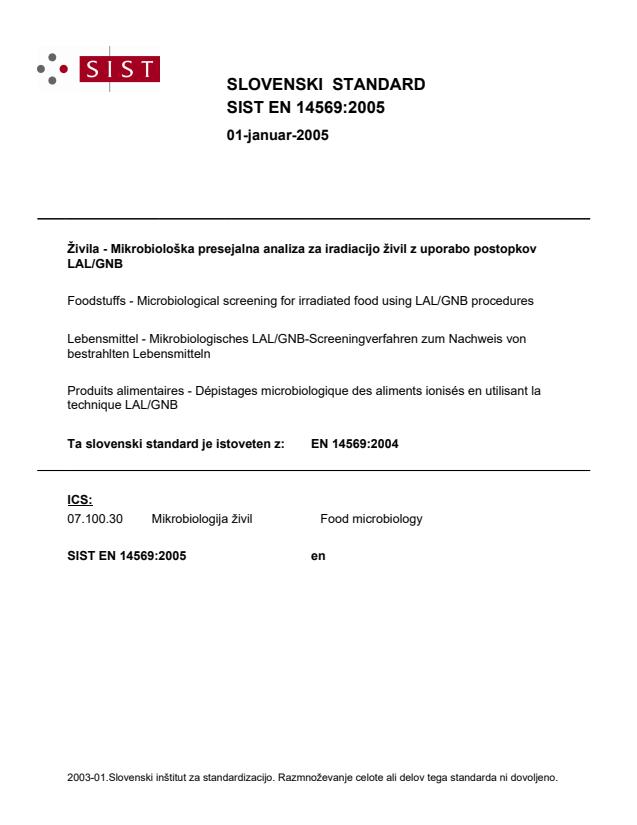
(Main)Foodstuffs - Microbiological screening for irradiated food using LAL/GNB procedures
General Information
- Abstract
This European Standard specifies a microbiological screening method comprising two procedures, which are carried out in parallel. It permits the identification of an unusual microbiological profile in poultry meat. The presence of a large excess population of dead micro-organisms can under certain circumstances be presumptive of irradiation treatment, which means, that the results of the procedure of the determination of endotoxin concentration in the test sample using the Limulus amoebocyte lysate (LAL) test and of the procedure of the enumeration of total Gram negative bacteria (GNB) in the test sample are not radiation specific. Therefore, it is recommended that a positive result be confirmed using a standardized reference method for the detection of irradiated food, e.g. EN 1784, EN 1785 or EN 1786 [1] to [3].
This screening method has been successfully tested by inter-laboratory trials [4], [5], [6] and the procedure is generally applicable to whole or parts of poultry, e.g. breast, legs, wings of fresh, chilled or frozen carcasses with or without skin.
The method can also provide information about the microbiological quality of a product prior to irradiation.
- Status
- Withdrawn
- Publication Date
- 31-Dec-2004
- Withdrawal Date
- 08-Mar-2026
- Technical Committee
- KŽP - Agricultural food products
- Current Stage
- 9900 - Withdrawal (Adopted Project)
- Start Date
- 06-Mar-2026
- Due Date
- 29-Mar-2026
- Completion Date
- 09-Mar-2026


Overview
EN 14569:2004 is a CEN European Standard titled Foodstuffs - Microbiological screening for irradiated food using LAL/GNB procedures. It specifies a microbiological screening method that combines two parallel procedures - an endotoxin concentration assay using the Limulus amoebocyte lysate (LAL) test and the enumeration of total Gram‑negative bacteria (GNB) - to identify an unusual microbiological profile that may be presumptive of irradiation in poultry meat. The method is intended for screening purposes and is not by itself radiation‑specific; positive findings should be confirmed with a standardized reference method.
Key topics and requirements
- Dual‑procedure screening: LAL endotoxin determination and total GNB enumeration are performed in parallel to detect an excess population of dead microorganisms.
- Scope of applicability: Designed for whole or parts of poultry (breast, legs, wings) from fresh, chilled or frozen carcasses, with or without skin.
- Interpretation caveat: A large excess of dead microbes can be presumptive of irradiation but is not radiation‑specific; environmental or processing factors can produce similar results.
- Confirmation requirement: Positive screening results should be confirmed using standardized reference methods (for example, EN 1784, EN 1785, EN 1786).
- Validation: The screening method has been successfully evaluated in inter‑laboratory trials, demonstrating its general applicability to poultry products.
- Additional value: Provides information on microbiological quality prior to irradiation and can assist in quality control.
Practical applications
Who uses EN 14569:2004 and why:
- Food microbiology laboratories performing routine screening for irradiated food as part of surveillance or compliance testing.
- Regulatory agencies and border control for preliminary detection of possible irradiation treatments in poultry imports and domestic markets.
- Poultry processors and QA teams to monitor product microbiological status before and after irradiation and to support HACCP-based controls.
- Third‑party auditors and certification bodies as part of broader food safety assessments.
Benefits:
- Fast, cost‑effective screening to flag samples needing confirmatory testing.
- Applicable to different poultry product types and storage conditions (fresh, chilled, frozen).
- Helps identify microbiological anomalies that may indicate processing treatments or quality issues.
Related standards
- EN 1784, EN 1785, EN 1786 - referenced standardized reference methods for confirming irradiation of food (recommended follow‑up when EN 14569 screening is positive).
Keywords: EN 14569:2004, LAL test, GNB enumeration, irradiated food screening, poultry microbiology, endotoxin concentration, Limulus amoebocyte lysate, food microbiology, EN 1784 EN 1785 EN 1786.
Relations
- Effective Date
- 25-Aug-2026
- Effective Date
- 28-Jan-2026
- Effective Date
- 28-Jan-2026
- Effective Date
- 09-Feb-2026
- Effective Date
- 28-Jan-2026
Frequently Asked Questions
SIST EN 14569:2005 is a standard published by the Slovenian Institute for Standardization (SIST). Its full title is "Foodstuffs - Microbiological screening for irradiated food using LAL/GNB procedures". This standard covers: This European Standard specifies a microbiological screening method comprising two procedures, which are carried out in parallel. It permits the identification of an unusual microbiological profile in poultry meat. The presence of a large excess population of dead micro-organisms can under certain circumstances be presumptive of irradiation treatment, which means, that the results of the procedure of the determination of endotoxin concentration in the test sample using the Limulus amoebocyte lysate (LAL) test and of the procedure of the enumeration of total Gram negative bacteria (GNB) in the test sample are not radiation specific. Therefore, it is recommended that a positive result be confirmed using a standardized reference method for the detection of irradiated food, e.g. EN 1784, EN 1785 or EN 1786 [1] to [3]. This screening method has been successfully tested by inter-laboratory trials [4], [5], [6] and the procedure is generally applicable to whole or parts of poultry, e.g. breast, legs, wings of fresh, chilled or frozen carcasses with or without skin. The method can also provide information about the microbiological quality of a product prior to irradiation.
This European Standard specifies a microbiological screening method comprising two procedures, which are carried out in parallel. It permits the identification of an unusual microbiological profile in poultry meat. The presence of a large excess population of dead micro-organisms can under certain circumstances be presumptive of irradiation treatment, which means, that the results of the procedure of the determination of endotoxin concentration in the test sample using the Limulus amoebocyte lysate (LAL) test and of the procedure of the enumeration of total Gram negative bacteria (GNB) in the test sample are not radiation specific. Therefore, it is recommended that a positive result be confirmed using a standardized reference method for the detection of irradiated food, e.g. EN 1784, EN 1785 or EN 1786 [1] to [3]. This screening method has been successfully tested by inter-laboratory trials [4], [5], [6] and the procedure is generally applicable to whole or parts of poultry, e.g. breast, legs, wings of fresh, chilled or frozen carcasses with or without skin. The method can also provide information about the microbiological quality of a product prior to irradiation.
SIST EN 14569:2005 is classified under the following ICS (International Classification for Standards) categories: 07.100.30 - Food microbiology. The ICS classification helps identify the subject area and facilitates finding related standards.
SIST EN 14569:2005 has the following relationships with other standards: It is inter standard links to SIST ISO 7218:1997, SIST EN 12396-3:2001, SIST EN ISO 11133:2014, SIST EN 60704-2-6:2005, SIST EN ISO 11691:2009. Understanding these relationships helps ensure you are using the most current and applicable version of the standard.
SIST EN 14569:2005 is available in PDF format for immediate download after purchase. The document can be added to your cart and obtained through the secure checkout process. Digital delivery ensures instant access to the complete standard document.
Standards Content (Sample)
2003-01.Slovenski inštitut za standardizacijo. Razmnoževanje celote ali delov tega standarda ni dovoljeno.Živila - Mikrobiološka presejalna analiza za iradiacijo živil z uporabo postopkov LAL/GNBLebensmittel - Mikrobiologisches LAL/GNB-Screeningverfahren zum Nachweis von bestrahlten LebensmittelnProduits alimentaires - Dépistages micro
...