

SIST EN 12729:2023
(Main)Devices to prevent pollution by backflow of potable water - Controllable backflow preventer with reduced pressure zone - Family B - Type A
General Information
- Abstract
This document specifies the field of application, the dimensional, the physico-chemical, the design, the hydraulic, the mechanical, and the acoustic characteristics of controllable backflow preventers with reduced pressure zone, Family B, Type A.
This document covers controllable backflow preventers of Family B, Type A, with reduced pressure zones, intended to prevent pollution of potable water by backflow, caused by backsiphonage or by backpressure.
It is applicable to controllable backflow preventers in denominations DN 6 up to DN 250.
It covers controllable backflow preventers of PN 10 that are capable of working without modification or adjustment:
- at any pressure, up to 1 MPa (10 bar);
- with any pressure variation, up to 1 MPa (10 bar);
- in permanent duty at a limited temperature of 65 °C and for maximum 1 h at 90 °C.
It specifies also the test methods and requirements for verifying their characteristics, the marking and the presentation at delivery.
- Status
- Published
- Public Enquiry End Date
- 14-Sep-2020
- Publication Date
- 10-Apr-2023
- Technical Committee
- IOVO - Water supply and waste water engineering
- Current Stage
- 6060 - National Implementation/Publication (Adopted Project)
- Start Date
- 06-Apr-2023
- Due Date
- 11-Jun-2023
- Completion Date
- 11-Apr-2023

Overview
EN 12729:2023 defines requirements for controllable backflow preventers with reduced pressure zone (Family B - Type A) used to protect potable water supplies from contamination by backsiphonage or backpressure. Published by CEN and approved 30 January 2023, this standard supersedes EN 12729:2002 and applies to devices in nominal sizes DN 6 to DN 250 and rating PN 10. It specifies the field of application, dimensional, physico‑chemical, design, hydraulic, mechanical and acoustic characteristics, plus test methods, marking and presentation at delivery.
Key Topics
- Scope & application: Devices intended to prevent pollution of drinking water by backflow; Family B Type A with reduced pressure zone, DN 6–250, PN 10.
- Operating conditions: Designed to operate without modification at pressures up to 1 MPa (10 bar) (including pressure variations up to 1 MPa); continuous duty up to 65 °C and short term (1 h) up to 90 °C.
- Materials & coatings: Physico‑chemical requirements, dezincification resistance for copper alloys, and surface coating specifications (epoxy, polyamide powder options and pre‑treatment guidance).
- Design & components: Requirements for relief valves, intermediate zone behaviour, pressure taps and test ports; symbolization and denomination rules for product identification.
- Hydraulic & mechanical performance: Pressure loss versus flow verification, relief valve operation, body mechanical resistance, torque and endurance tests.
- Tightness & reliability tests: Downstream/upstream check valve tightness, vacuum performance, and reliability of test port stop valves.
- Acoustics & compatibility: Noise emission testing procedures and compatibility with chemicals used for network shock disinfection.
- Conformity, marking & delivery: Mandatory marking information and technical documentation to accompany delivered units.
Applications
Who uses EN 12729:2023 and why:
- Manufacturers - design, test and certify controllable backflow preventers to meet European requirements.
- Testing laboratories - follow specified test methods for hydraulic, mechanical, tightness and acoustic verification.
- Water utilities & specifiers - select compliant devices for mains and building installations to protect drinking water.
- Installers & consultants - ensure correct product selection, installation and maintenance in accordance with defined operating limits.
- Regulators & procurement - reference for tender specifications and regulatory compliance.
Practical applications include commercial buildings, industrial service connections and critical installations where backflow prevention with controlled reduced pressure zones is required.
Related Standards
Relevant cross‑references in EN 12729:2023 include:
- EN 1717 (protection against pollution of potable water)
- EN 1267 (flow resistance testing)
- EN 13959, EN 13828 (related valve and check valve standards)
- EN ISO 3822 (acoustic noise testing)
- Coating and material standards referenced for surface treatments and tests.
Relations
- Effective Date
- 01-Sep-2020
- Effective Date
- 13-May-2026
- Effective Date
- 01-Apr-2026
- Effective Date
- 28-Jan-2026
- Effective Date
- 28-Jan-2026
- Refers
SIST EN ISO 2808:2019 - Paints and varnishes - Determination of film thickness (ISO 2808:2019) - Effective Date
- 28-Jan-2026
- Effective Date
- 28-Jan-2026
- Effective Date
- 28-Jan-2026
- Effective Date
- 28-Jan-2026
- Effective Date
- 28-Jan-2026
- Effective Date
- 28-Jan-2026
- Effective Date
- 28-Jan-2026
- Effective Date
- 28-Jan-2026
- Effective Date
- 28-Jan-2026
- Effective Date
- 28-Jan-2026
Get Certified
Connect with accredited certification bodies for this standard

DIBt (Deutsches Institut für Bautechnik)
German Institute for Building Technology.
DIN CERTCO
DIN Group product certification.

Kiwa BDA Testing
Building and construction product certification.
Sponsored listings
Frequently Asked Questions
SIST EN 12729:2023 is a standard published by the Slovenian Institute for Standardization (SIST). Its full title is "Devices to prevent pollution by backflow of potable water - Controllable backflow preventer with reduced pressure zone - Family B - Type A". This standard covers: This document specifies the field of application, the dimensional, the physico-chemical, the design, the hydraulic, the mechanical, and the acoustic characteristics of controllable backflow preventers with reduced pressure zone, Family B, Type A. This document covers controllable backflow preventers of Family B, Type A, with reduced pressure zones, intended to prevent pollution of potable water by backflow, caused by backsiphonage or by backpressure. It is applicable to controllable backflow preventers in denominations DN 6 up to DN 250. It covers controllable backflow preventers of PN 10 that are capable of working without modification or adjustment: - at any pressure, up to 1 MPa (10 bar); - with any pressure variation, up to 1 MPa (10 bar); - in permanent duty at a limited temperature of 65 °C and for maximum 1 h at 90 °C. It specifies also the test methods and requirements for verifying their characteristics, the marking and the presentation at delivery.
This document specifies the field of application, the dimensional, the physico-chemical, the design, the hydraulic, the mechanical, and the acoustic characteristics of controllable backflow preventers with reduced pressure zone, Family B, Type A. This document covers controllable backflow preventers of Family B, Type A, with reduced pressure zones, intended to prevent pollution of potable water by backflow, caused by backsiphonage or by backpressure. It is applicable to controllable backflow preventers in denominations DN 6 up to DN 250. It covers controllable backflow preventers of PN 10 that are capable of working without modification or adjustment: - at any pressure, up to 1 MPa (10 bar); - with any pressure variation, up to 1 MPa (10 bar); - in permanent duty at a limited temperature of 65 °C and for maximum 1 h at 90 °C. It specifies also the test methods and requirements for verifying their characteristics, the marking and the presentation at delivery.
SIST EN 12729:2023 is classified under the following ICS (International Classification for Standards) categories: 13.060.20 - Drinking water; 91.140.60 - Water supply systems. The ICS classification helps identify the subject area and facilitates finding related standards.
SIST EN 12729:2023 has the following relationships with other standards: It is inter standard links to SIST EN 12729:2003, SIST EN 1329-1:2026, SIST EN 1717:2025+A1:2026, SIST EN 13959:2005, SIST EN ISO 868:2003, SIST EN ISO 2808:2019, SIST EN 806-1:2001, SIST EN ISO 4628-2:2016, SIST EN 14901-1:2014+A1:2020, SIST EN ISO 2409:2020, SIST EN 1329-1:2021, SIST EN 10310:2004, SIST EN ISO 3822-1:1999, SIST EN ISO 11357-1:2023, SIST EN ISO 8501-1:2007. Understanding these relationships helps ensure you are using the most current and applicable version of the standard.
SIST EN 12729:2023 is associated with the following European legislation: EU Directives/Regulations: 305/2011, 98/83/EC. When a standard is cited in the Official Journal of the European Union, products manufactured in conformity with it benefit from a presumption of conformity with the essential requirements of the corresponding EU directive or regulation.
SIST EN 12729:2023 is available in PDF format for immediate download after purchase. The document can be added to your cart and obtained through the secure checkout process. Digital delivery ensures instant access to the complete standard document.
Standards Content (Sample)
SLOVENSKI STANDARD
01-maj-2023
Nadomešča:
SIST EN 12729:2003
Naprave za varovanje pred onesnaženjem pitne vode zaradi povratnega toka -
Sistemski ločevalnik z nadzorovanim območjem znižanega tlaka - Družina B - Tip
A
Devices to prevent pollution by backflow of potable water - Controllable backflow
preventer with reduced pressure zone - Family B - Type A
Sicherungseinrichtungen zum Schutz des Trinkwassers gegen Verschmutzung durch
Rückfließen - Systemtrenner mit kontrollierbarer druckreduzierter Zone - Familie B - Typ
A
Dispositifs de protection contre la pollution de l'eau potable - Disconnecteur à zone de
pression réduite contrôlable - Famille B - Type A
Ta slovenski standard je istoveten z: EN 12729:2023
ICS:
13.060.20 Pitna voda Drinking water
91.140.60 Sistemi za oskrbo z vodo Water supply systems
2003-01.Slovenski inštitut za standardizacijo. Razmnoževanje celote ali delov tega standarda ni dovoljeno.
EN 12729
EUROPEAN STANDARD
NORME EUROPÉENNE
March 2023
EUROPÄISCHE NORM
ICS 13.060.20; 91.140.60 Supersedes EN 12729:2002
English Version
Devices to prevent pollution by backflow of potable water
- Controllable backflow preventer with reduced pressure
zone - Family B - Type A
Dispositifs de protection contre la pollution de l'eau Sicherungseinrichtungen zum Schutz des Trinkwassers
potable - Disconnecteur à zone de pression réduite gegen Verschmutzung durch Rückfließen -
contrôlable - Famille B - Type A Systemtrenner mit kontrollierbarer druckreduzierter
Zone - Familie B - Typ A
This European Standard was approved by CEN on 30 January 2023.
CEN members are bound to comply with the CEN/CENELEC Internal Regulations which stipulate the conditions for giving this
European Standard the status of a national standard without any alteration. Up-to-date lists and bibliographical references
concerning such national standards may be obtained on application to the CEN-CENELEC Management Centre or to any CEN
member.
This European Standard exists in three official versions (English, French, German). A version in any other language made by
translation under the responsibility of a CEN member into its own language and notified to the CEN-CENELEC Management
Centre has the same status as the official versions.
CEN members are the national standards bodies of Austria, Belgium, Bulgaria, Croatia, Cyprus, Czech Republic, Denmark, Estonia,
Finland, France, Germany, Greece, Hungary, Iceland, Ireland, Italy, Latvia, Lithuania, Luxembourg, Malta, Netherlands, Norway,
Poland, Portugal, Republic of North Macedonia, Romania, Serbia, Slovakia, Slovenia, Spain, Sweden, Switzerland, Türkiye and
United Kingdom.
EUROPEAN COMMITTEE FOR STANDARDIZATION
COMITÉ EUROPÉEN DE NORMALISATION
EUROPÄISCHES KOMITEE FÜR NORMUNG
CEN-CENELEC Management Centre: Rue de la Science 23, B-1040 Brussels
© 2023 CEN All rights of exploitation in any form and by any means reserved Ref. No. EN 12729:2023 E
worldwide for CEN national Members.
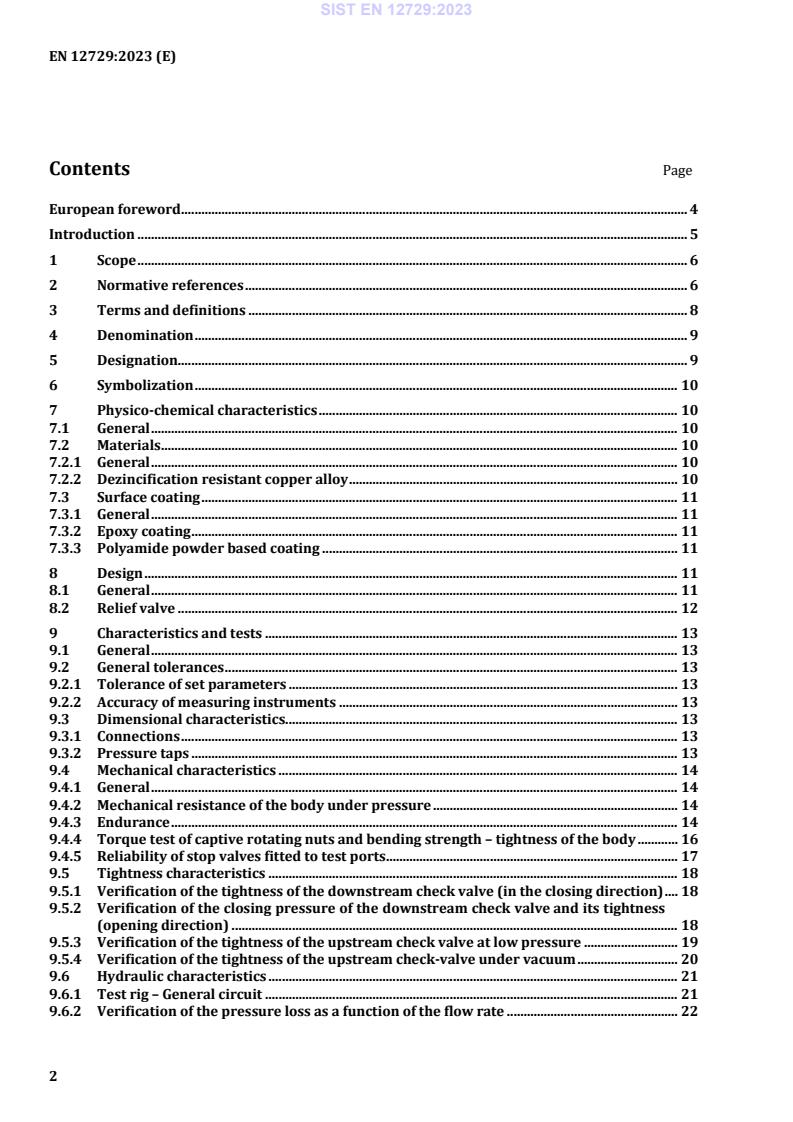
Contents Page
European foreword . 4
Introduction . 5
1 Scope . 6
2 Normative references . 6
3 Terms and definitions . 8
4 Denomination . 9
5 Designation. 9
6 Symbolization . 10
7 Physico-chemical characteristics . 10
7.1 General . 10
7.2 Materials . 10
7.2.1 General . 10
7.2.2 Dezincification resistant copper alloy . 10
7.3 Surface coating . 11
7.3.1 General . 11
7.3.2 Epoxy coating . 11
7.3.3 Polyamide powder based coating . 11
8 Design . 11
8.1 General . 11
8.2 Relief valve . 12
9 Characteristics and tests . 13
9.1 General . 13
9.2 General tolerances . 13
9.2.1 Tolerance of set parameters . 13
9.2.2 Accuracy of measuring instruments . 13
9.3 Dimensional characteristics. 13
9.3.1 Connections . 13
9.3.2 Pressure taps . 13
9.4 Mechanical characteristics . 14
9.4.1 General . 14
9.4.2 Mechanical resistance of the body under pressure . 14
9.4.3 Endurance . 14
9.4.4 Torque test of captive rotating nuts and bending strength – tightness of the body . 16
9.4.5 Reliability of stop valves fitted to test ports . 17
9.5 Tightness characteristics . 18
9.5.1 Verification of the tightness of the downstream check valve (in the closing direction) . 18
9.5.2 Verification of the closing pressure of the downstream check valve and its tightness
(opening direction) . 18
9.5.3 Verification of the tightness of the upstream check valve at low pressure . 19
9.5.4 Verification of the tightness of the upstream check-valve under vacuum . 20
9.6 Hydraulic characteristics . 21
9.6.1 Test rig – General circuit . 21
9.6.2 Verification of the pressure loss as a function of the flow rate . 22
9.6.3 Verification of the pressure difference between the upstream and the intermediate
zones . 22
9.6.4 Verification of venting to atmospheric pressure of the intermediate zone when the
upstream pressure drops . 23
9.6.5 Verification of opening start of the relief valve and of its closing . 23
9.6.6 Verification of the relief valve tightness in case of fluctuation of the upstream
pressure . 24
9.6.7 Verification of the intermediate zone pressure for a given relief flow rate under
inverse feed . 24
9.7 Compatibility with the products used for shock disinfection of the networks . 25
9.7.1 Requirement . 25
9.7.2 Test method . 25
9.8 Acoustic tests . 25
9.8.1 General . 25
9.8.2 Procedure . 26
10 Marking and technical documents . 26
10.1 Marking . 26
10.2 Technical documents . 27
11 Presentation at delivery . 27
Annex A (normative) General information for coating definition . 28
A.1 Organic coating (paint) . 28
A.2 Pre-treatment before coating. 28
A.3 Application techniques . 28
Annex B (normative) Evaluation of the degree of polymerization . 30
B.1 Solvent resistance test . 30
Bibliography . 32
European foreword
This document (EN 12729:2023) has been prepared by Technical Committee CEN/TC 164 “Water
supply”, the secretariat of which is held by AFNOR.
This European Standard shall be given the status of a national standard, either by publication of an
identical text or by endorsement, at the latest by September 2023, and conflicting national standards
shall be withdrawn at the latest by September 2023.
Attention is drawn to the possibility that some of the elements of this document may be the subject of
patent rights. CEN shall not be held responsible for identifying any or all such patent rights.
This document supersedes EN 12729:2002.
The main changes compared to the previous edition are listed below:
— hydraulic and mechanical requirements have been revised;
— the Scope has been updated;
— all tests have been described in more detail and optimized;
— acoustics have been updated;
— endurance tests have been revised;
— section coatings have been added;
— solvent resistance test section has been added.
Any feedback and questions on this document should be directed to the users’ national standards body.
A complete listing of these bodies can be found on the CEN website.
According to the CEN-CENELEC Internal Regulations, the national standards organisations of the
following countries are bound to implement this European Standard: Austria, Belgium, Bulgaria,
Croatia, Cyprus, Czech Republic, Denmark, Estonia, Finland, France, Germany, Greece, Hungary, Iceland,
Ireland, Italy, Latvia, Lithuania, Luxembourg, Malta, Netherlands, Norway, Poland, Portugal, Republic of
North Macedonia, Romania, Serbia, Slovakia, Slovenia, Spain, Sweden, Switzerland, Türkiye and the
United Kingdom.
Introduction
In respect of potential adverse effects on the quality of water intended for human consumption, caused
by the product covered by this document:
a) this document provides no information as to whether the product may be used without restriction
in any of the Member States of the EU or EFTA;
b) it should be noted that, while awaiting the adoption of verifiable European criteria, existing
national regulations concerning the use and/or the characteristics of this product remain in force.
1 Scope
This document specifies the field of application, the dimensional, the physico-chemical, the design, the
hydraulic, the mechanical, and the acoustic characteristics of controllable backflow preventers with
reduced pressure zone, Family B, Type A.
This document covers controllable backflow preventers of Family B, Type A, with reduced pressure
zones, intended to prevent pollution of potable water by backflow, caused by backsiphonage or by
backpressure.
It is applicable to controllable backflow preventers in denominations DN 6 up to DN 250.
It covers controllable backflow preventers of PN 10 that are capable of working without modification or
adjustment:
— at any pressure, up to 1 MPa (10 bar);
— with any pressure variation, up to 1 MPa (10 bar);
— in permanent duty at a limited temperature of 65 °C and for maximum 1 h at 90 °C.
It specifies also the test methods and requirements for verifying their characteristics, the marking and
the presentation at delivery.
2 Normative references
The following documents are referred to in the text in such a way that some or all of their content
constitutes requirements of this document. For dated references, only the edition cited applies. For
undated references, the latest edition of the referenced document (including any amendments) applies.
EN 806-1, Specifications for installations inside buildings conveying water for human consumption -
Part 1: General
EN 1267, Industrial valves - Test of flow resistance using water as test fluid
EN 1329-1, Plastics piping systems for soil and waste discharge (low and high temperature) within the
building structure - Unplasticized poly(vinyl chloride) (PVC-U) - Part 1: Specifications for pipes, fittings
and the system
EN 1453-1, Plastics piping systems with structured-wall pipes for soil and waste discharge (low and high
temperature) inside buildings - Unplasticized poly(vinyl chloride) (PVC-U) - Part 1: Specifications for pipes
and the system
EN 1717, Protection against pollution of potable water in water installations and general requirements of
devices to prevent pollution by backflow
EN 10310:2003, Steel tubes and fittings for onshore and offshore pipelines - Internal and external
polyamide powder based coatings
EN 13959, Anti-pollution check valves - DN 6 to DN 250 inclusive family E, type A, B, C and D
EN 13828, Building valves - Manually operated copper alloy and stainless steel ball valves for potable
water supply in buildings - Tests and requirements
EN 14901-1, Ductile iron pipes, fittings and accessories - Requirements and test methods for organic
coatings of ductile iron fittings and accessories - Part 1: Epoxy coating (heavy duty)
EN ISO 868, Plastics and ebonite - Determination of indentation hardness by means of a durometer (Shore
hardness) (ISO 868)
EN ISO 2409, Paints and varnishes - Cross-cut test (ISO 2409)
EN ISO 2808, Paints and varnishes - Determination of film thickness (ISO 2808)
EN ISO 2812-2, Paints and varnishes - Determination of resistance to liquids - Part 2: Water immersion
method (ISO 2812-2)
EN ISO 3822-1, Acoustics - Laboratory tests on noise emission from appliances and equipment used in
water supply installations - Part 1: Method of measurement (ISO 3822-1)
EN ISO 3822-3, Acoustics - Laboratory tests on noise emission from appliances and equipment used in
water supply installations - Part 3: Mounting and operating conditions for in-line valves and appliances
(ISO 3822-3)
EN ISO 21920-2, Geometrical product specifications (GPS) - Surface texture: Profile - Part 2: Terms,
definitions and surface texture parameters (ISO 21920-2)
EN ISO 4624, Paints and varnishes - Pull-off test for adhesion (ISO 4624)
EN ISO 4628-2, Paints and varnishes - Evaluation of degradation of coatings - Designation of quantity and
size of defects, and of intensity of uniform changes in appearance - Part 2: Assessment of degree of
blistering (ISO 4628-2)
EN ISO 4628-3, Paints and varnishes - Evaluation of degradation of coatings - Designation of quantity and
size of defects, and of intensity of uniform changes in appearance - Part 3: Assessment of degree of rusting
(ISO 4628-3)
EN ISO 6272-1, Paints and varnishes - Rapid-deformation (impact resistance) tests - Part 1: Falling-weight
test, large-area indenter (ISO 6272-1)
EN ISO 8501-1, Preparation of steel substrates before application of paints and related products - Visual
assessment of surface cleanliness - Part 1: Rust grades and preparation grades of uncoated steel substrates
and of steel substrates after overall removal of previous coatings (ISO 8501-1)
EN ISO 9227, Corrosion tests in artificial atmospheres - Salt spray tests (ISO 9227)
EN ISO 11357-1, Plastics - Differential scanning calorimetry (DSC) - Part 1: General principles
(ISO 11357-1)
EN ISO 6509-1, Corrosion of metals and alloys - Determination of dezincification resistance of copper
alloys with zinc - Part 1: Test method (ISO 6509-1)
ISO 228-1, Pipe threads where pressure-tight joints are not made on the threads — Part 1: Dimensions,
tolerances and designation
3 Terms and definitions
For the purposes of this document, the terms and definitions given in EN 1717 and EN 806-1 and the
following apply:
ISO and IEC maintain terminology databases for use in standardization at the following addresses:
— IEC Electropedia: available at https://www.electropedia.org/
— ISO Online browsing platform: available at https://www.iso.org/obp
3.1
controllable backflow preventer with reduced pressure zone, Family B, Type A
device, called “BA”, with following specific characteristics:
— 3 pressure zones such that upstream p > intermediate p > downstream p (static no flow and
1 i 2
under water flow conditions);
— p − p > 14 kPa (140 mbar);
1 i
— connection from the intermediate pressure zone (p) to the atmosphere when p − p ≤ 14 kPa
i 1 i
(140 mbar);
— disconnection by venting the intermediate pressure zone (p ) to the atmosphere when p < 14 kPa
i 1
(140 mbar);
— a minimum set discharge flow (backflow rate);
— devices that allow verification in every zone of the disconnection and of the sealing of the
protection devices (check valves, discharge valve)
Note 1 to entry: See Figure 1.
Key
1 upstream zone p
2 intermediate zone p
i
3 downstream zone p
Figure 1 — Design principle
Note 2 to entry: For the purposes of this document, “controllable backflow preventer BA” is hereafter referred to
as “device”.
3.2
in line device
device installed within the pipework where the downstream flow of water supplies one or more points
of use
3.3
incorporated device
device integrated in appliances
EXAMPLES Cleaning apparatus, heating boilers, etc.
3.4
end of line device
device installed at the end of the pipework at the point of use for a specific purpose
EXAMPLES Temporary filling heating system, jetwasher machine, feeding points for events, etc.
4 Denomination
For the purposes of this document, for the devices the nominal size DN is a function of the minimum
flow rate given in Table 6.
5 Designation
A controllable backflow preventer with reduced pressure zone, Family B, Type A is designated by:
— its name;
— its family and its type;
— type of installation (in line, end of line or incorporated device);
— its denomination;
— its size of end connection;
— the material of its body;
— its surface finish (possible coating);
— the acoustic group I, II or nc (for DN ≤ 32);
— the reference to this document.
Examples for a designation:
— Controllable backflow preventer with reduced pressure zone — Family B — Type A, in line, DN 32,
R 11/4 × R 11/4, bronze, I, EN 12729.
— Controllable backflow preventer with reduced pressure zone — Family B — Type A, in line DN 100,
flanged, cast iron, epoxy coated, EN 12729.
6 Symbolization
The graphic representation of the controllable backflow preventer with reduced pressure zone,
Family B, Type A is as follows (see Figure 2).
Figure 2 — Graphic symbol
7 Physico-chemical characteristics
7.1 General
The selection of materials is the responsibility of the manufacturer, provided they satisfy the following
requirements:
a) materials and coatings shall not contaminate the potable water;
b) in a technical document, the manufacturer shall state the nature of the materials and coatings used;
c) materials with inadequate corrosion resistance shall have additional protection;
d) the materials used shall be suitable for the temperatures specified in the tests in this document;
e) the materials, and in particular copper alloys, for which recommendations or international
standards exist, shall comply with the relevant European standards.
7.2 Materials
7.2.1 General
All materials coming into contact with water intended for human consumption shall present no health
risk nor cause any change to the water in terms of quality, appearance, smell or taste.
NOTE While awaiting the adoption of verifiable European criteria for testing materials in contact with water
intended for human consumption, existing national regulations concerning the use and/or the characteristics of
these products remain in force.
7.2.2 Dezincification resistant copper alloy
Copper-zinc alloys containing more than 15 % zinc are subject to dezincification when submitted to
water capable of dezincification. In the countries where the use of products made of dezincification
resistant materials is required, the materials used shall guarantee a dezincification depth less than
200 μm in any direction. For this purpose, materials shall be tested in accordance with EN ISO 6509-1
and the product shall be marked in compliance with the indications according to Clause 11.
7.3 Surface coating
7.3.1 General
The outside and inside surfaces of the device may contain a coating. Such coating shall not impair the
functional characteristics of the device.
The coating for protection of the basic material against corrosion can be either realized by epoxy
coating or by polyamide powder-based coating. See also Table A.1.
7.3.2 Epoxy coating
Epoxy coating shall fulfil the requirements as described in Annex A based on EN 14901-1.
7.3.3 Polyamide powder based coating
Polyamide powder coating shall fulfil the requirements as described in Annex A based on
EN 10310:2003.
8 Design
8.1 General
a) The internal components of the device shall be accessible for inspection, repair or replacement.
These operations shall be possible on the installed device. Mandatory maintenance can also be
done by removing the device from the pipework for sizes DN ≤ 20. By design, the components shall
be able to be refitted at their initial place, without ambiguity (impossibility of reversal, interchange
of obturators, diaphragms, springs …). A visible mark is not sufficient;
b) the settings of the springs shall be fixed and not adjustable;
c) in line devices and incorporated devices shall comprise three pressure tapings, upstream,
intermediate, downstream, permitting periodic verification of the function of the device;
d) end of line devices shall comprise at least two pressure tapings, upstream and intermediate
permitting periodic verification of the function of the device.
They are placed:
— upstream of the first check valve;
— in the intermediate zone;
e) It shall be possible to vent the air which can accumulate inside the device;
f) the internal components of the device can only be controlled by the pressure of the water of the
supply network;
g) possible additional control devices (electric, pneumatic, …) shall not adversely affect the backflow
protection function;
h) normally the device shall be installed horizontally. Devices DN ≤ 50 may be installed in the
downward vertical orientation in accordance with the design of the valve and the manufacturers’
instructions while satisfying all the criteria in this document. If this orientation influences the
function of the devices the tests shall be carried out in all possible orientations.
8.2 Relief valve
The design of the relief valve operation shall be such that when the differential pressure over the
upstream check valve is less than 14 kPa (140 mbar) the relief valve shall be open to ensure safety.
An internal vertical distance h, as shown in the Figure 3 (in disconnected position) shall be provided
between the upstream check valve seat and the seat of relief valve:
— h ≥ 5 mm for DN ≤ 15;
— h ≥ 10 mm for 15 < DN ≤ 50;
— h ≥ 20 mm for DN > 50.
Figure 3 — Relief orifice
In none of the installation positions indicated by the manufacturer, any water retention with the
intermediate zone shall be possible.
The cross sections of the passage orifices and of the pilot tube for operation of the relief device shall be
2 2
greater than or equal to 45 mm with DN ≥ 15, or 12,5 mm with DN < 15. No dimension for the
calculation of the cross section shall be less than 4 mm. The outside pilot tube shall be made so as not to
be subject to any permanent deformation or rupture under outside stresses.
An air break to drain shall exist between any waste drain and any means of collecting the discharged
water (floor, tundish, curb, sink).
The air break to drain shall meet the dimensional requirements as specified in EN 1717. This air break
to drain shall be either:
1) directly incorporated into the device; or
2) factory fitted; or
3) supplied with the device; or
4) guaranteed by the installation (accepted in case of outside applications).
In the cases 3 and 4, the relief orifice of the device shall permit neither the fitting of a standardized
threaded pipe, nor the connection of a standardized pipe or shape, neither by adhesive, welding nor
interlocking.
The dimension ‘’G” of the outlet of the air break to drain (see in EN 1717) shall be possible to connect a
standardized dr
...