

SIST EN 60839-11-1:2013
(Main)Alarm systems - Part 11-1: Electronic access control systems - System and components requirements
General Information
- Abstract
IEC 60839-11-1:2013 specifies the minimum functionality, performance requirements and test methods for electronic access control systems and components used for physical access (entry and exit) in and around buildings and protected areas. This standard applies to electronic access control systems and components intended to be used in security applications for the granting of access and includes requirements for logging, identification and control of information.
- Status
- Published
- Publication Date
- 19-Aug-2013
- Technical Committee
- EAL - Alarm systems
- Current Stage
- 6060 - National Implementation/Publication (Adopted Project)
- Start Date
- 30-Jul-2013
- Due Date
- 04-Oct-2013
- Completion Date
- 20-Aug-2013

Overview
EN 60839-11-1:2013 (identical to IEC 60839-11-1:2013) defines the system and component requirements for electronic access control systems used for physical access (entry and exit) in and around buildings and protected areas. The standard specifies minimum functionality, performance requirements and test methods for access control devices and systems used in security applications, including requirements for logging, identification and control of information.
Key topics and technical requirements
- Scope & architecture: conceptual models and typical architectures for electronic access control systems (central controllers, readers, portals, networks).
- Classification methodology: grade/level classification to determine required levels of protection (see Table 1).
- Access point interfaces: timing, portal release, status and access-control interactions (Table 2).
- Indication & annunciation: display, alerting and logging requirements for events and alarms (Table 3).
- Recognition functions: identity verification, credential handling and related performance requirements (Table 4).
- Duress and overriding: requirements for duress signalling, emergency override and associated controls (Tables 5–6).
- Communication & self-protection: secure communications, tamper detection and system self-monitoring (Table 7).
- Power supply: standby power, battery/charger requirements and associated tests (Table 8).
- Environmental & EMC: immunity and environmental conditioning requirements and test methods (Table 9; references to IEC environmental standards).
- Test methods & compliance: defined procedures for reduced functional tests, functional tests per subsystem (access point, annunciation, recognition, duress, overriding, communication), environmental/EMC conditioning, and test reporting.
- Documentation & marking: minimum documentation and marking requirements for products and systems.
Practical applications and users
EN 60839-11-1:2013 is used to:
- Guide manufacturers in designing access control components (readers, controllers, locks) to meet defined security and performance levels.
- Provide system integrators and specifiers with objective requirements for selecting and assembling access control solutions.
- Support testing laboratories and conformity assessment bodies in performing repeatable functional and environmental tests.
- Help security consultants, facility managers and regulators define procurement specifications and acceptance criteria for building and perimeter access control.
Keywords: EN 60839-11-1:2013, electronic access control systems, access control standard, alarm and electronic security systems, access point interface, recognition, duress signalling, EMC testing, power supply requirements, logging and identification.
Related standards
Normative references include standards for environmental and EMC testing and enclosures such as IEC 60068-1, IEC 60529 (IP Code), IEC 62262 (IK Code), IEC 62599 and related IEC alarm-system parts (see standard bibliography for full list).
Relations
- Effective Date
- 01-Sep-2013
- Effective Date
- 01-Sep-2013
- Effective Date
- 01-Sep-2013
- Refers
SIST IEC 62642-1:2024 - Alarm systems - Intrusion and hold-up systems - Part 1: System requirements - Effective Date
- 10-Feb-2026
- Effective Date
- 10-Feb-2026
- Effective Date
- 03-Feb-2026
- Effective Date
- 03-Feb-2026
- Effective Date
- 08-Apr-2026
- Effective Date
- 09-Feb-2026
- Effective Date
- 03-Feb-2026
- Effective Date
- 03-Feb-2026
- Effective Date
- 03-Feb-2026
- Effective Date
- 03-Feb-2026
- Effective Date
- 03-Feb-2026
- Effective Date
- 03-Feb-2026
Get Certified
Connect with accredited certification bodies for this standard

CIS Institut d.o.o.
Personal Protective Equipment (PPE) certification body. Notified Body NB-2890 for EU Regulation 2016/425 PPE.

Kiwa BDA Testing
Building and construction product certification.
Kmetijski inštitut Slovenije
Agricultural Institute of Slovenia. Soil testing, plant health, agricultural product analysis.
Sponsored listings
Frequently Asked Questions
SIST EN 60839-11-1:2013 is a standard published by the Slovenian Institute for Standardization (SIST). Its full title is "Alarm systems - Part 11-1: Electronic access control systems - System and components requirements". This standard covers: IEC 60839-11-1:2013 specifies the minimum functionality, performance requirements and test methods for electronic access control systems and components used for physical access (entry and exit) in and around buildings and protected areas. This standard applies to electronic access control systems and components intended to be used in security applications for the granting of access and includes requirements for logging, identification and control of information.
IEC 60839-11-1:2013 specifies the minimum functionality, performance requirements and test methods for electronic access control systems and components used for physical access (entry and exit) in and around buildings and protected areas. This standard applies to electronic access control systems and components intended to be used in security applications for the granting of access and includes requirements for logging, identification and control of information.
SIST EN 60839-11-1:2013 is classified under the following ICS (International Classification for Standards) categories: 13.320 - Alarm and warning systems. The ICS classification helps identify the subject area and facilitates finding related standards.
SIST EN 60839-11-1:2013 has the following relationships with other standards: It is inter standard links to SIST EN 50133-1:1999/A1:2003, SIST EN 50133-1:1999, SIST EN 50133-2-1:2001, SIST IEC 62642-1:2024, SIST IEC 62599-1:2024, SIST EN 62262:2007, SIST EN 60068-1:2014, SIST EN 17229:2026, SIST EN 17229-2:2023, SIST EN 50600-2-5:2021, SIST EN IEC 60839-11-5:2020, SIST EN 50600-2-5:2016, SIST EN 60839-11-2:2015, SIST EN 60839-11-32:2017, SIST EN IEC 60839-11-33:2021. Understanding these relationships helps ensure you are using the most current and applicable version of the standard.
SIST EN 60839-11-1:2013 is associated with the following European legislation: EU Directives/Regulations: 2007-01-2231, 2012-01-0929, 2020-01-0063. When a standard is cited in the Official Journal of the European Union, products manufactured in conformity with it benefit from a presumption of conformity with the essential requirements of the corresponding EU directive or regulation.
SIST EN 60839-11-1:2013 is available in PDF format for immediate download after purchase. The document can be added to your cart and obtained through the secure checkout process. Digital delivery ensures instant access to the complete standard document.
Standards Content (Sample)
SLOVENSKI STANDARD
01-september-2013
Alarmni sistemi - 11-1. del: Elektronski sistemi nadzora dostopa - Zahteve za
sistem in sestavne dele (IEC 60839-11-1:2013)
Alarm systems - Part 11-1: Electronic access control systems - System and components
requirements
Systèmes d'alarme - Partie 11-1: Systèmes de controle d'accès électroniques –
Exigences des systèmes et des composants
Ta slovenski standard je istoveten z: EN 60839-11-1:2013
ICS:
13.320 Alarmni in opozorilni sistemi Alarm and warning systems
2003-01.Slovenski inštitut za standardizacijo. Razmnoževanje celote ali delov tega standarda ni dovoljeno.
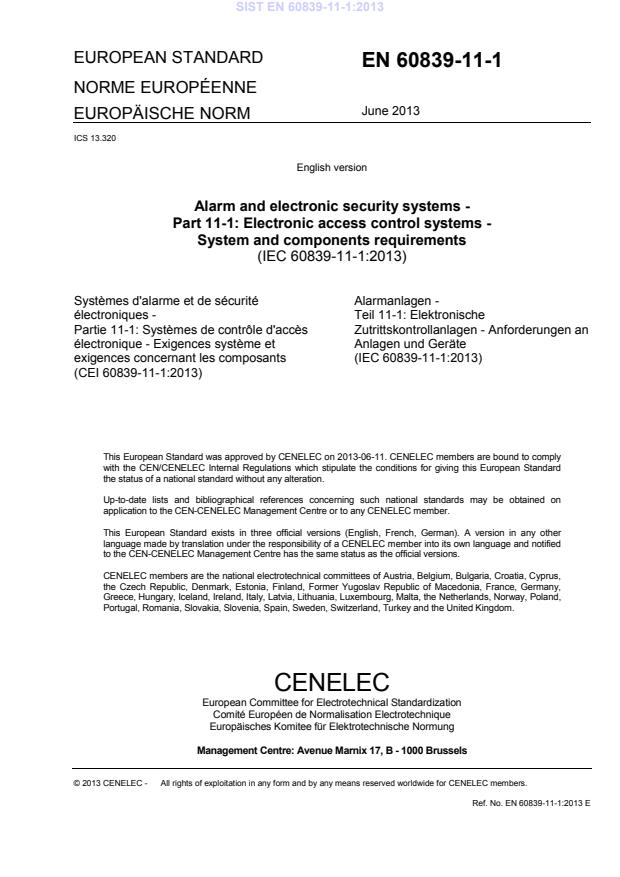
EUROPEAN STANDARD
EN 60839-11-1
NORME EUROPÉENNE
June 2013
EUROPÄISCHE NORM
ICS 13.320
English version
Alarm and electronic security systems -
Part 11-1: Electronic access control systems -
System and components requirements
(IEC 60839-11-1:2013)
Systèmes d'alarme et de sécurité Alarmanlagen -
électroniques - Teil 11-1: Elektronische
Partie 11-1: Systèmes de contrôle d'accès Zutrittskontrollanlagen - Anforderungen an
électronique - Exigences système et Anlagen und Geräte
exigences concernant les composants (IEC 60839-11-1:2013)
(CEI 60839-11-1:2013)
This European Standard was approved by CENELEC on 2013-06-11. CENELEC members are bound to comply
with the CEN/CENELEC Internal Regulations which stipulate the conditions for giving this European Standard
the status of a national standard without any alteration.
Up-to-date lists and bibliographical references concerning such national standards may be obtained on
application to the CEN-CENELEC Management Centre or to any CENELEC member.
This European Standard exists in three official versions (English, French, German). A version in any other
language made by translation under the responsibility of a CENELEC member into its own language and notified
to the CEN-CENELEC Management Centre has the same status as the official versions.
CENELEC members are the national electrotechnical committees of Austria, Belgium, Bulgaria, Croatia, Cyprus,
the Czech Republic, Denmark, Estonia, Finland, Former Yugoslav Republic of Macedonia, France, Germany,
Greece, Hungary, Iceland, Ireland, Italy, Latvia, Lithuania, Luxembourg, Malta, the Netherlands, Norway, Poland,
Portugal, Romania, Slovakia, Slovenia, Spain, Sweden, Switzerland, Turkey and the United Kingdom.
CENELEC
European Committee for Electrotechnical Standardization
Comité Européen de Normalisation Electrotechnique
Europäisches Komitee für Elektrotechnische Normung
Management Centre: Avenue Marnix 17, B - 1000 Brussels
© 2013 CENELEC - All rights of exploitation in any form and by any means reserved worldwide for CENELEC members.
Ref. No. EN 60839-11-1:2013 E
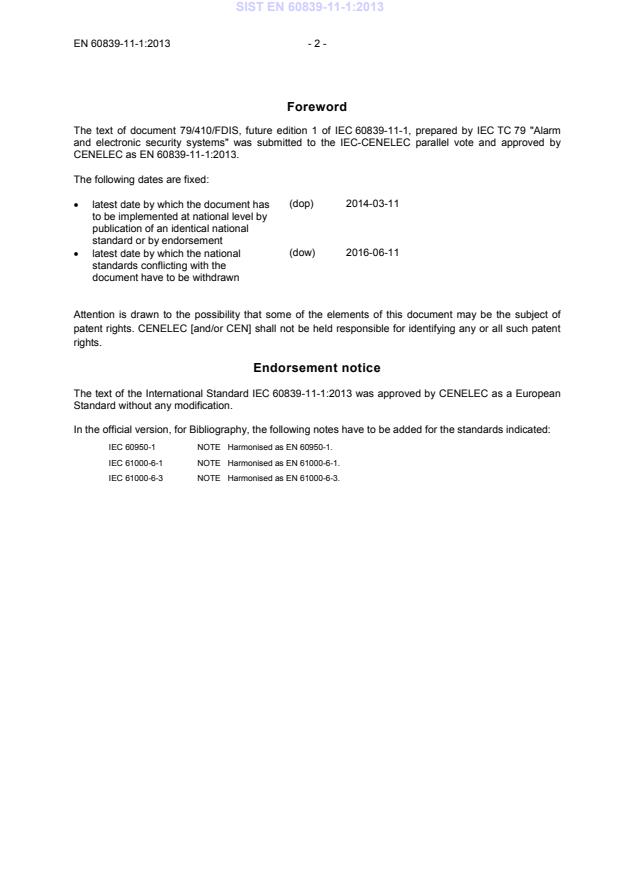
Foreword
The text of document 79/410/FDIS, future edition 1 of IEC 60839-11-1, prepared by IEC TC 79 "Alarm
and electronic security systems" was submitted to the IEC-CENELEC parallel vote and approved by
CENELEC as EN 60839-11-1:2013.
The following dates are fixed:
• latest date by which the document has (dop) 2014-03-11
to be implemented at national level by
publication of an identical national
standard or by endorsement
(dow) 2016-06-11
• latest date by which the national
standards conflicting with the
document have to be withdrawn
Attention is drawn to the possibility that some of the elements of this document may be the subject of
patent rights. CENELEC [and/or CEN] shall not be held responsible for identifying any or all such patent
rights.
Endorsement notice
The text of the International Standard IEC 60839-11-1:2013 was approved by CENELEC as a European
Standard without any modification.
In the official version, for Bibliography, the following notes have to be added for the standards indicated:
IEC 60950-1 NOTE Harmonised as EN 60950-1.
IEC 61000-6-1 NOTE Harmonised as EN 61000-6-1.
IEC 61000-6-3 NOTE Harmonised as EN 61000-6-3.
- 3 - EN 60839-11-1:2013
Annex ZA
(normative)
Normative references to international publications
with their corresponding European publications
The following documents, in whole or in part, are normatively referenced in this document and are
indispensable for its application. For dated references, only the edition cited applies. For undated
references, the latest edition of the referenced document (including any amendments) applies.
NOTE When an international publication has been modified by common modifications, indicated by (mod), the relevant EN/HD
applies.
Publication Year Title EN/HD Year
IEC 60068-1 - Environmental testing - EN 60068-1 -
Part 1: General and guidance
IEC 60529 - Degrees of protection provided by enclosures - -
(IP Code)
IEC 62262 - Degrees of protection provided by enclosures EN 62262 -
for electrical equipment against external
mechanical impacts (IK code)
IEC 62599-1 - Alarm systems - - -
Part 1: Environmental test methods
IEC 62599-2 - Alarm systems - - -
Part 2: Electromagnetic compatibility -
Immunity requirements for components of fire
and security alarm systems
IEC 62642-1 - Alarm systems - Intrusion and hold-up - -
systems -
Part 1: System requirements
IEC 62642-6 - Alarm systems - Intrusion and hold-up - -
systems -
Part 2-6: Intrusion detectors - Opening
contacts (magnetic)
IEC 60839-11-1 ®
Edition 1.0 2013-05
INTERNATIONAL
STANDARD
NORME
INTERNATIONALE
colour
inside
Alarm and electronic security systems –
Part 11-1: Electronic access control systems – System and components
requirements
Systèmes d'alarme et de sécurité électroniques –
Partie 11-1: Systèmes de contrôle d'accès électronique – Exigences système et
exigences concernant les composants
INTERNATIONAL
ELECTROTECHNICAL
COMMISSION
COMMISSION
ELECTROTECHNIQUE
PRICE CODE
INTERNATIONALE
CODE PRIX XB
ICS 13.320 ISBN 978-2-83220-761-1
– 2 – 60839-11-1 © IEC:2013
CONTENTS
FOREWORD . 5
INTRODUCTION . 7
1 Scope . 8
2 Normative references . 8
3 Terms and definitions . 9
4 Abbreviations . 20
5 Conceptual models and system architecture . 20
6 System performance functionality requirements . 23
6.1 Classification methodology and functionalities – Determining the levels of
protection . 23
6.2 Access point interface requirements . 25
6.2.1 Portal release timing . 25
6.2.2 Access control . 25
6.2.3 Portal status . 25
6.3 Indication and annunciation (display, alert, logging) requirements . 26
6.3.1 Annunciation . 26
6.3.2 Display . 26
6.3.3 Alert . 26
6.3.4 Logging . 27
6.4 Recognition requirements . 29
6.5 Duress signalling requirements . 32
6.6 Overriding requirements . 32
6.7 Communication requirements . 33
6.8 System self-protection requirements . 33
6.9 Power supply requirements . 35
7 Environmental and EMC (immunity) requirements. 36
8 Test methods. 38
8.1 General conditions . 38
8.1.1 Atmospheric conditions for tests . 38
8.1.2 Operating conditions for tests . 38
8.1.3 Specimen configuration . 38
8.1.4 Mounting arrangements . 39
8.1.5 Tolerances . 39
8.1.6 Provisions for tests . 39
8.1.7 Optional functions . 39
8.2 Reduced functional test . 41
8.3 Functional tests for access point interface . 41
8.3.1 Object of the test . 41
8.3.2 Principle . 41
8.3.3 Procedure . 41
8.3.4 Criteria for compliance . 43
8.4 Functional tests for indication/annunciation (displaying, alert and logging) . 43
8.4.1 Object of the test . 43
8.4.2 Principles . 43
8.4.3 Test procedure . 43
8.4.4 Criteria for compliance . 46
60839-11-1 © IEC:2013 – 3 –
8.5 Test methods for recognition functionalities . 46
8.5.1 Object of the test . 46
8.5.2 Principles . 47
8.5.3 Test procedure . 47
8.5.4 Criteria for compliance . 48
8.6 Functional tests for duress signalling . 48
8.6.1 Object of the test . 48
8.6.2 Principles . 48
8.6.3 Test procedure (ref. Table 5, lines 1 to 3) . 48
8.6.4 Criteria for compliance . 49
8.7 Functional tests for overriding . 49
8.7.1 Object of the test . 49
8.7.2 Principles . 49
8.7.3 Test procedure (ref. Table 6, lines 1 to 7) . 49
8.7.4 Criteria for compliance . 49
8.8 Functional tests for communication and self-protection . 50
8.8.1 Object of the test . 50
8.8.2 Principles . 50
8.8.3 Test procedure (ref. Table 7, lines 1 to 28) . 50
8.8.4 Criteria for compliance . 51
8.9 Power supply requirements . 51
8.9.1 Test of standby power duration . 51
8.9.2 Test of charger and standby power source capacity . 52
8.9.3 Test for low or missing battery condition . 53
8.10 Environmental and EMC (immunity) tests . 53
8.10.1 Test procedure . 53
8.10.2 Initial measurements . 54
8.10.3 State of the specimen during conditioning . 54
8.10.4 Conditioning . 54
8.10.5 Measurement during conditioning . 54
8.10.6 Final measurements . 54
8.10.7 Criteria for compliance . 54
8.11 Test report . 54
9 Documentation and marking . 55
9.1 Documentation . 55
9.2 Marking . 55
Annex A (normative) Timing diagram . 57
Bibliography . 58
Figure 1 – Conceptual model . 22
Figure 2 – Typical architecture of an electronic access control system . 23
Figure 3 – Example of system test configuration . 40
Figure A.1 – Timing diagram . 57
Table 1 – Grade classification . 24
Table 2 – Access point interface requirements . 25
Table 3 – Indication and annunciation requirements . 27
– 4 – 60839-11-1 © IEC:2013
Table 4 – Recognition requirements . 30
Table 5 – Duress signalling requirements . 32
Table 6 – Overriding requirements . 32
Table 7 – System self-protection requirements . 34
Table 8 – Power supply requirements . 36
Table 9 – Environmental and EMC (immunity) requirements . 37
60839-11-1 © IEC:2013 – 5 –
INTERNATIONAL ELECTROTECHNICAL COMMISSION
____________
ALARM AND ELECTRONIC SECURITY SYSTEMS –
Part 11-1: Electronic access control systems –
System and components requirements
FOREWORD
1) The International Electrotechnical Commission (IEC) is a worldwide organization for standardization comprising
all national electrotechnical committees (IEC National Committees). The object of IEC is to promote
international co-operation on all questions concerning standardization in the electrical and electronic fields. To
this end and in addition to other activities, IEC publishes International Standards, Technical Specifications,
Technical Reports, Publicly Available Specifications (PAS) and Guides (hereafter referred to as “IEC
Publication(s)”). Their preparation is entrusted to technical committees; any IEC National Committee interested
in the subject dealt with may participate in this preparatory work. International, governmental and non-
governmental organizations liaising with the IEC also participate in this preparation. IEC collaborates closely
with the International Organization for Standardization (ISO) in accordance with conditions determined by
agreement between the two organizations.
2) The formal decisions or agreements of IEC on technical matters express, as nearly as possible, an international
consensus of opinion on the relevant subjects since each technical committee has representation from all
interested IEC National Committees.
3) IEC Publications have the form of recommendations for international use and are accepted by IEC National
Committees in that sense. While all reasonable efforts are made to ensure that the technical content of IEC
Publications is accurate, IEC cannot be held responsible for the way in which they are used or for any
misinterpretation by any end user.
4) In order to promote international uniformity, IEC National Committees undertake to apply IEC Publications
transparently to the maximum extent possible in their national and regional publications. Any divergence
between any IEC Publication and the corresponding national or regional publication shall be clearly indicated in
the latter.
5) IEC itself does not provide any attestation of conformity. Independent certification bodies provide conformity
assessment services and, in some areas, access to IEC marks of conformity. IEC is not responsible for any
services carried out by independent certification bodies.
6) All users should ensure that they have the latest edition of this publication.
7) No liability shall attach to IEC or its directors, employees, servants or agents including individual experts and
members of its technical committees and IEC National Committees for any personal injury, property damage or
other damage of any nature whatsoever, whether direct or indirect, or for costs (including legal fees) and
expenses arising out of the publication, use of, or reliance upon, this IEC Publication or any other IEC
Publications.
8) Attention is drawn to the Normative references cited in this publication. Use of the referenced publications is
indispensable for the correct application of this publication.
9) Attention is drawn to the possibility that some of the elements of this IEC Publication may be the subject of
patent rights. IEC shall not be held responsible for identifying any or all such patent rights.
International Standard IEC 60839-11-1 has been prepared by IEC technical committee 79:
Alarm and electronic security systems.
The text of this standard is based on the following documents:
FDIS Report on voting
79/410/FDIS 79/416/RVD
Full information on the voting for the approval of this standard can be found in the report on
voting indicated in the above table.
This publication has been drafted in accordance with the ISO/IEC Directives, Part 2.
A list of all parts in the IEC 60839 series, published under the general title Alarm and
electronic security systems, can be found on the IEC website.
– 6 – 60839-11-1 © IEC:2013
Future standards in this series will carry the new general title as cited above. Titles of existing
standards in this series will be updated at the time of the next edition.
The committee has decided that the contents of this publication will remain unchanged until
the stability date indicated on the IEC web site under "http://webstore.iec.ch" in the data
related to the specific publication. At this date, the publication will be
• reconfirmed,
• withdrawn,
• replaced by a revised edition, or
• amended.
IMPORTANT – The 'colour inside' logo on the cover page of this publication indicates
that it contains colours which are considered to be useful for the correct
understanding of its contents. Users should therefore print this document using a
colour printer.
60839-11-1 © IEC:2013 – 7 –
INTRODUCTION
This standard is part of the IEC 60839 series, written to include the following parts:
Part 11-1 Electronic access control systems – System and components requirements
Part 11-2 Electronic access control systems – Application guidelines
This part of IEC 60839 describes the general requirements for functionalities of electronic
access control systems (EACS) for use in security applications. The design, planning,
installation, operation, and maintenance are part of the application guidelines in
IEC 60839-11-2 . The risk analysis is not part of this standard and the risk levels are for
informational purposes only.
An electronic access control system consists of one or more components that when
interconnected meet the functionality criteria stated in this standard.
This standard defines different security grades and the functionalities of the access control
system associated with each of these grades. It includes also the minimum environmental and
EMC compliance criteria as applicable for components of the electronic access control system
in every grade.
When a part of an electronic access control system (e.g. access point interface) forms a part
of an alarm system (intrusion, hold-up, VSS [Video Surveillance Systems], etc.) that part shall
also fulfil the relevant requirements of the applicable IEC standards. Functions additional to
the mandatory functions specified in this standard may be included in the electronic access
control system providing they do not prevent the requirements of this standard from being met.
This International standard also applies to access control systems sharing means of
recognition, detection, triggering, interconnection, control, communication, alert signalling and
power supplies with other applications. The operation of an access control system should not
be adversely influenced by other applications.
An electronic access control system may consist of any number of access points. This
standard addresses the security grade classification for each access point.
Compliance of the individual component parts of the electronic access control system can be
assessed to this standard provided all relevant requirements are applied.
The specific requirements for access point actuators, such as electric door openers,
electronic locks, turnstiles and barriers are included in other standards.
______________
Under consideration.
– 8 – 60839-11-1 © IEC:2013
ALARM AND ELECTRONIC SECURITY SYSTEMS –
Part 11-1: Electronic access control systems –
System and components requirements
1 Scope
This part of IEC 60839 specifies the minimum functionality, performance requirements and
test methods for electronic access control systems and components used for physical access
(entry and exit) in and around buildings and protected areas. It does not include requirements
for access point actuators and sensors.
This standard is not intended to cover requirements for off premise transmission associated
with intrusion or hold up alarm signals.
This standard applies to electronic access control systems and components intended to be
used in security applications for the granting of access and includes requirements for logging,
identification and control of information.
The standard comprises the following:
– A conceptual model and system architecture.
– Criteria covering:
• classification based on performance functionalities and capabilities;
• access point interface requirements;
• indication and annunciation requirements (display, alert, logging);
• duress signalling and overriding;
• recognition requirements;
• system self-protection requirements;
• communication between the component parts of the electronic access control system
and with other systems.
– Requirements for environmental conditions (indoor/outdoor use) and electromagnetic
compatibility.
– Test methods.
2 Normative references
The following documents, in whole or in part, are normatively referenced in this document and
are indispensable for its application. For dated references, only the edition cited applies. For
undated references, the latest edition of the referenced document (including any
amendments) applies.
IEC 60068-1, Environmental testing – Part 1: General and guidance
IEC 60529, Degrees of protection provided by enclosures (IP Code)
IEC 62262, Degrees of protection provided by enclosures for electrical equipment against
external mechanical impacts (IK code)
60839-11-1 © IEC:2013 – 9 –
IEC 62599-1, Alarm systems – Part 1: Environmental test methods
IEC 62599-2, Alarm systems – Part 2: Electromagnetic compatibility –Immunity requirements
for components of fire and security alarm systems
IEC 62642-1, Alarm systems – Intrusion and hold-up systems – Part 1: System requirements
IEC 62642-6, Alarm systems – Intrusion and hold-up systems – Part 6: Power supplies
3 Terms and definitions
For the purposes of this document, the following terms and definitions apply.
3.1
abnormal status
deviation from the expected mode of operation
3.2
access
physical access
action of entering into (or exiting from) a security controlled area
3.3
access control unit
controller
part of an access control system that interfaces with readers, locking devices and sensing
devices, making a decision to grant or deny access through a portal
3.4
access decision
action of comparing information with pre-set rules to determine whether to grant or deny
access
3.5
access level
set of rules used to determine where and when a credential has authorized access to one or
more portals and which may include special passage conditions such as specific portal
allowed open times
3.6
access point
portal
physical entrance/exit at which access can be controlled by a door, turnstile or other secure
barrier
3.7
access point actuation
portal actuation
function of an electronic access control system related to the releasing or securing of a portal
according to pre-set rules and conditional on the access rights of users
3.8
access point overriding
portal actuation overriding
action of issuing a manual command to bypass the pre-configured mode of operation (i.e.
release/secure/block) of an access point
– 10 – 60839-11-1 © IEC:2013
3.9
access point actuator
portal actuator
part of an access control system that interfaces to an access control unit releasing and
securing a portal according to pre-set rules
3.10
access point forced open
portal forced open
alert signal generated when an access point is opened without access being granted
3.11
access point interface
portal interface
device or circuitry which controls releasing and securing of an access point
3.12
access point status change
portal status change
event initiated by the change of an access point either from locked to unlocked or from
unlocked to locked
3.13
access point locking device
portal locking device
assembly associated with the access point, which performs the function of holding an access
point in the closed position and capable of releasing the access point in accordance with pre-
set rules
3.14
access point open time
portal open time
maximum time an access point door may be held open after access is granted and before an
access point opened too long alert is generated
3.15
access point opened too long alert
portal opened too long alert
signal generated when an access point open time is exceeded after access is granted
3.16
access point release
portal release
signal to the access point locking device that access has been granted
3.17
access point sensor
portal sensor
electrical component used to monitor the open or closed status of an access point, or
locked/unlocked status of a locking device, or the secure/unsecure status of an
electromagnetic lock or armature plate
3.18
access request
reading of a credential at a portal initiating the decision process for granting entry to or exit
from the area controlled by the portal
Note 1 to entry: See request-to-exit device.
60839-11-1 © IEC:2013 – 11 –
3.19
access request response time
time required by the system to react to an access request from the correct presentation of the
credential until the activation of the responding device
Note 1 to entry: Access request response time replaces the term authentication time.
3.20
accessory equipment
any component of an electronic access control system other than the access control unit
3.21
alarm
condition requiring human assessment or intervention.
Note 1 to entry: Often used in electronic access control system in the sense of alert.
3.22
alert
functionality of an electronic access control system related to the activation of an indicator to
prompt human assessment
3.23
alert at the portal
visual and or audible signal at the portal prompting action to close the opened access
point/portal and terminate the alert condition
3.24
alert inhibition
by-passing
system function preventing an event from generating an alert
Note 1 to entry: The alert inhibition event may or may not be logged.
Note 2 to entry: The alert inhibition is manually enabled/disabled by the system operator portal by portal.
3.25
ancillary device
piece of equipment for supplementary control purposes designed to be attached or added to
an electronic access control system by qualified service personnel and which will not prevent
the basic access control system requirements from being met
3.26
annunciation
presentation of the information to users, management or other systems, achieved by the
DISPLAY, ALERT and LOGGING functionalities of an electronic access control system
3.27
anti-passback
operating mode which requires user validation when leaving a security controlled area in
order to be able to re-enter and vice versa
Note 1 to entry: Also refer to hard anti-passback, soft anti-passback, global anti-passback, and timed anti-
passback.
3.28
area controlled anti-passback
operating mode which requires the user to be present in a designated security controlled area
in order to be able to enter another security controlled area
– 12 – 60839-11-1 © IEC:2013
3.29
anti-passback overriding
anti-passback disabling
system feature disabling the anti-passback
3.30
anti-tailgating
function which prevents or detects the attempt of two or more persons or entities to gain
access using only one set of credentials
3.31
armature plate
metal plate designed for use with an electromagnetic lock
3.32
authentication
process used to verify the integrity of the recognition of credentials
3.33
biometrics
biometric, adj
any measurable, unique physiological characteristic or personal trait that is used as a
credential to recognize and verify the identity of an individual’s dynamics
EXAMPLE: Biometrics includes but is not limited to fingerprint, hand or face geometry, retinal/eye, face, voice,
signature or keyboarding dynamics.
3.34
blocked access
passage through an access point is prevented even when valid credentials are presented
3.35
buffered events
temporarily stored events pending transmission for further processing
3.36
card
type of token
3.37
cause of denial
rationale for access denied
EXAMPLE: Causes of denial include: access privilege not including the particular portal, the particular time period,
the particular day, the particular holiday, the particular facility code; memorized information incorrect or not
provided in time; anti-passback violation; credential expired, not effective or not programmed in the system.
3.38
component
any part of an electronic access control system
EXAMPLE: Includes access control units, readers, access point actuators, access point sensors, keypads, request-
to-exit devices, and any related subassembly.
3.39
configurable
characteristic of an electronic access control system function to be enabled and disabled or
system parameter values to be modified as permitted by pre-set rules
60839-11-1 © IEC:2013 – 13 –
3.40
configuration
process or the result of enabling/disabling systems functions and/or changing parameter
values as allowed by pre-set rules
3.41
configuration mode
state of the access control unit during which the supported system functions can be
enabled/disabled or parameters values can be set/changed as required
3.42
credential
information either memorized or held within a token
EXAMPLE: The information includes a biometric image used to identify an individual to an access control system in
order to authenticate a user
3.43
credential forgive
command which re-enables a credential that has violated the anti-passback rules
Note 1 to entry: See forgive and global forgive.
3.44
credential suspend
function of an electronic access control system allowing the temporary invalidation of a
credential
Note 1 to entry: It is applied on a credential by credential basis, usually in situations when credentials have been
lost.
3.45
credential trace
function which tracks the movement, in real time, of specific credentials (personal
identification numbers, tokens or biometrics) in and out of portals.
Note 1 to entry: Programmed by the system manager the function will cause an alert, log or display on every use
of a particular credential (personal identification number, token or biometrics) at any portal as defined by the
system manager.
3.46
credential usage counter
function used for parking areas and other special applications, which counts the number of
uses and determines when the credential expires
3.47
data authentication
process used to verify the integrity of transmitted data
Note 1 to entry: Data integrity exists as long as accidental or malicious destruction, modification or removal does
not occur.
3.48
data entry system validation
system administrator notification of system acceptance/rejection of individual data entered
during programming mode
3.49
deadbolt
locking device that extends and retracts a bolt using an electrical, hydraulic or pneumatic
force
– 14 – 60839-11-1 © IEC:2013
3.50
default
settings of parameters in the electronic access control system as supplied by the
manufacturer that may later be changed
3.51
degraded mode of operation
limited mode of operation of access control components during communications failure
3.52
delay time for alerting
time elapsed between the electronic access control system recognizing a change occurring
and the related alert being indicated at the monitoring console
3.53
digital inputs
all inputs to the electronic access control system except communication signals
EXAMPLE: Door monitoring inputs, sensor inputs, inputs from other systems signalling their status, etc.
3.54
display
functionality of an electronic access control system related to the visual presentation of
information within the system
3.55
dual credential
multiple credential
function of electronic access control systems, which requires two or more sequential
authorised access requests within a configurable time period to grant access
3.56
dual occupancy
multiple occupancy
function of electronic access control systems, which counts the number of users entering and
leaving a security controlled area and grants entry/exit only when at least two authorized
users enter into/remain in the area at all times
3.57
duress alert
function of an electronic access control system related to the silent warning initiated by
system users entering a duress code when subject to coercive activity in order for
unauthorised persons to gain access
3.58
duress signalling
function of generating a duress alert at the monitoring console
3.59
electric lockset
mechanical lock designed to also be released electrically
Note 1 to entry: It may also incorporate a mechanical release and an integrated access control unit and/or reader
or keypad.
3.60
electric strike
device controlled remotely which releases the strike plate allowing the portal to open without
unlocking the lock
60839-11-1 © IEC:2013 – 15 –
3.61
electric panic bar
mechanical panic bar designed to also be released electrically
3.62
electromagnetic lock
electrically powered lock, which locks or unlocks by the activation or deactivation of an
electromagnet, magnetically coupled to an armature plate
3.63
electronic access control system
access control system
system designed to grant to authorized persons, or entities, entry to and/or exit from a
security controlled area and deny such entry and/or exit to non-authorized individuals, or
entities
Note 1 to entry: The extent of control of entry/exit may include the reporting and recording of related activity.
3.64
elevator control
function of electronic access control systems restricting the use of lifts or elevator cars
3.65
entity
any movable object to which access rights has been granted
EXAMPLE: Vehicle, etc.
3.66
event
change occurring within an electronic access control system
3.67
false acceptance rate
percentage of erroneous recognition of users where access have been granted
3.68
fault
condition where any system component fails to perform as designed
3.69
facility code
number embedded in the token during manufacturing or encoding, to identify the system for
which the token is valid
EXAMPLE: System code, site code or customer code.
3.70
forgive
command given when anti-passback is in use to reset credentials to ’unknown location’ status
after a hard anti-passback violation
Note 1 to entry: The next time credentials are used, their status is automatically corrected regardless of whether
they are used for entry or exit. The command may relate to one credential only (see card forgive) or to all
credentials at once (see global forgive) such as following a facility emergency evacuation.
– 16 – 60839-11-1 © IEC:2013
3.71
frame mounted actuator
frame mounted mechanism, which manipulates a component of a cooperating locking
mechanism in a door (such as pushing the latch out of the strike) in response to signals from
an input or controlling device allowing the portal to open without unlocking the lock
3.72
free access granting
condition when a portal is released without decision in accordance with pre-set rules
Note 1 to entry: See also timed free access granting, free access granting until further system command, and
single free access granting.
3.73
free access granting until further system command
system function allowing the system operator to release and re-secure a portal without
recognition in accordance with pre-set rules
3.74
global anti-passback
system feature which applies anti-passback rules at any authorized access point of a
controlled area even when the reader is connected to a different access control unit
3.75
global anti-passback credential reactivation
command given when anti-passback is in use to reset all credentials to ’unknown location’
status after a system failure
Note 1 to entry: The next time a credential is used, its status is automatically corrected regardless of whether it is
used for entry or exit.
3.76
graphics
drawings, maps or images providing visible aids used to support the assessment of conditions
3.77
hard anti-passback
system feature, which generates an alert and denies further access to a particular credential
following violation of anti-passback rules
3.78
local time
time of the country where each access control unit is located
3.79
logging
function of an electronic access control system related to the recording and retrieving of
changes (events) occurring within the system
3.80
logical access levels, pl
access rights, pl
ability of operators to perform functions within the electronic access control system such as
configuration or administration, categorized terms of operator authorization/responsibilities
3.81
man trap
combination of two or more portals required to be used in sequence in order to gain access to
a security controlled area
60839-11-1 © IEC:2013 – 17 –
Note 1 to entry: The release of a subsequent portal is condit
...