

SIST EN 16678:2022
(Main)Safety and control devices for gas burners and gas burning appliances - Automatic shut-off valves for operating pressure of above 500 kPa up to and including 6 300 kPa
General Information
- Abstract
EN 13611:2019, Clause 1 applies with the following modification and addition:
Modification:
The 1st paragraph of EN 13611:2019, Clause 1 is replaced by:
This document specifies the safety, design, construction, and performance requirements and testing for automatic shut-off valves for burners and appliances burning one or more gaseous fuels, hereafter referred to as “valves”.
This document is applicable to valves with declared maximum inlet pressures of more than 500 kPa and up to and including 6 300 kPa and of nominal connection sizes up to and including DN 250.
Addition:
This document is applicable to:
- electrically actuated valves;
- valves actuated by fluids including the pilot valves for these fluids if actuated electrically and including release valves, but not to any external electrical devices for switching the actuating energy;
- valves where the flow rate is controlled by external electrical signals proportional to the applied signal;
- valves fitted with closed position indicator switches.
This document is not applicable to valves specifically designed for use in transmission and distribution networks.
The 4th paragraph of EN 13611:2019, Clause 1 is removed.
- Status
- Published
- Public Enquiry End Date
- 02-Jun-2020
- Publication Date
- 14-Nov-2022
- Technical Committee
- PLN - Gas appliances for domestic use
- Current Stage
- 6060 - National Implementation/Publication (Adopted Project)
- Start Date
- 26-Oct-2022
- Due Date
- 31-Dec-2022
- Completion Date
- 15-Nov-2022


Overview
EN 16678:2022 (CEN) is the European standard for automatic shut-off valves used with gas burners and gas-burning appliances operating at inlet pressures above 500 kPa up to and including 6 300 kPa and nominal connection sizes up to DN 250. Published October 2022 (superseding EN 16678:2015), it aligns with EN 13611:2019 with specific scope modifications and additions. The standard specifies safety, design, construction, performance and testing requirements for valves used with one or more gaseous fuels.
Key topics and technical requirements
- Scope and applicability
- Applies to electrically actuated valves, fluid-actuated valves (including pilot valves when electrically actuated), valves with flow controlled by proportional electrical signals, and valves fitted with closed position indicator switches.
- Excludes valves specifically designed for transmission and distribution networks.
- Design & construction
- Mechanical and material requirements for pressurised parts, gas connections, and electrical components.
- Annexes specify acceptable materials and seals for pressurised parts.
- Performance & testing
- Leak-tightness (volumetric and pressure-loss methods), rated flow, torsion/bending resistance and durability tests.
- Closing/opening times, closing force, sealing force, delay times and endurance requirements.
- Electrical & EMC requirements
- Protection by enclosure, supply voltage variation tolerance, surge, burst and radio-frequency immunity tests and power-saving circuit considerations.
- Functional safety & reliability
- Methods for determination of Safety Integrity Level (SIL) and Performance Level (PL) are included in normative annexes; long-term and electronic control performance tests are covered.
- Marking & documentation
- Mandatory marking, instructions, lifetime (designed lifetime) information and warning notices required for safe use and maintenance.
- Normative and informative annexes
- Provide test methods, calculation methods for leakage, electrical/electronic fault modes, reset functions and environmental guidance.
Applications and users
- Manufacturers of high-pressure automatic shut-off valves for industrial burners and appliances
- Design engineers specifying safety and control devices for gas-fired equipment
- Testing laboratories and certification bodies performing compliance and performance testing
- OEMs, installers and maintenance teams who select, install and service valves in industrial and commercial gas systems
- Regulatory and conformity assessors referencing EN 16678 for CE marking and compliance with EU requirements (see Annex ZA for EU Regulation relationships)
Related standards
- EN 13611:2019 (horizontal standard for controls) - EN 16678 is intended to be used in conjunction with it
- EN 14459:2021 (classification/assessment methods)
- EN 126:2012 and other specific control standards referenced for combined or application control functions
Keywords: EN 16678:2022, automatic shut-off valves, gas burners, high-pressure gas valves, safety and control devices, leak-tightness, EMC, SIL, Performance Level, DN 250.
Relations
- Effective Date
- 01-Dec-2022
- Refers
SIST EN IEC 61058-1:2018 - Switches for appliances - Part 1: General requirements (IEC 61058-1:2016) - Effective Date
- 09-Feb-2026
- Effective Date
- 09-Feb-2026
- Effective Date
- 09-Feb-2026
- Effective Date
- 09-Feb-2026
- Effective Date
- 09-Feb-2026
- Effective Date
- 09-Feb-2026
- Effective Date
- 28-Jan-2026
- Effective Date
- 28-Jan-2026
- Effective Date
- 28-Jan-2026
- Effective Date
- 28-Jan-2026
- Effective Date
- 28-Jan-2026
- Refers
SIST EN 549:2019 - Rubber materials for seals and diaphragms for gas appliances and gas equipment - Effective Date
- 28-Jan-2026
- Effective Date
- 28-Jan-2026
- Effective Date
- 28-Jan-2026
Get Certified
Connect with accredited certification bodies for this standard

DNV
DNV is an independent assurance and risk management provider.

Lloyd's Register
Lloyd's Register is a global professional services organisation specialising in engineering and technology.
DNV Energy Systems
Energy and renewable energy certification.
Sponsored listings
Frequently Asked Questions
SIST EN 16678:2022 is a standard published by the Slovenian Institute for Standardization (SIST). Its full title is "Safety and control devices for gas burners and gas burning appliances - Automatic shut-off valves for operating pressure of above 500 kPa up to and including 6 300 kPa". This standard covers: EN 13611:2019, Clause 1 applies with the following modification and addition: Modification: The 1st paragraph of EN 13611:2019, Clause 1 is replaced by: This document specifies the safety, design, construction, and performance requirements and testing for automatic shut-off valves for burners and appliances burning one or more gaseous fuels, hereafter referred to as “valves”. This document is applicable to valves with declared maximum inlet pressures of more than 500 kPa and up to and including 6 300 kPa and of nominal connection sizes up to and including DN 250. Addition: This document is applicable to: - electrically actuated valves; - valves actuated by fluids including the pilot valves for these fluids if actuated electrically and including release valves, but not to any external electrical devices for switching the actuating energy; - valves where the flow rate is controlled by external electrical signals proportional to the applied signal; - valves fitted with closed position indicator switches. This document is not applicable to valves specifically designed for use in transmission and distribution networks. The 4th paragraph of EN 13611:2019, Clause 1 is removed.
EN 13611:2019, Clause 1 applies with the following modification and addition: Modification: The 1st paragraph of EN 13611:2019, Clause 1 is replaced by: This document specifies the safety, design, construction, and performance requirements and testing for automatic shut-off valves for burners and appliances burning one or more gaseous fuels, hereafter referred to as “valves”. This document is applicable to valves with declared maximum inlet pressures of more than 500 kPa and up to and including 6 300 kPa and of nominal connection sizes up to and including DN 250. Addition: This document is applicable to: - electrically actuated valves; - valves actuated by fluids including the pilot valves for these fluids if actuated electrically and including release valves, but not to any external electrical devices for switching the actuating energy; - valves where the flow rate is controlled by external electrical signals proportional to the applied signal; - valves fitted with closed position indicator switches. This document is not applicable to valves specifically designed for use in transmission and distribution networks. The 4th paragraph of EN 13611:2019, Clause 1 is removed.
SIST EN 16678:2022 is classified under the following ICS (International Classification for Standards) categories: 23.060.40 - Pressure regulators; 27.060.20 - Gas fuel burners. The ICS classification helps identify the subject area and facilitates finding related standards.
SIST EN 16678:2022 has the following relationships with other standards: It is inter standard links to SIST EN 16678:2016, SIST EN IEC 61058-1:2018, SIST EN 175301-803:2007, SIST EN 60730-1:2016/A1:2019, SIST EN 60730-1:2016/A2:2022, SIST EN 60730-1:2016, SIST ISO 8573-1:2023, SIST EN 1759-4:2004, SIST EN 10226-2:2005, SIST EN 1092-4:2002, SIST EN 1759-3:2004, SIST EN 1092-1:2018, SIST EN 549:2019, SIST EN 12627:2018, SIST EN 12516-4:2015+A1:2018. Understanding these relationships helps ensure you are using the most current and applicable version of the standard.
SIST EN 16678:2022 is associated with the following European legislation: EU Directives/Regulations: 2014/68/EU, 2016/426; Standardization Mandates: M/071, M/BC/CEN/89/6. When a standard is cited in the Official Journal of the European Union, products manufactured in conformity with it benefit from a presumption of conformity with the essential requirements of the corresponding EU directive or regulation.
SIST EN 16678:2022 is available in PDF format for immediate download after purchase. The document can be added to your cart and obtained through the secure checkout process. Digital delivery ensures instant access to the complete standard document.
Standards Content (Sample)
SLOVENSKI STANDARD
01-december-2022
Nadomešča:
SIST EN 16678:2016
Varnostne in nadzorne naprave za plinske gorilnike in plinske aparate - Samodejni
zaporni ventili za delovni tlak nad 500 kPa do vključno 6300 kPa
Safety and control devices for gas burners and gas burning appliances - Automatic shut-
off valves for operating pressure of above 500 kPa up to and including 6 300 kPa
Sicherheits- und Regeleinrichtungen für Gasbrenner und Gasbrennstoffgeräte -
Automatische Absperrventile für einen Betriebsdruck über 500 kPa bis einschließlich 6
300 kPa
Équipements auxiliaires pour brûleurs à gaz et appareils à gaz - Robinets automatiques
de sectionnement pour pression de service supérieure à 500 kPa et inférieure ou égale à
6300 kPa
Ta slovenski standard je istoveten z: EN 16678:2022
ICS:
23.060.40 Tlačni regulatorji Pressure regulators
27.060.20 Plinski gorilniki Gas fuel burners
2003-01.Slovenski inštitut za standardizacijo. Razmnoževanje celote ali delov tega standarda ni dovoljeno.
EN 16678
EUROPEAN STANDARD
NORME EUROPÉENNE
October 2022
EUROPÄISCHE NORM
ICS 23.060.40 Supersedes EN 16678:2015
English Version
Safety and control devices for gas burners and gas burning
appliances - Automatic shut-off valves for operating
pressure of above 500 kPa up to and including 6 300 kPa
Équipements auxiliaires pour brûleurs à gaz et Sicherheits- und Regeleinrichtungen für Gasbrenner
appareils à gaz - Robinets automatiques de und Gasbrennstoffgeräte - Automatische
sectionnement pour pression de service supérieure à Absperrventile für einen Betriebsdruck über 500 kPa
500 kPa et inférieure ou égale à 6300 kPa bis einschließlich 6 300 kPa
This European Standard was approved by CEN on 8 August 2022.
CEN members are bound to comply with the CEN/CENELEC Internal Regulations which stipulate the conditions for giving this
European Standard the status of a national standard without any alteration. Up-to-date lists and bibliographical references
concerning such national standards may be obtained on application to the CEN-CENELEC Management Centre or to any CEN
member.
This European Standard exists in three official versions (English, French, German). A version in any other language made by
translation under the responsibility of a CEN member into its own language and notified to the CEN-CENELEC Management
Centre has the same status as the official versions.
CEN members are the national standards bodies of Austria, Belgium, Bulgaria, Croatia, Cyprus, Czech Republic, Denmark, Estonia,
Finland, France, Germany, Greece, Hungary, Iceland, Ireland, Italy, Latvia, Lithuania, Luxembourg, Malta, Netherlands, Norway,
Poland, Portugal, Republic of North Macedonia, Romania, Serbia, Slovakia, Slovenia, Spain, Sweden, Switzerland, Türkiye and
United Kingdom.
EUROPEAN COMMITTEE FOR STANDARDIZATION
COMITÉ EUROPÉEN DE NORMALISATION
EUROPÄISCHES KOMITEE FÜR NORMUNG
CEN-CENELEC Management Centre: Rue de la Science 23, B-1040 Brussels
© 2022 CEN All rights of exploitation in any form and by any means reserved Ref. No. EN 16678:2022 E
worldwide for CEN national Members.
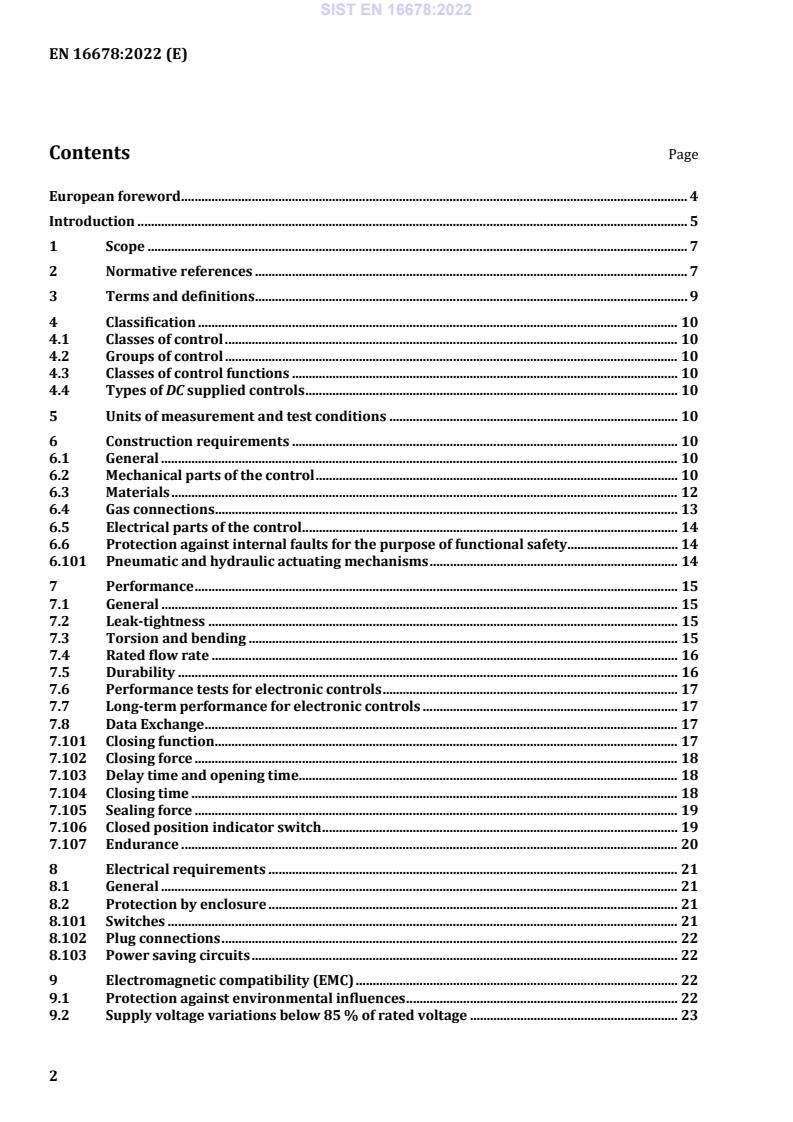
Contents Page
European foreword . 4
Introduction . 5
1 Scope . 7
2 Normative references . 7
3 Terms and definitions . 9
4 Classification . 10
4.1 Classes of control . 10
4.2 Groups of control . 10
4.3 Classes of control functions . 10
4.4 Types of DC supplied controls . 10
5 Units of measurement and test conditions . 10
6 Construction requirements . 10
6.1 General . 10
6.2 Mechanical parts of the control . 10
6.3 Materials . 12
6.4 Gas connections . 13
6.5 Electrical parts of the control . 14
6.6 Protection against internal faults for the purpose of functional safety . 14
6.101 Pneumatic and hydraulic actuating mechanisms . 14
7 Performance . 15
7.1 General . 15
7.2 Leak-tightness . 15
7.3 Torsion and bending . 15
7.4 Rated flow rate . 16
7.5 Durability . 16
7.6 Performance tests for electronic controls . 17
7.7 Long-term performance for electronic controls . 17
7.8 Data Exchange . 17
7.101 Closing function . 17
7.102 Closing force . 18
7.103 Delay time and opening time. 18
7.104 Closing time . 18
7.105 Sealing force . 19
7.106 Closed position indicator switch . 19
7.107 Endurance . 20
8 Electrical requirements . 21
8.1 General . 21
8.2 Protection by enclosure . 21
8.101 Switches . 21
8.102 Plug connections . 22
8.103 Power saving circuits . 22
9 Electromagnetic compatibility (EMC) . 22
9.1 Protection against environmental influences . 22
9.2 Supply voltage variations below 85 % of rated voltage . 23
9.3 Voltage dips and interruptions . 23
9.4 Supply frequency variations . 23
9.5 Surge immunity tests . 23
9.6 Electrical fast transient/burst . 23
9.7 Immunity to conducted disturbances induced by radio frequency fields . 23
9.8 Immunity to radiated disturbances induced by radio frequency fields . 23
9.9 Electrostatic discharge tests . 23
9.10 Power frequency magnetic field immunity tests . 23
9.11 Harmonics and interharmonics including mains signalling at a. c. power port, low
frequency immunity tests . 23
10 Marking, instructions . 23
10.1 Marking . 23
10.2 Instructions . 24
10.3 Warning notice . 25
Annex A (informative) Abbreviations and Symbols . 26
Annex B (informative) Leak-tightness test for gas controls – volumetric method . 27
Annex C (informative) Leak-tightness test for gas controls – pressure loss method . 28
Annex D (normative) Calculation of pressure loss into leakage rate . 29
Annex E (normative) Electrical/electronic component fault modes . 30
Annex F (normative) Additional requirements for safety accessories and pressure
accessories as defined in EU Directive 2014/68/EU . 31
Annex G (normative) Materials for pressurized parts . 32
Annex H (normative) Additional materials for pressurized parts . 33
Annex I (normative) Requirements for controls used in DC supplied gas burners and
appliances burning gaseous or liquid fuels . 34
Annex J (normative) Method for the determination of a Safety Integrity Level (SIL) . 35
Annex K (normative) Method for the determination of a Performance Level (PL) . 36
Annex L (informative) Relationship between Safety Integrity Level (SIL) and Performance
Level (PL) . 39
Annex M (normative) Reset functions . 40
Annex N (informative) Guidance document on Environmental Aspects . 41
Annex O (normative) Seals of elastomer, cork and synthetic fibre mixtures . 42
Annex ZA (informative) Relationship between this European Standard and the essential
requirements of Regulation (EU) 2016/426 aimed to be covered . 43
European foreword
This document (EN 16678:2022) has been prepared by Technical Committee CEN/TC 58 “Safety and
control devices for burners and appliances burning gaseous or liquid fuels”, the secretariat of which is
held by BSI.
This European Standard shall be given the status of a national standard, either by publication of an
identical text or by endorsement, at the latest by April 2023, and conflicting national standards shall be
withdrawn at the latest by October 2025.
Attention is drawn to the possibility that some of the elements of this document may be the subject of
patent rights. CEN shall not be held responsible for identifying any or all such patent rights.
This document supersedes EN 16678:2015.
The following significant changes compared to the previous edition have been incorporated in this
document:
a) alignment with EN 13611:2019;
b) terms and definitions are aligned with EN 13611:2019;
c) requirements from EU Directive 2014/68/EU were not adopted;
d) reference to EN 437 removed;
e) valves fitted with closed position indicator switches added to the scope;
f) Clause “Other controls assembled” to a valve removed;
g) Clause “Resistance to pressure” / safety factor removed;
h) Clause “Electronic component – sensing element” is not applicable;
i) Clause “Protection against internal faults for the purpose of functional safety” is not applicable;
j) information on lifetime for safe function (designed lifetime) added to instructions.
This document has been prepared under a Standardization Request given to CEN by the European
Commission and the European Free Trade Association, and supports essential requirements of
EU Directive(s) / Regulation(s).
For relationship with EU Directive(s) / Regulation(s), see informative Annex ZA, which is an integral part
of this document.
Any feedback and questions on this document should be directed to the users’ national standards body.
A complete listing of these bodies can be found on the CEN website.
According to the CEN-CENELEC Internal Regulations, the national standards organisations of the
following countries are bound to implement this European Standard: Austria, Belgium, Bulgaria, Croatia,
Cyprus, Czech Republic, Denmark, Estonia, Finland, France, Germany, Greece, Hungary, Iceland, Ireland,
Italy, Latvia, Lithuania, Luxembourg, Malta, Netherlands, Norway, Poland, Portugal, Republic of North
Macedonia, Romania, Serbia, Slovakia, Slovenia, Spain, Sweden, Switzerland, Türkiye and the United
Kingdom.
Introduction
This document is intended to be used in conjunction with EN 13611:2019.
EN 13611:2019 recognizes the safety level specified by CEN/TC 58 and is regarded as a horizontal
standard dealing with the safety, construction, performance and testing of controls for burners and
appliances burning gaseous and/or liquid fuels.
The general requirements for controls are given in EN 13611:2019, and methods for classification and
assessment for new controls and control functions are given in EN 14459:2021 (see Figure 1).
EN 126:2012 (see Figure 1) specifies multifunctional controls combining two or more controls and
Application Control Functions, one of which is a mechanical control function. The requirements for
controls and Application Control Functions are given in the specific control standard (see Figure 1,
control functions).
Figure 1 — Interrelation of control standards
EN 13611:2019 should be used in conjunction with the specific standard for a specific type of control (e.g.
EN 88-1:2022, EN 88-2:2022, EN 88-3:2022, EN 125:2022, EN 126:2012, EN 161:2022, EN 257:2022,
EN 298:2022, EN 1106:2022, EN 1643:2022, EN 1854:— , EN 12067-2:2022, EN 16304:2022,
EN 16340:2014, EN 16678:2022 and EN 16898:2022), or for controls for specific applications.
EN 13611:2019 can also be applied, so far as reasonable, to controls not mentioned in a specific standard
and to controls designed on new principles, in which case additional requirements can be necessary.
EN 14459:2021 provides methods for classification and assessment of new control principles.
Primarily in industrial applications it is common practice to rate the safety of a plant based on values
describing the likelihood of a dangerous failure. These values are being used to determine Safety Integrity
Levels or Performance Levels when the system is being assessed in its entirety.
CEN/TC 58 standards for safety relevant controls do go beyond this approach, because for a certain life
time for which the product is specified, designed and tested a dangerous failure is not allowed at all.
Failure modes are described and assessed in greater detail.
Under preparation. Stage at the time of publication: FprEN 1854:2022.
Measures to prevent from dangerous situations are defined. Field experience over many decades is
reflected in the CEN/TC 58 standards. Requirements of EN 13611:2019 can be considered as proven in
practice.
This document refers to clauses of EN 13611:2019 or adapts clauses by stating “with the following
modification”, “with the following addition”, “is replaced by the following” or “is not applicable” in the
corresponding clause.
This document adds clauses or subclauses to the structure of EN 13611:2019 which are particular to this
document. Subclauses which are additional to those in EN 13611:2019 are numbered starting from 101.
Additional Annexes are designated as Annex AA, Annex BB, Annex CC, etc. It should be noted that these
clauses, subclauses and Annexes are not indicated as an addition.
If by reference to EN 13611:2019 the term “control” is given, this term should be read as “valve”.
This document establishes methodologies for the determination of a Performance Level (PL) in
accordance with EN 13611:2019, Annexes K and L.
EN 16678 compliance for valves cannot be claimed based upon Performance Level (PL) classification
according to EN ISO 13849-1:2015 or Safety Integrity Level (SIL) classification according to
EN 61508-1:2010.
Valves with PL or SIL classification do not automatically meet the requirements of this document.
Performance Level (PL) classification according to EN ISO 13849-1:2015 or Safety Integrity Level (SIL)
classification according to EN 61508-1:2010 cannot be claimed based upon compliance with this
standard only.
1 Scope
EN 13611:2019, Clause 1 applies with the following modification and addition:
Modification:
st
The 1 paragraph of EN 13611:2019, Clause 1 is replaced by:
This document specifies the safety, design, construction, and performance requirements and testing for
automatic shut-off valves for burners and appliances burning one or more gaseous fuels, hereafter
referred to as “valves”.
This document is applicable to valves with declared maximum inlet pressures of more than 500 kPa and
up to and including 6 300 kPa and of nominal connection sizes up to and including DN 250.
Addition:
This document is applicable to:
— electrically actuated valves;
— valves actuated by fluids including the pilot valves for these fluids if actuated electrically and
including release valves, but not to any external electrical devices for switching the actuating energy;
— valves where the flow rate is controlled by external electrical signals proportional to the applied
signal;
— valves fitted with closed position indicator switches.
This document is not applicable to valves specifically designed for use in transmission and distribution
networks.
th
The 4 paragraph of EN 13611:2019, Clause 1 is removed.
2 Normative references
The following documents are referred to in the text in such a way that some or all of their content
constitutes requirements of this document. For dated references, only the edition cited applies. For
undated references, the latest edition of the referenced document (including any amendments) applies.
EN 161:2022, Automatic shut-off valves for gas burners and gas appliances
EN 549:2019, Rubber materials for seals and diaphragms for gas appliances and gas equipment
EN 1092-1:2018, Flanges and their joints — Circular flanges for pipes, valves, fittings and accessories, PN
designated — Part 1: Steel flanges
EN 1092-2:1997, Flanges and their joints — Circular flanges for pipes, valves, fittings and accessories, PN
designated — Part 2: Cast iron flanges
EN 1092-3:2003 , Flanges and their joints — Circular flanges for pipes, valves, fittings and accessories, PN
designated — Part 3: Copper alloy flanges
As impacted by EN 1092-3:2003/AC:2007.
EN 1092-4:2002, Flanges and their joints — Circular flanges for pipes, valves, fittings and accessories, PN
designated — Part 4: Aluminium alloy flanges
EN 1759-1:2004, Flanges and their joint — Circular flanges for pipes, valves, fittings and accessories, Class
designated — Part 1: Steel flanges, NPS 1/2 to 24
EN 1759-3:2003 , Flanges and their joints — Circular flanges for pipes, valves, fittings and accessories,
Class designated — Part 3: Copper alloy flanges
EN 1759-4:2003, Flanges and their joint — Circular flanges for pipes, valves, fittings and accessories, class
designated — Part 4: Aluminium alloy flanges
EN 10226-1:2004, Pipe threads where pressure tight joints are made on the threads — Part 1: Taper
external threads and parallel internal threads — Dimensions, tolerances and designation
EN 10226-2:2005, Pipe threads where pressure tight joints are made on the threads — Part 2: Taper
external threads and taper internal threads — Dimensions, tolerances and designation
EN 12266-1:2012, Industrial valves — Testing of metallic valves — Part 1: Pressure tests, test procedures
and acceptance criteria — Mandatory requirements
EN 12516-1:2014+A1:2018, Industrial valves — Shell design strength — Part 1: Tabulation method for
steel valve shells
EN 12516-2:2014+A1:2021, Industrial valves — Shell design strength — Part 2: Calculation method for
steel valve shells
EN 12516-3:2002 , Valves — Shell design strength — Part 3: Experimental method
EN 12516-4:2014+A1:2018, Industrial valves — Shell design strength — Part 4: Calculation method for
valve shells manufactured in metallic materials other than steel
EN 12627:2017, Industrial valves — Butt welding ends for steel valves
EN 12760:2016, Industrial valves — Socket welding ends for steel valves
EN 13611:2019 , Safety and control devices for burners and appliances burning gaseous and/or liquid fuels
— General requirements
EN 60730-1:2016 , Automatic electrical controls — Part 1: General requirements (IEC 60730-1:2013,
modified)
EN IEC 61058-1:2018, Switches for appliances — Part 1: General requirements (IEC 61058-1:2016)
As impacted by EN 1759-3:2003/AC:2004.
As impacted by EN 12516-3:2002/AC:2003.
As impacted by EN 13611:2019/AC:2021.
As impacted by EN 60730-1:2016/A1:2019 and EN 60730-1:2016/A2:2022.
EN 175301-803:2006, Detail Specification: Rectangular connectors — Flat contacts, 0,8 mm thickness,
locking screw not detachable
ISO 188:2011, Rubber, vulcanized or thermoplastic — Accelerated ageing and heat resistance tests
ISO 1431-1:2022, Rubber, vulcanized or thermoplastic — Resistance to ozone cracking — Part 1: Static and
dynamic strain testing
ISO 1817:2022, Rubber, vulcanized or thermoplastic — Determination of the effect of liquids
ISO 8573-1:2010, Compressed air — Part 1: Contaminants and purity classes
3 Terms and definitions
For the purposes of this document, the terms and definitions given in EN 13611:2019, EN 161:2021 and
the following apply.
ISO and IEC maintain terminological databases for use in standardization at the following addresses:
— IEC Electropedia: available at https://www.electropedia.org/
— ISO Online browsing platform: available at https://www.iso.org/obp
3.101
pilot valve
valve which controls the fluid (e.g. compressed air) supplied to the actuating mechanism
Note 1 to entry: A typical pilot and release valve application is shown in Figure 2.
3.102
release valve
valve in the line from the pilot valve to the actuating mechanism which closes the vent automatically
when the actuating fluid is released by the pilot valve and opens it automatically when the pilot valve is
closed
Note 1 to entry: A typical pilot and release valve application is shown in Figure 2.
Key
1 control under test
2 pilot valve (normally closed)
3 release valve, normally open
Figure 2 — Typical pilot and release valve application
4 Classification
4.1 Classes of control
EN 13611:2019, 4.1 is replaced by the following:
— Class A valves:
Valves where the sealing force is not decreased by the gas inlet pressure. They are classified A
according to the sealing force requirements of 7.105. Balanced valves according to this document are
also classified as Class A valves.
— Class D valves:
Valves which are not subject to the requirements for the sealing force and fixed closing time.
4.2 Groups of control
Shall be according to EN 13611:2019, 4.2.
4.3 Classes of control functions
EN 13611:2019, 4.3 is not applicable.
4.4 Types of DC supplied controls
Shall be according to EN 13611:2019, 4.4.
5 Units of measurement and test conditions
Shall be according to EN 13611:2019, Clause 5.
6 Construction requirements
6.1 General
Shall be according to EN 13611:2019, 6.1 with the following addition:
If an automatic shut-off valve requires a release and/or a pilot valve to fulfil the requirements of this
document, these are considered to be part of the automatic shut-off valve and shall be specified in the
instructions. The combination of automatic shut-off valve and release and/or pilot valve shall conform to
all requirements of this document.
The interaction of all valves participating in the closing mechanism shall be evaluated. An appropriate
risk assessment shall be carried out.
For each pressurized compartment the local maximum pressure shall be considered for the strength
design and for the selection of the material. It shall be ensured by mechanical means that parts for
different pressures are separated. A diaphragm shall not be used for this purpose.
6.2 Mechanical parts of the control
6.2.1 Appearance
Shall be according to EN 13611:2019, 6.2.1.
6.2.2 Holes
Shall be according to EN 13611:2019, 6.2.2.
6.2.3 Breather holes
EN 13611:2019, 6.2.3 is not applicable.
6.2.4 Screwed fastenings
EN 13611:2019, 6.2.4 is replaced by the following:
Screwed fastenings shall be specified in the instructions.
Self-tapping screws which cut a thread and produce swarf shall not be used for connecting gas-carrying
parts or parts which can be removed for service.
Self-tapping screws which form a thread and do not produce swarf may be used under the condition that
they can be replaced by metric machine screws.
6.2.5 Jointing
Shall be according to EN 13611:2019, 6.2.5.
6.2.6 Moving parts
Shall be according to EN 13611:2019, 6.2.6 with the following addition:
There shall be no exposed shafts or operating levers which could adversely affect the ability of valves to
close by unintended blockage.
6.2.7 Sealing caps
Shall be according to EN 13611:2019, 6.2.7.
6.2.8 Dismantling and reassembly
Shall be according to EN 13611:2019, 6.2.8.
6.2.9 Auxiliary canals and orifices
Shall be according to EN 13611:2019, 6.2.9.
6.2.10 Presetting devices
Shall be according to EN 13611:2019, 6.2.10.
6.2.101 Closed position indicator switch
Closed position indicator switches, where fitted, shall not impair the correct operation of valves.
Adjusters shall be sealed to indicate interference. Any drift of the switch and actuating mechanism from
its setting shall not impair correct valve operation. Conformity with these requirements is determined by
the test according to 7.107.3.
6.2.102 Valve with modulating control
Flow rates of valves with modulating control shall be adjustable over the full range as stated in the
instructions. If the adjustment of one flow rate affects the setting of any other flow rate, this shall be
clearly stated in the instructions for setting up. The setting of any flow rate shall require the use of
mechanical or electrical tools and shall be designed to discourage unauthorized adjustment.
6.2.103 Balanced valves
The closure member of a balanced valve shall have a resulting force in the closing direction where the
sealing force is not decreased by the gas inlet pressure.
For a balanced valve with one port a resulting force in the closing direction shall remain, if the balancing
force is removed, and the closure member shall have the same closing direction as the flow direction
through the valve.
6.2.104 Additional requirements for shut-off function
6.2.104.1 Diaphragms that assist the shut-off function
Shut-off functions using a diaphragm to apply (part of) the closing force to the closure member shall be
designed in such a way that, when the diaphragm is damaged, the closure member closes and the
maximum internal leakage rate of the valve is limited to 1 dm /h. Conformity shall be verified by the
method given in 6.2.104.2.
6.2.104.2 Leakage test
Remove or rupture the part(s) assisting the shut-off function. De-energize the valve. Measure the internal
leakage rate of the valve according to 7.2.2.
6.3 Materials
6.3.1 General material requirements
Shall be according to EN 13611:2019, 6.3.1 and Annex G.
6.3.2 Housing
6.3.2.1 Requirements
EN 13611:2019, 6.3.2.1 is replaced by the following:
Parts of the housing which directly or indirectly separate a gas-carrying compartment from atmosphere
shall be made from metallic materials that have a melting point (solidus temperature) of at least 427 °C.
6.3.2.2 Test
EN 13611:2019, 6.3.2.2 is not applicable.
6.3.3 Zinc alloys
EN 13611:2019, 6.3.3 is not applicable.
6.3.4 Springs providing closing and/or sealing force
Shall be according to EN 13611:2019, 6.3.4 with the following addition:
This requirement applies also for pilot and release valves for pneumatic or hydraulic actuators.
6.3.5 Resistance to corrosion and surface protection
Shall be according to EN 13611:2019, 6.3.5.
6.3.6 Impregnation
EN 13611:201911, 6.3.6 is replaced by the following:
Valves conforming to this document shall not be impregnated.
6.3.7 Seals for glands for moving parts
Shall be according to EN 13611:2019, 6.3.7.
6.3.101 Closure members
Closure members of valves shall either have a mechanical support (e.g. metallic) to withstand the sealing
force or shall be made of metal.
6.3.102 Parts transmitting the closing force
Parts transmitting the closing force shall be made of metal and shall be designed to withstand a force
equal to 5 times the closing force.
6.3.103 Balanced valves
The strength of the connection between closure members of a balanced valve shall be at least five
multiplied by the maximum inlet pressure multiplied by the total opening area of the closure members.
6.3.104 Bellows
When bellows are used as sealing elements proof of limiting fatigue stress shall be provided for at least
the number of cycles stated in Table 3.
For the calculation, not less than the number of cycles as stated in Table 3 shall be taken for the respective
nominal widths.
As calculation basis, EN 14917:2021 or comparable methods may be used.
6.4 Gas connections
6.4.1 Making connections
Shall be according to EN 13611:2019, 6.4.1 with the following addition:
If the valve is equipped with welding ends for welding to the pipe, EN 13611:2019, 6.4.1 is not applicable.
6.4.2 Connection sizes
Shall be according to EN 13611:2019, 6.4.2.
6.4.3 Threads
EN 13611:2019, 6.4.3 is replaced by the following:
Inlet and outlet threads shall be according to EN 10226-1:2004 or EN 10226-2:2005 and shall be chosen
from EN 13611:2019, Table 3. Threads shall only be used for valves up to DN 25 for inlet pressures not
greater than 2 500 kPa.
6.4.4 Union joints
Shall be according to EN 13611:2019, 6.4.4.
6.4.5 Flanges
Shall be according to EN 13611:2019, 6.4.5 with the following addition:
Also flanges according to EN 1092-1:2018, EN 1092-2:1997, EN 1092-3:2003, EN 1092-4:2002,
EN 1759-1:2004, EN 1759-3:2003 and EN 1759-4:2003, PN 25 to PN 63, are suitable.
6.4.6 Compression fittings
Shall be according to EN 13611:2019, 6.4.6 with the following addition:
The use of compression fittings is limited to valves up to an including DN 25.
6.4.7 Nipples for pressure test
EN 13611:2019, 6.4.7 is replaced by the following:
Nipples for pressure tests shall not be used.
6.4.8 Strainers
Shall be according to EN 13611:2019, 6.4.8.
6.4.101 Welded connections
If connections are made by welding using welding ends, these welding ends shall be according to
EN 12627:2017 or EN 12760:2016.
6.5 Electrical parts of the control
6.5.1 General
Shall be according to EN 13611:2019, 6.5.1.
6.5.2 Switching elements
EN 13611:2019, 6.5.2 is not applicable.
NOTE Requirements for closed position indicator switches are given in 7.106.1.
6.5.3 Electrical components
6.5.3.1 Performance of electrical components
Shall be according to EN 13611:2019, 6.5.3.1.
6.5.3.2 Tests
Shall be according to EN 13611:2019, 6.5.3.2.
6.5.3.3 Sensing element
EN 13611:2019, 6.5.3.3 is not applicable.
6.5.3.4 Gas controls employing electrical components in the gas circuit
Shall be according to EN 13611:2019, 6.5.3.4.
6.6 Protection against internal faults for the purpose of functional safety
EN 13611:2019, 6.6 is not applicable.
6.101 Pneumatic and hydraulic actuating mechanisms
Pneumatically or hydraulically actuated valves shall be provided with protection to ensure that the
blockage of an orifice in the control system does not adversely affect the relevant performance
requirements as given in Clause 7.
If the performance of the actuating mechanism depends on the quality of compressed air or hydraulic
fluid, appropriate information shall be stated in the instructions.
7 Performance
7.1 General
Shall be according to EN 13611:2019, 7.1 with the following addition:
Valves shall close automatically when de-energized or in the absence of actuating energy.
The electrical control valve of pneumatic or hydraulic actuating mechanisms shall also meet these
requirements.
The closing of pneumatically or hydraulically actuated valves shall be ensured over the range from 85 %
to 110 % of the actuating pressure or pressure range as stated in the instructions.
Where valves are specified for using pilot and/or release valves the assembly shall fulfil all performance
requirements and tests.
All tests are conducted at room temperature, if not stated otherwise.
7.2 Leak-tightness
7.2.1 Requirements
Shall be according to EN 13611:2019, 7.2.1.
7.2.2 Tests
EN 13611:2019, 7.2.2 is replaced by the following:
For internal leakage of closure members carry out the tests with an initial test pressure of 0,6 kPa. Then
for internal leakage repeat the tests at 1,1 times the maximum inlet pressure or 750 kPa, whichever is
greater. For external leakage the test pressure is 1,5 times the maximum inlet pressure.
If the valve consists of several compartments with different pressures, the external leakage test is
conducted for each compartment at 1,5 times maximum pressure.
The test fluid shall be air or suitable gas, e.g. nitrogen. The test duration shall be at least 1 h.
Use a method which gives reproducible results. Examples of such methods are shown in:
— Annex B (volumetric method) for test pressures up to and including 15 kPa;
— Annex C (pressure loss method) for test pressures above 15 kPa. The formula for conversion from
the pressure loss method to the volumetric method is given in Annex D;
— EN 12266-1:2012, A.3.2.1 for external leakage;
— EN 12266-1:2012, Table A.3 for internal leakage. Test pressure is applied in the direction of flow as
stated in the instructions.
7.3 Torsion and bending
7.3.1 General
Shall be according to EN 13611:2019, 7.3.1 with the following modification.
For valves with housing designed according to EN 12516-1:2014+A1:2018, EN 12516-2:2014+A1:2021,
EN 12516-3:2002 and EN 12516-4:2014+A1:2018 and valves for installation between flanges with wafer
or lug type housing no test for torsion and bending is applied.
Unit
7.3.2 Torsion and bending moments
Shall be according to EN 13611:2019, 7.3.2.
7.4 Rated flow rate
EN 13611:2019, 7.4 is not applicable.
7.5 Durability
7.5.1 Elastomers in contact with gas
Shall be according to EN 13611:2019, 7.5.1 with the following addition:
Respectively EN 549:2019 or EN 682:2002 may be used, in which case the following additional
requirements of Table 1 apply.
Table 1 — Test method and acceptance criteria referred to the properties of elastomeric
materials
a
Range of hardness IRHD
Test method
≥ 45 to > 55 to > 65 to > 75 to
> 85
Property
55 65 75 85
Reference
Test conditions Acceptance criteria
document
change in hardness at (70 ± 1) °C
±10 ±10 ±10 ±10 ±10
for (168 ± 2) h
change in tensile strength at
accelerated ±15 ±15 ±15 ±15 ±15
ISO 188:2011 (70 ± 1) °C for (168 ± 2) h %
ageing
from from from from from
change in elongation at break at
10 to 10 to 10 to 10 to 10 to
(70 ± 1) °C for (168 ± 2) h
−25 −25 −25 −25 −25
change in volume after immersion
in liquid B at (23 ± 2) °C after ≤ 40 ≤ 40 ≤ 30 ≤ 30 ≤ 25
(72 + 0/−2) h
resistance to
ISO 1817:2022 %
gas
change in volume after immersion
in liquid B at (40 ± 1) °C for 7 days ≥ −20 ≥ −17 ≥ −15 ≥ −15 ≥ −15
± 2 h and after drying
change in hardness after
immersion in oil N. 3 (IRM 903) at ±10 ±10 ±10 ±10 ±10
(70 ± 1) °C for 7 days ± 2 h
Resistance to
ISO 1817:2022 %
lubricant
from from from from from
change in volume after immersion
15 to
15 to 15 to 15 to 15 to
in oil N. 3 (IRM 903) as above
−5 −5 −5 −5 −5
Procedure A: strain the test pieces
Resistance to at (10 ± 1) % elongation with
ozone ISO 1431-1:2022 ozone concentration
cracking (25 ± 5) pphm at (30 ± 2) °C for
24 h
a
For equivalence between the hardness IRHD and shore see in [6] “Roger Brown, Physical Testing of Rubber, 4th Edition,
Springer Science + Business Media, Inc. – Clause 4 “Hardness” – sub-clause 4.4 “Accuracy and comparison of hardness
tests”.
7.5.2 Durability of Marking
Shall be according to EN 13611:2019, 7.5.2.
7.5.3 Resistance to scratching
Shall be according to EN 13611:2019, 7.5.3.
7.5.4 Resistance to humidity
Shall be according to EN 13611:2019, 7.5.4.
7.5.5 Lubricants in contact with gas
Shall be according to EN 13611:2019, 7.5.5.
7.6 Performance tests for electronic controls
EN 13611:2019, 7.6 is not applicable.
7.7 Long-term performance for electronic controls
EN 13611:2019, 7.7 is not applicable.
7.8 Data Exchange
EN 13611:2019, 7.8 is not applicable.
NOTE Valves are actuators and safety functions are hard wired.
7.101 Closing function
7.101.1 Requirement
Valves shall close automatically on reducing the voltage or current to 15 % of the minimum rated value.
Valves with pneumatic or hydraulic actuating mechanisms shall close automatically on reducing the
voltage or current to 15 % of the minimum rated voltage of the pilot valve.
Valves shall close automatically on removal of the voltage or current of between 15 % of the minimum
rated value and the maximum rated value increased by the tolerance according to 7.1.
In all cases, the closing time shall be in accordance with 7.104.
7.101.2 Test of closing function
Energize the valve at the maximum rated voltage or current and at the maximum actuating pressure, if
applicable. Slowly reduce the voltage or current to 15 % of the minimum rated value. Verify that the valve
has closed.
Energize the valve at the maximum rated voltage or current and at the maximum actuating pressure, if
applicable. Increase the voltage or current to the maximum rated value increased by the tolerance
according to 7.1, keeping the actuating pressure, if any, unchanged. De-energize the valve and verify that
it has closed.
Energize the valve at the maximum rated voltage or current and at the maximum actuating pressure, if
applicable. Reduce the voltage or current to a value between 15 % of the minimum rated value and the
maximum rated value decreased by the tolerance according to 7.1, keeping the actuating pressure, if any,
unchanged. De-energize the valve and verify that it has closed. Conduct this test at 3 different voltages or
currents between 15 % of the minimum rated value and the maximum rated value decreased by the
tolerance according to 7.1.
-------------------
...