

oSIST prEN IEC 62337:2026
(Main)Commissioning of electrical, instrumentation and control systems in the process industry - Specific phases and milestones
General Information
- Abstract
- Status
- Not Published
- Public Enquiry End Date
- 29-Jan-2026
- Technical Committee
- MOV - Measuring equipment for electromagnetic quantities
- Current Stage
- 4020 - Public enquire (PE) (Adopted Project)
- Start Date
- 11-Nov-2025
- Due Date
- 31-Mar-2026
- Completion Date
- 04-Feb-2026



Overview
prEN IEC 62337:2025 (IEC 62337, 3rd edition) provides guidance for the commissioning of electrical, instrumentation and control (EI&C) systems in the process industry. The standard focuses on the specific phases and milestones for precommissioning and commissioning EI&C equipment, offering a structured approach to testing, training, documentation and handover. This edition updates organization and technology coverage, and limits normative requirements to EI&C precommissioning and commissioning activities.
Key topics and requirements
- Scope and exclusions
- Normative coverage is limited to precommissioning and commissioning of EI&C equipment.
- Explicit exclusions include prior/post project activities, regulated industries, safety instrumented systems (SIS), manufacturing execution systems (MES), advanced process control (APC), industrial security for IACS, user-specific procedures and non-EI&C commissioning work.
- Phases, milestones and overview
- Structured lifecycle chapters covering preparations, commissioning and EI&C system testing.
- Emphasis on defined milestones to confirm readiness for each phase.
- Preparations
- Preparations by E&I: electrical, instrumentation and control-system readiness, training, and required EI&C documents.
- Preparations by other disciplines: mechanical completion, vendor assistance, leak tests, purging, cleaning and safety inspections (captured in informative annexes).
- Commissioning activities
- Commissioning tasks performed by E&I and coordination with other disciplines.
- Informative annexes detail typical E&I work, documents, and discipline-specific commissioning activities and checklists.
- Documentation and training
- Required technical documents and training programs to support safe, verifiable commissioning and handover.
- Informative annexes
- Annexes A–F and bibliographic references provide checklists, examples of documents and practical workflows for site teams.
Practical applications and users
Who uses this standard:
- E&I engineers and commissioning managers
- Control system integrators and contractors
- Plant owners, operators and maintenance teams
- Project managers overseeing mechanical–electrical integration
Practical benefits:
- Standardizes commissioning phases and milestones for EI&C scope
- Reduces project risk by clarifying responsibilities and required documents
- Improves coordination between E&I and other disciplines during precommissioning and commissioning
- Supports consistent testing, training and safe handover of automation systems
Related standards
- Developed by IEC TC 65 / SC 65E (Devices and integration in enterprise systems).
- The document references other applicable international standards and follows ISO/IEC directives for standards development (specific normative references are listed in the standard).
Keywords: IEC 62337, commissioning, EI&C, electrical instrumentation control systems, process industry, precommissioning, commissioning phases, milestones, automation systems.
Relations
- Effective Date
- 26-Nov-2024
Get Certified
Connect with accredited certification bodies for this standard

DIBt (Deutsches Institut für Bautechnik)
German Institute for Building Technology.
DIN CERTCO
DIN Group product certification.
DVS-ZERT GmbH
German welding certification society.
Sponsored listings
Frequently Asked Questions
oSIST prEN IEC 62337:2026 is a draft published by the Slovenian Institute for Standardization (SIST). Its full title is "Commissioning of electrical, instrumentation and control systems in the process industry - Specific phases and milestones". This standard covers: Commissioning of electrical, instrumentation and control systems in the process industry - Specific phases and milestones
Commissioning of electrical, instrumentation and control systems in the process industry - Specific phases and milestones
oSIST prEN IEC 62337:2026 is classified under the following ICS (International Classification for Standards) categories: 25.040.01 - Industrial automation systems in general; 91.010.20 - Contractual aspects; 91.040.20 - Buildings for commerce and industry. The ICS classification helps identify the subject area and facilitates finding related standards.
oSIST prEN IEC 62337:2026 has the following relationships with other standards: It is inter standard links to SIST EN 62337:2012. Understanding these relationships helps ensure you are using the most current and applicable version of the standard.
oSIST prEN IEC 62337:2026 is available in PDF format for immediate download after purchase. The document can be added to your cart and obtained through the secure checkout process. Digital delivery ensures instant access to the complete standard document.
Standards Content (Sample)
SLOVENSKI STANDARD
01-januar-2026
Prevzemni postopki za električne, merilne in nadzorne sisteme v procesni
industriji - Posamezne faze in mejniki
Commissioning of electrical, instrumentation and control systems in the process industry
- Specific phases and milestones
Inbetriebnahme elektrischer und leittechnischer Systeme in der verfahrenstechnischen
Industrie - Phasen und Meilensteine
Mise en service des systèmes électriques, de mesure et de commande dans l'industrie
de transformation - Phases et jalons spécifiques
Ta slovenski standard je istoveten z: prEN IEC 62337:2025
ICS:
25.040.01 Sistemi za avtomatizacijo v Industrial automation
industriji na splošno systems in general
2003-01.Slovenski inštitut za standardizacijo. Razmnoževanje celote ali delov tega standarda ni dovoljeno.
65E/1191/CDV
COMMITTEE DRAFT FOR VOTE (CDV)
PROJECT NUMBER:
IEC 62337 ED3
DATE OF CIRCULATION: CLOSING DATE FOR VOTING:
2025-11-07 2026-01-30
SUPERSEDES DOCUMENTS:
65E/1164/CD, 65E/1185/CC
IEC SC 65E : DEVICES AND INTEGRATION IN ENTERPRISE SYSTEMS
SECRETARIAT: SECRETARY:
United States of America Mr David Richmond
OF INTEREST TO THE FOLLOWING COMMITTEES: HORIZONTAL FUNCTION(S):
ASPECTS CONCERNED:
SUBMITTED FOR CENELEC PARALLEL VOTING NOT SUBMITTED FOR CENELEC PARALLEL VOTING
Attention IEC-CENELEC parallel voting
The attention of IEC National Committees, members of
CENELEC, is drawn to the fact that this Committee Draft
for Vote (CDV) is submitted for parallel voting.
The CENELEC members are invited to vote through the
CENELEC online voting system.
This document is still under study and subject to change. It should not be used for reference purposes.
Recipients of this document are invited to submit, with their comments, notification of any relevant patent rights of
which they are aware and to provide supporting documentation.
Recipients of this document are invited to submit, with their comments, notification of any relevant “In Some
Countries” clauses to be included should this proposal proceed. Recipients are reminded that the CDV stage is
the final stage for submitting ISC clauses. (SEE AC/22/2007 OR NEW GUIDANCE DOC).
TITLE:
Commissioning of electrical, instrumentation and control systems in the process industry -
Specific phases and milestones
PROPOSED STABILITY DATE: 2030
NOTE FROM TC/SC OFFICERS:
download this electronic file, to make a copy and to print out the content for the sole purpose of preparing
National Committee positions. You may not copy or "mirror" the file or printed version of the document, or any
part of it, for any other purpose without permission in writing from IEC.
IEC CDV 62337 © IEC 2025
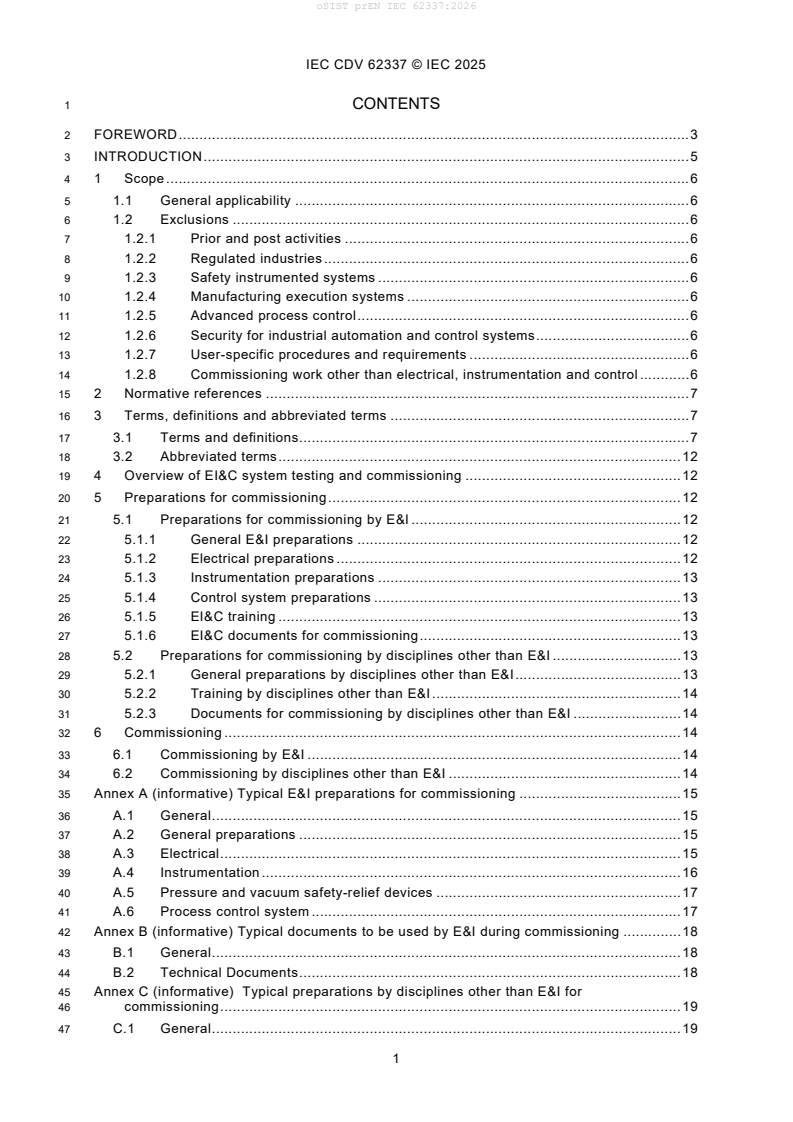
1 CONTENTS
2 FOREWORD . 3
3 INTRODUCTION . 5
4 1 Scope . 6
5 1.1 General applicability . 6
6 1.2 Exclusions . 6
7 1.2.1 Prior and post activities . 6
8 1.2.2 Regulated industries . 6
9 1.2.3 Safety instrumented systems . 6
10 1.2.4 Manufacturing execution systems . 6
11 1.2.5 Advanced process control . 6
12 1.2.6 Security for industrial automation and control systems . 6
13 1.2.7 User-specific procedures and requirements . 6
14 1.2.8 Commissioning work other than electrical, instrumentation and control . 6
15 2 Normative references . 7
16 3 Terms, definitions and abbreviated terms . 7
17 3.1 Terms and definitions . 7
18 3.2 Abbreviated terms . 12
19 4 Overview of EI&C system testing and commissioning . 12
20 5 Preparations for commissioning . 12
21 5.1 Preparations for commissioning by E&I . 12
22 5.1.1 General E&I preparations . 12
23 5.1.2 Electrical preparations . 12
24 5.1.3 Instrumentation preparations . 13
25 5.1.4 Control system preparations . 13
26 5.1.5 EI&C training . 13
27 5.1.6 EI&C documents for commissioning . 13
28 5.2 Preparations for commissioning by disciplines other than E&I . 13
29 5.2.1 General preparations by disciplines other than E&I . 13
30 5.2.2 Training by disciplines other than E&I . 14
31 5.2.3 Documents for commissioning by disciplines other than E&I . 14
32 6 Commissioning . 14
33 6.1 Commissioning by E&I . 14
34 6.2 Commissioning by disciplines other than E&I . 14
35 Annex A (informative) Typical E&I preparations for commissioning . 15
36 A.1 General . 15
37 A.2 General preparations . 15
38 A.3 Electrical . 15
39 A.4 Instrumentation . 16
40 A.5 Pressure and vacuum safety-relief devices . 17
41 A.6 Process control system . 17
42 Annex B (informative) Typical documents to be used by E&I during commissioning . 18
43 B.1 General . 18
44 B.2 Technical Documents . 18
45 Annex C (informative) Typical preparations by disciplines other than E&I for
46 commissioning . 19
47 C.1 General . 19
IEC CDV 62337 © IEC 2025
48 C.2 General preparations . 19
49 C.3 Completion of construction . 19
50 C.3.1 Mechanical checks and tests . 19
51 C.3.2 Documentation . 20
52 C.4 Precommissioning activities . 20
53 C.4.1 Vendor service assistance . 20
54 C.4.2 Rotation and alignment . 20
55 C.4.3 Leak and pressure tests . 20
56 C.4.4 Inspection . 20
57 C.4.5 Flushing and chemical or mechanical cleaning . 20
58 C.4.6 Temporary screens, strainers and blinds . 20
59 C.4.7 Purging or inerting . 20
60 C.4.8 Drying out . 20
61 C.4.9 Plant safety inspection . 21
62 C.4.10 Piping systems . 21
63 C.4.11 Buildings and accessories . 21
64 C.4.12 Vessels, tanks and heat exchangers . 21
65 C.4.13 Packaged Units . 21
66 Annex D (informative) Typical documents to be used by other disciplines during
67 commissioning . 22
68 D.1 General . 22
69 D.2 Technical Documents . 22
70 Annex E (informative) Typical E&I work during commissioning . 23
71 E.1 General . 23
72 E.1.1 Electrical . 23
73 E.1.2 Instrumentation . 23
74 E.1.3 Process control systems . 23
75 Annex F (informative) Typical work by disciplines other than E&I during commissioning . 24
76 F.1 General . 24
77 F.2 Commissioning activities by disciplines other than E&I . 24
78 F.2.1 Rotating equipment – General . 24
79 F.2.2 Rotating equipment – Steam driven . 24
80 F.2.3 Rotating equipment – Pumps . 24
81 F.2.4 Rotating equipment – Compressors . 24
82 F.2.5 Miscellaneous mechanical equipment (agitators and material-handling
83 equipment) . 24
84 F.2.6 Furnaces . 24
85 F.2.7 Shell and tube heat exchangers . 24
86 F.2.8 Piping . 24
87 F.2.9 Insulation and painting . 25
88 F.2.10 Packaged Units with their own control systems . 25
89 Bibliography . 26
IEC CDV 62337 © IEC 2025
91 INTERNATIONAL ELECTROTECHNICAL COMMISSION
92 ____________
94 AUTOMATION SYSTEMS IN THE PROCESS INDUSTRY –
95 COMMISSIONING OF ELECTRICAL, INSTRUMENTATION
96 AND CONTROL SYSTEMS
98 FOREWORD
99 1) The International Electrotechnical Commission (IEC) is a worldwide organization for standardization comprising
100 all national electrotechnical committees (IEC National Committees). The object of IEC is to promote international
101 co-operation on all questions concerning standardization in the electrical and electronic fields. To this end and
102 in addition to other activities, IEC publishes International Standards, Technical Specifications, Technical Reports,
103 Publicly Available Specifications (PAS) and Guides (hereafter referred to as "IEC Publication(s)"). Their
104 preparation is entrusted to technical committees; any IEC National Committee interested in the subject dealt with
105 may participate in this preparatory work. International, governmental and non-governmental organizations liaising
106 with the IEC also participate in this preparation. IEC collaborates closely with the International Organization for
107 Standardization (ISO) in accordance with conditions determined by agreement between the two organizations.
108 2) The formal decisions or agreements of IEC on technical matters express, as nearly as possible, an international
109 consensus of opinion on the relevant subjects since each technical committee has representation from all
110 interested IEC National Committees.
111 3) IEC Publications have the form of recommendations for international use and are accepted by IEC National
112 Committees in that sense. While all reasonable efforts are made to ensure that the technical content of IEC
113 Publications is accurate, IEC cannot be held responsible for the way in which they are used or for any
114 misinterpretation by any end user.
115 4) In order to promote international uniformity, IEC National Committees undertake to apply IEC Publications
116 transparently to the maximum extent possible in their national and regional publications. Any divergence between
117 any IEC Publication and the corresponding national or regional publication shall be clearly indicated in the latter.
118 5) IEC itself does not provide any attestation of conformity. Independent certification bodies provide conformity
119 assessment services and, in some areas, access to IEC marks of conformity. IEC is not responsible for any
120 services carried out by independent certification bodies.
121 6) All users should ensure that they have the latest edition of this publication.
122 7) No liability shall attach to IEC or its directors, employees, servants or agents including individual experts and
123 members of its technical committees and IEC National Committees for any personal injury, property damage or
124 other damage of any nature whatsoever, whether direct or indirect, or for costs (including legal fees) and
125 expenses arising out of the publication, use of, or reliance upon, this IEC Publication or any other IEC
126 Publications.
127 8) Attention is drawn to the Normative references cited in this publication. Use of the referenced publications is
128 indispensable for the correct application of this publication.
129 9) IEC draws attention to the possibility that the implementation of this document may involve the use of (a)
130 patent(s). IEC takes no position concerning the evidence, validity or applicability of any claimed patent rights in
131 respect thereof. As of the date of publication of this document, IEC had not received notice of (a) patent(s), which
132 may be required to implement this document. However, implementers are cautioned that this may not represent
133 the latest information, which may be obtained from the patent database available at https://patents.iec.ch. IEC
134 shall not be held responsible for identifying any or all such patent rights.
135 IEC 62337 has been prepared by subcommittee 65E: Devices and integration in enterprise
136 systems, of IEC technical committee 65: Industrial-process measurement, control and
137 automation. It is an International Standard.
138 This third edition cancels and replaces the second edition published in 2012. This edition
139 constitutes a technical revision.
140 This edition includes the following significant technical changes with respect to the previous
141 edition:
142 a) Title has been changed from “COMMISSIONING OF ELECTRICAL, INSTRUMENTATION
143 AND CONTROL SYSTEMS IN THE PROCESS INDUSTRY – SPECIFIC PHASES AND
144 MILESTONES” to “AUTOMATION SYSTEMS IN THE PROCESS INDUSTRY –
145 COMMISSIONING OF ELECTRICAL, INSTRUMENTATION AND CONTROL SYSTEMS”;
146 b) General re-organization of the standard;
IEC CDV 62337 © IEC 2025
147 c) Current technology has been incorporated;
148 d) Normative requirements have been limited to precommissioning and commissioning of EI&C
149 equipment;
150 e) Precommissioning and commissioning activities by disciplines other than E&I have been
151 moved to informative annexes;
152 f) Additional references to other applicable standards have been provided; and
153 g) Mechanical completion certificate, acceptance of the plant certificate and division of work
154 responsibility between contractor and owner have been deleted as these were not E&I
155 related.
156 The text of this International Standard is based on the following documents:
Draft Report on voting
65E/XX/FDIS 65E/XX/RVD
158 Full information on the voting for its approval can be found in the report on voting indicated in
159 the above table.
160 The language used for the development of this International Standard is English.
161 This document was drafted in accordance with ISO/IEC Directives, Part 2, and developed in
162 accordance with ISO/IEC Directives, Part 1 and ISO/IEC Directives, IEC Supplement, available
163 at www.iec.ch/members_experts/refdocs. The main document types developed by IEC are
164 described in greater detail at www.iec.ch/publications.
165 The committee has decided that the contents of this document will remain unchanged until the
166 stability date indicated on the IEC website under webstore.iec.ch in the data related to the
167 specific document. At this date, the document will be
168 • reconfirmed,
169 • withdrawn,
170 • replaced by a revised edition, or
171 • amended.
IEC CDV 62337 © IEC 2025
172 INTRODUCTION
173 The commissioning of electrical, instrumentation and control systems (EI&C) in the process
174 industry is an important phase that ensures all components are functioning according to the
175 project specifications before production begins. This document outlines the activities involved
176 in the commissioning phase and in the preparation thereof. It shows how these activities are
177 timely linked to other project phases and describes the need to verify that all EI&C equipment
178 has been tested, installed, calibrated, and configured in accordance with the vendor
179 requirements and project specifications. Training of personnel and the availability of necessary
180 documentation are also highlighted as required prerequisites for successful commissioning.
181 The focus of this document is on E&I related activities. In addition to this, typical work by other
182 disciplines which also occurs during the commissioning phase is included for reference. The
183 annexes provide typical activities and considerations of E&I and other disciplines for general
184 information.
IEC CDV 62337 © IEC 2025
185 AUTOMATION SYSTEMS IN THE PROCESS INDUSTRY –
186 COMMISSIONING OF ELECTRICAL, INSTRUMENTATION
187 AND CONTROL SYSTEMS
191 1 Scope
192 1.1 General applicability
193 This standard defines activities involved in the commissioning of electrical, instrumentation and
194 control (EI&C) systems in the process industry. Activities of other disciplines that also occur
195 during the commissioning of a process industry plant are provided for information only as a
196 frame of reference.
197 1.2 Exclusions
198 1.2.1 Prior and post activities
199 Engineering and manufacturing activities prior to commissioning (such as FAT, FIT, SAT and
200 SIT according to IEC 62381 as well as loop checks according to IEC 62382) and following
201 commissioning are not covered by this document.
202 1.2.2 Regulated industries
203 For applications in the pharmaceutical or other highly specialized industries, additional
204 guidelines (for example, good automated manufacturing practice (GAMP)), definitions and
205 stipulations apply in accordance with other applicable existing standards.
206 1.2.3 Safety instrumented systems
207 While this document mentions safety instrumented systems, it does not cover validation of a
208 safety system. IEC 61511 provides requirements for checks and validation of Safety
209 Instrumented Systems.
210 1.2.4 Manufacturing execution systems
211 Commissioning of manufacturing execution systems (MES) is not covered by this document.
212 1.2.5 Advanced process control
213 Commissioning of advanced process control (APC) is not covered by this document.
214 1.2.6 Security for industrial automation and control systems
215 While this document mentions network and system security, IEC 62443 provides requirements
216 for automation and control systems cyber security.
217 1.2.7 User-specific procedures and requirements
218 User-specific procedures and requirements for commissioning are not covered by this document
219 as they are unique to each user.
220 1.2.8 Commissioning work other than electrical, instrumentation and control
221 This document includes lists of commissioning documents and work by disciplines other than
222 E&I for information only and to provide some perspective for the E&I work.
IEC CDV 62337 © IEC 2025
223 2 Normative references
224 The following documents are referred to in the text in such a way that some or all of their content
225 constitutes requirements of this document. For dated references, only the edition cited applies.
226 For undated references, the latest edition of the referenced document (including any
227 amendments) applies.
228 IEC 62381, Automation systems in the process industry – Factory acceptance test (FAT), site
229 acceptance test (SAT), and site integration test (SIT)
230 IEC 62382, Control systems in the process industry – Electrical and instrumentation loop check
231 3 Terms, definitions and abbreviated terms
232 3.1 Terms and definitions
233 For the purposes of this document, the following terms and definitions apply.
234 ISO and IEC maintain terminology databases for use in standardization at the following
235 addresses:
236 • IEC Electropedia: available at https://www.electropedia.org/
237 • ISO Online browsing platform: available at https://www.iso.org/obp
238 3.1.1
239 advanced process control
240 APC
241 several tools and techniques whose common characteristic is taking process automation
242 beyond the limits of single-loop control
243 NOTE: APC includes model-based software that is used to direct the process operation and is commonly referred to
244 as multivariable predictive control or model predictive control.
245 [SOURCE: IEC 62381:2024, 3.1.1]
246 3.1.2
247 as-built documentation
248 set of drawings, plans, specifications, and records that accurately reflect the final construction
249 of a project as it has been installed
250 3.1.3
251 basic process control system
252 BPCS
253 system which responds to input signals from the process, its associated equipment, other
254 programmable systems and/or operators and generates output signals causing the process and
255 its associated equipment to operate in the desired manner but which does not perform any SIF
256 NOTE 1: A BPCS includes all the devices necessary to ensure that the process operates in the desired manner.
257 NOTE 2: A BPCS typically can implement various functions such as process control functions, monitoring, and
258 alarms.
259 [SOURCE: IEC 61511-1:2016, 3.2.3]
260 3.1.4
261 cold commissioning
262 phase, during which the activities associated with the testing and operation of equipment or
263 facilities using test media such as water or inert substances prior to introducing any chemical
264 in the system take place
IEC CDV 62337 © IEC 2025
265 [SOURCE: IEC 62381:2024, 3.1.5]
266 3.1.5
267 construction
268 phase of a project during which all assembly and installation of equipment and material take
269 place
270 3.1.6
271 control system
272 system which responds to input signals from the process and/or from an operator and generates
273 output signals causing the process to operate in the desired manner
274 NOTE: The control system includes sensors and final elements and can be either a BPCS or a SIS or a combination
275 of the two.
276 [SOURCE: IEC 61511-1:2016, 3.2.10]
277 3.1.7
278 electrical and instrumentation
279 E&I
280 disciplines of electrical and instrumentation
281 3.1.8
282 electrical, instrumentation and control systems
283 EI&C
284 framework of electrical components, measurement devices, and control mechanisms that work
285 together to operate, monitor, regulate, and automate industrial processes
286 3.1.9
287 factory acceptance test
288 FAT
289 activity, including inspection and testing, to demonstrate that the automation system,
290 subsystem, or component is in accordance with the specification and is typically conducted at
291 the vendor's facility
292 [SOURCE: IEC 62381:2024, 3.1.8]
293 3.1.10
294 factory integration test
295 FIT
296 activity, including inspection and testing, conducted at the vendor's facility to demonstrate that
297 the merging of some or all of the various subsystems and components into one overall
298 automation system functions in accordance with the specification
299 [SOURCE: IEC 62381:2024, 3.1.9]
300 3.1.11
301 function diagram
302 graphical description of the E&I functions of the control system
303 NOTE: Refer to IEC 62708 and the IEC 61131 series.
304 [SOURCE: IEC 62382:2024, 3.1.10]
305 3.1.12
306 functional requirements specification
307 specification listing the detailed operational requirements for a control system (i.e. what the
308 system does, not how it does it)
309 [SOURCE: IEC 62381:2024, 3.1.10]
IEC CDV 62337 © IEC 2025
310 3.1.13
311 hot commissioning
312 phase during which the activities associated with the testing and operation of equipment or
313 facilities using the actual chemical process prior to making an actual production run take place
314 [SOURCE: IEC 62381:2024, 3.1.11]
315 3.1.14
316 instrument index
317 tabulated list of all instruments per identifier
318 NOTE: For instrument index, also the term instrument list is used in practice.
319 [SOURCE: IEC 62708:2013, 5.1]
320 3.1.15
321 instrument specification
322 data sheet with all essential E&I data concerning tagging, function, description, measuring
323 range, accuracy, location, process data, instrument data, etc.
324 NOTE: Refer to ISA-TR20.00.01 for examples of instrument specifications.
325 [SOURCE: IEC 62382:2024, 3.1.14]
326 3.1.16
327 loop
328 all the hardware and software necessary to work together for the measurement or
329 communication or control, or a combination thereof, of a process variable
330 NOTE: The loop consists of all associated components and functions including sensor, logic, control, actuator, and
331 HMI.
332 [SOURCE: IEC 62382:2024, 3.1.15]
333 3.1.17
334 loop check
335 inspection and verification of the individual measurements and controls in conjunction with the
336 control systems used to monitor or control these devices
337 NOTE: Loop test is an alternate term used for loop check.
338 3.1.18
339 loop diagram
340 representation of hardware or basic software functions, or both, of a control loop with graphical
341 symbols
342 NOTE 1: A loop diagram shows equipment in its topological order and wiring including the terminals.
343 NOTE 2: Refer to IEC 62708 and ISA-5.4.
344 [SOURCE: IEC 62382:2024, 3.1.16]
345 3.1.19
346 loop list
347 tabulation of all loops with tagging, function, service description, and P&ID reference
348 [SOURCE: IEC 62382:2024, 3.1.17]
IEC CDV 62337 © IEC 2025
349 3.1.20
350 manufacturing execution system
351 MES
352 computerized system used in manufacturing to track and document the transformation of raw
353 materials to finished goods
354 [SOURCE: IEC 62381:2024, 3.1.12]
355 3.1.21
356 owner
357 company that operates the production facilities where the automation system is or will be
358 installed
359 [SOURCE: IEC 62381:2024, 3.1.13]
360 3.1.22
361 PID values
362 parameters used to tune a process controller in a BPCS with a proportional component, an
363 integral component, and a derivative component (PID)
364 3.1.23
365 plot plan E&I
366 presentation of the locations of E&I equipment in the plot plan
367 [SOURCE: IEC 62708:2013, 5.1]
368 3.1.24
369 precommissioning
370 phase during which the activities of non-operating adjustments, cold alignment checks,
371 cleaning, and testing of machinery and equipment take place
372 [SOURCE: IEC 62381:2024, 3.1.14]
373 3.1.25
374 process industry
375 industry that has a continuous or batch flow and uses chemical reactions, separations, or mixing
376 techniques in order to create new products, modify existing products or treat waste, and
377 includes the following types of industries: chemical, petrochemical, water and wastewater
378 treatment, paper, cement, etc.
379 NOTE: Process industry does not include such industries as equipment/machine manufacturing or other similar
380 industries. It does not include industries which are subject to regulations which have specialized validation
381 requirements.
382 [SOURCE: IEC 62381:2024, 3.1.15]
383 3.1.26
384 production
385 actual operations phase which follows the commissioning of a facility and in which raw materials
386 are transformed into finished products through a series of processes
387 3.1.27
388 punch list
389 list of all problems found, the corrective action to be taken, party responsible and date
390 completed
391 NOTE: Other information categories can be added as required.
392 [SOURCE: IEC 62381:2024, 3.1.16]
IEC CDV 62337 © IEC 2025
393 3.1.28
394 red-lined documents
395 set of issued for construction drawings, plans, specifications, and records that have been
396 marked (typically in red) to accurately reflect the final construction of a project as it has been
397 installed
398 3.1.29
399 safety instrumented function
400 SIF
401 safety function to be implemented by a safety instrumented system (SIS)
402 [SOURCE: IEC 61511-1:2016, 3.2.66]
403 3.1.30
404 safety instrumented system
405 SIS
406 instrumented system used to implement one or more SIFs
407 NOTE 1: A SIS is composed of any combination of sensor(s), logic solver(s), and final element(s) (e.g., see Figure
408 6 of IEC 61511:2016). It also includes communication and ancillary equipment (e.g., cables, tubing, power supply,
409 impulse lines, heat tracing).
410 NOTE 2: A SIS can include software.
411 NOTE 3: A SIS can include human action as part of a SIF.
412 [SOURCE: IEC 61511-1:2016, 3.2.67, modified – Figure 6 and reference to ISA
413 TR84.00.04:2015 part 1 have been omitted.]
414 3.1.31
415 single-line diagram
416 simplified system diagram in which the polyphase links or connections are represented by only
417 one line
418 3.1.32
419 site acceptance test
420 SAT
421 activity, including inspection and testing, conducted at the site of the installation, to demonstrate
422 that the installation of the automation system, any subsystem, or any component is in
423 accordance with the applicable standards, codes, specifications, and installation instructions
424 [SOURCE: IEC 62381:2024, 3.1.19]
425 3.1.33
426 site integration test
427 SIT
428 activity, including inspection and testing, conducted at the site of the installation, to demonstrate
429 that the merging of the various subsystems and components into one overall automation system
430 is completed and that all components work together in accordance with the specification
431 [SOURCE: IEC 62381:2024, 3.1.20]
432 3.1.34
433 vendor
434 manufacturer, distributor, or systems integrator of the automation system, subsystem, or
435 component
436 [SOURCE: IEC 62381:2024, 3.1.23]
IEC CDV 62337 © IEC 2025
437 3.2 Abbreviated terms
438 The following abbreviated terms are used (for terms not otherwise defined):
439 HMI human machine interface
440 P&ID piping (or process) and instrumentation diagram
441 4 Overview of EI&C system testing and commissioning
442 EI&C systems are tested at various stages in their development and implementation. They shall
443 be subjected to tests to demonstrate operation in accordance with the project specifications
444 and IEC 62381, for example FAT, FIT, SAT and SIT. Loop checks shall be performed in
445 accordance with IEC 62382, which typically occur after SIT.
446 During the project’s commissioning phase, all components, including mechanical equipment
447 and piping, are operated to confirm everything is working before introduction of materials for
448 production. At this time, the EI&C systems, which have already been individually tested, are
449 checked for operation in accordance with the project specifications together with all other
450 equipment before production can begin.
451 Figure 1 provides a general illustration of a portion of the timeline of a project from construction
452 to production and when EI&C testing described in IEC 62381 and IEC 62382 as well as EI&C
453 commissioning described in this document occurs. The industry and the specifics of a project
454 can vary the relative timing of each test.
457 Figure 1 – Project phases, EI&C testing and EI&C commissioning
458 5 Preparations for commissioning
459 5.1 Preparations for commissioning by E&I
460 5.1.1 General E&I preparations
461 E&I preparations for commissioning consist of verifying that all installation and testing of EI&C
462 equipment as well as required training has been completed in accordance with project
463 requirements and that all necessary documentation is available for commissioning. These
464 preparations typically occur during the precommissioning phase. Refer to Annex A for typical
465 E&I activities in preparation for commissioning.
466 5.1.2 Electrical preparations
467 In order for electrical to be ready for the commissioning phase of a project, electrical equipment
468 shall be:
469 • Verified to have been tested as per the required project specifications and applicable
470 IEC standards during FAT at vendor's facility;
IEC CDV 62337 © IEC 2025
471 • Verified to have been installed in accordance with installation drawings, project
472 specifications and vendor’s requirements;
473 • Verified to have been calibrated and configured correctly for the application per project
474 specifications; and
475 • Verified to have had correct operation during loop checks, as applicable, in accordance
476 with the project specifications and IEC 62382.
477 5.1.3 Instrumentation preparations
478 In order for instrumentation to be ready for the commissioning phase of a project,
479 instrumentation shall be:
480 • Verified to have been tested as per the required project specifications and vendor
481 requirements at the vendor's facility;
482 • Verified to have been installed in accordance with project installation drawings, project
483 specifications and vendor’s requirements;
484 • Verified to have been calibrated and configured correctly for the application per project
485 specifications; and
486 • Verified to have had correct operation during loop checks in accordance with the project
487 specifications and IEC 62382.
488 5.1.4 Control system preparations
489 In order for the control system to be ready for the commissioning phase of a project, the control
490 system shall be:
491 • Verified to have met project requirements before leaving the factory via FAT and optional
492 FIT in accordance with IEC 62381;
493 • Verified to have met project requirements after installation in the field via SAT and SIT
494 in accordance with IEC 62381;
495 • Verified to have had correct operation during loop checks in accordance with IEC 62382;
496 and
497 • Verified that all equipment and systems are left in a safe and secure state if there will
498 be any delay between precommissioning and commissioning.
499 5.1.5 EI&C training
500 In order for personnel to be ready for the commissioning phase of a project, it shall be verified
501 that all applicable personnel have been trained in the commissioning, operation and
502 maintenance of all EI&C systems for which they are responsible.
503 5.1.6 EI&C documents for commissioning
504 Documents necessary to support E&I work during commissioning shall be readily available to
505 personnel involved in the commissioning. This shall include all as-built documentation. Refer to
506 Annex B for a list of typical EI&C documents used in commissioning that can be utilized to
507 develop a project-specific checklist.
508 5.2 Preparations for commissioning by disciplines other than E&I
509 5.2.1 General preparations by disciplines other than E&I
510 Preparations for commissioning by disciplines other than E&I can vary widely depending on the
511 equipment and specific industry. Annex C provides for information a list of some activities by
512 disciplines other than E&I in preparation for commissioning.
IEC CDV 62337 © IEC 2025
513 5.2.2 Training by disciplines other than E&I
514 In order for personnel to be ready for the commissioning phase of a project, it should be verified
515 that all applicable personnel have been trained in the commissioning, operation and
516 maintenance of equipment for which they are responsible.
517 5.2.3 Documents for commissioning by disciplines other than E&I
518 Disciplines other than E&I refer to many other documents during commissioning. Annex D
519 provides a list of some of these documents for information.
520 6 Commissioning
521 6.1 Commissioning by E&I
522 E&I commissioning activities primarily consist of general support of plant operation and the
523 plant commissioning effort. Any remaining E&I punch list items shall be resolved and all final
524 adjustments of EI&C equipment shall be made in the commissioning phase. Refer to Annex E
525 for typical E&I activities in commissioning.
526 6.2 Commissioning by disciplines other than E&I
527 Activities by disciplines other than E&I during commissioning can vary based on the equipment,
528 the process and the owner’s requirements. Annex F provides for information a list of some
529 activities by disciplines other than E&I during commissioning.
IEC CDV 62337 © IEC 2025
530 Annex A
531 (informative)
532 Typical E&I preparations for commissioning
533 A.1 General
534 This Annex provides a non-exhaustive list of typical E&I preparations for commissioning which
535 should be considered when formulating a specific plan for preparations for commissioning of a
536 project. The topics to be considered in relation to the project specifications are listed below. All
537 testing should be performed according to vendor’s requirements and project specifications.
538 Depending on the individual project, the split between electrical and instrumentation can vary.
539 A.2 General preparations
540 The following items should be completed prior to commissioning:
541 – Verify that all EI&C documentation (see Annex B), as-built or red-lined, reflecting the actual
542 installation is available for commissioning;
543 – The number of personnel required, including their qualifications, their availability and their
544 organization, should be established;
545 – Verify that special tools and equipment as well as spare-parts are available;
546 – Obtain the assistance of the vendor, when necessary. This should be agreed by the vendor
547 and the owner;
548 – Determine what temporary accommodations could be required. These could include
549 software simulations of equipment or instruments, electrical jumpers or software forces,
550 temporary power, other devices or components, etc.;
551 – Determine steps to temporarily reduce nuisance alarms and coordinate with plant
552 operations;
553 – Obtain authorized access to required E&I rooms;
554 – Obtain work permits;
555 – Obtain radios suitable to the electrical classification of the area with dedicated channels for
556 commissioning;
557 – Coordinate the time window for commissioning with plant operations; and
558 – Review lockout-tagout status of equipment, and have locks removed for equipment used in
559 commissioning where safe to do so.
560 NOTE: Lockout-tagout (LOTO) is a safety procedure used to prevent the unexpected startup or release of hazardous
561 energy from machines and equipment. It involves isolating energy sources, locking them in a safe position, and
562 attaching a tag to indicate that the equipment is out of service and should not be operated.
563 A.3 Electrical
564 The following items should be completed prior to commissioning of electrical equipment:
565 – Verify that FAT for all engineered electrical equipment, high-voltage cables and low-voltage
566 cables was performed according to the project specifications including the vendor's
567 requirements and applicable IEC standards, for example:
568 • IEC 62271 series for the high-voltage switchgear and control gear;
569 • IEC 60076 series for the power transformers;
570 • IEC 61439 series and IEC 60947 series for low-voltage switchgear and control gear
571 assemblies;
572 • IEC 60840 and IEC 60502 series for power cables with extruded insu
...