

SIST EN 16602-10-09:2020
(Main)Space product assurance - Nonconformance control system
General Information
- Abstract
This Standard defines the requirements for the control of nonconformances.
This Standard applies to all deliverable products and supplies, at all levels, which fail to conform to project requirements.
This Standard is applicable throughout the whole project lifecycle as defined in ECSS-M-ST-10.
This standard may be tailored for the specific characteristics and constrains of a space project in conformance with ECSS-S-ST-00.
- Status
- Published
- Public Enquiry End Date
- 05-Sep-2018
- Publication Date
- 01-Apr-2020
- Technical Committee
- I13 - Imaginarni 13
- Current Stage
- 6060 - National Implementation/Publication (Adopted Project)
- Start Date
- 30-Mar-2020
- Due Date
- 04-Jun-2020
- Completion Date
- 02-Apr-2020

Overview
EN 16602-10-09:2020 - Space product assurance: Nonconformance control system defines requirements for the detection, documentation, review and disposition of nonconforming space products and supplies at all levels. Adopted by CEN from ECSS guidance, the standard applies throughout the whole project lifecycle (per ECSS‑M‑ST‑10) and may be tailored for project constraints in conformance with ECSS‑S‑ST‑00. It establishes a structured nonconformance control process to ensure safety, traceability and corrective/preventive action across supplier–customer chains.
Key topics and requirements
- Scope and applicability: Covers all deliverable products and supplies that fail to meet project requirements; applicable during the entire project lifecycle.
- Definitions & nomenclature: Clarifies terms such as nonconformance (NCR), major vs minor nonconformances, and abbreviations (NRB, RFW, RFD, PA, QA).
- Detection & immediate actions: Project Product Assurance (PA) representatives must assess extent/cause immediately and prevent unauthorized use.
- Nonconformance Review Boards (NRB):
- Internal NRB: Classifies NCRs, determines disposition (return to supplier, use-as‑is, rework, repair, scrap) and defines corrective/preventive actions.
- Customer NRB: Handles major NCRs, assesses impact on higher-level customers and recommends waivers or RFW/RFD as needed.
- Repair procedures: Distinguishes qualified/standard repair (pre-approved) and specific repair (NRB-approved), with required verification.
- Corrective & preventive actions: Root‑cause elimination and prevention measures must be defined, implemented and verified.
- Documentation & databases: NCR forms, status lists and databases are required to track action implementation and enable statistical/trend analysis; templates and annexes (NCR report, status list, templates) are provided.
- Process transparency: Supplier internal processing must be open to customer review and shall not delay NCR handling.
Practical applications - who uses it
- Space system product assurance teams (PA/QA) use the standard to define nonconformance workflows, NRB roles and closure criteria.
- Project managers and integration teams apply it to control deviations affecting interfaces, lifetime, reliability or safety.
- Manufacturers and suppliers use the standard to set internal NCR handling, maintain NCR databases, and prepare repair procedures and waivers.
- Procurement and customer QA rely on it for consistent reporting, disposition and cross‑level communication.
Related standards
- EN 16601-00-01 / ECSS‑S‑ST‑00‑01 - System glossary of terms
- EN 16602-20 / ECSS‑Q‑ST‑20 - Space product assurance: Quality assurance
- ESCC 22800 - EEE Nonconformance control system
- ECSS‑Q‑ST‑10‑09 (originating ECSS document)
Keywords: nonconformance control, space product assurance, EN 16602-10-09:2020, NCR, NRB, corrective actions, preventive actions, product assurance.
Relations
- Effective Date
- 24-Mar-2020
- Referred By
SIST EN 13291-2:2004 - Space product assurance - General requirements - Part 2: Quality assurance - Effective Date
- 28-Jan-2026
- Effective Date
- 28-Jan-2026
- Effective Date
- 28-Jan-2026
- Effective Date
- 28-Jan-2026
- Effective Date
- 28-Jan-2026
- Effective Date
- 28-Jan-2026
- Effective Date
- 28-Jan-2026
- Effective Date
- 28-Jan-2026
- Referred By
SIST EN 14089:2004 - Space product assurance - The control of limited shelf-life materials - Effective Date
- 28-Jan-2026
- Effective Date
- 28-Feb-2018
Get Certified
Connect with accredited certification bodies for this standard

BSI Group
BSI (British Standards Institution) is the business standards company that helps organizations make excellence a habit.

Bureau Veritas
Bureau Veritas is a world leader in laboratory testing, inspection and certification services.

DNV
DNV is an independent assurance and risk management provider.
Sponsored listings
Frequently Asked Questions
SIST EN 16602-10-09:2020 is a standard published by the Slovenian Institute for Standardization (SIST). Its full title is "Space product assurance - Nonconformance control system". This standard covers: This Standard defines the requirements for the control of nonconformances. This Standard applies to all deliverable products and supplies, at all levels, which fail to conform to project requirements. This Standard is applicable throughout the whole project lifecycle as defined in ECSS-M-ST-10. This standard may be tailored for the specific characteristics and constrains of a space project in conformance with ECSS-S-ST-00.
This Standard defines the requirements for the control of nonconformances. This Standard applies to all deliverable products and supplies, at all levels, which fail to conform to project requirements. This Standard is applicable throughout the whole project lifecycle as defined in ECSS-M-ST-10. This standard may be tailored for the specific characteristics and constrains of a space project in conformance with ECSS-S-ST-00.
SIST EN 16602-10-09:2020 is classified under the following ICS (International Classification for Standards) categories: 03.120.99 - Other standards related to quality; 49.140 - Space systems and operations. The ICS classification helps identify the subject area and facilitates finding related standards.
SIST EN 16602-10-09:2020 has the following relationships with other standards: It is inter standard links to SIST EN 16602-10-09:2014, SIST EN 13291-2:2004, SIST EN 14725:2004, SIST EN 14091:2004, SIST EN 14090:2004, SIST EN 14100:2004, SIST EN 14099:2004, SIST EN 14165:2004, SIST EN 14098:2004, SIST EN 14089:2004, SIST EN 16602-10-09:2014. Understanding these relationships helps ensure you are using the most current and applicable version of the standard.
SIST EN 16602-10-09:2020 is associated with the following European legislation: Standardization Mandates: M/496. When a standard is cited in the Official Journal of the European Union, products manufactured in conformity with it benefit from a presumption of conformity with the essential requirements of the corresponding EU directive or regulation.
SIST EN 16602-10-09:2020 is available in PDF format for immediate download after purchase. The document can be added to your cart and obtained through the secure checkout process. Digital delivery ensures instant access to the complete standard document.
Standards Content (Sample)
SLOVENSKI STANDARD
01-junij-2020
Nadomešča:
SIST EN 16602-10-09:2014
Zagotavljanje kakovosti proizvodov v vesoljski tehniki - Sistem kontrole
neskladnosti
Space product assurance - Nonconformance control system
Raumfahrtproduktsicherung - Nichtkonformitäts-/Abweichungs-Kontrollsystem
Assurance produit des projets spatiaux - Instruction et traitement des anomalies
Ta slovenski standard je istoveten z: EN 16602-10-09:2020
ICS:
03.120.99 Drugi standardi v zvezi s Other standards related to
kakovostjo quality
49.140 Vesoljski sistemi in operacije Space systems and
operations
2003-01.Slovenski inštitut za standardizacijo. Razmnoževanje celote ali delov tega standarda ni dovoljeno.
EUROPEAN STANDARD
EN 16602-10-09
NORME EUROPÉENNE
EUROPÄISCHE NORM
March 2020
ICS 49.140
English version
Space product assurance - Nonconformance control
system
Assurance produit des projets spatiaux - Système de Raumfahrtproduktsicherung - Nichtkonformitäts-
maîtrise des nonconformités /Abweichungs-Kontrollsystem
This European Standard was approved by CEN on 15 July 2019.
CEN and CENELEC members are bound to comply with the CEN/CENELEC Internal Regulations which stipulate the conditions for
giving this European Standard the status of a national standard without any alteration. Up-to-date lists and bibliographical
references concerning such national standards may be obtained on application to the CEN-CENELEC Management Centre or to
any CEN and CENELEC member.
This European Standard exists in three official versions (English, French, German). A version in any other language made by
translation under the responsibility of a CEN and CENELEC member into its own language and notified to the CEN-CENELEC
Management Centre has the same status as the official versions.
CEN and CENELEC members are the national standards bodies and national electrotechnical committees of Austria, Belgium,
Bulgaria, Croatia, Cyprus, Czech Republic, Denmark, Estonia, Finland, France, Germany, Greece, Hungary, Iceland, Ireland, Italy,
Latvia, Lithuania, Luxembourg, Malta, Netherlands, Norway, Poland, Portugal, Republic of North Macedonia, Romania, Serbia,
Slovakia, Slovenia, Spain, Sweden, Switzerland, Turkey and United Kingdom.
CEN-CENELEC Management Centre:
Rue de la Science 23, B-1040 Brussels
© 2020 CEN/CENELEC All rights of exploitation in any form and by any means Ref. No. EN 16602-10-09:2020 E
reserved worldwide for CEN national Members and for
CENELEC Members.
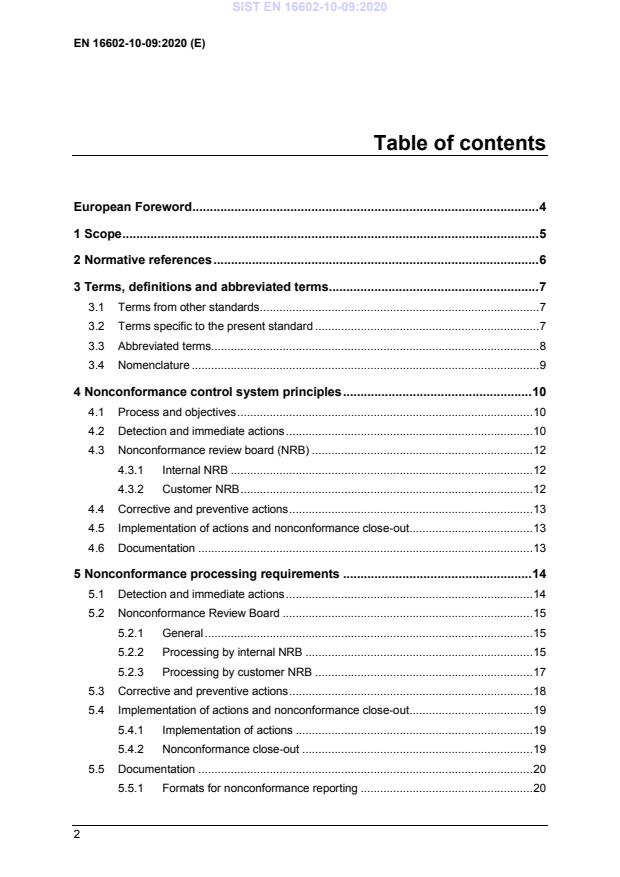
Table of contents
European Foreword . 4
1 Scope . 5
2 Normative references . 6
3 Terms, definitions and abbreviated terms . 7
3.1 Terms from other standards . 7
3.2 Terms specific to the present standard . 7
3.3 Abbreviated terms. 8
3.4 Nomenclature . 9
4 Nonconformance control system principles . 10
4.1 Process and objectives . 10
4.2 Detection and immediate actions . 10
4.3 Nonconformance review board (NRB) . 12
4.3.1 Internal NRB . 12
4.3.2 Customer NRB . 12
4.4 Corrective and preventive actions . 13
4.5 Implementation of actions and nonconformance close-out . 13
4.6 Documentation . 13
5 Nonconformance processing requirements . 14
5.1 Detection and immediate actions . 14
5.2 Nonconformance Review Board . 15
5.2.1 General . 15
5.2.2 Processing by internal NRB . 15
5.2.3 Processing by customer NRB . 17
5.3 Corrective and preventive actions . 18
5.4 Implementation of actions and nonconformance closeout . 19
5.4.1 Implementation of actions . 19
5.4.2 Nonconformance closeout . 19
5.5 Documentation . 20
5.5.1 Formats for nonconformance reporting . 20
5.5.2 Nonconformance database . 20
5.5.3 Analysis of records . 20
Annex A (normative) Nonconformance Report – DRD . 22
Annex B (normative) NCR Status List - DRD . 27
Annex C (informative) Nonconformance report template . 29
Bibliography . 34
Figures
Figure 4-1: Nonconformance processing flow chart . 11
Tables
Table C-1 : Description of the NCR data requirements . 31
European Foreword
This document (EN 16602-10-09:2020) has been prepared by Technical
Committee CEN/CLC/TC 5 “Space”, the secretariat of which is held by DIN
(Germany).
This document (EN 16602-10-09:2020) originates from ECSS-Q-ST-10-09C Rev.1.
This European Standard shall be given the status of a national standard, either
by publication of an identical text or by endorsement, at the latest by September
2020, and conflicting national standards shall be withdrawn at the latest by
September 2020.
This document supersedes EN 16602-10-09:2014.
The main changes with respect to EN 16602-10-09:2014 are listed below:
Implementing several change requests to update requirements and align
the standard with other documents in the EN 1660x-system
Addition of clause 3.4 :"Nomenclature"
Correction of Figure 4-1
Deletion of former clause 6 "Special nonconformance control
requirements"
This document has been prepared under a standardization request given to
CEN by the European Commission and the European Free Trade Association.
This document has been developed to cover specifically space systems and has
therefore precedence over any EN covering the same scope but with a wider
domain of applicability (e.g. : aerospace).
According to the CEN-CENELEC Internal Regulations, the national standards
organizations of the following countries are bound to implement this European
Standard: Austria, Belgium, Bulgaria, Croatia, Cyprus, Czech Republic,
Denmark, Estonia, Finland, Former Yugoslav Republic of Macedonia, France,
Germany, Greece, Hungary, Iceland, Ireland, Italy, Latvia, Lithuania,
Luxembourg, Malta, Netherlands, Norway, Poland, Portugal, Romania, Serbia ,
Slovakia, Slovenia, Spain, Sweden, Switzerland, Turkey and the United
Kingdom.
Scope
This Standard defines the requirements for the control of nonconformances.
This Standard applies to all deliverable products and supplies, at all levels,
which fail to conform to project requirements.
This Standard is applicable throughout the whole project lifecycle as defined in
ECSS-M-ST-10.
This standard may be tailored for the specific characteristics and constrains of a
space project in conformance with ECSS-S-ST-00.
Normative references
The following normative documents contain provisions which, through
reference in this text, constitute provisions of this ECSS Standard. For dated
references, subsequent amendments to, or revision of any of these publications
do not apply, However, parties to agreements based on this ECSS Standard are
encouraged to investigate the possibility of applying the more recent editions of
the normative documents indicated below. For undated references, the latest
edition of the publication referred to applies.
EN reference Reference in text Title
EN 16601-00-01 ECSS-S-ST-00-01 ECSS system – Glossary of terms
EN 16602-20 ECSS-Q-ST-20 Space product assurance – Quality assurance
ESCC 22800 EEE Nonconformance control system
Terms, definitions and abbreviated terms
3.1 Terms from other standards
For the purpose of this Standard, the terms and definitions from ECSS-ST-00-01
and ECSS-Q-ST-20 apply, in particular for the following terms:
alert
corrective action
critical item
customer
deviation
inspection
nonconformance
preventive action
repair
requirement
rework
supplier
technical expert
verification
waiver
3.2 Terms specific to the present standard
3.2.1 major nonconformances
nonconformances which can have an impact on the customer’s requirements in
the following areas and cases:
safety of people or equipment,
operational, functional or any technical requirements imposed by the
business agreement,
reliability, maintainability, availability,
lifetime,
functional or dimensional interchangeability,
interfaces with hardware or software regulated by different business
agreements,
changes to or deviations from approved qualification or acceptance test
procedures,
project specific items which are proposed to be scrapped.
3.2.2 minor nonconformances
nonconformances which by definition cannot be classified as major
NOTE For example, the following EEE discrepancies after
delivery from the manufacturer can be classified as
minor:
random failures, where no risk for a
lotrelated reliability or quality problem
exists;
if the form, fit or function are not affected;
minor inconsistencies in the accompanying
documentation.
3.3 Abbreviated terms
For the purpose of this Standard, the abbreviated terms from ECSS-S-ST-00-01
and the following apply:
Abbreviation Meaning
configuration item data list
CIDL
critical-item list
CIL
commercial offtheshelf
COTS
design justification file
DJF
European Cooperation for Space Standardization
ECSS
electrical, electronic, electromechanical
EEE
failure mode effect and criticality analysis
FMECA
nonconformance report
NCR
nonconformance review board
NRB
NOTE: Formerly known as MRB (material review
board).
product assurance
PA
quality assurance
QA
reliability, availability, maintainability, safety
RAMS
request for deviation
RFD
request for waiver
RFW
space component coordination
SCC
3.4 Nomenclature
The following nomenclature applies throughout this document:
a. The word “shall” is used in this Standard to express requirements. All
the requirements are expressed with the word “shall”.
b. The word “should” is used in this Standard to express recommendations.
All the recommendations are expressed with the word “should”.
NOTE It is expected that, during tailoring,
recommendations in this document are either
converted into requirements or tailored out.
c. The words “may” and “need not” are used in this Standard to express
positive and negative permissions, respectively. All the positive
permissions are expressed with the word “may”. All the negative
permissions are expressed with the words “need not”.
d. The word “can” is used in this Standard to express capabilities or
possibilities, and therefore, if not accompanied by one of the previous
words, it implies descriptive text.
NOTE In ECSS “may” and “can” have completely
different meanings: “may” is normative
(permission), and “can” is descriptive.
e. The present and past tenses are used in this Standard to express
statements of fact, and therefore they imply descriptive text.
Nonconformance control system
principles
4.1 Process and objectives
The Figure 4-1 describes the approach to the identification and processing of
nonconforming items, which can be performed at each customer/supplier level
This includes:
corrective actions against root causes, to avoid recurrence for other
products;
prompt and effective communication between suppliers and customers;
the prevention of nonconformance occurrence, from the analysis of
nonconformance records and derived lessons learned.
4.2 Detection and immediate actions
When a nonconformance is detected, the project PA representative analyses it to
identify its extent and cause. In addition he takes immediate actions to prevent
unauthorized use of the nonconforming item. The nonconformance is
documented on the NCR form and submitted to the internal NRB.
Higher level
Supplier Customer
customer(s)
NC detection
1. immediate actions
2. (Internal) NCR
3. Recording
Internal NRB
Analyse causes and
consequences
Propose dispostion
NCR classification
Major
Notification and
customer NRB
convening
higher level & major
impact?
Minor
yes
Arrange NRB
Inputs or participation
participation of higher
to NRB, if any
no
level customer(s)
Internal NRB Customer NRB
Disposition Disposition
No
corrective and corrective and
preventive actions preventive actions
no
Actionee(s)
Corrective and
RFW (if any
Yes
preventive actions
(or no RFW
accepted?
implementaion
PA function
Verification and
close-out
Figure 4-1: Nonconformance processing flow chart
4.3 Nonconformance review board (NRB)
4.3.1 Internal NRB
The internal NRB investigates the causes and consequences of the
nonconformance and classifies the nonconformance either as minor or major.
Furthermore, minor nonconformances are then disposed as follows:
Return to supplier: This disposition only applies to nonconforming
procured items.
Use “asis”: The item is found to be usable without eliminating the
nonconformance.
Rework: The item is recoverable to conform completely to all specified
requirements. Additional work is performed to prepare the item for the
rework (e.g. removal of faulty work and cleaning). In no case should the
result of earlier applied processes or the precondition for other processes to
be applied later on, be affected.
Scrap: The item is not recoverable by rework or repair, for technical or
economic reasons.
Repair: The item is recoverable such that it fulfils the intended usage
requirements although it does not conform to the originally specified
requirements.
The repair procedure is one of the following:
f. Qualified or standard repair procedure: Those repair procedures which
have been approved by the customer in advance for defined applications.
g. Specific repair procedure: Those repair procedures which are prepared
for the specific nonconformance and are approved by the NRB.
Any repair procedure includes the verifications needed to check the repair
result.
Major nonconformances are submitted to the customer NRB.
4.3.2 Customer NRB
In principle the customer NRB follows the same process as the internal NRB. In
addition, an assessment whether requirements of higher level customers are
impacted is performed. If so, these higher level customers are involved in
ensuing NRBs. The need for a waiver is also identified and recommended by
this NRB.
NOTE Multiple internal or customer NRBs can be held
before the NCR is closed out.
4.4 Corrective and preventive actions
During internal as well as customer NRB, corrective actions are determined to
eliminate the causes of the nonconformances. Preventive actions are identified
to avoid the occurrence of the nonconformance on similar items.
4.5 Implementation of actions and nonconformance
close-out
The supplier implements the corrective and/or preventive actions as defined by
the NRB.
As soon as all actions are performed and verified, the supplier PA
representative closes-out the nonconformance and informs the customer.
4.6 Documentation
The supplier documents his implementation of the nonconformance control
system.
The supplier’s internal reporting and processing of nonconformances is open
and visible to customer reviews and do not delay the processing of the
nonconformance in accordance with this Standard.
The supplier may maintain a database of minor and major nonconformances to
a. followup the NCR,
b. generate a nonconformance status list (see Annex B),
c. electronically process the nonconformance.
The amount of information stored should be sufficient to allow statistical and
trend analysis.
Nonconformance processing requirements
5.1 Detection and immediate actions
a. The supplier’s project PA representative shall perform an immediate
preliminary assessment of the nonconformance to establish its extent and
cause when it is detected.
b. Based on the preliminary assessment the supplier’s project PA
representative shall take the following actions without delay:
1. Provisions for the safety of the personnel and of the equipment.
2. Prevention of unauthorized use of the nonconforming items, by
marking and, unless otherwise determined by the PA
representative, segregation until their disposition.
3. Prevention of the recurrence of the nonconformances on similar or
identical items under processing or testing at that time.
NOTE This can lead to the suspension of manufacturing
or testing.
c. The supplier shall apply the following actions to the segregation of
nonconforming articles:
1. Establish a clearly marked holding area for nonconforming items
pending NRB disposition.
2. Limit the access to this area to NRB members or personnel
authorized by the NRB.
3. Make provisions to prevent unauthorized removal of any item.
d. For items whose segregation in the holding area is not practicable the
supplier shall perform the following actions:
1. Mark the item as “not to be used”.
2. Make sure that the item can not be used by unauthorized
personnel.
e. The supplier shall complete the nonconformance report in conformance
with Annex A, and submit it to the internal NRB.
f. The supplier shall describe the nonconformance clear, unambiguous and
sufficiently detailed that it can be understood by personnel not involved
in its detection.
g. The supplier shall ensure traceability between the NCR and the quality
and manufacturing records related to the nonconforming item.
5.2 Nonconformance Review Board
5.2.1 General
a. The NRB shall be the sole technical authority for the treatment of
nonconformances occurring in the frame of a business agreement.
b. All NRB members shall make dispositions and decisions by consensus.
c. The NRB chairman shall involve higher management levels in case of
conflict.
5.2.2 Processing by internal NRB
5.2.2.1 NRB meeting
a. The supplier shall nominate and authorize the internal NRBs core
members for the business agreement.
b. The responsibilities and authorities of each member shall be assigned.
c. The internal NRB shall include, at least, core members from the following
areas:
1. Project PA (chairman),
2. Engineering.
NOTE Additional members, or experts, depending on the
NCR subject can be nominated by the chairman.
d. Immediately after the reporting of a nonconformance, the chairman shall
convene an internal NRB.
5.2.2.2 Classification
a. The internal NRB shall classify nonconformances as major or minor,
based on the severity of their consequences.
NOTE Classification of nonconformances is not based on
their consequences on cost and schedule.
b. In case of several different minor nonconformances on the same item, the
internal NRB shall evaluate whether the nonconformances remain minor
or reclassified as “major”.
c. In case of doubt, the internal NRB shall classify nonconformances as
major.
5.2.2.3 Analysis of causes and consequences
a. The internal NRB shall investigate the cause(s) of the nonconformance.
NOTE If necessary, a separate group of experts can be
assigned for the investigation.
b. The supplier shall carry out physical operation of an irreversible nature
on the nonconforming item only with prior approval by the customer.
NOTE Nondestructive testing can be used, if the
techniques involved have previously been
approved by the customer.
c. The internal NRB shall analyse whether human error or poor
workmanship are the primary or secondary cause for the
nonconformance.
d. In case that human error or poor workmanship are the primary or
secondary cause for the nonconformance, the supplier shall review all
related documents and the competence level of personnel in order to
prevent recurrence.
e. The internal NRB shall investigate the consequences of the
nonconformance.
NOTE This can be supported, where appropriate, by
dependability experts or by documentation such as
FMECA, CIL, or DJF.
f. The internal NRB shall document the results of the investigation in the
nonconformance report.
5.2.2.4 Disposition of minor nonconformances
a. The internal NRB shall dispose minor nonconformances according to the
following criteria:
1. Return to supplier
2. Use “as-is”
3. Rework
4. Repair
5. Scrap
b. The supplier shall include minor nonconformances in the
nonconformance status list.
NOTE Unless otherwise stated in the business agreement,
the customer is not notified about minor
nonconformances.
c. The supplier shall provide the nonconformance status list to the
customer, upon request, for the review of the correct application of
classification criteria and appropriate processing.
5.2.2.5 Proces
...