

SIST EN 61375-1:2012
(Main)Electronic railway equipment - Train communication network - Part 1: TCN - Train Communication Network general architecture (IEC 61375-1:2012)
General Information
- Abstract
IEC 61375-1:2012 applies to the architecture of data communication systems in open trains, i.e. it covers the architecture of a communication system for the data communication between vehicles of the said open trains, the data communication within the vehicles and the data communication from train to the ground. The applicability of this part of IEC 61375 to the train network technologies allows for interoperability of individual vehicles within open trains in international traffic. The main technical change of this new edition with regard to the previous edition consists of a new structure of the complete IEC 61375 series.
- Status
- Published
- Publication Date
- 20-Sep-2012
- Technical Committee
- ŽEN - Electrical applications for railways
- Current Stage
- 6060 - National Implementation/Publication (Adopted Project)
- Start Date
- 30-Aug-2012
- Due Date
- 04-Nov-2012
- Completion Date
- 21-Sep-2012
2008/57/EC - DIRECTIVE 2008/57/EC OF THE EUROPEAN PARLIAMENT AND OF THE COUNCIL of 17 June 2008 on the interoperability of the rail system within the Community (Recast)OJ Ref: C 345/03 OJ Date: 26-Nov-2013
2016/797/EU - Directive (EU) 2016/797 of the European Parliament and of the Council of 11 May 2016 on the interoperability of the rail system within the European Union (Text with EEA relevance)OJ Ref: IZVEDBENI SKLEP KOMISIJE 2023/2584 OJ Date: 21-Nov-2023



Overview - EN 61375-1:2012 (Train Communication Network, TCN)
EN 61375-1:2012 (adopted from IEC 61375-1:2012) defines the general architecture for Train Communication Networks (TCN) used in open trains. The standard covers the structure and behaviour of data communication systems for:
- data exchange between vehicles of open trains,
- data communication within vehicles (on-board/consist networks),
- optional train-to-ground connections.
EN 61375-1:2012 enables interoperability of individual vehicles in international traffic by specifying architecture, naming conventions and services rather than implementation-specific details. It was approved by CENELEC and links to essential requirements of EU Directive 2008/57/EC.
Key Topics and Requirements
The standard lays out architectural building blocks and normative requirements, including:
- Hierarchical architecture: definition of network levels - train backbone and consist (vehicle) networks and their interfaces.
- Train backbone: topologies (bus-based and switched technologies), node numbering, directions/orientation and composition handling.
- Consist network: scope of standardization, topologies (bus technologies such as MVB and CANopen are referenced), switched networks, sub-networks and gateway functions.
- Train inauguration: procedures and data structures (train network directory) to detect and configure networked vehicles when trains form or split.
- On-board communication patterns: push, pull and subscription models, addressing at network and application layers, and availability requirements.
- Data classes and communication profiles: classification of services and their service parameters to ensure predictable behaviour and interoperability.
- Gateways and routers: functional descriptions for bridging backbone and consist networks and for heterogeneous architectures.
Applications and Who Uses It
EN 61375-1:2012 is used to design, specify and verify interoperable train communication systems. Typical users include:
- rolling stock manufacturers and systems integrators implementing TCN architecture,
- railway signalling and control engineers defining on-board communications,
- procurement teams and regulatory bodies assessing compliance with interoperability requirements,
- software and hardware vendors supplying gateways, switches, routers and end devices for train networks.
Practical benefits include improved interoperability of vehicles in international service, clearer requirements for train formation and split operations, and standardized on-board communication patterns that reduce integration risk.
Related Standards
- IEC/EN 61375 series (e.g., EN 61375-2-1, EN 61375-3-1)
- ISO/IEC 7498-1, 8824-1, 9646-1, 19501 (referenced IT standards)
- UIC CODE 556 (information transmission in the train)
Keywords: EN 61375-1:2012, IEC 61375-1:2012, Train Communication Network, TCN, train backbone, consist network, train inauguration, on-board data communication, railway interoperability.
Relations
- Effective Date
- 09-Feb-2026
- Effective Date
- 03-Feb-2026
- Effective Date
- 03-Feb-2026
- Effective Date
- 03-Feb-2026
- Effective Date
- 03-Feb-2026
- Effective Date
- 03-Feb-2026
- Effective Date
- 03-Feb-2026
- Effective Date
- 03-Feb-2026
- Effective Date
- 03-Feb-2026
- Effective Date
- 03-Feb-2026
- Effective Date
- 03-Feb-2026
- Effective Date
- 03-Feb-2026
- Effective Date
- 23-Jan-2023
Get Certified
Connect with accredited certification bodies for this standard

IRIS Certification (UNIFE)
International Railway Industry Standard certification.

TÜV SÜD Rail GmbH
TÜV SÜD railway certification services.

Bureau Veritas Railway Certification
Railway and transportation certification.
Sponsored listings
Frequently Asked Questions
SIST EN 61375-1:2012 is a standard published by the Slovenian Institute for Standardization (SIST). Its full title is "Electronic railway equipment - Train communication network - Part 1: TCN - Train Communication Network general architecture (IEC 61375-1:2012)". This standard covers: IEC 61375-1:2012 applies to the architecture of data communication systems in open trains, i.e. it covers the architecture of a communication system for the data communication between vehicles of the said open trains, the data communication within the vehicles and the data communication from train to the ground. The applicability of this part of IEC 61375 to the train network technologies allows for interoperability of individual vehicles within open trains in international traffic. The main technical change of this new edition with regard to the previous edition consists of a new structure of the complete IEC 61375 series.
IEC 61375-1:2012 applies to the architecture of data communication systems in open trains, i.e. it covers the architecture of a communication system for the data communication between vehicles of the said open trains, the data communication within the vehicles and the data communication from train to the ground. The applicability of this part of IEC 61375 to the train network technologies allows for interoperability of individual vehicles within open trains in international traffic. The main technical change of this new edition with regard to the previous edition consists of a new structure of the complete IEC 61375 series.
SIST EN 61375-1:2012 is classified under the following ICS (International Classification for Standards) categories: 45.020 - Railway engineering in general. The ICS classification helps identify the subject area and facilitates finding related standards.
SIST EN 61375-1:2012 has the following relationships with other standards: It is inter standard links to SIST EN ISO/IEC 9646-1:1997, SIST EN 61375-3-3:2012, SIST EN IEC 61375-2-8:2022, SIST EN 61375-2-5:2015, SIST EN IEC 61375-2-6:2019, SIST EN 61375-2-3:2016, SIST EN 62580-1:2017, SIST EN 62625-2:2017, SIST EN 62625-1:2014, SIST EN 61375-2-1:2012, SIST EN IEC 63341-1:2026, SIST EN 61375-3-4:2014, SIST EN IEC 61375-1:2026. Understanding these relationships helps ensure you are using the most current and applicable version of the standard.
SIST EN 61375-1:2012 is associated with the following European legislation: EU Directives/Regulations: 2001/16/EC, 2008/57/EC, 2016/797/EU, 96/48/EC. When a standard is cited in the Official Journal of the European Union, products manufactured in conformity with it benefit from a presumption of conformity with the essential requirements of the corresponding EU directive or regulation.
SIST EN 61375-1:2012 is available in PDF format for immediate download after purchase. The document can be added to your cart and obtained through the secure checkout process. Digital delivery ensures instant access to the complete standard document.
Standards Content (Sample)
SLOVENSKI STANDARD
01-oktober-2012
Železniške elektronske naprave - Komunikacijsko omrežje vlaka - 1. del: TCN -
Splošna arhitektura komunikacijskega omrežja (IEC 61375-1:2012)
Electronic railway equipment - Train communication network - Part 1: TCN - Train
Communication Network general architecture (IEC 61375-1:2012)
Elektronische Betriebsmittel für Bahnen – Zug-Kommunikations-Netzwerk (TCN) - Teil 1:
Allgemeiner Aufbau (IEC 61375-1:2012)
Matériel électronique ferroviaire - Réseau embarqué de train (TCN) - Partie 1:
Architecture générale (CEI 61375-1:2012)
Ta slovenski standard je istoveten z: EN 61375-1:2012
2003-01.Slovenski inštitut za standardizacijo. Razmnoževanje celote ali delov tega standarda ni dovoljeno.
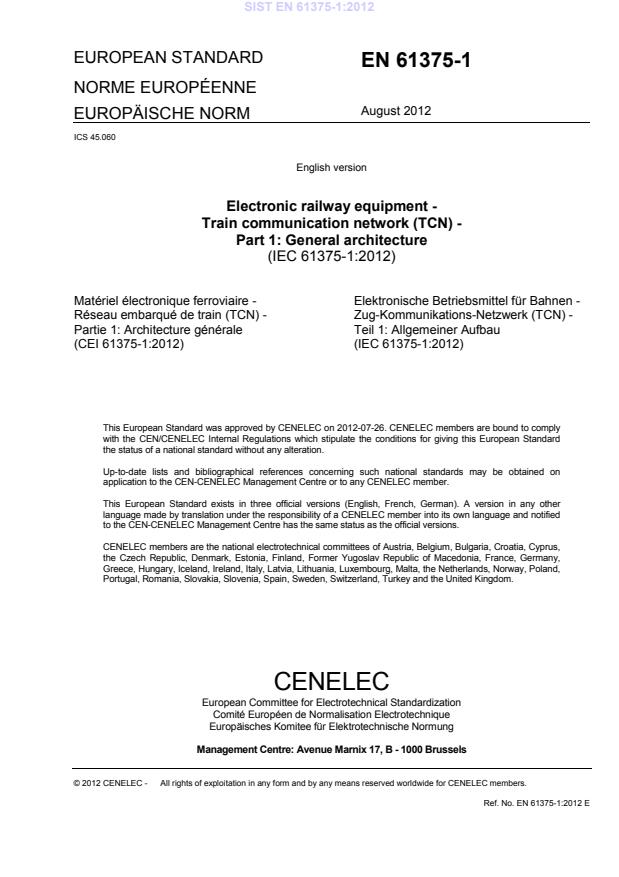
EUROPEAN STANDARD
EN 61375-1
NORME EUROPÉENNE
August 2012
EUROPÄISCHE NORM
ICS 45.060
English version
Electronic railway equipment -
Train communication network (TCN) -
Part 1: General architecture
(IEC 61375-1:2012)
Matériel électronique ferroviaire - Elektronische Betriebsmittel für Bahnen -
Réseau embarqué de train (TCN) - Zug-Kommunikations-Netzwerk (TCN) -
Partie 1: Architecture générale Teil 1: Allgemeiner Aufbau
(CEI 61375-1:2012) (IEC 61375-1:2012)
This European Standard was approved by CENELEC on 2012-07-26. CENELEC members are bound to comply
with the CEN/CENELEC Internal Regulations which stipulate the conditions for giving this European Standard
the status of a national standard without any alteration.
Up-to-date lists and bibliographical references concerning such national standards may be obtained on
application to the CEN-CENELEC Management Centre or to any CENELEC member.
This European Standard exists in three official versions (English, French, German). A version in any other
language made by translation under the responsibility of a CENELEC member into its own language and notified
to the CEN-CENELEC Management Centre has the same status as the official versions.
CENELEC members are the national electrotechnical committees of Austria, Belgium, Bulgaria, Croatia, Cyprus,
the Czech Republic, Denmark, Estonia, Finland, Former Yugoslav Republic of Macedonia, France, Germany,
Greece, Hungary, Iceland, Ireland, Italy, Latvia, Lithuania, Luxembourg, Malta, the Netherlands, Norway, Poland,
Portugal, Romania, Slovakia, Slovenia, Spain, Sweden, Switzerland, Turkey and the United Kingdom.
CENELEC
European Committee for Electrotechnical Standardization
Comité Européen de Normalisation Electrotechnique
Europäisches Komitee für Elektrotechnische Normung
Management Centre: Avenue Marnix 17, B - 1000 Brussels
© 2012 CENELEC - All rights of exploitation in any form and by any means reserved worldwide for CENELEC members.
Ref. No. EN 61375-1:2012 E
Foreword
The text of document 9/1641/FDIS, future edition 3 of IEC 61375-1, prepared by IEC/TC 9 "Electrical
equipment and systems for railways" was submitted to the IEC-CENELEC parallel vote and approved by
CENELEC as EN 61375-1:2012.
The following dates are fixed:
(dop) 2013-04-26
• latest date by which the document has
to be implemented at national level by
publication of an identical national
standard or by endorsement
• latest date by which the national (dow) 2015-07-26
standards conflicting with the
document have to be withdrawn
Attention is drawn to the possibility that some of the elements of this document may be the subject of
patent rights. CENELEC [and/or CEN] shall not be held responsible for identifying any or all such patent
rights.
This document has been prepared under a mandate given to CENELEC by the European Commission
and the European Free Trade Association, and supports essential requirements of EU Directive(s).
For the relationship with EU Directive(s) see informative Annex ZZ, which is an integral part of this
document.
Endorsement notice
The text of the International Standard IEC 61375-1:2012 was approved by CENELEC as a European
Standard without any modification.
In the official version, for Bibliography, the following notes have to be added for the standards indicated:
IEC 61375-2-1 NOTE Harmonized as EN 61375-2-1.
IEC 61375-3-1 NOTE Harmonized as EN 61375-3-1.
- 3 - EN 61375-1:2012
Annex ZA
(normative)
Normative references to international publications
with their corresponding European publications
The following documents, in whole or in part, are normatively referenced in this document and are
indispensable for its application. For dated references, only the edition cited applies. For undated
references, the latest edition of the referenced document (including any amendments) applies.
NOTE When an international publication has been modified by common modifications, indicated by (mod), the relevant EN/HD
applies.
Publication Year Title EN/HD Year
ISO/IEC 7498-1 - Information technology - Open Systems - -
Interconnection - Basic Reference Model:
The Basic Model
ISO/IEC 8824-1 2002 Information technology - Abstract Syntax - -
Notation One (ASN.1): Specification of basic
notation
ISO/IEC 9646-1 1994 Information technology - Open Systems - -
Interconnection - Conformance testing
methodology and framework -
Part 1: General concepts
ISO/IEC 19501 2005 Information technology - Open Distributed - -
Processing - Unified Modeling Language
(UML)
UIC CODE 556 - Information transmission in the train (train-- -
bus)
Annex ZZ
(informative)
Coverage of Essential Requirements of EU Directives
This European Standard has been prepared under a mandate given to CENELEC by the European
Commission and the European Free Trade Association and within its scope the standard covers all
relevant essential requirements as given in Annex III of the EU Directive 2008/57/EC.
Compliance with this standard provides one means of conformity with the specified essential
requirements of the Directive concerned.
WARNING: Other requirements and other EU Directives may be applicable to the products falling within
the scope of this standard.
IEC 61375-1 ®
Edition 3.0 2012-06
INTERNATIONAL
STANDARD
NORME
INTERNATIONALE
colour
inside
Electronic railway equipment – Train communication network (TCN) –
Part 1: General architecture
Matériel électronique ferroviaire – Réseau embarqué de train (TCN) –
Partie 1: Architecture générale
INTERNATIONAL
ELECTROTECHNICAL
COMMISSION
COMMISSION
ELECTROTECHNIQUE
PRICE CODE
INTERNATIONALE
CODE PRIX XA
ICS 45.060 ISBN 978-2-88912-069-7
– 2 – 61375-1 IEC:2012
CONTENTS
FOREWORD . 5
INTRODUCTION . 7
1 Scope . 8
2 Normative references. 8
3 Terms, definitions, abbreviated terms, acronyms, and conventions . 8
3.1 Terms and definitions . 8
3.2 Abbreviations and acronyms . 15
3.3 Conventions . 16
3.3.1 Requirement conventions . 16
3.3.2 Base of numeric values . 16
3.3.3 Naming conventions. 16
3.3.4 State diagram conventions . 16
4 Basic architecture . 16
4.1 Contents of this clause . 16
4.2 General . 16
4.2.1 Technology classes . 16
4.2.2 Component types . 17
4.3 Hierarchical structure . 17
4.3.1 Network levels . 17
4.3.2 Train backbone level . 17
4.3.3 Consist network level . 18
4.3.4 Interface between train backbone and consist network . 18
4.3.5 End devices connected to train backbone . 19
4.4 Network configurations . 19
4.5 Train to ground connection (option) . 20
5 Train backbone . 21
5.1 Contents of this clause . 21
5.2 Train backbone topology . 21
5.2.1 General . 21
5.2.2 Train backbone based on bus technology . 21
5.2.3 Train backbone based on switched technology . 22
5.3 Train compositions . 22
5.4 Train backbone node numbering . 23
5.5 Train directions . 23
5.5.1 Vehicle . 23
5.5.2 Consist . 23
5.5.3 Closed train . 24
5.5.4 Train . 24
5.6 Train inauguration . 26
5.6.1 Objectives . 26
5.6.2 Train network directory . 26
5.6.3 Inauguration control . 28
5.6.4 Node states . 29
5.6.5 Node roles . 32
5.6.6 Performance . 32
6 Consist network . 32
61375-1 IEC:2012 – 3 –
6.1 Contents of this clause . 32
6.2 Scope of standardization. 32
6.3 Consist network topology . 33
6.3.1 Consist network based on bus technology (MVB, CANopen) . 33
6.3.2 Consist network based on switched technology . 34
6.3.3 Sub-networks . 36
6.3.4 Heterogeneous consist network . 36
6.4 Gateway . 36
6.4.1 General . 36
6.4.2 Functional description . 37
6.4.3 Application layer gateway . 37
6.4.4 Gateway implemented by a router . 39
7 On-board data communication . 39
7.1 General . 39
7.2 Communication patterns . 39
7.2.1 Purpose . 39
7.2.2 Definitions . 39
7.2.3 Push pattern . 40
7.2.4 Pull pattern . 41
7.2.5 Subscription pattern . 43
7.3 Addressing . 43
7.3.1 General . 43
7.3.2 Network layer addressing . 43
7.3.3 Application layer addressing . 45
7.4 Availability of data communication . 45
7.5 Data classes . 46
7.5.1 General . 46
7.5.2 Service parameters . 46
7.5.3 TCN data class definition . 47
7.6 Communication profile . 48
Bibliography . 49
Figure 1 – Train backbone and consist network . 17
Figure 2 – Consist with two consist networks . 18
Figure 3 – End device connected to the train backbone (example) . 19
Figure 4 – Communication between train and ground (example) . 21
Figure 5 – Interfaces between consists . 21
Figure 6 – Train backbone bus topology . 22
Figure 7 – Train backbone switched topology . 22
Figure 8 – Directions and orientation in a vehicle . 23
Figure 9 – Directions and orientations in a consist . 24
Figure 10 – Directions and orientations in a closed train . 24
Figure 11 – Directions and orientations in train (TCN directions) . 25
Figure 12 – Structure of train network directory (example) . 27
Figure 13 – Train inauguration block diagram . 30
Figure 14 – Train inauguration state chart . 31
Figure 15 – Consist network standard interfaces . 33
– 4 – 61375-1 IEC:2012
Figure 16 – Consist network (bus technology) . 34
Figure 17 – Consist switches . 34
Figure 18 – Examples of consist network topologies (switched technology) . 35
Figure 19 – End Device connected to two consist switches . 35
Figure 20 – Sub-networks in a consist network . 36
Figure 21 – Implementation example for two vehicle busses . 36
Figure 22 – Example of heterogeneous train control network architecture . 37
Figure 23 – Local service . 38
Figure 24 – Unconfirmed service . 38
Figure 25 – Confirmed service . 38
Figure 26 – Provider initiated services . 39
Figure 27 – Point to point communication pattern (push) . 40
Figure 28 – Point to multi-point communication pattern (push) . 41
Figure 29 – Point to point communication pattern (pull) . 41
Figure 30 – Point to multi-point communication pattern (push) . 42
Figure 31 – Subscription communication pattern . 43
Table 1 – Train composition changes . 22
Table 2 – Train network specific parameters (example) . 27
Table 3 – Consist network specific parameters (example) . 27
Table 4 – Vehicle specific parameters (example) . 28
Table 5 – Device specific parameters (example) . 28
Table 6 – Service parameters . 46
Table 7 – Principal data classes . 47
61375-1 IEC:2012 – 5 –
INTERNATIONAL ELECTROTECHNICAL COMMISSION
____________
ELECTRONIC RAILWAY EQUIPMENT –
TRAIN COMMUNICATION NETWORK (TCN) –
Part 1: General architecture
FOREWORD
1) The International Electrotechnical Commission (IEC) is a worldwide organization for standardization comprising
all national electrotechnical committees (IEC National Committees). The object of IEC is to promote
international co-operation on all questions concerning standardization in the electrical and electronic fields. To
this end and in addition to other activities, IEC publishes International Standards, Technical Specifications,
Technical Reports, Publicly Available Specifications (PAS) and Guides (hereafter referred to as “IEC
Publication(s)”). Their preparation is entrusted to technical committees; any IEC National Committee interested
in the subject dealt with may participate in this preparatory work. International, governmental and non-
governmental organizations liaising with the IEC also participate in this preparation. IEC collaborates closely
with the International Organization for Standardization (ISO) in accordance with conditions determined by
agreement between the two organizations.
2) The formal decisions or agreements of IEC on technical matters express, as nearly as possible, an international
consensus of opinion on the relevant subjects since each technical committee has representation from all
interested IEC National Committees.
3) IEC Publications have the form of recommendations for international use and are accepted by IEC National
Committees in that sense. While all reasonable efforts are made to ensure that the technical content of IEC
Publications is accurate, IEC cannot be held responsible for the way in which they are used or for any
misinterpretation by any end user.
4) In order to promote international uniformity, IEC National Committees undertake to apply IEC Publications
transparently to the maximum extent possible in their national and regional publications. Any divergence
between any IEC Publication and the corresponding national or regional publication shall be clearly indicated in
the latter.
5) IEC itself does not provide any attestation of conformity. Independent certification bodies provide conformity
assessment services and, in some areas, access to IEC marks of conformity. IEC is not responsible for any
services carried out by independent certification bodies.
6) All users should ensure that they have the latest edition of this publication.
7) No liability shall attach to IEC or its directors, employees, servants or agents including individual experts and
members of its technical committees and IEC National Committees for any personal injury, property damage or
other damage of any nature whatsoever, whether direct or indirect, or for costs (including legal fees) and
expenses arising out of the publication, use of, or reliance upon, this IEC Publication or any other IEC
Publications.
8) Attention is drawn to the Normative references cited in this publication. Use of the referenced publications is
indispensable for the correct application of this publication.
9) Attention is drawn to the possibility that some of the elements of this IEC Publication may be the subject of
patent rights. IEC shall not be held responsible for identifying any or all such patent rights.
International Standard IEC 61375-1 has been prepared by IEC technical committee 9:
Electrical equipment and systems for railways.
This third edition cancels the second edition published in 2007 and constitutes a technical
revision.
The main technical changes with regard to the previous edition are as follows:
• new structuring of standard parts. The content of the previous edition has now been moved
to IEC 61375-2-1 and IEC 61375-3-1.
• this part of the standard describes now the general architecture of the onboard train
communication network.
– 6 – 61375-1 IEC:2012
The text of this standard is based on the following documents:
FDIS Report on voting
9/1641/FDIS 9/1665/RVD
Full information on the voting for the approval of this standard can be found in the report on
voting indicated in the above table.
This publication has been drafted in accordance with the ISO/IEC Directives, Part 2.
A list of all parts of IEC 61375 series, under the general title Electronic railway equipment –
Train communication network (TCN), can be found on the IEC website.
The committee has decided that the contents of this publication will remain unchanged until the
stability date indicated on the IEC web site under "http://webstore.iec.ch" in the data related to
the specific publication. At this date, the publication will be
• reconfirmed,
• withdrawn,
• replaced by a revised edition, or
• amended.
IMPORTANT – The 'colour inside' logo on the cover page of this publication indicates
that it contains colours which are considered to be useful for the correct understanding
of its contents. Users should therefore print this document using a colour printer.
61375-1 IEC:2012 – 7 –
INTRODUCTION
IEC 61375-1 defines the general architecture of the Train Communication Network (TCN) so as
to achieve compatibility between consist networks defined by this part of IEC 61375 and train
backbones defined by this part of IEC 61375.
The TCN has a hierarchical structure with two levels of networks, a train backbone and a
consist network:
a) for interconnecting vehicles in close or open trains, this part of IEC 61375 specifies train
backbones with different characteristics;
b) for connecting standard on-board equipment, this part of IEC 61375 specifies consist
networks with different characteristics.
The general architecture of the TCN, which is defined in this part of the standard, shall
c) establish the rules for interconnecting consist networks with train backbones, as
• identifying the interfaces;
• defining the principles of how train topology changes can be discovered;
• defining the basic communication services provided by train backbones to be used by
consist networks;
d) establish basic rules for the train backbone and for the consist network;
e) establish rules for communalities in operation, as:
• patterns for the communication between users;
• addressing principles;
• data classes to be supported.
– 8 – 61375-1 IEC:2012
ELECTRONIC RAILWAY EQUIPMENT –
TRAIN COMMUNICATION NETWORK (TCN) –
Part 1: General architecture
1 Scope
This part of IEC 61375 applies to the architecture of data communication systems in open
trains, i.e. it covers the architecture of a communication system for the data communication
between vehicles of the said open trains, the data communication within the vehicles and the
data communication from train to the ground.
The applicability of this part of IEC 61375 to the train network technologies allows for
interoperability of individual vehicles within open trains in international traffic. The data
communication systems inside vehicles are given as recommended solutions to cope with the
said TCN. In any case, proof of compatibility between a proposed train backbone and a
proposed consist network will have to be brought by the supplier.
This part of IEC 61375 may be additionally applicable to closed trains and multiple unit trains
when so agreed between purchaser and supplier.
NOTE 1 For a definition of open trains, multiple unit trains and closed trains, see Clause 3.
NOTE 2 Road vehicles such as buses and trolley buses are not considered in this part of IEC 61375.
2 Normative references
The following documents, in whole or in part, are normatively referenced in this document and
are indispensable for its application. For dated references, only the edition cited applies. For
undated references, the latest edition of the referenced document (including any amendments)
applies.
ISO/IEC 7498-1, Information Technology – Open Systems Interconnection – Basic Reference
Model: The Basic Model
ISO/IEC 8824-1:2002, Information technology – Abstract Syntax Notation One (ASN.1):
specification of basic notation
ISO/IEC 9646-1:1994, Information technology – Open Systems Interconnection – Conformance
testing methodology and framework – Part 1: General concepts
ISO/IEC 19501:2005, Information technology – Open Distributed Processing – Unified Modeling
Language (UML) Version 1.4.2
UIC CODE 556, Information transmission in the train (train-bus)
3 Terms, definitions, abbreviated terms, acronyms, and conventions
3.1 Terms and definitions
For the purposes of this document, the following terms and definitions apply.
61375-1 IEC:2012 – 9 –
3.1.1
active train backbone node
train backbone node receiving a sequence number during inauguration and forwarding user
data packets between consist network and train backbone
3.1.2
application layer
upper layer in the OSI model, interfacing directly to the Application
3.1.3
application layer interface
definition of the services offered by the application layer
3.1.4
application process
an element within a real open system which performs the information processing for a
particular application
3.1.5
bridge
device which stores and forwards frames from one bus to another on the base of their link
layer addresses
3.1.6
broadcast
nearly simultaneous transmission of the same information to several destinations. Broadcast in
the TCN is not considered reliable, i.e. some destinations may receive the information and
others not
3.1.7
bus
communication medium which broadcasts the same information to all attached participants at
nearly the same time, allowing all devices to obtain the same sight of its state, at least for the
purpose of arbitration
3.1.8
closed train
train composed of one or a set of consists, where the composition does not change during
normal operation, for instance metro, sub-urban train, or high speed train units
EXAMPLE Consists are coupled in a workshop to establish a closed train for operation.
3.1.9
communication devices
devices connected to consist network or train backbone with the ability to transport, source or
sink data
3.1.10
composition
number and characteristics of the vehicles forming a train
3.1.11
configuration
definition of the topology of a network, the devices connected to it, their capabilities and the
traffic they produce; by extension, the operation of loading the devices with the configuration
information before going to regular operation
– 10 – 61375-1 IEC:2012
3.1.12
consist
train set
rake of coaches
single vehicle or a group of vehicles which are not separated during normal operation, and
which contains no, one or several consist networks
EXAMPLE The vehicles of a consist are steadily connected in a workshop, and automatic couplers
are mounted at both ends of the consist to facilitate the coupling and de-coupling of complete consists
in the workshop or during operation.
3.1.13
consist network
communication network interconnecting communication devices in one consist
NOTE Consist networks do not spread beyond consist boundaries.
3.1.14
consist network address
network address, which does not change after inauguration and which is used to address
communication device in the own consist network
3.1.15
consist sequence number
sequence number of the consist in the train as obtained during train inauguration
3.1.16
consist switch
consist network node
network component used in consist network based on switched technology (ECN). See “switch”
3.1.58.
3.1.17
consumer
receiver of a message at the transport layer (see: “producer” 3.1.47)
3.1.18
destination device
receiver of a data packet (see: “source device” 3.1.55 )
3.1.19
end device
unit connected to one consist network or to one set of consist networks prepared for
redundancy reasons
3.1.20
end node
node which terminates the train backbone
3.1.21
function
application process which exchanges messages with another application process
3.1.22
gateway
connection between different communication technologies
61375-1 IEC:2012 – 11 –
3.1.23
group address
address of a multicast group to which a device belongs
3.1.24
inauguration
operation executed in case of composition change, which gives all nodes of the train backbone
their train backbone address, their orientation and information about all named nodes on the
same backbone
3.1.25
integrity
property of a system to recognize and to reject wrong data in case of malfunction of its parts
3.1.26
intermediate node
node which establishes continuity between two bus sections connected to it, but does not
terminate them
3.1.27
jumper cable
cable connecting the trunk cables of two consecutive vehicles, possibly of a larger cross-
section than the trunk cable, and which is plugged by hand in the case of the UIC-cable. There
are generally two jumper cables between vehicles
3.1.28
linear topology
topology where the nodes are connected in series, with two nodes each connected to only one
other node and all others each connected to two other nodes (that is, connected in the shape
of a line)
[IEC 61784-2]
3.1.29
local area network
part of a network characterized by a common medium access and address space
3.1.30
medium access control
sublayer of the link layer, which controls the access to the medium (arbitration, mastership
transfer, polling)
3.1.31
medium
physical carrier of the signal: electrical wires, optical fibers, etc.
3.1.32
message
data item transmitted in one or several packets
3.1.33
mobile train unit
part of a train which shall be uniquely addressable from ground. A mobile train unit provides
one active mobile communication gateway for train to ground communication.
– 12 – 61375-1 IEC:2012
3.1.34
multicast
transmission of the same message to a group of receivers, identified by their group address;
the word "multicast" is used even if the group includes all receivers
3.1.35
multiple unit train
a train consisting of a set of closed trains, where the composition of the set may change during
normal operation
3.1.36
network
set of possibly different communication systems which interchange information in a commonly
agreed way
3.1.37
network address
address which identifies a communication device on network layer
3.1.38
network device
components used to set up consist networks and train networks. These may be passive
components like cables or connectors, active unmanaged components like repeaters, media
converters or (unmanaged) switches, or managed active components like gateways, routers
and (managed) switches.
3.1.39
network layer
layer in the OSI model responsible for routing between different busses
3.1.40
network management
operations necessary to remotely configure, monitor, diagnose and maintain the network
3.1.41
node
device on the train backbone, which may act as a gateway between train backbone and consist
network
3.1.42
octet
byte
8-bit word stored in memory or transmitted as a unit
3.1.43
open train
train composed of one or a set of consists, where the configuration may change during
operation, as for instance locomotive hauled international UIC trains
3.1.44
operator
enterprise or organization which is operating trains
3.1.45
packet
unit of a message (information, acknowledgement or control) transmitted by protocols on
network or transport layer
61375-1 IEC:2012 – 13 –
3.1.46
passive train backbone node
train backbone node which is in standby to an active train backbone node in a consist network
3.1.47
producer
sender of a message at the transport layer (see: “consumer” 3.1.17)
3.1.48
publisher
source of a dataset for broadcasting (see: “subscriber” 3.1.57)
3.1.49
receiver
electronic device which may receive signals from the physical medium
3.1.50
repeater
connection at the physical layer between bus segments, providing an extension of the bus
beyond the limits permitted by passive means. The connected segments operate at the same
speed and with the same protocol. The delay introduced by a repeater is in the order of one bit
duration
3.1.51
residual error rate
probability of integrity breach (unrecognized wrong bit) per transmitted bit
3.1.52
ring topology
active network where each node is connected in series to two other nodes
[IEC 61918]
NOTE Ring may also be referred to as loop.
3.1.53
router
connection between two busses at the network layer, which forwards datagrams from one bus
to another on the base of their network address
3.1.54
service
capabilities and features of a sub-system (e.g. a communication layer) provided to a user
3.1.55
source device
sender of a data packet (see: “destination device” 3.1.18)
3.1.56
sporadic data
transmission of data on a demand basis
3.1.57
subscriber
one of the sinks of a broadcast dataset (see: “publisher” 3.1.48)
– 14 – 61375-1 IEC:2012
3.1.58
switch
MAC bridge as defined in IEEE 802.1D
3.1.59
topography
data structure describing the nodes attached to the train backbone, including their address,
orientation, position and node descriptor
3.1.60
topology
possible cable interconnection and number of devices in a given network
3.1.61
topography counter
counter in a node which is incremented at each new inauguration
3.1.62
train
composition of one or a set of consists, which can be operated as an autonomous unit, e.g.
containing drives and at least one driver’s cab. Trains can be categorized into open trains (see
3.1.43), closed trains (see 3.1.8) and multiple unit trains (see 3.1.35).
3.1.63
train communication network
data communication network for connecting programmable electronic equipment on-board rail
vehicles
3.1.64
train backbone
bus connecting the vehicles of a train and which conforms to the TCN protocols
3.1.65
train backbone node
node
device connected to the train backbone. A train backbone node can be used to connect end
devices or consist networks to the train backbone. A train backbone node can be active (see
3.1.1) or passive (see 3.1.46).
3.1.66
train backbone node number
node address
node number
Each active train backbone node is assigned a number during inauguration, which indicates the
position of the train backbone node on the train backbone.
3.1.67
train network address
dynamic network address, which is used to address communication devices in other consist
networks. This address can change after each inauguration.
3.1.68
train network management
services of the network management for TCN
3.1.69
transport layer
layer of the OSI model responsible for end-to-end flow control and error recovery
61375-1 IEC:2012 – 15 –
3.2 Abbreviations and acronyms
ANSI American National Standard Institute, a standardisation body in the United States
ALG Application Layer Gateway
BER Bit Error Rate, the rate of bit errors in a data stream, mainly caused by noise
(random bit errors), but also caused by memory defects in data storing devices
(systematic bit errors).
BR Bit Rate, the rate of data throughput on the medium expressed in bits per second
(bit/s) or in hertz (Hz), whichever is appropriate
CAN Controller Area Network
CN Consist Network
CPS Communication Protocol Stack
CRC Cyclic Redundancy Check, a data integrity check based on polynomial division
DIN Deutsches Institut für Normung, the German national standardisation body
ECN Ethernet Consist Network
ED End Device
EIA Electronics Industries Association, a standardisation body in the United States
ETB Ethernet Train Backbone
IEC International Electrotechnical Commission, Geneva
IEEE Institute of Electrical and Electronics Engineers, New York
IETF Internet Engineering Task Force
IP Internet Protocols, as defined by the IETF
ISO International Standard Organisation, Geneva
ITU International Telecommunication Union, the international standardisation body for
telecommunications based in Geneva
MAC Medium Access Control, a sub-layer within the Link Layer ruling which device is
entitled to send on the bus
MCG Mobile Communication Gateway
MTU Mobile Train Unit
MVB Multifunction Vehicle Bus
ND Network Device
OSI Open System Interconnection, a universal communication model defined in
ISO/IEC 7498-1
PCTR Protocol Conformance Test Report, defined in ISO/IEC 9646-1
PICS Protocol Implementation Conformance Statement, defined in ISO/IEC 9646-1
RFC Request For Comments, Internet Standard published by the IETF
TB Train Backbone
TBN Train Backbone Node
TCN Train Communication Network, a set of communicating vehicle and Train
Backbones
UIC International Union of Railways, the international railways operators association
URI Uniform Resource Identifier, as defined by the IETF
UML Unified Modeling Language, defined in ISO/IEC 19501.
WTB Wire Train Bus
– 16 – 61375-1 IEC:2012
3.3 Conventions
3.3.1 Requirement conventions
Shall is used to describe requirements.
Should is used to describe recommendations.
May is used to describe acceptable features.
Could is used to describe possible ways.
3.3.2 Base of numeric values
This part of IEC 61375 uses a decimal representation for all numeric values unless otherwise
noted.
Analog and fractional values include a comma.
EXAMPLE The voltage is 20,0 V.
Binary and hexadecimal values are represented using the ASN.1 (ISO/IEC 8824-1) convention.
EXAMPLE Decimal 20 coded on 8 bits = ‘0001 0100’B = ‘14’H.
3.3.3 Naming conventions
If the keyword name is composed, the different parts of the name are united with a space.
EXAMPLES “train backbone”, “consist”, “consist network”
Parameters are written with a capital letter at the beginning.
If the parameter name is composed, the different parts of the name are united without a space,
and all parts are beginning with a capital letter.
EXAMPLE “NumberOfConsists“
Function names are written with a lower case letter at the beginning.
If the function name is composed, the different parts of the name are united without a space,
and all parts except the first part are beginning with a capital letter.
EXAMPLE “indicateTopoChange“
3.3.4 State diagram conventions
State diagrams are defined followin
...