

SIST EN 16228-2:2014/oprA1:2019
(Amendment)Drilling and foundation equipment - Safety - Part 2: Mobile drill rigs for civil and geotechnical engineering, quarrying and mining
- Abstract
This European Standard, together with part 1, deals with all significant hazards for mobile drill rigs for civil and geotechnical engineering, quarrying and mining when they are used as intended and under the conditions of misuse which are reasonably foreseeable by the manufacturer associated with the whole life time of the machine (see Clause 4).
The requirements of this part are complementary to the common requirements formulated in EN 16228 1:2014.
This document does not repeat the requirements from EN 16228 1, but adds or replaces the requirements for application for mobile drill rigs.
In this document the general term "mobile drill rig" covers several different types of machines for use in:
- civil engineering;
- geotechnical engineering (including ground investigation, anchoring, soil nailing, mini-piling, ground stabilization, grouting);
- water well drilling;
- geothermal installations;
- landfill drilling;
- underpinning, tunnelling, mining and quarrying;
- for use above ground as well as underground.
Typically, the process of drilling involves the addition of drill rods, tubes, casings or augers etc., normally threaded, as the borehole extends to depth.
NOTE 1 For machines with torque greater than 35 kNm see EN 16228-4 initially.
NOTE 2 The term "drill rigs" includes rigs with a separate power pack supplied by the rig manufacturer.
Modification to the Scope:
First paragraph, delete ", quarrying and mining" and add "in soil or soil and rock mixture in" to read as follows:
"This European Standard, together with part 1, deals with all significant hazards for mobile drill rigs for in soil or soil and rock mixture in civil and geotechnical engineering when they are used as intended and under the conditions of misuse which are reasonably foreseeable by the manufacturer associated with the whole life time of the machine (see Clause 4).".
- Status
- Not Published
- Public Enquiry End Date
- 24-Jul-2019
- Technical Committee
- I13 - Imaginarni 13
- Current Stage
- 5020 - Formal vote (FV) (Adopted Project)
- Start Date
- 09-Sep-2021
- Due Date
- 28-Oct-2021
- Completion Date
- 09-Sep-2021


Overview
EN 16228-2:2014/prA1 (Drilling and foundation equipment - Safety - Part 2) specifies safety requirements for mobile drill rigs used in civil and geotechnical engineering in soil or soil-and-rock mixtures. Intended to be used together with EN 16228-1, this part complements common requirements by adding or replacing provisions specific to mobile rigs (including rigs used for ground investigation, anchoring, mini‑piling, geothermal installation, water wells, landfill drilling, tunnelling and underpinning). The amendment (prA1) updates normative references and adds machine‑type specific requirements (e.g., suspended drill rigs, guards, supplementary trip devices).
Key topics and technical requirements
- Scope and hazard coverage: Addresses significant hazards over the whole life of the machine - mechanical, thermal (fire), noise and communication interference.
- Guards and protective zones: Defines guard placement and protective zone dimensions, for example:
- Bottom edge of guard: up to 500 mm from mast base or no more than 200 mm above upper clamps/jaws.
- Upper level: prevents access up to 1 600 mm from mast base; if mast tilt >15°, guard extends 1 200 mm above clamps.
- Supplementary trip device: Requires at least one supplementary trip device per side of the drilling axis (or one if structure prevents dual‑sided coverage). For rigs designed to work with mast inclinations >15°, trip devices must cover the full rotary head stroke.
- Suspended drill rigs: Special requirements (hold‑to‑run rotation controls unless a supplementary trip device is fitted; feed speed limits; emergency‑stop at operating position).
- Stability, tipping and kinetic energy: Stability calculations and kinetic energy considerations are included; Annex B covers verification tests (brake, heat fade, etc.).
- Fire protection and noise: Fire protection measures and noise-related hazards are addressed (Annex A for noise impacts).
- Normative references: Adds EN ISO 13855 (positioning of safeguards) and updates cross‑references to other EN 16228 parts.
Applications and practical use
- Ensures machine designers, manufacturers, and OEMs meet European safety expectations for mobile drill rigs.
- Used by safety engineers, CE/ regulatory compliance teams, machine inspectors, and procurement to specify safe equipment for geotechnical and civil projects.
- Useful for site managers and training providers to define safe operating procedures and required protective devices.
Who should consult it
- Equipment manufacturers and designers
- Health & safety officers and compliance auditors
- Test laboratories and conformity assessment bodies
- Construction, geotechnical and drilling contractors
Related standards
- EN 16228-1:2014+prA1:2019 (common requirements)
- EN 16228-4 / EN 16228-5 (other machine categories)
- EN ISO 13855:2019 (safeguarding distances)
Keywords: EN 16228-2:2014/FprA1, mobile drill rigs safety, drilling equipment standard, geotechnical drilling safety, guards, supplementary trip device, suspended drill rigs, stability calculation.
Relations
- Effective Date
- 03-Nov-2021
- Effective Date
- 09-Nov-2016
Get Certified
Connect with accredited certification bodies for this standard

DVS-ZERT GmbH
German welding certification society.
CARES (UK Certification Authority for Reinforcing Steels)
UK certification for reinforcing steels and construction.
EWF/IIW (European/International Welding Federation)
International welding personnel certification.
Sponsored listings
Frequently Asked Questions
SIST EN 16228-2:2014/oprA1:2019 is a draft published by the Slovenian Institute for Standardization (SIST). Its full title is "Drilling and foundation equipment - Safety - Part 2: Mobile drill rigs for civil and geotechnical engineering, quarrying and mining". This standard covers: This European Standard, together with part 1, deals with all significant hazards for mobile drill rigs for civil and geotechnical engineering, quarrying and mining when they are used as intended and under the conditions of misuse which are reasonably foreseeable by the manufacturer associated with the whole life time of the machine (see Clause 4). The requirements of this part are complementary to the common requirements formulated in EN 16228 1:2014. This document does not repeat the requirements from EN 16228 1, but adds or replaces the requirements for application for mobile drill rigs. In this document the general term "mobile drill rig" covers several different types of machines for use in: - civil engineering; - geotechnical engineering (including ground investigation, anchoring, soil nailing, mini-piling, ground stabilization, grouting); - water well drilling; - geothermal installations; - landfill drilling; - underpinning, tunnelling, mining and quarrying; - for use above ground as well as underground. Typically, the process of drilling involves the addition of drill rods, tubes, casings or augers etc., normally threaded, as the borehole extends to depth. NOTE 1 For machines with torque greater than 35 kNm see EN 16228-4 initially. NOTE 2 The term "drill rigs" includes rigs with a separate power pack supplied by the rig manufacturer. Modification to the Scope: First paragraph, delete ", quarrying and mining" and add "in soil or soil and rock mixture in" to read as follows: "This European Standard, together with part 1, deals with all significant hazards for mobile drill rigs for in soil or soil and rock mixture in civil and geotechnical engineering when they are used as intended and under the conditions of misuse which are reasonably foreseeable by the manufacturer associated with the whole life time of the machine (see Clause 4).".
This European Standard, together with part 1, deals with all significant hazards for mobile drill rigs for civil and geotechnical engineering, quarrying and mining when they are used as intended and under the conditions of misuse which are reasonably foreseeable by the manufacturer associated with the whole life time of the machine (see Clause 4). The requirements of this part are complementary to the common requirements formulated in EN 16228 1:2014. This document does not repeat the requirements from EN 16228 1, but adds or replaces the requirements for application for mobile drill rigs. In this document the general term "mobile drill rig" covers several different types of machines for use in: - civil engineering; - geotechnical engineering (including ground investigation, anchoring, soil nailing, mini-piling, ground stabilization, grouting); - water well drilling; - geothermal installations; - landfill drilling; - underpinning, tunnelling, mining and quarrying; - for use above ground as well as underground. Typically, the process of drilling involves the addition of drill rods, tubes, casings or augers etc., normally threaded, as the borehole extends to depth. NOTE 1 For machines with torque greater than 35 kNm see EN 16228-4 initially. NOTE 2 The term "drill rigs" includes rigs with a separate power pack supplied by the rig manufacturer. Modification to the Scope: First paragraph, delete ", quarrying and mining" and add "in soil or soil and rock mixture in" to read as follows: "This European Standard, together with part 1, deals with all significant hazards for mobile drill rigs for in soil or soil and rock mixture in civil and geotechnical engineering when they are used as intended and under the conditions of misuse which are reasonably foreseeable by the manufacturer associated with the whole life time of the machine (see Clause 4).".
SIST EN 16228-2:2014/oprA1:2019 is classified under the following ICS (International Classification for Standards) categories: 25.080.40 - Drilling machines; 53.100 - Earth-moving machinery; 93.020 - Earthworks. Excavations. Foundation construction. Underground works. The ICS classification helps identify the subject area and facilitates finding related standards.
SIST EN 16228-2:2014/oprA1:2019 has the following relationships with other standards: It is inter standard links to SIST EN 16228-2:2014+A1:2022, SIST EN 16228-2:2014. Understanding these relationships helps ensure you are using the most current and applicable version of the standard.
SIST EN 16228-2:2014/oprA1:2019 is associated with the following European legislation: EU Directives/Regulations: 2006/42/EC; Standardization Mandates: M/396. When a standard is cited in the Official Journal of the European Union, products manufactured in conformity with it benefit from a presumption of conformity with the essential requirements of the corresponding EU directive or regulation.
SIST EN 16228-2:2014/oprA1:2019 is available in PDF format for immediate download after purchase. The document can be added to your cart and obtained through the secure checkout process. Digital delivery ensures instant access to the complete standard document.
Standards Content (Sample)
SLOVENSKI STANDARD
01-julij-2019
Oprema za vrtanje in temeljenje - Varnost - 2. del: Prenosna vrtalna oprema za
gradbeništvo in geotehniko, kamnolomstvo in rudarstvo - Dopolnilo A1
Drilling and foundation equipment - Safety - Part 2: Mobile drill rigs for civil and
geotechnical engineering, quarrying and mining
Geräte für Bohr- und Gründungsarbeiten - Sicherheit - Teil 2: Mobile Bohrgeräte für
Tiefbau, Geotechnik und Gewinnung
Machines de forage et de fondation - Sécurité - Partie 2 : Machines mobiles de forage de
génie civil, de géotechnique, de forage d'eau, d'exploration de sol, d'énergie
géothermique, de mines et carrières
Ta slovenski standard je istoveten z: EN 16228-2:2014/prA1
ICS:
25.080.40 Vrtalniki Drilling machines
53.100 Stroji za zemeljska dela Earth-moving machinery
93.020 Zemeljska dela. Izkopavanja. Earthworks. Excavations.
Gradnja temeljev. Dela pod Foundation construction.
zemljo Underground works
2003-01.Slovenski inštitut za standardizacijo. Razmnoževanje celote ali delov tega standarda ni dovoljeno.
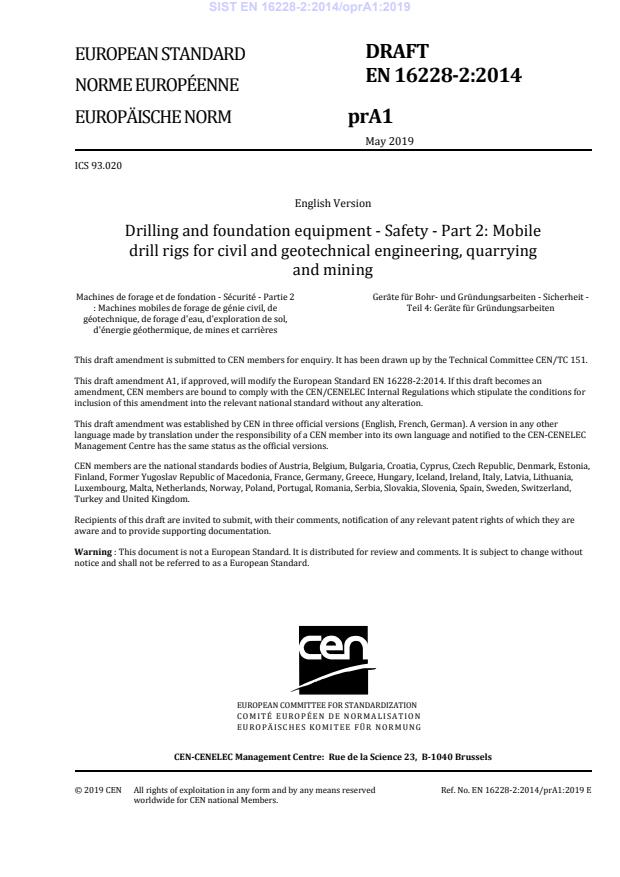
DRAFT
EUROPEAN STANDARD
EN 16228-2:2014
NORME EUROPÉENNE
EUROPÄISCHE NORM
prA1
May 2019
ICS 93.020
English Version
Drilling and foundation equipment - Safety - Part 2: Mobile
drill rigs for civil and geotechnical engineering, quarrying
and mining
Machines de forage et de fondation - Sécurité - Partie 2 Geräte für Bohr- und Gründungsarbeiten - Sicherheit -
: Machines mobiles de forage de génie civil, de Teil 4: Geräte für Gründungsarbeiten
géotechnique, de forage d'eau, d'exploration de sol,
d'énergie géothermique, de mines et carrières
This draft amendment is submitted to CEN members for enquiry. It has been drawn up by the Technical Committee CEN/TC 151.
This draft amendment A1, if approved, will modify the European Standard EN 16228-2:2014. If this draft becomes an
amendment, CEN members are bound to comply with the CEN/CENELEC Internal Regulations which stipulate the conditions for
inclusion of this amendment into the relevant national standard without any alteration.
This draft amendment was established by CEN in three official versions (English, French, German). A version in any other
language made by translation under the responsibility of a CEN member into its own language and notified to the CEN-CENELEC
Management Centre has the same status as the official versions.
CEN members are the national standards bodies of Austria, Belgium, Bulgaria, Croatia, Cyprus, Czech Republic, Denmark, Estonia,
Finland, Former Yugoslav Republic of Macedonia, France, Germany, Greece, Hungary, Iceland, Ireland, Italy, Latvia, Lithuania,
Luxembourg, Malta, Netherlands, Norway, Poland, Portugal, Romania, Serbia, Slovakia, Slovenia, Spain, Sweden, Switzerland,
Turkey and United Kingdom.
Recipients of this draft are invited to submit, with their comments, notification of any relevant patent rights of which they are
aware and to provide supporting documentation.
Warning : This document is not a European Standard. It is distributed for review and comments. It is subject to change without
notice and shall not be referred to as a European Standard.
EUROPEAN COMMITTEE FOR STANDARDIZATION
COMITÉ EUROPÉEN DE NORMALISATION
EUROPÄISCHES KOMITEE FÜR NORMUNG
CEN-CENELEC Management Centre: Rue de la Science 23, B-1040 Brussels
© 2019 CEN All rights of exploitation in any form and by any means reserved Ref. No. EN 16228-2:2014/prA1:2019 E
worldwide for CEN national Members.
EN 16228-2:2014/prA1:2019 (E)
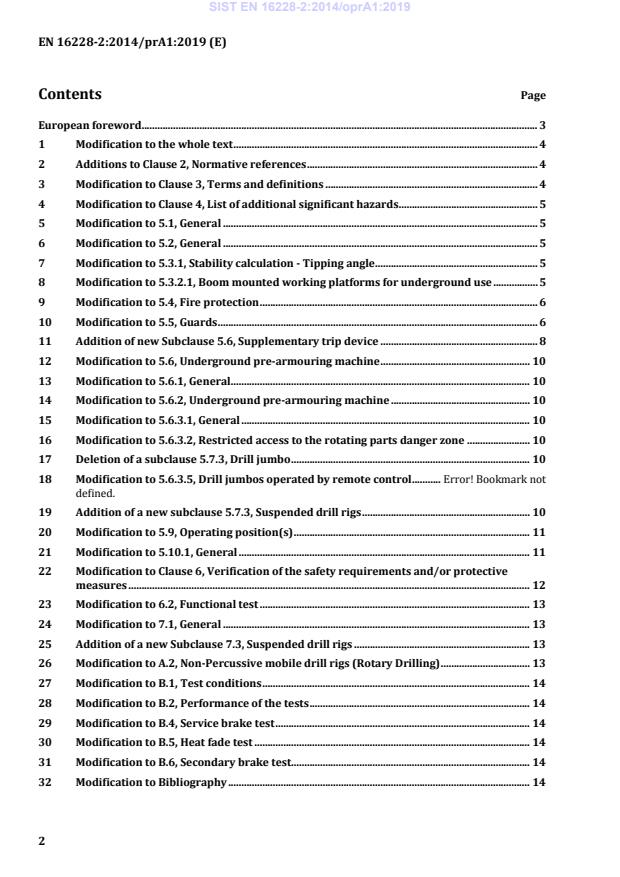
Contents Page
European foreword . 3
1 Modification to the whole text . 4
2 Additions to Clause 2, Normative references . 4
3 Modification to Clause 3, Terms and definitions . 4
4 Modification to Clause 4, List of additional significant hazards . 5
5 Modification to 5.1, General . 5
6 Modification to 5.2, General . 5
7 Modification to 5.3.1, Stability calculation - Tipping angle . 5
8 Modification to 5.3.2.1, Boom mounted working platforms for underground use . 5
9 Modification to 5.4, Fire protection . 6
10 Modification to 5.5, Guards . 6
11 Addition of new Subclause 5.6, Supplementary trip device . 8
12 Modification to 5.6, Underground pre-armouring machine . 10
13 Modification to 5.6.1, General . 10
14 Modification to 5.6.2, Underground pre-armouring machine . 10
15 Modification to 5.6.3.1, General . 10
16 Modification to 5.6.3.2, Restricted access to the rotating parts danger zone . 10
17 Deletion of a subclause 5.7.3, Drill jumbo . 10
18 Modification to 5.6.3.5, Drill jumbos operated by remote control . Error! Bookmark not
defined.
19 Addition of a new subclause 5.7.3, Suspended drill rigs . 10
20 Modification to 5.9, Operating position(s) . 11
21 Modification to 5.10.1, General . 11
22 Modification to Clause 6, Verification of the safety requirements and/or protective
measures . 12
23 Modification to 6.2, Functional test . 13
24 Modification to 7.1, General . 13
25 Addition of a new Subclause 7.3, Suspended drill rigs . 13
26 Modification to A.2, Non-Percussive mobile drill rigs (Rotary Drilling) . 13
27 Modification to B.1, Test conditions . 14
28 Modification to B.2, Performance of the tests . 14
29 Modification to B.4, Service brake test . 14
30 Modification to B.5, Heat fade test . 14
31 Modification to B.6, Secondary brake test. 14
32 Modification to Bibliography . 14
EN 16228-2:2014/prA1:2019
EN 16228-2:2014/prA1:2019 (E)
European foreword
This document (EN 16228-2:2014/prA1:2019) has been prepared by Technical Committee CEN/TC 151
“Construction equipment and building material machines - Safety”, the secretariat of which is held by
DIN.
This document is currently submitted to the CEN Enquiry.
This document has been prepared under a standardization request given to CEN by the European
Commission and the European Free Trade Association, and supports essential requirements of
EU Directive(s).
For relationship with EU Directive(s), see informative Annex ZA, which is an integral part of tEN 16228‑
2:2014.
EN 16228-2:2014/prA1:2019
1 Modification to the whole text
In the entire document, for all instances found:
Replace “EN 16228-1:2014” with “EN 16228-1:2014+prA1:2019”.
Replace “EN 16228-4:2014” with “EN 16228-4:2014+prA1:2019”.
Replace “EN 16228-5:2014” with “EN 16228-5:2014+prA1:2019”.
2 Additions to Clause 2, Normative references
Add the following reference:
"EN ISO 13855:2019, Safety of machinery - Positioning of safeguards with respect to the approach speeds
of parts of the human body (ISO 13855:2010)"
3 Modification to Clause 3, Terms and definitions
In the first paragraph, replace “EN 16228-1:2014” with “EN 16228-1:2014+prA1:2019”.
In definition 3.1.1 drill jumbo, delete the definition and re-number the subsequent definitions 3.1.2 and 3.1.3
into 3.1.1 and 3.1.2.
After 3.1.2 “pre-armouring machine”, Add the following new definition:
”
3.1.2
suspended drill rigs
non-self-propelled machine, not mounted on powered undercarriage and with external power system
designed to work on steep slopes, near to vertical inclines or in very narrow spaces
NOTE 1 to entry: They are mounted in a fixture which maybe:
— suspended in ropes;
— mounted in a stand;
— suspended by other means e.g. ; hydraulic jacks.”
Delete definitions 3.10 to 3.14
Add the following new definition:"
3.10
upper clamps/jaws
device to hold the drill sting closest from the rotary head"
EN 16228-2:2014/prA1:2019 (E)
4 Modification to Clause 4, List of additional significant hazards
Replace Table 1 with the following:
Table 1 — List of additional significant hazards and associated requirements
No. Hazard Relevant clause(s) in
this standard
1 Mechanical hazards
1.1 Stability 5.3, 5.9
1.2 Crushing 5.5, 5.6, 5.7
1.3 Shearing 5.5, 5.6, 5.7
1.4 Cutting and severing 5.5, 5.6, 5.7
1.5 Entanglement 5.5, 5.6, 5.7, 5.8
1.6 Kinetic energy 5.10, 5.11, Annex B
1.7 Falling or ejected object 5.2
1.8 Uncontrolled loading, overloading 5.2, 59
1.9 Lifting of person 5.2
1.10 Insufficient instructions for the driver/operator 7.1, 7.2
2 Thermal hazards
2.1 Fire 5.4
4 Hazards generated by noise, resulting in:
4.1 Hearing losses and physiological disorders Annex A
4.2 Accidents due to interference with speech communication Annex A
and warning signals
5 Modification to 5.1, General
Replace “EN 16228-1:2014” with “EN 16228-1:2014+prA1:2019”.
6 Modification to 5.2, Boom mounted working platforms for underground use
In the first paragraph, first sentence replace “Subclause 5.13.2 of EN 16228-1:2014” with “EN 16228-
1:2014+prA1:2019, 5.13.2”.
In the first sentence of the fifth, sixth and seventh paragraphs (3 occurrences) delete “Drill jumbo and p”
and capitalize “P” when beginning a sentence, to read “
...