

oSIST prEN 14372:2025
(Main)Child care articles - Cutlery, feeding utensils and food feeders - Safety requirements and tests
- Abstract
This document specifies safety requirements relating to the materials, construction, performance, packaging and labelling of cutlery, feeding utensils and food feeders. All products which are intended to be used by a child aged up to 48 months to eat by itself or with the assistance of another person are included in the scope of this document. This includes products which have a different primary function, but have a secondary function intended to allow a child to use the product to eat by itself or with the assistance of another person.
This document does not apply to pre-prepared food containers, to containers intended for storage only, or to cutlery, feeding utensils and food feeders designed for specialist medical applications or for use under medical supervision (B.1).
This document does not apply to single-use cutlery, feeding utensils and food feeders.
This document includes test methods for the mechanical and chemical requirements specified and requirements relating to the product information.
This document does not apply to drinking equipment (feeding bottles, teats, spouts, and cups) which is covered by EN 14350:2020+A1:2023.
- Status
- Not Published
- Public Enquiry End Date
- 02-Oct-2025
- Technical Committee
- OTR - Child use and care article
- Current Stage
- 4020 - Public enquire (PE) (Adopted Project)
- Start Date
- 24-Jul-2025
- Due Date
- 11-Dec-2025
- Completion Date
- 08-Oct-2026
- Directive
- 2001/95/EC - General product safety
Buy Documents


oSIST prEN 14372:2025 is the Slovenian publication of the draft European Standard prEN 14372 from CEN. It specifies safety requirements and test methods for children's cutlery, feeding utensils and food feeders, including the materials, construction, performance, packaging and labelling used for products intended for children up to 48 months of age.
Manufacturers, test laboratories, quality teams and buyers use this document to check whether a product meant for self-feeding or assisted feeding has the right safety design, passes the relevant tests and carries the required product information.
What does oSIST prEN 14372:2025 specify?
oSIST prEN 14372:2025 covers safety for child care articles used for eating, and it organizes that coverage into construction, mechanical testing, chemical testing, consumer packaging, product information and test reporting. It is focused on practical safety questions such as breakage, choking, sharp edges, chemical release and warning text that parents or carers need to see.
The scope includes products that a child up to 48 months uses to eat by itself or with assistance, including products whose main function is something else but that also have a feeding function. It excludes pre-prepared food containers, storage-only containers, specialist medical products and single-use items, and it also excludes drinking equipment covered by EN 14350.
| Annex | What it covers |
|---|---|
| Annex A | Warnings |
| Annex B | Rationales |
| Annex C | Good practice for visibility and legibility |
| Annex ZA | Relationship with Regulation 2023/988/EC |
The main body runs from Clause 1 to Clause 11. It starts with scope, references and terms, then describes the products, test equipment and tolerances, followed by construction, mechanical requirements, chemical requirements, consumer packaging, product information and the test report.
What are the key requirements of oSIST prEN 14372:2025?
The standard sets minimum safety rules for design and materials, then backs them up with named test methods. In practice, this means a product is not judged only by its appearance - it must survive handling, resist hazards and be documented in a way that supports safe use.
Design, construction and general safety
Clause 6 requires products to be free from accessible sharp points, sharp edges, flash and burrs when assembled for use. It also limits small parts, finger trap hazards and decorative methods on areas that a child may mouth.
Clause 6.1 adds cross-checks for products that also behave like toys or drinking equipment: those products must also meet the relevant requirements of EN 71 and EN 14350. It also prohibits accessible button and coin batteries, requires magnetic parts to be inaccessible and fully encapsulated, and excludes glass or ceramic cutlery and food feeders.
Clause 6.2 sets the sample preparation approach for testing, including conditioning before tests. That matters because test results must be repeatable and should represent a product after normal handling rather than a fresh, untreated sample.
Mechanical performance and food feeder-specific hazards
Clause 7 covers the core mechanical checks. These include tensile strength, torque, tear resistance, strength or rigidity of cutlery, drop and impact resistance, suction cup behaviour and fork tine integrity. For a buyer or engineer, these tests show whether the product can survive routine use without breaking into hazardous parts.
Food feeders get extra checks in Clause 7.9 because they create specific choking and access risks. The standard tests airway obstruction, mesh size and mesh strength, bite endurance of elastomeric food holders, security of the food holder, closure security, closure endurance and the size of the food holder protector.
The practical point is that the feeder must keep the food inside, resist repeated opening and closing, and avoid shapes or openings that could let food or parts pass through in unsafe ways.
Chemical safety and material-specific testing
Clause 8 requires accessible parts to use food contact grade materials and then assigns tests according to the material type. The standard points to different checks for plastics, TPE, silicone elastomer, glass or ceramic, metal, decorations and natural materials.
The chemical package includes volatile compounds in silicone elastomer components, N-nitrosamines and N-nitrosatable substances for elastomeric parts with mouth or food contact, migration of certain elements, formaldehyde release, colour fastness, migration of primary aromatic amines, lead and cadmium from glass and ceramic articles, migration of elements from metal, and nickel release. In practice, this means the manufacturer must know which materials are used in each component and select the right laboratory tests.
Clause 8 also makes the EN 71-3 method central for migration of certain elements. That matters because the same migration approach is used across several child-related products, which helps labs and suppliers compare results consistently.
Packaging, warnings, instructions and reporting
Clause 9 requires the consumer package to carry clear and legible instructions for use and hygienic care. Clause 10 requires purchase information, warnings and instructions for use, with the official main language of the country of sale and clear separation when more than one language is used.
The warning set is very specific: adult supervision, inspection before use, temperature checks before feeding, and no attachment to cords or loose clothing. Additional warnings apply to bowls and similar hemispherical products, glass products, ceramic products, all food feeders, feeders with a net food holder, feeders with a teether function, heated products and microwaveable products.
Clause 11 defines the test report content. For users of the standard, this means a lab report should identify the product, the test clauses used, the results, any deviations and, if a product fails, include a photograph for identification.
What terms does oSIST prEN 14372:2025 define?
- Cutlery - implements used for eating, such as knives, forks, spoons and food pushers.
- Feeding utensil - an implement or container, such as a plate or bowl, used for feeding children.
- Suction ring/cup/pad - a component intended to adhere or secure a product to a surface.
- Handle - a component designed to assist handling of a product.
- Food feeder - a device that contains food pieces and lets the child suck and/or chew through a mesh or perforated surface.
- Food holder - the flexible container, usually mesh or elastomer, that holds the food in a food feeder.
- Closure - the opening and closing parts that hold the food holder and prevent access to the contents.
- Food holder protector - a detachable component, usually dome-shaped, that covers the food holder.
Who uses oSIST prEN 14372:2025?
This standard is used by manufacturers of child feeding products, including cutlery, bowls, plates and food feeders. It is also used by test laboratories, regulatory and conformity-assessment teams, importers, retailers and procurement staff who need to verify product safety before market release.
In practice, these users apply it to product design reviews, material selection, lab test planning, supplier approval, packaging checks, warning text review and technical file preparation.
What changed in oSIST prEN 14372:2025 from the previous edition?
oSIST prEN 14372:2025 will supersede EN 14372:2004. The main changes listed for this edition are:
- the Introduction was completely reworded and references to European regulations were updated
- Clause 3 was revised and expanded, including new terms such as food feeder
- Clause 4 was expanded
- Clause 5 is completely new
- Clause 6 is completely new
- Clause 7 was reorganized into separate tests and expanded with new items
- Clause 8 was completely restructured and subdivided
- Clause 9 is completely new
- Clause 10 was revised and partly reworded
- Clause 11 is completely new
- Annexes A, B, C and ZA are new
Which standards are used with oSIST prEN 14372:2025?
The document relies on these referenced standards for specific methods and related safety checks:
| Reference | What it contributes |
|---|---|
| EN 71-1:2014+A1:2018 | Mechanical and physical tests used for several hazards, including sharp points and edges, drop, impact, suction cups and torque |
| EN 71-3:2019+A2:2024 | Migration of certain elements, used for chemical element release |
| EN 12868:2017 | Release of N-nitrosamines and N-nitrosatable substances from elastomer or rubber teats and soothers |
| EN 14350:2020+A1:2023 | Safety requirements and test methods for drinking equipment |
| EN ISO 17294-2:2023 | Analytical method for selected elements, used for lead and cadmium in glass and ceramic articles |
| EN 1811:2023 | Nickel release test for metal and alloy components |
What does the oSIST prEN 14372:2025 document contain?
The document includes product drawings and test fixtures, including figures for cutlery, feeding utensils, food feeders, small parts, finger-trap probes, tear resistance, strength and mesh testing. It also includes material-specific test tables, chemical migration limits, formulas and worked calculation guidance in the explanatory annexes, which are used by laboratories and technical reviewers.
Annex A provides warning text, Annex B explains the technical rationale behind the requirements, Annex C gives practical guidance on visibility and legibility, and Annex ZA links the standard to Regulation 2023/988/EC. Together, these parts support design review, testing, market documentation and compliance assessment.
Relations
- Effective Date
- 01-May-2024
Buy Documents
Frequently Asked Questions
oSIST prEN 14372:2025 is a draft published by the Slovenian Institute for Standardization (SIST). Its full title is "Child care articles - Cutlery, feeding utensils and food feeders - Safety requirements and tests". This standard covers: This document specifies safety requirements relating to the materials, construction, performance, packaging and labelling of cutlery, feeding utensils and food feeders. All products which are intended to be used by a child aged up to 48 months to eat by itself or with the assistance of another person are included in the scope of this document. This includes products which have a different primary function, but have a secondary function intended to allow a child to use the product to eat by itself or with the assistance of another person. This document does not apply to pre-prepared food containers, to containers intended for storage only, or to cutlery, feeding utensils and food feeders designed for specialist medical applications or for use under medical supervision (B.1). This document does not apply to single-use cutlery, feeding utensils and food feeders. This document includes test methods for the mechanical and chemical requirements specified and requirements relating to the product information. This document does not apply to drinking equipment (feeding bottles, teats, spouts, and cups) which is covered by EN 14350:2020+A1:2023.
This document specifies safety requirements relating to the materials, construction, performance, packaging and labelling of cutlery, feeding utensils and food feeders. All products which are intended to be used by a child aged up to 48 months to eat by itself or with the assistance of another person are included in the scope of this document. This includes products which have a different primary function, but have a secondary function intended to allow a child to use the product to eat by itself or with the assistance of another person. This document does not apply to pre-prepared food containers, to containers intended for storage only, or to cutlery, feeding utensils and food feeders designed for specialist medical applications or for use under medical supervision (B.1). This document does not apply to single-use cutlery, feeding utensils and food feeders. This document includes test methods for the mechanical and chemical requirements specified and requirements relating to the product information. This document does not apply to drinking equipment (feeding bottles, teats, spouts, and cups) which is covered by EN 14350:2020+A1:2023.
oSIST prEN 14372:2025 is classified under the following ICS (International Classification for Standards) categories: 97.040.60 - Cookware, cutlery and flatware; 97.190 - Equipment for children. The ICS classification helps identify the subject area and facilitates finding related standards.
oSIST prEN 14372:2025 has the following relationships with other standards: It is inter standard links to SIST EN 14372:2005. Understanding these relationships helps ensure you are using the most current and applicable version of the standard.
oSIST prEN 14372:2025 is associated with the following European legislation: EU Directives/Regulations: 2001/95/EC, 2023/988/EU; Standardization Mandates: M/264. When a standard is cited in the Official Journal of the European Union, products manufactured in conformity with it benefit from a presumption of conformity with the essential requirements of the corresponding EU directive or regulation.
oSIST prEN 14372:2025 is available in PDF format for immediate download after purchase. The document can be added to your cart and obtained through the secure checkout process. Digital delivery ensures instant access to the complete standard document.
Standards Content (Sample)
SLOVENSKI STANDARD
oSIST prEN 14372:2024
01-maj-2024
Izdelki za otroke - Jedilni pribor in posoda za hranjenje - Varnostne zahteve in
preskusi
Child care articles - Cutlery and feeding utensils - Safety requirements and tests
Artikel für Säuglinge und Kleinkinder - Besteck und Geschirr - Sicherheitstechnische
Anforderungen und Prüfungen
Articles de puériculture - Couverts et vaisselle - Exigences de sécurité et essais
Ta slovenski standard je istoveten z: prEN 14372
ICS:
97.040.60 Kuhinjska posoda, jedilni Cookware, cutlery and
servisi in jedilni pribor flatware
97.190 Otroška oprema Equipment for children
oSIST prEN 14372:2024 en,fr,de
2003-01.Slovenski inštitut za standardizacijo. Razmnoževanje celote ali delov tega standarda ni dovoljeno.
oSIST prEN 14372:2024
oSIST prEN 14372:2024
DRAFT
EUROPEAN STANDARD
prEN 14372
NORME EUROPÉENNE
EUROPÄISCHE NORM
May 2024
ICS 97.190 Will supersede EN 14372:2004
English Version
Child care articles - Cutlery and feeding utensils - Safety
requirements and tests
Articles de puériculture - Couverts et vaisselle - Artikel für Säuglinge und Kleinkinder - Besteck und
Exigences de sécurité et essais Geschirr - Sicherheitstechnische Anforderungen und
Prüfungen
This draft European Standard is submitted to CEN members for enquiry. It has been drawn up by the Technical Committee
CEN/TC 252.
If this draft becomes a European Standard, CEN members are bound to comply with the CEN/CENELEC Internal Regulations
which stipulate the conditions for giving this European Standard the status of a national standard without any alteration.
This draft European Standard was established by CEN in three official versions (English, French, German). A version in any other
language made by translation under the responsibility of a CEN member into its own language and notified to the CEN-CENELEC
Management Centre has the same status as the official versions.
CEN members are the national standards bodies of Austria, Belgium, Bulgaria, Croatia, Cyprus, Czech Republic, Denmark, Estonia,
Finland, France, Germany, Greece, Hungary, Iceland, Ireland, Italy, Latvia, Lithuania, Luxembourg, Malta, Netherlands, Norway,
Poland, Portugal, Republic of North Macedonia, Romania, Serbia, Slovakia, Slovenia, Spain, Sweden, Switzerland, Türkiye and
United Kingdom.
Recipients of this draft are invited to submit, with their comments, notification of any relevant patent rights of which they are
aware and to provide supporting documentation.
Warning : This document is not a European Standard. It is distributed for review and comments. It is subject to change without
notice and shall not be referred to as a European Standard.
EUROPEAN COMMITTEE FOR STANDARDIZATION
COMITÉ EUROPÉEN DE NORMALISATION
EUROPÄISCHES KOMITEE FÜR NORMUNG
CEN-CENELEC Management Centre: Rue de la Science 23, B-1040 Brussels
© 2024 CEN All rights of exploitation in any form and by any means reserved Ref. No. prEN 14372:2024 E
worldwide for CEN national Members.
oSIST prEN 14372:2024
prEN 14372:2024 (E)
Contents Page
European foreword . 5
Introduction . 6
1 Scope . 7
2 Normative references . 7
3 Terms and definitions . 8
4 Description . 9
5 Test equipment and tolerances .12
5.1 Test equipment .12
5.2 Tolerances .18
6 Construction and general requirements .19
6.1 General .19
6.2 Preparation of samples and general testing conditions .19
6.3 Decoration, inscription and decals (see B.5) .19
6.4 Visual and tactile examination .19
6.5 Small parts .20
6.6 Finger traps .20
6.6.1 Requirement .20
6.6.2 Test procedure .20
7 Mechanical requirements and test methods .20
7.1 Tensile strength .20
7.1.1 Requirement .20
7.1.2 Test procedure .20
7.2 Torque test .21
7.3 Tear resistance .21
7.3.1 Requirement .21
7.3.2 Test procedure .21
7.4 Strength/rigidity .21
7.4.1 Requirement .21
7.4.2 Test procedure .21
7.5 Drop test .21
7.5.1 Requirement .21
7.5.2 Test procedure .21
7.6 Impact test .22
7.6.1 Requirement .22
7.6.2 Test procedure .22
7.7 Suction cup template test .22
7.7.1 Requirement .22
7.7.2 Test procedure .22
7.8 Fork tines integrity .22
7.8.1 Requirement .22
7.8.2 Test procedure .22
7.9 Food feeder .22
7.9.1 Airway obstruction .22
7.9.2 Size of mesh (see B.7) .23
7.9.3 Bite endurance test of a food holder made of an elastomeric material .23
7.9.4 Strength test of mesh products .24
7.9.5 Security of food holder (see B.8) .24
oSIST prEN 14372:2024
prEN 14372:2024 (E)
7.9.6 Security of closure . 24
7.9.7 Closure endurance (see B.9) . 24
7.9.8 Food holder protector . 25
8 Chemical requirements and test methods . 25
8.1 General . 25
8.2 Preparation of samples for chemical tests . 25
8.3 Requirements for materials. 25
8.4 Volatile compounds content of silicone elastomer components (see B.11) . 27
8.4.1 Requirement . 27
8.4.2 Determination of volatile compounds content . 27
8.5 N-nitrosamines and N-nitrosatable substances release . 28
8.6 Migration of certain elements (see B.12 and B.13) . 29
8.6.1 Requirement . 29
8.6.2 Method for the determination of the migration of certain elements. 30
8.7 Formaldehyde release (See B.17) . 30
8.7.1 Requirements . 30
8.7.2 Determination . 30
8.8 Colour fastness (see B.10) . 30
8.8.1 Principle . 30
8.8.2 Requirement . 31
8.8.3 Determination of colour fastness . 31
8.9 Migration of primary aromatic amines (see B.16) . 32
8.9.1 Requirement . 32
8.9.2 Principles . 32
8.9.3 Procedure . 32
8.10 Migration of lead and cadmium from glass and ceramic articles (see B.14) . 32
8.10.1 Requirement . 32
8.10.2 Determination of lead and cadmium . 33
8.11 Migration of elements from metal (see B.13) . 33
8.11.1 Requirement . 33
8.11.2 Determination of elements . 33
8.12 Nickel release (see B.18) . 33
8.12.1 Requirement . 33
8.12.2 Determination of nickel release . 33
9 Consumer packaging . 33
10 Product information . 34
10.1 General . 34
10.2 Purchase information . 34
10.3 Warnings . 34
10.4 Instructions for use . 35
10.4.1 General . 35
10.4.2 Re-usable products . 35
10.4.3 Microwaveable products. 36
11 Test report . 36
Annex A (informative) Warnings . 37
Annex B (informative) Rationales . 38
B.1 Information for medical devices that have a feeding function . 38
B.2 Relationship with the Toy Directive . 38
B.3 Button and coin batteries (see 6.1) . 38
B.4 Magnets (see 6.1) . 39
B.5 Decoration, Inscription and Decals (see 6.3) . 39
B.6 Sample used for the test (see 6.2) . 39
B.7 Size of mesh (see 7.9.2). 40
oSIST prEN 14372:2024
prEN 14372:2024 (E)
B.8 Security of food holder (see 7.9.5) .40
B.9 Closure endurance (see 7.9.7) .40
B.10 Colourants (see 8.8) .40
B.11 Volatile compounds content (see 8.4) .41
B.12 Migration of certain elements (see 8.6) .41
B.13 Cr VI limit (see 8.6) .44
B.14 Migration of lead and cadmium from glass and ceramic articles (see 8.10) .44
B.15 Migration of elements from metal (see 8.11) .44
B.16 Migration of primary aromatic amines (see 8.9) .44
B.17 Formaldehyde release (see 8.7) .45
B.18 Requirement for Ni (see 8.12) .45
Annex C (informative) A-Deviations .46
Annex D (informative) Good practice for visibility and legibility .47
D.1 General .47
D.2 Warnings .47
D.3 Font .47
D.4 Multi-languages .47
Annex ZA (informative) Relationship between this European Standard and the safety
requirements of Directive 2001/95/EC aimed to be covered .48
Bibliography .50
oSIST prEN 14372:2024
prEN 14372:2024 (E)
European foreword
This document (prEN 14372:2024) has been prepared by Technical Committee CEN/TC 252 “Child care
articles”, the secretariat of which is held by AFNOR.
This document is currently submitted to the CEN Enquiry.
This document will supersede EN 14372:2004.
The main changes compared to the previous edition are listed below:
— Introduction: Completely reworded and references to European regulations have been renewed.
— Clause 3: Old definitions have been revised and new parts have been added, e.g. food feeder.
— Clause 4: New parts have been added.
— Clause 5: This clause is completely new.
— Clause 6: This clause is completely new.
— Clause 7: The whole clause has been divided into several sub-paragraphs for individual tests, and
several paragraphs for new items and their tests have been added.
— Clause 8: This clause has been completely restructured and subdivided. Chemical requirements and
test methods have been set for materials (like rubber, silicon, TPE, metal, glass) and exposures
(mouthing and swallowing) which are recently not covered by harmonized legislation. Requirements
for substances (e.g. Phthalate content, BPA release) which are covered by harmonized regulation
(like REACH, (EU) 10/2011 or its amendments) have not been included.
— Clause 9 This clause is completely new.
— Clause 10: Revised and partly reworded.
— Clause 11: This clause on the test report is completely new.
— Annex A: This informative annex with translations of warnings into 24 languages is completely new.
— Annex B: This informative annex with rationales is completely new.
— Annex D: This informative annex on good practice for visibility and legibility is completely new.
— Annex ZA: This informative annex regarding relationship between this standard and the safety
requirements of Directive 2001/95/EC aimed to be covered is completely new.
This document has been prepared under a standardization request addressed to CEN by the European
Commission. The Standing Committee of the EFTA States subsequently approves these requests for its
Member States.
For the relationship with EU Legislation, see informative Annex ZA, which is an integral part of this
document.
oSIST prEN 14372:2024
prEN 14372:2024 (E)
Introduction
This document establishes minimum safety requirements and specifies appropriate test methods for
children’s cutlery and feeding utensils. However, this document cannot eliminate all possible risks to
young children.
It is essential that the manufacturer gives all warnings and instructions specified in this document clearly,
to allow the consumer to ensure the product is used correctly and safely.
It is also important that the product or its packaging bears a traceability marking (e.g. batch coding) to
enable traceability of the product through the supply chain.
This document sets chemical requirements and test methods for materials (e.g. silicon, TPE, glass
ceramics, metals, etc.) and exposures (mouthing and swallowing) not covered by harmonized legislation.
Where this document sets migration limits for substances also covered by legislation, the requirements
of this document with stated test conditions must be regarded as additional.
Materials and chemical risks included in this document (Table 1) do not present a definitive list but the
considered opinion of the Technical Committee based on current knowledge of likely risks.
All food contact materials and articles are regulated by Regulation (EC) No 1935/2004 [1], Regulation
(EC) No 2023/2006 [22] and relevant implementation measures, at European or national level.
All plastics components of feeding utensils and cutlery which are intended to come into contact with food
are specifically regulated by Regulation (EU) No 10/2011 [2] on plastic materials and articles intended
to come into contact with food and its amendments. Therefore, for example, the Bisphenol A requirement
has not been included in this document [24]. Phthalates, Azo-dyes, PAH are regulated by Annex XVII of
the REACH Regulation [3] and have not been included in this document.
Articles treated with biocides are regulated under Regulation (EU) No 528/2012, and therefore have not
been included in this document.
oSIST prEN 14372:2024
prEN 14372:2024 (E)
1 Scope
This document specifies safety requirements relating to the materials, construction, performance,
packaging and labelling of cutlery and feeding utensils. All products which are intended to be used by a
child aged up to 48 months to eat by itself or with the assistance of another person are included in the
scope of this document. This includes products which have a different primary function, but have a
secondary function intended to allow a child to use the product to eat by itself or with the assistance of
another person.
This document does not apply to pre-prepared food containers, to containers intended for storage only,
or to cutlery and feeding utensils designed for specialist medical applications or for use under medical
supervision (see B.1).
This document does not apply to single-use cutlery and feeding utensils.
This document includes test methods for the mechanical and chemical requirements specified and
requirements relating to the product information.
This document is not applicable to drinking equipment (feeding bottles, teats, spouts, and cups) which is
covered by EN 14350:2020+A1:2023.
2 Normative references
The following documents are referred to in the text in such a way that some or all of their content
constitutes requirements of this document. For dated references, only the edition cited applies. For
undated references, the latest edition of the referenced document (including any amendments) applies.
EN 71-1:2014+A1:2018, Safety of toys — Part 1: Mechanical and physical properties
EN 71-3:2019+A1:2021, Safety of toys — Part 3: Migration of certain elements
EN 14350:2020+A1:2023, Child care articles — Drinking equipment — Safety requirements and test
methods
EN 12868:2017, Child use and care articles — Method for determining the release of N-nitrosamines and
N-nitrosatable substances from elastomer or rubber teats and soothers
EN ISO 17294-2:2023, Water quality — Application of inductively coupled plasma mass spectrometry (ICP-
MS) — Part 2: Determination of selected elements including uranium isotopes (ISO 17294-2:2023)
oSIST prEN 14372:2024
prEN 14372:2024 (E)
3 Terms and definitions
For the purposes of this document, the following terms and definitions apply.
ISO and IEC maintain terminology databases for use in standardization at the following addresses:
• ISO Online browsing platform: available at https://www.iso.org/obp
• IEC Electropedia: available at https://www.electropedia.org
3.1
cutlery
implements used for eating such as knives, forks, spoons and food pushers
3.2
feeding utensil
implement or container such as a plate or a bowl used for feeding children
3.3
suction ring/cup/pad
component intended to adhere or secure a product to a surface
3.4
handle
component designed to assist the handling of a product
3.5
food feeder
device intended to contain pieces of food and allow the child sucking and/or chewing the food through a
mesh or a perforated surface
Note 1 to entry: A food feeder is usually constructed of a handle, food holder and closure.
3.5.1
food holder
flexible container usually made of mesh or elastomer (e.g. silicone rubber, TPE, etc.) with openings, part
that holds and allows the child to access the food
3.5.2
closure
opening and closing component(s) used to hold the food holder and prevent access by the child to the
contents of the food bag
3.5.3
food holder protector
device that can be attached to and detached from the food feeder to cover the food holder
oSIST prEN 14372:2024
prEN 14372:2024 (E)
4 Description
Examples of cutlery and feeding utensils are shown in Figures 1, 2, 3 and 4.
Key
A Spoon
B Fork
C Knife
D1 Food pusher – top view
D2 Food pusher – front view
D3 Food pusher – side view
1 Tines
2 Neck
3 Handle
Figure 1 — Examples of cutlery
oSIST prEN 14372:2024
prEN 14372:2024 (E)
Key
A 1 Bowl – side view
A 2 Bowl – top view
B 1 Plate – side view
B 2 Plate – top view
C 1 Keep-warm plate – side view
C 2 Keep-warm plate – top view
C 3 Removable plug on keep-warm plate
D 1 Weaning bowl – side view
D 2 Weaning bowl – top view
Figure 2 — Examples of feeding utensils
oSIST prEN 14372:2024
prEN 14372:2024 (E)
Key
A 1 Feeding utensil with suction pad – side view
A 2 Feeding utensil – top view
B 1 Suction pad – side view
B 2 Suction pad – top view
B 3 Suction pad release tab
Figure 3 — Example of a feeding utensil with a separate suction pad
oSIST prEN 14372:2024
prEN 14372:2024 (E)
Key
1 handle
2 closure
3 food holder
Figure 4 — Example of a food feeder
5 Test equipment and tolerances
5.1 Test equipment
Dimensions in millimetres
Figure 5 — Small parts cylinder
oSIST prEN 14372:2024
prEN 14372:2024 (E)
Dimensions in millimetres
Key
1 tip radius equalling half the probe diameter
2 scribed line
diameter of probe 1: 5,5 mm,
−01,
+01,
diameter of probe 2: 12 mm
Figure 6 — Probes for holes (finger traps) test
Dimensions in millimetres
NOTE 1 All dimensions with a tolerance are machined as ISO 21920-1:2021 [4] to Ra 0, 4 .
NOTE 2 Material: H13 high chrome tool steel or equivalent. Harden to 45-50 Rockwell C.
Figure 7 — Indentor for tear resistance test
oSIST prEN 14372:2024
prEN 14372:2024 (E)
Dimensions in millimetres
oSIST prEN 14372:2024
prEN 14372:2024 (E)
C
Figure 8 — Guide A, B and C
oSIST prEN 14372:2024
prEN 14372:2024 (E)
Dimensions in millimetres
NOTE 1 Material: H13 high chrome tool steel or equivalent. Harden to 45-50 Rockwell C.
NOTE 2 Dimensions marked as “A” made to fit the individual test machine load cell.
NOTE 3 Dimensions marked as “B” made to fit the individual test machine table.
Figure 9 — Apparatus for strength/rigidity test
Dimensions in millimetres
Figure 10 — Size of mesh fixture
oSIST prEN 14372:2024
prEN 14372:2024 (E)
Figure 11 — Example of fixture assembly for size of mesh test
Dimensions in millimetres
NOTE 1 All dimensions with a tolerance are machined as ISO 21920-1:2021 [4] to Ra 0, 4 .
NOTE 2 Material: H13 high chrome tool steel or equivalent.
Figure 12 — Size of mesh probe
oSIST prEN 14372:2024
prEN 14372:2024 (E)
Dimensions in millimetres
Figure 13 — Bite endurance jaws
5.2 Tolerances
Unless otherwise stated, the following tolerances apply:
— forces: ±5 % of the nominal force;
— masses: ±0,5 % of the nominal mass;
— dimensions: ±1,0 mm of the nominal dimension;
— angles: ±2° of the nominal angle;
— duration of forces for durability tests: ±1 s;
— duration of forces for static load tests: ±2 s.
Mechanical tests are often described in terms of the application of forces. Masses can however be used.
1 kg mass may be used for 10 N force.
Unless otherwise specified, the test forces may be applied by any suitable device which does not affect
the results.
oSIST prEN 14372:2024
prEN 14372:2024 (E)
6 Construction and general requirements
6.1 General
There are some products designed as a toy or with features that resemble a toy. These products shall
additionally meet the relevant requirements of EN 71.
There are some products which are designed to be also used as drinking equipment or have a drinking
function. These products shall additionally meet the requirements of EN 14350:2020+A1:2023.
Button and coin batteries are not permitted, due to the severe health risk posed to small children if
inserted, swallowed, or ingested (see B.3).
Magnetic parts shall not be accessible to the child. They shall be fully encapsuled. All magnetic parts used
2 2 2 2
shall have a magnetic flux index less than 50 kG mm (0,5 T mm ) when tested according to EN 71-
1:2014+A1:2018 (see B.4).
Glass or ceramic cutlery is not permitted due to the risks of breakage and the possible hazards.
Products made of vulcanized rubber including natural latex have not been included in the Chemical and
the Product information part of this document. If manufacturers use these types of rubber for their
cutlery or feeding utensils, they shall follow the relevant parts of EN 14350:2020+A1:2023.
6.2 Preparation of samples and general testing conditions
Each mechanical destructive test shall be carried out on a new sample unless otherwise stated (see B.6).
All samples shall be submerged in water at (60 ± 2) °C for (10 ± 0,5) min. Drain excess water before
allowing the samples to cool to room temperature in a desiccator for (24 ± 1) h prior to testing. Use new
samples, preferably from the same batch, for each test unless otherwise stated (i.e. samples used in one
test shall not be used in another test).
6.3 Decoration, inscription and decals (see B.5)
All areas of cutlery and feeding utensils may be decorated or inscribed by techniques which do not apply
materials to their surface, e.g. by laser engraving. The manufacturer has to make sure that possible
contamination, e.g. from laser engraving combustion products, does not impair product safety.
NOTE Attention is drawn to Regulation (EU) No 10/2011 [2] with respect to printed, powder coated or inmold
labelled areas that are intended to come into contact with food.
Areas of feeding utensils that are intended to be mouthed shall not be powder coated, printed, and also
not when covered by a functional barrier including inmold labelling.
Areas of feeding utensils that are not intended to contact food and/or to be mouthed may be decorated
or inscribed with techniques which apply colorant such as printing with printing inks.
Adhesive decals and labels intended to stay on the product during use are not allowed on any part of
feeding utensils. Decorations shall not be attached to any part of feeding utensils by glue.
6.4 Visual and tactile examination
All components of cutlery and feeding utensils when assembled for use shall be free from any accessible
sharp points or edges and free of flash and burrs, which could cause injuries, and shall be assessed by
visual and tactile examination. In case of doubt, apply test for sharp point and sharp edge according to
EN 71-1:2014+A1:2018.
oSIST prEN 14372:2024
prEN 14372:2024 (E)
6.5 Small parts
All parts which are designed to be removed (e.g. for cleaning), or become separated after the tensile or
other mechanical tests shall not fit entirely within the small parts cylinder (see
Figure 5) in any orientation and without compression.
6.6 Finger traps
6.6.1 Requirement
This requirement only applies to components made of materials with a Shore A hardness of more than
60.
To avoid entrapment of fingers in any part of cutlery or feeding utensil, all accessible holes more than
10 mm deep shall not have an opening width between 5,5 mm and 12 mm, when tested in accordance
with 6.6.2.
NOTE Circular holes not meeting this requirement present a risk of restricting blood circulation. Also, non-
circular holes with acute V-shaped angles or inward facing angles that are not well rounded might also pose a risk.
6.6.2 Test procedure
Only accessible holes shall be tested when the parts of cutlery or feeding utensil are in their assembled
state. If movable parts are involved test all configurations representing the intended use for possible
entrapments.
Using the 5,5 mm probe (Figure 6) measure the penetration of any accessible hole. If the unhindered
penetration is more than 10 mm, repeat using the 12 mm diameter probe (Figure 6).
The test is passed if either both or none of the 2 probes penetrate to a depth of > 10 mm.
The test is failed if only one of the probes penetrates to a depth > 10 mm.
7 Mechanical requirements and test methods
7.1 Tensile strength
7.1.1 Requirement
All products with more than one component and which are intended to be held by a child shall be tested
as described in 7.1.2. No component shall break, tear, or separate during this test.
7.1.2 Test procedure
The tensile force shall be applied to one component of the sample whilst another component is firmly
held. A pre-load of (5 ± 2) N shall be applied to align the specimen and then the force shall be increased
to (90 ± 2) N at a cross head speed of (200 ± 5) mm/min and maintained at that level for (10 ± 1) s.
Clamps or other devices shall hold the components securely during the test without giving rise to damage
which might affect the test result. Any results where such damage occurs shall be disregarded.
Tests shall be carried out along the major axis and at the right angles to the major axis. Every possible
combination of pairs of components shall be tested.
oSIST prEN 14372:2024
prEN 14372:2024 (E)
7.2 Torque test
If a component can be gripped between thumb and forefinger, it shall be torque tested according to
EN 71-1:2014+A1:2018. No component shall break, tear, or separate during this test.
7.3 Tear resistance
7.3.1 Requirement
Components produced out of materials with a Shore A hardness of less than 60-shall be tested as
described in 7.3.2. The tested component shall not break, tear, or separate during the subsequent tensile
test.
7.3.2 Test procedure
The components to be tested shall be separated or if necessary, cut from any other components.
Place the component to be tested on a cutting board of at least 10 mm thickness and (70 ± 5) Shore D
hardness. Place the tip of the indentor, the shape and dimensions of which are given in Figure 7, in the
approximate centre of the largest surface of the component to be tested.
At a crosshead speed of (10 ± 5) mm/min apply a force of (200 ± 10) N for (1 ± 0,5) s.
If the indentor punctures the component carry out a tensile test in accordance with 7.1.2. For the
component suitable fixing devices shall be used to hold opposite ends of the component securely, so that
the puncture produced by the indentor is at 90 ° to the axis of tensile force.
7.4 Strength/rigidity
7.4.1 Requirement
The test shall be applied to all cutlery. When tested in accordance with 7.4.2 no component of cutlery
shall break, tear or separate.
7.4.2 Test procedure
A tensile testing machine with an attachment to facilitate three-point bend loading onto handles of
articles shall be used to apply a compression load to (100 ± 5) N at a crosshead speed of (10 ± 5) mm/min
and maintain for (10 ± 1) s as shown in Figure 9.
The load shall be applied at the mid-point of item’s length. The test shall be repeated with load applied at
(30 ± 1) mm either end of the product. In each test the restraining points shall be positioned (25 ± 1) mm
from the load point.
NOTE It might be necessary to prevent the cutlery from slipping during the test.
7.5 Drop test
7.5.1 Requirement
All products excluding those made of glass and ceramic when tested according to 7.5.2. shall not form
sharp edges, sharp points or small parts.
NOTE For feeding items made of glass or ceramic a warning is applicable. See Clause 10 Product information.
7.5.2 Test procedure
Test in accordance to EN 71-1:2014+A1:2018 Drop Test.
oSIST prEN 14372:2024
prEN 14372:2024 (E)
7.6 Impact test
7.6.1 Requirement
All products, excluding those made of glass and ceramic, when tested according to 7.6.2, shall not form
sharp edges, sharp points or small parts.
NOTE For feeding items made of glass or ceramic, a warning is applicable. See Clause 10 Product information.
7.6.2 Test procedure
Test in accordance to EN 71-1:2014+A1:2018 Impact Test.
7.7 Suction cup template test
7.7.1 Requirement
Suction cups, while attached to the product or detached from the product, shall in no direction protrude
through template for suction cups when tested according to 7.7.2.
7.7.2 Test procedure
Test in accordance to EN 71-1:2014+A1:2018 Small balls and suction cups.
7.8 Fork tines integrity
7.8.1 Requirement
When tested in accordance with 7.8.2 no fork tine shall break, tear or separate.
7.8.2 Test procedure
Test in accordance to EN 71-1:2014+A1:2018 Impact Test. The fork shall be positioned in such a way that
the tines are all within the 80 mm diameter of the metallic weight when impact occurs. The same fork
shall be impacted once on both sides.
7.9 Food feeder
The food feeder shall comply with all the requirements of this standard in addition to the specific
requirements of this clause.
7.9.1 Airway obstruction
7.9.1.1 Requirement
When tested in accordance with 7.9.5.2 no part of the product excluding the food holder shall protrude
past the base of Template A or B (see Figure 8).
7.9.1.2 Test procedure
Position and clamp the template so that the axis of the slot is substantially vertical and the slot is
unobstructed at its top and bottom openings. Place the sample in all possible orientations over the hole
without compressing it, so that the only force applied is due to its mass. Determine whether the product
protrudes past the base of the template.
oSIST prEN 14372:2024
prEN 14372:2024 (E)
7.9.2 Size of mesh (see B.7)
7.9.2.1 Requirement
This requirement is only applicable to mesh food feeders.
When tested in accordance with 7.9.2.2 the probe shall not pass through the mesh past the 5 mm diameter
of the probe (see Figure 12).
7.9.2.2 Test procedure
Fix a single layer of mesh over the size of mesh fixture (see Figure 10).
The mesh shall be placed over the end of the fixture with the 2mm radius in an undistorted free condition,
e.g. without any force applied to the mesh. Clamp the mesh on the 25 mm diameter of the fixture using a
suitable method ensuring that the mesh does not move during the test. A worm drive clamp („Jubilee
Clip”) is the suggested equipment (see Figure 11).
Insert the point of the probe (see Figure 12) into one of the largest holes in the weave of the mesh near
the centre of the 15mm diameter of the fixture. Ensure the probe is applied away from any seam of the
sample. Apply a force of (30 ± 2) N for (10 ± 1) s at a crosshead speed of (100 ± 5)mm/min.
7.9.3 Bite endurance test of a food holder made of an elastomeric material
7.9.3.1 Requirement
When tested in accordance with 7.9.1.2, no elastomeric component of the sample shall break, tear or
separate. When subsequently tested in accordance with 7.1.2, tensile test, no elastomeric component of
the sample shall break, tear or separate.
7.9.3.2 Test method
For each elastomeric component, new sample shall be used for each test.
Without pulling, cut off or remove the elastomeric component
...
SLOVENSKI STANDARD
01-september-2025
Izdelki za otroke - Jedilni pribor, posoda za hranjenje in pripomočki za hranjenje -
Varnostne zahteve in preskusi
Child care articles - Cutlery, feeding utensils and food feeders - Safety requirements and
tests
Artikel für Säuglinge und Kleinkinder - Besteck, Geschirr und Lebensmittelsauger -
Sicherheitstechnische Anforderungen und Prüfungen
Articles de puériculture - Couverts et articles de vaisselle - Exigences de sécurité et
essais
Ta slovenski standard je istoveten z: prEN 14372
ICS:
97.040.60 Kuhinjska posoda, jedilni Cookware, cutlery and
servisi in jedilni pribor flatware
97.190 Otroška oprema Equipment for children
2003-01.Slovenski inštitut za standardizacijo. Razmnoževanje celote ali delov tega standarda ni dovoljeno.
DRAFT
EUROPEAN STANDARD
prEN 14372
NORME EUROPÉENNE
EUROPÄISCHE NORM
July 2025
ICS 97.190 Will supersede EN 14372:2004
English Version
Child care articles - Cutlery, feeding utensils and food
feeders - Safety requirements and tests
Articles de puériculture - Couverts et articles de Artikel für Säuglinge und Kleinkinder - Besteck,
vaisselle - Exigences de sécurité et essais Geschirr und Lebensmittelsauger -
Sicherheitstechnische Anforderungen und Prüfungen
This draft European Standard is submitted to CEN members for second enquiry. It has been drawn up by the Technical
Committee CEN/TC 252.
If this draft becomes a European Standard, CEN members are bound to comply with the CEN/CENELEC Internal Regulations
which stipulate the conditions for giving this European Standard the status of a national standard without any alteration.
This draft European Standard was established by CEN in three official versions (English, French, German). A version in any other
language made by translation under the responsibility of a CEN member into its own language and notified to the CEN-CENELEC
Management Centre has the same status as the official versions.
CEN members are the national standards bodies of Austria, Belgium, Bulgaria, Croatia, Cyprus, Czech Republic, Denmark, Estonia,
Finland, France, Germany, Greece, Hungary, Iceland, Ireland, Italy, Latvia, Lithuania, Luxembourg, Malta, Netherlands, Norway,
Poland, Portugal, Republic of North Macedonia, Romania, Serbia, Slovakia, Slovenia, Spain, Sweden, Switzerland, Türkiye and
United Kingdom.
Recipients of this draft are invited to submit, with their comments, notification of any relevant patent rights of which they are
aware and to provide supporting documentation.
Warning : This document is not a European Standard. It is distributed for review and comments. It is subject to change without
notice and shall not be referred to as a European Standard.
EUROPEAN COMMITTEE FOR STANDARDIZATION
COMITÉ EUROPÉEN DE NORMALISATION
EUROPÄISCHES KOMITEE FÜR NORMUNG
CEN-CENELEC Management Centre: Rue de la Science 23, B-1040 Brussels
© 2025 CEN All rights of exploitation in any form and by any means reserved Ref. No. prEN 14372:2025 E
worldwide for CEN national Members.
prEN 14372:2025 (E)
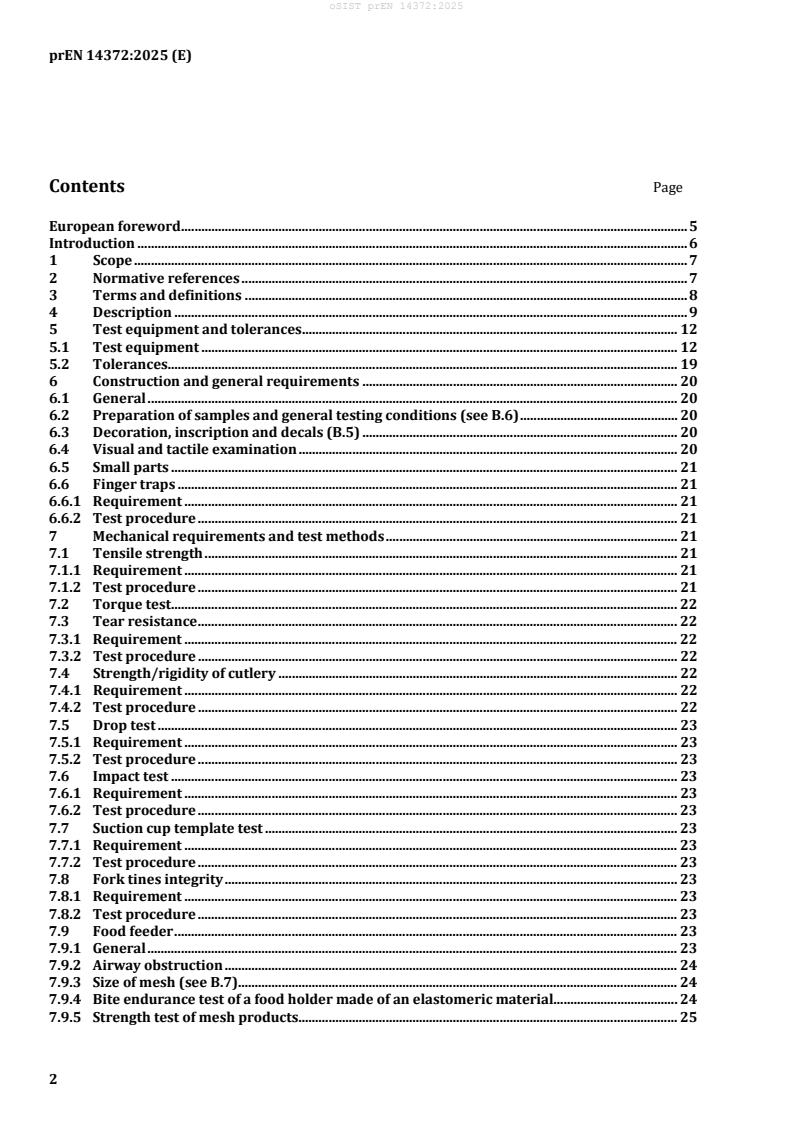
Contents Page
European foreword . 5
Introduction . 6
1 Scope . 7
2 Normative references . 7
3 Terms and definitions . 8
4 Description . 9
5 Test equipment and tolerances . 12
5.1 Test equipment . 12
5.2 Tolerances. 19
6 Construction and general requirements . 20
6.1 General . 20
6.2 Preparation of samples and general testing conditions (see B.6) . 20
6.3 Decoration, inscription and decals (B.5) . 20
6.4 Visual and tactile examination . 20
6.5 Small parts . 21
6.6 Finger traps . 21
6.6.1 Requirement . 21
6.6.2 Test procedure . 21
7 Mechanical requirements and test methods . 21
7.1 Tensile strength . 21
7.1.1 Requirement . 21
7.1.2 Test procedure . 21
7.2 Torque test. 22
7.3 Tear resistance . 22
7.3.1 Requirement . 22
7.3.2 Test procedure . 22
7.4 Strength/rigidity of cutlery . 22
7.4.1 Requirement . 22
7.4.2 Test procedure . 22
7.5 Drop test . 23
7.5.1 Requirement . 23
7.5.2 Test procedure . 23
7.6 Impact test . 23
7.6.1 Requirement . 23
7.6.2 Test procedure . 23
7.7 Suction cup template test . 23
7.7.1 Requirement . 23
7.7.2 Test procedure . 23
7.8 Fork tines integrity . 23
7.8.1 Requirement . 23
7.8.2 Test procedure . 23
7.9 Food feeder . 23
7.9.1 General . 23
7.9.2 Airway obstruction . 24
7.9.3 Size of mesh (see B.7) . 24
7.9.4 Bite endurance test of a food holder made of an elastomeric material . 24
7.9.5 Strength test of mesh products. 25
prEN 14372:2025 (E)
7.9.6 Security of food holder (see B.8) . 25
7.9.7 Security of closure . 25
7.9.8 Closure endurance (see B.9) . 26
7.9.9 Food holder protector size . 26
8 Chemical requirements and test methods . 26
8.1 General . 26
8.2 Preparation of samples for chemical tests . 26
8.3 Requirements for materials . 27
8.4 Volatile compounds content of silicone elastomer components (see B.11) . 28
8.4.1 Requirement . 28
8.4.2 Determination of volatile compounds content . 28
8.5 N-nitrosamines and N-nitrosatable substances release . 29
8.6 Migration of certain elements (see B.12 and B.13) . 30
8.6.1 Requirement . 30
8.6.2 Method for the determination of the migration of certain elements . 31
8.7 Formaldehyde release (See B.17) . 31
8.7.1 Requirements . 31
8.7.2 Determination . 31
8.8 Colour fastness (see B.10) . 31
8.8.1 Principle . 31
8.8.2 Requirement . 32
8.8.3 Determination of colour fastness . 32
8.9 Migration of primary aromatic amines (see B.16) . 33
8.9.1 Requirement . 33
8.9.2 Principles . 33
8.9.3 Procedure . 33
8.10 Migration of lead and cadmium from glass and ceramic articles (see B.14) . 33
8.10.1 Requirement . 33
8.10.2 Determination of lead and cadmium . 33
8.11 Migration of elements from metal (see B.15) . 34
8.11.1 Requirement . 34
8.11.2 Determination of elements . 34
8.12 Nickel release (see B.18) . 34
8.12.1 Requirement . 34
8.12.2 Determination of nickel release . 34
9 Consumer packaging . 34
10 Product information . 35
10.1 General . 35
10.2 Purchase information . 35
10.3 Warnings . 35
10.4 Instructions for use . 37
11 Test report . 37
Annex A (informative) Warnings . 38
Annex B (informative) Rationales . 39
B.1 Information for medical devices that have a feeding function . 39
B.2 Relationship with the Toy Directive . 39
B.3 Button and coin batteries (see 6.1) . 39
B.4 Magnets (see 6.1) . 39
B.5 Decoration, Inscription and Decals (see 6.3) . 40
B.6 Sample used for the test (see 6.2) . 40
B.7 Size of mesh (see 7.9.3) . 40
B.8 Security of food holder (see 7.9.6) . 40
B.9 Closure endurance (see 7.9.8) . 41
prEN 14372:2025 (E)
B.10 Colourants (see 8.8) . 41
B.11 Volatile compounds content (see 8.4) . 41
B.12 Migration of certain elements (see 8.6) . 42
B.13 Cr VI limit (see 8.6) . 44
B.14 Migration of lead and cadmium from glass and ceramic articles (see 8.10) . 45
B.15 Migration of elements from metal (see 8.11) . 45
B.16 Migration of primary aromatic amines (see 8.9) . 45
B.17 Formaldehyde release (see 8.7) . 45
B.18 Requirement for Ni (see 8.12) . 46
B.19 Bowls and similar hemispherical shaped items (See 10.3) . 46
Annex C (informative) Good practice for visibility and legibility . 47
C.1 General . 47
C.2 Warnings . 47
C.3 Font . 47
C.4 Multi-languages . 47
Annex ZA (informative) Relationship between this European Standard and the safety
requirements of Regulation 2023/988/EC aimed to be covered . 48
Bibliography . 51
prEN 14372:2025 (E)
European foreword
This document (prEN 14372:2025) has been prepared by Technical Committee CEN/TC 252 “Child care
articles”, the secretariat of which is held by AFNOR.
This document is currently submitted to the second CEN Enquiry.
This document will supersede EN 14372:2004.
The main changes compared to the previous edition are listed below:
— Introduction: Completely reworded and references to European regulations have been renewed.
— Clause 3: Old definitions have been revised and new parts have been added, e.g. food feeder.
— Clause 4: New parts have been added.
— Clause 5: This clause is completely new.
— Clause 6: This clause is completely new.
— Clause 7: The whole clause has been divided into several sub-paragraphs for individual tests, and
several paragraphs for new items and their tests have been added.
— Clause 8: This clause has been completely restructured and subdivided. Chemical requirements and
test methods have been set for materials (like rubber, silicon, TPE, metal, glass) and exposures
(mouthing and swallowing) which are recently not covered by harmonized legislation. Requirements
for substances (e.g. Phthalate content, BPA release) which are covered by harmonized regulation
(like REACH, (EU) 10/2011 or its amendments) have not been included.
— Clause 9 This clause is completely new.
— Clause 10: Revised and partly reworded.
— Clause 11: This clause on the test report is completely new.
— Annex A: This informative annex with translations of warnings into 24 languages is completely new.
— Annex B: This informative annex with rationales is completely new.
— Annex C: This informative annex on good practice for visibility and legibility is completely new.
— Annex ZA: This informative annex regarding relationship between this standard and the safety
requirements of Regulation 2023/988/EC aimed to be covered is completely new.
This document has been prepared under a standardization request addressed to CEN by the European
Commission. The Standing Committee of the EFTA States subsequently approves these requests for its
Member States.
For the relationship with EU Legislation, see informative Annex ZA, which is an integral part of this
document.
prEN 14372:2025 (E)
Introduction
This document establishes minimum safety requirements and specifies appropriate test methods for
children’s cutlery, feeding utensils and food feeders. However, this document cannot eliminate all
possible risks to young children.
It is essential that the manufacturer gives all warnings and instructions specified in this document clearly,
to allow the consumer to ensure the product is used correctly and safely.
It is also important that the product or its packaging bears a traceability marking (e.g. batch coding) to
enable traceability of the product through the supply chain.
This document sets chemical requirements and test methods for materials (e.g. silicon, TPE, glass
ceramics, metals, etc.) and exposures (mouthing and swallowing) not covered by harmonized legislation.
Where this document sets migration limits for substances also covered by legislation, the requirements
of this document with stated test conditions must be regarded as additional.
Materials and chemical risks included in this document (Table 1) do not present a definitive list but the
considered opinion of the Technical Committee based on current knowledge of likely risks.
All food contact materials and articles are regulated by Regulation (EC) No 1935/2004 [1], Regulation
(EC) No 2023/2006 [22] and relevant implementation measures, at European or national level.
All plastics components of cutlery, feeding utensils and food feeders which are intended to come into
contact with food are specifically regulated by Regulation (EU) No 10/2011 [2] on plastic materials and
articles intended to come into contact with food and its amendments. Therefore, for example, the
Bisphenol A requirement has not been included in this document [24]. Phthalates, Azo-dyes, PAH are
regulated by Annex XVII of the REACH Regulation [3] and have not been included in this document.
Articles treated with biocides are regulated under Regulation (EU) No 528/2012, and therefore have not
been included in this document.
prEN 14372:2025 (E)
1 Scope
This document specifies safety requirements relating to the materials, construction, performance,
packaging and labelling of cutlery, feeding utensils and food feeders. All products which are intended to
be used by a child aged up to 48 months to eat by itself or with the assistance of another person are
included in the scope of this document. This includes products which have a different primary function,
but have a secondary function intended to allow a child to use the product to eat by itself or with the
assistance of another person.
This document does not apply to pre-prepared food containers, to containers intended for storage only,
or to cutlery, feeding utensils and food feeders designed for specialist medical applications or for use
under medical supervision (B.1).
This document does not apply to single-use cutlery, feeding utensils and food feeders.
This document includes test methods for the mechanical and chemical requirements specified and
requirements relating to the product information.
This document does not apply to drinking equipment (feeding bottles, teats, spouts, and cups) which is
covered by EN 14350:2020+A1:2023.
2 Normative references
The following documents are referred to in the text in such a way that some or all of their content
constitutes requirements of this document. For dated references, only the edition cited applies. For
undated references, the latest edition of the referenced document (including any amendments) applies.
EN 71-1:2014+A1:2018, Safety of toys — Part 1: Mechanical and physical properties
EN 71-3:2019+A2:2024, Safety of toys — Part 3: Migration of certain elements
EN 12868:2017, Child use and care articles — Method for determining the release of N-nitrosamines and
N-nitrosatable substances from elastomer or rubber teats and soothers
EN 14350:2020+A1:2023, Child care articles — Drinking equipment — Safety requirements and test
methods
EN ISO 17294-2:2023, Water quality — Application of inductively coupled plasma mass spectrometry (ICP-
MS) — Part 2: Determination of selected elements including uranium isotopes (ISO 17294-2:2023, Corrected
version 2024-02)
EN 1811:2023, Reference test method for release of nickel from all post assemblies which are inserted into
pierced parts of the human body and articles intended to come into direct and prolonged contact with the
skin
prEN 14372:2025 (E)
3 Terms and definitions
For the purposes of this document, the following terms and definitions apply.
ISO and IEC maintain terminology databases for use in standardization at the following addresses:
• ISO Online browsing platform: available at https://www.iso.org/obp
• IEC Electropedia: available at https://www.electropedia.org
3.1
cutlery
implements used for eating such as knives, forks, spoons and food pushers
3.2
feeding utensil
implement or container such as a plate or a bowl used for feeding children
3.3
suction ring/cup/pad
component intended to adhere or secure a product to a surface
3.4
handle
component designed to assist the handling of a product
3.5
food feeder
device intended to contain pieces of food and allow the child sucking and/or chewing the food through a
mesh or a perforated surface
Note 1 to entry: A food feeder is usually constructed of a handle, food holder and closure.
3.5.1
food holder
flexible container usually made of mesh or elastomer (e.g. silicone rubber, TPE, etc.) with openings, part
that holds and allows the child to access the food
3.5.2
closure
opening and closing component(s) used to hold the food holder and prevent access by the child to the
contents of the flexible container
3.6
protective cover
component(s) to protect the feeding utensil or cutlery, not intended to be handled by the child
Note 1 to entry: Intended to be handled by the child means grasped, carried, or supported by the child’s hand(s).
3.7
food holder protector
device that can be attached to and detached from the food feeder usually a dome shaped component,
intended to cover the food holder 3.5.1
prEN 14372:2025 (E)
4 Description
Examples of cutlery and feeding utensils are shown in Figures 1, 2, 3 and food feeder in Figure 4.
Key
A Spoon
B Fork
C Knife
D1 Food pusher – top view
D2 Food pusher – front view
D3 Food pusher – side view
Figure 1 — Examples of cutlery
prEN 14372:2025 (E)
Key
A 1 Bowl – side view
A 2 Bowl – top view
B 1 Plate – side view
B 2 Plate – top view
C 1 Keep-warm plate – side view
C 2 Keep-warm plate – top view
C 3 Removable plug on keep-warm plate
D 1 Weaning bowl – side view
D 2 Weaning bowl – top view
Figure 2 — Examples of feeding utensils
prEN 14372:2025 (E)
Key
A 1 Feeding utensil with suction pad – side view
A 2 Feeding utensil – top view
B 1 Suction pad – side view
B 2 Suction pad – top view
B 3 Suction pad release tab
Figure 3 — Example of a feeding utensil with a separate suction pad
Key
1 handle
2 closure
3 food holder
Figure 4 — Example of a food feeder
prEN 14372:2025 (E)
5 Test equipment and tolerances
5.1 Test equipment
Dimensions in millimetres
Figure 5 — Small parts cylinder
Dimensions in millimetres
Key
1 tip radius equalling half the probe diameter
2 scribed line
3 0
diameter of probe 1: 5,5 mm,
−01,
+01,
diameter of probe 2: 12 mm
Figure 6 — Probes for holes (finger traps) test
prEN 14372:2025 (E)
Dimensions in millimetres
Material: H13 high chrome tool steel or equivalent. Harden to 45-50 Rockwell C.
NOTE All dimensions with a tolerance are machined as ISO 21920-1:2021 [4] to Ra 0, 4 .
Figure 7 — Indentor for tear resistance test
prEN 14372:2025 (E)
Dimensions in millimetres
Template A
prEN 14372:2025 (E)
Template B
prEN 14372:2025 (E)
Template C
Figure 8 —Template A, B and C
prEN 14372:2025 (E)
Dimensions in millimetres
Material: H13 high chrome tool steel or equivalent. Harden to 45-50 Rockwell C.
NOTE 1 Dimensions marked as “A” made to fit the individual test machine load cell.
NOTE 2 Dimensions marked as “B” made to fit the individual test machine table.
Figure 9 — Apparatus for strength/rigidity test
Dimensions in millimetres
Figure 10 — Size of mesh fixture
prEN 14372:2025 (E)
Figure 11 — Example of fixture assembly for size of mesh test
Dimensions in millimetres
Material: H13 high chrome tool steel or equivalent.
NOTE All dimensions with a tolerance are machined as ISO 21920-1:2021 [4] to Ra 0, 4 .
Figure 12 — Size of mesh probe
prEN 14372:2025 (E)
Dimensions in millimetres
Figure 13 — Bite endurance jaws
5.2 Tolerances
Unless otherwise stated, the following tolerances apply:
— forces: ±5 % of the nominal force;
— masses: ±0,5 % of the nominal mass;
— dimensions: ±1,0 mm of the nominal dimension;
— angles: ±2° of the nominal angle;
— duration of forces for durability tests: ±1 s;
— duration of forces for static load tests: ±2 s.
Mechanical tests are often described in terms of the application of forces. Masses can however be used.
1 kg mass may be used for 10 N force.
Unless otherwise specified, the test forces may be applied by any suitable device which does not affect
prEN 14372:2025 (E)
the results.
6 Construction and general requirements
6.1 General
There are some products designed as a toy or with features that resemble a toy. These products shall
additionally meet the relevant requirements of EN 71. (see B.2)
There are some products which are designed to be also used as drinking equipment or have a drinking
function. These products shall additionally meet the requirements of EN 14350:2020+A1:2023.
Button and coin batteries are not permitted, due to the severe health risk posed to small children if
inserted, swallowed, or ingested (see B.3).
Magnetic parts shall not be accessible to the child. They shall be fully encapsuled. All magnetic parts used
2 2 2 2
shall have a magnetic flux index less than 50 kG mm (0,5 T mm ) when tested according to
EN 71-1:2014+A1:2018 (see B.4).
Glass or ceramic cutlery or food feeder is not permitted due to the risks of breakage and the possible
hazards.
Products made of vulcanized rubber including natural latex have not been included in the Chemical and
the Product information part of this document. If manufacturers use these types of rubber for their
cutlery, feeding utensils or food feeders, they shall follow the relevant parts of EN 14350:2020+A1:2023.
6.2 Preparation of samples and general testing conditions (see B.6)
Each mechanical destructive test shall be carried out on a new sample unless otherwise stated in the test
method.
All samples shall be submerged in water at (60 ± 2) °C for (10 ± 0,5) min. Drain excess water before
allowing the samples to cool to room temperature in a desiccator for (24 ± 1) h prior to testing. Use new
samples, preferably from the same batch, for each test unless otherwise stated (i.e. samples used in one
test shall not be used in another test).
6.3 Decoration, inscription and decals (B.5)
All areas of cutlery, feeding utensils and food feeder may be decorated or inscribed by techniques which
do not apply materials to their surface, e.g. by laser engraving. The manufacturer shall ensure that
possible contamination, e.g. from laser engraving combustion products, does not impair product safety.
Areas of products that are intended to be mouthed shall not be powder coated, printed, and also not when
covered by a functional barrier including inmold labelling.
Areas of products that are not intended to contact food and/or to be mouthed may be decorated or
inscribed with techniques which apply colorant such as printing with printing inks, powder coating and
inmold labelling.
Adhesive decals and labels intended to stay on the product during use are not allowed on any part of
feeding utensils. Decorations shall not be attached to any part of feeding utensils by glue.
6.4 Visual and tactile examination
All components of cutlery, feeding utensils and food feeder when assembled for use shall be free from
any accessible sharp points or edges and free of flash and burrs, which could cause injuries, and shall be
assessed by visual and tactile examination. In case of doubt, apply test for sharp point and sharp edge
according to EN 71-1:2014+A1:2018.
prEN 14372:2025 (E)
6.5 Small parts
All parts which are designed to be removed (e.g. for cleaning), or become separated after the tensile or
other mechanical tests shall not fit entirely within the small parts cylinder (see
Figure 5) in any orientation and without compression.
6.6 Finger traps
6.6.1 Requirement
This requirement only applies to components made of materials with a Shore A hardness of more than
60.
To avoid entrapment of fingers in any part of product all accessible holes more than 10 mm deep shall
not have an opening width between 5,5 mm and 12 mm, when tested in accordance with 6.6.2.
6.6.2 Test procedure
Only accessible holes shall be tested when the parts of products are in their assembled state. If movable
parts are involved test all configurations representing the intended use for possible entrapments.
Using the 5,5 mm probe (Figure 6) measure the penetration of any accessible hole. If the unhindered
penetration is more than 10 mm, repeat using the 12 mm diameter probe (Figure 6).
The test is passed if either both or none of the 2 probes penetrate to a depth of > 10 mm.
The test is failed if only one of the probes penetrates to a depth > 10 mm.
7 Mechanical requirements and test methods
7.1 Tensile strength
7.1.1 Requirement
All products with more than one component and which are intended to be handled by a child shall be
tested as described in 7.1.2. No component shall break, tear, or separate during this test. Any separation
of components designed to be disassembled is functional in nature and shall not be considered as a
failure. These components shall be detached prior to the testing and each part shall pass the test
requirements.
NOTE Components are those individual and separate items or parts which are assembled to make the complete
product. They can be permanently or temporarily attached to the assembly. Components that are intended by
processing to create a homogenous item or part such as co-moulding of two different materials also known as over-
moulding, 2K – 2 component injection moulding or two shot moulding, are considered a single component for the
purpose of this test only.
7.1.2 Test procedure
The tensile force shall be applied to one component of the sample whilst another component is firmly
held. A pre-load of (5 ± 2) N shall be applied to align the specimen and then the force shall be increased
to (90 ± 2) N at a cross head speed of (200 ± 5) mm/min and maintained at that level for (10 ± 1) s.
Clamps or other devices shall hold the components securely during the test without giving rise to damage
which might affect the test result. Any results where such damage occurs shall be disregarded.
Tests shall be carried out along the major axis and at the right angles to the major axis. Every possible
combination of pairs of components shall be tested.
prEN 14372:2025 (E)
7.2 Torque test
If a component can be gripped between thumb and forefinger, it shall be torque tested before performing
the tensile test according to 7.1.
The torque test shall be performed according to EN 71-1:2014+A1:2018. No component shall break, tear,
or separate during this test.
Any separation of components designed to be disassembled is functional in nature and shall not be
considered as a failure. These components shall be detached prior to the testing and each part shall pass
the test requirements.
7.3 Tear resistance
7.3.1 Requirement
Components produced out of materials with a Shore A hardness of less than 60 but excluding suction
pads and co-moulded parts shall be tested as described in 7.3.2. The tested component shall not break,
tear, or separate during the subsequent tensile test.
NOTE Co-moulded parts are intended to create a homogenous item or part moulding of two different materials
by processing, also known as over-moulding, 2K – 2 component injection moulding or two shot moulding.
7.3.2 Test procedure
The components to be tested shall be separated if necessary from any other components.
Place the component to be tested on a cutting board of at least 10 mm thickness and (70 ± 5) Shore D
hardness. Place the tip of the indentor, the shape and dimensions of which are given in Figure 7, in the
approximate centre of the largest surface of the component to be tested.
At a crosshead speed of (10 ± 5) mm/min apply a force of (200 ± 10) N for (1 ± 0,5) s.
If the indentor punctures the component carry out a tensile test in accordance with 7.1.2. For the
component suitable fixing devices shall be used to hold opposite ends of the component securely, so that
the puncture produced by the indentor is at 90 ° to the axis of tensile force.
7.4 Strength/rigidity of cutlery
7.4.1 Requirement
The test shall be applied to all cutlery. When tested in accordance with 7.4.2 no component of cutlery
shall break, tear or separate.
7.4.2 Test procedure
A tensile testing machine with an attachment to facilitate three-point bend loading onto handles of
articles shall be used to apply a compression load to (100 ± 5) N at a crosshead speed of (10 ± 5) mm/min
and maintain for (10 ± 1) s as shown in Figure 9.
The load shall be applied at the mid-point of item’s length. The test shall be repeated with load applied at
(30 ± 1) mm from either end of the product. In each test the restraining points shall be positioned
(25 ± 1) mm from the load point.
NOTE It might be necessary to prevent the cutlery from slipping during the test.
prEN 14372:2025 (E)
7.5 Drop test
7.5.1 Requirement
All products excluding those made of glass and ceramic when tested according to 7.5.2. shall not form
sharp edges, sharp points or small parts.
NOTE For feeding items made of glass or ceramic a warning is applicable. See Clause 10 Product information.
7.5.2 Test procedure
Test in accordance to EN 71-1:2014+A1:2018 Drop Test.
7.6 Impact test
7.6.1 Requirement
All products, excluding those made of glass and ceramic, when tested according to 7.6.2, shall not form
sharp edges, sharp points or small parts. Fork tines shall be additionally tested according to 7.8.
NOTE For feeding items made of glass or ceramic, a warning is applicable. See Clause 10 Product information.
7.6.2 Test procedure
Test in accordance to EN 71-1:2014+A1:2018 Impact Test.
7.7 Suction cup template test
7.7.1 Requirement
Suction cups, while attached to the product or detached from the product, shall in no direction protrude
through template for suction cups when tested according to 7.7.2.
7.7.2 Test procedure
Test in ac
...