

SIST EN 1504-4:2005
(Main)Products and systems for the protection and repair of concrete structures - Definitions, requirements, quality control and evaluation of conformity - Part 4: Structural bonding
General Information
- Abstract
This Part 4 of EN 1504 specifies requirements for the identification, performance (including durability) and safety of structural bonding products and systems to be used for the structural bonding of strengthening materials to an existing concrete structure, including:
1) The bonding of external plates of steel or other suitable materials (e.g. fibre reinforced composites) to the surface of a concrete structure for strengthening purposes, including the laminating of plates in such applications.
2) The bonding of hardened concrete to hardened concrete, typically associated with the use of precast units in repair and strengthening.
3) The casting of fresh concrete to hardened concrete using an adhesive bonded joint where it forms a part of the structure and is required to act compositely.
The performance requirements in this Part of this Standard may not be applicable to highly specialised applications in extreme environmental conditions, e.g. cryogenic use, nor do they cover specialised circumstances such as accidental impact, e.g. due to traffic or ice, or earthquake loading where specific performance requirements will apply.
- Status
- Published
- Publication Date
- 31-Jan-2005
- Technical Committee
- BBB - Concrete, reinforced concrete and prestressed concrete
- Current Stage
- 6060 - National Implementation/Publication (Adopted Project)
- Start Date
- 01-Feb-2005
- Due Date
- 01-Feb-2005
- Completion Date
- 01-Feb-2005
- Directive
- 305/2011 - Regulation (eu) No 305/2011 of the European Parliament and of the Council of 9 march 2011 laying down harmonised conditions for the marketing of construction products and repealing council directive 89/106/eecOJ Ref: C 259 OJ Date: 08-Aug-2014
89/106/EEC - Construction productsOJ Ref: C 139 OJ Date: 08-Jun-2005

Overview
EN 1504-4:2004 is the CEN European standard for structural bonding products and systems used in the protection and repair of concrete structures. It defines identification, performance (including durability), safety, quality control and evaluation of conformity for bonding agents and systems used to create durable adhesive bonded joints in concrete works. The standard covers three main uses:
- bonding external plates (steel, fibre‑reinforced composites) for bonded plate reinforcement;
- bonding hardened concrete to hardened concrete (precast repairs);
- bonding fresh concrete to hardened concrete where the joint must act compositely.
The standard excludes highly specialized extreme‑environment applications (e.g., cryogenic), and does not cover special accidental or seismic performance requirements.
Key topics and technical requirements
EN 1504-4 sets out the technical framework rather than prescriptive designs. Key topics include:
- Performance characteristics required for intended uses: adhesion (plate-to-concrete, concrete-to-concrete, fresh-to-hardened), durability under thermal and moisture cycling, mechanical properties (compressive and shear strength), modulus, shrinkage, coefficient of thermal expansion and glass transition temperature.
- Application properties: open time, pot life and workable life for bonding agents, and suitability for vertical, horizontal and injection application methods.
- Identification and composition control: manufacturer tests (colour, granulometry, ash content, thermogravimetry) and acceptable tolerances for product declaration.
- Testing and test methods: references normative test standards for adhesion, thermal cycling, shrinkage, modulus and durability (e.g., EN 1799, EN 12636, EN 13733 among others listed in the standard).
- Quality control & conformity: sampling, factory production control, frequency of testing, evaluation of conformity and labelling/marking requirements.
- Informative annexes: guidance on special applications, release of dangerous substances and minimum factory test frequencies; includes Annex ZA linking the standard to the EU Construction Products Directive.
Practical applications and users
Who uses EN 1504-4:
- Structural engineers and designers specifying bonded reinforcement or composite joints.
- Product manufacturers of adhesives, polymer mortars and bonding systems for concrete repair.
- Contractors and applicators performing bonded plate installations, precast connections or composite cast joints.
- Testing laboratories and certification bodies conducting conformity assessment and durability testing.
- Asset owners and inspectors managing rehabilitation of bridges, buildings, tunnels and industrial structures.
Practical benefits:
- Ensures predictable long‑term behaviour of bonded joints.
- Supports selection of bonding agents for specific environmental and load conditions.
- Provides a basis for product declaration, factory control and CE marking under EU rules.
Related standards
EN 1504‑4 is part of the EN 1504 series (EN 1504‑1, ‑2, ‑3, ‑5, ‑6, ‑7, ‑8, ‑9, ‑10) and references numerous test standards for structural bonding and polymer products. Use it together with other EN 1504 parts for comprehensive concrete repair and protection specifications.
Relations
- Effective Date
- 10-Jun-2026
- Effective Date
- 28-Jan-2026
- Effective Date
- 28-Jan-2026
- Effective Date
- 28-Jan-2026
- Effective Date
- 28-Jan-2026
- Effective Date
- 28-Jan-2026
- Effective Date
- 28-Jan-2026
- Effective Date
- 28-Jan-2026
- Effective Date
- 28-Jan-2026
- Effective Date
- 28-Jan-2026
- Effective Date
- 28-Jan-2026
- Effective Date
- 28-Jan-2026
- Effective Date
- 28-Jan-2026
- Effective Date
- 28-Jan-2026
- Effective Date
- 28-Jan-2026
Get Certified
Connect with accredited certification bodies for this standard

DIBt (Deutsches Institut für Bautechnik)
German Institute for Building Technology.
DIN CERTCO
DIN Group product certification.

Aboma Certification B.V.
Specialized in construction, metal, and transport sectors.
Sponsored listings
Frequently Asked Questions
SIST EN 1504-4:2005 is a standard published by the Slovenian Institute for Standardization (SIST). Its full title is "Products and systems for the protection and repair of concrete structures - Definitions, requirements, quality control and evaluation of conformity - Part 4: Structural bonding". This standard covers: This Part 4 of EN 1504 specifies requirements for the identification, performance (including durability) and safety of structural bonding products and systems to be used for the structural bonding of strengthening materials to an existing concrete structure, including: 1) The bonding of external plates of steel or other suitable materials (e.g. fibre reinforced composites) to the surface of a concrete structure for strengthening purposes, including the laminating of plates in such applications. 2) The bonding of hardened concrete to hardened concrete, typically associated with the use of precast units in repair and strengthening. 3) The casting of fresh concrete to hardened concrete using an adhesive bonded joint where it forms a part of the structure and is required to act compositely. The performance requirements in this Part of this Standard may not be applicable to highly specialised applications in extreme environmental conditions, e.g. cryogenic use, nor do they cover specialised circumstances such as accidental impact, e.g. due to traffic or ice, or earthquake loading where specific performance requirements will apply.
This Part 4 of EN 1504 specifies requirements for the identification, performance (including durability) and safety of structural bonding products and systems to be used for the structural bonding of strengthening materials to an existing concrete structure, including: 1) The bonding of external plates of steel or other suitable materials (e.g. fibre reinforced composites) to the surface of a concrete structure for strengthening purposes, including the laminating of plates in such applications. 2) The bonding of hardened concrete to hardened concrete, typically associated with the use of precast units in repair and strengthening. 3) The casting of fresh concrete to hardened concrete using an adhesive bonded joint where it forms a part of the structure and is required to act compositely. The performance requirements in this Part of this Standard may not be applicable to highly specialised applications in extreme environmental conditions, e.g. cryogenic use, nor do they cover specialised circumstances such as accidental impact, e.g. due to traffic or ice, or earthquake loading where specific performance requirements will apply.
SIST EN 1504-4:2005 is classified under the following ICS (International Classification for Standards) categories: 91.080.40 - Concrete structures. The ICS classification helps identify the subject area and facilitates finding related standards.
SIST EN 1504-4:2005 has the following relationships with other standards: It is inter standard links to SIST EN ISO 3451-1:2026, SIST EN 12192-2:2000, SIST EN ISO 11358-1:2022, SIST EN 12189:2000, SIST EN 13733:2002, SIST EN 12615:2000, SIST EN 1766:2017, SIST EN 12617-3:2002, SIST EN 12614:2004, SIST EN ISO 3451-1:2019, SIST EN 13412:2006, SIST EN 12636:2000, SIST EN 13501-1:2019, SIST EN 1799:2000, SIST EN ISO 9514:2019. Understanding these relationships helps ensure you are using the most current and applicable version of the standard.
SIST EN 1504-4:2005 is associated with the following European legislation: EU Directives/Regulations: 305/2011, 89/106/EEC; Standardization Mandates: M/128. When a standard is cited in the Official Journal of the European Union, products manufactured in conformity with it benefit from a presumption of conformity with the essential requirements of the corresponding EU directive or regulation.
SIST EN 1504-4:2005 is available in PDF format for immediate download after purchase. The document can be added to your cart and obtained through the secure checkout process. Digital delivery ensures instant access to the complete standard document.
Standards Content (Sample)
2003-01.Slovenski inštitut za standardizacijo. Razmnoževanje celote ali delov tega standarda ni dovoljeno.Products and systems for the protection and repair of concrete structures - Definitions, requirements, quality control and evaluation of conformity - Part 4: Structural bonding.RQVWUXNFLMVNRSRYH]RYDQMHProduits et systemes pour la protection et la réparation de structures en béton - Définitions, prescriptions, maîtrise de la qualité et évaluation de la conformité - Partie 4: Collage structuralProdukte und Systeme für den Schutz und die Instandsetzung von Betontragwerken - Definitionen, Anforderungen, Qualitätsüberwachung und Beurteilung der Konformität - Teil 4: Kleber für Bauzwecke91.080.40Betonske konstrukcijeConcrete structuresICS:SIST EN 1504-4:2005enTa slovenski standard je istoveten z:EN 1504-4:200401-februar-2005SIST EN 1504-4:2005SLOVENSKI
STANDARD
EUROPEAN STANDARDNORME EUROPÉENNEEUROPÄISCHE NORMEN 1504-4November 2004ICS 91.080.40English versionProducts and systems for the protection and repair of concretestructures - Definitions, requirements, quality control andevaluation of conformity - Part 4: Structural bondingProduits et systèmes pour la protection et la réparation destructures en béton - Définitions, prescriptions, maîtrise dela qualité et évaluation de la conformité - Partie 4: CollagestructuralProdukte und Systeme für den Schutz und dieInstandsetzung von Betontragwerken - Definitionen,Anforderungen, Qualitätsüberwachung und Beurteilung derKonformität - Teil 4: Kleber für BauzweckeThis European Standard was approved by CEN on 23 April 2004.CEN members are bound to comply with the CEN/CENELEC Internal Regulations which stipulate the conditions for giving this EuropeanStandard the status of a national standard without any alteration. Up-to-date lists and bibliographical references concerning such nationalstandards may be obtained on application to the Central Secretariat or to any CEN member.This European Standard exists in three official versions (English, French, German). A version in any other language made by translationunder the responsibility of a CEN member into its own language and notified to the Central Secretariat has the same status as the officialversions.CEN members are the national standards bodies of Austria, Belgium, Cyprus, Czech Republic, Denmark, Estonia, Finland, France,Germany, Greece, Hungary, Iceland, Ireland, Italy, Latvia, Lithuania, Luxembourg, Malta, Netherlands, Norway, Poland, Portugal, Slovakia,Slovenia, Spain, Sweden, Switzerland and United Kingdom.EUROPEAN COMMITTEE FOR STANDARDIZATIONCOMITÉ EUROPÉEN DE NORMALISATIONEUROPÄISCHES KOMITEE FÜR NORMUNGManagement Centre: rue de Stassart, 36
B-1050 Brussels© 2004 CENAll rights of exploitation in any form and by any means reservedworldwide for CEN national Members.Ref. No. EN 1504-4:2004: E
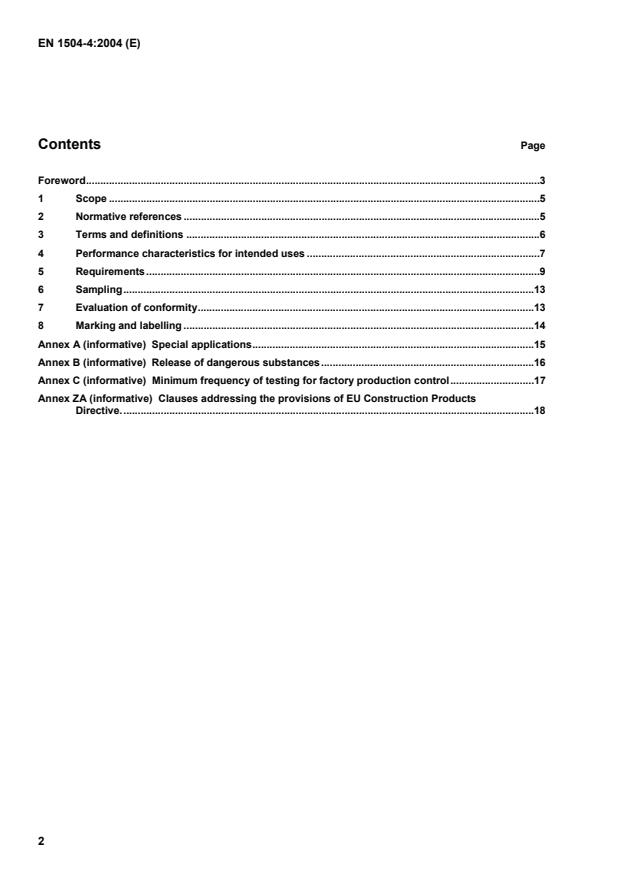
Special applications.15 Annex B (informative)
Release of dangerous substances.16 Annex C (informative)
Minimum frequency of testing for factory production control.17 Annex ZA (informative)
Clauses addressing the provisions of EU Construction Products Directive.18
3 Terms and definitions For the purposes of this document, the terms and definitions given in EN 1504-1, EN 1504-8and ENV 1504-9 and the following apply. 3.1 structural bonding products and systems products and systems applied to concrete to provide a durable structural bond to additional applied material 3.2 polymer mortars and polymer concretes (PC) blended mixtures of polymer binder and graded aggregates which set by polymer reaction
a) to vertical surfaces & soffits. † † b) to top horizontal surfaces. † † c) by injection. † † 2. Suitability for application and curing under the following special environmental conditions:
a) low or high temperature (Note 3). † † b) wet substrate.
„ 3. Adhesion:
a) plate to plate. „
b) plate to concrete. „
c) corrosion protected steel to corrosion protected steel (Note 4) †
d) corrosion protected steel to concrete (Note 4). †
e) hardened concrete to hardened concrete.
„ f) fresh concrete to hardened concrete (Note 5).
„ 4. Durability of composite system:
a) thermal cycling. „ „ b) moisture cycling. „ „ 5. Material characteristics for the designer:
a) open time (note 5) (note 6). „ „ b) workable life (note 6). „ „ c) modulus of elasticity in compression. „ „ d) modulus of elasticity in flexure. † † e) compressive strength.
„ f) shear strength. „ „ g) glass transition temperature. „ „ h) coefficient of thermal expansion. „ „ i) shrinkage. „ „ Notes 1. Repair method 4.3 is in accordance with ENV 1504-9. The bonding of external plates to the surface of a concrete structure for strengthening purposes, and the laminating of plates in such applications. An acceptable bond is unlikely to be achieved with stainless steel. 2. Repair method 4.4 is in accordance with ENV 1504-9. The bonding of hardened concrete to hardened concrete, typically associated with the use of precast units or the bonding of fresh concrete to hardened concrete where it forms a significant part of the structure and is required to act compositely. 3. Temperatures may be specified by the producer for the intended use. 4. In this context corrosion protection implies the application of a corrosion inhibiting priming coat to mild steel. 5. Not applicable to injection techniques. 6. At minimum, standard and maximum application temperatures.
7 Compressive strength
EN 12190 Declared value ± 20 %
5.2 Performance requirements The manufacturer shall undertake initial performance tests on the product in accordance with Table 3.1 (bonding agents for bonded plate reinforcement) or Table 3.2 (bonding agents for bonded mortar or concrete) and the product shall comply with the requirements.
7 Coefficient of thermal expansion — EN 1770 ≤ 100 × 10–6 per K 8a Total shrinkage for structural bonding agents — EN 12617-1 ≤ 0,1 % 8b Total shrinkage for structural bonding agents (alternative test method) — EN 12617-3 ≤ 0,1 % 9 Suitability for application to vertical surfaces and soffits — EN 1799 The material shall not sag flow by more than 1 mm when spread in thicknesses less than 3 mm. 10 Suitability for application to horizontal surfaces — EN 1799 The surface area of the bonding agent at the end of the squeezability test shall not be less than 3 000 mm2 (60 mm diameter). 11 Suitability for injection EN 1766 MC(0.40) EN 12618-2 For the test performed in the dry, failure shall occur in the concrete. 12 Suitability for application and curing under special environmental conditions — EN 12188 NOTE
The test method may need to be performed under environmental conditions other than those specified in EN 12188. The slant shear strength of scarf-jointed prisms tested in compression at various angles θ shall not be less than the values σo N/mm2 tabulated below. θ σo (N/mm2) 50° 50 60° 60 70° 70
The tensile stress carried by the bonded joint in a pull off test shall not be less than 14 N/mm2. The slant shear strength of scarf-jointed prisms tested in compression at various angles θ shall not be less than the values σo N/mm2 tabulated below. θ σo (N/mm2) 50°
50 60° 60 70° 70 14 Durability (thermal and moisture) — EN 13733 NOTE
The test method is not applicable for plates other than steel The compressive shear load at failure of the hardened concrete specimens after exposure to thermal cycling or the warm-moist environment shall not be less than the tensile strength of the concrete. The steel to steel specimens shall not fail after exposure to thermal cycling or the warm-moist environment.
NOTE Threshold requirements apply to the mean value of the relevant performance characteristic for any batch of the product as defined in EN 1504-8. Table 3.2 — Performance requirements of bonding agent for bonded mortar or concrete Item No Performance characteristic Reference concrete or mortar Test Method Requirements (See Note) 1 Modulus of elasticity in flexure. — EN ISO 178 ≥ 2 000 N/mm2 2 Compressive strength — EN 12190 ≥ 30 N/mm2 3 Shear strength — EN 12615 ≥ 6 N/mm2 4 Open time EN 1766 MC(0.40) EN 12189 Declared value ± 20 % 5 Workable life — EN ISO 9514 Declared value. Informative Note The workable life is dependent upon the batch quantity and ambient conditions. As such it is the responsibility of the producer. However, users should note that the workable life will usually be less than the pot life. 6 Modulus of elasticity in compression — EN 13412 ≥ 2 000 N/mm2
≥ 40 C
8 Coefficient of thermal expansion — EN 1770 ≤ 100 × 10–6 per °C 9a Total shrinkage for structural bonding agents — EN 12617-1 ≤ 0,1 % 9b Total shrinkage for structural bonding agents (alternative test method) — EN 12617-3 ≤ 0,1 % 10 Suitability for application to vertical surfaces and soffits — EN 1799 The material shall not sag flow by more than 1 mm when spread in thicknesses less than 3 mm. 11 Suitability for application to horizontal surfaces — EN 1799 The surface area of the bonding agent at the end of the squeezability test shall not be less than 3 000mm2 (60 mm diameter). 12 Suitability for injection EN 1766 MC(0.40) EN 12618-2 For the test performed in the dry failure shall occur in the concrete. 13a Suitability for application and curing under special environmental conditions EN 1766 MC(0.40) EN 12636 For hardened concrete-to-hardened concrete, the tensile bending test shall result in fracture in the concrete. For fresh concrete-to-hardened concrete, the pull off test shall result in fracture in the concrete. 13b Suitability for application and curing under special environmental conditions (alternative test method) EN 1766 C(0.40) or MC(0.40) EN 12615 The slant shear test shall result in fracture in the concrete. 14a Adhesion EN 1766 MC (0.40) EN 12636 For hardened concrete-to-hardened concrete, the tensile bending test shall result in fracture in the concrete. For fresh concrete-to-hardened concrete, the pull off test shall result in fracture in the concrete. 14b Adhesion (alternative test method) EN 1766 C (0.40) or MC (0.40) EN 12615 The slant shear test shall result in fracture in the concrete. 15 Durability (thermal and moisture) EN 1766 MC (0.40) EN 13733 The compressive shear load at failure of either the hardened concrete to hardened concrete, or fresh concrete to hardened concrete specimens after exposure to thermal cycling or the warm-moist environment shall not be less than the lowest tensile strength exhibited by either the bonded or the original concrete. NOTE Threshold requirements apply to the mean value of the relevant performance characteristic for any batch of the product as defined in EN 1504-8.
...