

SIST EN 13757-5:2016
(Main)Communication systems for meters - Part 5: Wireless M-Bus relaying
General Information
- Abstract
This European Standard specifies the protocols to use when performing relaying in wireless meter readout networks. This European Standard is an extension to wireless meter readout specified in EN 13757-4. It supports the routing of modes P and Q, and simple single-hop repeating of modes S, T, C, F and N.
The main use of this standard is to support simple retransmission as well as routed wireless networks for the readout of meters.
NOTE Electricity meters are not covered by this standard, as the standardisation of remote readout of electricity meters is a task for IEC/CENELEC.
- Status
- Published
- Public Enquiry End Date
- 09-Mar-2014
- Publication Date
- 25-Jan-2016
- Technical Committee
- I13 - Imaginarni 13
- Current Stage
- 6060 - National Implementation/Publication (Adopted Project)
- Start Date
- 20-Jan-2016
- Due Date
- 26-Mar-2016
- Completion Date
- 26-Jan-2016

Overview
SIST EN 13757-5:2016 - Communication systems for meters, Part 5: Wireless M‑Bus relaying specifies protocols and operational rules for relaying in Wireless M‑Bus meter readout networks. It is an extension to Wireless M‑Bus as defined in EN 13757‑4 and focuses on supporting routed networks and simple retransmission (repeating) to extend coverage and reliability of remote meter readout. Electricity meters are excluded from this part (electricity remote readout is handled by IEC/CENELEC).
Key topics and technical requirements
This standard defines protocol behaviour across multiple layers and relaying methods. Major technical topics include:
- Supported modes: routing for Mode P and Mode Q; single‑hop repeating for Modes S, T, C, F, and N.
- Layered protocols: specifications for Physical Layer, Data Link Layer, Network Layer and Application Layer as they apply to relaying.
- Relaying mechanisms: rules for routers, gateways, single‑hop repeaters, and registered/assigned/unregistered repetition.
- Routing controls: hop count, relay/transfer fields (H‑field, R‑field), address conversion and routing rules to prevent loops and manage multi‑hop paths.
- Timing and synchronization: precise timing requirements, search/wake‑up sequences, and support for precision timing in Mode Q.
- Power‑strobe operation: handling of low‑power or power‑strobed units participating in relaying.
- Robustness features: error handling, data duplication management, message retransmission strategies, and network management services.
- Transport and management: repeater management data elements, error reporting services, and network management procedures.
- Interoperability considerations: COSEM extension references and interactions with EN 13757‑1 application layer.
Practical applications
SIST EN 13757‑5 is intended to enable reliable wireless meter readout where direct radio links are insufficient. Typical applications:
- Extending coverage of water, gas, heat and other non‑electric meters in urban, suburban or indoor environments.
- Designing routed Wireless M‑Bus networks that require multi‑hop forwarding via routers and gateways.
- Deploying simple repeater installations for battery‑operated or constrained devices that need single‑hop retransmission.
- Implementing network management and error reporting for large-scale smart metering rollouts and AMR/AMI systems.
Who should use this standard
- Meter manufacturers and module vendors (Wireless M‑Bus devices)
- Utility companies and smart‑metering program integrators
- Network planners and RF/system architects for telemetry and AMR/AMI
- Test labs and certification bodies validating Wireless M‑Bus relaying
- IoT solution providers building metering gateways and routers
Related standards
- EN 13757‑4 (Wireless M‑Bus base specification) - primary reference
- EN 13757‑1 (Application layer) - application services and COSEM extension references
Keywords: Wireless M‑Bus, SIST EN 13757‑5:2016, relaying, routers, repeaters, gateways, smart metering, meter readout, routing, telemetry, network management.
Relations
- Effective Date
- 01-Mar-2016
- Effective Date
- 09-Feb-2026
- Effective Date
- 09-Feb-2026
- Effective Date
- 09-Feb-2026
- Effective Date
- 28-Jan-2026
- Effective Date
- 28-Jan-2026
- Effective Date
- 28-Jan-2026
- Effective Date
- 28-Jan-2026
- Referred By
SIST EN 13757-7:2018 - Communication systems for meters - Part 7: Transport and security services - Effective Date
- 28-Jan-2026
- Referred By
SIST EN 13757-4:2019 - Communication systems for meters - Part 4: Wireless M-Bus communication - Effective Date
- 28-Jan-2026
- Referred By
SIST EN 13757-7:2025 - Communication systems for meters - Part 7: Transport and security services - Effective Date
- 28-Jan-2026
- Effective Date
- 28-Jan-2026
- Effective Date
- 28-Jan-2026
- Effective Date
- 28-Jan-2026
- Effective Date
- 28-Jan-2026
Get Certified
Connect with accredited certification bodies for this standard

ANCE
Mexican certification and testing association.

Intertek Slovenia
Intertek testing, inspection, and certification services in Slovenia.

LNE (Laboratoire National de Métrologie et d'Essais)
French national laboratory for metrology and testing.
Sponsored listings
Frequently Asked Questions
SIST EN 13757-5:2016 is a standard published by the Slovenian Institute for Standardization (SIST). Its full title is "Communication systems for meters - Part 5: Wireless M-Bus relaying". This standard covers: This European Standard specifies the protocols to use when performing relaying in wireless meter readout networks. This European Standard is an extension to wireless meter readout specified in EN 13757-4. It supports the routing of modes P and Q, and simple single-hop repeating of modes S, T, C, F and N. The main use of this standard is to support simple retransmission as well as routed wireless networks for the readout of meters. NOTE Electricity meters are not covered by this standard, as the standardisation of remote readout of electricity meters is a task for IEC/CENELEC.
This European Standard specifies the protocols to use when performing relaying in wireless meter readout networks. This European Standard is an extension to wireless meter readout specified in EN 13757-4. It supports the routing of modes P and Q, and simple single-hop repeating of modes S, T, C, F and N. The main use of this standard is to support simple retransmission as well as routed wireless networks for the readout of meters. NOTE Electricity meters are not covered by this standard, as the standardisation of remote readout of electricity meters is a task for IEC/CENELEC.
SIST EN 13757-5:2016 is classified under the following ICS (International Classification for Standards) categories: 33.200 - Telecontrol. Telemetering. The ICS classification helps identify the subject area and facilitates finding related standards.
SIST EN 13757-5:2016 has the following relationships with other standards: It is inter standard links to SIST EN 13757-5:2008, SIST EN 60870-5-2:1997, SIST EN 60870-5-1:1997, SIST EN 62054-21:2005, SIST EN 13757-4:2013, SIST EN 13757-1:2015, SIST EN 13757-3:2013, SIST EN 13757-8:2023, SIST EN 13757-7:2018, SIST EN 13757-4:2019, SIST EN 13757-7:2025, SIST EN 1434-3:2008, SIST EN 13757-1:2022, SIST EN 16314:2013, SIST EN 13757-3:2018. Understanding these relationships helps ensure you are using the most current and applicable version of the standard.
SIST EN 13757-5:2016 is associated with the following European legislation: Standardization Mandates: M/441, M/490. When a standard is cited in the Official Journal of the European Union, products manufactured in conformity with it benefit from a presumption of conformity with the essential requirements of the corresponding EU directive or regulation.
SIST EN 13757-5:2016 is available in PDF format for immediate download after purchase. The document can be added to your cart and obtained through the secure checkout process. Digital delivery ensures instant access to the complete standard document.
Standards Content (Sample)
2003-01.Slovenski inštitut za standardizacijo. Razmnoževanje celote ali delov tega standarda ni dovoljeno.Kommunikationssysteme für Zähler - Teil 5: Weitervermittlung für den drahtlosen M-BusSystèmes de communication pour compteurs - Partie 5: Relais de transmission sans fil M-BusCommunication systems for meters - Part 5: Wireless M-Bus relaying33.200Daljinsko krmiljenje, daljinske meritve (telemetrija)Telecontrol. TelemeteringICS:Ta slovenski standard je istoveten z:EN 13757-5:2015SIST EN 13757-5:2016en01-marec-2016SIST EN 13757-5:2016SLOVENSKI
STANDARDSIST EN 13757-5:20081DGRPHãþD
EUROPEAN STANDARD NORME EUROPÉENNE EUROPÄISCHE NORM
EN 13757-5
November 2015 ICS 33.200; 35.100.10; 35.100.20 Supersedes EN 13757-5:2008
English Version
Communication systems for meters - Part 5: Wireless M-Bus relaying
Systèmes de communication - Partie 5: Relais de transmission sans fil M-Bus
Kommunikationssysteme für Zähler - Teil 5: Weitervermittlung This European Standard was approved by CEN on 22 August 2015.
CEN members are bound to comply with the CEN/CENELEC Internal Regulations which stipulate the conditions for giving this European Standard the status of a national standard without any alteration. Up-to-date lists and bibliographical references concerning such national standards may be obtained on application to the CEN-CENELEC Management Centre or to any CEN member.
This European Standard exists in three official versions (English, French, German). A version in any other language made by translation under the responsibility of a CEN member into its own language and notified to the CEN-CENELEC Management Centre has the same status as the official versions.
CEN members are the national standards bodies of Austria, Belgium, Bulgaria, Croatia, Cyprus, Czech Republic, Denmark, Estonia, Finland, Former Yugoslav Republic of Macedonia, France, Germany, Greece, Hungary, Iceland, Ireland, Italy, Latvia, Lithuania, Luxembourg, Malta, Netherlands, Norway, Poland, Portugal, Romania, Slovakia, Slovenia, Spain, Sweden, Switzerland, Turkey and United Kingdom.
EUROPEAN COMMITTEE FOR STANDARDIZATION
COMITÉ EUROPÉEN DE NORMALISATION
EUROPÄISCHES KOMITEE FÜR NORMUNG
CEN-CENELEC Management Centre:
Avenue Marnix 17,
B-1000 Brussels © 2015 CEN All rights of exploitation in any form and by any means reserved worldwide for CEN national Members. Ref. No. EN 13757-5:2015 E SIST EN 13757-5:2016
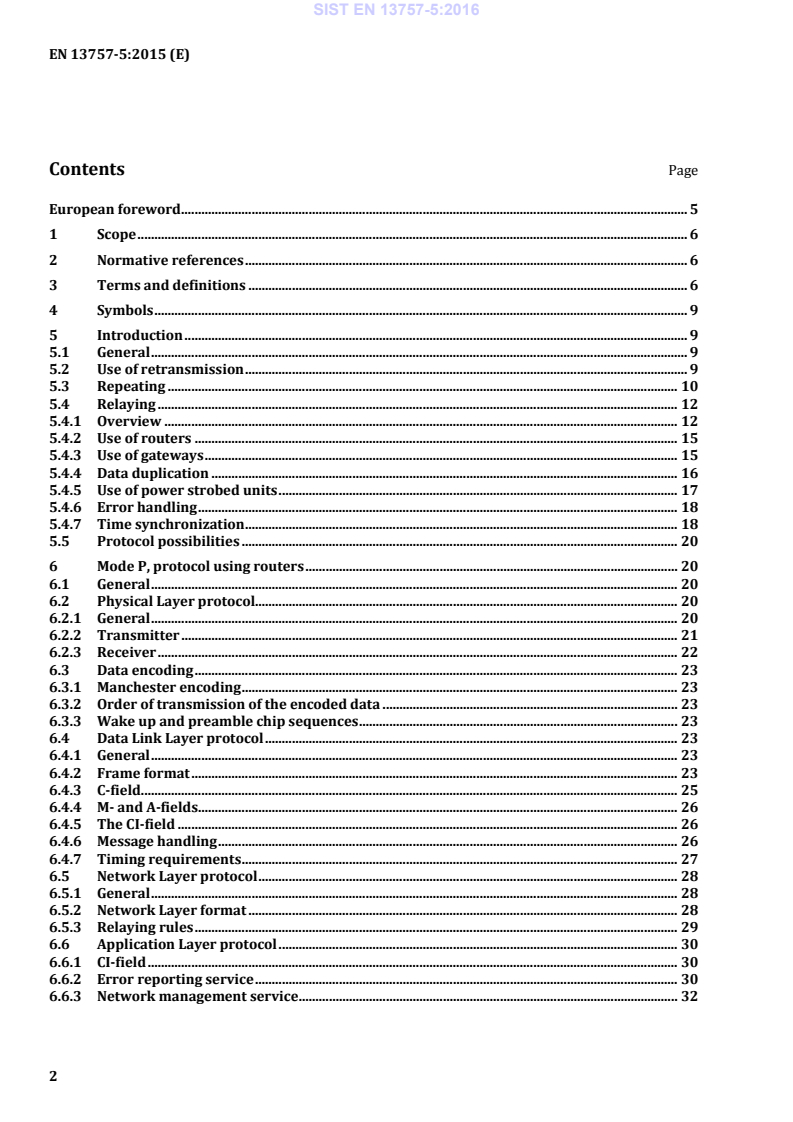
Page European foreword . 5 1 Scope . 6 2 Normative references . 6 3 Terms and definitions . 6 4 Symbols . 9 5 Introduction . 9 5.1 General . 9 5.2 Use of retransmission . 9 5.3 Repeating . 10 5.4 Relaying . 12 5.4.1 Overview . 12 5.4.2 Use of routers . 15 5.4.3 Use of gateways . 15 5.4.4 Data duplication . 16 5.4.5 Use of power strobed units . 17 5.4.6 Error handling . 18 5.4.7 Time synchronization . 18 5.5 Protocol possibilities . 20 6 Mode P, protocol using routers . 20 6.1 General . 20 6.2 Physical Layer protocol. 20 6.2.1 General . 20 6.2.2 Transmitter . 21 6.2.3 Receiver . 22 6.3 Data encoding . 23 6.3.1 Manchester encoding . 23 6.3.2 Order of transmission of the encoded data . 23 6.3.3 Wake up and preamble chip sequences . 23 6.4 Data Link Layer protocol . 23 6.4.1 General . 23 6.4.2 Frame format . 23 6.4.3 C-field . 25 6.4.4 M- and A-fields . 26 6.4.5 The CI-field . 26 6.4.6 Message handling . 26 6.4.7 Timing requirements . 27 6.5 Network Layer protocol . 28 6.5.1 General . 28 6.5.2 Network Layer format . 28 6.5.3 Relaying rules . 29 6.6 Application Layer protocol . 30 6.6.1 CI-field . 30 6.6.2 Error reporting service . 30 6.6.3 Network management service . 32 SIST EN 13757-5:2016
Timing Diagrams for a Single Hop Repeater . 89 Annex B (informative)
Message examples . 100 B.1 Command to Repeater and response . 100 B.1.1 General . 100 B.1.2 Configuration . 100 B.1.3 Detailed data, command . 101 B.1.4 Detailed data, acknowledge . 102 B.2 Readout of Radio Scan List . 102 B.2.1 General . 102 B.2.2 Configuration . 102 B.2.3 Detailed data, command . 103 B.2.4 Detailed data, acknowledge . 104 B.2.5 Detailed data, request . 105 B.2.6 Detailed data, response . 106 Bibliography . 108
RML list of end nodes registered for repetition Note 1 to entry: The list is allocated to (and downloaded into) a repeater by Network Control. The list is generated from meter assignment and meter registration. 3.19 repeater intermediate node in a data communications network, retransmitting data without modifying address information 3.20 router intermediate node in a data communications network, connected to two or more logical networks with identical protocols and modes SIST EN 13757-5:2016
Key A – E meters K – L repeater Z Other Device Figure 1 — Unidirectional Single Hop Repeater, USHR SIST EN 13757-5:2016
Key A – E meters K – L repeater Z Other Device Figure 2 — Bidirectional Single Hop Repeater, BSHR Bi-direction repetition, as shown on Figure 2, may get a little more complex once bidirectional meters and repeaters are used. The bidirectional meters may, for energy saving purpose, only enable its receiver in a narrow listening window. The setup in the repeater ensures that any response from the Other Device is transmitted in this listening window. The details of this are specified in Clause 9. 5.4 Relaying 5.4.1 Overview A radio network may have a structure like the one shown in Figure 3 below. The Nodes A, B, C, D, E, F and G are simple meters. They all need to communicate with Node Z, the data collecting unit / the primary station. In the current setup only the Nodes C and F, are able to reach the Node Z. The other nodes cannot reach the Node Z. The useful size of this network is thereby limited to only 2 nodes, Nodes C and F. SIST EN 13757-5:2016
Key A – G simple meters Z data collecting unit/primary station Figure 3 — Network with simple nodes, without relaying Extending the network by adding some nodes with relaying capability will give a structure as shown on Figure 4. Nodes F and G have now been extended to include relaying capability. Communication between Nodes A, B and D and the primary station is achieved by relaying the data through Nodes G and F. Node A sends data to node G, node G relays data to node F and node F relays data to the Node Z, the data collecting unit. The size of the network can now be extended to include all of the nodes shown. The Nodes F and G may be dedicated relaying nodes or meters with extended capabilities. Transmission from one node to another is called a hop. The transmission from node A to the data collecting unit/primary station consists of three hops. SIST EN 13757-5:2016
Key A – E simple meters F, G nodes with relaying capability Z data collecting unit/primary station Figure 4 — Network with relaying nodes Remark that the network still has a hierarchical structure at the application level, despite the relaying nodes. All end-to-end data transfer is performed between the data collecting unit and the meters. The meters do not communicate with one another at the application level nor do the relays.
Router approach Gateway approach Key UP upper layers (Transport – Application) NW Network Layer DL Data Link layer PH Physical layer M meter GW node with relaying capability (gateway) P data collecting unit/primary station Figure 5 — Router vs. gateway solution The relaying can be performed in two different ways as shown in Figure 5 using either a gateway or a router approach. SIST EN 13757-5:2016
Key A – E simple meters F, G nodes with relaying capability Z data collecting unit/primary station Figure 6 — Data duplication Data sent by Node E can be received by gateway G as well as by gateway F. When Node E sends a set of data, it will be received by both gateways. One set of data will be sent along the path E – G – F to node Z, the data collecting unit and another set of data will be sent along the path E – F to node Z. The use of unconditional relaying will cause duplication of the data received by the data collecting unit and cause unnecessary traffic on the network as well. Methods and rules needs to be implemented to ensure that data duplication is limited. Two issues should be handled when looking into avoidance of data duplication; a) Whether to use enabling or disabling lists, b) Whether to use a list of local or global nodes. The nature of radio communication is that the actual transmitting distance may vary a lot over time. It is thus not feasible to generate a list of nodes, not allowed to relay for. Special transmitting conditions, due to for instance special metrological conditions, may make it possible to hear nodes located far away. It is as well possible, that a new operator, also following this European Standard, could set up new nodes that were not known, when the initial network was set up. Data from the new nodes is not to be performed by default, but there is no possibility of knowing the coming of these nodes in advance. These are examples of situations that cannot be handled orderly by a disabling list. An enabling list shall therefore be used. The use of a global list of nodes, would require, that nodes at the higher levels of the hierarchy contains very large lists holding the address of all subordinate units it is to receive data from. All possible intermediate nodes has as well to contain information about all their subordinate nodes. This would SIST EN 13757-5:2016
...