

SIST-TS CEN/TS 16614-6:2024
(Main)Public transport - Network and timetable exchange (NeTEx) - Part 6: European Passenger Information Accessibility Profile
General Information
- Abstract
This document is a profile of the CEN/TS 16614 series. It focuses on information relevant to feed the necessary accessibility passenger information services and excludes operational and fares information. It is based directly on EPIP (CEN/TS 16614-4).
This European Passenger Information Accessibility Profile (EPIAP) for NeTEx is for exchanging passenger information; it describes how to extend EPIP (the European Passenger Information Profile) with additional information (including a minimal set) to feed the necessary accessibility passenger information services in a European wide and multimodal context. EPIAP especially formulates a mandatory minimal implementation that needs to be filled in by everybody to deliver the necessary information for an assessment of the accessibility of site(s), vehicles and on vehicle-site interaction for impaired persons. The minimal level allows an assessment and contains the information to produce PRM TSI if necessary. It will also cover what the current legislation usually warrants. It then describes how additional information must be provided if an organisation decides to provide it (e.g. the information of the full DELFI+ standard in Germany).
EPIP does not reflect part 5 (New Modes) yet. However, EPIAP takes it into account. EPIP will have to be adapted accordingly.
For EPIAP to be of use, the EC needs to declare the minimal level of EPIAP as mandatory.
- Status
- Published
- Publication Date
- 15-Sep-2024
- Technical Committee
- ITC - Information technology
- Current Stage
- 6060 - National Implementation/Publication (Adopted Project)
- Start Date
- 21-Aug-2024
- Due Date
- 26-Oct-2024
- Completion Date
- 16-Sep-2024

Overview
CEN/TS 16614-6:2024 - European Passenger Information Accessibility Profile (EPIAP) is Part 6 of the NeTEx family. It is a CEN Technical Specification (NeTEx) that defines a NeTEx profile focused on exchanging accessibility-related passenger information across Europe in a multimodal context. EPIAP extends the European Passenger Information Profile (EPIP, Part 4) with a mandatory minimal implementation that enables consistent assessment of the accessibility of sites, vehicles and vehicle–site interactions for persons with reduced mobility and other impairments. The profile excludes operational and fares data.
Key topics and requirements
- Mandatory minimal data set: a required, minimal set of accessibility attributes to be provided by all data producers so accessibility assessments can be made and PRM‑TSI outputs produced if needed.
- Extensions to EPIP: defines how to extend Part 4 (EPIP) with additional accessibility fields while taking new transport modes (Part 5) into account.
- Site modelling: structured representation of stop places, quays, entrances, access spaces and site equipment required for accessibility descriptions.
- Vehicle accessibility assessment: attributes and models to describe vehicle layouts, boarding aids, wheelchair spaces and related on‑vehicle features.
- Vehicle–stop interaction: data specifying how vehicles interact with site infrastructure (e.g., boarding heights, gap information).
- Assistance and operational metadata: key elements to describe passenger assistance and accessibility services (without covering operational scheduling).
- Realtime & journey planning integration: guidance on providing accessibility information for realtime feeds and OJP (Open Journey Planning) consumers.
- Modelling principles and interoperability rules: profile rules, code values, frame types and strict conformance guidance to reduce ambiguity and support plug‑and‑play integration.
- Compliance & adoption note: EPIAP is a provisional CEN/TS (initially limited to three years). For practical effectiveness the document notes that the European Commission should declare the minimal level mandatory.
Applications and who should use it
- Public transport authorities and network planners - to publish standardised accessibility data for stops, stations and vehicles.
- Operators and vehicle manufacturers - to describe on‑board accessibility features and vehicle–stop compatibility.
- Journey planner and real‑time information providers - to consume EPIAP feeds and surface accessibility guidance to travellers.
- Accessibility service providers and third‑party apps - to aggregate and present multimodal accessibility options.
- Regulators and policy makers - to harmonise reporting and support PRM‑TSI compliance and accessibility legislation.
Related standards and resources
- NeTEx series: Parts 1–5 (network, timetables, fares, EPIP and alternative modes)
- EN 12896 (Transmodel reference data model) series
- SIRI (EN 15531) for realtime interoperability
- Reference implementations and XML schema: netex-cen.eu and GitHub (NeTEx-CEN/NeTEx)
EPIAP enables consistent, machine‑readable accessibility data exchange across Europe - a practical foundation for inclusive multimodal travel information.
Relations
- Refers
SIST EN 12896-6:2026 - Public transport - Reference data model - Part 6: Passenger information - Effective Date
- 08-Jul-2026
- Effective Date
- 08-Jul-2026
- Effective Date
- 08-Jul-2026
- Effective Date
- 08-Jul-2026
- Effective Date
- 08-Jul-2026
- Effective Date
- 25-Feb-2026
- Effective Date
- 25-Feb-2026
- Effective Date
- 25-Feb-2026
- Effective Date
- 25-Feb-2026
- Effective Date
- 25-Feb-2026
- Effective Date
- 28-Jan-2026
- Effective Date
- 28-Jan-2026
- Effective Date
- 28-Jan-2026
- Refers
SIST EN 12896-6:2019 - Public transport - Reference data model - Part 6: Passenger information - Effective Date
- 28-Jan-2026
- Effective Date
- 28-Jan-2026
Get Certified
Connect with accredited certification bodies for this standard

BSI Group
BSI (British Standards Institution) is the business standards company that helps organizations make excellence a habit.

Great Wall Tianjin Quality Assurance Center
Established 1993, first batch to receive national accreditation with IAF recognition.
Hong Kong Quality Assurance Agency (HKQAA)
Hong Kong's leading certification body.
Sponsored listings
Frequently Asked Questions
SIST-TS CEN/TS 16614-6:2024 is a technical specification published by the Slovenian Institute for Standardization (SIST). Its full title is "Public transport - Network and timetable exchange (NeTEx) - Part 6: European Passenger Information Accessibility Profile". This standard covers: This document is a profile of the CEN/TS 16614 series. It focuses on information relevant to feed the necessary accessibility passenger information services and excludes operational and fares information. It is based directly on EPIP (CEN/TS 16614-4). This European Passenger Information Accessibility Profile (EPIAP) for NeTEx is for exchanging passenger information; it describes how to extend EPIP (the European Passenger Information Profile) with additional information (including a minimal set) to feed the necessary accessibility passenger information services in a European wide and multimodal context. EPIAP especially formulates a mandatory minimal implementation that needs to be filled in by everybody to deliver the necessary information for an assessment of the accessibility of site(s), vehicles and on vehicle-site interaction for impaired persons. The minimal level allows an assessment and contains the information to produce PRM TSI if necessary. It will also cover what the current legislation usually warrants. It then describes how additional information must be provided if an organisation decides to provide it (e.g. the information of the full DELFI+ standard in Germany). EPIP does not reflect part 5 (New Modes) yet. However, EPIAP takes it into account. EPIP will have to be adapted accordingly. For EPIAP to be of use, the EC needs to declare the minimal level of EPIAP as mandatory.
This document is a profile of the CEN/TS 16614 series. It focuses on information relevant to feed the necessary accessibility passenger information services and excludes operational and fares information. It is based directly on EPIP (CEN/TS 16614-4). This European Passenger Information Accessibility Profile (EPIAP) for NeTEx is for exchanging passenger information; it describes how to extend EPIP (the European Passenger Information Profile) with additional information (including a minimal set) to feed the necessary accessibility passenger information services in a European wide and multimodal context. EPIAP especially formulates a mandatory minimal implementation that needs to be filled in by everybody to deliver the necessary information for an assessment of the accessibility of site(s), vehicles and on vehicle-site interaction for impaired persons. The minimal level allows an assessment and contains the information to produce PRM TSI if necessary. It will also cover what the current legislation usually warrants. It then describes how additional information must be provided if an organisation decides to provide it (e.g. the information of the full DELFI+ standard in Germany). EPIP does not reflect part 5 (New Modes) yet. However, EPIAP takes it into account. EPIP will have to be adapted accordingly. For EPIAP to be of use, the EC needs to declare the minimal level of EPIAP as mandatory.
SIST-TS CEN/TS 16614-6:2024 is classified under the following ICS (International Classification for Standards) categories: 03.220.01 - Transport in general; 35.240.60 - IT applications in transport. The ICS classification helps identify the subject area and facilitates finding related standards.
SIST-TS CEN/TS 16614-6:2024 has the following relationships with other standards: It is inter standard links to SIST EN 12896-6:2026, SIST EN 12896-7:2026, SIST EN 12896-4:2026, SIST EN 12896-5:2026, SIST EN 12896-1:2026, SIST-TS CEN/TS 16614-3:2026, SIST-TS CEN/TS 16614-4:2026, SIST-TS CEN/TS 16614-1:2026, SIST-TS CEN/TS 16614-5:2026, SIST-TS CEN/TS 16614-2:2026, SIST-TS CEN/TS 16614-2:2020, SIST EN 12896-4:2019, SIST-TS CEN/TS 16614-3:2020, SIST EN 12896-6:2019, SIST EN 12896-7:2019. Understanding these relationships helps ensure you are using the most current and applicable version of the standard.
SIST-TS CEN/TS 16614-6:2024 is associated with the following European legislation: EU Directives/Regulations: 2010/40/EU; Standardization Mandates: M/456. When a standard is cited in the Official Journal of the European Union, products manufactured in conformity with it benefit from a presumption of conformity with the essential requirements of the corresponding EU directive or regulation.
SIST-TS CEN/TS 16614-6:2024 is available in PDF format for immediate download after purchase. The document can be added to your cart and obtained through the secure checkout process. Digital delivery ensures instant access to the complete standard document.
Standards Content (Sample)
SLOVENSKI STANDARD
01-oktober-2024
Javni prevoz - Izmenjava omrežnih in voznorednih podatkov (NeTEx) - 6. del:
Evropski profil za dostopnost potovalnih informacij
Public transport - Network and timetable exchange (NeTEx) - Part 6: European
Passenger Information Accessibility Profile
Öffentlicher Verkehr - Netzwerk- und Fahrplan-Austausch (NeTEx) - Teil 6:
Europäisches Profil für barrierefreie Fahrgastinformation
Transport public - Echanges des informations planifiées (NeTEx) - Partie 6: Profil
Européen d’Information Voyageur pour l’Accessibilité
Ta slovenski standard je istoveten z: CEN/TS 16614-6:2024
ICS:
03.220.01 Transport na splošno Transport in general
35.240.60 Uporabniške rešitve IT v IT applications in transport
prometu
2003-01.Slovenski inštitut za standardizacijo. Razmnoževanje celote ali delov tega standarda ni dovoljeno.
CEN/TS 16614-6
TECHNICAL SPECIFICATION
SPÉCIFICATION TECHNIQUE
June 2024
TECHNISCHE SPEZIFIKATION
ICS 35.240.60
English Version
Public transport - Network and timetable exchange
(NeTEx) - Part 6: European Passenger Information
Accessibility Profile
Transport public - Echanges des informations Öffentlicher Verkehr - Netzwerk- und Fahrplan-
planifiées (NeTEx) - Partie 6: Profil Européen Austausch (NeTEx) - Teil 6: Europäisches Profil für
d'Information Voyageur pour l'Accessibilité Fahrgastinformation zu Barrierefreiheit
This Technical Specification (CEN/TS) was approved by CEN on 15 April 2024 for provisional application.
The period of validity of this CEN/TS is limited initially to three years. After two years the members of CEN will be requested to
submit their comments, particularly on the question whether the CEN/TS can be converted into a European Standard.
CEN members are required to announce the existence of this CEN/TS in the same way as for an EN and to make the CEN/TS
available promptly at national level in an appropriate form. It is permissible to keep conflicting national standards in force (in
parallel to the CEN/TS) until the final decision about the possible conversion of the CEN/TS into an EN is reached.
CEN members are the national standards bodies of Austria, Belgium, Bulgaria, Croatia, Cyprus, Czech Republic, Denmark, Estonia,
Finland, France, Germany, Greece, Hungary, Iceland, Ireland, Italy, Latvia, Lithuania, Luxembourg, Malta, Netherlands, Norway,
Poland, Portugal, Republic of North Macedonia, Romania, Serbia, Slovakia, Slovenia, Spain, Sweden, Switzerland, Türkiye and
United Kingdom.
EUROPEAN COMMITTEE FOR STANDARDIZATION
COMITÉ EUROPÉEN DE NORMALISATION
EUROPÄISCHES KOMITEE FÜR NORMUNG
CEN-CENELEC Management Centre: Rue de la Science 23, B-1040 Brussels
© 2024 CEN All rights of exploitation in any form and by any means reserved Ref. No. CEN/TS 16614-6:2024 E
worldwide for CEN national Members.
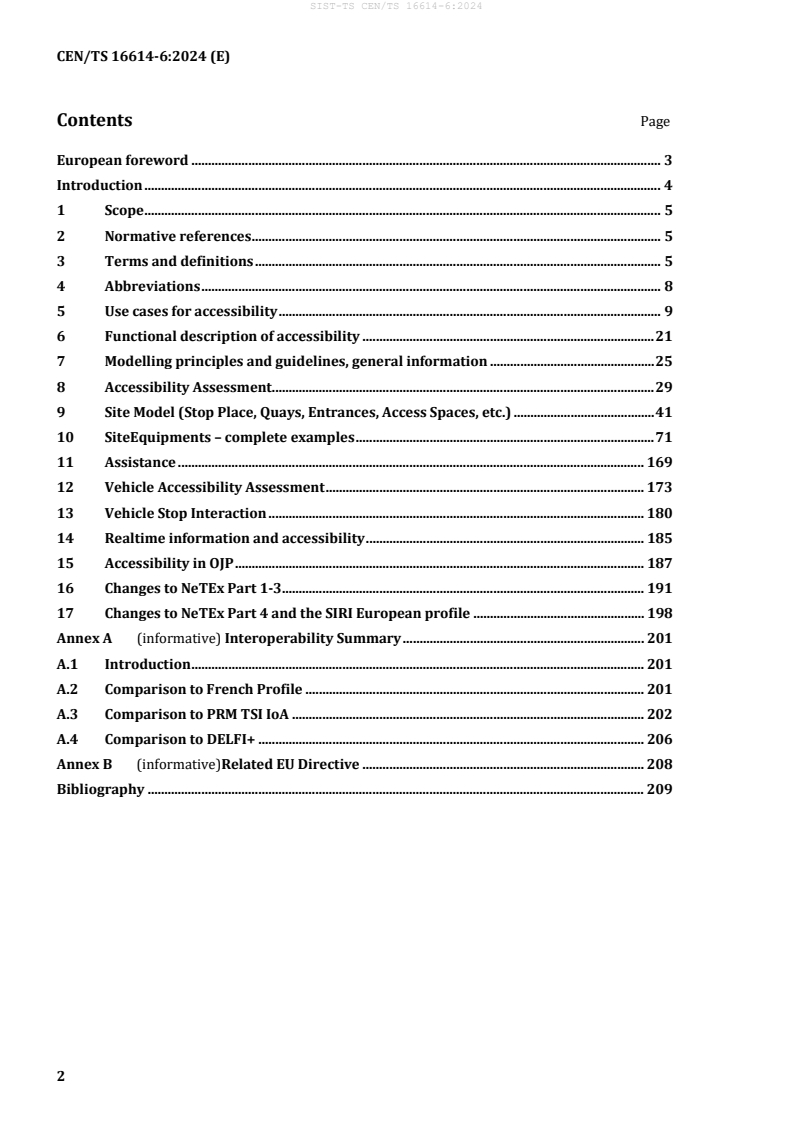
Contents Page
European foreword . 3
Introduction . 4
1 Scope . 5
2 Normative references . 5
3 Terms and definitions . 5
4 Abbreviations . 8
5 Use cases for accessibility . 9
6 Functional description of accessibility . 21
7 Modelling principles and guidelines, general information . 25
8 Accessibility Assessment . 29
9 Site Model (Stop Place, Quays, Entrances, Access Spaces, etc.) . 41
10 SiteEquipments – complete examples . 71
11 Assistance . 169
12 Vehicle Accessibility Assessment . 173
13 Vehicle Stop Interaction . 180
14 Realtime information and accessibility . 185
15 Accessibility in OJP . 187
16 Changes to NeTEx Part 1-3 . 191
17 Changes to NeTEx Part 4 and the SIRI European profile . 198
Annex A (informative) Interoperability Summary . 201
A.1 Introduction . 201
A.2 Comparison to French Profile . 201
A.3 Comparison to PRM TSI IoA . 202
A.4 Comparison to DELFI+ . 206
Annex B (informative)Related EU Directive . 208
Bibliography . 209
European foreword
This document (CEN/TS 16614-6:2024) has been prepared by Technical Committee CEN/TC 278
“Intelligent transport systems”, the secretariat of which is held by NEN.
Attention is drawn to the possibility that some of the elements of this document may be the subject of
patent rights. CEN shall not be held responsible for identifying any or all such patent rights.
This document has been prepared under a standardization request addressed to CEN by the European
Commission. The Standing Committee of the EFTA States subsequently approves these requests for its
Member States.
This document presents Part 6 of the European Technical Specification known as “NeTEx”. NeTEx
provides a framework for specifying communications and data exchange protocols for organisations
wishing to exchange scheduled information relating to public transport operations.
This document is made up of six parts defining a single European Standard series, which provides a
complete exchange format for public transport networks, timetable description and fare information:
— Part 1 is the description of the public transport network topology exchange format. It also contains
use cases shared with part 2, modelling rules, and the description of a framework shared by all
parts.
— Part 2 is the description of the scheduled timetables exchange format.
— Part 3 is the description of the fare information exchange format.
— Part 4 is the description of the European passenger information profile.
— Part 5 is the description of the alternative modes exchange format.
— Part 6 is the description of the European passenger information accessibility profile.
Part 1 is fully standalone, and Parts 2 and 3, 4, 5 and 6 rely on Part 1. Part 6 also relies on Part 4.
The XML schema can be downloaded from https://netex-cen.eu or from GitHub
(https://github.com/NeTEx-CEN/NeTEx, either press code and download zip or use a defined tag), along
with available guidance on its use, example XML files, and case studies of national and local deployments.
Transmodel terms and NeTEx conceptual model elements are written in capital letters, a journey pattern
would be spelled as JOURNEY PATTERN.
The minimally recommended elements are printed in bold in the examples.
Any feedback and questions on this document should be directed to the users’ national standards body.
A complete listing of these bodies can be found on the CEN website.
According to the CEN/CENELEC Internal Regulations, the national standards organisations of the
following countries are bound to announce this Technical Specification: Austria, Belgium, Bulgaria,
Croatia, Cyprus, Czech Republic, Denmark, Estonia, Finland, France, Germany, Greece, Hungary, Iceland,
Ireland, Italy, Latvia, Lithuania, Luxembourg, Malta, Netherlands, Norway, Poland, Portugal, Republic of
North Macedonia, Romania, Serbia, Slovakia, Slovenia, Spain, Sweden, Switzerland, Türkiye and the
United Kingdom.
Introduction
Public transport services rely increasingly on information systems to ensure reliable, efficient operation
and widely accessible, accurate passenger information. These systems are used for a range of specific
purposes: setting schedules and timetables; managing vehicle fleets; issuing tickets and receipts;
providing real-time information, and so on.
This document specifies a Profile of Network and Timetable Exchange (NeTEx) for public transport.
NeTEx is intended to be used to exchange information between public transport organisation systems
containing mostly scheduled public transport data. It can also be seen as a complement to the SIRI
(Service Interface for Real-time Information) standard (the EN 15531 series), as SIRI needs reference
data exchanged in the scope of NeTEx before any possible real-time exchange.
Well-defined, open interfaces have a crucial role in improving the economic and technical viability of
public transport information systems of all kinds. Using standardized interfaces, systems can be
implemented as discrete pluggable modules that can be chosen from a wide variety of suppliers in a
competitive market, rather than as monolithic proprietary systems from a single supplier. Interfaces also
allow the systematic automated testing of each functional module, vital for managing the complexity of
increasingly large and dynamic systems. Furthermore, individual functional modules can be replaced or
evolved, without unexpected breakages of obscurely dependent functions.
NeTEx improves a number of features of public transport information and service management:
• Interoperability – the standard will facilitate interoperability between information processing
systems of the transport operators by:
introducing common architectures for message exchange;
introducing a modular set of compatible information services for real-time vehicle
information;
using common data models and schemas for the messages exchanged for each service;
introducing a consistent approach to data management.
• Technical advantages include the following: reusing a common communication layer shared with SIRI
for all the various technical services enables cost-effective implementations, and makes the standard
readily extensible in the future.
A profile is an ancillary document to the standard which specifies additional rules for implementation in
a given context. The profile contains information such as:
• Details of the objects used in an exchange.
• Details on the options proposed by the standard.
• Details on optional elements.
• Precision on the identifier codes to be used.
• Advice on grouping elements.
The reason for having a detailed profile specification is that it facilitates implementation. A developer
intending to implement a certain service or type of service in a given environment need only implement
the smaller set of options and parameters specified in the profile and is given a number of additional rules
that restrict or simplify the required processing of data.
1 Scope
This document is a profile of the CEN/TS 16614 series. It focuses on information relevant to feed the
necessary accessibility passenger information services and excludes operational and fares information.
It is based directly on EPIP (CEN/TS 16614-4).
This European Passenger Information Accessibility Profile (EPIAP) for NeTEx is for exchanging
passenger information; it describes how to extend EPIP (the European Passenger Information Profile)
with additional information (including a minimal set) to feed the necessary accessibility passenger
information services in a European wide and multimodal context. EPIAP especially formulates a
mandatory minimal implementation that needs to be filled in by everybody to deliver the necessary
information for an assessment of the accessibility of site(s), vehicles and on vehicle-site interaction for
impaired persons. The minimal level allows an assessment and contains the information to produce PRM
TSI if necessary. It will also cover what the current legislation usually warrants. It then describes how
additional information must be provided if an organisation decides to provide it (e.g. the information of
the full DELFI+ standard in Germany).
EPIP does not reflect part 5 (New Modes) yet. However, EPIAP takes it into account. EPIP will have to be
adapted accordingly.
For EPIAP to be of use, the EC needs to declare the minimal level of EPIAP as mandatory.
2 Normative references
The following documents are referred to in the text in such a way that some or all of their content
constitutes requirements of this document. For dated references, only the edition cited applies. For
undated references, the latest edition of the referenced document (including any amendments) applies.
EN 12896-1, Public transport — Reference data model — Part 1: Common concepts
EN 12896-4, Public transport — Reference data model — Part 4: Operations monitoring and control
EN 12896-5, Public transport — Reference data model — Part 5: Fare management
EN 12896-6, Public transport — Reference data model — Part 6: Passenger information
EN 12896-7, Public transport — Reference data model — Part 7: Driver management
EN 12896-8, Public transport — Reference data model — Part 8: Management information & statistics
CEN/TS 16614-1, Public transport — Network and Timetable Exchange (NeTEx) — Part 1: Public
transport network topology exchange format
CEN/TS 16614-2, Public transport — Network and Timetable Exchange (NeTEx) — Part 2: Public
transport scheduled timetables exchange format
CEN/TS 16614-3, Public transport — Network and Timetable Exchange (NeTEx) — Part 3: Public
transport fares exchange format
CEN/TS 16614-4, Public transport — Network and Timetable Exchange (NeTEx) — Part 4: Passenger
Information European Profile
CEN/TS 16614-5, Public transport — Network and timetable exchange (NeTEx) — Part 5: Alternative
modes exchange format
3 Terms and definitions
For the purposes of this document, the terms and definitions given in the EN 12896 series
(Transmodel V6) and the CEN/TS 16614 series (NeTEx) and the following apply.
3.1
attribute
property of an entity
3.2
conceptual data model
description of a real-world domain in terms of entities, relationships and attributes, in an implementation
independent manner
Note 1 to entry: It should provide a structure on which the rest of the development of an application system can be
based.
3.3
conformant
satisfying all the rules of a specification, both syntactic and otherwise
3.4
consumer
system that imports profile conformant data
3.5
data model
description of a real-world domain in terms of data and relationships
3.6
data provider
organisation responsible for providing data
Note 1 to entry: This may be distinct from that of the data source or the producer.
3.7
dominant validity condition
validity condition that attaches to a version frame and applies to all its contents
3.8
entity
object (data) that has its own existence (as opposed to an attribute)
3.9
external reference
reference to another object in a document other than the document holding the reference
3.10
fare management
all activities related to the travel products and their tariffication
3.11
functional area
arbitrarily defined set of activities, used, in this document, to define the objectives and limits of the data
model and exchange profile
3.12
internal reference
reference to another object in the same document as that holding the reference
3.13
interoperability
ability of (sub)systems to interact with other (sub)systems according to a set of predefined rules
(interface)
3.14
object-oriented data model
data structure expressed according to principles that allow for a direct implementation as an object-
oriented database, where information is represented in the form of objects, i.e., respecting the principle
of encapsulation, meaning in particular that each data is accessed or modified through operations
(methods) belonging to it
3.15
passenger information
all activities related to informing the users either about the planned or about the actual transportation
services
3.16
producer
system that outputs data intended to be conformant to a profile
3.17
profile
subset of a standard selecting the needed concepts (entities and associated attributes) for a specific use
case or set of use cases, and complemented by rules defined to restrict possibilities of divergent
interpretations of open parts of the standard
3.18
profile code value
metadata used to describe a profile, a standardised code value, unique with the namespace of the profile,
that helps define the profile
3.19
profile metadata
data describing the properties of a profile, such as the permitted frame types and restricted code values
3.20
specific frame
version frame that may only contain certain types entities concerned with a particular functional area,
e.g. to describe a timetable
3.21
strict conformance
conformance to a profile such that a document contains only the specified elements (i.e. that is not
augmented or extended)
3.22
XML document
file containing data marked up with XML tags conforming exactly to an XML schema that specifies precise
syntactic rules for the names, nesting and cardinalities of the tags and for the formats of the data values
4 Abbreviations
CCAM Cooperative, Connected and Automated Mobility
CEN Comité Européen de Normalisation (European Committee for Standardization)
CEN/TC CEN Technical Committee
CEN/TS CEN Technical Specification
CENELEC European Committee for Electrotechnical Standardization
DELFI Durchgängige ELektronische FahrgastInformation
EN European Norm
EPIAP European Passenger Information Accessibility Profile for NeTEx
EPIP European Passenger Information Profile for NeTEx
ERA EU Agency for Railways
EU European Union
HRDF Hafas Raw Data Format
IFOPT Identification of Fixed Objects in Public Transport – DEPRECATED AND REPLACED
BY TRANSMODEL FROM VERSION 6
ISO International Organization for Standardization
ITS Intelligent Transport Systems
MaaS Mobility as a Service
NEN NEderlandse Norm (Dutch Norm)
NeTEx Network and Timetable Exchange
OJP Open Journey Planner
OSM Open Street Map
PRM Persons with Reduced Mobility
PT Public Transport
PTO Public Transport Operator
PT1711 (a CEN Technical Specification for alternative modes of PT)
SIRI Service Interface for Real-time Information
Transmodel Public Transport Reference Data Model (EN 12896)
TSI Technical Specification(s) for Interoperability
TSI TAP TSI - Telematics applications for passenger services
PRM TSI TSI - Persons with Reduced Mobility
PRM TSI IoA PRM TSI Inventory of Assets
UML Unified Modelling Language
XML Extensible Markup Language
XSD XML Schema Definition
5 Use cases for accessibility
5.1 General
Finding out the level of accessibility during the entire passenger journey/ trip (i.e., along the trip chain)
is a high priority. The presence of an “inaccessible" transfer within the travel chain can significantly
reduce the accessibility of the entire journey. Planning and selection of individual stages within the
journey need to be based on knowledge about the accessibility of individual transport services, as well as
the physical transfer to subsequent transport services, from the departure of the passenger at the origin
(i.e., residential area) to the destination (i.e., work/school or tourist destination).
At the pre-trip planning stage, the passenger will use a journey planner (also called trip planner) which
will provide sufficient information for all the stages in the trip.
1. Procedures to access transport services
a. Procedures to book and purchase transport services
b. Procedures to book accessibility assistance services
c. Information on passenger rights
d. Information on services for persons with disabilities and reduced mobility
2. Information on transport stations/stops:
a. Locations of destinations and transport stations/stops
b. Accessibility of destinations and transport stations/stops
c. Layout and location of facilities in transport stations (including emergency services)
d. Accessibility of services within transport stations
3. Information on transport services:
a. Travel and route options
b. Accessibility of travel and route options (for each segment)
c. Real-time transport schedules and disruptions
d. Location and accessibility of platforms (also for specific locations on the platform)
e. Ticket conditions and prices
f. Integration with booking and purchasing of travel tickets or assistance services
5.2 During trip and on-trip usage
The existence of smartphone devices has made on-trip information services and planning based on them
very common. Making and adjusting trip plans “on-the-go" no longer requires past experience or requests
for information from attendants. Since smartphones are often equipped with location services, the trip
can be planned from the current position of the passenger to the destination of choice. Travel Information
systems can also provide information on real-time disruptions:
- Information on transport services:
o Real-time provision of transport schedules and disruptions
o Support route planning in case of disruptions (similar to information and
booking/purchase in the pre-trip stage)
- Personal navigation
o Real-time navigation instructions, including current location (towards destinations, next
platform or accessibility services)
Data supplied in the NeTEx EPIP format forms the basis for enabling both the pre-trip and on-trip
functionalities. This profile describes an unambiguous interpretation of accessibility based on EPIP.
Collecting detailed data from stations and stops to meet the information needs of travellers with
disabilities requires a substantial effort. The starting point with regard to available data differs greatly
between the different Member States. NeTEx offers a framework to collect data at different levels of detail.
This concept is also used in EPIAP, which gives an entry-level for all Member States to include accessibility
in travel information.
Until both infrastructure and vehicles are accessible without restrictions, appropriate information
services can and must make an important contribution to enable or facilitate the use of public transport
for people with reduced mobility and the elderly. This will be more successful as all information relevant
to the passenger can be made generally accessible in high quality.
Passengers with reduced mobility is a collective name for different user groups. Each of these user groups
has different needs for a journey to be accessible. to describe inputs for a journey planner that may to be
taken in to account when seeking journeys. For example, an assisted wheelchair could use a route that
involved a single step and the use of doors. An unassisted wheelchair would not. A path between an
entrance and a stop that is accessible for a person in a wheelchair might not be suitable for a visually
impaired person.
5.3 User groups
The following assumptions apply to the user groups.
• There are different types of disability: physical, sensory and cognitive:
o Physically impaired people mainly have special requirements regarding obstacles and
hindrances on their way (e.g., wheelchair accessibility).
o Sensory impaired people mainly have special requirements to be able to find their way, in
particular by relying on additional sensory information (e.g., tactile guidance, colored steps,
audible signals).
o Cognitively impaired people mainly have special requirements for easy access to information
and easy to understand information and guidance (e.g., how to change trains).
• Within the disability types there are different user groups with different needs.
• There are overlaps between the needs of user groups.
• Improved accessibility services in transportation in most cases benefit everyone.
User needs and user stories can always be assigned to a user group. The following table shows the user
groups within their type of disability and a selection of relevant needs for this particular user group.
Table 1 – User groups with special needs in public transport
Type User group Relevant needs (selection)
physical
Person in a wheelchair Wheelchair accessible routes (paths, ramp, elevator,
automatic doors), accessible stops, accessible vehicles
Person in a wheelchair (motorised) Wheelchair accessible routes (paths, ramp, elevator,
automatic doors), accessible stops, accessible vehicles,
entrance restrictions
Person in a wheelchair with Stair-free routes (paths with or without single steps,
assistance ramp, elevator), accessible stops, low floor vehicles
Person with walking disability (with Step free routes (paths, ramp, elevator),
aids like rollator) accessible stops, low floor vehicles, seating
Person with walking disability, Step free routes (paths, ramp, elevator), low floor
elderly, illness vehicles, seating
Temporary impaired Person (stroller, Step free routes (paths, ramp, elevator), low floor
baggage) vehicles, storage
sensory
Visually impaired person Surfaces, Braille, audio announcements, lighting
Hearing impaired person Visual information
Balance impaired person Handrails and grabrails
cognitive
Mentally impaired person Special drivers’ trainings
Special drivers’ trainings, easy understandable
Intellectually impaired person
information, easy ticketing
5.4 Use cases
5.4.1 General
For the profile no additional use cases have been created. Instead, existing use cases have been
complemented to include accessibility aspect. Two sources were considered: NeTEx part 1 and the EU
regulation (see Annex B).
5.4.2 Use cases from NeTEx part 1
The following relevant use cases have been taken from NeTEx part 1 and complemented with accessibility
aspects in this profile.
Use Case: NETWORK-001-002(#1)
Name Planning and understanding the coverage of an area or region by public transport
Source Transmodel
Description In order to plan the adequate accessibility on the PT service within a region, a detailed
model of actual coverage is needed.
NeTEx NeTEx allows for describing the availability and accessibility of stop places and stop
contribution points as well as the PT service offer within a region.
Use Case: NETWORK-001-002(#1)
Main actors Urban development departments, authorities.
Main objects Stop places, stop points, accessibility attributes.
Use Case: PASSENGER-001-014 (#2)
Name Planning trips through the network, including detailed transfer times and detailed
guidance for making an interchange between two services over a
connection/interchange.
Source Transmodel
Description In planning a multi-leg trip plan through a network, a trip planning system will take
into account the transfer time needed to interchange between services at an
interchange point. Depending on the sophistication of the journey planning system and
the availability of data, the individual timings required for transfers between different
stop areas or stop points within an interchange may be taken into account or just an
average time for any transfer at the station may be used.
In particular, in the case of frequency based services enough information about the
service frequency shall be provided to the journey planning system in order to allow
for sufficient waiting time.
Trips may be made by passengers on foot, on a bicycle, in a car or using a combination,
for example park and ride or kiss and ride. The stop model should support journey
planning of intermodal journeys.
Journey planners providing trip plans for trips involving the traversal of large
interchanges will be concerned to provide detailed guidance on the navigation of the
interchanges, typically as step by step instructions that can be related to the signage
found within the interchange building. Depending on the sophistication of the journey
planning system and the availability of data, the individual paths required for transfers
between different stop areas or stop points within an interchange using specifically
identified navigation paths and accessibility needs may be given.
NeTEx Journeys for NeTEx part 2
contribution
Connection and interchange times are part of NeTEx part 1.
NeTEx only supports guidance information if it is inside a Stop place (not on the road
network, etc.)
The link of Stop Places (or components) to the road has to be taken into account
Guidance information may be attached to the access path links.
Main actors Authorities, operators, passenger information systems.
Main objects Connection links, interchanges, stop places, accessibility attributes.
Use Case: PASSENGER-001-015 (#3)
Name Planning journeys through the network, including detailed connection/interchange
times, under different constraints for mobility restricted users.
Source Transmodel
Description As a refinement to previous use case, in planning a multi-leg trip through a network, a
journey planner may additionally take into account the accessibility requirements and
different transfer times needed for different types of users, with different walk speeds
or other needs, in particular for impaired mobility accessibility. Depending on the
sophistication of the journey planning system and the availability of data, the individual
timings required for transfers between different stop areas or stop points within an
interchange using specifically identified navigation paths and accessibility needs may
be taken into account or just an average time for any transfer at the station may be
used, scaled to a particular walk speed.
NeTEx Providing enough information to support the needs of mobility restricted users is of
contribution importance for NeTEx.
Stops places, Equipment, accessibility on path links.
Journey accessibility has to be taken into account in part 3. This comprises the
assignment of timetabled trips to vehicle attributes (e.g., low-floor, lift-equipped
vehicles).
Main actors Authorities, operators, passenger information systems.
Main objects Connection links, interchanges, stop places, accessibility attributes.
Use Case: PASSENGER-001-019 (#4)
Name Distributed assignment of responsibility for data management.
Source Transmodel
Description The data sets covered by NeTEx are large and belong to many different stakeholders.
The task of gathering, collating and aggregating the data necessarily shall be
distributed among many different organisations. Some degree of central coordination
is needed to agree who is responsible for which type of data, to agree common
interfaces, and to agree the partition of code namespaces so that data coded to a
common standard can be aggregated without clashes as to the unique identifiers.
Each data object should have:
- Operational responsibility.
- Owner (legal owner of the data who holds the copyright).
- Data Provider (Organization which runs the producer of the data).
- Administrator (Organization which is responsible for the content of the data).
- “Data System": Name Space in which identifiers are unique.
NeTEx NeTEx provides means to define ownership of data objects so that it becomes clear who
contribution is responsible to maintain the data. It also provides unique object identifiers that allow
mapping of object references across system boundaries.
Main actors Data aggregating systems, authorities.
Ownership attributes for stop places, stop points, lines, equipment, connections links,
Main objects
interchanges.
Object reference mechanisms.
The two following diagrams (Figure 1 and Figure 2) describe an example of an organisational context
that requires a distributed role (“Planning”) and a corresponding responsibility assignment. In this
example it is illustrated that several organisations do maintain the data that describe the informational
results of the processes that are executed by them. The following roles are shown:
• Schedule planning role as executed by PTOs.
A PTO may be responsible to plan its operations and provide the service view on the operational
schedule plans for external usage.
• Stop place accessibility planning as executed by infrastructure managers.
Municipal infrastructure management organisations may be responsible to provide the service
view on build and maintenance plans of stop places for external usage.
• Matching of schedule and stop place information as well is maintaining general integrity.
A separate role, the information manager, is shown that maintains the matching of the different
information sets. Matching of schedules and stop information is realised through the NeTEx
concept of “passenger stop assignments" that match logical stops (schedule) to physical stops
(stop place information).
Parts of this role could be carried out by the PTO’s. For the sake of clarity of the example, these considerations
are not taken into account, apart from the fact that NeTEx should not limit the implementation of different
organizational structures that are different from this example.
• Collating and aggregating of sets of information.
The integrator is responsible for collection and aggregation of the various datasets that
collectively describe the entire operation within an area (e.g., region or country). The result is the
provision of information to users that completely and consistently describe the journeys carried
out, regardless of service provider origin.
• End-usage of information.
Information can be used by various types of users, e.g. providers of a journey planning service.
The PTO’s and infrastructure managers are users as well.
One major justification for the existence of an integrator is the requirement that (sub) regional
information can be used consistently, regardless the partitioned structure of the original information sets
that are provided by the service providers that implement their part of the services. This is illustrated by
Figure 2, where an end-user requests data through a NeTEx filtered request, that describes the operation
in, e.g., a single city. This filtered sub-set is represented by the User view rectangle.
Figure 1 — Illustration for use case “Distributed assignment of responsibility".
Key
User view view presented to user
Op Operator
IM Information Manager
SM Stop Management
Network Network / plan information (NeTEx/Transmodel)
Assignment assignment of physical stops to network (NeTEx)
Stop physical stop information (NeTEx / IFOPT)
red dots and lines actual assignment stop to network element
Figure 2 — Illustration for use case Distributed assignment of responsibility, showing the
referencing of layers and the use of filtering
Use Case: VALIDITY-001-001 (#5)
Name Temporary change in stop availability
Source TRANSMODEL : GEN#02
Description Systems shall allow for the temporary change of stop availability or accessibility,
through the addition or closing of stops or the reassigning of scheduled stop points
from one physical location to another, the moving of stops, or by alterations to
accessibility. Typically such changes are planned in advance and can be distributed
with a validity condition along with other updates to the stop data.
NeTEx NeTEx provides enough support for temporary changes to stops such that current and
contribution up-to-date timetables can be exchanged to reflect the correct situation.
Support for advising passengers about what the impact to public transport will be and
how they could avoid potential disruptions is likely to be applied in the following two
typical situations:
• During preparation of a trip, e.g. by using a trip planner: NeTEx objects can
optionally refer to a SIRI-SX structure as part of the NeTEx data delivery to
provide situation related cause / effect information.
• During travelling, however, the provision of this cause / effect information is the
task of the operational SIRI interfaces.
Main actors Authorities, operators, passenger information systems
Main objects Validity information on stop places and stop point attributes
5.4.3 Use cases from the EU regulation
5.4.3.1 General
The following use cases are directly extracted from the COMMISSION DELEGATED REGULATION (EU)
2017/1926 of 31 May 2017 (https://eur-lex.europa.eu/legal-
content/EN/TXT/HTML/?uri=CELEX:32017R1926 ).
5.4.3.2 Trip planning
Table 2 – EU use cases for trip planning
Level Category Description Minimal Other
concept concepts
1 Trip plan Stop facilities access nodes FACILITIES EQUIPMENT
computation — (including platform information, STOP PLACE
scheduled modes help desks/information points, PASSENGER
transport ticket booths, lifts/stairs, entrances STOP
and exit locations) ASSIGNMENT
1 Trip plan Accessibility of access nodes, and FACILITIES EQUIPMENT
computation — paths within an interchange (such as STOP PLACE NAVIGATION
scheduled modes existence of lifts, escalators) PATH
transport
1 Trip plan Existence of assistance services FACILITIES LOCAL
computation — (such as existence of on-site STOP PLACE SERVICE
scheduled modes assistance)
transport
1 Trip plan Vehicles (low floor; wheelchair FACILITIES EQUIPMENT
computation — accessible.) VEHICLE
scheduled modes TYPE
transport
1 Trip plan Pedestrian network and accessibility n/a NAVIGATION
computation — facilities PATH
road transport Note: Detailed topology is usually
(for personal taken from a source like OSM.
modes)
1 Passing times, trip Status of access node features (SIRI)
plans and (including dynamic platform Situation
auxiliary information, operational Exchange
information lifts/escalators, closed entrances Facility
and exit locations — all scheduled Monitoring
modes)
3 Detailed common Passenger classes (classes of user ACCESS RIGHT
standard and such as adult, child, student, veteran, PARAMETER
special fare query impaired access and qualifying ASSIGNMENT
(all scheduled conditions and classes of travel such
st nd
modes) as 1 , 2 .)
Special Parking Information on parking facilities (all PARKING EQUIPMENT
case REGULATION modes) PARKING NAVIGATION
(EU) 2015/962 et Note: EU regulation doesn’t AREA PATH
REGULATION explicitly warrant accessibility PARKING BAY
(EU) 2017/1926 information for parking facilities.
5.4.3.3 Place information
Table 3 – EU use cases for place information
Level Category Description Minimal Other
concept concepts
1 Location search Address identifiers (building Everything ENTRANCE
(origin/destination) number, street name, postcode) that inherits QUAI
from POI
ADRESSABLE PARKING
PLACE
1 Location search Topographic places (city, town, TOPOGRAPHIC
(origin/destination) village, suburb, administrative PLACE
unit)
1 Location search Identified access nodes (all STOP PLACE QUAY
(access nodes) scheduled modes) SCHEDULED
STOP POINT
PASSENGER
STOP
ASSIGNMENT
1 Location search Geometry/map layout structure of STOP PLACE QUAY
(access nodes) access nodes (all scheduled
modes)
1 Trip plan Stop facilities access nodes STOP PLACE EQUIPMENT
computation — (including platform information, FACILITIES
scheduled modes help desks/information points,
transport ticket booths, lifts/stairs,
entrances and exit locations)
1 Trip plan Existence of assistance services STOP PLACE LOCAL
computation — (such as existence of on-site FACILITIES SERVICE
scheduled modes assistance)
transport
5.4.4 Use cases from the EU regulations (EU) 2019/772 (PRM TSI) and (EU) 454/2011
The use cases are extracted from the Commission Implementing Regulation (EU) 2019/772 of 16 May
2 3
2019 (PRM TSI) and from the Commission Regulation (EU) 454/2011 (TAP TSI) .
Table 4 – Use cases for the PRM TSI and TAP TSI
# Description Regulation
1 The entity in charge of collecting accessibility data or the station Recommendation
manager publishes information on the accessibility of rail services concerning a revision
of (EU) 454/2011
(TAP TSI)
2 the public shall be able to access information from a public website (EU) 2019/772
hosted by the European Union Agency for Railways
https://eur-lex.europa.eu/legal-content/EN/TXT/?qid=1566397460027&uri=CELEX%3A32019R0772
https://eur-lex.europa.eu/legal-content/EN/TXT/?uri=uriserv%3AOJ.L_.2013.328.01.0072.01.ENG
https://www.era.europa.eu/content/recommendation-era-rec-122-european-union-agency-railways-technical-
specification_en
# Description Regulation
3 registered national authorities shall be able to retrieve all accessibility (EU) 2019/772
data that are relevant to the Member State
4 the Commission and the Agency shall be able to retrieve all accessibility (EU) 2019/772
data
5.5 User group needs
Table 5 describes the passenger information need related to different user groups. It is also indicated to
which area of application the informatio
...