


SIST EN 12385-4:2003+A1:2008
(Main)Steel wire ropes - Safety - Part 4: Stranded ropes for general lifting applications
Steel wire ropes - Safety - Part 4: Stranded ropes for general lifting applications
This Part of this European Standard specifies the particular materials, manufacturing and testing requirements for
ropes for general lifting applications.
The particular hazards covered by this Part are identified in Clause 4.
This Part of this European Standard does not establish requirements for information for use other than those given
in clause 7 of Part 1. Neither does it cover the requirements for ropes fitted with terminations.
Minimum breaking force values for the more common classes, sizes and grades of rope are provided in tables 5 to
17.
Drahtseile aus Stahldraht - Sicherheit - Teil 4: Litzenseile für allgemeine Hebezwecke
Dieser Teil dieser Europäischen Norm legt die besonderen Anforderungen an Werkstoffe, Herstellung und Prüfung für Litzenseile für allgemeine Hebezwecke fest.
Die besonderen Gefährdungen, die in diesem Teil behandelt werden, sind in Abschnitt 4 angegeben.
Dieser Teil dieser Europäischen Norm legt über die Anforderungen in Teil 1, Abschnitt 7, hinausgehend keine weiteren Anforderungen an Anwendungshinweise fest. Er enthält auch keine Anforderungen an Seile mit Endverbindungen.
Mindestbruchkräfte für die gebräuchlicheren Seilklassen, Durchmesser und Seilfestigkeitsklassen sind in den Tabellen 5 bis 17 angegeben.
Câbles en acier - Sécurité - Partie 4: Câbles à torons pour applications de levage générales
La présente partie de cette Norme européenne spécifie les matériaux particuliers, les prescriptions pour la fabrication
et les essais des câbles toronnés pour les applications générales de levage.
Les phénomènes dangereux particuliers couverts par la présente partie sont identifiés à l’article 4.
La présente partie de cette Norme européenne ne donne pas de prescriptions relatives à l’information pour l’utilisation
autres que celles données à l’article 7 de la partie 1. Elle ne couvre pas non plus les prescriptions pour les câbles
munis de terminaisons.
Les valeurs de charges de rupture minimales pour les classes, les dimensions et les catégories de câble les plus
courantes sont fournies dans les Tableaux 5 à 17.
Jeklene žične vrvi - Varnost - 4. del: Pramenaste vrvi za splošne dvigalne namene
General Information
- Status
- Published
- Publication Date
- 03-Apr-2008
- Technical Committee
- DTN - Lift and transport appliances
- Current Stage
- 6060 - National Implementation/Publication (Adopted Project)
- Start Date
- 01-Apr-2008
- Due Date
- 06-Jun-2008
- Completion Date
- 04-Apr-2008
- Directive
- 98/37/EC - Machinery
Relations
- Effective Date
- 01-Jun-2008
- Effective Date
- 01-Jun-2008
- Consolidates
SIST EN 12385-4:2003 - Steel wire ropes - Safety - Part 4: Stranded ropes for general lifting applications - Effective Date
- 18-Jan-2023
- Effective Date
- 18-Jan-2023
Overview
EN 12385-4:2002+A1:2008 - Steel wire ropes - Safety - Part 4: Stranded ropes for general lifting applications (CEN) defines material, manufacturing and testing requirements for stranded steel wire ropes used in general lifting. It is a harmonized European standard intended to support the Machinery Directive and to reduce risks associated with rope failure. The standard includes Amendment 1 (2008) and Corrigendum (2005) and is part of the EN 12385 series.
Key topics and technical requirements
- Scope & hazards
- Specifies particular hazards for general lifting ropes (see Clause 4) and identifies required risk-reduction measures.
- Does not cover rope terminations; information for use follows Part 1 (clause 7).
- Materials
- Wire quality before ropemaking shall conform to EN 10264-2.
- Allowed rope grades (for ≤ 60 mm diameter): 1770, 1960, 2160 (and intermediate grades up to 2160).
- Core types permitted: fibre, steel (IWRC/WSC), composite, cushion core, solid polymer.
- Lubrication
- Lubricants must comply with ISO 4346; at least the strands shall be lubricated.
- Rope construction
- Accepts specific constructions listed (Tables 5–17) and other single-layer, parallel-closed or rotation-resistant constructions per EN 12385-2 classification.
- Diameter and tolerances
- Measurement tolerances and allowed differences between measurements are specified (see clause 5.4 and Table 3/4).
- Minimum breaking force
- Minimum breaking forces for common classes, sizes and grades are given in Tables 5–17.
- Annex A/B provide formulae and factors to calculate minimum breaking force and nominal mass for intermediate diameters.
- Verification & information
- Verification methods (visual inspection, document checks) are given in clause 6.
- Certificates must state either working load at a given safety factor or the working load limit when intended use is known. The introduction notes an assumed factor of safety of 5 for certificate purposes but final safety factor is the machinery manufacturer's responsibility.
Applications and users
- Useful for:
- Rope manufacturers (material, construction and testing requirements)
- Machine designers and OEMs specifying lifting ropes for cranes, hoists and lifting appliances
- Purchasers and specifiers selecting ropes based on breaking force, grade and core type
- Inspectors, maintenance and safety personnel verifying conformity, lubrication and marking
- Notified bodies and certifiers assessing compliance with the Machinery Directive
- Typical applications: general lifting and hoisting where stranded steel wire ropes are employed (cranes, winches, elevator auxiliary equipment, material handling).
Related standards
- EN 12385 series: Part 1 (General), Part 2 (Definitions & classification), Part 3 (Information for use & maintenance), Part 5–10 (specific rope types/applications).
- Normative references: EN 10264-2 (steel wire for ropes), ISO 4346 (lubricants).
Keywords: EN 12385-4:2002+A1:2008, steel wire ropes, stranded ropes, general lifting applications, minimum breaking force, rope grade, rope manufacture, CEN, Machinery Directive.



Frequently Asked Questions
SIST EN 12385-4:2003+A1:2008 is a standard published by the Slovenian Institute for Standardization (SIST). Its full title is "Steel wire ropes - Safety - Part 4: Stranded ropes for general lifting applications". This standard covers: This Part of this European Standard specifies the particular materials, manufacturing and testing requirements for ropes for general lifting applications. The particular hazards covered by this Part are identified in Clause 4. This Part of this European Standard does not establish requirements for information for use other than those given in clause 7 of Part 1. Neither does it cover the requirements for ropes fitted with terminations. Minimum breaking force values for the more common classes, sizes and grades of rope are provided in tables 5 to 17.
This Part of this European Standard specifies the particular materials, manufacturing and testing requirements for ropes for general lifting applications. The particular hazards covered by this Part are identified in Clause 4. This Part of this European Standard does not establish requirements for information for use other than those given in clause 7 of Part 1. Neither does it cover the requirements for ropes fitted with terminations. Minimum breaking force values for the more common classes, sizes and grades of rope are provided in tables 5 to 17.
SIST EN 12385-4:2003+A1:2008 is classified under the following ICS (International Classification for Standards) categories: 77.140.65 - Steel wire, wire ropes and link chains. The ICS classification helps identify the subject area and facilitates finding related standards.
SIST EN 12385-4:2003+A1:2008 has the following relationships with other standards: It is inter standard links to SIST EN 12385-4:2003/AC:2006, SIST EN 12385-4:2003, SIST EN 12385-4:2003, SIST EN 12385-4:2003/AC:2006. Understanding these relationships helps ensure you are using the most current and applicable version of the standard.
SIST EN 12385-4:2003+A1:2008 is associated with the following European legislation: EU Directives/Regulations: 2006/42/EC, 98/37/EC; Standardization Mandates: M/396, M/BC/CEN/91/1. When a standard is cited in the Official Journal of the European Union, products manufactured in conformity with it benefit from a presumption of conformity with the essential requirements of the corresponding EU directive or regulation.
SIST EN 12385-4:2003+A1:2008 is available in PDF format for immediate download after purchase. The document can be added to your cart and obtained through the secure checkout process. Digital delivery ensures instant access to the complete standard document.
Standards Content (Sample)
2003-01.Slovenski inštitut za standardizacijo. Razmnoževanje celote ali delov tega standarda ni dovoljeno.Steel wire ropes - Safety - Part 4: Stranded ropes for general lifting applicationsCâbles en acier - Sécurité - Partie 4: Câbles à torons pour applications de levage généralesDrahtseile aus Stahldraht - Sicherheit - Teil 4: Litzenseile für allgemeine HebezweckeTa slovenski standard je istoveten z:EN 12385-4:2002+A1:2008SIST EN 12385-4:2003+A1:2008en,fr77.140.65ICS:SLOVENSKI
STANDARDSIST EN 12385-4:2003+A1:200801-junij-2008
EUROPEAN STANDARD NORME EUROPÉENNE EUROPÄISCHE NORM
EN 12385-4:2002+A1
March 2008 ICS 77.140.65 Supersedes EN 12385-4:2002 English Version
Steel wire ropes - Safety - Part 4: Stranded ropes for general lifting applications
Câbles en acier - Sécurité - Partie 4: Câbles à torons pour applications de levage générales
Drahtseile aus Stahldraht - Sicherheit - Teil 4: Litzenseile für allgemeine Hebezwecke This European Standard was approved by CEN on 12 November 2001, includes Amendment 1 approved by CEN on 14 February 2008 and includes Corrigendum 1 issued by CEN on 19 October 2005.
CEN members are bound to comply with the CEN/CENELEC Internal Regulations which stipulate the conditions for giving this European Standard the status of a national standard without any alteration. Up-to-date lists and bibliographical references concerning such national standards may be obtained on application to the CEN Management Centre or to any CEN member.
This European Standard exists in three official versions (English, French, German). A version in any other language made by translation under the responsibility of a CEN member into its own language and notified to the CEN Management Centre has the same status as the official versions.
CEN members are the national standards bodies of Austria, Belgium, Bulgaria, Cyprus, Czech Republic, Denmark, Estonia, Finland, France, Germany, Greece, Hungary, Iceland, Ireland, Italy, Latvia, Lithuania, Luxembourg, Malta, Netherlands, Norway, Poland, Portugal, Romania, Slovakia, Slovenia, Spain, Sweden, Switzerland and United Kingdom.
EUROPEAN COMMITTEE FOR STANDARDIZATION
COMITÉ EUROPÉEN DE NORMALISATION EUROPÄISCHES KOMITEE FÜR NORMUNG
Management Centre: rue de Stassart, 36
B-1050 Brussels © 2008 CEN All rights of exploitation in any form and by any means reserved worldwide for CEN national Members. Ref. No. EN 12385-4:2002+A1:2008: E
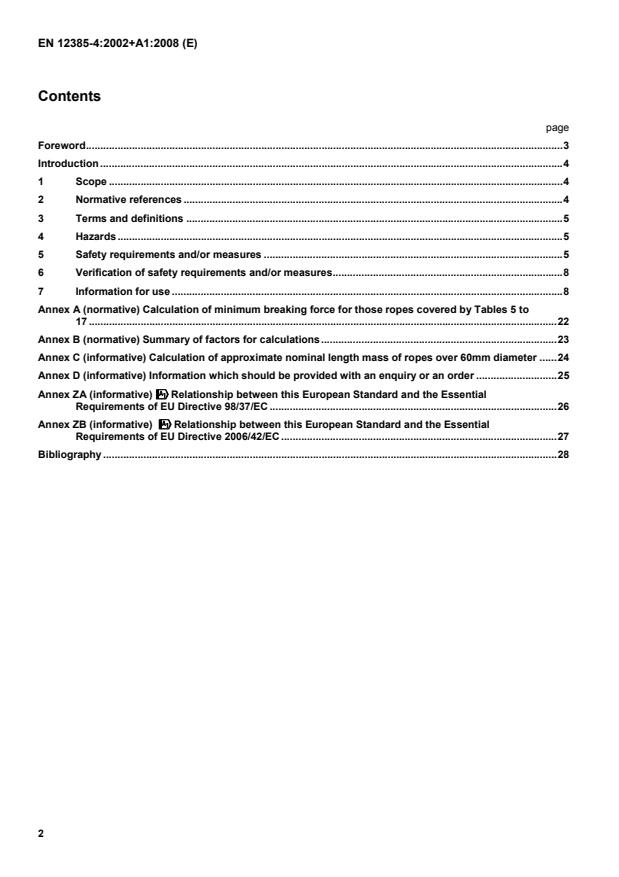
page Foreword.3 Introduction.4 1 Scope.4 2 Normative references.4 3 Terms and definitions.5 4 Hazards.5 5 Safety requirements and/or measures.5 6 Verification of safety requirements and/or measures.8 7 Information for use.8 Annex A (normative) Calculation of minimum breaking force for those ropes covered by Tables 5 to 17.22 Annex B (normative) Summary of factors for calculations.23 Annex C (informative) Calculation of approximate nominal length mass of ropes over 60mm diameter.24 Annex D (informative) Information which should be provided with an enquiry or an order.25 Annex ZA (informative) !!!!Relationship between this European Standard and the Essential Requirements of EU Directive 98/37/EC.26 Annex ZB (informative)
!!!!Relationship between this European Standard and the Essential Requirements of EU Directive 2006/42/EC.27 Bibliography.28
According to the CEN/CENELEC Internal Regulations, the national standards organizations of the following countries are bound to implement this European Standard: Austria, Belgium, Bulgaria, Cyprus, Czech Republic, Denmark, Estonia, Finland, France, Germany, Greece, Hungary, Iceland, Ireland, Italy, Latvia, Lithuania, Luxembourg, Malta, Netherlands, Norway, Poland, Portugal, Romania, Slovakia, Slovenia, Spain, Sweden, Switzerland and United Kingdom.
Introduction This Part of this European Standard has been prepared to be a harmonized standard to provide one means of complying with the essential safety requirements of the Machinery Directive. This Part of this European Standard is a type C standard as stated in EN 292. For the purposes of the Certificate referred to in clause 7, this Part assumes a working load limit based on a safety factor of 5. The safety factor and the required minimum breaking force of the rope for a given application is the responsibility of the manufacturer of the machine of which the rope forms a part. During the preparation of this standard, it was assumed that a negotiation would take place between the purchaser and the manufacturer concerning the intended purpose of the rope. Although tables of breaking forces and masses are provided for a number of the more common classes, diameters and rope grades, this Part of this standard is not limited to those given, providing all of the other requirements are met. Specifiers, purchasers and users should recognise that some ropes are specially designed by the manufacturer to meet particular lifting machinery requirements.
1 Scope This Part of this European Standard specifies the particular materials, manufacturing and testing requirements for ropes for general lifting applications. The particular hazards covered by this Part are identified in Clause 4.
This Part of this European Standard does not establish requirements for information for use other than those given in clause 7 of Part 1. Neither does it cover the requirements for ropes fitted with terminations. Minimum breaking force values for the more common classes, sizes and grades of rope are provided in tables 5 to 17. 2 Normative references This European Standard incorporates by dated or undated reference, provisions from other publications. These normative references are cited at the appropriate places in the text, and the publications are listed hereafter. For dated references, subsequent amendments to or revisions of any of these publications apply to this European Standard only when incorporated in it by amendment or revision. For undated references the latest edition of the publication referred to applies (including amendments). EN 10264-2, Steel wire and wire products – Steel wire for ropes – Part 2: Cold drawn non-alloyed steel wire for ropes for general applications.
EN 12385-1:2002, Steel wire ropes – Safety – Part 1: General requirements.
EN 12385-2:2002, Steel wire ropes – Safety – Part 2: Definitions, designation and classification.
ISO 4346, Steel wire ropes for general purposes – Lubricants – Basic requirements.
Table 1- Hazards and associated requirements Hazards identified in annex A of EN 1050:1996 Relevant clause of annex A of EN 292-2:1991/A1:1995 Relevant clause of this standard 27.4
27.6 Mechanical hazard from insufficient strength of parts
Mechanical hazard from inadequate selection of ropes and their inadequate integration into the machine
4.1.2.3
4.3.1 5 and 6
NOTE For the purposes of this Part of EN 12385, insufficient strength of parts means failure to achieve the minimum breaking force of the rope. 5 Safety requirements and/or measures 5.1 General In addition to the requirements given 5.2 to 5.5, the requirements shall also conform to those given in EN 12385-1.
5.2 Materials 5.2.1 Wire Wires, before ropemaking, shall conform to EN 10264-2.
For those ropes where a rope grade is applicable, e.g. Tables 5 to 16, the tensile strength grades of the wires shall be subject to the limits given in Table 2.
For those ropes where a rope grade is not applicable, e.g. large diameter ropes, the tensile strength grades of the wires shall be one or a combination of those given in EN 10264-2.
Table 2 — Wire tensile strength grades excluding centre and filler wires for given rope grades Rope Wire tensile strength grades N/mm2
Grade Minimum
Maximum
1770 1960 2160 1570 1770 1960 1960 2160 2160
a) fibre; b) steel, as an independent wire rope (IWRC) or wire strand (WSC); c) composite (e.g. steel and fibre or steel and solid polymer); d) cushion core; or e) solid polymer.
5.2.3 Lubricant The lubricant shall comply with ISO 4346.
5.3 Rope manufacture 5.3.1 Lubrication At least the strands shall be lubricated.
5.3.2 Construction The rope construction shall be either:
a) one of those covered by Tables 5 to 17; or b) another single layer or parallel-closed or rotation-resistant rope construction as specified by the manufacturer and covered by the respective classes in EN 12385-2.
5.3.3 Rope grade For rope sizes up to and including 60 mm diameter, the rope grade shall be 1770, 1960 or 2160 or an intermediate grade as specified by the manufacturer, but not exceeding 2160.
NOTE Ropes larger than 60mm diameter may not have a rope grade. 5.4 Diameter 5.4.1 Tolerances When measured in accordance with 6.3.1 of EN 12385-1:2002, the measured diameter shall not vary from the nominal diameter by more than the values given in Table 3. For ropes with diameters from 2 mm to 5 mm inclusive, the tolerance shall be rounded up to the nearest 0,05 mm.
Table 3 — Tolerances on rope diameter
Nominal rope diameter
mm Tolerance as percentage of nominal rope diameter From 2 to < 4 08+ From 4 to < 6 07+ From 6 to < 8 06+ 8 and greater 05+
5.4.2 Differences between diameter measurements The difference between any two of the four measurements taken in accordance with 6.3.1 of EN 12385-1:2002 and expressed as a percentage of the nominal rope diameter, shall not exceed the values given in Table 4.
Table 4 — Differences between diameter measurements
Difference between measurements as percentage of nominal rope diameter Nominal rope diameter
mm Rope with strands that are exclusively of wire or incorporate solid polymer Ropes with strands that incorporate
fibre centres From 2 to < 4 From 4 to < 6 From 6 to < 8 8 and greater 7 6 5 4 - 8 7 6
NOTE The values in the table apply irrespective of the type of core in the rope. 5.5 Breaking force The breaking force shall be specified only as minimum breaking force.
The values of minimum breaking force for the more common classes and grades of ropes shall be not less than those given in Tables 5 to 16. For intermediate rope diameters, the values shall be not less than those obtained using the formula in annex A with the factors given in annex B.
The values of minimum breaking force for large diameter ropes are given in Table 17. For intermediate rope diameters, the values shall be not less than those obtained using the formula in annex A.
NOTE
Refer to the definitions given in EN 12385-2 for derivation of the formula for calculation of minimum breaking force.
5.6 Designation and classification Rope designation and classification shall conform to EN 12385-2.
6.2 Lubricant Compliance with the lubricant requirements shall be through a visual verification of the inspection documents supplied with the lubricant. 6.3 Lubrication Compliance with the lubrication requirements shall be through a visual verification. 6.4 Construction Compliance with the construction requirements shall be through a visual verification. 6.5 Rope grade Compliance with the rope grade requirements shall be through a visual verification of the inspection documents supplied with the wire in relation to the minimum breaking force value of the rope. 7 Information for use In addition to conforming to clause 7 of Part 1, the Certificate (see 7.2.1 of Part 1) shall also include either an example of the maximum working load to which the rope shall be subjected in service at a given factor of safety or the working load limit when the intended use is known.
Table 5 — Class 6××××7
Construction cross section example Construction of rope Construction of strand Item Quantity Item Quantity Strands 6 Wires 5 to 9 outer strands 6 Outer wires 4 to 8 layers of strands 1 Layers of wires 1 Wires in rope 30 to 54
(excluding metallic core)
6x7-FC Typical example No. of outer wires Outer wire factor1)
Rope Strand Total per strand
6×7 1-6 36 6 0,106
Min. breaking force factor: K1 = 0,332 K2 = 0,359 K3 = 0,388
Nominal length mass factor1): W1 = 0,345 W2 = 0,384
Nominal metallic cross-sectional area factor1) C1 = 0,369 C2 = 0,432
Nominal rope diameter
Approximate nominal length mass1) kg/100 m Minimum breaking force
kN
Fibre core Steel core Rope grade 1770 Rope grade 1960 mm
Fibre core Steel core Fibre core Steel core 1 2 3 4 52) 6 72) 2
1,38
1,54
2,35
2,54
2,60
2,81 3
3,11
3,46
5,29
5,72
5,86
6,33 4
5,52
6,14
9,40
10,2
10,40
11,3 5
8,63
9,60
14,7
15,9
16,3
17,6 6
12,4
13,8
21,2
22,9
23,4
25,3 7
16,9
18,8
28,8
31,1
31,9
34,5 8
22,1
24,6
37,6
40,7
41,6
45,0 9
27,9
31,1
47,6
51,5
52,7
57,0 10
34,5
38,4
58,8
63,5
65,1
70,4 11
41,7
46,5
71,1
76,9
78,7
85,1 12
49,7
55,3
84,6
91,5
93,7
101 13
58,3
64,9
99,3
119 14
67,6
75,3 115
138 16
88,3
98,3 150
180 18 112 124 190
228 20 138 154 235
281 22 167 186 284
341 24 199 221 338
405 26 233 260 397
476 28 270 301 461
552 32 353 393 602
721 36 447 498 762
912 40 552 614 940 1 020 1 040 1 130 1) Informative only 2) For small diameter ropes (2 mm to 7 mm) with wire strand core (WSC), K3 may be used for the calculation of breaking forces. The values given in columns 5 and 7 are based on ropes with independent wire rope cores (IWRC).
Table 6 — Class 8x7
Construction cross section example Construction of rope Construction of strand Item Quantity Item Quantity Strands 8 Wires 5 to 9 outer strands 8 Outer wires 4 to 8 layers of strands 1 Layers of wires 1 Wires in rope 40 to 72
(excluding steel core)
8x7-FC Typical example No. of outer wires Outer wire factor1)
Rope Strand Total per strand
8×7 1-6 48 6 0,087
Min. breaking force factor K1 = 0,291 K2 = 0,359 K3
= 0,404
Nominal length mass factor1): W1 = 0,327 W2 = 0,391 W3 = 0,464
Nominal metallic cross-sectional area factor1) C1 = 0,335 C2 = 0,439 C3 = 0,379 Nominal rope diameter
Approximate nominal length mass1) kg/100 m Minimum breaking force
kN
Fibre core Steel core Rope grade 1770 Rope grade 1960 mm
Fibre core Steel core Fibre core Steel core 1 2 3 4 52) 6 72) 2
1,31
1,56
2,06
2,54
2,28
2,81 3
2,94
3,52
4,64
5,72
5,13
6,33 4
5,23
6,26
8,24
10,2
9,13
11,3 5
8,18
9,78
12,9
15,9
14,3
17,6 6
11,8
14,1
18,5
22,9
20,5
25,3 7
16,0
19,2
25,5
31,1
27,9
34,5 8
20,9
25,0
33,0
40,7
38,6
45,0 9
26,5
31,7
41,7
51,5
46,2
57,0 10
32,7
39,1
51,5
63,5
57,0
70,4 11
39,6
47,3
62,3
76,9
69,0
85,1 12
47,1
56,3
74,2
91,5
82,1
101 13
55,3
66,1
87,0
96,4
119 14
64,1
76,6 101
125 112
138 16
83,7 100 132
163 146
180 18 106 127 167
206 185
228 20 131 156 206
254 228
281 22 158 189 249
308 276
341 24 188 225 297
366 329
405 26 221 264 348
430 386
476 28 256 307 404
498 447
552 32 335 400 527
651 584
721 36 424 507 668
824 739
912 40 523 626 824 1 020 913 1 130 1) Informative only 2) For small diameter ropes (2 mm to 7 mm) with wire strand core (WSC), K3 may be used for the calculation of breaking forces. The values given in columns 5 and 7 are based on ropes with independent wire rope cores (IWRC).
Table 7 — Class: 6x19
Construction cross section examples Construction of rope Construction of strand Item Quantity Item Quantity Strands 6 Wires 15 to 26 outer strands 6 Outer wires 7 to 12 layers of strands 1 Layers of wires 2 to 3 Wires in rope 90 to 156
(excluding steel core)
6×19S-FC Typical example No. of outer wires Outer wire factor1) Rope Strand Total per strand
6×19S 1-9-9 54 9 0,080 6×25F 1-6-6F-12 72 12 0,064 6×19W 1-6-6+6 72 12 6 0,073
6×26WS
1-5-5+5-10
60 6 10 0,055 0,074
Min. breaking force factor: K1 = 0,330 K2 = 0,356
6×25F-FC Nominal length mass factor1) W1 = 0,359 W2 = 0,400
Nominal metallic cross-sectional area factor1):
C1 = 0,384 C2 = 0,449
Approximate nominal length mass1) Minimum breaking force kN kg/100 m Rope Grade Nominal rope diameter mm
1770 1960 2160
Fibre core Steel core Fibre core Steel core Fibre core Steel core Steel core 1 2 3 4 5 6 7 8 6
12,9
14,4
21,0
22,7
23,3
25,1
27,7 7
17,6
19,6
28,6
30,9
31,7
34,2
37,7 8
23,0
25,6
37,4
40,3
41,4
44,7
49,2 9
29,1
32,4
47,3
51,0
52,4
56,5
62,3 10
35,9
40,0
58,4
63,0
64,7
69,8
76,9 11
43,3
48,4
70,7
76,2
78,3
84,4
93,0 12
51,7
57,6
84,1
90,7
93,1
111 13
60,7
67,6
98,7
130 14
70,4
78,4
151 16
91,9
197 18
249 20
308 22
372 24
443 26
...
Questions, Comments and Discussion
Ask us and Technical Secretary will try to provide an answer. You can facilitate discussion about the standard in here.
Loading comments...